



Abstract
Policy regarding the inclusion of transgender soldiers in the U.S. Military has shifted back and forth in recent years, with public opinion likely a significant factor shaping the eventual policy outcome. As such, this study examines the factors that shape public attitudes toward military service by transgender people. In particular, we examine the influence of sex, social gender roles, and attitudes toward gender in shaping transgender military service attitudes. Further, we hypothesize that personal experiences with the military and with transgender people, along with values, personality predispositions, and religion, are likely to influence individual attitudes. We test these hypotheses using data from a unique October 2015 national survey of American adults. The results suggest that personal experiences, attitudes toward gender roles, and religion have substantial but sometimes conditional effects on attitudes toward military service by transgender people.
For more than 25 years, the United States has experienced political and cultural upheaval at the intersection of lesbian, gay, bisexual, transgender, and queer/questioning (LGBTQ) populations, gender, and military issues. From 1993 to 2011, the Don’t Ask, Don’t Tell (DADT) policy barred openly gay, lesbian, or bisexual individuals from serving in the military, but it was silent on whether transgender people could serve. They were, however, excluded by military medical standards and other regulations. During this same period, the visibility of transgender issues increased along with that of the broader LGBTQ community. Indeed, when President Obama repealed DADT in 2011, transgender rights had already become an important component of the LGBTQ rights movement (Taylor & Lewis, 2014). Yet the repeal of DADT did not actually allow transgender people to serve in the military. In 2014, Defense Secretary Chuck Hagel asserted that the military should review its prohibition on transgender people. Just 2 years later, Defense Secretary Ash Carter announced that “transgender Americans” could serve openly (Bromwich, 2017), which coincided with the decision to allow women to serve in military combat units. The decision on transgender service followed the example of Canada, which lifted its ban in 1992 and adopted explicitly inclusive policies in 2010 and 2012 with no loss in operational effectiveness (Okros & Scott, 2015). 1
More recently, the Trump administration reinstituted a near total ban on transgender people serving in the military. Transgender people were barred from service if they had transitioned, were transitioning, or otherwise engaged in activities that allowed them to lead their lives according to their gender identity (Sonne & Marimow, 2019). The stated rationale for a ban was “‘tremendous medical costs and disruption’ of allowing such troops to serve” ( The Economist, 2017). The Palm Center, an independent institute focusing on LGBTQ issues in the military, contends the ban echoes DADT in that “transgender troops will be forced to leave the military or to serve in silence” (Palm Center, 2018, p. 1). In less than 4 years, openly transgender military personnel went from being banned from service, to being allowed to openly serve, and back to being banned once again (Taylor, Lewis, & Haider-Markel, 2018).
These policy shifts are not just political fodder. Estimates derived from the National Transgender Discrimination Survey (NTDS), one of the largest surveys of Americans who identify as transgender or gender nonconforming, 2 show that these policies affect a substantial number of military service members: “[a]pproximately 15,500 transgender individuals are serving on active duty or in the Guard or Reserve forces…and there are another 134,300 transgender individuals who are veterans or are retired from Guard or Reserve service” (Gates & Herman, 2014, p. 1). In fact, transgender Americans are twice as likely to have served in the military as the general population (Gates & Herman, 2014). While it seems paradoxical that transgender people serve at such high rates, gender-dysphoric individuals born male may experience a phase of hypermasculinity during their teenage and young adult years as an attempt to purge their cross-gender identifications. This phase, where male-born individuals pursue stereotypically masculine activities, may in part drive the prevalence of military service among this population (Brown, 1988; McDuffie & Brown, 2010). Indeed, the NTDS revealed that 20% of transgender and gender nonconforming respondents served in the military at some point in their life and many others wanted to serve, but they could not due to the ban. One respondent stated that he “scored high enough to go into the military and die for our country as a ranking officer—but [he] was denied because of [his] genitals not matching what [his] gender marker was on [his] license” (Harrison-Quintana &Herman, 2012–2013, p. 8). Among those who are allowed to serve, transgender soldiers often endure a sense of alienation and find barriers in pronoun usage, dress and grooming standards, and pressure to exceed performance standards (Parco, Levy, & Spears, 2015).
As a salient political issue, policies toward transgender people in the military service are likely significantly shaped by public opinion (e.g., Soroka & Wlezien, 2010), but it is not clear from existing research how individuals form attitudes on this relatively new issue. Consistent with social role theory (e.g., Schneider & Bos, 2019), we contend that attitudes toward societal gender roles and identity, along with personal experiences related to gender roles, significantly shape individual attitudes on transgender people serving in the military. This issue likely echoes prior experiences with policies related to a more inclusive military—be it the inclusion of gays and lesbians, women in combat roles, or even racial integration—that have drawn opposition based on the idea that inclusive combat units disrupt military readiness, which for the case of gays, lesbians, and women centers on how they are not cisgender heterosexual males and disrupt traditional ideals of the masculine order. Since trans-inclusive policies violate the traditional parity between sex and gender roles, it is likely that perception of one’s own sex-to-gender role conformity and beliefs about social roles shape attitudes toward these policies. In addition, as an evolving issue, we expect that personal experiences related to gender—including contact with transgender people and personal experience with traditionally sex-segregated spaces, especially the military itself—should shape individual attitudes and preferences. Analyzing a 2015 national survey, we find that gender-related attitudes and personal experiences are, indeed, significant factors affecting attitudes toward military service by transgender individuals.
Public Opinion on Military Service and LGBTQ People
Relatively little empirical research has examined attitudes toward transgender people serving in the military, but there is some work on attitudes toward lesbian, gay, and bisexual (LGB) soldiers. Public support for LGB soldiers serving openly in the military began gradually increasing in the 1970s and 1980s, with a sharper increase starting in the 1990s (Flores, 2014; Garretson, 2017). In the mid-1990s, opinions split nearly evenly on the issue, but by the early 2010s, substantial majorities (60% or more) favored LGB military service. However, work comparing public attitudes toward gay rights to attitudes toward transgender rights finds that the factors that shape these sets of attitudes differ in important ways (Lewis et al., 2017). As such, increasing public support for LGB soldiers may not necessarily extend to transgender soldiers.
Unfortunately, polling about military service by transgender people has been sparse. In one of the few studies on this topic, Ender, Rohall, & Matthews (2016) compared the attitudes of civilian undergraduates, Reserve Officers’ Training Corp cadets, and military academy cadets. They found that civilian students were least supportive of a ban on openly transgender people serving in the military (16.6%), while academy cadets were most accepting of a ban (45.8%). Further, they found that men and ideologically conservative respondents were more supportive of a ban. Although the study relied on a limited sample, these predictive factors may extend to the general public, where military veterans, men, and ideological conservatives are more likely to support such a ban.
Indeed, the difference in attitudes between civilians and cadets mirrors the civil–military divide on political attitudes such as racial resentment, gay rights, and presidential candidates. Much of these gaps have been attributed to self-selection, where those who volunteer for military service tend to have significantly different political identities, personality traits, demographics, and even genetics relative to civilians (e.g., Kellermann, 2014; Miles & Haider-Markel, 2018; Nteta & Tarsi, 2016), but socialization into the military may also play a factor (Bachman, Sigelman, & Diamond, 1987; Jackson et al., 2012). Military service entails powerful socialization mechanisms through boot camps and institutionalization at an age when people are still forming their political and social identities, as well as personality traits (Jackson et al., 2012; Jenning & Markus, 1977). Critically, for the issue of transgender military service, this socialization into a hierarchical structure emphasizing authoritarian values and traditions of sex-segregated spaces and roles may result in lower support for policies that defy a binary conception of gender, sex segregation, and traditional gender roles. As such, we expected veterans of the military to be less likely to support transgender military service (Hypothesis 1).
Public Opinion Toward Transgender People
Given the limited number of studies and limited applicability of some LGB-focused research for public attitudes toward transgender people in the military, we also look to the literature on general attitudes toward transgender rights. This body of research has identified many factors that shape opinions about transgender people and a variety of related policies (e.g., nondiscrimination laws and hate crimes policies) that should extend to transgender military service. The first study on U.S. attitudes toward transgender people using a nationally representative sample showed that negative attitudes were associated with authoritarianism, ideological conservatism, anti-egalitarianism, and support of a binary conception of gender (Norton & Herek, 2013). Other studies revealed negative correlations with traits such as disgust sensitivity and moral traditionalism, extending to attitudes toward transgender people, candidates, and related policies (Flores et al., 2018a; Jones et al., 2018; Miller et al., 2017; Taylor et al., 2018a).
Demographic characteristics, including education, race, sexual orientation, partisanship, ideology, and age, were also associated with attitudes toward transgender people (Castle, 2018; Jones et al., 2018; Lewis et al., 2017; Norton & Herek, 2013; Tadlock et al., 2017). Generally, higher levels of educational attainment, racially identifying as White, Democratic partisanship, liberal ideological self-placement, and LGBTQ identification are each positively associated with pro-transgender positions. Conversely, age is negatively associated with these same positions. Religion, particularly religiosity as measured by the frequency of religious service attendance, is also a significant negative factor, though it may be a weaker factor compared to its role in shaping attitudes toward LGB people (Castle, 2018; Lewis et al., 2017; Tadlock et al., 2017).
Another significant factor is interpersonal contact. In general, people view out-groups more favorably when they personally know someone from those groups (e.g., Allport, 1954). This effect may extend to contact with transgender people (Tadlock et al., 2017). Further, Flores (2015) found that contact with gays and lesbians induces a secondary contact effect on attitudes toward transgender rights (see also Lewis et al., 2017; Tadlock et al., 2017). Experimental work revealed that even “mere exposure” to images of transgender people can mitigate transphobia and prejudice in ways similar to parasocial contact (Flores et al., 2018a, 2018b).
Sex, Gender Identification, and Gender Roles
Perhaps not surprisingly, many studies show that sex, gender, and attitudes toward gender roles are important in shaping opinions toward transgender people and issues. A “gender gap” is common in many issues in the United States (e.g., Clark, 2017), likely because expressly gendered policies, including in areas that encompass historically sex-segregated institutions like the military, can affect men and women differently (Sapiro, 2003). Beyond clearly gendered policies, sex also serves as a cognitive cue to help form opinions and political attachments (Miller & Conover, 2015; Winter, 2005). Nearly all studies found that women have more favorable attitudes than men about transgender people and their rights (e.g., Harrison & Michelson, 2018; Lewis et al., 2017). In addition, masculinity and femininity often serve as a foundation for policies that involve the use of force (Haider-Markel & Vieux, 2008), and women have been less supportive of military spending than men (Leal, 2005). As such, we expected that women are more likely to support transgender military service (Hypothesis 2).
The underpinnings of an observed “gender gap” on attitudes toward transgender people in the military may be explained by social role theory. This theory asserts that gender stereotypes and expectations stem from traditional societal gender roles developed historically and based on biological differences. People are socialized into these roles from a young age and these roles subsequently shape their attitudes (Schneider & Bos, 2019). Those with more traditional attitudes about the roles of men and women in society are likely to oppose policies that violate gender expectations (Tesler & Sears, 2010; Young & Nauta, 2013). Thus, when an individual considers a historically sex-segregated and gendered environment like the military, gender roles and identities should play prominent roles in opinions on transgender military service. Research on women serving in combat roles is consistent with these arguments. Indeed, opposition to women serving in combat roles was stronger among those who supported traditional gender roles (Iskra, 2007; Matthews et al., 2009; Young & Nauta, 2013). And as with attitudes toward LGB military service, men, conservatives, and more religious respondents were more likely to oppose women serving combat roles (Matthews et al., 2009; Segal, Kinzer, & Woelfel, 1977; Young & Nauta, 2013). Following this research, we expected people with more traditional views about gender roles to be less likely to support transgender military service (Hypothesis 3). Similarly, relatively more religious people should be less likely to support transgender military service (Hypothesis 4).
It is important to note that surveys often do not address gender in ways that are more complex than simply denoting one’s sex as a biologically based, binary variable (Sapiro, 2003). Yet gender is a separate but related construct that may not align with biological sex: “masculinity and femininity correspond only fleetingly and roughly to ‘male’ and ‘female’” (Beckwith, 2005, p. 131). The gender gap in political attitudes, for example, tends to diminish once gender identity is taken into account (Hatemi, McDermott, Bailey, & Martin, 2012). Bittner and Goodyear-Grant (2017) found that binary sex categories are appropriate for about three quarters of Americans, but for one out of every four adults, binary categories do a poor job capturing a person’s gender identity. Gender identification can be viewed as a social identity, and people may categorize themselves as more or less conforming to their sex as assigned at birth. As a fundamental categorical schema for many people, “the self-categorization approach captures a more direct self-labeling of gender identity” (Wood & Eagly, 2015, p. 464). This perspective incorporates social identity theory as it relates to social groups and prejudice (Tajfel, 1981). Those who have a strong sense of gender identity conformance—adhering to traditional gender roles—might be antagonistic toward transgender people who violate gender expectations and view them as an out-group. In this study, we expected people with more congruent gender identities to be less likely to support transgender military service (Hypothesis 5).
Further, sex, gender, and views on gender roles may condition the effects of other factors. For example, Nagoshi et al. (2008) found transphobia to be correlated with homophobia, authoritarianism, and religious fundamentalism. However, when homophobia was controlled for, authoritarianism and fundamentalism predicted transphobia only for women, but not for men. In this policy area, we expect the “gender gap” to shrink for people who hold less traditional gender role views. For these people, gender is likely a less important identity construct, leading both men and women with less traditional gender role views to hold relatively similar attitudes toward transgender military service. In other words, we expected the effect of sex to be smaller for people with less traditional views about societal gender roles (Hypothesis 6). Likewise, this conditional effect may extend to other characteristics that reflect traditional values such as religiosity. Since adherence to traditional gender roles is prominent in many religions, the effect of sex should be larger for relatively more religious people (Hypothesis 7). There may also be a conditional effect of sex across gender identities, where those with more sex-gender congruent identities have larger differences between the sexes (Hypothesis 8). Indeed, research on sex-segregation policies in athletics found that the effects of sex were contingent on gender identity, attitudes toward gender roles, and sports fandom (Taylor et al., 2018b). More traditional gender identities and attitudes toward gender roles increased the gap between the sexes, but stronger sports fandom decreased this difference. With the traditional culture and tradition of sex segregation in the military, we expect similar sex-interactive effects on attitudes toward transgender military service.
Data and Methods
To test the hypotheses enumerated in the previous section, while also accounting for the effects of psychological traits, interpersonal contact with LGBT people, demographics, and political orientations, we analyzed a nationally representative survey of 1,020 American adults fielded by the large research firm GfK, via their KnowledgePanel, on October 9–11, 2015. The survey was fielded prior to the repeal of the ban on transgender service members. The survey was administered online to a nationally representative panel constructed using address-based probability sampling to overcome coverage bias issues common in landline telephone–based polling (e.g., the rise of cell phone–only households). To further reduce sampling bias, selected respondents in non-Internet households were provided a computer and online access. This sample differs from nonprobability online surveys since respondents do not opt in to the panel, reducing demographic and political biases common in opt-in surveys (Yeager et al., 2011). Thus, this sampling methodology provides a representative national sample with better coverage than surveys that rely on traditional approaches (Dennis, 2010). 3 Further, all the analyses used GfK’s proprietary weights compensating for demographic nonresponse and probabilities of selection. 4 Missing data values were estimated via multiple imputation rather than allowing for list-wise deletion, which systematically biases data analyses (King et al., 2001).
The dependent variable for the analyses gauged support for allowing transgender people to serve openly in the military. The survey included batteries of items asking respondents whether they strongly agreed, agreed, neither agreed nor disagreed, disagreed, or strongly disagreed with a set of statements, two of which addressed military service. The first statement had a positive valence, “Allowing transgender people to serve openly in the military.” As Figure 1 shows, 25% of respondents disagreed or strongly disagreed with this statement, 39% agreed or strongly agreed, and 36% reported neither agreeing nor disagreeing. The second statement had a negative valence, “Transgender people should not be allowed to serve openly in the military.” Forty-two percent disagreed or strongly disagreed with this statement, 22% agreed or strongly agreed, and 36% reported neither agreeing nor disagreeing. The 2 items were strongly correlated (r = −.78), and a clear plurality supported allowing transgender people to serve in the military, though more than a third of the sample reported no clear opinion. Responses were recoded such that higher scores indicated support for allowing transgender people to serve in the military. This allowed the items to be combined into a single variable. For the analyses, we used a respondent’s mean response on these 2 items as the dependent variable. 5 Scores ranged from 1 to 5, with a mean of 3.2 (standard deviation [SD] = 1.1). 6
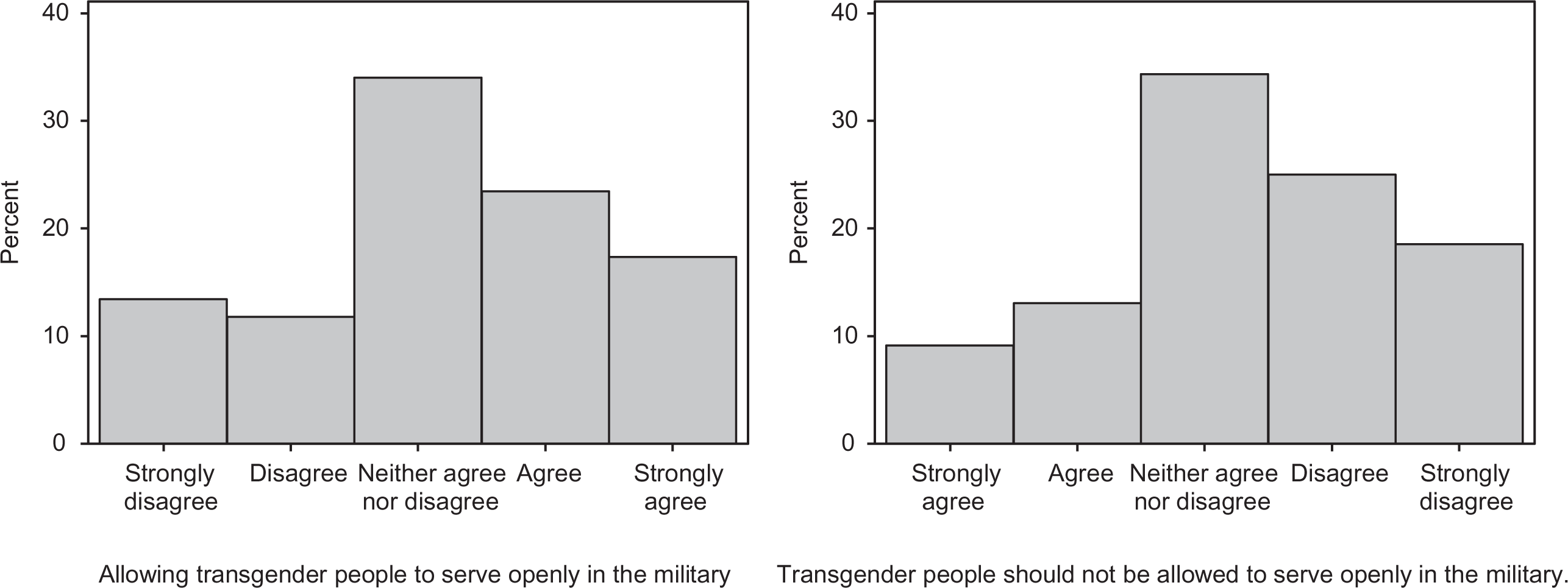
Attitudes toward transgender military service, October 2015.
We modeled support for allowing transgender people to serve in the military as a function of a number of independent variables measuring factors identified in the literature review, including demographics, psychological traits, political attitudes, and personal experience. 7 Sex was assessed with a traditional, dichotomous indicator of female versus male respondents (Hypothesis 2). Beyond this key demographic factor, the models also account for educational attainment, race (non-White/White), LGBT identification, and age (on the logarithmic scale).
The models included two gender constructs. First, gender identity congruence (Hypothesis 5) was measured with items from the Adult Gender Identity Scale that gauge respondents’ perception of their own masculinity or femininity (Hatemi et al., 2012). Depending on their reported sex, respondents were asked whether they agreed (0) or disagreed (1) with the following statements:
Women
In many ways, I feel more similar to men than women.
I feel like part of me is female and part of me is male.
I often think that I would rather be a man.
People think that I should act more feminine than I do.
Men
In many ways, I feel more similar to women than men.
I feel like part of me is male and part of me is female.
I often think that I would rather be a woman.
I don’t feel very masculine.
An additive scale of these items was created, with higher scores indicating gender identities that are more congruent with a person’s sex as assigned at birth. 8 The mean score was 3.6 (SD = 0.8), with 77% of the sample reporting the highest level of gender identity congruence (4). Another 13% of the sample had a score of 3. This high degree of sex-gender identity congruence is not surprising given the relatively low population of people who identify as transgender in the United States (Flores, Herman, Gates, & Brown, 2016). Still, nearly 10% of the sample reported some sex-gender identity noncongruence (i.e., scored less than 3).
Second, we measured attitudes toward gender roles with a Gender Traditionalism Scale (Hypothesis 3) derived from 4 items in Kerr and Holden’s (1996) Gender Role Belief Scale:
The initiative in courtship should usually come from the man.
There are some professions and types of businesses that are more suitable for men than women.
It bothers me more to see a woman who is pushy than a man who is pushy.
It is disrespectful for a man to swear in the presence of a lady.
The items used a 7-point Likert-type response, with higher scores indicating more traditional gender roles. Responses were added together in an index with a possible range of 0–24. 9 The index had a modal score of 12, a mean of 12.5 (SD = 4.9), and a relatively normal distribution.
Key experiential factors in the model include interpersonal contact and prior military service. Interpersonal contact was accounted for with two indicators of whether respondents know a family member, a close friend, or an acquaintance who is gay/lesbian or transgender; 72% of the sample reported knowing a gay man or lesbian, but just 14.6% reported knowing a transgender person. The effect of military service was assessed with a binary indicator of whether a respondent is a military veteran (Hypothesis 1), accounting for 13.5% of the sample.
The models also included psychological traits. Authoritarianism was measured with an additive scale of 4 items taken from the American National Election Studies (ANES; DeBell et al., 2011). 10 Ranging from 0 to 4, higher values indicated greater authoritarianism. Disgust sensitivity was controlled for via an additive scale of 4 items based on the concept of contamination disgust (Haidt, McCauley, & Rozin, 1994). This scale ranges from 0 to 12, with higher values indicating more disgust sensitivity. 11 Moral traditionalism 12 and egalitarianism 13 were each assessed with an indice derived from the ANES. After recoding items to ensure uniformity of direction, both scales have possible ranges between 0 and 16, with higher scores representing greater levels of the construct.
Several other relevant factors were accounted for in the analyses. Religiosity is gauged with a 6-point scale of religious service attendance (Hypothesis 4), ranging from more than once a week to never. 14 Conservative religious adherence was measured by self-identification as a born-again or evangelical Christian. Lastly, the models included 7-point scales of ideology and partisanship. Higher scores on the ideology measure indicate greater conservatism, while a higher score on the partisanship shows greater adherence to the Republican Party.
From this base specification, we also estimated models to assess interactions with sex, including interactions with gender role traditionalism (Hypothesis 6), religiosity (Hypothesis 7), and gender identity congruence (Hypothesis 8). This allowed us to test whether the effect of sex is conditioned by these factors. In addition, to more broadly explore possible conditional effects of the factors by sex, we split the model by sex and estimated two seemingly unrelated regressions (SUR), which enabled us to conduct statistical tests of differences in coefficients for all the independent variables by sex.
Results
The results from ordinary least squares regressions of support for military service by transgender people are presented in Table 1. Model 1 provided support for both Hypotheses 1 and 2. Veterans, on average, were less supportive of transgender people serving in the military by about 10% of an SD. Although this effect is not large, its significance across all models is striking given the number of demographic and psychological variables in the models. Women, meanwhile, were more supportive by a similar magnitude. However, Models 2–4 suggested that the effect of sex was conditioned by gender role orientations and attitudes.
Support for Allowing Transgender People to Serve in the Military.

Note. N = 1,020; data from GfK survey was administered on October 9–11, 2015. LGBT = lesbian, gay, bisexual, transgender.
† p < .1. *p < .05. **p < .01. ***p < .001 (directional tests where appropriate).
Contrary to Hypothesis 5, gender identity congruence seems to have no effect, but attitudes toward gender roles significantly shaped opinions about transgender soldiers as predicted by Hypothesis 3. An SD shift (about 5 points) toward more traditional views about gender roles decreases support by about 0.2 points. Compared to those with the most nontraditional views about gender roles, people with the most traditional gender views (24) had a mean support level about 1 point lower, on average. Disgust sensitivity also had a statistically significant effect. The most sensitive respondents reported roughly 0.4 points lower support, on average, than the least sensitive. The largest effect in the model, according to standardized coefficients, was moral traditionalism. An SD increase in moral traditionalism (3.6) was associated with a 0.3-point decrease in support. A shift from the minimum to the maximum moral traditionalism score reduced support by 1.4 points. Egalitarianism, not surprisingly, was significantly associated with support for transgender people’s military service. The most egalitarian respondents were nearly 1 point more supportive than those with the least egalitarian views.
Several other variables also had significant effects. Both interpersonal contact coefficients were statistically significant and positive. Yet knowing a transgender person had nearly twice as large an effect as knowing a gay or lesbian person. Although religious service attendance was statistically significant (Hypothesis 4), born-again or evangelical adherents reported significantly lower levels of support for transgender military service by about 0.3 points on average. Age was also a significant factor, with older respondents reporting less supportive attitudes. Compared to an 18-year-old respondent, a 65-year-old respondent was about 0.2 points less supportive, on average. Last, partisanship showed a marginally significant effect. A strong Republican was 0.15 points less supportive on average compared to a strong Democrat.
Interaction Effects
The next three models in Table 1 include interactions with the binary sex variable. Although these specifications reveal conditional effects of sex, the results of the other factors remained largely the same, with a consistent model fit of about 0.465. First, Model 2 tested a conditional effect of sex based on respondents’ gender identity congruence. Although the coefficient on the interaction was not statistically significant, an interactive effect consistent with Hypothesis 8 is evident from the marginal effects presented in Figure 2. For respondents with relatively incongruent gender identities (<3), about 10% of the sample, sex was not a significant factor. However, for those respondents with more congruent gender identities, women were significantly more supportive than men by about a tenth of a point on average.
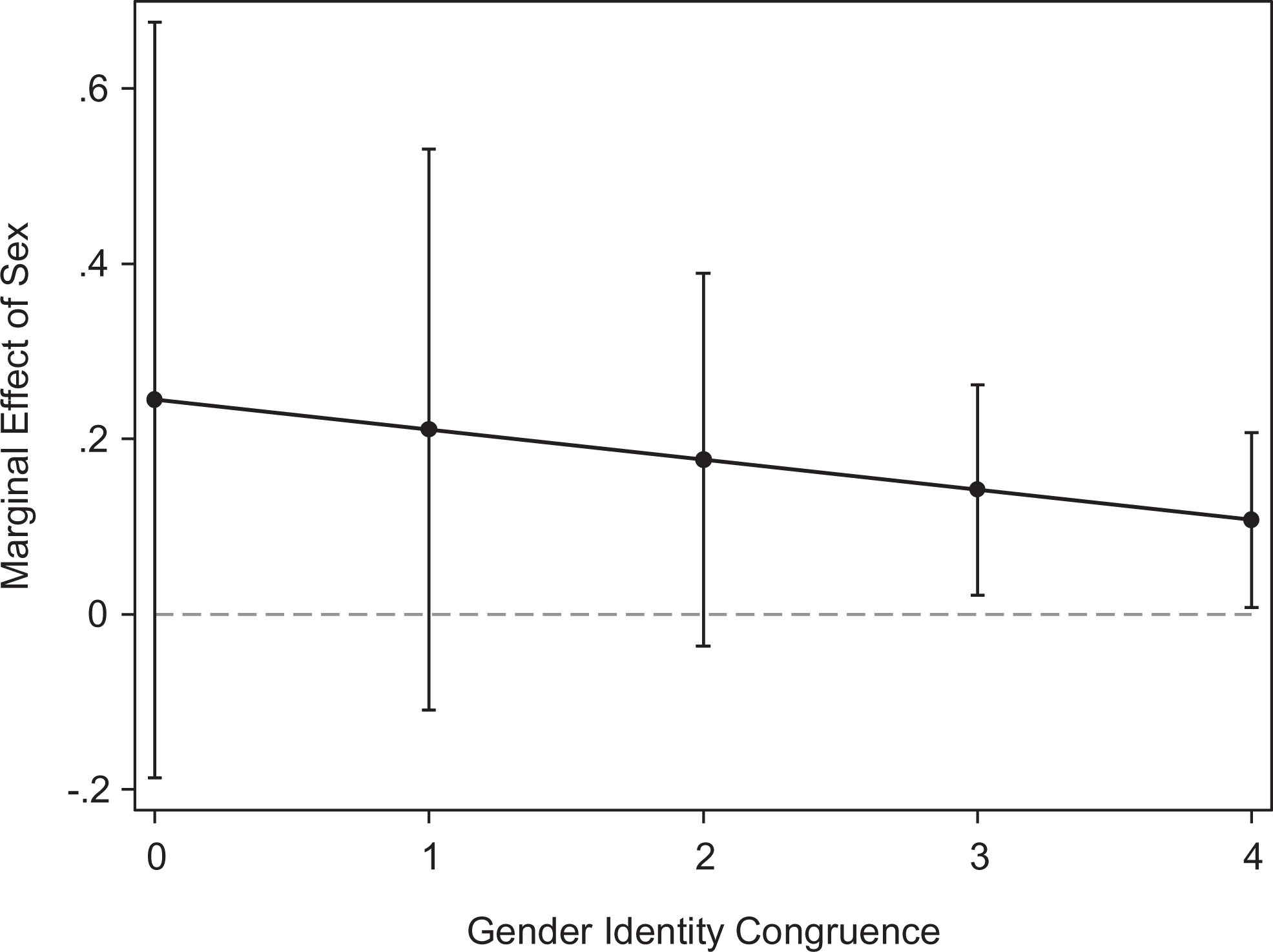
Marginal effect of sex across values of gender identity congruence. Range bars represent 90% confidence intervals.
Next, Model 3 tested the interaction between sex and gender traditionalism. Again, plotting the marginal effects in Figure 3 revealed significant variation in the effect of sex across the values of gender traditionalism (Hypothesis 6). For respondents with the most nontraditional views about gender roles, there was no significant difference between the sexes in attitudes toward military service by transgender people. Yet, for respondents with more traditional views, the difference between men and women increased, reaching marginal levels of statistical significance (p < .10). Women who held more traditional gender role attitudes were relatively more supportive of military service by transgender people than men with those same views. This difference became marginally significant at around 8 on the gender role scale, and the gap increased from about 0.1 to 0.17 points for those with the most traditional gender views.
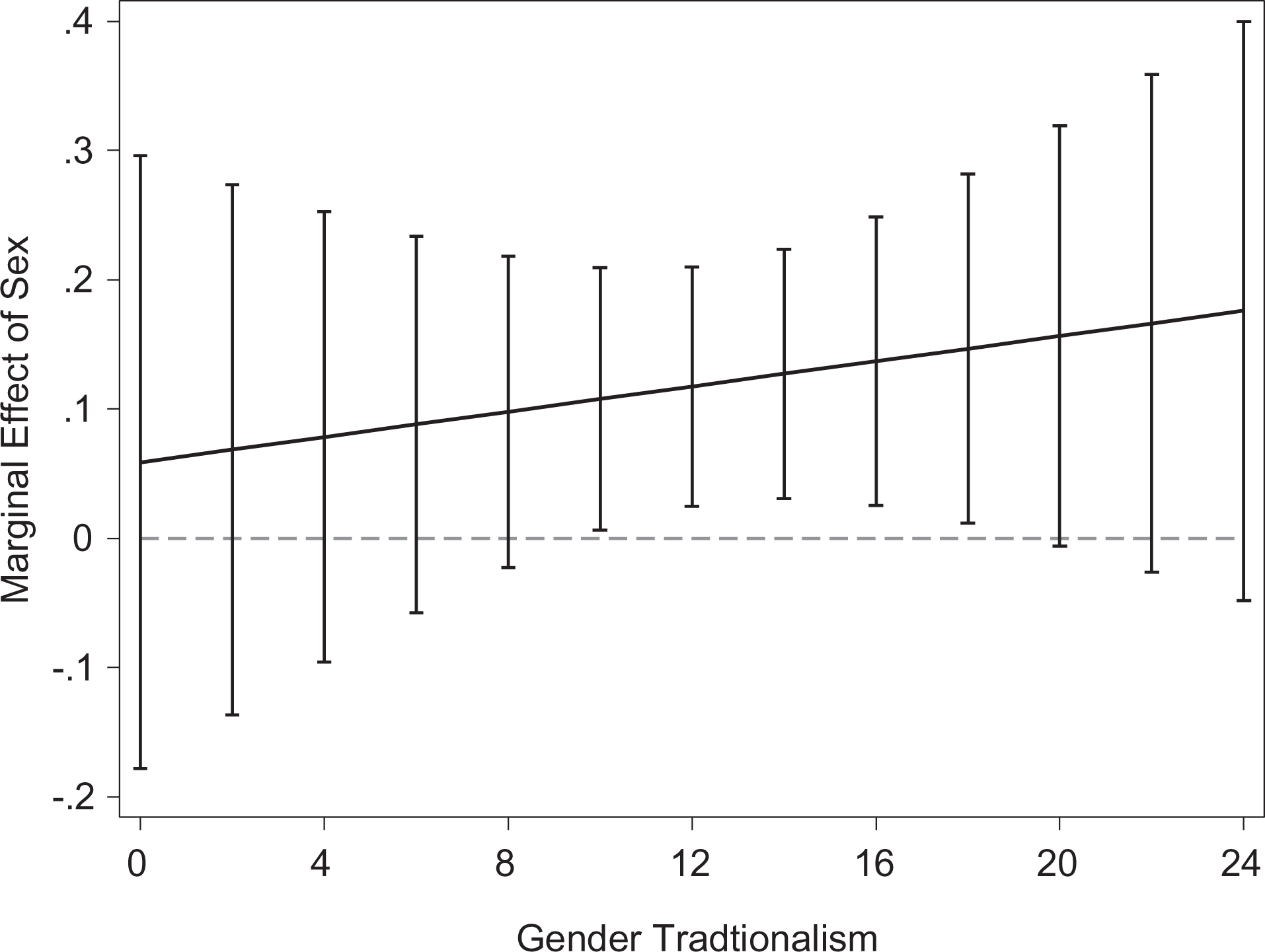
Marginal effect of sex across values of gender traditionalism. Range bars represent 90% confidence intervals.
Last, as seen in Figure 4, the interaction between sex and religiosity in Model 4 also revealed a conditional effect of sex. In this model, the coefficient for the sex variable was positive and statistically significant. For respondents who attend religious services more than once a week, there was a large (nearly 0.2 points) and statistically significant difference between men and women, with women significantly more supportive of military service by transgender people than men. Consistent with Hypothesis 7, the gender gap, however, decreased as respondents attend church less often and disappeared entirely for those that never attend religious services.
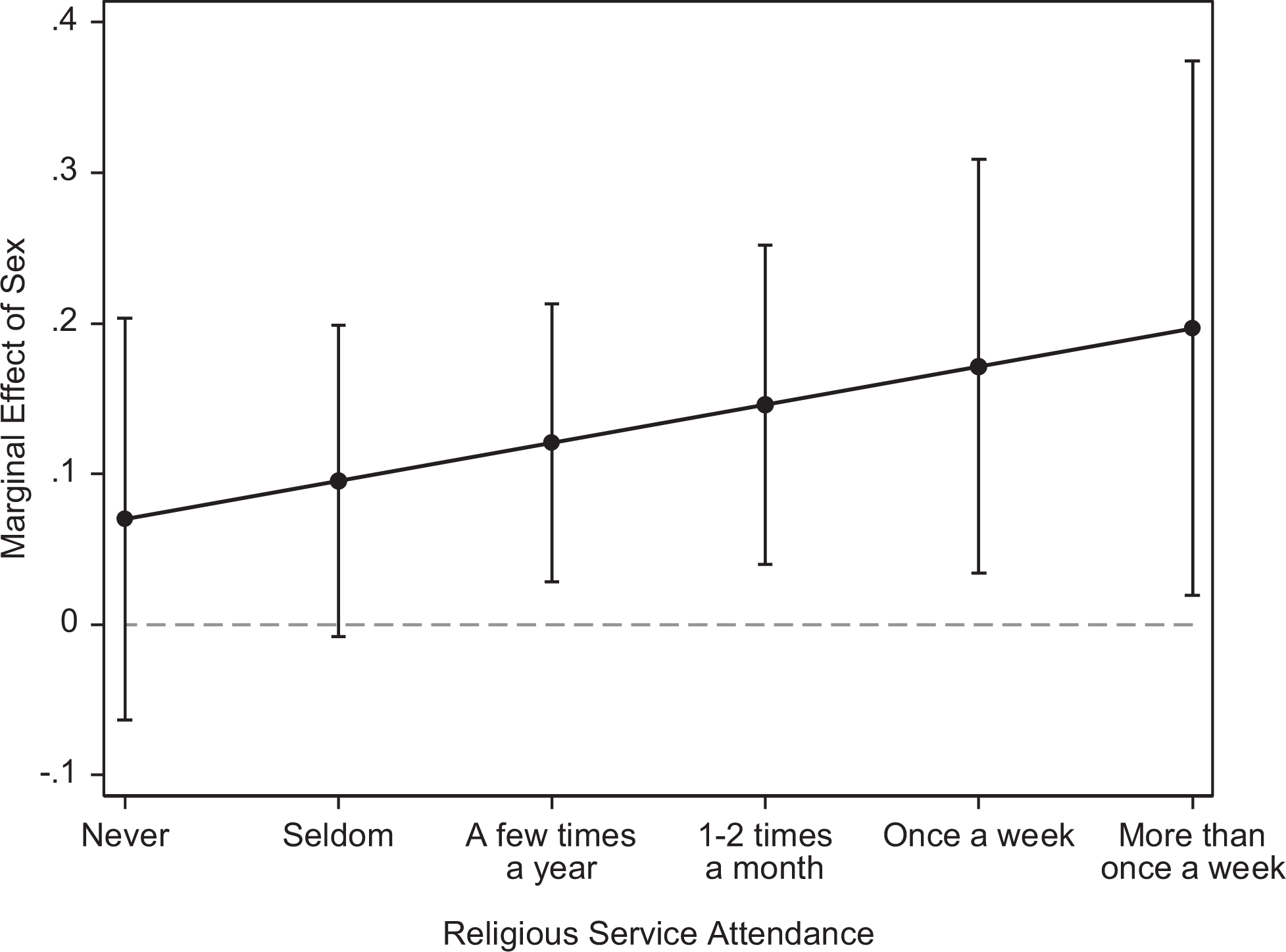
Marginal effect of sex across values of religiosity. Range bars represent 90% confidence intervals. Religiosity scale reversed from model
The results from Models 2 to 4 suggest that the base model oversimplified the effect of sex on attitudes toward military service by transgender individuals. Among respondents with more gender-congruent identities, traditional views on gender roles, and higher religiosity, sex was a significant factor in shaping attitudes. Yet it was not a significant factor for those who had less congruent gender identities, less traditional views about gender roles, and were less religious.
Interestingly, while the models presented in Table 1 showed a conditional effect of sex, the reverse interactive effect was not apparent. The effects of gender identity congruence, gender traditionalism, or religiosity did not vary between men and women. To more fully assess whether the factors vary by sex, we estimated an SUR model split by sex to allow for statistical tests of the equality of coefficients across equations (reported in the Online Appendix). For most variables, the effects on attitudes toward military service by transgender people were the same for men and women. Indeed, only LGBT identification had a statistically significant difference according to χ 2 tests. Yet a few other factors displayed differences worth mentioning. First, veteran status did not have a significant effect for men, but female veterans reported less support for military service by transgender individuals than their civilian counterparts. However, this result was based on just 18 female veterans in the sample, so we are cautious about this possible effect. Next, the disgust sensitivity coefficient for men was twice the size of the coefficient for women. Also, respondent LGB interpersonal contact was not a significant factor for men, but was for women. Similarly, respondent LGBT identity and age were significant factors shaping women’s attitudes, but not for men. In all, the “gender gap” in support for military service by transgender people may derive from the differences in the effects of just a handful of factors.
Conclusion
The ongoing legal and political struggles over transgender people in the military underscore the importance of public perceptions on this issue. As Mucciaroni (2017) notes, transgender inclusion would transform “the institutions because they are no longer bastions of…privilege based upon fixed gender assignment” (p. 541). As with DADT, “opponents of LGBTQ rights fought so hard to exclude queers from the military and marriage is precisely because they used these widely cherished institutions to enforce heteronormativity and stigmatize those who refuse to conform to it” (Mucciaroni, 2017, p. 541). Indeed, we showed that respondents with a stake in protecting the status quo in the military and society—men, veterans, religious conservatives, and traditionalists—were all more likely to oppose this transgender-inclusive policy.
Yet we also found the effect of sex to be dependent on gender identity congruence, traditional gender norms, and religiosity. Among those with the most conservative and traditional perspectives, men and women reported significantly different attitudes, but these differences declined for more respondents with less traditional gender role orientations. These nuanced effects are particularly striking when placed in the current political context of large gender gaps on many political issues and shifting attitudes about gender roles in society and the armed forces (e.g., Burns & Gallagher, 2010; Carroll & Fox, 2018). This is consistent with Hatemi, McDermott, Bailey, and Martin (2012), who contend that the effects of gender identity are magnified in contexts of social and political hierarchy related to sex. In this case, it appeared that attitudes toward military service by transgender people were significantly shaped by gender roles and identities, conditioning traditional political factors that often shape public opinion. Disentangling these factors “adds theoretical coherence, normative value, and possibly predictive power to the analyses of political preferences” (Hatemi et al., 2012, p. 90). As such, significant opposition to a ban on transgender people in the military extends beyond the traditional liberal-conservative and traditional-progressive cleavages, with sex and gender roles acting as significant conditioning factors.
Understanding the factors that shape public opinion regarding the inclusion of groups who have been historically excluded from the military is also important because it likely affects the willingness of out-groups to both participate in the military and to continue their service beyond an initial commitment. In their study of women in the military, Matthews, Ender, Laurence, and Rohall (2009) argue that “social attitudes may impact the propensity of women to volunteer for military service of any type and, if serving, affect the likelihood of remaining in the military beyond the initial service commitment” (p. 250). Thus, it is important to consider the extent to which public attitudes may affect transgender individuals’ willingness to build a career in the military. Although transgender people have shown high rates of military service, negative public opinion may be limiting the ability of the military to retain these service members.
Further, public opinion is a powerful factor shaping public policies themselves. As attitudes toward LGBTQ rights shifted in recent decades, policies that provide protections and enhance inclusiveness have followed. Indeed, public opinion has been a major factor shaping the legalization of same-sex marriage and the passage of nondiscrimination laws (Lewis & Jacobsmeier, 2017; Taylor et al., 2012, 2018). In addition, the repeal of DADT was certainly affected by an ever more tolerant public, driven in part by increasing amounts of, “mass information about homosexuality and awareness of gays and lesbians” (Brewer, 2003, p. 1217). Further, as public policies become more inclusive, public opinion may, in turn, become more supportive of LGBTQ rights (e.g., Flores & Barclay, 2016; Kreitzer, Hamilton, & Tolbert, 2014).
This begs the question of whether similar dynamics are in play with transgender people, given the heightened awareness of them through popular culture, the political environment, and interpersonal contact (Tadlock et al., 2017). Indeed, Garretson notes that “those who were marginalized—or potentially risked marginalization—because of their…gender identity” serve as the medium through which public opinion changes (2017, p. 263). Stories about transgender people seeking to serve their country only to be turned away, especially if they are removed from the military, will likely create a narrative that resonates with the public. Thus, as the public becomes more aware of potential or actual transgender service members, and transgender people more broadly, they will likely increase support for inclusion in the armed forces. Indeed, recent polling suggests that following the Trump administration’s ban on transgender military service, Republican support for allowing transgender people to serve has actually increased (Blake, 2019). Although concerns about organizational change in the military and its impact on military readiness may remain, changing societal attitudes toward gender roles and decreasing sex segregation in the military will only increase support for inclusion of transgender people in the military.
Supplemental Material
Supplemental Material, AFS_Appendix_RandR_3.19 - Public Attitudes on Transgender Military Service: The Role of Gender
Supplemental Material, AFS_Appendix_RandR_3.19 for Public Attitudes on Transgender Military Service: The Role of Gender by Daniel C. Lewis, Barry L. Tadlock, Andrew R. Flores, Donald P. Haider-Markel, Patrick R. Miller and Jami K. Taylor in Armed Forces & Society
Footnotes
Declaration of Conflicting Interests
The authors declared no potential conflicts of interest with respect to the research, authorship, and/or publication of this article.
Funding
The authors disclosed receipt of the following financial support for the research, authorship, and/or publication of this article: This study was funded by the University of Toledo, University of Kansas, the Williams Institute at the UCLA School of Law, and Ohio University.

Supplemental Material
Supplemental material for this article is available online.
Notes
References
Supplementary Material
Please find the following supplemental material available below.
For Open Access articles published under a Creative Commons License, all supplemental material carries the same license as the article it is associated with.
For non-Open Access articles published, all supplemental material carries a non-exclusive license, and permission requests for re-use of supplemental material or any part of supplemental material shall be sent directly to the copyright owner as specified in the copyright notice associated with the article.
