



Abstract
Defense ministers are among the most central players in democracies’ civil–military relations. This article aims to identify the determinants of the selection criteria of defense ministers in democracies and semi-democracies. More specifically, it attempts to measure the effects of systems of government on decisions to appoint civilians or military officers to head the defense ministry. We argue that some characteristics of presidentialized regimes lead to the appointment of military defense ministers. This is a novel contribution, one that connects the literature on civil–military relations and that on systems of government. To assess our hypothesis and its mechanisms, we use comprehensive cross-national data in 1975–2015. Our tests indicate a robust association between presidentialized systems of government and the appointment of military ministers. We also show that military defense ministers are associated with some relevant outcomes. These findings have important implications for the study of civil–military relations, defense policy, and democracy.
Keywords
The importance of the ministry of defense is well-established in the scholarly literature. This ministry is key to the essential problem of civil–military relations in a democratic setting. Feaver (2003, p. 57) goes to the heart of the question: In the civil-military context, the civilian contracts with the military agent to develop the ability to use force in defense of the civilian’s interests. Once the contract is established, the civilian principal seeks to ensure that the military agent does what the civilians want while minimizing the dangers associated with a delegation of power.
This idea is consistent with the findings of Cheibub (2007), who argues that countries where militarism—that is, where armed forces’ interventions in politics are frequent—remained strong go through democratic breakdowns more frequently. Likewise, Stepan (1988) sees active-duty military participation in the cabinet as one of the prerogatives of the armed forces as an institution in democratic regimes. This prerogative is lower, in Stepan’s (1988, p. 95) view, when there is usually no active-duty military participation in the cabinet.
Additionally, the frequent presence of military officers at the top of defense ministries can lead to higher levels of military political influence and lesser democratic accountability as far as national security issues are concerned (Croissant et al., 2017).
Therefore, defense ministers are an essential factor for the quality of democracy. Along with chief executives, they are often the most central player in any democracy’s civil–military relations. It is precisely their job, among other issues, to manage this relationship. Military ministers are more likely to shield the military from oversight and empower them because they are more likely than civilians to have incentives to defend the interests of military organizations (Betts, 1991; Bland, 1999; Feaver, 2003). Hence, it is crucial to understand why and under what conditions military (civilian) ministers are selected.
With this in mind, this article investigates the determinants of the selection criteria of defense ministers in democratic and semi-democratic regimes. Our main hypothesis is that pure presidentialism should feature a higher frequency of military officers heading the ministry of defense than presidential-parliamentarism, premier-presidentialism, and pure parliamentarism, in this order.
As for the definition of each system of government, pure presidentialism is characterized by five elements: the popular election of the chief executive, the popular election of an assembly of representatives, the terms of office of the chief executive and the assembly are fixed and mutually independent, the chief executive appoints and directs the composition of government, and the chief executive has some constitutionally granted lawmaking authority (Shugart & Carey, 1992, p. 19). Pure parliamentarism features the following attributes: The head of government depends on the confidence of the legislature and can be unseated by a no-confidence vote; the head of government is selected by the legislature; the prime minister and the cabinet form a collective executive body, whose decision-making process has a collegial nature (Lijphart, 1992).
As for the other two executive types, they are semi-presidential systems. According to Elgie (1999), the defining feature of semi-presidentialism is the popular election of the head of state. What differentiates this regime type from pure presidentialism is that the president coexists with a prime minister and cabinet accountable to the parliamentary majority. Thus, any country with a popularly elected president and a cabinet accountable to parliament is here defined as semi-presidential. There are two subtypes of semi-presidentialism, as defined by Shugart and Carey (1992). Premier-presidential regimes grant a popularly elected chief of state narrow powers over the cabinet. Such regimes are also characterized by the separation of assembly and cabinet survival. The president has the power to appoint the prime minister, who, in turn, appoints the rest of the cabinet. The assembly, however, retains the power to dismiss the prime minister and the cabinet through a no-confidence vote. President-parliamentary systems provide the chief of state with extensive powers over the cabinet (appointment and dismissal), but there is no separation of assembly and cabinet survival, for the assembly can also dismiss the cabinet. This is the only executive type under which the cabinet can be dismissed by both the head of state and the assembly.
The literature offers a few empirical findings on the relationship between systems of government and the military: (1) The establishment of presidentialism in the Americas in the 19th century is closely linked to the emergence of military leaders in the context of national independence wars (Colomer, 2013); (2) throughout the 20th century, countries that had had military regimes were more likely to adopt presidentialism (Cheibub, 2007); (3) presidential democracies are more likely to experience military coups than parliamentary ones (Cheibub, 2007; Linz, 1994; Przeworski et al., 2000). Besides those macropolitical findings, however, relatively little is known about the links between, on the one hand, systems of government and, on the other, civil–military relations. This article intends to contribute to filling this gap.
We argue that some characteristics of more presidentialized regimes, such as the division of powers, lead to more interbranch or intraexecutive competition, which, by their turn, provide more “breathing space” to the armed forces. Moreover, in pure presidential systems, heads of government often appoint nonpartisan ministers, given that presidents need less support from parties and the legislature than prime ministers. Combined, these incentives favor the appointment of military defense ministers in such regimes.
To assess these hypotheses, we use statistical analysis, controlling for several possible confounders. Results indicate a robust association between presidentialism and presidential-parliamentarism and the appointment of military officers to head the defense ministry, in contrast to premier-presidentialism and parliamentarism. In addition, we briefly test for the consequences of military defense ministers and show that they are associated with less transparency in defense policy, more military personnel, a bigger size of the army relative to the other services, and less military professionalism.
The remainder of this article proceeds as follows. The next section more fully elaborates the argument discussed briefly above. The third section deals with data and measures. Using cross-sectional time series and survival models, the fourth section tests the hypotheses and causal mechanisms. The fifth section shows empirical evidence on the consequences of defense ministers. The last section concludes.
Systems of Government and the Selection Criteria of Defense Ministers
Presidentialism versus Parliamentarism
Building on research on civil–military relations, we discuss the first mechanism of our argument: Features of more presidentialized regimes, such as the division of powers, lead to more interbranch or intraexecutive competition and the strengthening of the military services. Using works on systems of government, we discuss the second mechanism: In presidential regimes, chief executives tend to privilege the appointment of nonpartisan ministers more than in other regimes, particularly in regard to defense policy, since, in order to conduct the latter, presidents need less support from parties and the legislature than prime ministers.
As for the first mechanism, especially relevant are the works by Avant (1994) and Egnell (2009), which compare the United States and Great Britain. 1 Avant argues that multiple principals (Congress and President) allow the U.S. military branches to have more autonomy than a single principal as in the UK. The United States is considered by Egnell as a classic case of a divided approach to civil–military relations, with limited interagency cooperation and weak civil–military interface within the Department of Defense—checks and balances lead to competition between government branches and agencies, which, in turn, leaves the branches divided and fragile in the face of cohesive and well-organized forces. Therefore, this interbranch division, Egnell (2009) claims, removes civilians from military affairs, leaving the armed forces free to organize themselves and determine their functional imperative.
Britain, on the other hand, has its decision-making process centralized in the Cabinet Office, being characterized by extensive interagency cooperation and civil–military cooperation within the ministry of defense.
In short, the U.S. presidential system of government is reflected in civil–military relations marked by a divided pattern of interaction. In the same way, Britain’s parliamentary system of government is also mirrored in civil–military relations, which stand out for its integrated pattern of interaction (Egnell, 2009, p. 30). That is, the system of government shapes the pattern of civil–military interactions—the critical point being that the division of powers that characterizes presidential regimes strengthens the armed forces. Note that this strengthening does not mean that the military is able to force its way and impose an officer to the post of defense minister. It means that the president will take the armed forces more into account in his or her calculations when considering whom to appoint to head the ministry of defense.
Can the propositions derived from Avant and Egnell be generalized to other countries as far as the selection criteria of defense ministers are concerned? The only comparative and systematic work involving defense ministers in Europe is that of Schleiter and Morgan-Jones (2009), which shows that the ministries of defense are headed the least by party politicians as compared to other portfolios, based on a sample of 438 cabinets formed in 15 parliamentary systems and 13 semi-presidential regimes between 1945 and 1998, a trend particularly salient in the latter executive type. As for presidential systems, Pion-Berlin (2013) analyzes the frequency of civilian and military defense ministers in 16 Latin American countries between 1990 and 2005. During this period, on average, 59% of the ministers were civilians and 41% military. However, nothing has been said about the impact of systems of government on the selection of defense ministers from a global perspective. This article tries to fill this gap.
In presidential regimes, the principals in civil–military relations are the president and the minister of defense. In parliamentary and semi-presidential regimes, they are the head of state, the head of government, and the minister of defense. In all systems of government, the legislature also has a constitutional role in defense, but, with the possible exception of war declarations and the authorization of military operations, the role of legislatures is always secondary to that of the executive branch. After all, control of military missions is not a legislative activity (Peters & Wagner, 2014, p. 327).
What, then, changes under different executive types? The answer to this question is related to our second mechanism. In analyzing the policy-making instruments available to chief executives in various systems of governments, some authors emphasize that presidential regime leaders may opt for bills of law or constitutional prerogatives (in general, decrees) or a mix of both (Amorim Neto, 2006; Amorim Neto & Samuels, 2010; Chaisty et al., 2018). In these countries, the appointment of ministers reflects leaders’ commitment to not only bundling a legislative coalition but also avoiding agency failures that might affect policy-making (see Martínez-Gallardo & Schleiter, 2015). Alternatively, in countries whose chief executive is dependent on parliamentary confidence, bills of law are the foremost policy-making instrument. No wonder highly presidentialized regimes feature a higher frequency of nonpartisan ministers than pure parliamentarism and premier-presidentialism (Amorim Neto & Samuels, 2010).
Bills of law, moreover, are a less necessary instrument particularly for defense policy. In this area, most decisions are made unilaterally by the executive branch, except for budget allocations. While there are certainly important executive-initiated bills of law on defense policy that demand careful coalition building so as to be approved by the legislature, they tend to be few as compared to the number of bills on other relevant policy areas such as economic policy. In France, for example, between 1974 and 2013, the number of defense decrees is quite comparable with the number of laws regarding defense. The former varies between 0 and 7 per year, while the latter varies between 0 and 10, with some alternation of years in which one or another was used more (Comparative Agendas Project, 2019). In comparison, macroeconomic policy has many more laws in every single year, its peak number being 24, in comparison with four for decrees. This also means that the translation of the preferences of presidents, prime ministers, and defense ministers into implemented policies, on average, depends much more on their control over the military apparatus and the national security bureaucracy than on legislative majorities. No wonder all over the world, parliaments generally play a modest role in national defense. According to Zegart (1999), not even the atypically powerful U.S. Congress can have the same broad influence in defense policy as it does in other policy areas.
Therefore, in matters of defense, the control of the military apparatus and the national security bureaucracy is, for the chief executive and the defense minister, a more relevant goal than obtaining legislative support. However, this goal is affected by the system of government. So, what would the impact of systems of government on the selection criteria of defense ministers be?
With regard to presidential regimes, it is to be expected that heads of state will privilege the appointment of nonpartisan ministers (either civilian or military), since, in order to conduct defense policy, presidents need less support from parties and the legislature than prime ministers. Presidential chief executives also need defense experts or operators who know the barracks inside out. This may favor the selection of military officers. Expertise and inside information on the armed forces are particularly relevant given that political power in the defense area is based on specialized technical knowledge and familiarity with the high command of the forces and their standard operating routines and procedures (Allison & Zelikow, 1999). Although these incentives also exist in parliamentary systems, as will be discussed below, we argue that they face competing incentives that affect presidential regimes to a lesser extent.
In addition, in their study of presidentialization of politics, Poguntke & Webb (2005, p. 14) highlight “[…] the trend towards ‘sectorized’ policy-making [which] brings more bilateral contacts between relevant ministers and the head of the core executive.” Presidentialism’s trend toward sectorized policy-making as far as defense policy is concerned is, therefore, another source of incentives for the selection of military officers to head the defense ministry. Actually, the appointment of an officer to this ministry implies an extreme form of “sectorization” of defense policy, thus providing the chief executive with a stronger bilateral link with the armed forces and further enhancing his or her role as commander in chief.
As for parliamentary systems, even if defense policy depends less on bills of law than other public policies, the need for the government to count on parliamentary confidence permanently imposes a more political profile even on the defense minister. Any controversial defense issue or military fiasco offers rich opportunities for the opposition to request a motion of no-confidence on the cabinet, which always requires the defense minister political dexterity in dealing with lawmakers. Also, roll-call votes on sensitive defense issues can lead to the downfall of the cabinet. That is, in pure parliamentary regimes, the premier should prefer to appoint partisan ministers of defense and be more reluctant to appoint military officers to head the ministry than are presidents. The prevalence of these criteria, in turn, should increase the presence of generalist ministers and reduce the number of ministers with a career in the defense bureaucracy or the armed forces.
Additionally, note that the vertical character of the delegation chain of pure parliamentary systems contributes to relax the need for strong control of the military apparatus by the premier and his or her defense minister, since, unlike presidentialism, the only organ to which the armed forces are effectively subordinate is the cabinet, although a republican head of state or a monarch may have a ceremonial role as commander in chief of the military (Strøm, 2000). In the words of Avant (1994, p. 10): If there is only one institution responsible for controlling and monitoring the military [the cabinet], agreement among civilian leaders is more likely, and it is easier to set up and monitor military institutions.
Semi-Presidentialism
What about the impact of semi-presidentialism on the selection criteria of defense ministers? Under semi-presidentialism, the incentives relating to the selection criteria of the defense minister are hybrid, that is, they are a blend of what is seen in pure presidentialism and pure parliamentarism. This proposition is consistent with the institutional structure of semi-presidentialism. After all, the heads of state of semi-presidential regimes are, in general, the commander in chief of their respective armed forces and have a say on defense policy—two substantial presidential aspects of this type of executive. Likewise, under semi-presidentialism, the premier also depends on parliamentary confidence, a robust parliamentary aspect. No wonder Schleiter and Morgan-Jones (2009) find that in European democracies in 1945–1998, defense ministries are the portfolios that were least headed by party politicians in semi-presidential regimes. However, given that presidential-parliamentary regimes grant the chief of state more extensive appointment powers than premier-presidential systems, it is sensible to expect that under the former there will be more military officers appointed to the defense ministry than under the latter. Why?
Elgie (2011) argues that president-parliamentarism is likely to be more unstable and conflict-ridden than premier-presidentialism (in this case, conflict is between the chief of state and the chief of government, also referred to as intraexecutive conflict). This is because, under premier-presidentialism, the president knows that once a prime minister and cabinet have been appointed, there is no subsequent opportunity to shape the government and exercise indirect influence over the policy process through it. Consequently, to enhance postappointment influence, the chief of state has an incentive to work with the forces in parliament before the investiture of the new government. This gives both the president and the parliament a stake in the survival of the government once it has been invested. By contrast, under a president-parliamentary regime, the chief of state can always calculate that his or her influence over the policy process might be augmented by unseating the current government and forcing the creation of a new one. That is to say, the president has an incentive to change the government. The same is true for the parliament: It may calculate that it has the potential to exercise more influence over the policy process if it brings down a presidentially appointed government. The result, Elgie (2011, p. 34) contends, is that neither the president nor the legislature has any particular stake in the continuity of the incumbent government. This is why government instability is greater under president-parliamentarism than under premier-presidentialism (see Elgie, 2011, p. 34; Fernandes & Magalhães, 2016; Protsykh, 2006).
Therefore, given president-parliamentarism’s propensity to government instability and intraexecutive conflict, establishing a direct link to the military through the appointment of a general officer to head the defense ministry is a handy expedient to which chiefs of state can resort to enhance their independent authority vis-à-vis the cabinet and the assembly. As argued by Skach in her analysis of Weimar Germany (a prototypical presidential-parliamentary regime): For instance, in times of disagreement between the president and the prime minister, it is not always clear which executive has final decision authority. The president almost always has constitutionally granted emergency powers and a significant power vis-à-vis the military and the intelligence community. In crises, it is possible that the president and the legislature issue conflicting orders to the military, but the military may decide against the majority and in favor of its chief commander—the president. (Skach, 2005, p. 14)
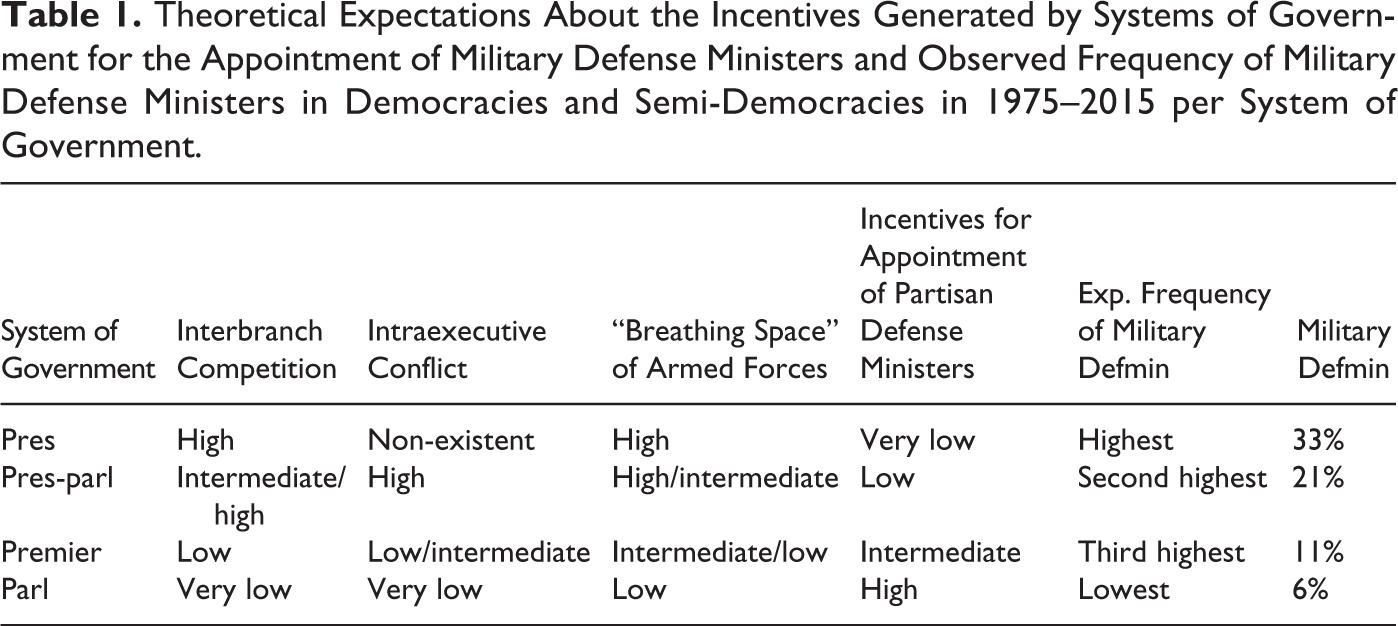
Table 1 displays all our theoretical expectations regarding the incentives generated by each system of government and the frequency of military ministers per executive type in our data. The descriptive statistics of this dependent variable is a first indication that the central hypothesis of this article is correct: 33% of the country-years under pure presidentialism feature military defense ministers, 21% under presidential-parliamentarism, 11% under premier-presidentialism, and 6% under pure parliamentarism. This corresponds precisely to the “pecking order” proposed above.
Theoretical Expectations About the Incentives Generated by Systems of Government for the Appointment of Military Defense Ministers and Observed Frequency of Military Defense Ministers in Democracies and Semi-Democracies in 1975–2015 per System of Government.
Other variables are crucial for the study of the selection criteria of defense ministers and could be plausibly correlated with both our dependent and independent variables, including (1) the characteristics of a country’s previous regime as a proxy of the degree of autonomy of the armed forces. We assume that the more autonomous (or politically powerful) the armed forces, the higher the likelihood of a military officer being appointed as defense minister. This possibility is based on the work of Cheibub (2007), who argues that countries that had military dictatorships end up with stronger armed forces that intervene in politics more frequently; (2) different regions can exhibit distinct patterns of civil–military relations. Latin America, for example, is known for being presidential, praetorial, unstable, and for having a high rate of military intervention in politics (Cheibub, 2007, p. 155; Loveman, 1999); (3) the age of the regime can also predict military participation in politics. Younger regimes tend not to have tight civilian control over the military, which is a process that takes time to consolidate, especially in polities that follow military dictatorships (Pion-Berlin & Martinez, 2017); (4) single-party majority governments should be associated with a higher probability of having a military minister, given that majority governments do not have to use this ministry to solidify legislative support by appointing a partisan minister; and (5) legislative fragmentation is also likely to impact the defense ministry—the higher the number of parties in the legislature, the greater the probability of the defense minister being affiliated to a party. This is because the more fragmented a legislature, the more intense the need for the chief executive to use all available ministerial posts to accommodate allies. Thus, fragmentation should be negatively associated with military defense ministers.
Beyond these variables, we include other controls that are important for cross-country analysis: level of democracy, income, and population. The former two should have a negative relationship with military ministers, given that it is plausible that the military are, on average, more politically powerful in less developed and less democratic countries. Population, on the other hand, is correlated with system of government. Therefore, it is usually included as a control in works on this subject (e.g., Cheibub, 2007). Additionally, it is plausible that population is correlated with defense matters, which could cause this variable to be a confounder. Note, however, that we do not have a specific expectation for its correlation with the type of defense minister. Also, it is relevant to include a control for the Cold War, which is expected to have a positive relationship with military ministers. Owing to the U.S. policy of communist contention, the Cold War ended up strengthening the military in the Third World.
Finally, to illustrate the importance of defense ministers, we also perform tests using it as an independent variable. In these tests, we use, as dependent variables, proxies for transparency, accountability, and professionalism of the armed forces, military expenditure and personnel, and the relative size of the army. Here, our expectations are aligned with the literature surveyed above: Military defense ministers are more likely to defend the interests of the armed forces and shield it from civilian oversight. Hence, we expect them to be associated with less transparency and accountability and to increases in military expenditure and personnel. We also anticipate military ministers to be associated with an increase in the relative size of the army in comparison to the other branches, given that these ministers are more commonly from a career in the army. 2 Lastly, we are agnostic about the possible effects of military ministers on professionalism—it is possible to conceive that these ministers use their position to secure more investment in training, for example, but they could also be interested in obstructing changes that would prevent them from influencing politics in the future.
Data and Measures
Drawing from the databases mentioned below, a resulting database was generated with cross-sectional time series data from 1975 to 2015, including 128 open anocracies and democracies from all continents and 3,179 observations, where the unit of analysis is country-year. Below are the detailed description and operationalization of the variables used in this study, preceded by Table 2, which displays the descriptive statistics of all the variables used in this study.
Descriptive Statistics.

Dependent Variables
Defmin: indicates whether defense ministers were active-duty military officers when they assumed office. Coded as 1, if yes, that is, if the source used for the The Database of Political Institutions (DPI) coding included a rank in the title of the defense minister and 0 otherwise (Cruz et al., 2016). This is the main dependent variable of this article.
Transparency Index: index on the quality of legislative oversight of defense in 82 countries by Transparency International UK (Cover & Meran, 2013), based on seven indicators. Countries then receive a grade from A to F. We coded A as 1 and F as 6—thus, the higher a country scores on this variable, the less transparent it is.
White Book: time elapsed between 1975 and the year in which each country adopted a White Book on National Defense (Sousa, 2018), as a proxy for the transparency of defense policy.
Mil Expenditure: total military budget in each year (Singer et al., 1972). The natural logarithm of this variable was used to reduce the influence of outlier observations.
Mil Personnel: sum of the variables “size of the army,” “size of the navy,” and “size of the air force” (Böhmelt et al., 2019). The natural logarithm of this variable was used.
Relative Size Army: variable “size of the army” divided by “Mil Personnel,” as cited above.
Number Mil Acad: number of military academies as a proxy for professionalism, as in Böhmelt et al. (2019).
Independent Variables
Systems of government: dummies regarding the system of government of each country: pure presidentialism (Pres), pure parliamentarism (Parl), presidential-parliamentarism (Pres-parl), and premier-presidentialism (Premier; Cruz et al., 2016; Elgie, 2018).
Defmin: note that this variable is also used as an independent variable in the fifth section.
Controls
Allhouse: a binary indicator of single-party majority governments from the DPI database and refers to whether the party of the executive has an absolute majority in all relevant houses that have lawmaking powers (Cruz et al., 2016).
Frac: a measure of legislative fragmentation from DPI—it refers to the probability that two deputies picked at random from the legislature will be of different parties (Cruz et al., 2016).
Age Dem: age of the current democracy in a given country. This is a count variable indicating the age of the regime, with the first year of the regime coded 1 (Coppedge et al., 2018).
Military Leg: dummy that takes the value of 1 when a country’s previous regime was a military dictatorship and 0 otherwise (Cheibub, 2007). The authors coded this variable for the 2003–2015 period.
Latin Am: a dummy for Latin America.
Anocracy: polity score from V-Dem lower than 6 (Coppedge et al., 2018).
Pop: natural logarithm of the total population of a country (Coppedge et al., 2018).
GDP/PC: natural logarithm of the gross domestic product per capita (Coppedge et al., 2018).
Pres Power: presidential power scores based on 28 published measures of presidential power (Doyle & Elgie, 2015). The rationale for including this measure in some tests will be discussed below.
Cold War: a binary indicator for the Cold War, where 1 is given if the year is below 1992.
Mil Cab Share: it provides a proportion measure of the military’s share of cabinet- and state council-level positions and is the average proportion of government positions held by military officers (White, 2017, p. 593).
Econ Growth: change in GDP in a given year (Coppedge et al., 2018).
War: dummy for countries involved in interstate armed conflicts in a given year (Coppedge et al., 2018).
Civil War: dummy for countries involved in intrastate armed conflicts in a given year (Coppedge et al., 2018).
Empirical Analysis: The Sources of Military Defense Ministers
Again, note that, when the frequency of military defense ministers is broken down per system of government, we find precisely the “pecking order” proposed by our theoretical expectations. This is an indication that the central hypothesis of this article is correct.
Main Effects
To properly verify this hypothesis, it is, however, necessary to perform a multivariate cross-sectional time series analysis of the binary dependent variable. Table 3 reports the logit regression output of six models. Note that pure parliamentarism is the reference category of systems of government. Thus, the dummies tapping pure presidentialism, presidential-parliamentarism, and premier-presidentialism should have positive signs, and the size of their coefficients should follow the theorized pecking order. Models include fixed effects, except for the last one, because of the Latin America dummy, and for the sake of robustness. 3
Cross-Sectional Time Series Analysis of the Recruitment Criteria of Defense Ministers (1975–2015), with Military Ministers as the Dependent Variable.

Note. Models are logit. Standard errors in parentheses.
*p < .1. **p < .05. ***p < .01.
Models 1 and 2 are our baseline models, with Model 2 controlling for country size, income, and level of democracy. Then, Model 3 prioritizes political variables such as fragmentation and legislative majority, while Model 4 focuses on external and historical factors such as military legacy, Cold War, and age of the regime. Models 5 and 6 include all variables, with the latter adding a dummy for Latin America.
There is robust empirical evidence for the article’s hypothesis. In every model, presidentialism is significant in the expected direction, mostly at the 1% level and at least at the 10% level. Also, the pecking order is respected in almost every model. It should also be noted that the other variables’ coefficients are consistent with theoretical expectations (e.g., income, level of democracy, fragmentation, Latin America, majority government). Cold War and military legacy are positive and significant only in the model without fixed effects.
As for the interpretation of the substantive effects of systems of government, the coefficients of Table 3 should be transformed into odds ratios. For presidentialism, the smallest coefficient of 1.48 represents an odds ratio of 4.4, and the largest coefficient of 2.29 represents an odds ratio of 9.8. In other words, changing from parliamentarism to presidentialism increases the odds of having a military defense minister by more than 4 times according to our most modest results and by almost 10 times according to our most expressive results. These variations are considerable, indicating that the substantive impact of these executive types on the recruitment criteria of defense ministers is politically meaningful.
Another method that can be employed to verify the impact of systems of government on the appointment of defense ministers is survival analysis, an approach adopted by Barnes and O’Brien (2018) to examine the recruitment of female defense ministers. The logic here is straightforward: If our arguments are correct, spells of military ministers will be longer in more presidentialized regimes, while the opposite should be true for civilian ministers. In other words, it is more likely that civilian ministers in presidential regimes will be replaced sooner by military ministers than in parliamentary regimes, with the opposite being true for military ministers.
To test for this expectation, we performed Cox Proportional-Hazards models using the duration time of spells of civilian and military ministers as the dependent variable. The results shown in Table 4 are also strongly consistent with our hypothesis. 4 Note that the coefficients are for the hazard ratios (or risk) of each type of minister. Therefore, we should expect a positive coefficient on presidentialism for civilian ministers and a negative coefficient for military ministers. Almost every model then is significant at the 1% level and in the expected direction, showing that civilian ministers are from 2.3 to 4.8 times more “at risk” of becoming military ministers in presidential systems in comparison to parliamentarism. Alternatively, military ministers are from 62% to 81% less “at risk” under presidentialism. Again, these effects are surprisingly relevant. Note also that only do the executive-type variables show strong effects both in the time series and in each type of survival models—this is further encouragement for the validity of our findings.
Cox Proportional-Hazards Models of Military’s and Civilian’s Spells as Defense Ministers.

Note. Robust standard errors clustered by country in parentheses.
*p < .1. **p < .05. ***p < .01.
Testing the Mechanisms
Overall, these results provide strong support for the article’s central hypothesis. However, they tell us little about the underlying causal mechanisms: (1) Are military defense ministers appointed more frequently in these regimes because presidents need less support from parties and the legislature than prime ministers? (2) Do military services become stronger more easily in presidentialized regimes? (3) Is presidential-parliamentarism associated with more military appointments by being more prone to intraexecutive conflicts than premier-presidentialism? If these theoretical arguments are correct, we should be able to test for some of their observable implications.
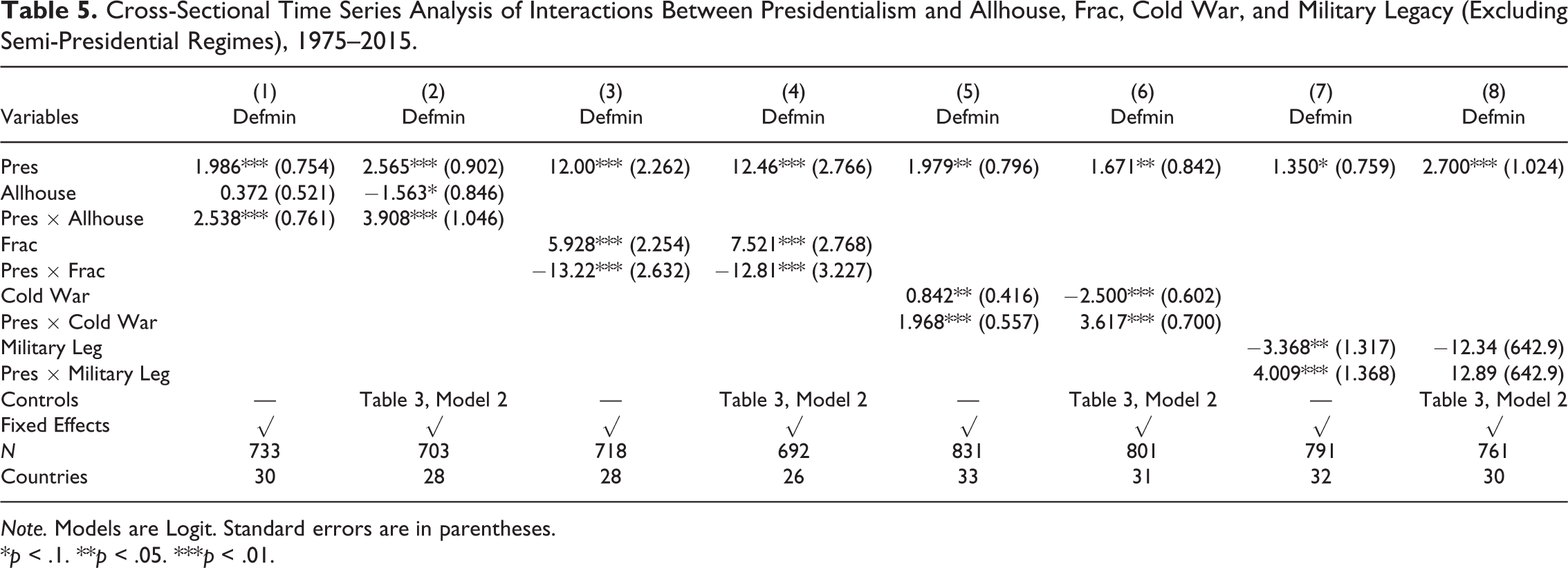
To answer the first two questions, we resort to interactions between our variables. Regarding the first, the variables Frac and Allhouse can be used. If military defense ministers are appointed more frequently in presidential regimes because presidents need less support from parties and the legislature than prime ministers, we should see a negative interaction between Frac and presidentialism. This is because the former variable is expected to have its effects increased in parliamentary countries, whose governments are under pressure to build and maintain majority coalitions. Alternatively, presidentialism should have a positive interaction with Allhouse—again, minority governments in parliamentary countries are expected to use every minister to build ad hoc majorities.
As for the second question, Cold War and Military Legacy can be used as proxies for situations in which there is an incentive for the armed forces to become more powerful. If presidential regimes are more prone to have politically stronger military services, we should see these variables having more pronounced effects in presidential countries. Therefore, there should be a positive interaction between them and presidentialism. Note that having two variables for the testing of each mechanism should reduce the likelihood of omitted variable bias. We test each interaction in Table 5, using the baseline models from Table 3 and excluding semi-presidential regimes.
Cross-Sectional Time Series Analysis of Interactions Between Presidentialism and Allhouse, Frac, Cold War, and Military Legacy (Excluding Semi-Presidential Regimes), 1975–2015.
Note. Models are Logit. Standard errors are in parentheses.
*p < .1. **p < .05. ***p < .01.
Once more, there is strong evidence for our hypotheses. Almost every interaction is significant and in the expected direction, the only exception being military legacy in Model 8. These results make the findings on the main effects even more meaningful and reliable.
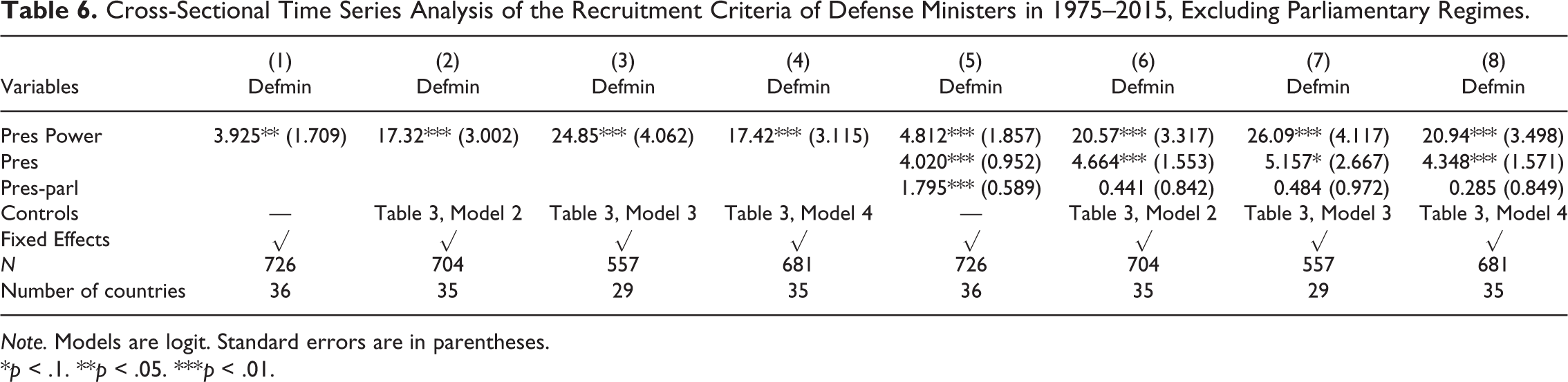
A final statistical test can be used both as a robustness check and a way to explore the third mechanism proposed above. The test is based on a relevant strand in the literature on semi-presidentialism, which surmises that the overall extension of presidential power is a crucial factor in the working of semi-presidential systems. For example, Elgie (2018, pp. 127–149) recently conducted a study of presidential/prime ministerial conflict in European semi-presidential and parliamentary countries in 1995–2015. Results show that presidential power was a better predictor of the presence of presidential/prime ministerial conflict than regime type. To put it differently, presidential power in both semi-presidential and parliamentary systems was positively correlated with presidential/prime ministerial conflict. Therefore, it is key to check whether our coefficients for the two types of semi-presidential regimes remain in the same order in the presence of presidential power.
That said, Table 6 reproduces the first four models of Table 3 twice. In the first four, we exclude regime type and add a different independent variable: presidential power (Doyle & Elgie, 2015). Models 5–8 use presidential power and also regime-type dummies, excluding parliamentary regimes. 5 These models allow us to check whether the executive types still respect the order hypothesized by this article (without parliamentary countries) and to assess the effects of presidential power on the selection of defense ministers, which is a proxy for presidential/prime ministerial conflict.
Cross-Sectional Time Series Analysis of the Recruitment Criteria of Defense Ministers in 1975–2015, Excluding Parliamentary Regimes.
Note. Models are logit. Standard errors are in parentheses.
*p < .1. **p < .05. ***p < .01.
Results provide further evidence for the manuscript’s arguments and evidence for its last mechanism. First, presidential power is highly significant in every one of the eight models—this is a proxy for the third mechanism proposed in this section. Second, there is evidence that there are factors other than presidential power in these executive types influencing the dependent variable. Not only the ordering of executive types in Models 5–8 is respected with the inclusion of presidential power, but the executive-type coefficients were significant in all of the models for presidentialism, and in one for presidential-parliamentarism.
In sum, there seems to be robust statistical evidence regarding the relationship between systems of government and the selection criteria of defense ministers. More presidentialized regimes are associated with a higher frequency of military ministers, longer duration of spells of military ministers, and shorter duration of spells of civilian ministers. Overall, executive types are the only variables that show strong effects in both the cross-sectional time series and the duration models. In addition, the confirmation of the underlying mechanisms bolsters the main results.
Empirical Analysis: The Consequences of Military Defense Ministers
As argued in the Introduction, there is a significant literature that suggests that whether defense ministers are civilian or military is an important factor for civil–military relations. Still, to address possible skepticism regarding the relevance of our dependent variable, we have included tests that exemplify the impacts of defense ministers. Here, we use Defmin as an independent variable for two measures of transparency (Transparency Index and White Book) and four policy outcomes (Mil Expenditure, Mil Personnel, Relative Size of the Army, and Number of Mil Academies).
Because the transparency index has only observations for the year 2012, we used Ordinary Least Squares (OLS) in this test. Nonetheless, we took two precautions to minimize problems of endogeneity. First, we lagged the variable Defmin for 5 years; second, we controlled for the military’s share of cabinet- and state council-level positions (Mil Cab Share), in addition to the variables from Model 5 of Table 3. By doing so, we can argue that even in highly militarized governments, it is the defense minister that “is doing the work” for the sake of minimizing transparency. On the one hand, this is intuitive since this minister is in a privileged position to affect defense policy. On the other hand, this makes this test quite conservative for the variable Defmin.
The White Book variable, alternatively, describes the time for an event, the adoption of the first official book or paper on defense policy. White books are a communication tool of a country with its national society and a confidence-building measure toward the international community as regards the country’s goals and resources of national defense. The first issue of such document is a relevant turning point in terms of a state’s defense policy transparency. Therefore, we once more performed a Cox Proportional-Hazards model, in which the dependent variable is the “hazard rate” for the adoption of a White Book. In other words, the dependent variable is the time elapsed between 1975 (the year in which our data set begins) and the year in which the first White Book was published. Here, we have also included Mil Cab Share as a control. Table 7 displays the results of both tests.
OLS and Cox Proportional-Hazards Models of the Determinants of Defense Policy Transparency and Adoption of White Books, Respectively.

Note. Standard errors are in parentheses.
*p < .1. **p < .05. ***p < .01.
The results above indicate that military ministers generate significant consequences for defense policy, with relevant effect sizes. For the first model, it indicates an increase of 1.5 points in a scale that ranges from 1 (more transparent) to 6 (less transparent). For the second model, countries that have a military defense minister are 55% less “at risk” of adopting a White Book.
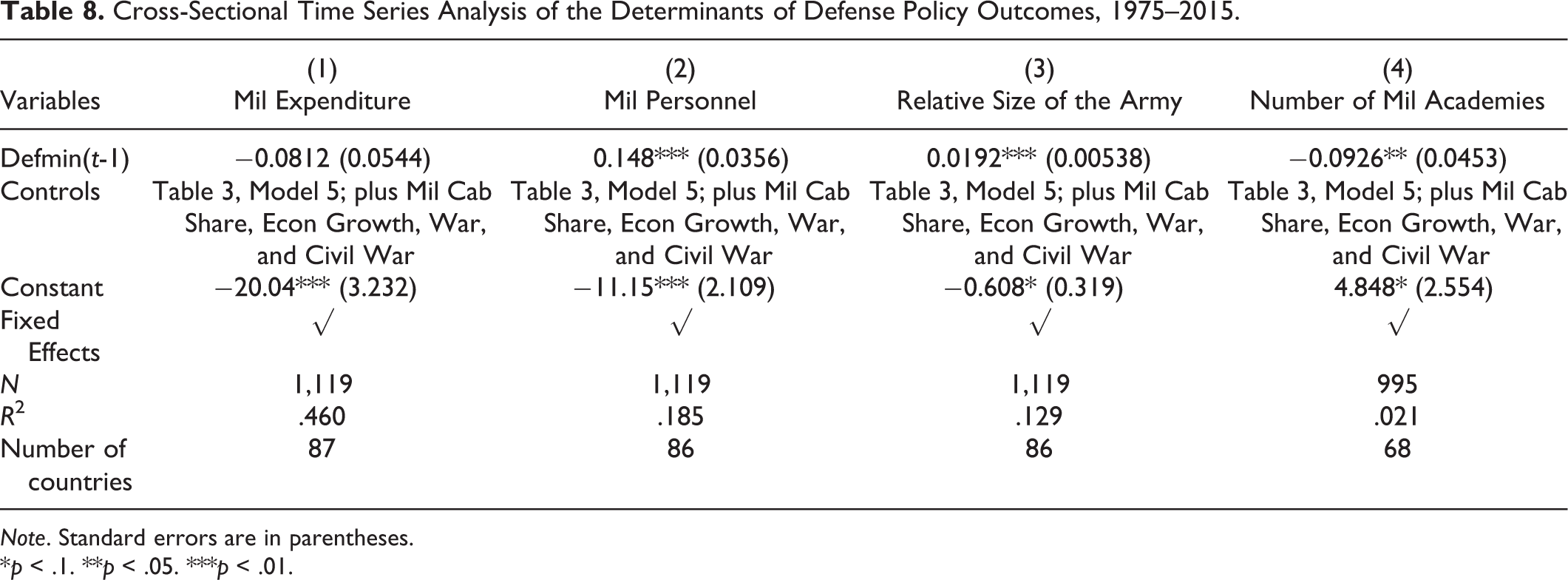
In addition, Table 8 displays the results of a cross-sectional time series analysis of four important variables for defense policy, using Defmin as an independent variable. For each test, we also included the same controls as in Model 5 of Table 3. Moreover, we kept Mil Cab Share as a control and added economic growth (Econ Growth) and dummies for countries in interstate and intrastate wars (War and Civil War), as per Goldsmith (2003). We have also lagged the independent variables to minimize endogeneity.
Cross-Sectional Time Series Analysis of the Determinants of Defense Policy Outcomes, 1975–2015.
Note. Standard errors are in parentheses.
*p < .1. **p < .05. ***p < .01.
The results show an association between military defense ministers and three of the four policy outcomes hypothesized. Although there does not seem to be an effect of defense ministers on military expenditure, the independent variable has a positive and significant effect on personnel size and relative size of the army and a negative and significant effect on professionalism. In sum, this is encouraging preliminary evidence on the importance of defense ministers—future research should examine these effects and their mechanisms in more detail.
Conclusion
Recently, Brooks (2019) called students of civil–military relations to integrate this subfield into some of the research agendas in comparative politics. This article has done precisely so by answering the question of what the relationship between executive types and the military is. All else held constant, more presidentialized systems of government—pure presidentialism and presidential-parliamentarism—are associated with a relatively high frequency of military officers heading the defense ministry.
So what?
First, the frequent presence of military officers heading the defense portfolio means less democratic accountability as regards national security and may also contribute to a less inclusive and less integrated pattern of civil–military relations as far as strategic decision-making is concerned, which, according to Egnell (2009), is not the best suited to the complex military challenges of the 21st century. Second, our work suggests that the relatively frequent appointment of active-duty officers to head the ministry of defense should be seen not only as a prerogative stemming from past regimes but also as a consequence of built-in incentives generated by highly presidentialized systems of government. Third, there is a relevant literature associating pure presidentialism and presidential-parliamentarism with democratic instability and lower quality democracies (e.g., Sedelius & Linde, 2018). We demonstrate one of the possible mechanisms underlying this association: There are inherent characteristics of executive types that influence important indicators of civil–military relations. If more presidentialized regimes are associated with a more influential military establishment, it is not surprising that they are more unstable or of lower quality.
Fourth, we have provided evidence on the possible effects of defense ministers on civil–military relations and defense policy. To the best of our knowledge, this is the first systematic analysis of the “consequences” of military defense ministers. This analysis, however, is preliminary, and future research should examine these effects in more detail.
This article also provides possible avenues for the future study of the selection of defense ministers. Note that the analytical mechanism mediating between highly presidentialized systems and the recruitment criteria of defense ministers needs to be better investigated. On this point, it will be key to understand causal mechanisms in more detail using, for example, case studies.
The consequences of different recruitment criteria of defense ministers for national security policy-making demand more in-depth study too. For example, some scholars (e.g., Betts, 1991; Huntington, 1961; MccGwire, 1987) have discussed how military policy might look different based on whether civilians or the military have more influence on it, as well as the tendency of the military to adopt worst-case analysis, to focus on other countries’ military capabilities rather than intention, and to advise the executive based on pure military logic. Alternatively, there is the notion that the military are less willing to initiate armed conflicts than civilians, but once a conflict is started, the military are more prone to escalate it than civilians (Betts, 1991). Therefore, the findings presented here have the potential to affect important outcomes related to international conflict and deterrence, among others. Developing cross-national operational indicators of all those variables will be an important step in gauging the effects of military defense ministers.
Finally, the attributes of defense ministers need improvement as well. Whether the defense minister is an active-duty military officer or not, while very relevant, is a limited measure. This article, for example, does not consider retired military officers—still, one could expect even stronger results if this distinction is made, since the occurrence of the dependent variable would become more common in the data set. Moreover, this research agenda could be expanded to nondemocratic contexts as well, where different mechanisms could be explored. In any case, we consider the findings presented here to be a proper first step in examining important cross-national variation regarding the links between systems of government and civil–military relations.
Footnotes
Acknowledgments
The first version of this article was presented at the XXXVI Congress of the Latin American Studies Association, Barcelona, Spain, June 23-26, 2018. The authors thank three anonymous reviewers for their generous comments and fruitful suggestions; Igor Acácio, Thomas Bruneau, Tanisha Fazal, Ron Krebs, David Pion-Berlin, Stephen Saideman, and David Samuels for comments on earlier versions of the paper; Nathaniel Beck, Nathan Canen, and Logan Stundal for methodological advice; Brazilian Army Colonel Gustavo J. B. Sousa (retired) for sharing his data on the publication year of countries’ first white book on national defense, and Camila Farias for her superb research assistance.
Declaration of Conflicting Interests
The authors declared no potential conflicts of interest with respect to the research, authorship, and/or publication of this article.
Funding
The authors disclosed receipt of the financial support for the research, authorship, and/or publication of this article: This work was supported by Brazil’s National Council on Scientific Research (CNPq).
