



Abstract
What explains the post–Cold War surge in peacekeeping contributions from the developing world? I argue that, amid a wave of democratization and expanded peacekeeping activity, such countries use peacekeeping deployments to reduce the threat of the military to nascent democratic institutions. Peacekeeping participation serves to placate the military in the short term with resources and continued activity, while socializing and professionalizing it to pro-democracy behaviors in the long term. Assessing troop contributions from 1990 to 2011, I find evidence that new democracies make larger contributions than other states, where the effect diminishes as democracy becomes consolidated. Moreover, the effect is amplified in countries with a greater military legacy. I supplement this with a study of Argentina to further support the proposed mechanism. These findings help explain the shift in state peacekeeping contributions in recent years, the role of democracy in peacekeeping efforts, and the impact of international actors in supporting democratization.
In recent decades, the provision of personnel for United Nations peacekeeping operations (UNPKOs) has shifted largely from the developed to the developing world. Where mission compositions were once dominated by Europe and North America, they now consist heavily of peacekeepers from Africa, South Asia, and Latin America. While various studies have attempted to explain this pattern, there remains a lack of consensus. I argue that the process of democratization creates strong incentives for states to support peacekeeping missions with their own personnel and that such states will subsequently make larger contributions than both established democracies and nondemocracies. Democratizing states 1 face unique challenges relating to domestic demand for public goods provision as well as pressures from the military. Participation in peacekeeping creates a means to satisfy both of these challenges. I argue that participation addresses the domestic threat of the military both by placating it in the short term with resources and continued activity, while also socializing and professionalizing its members in the long term to pro-democracy behaviors. In achieving these outcomes, domestic opposition to continued high spending on the military can be assuaged, while much needed funds can be diverted to domestic purposes. By achieving these outcomes, a newly democratic state can decrease the likelihood of opposition and regime instability and thereby increase the probability of democratic consolidation.
I test my argument empirically by examining the effect of being a new democracy on personnel contributions to UN peacekeeping operations between 1990 and 2011. While previous studies have considered the relationship between democracy and contributions (e.g., Andersson, 2002; Lebovic, 2004; Perkins & Neumayer, 2008), they focus only on a state’s regime type rather than considering states in transition, much less the internal political dynamics of the country. I therefore offer a novel insight into this relationship, considering democracies in transition. The results show support for my arguments: Newly democratized states make larger personnel contributions than other states, but their commitments decrease as democracy becomes more consolidated. I also find that the effect is amplified where the country experienced coups in the past and where the military was more prominent prior to transition. To offer further support for the proposed mechanisms, I supplement the statistical analysis with a case study of Argentina, whose involvement in peacekeeping in its postdemocratization years was critical for establishing stable civil–military relations that supported the successful consolidation of democracy.
This project contributes to the understanding of civil–military relations in the context of democratization, while also considering the undertheorized role of international organizations in this process, contributing to a broader literature on how involvement in international organizations can support the process of democratization. It also adds to an ongoing discussion on the determinants of peacekeeping personnel contributions. In particular, prior consideration of regime characteristics has overlooked heterogeneous factors among democracies and has subsequently produced mixed results. With that, I offer the first large-n test of the role played by democratization in peacekeeping contributions and add to a sparse understanding of how states use peacekeeping as a strategic means to address threats posed by the military.
Who Keeps the Peace?
In 2016, Ghana had the 49th largest population and a military that ranked 120th in personnel numbers (World Bank, 2018). Despite this, it was the ninth largest contributor to UNPKOs, far outpacing the much larger and more advanced militaries of developed Western countries. Ghana’s large contributions have been consistent since its transition to democracy at the end of 2000 (see Figure 1). In the subsequent decade, an average of 23% of its military was deployed to UNPKOs at any given time, with many more at home preparing for future rotations.
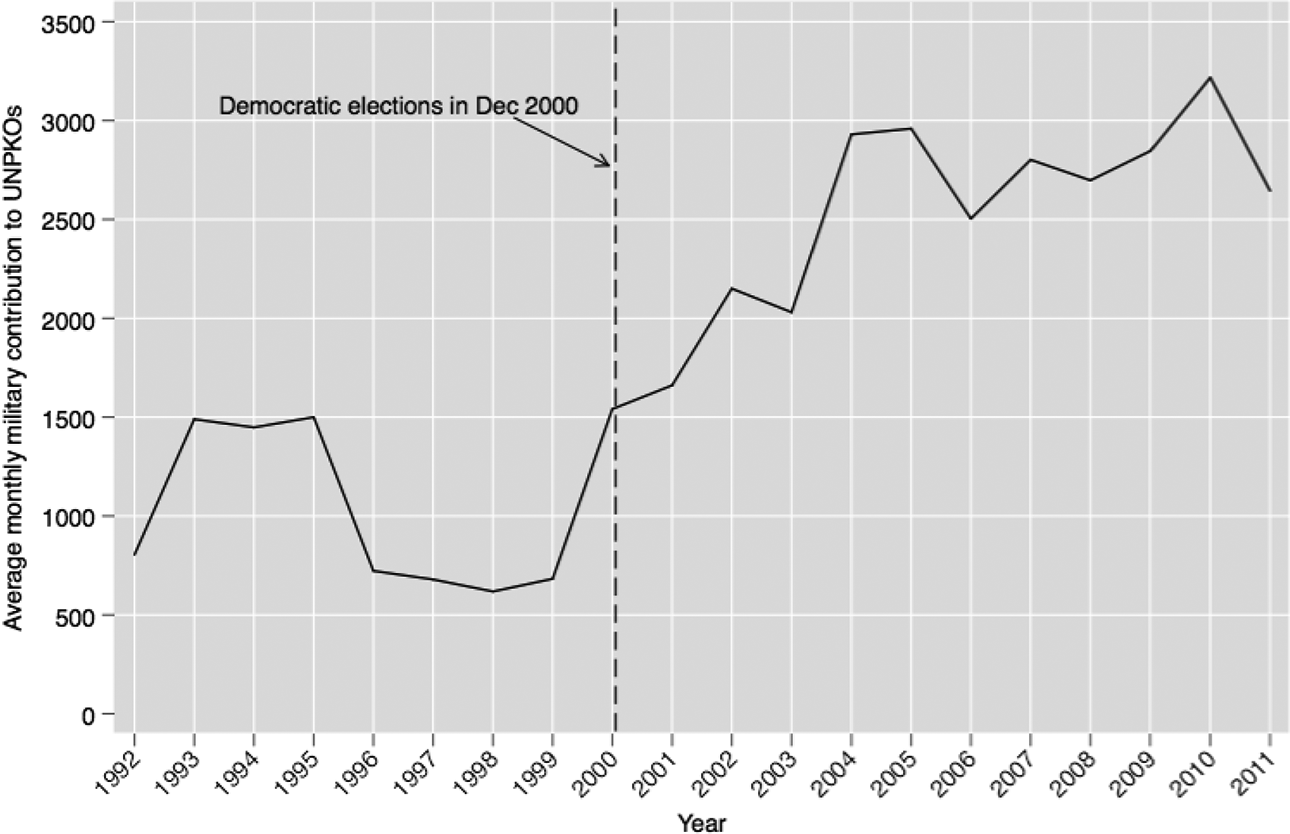
Ghana’s average monthly military deployment to United Nations peacekeeping operations, 1992–2011.
What explains why a country like Ghana would make such a major investment in international peacekeeping efforts and particularly in the years immediately after democratization? Ghana is far from alone in this behavior. In 2016, the eight countries making larger contributions were Ethiopia, India, Pakistan, Bangladesh, Rwanda, Nepal, Senegal, and Burkina Faso. This is a vast shift from the dominant participation of countries such as Canada, Austria, Finland, France, and the United Kingdom in the Cold War era. An extensive literature has investigated the determinants of state contributions to UNPKOs, 2 particularly in light of this shift, which coincided with a new wave of democratization and the expansion of peacekeeping activity globally. Table 1 shows the top personnel contributors to UNPKOs from 2000 to 2010 as a total, proportion of all military personnel, and proportion of defense expenditure. All three measures indicate the centrality of developing countries in peacekeeping over this period.
Top Military Contributors to UN Peacekeeping Missions, 2000–2010 (UN Department of Peacekeeping Operations).

A small number of studies have considered the role of domestic politics as a motivation for larger personnel contributions. Within this category, two themes have emerged: the role of the potential contributor’s regime type (Andersson, 2002; Lebovic, 2004; Perkins & Neumayer, 2008; Victor, 2010) and civil–military relations within the state (Kathman & Melin, 2017; Sotomayor, 2014). I argue that a more comprehensive understanding of recent trends in UNPKO contributions incorporates both of these elements. Therefore, failing to account for both regime dynamics and civil–military conditions may explain why previous studies have produced disparate findings and left little clarity of the relationship between domestic politics and peacekeeping involvement.
Regime Type and UNPKO Participation
Previous investigations linking regime type to peacekeeping activity have argued that more democratic states will make larger contributions of military personnel to UNPKOs. There exist two proposed mechanisms underlying this link. First, and as something of an extension of the famed “democratic peace,” contributions from democracies will be greater since these states believe more readily in the civil and human rights afforded to all people, and that such rights should be promoted and protected wherever possible (Bellamy & Williams, 2013, p. 11). Second, democracies may seek to foster an international order more conducive to the thriving of peace and prosperity (Lebovic, 2004, p. 912). These arguments form the basis of several positive findings for this relationship, where the stronger the democracy, the more likely the state is to participate in peacekeeping and with larger contributions (Andersson, 2002; Lebovic, 2004; Perkins & Neumayer, 2008).
However, these arguments have not been borne out empirically in recent years as contributions from strong democracies have dwindled. During the 1990s, France, the United Kingdom, Canada, Austria, Finland, the United States, and Ireland all appeared at various points in the top 10 personnel contributors. However, from 2001 to 2011, not one of these countries, nor any other Organisation for Economic Cooperation and Development country, appeared in the top 10. Moreover, for those established democracies that continue to contribute, deployment sizes are often drastically inconsistent across time and missions. More recent studies support this, finding no relationship between democracy and contributions (Kathman & Melin, 2017; Uzonyi, 2015; Victor, 2010).
This suggests a linear relationship between democracy and UNPKO participation may have once existed but has disappeared in recent years as the costs of sending troops to UNPKOs, both financially and politically, have outweighed the benefits for established democracies. It therefore seems that if regime characteristics are to be considered an important factor in driving state contributions of peacekeepers, a more precise theoretical explanation is required that both consider alternative ideas about the role of democracy while also accounting for the increased presence of developing countries in peacekeeping. Below, I argue that the rise of these new contributors to peacekeeping can be explained by the desire of those states to reap benefits for democratic consolidation—particularly as regard the military—and that this phenomenon has become more prominent in recent decades both because the demand for peacekeepers has increased and as more countries have transitioned to democracy.
The Democratization–Peacekeeping Nexus
The post–Cold War era ushered in an unprecedented wave of democratization (Figure 2). In total, 77 countries experienced a transition to democracy after 1990 (measured as an increase in the state’s Polity score to +6 or above). Yet these transitions, like many before them, were not without problems. Many states succumbed to backsliding in the face of institutional or economic crises, forced takeover, or civil war. Of the 77 states making the transition to democracy, 31 had at least one experience of backsliding. The most commonly cited causes of failed democracy are economic underperformance and military intervention (Cheibub, 2007; Gasiorowski, 1995; Przeworski et al., 2000).

Global number of democracies by year.
New democracies face the unique challenge of providing public goods while simultaneously having political institutions often too weak to do so. Failure to stimulate economic development, implement civil rights and the rule of law, and incorporate varied groups into civil society will compromise the government’s credibility, reduce faith in democracy, and open the door to autocratic predators. One such actor is the military. Militaries have a long history of involvement in domestic politics. For example, between 1945 and 2000, there were 432 coup attempts globally, with over half seeing success (Belkin & Schofer, 2003, p. 596). The effect is particularly pronounced in new democracies. Svolik (2008, p. 162) finds that only one in eight democracies preceded by a military dictatorship will consolidate, while nine of the 10 democracies transitioning from other regime types will experience successful consolidation. Democratization offers the military both increased incentive and opportunity to intervene. First, it creates the incentive since it risks becoming a more constrained entity under democracy, losing power, influence, and resources. Decision-making has been decentralized, repression of the public through military force is no longer acceptable, and there may even be calls for punishment or major reform of the armed forces. The military will thus likely see democratic transition as a threat and increase its likelihood of intervening. Second, democratization often presents the military with the opportunity to intervene, where its strength of organization and political efficacy through past involvement give it the perception that it can run a better system, particularly where democracy does not deliver quick benefits to the people and has institutions still under development. However, while some military interventions reflect the “praetorian guard” nature of the military, seeing themselves as the protector of the land and stepping in amid poor governance or economic upheaval (Gandhi, 2008, pp. 27–28), in reality, it is more likely that interventions reflect the corporate interests of the military and of its individual members (Finer, 1962; Nordlinger, 1977). Preventing military meddling is thus most effective when the military can be sufficiently incentivized to refrain from intervening, which typically takes the form of financial payment or similar benefits (Acemoglu et al., 2010, p. 2). While this may be a viable option for autocratic leaders, a democratic government must find a way to appease the military while balancing its newfound responsibility to the public, which will expect to see improved economic conditions and will oppose continued high spending on the military.
Even if democratizing states can offer short-term concessions to satisfy the military, they cannot credibly commit to not reforming the military in the long term (Acemoglu et al., 2010). The consolidation of democracy in the presence of a military legacy therefore requires a credible commitment to the military that it will not be weakened, punished, or decommissioned. Yet a similar commitment must be made to the domestic public that the military is not a threat to stability and that such things as political and civil freedoms, human rights, and government-provided goods will be protected. Without both of these outcomes, democracy is unlikely to last long in that country.
Peacekeeping as a Solution
One solution to this dilemma may be found in participation in UNPKOs. First, by involving the military in peacekeeping, the government signals to the military that it will not be decommissioned or lose important benefits with its changing role in society. The constant demand for peacekeepers offers an indefinite commitment to military activity, while also providing training and income often superior to that they have received domestically. Serving as a peacekeeper is a source of individual pride as well as an opportunity to experience other countries and cultures (Battistelli, 1997). For the government, peacekeeping remunerations can comprise a major source of funds by which to supplement the defense budget, thereby freeing up government funds for public spending. Cunliffe (2013, p. 172) reports that Ghana brought in 43.6% of its defense expenditure from peacekeeping between 2002 and 2011, while Rwanda earned 47.3% between 2006 and 2011. Therefore, in the short term, peacekeeping deployment can placate disgruntled soldiers and generals alike, who fear becoming redundant in a democratic system and risk losing their livelihood and status.
However, for democracy to stand its best chance of being consolidated, the government must consider the longer term role and orientation of the military. A military may be placated temporarily, but if its raison d’être is not shifted away from political influence and toward subordination, it risks using its newly learned skills and heightened sense of efficacy to interfere domestically (Dwyer, 2015; Levin et al., 2016; Scobell, 1994). Fortunately, UN peacekeeping deployment offers a number of socializing and professionalizing benefits that can contribute to redirecting the military’s outlook. 3 Most prominently, internalizing the UN’s value system and serving alongside soldiers and under leaders from established democracies may engender a process of socialization towards democratic ideals and behaviors (Sotomayor, 2014, p. 6). Such positive socialization has been reported in the cases of Argentina (Worboys, 2007, p. 156), Bangladesh (Murthy, 2007, p. 166), and Sri Lanka (Avezov, 2014, p. 267). Additionally, undertaking tasks that reinforce the notion of a military narrowly focused and politically disengaged can result in a professionalization of the armed forces that further supports democratic governance. Huntington (1957) argued that civil–military relations were best suited to domestic stability when the military was empowered in an area of relative autonomy and made to focus exclusively on external security. The alternative, allowing the military to perform important domestic roles and influence political decision making, would inherently threaten stability. UNPKOs offer a path to the former although this is not guaranteed. UNPKOs vary greatly in their role, ranging from small deployments that observe ceasefires to large multidimensional missions that seek to rebuild capacity and stability in the country. This latter type of mission can increase the military’s sense of efficacy and legitimacy as a domestic actor and make it more of a threat upon returning home. Such has been argued in the cases of Fiji (Scobell, 1994), Bangladesh (Levin et al., 2016), and a number of West African countries (Dwyer 2015). However, missions reflective of a professional military can play an important role in reorienting the military to a role that supports a democratic model of civil–military relations. Such a conclusion has been reached in the cases of Burundi (Wilén et al., 2017), Ghana (Aning & Aubyn, 2013), and Argentina (Norden, 1995; Worboys, 2007) among others.
Peacekeeping therefore provides a unique avenue by which a nascent democracy can increase its chances of survival. It is for these reasons that I argue that the largest personnel contributions to peacekeeping will come not from strong democracies, as has previously been argued, but those looking to consolidate their legitimacy and institutions and become stable democracies. In making this argument, it is important to distinguish between mere participation in peacekeeping and the size of the contribution. The shift to developing countries has largely been manifested in the size of contributions, where developed countries still participate often, only with reduced numbers. Coleman (2013) argues that the practice of making “token” contributions is widespread and that such contributions reap alternative benefits for states, such as international reputation, that require only nominal involvement. The benefit for democratizing states relies more heavily on the marginal gains from sending more troops, and so contribution size is of more importance. I therefore do not argue that democratizing states are more likely to participate than others, only that they will make larger contributions.
Hypotheses
Democratizing states stand to gain much from contributing troops to UNPKOs. Moreover, these benefits are largely unique to this set of states. Established democracies and nondemocracies may have separate incentives to contribute in large numbers, but there is little empirical evidence or theoretical explanation that undergirds a systematic incentive for these two groups. This leads to my primary hypothesis:
Since the incentives offered to these states are time-sensitive—it is new democracies that face such challenges—there will likely come a point where making large contributions is no longer optimal. This may be because it has achieved desired outcomes, such as the reorientation of the military toward democratic norms, or ultimately the consolidation of democracy. These states will subsequently choose to reduce their peacekeeping commitments over time as the marginal benefit of each additional soldier reduces. I therefore offer a hypothesis that predicts a diminishing effect on contributions:
Finally, in order to shed some light on the proposed mechanism, I offer a hypothesis that tests whether democratizing states’ contributions are moderated by the perceived threat of the military, either due to a history of coups or to a prominent military at the time of democratization:
Research Design
I test the relationship between democratization and UNPKO personnel contributions on a sample of 166 UN member states and covering 66 UN peacekeeping operations from 1990 to 2011. Since I am interested in state contributions to peacekeeping in general, as opposed to specific missions, I employ a contributor-year unit of analysis, with standard errors clustered on the contributor to account for correlated errors within each cluster.
Dependent Variables and Estimation Method
The dependent variable, contribution, measures the average monthly contribution of military personnel, consisting of troops and military observers, made by a state to all UNPKOs in a given year (Kathman, 2013). While other studies use the total personnel in a year, deployment data are collected monthly, and since troops are not replaced on a monthly basis but rather usually serve a 6- or 12-month deployment, adding months up to give an annual figure is misleading. The mean contribution for the sample is 269 personnel in an average month. Removing the observations of zero (i.e., looking only at when countries do contribute), the mean is 553 personnel.
Since the majority of observations are zeroes (a country does not contribute personnel in a given year) and since there are likely separate processes determining first whether a country will contribute at all and, second, how much it will contribute, I employ a zero-inflated negative binomial estimation method (ZINB). The model consists of two components. First is a logit equation that tests the probability that states will never participate in UNPKOs. For this equation, I model a set of predictors that are likely to affect a state’s decision to even contribute to a UNPKO in the first place. The second component is a negative binomial equation, which uses as the dependent variable the count of personnel contributed by a state. Predictors in this equation therefore address those factors likely to influence the size of a state’s contribution. I offer additional justification for this modeling choice in the Online Appendix.
Democratization
I construct a measure of democratization using the Polity IV Scale (Marshall et al., 2017), which scores states from −10 (full autocracy) to +10 (full democracy). Polity is the most commonly used measure of democracy in international relations literature and has been the measure of choice in virtually all studies addressing UN peacekeeping contributions or the relationship between democratization and international organizations (Mansfield & Pevehouse, 2006; Pevehouse, 2002; Poast & Urpelainen, 2013, 2015). Most commonly, a democracy is considered a country with a score of +6 or higher on the Polity scale. The baseline explanatory variable, democratization, is therefore a binary measure that receives a one if a state went from a Polity score of +5 or below to +6 or above in a given year. Since previous studies have considered a reasonable time lapse to still be considered a democratizing state as 5 years (Mansfield & Pevehouse, 2006; Poast & Urpelainen, 2013), I include increasing annual windows within which a state has democratized, ranging from transitioning in the current year to transitioning within the last 5 years. Since these variables are lagged by 1 year to account for possible reverse causality, they are denoted as t–1 up to t–5. I replace observations as zero if they have reverted to a state of autocracy in that year (−6 or below). I do not apply this rule to states backsliding to anocracy (+5 to −5), since some semblance of democratic governance most likely remains and the state may continue to use peacekeeping in an attempt to reintroduce democracy.
To test Hypothesis 2, the variable years of democracy is a count of the number of years since the country first transitioned to democracy. If the state reverts to nondemocracy, the count ends. Since this test is only interested in the behavior of states democratizing in the time period covered by this study, the sample is restricted to those 79 countries. A nonlinear relationship is likely to be observed for this variable: Contributions will decline over time and eventually stabilize. I therefore tests models with squared and cubed terms of years of democracy to account for this likely curvilinear relationship.
Military Legacy
I use several variables to reflect the potential or perceived threat of the military within a nascent democracy, as tested with Hypothesis 3. Such concerns may be caused by two prominent factors: a prevalence of coup activity in the past and the prominence of the military immediately prior to transition. In the former category, I include previous coup, which indicates if the country has experienced an attempted our successful coup in its history (since 1950); number of coups is a count of such coups or attempts; and years since coup is the number of years since the most recent coup or attempt. Coup data come from Powell and Thyne (2011). Regarding the last of these variables, Kathman and Melin (2017) find that states with more recent experience of a coup make larger personnel contributions to UNPKOs, but that this effect diminishes as the time since the coup increases. I therefore include a squared version of years since coup to account for the identified nonlinear relationship. I also use this as a control variable in other models to account for their result in my tests. For the second category, I test three variables reflecting the legacy of the military establishment at the time of democratization. Military regime indicates if the country transitioned to democracy directly from a military-led government (Wahman et al., 2013). While the military may not have had political control, it may still have been an influential institution. I therefore include two measures of the military’s capacity prior to democratization. Militarization expenditure is the total defense expenditure averaged over the 5 years prior to transition and converted to its natural log. Militarization personnel is constructed the same way but measures the number of standing armed forces personnel. The former of these is also included as a control variable in other models. Both are created using data from the Correlates of War National Material Capabilities data set (Singer et al., 1972).
Control Variables
I include a number of control variables in one or both equations of the model to account for other factors that affect state contributions to PKOs. Intrastate conflict indicates whether or not the potential contributing country is engaged in a domestic conflict. One would expect such states to have little desire to send their uniformed personnel to international peacekeeping missions. This measure is taken from the UCDP/PRIO Armed Conflict Dataset (Allansson et al., 2017; N. P. Gleditsch et al., 2002). I include the natural log of the country’s per capita gross domestic product, GDPpc (K. S. Gleditsch, 2002). Since some have argued states may contribute larger numbers of peacekeepers to receive the economic gain from UN remuneration (Gaibulloev et al., 2015; Levin et al., 2016), it is important to control for this so as to ensure that any relationship between democratization and contributions is not spuriously driven by the underlying effect of economic underdevelopment. Global missions counts the number of UNPKOs taking place globally, reflecting the opportunity states have to contribute. P5 is a binary measure that indicates if the potential contributor is a member of the UN Security Council Permanent Five. Since these states have a vested interest in the success of the mission (Stojek & Tir, 2015), they may offer large numbers of their own personnel. I also include the natural log of the country’s population (Singer et al., 1972). A larger population may reflect greater public accountability of the government as well as a greater need for capacity in its institutions.
I include a count of the years from 1990 to 2011, as well as squared and cubed terms, which will identify underlying shifts in general contribution patterns over the time period. I also include dummy variables reflecting the region in which the state is found geographically, since the effects of regional institutions or spatial contagion may cause greater participation from some regions than others.
Finally, I include the dependent variable lagged by one year in the count equation, since it is highly probable that a state’s contribution in year t is correlated with its contribution in year t–1. I also include in the inflation equation the variable participate, a binary measure of whether or not a country contributed any personnel at all in the previous year. Where potential reverse causality may occur, I lag covariates by one year.
Findings
Results from testing Hypothesis 1 are shown in Tables 2 and 3, where each successive model corresponds with a wider democratization time window (1–5 years). For each model, both the inflation and count equations are shown. Coefficients in the inflation equation predict the probability that a state will not contribute. Coefficients in the count equation indicate the effect of each variable on the size any resulting contribution. The results indicate that democratization has no impact on whether or not a state will participate at all, since the coefficients in the inflation equations never reach statistical significance. However, looking at the count equation, democratization has a positive and statistically significant effect on the size of the contribution, supporting Hypothesis 1. Notably, the relationship is just outside of standard statistical significance in Model 5 (p = .055). This, combined with the gradually reduced size of the coefficient from Models 1 to 5, suggests that the effect of democratization on contribution size wanes over time. This phenomenon is tested more thoroughly through Hypothesis 2.
Effect of Democratization on UN Peacekeeping Troop Contributions Using a Zero-Inflated Negative Binomial Regression.
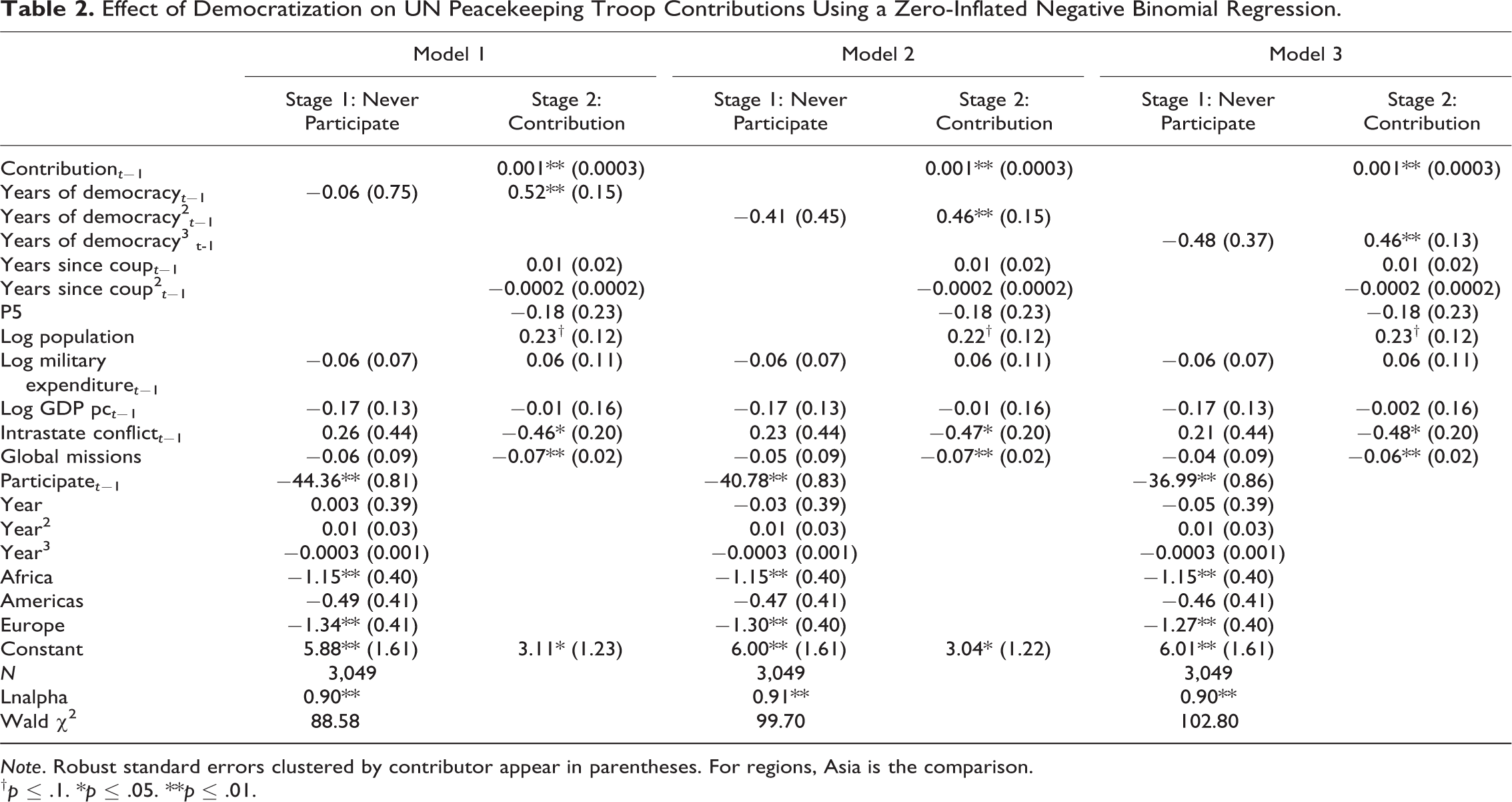
Note. Robust standard errors clustered by contributor appear in parentheses. For regions, Asia is the comparison.
† p ≤ .1. *p ≤ .05. **p ≤ .01.
Effect of Democratization on UN Peacekeeping Troop Contributions Using a Zero-Inflated Negative Binomial Regression.

Note. Robust standard errors clustered by contributor appear in parentheses. For regions, Asia is the comparison.
† p ≤ 0.1. *p ≤ 0.05. **p ≤ 0.01.
By calculating the substantive effects of being a new democracy, holding other variables at their mean or median value, the true impact of this transition can be seen. When measuring democratization as taking place within one year (Model 1), a new democracy will give 307 peacekeepers, 67.8% more than other states, which give 183. Even with the broadest measurement of democratization (occurring within the previous 5 years), a new democracy will give 38.1% more than other states. Additional tests separating out other states into established democracies, anocracies, and established autocracies are included in the Online Appendix and show that democratizing states consistently give more troops than each individual category of states.
Looking at the other covariates, states experiencing their own internal conflict are no less likely to participate in peacekeeping but give fewer personnel than states without conflict. A state is no more likely to make a large contribution if it spends more money on defense, which is unsurprising given the relative absence of major military powers in modern peacekeeping. States are also no more likely to make large contributions with a recent history of a coup. The extent to which military capacity and legacy leads to variation in contributions among new democracies only is considered in Hypothesis 3.
A state’s per capita GDP has no significant effect on the contribution size, challenging the argument that developing countries participate in peacekeeping primarily for financial gain. Finally, and surprisingly, a larger number of total missions occurring globally lead to a smaller average annual contribution from states. There is no obvious theoretical explanation for a decline in contributions when more missions exist. States may perhaps contract peacekeeping fatigue if overall demand is too great or a higher presence of global conflict may indicate that their military personnel are being used in other unilateral or multilateral interventions.
The results for the test of Hypothesis 2 are shown in Table 4. This test gives more clarity to the trend identified in Models 1–5, where the effect of being a new democracy on personnel contributions diminishes over time. The coefficient for the linear term of years of democracy is negative and statistically significant in the contribution equation. Taken with the squared and cubed coefficients, this indicates the presence of a polynomial relationship. This is displayed in Figure 3. Supporting the findings in Models 1–5, initial contributions of new democracies are high but see a steady decline in the first few years of democracy. In the first year after democratic transition, such states will contribute 295 military personnel. By the time the state is considered a consolidated democracy (Year 6), the average contribution has dropped by 40.3% to 176 peacekeepers. After 10 years, the contribution hits its lowest point of 155 peacekeepers, almost half of the initial size. Beyond 10 years, contributions increase again slightly before leveling off, suggesting they fall into a more stable contribution pattern similar to other established democracies.
Effect of Time Since Democratization on UN Peacekeeping Troop Contributions Using a Zero-Inflated Negative Binomial Regression.
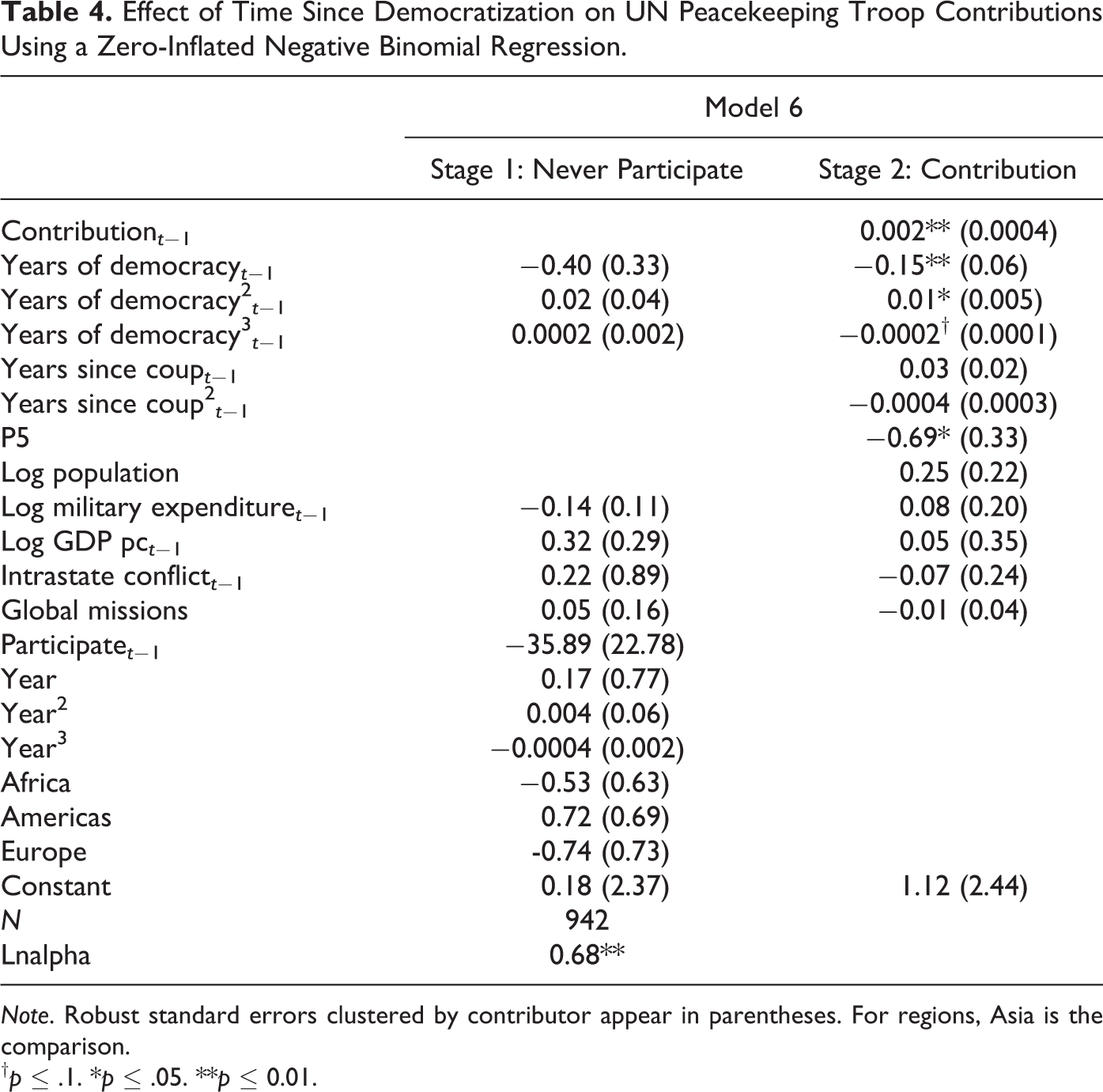
Note. Robust standard errors clustered by contributor appear in parentheses. For regions, Asia is the comparison.
† p ≤ .1. *p ≤ .05. **p ≤ 0.01.
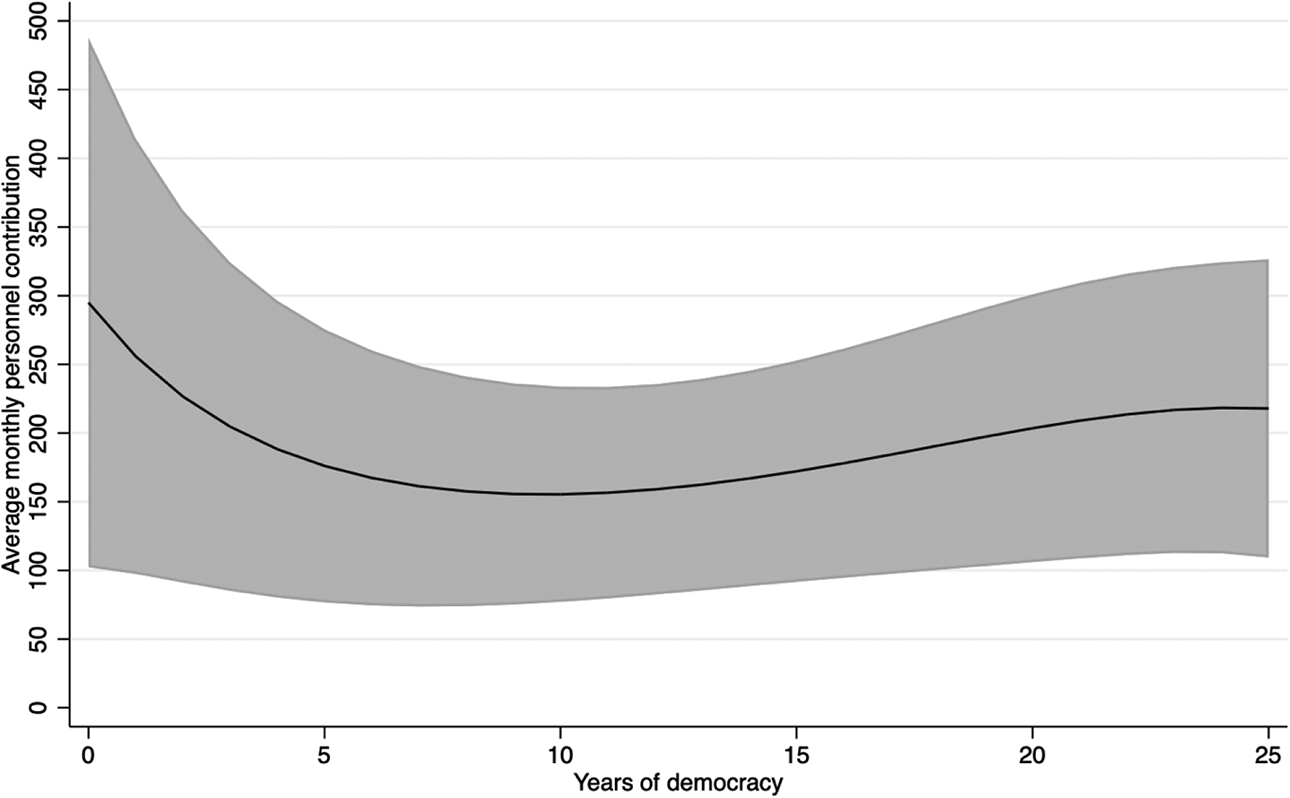
Effect of time since democratization on personnel contributions.
What is perhaps surprising is the speed with which the decline occurs after democratization. There are ways of interpreting this quick shift, however. Most obviously, the state may have achieved its objectives such that sustained contributions are not required. While it is unlikely that civil–military relations have been comprehensively reformed within 5 years, this may indicate that the situation has stabilized. Other facets of democratic consolidation may play a role, such as a stronger and more stable economy that reduces government fears of military intervention or strengthened relations with other strong democracies that could deter the military from attempting to destabilize the domestic system. Other explanations are possible. Perhaps the initial contribution made by the state is high in order to send a resounding signal to relevant actors, after which it can sustain its reputation with smaller contributions. Alternately, the state may experience problems with the chosen tactic of involvement in peacekeeping, finding that it has overstretched its military. Whatever the case, new democracies perceive the time immediately after transition as the best to deploy large numbers of military personnel to peacekeeping.
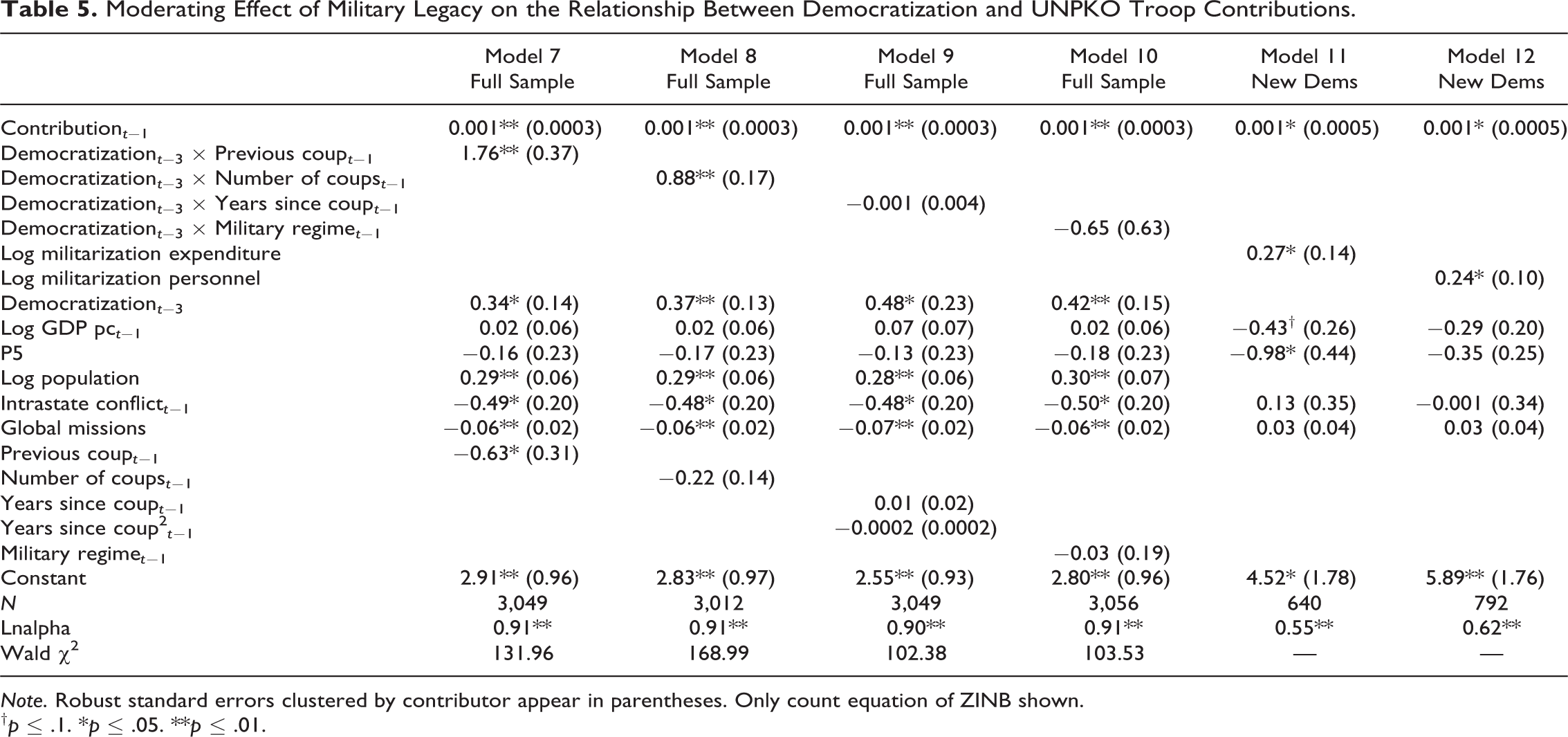
Lastly, I test Hypothesis 3 to more directly test the proposed mechanism of my argument and identify whether new democracies undertake peacekeeping in greater measure when the military is perceived to be a greater threat. Table 5 shows a test of each of the six military legacy variables. In Models 7–10, the variables are interacted with democratization across the full sample to test for a moderating effect. Rather than testing each window of democratization, I choose the midpoint for these models: democratization occurring within the last 3 years. For the two militarization variables (Models 11 and 12), the sample is restricted to those countries that experienced a democratic transition during the time frame, since the variables measure the military’s size prior to democratization. I test these models using a ZINB estimation as with the first two hypotheses although only the count equations are shown in Table 5.
Moderating Effect of Military Legacy on the Relationship Between Democratization and UNPKO Troop Contributions.
Note. Robust standard errors clustered by contributor appear in parentheses. Only count equation of ZINB shown.
† p ≤ .1. *p ≤ .05. **p ≤ .01.
The results vary across the different measures of military legacy. Regarding coups, the coefficients for the interactions indicate that the effect of democratization on contributions is amplified in countries where a coup has occurred historically (Model 7) as well as when the number of coups is higher (Model 8). However, there is no discernible effect of a more recent coup (Model 9). This suggests that governments may be wary of coups due to past experience and that the institutional memory of coups does not quickly subside, but rather more distant coups may be equally as concerning as recent ones. Substantively, the effect of past coups is significant. While a new democracy with no coup history will give an average of 230 troops per month, a new democracy with any past experience will give 711, more than 3 times the former amount. Considering the number of coups experienced, a new democracy with three coups in its history will give a monthly average of 3,304 troops, a 7-fold increase on one coup, and 14 times more than a new democracy with no coup history.
Concerning the military’s role before transition to democracy, the results suggest that where the military had greater capacity, contributions to UNPKOs are higher in new democracies. This is true for both countries with a larger defense budget (Model 11) and a greater number of military personnel (Model 12). While the results for the militarization variables may indicate that countries give more simply because they have more to give, this was not borne out for all countries in Models 1–8 but rather appears to be a unique feature of new democracies. Model 10 indicates that contribution patterns are not affected by whether or not the previous government was a military regime. It should be noted that the militarization coefficients in Models 11 and 12 are not statistically significant with the inclusion of population as a control variable. Although it is highly correlated with both variables and may cause this outcome due to introducing multicollinearity into the model, it cannot be discounted that the effect of militarization may be unstable.
These results taken together support the idea that the military did not have to exert its influence on domestic politics through governing or recent coups to evoke action from the democratic government. Rather, the perceived latent threat of the military, whether due to its historical role or its size at the time of democratization, appears sufficient to drive the government to deploy troops to UNPKOs. More broadly, these results suggest that while democratization may offer a variety of incentives for countries to participate in UN peacekeeping, concerns over civil–military relations appear to play a significant role.
Civil–Military Motivations: Evidence From Argentina
Argentina illustrates well the use of peacekeeping to reform civil–military relations in the wake of a democratic transition. After years of political turbulence at the hands of the military, Argentina was able to successfully transition to democracy in the 1980s and 1990s and reconfigure civil–military relations to bring the institution under the control of the democratic civilian government. A centerpiece of this effort was the involvement of the military in UN peacekeeping. First, Argentina’s peacekeeping participation assuaged the immediate risk of a coup by placating the military, while also enabling government efforts to reignite economic growth and establish legitimacy with society. Second, the government was strategic in supporting missions that would maximize the military’s exposure to democratic norms through co-deployment with established democracies as well as missions that would reinforce a professional military and divest it of its previous tendencies toward domestic-oriented tasks. These factors would redirect the military to becoming a functioning yet subordinate component of a democratic system.
The Argentinian military established its prominence as a political force in the late 19th century but consolidated its power through the 1966 takeover, which established a governing military regime that would last until 1983. Widespread human rights abuses and gross mismanagement of the economy ultimately paved the way for democratic transition. The first president elected in the newly democratic regime, Raul Alfonsín, embarked on a campaign of sweeping reform of, and retribution against, the military. Numerous military leaders were tried and imprisoned for their roles in human rights violations. He further sought to comprehensively remove political influence from the military by creating a Ministry of Defense, while his 1988 National Defense Law removed the military from domestic tasks such as internal security. Lastly, Alfonsín stripped the military of the resources that might perpetuate its strength. Between 1982 and 1989, defense expenditure both in actual terms and as a proportion of public sector expenditure was cut almost in half, while armed forces personnel were reduced from 175,000 to 95,000 (Hunter, 1996, p. 12).
The historical record indicates that Alfonsín’s reforms were both excessive and misguided. Undergirding his approach was a desire to exclude and shackle the military rather than incorporate it into the democratic order. This ultimately failed to strip the military of its political inclinations, instead inadvertently spurring it to hold on to what influence it could. The almost inevitable result was a series of military rebellions between April 1987 and December 1988 (Hunter, 1996, p. 13). While the government survived, it highlighted the failure of Alfonsín’s approach and ultimately led to a change in power as Carlos Menem was elected president in 1989.
Menem immediately departed from the existing posture, seeking instead to coopt the armed forces into the democratic system. Menem curbed the slashing of military budgets (Hunter, 1996, pp. 14–15) and facilitated a new role for the military that would support both democratic consolidation and economic development. Central to this strategy was involvement in UN peacekeeping, which would redirect the military’s attention and purpose, allow it to practice its profession in an acceptable manner, and expose it to norms of democratic civil–military relations. Furthermore, it would offset the frustration of continued reduction in defense expenditure without diverting resources away from society.
Argentina’s first major involvement in peacekeeping came in 1990, when around 600 troops were sent to support the UN-sanctioned blockade of Iraq (Norden, 1995, p. 331). In the subsequent years, large contingents were deployed to missions in Croatia, Somalia, Cyprus, Haiti, and Angola (Hunter, 1996, p. 7). Between 1992 and 1996, Argentina was Latin America’s largest suppliers of troops to UNPKOs and was in the top five contributors worldwide (Sotomayor, 2010, p. 181).
In the immediate term, involving the military in peacekeeping would assuage its fears of further punishment and dismantling. For individual soldiers, peacekeeping offered the rare opportunity of foreign travel experiences (Norden, 1995, p. 340) and interaction with better trained militaries from other countries, providing valuable knowledge and expertise (Hunter, 1996, p. 17). Perhaps more importantly, peacekeeping provided soldiers with a comfortable salary. Where a sergeant would earn around $760 per month prior to the 2001 depression, a peacekeeper would make approximately $1,400 (Sotomayor, 2014, p. 45).
At the institutional level, peacekeeping would not only give the military a new purpose but would reinforce some of its prior tendencies in a form that did not threaten political stability. Meanwhile, peacekeeping revenues would allow Menem to reduce defense expenditures without causing a major backlash, as had occurred under Alfonsín (see Figure 4) and focus those funds on economic development. Within 2 years of his presidency, inflation had been brought under control and economic growth was occurring. In just 3 years, from 1989 to 1992, per capita income in Argentina (in current US Dollars) rose from $2,973 to $4,903, a 65% increase (K. S. Gleditsch, 2002).
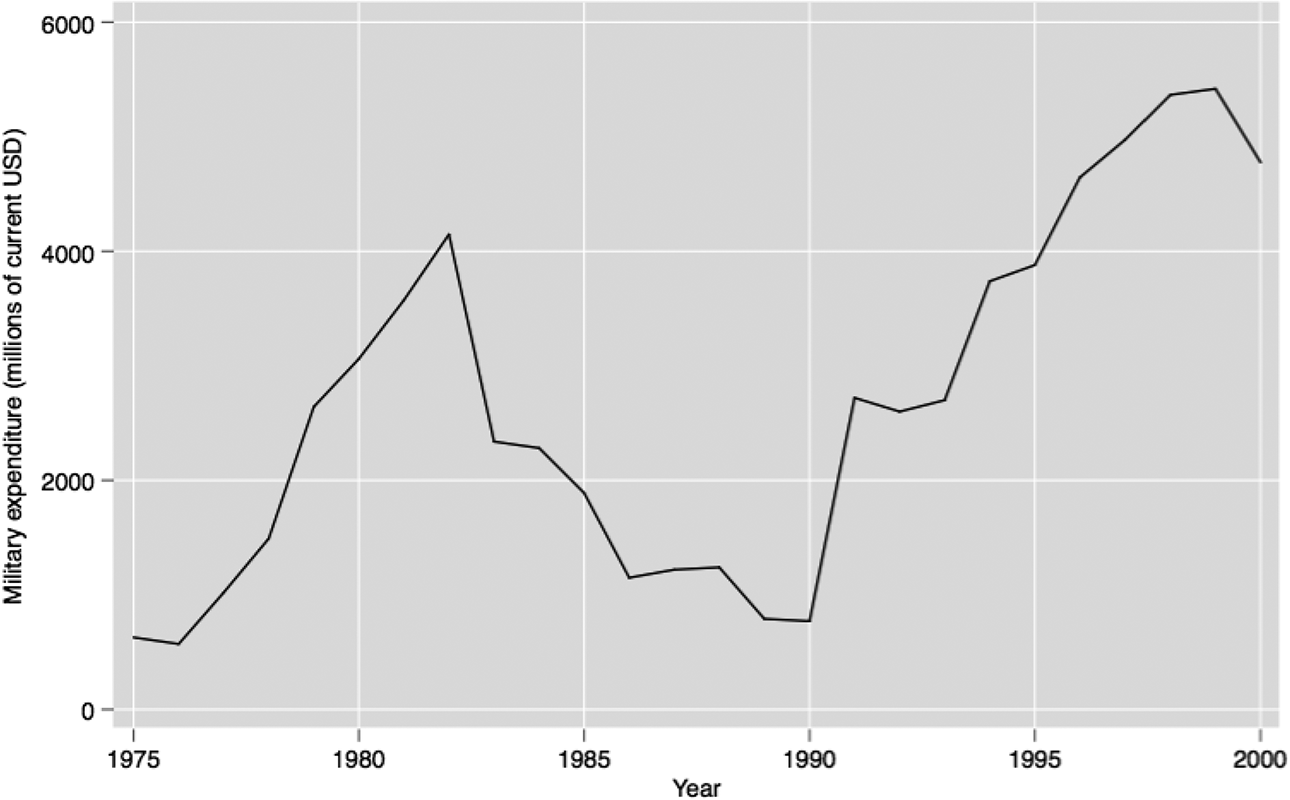
Argentina’s military expenditure, 1975–2000 (Singer et al., 1972).
Beyond temporarily appeasing the military, the Menem government actively sought to diffuse the benefits of peacekeeping as broadly throughout the military as possible. This suggests that a greater incentive to involve the military was to seek its long-term reorientation toward democracy. While many militaries would create small, specialized peacekeeping units (Worboys, 2007, p. 153), the Argentinian government sought to extend the opportunity broadly. Within only the first half-decade of involvement, around 40% of the country’s commissioned officers gained UNPKO experience in some form (Sotomayor, 2010, p. 181).
During this period, the military’s view of both peacekeeping and civil–military relations changed drastically. According to interviews with Argentinian soldiers conducted by Fitch (1995), only 3% supported peacekeeping as a military mission in 1985, while the number jumped to 81% by 1992. Fitch also found that while 70% of soldiers believed that internal security was one of the military’s missions in 1985, only 30% believed the same in 1992. Thus, attitudes were shaped by more than just financial and professional incentives. Rather, a broad ideological shift occurred that made the military much more amenable to a democratic conception of the military role.
The professionalization of the military toward an institution more narrowly focused on external missions rather than domestic politics occurred in several ways. Prior to deployment, soldiers underwent comprehensive peacekeeper training implemented by the government. The Centro Argentino de Entrenamiento Conjunto Para Operaciones de Paz sought to prepare troops for deployment by bringing them into a better understanding of UN norms. The components of training were often outside that of prior domestic military training, focusing on such subjects as cultural and religious awareness, international law, human rights, negotiation and diplomacy, impartiality, and civil–military relations (Sotomayor, 2014, p. 74; Worboys, 2007, p. 158). Beyond this, Argentina was strategic in its deployment to maximize democratic socialization and narrowly professionalize the military as an entity separated from domestic society. Regarding socialization, it sent most peacekeepers to missions in Europe that were predominantly staffed by European and other Western countries. UNFICYP, long recognized as a Western-dominated mission, exemplifies this. Between 1992 and 2011, Argentina was the only non-European country to make a sizable contribution of troops. In total, it gave 29.2% of all troops during this period, second only to the United Kingdom. This equated to an average monthly deployment of 370 soldiers. By comparison, Chile made an average contribution of 15, Peru gave two, and Brazil and Uruguay sent only one. These deployments indicate a strong desire by the government for its military to serve alongside militaries with an established record of healthy civil–military relations.
The government also sent personnel to missions that would establish the military as a politically disengaged force by seeking out tasks that reflect a military focused on external security rather than an internal role. Figure 5 shows the total number of military personnel contributed by Argentina between 1992 and 2011, broken down by the type of mission to which they were sent. 4 Overwhelmingly, Argentina chose to send troops to missions with narrow military roles (observer, traditional, and enforcement) and sent less than 1% to multidimensional missions. 5 The Menem government simultaneously reduced the military’s participation in politics to a largely advisory role, focusing only on issues of defense and foreign policy.

Deployment of Argentinian military personnel by mission type, 1992–2011. Data source: Kathman (2013); Doyle and Sambanis (2006).
In conclusion, the effective subordination of the once-dominant military under the Menem government proved pivotal in establishing democracy in Argentina. These policies carefully balanced the demands of society with the need to avoid excessive reform of the military that might incite repeats of prior rebellions. The success of this approach is articulated well by former Defense Minister Oscar Camilión, stating that peacekeeping has not only “given members of the armed forces a deep feeling of professional pride, but also an international outlook which is very much helping to consolidate the military as a pillar of the constitutional system” (Camilión, 1995, p. 15).
Conclusion
As the size and scope of UN peacekeeping has grown in recent decades, an unlikely category of states with underdeveloped political institutions and comparably weaker economies has stepped up and shouldered much of the burden. This study find evidence that a particular subset of states, those in the early years of democracy, are the most likely contributors of troops to UN peacekeeping. These findings support the idea that democratizing states find in peacekeeping an opportunity to strengthen domestic political institutions and reduce the risk of military interference. This challenges previous arguments that it is the strength, rather than the weakness of democracy that elicits greater peacekeeping involvement, and offers insight into how states might effectively use international organizations and foreign policy to mitigate one of the most pressing threats to democratic consolidation.
The complex relationship between state and military also suggests that peacekeeping may only be of benefit under certain conditions. As seen in the case of Argentina, it was the government’s strategic decision to deploy to missions that appear to have maximized socialization to democratic norms and professionalization to an apolitical military role in society. While testing the outcome of contributions to benefit democratization are outside the scope of this project, this assertion is supported by mixed findings on the impact of peacekeeping on militaries (Dwyer, 2015; Levin et al., 2016, Scobell, 1994; Lundgren, 2018; Sotomayor, 2014). Future research might consider the systematic effect of these nuances both in deployment patterns and their consequences.
Beyond the study of democratization and civil–military relations, the findings here suggest important implications for UN peacekeeping. The role that was once the remit of militaries from wealthy, established democracies has largely been undertaken by poorer countries with inferior military training and lack of experience in taking a back seat to a democratic government. The provision of funding and equipment by established democracies is no substitute for having democratic peacekeepers on the ground working to implement peace agreements, overseeing elections, and training local police and soldiers. While recent contribution trends offer benefits for the sending state in terms of domestic political stabilization, they may simultaneously hamper the effectiveness of missions in promoting peace. Moreover, the results indicate that transitioning democracies may not have sufficient incentives to offer sustained contributions as democracy takes root domestically. The fact that peacekeeping has come to rely so heavily on such countries for its personnel in recent years may thus be problematic for the future supply of blue helmets. These are concerns of which the UN is very much aware, and how it chooses to incorporate and incentivize a growing number of less politically and economically developed countries into UN peacekeeping may determine the very future of the enterprise itself.
Supplemental Material
Supplemental Material, sj-docx-1-afs-10.1177_0095327X20968197 - Democratization and Troop Contributions to United Nations Peacekeeping
Supplemental Material, sj-docx-1-afs-10.1177_0095327X20968197 for Democratization and Troop Contributions to United Nations Peacekeeping by Timothy J. A. Passmore in Armed Forces & Society
Footnotes
Acknowledgment
I am grateful for the comments from Megan Shannon, Jaroslav Tir, Carew Boulding, David Bearce, Benjamin Teitelbaum, Gaspare Genna, Brandon Boylan, and three anonymous reviewers.
Declaration of Conflicting Interests
The author declared no potential conflicts of interest with respect to the research, authorship, and/or publication of this article.
Funding
The author disclosed receipt of the following financial support for the research, authorship, and/or publication of this article: Funding for this research was received from the Horowitz Foundation for Social Policy.

Supplemental Material
Supplemental material for this article is available online.
Notes
References
Supplementary Material
Please find the following supplemental material available below.
For Open Access articles published under a Creative Commons License, all supplemental material carries the same license as the article it is associated with.
For non-Open Access articles published, all supplemental material carries a non-exclusive license, and permission requests for re-use of supplemental material or any part of supplemental material shall be sent directly to the copyright owner as specified in the copyright notice associated with the article.
