



Abstract
Previous research indicates that one’s identity relates to one’s use of specific coping strategies. Exploring the relationship between self and coping in military wives is crucial to understanding how they manage military lifestyle-related stressors. The researchers hypothesized that identity status, self-concept clarity, self-monitoring, mastery, and role conflict will be related to choice of emotion-focused coping or problem-focused coping strategies. Two hundred two participants completed an anonymous online survey containing standardized scales. Ordinary least squares (OLS) regression analyses revealed that emotion-focused coping had positive relationships with achieved identity status and role conflict. Problem-focused coping had positive relationships with moratorium status, self-concept clarity, self-monitoring, and mastery. Findings provide preliminary support that sense of self is important in understanding how military wives choose to cope with particular challenges.
Introduction
Understanding the coping process is crucial for examining psychological adjustment and health (Lazarus, 1993). Coping minimizes negative emotions associated with stressors and is a key factor in maintaining positive affect in the face of substantial difficulties (McCrae & Costa, 1986). A wide range of coping strategies may be needed when an individual encounters chronic or repeated stressors (Dimiceli et al., 2010; Patterson & McCubbin, 1984; Thoits, 1986). Women who are married to male military service members face a unique constellation of challenges (Clever & Segal, 2013; Dimiceli et al., 2010; Drummet et al., 2003; Green et al., 2013; Joseph & Afifi, 2010) which demand constant use of coping strategies. Understanding which coping strategies are used by this population as well as factors associated with choice of coping are important first steps in identifying what may promote successful outcomes for this group.
Extant research has documented the impact of typical military stressors on military wives’ functioning (e.g., Aducci et al., 2011; Clever & Segal, 2013; Dimiceli et al., 2010; Green et al., 2013; Padden et al., 2011). However, the literature’s generally limited focus on stressors and well-being, without attention to coping processes, suggests that the military lifestyle itself determines outcomes. While external factors may play a role in outcomes, these women also have control over the ways in which they cope.
To date, most research regarding military spouses has centered on deployment-associated stressors (e.g., Aducci et al., 2011; Davis et al., 2011; Nichols et al., 2013), with less attention given to wives’ experiences of overall Active Duty lifestyle challenges (Green et al., 2013). One of the most fundamental, but rarely recognized, difficulties these women confront is maintaining a healthy sense of self. Research shows that the Active Duty military lifestyle constantly threatens to undermine her sense of identity by expecting that she place the military’s needs ahead of her own (Drummet et al., 2003; Robbins, 2002; Ziff & Garland-Jackson, 2020), and adapt to career interruptions and new roles with each relocation (Dimiceli et al., 2010; Ziff & Garland-Jackson, 2020). Military wives may perceive a lack of control over their lives (Aducci et al., 2011; Davis et al., 2011; Dimiceli et al., 2010; Robbins, 2002). To manage these stressors, they may look to others for behavioral or emotional cues to conform (Drummet et al., 2003; Wang et al., 2015).
Given this specific set of challenges and the lack of research on the overall military spouse experience, it is important to examine whether sense of self influences choice of coping strategies in contexts outside of deployment. More research is needed on the cumulative effects of this unique lifestyle on choice of coping. Additionally, understanding the relationship between the self and choice of coping would likely yield important information for clinicians who serve military wives, those who create programs to support them, and those who create policies aimed to benefit them (Braun-Lewensohn & Bar, 2017; Runge et al., 2014). The lack of comprehensive services available for military wives (Klodnicki, 2015) underscores the importance of understanding more about choice of coping and could prompt service providers to consider a new aspect of these women’s lives as they develop supports. This paper explores the relationships between identity status, self-concept clarity, self-monitoring, role conflict, and mastery and choice of coping strategy.
Conceptual Framework
Coping Strategies
Coping strategies are generally classified as problem-focused coping or emotion-focused coping. Problem-focused coping strategies are efforts made to change a specific problematic situation (e.g., changing a work schedule that is problematic), whereas emotion-focused coping strategies are efforts made to temper feelings associated with a stressor (e.g., venting frustration to a friend; Folkman & Lazarus, 1980; Thoits, 1995). Problem-focused coping is typically used when one appraises a stressor as modifiable; emotion-focused coping is generally used in situations appraised as unchangeable (Folkman & Lazarus, 1980).
Substantial research links dispositional characteristics to choice of coping strategy (e.g., Baltes et al., 2011; Carver et al., 1989; Luyckx et al., 2012). However, few studies have considered the importance of inherent traits (exceptions include Aducci et al., 2011; Robbins, 2002; Sinclair et al., 2019) and their relationships to military wives’ coping. While a small number of studies have advanced understanding of coping behaviors among Active Duty military wives (e.g., Dimiceli et al., 2010; Dolphin, et al., 2015), they tend to ground examinations of military spouse coping behaviors during deployment separation rather than exploring coping with military life stress generally (Wang et al., 2018 being an exception).
For example, Dimiceli et al. (2010) found that the majority of their sample (85%) were coping with a deployment-related stressor (e.g., giving birth alone while the spouse was deployed). Although military spouses in their sample used both types of coping strategies, they used problem-focused coping significantly more than emotion-focused coping. They note the unexpected nature of this finding given their understanding that stressors among military wives are typically uncontrollable. They add that their findings may be understood in light of using a slightly broader operational definition for problem-focused coping (i.e., including positive reframing and seeking emotional or instrumental support as problem-focused coping). Despite these potential explanations, it is clear that further exploration is needed in understanding the coping process among military wives.
Internally and Externally Focused Components of the Self
The self is complex and multi-faceted. It is a psychosocial concept comprising the way individuals perceive themselves internally, in relationships, and related to society at large (Campbell, 1990; Campbell et al., 1996; Light & Visser, 2013; Marcia, 1966; 1980; Snyder, 1974). A healthy sense of self generally maintains a degree of stability across time and situations, but it is also adaptable even into adulthood (Carter & Bruene, 2019; Kroger et al., 2010; Marcia, 1966; 1980; Meeus, 2018). Life experiences, maturity, and decisions made all affect a person’s identity structure (Marcia, 1980) and the clarity one has about one’s self (Light & Visser, 2013; Ritchie et al., 2011).
Given the complexity of the self and the role that cognitive appraisal plays in the coping process (Folkman & Lazarus, 1980; Ritchie et al., 2011), one can reasonably assume that various components of the self may affect choice of coping. Therefore, it is important to examine multiple aspects of the self in relation to coping so that a more comprehensive, nuanced understanding of this relationship can be developed. This is of particular importance to the military spouse population as these women face numerous threats to sense of self.
Internally Focused Components of Self: Identity Status and Self-concept Clarity
As noted above, the self comprises both internally focused and externally focused components. Identity status (Marcia, 1966) and self-concept clarity (Campbell, 1990; Campbell et al., 1996) are inward-focused concepts of the self. Identity status encompasses the extent to which a person has engaged in exploration and committed to an identity (Marcia, 1966). Marcia based his work on Erikson’s (1956, 1963) theory, conceptualizing four status levels of identity formation: achieved, moratorium, foreclosed, and diffusion. In this framework, a person with achieved identity status (considered the most mature) has been through a period of exploration; come to a strong sense of commitment; and is thus imbued with a sense of stability regardless of circumstance. Moratorium status describes those in the active exploration stage who have yet to firmly commit to one ideology or occupation. A person with foreclosed status has a high degree of commitment, but has not engaged in exploration and value-weighing: this leads to a high degree of inflexibility in personality and decision-making. In identity-diffusion (considered the least mature), the person may or may not have experienced the crisis period and shows little interest in settling on an occupation or belief system.
Identity status remains a topic of interest and debate (e.g., Kroger et al., 2010; Meeus, 2018; Pellerone, 2013, 2015). Previous research indicates that identity status and its components are associated with choice of coping strategy. Specifically, achieved and moratorium statuses were found to relate to higher degrees of problem-focused coping while foreclosed and diffusion related to lower degrees of problem-focused coping in college student samples (Grotevant & Adams, 1984). More recently, Pellerone (2013, 2015) demonstrated that extent of self-exploration negatively correlated with avoidance coping strategies and was predictive of use of problem-solving strategies in samples of adolescents and young adult university students. Together these findings suggest that engaging in self-exploration (the component common to both achieved and moratorium statuses) may relate more to use of problem-focused coping. However, given the nature of these samples, it is unclear whether this pattern would hold true for other adult groups.
Identity status in military wives may interact uniquely with choice of coping strategy. For those with moratorium or diffuse identity statuses, feelings of being out of control (Davis et al., 2011; Dimiceli et al., 2010) or “in second place” (Aducci et al., 2011; Ziff & Garland-Jackson, 2020) may exacerbate immature responses and impede growth. These challenges may prompt intense emotions among those with foreclosed identity status who lack openness to new experiences and to those with an achieved status who have a strong commitment to identity.
Self-concept clarity, another inwardly focused component of self, also remains a topic of interest (e.g., Carter & Bruene, 2019; Light & Visser, 2013; Slotter & Walsh, 2017). Self-concept clarity is “the extent to which the contents of an individual’s self-concept (e.g., perceived personal attributes) are clearly and confidently defined, internally consistent, and temporally stable” (Campbell et al., 1996, p. 141). Self-concept clarity differs from identity, which has more depth and complexity, and is integral to self-esteem because a lack of self-concept clarity may create vulnerabilities related to negative input from one’s environment (Campbell, 1990; Campbell et al., 1996). Self-concept clarity helps to organize experiences to enable coping with life’s challenges (Epstein, 1973). Moreover, a high degree of self-concept clarity is typically viewed as promoting general well-being (Slotter & Walsh, 2017).
Previous authors have called for more exploration of how self-concept clarity and coping interact, given the role it may play in the stress appraisal process (Lee-Flynn et al., 2011; Ritchie et al., 2011; Smith et al., 1996). It may provide ways for a person to maintain a positive self-view and cope actively with negative feedback and social conflict (Bechtoldt et al., 2010). Smith et al. (1996) found evidence that self-concept clarity was related to coping choice as a general style, in response to an event, and in dealing with an ongoing stressor. Specifically, high self-concept clarity was generally related to use of more active coping strategies, while lower self-concept clarity was associated with more passive strategies.
Given the certainty of self-knowledge in achieved and foreclosed identity statuses (Marcia, 1966) and in high self-concept clarity (Campbell, 1990; Campbell et al., 1996), one might expect these facets of the self to relate similarly to choice of coping. The inverse might be true for moratorium and diffuse statuses and low self-concept clarity. However, they may not operate in tandem, given the fact that self-concept clarity does not necessarily encompass the extent to which a person engages in exploration before landing on a sense of identity, which is a central feature of identity status.
Externally Focused Components of the Self: Self-monitoring, Role Conflict, and Mastery
Self-monitoring, role conflict, and mastery are each components of the self that interact a great deal with one’s social environment. The self-monitoring individual is “one who, out of a concern for social appropriateness, is particularly sensitive to the expression and self-presentation of others in social situations and uses these cues as guidelines for monitoring his own self-presentation” (Snyder, 1974, p. 528). Self-monitoring emphasizes a person’s attentiveness to social cues and the degree to which he, she, or they desire to adjust behavior to those cues. A person could find this attentiveness to be useful in coping with life’s challenges or the person could find the constant awareness of others’ expectations stifling.
Lower degrees of self-monitoring have been associated with increased experiences of emotional symptoms and with greater likelihood of using emotion-focused coping, while higher degrees of self-monitoring were correlated with higher use of more active, problem-focused coping (Huflejt-Łukasik & Czarnota-Bojarska, 2006). Given the social pressure of the Active Duty military lifestyle, self-monitoring is likely to drive choice of coping strategy for the challenges faced by military wives. However, self-monitoring may relate differently to coping for this group, given the likelihood they may modify behavior or emotional expression to conform to what they feel the military community expects of them (Drummet et al., 2003; Wang et al., 2015). For some, this constant adjusting may lead to stress and an appraisal that the expectations are inescapable, driving use of emotion-focused coping; others may find it helpful to look to others for guidance in new situations, leading to use of problem-focused coping (Snyder, 1974).
Role is also an important outward-facing component of the self. Roles are created through social interactions and lead to expectations regarding predictable behavior associated with the role (Biddle, 1986; Stryker, 1968). Roles reflect a person’s values and priorities, and they guide behavior and social interactions in ways that inform self-knowledge (Callero, 1985; Light & Visser, 2013; Stryker, 1968). Thus, roles may be considered an outward-facing aspect of the self (Callero, 1985; Stryker, 1968).
Two primary theories exist as to how the number of roles a person impacts individual functioning: the scarcity (Goode, 1960) and enrichment (Marks, 1977) theories. The scarcity approach holds that individuals do not have enough time or resources to meet the demands of all the roles they inhabit. The enrichment theory argues that the greater the number of roles a person holds, the more benefits the person receives from them. Some studies have supported the enrichment approach (e.g., Baruch & Barnett, 1986; Kulik & Liberman, 2013), while others report inconclusive findings (e.g., Coverman, 1989; Kulik et al., 2015; Lenaghan & Sengupta, 2007). This lack of clarity suggests that something other than the number of roles may be more important to understanding the impact of role management (Baruch & Barnett, 1986; Kulik et al., 2015). Perhaps one such factor is the experience of role demands conflicting with one another.
Role conflict is the experience of having two or more roles with expectations or demands that contradict one another (Biddle, 1986; Lazarus & Folkman, 1984). Role conflict may reflect the challenges of negotiating the hierarchy of identity salience in a given situation (Stryker, 1968). Role conflict has been shown consistently to be associated with negative emotional outcomes such as decreased job satisfaction and increased psychological distress (Coverman, 1989). It is also associated with increased emotional distress at home and at work (Kulik & Liberman, 2013), sense of meaning in life (Kulik et al., 2015), and exhaustion (Hornung et al., 2016). Thus, it is important to examine role conflict as an aspect of the self as well as how it relates to choice of coping.
Previous research has focused on the effects of coping with role conflict rather than how role conflict may influence choice of coping. Emotional and workplace support have been associated with lower family and work distress among those experiencing role conflict between these two domains (Kulik & Liberman, 2013). Additionally, problem-focused coping strategies have buffered the joint effects of role conflict and role ambiguity on worker exhaustion, whereas emotion-focused coping worsened the effects (Hornung et al., 2016). These findings suggest that role conflict and coping interact, but the potential effects role conflict has on choice of coping has yet to be examined. Given the nature of role conflict as an aspect of identity that interacts with the social environment, driving behavior choices, it is logical to consider its impact on choice of coping. Role conflict may be particularly salient for military wives in coping strategies due to the likelihood that they will find themselves in double-bind situations which preclude role conflict from being resolved (Hornung et al., 2016).
Mastery is also a concept that reflects the interaction between self and the external world. Mastery is “the extent to which one regards one’s life-chances as being under one’s own control in contrast to being fatalistically ruled” (Pearlin & Schooler, 1978, p. 5). Mastery refers to an overall worldview of control rather than the controllability of any one specific situation and is comparable to other control-related constructs (Li, et al., 1999). An important distinction to make is that mastery refers to the perceived control of events in one’s life, not necessarily the actual control one has in a range of situations (Burger, 1989). Mastery and other control-related constructs are determinants of the coping process (e.g., Folkman & Lazarus, 1980; Frazier et al., 2011; Pearlin & Schooler, 1978). Part of appraisal is determining the controllability of a stressful situation (Folkman & Lazarus, 1980; Lazarus, 1993). Thus, an individual’s sense of mastery is likely to have a strong influence on that person’s choice of coping strategy in a situation. The Active Duty military lifestyle is rife with conditions which seem to reduce a sense of control, either objectively or subjectively (Aducci et al., 2011; Davis et al., 2011; Dimiceli et al., 2010; Robbins, 2002). However, research indicates that some are able to maintain a sense of personal control over their lives (Robbins, 2002; Wang et al., 2015). Lack of objective control may prompt even those women with a high sense of mastery to employ emotion-focused coping because the stressors they so often face are not within their power to resolve, but they can control the way they manage the emotions associated with that situation. Thus, understanding the role that mastery plays in coping is key for supporting this population.
The Current Study
Collectively, this body of research suggests that constructs of identity status, self-concept clarity, self-monitoring, role conflict, and mastery may differentially influence selection of types of coping strategies in Active Duty military wives. As such, the current study explored the relationships between identity status, self-concept clarity, self-monitoring, role conflict, and mastery and choice of both problem-focused and emotion-focused coping.
Hypotheses
Hypothesis 1. Individuals who endorse the most mature identity status (achieved); higher degrees of self-concept clarity, self-monitoring, and mastery; and lower degrees of role conflict will report significantly greater use of emotion-focused coping as opposed to those who endorse the “less mature” identity statuses (foreclosed, moratorium, or diffused); lower degrees of self-concept clarity, self-monitoring, and mastery; and higher degrees of role conflict when controlling for employment, education, race, husband’s rank, and age.
Hypothesis 2. Individuals who endorse the three less mature identity statuses; lower degrees of self-concept clarity, self-monitoring, and mastery; and higher degrees of role conflict will report significantly greater use of problem-focused coping as opposed to those who endorse the most mature identity status; higher degrees of self-concept clarity, self-monitoring, and mastery; and lower degrees of role conflict when controlling for employment, education, race, husband’s rank, and age.
Methods
This study employed a cross-sectional survey design. The online survey contained demographic information and multiple scales measuring all key concepts. This study was approved by the University of Pennsylvania Institutional Review Board.
Sample Size and Participant Eligibility
Inclusion criteria were: self-identified women who were legally married at the time of study participation to Active Duty/retired from Active Duty male service members (specifically, retired within the previous 3 years) from any branch of the U.S. military whose husbands had served at least 5 years of Active Duty during the time of their marriage. The survey was administered in English. A sample size of at least 120 participants was determined to be sufficient to detect a medium-sized effect (.15) with a power of .9, given the model parameters. However, 202 respondents sufficiently completed the questionnaire to be included in the analysis. Excluded were women who, at the time of data collection, were divorced from service members, married to female service members, currently on Active Duty themselves, or indicated via survey responses that they were members of the LGBTQ community. The choice not to include members of the LGBTQ community was due to likely substantial differences in challenges faced by this group from those of cisgender women married to men, particularly in light of the U. S. military’s historical adoption of the “Don’t Ask, Don’t Tell” policy, repealed only in recent years. Additionally, given the short time period since federal recognition of same-sex marriages, these couples would not have been recognized by the U.S. military for a long enough time frame to meet inclusion criteria. Wives of National Guard/Reserve service members were also excluded due to likely substantial differences in military lifestyle experiences (Lapp et al., 2010; Marnocha, 2012; Wheeler & Stone, 2010). The inclusion of wives of service members retired from the military within 3 years was due to the possibility that cumulative effects of stressors such as employment challenges may continue after the service member exits the military (Borah & Fina, 2017; National Academies of Sciences, Engineering, and Medicine [NASEM], 2019).
Recruitment
Recruitment occurred through multiple strategies. The first author, a U.S. military spouse herself, utilized snowball sampling via email. She also engaged in convenience sampling by posting flyers in two public areas in a community close to U.S. military installations and advertisements on the website craiglist.org (Joseph & Afifi, 2010) and on Facebook pages and websites dedicated to U.S. military spouses (Klodnicki, 2015). Each of these strategies included a brief introduction and a link to the online survey. In addition, Military Spouse magazine was utilized to recruit participants. These methods sought to yield participants from a wide range of geographic areas. Informed consent was obtained from all participants prior to their beginning the survey. The online survey was administered in Qualtrics from April to June 2017 and structured such that the informed consent document appeared immediately upon opening the survey link. Potential participants were asked to confirm that they met inclusion criteria and to discontinue participation if they did not. Potential participants were not allowed to move through to the survey without indicating their consent. Because the first author was recruiting respondents through her personal acquaintances, she chose not to collect any identifying information (e.g., names and birthdates) to keep respondents anonymous. Knowing names of women who had completed the survey created the possibility for the researcher to inadvertently connect content from the coping measure’s open-ended item with what she knew about her acquaintances’ history. Respondents were not compensated for participation.
Measures
Demographic Variables
Demographic variables included husband’s rank, branch of service, and number of deployments, number of geographic relocations, length of marriage, education level, employment status, age, and race.
Dependent Variables
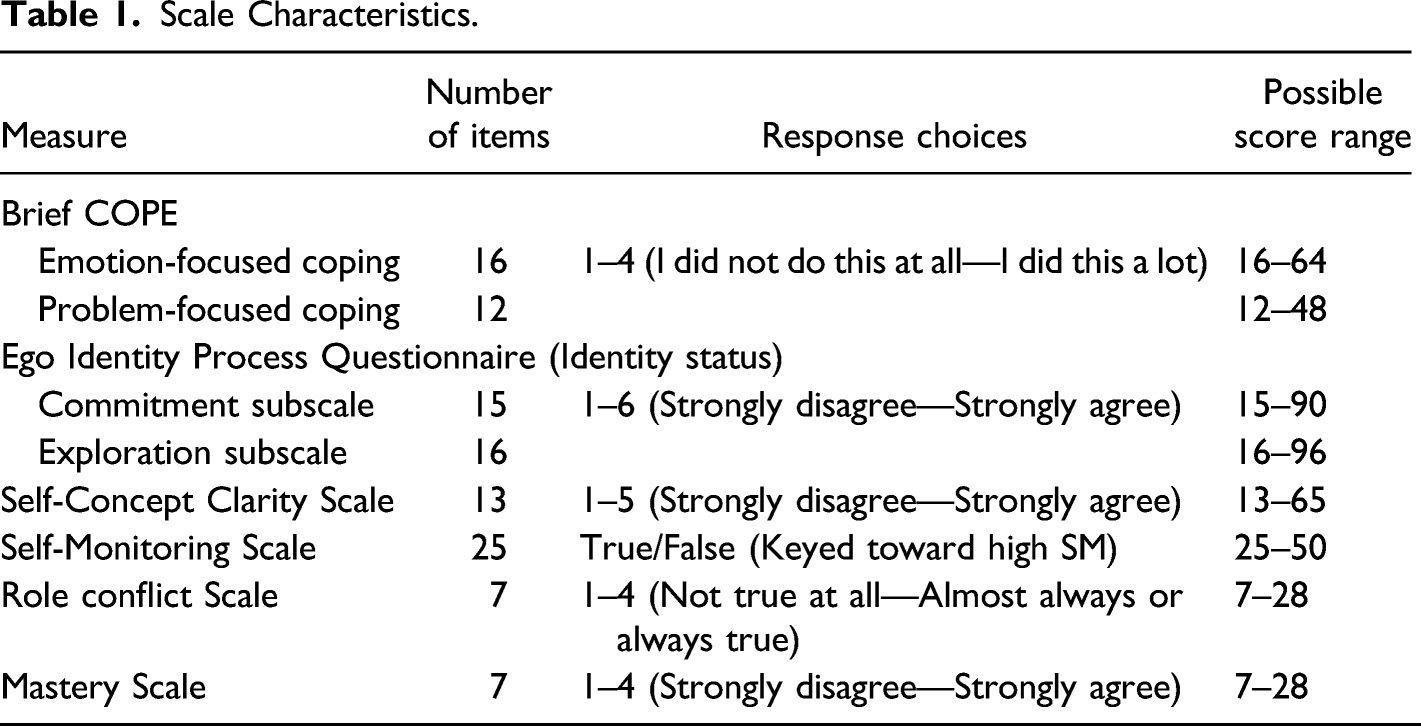
Scale Characteristics.
Independent Variables
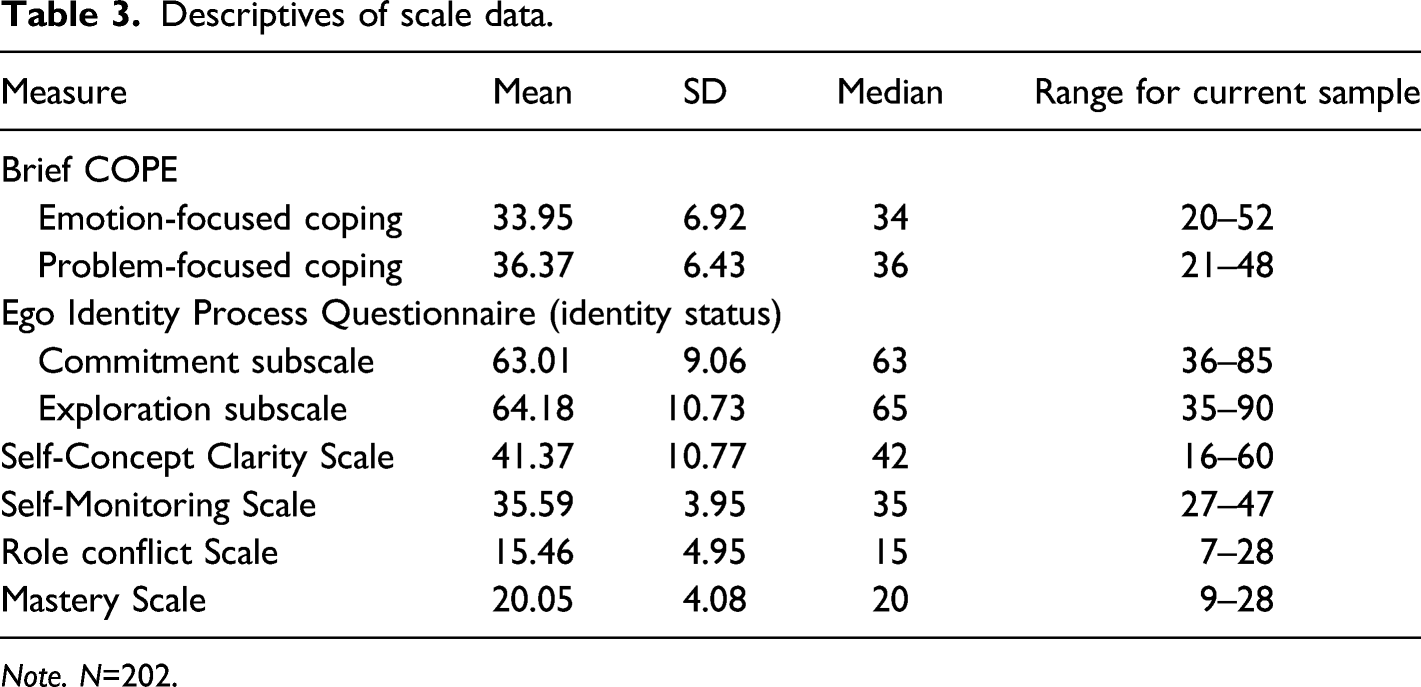
Identity status: The Ego Identity Process Questionnaire (EIPQ) measured identity status, with language slightly modified to reflect “marriage” rather than “dating” (Balistreri et al., 1995). The measure has good reliability, validity, and internal consistency for the commitment and exploration subscales, respectively (Balistreri et al., 1995). Of note is the fact that one item was inadvertently left off the commitment subscale, which affected the range of possible scores (see Table 1). Median scores in Balistreri et al.’s study were 66.5 for the exploration subscale and 62 for the commitment subscale. Despite the missing item in the current sample, median scores were very similar to those from the normed sample (65 for exploration subscale and 63 for the commitment subscale). Alphas for the subscales in the present study were .749 (commitment) and .791 (exploration). Given the omitted item and the differing nature of the current sample from the normed sample, we adapted Balistreri et al.’s (1995) scoring instructions, classifying participants into identity status according to respective scores relative to the sample’s median for each subscale. Respondents who scored above the median for each subscale were classified as “high” on each of the subscales. Those who scored at/below the median were considered “low.” For example, those who scored at/below the median on both commitment and exploration subscales were classified as “Diffuse” status.
Self-concept clarity: The Self-Concept Clarity Scale (SCCS) has demonstrated good construct validity, temporal stability, and internal consistency over repeated administrations (Campbell et al., 1996). Alpha for the present sample was 0.907 (see Table 1 for further details).
Self-monitoring: The Self-Monitoring Scale (SMS) has demonstrated good validity (Snyder, 1974). Respondents scoring above the median were categorized as high in self-monitoring, while those who scored at or below that point were deemed low in self-monitoring (see Table 1). Alpha for the present sample was 0.703.
Role conflict: Seven items created by the first author asking participants whether they perceive the role of military wife conflicting with other roles they inhabit (e.g., daily job responsibilities, overall career, and meeting family’s needs) assessed role conflict. Others have measured role conflict similarly (Coverman, 1989). Alpha for the present sample was 0.858. (see Table 1).
Mastery: The Mastery Scale (Pearlin & Schooler, 1978) assesses individual traits which may serve as coping resources. It has demonstrated good internal consistency (Frazier et al., 2011) (see Table 1). Alpha for the present sample was 0.835.
Data Analysis
Ordinary least squares (OLS) linear regression was used to estimate the relationship between independent variables of identity status, self-concept clarity, self-monitoring, role conflict, and mastery and dependent variables of coping outcomes, while controlling for employment, education, race, husband’s rank, and age. Missing data was addressed by listwise deletion.
Results
Sample Characteristics
Sample Characteristics.

Note. N=202.
Descriptives of scale data.
Note. N=202.
Hypothesis 1
Regression analyses for emotion-focused and problem-focused coping.

Note. “Diffuse” identity status was used as the reference variable in the OLS regression.
* Significant at 0.05 level; **Significant at 0.01 level.
Hypothesis 2
Hypothesis 2 was partially supported. As detailed in Model 2 of Table 4, “moratorium” status was significantly related to problem-focused coping (p < 0.05); associations between other identity statuses and problem-focused coping did not reach significance. Model 2 also revealed significant, positive relationships between self-concept clarity (p < .05), self-monitoring (p < .01), mastery (p < .05), and Caucasian race (p < .05) and the outcome of problem-focused coping. The relationship between role conflict and problem-focused coping did not reach significance.
Discussion
To our knowledge, this is the first study of its kind to examine relationships between self and identity-related variables and choice of coping strategies in a sample of U.S. Active Duty military wives. Results revealed that they utilized a wide range of coping strategies in navigating the multitude of challenges associated with the Active Duty lifestyle. This diversity of coping strategies may reflect the more experienced nature of this sample, who had lived through several relocations and spouse deployments on average. In other words, perhaps over time, the respondents had collected a rich toolbox from which to draw in managing challenges of the Active Duty lifestyle. On average, participants reported use of problem-focused coping more frequently than they did emotion-focused coping, even though the range of scores for the emotion-focused coping subscale was higher (20–52) than that of problem-focused coping subscale (12–48). This suggests that respondents were much more likely to utilize problem-focused coping. Perhaps this is due to the important role problem-focused coping can still play, even in dealing with stressors that are not in the person’s control. For example, problem-focused coping such as acceptance of a relocation may be the only real option for these women, as they are likely unable to prevent these changes from taking place. Additionally, acceptance may spur the planning process around the upheaval that such changes will inevitably cause. Seeking social support may assist them in this process, as it may enable them to determine what resources are available to them. Similarly, seeking emotional support from others may enable these women to reframe a challenge. As Pearlin and Schooler (1978) note, seeking social support may set the person on the path of determining next steps in the coping process. Ultimately, while these women may not be able to change circumstances, they can change the way they think about and prepare for them.
Overall, findings yielded partial support for both hypotheses. Emotion-focused coping had significant, positive relationships with achieved identity status and role conflict as well as significant inverse relationships with self-concept clarity and mastery. Problem-focused coping had significant positive relationships with moratorium identity status, self-concept clarity, self-monitoring, and mastery. One perplexing aspect of these findings was that achieved identity status operated differently from self-concept clarity. While this lends further support for the contention that they are distinct (Campbell et al., 1996), these constructs were hypothesized to have similar relationships with coping responses. However, although self-concept clarity was related to problem-focused coping, the associations between achieved status and problem-focused coping did not reach significance. In addition, self-concept clarity was inversely related to emotion-focused coping, whereas achieved identity status was positively associated with emotion-focused coping. In reflecting on the unexpected nature of these findings, it is important to consider that hypotheses were based on previous research involving college students and that two of the studies were decades old (e.g., Grotevant & Adams, 1984; Pellerone, 2013; 2015; Smith et al., 1996). Therefore, our distinct findings related to identity status and self-concept clarity may offer further support for the idea that identity development continues beyond adolescence, as our sample’s mean age was 35.62. Additionally, our findings likely reflect the impact of the unique Active Duty military spouse lifestyle. For example, as noted previously, self-concept clarity may operate differently from achieved identity status because high self-concept clarity does not necessarily require a great deal of exploration beforehand. However, exploration and commitment are requisites of an achieved identity status. Thus, perhaps the rich and varied nature of the Active Duty military lifestyle (particularly those of an older, more seasoned sample such as ours) contributed to these distinctive outcomes. In addition to the typical maturational processes and changing dynamics that occur within all marriages and families, women married to Active Duty service members face new role expectations with their husbands’ career progression. Furthermore, they hold and constantly adjust to new personal and professional roles with each relocation (Eubanks, 2013). Such experiences would contrast with the earlier samples of college students, whose lifestyles and roles were perhaps more consistent, and may explain why the two constructs operated differently than expected.
The question remains, then, what the particular distinctions are between the two concepts which led to their differing relationships with choice of coping. One might assume that an individual who had engaged in much exploration and firmly committed to an identity would have a rich self-concept that is clear and consistent across time. This may not be the case. Perhaps the distinction between SCC and achieved identity status is the emphasis placed on internal consistency and temporal stability in spite of changing circumstances. In other words, perhaps high self-concept clarity, or the ability to maintain a clear sense of self amid change within that core self, allows for flexibility not afforded by commitment to an identity, which may continue to develop over time. Epstein (1973) notes that one major role of self-concept is to consolidate all of the information from the individual’s life experiences in a way that enables the individual to cope with life’s challenges. Epstein also states that an individual with an extensive self-theory will have concepts available for coping with a wide variety of situations. He will be aware of more facets of his feelings, abilities, and personality characteristics than an individual with a narrow self-theory. Accordingly, he should be more flexible and open to new experience (Epstein, 1973, p. 408).
A theme in the military spouse literature is that living the military lifestyle produces a sense of personal growth and an enhanced sense of self for many military spouses (e.g., Aducci et al., 2011; Davis et al., 2011; Robbins, 2002; Runge et al., 2014). In other words, a rich, complex self-concept fosters coping through offering the individual many inner resources on which to draw. Thus, respondents with high self-concept clarity maintain their internal sense of self regardless of the vicissitudes they encounter in the Active Duty military lifestyle. This may provide additional insight into the fact that nearly half of the present sample fell into the “moratorium” identity status: a sense of growing, adapting, and maintaining flexibility are important factors in coping with the lifestyle across studies. One potential factor in understanding the positive relationship between achieved identity status and emotion-focused coping may be the importance that sense of purpose has for military spouses; this is particularly true in their careers, as they face frustrations having to “start over” with each relocation (Sonethavilay et al., 2021; Dimiceli et al., 2010).
Additionally, the two measures themselves may provide some insight into the differences between these constructs. The SCCS (Campbell et al., 1996) is comprised of questions that relate almost exclusively to one’s internal consciousness (i.e., what the person thinks about herself). In contrast, the EIPQ (Balistreri et al., 1995) asks the individual to reflect on interactions with her external environment and internal characteristics. The EIPQ may not be the most appropriate measure for use with this population, primarily because the items used to measure commitment may not translate well to the Active Duty military community. For example, asking an Active Duty military wife whether she has definitively decided on the occupation she wants to pursue may not be applicable if she knows that she is unlikely to have a steady career. This may not reflect a lack of commitment; rather, such alterations may be a coping response to her employment reality, which is often checkered due to multiple relocations and changing roles related to her spouse’s work commitments. Furthermore, the EIPQ’s relation to choice of coping was tested with college students, whose life experiences and responsibilities may not have been so varied as Active Duty military wives. Future research should include development and psychometric testing of culturally responsive instruments designed to measure these constructs in samples of Active Duty military wives.
Just over 40% of respondents fell into “moratorium” identity status, which was significantly and positively related to problem-focused coping. Alternately, the smallest percentage of the sample (15.1%) fell into the “achieved” status, which was correlated only with emotion-focused coping. However, no significant relationship existed between those who fell into “foreclosed” and “diffused” statuses and either type of coping strategy. In other words, for nearly half the sample, no significant relationship between identity status and either type of coping strategy existed. Several potential explanations for this incongruity are possible. One explanation could be the fact that Brief COPE (Carver, 1997) used in the present study asked respondents to describe coping responses to one situation without asking them to specify a time frame for that situation and whether the response was consistent with respondents’ typical coping strategies. Similarly, respondents’ actual coping strategies might have evolved since the time of the selected challenge. Another potential explanation for the lack of relationship might be the specific choice of challenge described on the Brief COPE (Carver, 1997). For example, respondents might have selected a situation because it stood out in some way (i.e., particularly poorly handled or well handled). Selection of such a unique challenge may have contributed to the lack of empirical support.
An intriguing finding was that moratorium status and self-monitoring behaved similarly in relation to respondents’ choices of coping strategies. Perhaps self-monitoring and moratorium are “two sides of the same coin.” One’s ability to adapt to a wide range of social situations might overlap with having engaged in a high degree of exploration without committing to an identity. This may provide a richer understanding of the association of role conflict with emotion-focused coping: those who are good self-monitors and have engaged in exploration without landing on a sense of self may be less likely to experience role conflict because they are not committed to an identity nor confined themselves to particular roles. Furthermore, those roles may be less central to how they define themselves.
The somewhat intuitive relationship between role conflict and emotion-focused coping (i.e., role conflict would not occur if a situation was perceived as modifiable) may shed light on the relationship between achieved identity status and emotion-focused coping. Those with a strong sense of self may bristle at the strictures of the lifestyle. A person with high commitment to an identity might attempt to maintain carefully defined roles, which could increase discomfort with the lack of control afforded by this lifestyle. This could lead to increased difficulty (or at least discomfort) with the need for flexibility that this lifestyle demands. Additionally, military wives may often find themselves in role conflicts that reach the point of a double-bind, in which any attempt to resolve the conflict has severe negative consequences (Hornung et al., 2016). Such examples might include roles related to career and parenting, given the expectation that service members’ careers come first; if child care is needed, the military wife is likely the one to leave her job instead of the service member. Finally, one could surmise that the converse is also true: those who were more malleable and able to adjust to situations were able to cope more adaptively with the lifestyle.
Strengths and Limitations
The methodology of this study precludes generalizability of these findings. Additionally, certain characteristics (age of entry into the military lifestyle, whether the service member was currently serving or separated, parental status) were not included in the analysis. To maintain statistical power and remain consistent with our theoretical orientation, we were compelled to be judicious with the number of variables included in the analysis. Furthermore, the use of a cross-sectional design limits the ability to make causal inferences or being assured of the temporal ordering of the independent and dependent variables. Due to the study’s inclusion criteria, the sample may be biased toward those whose husbands are/were “career” military rather than those who serve for a shorter time. However, those who are married to “career” service members may be more likely to feel the effects of the lifestyle; thus, the findings of the present study are likely more applicable to those women. Inclusion criteria likely also influenced demographic characteristics of the study population, as the sample tended to be older and more frequently married to officers compared to the general military population (Office of the Deputy Assistant Secretary of Defense [DoD], 2016). Additionally, women married to both retired and Active Duty service members were included in the study; however, participants were not asked to distinguish whether their spouse was still actively serving. While this precluded assessing for differences between these two groups and prohibited generalizability to the population, many experiences associated with the military lifestyle remain prevalent for those recently separated (e.g., NASEM, 2019). An important benefit is that these women would potentially feel more comfortable speaking freely. In previous research, spouses of Active Duty service members have expressed concerns about impact of what they say on their service members’ careers (Sonethavilay et al., 2020). Therefore, respondents who no longer had this concern might contribute meaningful information that might otherwise be absent. Prioritizing anonymity of respondents opened the possibility that individuals may have completed more than one survey. Finally, study findings are not generalizable to women divorced from service members or married to members of the National Guard/Reserves or to female service members.
Aspects of measurement also present some limitations. As noted previously, an item was left off the EIPQ and scoring protocols were adapted (Balistreri et al., 1995). Coping checklist have inherent problems such as vagueness and lack of scenario specificity (Coyne & Racioppo, 2000), but these were addressed in the current study by employing an approach similar to that of Mattlin et al. (1990). While such retrospective reports of coping are subject to recall bias (Stone et al., 1998), concurrent reports of coping strategies would not allow for reporting the entirety of a person’s coping response to an ongoing stressor. Finally, while the absence of a validated pertinent measure of role conflict is a limitation; given that none exists, the researcher created one to capture the potential impact of role conflict as it manifests among military wives. A potential limitation of the created measure is its inclusion of an item focused on role conflict around employment, which may not apply to those not working. However, the phrasing of the item (which refers to interfering with one’s ability to work) and response choices (including a “does not apply” option) address this concern. Furthermore, it gives an option for those who are not employed specifically due to conflicts presented by the military lifestyle to report a role conflict of such severity that they are unable to work. More research is needed to create validated instruments measuring this construct.
Implications
In light of the wide range of coping strategies endorsed in the present study, mental health providers and other military support agencies can promote awareness of the transactional nature of coping (Folkman & Lazarus, 1980; 1984; Lazarus, 1993; Thoits, 1995) and support these women in consciously considering the needs of each situation. Promoting self-reflection, exploration, and synthesis of varied life experiences into a sense of self may be useful given the relationships between certain identity statuses and choice of coping strategies. Such exploration may support a military wife in determining which coping strategy is best for a situation. Assessing the extent to which a military wife engages in self-monitoring or experiences self-concept clarity could inform clinicians what type of coping strategies they might suggest to a military wife. Moreover, these findings support the importance of tailoring interventions to support these women in coping with the Active Duty lifestyle.
Baker and Berenbaum (2007) note that substantial empirical support exists that problem-focused coping is generally more adaptive than emotion-focused coping (e.g., Braun-Lewensohn & Bar, 2017; Mattlin et al., 1990; Pearlin & Schooler, 1978). However, this is not always the case (Baker & Berenbaum, 2007; Padden et al., 2011). Research also suggests that problem-focused coping may be more adaptive for military wives dealing with deployment-related challenges (e.g., Dimiceli et al., 2010; Dolphin et al., 2015; Green et al., 2013; Nichols et al., 2013), but less is known about a wider range of situations. While this study marks an important preliminary contribution to the literature in its introductory exploration of coping strategies military wives use across a range of situations, the sample is a small, non-generalizable one. More research is needed to determine whether the findings presented are replicated in more diverse, representative samples. Additionally, more research with similar samples that explores factors which may affect their choice of coping would also yield important information by centering the experiences of those military wives who are most experienced in the lifestyle. More research is also needed to examine which coping strategies ultimately lead to better outcomes for this group and the role that identity and self may play in choice of adaptive coping strategies. Coping is neither purely situational nor purely dispositional, particularly for a population that faces so many sudden changes from one day to the next. Therefore, the efforts to capture a fuller picture of the coping landscape for these women may depict more accurately the way these women experience their lives and choose to manage the challenges they face. This area of research remains important even with the withdrawal of U.S. troops from Afghanistan. While the so-called forever war has drawn to a close, the challenges and opportunities of the Active Duty military lifestyle for these women remain. Their well-being continues to be a priority for the nation.
Footnotes
Declaration of Conflicting Interests
The author(s) declared no potential conflicts of interest with respect to the research, authorship, and/or publication of this article.
Funding
The author(s) received no financial support for the research, authorship, and/or publication of this article.
