



Abstract
Scholars have described a divide between military and civilian culture, often focusing on the relationship between civilian communities and the Armed Forces and its veterans. Equally important are the families of military personnel. News media are an important source of information about military society for many U.S. civilians. This study examined how three types of news publications portrayed military families on Twitter between 2010 and 2020. News content was drawn from 21 outlets that cater to (1) general audiences, (2) military communities, and (3) military personnel. News outlets often associated military families with terms related to hardship, including substandard housing, financial problems, and other issues. In 1,052 posts, news outlets used five frames to describe military families: hardship, support, education, honor, and politics. General news outlets focused on politics, covering PR events staged by politicians. News outlets in military communities focused on support and providing readers resources to help navigate life in a military family. News outlets catering to military personnel focused on hardships.
The Armed Forces rank among the most trusted organizations in the United States (Pew Research Center, 2019a), but a division exists between military and civilian society such that the general public does not understand the structure, functions, challenges, or culture of the military (Pew Research Center, 2011). A growing line of research is attempting to understand the military–civilian divide, examining the concept and its characteristics, sources, and outcomes (e.g., Osborne, 2014; Taylor et al., 2011). Meanwhile, the Department of Defense (DoD), veterans’ organizations, and other vested groups are attempting to close the gap through education, contact with the public, and other means (e.g., Maucione, 2018). Often neglected in the conversation, however, are the families of military servicemembers, a community unto itself whose members have described feeling isolated (Blue Star Families, 2020). In one national survey, most respondents with deployed spouses described critical—yet unmet—needs such as help with child care, social and recreational activities, and social support (Blue Star Families, 2020), social connections that could be provided through greater engagement with surrounding communities.
People who live in communities where military bases are located—such as Fayetteville, NC; San Antonio, TX; or San Diego, CA—likely experience more one-on-one contact with military families than do people elsewhere in the United States. Instead of direct connection with military families, much of the American civilian population learns about military families through mass media, including movies, television shows, social media, and, the focus of the present study, news content. Still, we know little about how the mass media represent military families and, in turn, the potential positive and negative consequences of exposure to messages about military families. The present exploratory study is an initial step toward filling the void and developing theory in the area, examining how news organizations in the United States represent military families. Using a quantitative content analysis, the study specifically examines differences among news outlets that cover the military (e.g., Stars and Stripes), publications that serve military communities (e.g., The Fayetteville Observer), and traditional news publications that reach broad audiences (e.g., The New York Times). Results suggest the news media represent military families much the same as they do military veterans, focusing on hardships and charity-related support, but the frames vary depending on the audience that the news publications are serving.
Literature Review
U.S. Military Families: Background
The population of the American military is currently less than 0.5% of the entire American population, with close to 1.3 million people serving in one of six DoD military branches or in the Department of Homeland Security’s branch of the Coast Guard (Council on Foreign Relations, 2020). The DoD has stated that there were 4.7 million DoD personnel and family members as of 2021, which places the military connected population at 1.7% of the American population (DoD, 2020). Military families are defined as direct dependents of military servicemembers or beneficiaries of a servicemember’s TRICARE and DoD benefits (Absher, 2021). U.S. military families are located around the world and it is important for families to experience social connection to reduce isolation. Military families are commonly seen as a single large entity, when in reality they are diverse (Cozza et al., 2005; Totenhagen & Albright, 2018). Such diversity includes LGBT (lesbian, gay, bisexual, and transgender) servicemembers and families, who feel accepted within the overall military family community while also feeling a lack of acceptance from base or military offered programs (Sullivan et al., 2021). It is also important to note that 6.8% of married servicemembers are in a dual-service marriage, presenting additional nuances to the military family structure (DoD, 2020).
While the culture of the military creates a pack-like environment for co-workers in units, a culture of “chosen family support” also exists within military family communities. Many bases provide on-base housing as an option for military families, providing families immediate connection with other families experiencing similar life circumstances. Still, on-base families are often isolated from nonbase areas, typically by fencing with barbed wire, armed gate guards, and strict entry eligibility requirements. Furthermore, military families who do not live on a base still have access to on-base services, including family events and activities, youth sports teams, and schools. Programs such as Family Readiness Groups and Fleet and Family Services make attempts to engage both on-base and off-base families, with these programs mostly beneficial, as found for the Army National Guard (Griffith, 2020). The combination of factors can nurture an environment in which military families lack substantial connection with civilian families, reducing the likelihood of connection, knowledge, and understanding between the two.
Still, there are benefits to being around similar families. A culture of togetherness can help military families through challenging times, such as when a loved one is on deployment. Military deployments can vary in length from days to 18 months, requiring families to be self-sufficient without the servicemember physically (or sometimes even remotely) available. One benefit of belonging to military families is the built-in network that exists within the command structure. Family members of command leaders are often appointed to help mentor those families who are new to military life, the deployment cycle, or new to the command. This encourages inclusivity.
Military families face a number of hurdles in connecting with civilian communities. Servicemembers traditionally do not stay stationed at one base for their entire career, with mission-related duties requiring moves from one corner of the United States to the other (or even beyond to an overseas base). A family can live in one location for an assignment from 6 months to several years, depending on the servicemembers’ occupation, deployment cycle, and other factors (Powers, 2018). The itinerant lifestyle can be jarring, especially for families who have children and must move during a school year. Military spouses must also navigate challenges finding work, as employers hesitate to hire an employee they know will leave (Alwine, 2020). Indeed, the unemployment rate for female military spouses is 4 times higher than civilian females (U.S. Chamber of Commerce Foundation, 2017).
A disconnect can emerge between military and civilian families in which the general public misunderstands the consequences—positive and negative—of being in a military family. Military families face numerous challenges that civilian families might not appreciate, including anxiety surrounding deployment and combat, the adoption of new household routines and responsibilities, the absence of one or more parents for an extended period of time, and as 45% of youths surveyed by RAND indicated “not having people in the community understand what deployment is like” (Chandra et al., 2011, p. 11). A report by the National Academies of Sciences, Engineering, and Medicine (2019) describes the military family experience as complex. For example, deployment could present an opportunity for children in one family to become more resilient while representing a risk factor for children in another family. A number of factors inform the outcomes of service for military families and an appreciation of the complexity could provide civilian leaders and neighbors the insight necessary to help accentuate the benefits while mitigating the risks.
Still, an informational void develops when social groups lack direct, recurrent contact with one another, increasing opportunities for misunderstanding while decreasing chances for shared knowledge, social connection, and community. When such information voids develop, people can become dependent on third parties for information about the other community, which can be problematic. We know of no studies specifically examining media representations of military families, despite the importance of the subject. The present study seeks to help address the gap.
Media Framing
The news media shape public perceptions of social groups especially in the absence of direct contact (see Parrott et al., 2020). By focusing on certain bits of information over others, news organizations can frame issues, people, and groups in ways that skew public understanding. Researchers have focused on three areas of research related to such media framing. First, scholars have examined the frame building process, in which journalists actively select information to present to the public (and how it should be presented). Second, scholars have studied the actual frames journalists use to convey information. This is the focus of the present study. Third, scholars have used experiments and surveys to examine framing effects, or how exposure to a frame affects an audience member’s attitudes and emotions (Cacciatore et al., 2016). Researchers generally agree on the ability of news frames to increase the salience of certain bits of information over others (Entman, 1993). In other words, one should be more inclined to experience negative emotions or thoughts after encountering news stories in which military families are framed as passive victims versus members of a proud community.
Entman (1993) highlighted four functions of media frames: to define problems, diagnose causes, make moral judgments, and suggest remedies. All of these can occur concurrently; however, not all are required for a frame to exist (Entman, 1993). Consider the example of military families encountering hardships during a servicemember’s combat deployment. The problems of both hardship and combat deployment are present. Posts of hardships due to the combat deployment may be present or absent in the news, with no moral judgment made, and no remedy provided. Regardless, framing is still present: Military families suffer hardships while servicemembers are deployed. In this case, a news frame has increased the salience of military family hardship.
The sheer omnipresence of mass media in modern life underscores the importance of understanding how news outlets frame military families, especially on social media. An estimated seven in 10 adults in the United States use social media (Pew Research Center, 2021), and nearly half of Americans get news from social media sites (Walker & Matsa, 2021). There is growing evidence concerning the effects of social media consumption, including the potential for news-related posts to elicit public mood changes in relation to political subjects (e.g., Zhou et al., 2021). Personal experience can dampen, eliminate, or accentuate emotional and cognitive effects of media exposure (see Oliver et al., 2019). However, many U.S. civilians lack personal contact with active duty personnel, veterans, and military families due to the decreasing number of military servicemembers (Pew Research Center, 2011). This disconnect presumably creates a dependency on the media that might develop and alter thoughts about military servicemembers, veterans, and their families.
Numerous studies exist that evaluate the media’s stereotypes that exist of military servicemembers and veterans (Kleykamp & Hipes, 2015; Wilbur, 2016), as well as what political leaders communicate (Eckhart et al., 2021). For example, Kleykamp and Hipes (2015) examined how prestige publications—The New York Times and Washington Post—covered veterans of the Iraq and Afghanistan wars between 2003 and 2011. The analysis identified two dominant frames in which veterans emerged physically and emotionally traumatized by service but worthy of government benefits and social assistance. In another study, Wilbur (2016) examined how 10 news organizations framed veterans of the Iraq and Afghanistan wars between 2011 and 2013. Using an inductive approach, the analysis identified five predominant themes: (1) veterans as broken heroes, (2) veterans as disoriented and struggling to reintegrate into civilian society, (3) veterans returning home only to battle bureaucracy, (4) veterans’ families becoming overwhelmed, and (5) financial hardships. The latter two frames are of particular importance for the present study, illustrating journalistic representations of military families and the ambivalent feelings families might experience. Journalists can shine a light on issues that might otherwise go ignored by the general public. In drawing attention to injustice, though, journalists also run the risk of marginalizing military families by providing the public a narrow representation of what it means to have a loved one serve in the Armed Forces.
Beyond Wilbur’s study, few if any studies examine the portrayal of military families, a notable gap given the potential for media to shape public understanding. When paired with the decreasing contact servicemembers, veterans, and military families have with society, news frames become even more important. Therefore, given the sparse research related to military families and their mediated framing, combined with the relatively low contact with civilian members of society, investigation is warranted.
Research Questions/Hypothesis
As noted, media frames operate by strengthening readers’ focus on particular words, themes, or patterns, rendering conceptual associations more readily accessible in readers’ minds. To illustrate, Parrott et al. (2020) asked respondents what words and images came to mind when they heard the phrase “military veteran.” A pattern emerged in which respondents most often called to mind themes of heroism and honor when they personally knew a veteran; however, words associated with trauma most readily came to mind when respondents were dependent on mass media for information about veterans. Parrott et al. (2020) explain the cognitive associations using the network model of memory, which proposes that the human mind is a network of interconnected concepts. When one concept is primed, the activation spreads to related concepts. Concepts become more strongly connected based on the frequency with which they are primed in concert. For example, a person who hears the word “nurse” should more quickly call to mind the term “doctor” compared with “bread” and the term “butter” should more quickly summon “bread” than “doctor.” The mass media, including news, can strengthen the connection between concepts, affecting everything from first impressions to real-world behavior (Dillman Carpentier, 2017). Given this literature, the present study focuses on military families and examines the following:
In addition to repetitious word use, the news media focus on themes or characteristics, accentuating them for readers. This can be problematic because the mass media stand the risk of providing audiences narrow representations of social groups. As noted, researchers identified several common frames of military veterans, including themes of honor/heroism, hardships/victimization, politics, and charity/deservedness (Kleykamp & Hipes, 2015; Wilbur, 2016). Later studies identified frames of politics and education. The present study examines whether comparable frames carry over to the families of military servicemembers. Specifically, it asks,
When frames are identified in news content, questions emerge concerning the reason journalists focus on one characteristic instead of another. Put simply, what might lead a journalist to frame military families using hardship versus education? Several factors inform the way newsrooms operate (Shoemaker & Reese, 1996), including journalists’ individual attitudes, a newsroom’s corporate oversight, organizational routines, and other influences. Even with the internet, news organizations face time and space limitations in terms of the news they can print. Therefore, journalists act as gatekeepers and use numerous considerations to determine what information is important enough to make it on the 10 o’clock news, the front page of the paper, or, in the present case, the news outlet’s Twitter feed.
In the United States, journalists often embrace an allegiance to readers, putting the needs of the audience over employers, community leaders, and themselves (see Kovach & Rosenstiel, 2021). The relationship between journalists and their audiences remains underexamined in the field of journalism and mass communication studies (Nelson, 2021). When reporting news, journalists keep in mind their audiences—or, what they perceive to be their audiences, a concept known as the imagined audience (Nelson, 2021). The journalist/audience relationship presents a duality. On one hand, journalists attempt to provide audiences information they need. On the other hand, they seek to do so while maintaining control over the content and independence from external influences. Journalists make assumptions concerning the audience, deriving insight from conversations, family, friends, sources, and even readership statistics and social media interactions (e.g., Robinson, 2019). The imagined audience often differs by publication. For example, The New York Times serves a national audience, while the Asheville Citizen-Times primarily serves a handful of counties in the mountains of North Carolina. Journalists in each newsroom imagine different audiences when reporting the news. While Times reporters might focus on opinion leaders in Washington or a national audience, the community journalists in the Citizen-Times newsroom should be more inclined to picture the Asheville City Council, or local apple farmers, or the parents of local schoolchildren. The differences, in turn, can elicit different approaches to story subject, reporting style, and actual content. For example, an analysis by the Pew Research Center (1998) found that national news outlets provided more analysis and historic background in front-page stories than did local news outlets, while local news outlets more often focused on straightforward reporting of news than their nationally focused contemporaries. This may be one reason people who read, watch, or hear the news often place more trust in local news outlets than they do in national news outlets (Sands, 2019). The audience represents one level of influence on the production of news content, Shoemaker and Reese (1996) argue. It also represents a focus of the current study, which examines whether the communities (i.e., the audiences) served by news outlets influence how news organizations cover military families.
The study is exploratory, given its focus on a largely unexamined area in the social sciences (i.e., the representation of military families in mass communication). Casula and colleagues (2021) underscore the importance of exploratory research because it provides the foundation for future research that describes and explains phenomena. The goal is the “discovery of potential generalizations” and the authors advocate for the usefulness of the working hypothesis in exploratory research. Casula and colleagues (2021) define the working hypothesis as “a statement of expectation that is tested in action,” with the term working meaning the expectations are “provisional and the possibility of finding contradictory evidence is real” (p. 1709).
Based on the literature, the present study advances working hypotheses concerning the communities served by news publications and the frames they advance concerning military families. A community newspaper in a military town should understand its audience has readers connected to the military; therefore, information about local resources for military families would be helpful. Given the presence of the military in the community, one might also expect journalists to cover more events (fundraisers, parades, etc.) generated by or supporting military families simply because the community recognizes the importance of military families in their area. Meanwhile, the independent journalists who work for military-centric publications such as Stars and Stripes should consider military personnel their primary readership. Stars and Stripes (2022) describe its audience as “active-duty servicemembers, DoD civilians, veterans, contractors, and their families” (para. 1). Therefore, their stories about military families should address questions such as “How are our families doing at home?” Finally, a national publication such as the The New York Times or Washington Post focuses less on local communities and more on national politics, interviewing presidents, politicians, and lawmakers about policy affecting military families. To illustrate, an analysis of news stories about the Iraq War (Carpenter, 2007) found that elite publications such as the Washington Post averaged twice as many official sources as nonelite publications such as the Roanoke Times. In addition, nonelite publications stood greater likelihood of quoting local sources, while elite publications more often quoted national and international sources. Such findings are in line with the imagined audience for elite national publications such as The New York Times, which bills itself as the “No. 1 destination for opinion leaders,” with 164 million readers worldwide with $1.4 trillion in total buying power among its affluent site visitors (The New York Times, 2022). Research (Eckhart et al., 2021) suggests that politicians often focus on themes of heroism/honor when referencing military veterans.
Therefore, the study advanced and tested the following hypotheses:
Method
Sample and Publications
To examine the working hypotheses, news posts were drawn using Sprinklr, software used for social media research and monitoring. Sprinklr permits users to perform sentiment analysis on series of words—including social media posts, such as the Twitter news stories examined in the present study (Sprinklr, 2022). Sentiment analysis uses machine learning and natural language processing to identify polarized words within the text. Algorithms label posts as positive, negative, or neutral based on the words employed within the social media post. The tool also permits researchers to identify which words are most often used within texts, including the collection of social media posts examined here. By entering keywords (in this case, “military family” and “military families”), the service collected public social media posts in which the terms were employed. The present study focused on Twitter, a popular platform for sharing and reading news in the United States, examining news posts between 2010 and 2020 by three types of publications. The study examined tweets—rather than entire news articles—for several reasons. Social media posts resemble headlines in that they represent what journalists perceive to be the most important (or attention grabbing) information from a newsworthy event. In addition, Americans primarily access news through websites, apps, and social media using digital devices such as smartphones and computers, where scrolling through updates is common. More than eight in 10 adults in the United States use digital platforms to get their news (Shearer, 2021). Nearly half of Americans get news from social media sites (Walker & Matsa, 2021). Research suggests more than half of Twitter users regularly retrieve news from the site (Walker & Matsa, 2021). Therefore, the headline of the story might represent the only information readers see unless the reader is invested in the subject. Given the military–civilian divide, we assume people who would encounter these posts have a cursory interest in military families, so the approach best captures what they might encounter while consuming news.
Similarly, the research team focused on the 10-year time span for numerous reasons. First, the study gleans additional insight by examining an extended period of time, accounting for the potential influence of major events affecting military families and journalism. For example, 2010–2020 witnessed fluctuating numbers of deployed U.S. military personnel, two presidential administrations (Democrat Barack Obama, Republican Donald Trump), and the increasing ubiquity of social media in everyday life and U.S. newsrooms. The period also witnessed the beginning of the COVID-19 pandemic. The pandemic introduced (or exacerbated) financial, health, social, and additional challenges for many Americans, including servicemembers and their families (e.g., Urbieta et al., 2021).
Coders examined editorial/opinion and news posts because the study sought to understand the overall representation of military families by news publications on the social media platform. In addition, the differentiation between news and opinion can be challenging for news consumers in the social media environment (e.g., Mitchell et al., 2018).
In terms of publications, the study first examined outlets catering to military personnel, including Stars and Stripes and Military Times. Second, the research team selected communities across the United States with strong representation from different branches of the Armed Forces, including the Fayetteville Observer (home to Fort Bragg), The Leaf Chronicle in Clarksville, Tennessee (Fort Campbell), the San Diego Union-Tribune in California (Naval Base San Diego), The News Tribune in Tacoma, Washington (Fort Lewis), San Antonio Express-News in Texas (Joint Base San Antonio), and the Baltimore Sun in Maryland (Fort George G. Meade). Third, the study examined the social media feeds for national television news, including Fox News, ABC News, NBC News, CNN, and CBS News. Content was also collected from publications representing each region of the United States: the Los Angeles Times for the West, Atlanta Journal Constitution for the South, Chicago Tribune for the Midwest, Seattle Times for the Northwest, and the Boston Globe for the East. Finally, the study examined The New York Times, USA Today, and Washington Post (because of its location in the nation’s Capitol).
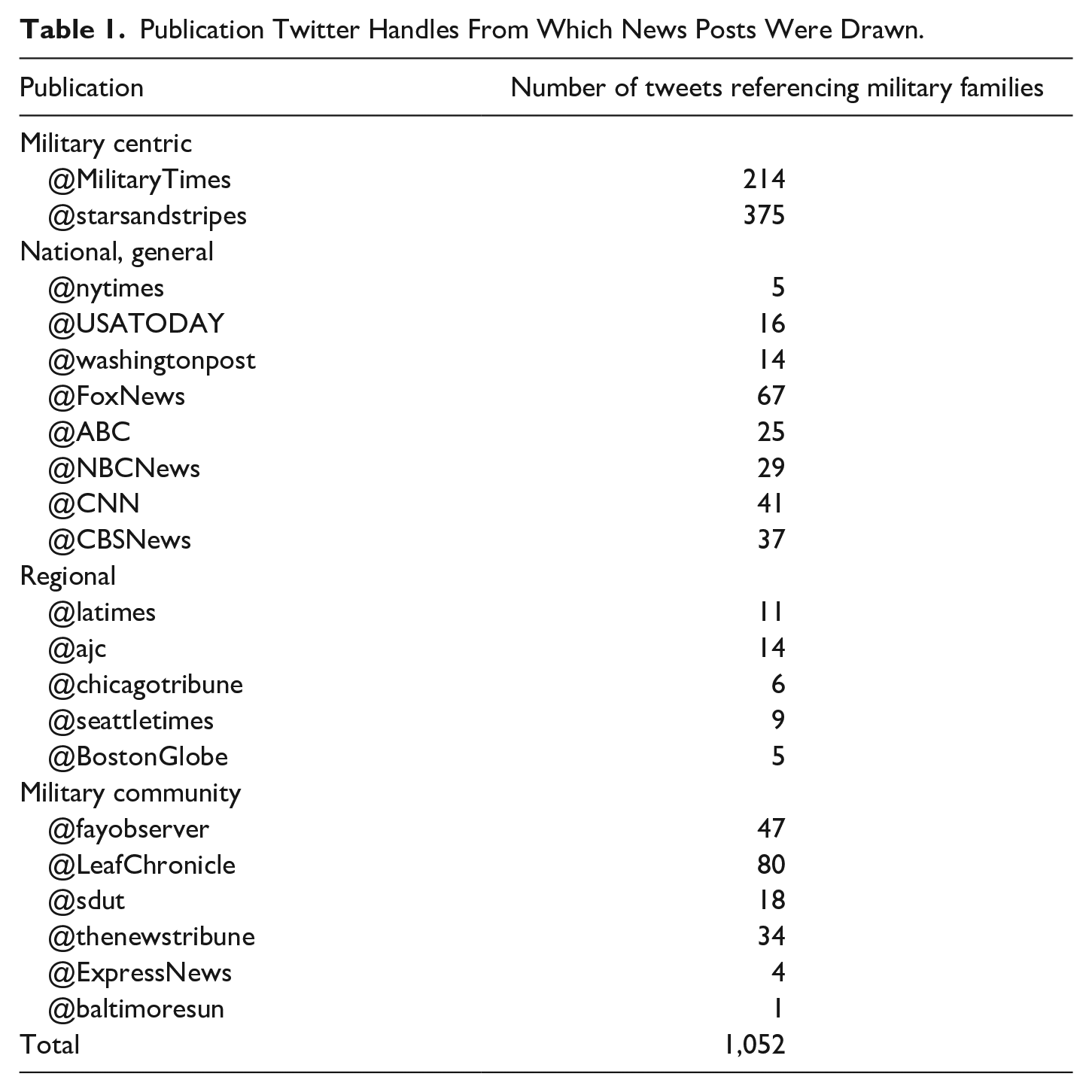
All told, the study examined news posts from 21 news organizations. Table 1 reflects the names of the publications and the number of posts each shared about military families. The final sample had 1,052 news posts. News organizations sometimes tweet multiple times about major events. Coders rated all tweets because they represent news organizations’ overall communication about military families. In addition, coders rated only posts produced by the news organization. Coders did not rate retweets by the news organizations, or followers’ retweets/shares of the news content.
Publication Twitter Handles From Which News Posts Were Drawn.
Coding Process
The primary investigator developed the coding protocol based on existing research concerning mass media and the military–civilian gap. Frames are described in the variable section below. After identifying common frames from the literature, the primary investigator conducted an initial review of the data set of 1,052 tweets to determine whether any additional frames might be common (and might otherwise be missed). No additional frames were identified. The first author trained the second author in the coding procedure, reviewing the protocol and answering questions concerning the operationalization of variables. Coder 2 was naive to the hypotheses. Afterward, the authors separated and each individually coded a random sample of 205 news posts (19.5% of the overall sample). As reflected below, the protocol was judged reliable based on Krippendorff’s alpha and percent agreement. For each variable, coders marked 1 when the information appeared within the tweet and 0 when it did not. More than one frame might appear in a tweet (e.g., a politician honoring families). In such circumstances, coders noted both frames as being present, reasoning that an audience member could encounter the tweet (which is 240 characters or less) and conclude the exposure with more than one frame as salient.
Variables
Support (Krippendorff’s α = .87, 95% Agreement)
Coders indicated the presence of support when posts described charities, benefits, or events helping military families. To illustrate, one post informed readers about a $16.5 million gift that would help military families pay for college, while another tweet asked readers to help military families cover the cost of groceries. “Group donates 500 meals to military families,” read a tweet from The Leaf-Chronicle in Tennessee (The Leaf-Chronicle, 2015).
Honor (α = .73, 98%)
Coders indicated the presence of honor when posts described efforts to recognize or honor military families. To illustrate, one post quoted President Donald Trump telling military families, “I hope you feel the full gratitude of our nation,” while another story described country music singer Carrie Underwood honoring military families during her music tour. In another example, CNN (2014) asked its readers to “Help CNN pay tribute to the sacrifices of military families” for a special feature called “Salute to Families.”
Education (α = .81, 92%)
Coders indicated the presence of education when the news posts provided military families information that would be useful in their own lives. For example, during the COVID-19 pandemic, one news organization shared information about when and where military families could access vaccinations. Another story included tips for military parents sending their children back to school, while Stars & Stripes (2013) informed its readers that “Facebook, blogs, Skype . . . they’re all becoming increasingly important for #military families.”
Hardships (α = .93, 97%)
Coders considered hardships present when posts referenced physical, mental, or emotional harm befalling military families. For example, one post shared the headline, “‘I feel that we have been abandoned’: US military families in Europe frustrated by vaccine shortages,” while another tweet described military families suing private housing companies because residences at the Naval Postgraduate School contained mold that made their children sick.
Politics (α = .88, 97%)
Coders indicated the presence of politics when posts referenced politicians, governmental policy, or bills introduced/debated by lawmakers. For example, one post described First Lady Jill Biden visiting military families, while another described Republican and Democratic senators as expressing concern about military families and housing. In another example, the Washington Post (2015) reported that “John McCain calls on Donald Trump to apologize to military families.”
Results
Analyses were conducted using two methods: SPSS Statistics Version 27 and a built-in lexical analysis tool within the Sprinklr software. Sprinklr’s proprietary software permits researchers to compile tweets and demographic information concerning those tweets, such as the user account and number of likes and retweets, a function by which Twitter permits users to share others’ posts with their own followers. Sprinklr also rates tweets in terms of valence—positive, negative, or neutral—based on words used.
RQ1 sought to identify the most common terms used in association with military families. The word cloud in Figure 1 illustrates the results, with larger words representing more frequent use. An additional analysis was conducted to identify differences in terms of valence (positive, negative). Figures 2 and 3 illustrate those results. Military, family, and families represented the most common terms, as one would expect given the initial search parameters. Other frequent terms included housing, children, food, president, Biden and Trump (the names of politicians).

Most Common Words Used in 1,052 News Posts About Military Families
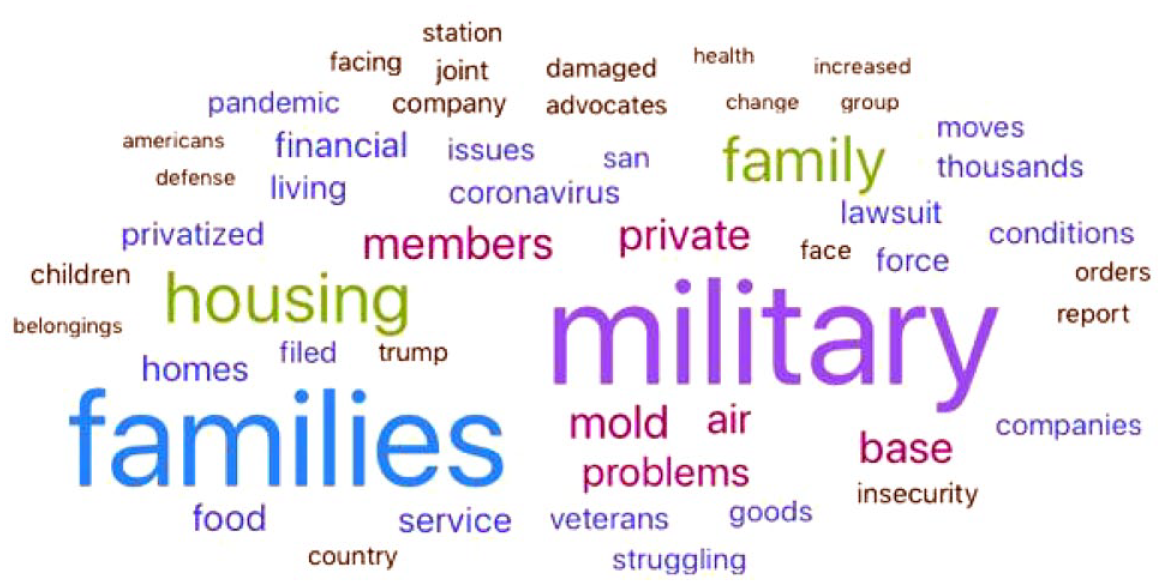
Most Common Words Used in Negatively Valenced News Posts
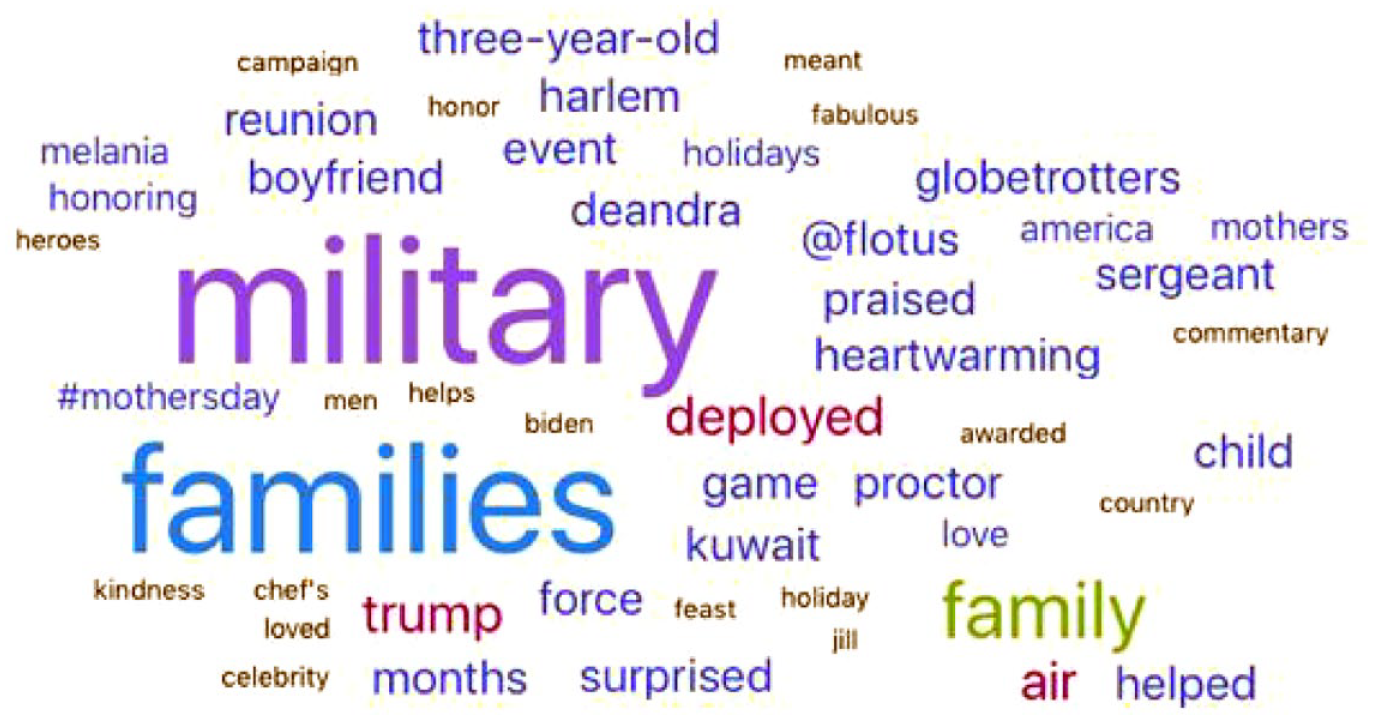
Most Common Words Used in Positively Valenced News Posts
As illustrated below, negative news posts most often associated military families with words related to living conditions and relocation: housing, base, mold, problems, air, and moving.
As illustrated in Figure 3, positive posts most often associated military families with terms related to events, including presidential visits (e.g., Trump, Melania, @flotus), holidays (e.g., #mothersday, holidays), and homecomings (e.g., surprised, reunion).
Answering RQ2, every news story reflected at least one of the frames identified from the previous literature: honor, hardships, support, politics, and education. Overall, news publications most often framed military families in relation to hardships (n = 431, 41% of posts), followed by education (n = 270, 26%), politics (n = 247, 24%), support (n = 184, 18%), and honor (n = 29, 3%).
A series of chi-square tests of independence were conducted to examine the hypotheses, which advanced statements concerning the relationship between publication type and frames used. There was a significant association between publication type and the use of the support frame, χ2(2, N = 1,052) = 33.5, p < .001, Cramer’s V = .179. Supporting H1, nearly one in three posts published by newspapers in military communities focused on support (57 of 184, 31%) compared with 19% of general publications (53 of 279) and 13% of military publications (74 of 589).
In addition, there was a significant association between publication type and the use of the education frame, χ2(2, N = 1,052) = 48.59, p < .001, Cramer’s V = .215. In military towns, 35% of news posts provided educational information for military families (65 of 184), compared with 30% of military publications (176 of 589) and 10% of general publications (29 of 279). H1 is supported.
The data partially supported H2, which proposed that military publications would most often focus on the hardships experienced by military families. There was a significant association between publication type and the use of the hardship frame, χ2(2, N = 1,052) = 19.19, p < .001, Cramer’s V = .135. However, general and military publications shared posts of hardship in a comparative fashion (45%, 126 of 279 general posts; 44%, 256 of 589 military posts). Publications in military towns focused on hardships in 49 of 184 posts, or 27% of the time.
Data also supported H3. There was a significant association between publication type and the use of the honor frame, χ2(2, N = 1,052) = 1.031, p < .001, Cramer’s V = .031. General publications used the frame most often, in 10 of 279 posts (4%), compared with five of 184 (3%) of publications in military towns and 14 of 589 posts (2%) by military-focused publications.
Finally, there was a significant association between publication type and the use of the political frame, χ2(2, N = 1,052) = 32.77, p < .001, Cramer’s V = .176. As anticipated, general publications associated politics and military families most often, in 34% of posts (95 of 279), compared with 22% of posts by military publications (131 of 589) and 11% of posts by military town publications (21 of 184).
Discussion
The present study examined the representation of military families in U.S. news publications that serve different audiences: a general readership, communities in which military bases are found, and publications that cater specifically to members of the Armed Forces. Conclusions were based on an analysis of 1,052 news posts shared via Twitter, in which journalists used five frames to inform readers about military families.
Hardship represented the most prominent frame, appearing in four of 10 posts, highlighting the diverse challenges military families face. In these posts, military families struggled to find food, vaccinations, and safe housing. Families struggled with addiction and substance abuse. They spent Christmas and Thanksgiving separated from friends and family, survived government shutdowns and dangerous storms, and cared for family members who experienced suicidal ideations. The posts certainly illustrate the diverse and significant issues military families encounter, but the fact this narrative of hardship was most prevalent raises questions, namely, why, and with what effect?
The study is an initial step in the process of answering those questions, identifying common themes in the messages we regularly encounter in the media; future research will need to examine journalists’ motivations and the effects of exposure to such narrow representations of military families. Considering the latter question, recent research suggests that exposure to repetitious representations would nurture mental and emotional associations among audience members (Parrott et al., 2020). In the present case, the association would likely connect suffering and military families, eliciting an emotion of pity. Research will tell.
In terms of motivation, journalists might focus on stories of hardship because they generally gravitate toward bad news (e.g., Shoemaker, 1996). Shoemaker (1996) writes that humans are “hard wired” to notice the deviant or unusual, and that “Journalists fulfill people’s innate desire to detect threats in the environment, keep informed about the world, and devise methods of dealing with these threats, whether real or potential” (p. 32). The focus on hardship should not be construed as pity on the part of journalists. American journalists embrace the role of governmental watchdog, holding authority accountable and speaking for people who might otherwise be voiceless on the national stage (e.g., Ward, 2005). Perhaps journalists are trying to help military families by revealing injustice: covering lawsuits about poor (and at times dangerous) living conditions; questioning the morality of a nation leaving military families without food or school supplies; and challenging bureaucracy to care about the people behind the soldiers, sailors, airmen, and Marines.
In another important finding, news organizations covered military families differently based on the audience their newsrooms were serving. Publications in military communities such as San Diego and Fayetteville most often focused on providing military families helpful information and describing ways in which families can be—and are—supported by the local community. In an exceptional example, the Leaf-Chronicle in Clarksville, Tennessee (population 152,000), published a regular column in which author Paige Thomas King offered military families advice based in part on her own experience as the spouse of an Army veteran. She wrote about getting started in a new community (King, 2014), visiting family and friends (King, 2015b), and decorating tips for the home (King, 2015a).
The support frame could be perceived in a positive or negative light. On one hand, local communities probably appreciate the proximity of military bases because of the effect on the local economy through job creation and tax revenue, the military personnel who serve the community as volunteers, and other perks (e.g., Bonessi, 2019). By focusing on support, news organizations highlight ways in which civilian and military communities benefit from being neighbors. Meanwhile, educational posts can connect military families to information and community resources they might not otherwise know are available. However, people have also expressed concern over an “entitlement” stereotype in which military families are expected to receive preferred treatment (e.g., store discounts, free services). In The Fayetteville Observer, Susan Reynolds described the stereotype as hurtful for military families (Reynolds, 2015). Reynolds wrote, “There is nothing wrong with thanking families for their sacrifice. I believe most Americans don’t know what else to say or do for the military.” Reynolds continued,
It is up to us, the military, to let America know what we need. What do we need? We need help, support, friendship, community, love, stability and family. We need you, our citizens, to care for us because we have been through so much. We need to feel welcome, and we need to fit in and be a part of our community even if we only live in that community for a short time. (para 13, 14)
In addition, Reynolds noted, politicians need to stop using military families as “political pawns.” Based on the data presented here, she has a case. News publications—especially general news outlets—frequently wrote about military families while covering politicians’ formal and informal campaign events. Most common were posts in which presidents, both Republican and Democrat, hosted military families for lunches or dinners. Such events could be described as political posturing, using military families to suggest to voters that the nation’s Commander in Chief recognizes the hardships these families experience and supports them. On the other hand, the events could be inspired by a legitimate desire to recognize servicemembers and the partners and children who back them. Regardless of the politician’s motivation, discussions of policy failed to materialize.
One of the more troubling findings involved military-centered publications and their focus on the hardships experienced by family members back home. The posts represent a double-edged sword: They bring to light problems that need to be addressed, but they might also generate worry and anxiety among servicemembers who find themselves far away from partners and children. The data suggest advocacy may indeed be the reason these publications focus on the subject. In 2020, the Pentagon attempted to shutter Stars and Stripes, a paper delivered to U.S. troops around the world (Beggin, 2020). The decision was reversed following outcry. During this period, Stars and Stripes shared a quote from U.S. Rep. Ruben Gallego, in which the Congressman described the publication as fulfilling “a niche in journalism that isn’t going to be matched by other journalists when it comes to military families and the minutiae of benefits” (Beynon, 2020). In addition, military publications provided educational information or political coverage in more than half of the posts about military families.
As exploratory research, the study contributes to theoretical development concerning mass media and the military–civilian divide. It supplements a budding field of research into (1) mass media content concerning military culture, (2) content creation, and (3) outcomes of exposure (e.g., Parrott et al., 2020, 2022). A theoretical model emerges based on the existing evidence, providing testable hypotheses for future research:
Newsroom routines—such as reporters’ imagined audience—affect how journalists cover military culture.
The more generic or “massive” the imagined audience, the more generic and stereotypical the news story.
News stories affect audience members’ thoughts and emotions, including attitudes related to military culture.
The effects are particularly pronounced for people who lack real-world contact with military culture.
News exposure can help bridge the military–civilian divide, but more often journalistic routines have generated shallow representations that elicit narrow thinking about military culture, including veterans, service personnel, and their families.
As with any research, the present study had limitations. The study focused on military families without examining an additional social group for purposes of comparison. Conclusions cannot be generalized beyond the 21 publications examined here. Furthermore, they cannot be generalized to other countries. Overall, though, the study contributes to the ongoing dialogue concerning the military–civilian divide by showing how journalists constructed more than 1,000 social media posts about military families using only five frames: hardship, honor, politics, education, and support.
It is important future research consider the potential implications of such news content on audience members’ thoughts, emotions, and behaviors related to military families. Research should also seek to understand how the mass media—including news posts—might inform communication within the family unit upon a veteran’s return, a particularly vulnerable time (see Cox & Albright, 2014). The present study emerged from a discussion concerning the separation between military and civilian communities, a byproduct of the end of the draft when the U.S. Armed Forces became all volunteer. Fewer people are serving and the people who are joining the service often come from military families. Put another way, the segment of the population with direct experience with the military (personal or familial) has narrowed. This introduces increased potential of the mass media shaping the way civilians think, feel, and act toward military families. Should civilians feel pity for military families? Should families pity themselves? Should civilians recognize the hardships military families experience, and show gratitude for the sacrifice? Should we recognize the media representation for what it is, an oversimplification, and focus on bridging civilian and military communities by focusing on the dictionary definition of community, a fellowship with others? Such connection would require contributions from journalists, military communities, veterans, and veterans families—the key stakeholders. Through community partnerships, we might contribute to better trained journalists, increased connection between newsrooms and military communities, and better understanding of how the news media contribute to the so-called civilian–military gap. Through increased knowledge, we might also understand how to “flip the script” and use mass media to nurture greater understanding of military communities, servicemembers, veterans, and families.
Toward this end, research should employ experiments and surveys to examine how exposure to news narratives about military families—and veterans—shapes emotions, attitudes, beliefs, and behavioral intentions toward these social groups. People who are dependent on the news for information about the military, its servicemembers, and families likely lack accurate understanding of the consequences of military service, including the implications for family members. Scholars might also examine how social media users engage posts from news organizations. The commentary placed beneath original posts can drastically alter audience members’ interpretation of the original content, shifting readers’ frame of interpretation or even providing social normative cues concerning the appropriateness of the content. Future research should also examine the practices that go into the creation of news content. Why do the news media provide such narrow representations of veterans and military families? Gatekeeping theory suggests a hierarchy of factors influence what makes the news and how, including journalists’ individual attitudes, organizational influences, social factors, and other contributors (Shoemaker & Reese, 1996). The present study suggests community, or target audience, might also be important, shaping journalists’ perceptions of their readers and their readers’ interests. Anecdotal evidence illustrates the pressing need for additional research, as servicemembers and families describe public misunderstanding of everything from the reasons people join the military to the outcomes of service (e.g., Cruz Lemar, 2020).
Journalists often describe PR as “the dark side” (Sherwood et al., 2019, para. 1); therefore, journalists should not be expected to advocate causes. Still, scholars describe public relations and journalism as symbiotic, pronouncing the lines between the fields as blurred within the modern media environment (Sherwood et al., 2019). In addition, professional journalists in the United States generally follow the Code of Ethics from the Society of Professional Journalists, which recommends reporters avoid sensationalism, provide context, and avoid doing harm (Society of Professional Journalists [SPJ], 2014). An argument can be made that stereotypical posts would violate the code. Therefore, the field would benefit from training resources and formal recommendations related to journalism, military veterans, and military families. What posts might journalists cover? How might journalists cover important news—such as veteran suicide—while avoiding stereotypes? Scholars in journalism, social work, and other fields are partnering with veterans to develop such recommendations, which will hopefully nurture more accurate and representative portraits of what it means to serve in the Armed Forces—or be related to someone who does.
Footnotes
Declaration of Conflicting Interests
The authors declared no potential conflicts of interest with respect to the research, authorship, and/or publication of this article.
Funding
The authors received no financial support for the research, authorship, and/or publication of this article.
