




Abstract
State-building process in Africa appears in different conditions to those experienced on other continents. It is primarily characterized by the presence of fixed borders. The article repurposes evolutionary and identitarian theories on the development of political communities for the African realities. It highlights the necessity to develop policies creating territorial division between the population of the state and the external environment and utilizing armed forces for the protection of the state against such an environment for the state-building process to succeed. In cases of Eritrea, Senegal, and Burkina Faso, three hypotheses are being tested with an outcome that state-building process connected to the creation of Nomos does not have to be violent but requires a connection of the armed forces to the society. Once the division between the Nomos and the hostis develops inside of the state, such entities are not able to develop power projection capabilities inside their borders.
Introduction
In the post-Cold War period, one can increasingly stumble upon analyses demoting the state’s role in international politics (Clunan & Trinkunas, 2010; Kaplan, 1994; Khanna, 2016; Williams & Felbab-Brown, 2012). It is undoubtedly true that the state’s role is transforming and that, in many regions, it is not the primary unit for the administration of the territory. Furthermore, its universal global spread was always fictional. Nevertheless, this type of political entity remains a dominant form of politico-spatial organization in macro-perspective. However, the historical experience and geographic and demographic factors affect the specific nature of the state-building process in different regions.
Consequently, the resulting institutionalization of political power differs throughout the world. Despite this, we can extrapolate some basic common features that present the necessary conditions for successful state-building. The development of states in sub-Saharan Africa contrasts with the experience of the European states. They established juridical statehood before the empirical statehood (Jackson & Rosberg, 1982) inside largely artificial borders (Herbst, 1989) and challenging geography (Herbst, 2000, pp. 159–169). The empirical statehood is often still, to a large degree, missing. African states are thus primarily defined by neo-patrimonial relations and weak center-periphery ties (Hentz, 2019). The following text identifies features tied to effective state-building and applies them to the state-building process in three African states—Eritrea, Senegal, and Burkina Faso. It thus investigates the importance of both armies and societies for developing functioning states.
The article is theoretically based on the evolutionary approach to the establishment of political institutions and the identitarian vision of political communities. These approaches present a universally applicable basis for developing territorial political communities that might be amended to fit the African realities. C. Tilly (1975, 1990) pointed out that the evolutionary perspective he presents for the European context is not directly transferable to other communities. While we agree with this conclusion, we also believe that the primary evolutionary logic is the same. However, it is manifested according to historical development, demographic and geographic conditions, and cultural and other traits. In this regard, Tilly’s focus on the importance of resource/population exploitation for war fighting as the main component of state formation is also applicable outside Europe. Furthermore, C. Schmitt, in his work, provided much-needed insight into the development process of political communities through the division between Nomos and hostis that further enlightens the issues connected to setting up coherent societies inside the borders of postcolonial African states (Mičko & Riegl, 2022). We understand Nomos as an underlying political order that consists of the politically relevant grouping point that serves for the identification of friends and strangers against whom a fight is possible (termed here as hostis). The combination of the importance of nomos formation as a unifying factor for the population and the subsequent war-fighting-enabling exploitation is used as the primary process that allows for effective state formation. We, therefore, argue that there is an essential nexus between how civil society is organized along the political lines of friends/hostis, the existence of an external threat that requires the application of armed forces and the ability to establish functioning state institutions.
In turn, this translates into three underlying hypotheses that are tested within the following text:
We present these individual traits in the following chapter and subsequently apply them to the process of state-building in three African countries with different experiences—Eritrea, Senegal, and Burkina Faso. The article explains how the evolutionary and identitarian theories help us explain the different levels of state-building on the African continent.
Evolution, Identity, and Political Communities
Despite their Eurocentric origin, the ideas of Tilly and Schmitt play an essential role in the analysis of state-building processes. The following section extrapolates the critical findings for state-building outside the specific European context. This approach divides the possible analysis into two interconnected factors—the development of political communities and the connection of political power with a defined territory, its population, and resources via stable institutions.
In this respect, a sovereign state is understood as a set of coherent institutions used to consolidate power over the territory. The state must be believed to exist, and its establishment took place through generations (Strayer, 1970) and not by one single decision. A political order is established through land appropriation, which grounds ownership of the land both externally and internally (Schmitt, 2006, pp. 45–46). Such land appropriation, therefore, underlies all subsequent law and order of the society. Schmitt (2006, p. 68) claims that this fundamental territorial appropriation establishes the original order of the land or Nomos. This order is not only a delimitated territory, as it is a part of the land imbued with sacred orientations that govern a given society (Schmitt, 2006, p. 70). In this understanding, Nomos (pl. nomoi) refers to both the process of land appropriation and order itself. It constitutes the original exclusory point, which subsumes the concepts of friends, as those that belong, and enemies, as those that do not. Within this exclusory point, all other domains are incorporated as potentially political—culture, language, religion, economy, and education—all become tied to that particular grouping point as a way of life (Schmitt et al., 2013, p. 22). It is precisely this grouping point, established through the act of land appropriation, that enables the original political distinction between a friend and an enemy. An enemy in this sense should be understood under the term hostis (pl. hostēs)—a stranger against whom an existential fight is possible but not necessary. And if this fight occurs, it is always tied to the negation of the way of life established in the original grouping point and on the given territory (Schmitt et al., 2013, pp. 26–27).
The stated consideration implies two key issues. First, an established territory is always imbued with a specific set of values understood as a sanctified way of life. This way of life is typically referred to as “the common” of political unity. Second, the existence of hostis is always possible as far as different Nomoi exist. It is then tied to the different types of enmities as envisioned by Schmitt (2004). However, the enmity is not necessarily external—an enemy can exist within society as long as he or she violently challenges the sanctified way of life over the entire (revolutions) or part of the territory (secession).
The issues of a particular political and extra-legal territorial order are inherently tied to unifying the state vis-á-vis an internal opposition, extraction of resources from the territory, and the question of external differentiation of the population. As such, the institutions allowing for a practical side of developing territorial political communities that turned into modern states were developed through violent and uneven processes inside the specific European context. The exact path will not be duplicated elsewhere as Europe enforced this type of political unit on other communities and thus changed the trajectory of state development. However, it offers crucial lessons for different geographic, demographic, and historical contexts.
The state-building was tied to two processes, allowing for internal and external autonomy of the units (Spruyt, 1994). The first was the internal consolidation of power rooted in the violent subordination of different opposition classes and groups. The second was the protection against external enemies that involved the enlargement of effective political units. Rulers needed to reflect both of these processes, and state-building was a by-product of the successful demand satisfaction. Notably, both of these processes involved centralization of power and developments that were progressively dependent on the rising amount of resources and workforce and allowed for an increase in the efficiency of such units’ military power. Expanding inland armies led to new efforts to extract resources from the population. It involved increased opposition from the population that needed to be coerced and the establishment of the new bureaucracies. The dominance of the sovereign state was defined by territorial control, centralization, differentiation from other organizations, and the establishment of a monopoly on concentrated violence inside the territory. It involved the bureaucratic connection of the ruler to the population and territory that increased military effectiveness that allowed the state to survive. Only after the Peace of Westphalia did the units recognize each other, thus following their de facto existence by de jure recognition. And only in the 19th century did the state finally disarm their population and control the means of violence (Tilly, 1975, 1990).
As noted, a key factor of state-building is the ability to wage war. As war is an expensive project, it needs extractive capabilities, and these require efficient administration, including keeping records of the available and required resources, thus developing administrative institutions. The increasing scale of war then gave an advantage to states with larger standing armies that could have been financed by extracting resources from the population and successfully adapting to the capitalist economic system. A ruler needed to have stable access to the population and resources as well as control over them. The understanding that territory with its population and resources was an important asset led to expansionist policies aiming to capture resources located on other states’ territories. The internal changes toward a more significant population representation were also tied to this development. While in the early phases of state development, the rulers needed to bargain with the wealthy class, with the expansion of warfare, the seat of power required to gather resources from the entire population. The external conflict then shapes the state not only in its physical characteristics but also in its identity, contrasting that of its rivals. For the state-building process, a shift of identity of the population from alternative units to state is crucial. Only when the population recognizes the need for the government’s final authority might the ruler act upon its sovereign claim (Strayer, 1970; Tilly, 1990). For a ruler to last in a leading position and evolve through these stages, it must at minimum be able to make a state to counter the internal opposition, make war against external resistance, and protect the ruler’s allies in the context of effective extraction of resources (Tilly, 1990). These minimal conditions of state-building development may consequently be applied to non-European contexts as well.
A territorial order or a particular political entity (a state in our case) is tied to a specific sanctified way of life established by a given political community through its elites. And it is the question of political sanctification of a way of life that is necessary for a would-be ruler. Such a way of life is based on the performative practices used to identify group members (friends) and those that do not belong (hostēs). Territory in this regard is not only a random variable, as it is necessarily tied to the grouping point, or Nomos, of the given community. The imposition of another way of life on a territory directly challenges the established territorial order. Therefore, only successful sanctification of a way of life on a specified territory, a process known as establishment of Nomos, as a grouping point for a given political community can lead to the establishment of a political unity capable of identifying its members and strangers, against whom a unified struggle is possible.
Once Nomos is established, a hostis can be recognized. It does not necessarily mean that all hostēs must be enemies; they can be welcomed guests. Still, there must be a clear dividing line between them and the political community members through the performative way of life. Any inconsistencies in the perception of what constitutes the Nomos of a political community lead to the potential for the continued internal struggle for territory or way of life. On the contrary, the clearer the performative and territorial delineation of a community’s Nomos, the clearer the ability to identify the hostis, and, consequently, the more coherent the political community.
This discussion is tied to the processes of developing communities supportive of state-building. These include identitarian development of political community and practical connection of the state institutions to the resources on its territory. These are relevant even in the African context, which differs from the European experience in the historically lower population density, lower level of contestation among the political units over resources, external imposition of state structure on artificially drawn but internationally protected territories, and history of the importance of population control over the control of territory.
It is important to note that the European-delimited borders were set to avoid conflict with other colonizers, so no violent state-building appeared even in a limited sense of armed conflict between colonial powers. This principle was further strengthened by the adherence to territorial integrity by the Organization of African Unity (OAU), connected to the principle of granting legitimacy to a government controlling the capital (Herbst, 1989). African states thus generally did not go through the period of an interstate war that would threaten their survival and lead to the increased capacity to extract resources and connect the population via a single identity (Hebrst, 1990). We can identify several general yet critical conditions for developing political communities in the theoretical literature.
First, the entities established through a fight for their survival against an external opponent that can destroy this entity, overcome its ruler, or annex part of the territory are better posed to begin the effective state-building process. It is because their enmity lines are established, and their struggle requires the successful extraction of resources from the population. The more dependent the entity is on external support, the lower the chance the state-building process will begin. It corresponds to the first hypothesis tested in this paper. Specifically, an external threat to a state’s existence is a necessary condition for developing modern state institutions in African states.
Second, the state-building process involves internal unification and protection against external threats. If the rulers create, sustain, or cannot contain internal divisions and enemies, they do not support the state-building process. Contested statehood supports the state-building process while internal contests over government weaken it. The former pushes rulers to strengthen state capabilities to wage war, thus enhancing resource extraction and administration; the latter leads to the development of personalist security forces aligned to a specific person(s) on the top of the hierarchy and weakens the other parts of the security system. Clear external identification of a hostis as an enemy implies an evident politically unified community willing to kill and die to maintain its way of life on its specified territory (Schmitt et al., 2013, p. 46). On the contrary, internal and external enemies challenge identity and nomos establishment (Schmitt, 2004, pp. 60–61). In such a case, a ruler would not only have to unify the claimed territory to impose a particular sanctified way of life, but it would also have to ensure that this sanctified way of life is accepted to oppose the external enemy. No matter the region, effective states are developed if the context forces rulers to strengthen the state’s security against external threats and unite the population with any means necessary. If the ruler sets up internal enemies and gets support from the outside, the state is weakened. Therefore, we argue that postcolonial states that aimed at internal cohesion, governance through the unification of their population, national armed forces, and resource extraction, especially under external threats to their statehood, present higher levels of state-building than those that go the opposite direction.
Consequently, the article investigates two more hypotheses connected to the consideration above. Hypothesis 2 expects the development of common Nomos to be necessary for developing modern state institutions in African states. Hypothesis 3 predicts using the military against an external rather than an internal threat (hostis) is a necessary condition for developing modern state institutions in African states. Before delving into the empirical research, it is essential to address the methodological approach to evaluating these hypotheses.
Method and Case Selection
In the following case studies, we study the criteria for developing the political community from identity and practical perspectives. We will look at the postcolonial experiences of three case studies—Eritrea, Burkina Faso, and Senegal—and specify the identity development process and connection of territory with its government and armed forces. These three cases were selected because they share many geographic and demographic characteristics as they are multi-ethnic entities dealing with decolonization issues. Nonetheless, they widely differ in their ability to control territory or provide services. They also differ in their historical experience directly tied to the studied factors connected to the state-building process. Eritrea is a state that was built in an armed struggle, and its identity was created through armed rebellion against the external enemy. Senegal was decolonized in 1960, became part of two federations (Mali Federation and Senegambia), and engaged in a rather effective state-building. Finally, Burkina Faso is also an entity created within colonial borders, but the process of institutionalized state-building is minimal. The external challenges were considerably limited, and the internal power struggle weakened the state-building process. The cases, therefore, provide a sufficient difference in tracked variables that allows for formulating conclusions on the three stated hypotheses.
The studied variables include the definition of political community through highlighting those that belong—friends—and those that do not—hostēs, presence of internal and external conflict over either statehood or governance, the method of governance, and employment of national security forces. In this regard, we start with the definition of the political community. Going back to the theoretical discussion over Schmitt’s work, it is necessary to appropriately apply this theory to focus on an implicit or explicit formulation of an integrative grouping point that consists of a particular performative feature. It may be a religion, a national language, ethnicity, shared history of colonialism, or even participation in war—that creates a distinction between those belonging and those not belonging, in other words, between the friends and the hostes. Such a grouping point must also be related to a particular territory, understood as a specific force-field of the nascent political community. In particular, we will look for any declaration of such a grouping point by the proponents of independence. This will be done through research of the primary (published newspapers from the relevant period) and the secondary literature.
Similarly, we will look at the history of violent conflict during the period of establishment of the country. If such a conflict exists, we will narrate it regarding internal or external friend–enemy distinction and what role it played in establishing the governance structures, once again using the secondary and primary literature as available. As for the method of governance, we understand it as regime type, with regard to the nature of the political system chosen to govern over the country, along with the approach to socialization of the population to the selected grouping point established earlier. Therefore, we will examine how the governing elite manages political participation. We will also evaluate how the decisions are made and whether any power change occurs. Finally, and most importantly, we will also inspect whether and how is the population grouped under the political grouping point specific for that society allowed to participate in the political system. Finally, there is a question of the employment of national security forces. This question is tied to all the previous issues precisely because it concerns the nature of the political community, the method of governance, and the extraction of resources from society; however, it stands apart from others as it showcases the nature of power in the given state. Therefore, we will look at how the armed forces were used during and after the independence of the selected countries.
We will be using the causal process tracing method (Blatter & Haverland, 2012) to track how the processes associated with the establishment of the new state entities with the focus on the production of internal and external friend–hostis distinction through speech acts and actions denoting particular inclusions and exclusions of groups based around different grouping points (ethnicity, culture, language, economy, etc.) and the employment of armed forces in safeguarding/achieving independence or regime stability. We expect that the newly established countries with well-formed friend–hostis distinction on a particular territory and armed forces protecting this distinction instead of the regime achieve a higher level of administrative capacity and active political life than those without.
Case Studies
Eritrea
The case of Eritrea is uncommon in the African context. It presents an example of a political entity whose development after the Second World War disrespected the principle of uti possidetis juris. Eritrea, historically a part of the Ethiopian state, was until 1941 an Italian colony—the first era when Eritrea was shown as an independent entity on maps including throughout the education of the Eritrean population—and later until 1952 under the British administration—turning Eritrean identity into a political question (Dias & Dorman, 2019, pp. 399–400). As such, the ethno-linguistically and religiously diverse territory began to develop a distinct identity that was not respected by treaties (Bereketeab, 2018, p. 158; Dias & Dorman, 2019, p. 397; Müller, 2019; Plaut, 2016, pp. 6–7). Eritrea was reincorporated into Ethiopia, which did not respect the promise of setting up a federative structure and autonomy. This development resulted in a 30-year-long civil war that ended in 1991 with a military takeover of Addis Ababa by the Tigray People’s Liberation Front (TPLF), supported by the Eritrean People’s Liberation Front (EPLF). This development led to the declaration of independence of Eritrea becoming an independent country 2 years later (Dias & Dorman, 2019, p. 398). The violent conflict for statehood showcases how the questions of Nomos-creation and friend-enemy distinctions interacted with the issues of resource extraction, administration, and armed forces employment.
Muslim intellectuals started the Eritrean Liberation Front (ELF) movement in 1960 in Cairo, Egypt. The internal tensions led to the first Eritrean Civil War in 1972–1975 between the ELF and the newly created EPLF. Progressively, the independence movement transformed from a Muslim revolt against Christian-dominated Ethiopia into a radical socialist revolution group (Jonathan, 1977). The groups at the time were reportedly both apt at establishing hospitals, providing education to the youth, repairing weapons, and manufacturing explosives. The years 1980 and 1982 involved a civil war between ELF and EPLF. ELF was now camped in Sudan, with no territory held in Eritrea proper. EPLF carried out widespread land reform and reorganized village life under a democratic system with elected officials. At this point, they were boasting some 30,000 to 40,000 men and women operating modern military technology captured from the Ethiopians (Bryant, 1982). As the 1980s progressed, EPLF created and maintained a widespread social and political infrastructure with little outside help.
Regarding nationalism, the EPLF position at the time was that the shared identity rose from the memory of Italian colonialism, which gathered even linguistically and religiously disparate groups. Isolated from both the East and the West, the EPLF representatives argued that isolation steeled them and made them self-sufficient (Kifner, 1988b). There were nine languages and two major religions—Christianity and Islam—separated in different regions of the country. These two religious groups were also different in their way of life—Christians settled in the highlands, while Muslims lived nomadically in the lowlands. As the EPLF was pushing the Ethiopians from the territory, its then-secretary general argued the nationalist movement was brought together by a clear-cut contrast between the Eritreans (“the good”) and the Ethiopians (“the evil”). The EPLF signed a military cooperation agreement with the TPLF against the Derg government, despite having been on bad terms (Gershoni, 1996; Kifner, 1988a, p. 238).
As the claims of independence came about and Eritrea seceded from Ethiopia, the elections needed to occur during the transitional period. Any Eritrean resident who wanted to vote would have to register as a citizen of the province (Hartley, 1991). After the 30-year-long war, it was clear that there were intense antagonisms against Ethiopians, especially after ending the ban on Tigrinya, the most spoken language in Eritrea, as the administrative language. Following this, it seemed at the time that the EPLF was not intending to include any outsiders in the provisional government, even going as far as reportedly expelling Ethiopians still living in Eritrea.
This historical development sets Eritrea in contrast to most postcolonial states with protected borders. EPLF understood the necessity of developing a national identity that would crosscut the internal divisions. After becoming the dominant military group representing the entity, it not only pushed forward the ideas of Eritreans and state development but also aided the local population in establishing a tangible connection with the future population of the state (Dias & Dorman, 2019; Mahrt, 2009, p. 404). The idea of the connection between state and society is rooted in guerrilla history (Woldemikael, 2009), and the national identity of Eritreans is closely connected to the state’s existence (Müller, 2019). After gaining independence, the now governing EPLF, headed by Isaias Afwerki, continued with the state and nation-building project (Riggan, 2016, p. 9), including aggressive delimitation of borders involving border wars with all of its neighbors (Müller, 2019; Plaut, 2016, pp. 28–30; Sudan in 1994, Yemen in 1995, Djibouti in 1996 and 2008, and Ethiopia in 1998–2000; Dias & Dorman, 2019, p. 413). It focused on developing peripheries (Reid, 2005) and internal state-building policies, including setting up administrative regions that disrespect ethnolinguistic borders (Bereketeab, 2018, p. 161). Similarly, it focused on a language policy intended to teach the population Tigrayan and their respective mother language to unify the population without erasing its ethnolinguistic identity (Dias & Dorman, 2019, p. 405). Furthermore, it implemented policies promoting equity, including gender equality (Riggan, 2016, p. 36), and hierarchization and organization of the society, including mandatory military service for 6 months followed by 1-year participation in the reconstruction projects (Müller, 2009). The progress in state-building was rooted in ideas of discipline, opposition to external pressures, and progress. Eritrean identity was, thus, since the times of civil war, based on the attempt to develop a new state based on a constructed Eritrean identity. This origin was later cemented by the national myth rooted in The Struggle—a period of conflict over independence with Ethiopia (Riggan, 2016, p. 8). It led the state to promote goals of self-reliance, clear demarcation of external borders, and identity-building rooted in development (Bereketeab, 2018, p. 159). Similarly, the connection with the population was developed practically via developmental policies and ongoing political reforms that would increase the stakes of the people on state development via increased representation.
Following the border war of 1998–2000, however, the state turned to increasingly authoritarian policies aiming at the personalization of power in the president’s hands (Bereketeab, 2018, p. 164), persecution of internal enemies (nonetheless not on ethnic or religious basis) including random punishments, political control of the population (Bozzini, 2015), and maltreatment of the military forces in economic activity. The resource extraction from the territory is weak, and the government requires taxation of the diaspora to increase its liquidity. The military service turned indefinite in 2002, and military conscripts started to be used in the economic segment to increase the resource generation of the state in the so-called Warsay-Yekealo Development Programme (Bereketeab, 2018, p. 164; Bozzini, 2015; Riggan, 2016, p. 6). Thus, the country’s economy was by the ruling elite. The largest share of the economy is covertly under the political elite’s control through the military (Plaut, 2016, pp. 133, 143–147). All the students in the final year of high school are to get their education in the Sawa training camp, thus placing them under the military auspices. All the students must pass 3 months of the service before graduation, with only those who manage to get accepted to university studies exempted from the indefinite service later on (Reid, 2005; Riggan, 2020). The lack of connection with the population was also manifested by increased secret police power, which turned the country into a highly secretive society. This further strengthened the division between the “fighter generation” of the civil war and the rest of the population (Reid, 2005).
The turn to authoritarianism seems unaffected by the peace deal struck with Ethiopia in 2018 (Müller, 2019) that solved the conflict over border delimitation (Plaut, 2016, p. 42). It seems that the regime is moving away from its role as a developer of state to more common personalistic policies focusing on pacification of internal opposition. Despite these defects, given the basis of the Eritrean identity, the country holds potential for efficient state-building (Riggan, 2016, p. 56, 64).
Senegal
Unlike the previous case, Senegal was born directly from the process of decolonization, specifically by the dissolution of French West Africa. To understand the development of the us versus them dichotomy in Senegal, we need not focus on the external armed challenge but its specific position in the colonial hierarchy. Today’s territory of Senegal incorporated the Four Communes (Saint-Louis, Dakar, Gorée, Rufisque), whose French citizens held full citizen rights and could vote into the French National Assembly. Thus, there is a history of competitive elections in the Senegalese territory dating back to 1848, when the first representative from sub-Saharan Africa was voted into the parliament (Beck, 2008, p. 52; Chafer, 2002, p. 75). This tradition was occasionally interrupted but continued without disturbance after 1879 (Hartmann, 2010, p. 770).
In addition, Dakar had been since 1902 the capital of the federation, the most prominent French colony in Africa, stretching as far as Côte d’Ivoire and Upper Volta (Burkina Faso), giving the Senegalese a unique position in colonial architecture (Chafer, 2002, p. 27, 195). While the account of the development of Senegal Nomos is not violent, there are at least three historical processes that can showcase how this construction took place and how it was related to the effective exploitation of the resources from a population that understood the country as its own. First of them is the collapse of the Mali Federation that occurred right after the declaration of independence. The second one is the separatist conflict in Casamance. Finally, the third one is the failure of the Senegambia confederation.
Starting with the independence and the Mali Federation, two competing ideas about the future political identity of the federation stood at its beginnings. The Senegalese understood the federation as a shared house for the two nations (Rodet & County, 2018, pp. 469–470) with aims of economic and cultural development as key to true liberation (Heitz, 2008). Meanwhile, the Malians called for a closely integrated political entity with a single political nation as its goal (Kurt, 1970, p. 417). The federation lasted only 10 months and only two as an independent political entity. In these months, several events showcase the construction of the Senegalese entity along the ideological lines outlined earlier. First of these events was the attempted integration of the Senegalese Muslim leaders, on whom Senghor, a Catholic and the future president of Senegal, depended for electoral support, into the Union soudanaise party in 1959 (Kurt, 1970, p. 419). The second one was the rapid increase in Malian officials in Dakar in just a year, termed as implied new colonization by the Senegalese leadership (Rodet & County, 2018, p. 472). Both events display the particular friend and hostis distinction that permeated the nascent Senegalese identity. The consequent collapse of the federation was caused by the fear of a potential coup and performed through the Malian military mobilization, the Senegalese counter-mobilization of the National Gendarmerie, and the ostentatious expelling of the Malian officials to Mali. Over the next few years, Senegalese essentially prevented any Malian (or other western African) descent inhabitants from acquiring citizenship (Rodet & County, 2018, p. 481). At the same time, the country underwent a “Wolofisation” process based on the non-exclusory practices toward other historical ethnicities of Senegal and their access to the political and economic arena (Keese, 2019). From these two developments, the intention to ensure the well-being of “those that belong” before “those that do not” is clear.
However, while the governing elite of Senegal has been long described as integrative in the protection of minorities (Dash, 1980), the case of Casamance shows how the issues of inclusion in the “division of the land” impact the formation of political fault lines. The first prominent separatist displays occurred in the 1980s (Dash, 1983b). While the economic neglect by the central government played a role, the secessionist sentiments were reinforced by ethnic, religious, and historical differences. Compared with the Muslim majority, the native Diolas that do not speak Wolof differed from the majoritarian population in their Christian or Animist faiths and their historical ties with Portugal. Even as the 1980s progressed, the situation did not improve. The government appointed several local officials that were incognizant of the local customs and culture. At the same time, the purchase of the land by the Wolof population in Casamance led to the reported feelings of being pushed away (Ba, 1990). Intentional or not, the marginalization of the Diolas led to the establishment of a clear-cut internal enmity. Both sides professed this internal enmity—the Casamance separatists shifted from using bows and arrows to modern weaponry (Hecht et al., 1997) while carrying out several deadly attacks (Noble, 1991; Reuters, 1995) on both civilians and armed forces throughout the 1990s. On the contrary, the government responded with a significant deployment of soldiers, employment of heavy weaponry, and reported use of collective punishments (Noble, 1991). All this despite having signed several peace treaties and the fact that most of the Casamancais declared that they feel Senegalese but do not receive any services from the central government. In 1991, Mouvement des forces démocratiques de Casamance (MFDC) and the central government signed a ceasefire based on the promise of socioeconomic development of the region and increased representation of the area.
Nonetheless, a part of MFDC did not accept the deal and a low-intensity conflict continues in the region until today (Foucher, 2019, p. 281). The remains of MFDC are, nowadays, portrayed as criminal elements (partially correctly [Jeram, 2012, p. 160]), and the rebellion is not tied to the local population, which is now reportedly not being targeted by the military but protected against the rebels (Matisek, 2019, pp. 75–76; Theobald, 2015, p. 196). In addition, the region is being developed to a degree, including the opening of a university in Ziguinchor, which further ties the population to the state institutions. Senegal thus provided the Casamance population with a more promising future compared with the failure of MFDC to unite the various ethnic population groups in the region under a single identity (Foucher, 2019, pp. 287–289; Heil, 2020, p. 72; Theobald, 2015, p. 192).
While Casamance was administered jointly with Senegal at least since 1888, when it was transferred to French colonial administration from Portugal, Gambia is a piece of formerly British-administered territory wedged into Senegal. The idea of unification came to fruition only after the Senegalese military intervened to stop a coup in the Gambia in 1981 (Dash, 1981). The two (con)federated nations bore many similarities—they spoke the same native languages, are majority Muslim, and share many similar customs. However, their colonial histories impacted their cultures differently and created specific cultural divides in terms of official language use (English vs. French) and performative culture (Ross, 1998). In addition, the Gambian economy was generally based on the smuggling of competitively priced imported produce into Senegal, which made it vary of any closer integration into the federation (Fievet, 1989d). Even despite the Senegalese military presence, going as far as providing the presidential guard for the Gambia and some cultural integration schemes, the federation project fell through in 1989. The year was marked by the new defense pact between the Gambia and Nigeria, several calls for changes to the rotating presidency held permanently by Senegal, and the subsequent withdrawal of Senegalese troops. Diplomatic sources at the time of the federation’s breakdown claimed that it was caused by the Gambian fears of an economic downturn and “above all, a loss of identity” (Fievet, 1989a).
Two themes emerge from these chapters of Senegal’s history. It is clear that upon its establishment, the country had a functioning military force and a clear sense of distinction between friend and hostis that enabled the extraction of resources. Outside the process outlined earlier, this can also be seen in how the situation in the country, made unstable around the election time in 1988 (Medlock, 1989) with the declaration of a state of emergency and deployment of the military against the opposition, calmed down once the ethnic tensions with Mauritania flared up in 1989 (Fievet, 1989c). It ultimately led to cementing of the domestic political scene around the administration in power (Fievet, 1989b). However, the situation with Casamance and Gambia also shows how the failure or the inability to include a population in the division of the land results in the eventual creation of friend-enemy distinctions that are hard to overcome even with the use of an effective military. The changing approach in Casamance plays a crucial role here, as it seems apparent that the attempts at inclusion in the land division through the region’s development are intended to reestablish the Nomos and integrate the Casamancais population.
However, Senegalese state-building follows the conditions set in the theoretical literature, without high-intensity military challenge from the outside. External pressure does not lie in direct military confrontation but in possible spillover of instability into the country from the neighborhood (Durrani & Crossouard, 2020, p. 322). The development of the Senegalese identity is thus tied to the relatively inclusive political regime, relative stability, and inclusive religious environment (Diouf, 1992, p. 117; Durrani & Crossouard, 2020; Gomez-Perez, 2017). Armed forces are used as a truly national institution not involved in the internal political struggle. The case of Senegal thus presents a development of collective us in relation to less specific unstable them with the armed forces protecting the state against the hostile and tumultuous external environment.
Burkina Faso
Unlike the previous cases, there was a very meager establishment of the friend-hostis distinction in Burkina Faso. Similar to other former colonies of French Western Africa, Burkina Faso gained independence in 1960. However, due to historical circumstances, several specificities accompanied the birth of the country—the lack of popular support and political experience of the new country’s first generation of politicians; the lack of nationwide or any strong political party; and their substitution by trade unions (Englebert, 2018, p. 170). A grounding of the political elites around their education helped prevent any particular grouping around ethnic lines (Englebert, 2018, p. 121, 123). Still, it also contributed to the personalization of politics in a country that generally lacked any strong ideological vision (Englebert, 2018, p. 43, 194), reflected in the high success rate of coups (McGowan, 2006).
In Burkina Faso’s history, the time of possibly the most radical politics was the time of the military government of Thomas Sankara (Bienen, 1985). It was not only because he emulated Libya’s Gaddafi-inspired revolution but also because the only open war that Burkina ever fought took place under his leadership. The country changed its name from colonial Upper Volta to Burkina Faso. Sankara’s government, established in 1983, came to power after several military coups, first in 1966, and brief experiments with democracy. Sankara was initially the prime minister of Jean-Baptiste Ouedraogo’s government (Financial Times, 1982b) that was in power after the 1982 coup against the previous military dictatorship by Saye Zerbo (Financial Times, 1982a). The government itself was an alliance of young radical leftist officers, represented by Sankara, and former French colonial army senior officers with conservative and pro-Western orientations. The nature of the coalition suggests the aforementioned personalization of politics, absent of ideology.
However, in 1983, Sankara started to publicly speak against the “internal enemies of the people,” pointing toward traders, religious leaders, and even trade unionists. In this way, he gained popular support, especially among the poor and students. At the same time, he started to entertain very close ties with Gaddafi’s Libya. As Ouedraogo’s government tried to imprison him, his close colleague Blaise Compaore led a military coup (Dash, 1983a) supported by Libya. Following the coup, Sankara became the country’s new president. Over the following years, his policies included cutting the country off of any aid from international organizations except for the support from Libya following non-aligned foreign policy, centralization of power in his hands, banning fruit imports, or enforcement of the wearing of the traditional dress in the country (Fievet, 1987). At the same time, he started to fight the widespread corruption in the country by cutting spending and taxes. Despite all these policies, it is generally hard to classify the regime in a proper ideological way (Englebert, 2018, p. 57). While there was some criticism of the government, most of it existed only at the universities (Bonkoungou, 1988a) and trade unions (Bonkoungou, 1988b). Both institutions were squashed by Sankara who even imprisoned some of the union leaders (Bonkoungou, 1987). However, his end in 1987, brought about by his close colleague Blaise Compaore, was reportedly not tied to any particular policy or discontent on the side of the population. It was supposedly caused by physical threats to the new coup’s organizer (Smith, 1987) and also by unfriendly relations with the country’s neighbors (“Burkina Faso Wants Better Ties With Neighbours,” 1987).
Outside the fact that any grouping points outside of socioeconomic policy debates seem to be missing in Burkina Faso’s political process, the personalization of politics can also be seen in the short war with Mali that flared up in 1985. According to the available sources, soldiers from Mali occupied villages in the disputed borderlands in late December 1985, which met with a military response from Burkina Faso (TMSC, 1985). This initial clash was followed by several others, concluding with a ceasefire on December 30, 1985 (Financial Times, 1985). Despite the apparent issues of borders and external land division that was the base for the conflict—which was, after all, confirmed by the issue raised at the International Court of Justice (Schuil, 1986)—Burkinabe authorities claimed that the true aim of the Malian intervention was to overthrow Sankara’s regime and government (The Times, 1986). On the contrary, the conflict origins probably originated in Sankara’s attempt to promote revolution in Mali combined with the disputed census by Burkinabe authorities in the disputed regions. It also highlighted the incompetence of the Burkinabe army in defending its territory (Naldi, 1986). The court’s ruling also supported the intense focus on the territorial integrity principle in sub-Saharan Africa (Herbst, 1989, p. 686).
The further personalization of politics under Compaoré is evident in the security sector. Compaoré coup-proofed the military, being dependent on Régiment de la Sécurité Présidentielle (RSP)—a small unit incapable of providing security to the state but only the regime as a part of coup-proofing (see Albrecht, 2015). This strong connection of RSP to Compaoré was evident in an attempted coup on September 16, 2015, that aimed to return the former president, who was forced out of office a year earlier, back into office. RSP was dissolved after the incident (Kibora & Traore, 2017). It is also highly likely that Compaoré was holding secret deals with many of the potentially rebelling leaders, which provided security to the state’s territorial integrity, yet only due to personal connections. Following the beginning of the jihadist insurgency that spilt into the country, the army is incapable of controlling most of the territories and must rely on local militias (Leclercq & Matagne, 2020). It is the first time in Burkinabe history territorial integrity of the state has been externally challenged. It might stand at the beginning of the development of the Burkinabe identity that might push forward institutional changes necessary to develop working and more inclusive policies in a highly ethnically and religiously fragmented country lacking a history of modern state-building (Barlow et al., 2021).
Based on this outline, it is possible to conclude that without the development of institutions and differentiation of “domestic” and “external,” the actual political establishment of Nomos either never took place or was very weak. Consequently, politics became personalized. The military was used to persecute domestic critics that focused more on the practical implementation of politics instead of providing a new ideological direction for the country. The military forces were not developed to protect the country, thus failing to adequately react to the current wave of Islamist and other violence that grips the country.
Discussion of Findings
Based on the presented theoretical framework, the analytical work was focused on answering three formulated hypotheses:
These three hypotheses were investigated in the three studied cases—Eritrea, Senegal, and Burkina Faso. The case of Eritrea demonstrated how the country’s birth in the civil war against the Ethiopian central government on the outside formed the friend and enemy distinction in the nascent country. This distinction then remained the unifying factor of the new political identity. Dissimilarly, the case of Senegal shows how the underlying identification of friends and hostēs already existed in Senegal and was reinforced by particular policies of inclusion in the country. The policies and the identification stand out even more in the cases where they did not take hold—the collapse of the Senegambia federation and Casamance separatism. These two cases show that all the grouping points tied to Senegalese Nomos came to play a part. Both Wolof ethnic dominance and linking development with independence were questioned and problematized. Finally, the case of Upper Volta/Burkina Faso shows how the lack of any solid friend–enemy distinction led to the personalization of politics and the use of the armed forces for purely regime maintenance-related activities. The state collapse further highlighted this issue following the beginning of Islamist violence in 2015. The findings are summarized in Table 1.
Findings.
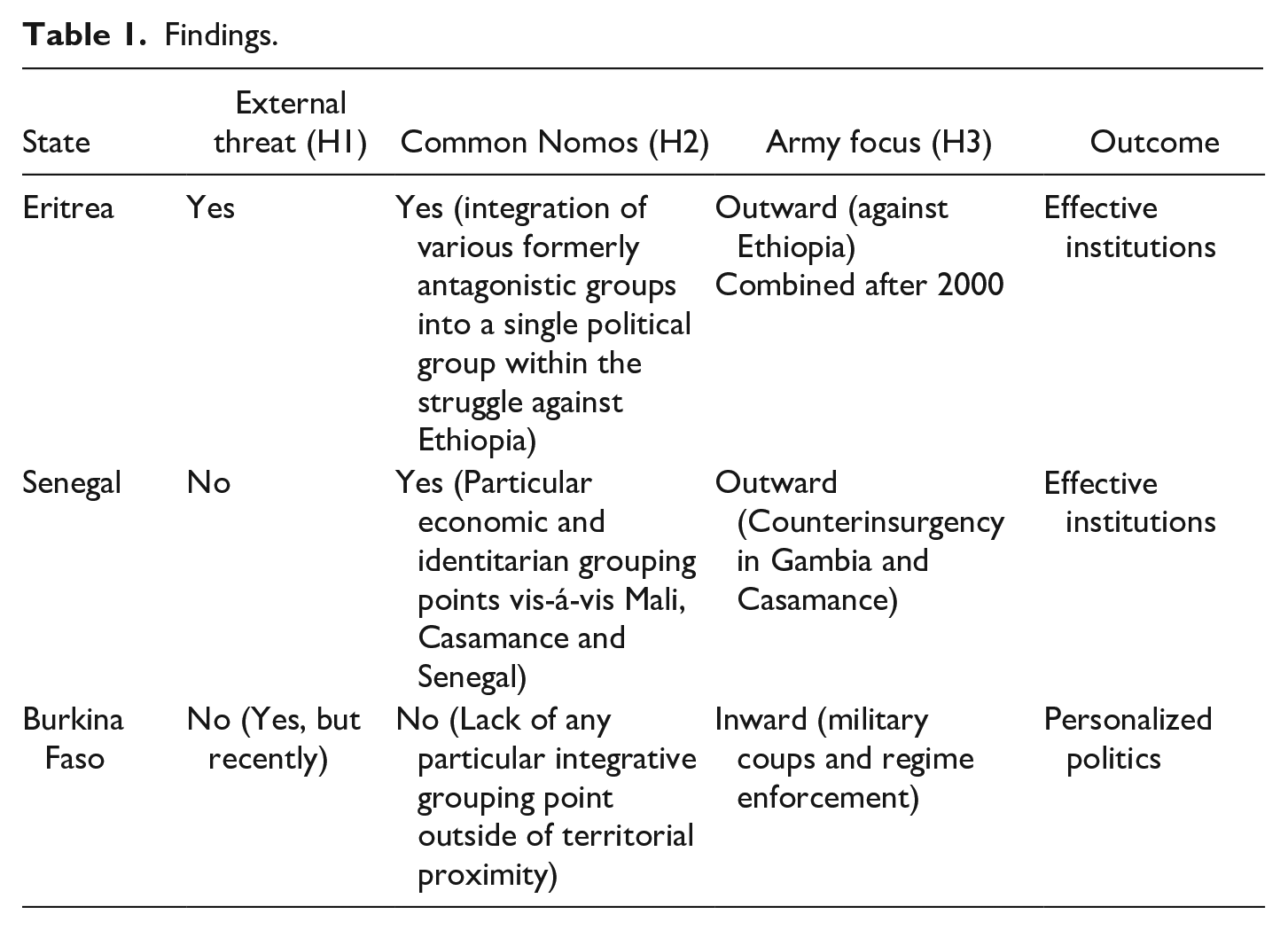
The first hypothesis is thus tested as inconclusive. While the external threat proved vital for the development of state institutions in the case of Eritrea, it was not necessary in the case of Senegal. Moreover, the impact of the spill-over of a nonstate existential threat on Burkina Faso’s institutional development is yet to be seen. External threat thus seems to be a sufficient condition in case the political community can persist but not a necessary one, as evident from the case of Senegal. On the contrary, we can confirm the second and third hypotheses as the development of common nomos has, in all three cases, correlated with the effectiveness of state institutions as was the outward focus of the military. These, however, are dynamic and in the case of Eritrea the impact of heavy-handed authoritarian policies might in the future completely disintegrate the developed distinctions.
Conclusion
This article revisited the issue of state-building in Africa and presented the utility of theoretical approaches offered by evolutionary and identitarian perspectives. In particular, it demonstrated the usefulness of Tilly’s approach adapted to the continent’s historical development, demographic and geographic conditions, and cultural and other traits through its integration with Schmittian theory of the evolution of political communities by establishing Nomos and identification of hostis. It was achieved by creating a conceptual frame that integrated Tilly’s focus on the evolution of states as resources/population-exploiting tools for war-fighting and Schmitt’s understanding of politico-spatial ordering based on unification of the population under the relevant inclusion/exclusion-making grouping points within the dynamic of friends and strangers (hostēs). The frame allowed for formulating three hypotheses that were tested using the process-tracing method in three case studies of Eritrea, Senegal, and Burkina Faso. Findings from the case studies demonstrate the importance of establishing a political grouping point (nomos) on the given state’s territory as well as a positive effect stemming from the employment of the military against an external threat.
Based on the evaluation of the three examined hypotheses, the selected theoretical framework can be a helpful tool in exploring the various ways the statehoods developed on the continent after the advent of decolonization. It can also assist with the evaluation of how the existence of friend/hostis distinction played into the effectiveness of their administration and use of their militaries.
Further analyses should be used to adapt the proposed frame better to suit the discovered empirical realities and test it on additional cases. It can also lead as a guide toward improving the success of postcolonial state-building practices. Therefore, the article concludes that the administrative strength of states in Africa, which emerged after the collapse of European colonial empires, depended on whether they established a clear-cut friend-hostis distinction and whether they employed their militaries in situations when the state was questioned externally. Maintenance of such a distinction and role of armed forces in it seems to be of crucial importance for the future effectiveness of the African states.
Footnotes
Declaration of Conflicting Interests
The authors declared no potential conflicts of interest with respect to the research, authorship, and/or publication of this article.
Funding
The authors disclosed receipt of the following financial support for the research, authorship, and/or publication of this article: This work was supported by the Charles University Cooperatio Program, research area POLS