




Abstract
This article examines the ethnicization of the Nigerian Army between 1957 and 1966, tracing how recruitment reforms transformed it from a meritocratic institution into one fractured by competing loyalties. We distinguish three intersecting cleavages—ethnic, regional, and sociological (linked to educational and training pipelines)—to show how the introduction of a regionally based “Quota System” reshaped officer cohorts, lowered professional thresholds, and fostered resentment among rival groups. Archival records, parliamentary debates, and memoirs reveal how a policy framed as inclusive instead weakened corporateness and legitimized factional politics within the military. The result was an officer corps divided in identity, unequal in competence, and prone to intervention. By situating Nigeria within wider debates on nonmeritocratic recruitment and praetorianism, the article highlights how politicized personnel policies can erode military professionalism and destabilize fragile democracies.
Introduction
In August 1965, mere months after the Nigerian Army gained its first indigenous head, a group of majors, largely from Infantry backgrounds, plotted a bloody coup against Prime Minister Sir Abubakar Tafawa Balewa’s government. Executed in the early hours of 15 January 1966, the coup was fueled by frustrations with corruption, mismanagement, and elite malfeasance. But as Daly (2024, p. 6) notes, soldiers also harbored disdain for civilian rule: “They saw British civilians as pale shadows of the decisive officers who had trained them,” and the African politicians who replaced them were “just as bad.”
To many Nigerians, the coup was cathartic. Jubilations broke out nationwide, and Lagos saw mock funerals for civilian politics, complete with coffins. The popular slogan “Chop-chop—e don die-o!” celebrated what many believed was the end of political corruption (Time, 1966, p. 22). The media praised the Army, and politicians “slunk out of sight” to avoid public scorn (First, 1970, p. 301). The coup, though violent—killing 40 civilians and 24 officers (Time, 1966, p. 22)—was reportedly “greeted with more enthusiasm than independence itself” (First, 1970, p. 301).
However, the ethnic profile of the plotters cast a long shadow. While the public embraced the idea of a military reset, closer scrutiny revealed the coup’s ethnic complexion. According to a Police Special Branch report, the conspirators—including Ifeajuna, Okafor, Nzeogwu, and Onwuatuegwu—were predominantly Igbos from the South-East (Gbulie, 1981; Muffett, 1982; Siollun, 2009). This raised suspicions that one group aimed to dominate both the Army and Government (Barrett, 1979, p. 45), especially as a number of the victims—Balewa, Bello, Maimalari—were Northern Hausa-Fulani or Kanuri elites.
These ethnic tensions brought the Army to the brink of disintegration. As Huntington (1957, p. 8) would put it, the Army’s corporateness had eroded. Yet this fracture did not emerge overnight. The remainder of this paper examines how pre-independence recruitment patterns and politicized reforms undermined institutional cohesion and laid the groundwork for civil war.
Literature Review
This section of the article engages comparative debates on ethnicized militaries and non‑meritocratic recruitment, linking Nigeria’s experience to wider findings in political science and sociology. Foundational works argue that when states allocate military opportunity along ethnic lines, cohesion erodes, affective bonds within the military institution are undermined, and political instability rises (Cederman et al., 2010; Enloe, 1980; Harkness, 2016). Complementing this, Lyall (2020) argues that organizational inequality undermines battlefield performance by fraying trust and willingness to fight across units. Put another way, the ethnicization of a military force stratifies the ranks and damages what Huntington (1957) refers to as its “corporateness”: its sense of organic unity, discipline and training, and a consciousness that the military was a group that bonded together (p. 10). Taken together, these studies suggest that policies privileging ethnic arithmetic over professional standards degrade corporateness and heighten the risk of factionalism.
Civil–military theory helps explain why such institutional choices have political aftershocks. McMahon and Slantchev (2015) frame a “guardianship dilemma,” where rulers seek loyalty from the armed forces yet also fear their strength. McMahon and Slantchev’s research, therefore, suggests that policies that buy loyalty can simultaneously dilute professionalism—defined by Samuel Finer as a military institution’s “composite of expertise, social responsibility and corporate loyalty [corporateness]” (Finer, 2002, pp. xv–xvi).
Mattingly’s recent work likewise documents political leaders’ trade‑offs between rewarding loyalists and promoting competent officers under varying threat environments (Mattingly, 2024). In post‑colonial polities, such as 1960s Nigeria, as the site of this paper’s core analysis, Huntington’s (1957) emphasis on expertise and corporateness—and Schiff’s (1995) concordance among elites, military, and citizens—offer clear benchmarks for assessing when recruitment rules bolster professionalism versus when they politicize the force.
The Nigerian case contributes micro‑historical leverage on these claims. In our paper, we trace how the shift from meritocratic recruitment to a regionally allocated “Quota System” altered the officer pipeline, changed cohort identities (e.g., Sandhurst, Eaton Hall, short‑service), and redistributed authority across ranks. By reading ministerial instructions, parliamentary debates, War Office files, training‑school intakes, and cohort promotions alongside memoirs and press coverage, we show how an ostensibly integrative policy generated resentments, lowered entry thresholds, and weakened professional cohesion—conditions under which praetorian tendencies flourished in the early 1960s (cf. Luckham, 1971; Siollun, 2009).
The Nigerian Army, we argue, was pulled apart by centrifugal forces born of competing ethnic loyalties. Unable to contain these pressures, the institution fractured: one faction moved to seize power, and the Army as a whole turned its weapons inward. In that collapse, praetorianism—defined by Perlmutter and Bennett (1980, p. 9) as “a situation where the military class of a given society exercises independent power by virtue of an actual or threatened use of force”—emerged as the ultimate expression of institutional dysfunction.
Research Design and Methods
Scope and Outcome of Interest
The study covers the period from 1957 to 1966 and examines the ethnicization of the Nigerian Army. We define this as the progressive allocation of access, authority, and advancement according to ethnic criteria or their institutional proxies (notably regional quotas), and its consequences for professionalism and civil–military relations (praetorianism, elite capture).
Sources and Triangulation
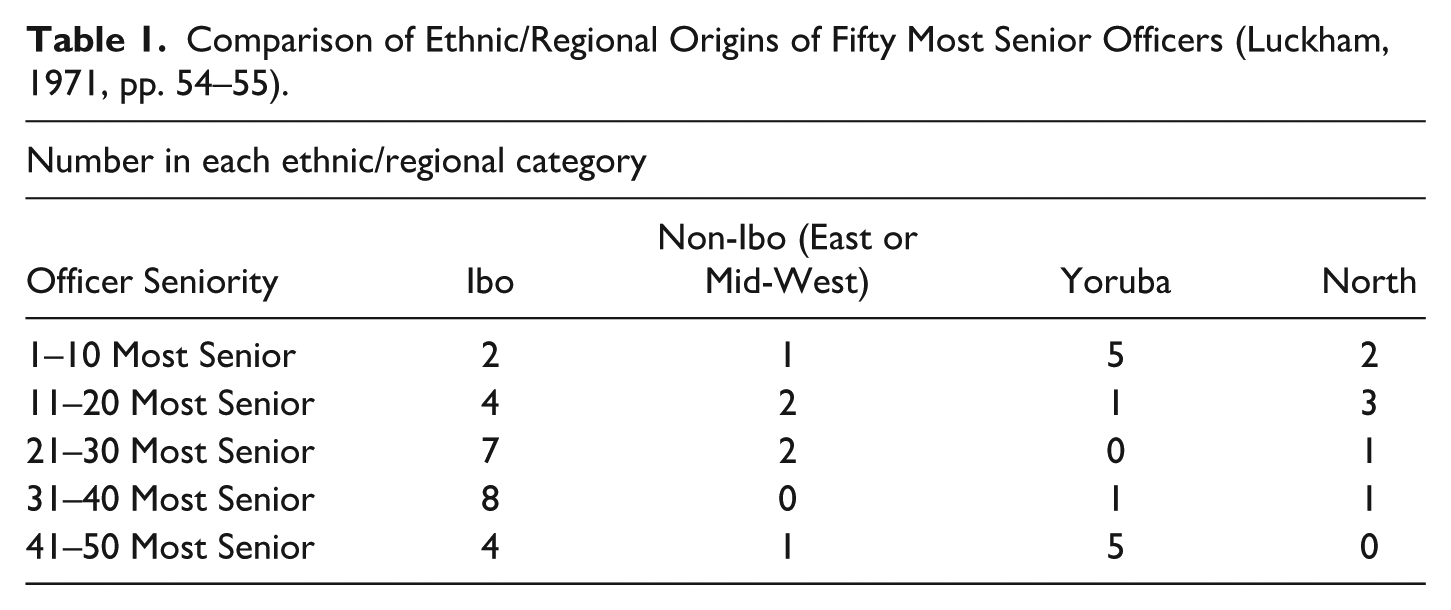
Evidential material employed synthesizes parliamentary debates (1959–1961), ministerial memoranda, War Office and Ministry of Defence files, training college records, press reportage, and memoirs (e.g., Ademoyega, 1981; Madiebo, 1980; Obasanjo, 1987). It also employs relevant historical and sociological studies on the Nigerian Army within the relevant timeframe (e.g., Luckham, 1971; Miners, 1971; Siollun, 2009). Claims about intent behind NPC‑era manpower policies are examined by comparing public justifications with procedural changes (e.g., selection‑board instructions, altered entry thresholds) and resultant compositional shifts. These are all documented in Tables 1–3, with further interpretation (and conceptual clarification) provided as and when required.
Comparison of Ethnic/Regional Origins of Fifty Most Senior Officers (Luckham, 1971, pp. 54–55).
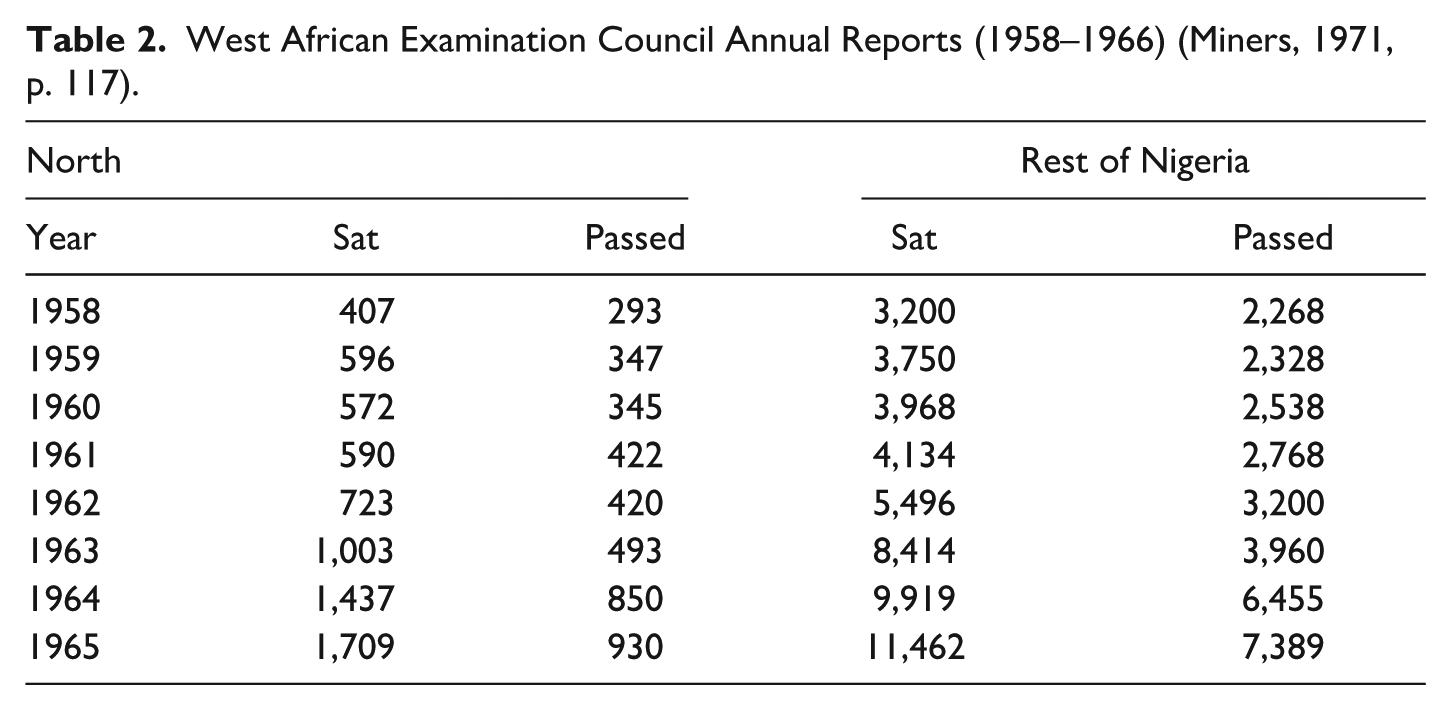
West African Examination Council Annual Reports (1958–1966) (Miners, 1971, p. 117).
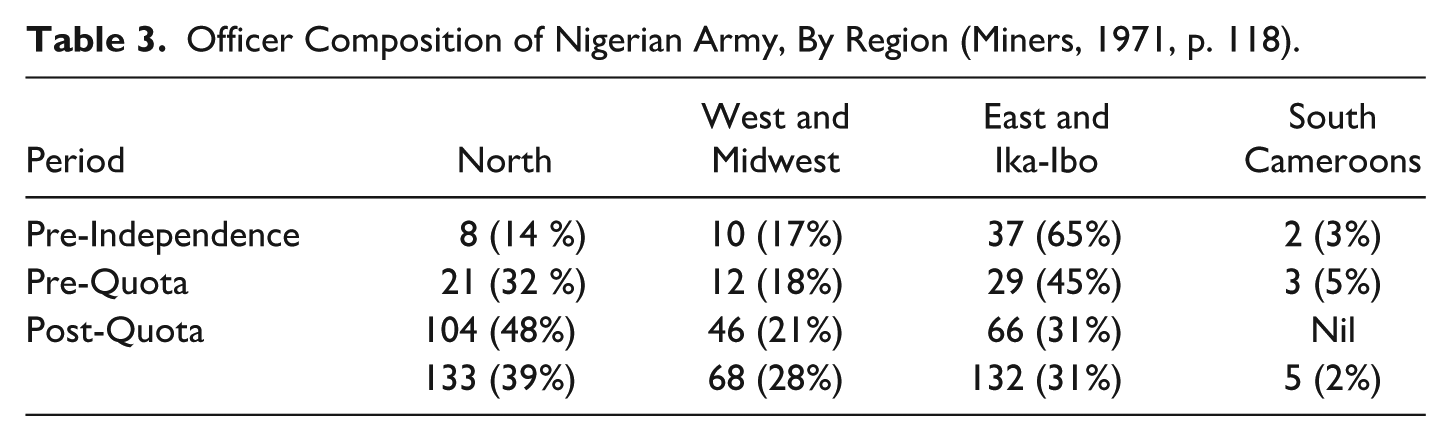
Officer Composition of Nigerian Army, By Region (Miners, 1971, p. 118).
Bias and Limitations
Colonial and political sources, especially within new states, can naturalize pre-existing martial stereotypes or rationalize policy choices. We therefore cross‑check British officials’ statements against Nigerian parliamentary records, ministerial directives, and recruitment/educational data, and treat memoir narratives as partial and situated. Insofar as archival categories often track region rather than ethnicity, we treat region (i.e., sites of geopolitical extraction) as an imperfect proxy for ethnicity and make this distinction explicit in interpreting Tables 1 and 3.
Operationalization
Analytically, we distinguish three cleavage types: (a) ethnic (e.g., Hausa‑Fulani, Igbo, Yoruba, Kanuri); (b) geographic/regional (North, East, West/Mid‑West); and (c) sociological cohort effects linked to education/training pipelines (Sandhurst vs. Eaton Hall vs. short‑service officer commissions). Finally, our analysis tracks how the quota policy (also referred to, in the paper, as the “Quota System”) interacted with these cleavages to reshape the ethnic composition of the officer corps and by contributing to intra-institutional grievance and stratifying the ranks, the policy provided further incentives for political intervention.
Conceptual Clarification
In our paper, we take “ethnicisation” to be the process by which organizational rules, practices, and informal networks allocate recruitment and advancement using ethnic criteria or proxies (notably regional quotas). We build on two existing concepts in determining our position. First, “ethnicisation” as the colonial practice of assigning martial stereotypes to different ethnic groups and then making decisions around roles based on those stereotypes (Killingray & Plaut, 2010; Kirk-Greene, 1980, pp. 40–43). Second, “ethnocentrism” as the “tendency to see one’s own (ethnic) group in positive terms and, conversely, other groups in negative terms” (Evans & Newnham, 1998, p. 154). Next, in our paper, “regional politics” denotes the formal allocation by geographic region (North, East, West/Mid‑West), which overlaps with but is not identical to ethnicity (e.g., Igbo residents counted under Western quotas). Finally, “Sociological cleavages” capture cohort identities tied to education and training (Sandhurst, Eaton Hall, short‑service). Disentangling these helps interpret Tables 1 and 3 without conflating categories.
The Nigerian Army at Independence
Since Nigeria’s creation in 1914, the three largest ethnic groups—Hausa in the North, Yoruba in the South-West, and Igbo in the South-East—have shaped recruitment patterns into the Nigerian Army (Stapleton, 2019). Ethnic background and geopolitical origin strongly influenced perceptions of soldiering. By Independence in 1960, three broad categories of recruits emerged: (a) students from regions that traditionally valued military service; (b) orphans or those from financially unstable families who saw the military as an accessible career path; and (c) those with familial ties to colonial military service, for whom soldiering was “a traditional occupation” (Miners, 1971, p. 111).
Colonial officials reinforced martial stereotypes. In 1947, the General Officer Commanding-in-Chief of the WAFF assured the War Office that the “fighting element” of the Army remained “recruited from the Northern parts of Nigeria,” which had a “tradition” of supplying the rank and file (War Office, 1947). By the late 1950s and into the 1960s—especially under the “Quota System”—Northerners enlisted in large numbers. Yet many lacked the education to meet the British-imposed officer entry standards, with some having “failed to get entry to sixth form or. . . willing to sacrifice the greater status of a higher formal education for a better chance of material benefit in the officer corps” (Luckham, 1971, p. 123).
Meanwhile, the Yoruba and Igbo, though having served ably in wartime, were often categorized as the “‘tradesmen’ element” and “recruited mainly from the Southern portion of Nigeria” (War Office, 1947). Better educated, they tended to prefer careers in commerce or the civil service. For recruiters, therefore, the challenge was twofold: improve military pay to attract Southerners, and lower or adjust educational standards to accommodate Northern enlistment into the officer corps.
In 1960, Army recruiters implemented a general salary revision, making military pay competitive with—and in some cases exceeding—that of the civil service. A university graduate entering the civil service earned £720, while a newly commissioned subaltern in the Nigerian Army received £768 per annum (Miners, 1971, p. 113). Alongside this, recruitment standards were relaxed. In December 1959, the educational requirement was reduced from four credits, including English, to four school certificate passes (Alabi-Isama, 2013, p. 22). By May 1961, a Teacher’s Grade II Certificate or RSA Stage II Examination was deemed sufficient (Daily Express, 1961). The age limit was also raised from 22 to 24, allowing university graduates to explore other careers before joining the Army (Miners, 1971, p. 111). Physical requirements were likewise lowered (Alabi-Isama, 2013, p. 22).
These shifts broadened access to the officer corps. Enlistment was no longer restricted to those who met previously stringent standards, and recruitment began to draw from a wider ethnic base. Beyond the Igbos and Hausas, Yoruba, Fulani, Kanuri, Tiv, and minority groups also began to emerge in the ranks. Still, due to disparities in education, the Igbo supplied the Army with literate personnel for clerical roles, while the North contributed largely illiterate infantrymen (Gaub, 2011, p. 23). The Yoruba, however, “for historical reasons had looked upon the military as a place for drop-outs” and gravitated toward public service or private sector jobs (Peters, 1997, p. 80). As Alabi-Isama (2013, p. 21) observed, the sentiment was: “why go for rigorous bush training when you can put on a tie and work comfortably in an office?”
An Ethnic “Sandwich”: The Nigerian Army From the Mid-1950s
By the late 1950s, the consequent institutional imbalance that emerged across the Army’s ranks was underpinned by this study’s central themes of ethnicism, regionalism and the literacy divide between North and South. Table 1 compares the ethnic or regional origins at the most senior levels of the Nigerian Army—that is, the “Nigerianisation” of the top 50 officer ranks—until January 1966, when the first coup d'état occurred. The officers below constituted approximately the most senior 15 per cent of combat officers at the time. The table highlights two things: overall, the Igbo were far ahead in terms of officer numbers at the time. Second, in the most senior positions, the Yoruba had more officers.
Table 1 suggests that, at the surface level, the Nigerian Army of the 1950s appeared broadly “multi-ethnic and meritocratic” (Luckham, 1971, pp. 54–55). Moreover, the “Nigerianisation” process, which saw more Nigerians taking up roles previously held by British persons (Ministry of Defence, 1961), was coming on well, and professionalism was high. Indeed, when Britain agreed to cede control of the Army in 1957, several of its officers were educated Nigerians. Confidence was high in the potential of Nigeria’s officers, even though, on the part of senior British military officials, skepticism remained that they were ready to command the Army (Ministry of Defence (UK), 1964).
On 1 April 1958, the British Army Council in London relinquished control of the Nigerian Military Forces to the Nigerian Government, and Sir James Wilson Robertson, the last British Governor-General, optimistically declared the Army “bound to become one of the main embodiments of the national spirit” (Nigerian Army Education Corps and School [NAECS], 1992, p. 110). Indeed, there was a groundswell of patriotism as the Army emerged as “the vanguard of national integration and Nigerianism” (Gaub, 2011, p. 28). By the time Robertson handed over to Nigerian politicians in 1960, the Army had become a reasonably prestigious occupational model for youth, with its parades, smartly dressed personnel, and reputation for discipline. It was an institution with broad recruitment appeal and, on the surface, symbolized “national unity” as the coming together of people and groups across ethnic, geopolitical and party lines. Viewed this way, “national unity” or “Nigerianism” was the antithesis of ethnicism and regionalism—both of which are frowned upon within the military institution as an apolitical instrument of the state. Indeed, even the January 1966 mutineers believed that “only in the army do you get true Nigerianism” (West Africa, 1966).
Yet, beneath this image, ethnic-based recruitment undermined the Army’s corporatist ideal. Ethnicism had stratified its ranks for decades. By 1950, all short-service commissioned officers were Southerners, mostly Yoruba—Samuel Ademulegun, Babafemi Ogundipe, Ralph Shodeinde, and Robert Adebayo. Slightly junior to them were the first Sandhurst-trained officers, all Kanuri Muslims from the North—Zakariya Maimalari, Umar Lawan, and Kur Mohammed (Siollun, 2009, p. 22). The only senior officer outside the Yoruba or Kanuri in-group was Major-General Johnson Aguiyi-Ironsi, appointed the first indigenous GOC in 1965 (British High Commission Lagos, 1966).
Officer backgrounds—whether Sandhurst-trained, commissioned from Eaton Hall, promoted from NCO ranks, or university-educated—shaped sub-identities and fostered in-groups within the officer corps. Thus, not all officers of the same rank were truly equal, further undermining corporatism and “Nigerianism” (Obasanjo, 1987, p. 45).
Class divisions also created inferiority complexes. Aguiyi-Ironsi, for example, trained at Eaton Hall, not the more prestigious Mons or Sandhurst. As a result, despite leading the Army, he lacked a regular combatant commission and was acutely aware that many younger officers had trained at Sandhurst (Omeni, 2025). Eaton Hall produced “national service officers,” akin to the US ROTC. Consequently, “Ironsi carried with him a sense of grievance, especially in a sort of masochistic feeling of inferiority vis-à-vis those junior to him who had trained at Sandhurst” (Muffett, 1982, p. 171).
This stratification had concrete effects. By independence, only eight of the Army’s 55 officers were Northerners (Miners, 1971, pp. 27, 36, 114, 115). The Southwest had 10; the Southeast had 37—nearly double the combined total of the other two regions (Luckham, 1971, p. 344), with most officers predominantly Igbo (Alabi-Isama, 2013, p. 21). Accelerated promotions under “Nigerianisation” meant that most senior officers between the late 1950s and 1966 were Southerners.
Conversely, subalterns and NCOs were overwhelmingly Northern, thanks to targeted recruitment campaigns by Northern politicians (Siollun, 2009, p. 22). Historically, Northern soldiers filled combat roles—infantry and artillery—while Southerners tended to join Services and technical units like Signals (War Office, 1947).
By the 1960s, regional and ethnic stratification had deepened within the Nigerian Army. Southern officers were generally more literate and politically inclined, while Northern officers excelled in infantry roles but were often less literate. Southern recruits also performed better in army entrance exams, continuing a trend from the Second World War when literate African personnel gained prominence.
After the war, British officials recognized Southern dominance in literacy but hoped Northerners would eventually catch up. As Lt. Gen. M.B. Burrows, GOC-in-C West Africa, noted, he “hope[d] that as the Army Education Scheme progresses, the educational standard of the Northerners will increase and we shall find a larger proportion of them occupying specialist appointments” (War Office, 1946, p. 15). Until then, he expected Northerners to continue serving mainly as infantrymen—as they did for many years.
Recruitment Shifts: Northern NCO, Subaltern and Soldier Dominance by 1966
Even though Northern NCOs and Warrant Officers (WOs) dominated those ranks, especially in the infantry regiments, “few were sufficiently educated to qualify for a short-service commission” (Miners, 1971, p. 37). This raises a question of note. Indeed, the fact that Northerners were over-represented in the Infantry rank and file was hardly unusual and was to be expected, given the historical precedent and the established “tradition” (War Office, 1947). What seemed curious was that if Northern NCOs and WOs with an Infantry background struggled to qualify for short-service commissions, and if Northern recruits also struggled to meet the requirements to be put forward to the Selection Board for cadet training en route to becoming subalterns (Miners, 1971, p. 37), then how did so many Northern subalterns suddenly emerge by 1966?
Moreover, such was the uptick in the numbers of Northern officers coming through the ranks by the mid-1960s that by the time the Nigerian Defence Academy, Kaduna, opened in February 1964 and produced the first batch of regular combatants in 1967, the question of an ethnic imbalance that disadvantaged the North was practically a nonissue. What is the explanation for this “surprising” trend of Northerners quickly bridging the recruitment gap between themselves and the Southerners into the Army’s ranks between the mid-1950s and mid-1960s—a period of just a decade? For instance, in 1954, only 85 boys from the North passed the School Certificate Examination, compared with 1,334 boys in the South (Miners, 1971, p. 37).
So how could such an educational divide between North and South, which in theory should have meant that the better-educated and thus better-qualified Southerners dominated the military, become a nonissue over just a few years? Part of the answer requires a deep dive into the contentious political debate around recruitment into the military.
Explaining Recruitment Shifts: Transfer of Control to the Nigerian Government
In 1950, the idea of a “Quota System” for the Army’s recruitment was first floated at the Ibadan General Conference. However, by that time, control of the Nigerian Military Forces (NMF), which included the Army, was the responsibility of the Army Council in London. The Council was administered by the War Office and had as its principal members the Secretary of State for War as President, the Parliamentary Under-Secretary of State for War, and the Financial Secretary to the War Office. The Permanent Under-Secretary of State for War was also part of the Army Council, serving as its secretary. Meanwhile, the Council’s two most senior military members were the Chief of the (Imperial) General Staff and Adjutant-General to the Forces.
The Nigerian Army fell within the remit of the Council, and so, whereas Nigerian politicians could debate Army recruitment issues, they could not implement changes—short of presenting motions, agreeing on them and then passing them on to Whitehall. Simply put, before Independence, politicians could rarely insist on matters as important as defence policy if they failed to align with the government and Whitehall. In this instance, the Army Council preferred that recruitment stay merit-based on British officers’ advice in Nigeria. Consequently, there was little chance of adopting a “Quota System” as British officers believed doing so would undermine the Army’s professionalism.
However, at the 1957 Constitutional Conference held on 1 April, the Army Council in London lost control of the NMF, which the British government passed on to the Nigerian government. This was to be expected as an eventuality, given the countdown to Nigeria’s Independence. The handing over of control of the Nigerian Army to Nigeria’s government came as “part of the process of disengagement by colonial authorities” and allowed Nigerian leaders to accrue experience related to armed forces administration (Peters, 1997, p. 63).
A newly created Defence Committee of the Government of Nigeria structured control of the Army by the Nigerian government. This Committee was to be chaired by the Governor-General of Nigeria (Dr Nnamdi Azikiwe) and included in its membership the Deputy Governor-General, the Prime Minister, two other Federal Ministers, the GOC of the Nigerian Army, and the Regimental Premiers (Peters, 1997, p. 70).
On 1 April 1958, control of the Nigerian Army shifted from Whitehall to Governor Sir James Wilson Robertson’s government. This was a curious compromise—Nigeria’s government managed the army’s budget, but spending remained under British control via Robertson’s administration. As Gaub (2011) notes, “only after the federal elections of 1959 and the constitution of the first Nigerian government” did full budgetary control shift to the Ministry of Defence (p. 21). Until then, “the Nigerian Army was essentially a colonial one” (Obasanjo, 1987, p. 34).
From 1960, civil oversight fell to Defence Minister Alhaji Muhammadu Ribadu and, after his death in May 1965, to Alhaji Inuwa Wada. Both were Northern People’s Congress (NPC) members and “powerful figures of a very conservative kind” (Dent, 1971, p. 372).
Despite the transfer, Britain provided £500,000 between 1958 and 1959, and the same sum again at Independence to ease the financial burden (Miners, 1971, pp. 59–60). Though modest for a 7,280-strong force (Omojokun, 1978, p. 4), Nigeria’s leaders did not anticipate needing large armed forces. There was no Air Force until 1964, and none planned before 1962 (Air Ministry, 1962). Aside from the H.M.N.S. Nigeria “gifted” by the British, the Navy had no operational warships (Colonial & Office, 1958, 1959).
At the first Federal Defence Council meeting in 1957, it was agreed “the Army would be required for no more than internal security duties and minor frontier incidents” (Miners, 1971, p. 61). Consequently, during the first strategic review, even the Army’s Artillery Battery was questioned. By April 1958, it was converted to a Reconnaissance Squadron in Kaduna to enhance mobility and secure the Northern frontier—years before French West Africa became a treaty ally (1978–1981) (Omeni, 2018, p. 70).
Despite its reduced size, the Nigerian Army was now close to being entirely within the remit of Nigerians. For the first time, Nigerian politicians could make strategic decisions around the structure and operations of the Army and so opt for additional changes. Approval was given to build a cadet school at Kaduna, which became operational in 1960 as the British-run Royal Military Forces Training College (RMFTC) (NAECS, 1992, p. 141).
These cumulative shifts—regional rebalancing, lowered entry thresholds, and the emergence of rival training cohorts—did not remain administrative adjustments. In time, they reshaped everyday life within the barracks: who was deemed competent, who exercised informal authority, who was prioritized for appointments and promotion, and who was regarded as an outsider within a rapidly politicizing institution.
As these identities hardened, the Army’s earlier self-conception as a cohesive professional corps gave way to competing narratives of entitlement and exclusion. Within this environment, the ranks increasingly divided into distinct constituencies: those who understood the quota system for what it was and were “hand in glove” with the politicians behind it, prepared to defend a policy from which they directly benefited; a second group, largely indifferent, who were already securely embedded within the officer corps and felt little immediate stake in resisting the entry of less-qualified successors; and, finally, the “small and articulate group” who, as Ademoyega (1981, 32) records, “hated” the quota system and perceived it as a corrosive force undermining the profession. It was this last group that would ultimately plot to overthrow the political order and restore what they considered the Army’s disrupted balance.
Theory reinforces the connection between problematic recruitment practices and the erosion of professionalism. As Harkness (2018) shows through the cases of Sierra Leone and Cameroon, stratification within postcolonial African militaries not only weakens professionalism and affective bonds but also produces persistent grievances among groups that see themselves as structurally disadvantaged within the military order. These outcomes echo Enloe’s (1980, 50) earlier warning that recruitment models which divide the ranks inevitably generate militaries that are “sadly inadequate” for the demands placed upon them.
This dynamic increasingly characterized Nigeria’s Army. By the mid-1960s, the officer corps no longer shared a coherent professional ethos; it shared a set of resentments. From these fractured loyalties—rather than from any singular ethnic motivation—emerged the conspiratorial networks that coalesced into the January 1966 coup (McMahon & Slantchev, 2015; Miners, 1971).
Origins of the “Quota System”
In 1958, with the Army under government control eight years after the Ibadan Conference of 1950, the idea of a “Quota System” resurfaced—this time backed by Northern politicians and gaining traction (Oyediran, 1979, p. 23). It was proposed that Army recruits be “drawn from each region in the same proportion as the regional population stood in relation to the total population” (Oyediran, 1979, pp. 23–24). This approach replaced merit-based recruitment with regional representation and the doctrine of “federal character.”
Critics of this policy argued it “glorif[ied] mediocrity and undermin[ed] merit through positive discrimination,” thereby creating a two-tier system that fostered mistrust rather than integration (Fayemi, 1994, pp. 109, footnote 9). Contemporary analysts echo this view, noting such policies diminished “questions of merit or competitiveness” and introduced “suspicion and malice” into public decision-making (Kanyip, 2013; Nwenearizi et al., 2018, pp. 18, 65–66; Saint et al., 2003). Northern candidates benefited from relaxed standards, while Southern merit-based opportunities were curtailed.
Yet in 1958, opponents of the “Quota System” were few, and political dominance by the Northern People’s Congress ensured its adoption. British-set meritocratic recruitment standards were replaced with regional quotas: “Northern Region, 50 per cent; Eastern Region, 25 per cent; and Western region, 25 per cent.” After the Mid-West Region’s creation in 1963, it was allocated 4 per cent (Oyediran, 1979, p. 24).
Despite this “discriminatory lowering of standards for Northern officer cadets” (Miners, 1971, p. 115), further proposals emerged to reduce Sandhurst entry qualifications for Northerners (Gutteridge, 1966, p. 38). Although not immediately adopted, these changes began to take shape in 1961, when the Ministry of Defence intervened more directly (Miners, 1971, p. 116).
The short-term impact of the “Quota System” deserves attention. By deemphasizing merit-based recruitment, it facilitated the influx of Northern subalterns and NCOs into the Army (Miners, 1971, p. 116). With stringent qualifications removed, the system effectively “guaranteed” large numbers of Northern cadets would pass the Selection Board. The Federal Government also resorted to informal methods, instructing Selection Boards to favor Northern applicants “when their qualifications and aptitude were equal to those of Southern applicants” (Luckham, 1971, p. 244).
However, as Northern recruitment increased, the educational gap widened. The North lacked sufficient West African School Certificate Examination candidates to support this policy. As Luckham (1971) notes, “there were too few Northerners with academic qualifications comparable to their southern opposite numbers for these methods to be effective, mainly because of the shortage of secondary schooling in the North” (p. 244).
Between 1958 and 1965, the disparity in male School Certificate passes was stark. In 1965, only 930 Northerners passed the exam, compared to over 7,000 in the South. This reflected not only the educational gap in relative terms but also the slow pace of improvement in the North in absolute terms.
The trends in Table 2 underscore how a merit-based system might have excluded substantive Northern recruitment. The “Quota System” sought to counter this. Meanwhile, Table 3 highlights the system’s effect on officer distribution, revealing tensions—particularly “among the officers of Eastern and Ibo origin, including those who staged the January 1966 coup” (Luckham, 1971, p. 245).
Between 1958 and 1961, Northern commissioned officer numbers rose sixteenfold. Had this pattern continued, most regular commissioned subalterns by the late 1960s would have been Northerners. Over time, the system “lowered standards” by admitting officers who might not have met earlier entry criteria. As the Nigerian Military Training College (NMTC) in Kaduna expanded under this policy, by 1966, over 33 percent of officers were Northerners, up from just eight out of 57 (14 percent) at Independence (Alabi-Isama, 2013, p. 23).
The West African Pilot criticized this development, stating the Ministry of Defence was sending “subgrade people for training merely to satisfy Regional as opposed to National interests” (1964). Yet, “national interest” was ambiguous, shaped by how the government viewed the Army. With no external threat in the early 1960s, the Army was intended for internal security. In such a context, an ethnically representative force aligned with “federal character” might be seen as serving national cohesion (West African Pilot, 1964). Still, whether compromising standards for “ethnic balancing” served the nation’s long-term interests remains debatable.
Military Recruitment and Ethno-Regional Politics in the Independence Era
Regardless of how “national interest” was framed, both sides of the “Quota System” debate had valid points. The Northern People’s Congress (NPC) envisioned integration in three ways: first, through the “Quota System”; second, by forming multiethnic units rather than maintaining Northern dominance in Infantry and Southern dominance in Signals; and third, by using the military (and, eventually, its sister services) to promote “Nigerianess” among youth (Gaub, 2011, p. 32).
Yet Southerners questioned the intent, asking: integration for whom? To many, the “Quota System” signaled “a rather clear message by Northern minorities and Hausas (for whom the NPC claimed to be speaking), who feared being overtaken in their stronghold, the army, by the more literate Southerners” (Gaub, 2011, p. 32).
The system impacted regions unevenly. While it significantly boosted Northern representation, it was only “partially successful in increasing the number of Yorubas in the military” (Peters, 1997). A 1958 “regional quota” aimed to curb Northern overrepresentation in the ranks (Luckham, 1971, p. 245), though its effectiveness remains unclear.
Importantly, the North’s gains were not offset by reductions in the East. This was partly because Igbos residing in the Western Region—including Lagos and the Mid-West—were counted in Western quotas, not Eastern ones. More Igbo lived in the West than Yoruba lived in the East, skewing the numbers. Despite this complexity, the North remained the primary beneficiary of the “Quota System” (Miners, 1971, p. 118). Table 3 provides a full regional breakdown of officer distribution across phases.
The “Quota System” was so divisive that during the 1964 General Election campaign, the United Progressive Grand Alliance (UPGA) made it a central issue. The party pledged to eliminate “all defects” in the Constitution and promised that “recruitment and promotion of members of the armed services will be divorced from tribalism and based strictly on merit and qualification” (Daily Times, 1964; Diamond, 1988, p. 200).
Viewed as a replacement of meritocracy with ethnicism, the “Quota System” was seen as harmful to national unity and a cause—possibly even a proximate one—of “divisive tendencies within the Army” (Gaub, 2011, p. 32, 200). However, despite UPGA’s reformist agenda, the party lost the election amid widespread violence and manipulation. The NPC, in alliance with the NCNC under the Nigerian National Alliance (NNA), formed the new government (Diamond, 1988).
By then, much of the Army’s ethnic restructuring had already taken place. Although UPGA campaigned to reverse the policy, the Northern elite had long perceived Igbo dominance in the officer corps as a strategic threat and acted early to alter the balance. By Independence, this shift was largely a fait accompli.
Southern politicians, though aware of the transformation, were constrained by the realities of First Republic politics, where ethnic considerations dominated statecraft. Leaders had to navigate intense rivalries among Hausa, Fulani, Yoruba, and Igbo elites (Perlmutter, 1977, p. 126). The overlap between party and state was particularly stark in the NPC-led government, where both were “indistinguishable” (Perlmutter, 1977, p. 126). Many Northern officers owed their advancement to the intervention of regional political elites and, in turn, supported the politicians who had relaxed recruitment standards to enable their entry (Siollun, 2009, p. 30). Northern leaders took pride in seeing Sandhurst-trained Northerners rise through the ranks—a perceived validation of their policies (Siollun, 2009, pp. 30–31).
This shift from Southern to Northern dominance in the officer corps was striking. In 1958, General Sir Lashmer “Bolo” Whistler, who succeeded Brigadier Swynnerton as WAFF Colonel Commandant, oversaw a Nigerianisation process that, due to high entry standards, resulted in over 60 percent of officers being Igbo by Independence (Siollun, 2009, p. 27). This dominance may have fostered a sense of superiority among some Igbo officers and contributed to the January 1966 coup.
The imbalance was troubling: a Northern-led civilian government and an Igbo-dominated officer corps created potential for civil-military conflict, especially amid growing political crises after 1962. Disillusioned by perceived tribalism and corruption, Igbo officers increasingly viewed intervention as necessary (Ademoyega, 1981).
Aware of the imbalance, Northern ministers pushed for regional quotas from 1958, arguing martial aptitude—not education—should determine Army eligibility. As one saying put it, “the warrior is not talkative [mai fada ba zai yi surutu ba]” (Oyediran, 1979, p. 23). Ironically, soldiers later turned this argument against politicians, claiming they “are too talkative [. . .] and do not speak the truth” (Dent, 1970, p. 79, 1971, p. 373).
Though the Quota System was officially adopted in 1958 (Siollun, 2009, p. 28), Igbo dominance persisted into Independence, partly because such policies take time to bear fruit. Nevertheless, not all Northern politicians were willing to wait. In an April 1960 parliamentary debate, Abdullahi Magajin Musawa urged Balewa to ensure a “united in diversity” officer corps, calling for ethnic balance across the Army’s regions (House of Representatives Debate, 1960, col. 1252).
However, the Prime Minister was not minded toward accelerating further the “equalisation” of the officer corps ethnicity, outside of the ambit of the “Quota System,” already introduced as government policy (Oyediran, 1979, p. 24). In Balewa’s view, little else could be done at the time. To him, a competent Army required qualified service personnel. Indeed, the previous August, Balewa had tried to state as much within a House debate, I do not like only one section of the Federation to be overwhelmingly dominating the other sections if it is possible, but at the same time, we want to have Nigerian officers in the Army, and specific educational qualifications are required of such officers. Still, if people who present themselves to the Army are from one section and have the qualifications, what can the government do other than accept them? (House of Representatives Debate, 1959)
The Prime Minister faced a dilemma (Miners, 1971, p. 53), but time and policy eventually increased Northern numbers in the officer corps, enabling the North to reassert military and political dominance. In 1961, the Selection Board was instructed that “where there are potential cadets of equal merit, consideration may be given. . .to the ethnic balance between regions” (House of Representatives Debate, 1961). This undermined meritocracy. As Madiebo (1980, p. 10) recalled, “in the name of ‘ethnic balance,’ military hospitals were staffed with doctors trained in Kano. . .over doctors of Southern Nigeria origin with internationally recognised diplomas.”
Yet Northern recruitment still lagged. Of 17 cadets selected for overseas training in March 1961, only five were Northerners, while 12 were Southerners—nine of them Igbos (Miners, 1971, p. 116). In response, Defence Minister Muhammadu Ribadu enforced the 1958 quota: a “rigid regional quota system” requiring 50 percent recruitment from the North, applying “to the initial selection board and to the final pass list, whatever the order of merit” (Miners, 1971, p. 116).
That year, Army units were also ordered to be ethnically mixed “down as far as the sections in a platoon” (Gaub, 2011, p. 35). Though presented as integration, this produced a “discriminatory” effect, distorting unit composition regardless of merit (Miners, 1971, p. 115).
Pro-Northern policy effects soon materialized. Six cadet recruitment units were established in the North—at Keffi, Kaduna, Sokoto, Kano, Zaria, and Bida—compared to two in the South: Igbo Etiti Grammar School (Enugu) and Government College, Afikpo (Miners, 1971, p. 117). Northern leaders, including emirs and ministers, encouraged enlistment, helping to normalize military careers. Similarly, figures like Dr. Azikiwe reportedly advised Ojukwu and others to join the Army post-university (Dent, 1971, p. 372).
Nonetheless, fears of Igbo dominance persisted. Northern leaders sought to block Igbos from replacing British officers (Siollun, 2009, p. 30), reflecting broader anxieties over political survival. Governor Sir Kashim Ibrahim quoted Prime Minister Balewa’s warning: “we are all surrounded by Igbo officers; if anything happens, they are going to kill us” (Osuntokun, 1987, p. 29). On 14 January 1966, Western Premier Akíntọ́lá echoed this fear to Ahmadu Bello in Kaduna, repeating as he departed: “I tell you, today they are going to kill us” (Muffett, 1982, pp. 20–23).
“They,” as alluded to by Akíntọ́lá, concerned the Igbo officers around them. Tragically, the very next day, both men, the Sardauna (Sir Ahmadu Bello) and Akíntọ́lá, were targeted and killed by the predominantly Igbo coupists. For that matter, so too was Balewa. The premonitions of the Western Premier and the Prime Minister regarding the threat of an Igbo rebellion were, quite disastrously, precise. In hindsight, perhaps more attention might have been paid to the signs. Igbo officers were dominant in the Army at the time. Indeed, six of every 10 persons in the Army’s officer corps by Independence were Igbos (Siollun, 2009, p. 27).
The Igbos, however, could not be blamed for dominating the officer corps. Cadet entry was based on competitive qualifications and open to all ethnicities. Unlike Northern politicians who actively lobbied for enlistment (Oyediran, 1979, pp. 23–24), the Army made no similar effort in the South (Miners, 1971, p. 41). General Sir Whistler dismissed complaints about Igbo dominance, blaming Northern leaders for resisting Western education and failing to produce qualified officer candidates (Smyth, 1967, p. 230).
Whistler’s stance echoed British officials like Cameron and Bourdillon, who described the North as “backward” (Bourdillon, n.d., p. 77; Cameron, 1931, p. 13). Yet such claims ignored colonial policies that deepened regional disparities. As Rodney (2018, p. 365) argued, the North was deliberately isolated from global influences to maintain aristocratic rule. Keen to address the resulting educational gap, Defence Minister Muhammadu Ribadu lowered officer entry standards, helping drive the adoption of the recruitment “Quota System” (Siollun, 2009, p. 28).
This system allocated 50% of Army recruitment to the North, enforcing ethnic targets regardless of merit (Dent, 1971, p. 371). Entry standards were also lowered, allowing semi-literate but “courageous” Northerners to attend institutions like Sandhurst, while better-qualified Southerners were sidelined (Dent, 1971, p. 371). These policies reflected the NPC’s parliamentary dominance, where politics outweighed merit (Oyediran, 1979, p. 24).
Northern political control further entrenched the system. Defence Ministers Ribadu and Inuwa Wada, and senior officials like Ibrahim Tanko Galadima (Minister of State for the Army), Alhaji Sule Kolo (Permanent Secretary), and Ahmadu Kurfi (Deputy) were all Northerners (British High Commission Lagos, 1965). With ethnic control over Defence, the “Quota System” became institutionalized, expanding Northern military access regardless of credentials (Siollun, 2009, p. 28).
Still, not all Northern leaders supported such entitlement. Sir Ahmadu Bello warned: “being a Northerner is not a qualification” (Bello, 1962, p. 164), and during a 1955 tour, he reiterated, “Many people have taken it for granted that so long as I am a Northerner, I must be given the privilege of being a Northerner” (Bello, 1962, p. 165).
The Quota System and Its Implications for Civil-Military Relations
The introduction of the “Quota System” in Nigeria’s First Republic, particularly as it applied to military recruitment, was a pivotal intervention by Northern political elites aimed at addressing what they perceived as regional imbalances in the officer corps. Despite cautious remarks by Northern Premier Ahmadu Bello about preserving standards, the long-term implications of this “rebalancing act” were far-reaching. As Falola and Genova (2009, p. 29) observe, some of the most influential Northern military leaders in Nigeria’s history—Muhammadu Buhari, Ibrahim Babangida, and Sani Abacha—all commissioned in 1963, entered the Army after the quota system had been introduced and educational entrance standards had been lowered. This raises enduring questions about whether these figures would have qualified for officer training under the more stringent British-determined standards that were in place before the withdrawal of colonial officers in 1965 (Agbese, 2012; Bennett & Ennals, 2019; Falola and Genova, 2009, pp. 48–49). These lowered thresholds did not simply expand the recruitment pool; they reshaped the Army’s internal dynamics in ways that proved institutionally consequential.
The lowering of recruitment and commissioning thresholds did more than redistribute access: it altered the Army’s internal hierarchy of competence in ways that made praetorian intervention increasingly thinkable. As professional standards declined, officers who had advanced under the earlier meritocratic regime perceived the new intake as politically favored and technically underprepared (Ademoyega, 1981, 32); a combination that eroded corporateness and deepened cohort resentments (Huntington, 1957; Schiff, 1995).
Such resentments mapped onto ethnic and regional lines, intensifying the perception that the Army’s leadership pipeline was being captured by partisan actors. In such conditions, loyalty to factional peers became a more reliable currency than loyalty to the institution, creating the micro-level networks that ultimately facilitated conspiratorial action. The January 1966 coup, then, was not simply a reaction to political decay but the culmination of an internal legitimacy crisis produced by the politicization of recruitment and the weakening of the officer corps’ shared professional identity (Luckham, 1971; Siollun, 2009).
Beyond these long-term consequences, the short-term impact of the Army’s ethnic restructuring was also significant. By January 1966, the Army comprised 336 combatant officers and 181 with noncombatant commissions. Of these, 32.5% were Northerners, 36.5% from the Midwest and Western Regions, and 40.5% from the Eastern Region (Gaub, 2011, p. 34). This suggests that if the Northern political elite aimed to increase Northern representation, they had already made considerable headway by the time of the first coup.
Nigeria’s experience was not anomalous. Similar patterns of ethnicized recruitment producing praetorian outcomes appeared across postcolonial Africa. In Sudan, successive governments relied on regionally skewed recruitment to secure regime loyalty, a strategy that entrenched factionalism and precipitated repeated military interventions (Johnson, 2011). Uganda’s early post-Independence presidents likewise built armed forces dominated by narrow ethnic constituencies, weakening professional norms and enabling coups in 1966, 1971, and 1985 (Mutibwa, 1992; Reid, 2017). West Africa offers comparable lessons, even where immediate outcomes differed. In both Cameroon and Sierra Leone, Harkness (2016) shows that militaries structured around ethnic patronage rather than institutional expertise experience an erosion of corporateness, deeper factional cleavages, and an increased willingness to police political disputes through force. In each case, the “losing officers” who viewed themselves as disadvantaged sought to redress their grievances through coups (Harkness 2016, 87–124). The commonalities across these cases should not be overstated. Nevertheless, situating Nigeria within this wider pattern underscores that its trajectory reflected a broader structural dilemma facing new states attempting to build genuinely national armies out of colonial legacies.
Viewed in this light, Nigeria’s descent into praetorianism after Independence was not the result of spontaneous military adventurism but rather the cumulative outcome of deliberate recruitment policies, elite manipulation, and structural imbalances within the Army (Luckham, 1971; Siollun, 2009). These dynamics produced a politicized military institution whose long-term implications for civil-military relations remain significant.
The Nigerian case reveals that military professionalism was never ideologically neutral. Rather, it became a tool for competition—deployed by officers to assert personal legitimacy, elevate their group’s status, or exclude rivals. The rivalry between Sandhurst-trained officers and short-service commission holders reflected deeper struggles over who could claim institutional legitimacy and control within the armed forces (Muffett, 1982; Omeni, 2025).
The early failures of Nigeria’s civilian leadership—particularly the use of the quota system to privilege ethnic representation over merit—fundamentally eroded both the legitimacy of the state and the cohesion of the Army. The January 1966 coup and the violence that followed were symptoms of a deeply stratified and ethnically imbalanced military, where Igbos were disproportionately represented among officers while Northerners dominated the lower ranks. This imbalance generated resentment and suspicion within the military, contributing to its internal fragmentation (Siollun, 2009). For Southern officers, in particular, frustration with the lowering of standards under the “Quota System” reinforced their belief that political interference and corruption had eroded professionalism—serving, in their eyes, as a justification for coup-making (Nwenearizi et al., 2018).
The Nigerian experience highlights the limitations of reform paradigms that treat the military as a politically neutral institution that can be “fixed” through technical interventions. Training programs, legal reforms, and oversight mechanisms are necessary but insufficient if they do not engage with the historical and political contexts that shape military institutions. As reiterated by Ansorg (2017), “Institutional reform cannot be seen as independent from previous institutional choices that constitutes the local context” (p.140). Though established for national defence and security, the Army in postcolonial Nigeria functioned as an arena of elite contestation and political bargaining—not by deliberate design, but as a role shaped by sociologically embedded practices within the broader political order. The implications of this reality should have been more carefully considered in the indigenisation process.
To prevent the institutional dysfunction that later emerged, Nigeria’s post-independence leadership could have maintained merit-based military recruitment while advancing regional inclusion through targeted investment in preparatory education. Rather than lowering entry standards, enhancing access to quality education across regions would have broadened the pool of qualified candidates without compromising professionalism. Establishing a single, national military academy with unified training and doctrine could have further fostered cohesion and national identity over regional rivalry. Indeed, the creation of the Nigerian Defence Academy in Kaduna in 1964 was a crucial, if belated, step toward promoting unity within the officer corps.
Embedding robust civilian oversight through nonpartisan, consensus-based reforms could have curtailed elite manipulation of the military. Schiff’s Concordance Theory highlights the need for agreement among political elites, the military, and citizens on recruitment and force composition (1995). In Nigeria, such a consensus was lacking. The shift from colonial merit-based recruitment to a northern-dominated quota system bred resentment among the better-educated officer corps. Sandhurst-trained southern officers—mainly Igbo—often saw themselves as professionally superior, fostering elitism and political assertiveness. Conversely, many newly recruited northern officers internalized their positions as products of political accommodation rather than professional competence. These divergent self-perceptions deepened military divisions and contributed to the instability that culminated in rebellion.
A genuinely inclusive political settlement, rooted in civic rather than ethnic identity, might have redirected patronage networks toward strengthening institutional integrity and advancing democratic consolidation. As observed by Harkness (2016, p. 592), “where leaders chose to condition military recruitment and promotion on shared ethnic ties, despite a diverse colonial officer corps, they tended to set their countries on dangerous paths of violence.”
Conclusion
“Nigerianisation” and the introduction of a “Quota System” by Northern politicians led to a surge of Northern junior officers (subalterns) and NCOs that came through the ranks. By 1966, many of these officers, who now had regular commissions, were captains or full lieutenants. Consequently, the Army structure emerged as dysfunctional and stratified along ethnic and regional lines. First, an Igbo officer (Major-General Aguiyi-Ironsi) was at the top, followed by Kanuris and Yoruba officers (Senior Colonels and Brigadiers) below him. Next came an entire “caste” of largely Sandhurst-trained Igbo officers. Finally, primarily Northern subalterns and NCOs were at the bottom of this institutionally dysfunctional Army pyramid. In this way, the Nigerian Army eventually resembled “a sandwich, with different ethnic groups dominating in different ranks” (Gaub, 2011, p. 24).
Such institutional dysfunction was years in the making. As the paper’s analysis indicates, strict implementation of the “Quota System” from 1961 brought sweeping changes to the ethnic character of the Nigerian military. Yet not all change is necessarily good change. After British personnel relinquished control of the Nigerian Army in February 1965, it took a mere 11 months for the institution to turn “its guns on itself” and disintegrate along ethnic-regional lines (Siollun, 2009, p. 146). The very same soldiers entrusted with protecting the polity turned on their political overlords in January 1966. The age of praetorianism had begun in Nigeria, and it would be another 33 years before the country returned to an uninterrupted democracy.
The January 1966 coup and the violence that followed were not isolated anomalies but symptoms of this stratified military order—one where Igbos were disproportionately represented among officers, while Northerners dominated the lower ranks. This structural imbalance bred resentment and suspicion, particularly among Northern soldiers and among Southern officers who viewed lowered standards under the “Quota System” as evidence of institutional decay. For some officers, this perception of decline legitimized a broader critique of corruption and justified military intervention (Dent, 1971; Miners, 1971; Oyediran, 1979; Siollun, 2009).
In hindsight, Nigeria’s post-independence leadership might have promoted national integration through inclusive education and balanced access to recruitment opportunities—rather than undermining merit-based selection criteria. Indeed, as the revised defence policies from 1958 onwards illustrate, the preference for short-term ethnic arithmetic over long-term institutional cohesion ultimately created a fragmented army, vulnerable to elite manipulation and intra-military rivalries. Although the establishment of the Nigerian Defence Academy in 1964 aimed to unify officer training and standardize doctrine, this move alone could not counteract the political entrenchment of ethnic patronage within the military (Gaub, 2011; Siollun, 2009).
Indeed, while the Academy represented an effort at institutional cohesion, its impact must be understood within the broader dynamics that earlier scholarship has highlighted—ethnic imbalance, colonial legacies, and elite rivalry—as key drivers of Nigeria’s first coups (Luckham, 1971; Miners, 1971; Siollun, 2009). This study builds on that foundation by demonstrating, through micro-historical analysis, how recruitment reforms institutionalized structural inequality and fractured corporateness within the Army (Finer, 2002; Huntington, 1957). By tracing how ostensibly inclusive personnel policies produced these divisions, the analysis shows how such reforms created the institutional conditions for praetorian outcomes and the roots of military intervention in postcolonial Nigeria.
The Nigerian experience highlights the consequences of politicized personnel policies, driven by regional anxieties and elite competition, in eroding professionalism and legitimacy within security institutions. It also illustrates how militaries—when perceived as vehicles for ethnic advancement—become both agents and arenas of political conflict. The task of building a national army is therefore not merely technical; it is profoundly political.
Footnotes
Acknowledgements
None.
Declaration of Conflicting Interests
The authors declared no potential conflicts of interest with respect to the research, authorship, and/or publication of this article.
Funding
The authors received no financial support for the research, authorship, and/or publication of this article.
