



Abstract
Does discrimination in the military erode institutional trust and reduce public support for defense spending and recruitment? We test this through a survey experiment (n = 2,442) examining Canadian public reactions to scenarios highlighting the Canadian Armed Forces’ inclusion challenges for First Nations, Métis and Inuit, Francophones, people of colour, LGBTQ2S+, and women. Findings reveal that discrimination scandals significantly erode public trust, reduce support for defense spending, and undermine willingness to recommend military recruitment. Using causal mediation analysis, we demonstrate that discrimination primarily operates through its effect on institutional trust rather than through direct pathways. Crucially, trust functions as a more complete mediator in recruitment decisions than in defense spending, indicating that personnel recruitment depends almost entirely on institutional confidence, while spending support reflects a more complex calculus. Maintaining public trust—particularly trust that the military reflects societal values of inclusion—is essential for sustaining public support necessary for military recruitment and resource mobilization.
Keywords
Why do people trust their military, and why do they support defence spending and recruitment? These questions have become increasingly urgent as Western militaries face simultaneous crises: scandals involving discrimination and sexual misconduct (Department of National Defence, 2022b; Department of National Defence, 2015; Drezner, 2022; Martinez, 2022; Stayner, 2022; Waleckx, 2022; Whyte, 2022), growing recruitment shortfalls (Garamone, 2023; Raycraft, 2023; Townsend, 2019), and pressure to increase defence budgets in response to evolving security threats. For decades, conventional wisdom held that publics in democratic states maintained consistently high regard for their militaries, making public opinion largely irrelevant to defence policy (Burbach, 2017, 2019; Feaver & Kohn, 2021; Garb & Malešič, 2016; Golby et al., 2017; Hill et al., 2013; Krebs et al., 2023; Robinson, 2018). Recent research challenges this assumption, demonstrating that trust, support for defence spending, and willingness to recommend military service reflect complex interactions among knowledge, emotion, perception, and political values (Feaver, 2023; Golby et al., 2017; Hines et al., 2014). This emerging understanding matters because military institutions in democratic states require sustained public trust to secure the financial and human resources necessary to fulfil their missions (Biehl, 2022; Feaver, 2023; Fitzsimmons et al., 2014; Kasher, 2003; Leal, 2005; Tiargan-Orr & Eran-Jona, 2016).
A key driver of public trust in militaries is their reputation for professionalism—espousing strict codes of conduct and promoting integrity (Accorsi & Krebs, 2025; Burbach, 2017; Feaver, 2023; Garb, 2015; Garb & Malešič, 2016; Hill et al., 2013). When military personnel engage in actions contrary to these ethical standards—such as excessive partisanship, misconduct, or misappropriation of funds—public trust erodes (Rahbek-Clemmensen et al., 2012). These failures clash with expectations of heightened professionalism and signal that military culture may not reflect the norms and values of the societies these institutions serve. As Janowitz (1960) argued, when military norms fail to evolve alongside broader societal values, institutional legitimacy suffers (Feaver, 2023; Kasurak, 2022). In contemporary pluralist democracies, where inclusion and equal treatment have become core values, discrimination against equity-seeking groups represents a particularly consequential form of institutional failure—one that challenges not merely what the military does, but who it is and whom it represents.
Despite extensive documentation that discrimination scandals damage institutional trust, we lack an understanding of the mechanisms through which such failures translate into reduced public support for military resources and recruitment. Do discrimination narratives affect defence spending and recruitment primarily by eroding trust, or do they operate through alternative pathways? Does trust function similarly across these different forms of support, or do recruitment and spending attitudes respond to institutional failures through distinct mechanisms? Addressing these questions is essential to understanding both the nature of civil–military relations across diverse democracies and the practical challenges militaries face in maintaining public support.
We address this gap through a population-based survey experiment (n = 2,442) examining how narratives of discrimination against equity-seeking groups—First Nations, Métis, and Inuit peoples; Francophones; LGBTQ+ individuals; people of colour; and women—shape Canadian public attitudes toward military institutions. Canada provides an instructive but understudied case (Boucher, 2020): 2021 and 2022 saw widespread scandals involving sexual misconduct and discrimination in the Canadian Armed Forces (CAF) (Department of National Defence, 2022b; Department of National Defence, 2015), including the suspension of a newly appointed Chief of Defence Staff (Burke & Brewster, 2021) and a class action lawsuit recording more than 20,000 claimants. 1 Reports of white supremacy within the ranks further intensified public scrutiny of the CAF’s struggles with inclusion (Boutilier, 2022). These events unfolded while the military faced a personnel shortage the Chief of Defence Staff characterized as “existential” (Brewster, 2021; D’Andrea, 2024). 2 The CAF has sought to address this crisis by recruiting from more diverse populations though progress has been uneven: the very groups the military seeks to attract—visible minorities, Francophones, and First Nations, Métis, and Inuit—are documented as holding lower institutional trust (Hwang, 2018; Office of the Auditor General of Canada, 2025; E. Thompson, 2022).
Drawing on this context, we demonstrate that discrimination narratives significantly erode trust, defence spending support, and willingness to recruit, primarily by undermining institutional confidence. Using causal mediation analysis, we identify distinct pathways where discrimination directly affects trust, which in turn mediates effects on defence spending and recruitment—though trust functions as a more complete mechanism for recruitment than for spending. Crucially, our results challenge the conventional wisdom that societal representation and functional effectiveness exist in tension, suggesting instead that meeting societal expectations for inclusion may be instrumental to achieving the military’s core missions.
Professionalism, Discrimination, and Defence Policy
One of the most engaging theoretical and empirical questions in contemporary civil–military literature is understanding what determines public trust in military institutions (Accorsi & Krebs, 2025; Feaver, 2023; Lotito & Joyce, 2024). This question has become increasingly urgent: while respect for the armed forces across Western states has historically been high (Berndtsson et al., 2015; Burbach, 2017), recent surveys indicate a concerning decline in this confidence (Feaver, 2023). Among the factors examined by scholars, professionalism has emerged as particularly important in shaping public trust in military institutions (Feaver, 2023; Hill et al., 2013). Yet considerable debate persists about what constitutes professionalism and how different dimensions of professional conduct affect trust (Burbach, 2019; Hill et al., 2013; Margulies & Blankshain, 2022).
Huntington’s (1957) theory of professionalism has shaped both scholarship and how many democracies’ militaries understand their identity and civil–military relations. Huntington argued that the functional imperative (military effectiveness) and societal imperative (reflecting society’s values) are often in tension, advocating for military autonomy in professional matters to maximize effectiveness. 3 Following Huntington’s work, scholars have further conceptualized professional military ethics to include honesty, integrity, credibility, selflessness, fairness, and accountability (Hill et al., 2013; King & Karabell, 2003).
Janowitz (1960) fundamentally challenged Huntington’s framework, arguing that the military must function as a civic institution integrated with democratic society rather than an autonomous professional sphere. In this civic republican model, society—not the military itself—defines ethical standards and sets the framework within which military institutions must operate. This connection implies that military ethical behaviour must evolve alongside societal values to maintain legitimacy. Echoing Janowitz, Feaver (2003) extended this critique by applying principal–agent theory to civil–military relations, arguing that in democracies, civilian principals—not military agents—determine how to balance effectiveness against other values, including force composition and diversity. These challenges to Huntington’s autonomous professionalism model have gained increasing empirical support. Brooks (2020) demonstrates how Huntington’s framework has misled modern militaries by obscuring the primacy of civilian control and democratic accountability (see also Brooks & Grewal, 2022; Feaver & Kohn, 2001, 2021; Kasurak, 2022; Krebs et al., 2023). Most recently, Feaver (2023) provides empirical evidence demonstrating that public trust depends critically on perceived alignment between military conduct and societal values. The military has no control over these evolving societal values and must adapt its ethical behaviour accordingly. Failing or neglecting to adapt to evolving societal norms risks creating an ethical gap where military culture is misaligned with and unrepresentative of the society it serves, ultimately leading to a civil–military crisis and an erosion of trust in military institutions (Kasher, 2003; Rahbek-Clemmensen et al., 2012).
Empirical evidence supports this theoretical link between military professionalism and public trust. Scholars have systematically documented how military scandals—whether ethical violations (Abu Ghraib: Bennett et al., 2006; Rowling et al., 2011; My Lai: Rowling et al., 2015), procurement and financial mismanagement (Operation Illwind in 1988: Federal Bureau of Investigation, 2013), or political cover-ups (Iran-Contra: Brody & Shapiro, 1989)—undermine confidence in military institutions (Entman, 2012; Rottinghaus, 2015; J. B. Thompson, 2000). This pattern holds across diverse democracies, with negative media coverage of military misconduct correlating with declining trust in Slovenia (Garb & Malešič, 2016) and the United States (Burbach, 2017; Entman & Stonbely, 2018). Survey research more broadly confirms that citizens are sensitive to military conduct, with service member behaviour consistently shaping institutional confidence (Accorsi & Krebs, 2025; Berndtsson et al., 2015; Garb, 2015; Garb & Malešič, 2016; Hill et al., 2013). Most recently, Feaver (2023) experimentally demonstrated that priming U.S. respondents with stories of unethical behaviour by military leaders decreased trust by 14 percentage points. 4 While these studies establish that operational and ethical failures erode trust, less examined is whether discrimination—which challenges not what the military does but who it is—operates through similar or distinct mechanisms.
Discrimination against equity-seeking groups represents another form of institutional misconduct that contradicts democratic values. As Western democracies have embraced pluralism and equal treatment as core values, public institutions—including militaries—face intensifying pressure to reform discriminatory practices. Western militaries have faced persistent allegations of discrimination based on race (Appy, 1993; Bailey, 2009; Burk & Espinoza, 2012; Butler & Holmes, 1981; King & Karabell, 2003; Moskos & Butler, 1996), gender (Carreiras, 2006; Dahl et al., 2021; Moore, 2020), and sexual orientation (Barkawi et al., 1999; Carey et al., 2022; Daniel et al., 2023; Dunlap et al., 2021; Goodhart & Taylor, 2020; Herek et al., 1996). Moore (2020) characterizes this as a “push-and-pull dynamic” in civil–military relations, where advancing equality challenges traditional institutional norms and hierarchies. In this context, addressing barriers to inclusion has become inseparable from military professionalism itself (King & Karabell, 2003; Margulies & Blankshain, 2022). As Feaver (2023) argues, “People who think the military looks like them are more likely to have higher confidence in the military than those who feel the military does not reflect them” (p. 65). This representational dimension has been documented across multiple military contexts (Biehl, 2022; Kasher, 2003; Tiargan-Orr & Eran-Jona, 2016) and is particularly consequential because discrimination signals not merely an institutional failure to perform, but an institutional failure to embody the democratic values of pluralism and equal treatment that Western societies espouse. Given Feaver’s framework—where professionalism depends on alignment with societal values—discrimination against equity-seeking groups should erode trust in military institutions. This leads us to our first hypothesis:
While research shows that higher trust correlates with greater support for
Notably, while scholars have drawn connections between trust in the military and support for defence spending (Feaver, 2023), no study has examined whether discrimination within militaries can negatively affect support for defence expenditures. The question here is whether allegations of unprofessional conduct might have broader effects (Burbach, 2017; Feaver, 2023; Hill et al., 2013; King & Karabell, 2003; Margulies & Blankshain, 2022). Ethical gaps between military culture and democratic societal norms, especially concerning discrimination against underrepresented groups, could significantly influence attitudes toward defence spending. When military organizations engage in, or fail to address, discriminatory practices, this could undermine public confidence and reduce support for defence expenditures. We argue that trust serves as the causal mechanism linking discrimination to attitudes toward defence spending. Specifically, trust mediates this relationship: discrimination affects spending support primarily by first undermining institutional trust, which then shapes policy preferences. This mediation framework suggests that the effects of professionalism failures extend beyond attitudinal measures to concrete policy consequences.
Furthermore, research has established that support for military spending among equity-seeking groups, such as people of colour or women, is consistently lower than within Caucasian and male populations (Eichenberg, 2005; Eichenberg & Stoll, 2017; Feaver, 2023; Leal, 2005; Simon et al., 2018), a pattern that may reflect broader differences in institutional trust among minority groups (Hwang, 2018). Nevertheless, the causal mechanism embedded in these results remains elusive. One explanation might be that these groups, often the target of discrimination within the military, perceive these institutions as either not representing them or at odds with social norms of non-discrimination. Testing whether trust mediates the relationship between discrimination and support for defence spending can help explain these persistent demographic gaps. We therefore propose:
Individual–organization fit theory suggests that individuals are more likely to pursue and recommend organizations whose values align with their own (Cable & Judge, 1996; Graf & Kuemmel, 2022; Kristof-Brown et al., 2005; Schreurs & Syed, 2011). Recent research indicates that perceived discrimination within military organizations creates value misalignment that discourages enlistment. Studies focusing on gender equality demonstrate that women’s perceptions of discrimination significantly influence their willingness to enlist (den Buijs & van Doorn, 2024; Graf & Kuemmel, 2022; Segal et al., 1998; Sørlie et al., 2020; Yeung et al., 2017). When individuals perceive gaps between military culture and democratic values—particularly regarding discrimination against marginalized groups—this misalignment should discourage support for military careers. As with defence spending, we expect trust to mediate this relationship.
Method
To test these hypotheses, we conducted a population-based survey experiment study. Participants were recruited by telephone via a live agent using a random digital dialling (RDD) dual-frame (landline and cell line) hybrid method. 5 Overall, 2,442 Canadians aged 18 or older completed an online survey in both official languages (French and English) between Oct 2022 and June 2023 by Nanos Research. 6
The population-based survey experiment included six different groups (including one control) who were exposed to a treatment outlining discrimination against traditionally marginalized groups in the Canadian military.
7
We created realistic media treatments—based on actual news stories—to increase the external validity of our experimental survey (Mutz, 2011). We randomly assigned participants to one of six groups. The control group did not receive media treatment. In contrast, the five other groups received a treatment outlining the CAF’s struggles with discrimination vis-à-vis one of the following groups in the Canadian military (1) women (n = 385); (2) First Nations, Métis, Inuit (n = 403); (3) people of colour (n = 375); (4) francophones (n=409); (5) LGBTQ+ (n = 424).
8
Treatments were block-randomized to ensure balance on gender, age, and region across the groups and read as follows: Canada’s military wants to boost its recruitment of [women, people of colour, First Nations, Métis, Inuit peoples, Francophones, LGBTQ2S+ members <randomize>] and people from other diverse communities. Senior leaders in the Canadian Armed Forces (CAF) say they want to change the military’s culture by increasing representation of < women/ people of colour/ First Nations, Métis, Inuit/ Francophones/ LGBTQ2S+ [Randomize]> service members. Currently, seven in ten military members are white men—and the CAF’s watchdog recently warned that the allegations of sexual misconduct over the last couple of years pose a “national security risk” owing, in part, to the “negative impacts on recruitment and retention” of < women/ people of colour/ First Nations, Métis, Inuit/ Francophones/ LGBTQ2S+ > service members.
Immediately after reading the experimental treatment, we asked participants three questions—our dependent variables: (1) their level of trust in the Canadian military; 9 (2) their views on defence spending; 10 and (3) whether they would recommend the military as a career. 11
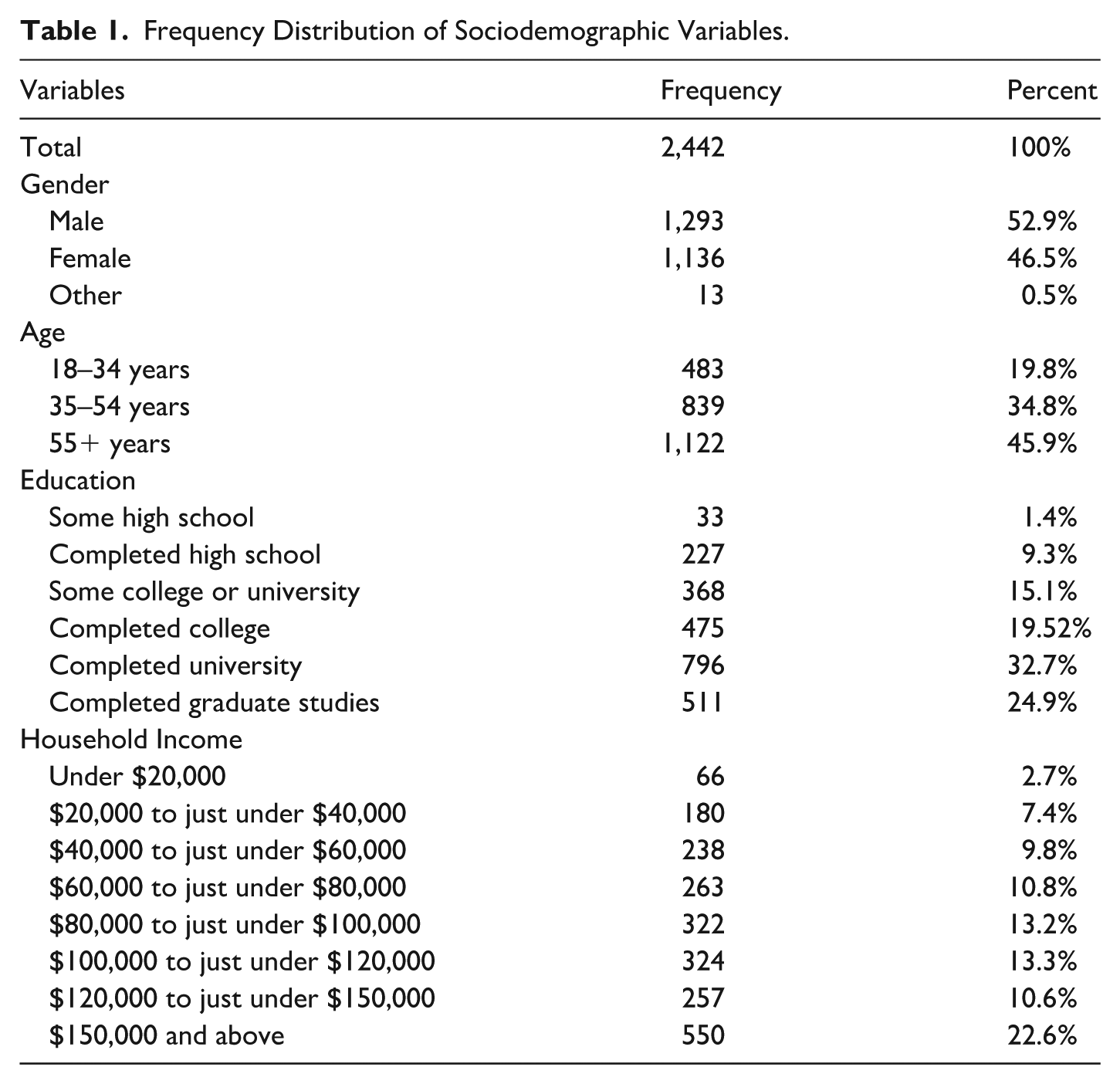
To fully assess the effect of our treatment, we controlled for two types of variables. First, we added socio-demographic characteristics, including gender, age, income, education, and ideology. The influence of socio-demographic characteristics has been studied for a long time, although they can have significant variability across studies (Burbach, 2017, 2019; Caforio, 2008; Eichenberg, 2005; Feaver, 2023; Fitzsimmons et al., 2014; Leal, 2005; Simon et al., 2018; Simon & Lovrich, 2015; Tomz et al., 2020). Thus, controlling for demographic variables shown to affect trust in the military and defence policy preferences helps us assess the extent to which the treatment is effective, or whether respondents’ demographic traits continue to influence their views on the military. Table 112 presents the frequencies of the variables and their operationalizations. The number of cases (N) reported in this table represents unweighted counts. All subsequent analyses incorporate survey weights to account for sampling design and ensure population representativeness. For ideology, we asked respondents to position themselves on a scale from 0 to 10, where 0 represents a left-leaning ideology and 10 represents a right-leaning ideology.
Frequency Distribution of Sociodemographic Variables.
We also introduced three additional control variables to account for how certain beliefs and values might interact with our causal mechanisms. Scholars have long argued that individuals possess systems of representation that encapsulate their core beliefs, values, and foundational principles, which they use to interpret and evaluate the world (Holsti, 1962). These conceptual frameworks are particularly valuable because they enable individuals to form preferences even without extensive knowledge of specific issues. As Wittkopf (1990) argues, . . . interest and knowledge are largely irrelevant to whether the American people are able, in the aggregate, to hold politically relevant foreign policy beliefs. These beliefs may not conform to what political scientists and journalists would like to see as they contemplate the theory and practice of contemporary democracy, but foreign policy beliefs may be both coherent and politically relevant, even if they are not grounded in political sophistication. (p. 15)
Building on this idea, we selected three beliefs—militarism, racial resentment, and sexism—that were most relevant to our experiment.
First, regarding militarism, we aim to capture how preferences in international affairs shape individuals’ attitudes toward foreign and defence policy. This concept is well-established in International Relations and foreign policy analysis, where scholars position individuals’ foreign policy beliefs along a hawk–dove continuum (Holsti & Rosenau, 1990; Russett, 1990) or between militant and cooperative internationalism (Bardes & Oldendick, 1978; Kertzer et al., 2014; Rathbun et al., 2016; Wittkopf, 1990). Russett (1990) describes this dichotomy: . . . hawks emphasize the need for military strength to deter war, often willing to use force to defend interests and weaken adversaries. . . . Doves, by contrast, emphasize cooperation to avoid war and warn against provoking adversaries. They prefer negotiations for arms control and disarmament over unilateral action. (p. 516)
Militarism, then, suggests a strong trust in the military as an institution or at least a perceived need for its strength. This trust may be resilient, potentially making individuals less affected by narratives of discrimination. To measure militarism, we asked respondents to rate their agreement, from 0 to 10, with the statement, “Canada needs a strong military to be effective in international relations.”
Second, we also controlled for attitudes toward social dominance, which has been linked to prejudice (Crawford & Pilanski, 2014; Sibley & Duckitt, 2008). Since our experiment focuses on discrimination against various equity-seeking groups, these views could affect respondents’ susceptibility to the treatments. We adapted questions from the Canadian Election Studies (Harell et al., 2022) to measure racial resentment and prejudice toward women. Racism was measured by asking respondents to rate their agreement, on a 0 to 10 scale, with the statement, “Minorities should be Canadians first and whatever their identities second.” For sexism, respondents rated their agreement with the statement, “Women seek to gain power by getting control over men.”
Results and Discussion
As a preliminary analysis, we tested the efficacy of our treatments through an attention check. Respondents were asked to identify which equity-seeking group was presented in the vignette they read. On average, 87.42% of respondents answered correctly. 13 Given this high response rate, we decided to keep all respondents (both attentive and inattentive) in our analysis. As Alvarez et al. (2019) suggested, when “. . . lack of careful attention to the questionnaire is innocuous, in the sense that it does not alter responses to survey questions, then the best approach for dealing with inattentiveness is to do nothing” (p. 158). All regression tables for models (including attentive and inattentive respondents) are presented in Tables 2, 3, and 5. Across the analyses, we found no significant differences between the models, indicating that attention level did not substantially affect the results.
Linear Regression Models—Trust in Military Institutions.

p < .1. **p < .05. ***p < .01.
Comparison of Regression Models: Defence Spending.
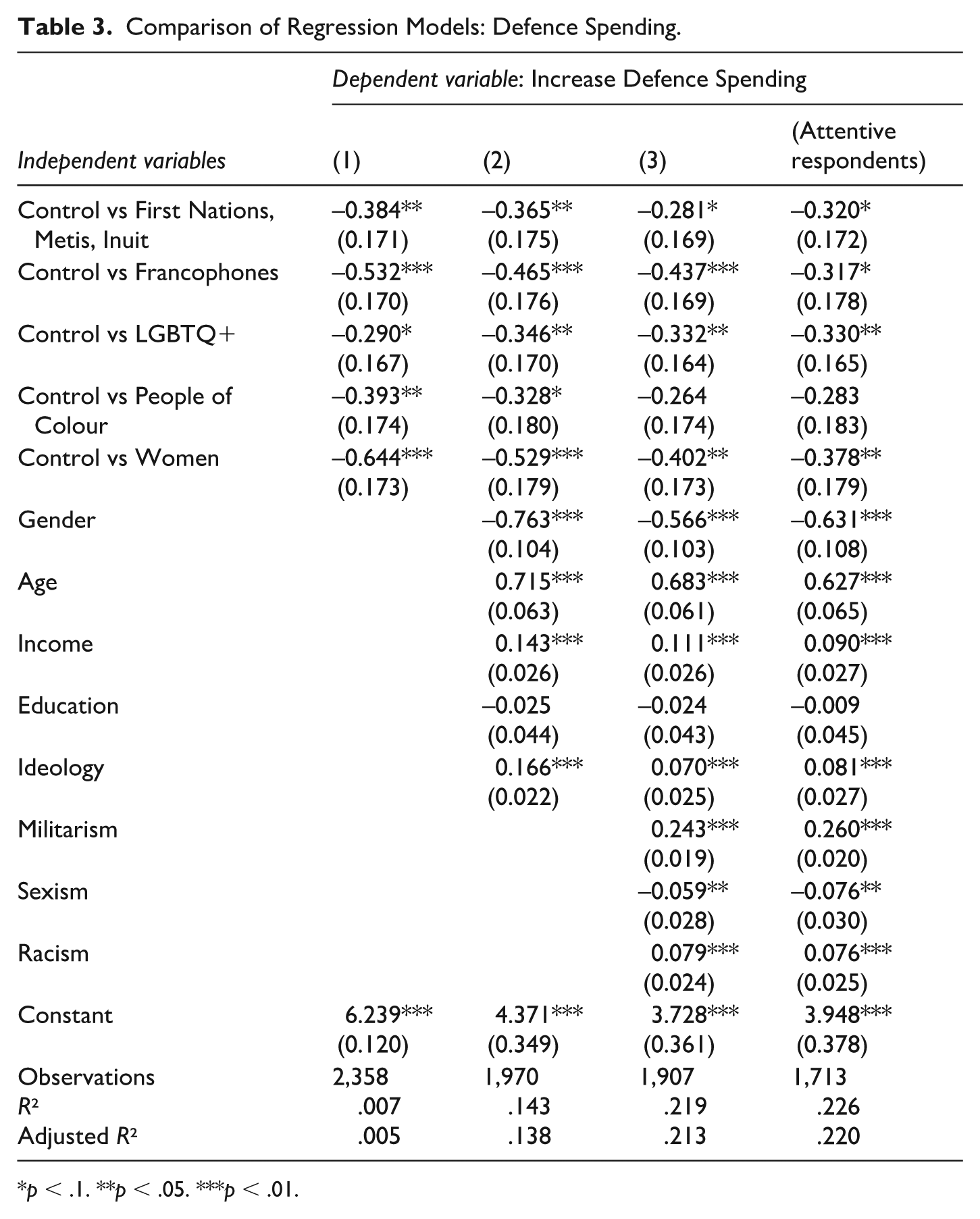
p < .1. **p < .05. ***p < .01.
We first focus on our primary dependent variable: trust in military institutions. Figure 1 shows the baseline distribution for the control group. The data indicate a high level of trust in the Canadian military, with an average score of 6.28 and a standard deviation of 2.46. Most respondents rated their trust around 7.5, as shown by the broadened density distribution in the violin plot. To further explore the nuances of trust in military institutions, we also asked respondents about their confidence in leaders from academia, the military, political parties, the media, and the defence industry to formulate policies benefiting Canada. Canadians showed relatively low confidence across all institutional leaders. From a civil–military relations standpoint, this broader erosion of trust is concerning, as it may signal a fracture in the social contract between the public and elites on defence policy (Figure 1). 14

Trust in Military Institution and Confidence in Leaders on Defence Policy.
Conversely, academics are the most trusted stakeholders, likely reflecting academia’s key role in broader policy debates, including those on defence and security. Finally, it is noteworthy that there is an apparent discrepancy between trust in the military as an organization (μ = 5.68) and in military leaders (μ = 4.65), suggesting that individuals may distinguish between trust in the institution and trust in those who serve within it. This distinction suggests that while the public views the military institution as stable and trusted, they hold reservations about the leadership and decision-making of those in charge.
For our ancillary dependent variables—support for defence spending and willingness to recommend military recruitment—Figure 2 presents the distribution of responses within the control group. On the one hand, support for defence spending is high in Canada (μ = 6.22, SD = 2.51). The question’s wording was particularly loaded, asking respondents to consider this issue in the context of a trade-off in which higher defence spending could require tax increases, while less spending could mean less capacity for the Canadian military. These results are consistent with previous studies on Canadian public attitudes toward defence and security issues and show stable support for increasing defence spending over the last decade (Boucher, 2020, 2021; Fitzsimmons et al., 2014). On the other hand, Canadians exhibit limited enthusiasm for recommending the military as a place of employment, with an average response of 5.22, 15 indicating general indifference. This is particularly critical, as the CAF have struggled to recruit the troops needed to maintain operational readiness (Figure 2). 16

Support for Defence Spending and Recommend Recruitment in the Military.
Figure 3 and Table 2 present the average marginal effects of our multilinear regression. 17 It illustrates how allegations of discrimination against distinct equity-seeking groups shape individuals’ trust in military institutions. The results broadly support our first hypothesis: exposure to stories of discrimination involving marginalized groups significantly reduces respondents’ trust in the military. When comparing the different groups to the control group (which received no treatment), we observe a decline in trust ranging from 5 to 8 percentage points, depending on the marginalized group, even after controlling for other factors. 18 These findings support the Janowitzian expectation outlined earlier: public trust depends on perceived alignment between military conduct and evolving societal values. Discrimination signals that military culture remains misaligned with democratic norms of inclusion—a gap that erodes institutional legitimacy (Feaver, 2023; Rahbek-Clemmensen et al., 2012). As Feaver (2003) argued, the relationship between a state and its military is fundamentally a “principal–agent” relationship, where civilians (the principal) delegate a mission to the military (the agent). For this relationship to function effectively, civilians’ trust is essential. While our study introduces a single intervention—a story describing the armed forces’ difficulty in including members of underrepresented communities—it measures only the impact of that story. We can imagine that a constant media barrage of repeated stories about discrimination, sexual misconduct, or failure to provide a safe working environment for all members would likely compound these effects, dramatically eroding public trust in the military over time. These findings underscore how even isolated ethical breaches can significantly undermine institutional trust, particularly under highly visible, persistent public scrutiny.

Average Marginal Effects on Trust in Military Institutions.
Having established that discrimination erodes trust, we now examine whether these effects extend to concrete policy outcomes: support for defence spending and recruitment. Table 3 shows that discrimination narratives reduce defence spending support by 3 to 5 percentage points, with effects strongest for discrimination based on gender, linguistic differences, sexual orientation, and against First Nations, Métis, and Inuit. While this supports H2, the correlation between trust and spending does not establish whether trust operates as the causal mechanism. Recent scholarship examines predictors of military trust (Accorsi & Krebs, 2025; Feaver, 2023), with Feaver (2023) arguing that perceived ethical lapses erode trust and reduce support for military investments. However, this mediation pathway underlying H2b remains untested. We address this gap using causal mediation analysis (Tingley et al., 2014)—a technique underused in civil–military relations research despite its power to identify mechanisms—to examine whether institutional trust mediates the relationship between perceptions of discrimination and support for defence spending.
Table 4 reveals that trust operates as the primary mechanism through which discrimination affects spending support. Across all groups, the indirect effect through trust (ACME) is statistically significant and negative, while direct effects (ADE) are largely non-significant. 19 This pattern indicates that discrimination reduces defence spending support primarily by eroding institutional trust, not through alternative pathways. For women, Francophones, and LGBTQ+ individuals, between 35% and 53% of the total effect flows through trust. Notably, for People of Colour and First Nations, Métis, and Inuit, the trust mechanism operates (significant ACME) even though the overall effect on spending support does not reach statistical significance. These findings suggest that perceptions of discrimination signal a deeper misalignment between military practices and societal values of inclusion, which translates into reduced public support for military investment. When citizens perceive the military as failing to uphold democratic values, support for defence spending declines, reflecting broader skepticism about investing in institutions perceived as misaligned with democratic ideals (Burbach, 2017; Hill et al., 2013; King & Karabell, 2003; Margulies & Blankshain, 2022).
Mediation Analysis Between Institutional Trust and Support for Defence Spending.
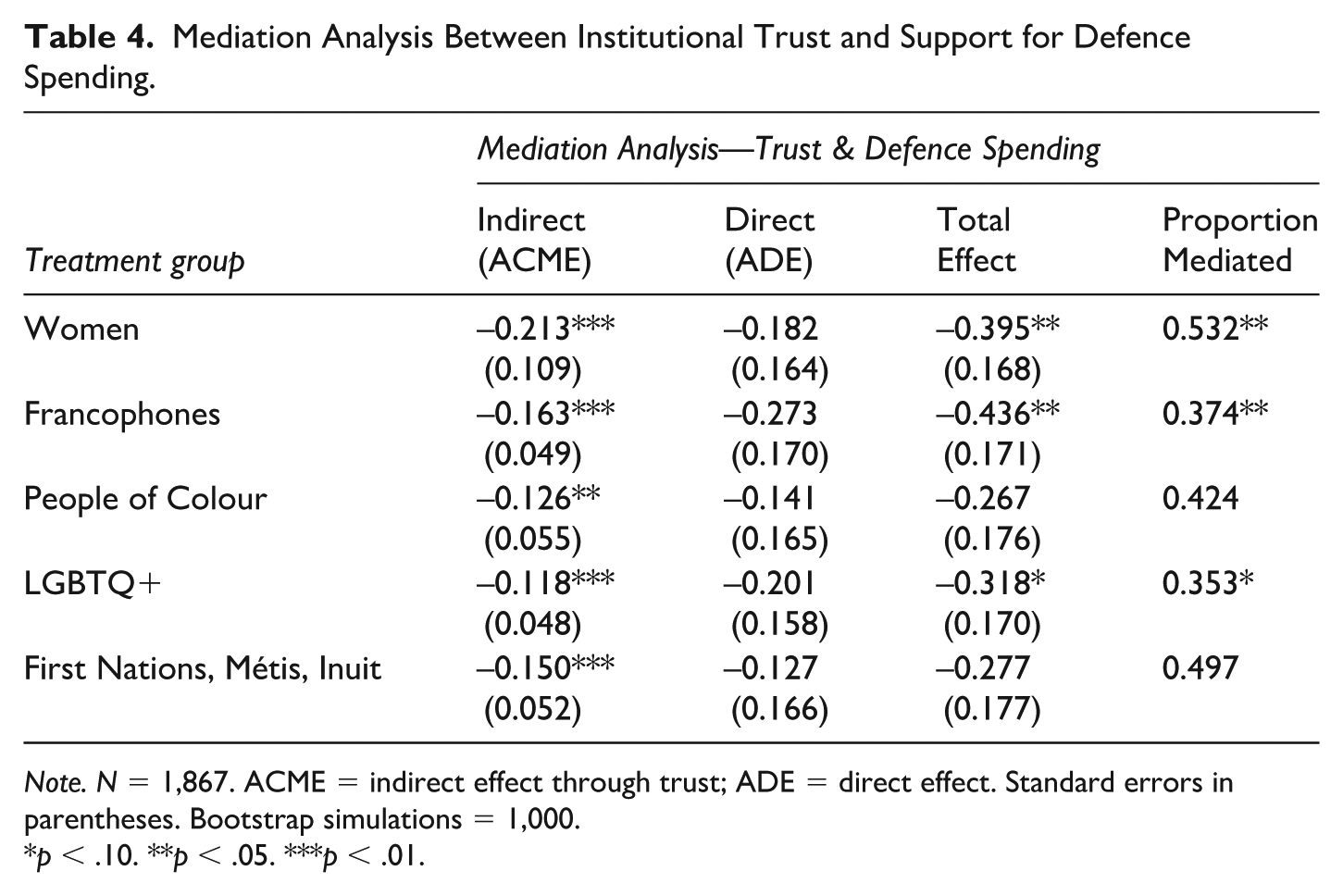
Note. N = 1,867. ACME = indirect effect through trust; ADE = direct effect. Standard errors in parentheses. Bootstrap simulations = 1,000.
p < .10. **p < .05. ***p < .01.
Table 5 examines the impact of discrimination against members of equity-seeking communities on recruitment willingness. Exposure to discrimination narratives—particularly against people of colour, women, and Francophones—reduces support for military recruitment by 5 to 7 percentage points. Given that the baseline endorsement among Canadians is already relatively low (μ = 5.22; Figure 2), this represents a substantial further erosion. The pattern aligns with person–organization fit theory: when individuals perceive gaps between military culture and democratic values, particularly with regards to pluralism, this misalignment discourages support for military careers (Graf & Kuemmel, 2022; Kristof-Brown et al., 2005).
Comparison of Regression Models: Willingness to Recommend Recruitment.
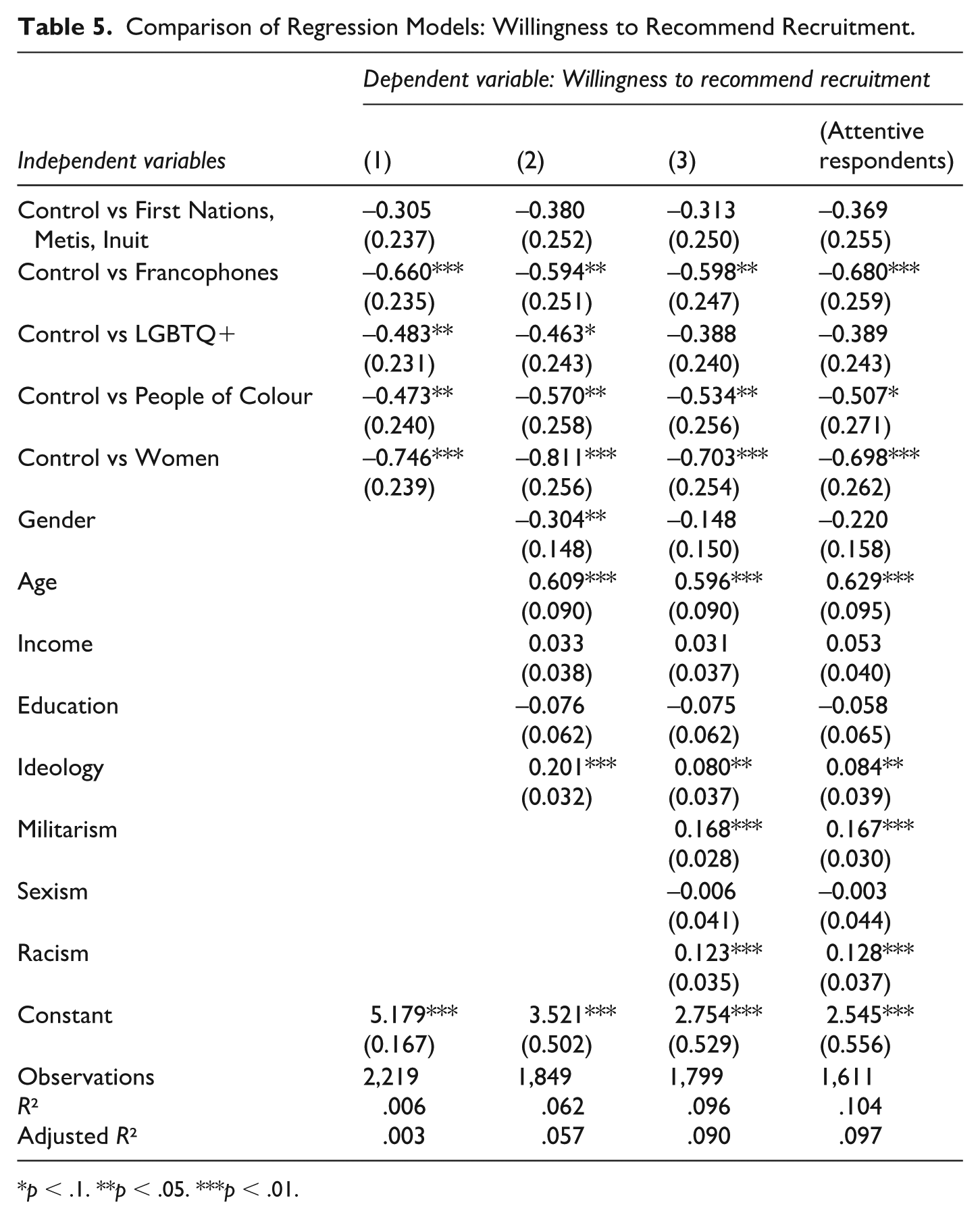
p < .1. **p < .05. ***p < .01.
Does this effect, like defence spending, operate through trust? Table 6 reveals an even stronger mediation pattern for recruitment. All indirect effects through trust (ACME) are statistically significant, while direct effects (ADE) remain non-significant across all groups, confirming that discrimination’s impact on recruitment support flows almost entirely through its effect on institutional trust. Among groups with significant total effects (Women, Francophones, People of Colour), the proportion mediated through trust ranges from 53% to 67%, with women showing the strongest mediation (66.5%). 20 Notably, LGBTQ+ individuals and Indigenous peoples show the highest proportions mediated (76.2% and 78.4%, respectively), though these groups’ total effects are weaker or non-significant. This pattern suggests that for these groups, the trust mechanism operates particularly strongly, but other factors—potentially including baseline recruitment intentions or group-specific attitudes toward military service—may attenuate the overall effect on recruitment support. These findings reinforce the role of institutional trust as the critical link between perceived discrimination and public support for military operations, with particularly pronounced effects on recruitment outcomes. The contrast with defence spending is striking; while trust mediates only 35% to 53% of spending effects, it mediates 53% to 78% of recruitment effects. Recruitment decisions, it appears, flow almost entirely through trust pathways; spending attitudes retain independent drivers. 21 This finding helps explain why studies examining trust and military support sometimes yield inconsistent results—the relationship between trust and policy support varies depending on the outcome that is examined. These effects hold even after controlling for demographic and attitudinal factors, with treatment effects generally comparable to or exceeding the influence of control variables. It is perhaps no coincidence that many militaries are increasingly focused on promoting diversity and inclusion—not just as an operational necessity but also as a means of maintaining public support.
Mediation Analysis Between Institutional Trust and Willingness to Recommend Recruitment.

Note. Standard errors in parentheses. ACME = indirect effect through trust; ADE = direct effect. N = 1,771. Bootstrap sims = 1,000.
p < .10. **p < .05. ***p < .01.
Conclusion
Our research demonstrates that discrimination within military institutions undermines the three pillars of democratic military support—trust, defence spending, and recruitment willingness—primarily by eroding institutional confidence. These findings challenge conventional understandings of civil–military relations in several ways. First, they demonstrate that the tension Huntington (1957) posited between functional imperatives (military effectiveness) and societal imperatives (reflecting society’s values) may be fundamentally misguided. Our results show that discrimination against equity-seeking groups undermines public trust, which in turn depresses recruitment and spending support, ultimately compromising the very effectiveness that military doctrine prioritizes. Rather than existing in tension, meeting societal expectations for inclusion appears instrumental to achieving functional goals. Militaries must address discrimination not merely to satisfy external demands for representation, but to sustain the public trust essential for securing the human and financial resources necessary for operational readiness.
Second, our findings advance civil–military relations research methodologically by moving beyond correlational claims to identify specific causal pathways. While scholars have long documented associations between military conduct and public attitudes, our mediation analysis demonstrates precisely how institutional failures translate into reduced support. This approach reveals that discrimination operates almost entirely through trust erosion rather than alternative mechanisms—a finding with important policy implications. Interventions aimed at rebuilding military support cannot simply address discriminatory practices; they must actively restore institutional confidence, as the pathway from reform to renewed support runs through trust rebuilding.
Third, our results suggest important practical implications for military recruitment and resource mobilization. The finding that trust mediates recruitment support far more completely than spending support indicates that trust deficits pose particularly acute challenges for personnel recruitment. When discrimination erodes confidence in military institutions, recruitment support collapses almost entirely, whereas some spending support persists through other considerations. This differential pattern helps explain why militaries can sometimes maintain budgets while struggling with recruitment crises—the mechanisms sustaining these two forms of support operate differently, with recruitment being far more trust-dependent.
Our study of the Canadian context provides broader lessons for understanding civil–military relations in pluralist democracies. Canada’s historical emphasis on balancing community and individual rights, embodied in the CAF’ core ethical principle of “respecting the dignity of all individuals” (Department of National Defence, 2022a), creates strong public expectations that military institutions will reflect societal values of inclusion. When these expectations are violated, trust erodes with measurable consequences for recruitment and spending support. Research examining similar dynamics in other democracies (Cohen & Cohen, 2020; Feaver, 2023; Garb & Malešič, 2016; Kasher, 2003) suggests these patterns may generalize beyond Canada, though comparative research is needed to assess how institutional context shapes the relationship between discrimination, trust, and military support.
An important limitation of our design is that we cannot determine whether discrimination narratives produce larger, smaller, or equivalent effects compared to other types of military scandals. Our comparison is discrimination information versus no information, not discrimination versus other negative information (e.g., corruption, operational failure, partisan behaviour). While our theoretical framework distinguishes between discrimination as a challenge to societal trust and performance trust, future research should employ factorial designs directly comparing scandal types to empirically test whether mechanisms or effect sizes differ. Our study establishes that discrimination operates primarily through trust erosion—whether this pathway is stronger or weaker than other institutional failures remains an important open question.
Ultimately, our findings demonstrate that inclusion and diversity are not peripheral concerns for military effectiveness but central to sustaining the public support necessary for operational readiness. Militaries that fail to address discrimination risk a cascading erosion of trust that undermines both recruitment and resource mobilization. While our study examined responses to single discrimination narratives, the persistent media coverage of misconduct scandals in recent years suggests these effects may compound over time, creating deeper challenges for military legitimacy. As Western militaries face recruitment crises and pressure to increase defence expenditures, understanding how discrimination undermines public support becomes increasingly urgent. Our findings suggest that genuine inclusion—not merely symbolic diversity efforts—may be essential for rebuilding the institutional trust on which military effectiveness ultimately depends.
Supplemental Material
sj-pdf-1-afs-10.1177_0095327X261437281 – Supplemental material for Mistrusted to Serve? Discrimination in the Military and Its Impact on Public Support
Supplemental material, sj-pdf-1-afs-10.1177_0095327X261437281 for Mistrusted to Serve? Discrimination in the Military and Its Impact on Public Support by Jean-Christophe Boucher, Charlotte Duval-Lantoine, Lynne Gouliquer and Stephen M. Saideman in Armed Forces & Society
Footnotes
Acknowledgements
We would like to thank those who gave very helpful suggestions during our presentations at the European Research Group on Militaries and Societies and the American Political Science Association, and multiple briefings with various Canadian defence agencies, as well as our research assistants: Alireza Mamdouhi, Adetayo Adediran, and Alexandra Richards.

Funding
The authors disclosed receipt of the following financial support for the research, authorship, and/or publication of this article: This research was supported, in part, by the Social Sciences and Humanities Research Council (SSHRC) project number 895-2019-1000 and the Mobilizing Insights in Defence and Security (MINDS) program of Canada’s Department of National Defence.
Declaration of Conflicting Interests
The authors declared no potential conflicts of interest with respect to the research, authorship, and/or publication of this article.
Supplemental Material
Supplemental material for this article is available online.
Notes
Author Biographies
References
Supplementary Material
Please find the following supplemental material available below.
For Open Access articles published under a Creative Commons License, all supplemental material carries the same license as the article it is associated with.
For non-Open Access articles published, all supplemental material carries a non-exclusive license, and permission requests for re-use of supplemental material or any part of supplemental material shall be sent directly to the copyright owner as specified in the copyright notice associated with the article.
