




Abstract
Why do similar e-government initiatives, implemented by different nations but aimed at achieving similar policy goals, produce different outcomes? To answer this question, this study examines institutional arrangements for e-government development during the Bush administration in the United States and the Roh Moo-hyun administration in Korea. The results of this study demonstrate how different institutional arrangements for e-government developments in terms of the concentration of authority based on differing legal frameworks and the development of diverse and powerful managerial tools for control and coordination contributed to producing different outcomes with regard to building Business Reference Models (BRM) in the two nations.
Introduction
Why do similar e-government initiatives, implemented by different nations but aimed at achieving similar policy goals, produce different outcomes? What are the central institutional dimensions and processes that contribute to producing these different outcomes? What structural and political dimensions at the national state level influence variation between nations of e-government systems and their performances in spite of diffusion and imitation at the global level?
Since the 1990s, e-government has been seen as a core step toward the creation of the information society; thus, e-government initiatives that succeeded in one nation were benchmarked and imitated by other nations. International organizations such as the United Nations and the Organization for Economic Co-Operation and Development (OECD), as well as global information technology (IT) consulting firms, have contributed to the expansion and diffusion of e-government worldwide by publishing research on e-government best practices and providing consulting services to promote IT systems (Dunleavy, Margetts, Bastow, & Tinkler, 2006; Eifert & Puschel, 2004; Mayer-Schönberger & Lazar, 2007; Tingling & Parent, 2002).
Perhaps not surprisingly, however, the same e-government initiatives diffused from one nation to another have produced different outcomes. One of the best examples is the diffusion of the Business Reference Model (BRM), a part of the U.S. Federal Enterprise Architecture (FEA) framework. It was implemented in the United States and Korea but resulted in very different systems in each of the two countries. The U.S. BRM has a function-oriented structure independent of organizations in accordance with the project’s policy goals, including an objective to integrate “stove-piped” information systems (ISs) built in government agencies and to identify opportunities to simplify processes and unify work across the agencies. By contrast, the Korean BRM has an organization-oriented structure even though its purpose was similar to that of its U.S. counterpart.
Comparative institutional analysis has been used extensively to describe and explain national variation in state structures, policies, and policy-making processes. This article draws from this rich vein of theory and methods and extends them to the development of information infrastructure in governments. This study analyzes how different institutional arrangements for managing control and coordination problems contributed to producing the different outcomes of BRM initiatives in the two nations. In brief, U.S. institutional structure for development of e-government policy is characterized by a concentration of authority based on a legal framework, development of diverse and powerful managerial tools for control and coordination, and leadership based in the Office of Management and Budget (OMB) over federal agencies. These institutional dimensions contributed to the development of a function-oriented BRM independent of organizations and achieving the project’s policy goals. By contrast, the Korean implementation of the BRM suffered from fragmented authority, ineffective managerial tools, and confrontations among agencies over the course of building the BRM. Consequently, the Korean government had no choice but to abandon its original function-oriented system plan, and produced an organization-oriented form of the BRM. Given the generally centralized and strongly planned nature of national government in Korea, these dimensions are counterintuitive and paradoxical. Similarly, U.S. federal policy making is typically fragmented often due to agency autonomy and bureaucratic politics. These counterintuitive results invite a comparative analysis of the institutional contexts that produced them.
This article contributes to our understanding of the “powers of institutions” on e-government developments. A focus on the importance of institutions is not news to institutional scholars, who have always emphasized the value of broad institutional analysis in binding together explanations that might connect global institutional forces and local structure and agency. However, in the area of ISs and IT, the use of institutional theory remains in its infancy primarily because, to date, technology-related variables and technological systems have been in the mainstream in e-government research (Bekkers & Homburg, 2005; Currie & Swanson, 2009; Fountain, 2001; Lyytinen, Newman, & Al-Muharfi, 2009; Orlikowski & Barley, 2001; Snellen, 2005; Weerakkody, Yogesh, & Irani, 2009). Moreover, even e-government research that has drawn from an institutional perspective has emphasized the cultural-cognitive aspects of institutions and institutional isomorphic mechanisms in e-government building processes. This article draws out institutional perspectives more closely related to state structures and processes and applies them to e-government research (Fountain, 2007; Hassan & Gil-Garcia, 2008; Mignerat & Rivard, 2009).
I argue that “institutions matter” in IS/IT research and provide evidence for this line of argument by examining the influence of multilevel institutional arrangements including the legal frameworks and organizational routines that are the focus of institutional analysis in political science. The two cases presented in this article serve as detailed examples to support the argument that IT systems are constructed and implemented with the mediation of institutional arrangements, not by extrapolation from outside of the organizations or by technological determinism (Currie & Guah, 2007; Fountain, 2001, 2007). This perspective might also be helpful to a reconsideration of the roles played by institutions in producing (or not) isomorphic mechanisms in the diffusion of IS/IT and the interactions between e-government policy participants.
This article is organized as follows. In the section titled “Theoretical Background and Research Design,” I review core institutional concepts and advance an analytical framework to relate key governance structures with their influence on e-government development. In the section titled “The BRM in the United States and Korea,” I present the results of empirical research on the BRM initiatives in both counand examine national differences. In the sections titled “Analysis of Institutional Structures for e-Government Development” and “Analysis of BRM Building Process in the United States and Korea,” I analyze the institutional strucof the two nations and compare and contrast their different influences on development processes and outcomes of the BRM initiatives.
Theoretical Background and Research Design
Institutionalism and e-Government Research
Despite diverse academic perspectives, institutions are commonly defined as sets of formal and informal rules and procedures, which are accompanied by monitoring and sanctioning mechanisms that influence actors to comply with these rules and that structure their conduct (Campbell, 2004; Thelen & Steinmo, 1992). Institutional arrangements function as structures of political and policy-making struggle and contribute to policy outcomes as follows. First, institutions constrain available policy alternatives (Scharpf, 2000). The permissibility and content of policy options can be differentiated according to institutional contexts. Second, participants in policy processes are defined, and their interactions can be constrained under institutional arrangements (Hall & Taylor, 1996; Timmermans, 2001). Third, the characteristics of policy processes—including incentive structures, decision-making protocols, level of centralization of decision making, the location and number of veto points, and the stability and coherence of political elites—are all shaped by institutional structures (Saint-Martin, 2004; Skocpol & Rueschemeyer, 1996; Weaver & Rockman, 1993). Thus, institutional arrangements can influence the policy capabilities of government by encouraging or discouraging certain types of attributes of decision-making processes (Clemens & Cook, 1999; Hay, 2006; Peters, Pierre, & King, 2005).
It has been argued that the institutional approach should be applied to IS/IT research because institutional perspectives offer e-government researchers a vantage point for conceptualizing IT initiatives in public organizations as complex and emergent phenomena that are shaped by technical-rational and institutional issues (King et al, 1994; Orlikowski & Barley, 2001). Moreover, an institutional approach helps e-government researchers not only to locate constraints on actors in e-government policy processes and structural factors that influence the interactions among them but also to focus on mediators of the impact of information technologies and various environmental factors (Bekkers & Homburg, 2005; Fountain, 2007; Jones & Orlikowski, 2007; Snellen, 2005; Welch & Wong, 2001).
E-government researchers who have used an institutional perspective have followed three broad streams of conceptualization. The first group has examined how specific institutional characteristics, such as laws, regulations, budget processes, jurisdictions, agency autonomy, and contract systems, have influenced IT and e-government outcomes (Dawes & Pardo, 2002; Margetts, 2006; Moon, 2002; OECD, 2005). These categories of institutions constrain and guide the actions of participants in the policy-making process, and thus the institutions themselves have the power to influence e-government outcomes. Another line of research in this broad stream has focused on informal institutions, such as culture and value systems, as influential factors in the IT system adoption process. Research in this view claim that, in addition to physical IT infrastructure and hardware, the configuration and overall performance of IT systems are influenced by protocols related to IS usage, interpretation frameworks, and organizational cultures (Laudon, 1985; Margetts & Dunleavy, 2002; Sarker, 2000).
The second group has examined the ways in which institutions exert isomorphic pressures—mimetic, normative, and coercive—in the course of IT selection, adoption, and implementation. For example, Standing, Sims, and Love (2009) found that government agencies respond to coercive pressures from the central government with either acquiescence, defiance, avoidance, or compromise. Tingling and Parent (2002) found mimetic institutional pressure in the decision processes of governments selecting between competing technologies.
The third group has examined the effects of the macroinstitutional arrangements of nations on e-government policies. Researchers have identified as important the institutional relationships between governments and the IT industry, the degree of centralization and fund raising systems to promote the IT industry factoring in influencing overall performance of e-government and national information infrastructure development (Dunleavy et al., 2006; Hong, 2003; Margetts, 1999; Song & Cho, 2007). In comparing data from OECD countries, Adler and Henman (2005) argued that different state welfare regimes—market-oriented, network-oriented, or customer-oriented—produced characteristically different welfare ISs. For example, the welfare IS for the Netherlands, a network-oriented regime, has a more collaborative nature than that of the United States, a market-oriented regime, despite the similar major goal of building welfare ISs to enhance welfare policy efficiency.
Research on e-government using an institutional approach has illuminated the influence of a wide variety of institutions on e-government outcomes and performance. But previous research in these streams has the following limitations: First, researchers in this subfield lack a detailed and comprehensive analysis of the institutional elements influencing e-government policy results. Recent theoretical developments in the institutionalist perspective argue that institutions should not be conceptualized as monolithic entities but as multielement complexes whose elements are networked together in heterarchical and hierarchical structures (Lowndes, 1996; Orren & Skowronek, 2004; Weaver & Rockman, 1993). This important conceptual development has not been applied fully to e-government research. For example, most analyses of the institutional factors in e-government policy do not comprehensively and clearly assess legal frameworks, standard operation procedures, and organizations, which are complementary to each other.
Second, methodological problems exist. A comparative perspective has not been adopted systematically in institutional e-government research (Borins, 2007; Dunleavy et al., 2006; Fountain, 2003). Most previous cross-national comparative research has been descriptive, essentially introducing e-government policy structures in different countries, and much of the research has been conducted by different researchers using different analytical frameworks. This lack of a rigorous comparative method led to criticism that the causal relations between institutions and e-government outcomes are vague (Yang, 2003). Third, the processes through which e-government policy has been formulated and implemented have received insufficient academic attention (Jaeger, 2003; Yildiz, 2004). In conclusion, a more comprehensive analysis of institutional arrangements using more systematic comparative methods should be conducted to overcome the limitations of previous research. This article seeks to fill these gaps.
Research Design: Analytical Framework and Research Methods
Adapting and modifying the conceptual framework developed by Lynn, Heinrich, and Hill (2001) and Fountain’s (2007) multilevel integrated information structure, I outline a three-tiered analytical framework with the following dimensions: (a) a legal framework, (b) managerial tools for control and coordination, and (c) organizational arrangements. This framework, as well as those of Lynn et al. and Fountain, analyzes institutional arrangements for e-government development because it is based on the logic of governance in the public sector and examines distinctive levels and elements for analyzing public management reform and e-government projects (Pollitt & Bouckaert, 2004). However, the original frameworks are modified for this study in two ways. First, the analytical framework in this study focuses more on the institutional and managerial levels of the original frameworks to examine the powers of institutions in detail. Second, organizational arrangements in the primary work level in the original frameworks are emphasized considering the importance of organizations in the course of e-government development.
The specific features of the analytical framework I outline here are as follows. The first tier, the legal framework, is concerned with the establishment of government relations, or broad strategic alignments, at the legislative level. More specifically, the legal framework defines the formal roles of organizations participating in the policy process, their accountability, resources, and concentration of authority measured by the concentration of functions in rules and related laws. The latter is regarded as one of the main foundations of policy capacity.
The second tier, managerial tools for coordination and control, is concerned with elaboration of strategies by organizational actors. This tier is grounded in the legal framework, with managerial tools selected based on the legal framework. It is concerned with relationships between organizations and, in particular, deals with how e-government building actions are coordinated. These elements can contribute to the development of routine, stable, and recurring modes of behavior within legal frameworks and among organizations by providing government operations with coherence and effectiveness. In this study, three managerial mechanisms or devices were identified based on Vedung (1998): authority, budget, and persuasion.
The third tier consists of organizational arrangements in e-government building. At this level, I examined organizations that play a direct role in building e-government systems and that interact with each other over the course of building e-government systems. These organizational arrangements are based on formal norms such as legal frameworks, government contracts, and regulations. That is, the organizations are selected based on the legal framework and, sometimes, reorganized by the legal framework. The organizations should comply with managerial tools and procedural routines, and report on the results of their activities. The analytical framework is illustrated in Figure 1.
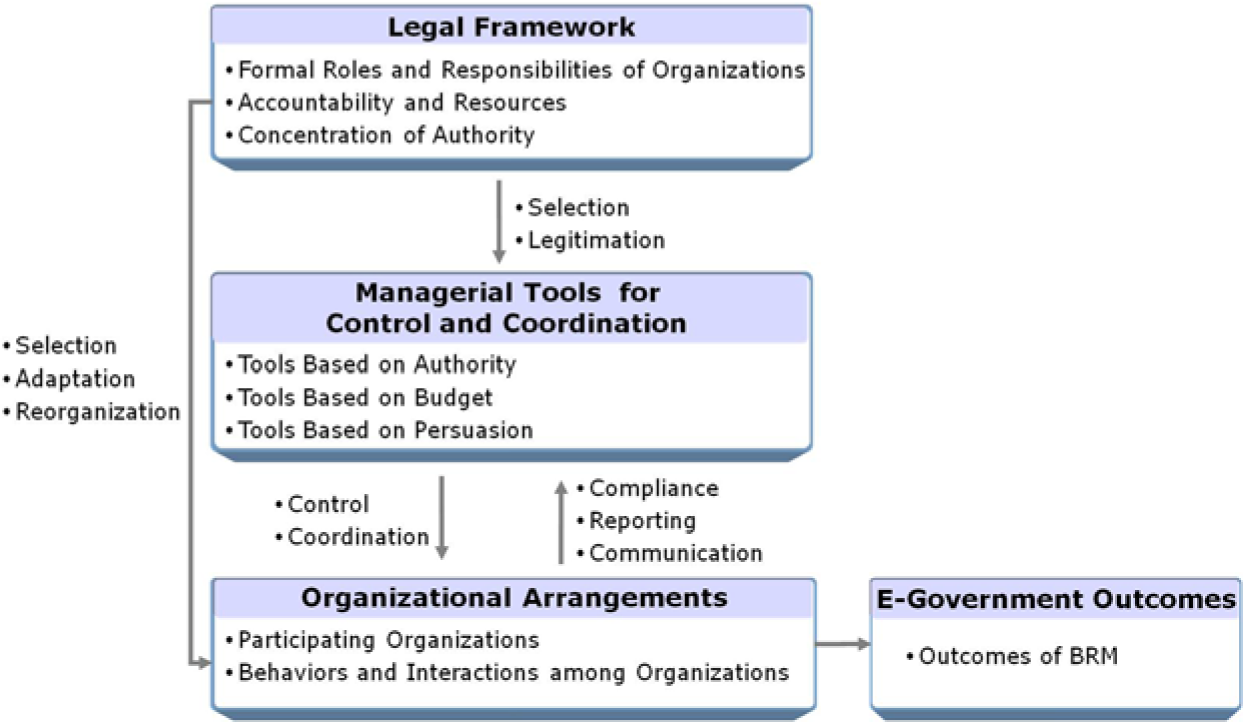
Analytical Framework.
Primary data sources include the results of face-to-face interviews with key managers, IT experts such as consultants and stakeholders from the core organizations involved in the development of the BRM in Washington, D.C., United States, and Seoul, Korea. 1 Moreover, the author examined a wealth of archival information including white papers, newspaper articles, academic papers, and testimonies before Congress, as well as policy reports published by executive agencies, Congress, research institutes, and IT consulting firms. Interview and archival data were analyzed thematically to develop a systematic understanding of the roles and responsibilities of important actors and constraints from the institutional arrangement in the course of the BRM building and overall institutional arrangements for e-government promotion in both nations.
The BRM in the United States and Korea
Definitions and Purpose of the BRM
The BRM is one of the reference models of the FEA 2 framework, one of the e-government initiatives of the Bush administration. The BRM is defined as “A function-driven framework for describing the business operations of the federal government independent of the agencies that perform them and it provides an organized, hierarchical construct for describing the functions and day-to-day business operations of the federal government” (Federal Enterprise Architecture Program Management Office [FEAPMO], 2002, p. 6). The model describes the federal government’s “lines of business,” including operations and services for citizens independent of the agencies, bureaus, and offices that perform them as illustrated in Figure 2. By describing the federal government in terms of common business areas instead of taking a stove-piped, agency-by-agency view, the BRM promotes agency collaboration. Moreover, by following the BRM, performance measures, government initiatives, and government agencies can be integrated as a single cross-agency initiative. 3
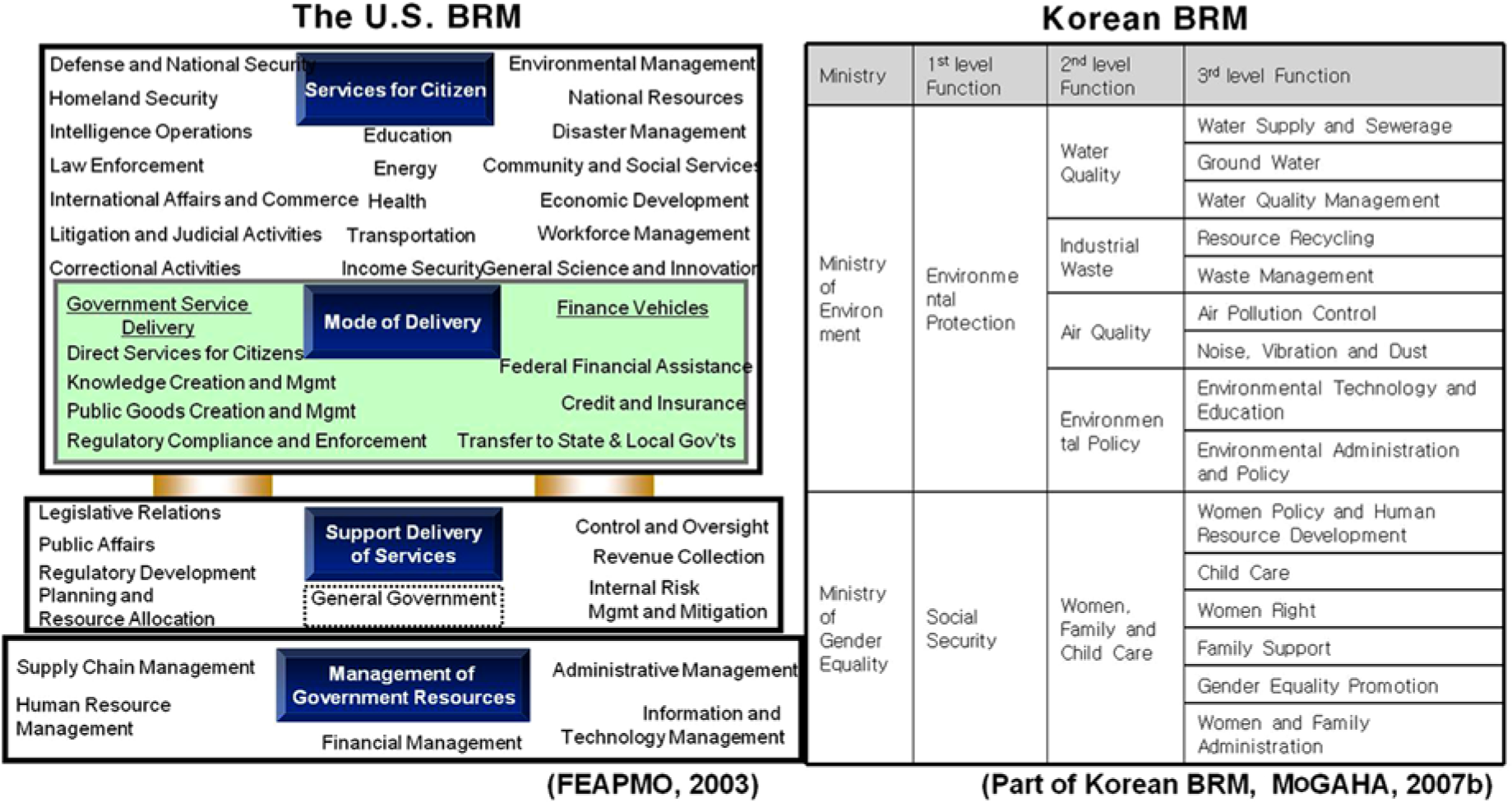
The U.S. and Korean BRMs.
The BRM and the FEA of the Bush administration were benchmarked by the Roh Moo-hyun administration in Korea for developing the Korean BRM and the “Governmental Information Technology Architecture (GITA),” a Korean version of the FEA framework. Early in the the Roh Moo-hyun administration, there were criticisms made concerning apparent redundancies in IT investments, the low efficacy of e-government systems in providing citizen-centric services and enhancing government performance, the ISs built in a “stove-piped” style, and the low level of information sharing between e-government agencies. In seeking a way to redress these deficiencies, the Korean government viewed the U.S. BRM and the FEA as good models, and the BRM was selected as one of the core e-government projects of the the Roh Moo-hyun administration (Presidential Committee on Government Innovation and Decentralization [PCGID], 2005).
For these reasons, the definition and purpose of the Korean BRM were similar to those of its U.S. counterpart. The Korean BRM was defined as “A government-wide functional map independent of government agencies for providing citizen-centric public services, driving government innovation and enhancing the effectiveness and efficiency of e-government” (PCGID, 2005, pp. 205-211). The purpose of the Korean BRM was (a) to promote government reform by identifying opportunities to simplify processes and to enhance the level of collaboration across agencies and (b) to reduce the redundancy of IT investment, to promote information sharing, and to establish ISs linkage across agencies (Ministry of Government Administration and Home Affairs [MoGAHA], 2007a).
Differences Between the U.S. and Korean BRMs
Although both BRM initiatives started with similar goals, and Korean policy makers followed the U.S. BRM model, project outcomes for both nations differed. In terms of BRM structure, the U.S. BRM has a function-oriented structure, independent of federal agencies as illustrated in the Figure 2. The current U.S. BRM has a three-tiered hierarchical structure, consisting of four business areas, 39 lines of business, and 153 subfunctions (FEAPMO, 2003).
The Korean BRM, however, has an organization-oriented structure because the root category of the Korean BRM is the “Ministry.” Furthermore, the levels of functions are followed by the organization structure of the ministry. That is, the second level of the Korean BRM consists of functions carried out by bureaus and offices, the higher level organizations in the ministry. The third level pertains to the functions of divisions, which represent lower level organizations in the ministry (MoGAHA, 2007b). 4 Under these principles of functional categorization, the current Korean BRM has a three-level hierarchical structure, containing 15 first-level functions, 67 second-level functions, and 491 third-level functions as of August 2008.
These differences between the United States and Korea led to a divergence of realization of the expected benefit of the BRM and evaluation about it in the two countries. For the United States, redundant IT initiatives could be identified, and the level of information sharing among federal agencies enhanced by using the BRM. For example, the OMB found that ISs which the Department of Education had tried to build, provided services similar to those of the e-Grant system, a government-wide IT system developed by the Bush administration following adoption of the BRM. Consequently, the OMB did not allocate further resources for the Department of Education system (OMB, 2002). As well, the Departments of Labor, Housing and Urban Development, and Education discovered through use of the BRM that they provided similar job training programs for the unemployed. As a result, the three departments began to share information among themselves and coordinated the programs of each agency (Rocheleau, 2006).
In addition, the U.S. BRM was institutionalized successfully in the federal budget process and performance evaluation systems of IS. For example, OMB Circular A-11 was revised for federal agencies to use the BRM in requesting budget allocations from the OMB for new IS projects and for evaluating the performance of established IT projects. In addition, federal agencies use the BRM in mapping their business functions and ISs for enhancing the level of integrity, confidentiality, and availability of their ISs (Department of the Interior [DOI], 2006). Consequently, this institutionalization of the BRM contributed to increasing the chances of success in removing organizational barriers to the use of the BRM (Guijarro, 2007).
Evaluations of the BRM and the FEA from outside the U.S. federal government were also relatively positive. For example, representatives of the U.S. Government Accountability Office (GAO) and an IT expert in an NGO advocating e-government and federal government reform stated that they supported the “across agency boundary” principles of the FEA, the core concept of the BRM, in a hearing on the FEA before the U.S. House of Representatives. 5 In addition, the works of enterprise architecture in the U.S. federal government was evaluated to be in the best condition of 15 countries according to a survey on government enterprise architecture conducted by the Ministry of Finance in Finland (Ministry of Finance, Finland, 2007).
By contrast, the Korean implementation of the BRM limited the usefulness of government-wide management systems and thus did not provide its expected beneficial effects. According to research conducted by the Korean Institute of Public Administration (2007), a national think tank in public administration and policy, users were prevented from finding similar programs to collaborate with and from linking together government-wide programs and functions because the BRM had an organization-centric structure. In addition, the BRM was of little use in enhancing levels of information sharing due to its organization-centric structure and a lack of information about BRM functions. In brief, it was difficult for users to identify the functions and organizations in which information sharing was required for better performance and higher efficiency from use of the BRM. 6 Furthermore, unlike its U.S counterpart, the Korean BRM is not firmly linked to the budget process and the performance evaluation systems of IT projects. For these reasons, public officials in e-government doubt the usefulness of the BRM. Indeed, the Korean BRM had been seldom used in the Korean government. 7
Analysis of Institutional Structures for e-Government Development
Institutional Structure of the Bush Administration in the United States
Legal Framework
The E-Government Act of 2002 (EGA; Public Law 107-347) was the major legal framework for e-government building under the Bush administration building on the Government Performance Results Act, the Clinger-Cohen Act, and the Government Paper Elimination Act central IT-related reform laws of the Clinton administration (Hagen, 2004). The EGA prescribes the formal roles of federal agencies, resources, and their accountability for e-government building. The major features of the EGA were to establish the Office of e-Government and IT (OEG) within the OMB and the creation of the US$345 million E-Government Funds for the 2002 to 2007 fiscal years (Fountain, 2007; Hagen, 2004).
The law states that the OEG shall assist the director of the OMB
in carrying out (1) all functions of management and promotion of e-government services; (2) all of the functions assigned to the Director under federal management and promotion of electronic government services; and (3) other electronic government initiatives, consistent with other statutes.
8
Specifically, the administrator of the OEG was given substantial authority for building e-government systems by the EGA, including (a) planning authority in building government-wide strategies, promoting innovative uses of IT by agencies, and conducting capital planning with the Office of Information and Regulatory Affairs in the OMB; (b) oversight and evaluation authority of e-government implementation, the development of enterprise architectures, information security and privacy, and so on; (c) budget authority in advising the director on resource requirements for developing and effectively administering e-government initiatives, overseeing the distribution of E-Government Funds, and of controlling capital planning and investment for IT; and (d) coordination authority for promoting e-government and the efficient use of IT by agencies, providing overall leadership and direction to the executive branch on e-government, particularly initiatives involving multiagency collaboration leading the activities of the Chief Information Officers (CIO) Council. In sum, all types of authority needed to build government-wide e-government systems, such as planning, overseeing, budgeting, and coordinating authority, were concentrated within the OEG in the OMB under the EGA.
Managerial Tools for Control and Coordination
Tools based on authority
The OMB developed several evaluation frameworks for control and coordination of the President’s Management Agenda (PMA), including “expanding e-government.” For example, a “traffic-light” scorecard evaluation framework was adopted for evaluating e-government promotion in each federal agency. 9 Within this framework, each federal agency’s e-government initiative results, as well as other items on the PMA, were monitored quarterly (Bruel, 2007). Each federal agency was highly sensitive to the results because President Bush was strongly interested in seeing improvement. In addition, results were reported during cabinet meetings and directly related to allocation of budget for e-government initiatives. 10 In addition, the OEG developed evaluation frameworks exclusively for e-government initiatives. For example, indices for adoption/participation, usage, and customer satisfaction were developed to evaluate e-government initiatives. 11 Moreover, the OEG set midterm performance and production baselines for each e-government initiative and monitored levels of achievement.
Tools based on budget
The OEG uses control and coordination tools based on budget. First, the OEG was able to engage in budget allocation for IT investments and the use of the E-Government Fund. In distributing the funds, it was a directive that the administrator of the OEG “should establish procedures for accepting and reviewing proposals for funding, and assist the Director in coordinating resources that agencies receive from the Fund with other resources available to agencies for similar purposes.” 12 Second, the OEG strengthened its collaboration with the budgeting side of the OMB. The two offices held regular meetings discussing the status of e-government initiatives and assessing budget allocations. This collaboration provided the institutional background for the “budget power” of the OEG. Third, evaluation frameworks for e-government initiatives were linked to budget allocations. Results of the evaluations were directly reflected in the upcoming year’s budget, because they were developed by the OMB. Hence, the two types of managerial tools had a synergistic effect on performance management of e-government initiatives (Yoon & Lee, 2005).
Tools based on persuasion
The OEG joined established committees and established new forums responsible for enhancing collaboration and sharing of experiences and information among federal agencies. Initially, the OEG established a partnership with the President’s Management Council (PMC), whose members consisted of high-ranking officials in federal agencies, and let members of the PMC participate in important decision-making processes, such as the selection of e-government initiatives. In taking this approach, the OEG established the political legitimacy of e-government policy. In addition, the CIO Council served as a cross-agency forum to discuss e-government developments. The administrator of the OEG would lead activities of the Council on behalf of the deputy director of management, a chairperson of the Council. The members of the CIO Council also participated in a steering committee of the OEG, which was intended to enhance collaboration related to e-government policy (OMB, 2002). 13 The OEG established new committees and forums for promoting implementation of each initiative and the activities of the OEG. For example, it formed “Portfolio Steering Committees,” which served under the administrator. Committee members were from agencies that made up the project teams for each of the initiatives. The steering committees advised agency program managers concerning their initiatives and helped remove barriers to their implementation (OMB, 2002).
Organizational Arrangements
Diverse federal agencies participated in the e-government building process, carrying out their own functions. For example, the General Services Administration administered the E-Government Fund, supported the CIO Council, and provided guidelines for collaboration among federal agencies and interoperability of IT. The Office of Personnel Management was concerned with training and education for IT staff, and the Office of Federal Procurement Policy carried out the procurement of IT. In addition, the federal agencies concerned with e-government initiatives took responsibility for the use and management of IT to deliver government information and services and were designated “Managing Partners” of the cross-agency or government-wide initiatives.
In these organizational arrangements, the OEG assumed a leadership role for e-government system building during the Bush administration. It was delegated managerial tools via the legal framework and supported by the PMC as well as other OMB staff, and members of the CIO, Chief Financial Officers, and Procurement Executive and Human Resources Councils. The OEG developed an organizational structure intended to enhance its leadership, daily management, and coordination. It hired four portfolio managers for each of the four citizen segments: government to citizen (G2C), government to business (G2B), government to government (G2G), and Internal Efficiency and Effectiveness (IEE), and they were responsible for overseeing progress in the field of e-government initiatives. To promote coordination among e-government initiatives, portfolio steering groups were formed to cooperate with other federal management councils, federal agencies, local governments, and the CIO Council. The committees also supported their corresponding portfolio manager through daily interaction with the managing partners of the initiatives (OMB, 2002).
Institutional Structure of the Roh Moo-hyun Administration in Korea
Legal Framework
Since the Korean government started building e-government systems in earnest in the early 1990s, several laws had been enacted regarding the construction of e-government systems, with different rules giving authority for e-government promotion to different ministries (Phang, 2002; Yoo & Yoon, 2005). During the Roh Moo-hyun administration, the situation continued unchanged. Specifically, the Framework Act on Informatization Promotion enacted in 1996 gave authority to the Ministry of Information and Communication (MIC) for implementing IT policy, information resources management, and e-government promotion. The Government Organization Act, which was amended in 1999, delegated the functions of budget allocation and e-government promotion for government reform to the Ministry of Planning and Budget (MPB). However, the E-Government Act enacted in 2001 gave similar authority to the MoGAHA. The MoGAHA had taken responsibility for internal management of government including the management of information resources and administrative networks.
In this situation, the newly enacted Presidential Decree on the PCGID in the Roh Moo-hyun administration directed the PCGID to take charge of planning and coordination tasks for e-government promotion. Based on this decree, an E-Government Special Committee (hereafter Special Committee) was created within the PCGID and given authority to make plans for e-government promotion, selecting initiatives, and coordinating among agencies early in the Roh Moo-hyun administration.
This was one of the causes of the “turf war” on the authorities of e-government promotion among the ministries. To resolve the conflict, the Korean government amended the Government Organization Act in 2004, adjusting government agency functions and authorities over e-government promotion. As a result of the amendments, the MoGAHA was put in charge of e-government promotion. In addition, the Presidential Decree was amended so that the Special Committee was changed to an advisory committee, causing it to lose substantial authority over e-government promotion.
However, the conflicts between the government agencies persisted after amendment of the Government Organization Act, because the amended Act still tasked the MIC with managing government’s IT and information infrastructure. Furthermore, there were no institutional changes regarding financial resources for e-government system building following the amendment of the Government Organization Act. So the MPB still maintained budget authority over e-government initiatives. Ultimately, in contrast with the U.S. case, the many authorities tasked with different aspects of e-government building, such as planning, implementation, technology, budget, and coordination, were splintered across several agencies. Unclear and contradictory versions of several rules were a source of conflict among agencies, eventually weakening control and coordination power in the field of e-government system building.
Managerial Tools for Control and Coordination
Tools based on authority
A comprehensive e-government performance evaluation system was not established during the Roh Moo-hyun administration. One of the main reasons for this was the conflict over who should take charge of evaluations related to e-government initiatives. Each ministry argued for legitimacy, indicating that it should be in charge of the evaluation process based on the various e-government authorization acts. 14 Eventually, the Special Committee carried out evaluations on 11 of 31 total initiatives, with the MoGAHA evaluating the other 20, albeit with a different evaluation framework and the evaluations were limited to process evaluations based on qualitative indicators (PCGID, 2005).
Tools based on budget
Budget-based control and coordination tools were effectively dismantled during the Roh Moo-hyun administration. The Informatization Promotion Fund 15 was abolished because of a corruption scandal related to the fund. Instead, the e-government system building funds came from general accounts in the annual budget (PCGID, 2005). This meant that fiscal discretion for control and coordination of e-government promotion was limited because general accounts were less flexible than the Fund (Song & Cho, 2007). In addition, communication channels for cooperation with the budget office were closed. The Special Committee also, “did not exert formal/informal influence on the allocation of the budget and was not involved in the budget allocation process” (PCGID, 2005, p. 47). Nor did the MoGAHA have access to effective communication channels with the budget office of the MPB. 16 Consequently, collaboration with the MPB, the central budget agency became increasingly weaker in the Roh Moo-hyun administration.
Tools based on persuasion
The Special Committee itself was established to enhance communication and coordination among government agencies, especially among the major ministries related to e-government implementation. Thus, directors of the MoGAHA, the MIC, and the MPB were included as members of the Special Committee, along with members from the private sector. However, the MoGAHA and the MIC directors were in conflict, even during meetings of the Special Committee. 17 In addition, the director of the MPB had a low attendance rate. 18 Essentially, there were no other effective forums for sharing information and experiences related to e-government building among agencies.
Organizational Arrangements
Most government agencies in the Roh Moo-hyun administration participated in the e-government building process. Some ministries took responsibility for managing e-government initiatives related to their functions. For example, the Ministry of Labor took responsibility for upgrading the Work-Net, a government-wide, Internet-based IS for providing the unemployed with information concerning job opportunities. However, the MoGAHA, the MIC, and the MPB had been major actors in the implementation of e-government initiatives because each ministry had its own authority for e-government promotion based on various legislative acts and laws. In addition to these, the Special Committee set up and participated in the e-government building process with authorities for making plans and coordination among the ministries.
In spite of these collaboration and coordination mechanisms, various conflicts arose. Specifically, conflicts between the MoGAHA and the MIC arose in most issues including the BRM and the GITA. Each department exerted and tried to extend their control and power over the e-government initiatives (Yoo & Yoon, 2005). The Special Committee did not succeed in achieving control and coordination over the MoGAHA and the MIC actions because they did not have the authority or resources needed to control and coordinate them. In addition, several members of the Special Committee were current university professors, and there were only about six administrative staff members 19 Thus, the characteristics of the Special Committee resembled that of a temporary organization. 20 It was nearly impossible to coordinate and mediate conflicts between different government agencies.
Analysis of BRM Building Process in the United States and Korea
BRM Building in the United States
The FEA having been selected as an e-government initiative in February 2002, the first version of the BRM was made available in July 2002 and was subsequently revised and republished in June 2003. For making and revising the BRM, several subtasks, including surveying and categorizing federal agency functions, linking those functions between federal government ISs, and collecting feedback from agencies, were carried out. The BRM was adopted by the federal government and has been used for managing information assets. In addition, it began to be used for IT budget allocation having been institutionalized into the budget process since the 2004 fiscal year (FEAPMO, 2002, 2003).
The OMB took the initiative to develop the BRM from making initial plans for the BRM to its implementation. The OMB selected the FEA and decided to build the BRM. In developing the “E-Government Strategy” and selecting the e-government initiatives of Bush administration, the OMB developed “An Integrated Government-wide Business Architecture,” the draft version of the current BRM, and used it to identify federal government functions and opportunities for simplifying governmental business process (FEAPMO, 2002; OMB, 2002).
With enactment of the EGA, the OEG was created within the OMB and given authority to implement and oversee development of the BRM and FEA within and across agencies. Moreover, to develop the BRM and to manage the FEA initiative, the FEAPMO and the position of “Chief Architect” were created in the OEG. The FEAPMO then assumed the task of developing and disseminating principles and regulations for the BRM, as well as managing the initiative.
The OEG’s authority for building the BRM was based primarily on its authority to implement and oversee development of the enterprise architectures given by the legal frameworks. That is, building the FEA within and across agencies and the roles and responsibilities of the OEG were outlined by laws, such as the Clinger-Cohen Act and the EGA. Specifically, the latter prescribes that
The Administrator [of the OEG] shall work [ . . . ] capital planning and investment control for information technology; the development of enterprise architectures; [ . . . ] Oversee the development of enterprise architectures within and across agencies.
21
So the federal agencies had no choice but to follow OEG’s policy directives. 22
Based on the legal frameworks, the OEG established various control and coordination tools. In particular, to check each agency’s implementation of the FEA, the OEG created “the Enterprise Architecture Assessment Framework” and evaluated an agency’s FEA status annually. It allowed each agency to rate the status of the FEA including BRM usage but also permitted the OEG to discuss and become involved in an agency’s FEA practices. 23
The OMB also had institutionalized the BRM into the budget process by revising OMB Circular A-11, which regulated budget processes (FEAPMO, 2003). When federal agencies submitted budget requests to the OMB, they were required to link IT investments with code numbers of functions in the BRM. Consequently, this forced federal agencies to use the BRM, as they could not submit budget requests without referencing it.
In addition, the OEG shared information and tried to coordinate activities of the FEA and the BRM through the CIO Council and other committees. To enhance understandability of the BRM and the FEA, and to clarify other issues, the CIO Council supported the OEG’s activities forming the Architecture and Infrastructure Committee to (a) integrate OEG and CIO Council FEA efforts; (b) facilitate simpler, consistent FEA taxonomy and terminology; (c) facilitate cross-agency efforts; and (d) operationalize FEA efforts and develop principles and regulations of the FEA (FEAPMO, 2004). In addition, the Chief Architect Forum (CAF), composed of chief architects from various agencies, was newly formed to share experiences regarding architectural activities (Seifert, 2006). 24
These tools were helpful to overcome resistance from federal agencies and to achieve coordination. Actually, there were skepticism and resistance over the OMB’s promotion of cross-agency e-government and the BRM from the initial stage. Federal agencies complained that the OMB’s intent to build new cross-agency ISs would force the agencies to consolidate their existing ISs into the new cross-agency system or cancel outright any plans for building new ISs for their agency. 25 The concept of the “FEA covering the whole government” was ambiguous and unfamiliar to federal agencies. 26 Some IT specialists from federal agencies were extremely cynical about the feasibility of such an initiative. 27 However, this initial resistance and cynicism were not explicitly expressed because the efforts were simply in the planning stage. The federal agencies were concerned that open resistance to OMB’s proposed policy would result in reduced budget allocations. 28
After implementing the BRM in earnest, however, some conflicts and criticisms regarding the adoption of the BRM and FEA became overt. 29 Most of all, the matter of requiring agency staff to produce a large volume of paperwork was critical. Agencies had to submit “stacks of paper as tall as a person,” and those activities were very time and labor intensive. 30 These criticisms generated doubt as to whether the BRM and FEA were truly beneficial to federal agencies and whether they enhanced IT manageability in the federal government. Some agencies criticized the BRM as existing merely to enhance the efficiency of OMB budget control and not to actually improve IT management for agencies. Conflicts existed between the BRM and other managerial tools of the OMB. Performance evaluation systems such as the Scorecard and Program Assessment Rating Tools were agency-centered programs, but the BRM was intended for cross-agency collaborations. Therefore, an agency did not have any incentive to follow the BRM. 31 Finally, some technical problems were discovered. For example, an agency could not readily determine the exact BRM function that an IT system was charged with supporting because some IT systems pursued several purposes and supported several functions of the BRM.
Response from the OMB to such resistance and criticism can be summarized by the adage “small carrots and big sticks.” 32 In terms of small carrots, the Office tried to share experiences and knowledge of the BRM through the CIO Council and CAF. In addition, many sets of guidelines and case studies for using the BRM and FEA were disseminated to agencies. Those publications had the intended purpose of enhancing an agency’s understanding of the BRM and FEA. However, big sticks were more effective than the small carrots. After June 30, 2005, assessment results were included in the Scorecard framework 33 in addition to the established evaluation framework for the agencies’ FEA activities. Furthermore, wielding the big stick of “budget power,” the OEG stressed possible disadvantages, such as the suspension of budget rights, for agencies that resisted the OEG’s policy direction, while allocating additional funds to agencies in exchange for acceptance of the OEG’s direction. 34
BRM Building in Korea
The Korean BRM was officially selected as one of the “core” e-government initiatives of the Roh Moo-hyun administration in August 2003. Like the U.S. BRM, it was created via surveying, categorizing, linking the functions of government agencies, and collecting feedback from agencies from August 2004 to November 2005. After that, the BRM was used as a reference model for the GITA and integrated into government-wide shared applications as a common categorization of government functions as of October 2005 (PCGID, 2005).
In the course of selecting the BRM as an e-government initiative and making plans for implementing it, the Special Committee took the initiative. The Special Committee members shared a strong consensus regarding model-driven e-government promotion to overcome the problems that generated from “stove-piped” e-government structures. The U.S. BRM was seen as a good model for fixing them, and the Korean government benchmarked it for developing the Korean BRM. The Special Committee tried to maintain the initiative in the implementation stage. It wrote detailed implementation plans stating that the Special Committee would make decisions and coordinate efforts with regard to problems that might occur during BRM development with other government agencies (E-Government Special Committee, 2005).
However, the plans faced severe disagreements and conflicts from the MoGAHA and the MIC, which delayed the project. They were highly critical of the feasibility of the function-oriented BRM from its planning stage, pointing out that members of the Special Committee did not understand the realities of the Korean government. 35 In addition, the MoGAHA and the MIC strongly argued that authority for building the BRM should be given to them. The Special Committee “did not have formal authorities for control of the government agencies, but also financial resources and manpower enough to develop and manage the BRM initiative, one of the biggest e-government initiatives” (PCGID, 2005, p. 207).
After serious debate, it was decided that authority for e-government promotion should be given to the MoGAHA by an amendment to the Government Organization Act. In contrast, the primary function of the Special Committee was to give advice to the President, as set out in the amended Presidential Decree of the PCGID in January 2006. 36 Consequently, the MoGAHA was able to wield the powers for managing the BRM projects from the development stage, and the control and coordination authority of the Special Committee became much weaker than before.
With the change of authority for building the BRM, the main principles of structuring the BRM were changed. Contrary to its original plans, the functions of the agencies were simply arranged by organization. There would be no linkage across agencies or integration of functions, and no examination of similarities among functions carried out by different agencies. “The MoGAHA had dealt with organizational management of the Korean government. Such an organization-centric perspective had been deeply embedded in the MoGAHA, and it was also reflected on the BRM structure.” 37 The Special Committee was informed of the results of the BRM projects and sometimes offered comments. However, the Special Committee did not raise issues very aggressively, and the Special Committee’s project comments were undervalued and not fully accepted by the MoGAHA.
In spite of its formal authority, the MoGAHA could not fully exercise any actual control and coordination power. First, the MIC and the MPB maintained their authority over e-government policy even though the Government Organization Act delegated that authority to the MoGAHA. Second, the MoGAHA did not have actual managerial tools available for control and coordination. Due to the abolishment of the IT Promotion Fund for e-government building, the MoGAHA did not have sufficient financial resources either. Moreover, the evaluation systems of e-government initiatives had not been established. There were no forums for use in persuading agencies to adopt the BRM or for asking the cooperation of the MPB and the MIC. 38
Lack of control and coordination powers prevented the MoGAHA from taking the initiative in the integration of the BRM and other function categorization frameworks in other ISs, one of the biggest tasks at the adoption stage of the BRM. For example, a newly established government-wide budget and financial management system, of which the MPB was a managing partner, had its own function categorization system for operations related to financial tasks. Specifically, the categorization structure of the financial management system was organization-oriented, with its root category being “ministry.” In the course of integration, the MPB tried to maintain its own categorization, and the MoGAHA could not be persuaded to accept its categorization framework in the BRM.
Other ministries agreed with the MPB’s stance because they were concerned with the MPB’s power over the process of budget allocations. 39 As well, the agencies believed that a more obvious organization-centric structure would be better because each ministry could secure its own turf under an organization-centric form of BRM. Moreover, each ministry tried not only to enhance the level of its functions but also to increase the number of its functions in the organization-centric BRM because they expected that an increase in the number of an agencies’ functions would bring greater agency resources and dedicated agency budget in the future. 40
In responding to system integration issues and agency arguments, the MoGAHA did not exercise any control and coordination power and mainly accepted demands from the MPB and other departments. Consequently, the BRM was changed again so as to have a more explicit organization-centric structure with the root category of “ministry” and drastic increase of the numbers of functions at the third level. 41
Conclusion
Why do similar e-government initiatives, implemented by different nations but aimed at achieving similar policy goals, produce different outcomes? What structural and political dimensions at the national state level influence variation between nations of e-government systems and their performances in spite of diffusion and imitation at the global level? Why is it that some countries achieve policy goals in e-government building while others do not? How is it that a government well known for excellent planning was fragmented in its development of the BRM while a national government known for fragmentation acted with unusual coordination and collaboration?
To answer these questions, this study examined the influence of national institutional structures on e-government outcomes through a cross-national comparative analysis of BRM initiatives implemented in the United States and Korea with a three-tiered conceptual framework to bring together in one analysis the complementary institutional roles of the legal framework, managerial tools for coordination and control, and organizational structure as mechanisms of influence in the development of e-government and IS/IT. The U.S. institutional structure for e-government promotion, with its concentration of authority, and the development of diverse and powerful managerial tools for control and coordination, with leadership from the OEG over federal agencies, contributed to creating the function-oriented BRM in accordance with the project’s policy goals. In contrast, the Korean implementation suffered from fragmented authority, ineffective managerial tools, and confrontations among agencies over the course of building the BRM. Consequently, the Korean government had no choice but to abandon its original function-oriented system plan, and produce a much weaker, less effective organization-oriented form of BRM.
The study is not without limitations. First is comparability issue. There is a great disparity between the two nations compared in this study in terms of the institutional characteristics of the governments in which the BRMs were embedded. For example, the public administration system in the United States has been said to be more function oriented than that of Korea. To maintain comparability in this study, the author controlled the comparison between divergent institutional arrangements for e-government promotion and the results of same initiatives commonly implemented in both nations. However, the comparability issues should not be underestimated. Second, the results should be considered suggestive rather than conclusive and are limited in generalization due to the two-case study design. Statistical testing or large-N case study design should be considered in future research to test the external validity of some of the claims introduced here.
This article makes important contributions to our understanding of the multiple layers and dimensions of institutional structures and processes and the ways in which they influence policy making, even in highly technical projects when one might cede a powerful role to technological power and influence alone. From a conceptual perspective, this study contributes to expanding our knowledge about the relationship between institutions and IS/IT. Institutional arrangements not only have the potential to enhance the policy capacity for e-government development but also can mediate and sometimes bend the “powers of technology.” In addition, to date, we do not know much about the changes of IT/IS in the course of diffusion of IS or the resistance against diffusion, although there are a number of studies of the diffusion of IT/IS and its diverse isomorphic mechanisms which it is argued bring homogeneity to e-government systems across countries (Henriksen & Damsgaard, 2007; Standing et al., 2009; Tingling & Parent, 2002). By contrast, the findings of this study force a reconsideration of the roles of institutions as mechanisms of isomorphism in e-government policy.
Moreover, research findings describe and conceptualize the roles of diverse actors as participants in the e-government building process (Dunleavy et al., 2006; Fountain, 2007; Yildiz, 2004), but far less is known about the factors that shape the structure of interactions among actors and how different structures of interaction tend to lead to different outcomes of e-government systems. This study also contributes to an understanding of the ways in which different institutional arrangements of e-government policy produce different structures in actor relationships, shape the delegation of different resources, and mobilize different authorities for control and coordination by taking a cross-national comparative perspective.
From a practical perspective, this study recommends to e-government policy practitioners to build up strong institutional arrangements to promote cross-agency collaborations, which are the key success factors for e-government projects. The cases presented in this research illustrate that interorganizational relationships are influenced by legal frameworks and managerial tools based on communication, incentives, and coercion. Therefore, leaders and innovators in e-government policy are challenged to learn to work within these interagency institutional arrangements and, when opportunities arise, to establish strong governance bodies and managerial tools for the success of e-government projects.
Footnotes
Acknowledgements
The author deeply thanks Professor Yong-duck Jung at Seoul National University and Professor Jane Fountain at University of Massachusetts Amherst for their useful comments and academic advices. The author gratefully acknowledges a doctoral fellowship at the National Center for Digital Government at the University of Massachusetts Amherst, supported by the U.S. National Science Foundation, which made possible development of the U.S. case study in this research.
Declaration of Conflicting Interests
The author(s) declared no potential conflicts of interest with respect to the research, authorship, and/or publication of this article.
Funding
The author(s) received no financial support for the research, authorship, and/or publication of this article.