



Abstract
Achieving diversity in the workplace has become the antidote for what ails many organizations. Specifically for public organizations, although many genuinely pursue diversity to achieve public good, some use diversity for more questionable means. An exploratory study on local governments revealed that women and minorities, relative to White men, are disproportionately assigned to manage diversity programs. Using the research on groups, a theory of multiple marginality was developed to explicate the rationale(s) for these programs’ overrepresentation of women and minorities that further marginalizes these already marginalized groups. The adverse effects, the policy implications, and future research are discussed.
Managing diversity, or similarly named initiatives, has become commonplace in some organizations today without a sufficiently clear definition of diversity or a clear justification for such practices. Some organizations have awkwardly joined the diversity bandwagon without any apparent direction as to how to go about achieving diversity or what doing so will mean for them. For this purpose, diversity connotes an instrument for achieving equity and social justice for the public good. Yet, many private sector organizations have deftly made the business case for implementing diversity programs as a way of remaining competitive (Cox, 1993; Loden & Rosener, 1991). It is the economic goals and the importance of meeting the bottom line that serve as the prime motive for private sector organizations’ pursuit of diversity. For these organizations, diversity has become an imperative for their very survival (Mathews, 1998).
However, some public sector organizations have yet to unearth this sure footing. Although research abounds about the importance of diversity (Cox, 1993, 2001; Duggett & Bertucci, 2001; Golembiewski, 1995; Kalev, Dobbin, & Kelly, 2006; Naff & Kellough, 2001; Thomas, 1991), others have shown that when not well managed, how such programs can fall short of the potential for success (Hall & Stevenson, 2007; Naff & Kellough, 2001; Reskin, McBrier, & Kmec, 1999; Riccucci, 1997; Soni, 2000). They lack adequate articulation about why diversity matters and how it can contribute to their bottom line. Public sector organizations also remain uncertain about what defines their bottom line. Although keenly aware of the obligation for social justice and equity in the delivery of public services (Duggett & Bertucci, 2001), public sector organizations must be equally mindful of the need to remain legitimate by supporting initiatives like diversity (Golembiewski, 1995) especially in light of the demographic shifts in their constituencies. Some believe that the reasons for public sector organizations’ support for such initiatives are political because of the perceived and actual obligations to do so and the possible public outcry if they do not (Reskin et al., 1999).
But, an important distinction must be made between achieving diversity and adhering to the goals of affirmative action, a controversial yet still important tool for achieving diversity. Public sector and government contractor private sector organizations are legally bound to comply with the mandates of affirmative action (Appel, Gray, & Loy, 2005; Pynes, 2009). But there is no such legal mandate for diversity. Affirmative action refers to a composite of federal, state, local, and administrative edicts (Holzer & Neumark, 2000; Pynes, 2009; Riccucci, 1997) to bridge, in this case, the gap in employment between the majority (White males) and women and minorities; diversity, however, represents an alternative to affirmative action (Anderson, 2004) that is not only less controversial in nature, it is also unbounded by legal and enforcement requirements. One positive outgrowth of affirmative action though has been to bring about diversity (American Psychological Association [APA], 2003; Badgett, 1999; Konrad & Linnehan, 1999). Yet, despite the institution of affirmative action, discriminatory practices persist in such forms as the glass ceiling (Mani, 1997; Pynes, 2009; U.S. General Accountability Office, 2003), job segregation (Guy & Newman, 2005; Holzer & Neumark, 2000), and wage disparities (Crosby, 2004; Holzer & Neumark, 2000; Meier & Wilkins, 2002; West & Curtis, 2006). This is a paradox when it becomes necessary to utilize legislation to bring about positive effects through affirmative action, yet doing so means avoiding the ill effects of the policy because of the undue attention that it brings to women and minorities (Harris, 2010; Schneider & Northcraft, 1999).
Many well-meaning public sector organizations do genuinely seek to diversify their workforces. But others, as this article will demonstrate, appear to be merely interested in projecting the socially desirable facade of diversity by strategically assigning women and minorities to manage diversity programs. According to Riccucci (1997), this action not only serves as a scheme for organizations to evade the mandates of affirmative action but also obfuscates the real intent of such a policy, that is, to eradicate discrimination in employment (Nkomo, 1992; Wise, 2005). Thus, implementing diversity programs and concentrating women and minorities for their administration are how some organizations address the pressures they encounter to achieve broader workplace diversity. The appeal for diversity has become a convenient and systematic means for violating affirmative action.
Using the findings of an exploratory study on why local governments (county and municipalities) craft diversity initiatives, this article also examines why a disproportionate number of women and minorities are assigned to manage them. The evidence suggests that the disproportionate assignment of women and minorities to manage organizations’ diversity programs serves only to further marginalize these already marginalized groups. First, there is relatively little research on this subject in public administration, although there is a wealth of research in the education literature, for example, regarding faculty of color (Callahan & Tomaszewski, 2007; Smith & Calasanti, 2005; Viernes Turner, 2002). Scholars like Wise (2005), Nkomo (1992), and Riccucci (1997) also note the clever disguises that organizations use to circumvent dealing with the real issue of discrimination by creating diversity programs. Second, based on the research on groups, a theoretical framework has been developed to demonstrate how majority groups engage in marginalization when they are forced to share valuable resources with perceived minority or low-status groups. Third, by using this theoretical foundation and the findings of the exploratory study, propositions are produced toward a theory of multiple marginality to explicate the rationale(s) for the overwhelming placement of women and minorities into diversity programs. Finally, the adverse effects of this practice are discussed, as are the potential policy implications of continuing this practice for public administration and future research. The basis of this article is thus not to advocate the dismantling of diversity programs but to question the pretext under which many such programs have been established and managed.
Theoretical Framework
Much has been written about the dilemmas of diversity (Iannone, 2005; Hall & Stevenson, 2007; Kalev et al., 2006; Riccucci, 1997; Schneider & Northcraft, 1999; Wentling, 2004). However, few, if any, studies in public administration have delved into the further marginalization of women and minorities given their assignment to manage diversity programs (Dansby & Landis, 1998; Hall & Stevenson, 2007; Viernes Turner, 2002), although more recently Pitts (2009) empirically demonstrates that federal employees of color appear to benefit more from such initiatives than Whites. Yet, the research on groups may help us in understanding why predominantly White male institutions treat women and minorities as “other” by segregating and channeling them to manage diversity programs.
Tokens: Minority Versus Majority Groups
Kanter (1977) is known for her work on tokenism where the proportion of the minority group in an organization largely determines the level of acceptance and discrimination toward that group. For Kanter, women must achieve a critical mass of at least 15% in any occupation in the workplace to divert unwanted attention to themselves to be seamlessly integrated into the existing workforce and can, like men, appear as if they have always belonged. Accordingly, for women to risk becoming overly visible in the workplace is to distract and continually reinforce their status as tokens. Similarly, Dansby and Landis (1998) found that minority female officers were the least likely of any demographic group to view the military favorably. They hypothesized that as the number of minority female officers approached a certain level, their view of the military would become more favorable. This experience is akin to female officers as a group, who, given their small proportion in the military, are prone to be under evaluated by male superiors (Pazy & Oron, 2001). In another similar example, when the number of African American workers was small, they were the least likely to be favorably evaluated (Kraiger & Ford, 1985). But as Dansby and Landis point out, female minority military officers carry a double and possibly a triple burden as minority females who are pioneers in a predominantly White male institution. Tallarigo (1994) found that as the ratio of women to men increased in military units, women were more likely to feel positive about the military and less likely as victims of discrimination.
Rosen et al. (1996) and Yoder (1991) do not dispute Kanter’s (1977) tokenism as a factor in the bias against minority groups in majority organizations. But they do argue that bias is not just about tokenism. Using the minority proportion discrimination hypothesis, Rosen et al. describe the effects of minority group representation in majority military units. They found that as the number of women increased in these units, male soldiers became more accepting of them while still considering the female soldiers to be less competent. The opposite was true of female soldiers’ evaluation of other incoming female soldiers. Interestingly, as the number of incoming female soldiers in the units increased, although the existing females viewed them as equally competent, they were less likely to want to work with them. But Yoder saw Kanter’s study on tokens as not fully representing the peculiarities of the research. Doing so, according to Yoder, means looking beyond the numbers. Yoder argues that tokenism does occur. However, it is not just about the proportion of minority groups, in this case women, in majority organizations, but given the period when Kanter’s work was conducted, what mattered most was the type of positions that the women held. Furthermore, the majority group perceived the minority group as having a lower status and considered their presence an irritant. Either way, the minority group must be perceived as balanced in representation as compared with the size of the majority group, for as Kanter acknowledged, achieving a critical mass by a minority group also has consequences. Contrast and hypervisibility are byproducts of tokenism. As the size of tokens increases, they may still become vulnerable to group labels; for even as they assimilate, they risk being stereotyped as a group, not merely as individual tokens.
Blalock (1967) perceives the above as purely economic. It reflects the competition for resources that poses a threat to the majority group caused by any increase in the size of the minority or low-status group. Unlike Kanter (1977), Blalock’s focus was on the composition of White and non-White groups. Any increase in the size of the minority group will result in a corresponding increase in bias against that group (Blalock, 1967; Friesbie & Niedert, 1977). Reskin et al. (1999) contend that this reasoning should also hold true for gender and race compositions in organizations. The heterogeneity and gender and race compositions of any organization then dictate the degree to which majority and minority groups will interact, with the preponderance of such activity occurring more for minority groups given their representation and the need to do so. But as Rosen et al. (1996) maintain, when same gender workers interact, such interactions may not necessarily be positive. Interactions between minority and majority women are likely to become isolating, especially for minority women (Konrad, Winter, & Gutek, 1992). Essentially, an increase in gender similarity is no guarantee of identification with, attraction to, or even contact with similar groups.
Hegemony: A Strategy of Containment
For some observers, as stated, the relatively novel term diversity simply functions as a distraction; a strategy for skirting the core problem of discrimination and sustaining the conditions that call for affirmative action (Nkomo, 1992; Riccucci, 1997; Wise, 2005). Because affirmative action connotes race, for instance, and in doing so the public policy excludes the majority culture (Nkomo, 1992), affirmative action has become a verbal lightening rod for perceived exclusion among Whites, particularly White males. Furthermore, when members of the majority view such policies as a threat to their economic and political security, they become less supportive of such efforts (Renfro, Duran, Stephan, & Clason, 2006). Likewise, even when such policies are scrutinized as a pretext for help from majority groups, doing so in no way guarantees that help will be obliged (Pratkanis & Turner, 1999). As well, according to some, because policies like affirmative action were developed by the majority, its nominal gains should come as no revelation (Aguirre, 2000; Law, 1999). In contrast, using the term diversity creates a more palatable measure of inclusion of the majority, especially for White males, without the realization that diversity should become one of multiple tools for achieving affirmative action (Riccucci, 1997). Says Riccucci, this verbal substitution of diversity for affirmative action is a problematic tactic of diversity initiatives. Diversity signifies that, at least symbolically, the status quo will change not only superficially but also without the accompanying structural modifications crucial for systematic change, because the structural elements are, in essence, diametrically opposed to achieving genuine diversity. Thus, many diversity programs represent, at best, tepid attempts at making it appear that change in the status quo will follow.
Otherness
According to Frankenberg (1993), to be White in America and to the rest of the world, for that matter, signifies a Eurocentric view of what it means to be in the mainstream. Being White is a norm to which the characteristics “dominance” and “economic superiority” are ascribed (DeMello Patterson, 2000, p. 104). However, to be non-White implies an otherness, invisibility, and differentness that suggest “subordination” and “marginalization” (DeMello Patterson, 2000, p. 104). Even in the postcolonial world, people still relate to each other with regard to these hierarchical differences. Such is the case for women and minorities who are cast as other because they are not perceived as representing the mainstream. Hence, non-Whites are deviant (Law, 1999), as are women (Ellefson, 1998). But Grimes (2002), in an attempt to demonstrate how the exclusion of Whites as part of the solution to diversity management can unmask Whiteness, relates Brown and Sussman’s (1995) concept of nationality or how being American becomes synonymous with being White or natural. They tell the story of a White American restaurateur who is portrayed as a good employer and is being unfairly chastised by his Asian American employee for being passed over for a promotion. The story suggests that, although the employer on a superficial level hired the Asian American for the explicit purpose of creating a diverse workforce, his ultimate goal was homogeneity or what Thomas (1991) calls assimilated diversity. Assimilated diversity occurs when the majority within an organization expects diverse employees to act like them. As such, the dominance of Whiteness remains masked even as an unassimilated form of diversity simultaneously evolves as some diverse employees are unwilling to relinquish their identities. Despite a diverse looking workforce, the organizational practices remain static as they continue to represent those of the majority and, therefore, that of White privilege. For according to Grimes (2002), Whites in America need not justify their citizenship as Americans. But other groups such as non-Whites, and by implication, women, must demonstrate their desire to become “true” Americans through assimilation with Whites (p. 398).
Power
Power lurks within the shadows of all organizations. Power itself serves as an organizational social structure (Kanter, 1977; Reskin et al., 1999). However, it is the race and gender of groups that determine the degree to which they are represented in the labor pool and where they are distributed in organizations (Reskin et al., 1999). Power is the capacity to leverage resources and when already scarce resources become scarcer, and the need to share with perceived out-groups arises, discrimination against them increases (Blalock, 1967; Friesbie & Niedert, 1977; Renfro et al., 2006). Therefore, when an organization is perceived as attractive, its incumbents (in-groups) will do all that they can to either bar out-groups from penetrating the organization and/or prevent out-groups from sharing in the organization’s limited bounty (Reskin et al., 1999). In fact, one of the primary reasons for opposition to affirmative action is its perceived economic threat to the majority’s well-being (Frederico & Sidanius, 2002a, 2002b; Kravitz et al., 2000; Renfro et al., 2006). The balance of power between majority and minority groups is contingent on the majority’s perception of the minority’s share of organizational resources (Reskin et al., 1999).
Although as Kanter (1977) recounts, minority groups must achieve a critical mass to close the disparity between themselves and the majority group, minority groups do so at a risk as the salience of some groups is such that the size of their groups becomes irrelevant to how they are perceived by the majority. According to Blau (1994), women represent such a group. It is also suspected that, given the history of African Americans, this salience also applies especially in light of the fact that research reveals some employers’ preference for Hispanics over Blacks, for instance (Moss & Tilly, 2001; Wilson, 1996). A meta-analysis of social-psychological studies shows that in the workplace, African Americans were the least favorably evaluated of all employee groups (Kraiger & Ford, 1985). This view is shared by Etzkowitz, Kemelgor, and Uzzi (2000) in that achieving a critical mass does not obviate discrimination against minority groups. Moreover, as Zimmer (1988) and Nkomo (1992) claim, sexism and racism in organizations exist to reinforce gender and race distinctions among certain groups. Therefore, to succeed in predominantly White male organizations, perceived minority or low-status groups must abide by the rules of the majority group (Hall & Stevenson, 2007) by engaging in assimilated diversity (Thomas, 1991). But again, minority groups do so at a sacrifice.
Accordingly, tokens are always on stage (Kanter, 1986); everything that they do is illuminated through biased lens and their work is subject to constant asymmetric scrutiny. Consequently, tokens or minorities are in constant fear of underperforming. Yet, underperformance is unintentionally what occurs. Because of stereotype threat, as minority groups strive to dispel the perceived stereotypes about them by the majority group, by attempting to outperform in particular domains, they self-sabotage their efforts and succumb to the threat and pressure to do well by underperforming (Steele, 1997). Kanter (1986) maintains that tokens respond by attempting to be all things to all people, in a sense, as a way of averting special attention, hypervisibility given their differentness, and the need to live up to multiple standards, and carry out their responsibility while being judged as tokens. Tokens become overachievers to demonstrate to the majority that they have the right to their positions. But, as Steele (1997) and Kanter (1977) concede, when tokens and minorities fail, the very differentness that unintentionally brings attention to them cast aspersions on their groups. Hence, tokens’ ascendance to legitimate power is closely controlled by the majority (Elliott & Smith, 2004). While women and minorities do achieve some modicum of control in the hierarchy, as supervisors, for instance, there is an invisible barrier that stifles their rise in organizations as a way for the majority to retain managerial control over them.
However, women and minorities’ ascent to power in the workplace may be more a matter of access through sponsorship than it is about whether or not they have the qualifications for certain positions (Elliott & Smith, 2004). The formation of networks is key to information about opportunities and access to certain organizational resources (Bridges & Villemez, 1986; Podolny & Baron, 1997). In addition, these networks serve as informal media about career and training opportunities. But, for women and minorities, such networks, even if directly job related, do not guarantee their inclusion or even yield the benefit of potentially career enhancing information (McGuirre, 2002). This means that even when women and minorities have access to higher level, job-related networks, they are seldom given access. Those in the organizational hierarchy (the majority) are thought to rank network members and use such considerations for making certain decisions. Rank considerations are raised for White men more than any other group and, as such, they receive much more assistance than all other groups. According to McGuirre (2002), women and minorities then tend to overrely on credentialing through education and experience, paths for achieving legitimate power and compensation for lack of access to connections. Still, in reality, one’s qualifications can only help one to progress so far up the organizational ladder. Therefore, the informal organizational network or sponsorship not only becomes the default but also ultimately facilitates one’s success in an organization.
Women and minorities still encounter an additional hurdle in their quest for higher organizational achievement and power. Kanter (1977) uses “homosocial reproduction” to describe the majority’s practice of favoring its own, particularly in situations of uncertainty. In effect, the majority sponsors itself for key positions in the organizational hierarchy as a way of retaining power and control. The more prestige attached to these positions, the greater the likelihood that individuals from perceived out-groups will be overlooked. In addition, with any selection comes the implicit expectation of loyalty to the sponsor(s). Even when selected to positions in management, for example, some women experience a special form of powerlessness in that the positions for which they have been selected are themselves marginalized or lack prestige, and coupled with their status of differentness as women, make navigating the path to power especially onerous for them (Kanter, 1979). Schneider (1987) attributes this phenomenon to attraction-selection attrition where even in hiring situations, the majority is still more likely to choose its own. This situation also serves to deter women and minorities from wanting to enter certain organizations. For this reason, neither men nor women have been willing to sponsor other women (Kanter, 1979). The few women who succeed are purported to do so given family ties that help to position them in the organizational mainstream. Yet, in spite of this success, women are only perceived as the beneficiaries of sponsorship, not as sponsors themselves. It appears that women and minorities, regardless of the positions held in the organizational hierarchy, are perceived as marginalized members and are rendered powerless.
A Theory of Multiple Marginality
In this theoretical framework, the basis for the disparate treatment of women and minorities in predominantly White male organizations was explored. Based on an exploratory study of local governments’ rationales for creating diversity programs, propositions were developed to illustrate a theory of multiple marginality. This theory is an effort to explicate the real underpinnings for installing these initiatives, which may also serve to perpetuate the marginalization of women and minorities assigned to manage diversity programs.
Method
Using purposive sampling of 11 local governments (5 counties, 6 municipalities) located in and around a major metropolitan region of the northwestern United States, a total of 12 interviews were conducted with 16 interviewees (see Table 1). Preliminary selection of the sample was based on information on these locales with expressed or existing diversity programs given information from the Internet. Following this initial identification, and to schedule face-to-face interviews, telephone contacts were made to ascertain the names of those responsible for each organization’s diversity function. On confirmation of the interviews, a list of questions, along with informed consent forms were electronically distributed to the interviewees. In addition, although the information was already included in the electronically submitted materials, the interviewees were again advised that the interviews would be tape-recorded. All interviews, but one, were tape-recorded with individuals identified as either the principals for diversity-related or human resource management activities for their respective organizations. An interview guide of eight open-ended questions was used to conduct each face-to-face interview. Given the size of this sample, the data were analyzed from a transcription of the tape-recorded interviews. The transcriptions were further deduced using a thematic approach to identify themes within and across the interviews. Table 1 captures the profile of this sample which includes the gender, race, and/or ethnicity of the interviewees.
Profile of Local Governments.
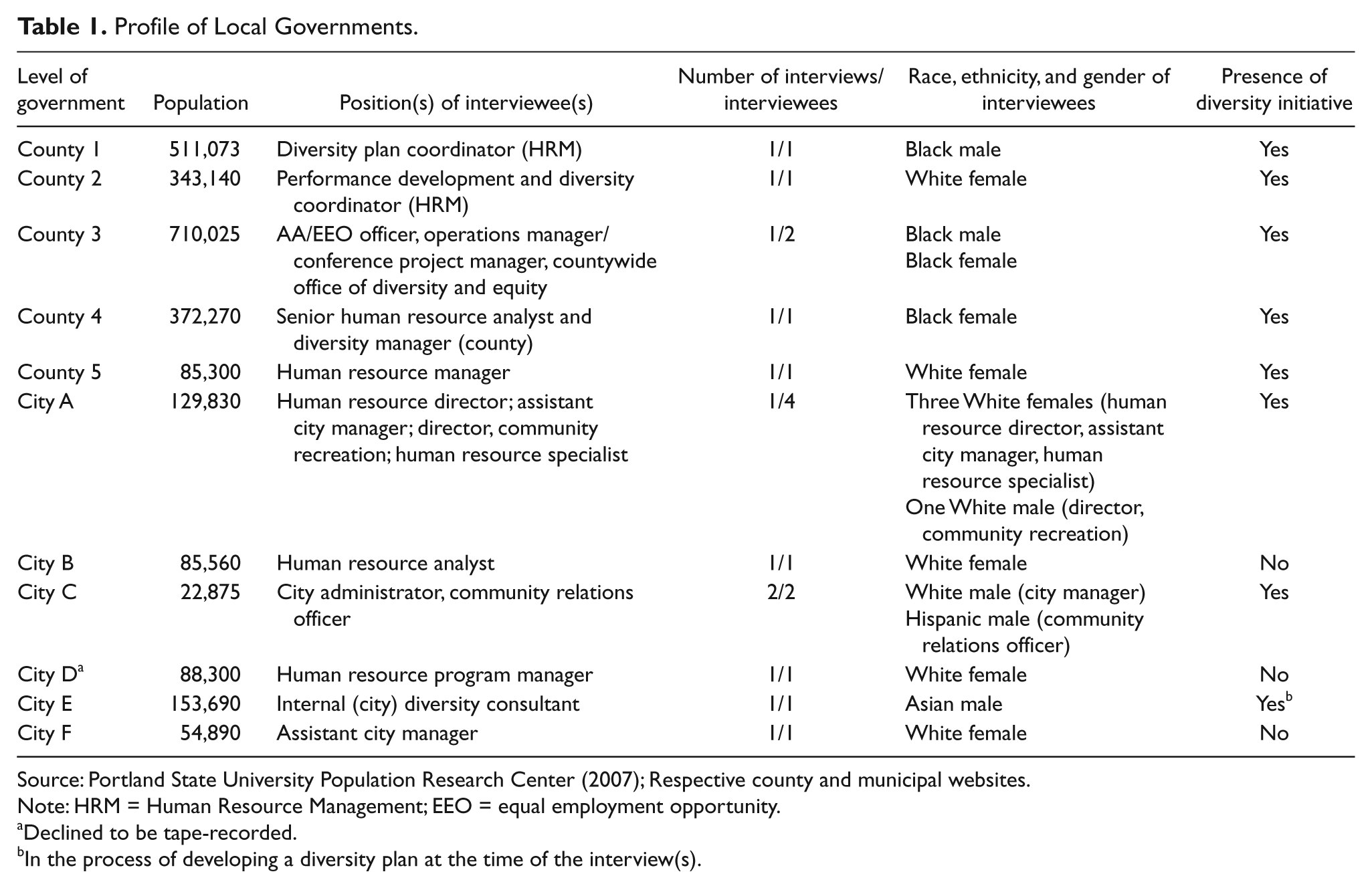
Source: Portland State University Population Research Center (2007); Respective county and municipal websites.
Note: HRM = Human Resource Management; EEO = equal employment opportunity.
Declined to be tape-recorded.
In the process of developing a diversity plan at the time of the interview(s).
Of the 11 local governments and 16 interviewees, only 2 organizations included White males. One White male was one of four interviewed who serves as the director of community recreation for a large city; the other White male, who disclosed that he is married to an Hispanic woman, is the city manager for a small municipality with a growing Hispanic presence. Women and minorities were overwhelmingly assigned to manage local governments’ diversity programs. Ironically, in the interviews that included White males, both of these cities’ approaches to diversity were considered somewhat progressive as compared with the remaining local governments interviewed. City A not only admitted to its ignorance in developing diversity programs and asked for direction in doing so, it was also the only city that planned to incorporate measures as part of managers’ performance to promote diversity. City C shrewdly utilized the skills of a community relations officer (CRO), himself a Hispanic, as a liaison to its Hispanic community. In addition, unlike other local governments, this city offered skilled-based incentives for employees who acquired additional language skills such as Spanish.
Results
In all cases, although at varying degrees, the rationales for instituting diversity programs were not proactive. The impetus for local governments to develop some level of diversity activity was multifaceted and promulgated by pressures that have been categorized as internal, external, and institutional in origin. The pressures included the changing demographics of communities; complaints from employees, local communities and the coalition of local civil rights groups, and/or human rights commissions; or the loss of lucrative business to competing municipalities around the country. At no time were the interviewers asked about the funding sources for these initiatives or why certain personnel selections were made for these assignments. Furthermore, the effectiveness and deployment of diversity programs were determined by the commitment or lack thereof of the political, administrative, or charismatic leadership within each organization.
A few local governments faced a number of challenges and eventually decided that some level of change was necessary. Many faced demographic shifts in their communities, an inability to meet some of the essential services for their changing clientele as a function of complaints from members of their communities, the coalition of groups and the possible legal ramifications, and complaints from their own employees. In other government organizations, although this recognition for change was evident, it was the loss of federal dollars together with the overwhelming number of complaints from various underserved minority populations that mattered. Also significant was the loss of business from a private sector company that relocated to another city and state given the dearth of diversity because the municipality in question either lacked the population diversity or the services that the company sought. One county government changed leadership, and in doing so, reduced the level of staffing for diversity-related services amid the increasing need for such services. Another organization simply reframed its affirmative action plan as a diversity plan. The interviews also revealed that many of the local governments neither knew nor made a distinction between diversity and affirmative action. Some struggled with defining diversity. In most cases, the installation of diversity activities was a top-down mandate. It appeared then that though most local governments succumbed to the pressures for change, such change was reactive in nature, and as a result, may not be considered an authentic endeavor. Figure 1 describes the ensuing catalysts, that is, nature of change given internal, external, and institutional pressures and the corresponding rationales that provided the change for the development of diversity programs in local governments as follows:
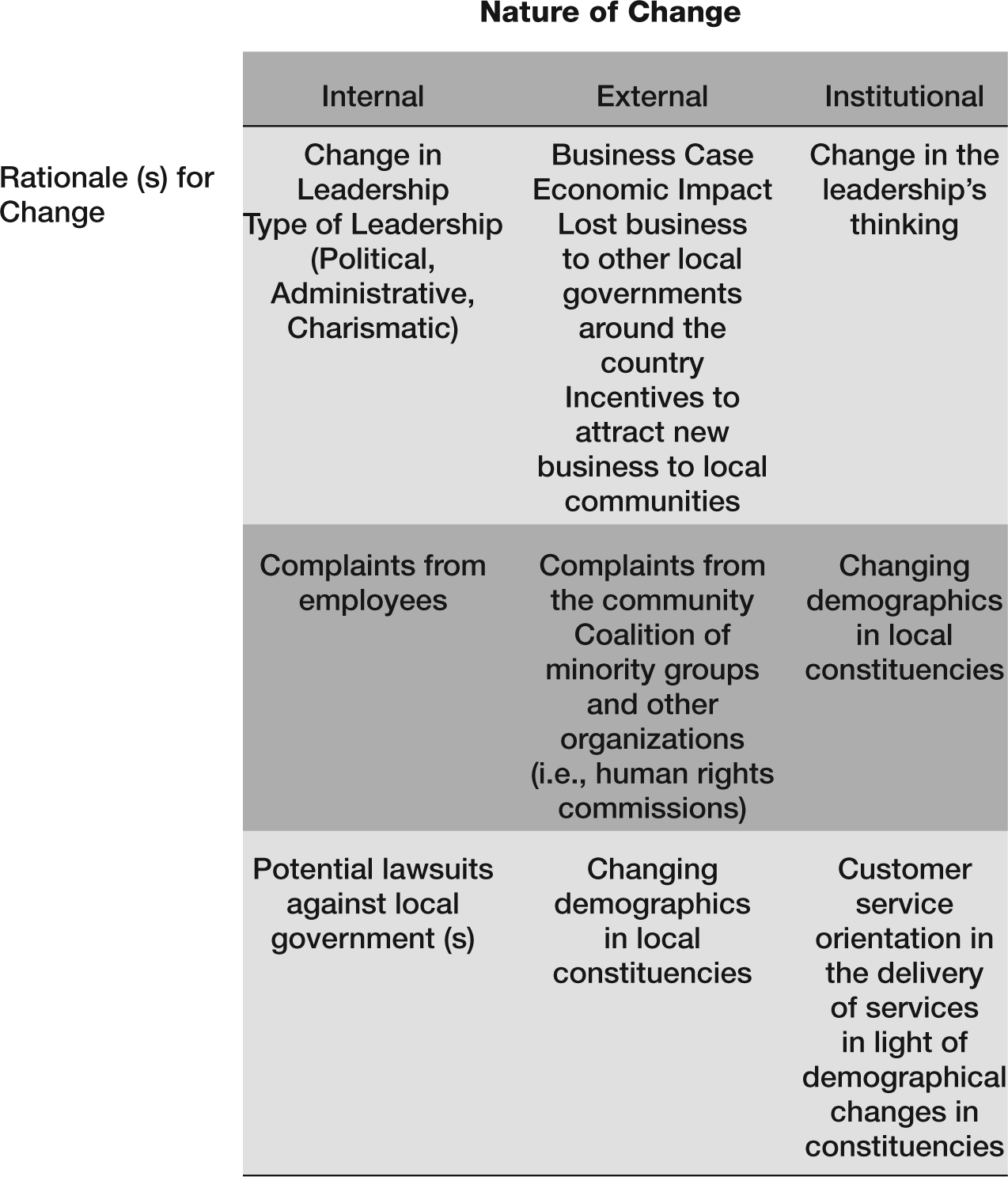
Agents of change.
Symbolism
One of the most salient findings in this research was that in almost all of the local governments interviewed, those responsible for managing diversity initiatives were either women or minorities. Although these selections were not surprising, the frustrations expressed by most incumbents in terms of garnering the support necessary to render such programs viable, together with the reactive justifications for instituting them, raised questions about the underlying reasons for why these initiatives were developed and the basis for selecting members of protected groups to manage them. In the case of one municipality, when asked who had responsibility for the organization’s diversity plan, which, at the behest of the city’s attorney office, was changed from the affirmative action plan, the employee replied that following the annual updating of the statistical data for the plan, the mayor and city attorney would simply review the information but that nothing would result from these annual reviews. In a second example, one county government’s female incumbent expressed her frustration that as the diversity coordinator, not only was her position reduced to half time but in light of budget cuts, “there was no budget for diversity.” This same diversity coordinator expressed how inconsequential she felt as she conducted a diversity workshop to primarily a group of public works male employees. She added, “I was a woman and I was only going to be taken so seriously because of that.” In essence, the motives for this meeting were merely formal.
To Arnstein (1969), these assignments are analogous to endorsing advisory committees that serve as misrepresentations of citizen participation because they appear to be designed solely as a public relations strategy for the powerbrokers. Such schemes are therefore described as “dishonest” and “arrogant” (p. 218). It is thus believed that the selection of women and minorities to manage diversity programs was intentionally done for symbolic reasons.
Proposition 1: Women and minorities are deliberately assigned to manage diversity programs only as an organization’s symbolic demonstration of support for diversity.
Handling Their Own Kind
The incumbents for managing diversity programs in this study have been overwhelmingly women and minorities. Yet, although in many cases there was the recognition that these programs were needed, fiscally austere conditions defined by budgetary, time, and staffing constraints led some local governments to under staff diversity functions despite the increasing need for such services. It is then speculated that the primary motivation for placing women and minorities to manage diversity programs is based on the notion that only women and minorities are best equipped for handling these issues. As one diversity coordinator noted, “I was the only voice for diversity . . . and uh, it was a very slow and very challenging kind of frustrating process.” In another instance, she continued that “One of the things that I’ve found is very challenging in getting the diversity initiatives going is that . . . for example, in recruiting and selecting, um, supervisors. It’s like diversity is this separate thing out there.” In other words, the issue of diversity then becomes an issue of “otherness.” There is some evidence to support this “othering” of the problem. For instance, the experience of many faculty members of color in higher education typically validates this speculation that is reflected as the following: feelings of isolation and under respect, hypervisibility because of their race and gender, the expectation that they should handle all race and gender matters that arise in their institutions, the expectation to be the representatives on committees concerning race and gender, being unnecessarily challenged in the classroom by majority students, and the expectation to do more than is expected of majority faculty (i.e., committee work and student advising) in functions that may not lead to tenure (Viernes Turner, 2002).
For the Viernes Turner (2002) study, one African American female professor reported the emotional drain she experienced because of the demands to be all things to all people. In another example, one public school routinely limited the selection of its diversity coordinators to those of the newest staff members who tended to be young, female, and minority to shepherd the “multicultural health of the school without any clear guidance on how to proceed and/or what is expected of them in that role” (Hall & Stevenson, 2007, p. 2). At no time was diversity defined, and out of frustration, the diversity coordinators sought to operationalize the vague term. Yet, they were subsequently confronted by the schools’ administrators and accused of being overly controlling. Despite the schools’ overt support for diversity, when data on enrollment and retention were requested, the diversity coordinators were met with outright resistance. As a result, the following is surmised:
Proposition 2: Women and minorities are deliberately segregated to manage diversity programs in the belief that only they are best at handling or should handle such affairs.
Reinforcing Marginalization
In this study, all local governments with some form of diversity program or were contemplating the establishment of such programs did so because of internal, external, and/or institutional pressures. No local government instituted these measures proactively. Women and minorities face multiple marginality because the issues that concern them tend to be marginalized, and, given their “otherness” as perceived by the majority, placing women and minorities in these roles also tends to reinforce their marginalization. One county diversity coordinator recalled her humiliating experience following a presentation on diversity. She said,
I was presenting to then . . . and I remember sitting there and they were all giving me the nicest smiles and if they could have patted me on the head, they would have (laughing). You know . . . Ah, this is so sweet.
According to Kanter (1977) and Law (1999), this tokenism occurs in situations where majority groups are forced to share their resources with minority groups. Arnstein (1969) demonstrates how in citizen participation such an exercise about the actual redistribution of power still engenders powerlessness in the already powerless. Through placation, although the marginalized have the right to advise, the powerful continue to retain the veto right to decide to whom, and if any, resources are to be distributed. Diversity programs thus become tokenized representations to preclude the majority from relinquishing valuable resources while pandering to the social pressure to establish these programs and quell any dissatisfaction among women and minority groups. This pressure, for Massey and Denton (1993), at least as it relates to housing where the affirmative mandate for integration was undercover of law by the Fair Housing Act (FHA; 1968), culminated in hyper segregation: Whites responded negatively when some Blacks attempted to move or moved into predominantly White neighborhoods, hence creating greater segregation of the groups from one another.
Proposition 3: As traditionally marginalized groups, women and minorities are further marginalized through specific placement to manage diversity programs.
Diminution of Power
Most local governments in this study struggled to define diversity. Consequently, few were successful in incorporating diversity as part of their overall strategic plans while catering to the divergent needs of their changing communities. Many local governments had difficulty in distinguishing between diversity and affirmative action, and as earlier noted, one city’s affirmative action plan was simply renamed the diversity plan but essentially continued to function as an affirmative action plan given the annual statistical updates of the plan’s equal employment opportunity–1 (EEO-1) report. As one local government demonstrated, and is borne out by research, diversity programs have become mere regurgitations of affirmative action programs (Naff & Kellough, 2001). Furthermore, the environment of fiscal austerity might have also provided the rationale for substituting or integrating diversity as part of the larger EEO function. Many organizations in this sample were uncertain as to whether diversity was an organizational objective or a departmental or functional goal. Many assumed that the organizational mandate for diversity emanated from the human resource department. And given such ambiguity and confusion, many local governments in turn experienced difficulty in launching diversity training as they viewed diversity as a human resource objective, not for each department to pursue as part of the larger organizational mission. The dissatisfaction of one county diversity plan coordinator became evident during the interview when she stated that the most challenging aspect of her role is convincing others that diversity is something that must be embraced and filtered up, down, and throughout the organization as opposed to “it’s like diversity is this separate thing out there.” Furthermore, her dissatisfaction was exacerbated “with the fact that, [she] was the only voice for diversity here.” In essence, diversity will “just be a token effort.”
However, another county diversity plan coordinator in this sample with 30 years of experience in human resource management emphatically suggested that for the survival of any organization’s diversity plan, it is important to “make diversity a part of your organization but separate from affirmative action.”For,
You know, if you put the two together, you’re just looking for so much resistance. Until you have an organization that is strongly . . . it’s ingrained in the organization what you’re talking about is diversity. Give diversity its own identity. But, it’s got to be supported somewhere.
Only one organization even suggested that it planned to utilize measures as indicators of management’s performance on diversity. It has long been held that diversity initiatives’ success must be tied to some form of assessment (Cox, 2001; Dobbs, 1998; Naff & Kellough, 2001). Therefore, research and measurement are important components of this process (Cox, 2001; Pynes, 2009). Thus, the assignment of women and minorities to manage diversity programs may ostensibly be viewed as a strategy of containment of women and minority groups to retain hegemony and power by the majority group. Diversity then functions as the instrument for achieving this goal. This sidelining of groups is parallel to discrimination against older employees. Henderson (1994) coined the term “Detroit syndrome” (p. 84) to signify the level of ageism against older American workers where management simply wants to “devalue them, demote them, discount them and dump them” (p. 84).
In one study, some who were appointed to diversity positions spoke of not having job descriptions, clear goals, or mission statements to explain their roles (Hall & Stevenson, 2007). Although in some cases diversity was identified as the overriding goal, no one was clear on how to achieve it. In other cases, the dedication to the function of organizational diversity was to be achieved on an abbreviated basis (i.e., part-time). Hence, the function of diversity became an ad hoc endeavor and, consequently, was perceived by the organizational hierarchy as well as its employees as a program that should not be taken seriously. Diversity programs become marginalized as those who are charged with their management. This type of discrimination, although not overt, nevertheless occurs in a more subtle yet invidious form (Massey & Denton, 1993). More disturbing is that given this subtlety, victims of discrimination may be unaware of its occurrence. Massey and Denton (1993) refer to this trend as “Discrimination with a Smile” that aptly describes the experience of one county diversity coordinator in this current study, who only received begrudging smiles from her audience of White male managers (p. 96).
Proposition 4: The double and, in some cases, triple marginalization of women and minorities through their deliberate assignment to manage diversity programs may represent a diminution of power for these incumbents, for to the organization (including its leadership), these positions are perceived as purely symbolic and largely ineffective.
Silencing the Critics
All of the local governments profiled in this study have developed diversity programs or are considering developing similar initiatives in reaction to internal, external, and/or institutional pressures. As argued by Reskin et al. (1999), the justification for public sector organizations to institute diversity programs is purely political given the potential public backlash. As such, to remain legitimate, public sector organizations must support programs like diversity (Golembiewski, 1995). Therefore, although public sector organizations exist to create public value because they are externally justified (Bryson, 2004) and to protect equal rights and promote social equity (Bertucci & Duggett, 2000), the political will to do so, given the political risks, trumps the need to create public value.
One county diversity plan coordinator in this sample remembered the day when he became so “fed up” that he marched into the county administrator’s office to submit his resignation. Ironically, the county administrator only 1 hr earlier at a director’s level retreat touted how the county was doing so well that it should serve as the model for other counties. It was only after this diversity plan coordinator described his own ordeal did diversity within this county begin to receive any real attention. On his 1st day, he went to secure his identification badge and a police officer asked him whether he was there to see his attorney, implying that his presence meant that he was in trouble and/or was a criminal. On another occasion, this same employee was in another county building when an officer scolded him by saying that “If you keep standing there, we’ll arrest you for loitering.” Only after sharing these negative experiences as a county employee did the county administrator take note that, for some employees, the experience was very different from his own. Although at the time the employee was hired as a diversity administrator in the human resource department, it was only following the threat of his resignation directly to the county administrator did diversity as a plan became more action oriented. In response, the county administrator summoned an emergency meeting of the county’s directors. Yet, although the county administrator was known for his leadership prowess, given his style and charisma, many in senior management warned him against advancing any diversity initiative. To do so, they said, would be committing “political suicide.”
Because diversity becomes a matter of representation, especially in light of demographic shifts and the ideals of a representative bureaucracy, public sector organizations must work on behalf of stakeholders who fund them, directly or indirectly, through other levels of government and the public’s purse. In an era of limited and diminishing resources, keeping the critics at bay to remain fiscally solvent is one way that local governments attempt to meet their missions as well as official and unofficial mandates. Meeting one of these mandates, officially or unofficially, is via the development of diversity programs. Thus, under the banner of diversity, the institution of these programs becomes a disingenuous ploy to silence critics. Therefore,
Proposition 5: Assigning women and minorities to manage diversity programs may serve as a conduit for silencing the critics through the overt and symbolic support of such programs.
Diversity: The Purview of Women and Minorities and the Absolution of Responsibility by the Majority
Although the reasons for this study of local governments’ disproportionate selection of women and minorities to administer diversity programs are only conjecture at this point, it was concluded that such selections emerged from the belief that diversity falls within the purview of women and minorities. In one city, the former diversity manager, an African American woman, was replaced by an Asian male but as a diversity consultant. The former diversity manager was perceived as too outspoken and had some verbal altercations with the city’s police stemming from a driving-related incident. As the current diversity consultant put it, the city’s survey of employees revealed that many believed that “diversity is being shoved down our throats.” The diversity consultant described how employees would refer to him by using such phrases as “you are so well spoken.” And “You are so level headed.” He, the diversity consultant, believed that this image of him as stereotypically the model minority because he is Asian, markedly contrasts with that of, as he put it, “the whole angry African American female stereotype.” Yet, this diversity consultant was not amused by these comments and sarcastically stated that “So, I’m just like ‘you.’ Just thought you complimented me but you just totally slammed me. Thank you.” He went on to say that because he has no staff, this bolstered the city’s rationale to change the position’s title from diversity manager to diversity consultant. Although he also has no budget, the city claims that there is money for the function of diversity, just not the position of diversity. The diversity consultant, however, questions this logic. In essence, making diversity a position without a budget absolves the majority from taking responsibility for either the program’s success or failure.
Pierce (2003) says that these practices reveal “how we are involved in the dirty process of racializing others” (p. 69), Nkomo (1992) likens participation in this charade to the fable “the emperor with no clothes” (p. 507), Arnstein (1969) views this collectively as a sham, and Cose (1993) submits that doing so pigeonholes those who are charged with such responsibilities. Case in point, Cheryl Boulden, a former employee with the U.S. Forest Service’s Hoosier National Forest in Bedford, Indiana, who was allegedly forced out of employment by the Forest Service, wrote a letter to former President Clinton describing the discriminatory ordeal that she endured at the hands of her superiors. Ms. Boulden, a budget and accounting officer, was the only African American at that location but was also assigned the responsibility of diversity program manager for the location (Reeves, 2006). Her letter to the President concluded by citing former Secretary of Agriculture Michael “Mike” Espy, himself an African American and the first to serve in that post, who said, “it’s time to close down the plantation which is known as the Forest Service” (p. 72). Presumably, some organizations conspire to suppress the truth and deliberately engage in plantation behavior through such practices as the glass ceiling, wage disparities, job segregation, and the like to segregate perceived problem groups by relegating the issues of diversity to those groups while excusing the majority of such responsibilities.
One city manager, whose municipality was the most progressive on diversity issues in this study, indicated that his spouse is Hispanic. His stance on diversity and the fervor with which this city has approached the issue was partly attributed to this city manager’s ties with the rapidly growing Hispanic community. For him, it was only fair that because that segment of the city’s population already constituted 50%, many of them were first-generation Americans, and in light of the city’s sizable other immigrant population, it was important that Hispanics are represented. This city, unlike its other municipal and county government counterparts, offered language-skill-based incentives to its employees to more effectively service and communicate with its diverse constituents.
Another large municipality in this study, that included one White male from its leadership, readily admitted its ignorance in dealing with diversity issues even in the face of an increasing Hispanic constituency. Moreover, this was the same local government that planned to institute measures as part of individual manager’s performance on diversity. A study conducted by Hall and Stevenson (2007) strongly suggests that limiting the diversity responsibility to minorities and women will place the burden of these initiatives’ success or failure exclusively on these groups. The diversity coordinators felt that this burden was unfair in that they were made exclusively responsible for the diversity program when the ultimate responsibility rested with the schools’ administrators. The majority determines who are different. Therefore, diversity only impacts women and minorities, not Whites and, as a result, such assignments become “person of color” jobs (Hall & Stevenson, p. 11). By also not making the majority responsible, the majority fails to see itself as part of the solution for achieving diversity. According to one displeased diversity coordinator in this current study of local governments, as long as she remained the only advocate for diversity, “The organization is not going to take responsibility for it.” Therefore, the majority cannot be held accountable for that which it should assume some responsibility. As a result,
Proposition 6: Limiting the management and responsibility of diversity initiatives to women and minorities makes them solely responsible for the success or failure of these initiatives. This action therefore absolves White males, and thus the organization’s leadership, from any responsibility or burden for these programs’ success or failure.
Lack of Commitment by Organizational Leadership
The viability and success of any organizational diversity program begins with its leadership (Cox, 2001; Dobbs, 1998; Kellough & Naff, 2004). At least four of the local governments interviewed for this study implicitly or explicitly attributed the success or lack thereof of their diversity efforts to the vision, direction, and involvement of their leadership. As indicated earlier, local governments’ diversity programs were primarily precipitated by internal, external, and institutional forces. Most of these programs were top-down in nature; and a formerly robust program was significantly reduced in staff given a change in the political leadership. In another case, the redirection of federal funding and lost business forced one local government’s leadership to respond by installing a diversity program. According to this county Affirmative Action/Equal Employment Opportunity (AA/EEO) officer, especially after the loss of business to other U.S. cities, he received a personal telephone call from the city’s then mayor about developing “something on diversity.” The officer jokingly asked, “When did the sky open up and how did this light shine on you to give you this vision?”
Like affirmative action, despite its legislative mandate, the lack of leadership, political will, arbitrary goals, and inconsistent application continue to define diversity programs’ precarious existence (Harris, 2009). The repeated botched administration of the FHA signified corruption and mismanagement on the part of its leadership that colluded with mortgage brokers, developers and banks to maintain the Black enclaves and not seek the affirmative mandate for housing integration (Massey & Denton, 1993). The aforementioned AA/EEO officer referencing diversity, said that “Leadership is important, if it doesn’t come from or is supported from the top, it [diversity] doesn’t happen.” Some diversity initiatives are similarly plagued by such compromises in leadership. Thus,
Proposition 7: Failure of local governments’ leadership to embrace, commit to, and support diversity programs will undermine the likelihood of their success and further marginalize the women and minorities who are charged with their management.
Starve the Program
Most of the local governments interviewed for this study struggled with justifying the institution of new diversity programs in times of fiscal duress. In lean economic times, most local governments yielded only to the groundswell of pressures that they could no longer overlook or control, that is, internal, external, and institutional reasons for change. Hence, these local governments might have perceived that to remain viable, they had to keep already meager resources in check to avoid squandering them on perceived low-level priorities like diversity. Yet, it was in direct response to the diversity concerns of their changing internal and external environment that forced many local governments to make institutional changes that were crucial to their continuing legitimacy (Duggett & Bertucci, 2001; Golembiewski, 1995). Like the sources of opposition to affirmative action, it was the economic threat of diverting scarce resources to minority groups and women (Blalock, 1967) that galvanized outrage against the public policy. The more credible that the threat was perceived, the more fervent the opposition became against affirmative action (Renfro et al., 2006). Furthermore, for organizations to retain their most prized resources to leverage power, they must find ways of barring perceived out-groups (women and minorities) from sharing them (Reskin et al., 1999).
Nevertheless, although a less controversial form, the pressure to install diversity programs may have ignited similar hostile attitudes. Therefore, as a way of appearing to support diversity while seeming to appease a diverse constituency to escape the wrath of not taking action, some local governments may have opted to throw limited resources at diversity programs to ensure their demise or ineffectiveness. As seen from some local governments in this study, neither the function nor the position responsible for diversity was budgeted. Even if budgeted, funds were inadequate. One diversity coordinator in this study cynically said after complaining that he had no budget for diversity, “Pat yourself on the back,” at least “we have a diversity program.” Inadequate funding allows organizations to protect their priorities while diversity programs and their managers are marginalized in the process.
Proposition 8: By allocating only the most limited resources to diversity programs to either ensure their demise or continued ineffectiveness, organizations guarantee that these programs will not divert prized resources from organizational priorities while seeming to satisfy their citizenry. This action in turn reinforces the marginalization of diversity programs as well as further marginalizes those who manage them.
In accordance with Arnstein’s (1969) ladders of citizen participation and in concert with the theoretical framework provided and the propositions articulated in the theory of multiple marginality, Figure 2 below helps to dissect the multilayered and entrenched rationales for the assignment of women and minorities to manage diversity programs. The extent to which these rationales are carried out is determined by the associated underlying strategies, the strategic roles played by those involved and the resultant degrees of influence. Together, the elements within each column help to reveal the purposeful action behind the steps toward the increased marginalization of women and minorities.
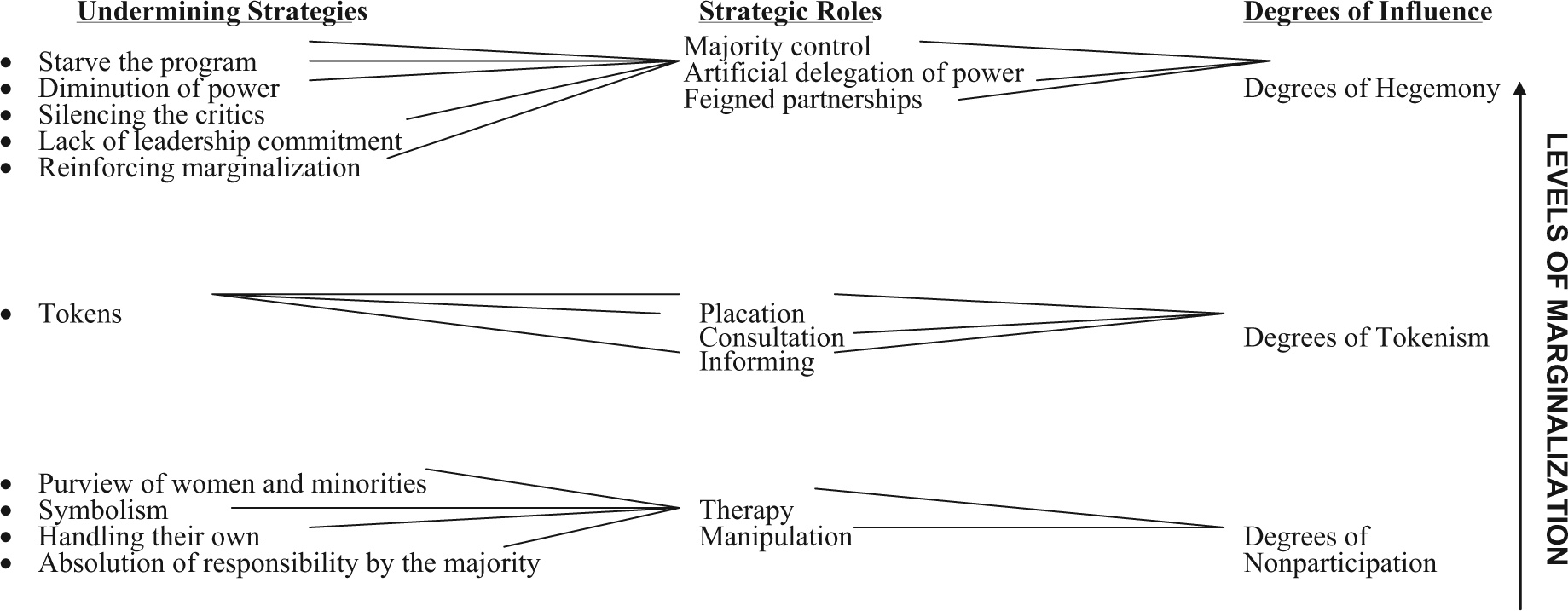
Reinforcing and multiplying marginalization: Uncovering the veil behind the assignment of women and minorities to diversity programs.
The lowest level, or degrees of nonparticipation, explains how managers of diversity initiatives are lulled into a false sense of active participation that they are making a difference through such assignments. Fundamentally, women and minorities become surrogates of this problem that reinforces their marginalization. Manipulation serves as a public relations strategy to entice certain groups’ participation then through therapy participants are encouraged to believe that these assignments are for their own good given their pathology. Manipulation and therapy signify varying degrees of nonparticipation on the part of those responsible for diversity programs. At the middle level, or degrees of tokenism, acts of informing, consultation, and placation take place. Those charged with diversity programs are made to feel that doing so is in their best interest (Arnstein, 1969). Their selection represents the first in a series of efforts toward their legitimatization. This action constitutes informing, in this case, recognition of the need for their assignments to diversity programs. But as Arnstein argues, such efforts result in one-way communication from the powerbrokers to the participants. Consultation, while also a step in the right direction toward the legitimization of participants, takes the form of statistical data that is solely measured by the number of people who attend diversity meetings, for instance. This exercise, too, is suspect, not substantive, and is equivalent to “window dressing” (Arnstein, 1969, p. 219). And placation occurs when employees are handpicked by their organizations to serve on high-profile public bodies or boards. However, these positions lack authority as the decisions lie with the powerbrokers. Members of the respective diversity programs are placed on these bodies, not as a part of the decision-making process but as token representatives of their organizations. Thus, informing, consultation, and placation represent varying degrees of tokenism.
Finally, at the highest level, control by the powerbrokers is the strongest. Here, the establishment of partnerships can potentially foster genuine levels of change through negotiations between participants and powerbrokers to influence the outcome (Arnstein, 1969). But, because it is the institutions and not women and minorities who control how the resources, if any, are distributed to diversity programs, these partnerships are feigned attempts at best. Delegation of power might seemingly also produce increased power sharing between participants and powerbrokers. However, because the delegation of power is artificial in nature and the powerbrokers have control over how organizational resources are distributed, diversity programs suffer. Because the majority retains ultimate control over how resources are allocated, eventually diversity programs become ineffective. Besides, there is no commitment for such programs by the institutional leadership to sustain them. This move in turn reinforces the marginalization of diversity programs and the employees who manage them.
Conclusion
This article has developed a theory of multiple marginality by using the findings of an exploratory study on local governments’ propensity to craft diversity initiatives. This theory demonstrates most local governments’ actual reasons for initiating diversity programs. With the research on groups as the basis, a series of propositions were produced to describe why local governments institute diversity programs, and in doing so, further marginalize already marginalized groups like women and minorities by assigning them to manage these programs. First, such placements provide symbolic but superficial support for diversity. Second, the observation that women and minorities were given the primary responsibility for diversity programs was stark. It is hypothesized that women and minorities were selected for these roles in the belief that only they should handle these affairs because they are the only ones with the perceived problems and needs for these initiatives. Third, placing women and minorities into diversity positions is a manipulative yet effective tactic by the majority to sustain women and minorities’ marginalization. It is this very segregation that calls attention to their differentness and in turn otherness, and further marginalizes them. Fourth, the placing of women and minorities into diversity positions becomes a long-term strategy of containment by the majority to retain hegemony. Those who are assigned to diversity positions are given unclear goals, no indicators of performance to gauge the progress of diversity programs and the time devoted to these programs is customarily parceled out on an ad hoc or part-time basis as a clear indication that diversity programs are not instituted as serious endeavors for change.
Fifth, local governments that fail to support diversity programs may in turn suffer public scrutiny because they may be viewed as not representing the interests of their constituencies. Some local governments may have established these programs as a way of silencing their critics. In addition, because the burden of achieving diversity falls solely on the shoulders of women and minorities, the majority escapes any culpability for programmatic results.
Seventh, the success of any diversity program has been directly linked to the commitment of an organization’s leadership without which such programs can neither survive nor thrive. When leaders fail to support diversity efforts, they marginalize these programs and their managers. Finally, by ensuring that diversity programs do not threaten resources that have been earmarked for organizational priorities, particularly in an era of already constrained resources, the leadership of some local governments may have invested the least amount of resources possible to render diversity programs ineffective or altogether extinct. Doing so may provide these organizations with the convenient political cloak of goodwill in that they have done all that they can do, given limited resources, to leverage these programs’ success.
Implications for Public Administration
This exploratory study was derived from a purposive sample. As such, the study is limited in scope for the sample is too small and cannot be generalized as representative of all local public organizations, especially government. Therefore, the author’s interpretation of the findings of this study neither indicts nor represents those public organizations that continually strive to institute meaningful diversity initiatives. Nonetheless, the findings of this study reveal many superficial diversity efforts on the part of most local governments that were interviewed and the disproportionate assignment of women and minorities to manage them. For bureaucracies to achieve the work that they are charged to do, they must adequately represent the citizenry. One visible yet authentic manner in which representative bureaucracy can be achieved is through representation to ensure that governmental workforces mirror their surrounding social geography. However, having diverse workforces that reflect constituencies alone, while visible (passive representation), may not be enough to ensure that the interests of diverse communities, internal and external to the organizations, are being served (active representation). Although some public organizations have been successful in striking a delicate but tenuous balance between representing diverse constituencies and interests and those of all constituencies, others have floundered by propping up feigned symbolic evidence as stewards of diversity. But, as seen from this exploratory study, as constituencies become more diverse, at some time or another, governments will be forced to cede to the will of the people.
In an increasingly diverse society, local governments will be hard-pressed to provide merely lukewarm support to programs like diversity when it is evident that such programs promote the interests of their constituencies. It is recognized that public administration, and by extension public management, confronts the auspicious but necessary task of making decisions about multiple priorities, and in doing so, frequently encounter tensions between the need for representativeness, neutrality, competence, responsiveness, and accountability. Still, local governments are compelled by their very existence to find ways to meet these multiple and conflicting priorities, even in an era of fiscal duress, for the good of their polity. To do otherwise is to shirk the fundamental responsibility of government and of a representative bureaucracy. Supporting and leveraging the resources necessary for the viability of programs like diversity is one way of remaining a legitimate agent of the people’s interests to create public value for the public good.
Implications for Future Research
It is hoped that these profound issues surrounding the underlying reasons for the development of diversity programs and the assignment of women and minorities by local governments to manage them will prompt all levels of government to consider the implications of instituting such programs, not as a way of benefiting the affluent few to control perceived prized resources to advance their own interests, but to achieve real diversity for the good of the polity and democratic society for the long term. The literature abounds with strategies for developing, implementing, and sustaining diversity efforts such as those proposed by Hall and Stevenson (2007), primary among them is redefining diversity as inclusive of all groups and specifying the associated goals for such initiatives. Because diversity often elicits highly charged emotions, including anger and guilt, trained personnel licensed to work with these hotbed issues should be part of the general discussion. Institutions should avoid burdening any group or person as responsible for diversity. More importantly, institutions should explore ways of making diversity and diversity-related discussions a part of the institutions’ mainstream cultures and general discussions. By using the above, public institutions can engage all employees, avoid creating an atmosphere of blame and burden (Hall & Stevenson, 2007) and involve the majority as part of the solution (Harris, 2010). Concurrently, diversity research can be enriched by exploring, for instance, whether or not such initiatives will be rendered effective if persons from the majority (White males) are also placed as part of the management of these programs. Furthermore, as society becomes increasingly diverse and move toward a steady decline in the majority population over time, how will these same diversity programs come to sensitize and serve the interests of this dwindling majority?
Footnotes
Declaration of Conflicting Interests
The author(s) declared no potential conflicts of interest with respect to the research, authorship, and/or publication of this article.
Funding
The author(s) disclosed receipt of the following financial support for the research, authorship, and/or publication of this article: The author received financial support for this exploratory study on which this article is based.