



Abstract
Large-scale emergency response requires management of collaborative networks that stretch across government agencies and levels, and that include nonprofit and private organizations. Management of such collaborative networks has been recognized as a research area in need of further study. Inter-organizational complexities associated with these collaborative networks give rise to unanticipated contingencies that compound issues directly associated with an emergency itself. Planning for such response is therefore intrinsically limited, and emergency managers must bridge the gaps via articulation practices in real-time. In this paper, the authors draw on empirical data to develop a conceptual framework characterizing dimensions of inter-organizational complexity and domains of response coordination through which emergency managers articulate large-scale response efforts. The framework is illustrated with examples of state-level emergency managers articulating threads of networked response efforts concurrently through vertical and horizontal dimensions of inter-organizational complexity, and logistical, jurisdictional and governance domains of coordination. Theoretical and practical implications are discussed.
Although “every emergency is local” (Comfort, 1999; Dynes, Quarantelli, & Kreps, 1972), many of the budgetary and personnel resources for responding to major disasters and terrorist activity in the United States issue from the federal level. Processes of emergency response therefore give rise to gaps and tensions between local participants and federal participants, with state-level participants finding themselves in the middle, negotiating management of those gaps and tensions while at the same time addressing urgent, situationally specific aspects of the emergency.
Emergency response is typically managed through a flexible organizational structure known as the Incident Command System (ICS; Bigley & Roberts, 2001; Department of Homeland Security [DHS], 2008a). Daniel Moynihan (2009), in his work on network governance for crisis response, notes that although ICS is generally described by DHS as a highly centralized mode of network governance, much of crisis response is actually more dependent on network collaboration. In this article we extend that work, shedding light on situated practices at the state level during formulation of emergency response. Of critical importance in our perspective is the fundamental gap between emergency preparedness and mitigation plans on one hand, and the situated actions (Suchman, 2007) necessary for provision of emergency response on the other. We present empirical findings about the activities in which state-level emergency managers engage as intermediaries: we describe the practices through which these public servants orchestrate collaboration across a wide network of organizations and participants, piecing together nonroutine portions of response efforts for each specific emergency.
We develop our results using a practice-based approach (Brown & Duguid, 2001; Fosher, 2009; Orlikowski, 2000; Suchman, 2007; Weber & Khademian, 2008), and we highlight how the actions of state-level public managers during emergency response operations can be understood as articulation work (Strauss, 1988). Through their articulation practices, emergency managers reconfigure an area’s or a group’s networks and capacities, working up and down levels of government, as well as across levels (within a state and with cooperating external organizations), encountering complicating factors along the way. We find that their just-in-time practices interweave across logistical, jurisdictional, and governance domains of coordination. We illustrate our findings with data from observation of emergency response exercises and interviews of emergency response personnel. These results contribute to general knowledge about what happens on the ground during emergency response, and to scholarly knowledge about network management during emergency response. We conclude by discussing theoretical implications for the study of public network management and practical implications for understanding and improving emergency response, including the design of supportive technologies.
Background
Effective response to emergency or other forms of crisis depends on interagency collaboration and networks—formal and informal (Kapucu, Arslan, & Collins, 2010; Solansky & Beck, 2009). Management and governance of such interagency networks are areas of growing research interest (Agranoff, 2006, 2007; Hall & O’Toole, 2000; Moynihan, 2009; Provan & Kenis, 2008; Rhodes, 2007); however, most of the current research is oriented toward longer term policy networks, leaving the area of network management for emergency and crisis response understudied, with Moynihan’s (2009) work on ICSs a notable exception. Meanwhile, planning aspects of emergency preparation have traditionally been oriented toward facilitating routine types of operations; yet it is the management of nonroutine aspects of emergencies that is especially challenging but has not been studied in detail. This is the phenomenon at the root of Birdsall’s (2009a, 2009b) “Looking for the FEMA guy” experience, and which he emphasizes in his response to comments challenging the validity of his reported experience (Birdsall, 2010). Our work, therefore, addresses the recognized need for empirical research in these areas (Agranoff, 2006, 2007; Hall & O’Toole, 2000; Moynihan, 2009; Provan & Kenis, 2008; Rhodes, 2007).
As emergency response entails managing collaboration across network relations within one or more hierarchies enabled by differing information and communication technologies (ICTs), there is a general recognition that an incident management system needs to be flexible and scalable (Somers & Svara, 2009). The ICS, which is now part of the National Incident Management System (NIMS), is a flexible structure designed for managing emergency response operations and adapted by many states for training and emergency preparation guidance 1 (Bigley & Roberts, 2001; DHS, 2008a).
ICS is a widely applicable management system designed to enable effective, efficient incident management by integrating a combination of facilities, equipment, personnel, procedures, and communications operating within a common organizational structure. (DHS, 2008a, p. 45) As a system, ICS is extremely useful; not only does it provide an organizational structure for incident management, but it also guides the process for planning, building, and adapting that structure. Using ICS for every incident or planned event helps hone and maintain skills needed for the large-scale incidents. (DHS, 2008a, p. 46)
NIMS (DHS, 2008a) and the National Response Framework (DHS, 2008b) include ICS as a major component of their strategies for U.S. homeland security and emergency preparedness and response (EP&R; Federal Emergency Management Agency [FEMA], 2009; Moynihan, 2009). States use ICS for emergency response as they are required to follow NIMS to receive any federal grants. ICS includes methods of documenting emergency response actions—and these documents must then be filed in order for the state(s) to receive reimbursement for a federal declared emergency; therefore, while ICS can be tailored to each state, it remains fundamentally similar from state to state.
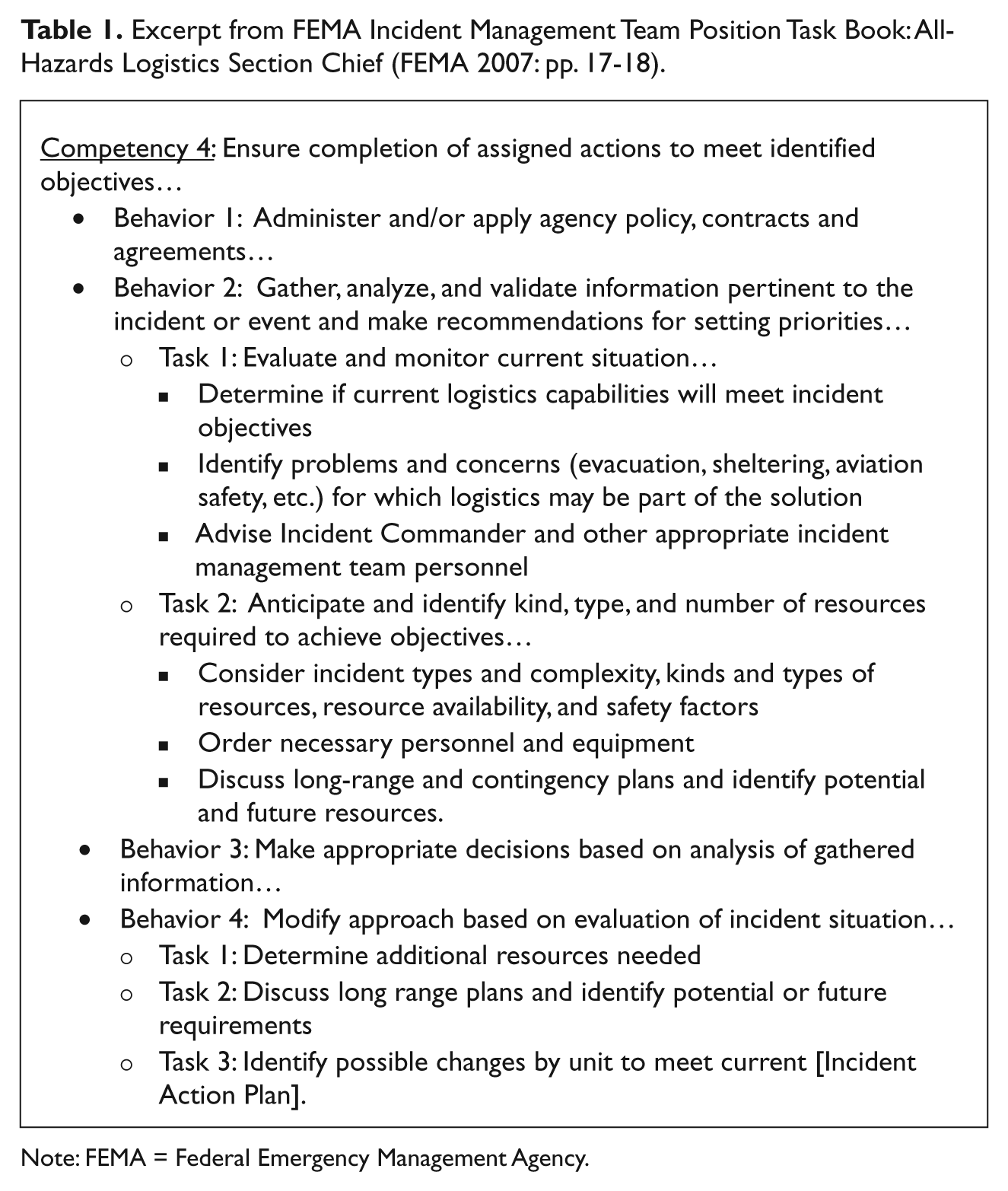
The tasks that a state-level emergency operations center (EOC) must follow are essentially laid out in the ICS process and procedures. One example of such an emergency manager job description—that of a logistics section chief—is shown in Table 1.
Excerpt from FEMA Incident Management Team Position Task Book: All-Hazards Logistics Section Chief (FEMA 2007: pp. 17-18).
Note: FEMA = Federal Emergency Management Agency.
Compared with the operations of a planned event, 2 emergency response operations have more challenging requirements for information: emergency response personnel need—and need to make sense of—a greater volume of information of varying importance in a shorter period of time. The types and timing of these information needs are driven by unfolding and unforeseen events, so that planning is of limited usefulness overall (Birdsall, 2010; Henderson, 2009).
Furthermore, because gaps and tensions often emerge between federal and local levels in such unplanned emergency management situations, state-level emergency managers frequently function as intermediaries, managing collaboration across the response networks. Private-sector corporations (e.g., utility companies, hospitals) and nongovernmental organizations (e.g., Red Cross, Citizen Corps), and ad hoc groups of concerned citizens are likely to be involved as well (Kapucu, 2009), further complicating management of response. Our research therefore seeks to answer to the question: How do state-level personnel manage network collaboration during emergency response?
In the following sections, we describe our research methods and then our findings about (a) the complexity of the field within and through which the response must be organized, and (b) the types of practices that emergency managers engage in as they organize the response to an incident from resources available within the complex field. Last, we discuss theoretical and practical implications of these findings for understanding and promoting effective emergency response, including recommendations for improving design and development of supportive technologies.
Method
Because we were asking a ‘how’ question, on which theory was nascent, we undertook qualitative field research and based our research approach on the methods associated with comparative case studies (Eisenhardt, 1989; Yin, 2009). Our research team included several social scientists with different backgrounds from an independent government-sponsored research organization and a research university.
Approach to Data Sources
Our goal was to collect primary and secondary data from a geographic cross-section of states involved in a range of emergency situations calling for response activity. We established contacts with emergency response agencies at different levels of government in the United States, and obtained observational access to three large-scale exercises each of which involved a broad range of participating organizations and agencies. Data collection was somewhat restricted by required nondisclosure Agreements and emergency managers’ concerns that our research products might be interpreted as evaluations and therefore negatively affect their future funding opportunities (especially in the current atmosphere of ongoing budget cuts).
Consequently, we took opportunistic advantage of as many different sources as possible, gathering data with multiple methods for each source, an approach which supports analytical triangulation and increases construct validity (Eisenhardt, 1989; Eisenhardt & Graebner, 2007). We were able to observe state-level emergency exercises in two states and one other interstate (regional) event that involved state-level participation. These regional exercises involved federal, state, county, and local personnel from a total of 10 states in the Northeast, Southeast, Midwest, and Southwest regions of the United States; all occurred between 2008 and 2010. In addition, we interviewed several high-ranking emergency managers in these and other states. Additional data were collected during conversational efforts to set up meetings and interviews with EP&R personnel, formal and informal discussions with independent contractors working in the EP&R arena, conference attendance, and participation in a class on the ICS. 3 We also held conversations with systems engineers working in the field of EP&R in the course of scoping our research question and obtaining access for data collection. We obtained further, circumstantial data via our efforts to secure observational access to several other (state, city, and national) events even when that access was ultimately not permitted. Additional background information was obtained through review of newspaper and trade press articles, websites, and archived materials.
Data Collection
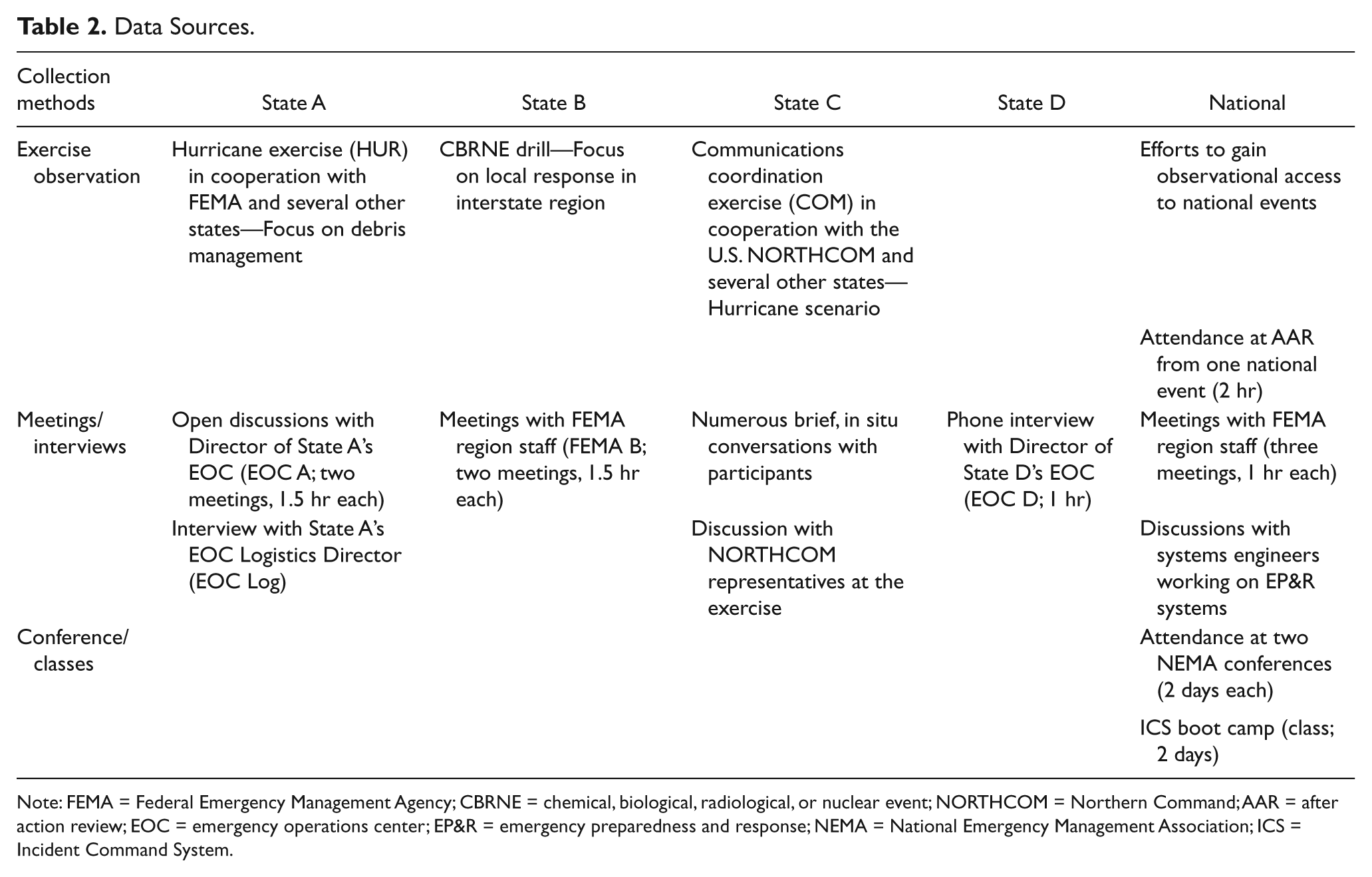
We observed three large-scale exercises as part of our data collection as summarized in Table 2.
Data Sources.
Note: FEMA = Federal Emergency Management Agency; CBRNE = chemical, biological, radiological, or nuclear event; NORTHCOM = Northern Command; AAR = after action review; EOC = emergency operations center; EP&R = emergency preparedness and response; NEMA = National Emergency Management Association; ICS = Incident Command System.
The first observations occurred at a state-level hurricane response exercise (HUR). HUR involved federal (Army Corps of Engineers [ACEs], FEMA, U.S. Department of Labor, and other participants), state, county, and local agencies. As part of a regional activity, the exercise was simultaneously conducted in four other states within the same FEMA region. In addition, emergency managers in the observed state interacted with counterparts in a distant state to test an Emergency Management Assistance Compact (EMAC) and also communicated with responders from Canada.
The second exercise was a form of a chemical, biological, radiological, or nuclear event (CBRNE) drill. Representatives from FEMA and other federal agencies were present at the exercise, as were representatives from EOCs in two adjoining states which would likely have been affected in an actual emergency. The third exercise focused on communication capabilities (COM). It was also based on a hurricane scenario with federal, state, and local participants, and was held in conjunction with a larger exercise run by the U.S. Northern Command (“NORTHCOM”), 4 involving several other states as well.
In addition to observations on-site, interviews were conducted by a team of researchers using a semistructured interview protocol, each lasting between 60 and 90 min. Researchers typed up their notes shortly after each interview or period of observation.
Analytical Approach
Our analysis procedure was consistent with recommendations by Yin (2009) and Eisenhardt (1989) for cross-case comparisons, and entailed precautions to counteract potential investigator bias during the analysis phase. Each interview or event was separately analyzed and a report on it was written prior to the cross-case analysis. In addition to triangulating across multiple sources of data, several persons with different backgrounds were involved in the writing and reviewing of each individual report. The first author then conducted cross-case analysis, reviewing all of the original field and interview notes, the observational reports from exercises, and memos on the high-level themes, before completing a round of coding across the four state data set. These results were reviewed by other members of the team and their feedback was integrated. Relevant literature was iteratively compared with the emerging results to further refine our findings and incorporated in the written products.
Findings
During large emergencies, when emergency management extends above the local level to state and federal levels, complications frequently arise due to the vast numbers of potential actors within each level of the response effort (Comfort, 2002, 2007; Moynihan, 2009). Although planning and preparation are helpful, the working out of a specific response for each contingency as it arises is ultimately a matter of “execution” (Birdsall, 2010). Some contingencies simply cannot be foreseen—and therefore comprise an impetus for ad hoc realignment of network relations by emergency managers. Given the intermediary role of state-level managers, a focus on that level of government provides a lens with which to view upward and downward interaction, which can be extrapolated to other levels of government with comparable directional relationships to manage.
In the following section, we develop a conceptual framework characterizing the complexity of the field in which state-level emergency managers must coordinate response efforts, and how they do so. First, we provide our findings about the dimensions of network complexity that state-level emergency managers must manage—as intermediaries bridging between federal and local emergency response activities. Then, we discuss two additional factors which frequently complicate managers’ efforts to organize collaboration across the network, rendering the overall organizing process even more complex. We follow this with description and illustration of state-level managers’ actions as articulation practices that interweave through these dimensions and across three domains of coordination: logistics, jurisdiction, and governance.
Vertical and Horizontal Dimensions of Network Complexity
State-level emergency managers work with network relations vertically (upward to the federal level, downward to intrastate regional and local) and horizontally (within state as well as with other states and with nongovernment entities). In this section, we identify the kinds of gaps and tensions that arise contingently out of the interfaces between and across these levels, which state-level managers face as intermediaries. We begin by noting that although vertical coordination may be perceived as easier to manage than “sideways” or horizontal coordination, evidence suggests that vertical relationships are not necessarily easier to manage than horizontal ones (Yang, Zheng, & Pardo, 2012).
Upward: State-Federal Relations
During the emergency management exercises we observed, the primary relationships that state-level emergency managers had with federal-level agencies were with representatives from FEMA. Relationships with other federal agencies depended on specifics of each emergency, and relate to those agencies’ participation in emergency support functions (ESFs; FEMA, 2008). For example, the COM exercise was partially integrated with a larger NORTHCOM exercise. Other federal partners that state-level emergency managers commonly engage with—not solely during exercises—include the ACEs, the Federal Bureau of Investigation (FBI), and the Transportation Security Administration (TSA). One EOC director (EOC D) also indicated that his EOC occasionally collaborates with the Secret Service.
These relationships extending upward did not always flow easily and mismatches between state and federal control efforts were evident. Both of the state-level EOC exercises that we observed were initiated by federal agencies (one by a FEMA region, the other by NORTHCOM). In the initial stages of planning for the COM exercise, the state was better organized and oriented toward its own hurricane scenarios than were the federal exercise planners at NORTHCOM; hence, the state moved ahead and developed its own exercise with federal participants as observers, although the NORTHCOM exercise lead (not on-site at the state exercise) was not comfortable with that state’s independence. In the other state EOC exercise (HUR), the state independently modified a time schedule that had been provided by FEMA to better serve the state’s priorities.
Communication gaps between federal and state agencies also occurred during planning and preparation stages. For example, at the 2008 National Emergency Management Association (NEMA) conference, state-level emergency managers issued a challenge to FEMA: “Build it with us.” Yet at the 2009 NEMA conference, those same emergency managers were lamenting, “Where are the people they said would be in touch with us?”
Downward: State-Local Relations
Responsiveness to local and within-state regional entities is a primary responsibility of state-level emergency managers (EOC A, EOC D). Hurricanes are a prime example of an emergency that requires state-level coordination between intrastate entities. As a COM interviewee noted with respect to staffing response efforts, “[The local and regional agencies] just don’t have the people to do it.” EP&R capabilities vary in how they are organized between states, depending in part on whether there is a strong meso-level (county, district, etc.) between the state and the localities. For example,the EOC Director from State D referred to county emergency management agencies within his state as “primary customers,” whereas the EOC Director from State A was mainly concerned with the towns and cities in his state.
As mentioned above, because state-level EOCs are strategically positioned as conduits for federal funding to local-level emergency response organizations, their service to the federal level in this way may conflict with their traditional responsibilities to the local levels, with state-level emergency managers finding them uncomfortably situated in between local and federal levels. For example, one participant at the COM exercise expressed concern that critical infrastructure and public safety communities – at the federal and state level respectively – focused on different risks relative to the same resource. He noted that a nearby nuclear power plant with old infrastructure was at risk of leaking and would require US$40M to modernize, and that this would open up very different public safety dangers than if it were breached by outsiders. Yet while federal funding was available for the latter, comparable funding was not available for the former.
Horizontal: Internal to state
Relationships between state-level agencies within a single state can also present management challenges. For example, we observed in-state communication glitches between state EOCs and their respective governors during two different exercises. The Governor of State C asked for an accounting of resources deployed during the COM exercise—how much all the assets, resources, and processes were costing and which pot of money would be used to fund them (local, state, or federal); this information was simply not yet readily available to provide. The other instance involved an effort by State A’s Governor to contribute to the HUR exercise via an atypical communication channel, which necessitated someone leaving the EOC space to use the phone in a quiet office to “find out what he wanted.” Relationships between EOCs and other in-state agencies such as state police and state national guard also called for extra attention during the exercises.
Horizontal: External to state
Because each state has its own rules, contracts, procedures, and practices for EP&R, interstate cooperation requires a high degree of management and collaboration. Externally, states therefore have EMACs with other states, to voluntarily share assets from one state to another during emergencies.
Public–private partnerships were also evident in the state-level exercises, and tensions surfaced in this regard as well. For example, several telecommunications companies participated in the COM exercise, with a representative of one assuming a functional role within the state-level emergency organization. Issues then arose with regard to whether that particular company was entitled to have access to privileged information without that same information being shared with industry competitors who were also participating. Other vendors displayed their products and services in a “demo” area at the exercise. At the CBRNE drill, tensions were evident between the management of the private facility that was staging the incident, and contractors hired by FEMA to assess performance during the drill.
Additional Complicating Factors
In addition to issues specific to horizontal and vertical network relations, our data revealed two further complicating factors, both related to evolutionary change processes. We found that interagency relationships and roles were frequently affected by ongoing organizational change initiatives such as turnover in leadership and shifts in goals. And we found that changes in communication and information technologies, commonly experienced across all organizations, presented additional challenges during emergency response.
Organizational change
Recent changes in leadership were evident in three out of the four states from which we obtained primary data. In State A, the state EOC had a new director who was concerned with changing the organizational culture; his strategic priority was establishing new initiatives to improve interfaces with the governor’s office, FEMA regional office, and local communities. In the CBRNE case, recent changes in leadership at both the private corporation that owned the facility and its government regulatory agency resulted in disagreements over how the exercise should be evaluated. 5 And an emergency manager at the COM exercise noted: “The product is evolving.”
Technological contingencies
Many evolutionary changes in emergency response over the past two decades can be traced to availability and introduction of networked ICT. These changes rarely stand still; instead they continue to advance, although in uneven fashion. Emergency response is therefore further complicated by, and requires additional organizing to integrate, contingencies associated with the broad range of technologies used for communication and information sharing. Different levels of government frequently rely on different channels of communication for obtaining necessary information, as do different agencies at the same level of government. At the state level, two different information systems are commonly used for emergency response. WebEOC is a commercial product for managing unclassified information; it is primarily used for communicating downward with locals. The Homeland Security Information Network (HSIN) is designed for managing sensitive information and is used to communicate upward with DHS. In addition, WebFusion—a relatively new software system—provides access to multiple WebEOC systems and enables FEMA, TSA, DHS, FBI, and the Secret Service to join with all the entities on WebEOC to share information; WebFusion is now deployed in some settings (e.g., Virginia, 2010).
Despite federal mandates for information sharing between state and federal levels, interoperability issues between different technologies are not uncommon. For example, when a state needed to share data with the Department of Defense (DoD) Information Systems Agency (DISA) during the COM exercise, it experienced interoperability problems with the DoD network. And while most states use WebEOC to share information between state and local levels, federal agencies are required to obtain their information primarily from HSIN as specified in the National Response Framework (DHS, 2008b) for security reasons, with significant interoperability issues resulting. We found a staff person in one EOC therefore needing to enter the same information into both WebEOC and HSIN: “It’s time-consuming to post information twice” (COM). More generally, we found technology interoperability problems interfering with communication and information sharing across vertical and horizontal boundaries, requiring emergency managers to piece together low-tech workarounds in support of effective information flow.
Digital communications technologies not designed for emergency support or government activities may also be in use, further complicating things because these unofficial, nonsanctioned technologies present additional security concerns. For example, participants at the COM exercise used Yahoo.com to collect feedback and lessons learned about the exercise itself, although it was not approved for this use by DHS due to security vulnerabilities. Email, Twitter, and Facebook, all of which provide easy access to a wide swath of participants as well as the public, present similar concerns.
In addition, although radio infrastructure is an essential “backbone” for communicating with local emergency response personnel during a disaster when normal communication capabilities have been destroyed, many emergency response personnel do not have the necessary (radio) skills. Instead, amateur radio operators (often retired military personnel)—play a key role as backup support and must also be integrated into the operation (COM).
Furthermore, nonelectronic technologies such as phone and paper are preferable for many types of activities because they facilitate ease of use and training. For example, paper maps and organization charts are often affixed to walls so that managers can quickly scan them without having to move to a computer keyboard or reach for a mouse. Yet, information contained in these paper-based products is not readily integrated with electronic versions. Finally, of course, failures of electronic communication systems are common—to the extent that a HUR participant expressed surprise when the cell phone system did not suffer any failures.
Given all these potential complications, many of the organizational and technological contingencies affecting interactions among networked organizations and agencies during emergency response simply cannot be foreseen or prepared for in advance. Consequently, the job of emergency managers becomes one of piecing things together on the fly; how they do this is described in the following section.
Articulation Practices
Our observations revealed that during an emergency, state-level emergency managers spend much of their time on the phone and talking with each other face to face, working to bridge gaps that response planners and information systems designers had not been able to foresee. That a certain amount of this kind of work is inevitable has been highlighted by Suchman (1988, 2007), in her explication of the fundamental distinction between plans and situated actions:
The planning model takes off from our common sense preoccupations with the anticipation of action and the review of its outcomes and attempts to systematize that reasoning . . . [whereas s]ituated practice comprises moment-by-moment interactions with our environment more and less informed by reference to representations of conditions and of actions . . . Plans specify actions just to the level that specification is useful; they are vague with respect to the details of action precisely at the level at which it makes sense to forego specification and rely on the availability of a contingent and necessarily ad hoc response. (Suchman, 1988, pp. 314-315)
As highlighted above in Table 1, plans and job descriptions drop off in detail at some point. The process of addressing unplanned contingencies in situ and in real time is termed articulation (Corbin & Strauss, 1993; Strauss, 1988). Articulation work comprises “the specifics of putting together tasks, task sequences, task clusters—even aligning larger units such as lines of work and subprojects—in the service of work flow” (Strauss, 1988, p. 164). Articulation work is instrumental for repairing organizational routines that have been disrupted, often the case in emergencies.
During an emergency, managers—particularly at the state level—assume responsibility for sustaining workflows of personnel, material resources, information, and control, each of which must be defined, refined, and managed; these responsibilities are outlined in FEMA’s Incident Management Team Position Task Books such as illustrated above in Table 1. The identification and assignment of appropriate combinations of resources, expertise, and responsibility is accomplished through articulation work; it becomes explicit in the process of “thinking out loud” (Fosher, 2009). Many trial-and-error attempts and iterative cycles of articulation may be required before “getting it right.” This is because, again as Birdsall (2010) notes, the exact specifics of the emergency could not have been foreseen; rather, the articulation work must be conceived and carried out “just in time.” This “articulation process” is “the overall organizational process that brings together as many as possible of the interlocking and sequential elements of the total work, at every level of organization—and keeps the flow of work going” (Strauss, 1988, p. 175).
In a study of developing infrastructure, Star and Ruhleder (1996) posit three levels of issues that must be articulated, reflecting increasingly wider and more diffuse contextual effects. We follow their lead in characterizing three domains of coordination addressed in organizing emergency response. We propose that logistics, jurisdiction, and governance coordination domains can be understood in terms of the contingent issues that emergency managers must address within any specific emergency:
Which resources will go where? (logistics)
Who decides which resources may go where? (jurisdiction)
How is it determined who has control over which resources? (governance)
We next describe how each of these domains becomes manifest in state-level emergency managers’ practices during a response effort.
Logistics domain of coordination
Response to an emergency is composed of material resources and support services; our data revealed numerous instances of state-level emergency managers coordinating arrangements for the distribution and application of these resources. We refer to the making of these ad hoc coordination arrangements as articulation in the logistics domain.
During emergencies, resources are frequently not where they are needed, nor even are they initially accessible to the responders who will use or distribute them. Articulation in the logistics domain is then required to match the resources with persons who can deliver them to the areas of need. For example, logistical articulation in the HUR exercise commonly entailed dispatching work crews to remove downed trees that were obstructing a particular road, and directing truckloads of bottled water to certain sites within communities that needed them. In the COM case, logistical articulation comprised the tasking of communication assets (mobile communication units and personnel) to different locations. During the CBRNE event, logistical articulation entailed asking specific groups of subject matter experts for technical assessments regarding emergent risks associated with the incident.
Jurisdiction domain of coordination
Impromptu decisions about how to allocate control and responsibility for distribution and application of material resources, and how to manage needed information and labor, were plentiful in our data. We refer to these types of coordination arrangements as articulation in the jurisdiction domain. Interlocal and mutual aid agreements lay the foundation for coordination in the jurisdictional domain, yet details must still be worked out when resources are needed across organizational boundaries in emergency response (National Emergency Number Association [NENA], 2005). Typical cases in the HUR exercise involved the need to determine which agency or organization should be tasked with sending crews to remove the fallen trees or deliver the water: which Department of Public Works (DPW) unit, state highway patrol, or utility company should be in charge of a locale-specific effort. If a tree fell on a power line, the public works agency responsible for clearing the roads and the utility company responsible for repairing it might both be involved. But if one of those units is detained on a prior call, the other might be able to initiate work, or another group with comparable capabilities from a different jurisdiction could be tasked to fill in. In the COM exercise, decisions needed to be made about which localities’ communication assets could be tasked with serving emergent needs in other communities. In CBRNE, decisions needed to be reached regarding who should brief the media about which aspects of the incident. These examples of jurisdictional articulation entail allocating control and responsibility not only for distribution and application of material resources, but also for communicating with those outside the response effort.
Jurisdictional coordination can be quite complex due to the large number of organizations involved in emergency response (especially above the local level), the unpredictability of actual contingencies during any particular emergency, and the shared basis of authority (Moynihan, 2009). Nevertheless, our data indicate that jurisdictional issues are usually resolvable in a relatively straightforward manner. Resolution occurs through adherence to “due process,” that is, institutionalized or routine ways of negotiating power relationships and decision methods that respect the concerns of all stakeholders, so that each can support the results of the negotiation (Gerson & Star, 1986).
Governance domain of coordination
Our data also revealed some instances in which decisions about jurisdictional issues were not readily resolvable through due process. These required an additional level of articulation, which we term the governance domain. For example, at the COM exercise, one portion of the organizational chart remained in continual flux throughout the 4 days of the exercise—it changed 4 times on the 1st day alone and still was not stabilized by the final day due to the broad range of contingencies associated with locally owned technological assets and needs in different areas of responsibility. At CBRNE, contentions arose over whether managers from the privately owned facility—or a representative from the government regulatory agency—should be entitled to determine how much information could be disclosed to the contractors hired to evaluate incident response. At the HUR exercise, members of one ESF complained that some of the requests for assistance (RFAs) they had received were not significant enough to warrant state-level attention, and should have been filtered at the regional level (between local and state) instead. Also at the same exercise, other participants questioned why their group was not tasked with providing the services that were typically their responsibility. Thus, articulation work in the governance domain entails resolving ambiguities and conflicts over jurisdiction especially as they occur between members of different agencies that do not routinely work together.
Governance issues appear especially likely to arise when participating groups share a history of competing with each other for funding; such interagency rivalries may supersede other concerns at times. One participant at the COM exercise shared a story about two state regional task forces, each of which “wanted to knock down missions faster than the other” as part of their ongoing competition for funding. The task forces refused to work together claiming technical interoperability problems. Our interviewee was convinced, however, that the tensions originated out of frictions higher up the command chain rather than with the task forces themselves, noting that millions of dollars had already been directed into upgrades to address ostensibly technological problems: “They keep blaming problems on equipment, while they’re sitting in an orange three-quarter-of-a-million-dollar truck!” Another example occurred at the HUR exercise, where agencies that were not chosen to lead a multi-agency effort raised concerns about how their accountability should be managed.
We found that relational aspects of informal collaborative networks rose in prominence during governance articulation, and that articulation work to address such issues is frequently conducted using relationship management techniques. A representative from FEMA indicated, it is “better to consider social relationships” than to rely solely on formal hierarchies while formulating response to an incident. One member of the incident management team (IMT) at COM noted that a common saying in a cross-organizational coordination group is “When you need a friend, it’s too late to make one”—pointing to the importance of training and continuity across incident management experiences. Another common approach simply involves the establishment of common forums for representatives from different agencies to meet and discuss matters of concern. For example, when locally-based service providers expressed concerns during the hotwash 6 after the COM exercise – that they were not being adequately utilized or involved in the exercise – a DHS representative present spoke up to assure them that although the federal levels were unaware of all the difficulties that local and state levels encounter, the DoD and NORTHCOM were fully pleased with the level of effort. Similarly, the EOC Director from State A established an advisory council which held regular meetings and took on a variety of EP&R-related projects, as part of an in-house grassroots effort to develop collaborative relationship among responders and cultivate the trust that is supportive of informal collaboration.
Articulation work in the governance domain may also entail bringing in a higher level third party as broker. For example, when supportive utility crews from Canada were detained at the border during the HUR exercise, state-level emergency managers asked the state police to contact Border Patrol to expedite the Canadians’ entry into the US. And when people from the Health and Medical ESF voiced concerns that they were not tasked to participate in much of the exercise, they indicated that they planned to get Health and Human Services (HHS, a federal-level agency) involved to facilitate their future mission assignments. Discussions about involving a broker often included reference to a specifically-named individual, who could be expected to provide assistance on the other side. Approaches also entailed interactional strategies and tactics such as negotiation, persuasion, manipulation, and coercion (Corbin & Strauss, 1993) to articulate resolution of governance issues.
Governance concerns also emerged as cultural issues, with people from different groups working to establish common expectations and evaluative criteria. For example, at the COM exercise, the slogan “leave your logos and egos at the door” was repeated throughout the day in an effort to sway those participants accustomed to a more hierarchical, “command and control” approach toward a more horizontal collaborative approach. Similarly, a state-level entity changed its name and mission to reflect a shift from “command and control” to “coordination” to better facilitate relationships with local entities. One member of the COM IMT counseled: “[We] need to connect with Public Safety in the specific hit area before the hurricane hits. Call them—‘we’ve got task forces assembled, tell us what you need’–[that] gets them thinking to prepare.” HUR exercise participants in the Food and Water ESF noted that there would be times when they entered information into WebEOC and the response they received back had nothing to do with what they put in—such discrepancies reflected differences in language, acronyms, and so on. Another source mentioned difficulties he was having in collaborating with a state police organization, characterizing it as “a hard group to break into.”
Our data further indicate that there are also times when non-emergency governance issues assume first priority. Governance issues requiring negotiation were often framed in terms of budgetary and financial consequences, with emergency managers concerned about balancing effective emergency response against ongoing (non-emergency) budgetary and financial considerations. For example, a COM emergency manager was concerned about obtaining a final correct version of resource assignments because it would be reviewed by local governments, each wanting to see their own assets in the list. Concerns were also voiced about how state and local responders would be paid for their time while participating in the exercise, and how much money the state legislature had allocated for the training exercise. At the same time, local participants were repeatedly reminded that the state had spent billions of federal dollars on equipment with 96 cents out of each dollar going to local jurisdictions. There were also discussions about how to order material resources: whether they should be ordered through the relatively slow state ordering system which provided sound fiscal accountability, or through a federal system which was much faster but less likely to support reimbursement of local expenses.
In this section, we have described distinctions between logistical, jurisdictional, and governance domains of coordination—domains within which managers articulate specifics necessary for managing a response effort during a complex emergency incident. For each domain, we have detailed the types of issues that must be addressed and how they are normally handled by the state-level emergency managers. In the following section, we describe how state-level managers interweave problem-solving activities across these different articulation domains, constructing networked emergency response in real time.
Interweaving Articulation Threads Over Time and Across Coordination Domains
Our data reveal that response to any particular emergent contingency is commonly not completed before response to others must be begun or continued. Multiple RFAs frequently need to be worked out in parallel as contingencies and responses unfold, each at their own pace and with varying degrees of urgency. We found that the practice of articulation work during emergency response therefore entails juggling these efforts in rapid, ad hoc fashion depending on specific contingencies of a particular emergency situation. Furthermore, some sets of contingencies call for cascading articulation work across domains, reflecting interdependencies between them. In other words, efforts to resolve a logistics question may necessitate that a jurisdictional concern be addressed first, and possibly a governance issue in the course of that—all before the logistics issue can be resolved. The situated practice of articulation work consequently entails temporally interweaving threads of response efforts across different locales, organizational dimensions, and coordination domains, as well as across a range of communication channels.
An example is displayed in Table 3. This series of interactions took place during the state-level HUR exercise, as part of a larger multistate FEMA exercise, with local and state regions participating in addition to FEMA and state-level ESFs. The exercise scenario was 24 hours “post landfall” of the “hurricane,” which started at 9 a.m. and took 12 hours to move through the state, and was being played in real time. Because it was a training exercise, more instructions were given than might be during a real emergency—we indicate these steps as [Training] in the articulation domain column.
Interweaving Coordination Domains, Communicative Modes, Organizational Dimensions, and Locales.

The conversation(s) took place in the Logistics Director’s office, a small room connected to the back of the larger EOC, with a large sliding glass window that rendered activity in the EOC visible from inside the logistics room, and enabled face-to-face interaction and the passing of documents from one room to the other when the window was open, while prohibiting direct foot traffic between the two rooms. Within the small office were the Logistics Coordinator (already familiar with his job) and two assistants in training, plus our two observers. Because the log is from field notes rather than an electronic recording, it is not as precise as transcription; nevertheless, the general sequence and relative meaning of statements offers adequate fidelity for the current purposes.
The excerpt in Table 3 reveals the temporal interweaving of response threads across coordination domains, communication modes, organizational dimensions and locales. A glance down the “coordination domain” column reveals back-and-forth interweaving of issues between the logistical and jurisdictional domains over time. Emergency managers articulated the response using multiple communication channels within the same process: that is, the communication mode shifted from a significant events weblog projected on a large screen at the front of the EOC (T1-T3), to records in WebEOC on a desktop PC in the logistics room (T4), to face-to-face conversation among those co-present in the room (T4-T8), involving radio transmissions from the field (T8), and then back to WebEOC (T9), face-to-face conversation (T11-T13), and phone (T14-T16), before a human messenger announced the requirement to complete an incident action plan (IAP) (T17). Concurrently but with a disjoint ordering, the participants’ focus shifted from the locale of the first crisis (G-City) (T2) to the second (L-Town) (T3-T7) and back to the first before moving on to the third (M-Town) (T9-T13) and then returning again to the second (T15-16). Organizational dimensions of response effort bounced up and down between state and local, occasionally involving intra-state region and private sector. Furthermore, all of this occurred in less than 20 minutes time.
We note also that when articulation requests from higher levels of government are issued, they may temporarily take precedence over logistical and jurisdictional concerns. For example, at a later point during the same exercise, a person from the EOC stopped by the logistics office window to indicate that the governor had put in a RFA, though not through the formally correct channels; the need to deal with this request assumed precedence over some of the other ongoing activity, with one participant relocating to a private office to speak with the governor’s office by phone to ascertain the details of what was being requested.
Interactions among logistics, jurisdictional, and especially governance issues may be further clouded by sense-making issues in subtle ways, rendering them particularly difficult to recognize and untangle. Complications arising from attribution errors were stubbornly resistant to resolution (Comfort, 2007). This happened particularly in cases where information-sharing failures were attributed to ignorance or cultural resistance, when in fact they were due to poorly functioning communication systems. For example, in the HUR exercise, local requests were expected to be submitted to regional offices, but were instead coming directly to the state EOC. State-level emergency managers presumed that the problem was a training and jurisdictional issue, until they later found out that the communication capabilities of the regional headquarters were down (i.e., a logistics domain communication problem was misperceived as a governance issue).
Finally, it is worth noting that as articulation threads cross into the governance domains, political tensions may arise or may be brushed aside. For example, in the COM exercise, differences of opinion surfaced over who should be in control (i.e., NORTHCOM or State C): numerous participants claimed that the federal agency NORTHCOM’s position was not necessarily “above” the state, and NORTHCOM’s on-site observer noted, “Doesn’t matter who tells the truck to move.” Other COM interviewees expressed a similar sentiment: “Coalition of the willing,” “Don’t mess with success,” and “NORTHCOM can learn from [State C]!” In the HUR exercise, state-level emergency managers altered a FEMA-provided timeline to allow for more intensive exercise of certain specific capabilities needed by the state, without consulting or even informing FEMA representatives about the change.
Discussion
This article has focused on the work that state-level emergency managers do as central players in large-scale interorganizational emergency response efforts. Our interest has been in how these managers work out details of emergency response that arise in situ—when the complete list of activated organizations and the precise nature of each agency’s involvement could not have been foreseen, even while a host of potentially useful network relations may have already been in existence.
Our primary contribution has been to elucidate the practices that these state-level managers engage in as they coordinate emergency response across complex collaboration networks: more specifically, the processes through which they connect a broad range of (network) sources of resource provision to specific needs (resource requirements) in specific locales. To portray the range of the contingencies that these intermediary-level emergency managers address, we developed a framework characterizing dimensions of network complexity and domains of coordination. We first identified hierarchical (vertical/horizontal) dimensions of network complexity along with two additional complicating factors (organizational and technological change). We then identified three domains of coordination—logistical, jurisdictional, and governance—in which state-level emergency managers articulate response efforts. Finally, we illustrated how an overall response effort is constituted through temporally interweaving threads of articulation work through these dimensions, across the coordination domains, using a range of communication modes. Our work thus provides a response to calls for the empirical study of lower level and midlevel of organizational and network management practices (Agranoff, 2006, 2007; Hall & O’Toole, 2000; Moynihan, 2009; Provan & Kenis, 2008; Rhodes, 2007), especially in crisis situations (Garrett, 2010; Kapucu et al., 2010).
A key contribution of this work is the explication that—despite the value of emergency planning preparation and mitigation measures, and the normal efficiencies of hierarchical control—situated articulation practices are a crucial and indeed defining characteristic of the nonroutine and complex work inherent in managing emergency response, especially with larger incidents. Emergency response, as coordinated by midlevel emergency managers through their articulation practices, must be improvised and carried out to meet and address contingencies as they emerge in an ad hoc fashion, rather than via rote execution of plans. This finding resonates with Suchman’s (2007) distinction between plans and situated actions in the design, development, and use of automated (computer) systems.
We have shown how such articulation work is central to the very nature of emergency (i.e., nonroutine) response—especially at the intermediate levels of coordination—because a host of contingent issues emerges out of complex interdependencies among large numbers of organizations across different hierarchical levels and jurisdictions, as well as ongoing innovations in support technologies and organizational change efforts, all of which may be potentially implicated in nonroutine operations during response to a specific crisis. Our study of emergency response thus contributes a conceptual framework for understanding and analyzing this complexity. Our documentation of practice using the descriptive power of the multicase study approach within this framework therefore adds to the growing body of empirical knowledge about the management of emergent crisis response networks, and about networked forms of organization more generally. In the following sections, we first discuss how our results advance theoretical knowledge regarding network management and governance, particularly during emergency response; we then prescribe practice-based guidance regarding training and the design of supportive technologies.
Theoretical Implications
With regard to the growing body of work on network governance, our approach contributes insight into the role of intermediate nodes in the network, with participants doing articulation work up, down, and sideways to manage collaboration across the network, thus complementing traditional perspectives on hierarchical top-down or grassroots bottom-up organizing processes. Our perspective aligns with Nonaka and Takeuchi’s (1995) characterization of “middle-up-down management” in organizational knowledge creation, and extends their approach by adding a “sideways” dimension.
With respect to knowledge about network management, our work highlights the role(s) of knowledgeable actors constituting articulation of emergency response, dynamically developing capabilities for rebuilding response systems as necessary (Kapucu & Van Wart, 2008). Our findings strengthen the argument that network evolution during crisis or times of rapid change is often more of a just-in-time network management bricolage (Andersen, 2008) of situated initiatives, than it is a strategic decision or deliberate choice process about network governance per se (Provan & Kenis, 2008). Our findings thus also support Feldman and Khademian’s (2002) argument that “to manage is to govern” especially during emergencies where the necessity of responding to emergent contingencies can rapidly supersede the projections of planning.
These results additionally help to explain why the logistics domain of articulation work is typically considered “regular” emergency management work while jurisdictional and governance articulation work are more often viewed as problematic: because the effectiveness of the logistical response is dependent on their resolution. Once the latter issues are worked through and solved, their resolution becomes routinized and fades into the cognitive background, becoming invisible, or taken for granted—in other words, harder to recognize. And yet in emergency management in general, and midlevel network management in particular, we find that the jurisdiction and governance domains are where much of the critical articulation work occurs, because these contingencies are precisely those that were not visible during prior planning and preparation stages. We therefore maintain that jurisdictional and governance coordination comprise an intrinsic and crucial portion of emergency management and response activities, precisely because they are difficult to anticipate due to network complexity and their nonroutine (emergent) nature.
These results also help to explain why many policies and systems designed for emergency response and information sharing are not fully implemented as intended by their originators—because they are not designed to fully address the range of emergent contingencies arising out of the complexity of network relations comprising the response effort. Nor are many policies formulated in ways which actively facilitate the dynamic interweaving of articulation threads across the domains, ICS being a prime exception. We posit that the ad hoc articulation process which ICS supports is optimal for emergency management because the coordination costs associated with managing larger numbers of organizations potentially participating in the response effort increase geometrically as the size of the effort expands, as do the range of potential contingencies arising from the emergency situation itself.
Practical Implications
As complexities associated with the above described organizational dimensions and coordination domains are inevitable in large-scale emergency management, we stress that emergent needs for jurisdictional and governance articulation work should not be interpreted as indications that emergency managers are not doing their jobs correctly, or that more planning or technology is necessarily needed. Rather, recognition is needed that the articulation work itself is a cognitively demanding form of multi-tasking, especially under time constraints of emergency situations, and that many emergency managers are doing an impressive job of managing collaboration networks under challenging circumstances. We further assert that respect for these unavoidable intricacies is called for, including increased attention to the requirements voiced by persons serving in this capacity. We therefore offer practical suggestions for training and technology design along these lines.
Implications for training
Training is a key purpose of EP&R exercises. As the EOC Director from State D noted, “Exercises are pretty key. Exercises are important to keeping the skill set up.” Repetitious training minimizes the need for articulation through facilitating routinization of those processes found to be effective, such as identifying within a particular emergency response community who is best qualified to manage which kinds of task assignment and who can be expected to carry out which kinds of tasks most effectively. Portions of articulation processes that can be resolved during training do not need to be attended to during an actual emergency, as they have become internalized by participants. As one FEMA representative put it: “[We] need to work like greased lightning . . . need to drill the process; push through as quickly as possible.”
Exercises can also be and often are dedicated to improving a particular capability. For example, the purpose of the COM exercise we observed was to improve communication capabilities; for the HUR exercise, the purpose was to examine critical resources logistics (distribution, debris management, and mass care). Depending on the goals of the training, different groups may need to be involved in its planning.
Some may think that improved training obviates the need for articulation practices. Recent research suggests that this is highly unlikely given the prevalence of communities coming together in unpredictable emergencies (Cowen & Cowen, 2010; Majchrzak, Jarvenpaa, & Hollingshead, 2007) and the need to train new members in temporary organizations (Bechky, 2006). Emergency management organizations typically experience high degrees of personnel turnover and frequent deployments of new technologies in addition to changing sets of instructions on how to order commodities or interact with members of other communities. Each organization (e.g., FEMA, state EOC, private corporation, state civil defense exercise training office) typically has its own training person, and as with other jobs, those positions are subject to turnover. We therefore assert that developing articulation skills must remain an important aspect of training, regardless. Training is not temporally separated from actual emergency management, but remains important throughout actual emergency management as appropriately trained personnel may not be readily available and novices must be instructed to perform properly in actual emergencies as well as during exercises.
Furthermore, advance preparation only helps to a certain degree. As one IMT member at COM counseled: “As the event progresses—trainees are now leaning forward: ‘we’ve got it!’ But later, when the storm really hits: ‘We don’t have it!’” To develop capabilities as emergency managers, participants must gain solid experience interweaving articulation threads across emergency management dimensions and domains, a capability which is learned through participating in a number of exercises. Because so many different organizations are involved in large training exercises, jurisdictional and governance issues are common in these contexts as well, affording exercise in articulation skills and practices, while meeting the explicitly stated goals of the exercise. As the Director of EOC A put it, “We should train the way we work.” Using the same procedures for normal daily operations and for emergency response is therefore important for training and familiarity reasons. This perspective on the “abnormal as normal” contributes to understanding constructs of resilience (Edwards, 2009) and return-to-normal operations; it also has implications for the design of information sharing systems.
Implications for information sharing systems
Although traditional types of ICT are designed and work adequately for organizations that are relatively stable, in emergency management, especially in the early stages when requirements are still being identified and the response processes are not yet routine, articulation work often takes precedence over automation. Designing emergency response systems to facilitate ad hoc information sharing therefore presents a challenge to ICT developers who are accustomed to designing systems that automate routine operations within a hierarchical structure, and that support foreseeable contingencies. Yet, providing for use of the same system in routine and emergency operations is important to facilitate familiarity and ease of use during emergency response. Design of systems for information sharing during emergency response must therefore diverge in significant ways from more traditional organizational and ICT design and development, or the systems which are its products will not being used. 7
In other words, the design of technologies for emergency response must support emergency management under conditions where concurrent and collaborative articulation work takes precedence at and across multiple organizational boundaries, and where jurisdictional and due process issues must be worked out in situ before knowledge about which organizational routines are appropriate to the restoration of order can be determined. Systems designed for information sharing must therefore find ways to accommodate fluctuating and unpredictable circumstances and information sharing needs during emergencies to a much greater extent than more traditional ICT.
We therefore propose three design principles that may be helpful toward the design of information sharing systems across local, state, and federal levels during emergency management. The first design principle is that resource need requests must be tracked unambiguously, as they transit different systems, organizations and organizational levels, and media (including paper). This implies the need to identify each specific emergency situation as a primary information object, comprising a geographical location, the current status of the situation, and especially of emergent local needs associated with it. As an example, whenever a hurricane hits a metropolitan region, there will be needs for food, shelter, debris clearance, medical, and electrical utilities in specific districts at particular times. But for emergency management systems to support the response to specific local events and need requests, each must be tracked separately throughout time and independently of specific resource providers.
The second principle is that the overall set of resources—whether those resources are associated with local, state, or federal authorities or with private-sector entities that participate in ESFs—must also be tracked. Resource management tracking needs to detail what resources are available from and provided by which organizations (regardless of level) and where they are assigned or directed to (and current status of provision). Although some emergency response information systems are focused on tracking resources for a specific set of stakeholders (e.g., firefighters, medical providers), others are working to leverage the National Incident Management System (NIMS) resource definitions to track a broad spectrum of resources. Overall, resource tracking is a growing trend at the state level, for example, Missouri Office of Homeland Security (2007) and Florida Division of Emergency Management (2009) and also in the District of Columbia (2007); EOC A already had such a system under development.
Information sharing technology already exists to support these two principles, although its widespread adoption would be needed to achieve the level of resource tracking envisioned above. As a commonly used incident management tool, WebEOC is already in use by many emergency managers at all levels of government to coordinate tasks, provide reports concerning the changing situation, and link with other afflicted communities. WebEOC offers a plug-in software package called Resource Manager that is able to track resources in each community and coordinate deployment in reply to emergency incident needs. Another related software product, WebFusion, allows different WebEOC implementations to communicate in a larger scale emergency, supporting wider resource monitoring and sharing based on community-specific resource tracking capabilities. If communities could be counted on to accurately collect and share this information, emergency managers would know what assets they have, which have been deployed, and which are available to fulfill their own and neighboring needs.
A second level of tracking is required to physically monitor resources in storage and in the field. Radio frequency identification (RFID) tagging has proven successful in the private and public sectors for identifying and locating many kinds of inventory, assets, and even people. Some RFID chips can be detected over relatively long distances (several 100 feet) but none are yet detectable over the expanse that might warrant tracking in an ongoing incident. However, GPS devices are quite capable of handling long-distance location needs, perhaps in concert with RFID for close-by positioning. These examples demonstrate that the technology exists to support resource requests and tracking, but that their effective use will depend on the willingness of emergency management teams to employ them consistently and accurately, with an eye to the common good. This implies a change to operational processes and tactics in addition to the new systems to be implemented.
This leads to the final principle, which notes that traditional information systems design approaches, especially those in the “waterfall” development family have limited value when designing information and communications technologies for emergency management. Designers should begin by observing several exercises and actual events before endeavoring to set specifications for new emergency management systems. This will enable ICT designers to take a step back and consider the organizational and dynamic organizing realities of emergency management—which differ significantly from the routine operations of more traditional organizations automated by more traditional ICT. Periodic observations will give designers insights into the flexibility needed to support the managerial and communications articulation that occurs during each unique incident. It is also not enough to consult with centrally located EOC users without understanding how those with whom they interact in the field will employ a new or integrated system. The number of stakeholders directly or indirectly affected by any new or changed system is far greater than one might expect if these contingencies were not taken into account. 8
Limitations and Future Research
There are a number of limitations to this work. We were able to gather our primary data from only a small number of exercises and states, thus ours was a very small sample, constrained opportunistically and not particularly strong in terms of theoretical sampling (Eisenhardt, 1989; Yin, 2009). Also, because we observed at exercises rather than actual emergencies, our results are colored by fundamental differences between exercises and actual events, including that each exercise was only partial and did not include all the actors that would be participating in an actual emergency. Furthermore, the exercises we observed did not allow for citizen input; actual emergencies would be very different because information sharing and communication would likely be quite affected by citizens using mobile phones and Twitter (Crowe, 2010).
Thus, we believe that study of emergency management articulation practices should continue, building on our identification of three primary coordination domains (logistics, jurisdiction, and governance) across vertical and horizontal dimensions of inter-organizational complexity, with complications related to organizational change and discontinuous technologies. Furthermore, we hope that the conceptual framework we have developed may also prove useful in other types of network management efforts, such as policy development and non-emergency event management that are less time constrained.
In addition, we would like to see more research from a structural perspective, focusing on ESFs as vertical columns or pillars that traverse vertical levels (local, state, and federal) around their specific support function. We suspect that the ESF structure may prove to be especially well designed for managing articulation processes vertically and across coordination domains, and for managing and tracking specific types of resources. 9
In conclusion, our work shines an empirical light onto the role of state-level emergency managers, and offers a conceptual framework which characterizes their articulation practices for managing complex networks of collaboration across hierarchical dimensions and coordination domains during incident response. It further offers prescriptions for improvements in emergency response efforts. We hope these findings contribute to continued steps forward in emergency response efforts and policy research.
Footnotes
Acknowledgements
We thank the emergency management and response personnel who permitted observation and participated in interviews. The research design, data collection, and some of the insights described here represent the work of the Social Collaboration Across EP&R Communities research team, which included Theresa Fersch, M. Lynne Markus, Stacey Stanchfield, Mark Taylor, and Margie Zuk. Thanks also to MITRE staff who helped facilitate these and other data collection opportunities: Russ Graves, Norm Michaels, Neal Rothleder, Jeff Sands, Duane Taylor, and Kim Warren. William Waters and Torin Monahan provided helpful comments on the manuscript.
Authors’ Notes
This article has been approved by The MITRE Corporation for public release, distribution unlimited [Case #10-3770].
Declaration of Conflicting Interests
The author(s) declared no potential conflicts of interest with respect to the research, authorship, and/or publication of this article.
Funding
The author(s) disclosed receipt of the following financial support for the research, authorship, and/or publication of this article: This research was funded by the MITRE Innovation Program.