




Abstract
Best available science has long been the standard for using science to inform environmental and natural resource policy. This study examines the selection of data from federal, state or local, and nongovernmental sources for use in making ground-level natural resource policy, or biodiversity management decisions. The authors argue that aspects of neo-institutional theory are explanatory of data selection within a natural resource agency. They empirically test their theory by analyzing original data collected from a 2007 survey of U.S. Fish and Wildlife Service field offices, which attained a response rate of 36.6% (204 of 557 field offices). The authors find that data selection cannot merely be explained by the discussion of best available science. Rather, neo-institutional theory tenets of normative isomorphism and path dependency are explanatory of how science is selected for use in making biodiversity management decisions. However, coercive isomorphism does not possess the same explanatory ability with regard to U.S. Fish and Wildlife Service field office data selection.
Keywords
The ideal role of science in natural resource policy making is to inform and support the process in a nonbiased, policy-relevant, and value-neutral manner (Lackey, 2007; Scott et al., 2007). This role has come under recent scrutiny, most notably due to the 2009 controversies surrounding the Intergovernmental Panel on Climate Change (Ravindranath, 2010). A protracted debate exists among scholars and in natural resource policy circles related to the role that advocacy should play in the policy process. Although some scholars argue for the value-neutral presentation of science as a means to objectively inform the policy process (Lackey, 2007; Scott et al., 2007), others see merit in scientists advocating policy positions through the results of their research (Meine & Meffe, 1996; Noss, 2007; Shrader-Frechette, 1996).
Further clouding the science–natural resource policy relationship is the insistence within environmental and natural resource policy making communities on the use of best available science in making policy. In the early 1970s, the U.S. Environmental Protection Agency (EPA) began to emphasize the use of best available science in formulating environmental and natural resource policies (Sullivan et al., 2006). Several federal laws followed suit. The Endangered Species Act of 1973 requires consultation of the “best scientific and commercial data available” when making threatened or endangered species designations (Endangered Species Act, 2011; Sullivan et al., 2006). The National Standard 2 of the Magnuson-Stevens Fishery Conservation and Management Act mandates that conservation and management efforts be based on the “best scientific information available” (Magnuson-Stevens Fishery Conservation and Management Act, 2011; Sullivan et al., 2006). The EPA also stressed the use of best available science in implementing the Clean Water Act of 1972 (USEPA, 1997, as cited by Sullivan et al., 2006). However, this approach to policy making has been strongly questioned due to the lack of a clear and uniform definition of best available science (Bisbal, 2002; M. W. Meyer, 1998; Mills, Francis, Shandas, Whittaker, & Graybill, 2009; Ryder, Tomlinson, Gawne, & Likens, 2010; Sullivan et al., 2006).
An additional factor that defines the relationship between science and natural resource policy is the voluminous amount of data available to policy makers. The National Biological Information Infrastructure (NBII) is a “broad, collaborative program to provide increased access to data and information on the nation’s biological resources” (NBII, 2011). NBII, a public program managed by the U.S. Geological Survey, partners with agencies, organizations, and firms in the public, nonprofit, and private sectors to “link diverse, high-quality biological databases, information products, and analytical tools,” which may be used to inform a variety of natural resource policy decisions (NBII, 2011). Most federal natural resource agencies, such as the U.S. Fish and Wildlife Service (USFWS), Bureau of Land Management, and EPA, are NBII partners, as are several state government agencies (NBII, 2011). Nongovernmental organizations, such as Ducks Unlimited, the American Fisheries Society, Loftus Consulting, and Natural Resources Information Management, Inc., also supply biological data to the program (NBII, 2011). Although not all sources of biological information are affiliated with NBII, most are, and the program offers a wealth of scientific information to policy makers and natural resource field professionals. In addition to NBII, biological science is readily available through various popular media outlets and portals on the World Wide Web (Sullivan et al., 2006).
Natural Resource Policy and Best Available Science
With increased access to biological data and decision support tools comes new and unique challenges associated with the use of best available science in making natural resource policy, most of which are related to uncertainty in the identification of such data. Among the hundreds of data sets available, how do policy makers and professionals differentiate between options and settle on the best available science to inform the policy issue(s) before them? Prior to addressing such an important question, perhaps a brief explanation of a scientifically informed policy process and the desired role of best available science is useful.
The EPA stresses, “Science does not drive [our] policy decisions, but rather, along with other relevant factors, informs and supports those decisions” (USEPA, 2011). Although this may be true of the EPA and other natural resource agencies, it is clear that best available science plays a very important role in formulating policy decisions (Carolan, 2008; Endangered Species Act, 2011; Glicksman, 2008; Magnuson-Stevens Fishery Conservation and Management Act, 2011; Sullivan et al., 2006). Within the USFWS’s implementation of the Endangered Species Act, in particular, the listing of threatened or endangered species always rests on the shoulders of best available science (Carolan, 2008; Endangered Species Act, 2011). In making more common biodiversity management decisions, USFWS biologists consult best available science early in the process and, if necessary, make policy recommendations to their superiors based on the best data available to them (Gerlach, 2005). The next logical question is, “How is science identified as best available?” Unfortunately, this is a question with no clear answer.
Glicksman (2008) stated, “The implementation of environmental law and policy often, if not typically, proceeds in the face of scientific uncertainty” (p. 465). Other scholars argue the policy formulation stage operates within the confines of that same uncertainty regarding the standard of best available science (Bisbal, 2002; Ryder et al., 2010; Sullivan et al., 2006). Sullivan et al. (2006) suggested that best available science may be identified by criteria “that the questions be clearly stated, the investigation well designed, and the results analyzed logically, documented clearly, and subjected to peer review” (p. 462). Still, it is quite rare that biologists and other natural resource professionals are provided parameters within which to identify, select, and use best available science. The state of Washington placed restrictions of what could and could not be considered best available science in implementing their 1990 Growth Management Act (Mills et al., 2009). However, those restrictions are rare and did very little to remove uncertainty from the identification process. By and large, federal agencies such as the EPA and USFWS are left to identify best available science in their own ways, although they certainly have the benefit of professional expertise and experience.
It should be noted that uncertainty and ambiguity in defining and identifying best available science are of utmost importance to federal natural resource agencies because their policy decisions are almost always guided by science (USEPA, 2011; USFWS, 2011). Within the USFWS, ground-level decisions, although not necessarily driven by science, are heavily informed by it (Gerlach, 2005). Biologists and managers realize the importance of consulting reliable science when making biodiversity management decisions, including implementation practices related to the Endangered Species Act (Gerlach, 2005). However, uncertainty is a hallmark of the environmental and natural resource policy process (Glicksman, 2008). Such uncertainty raises questions regarding data-selection practices. Are these practices hitting the mark in achieving the standard of best available science, or can data selection also be explained in a different manner?
An Alternate Explanation of Data Selection
It is our contention that the term best available science is considerably less meaningful than originally intended. Rather, certain tenets of neo-institutional theory are salient in explaining data use among natural resource policy makers and professionals. Scholarly literature is lacking in empirical research aimed at explaining natural resource data selection. Previous studies have identified a high level of ambiguity as a major challenge to the use of best available science (Bisbal, 2002; Ryder et al., 2010; Sullivan et al., 2006), as well as variation in how it is used in making environmental policies (Francis, Whittaker, Shandas, Mills, & Graybill, 2005). This work builds on their contributions by offering an alternative empirical explanation of how data are selected for use in the natural resource policy process.
Scholarly literature shows linkages between uncertainty and institutionalism (Dequech, 2001, 2004; Page, 2008). In the vein of uncertainty, a plethora of sociology of science literature calls into question the very meaning of science and how it is created, identified, and perceived (Astley, 1985; Barnes & Dolby, 1970; Ben-David & Sullivan, 1975; Latour & Woolgar, 1979; Merton, 1973; Pinch & Bijker, 1984; Ziman, 2000). Some scholars believe science is social or socially constructed, involving a formulation, verification, and perception process, which struggles for objectivity given the subjective nature of humanity (Astley, 1985; Latour & Woolgar, 1979; Ziman, 2000). Pinch and Bijker (1984) wrote of “interpretive flexibility,” a concept that would surely alarm those of the belief that science should be marked by reliability and objectivity. The notion that perhaps science is institutionalized (Ben-David & Sullivan, 1975) and institutionalized norms are often more explanatory of decision making than rational choices (Drori, Meyer, Ramirez, & Schofer, 2003) warrants an examination of how science is used to make natural resource policy decisions. Is the process a function of using professional expertise and experience to make good faith identifications of best available science or are these identifications driven by institutional factors such as conscious or subconscious decisions within natural resource agencies to use science that is socially accepted, authenticated, or engrained in the agency’s standard decision-making pathway?
This study focuses on ground-level natural resource policy decisions, referred to exclusively from this point forward as biodiversity management decisions, made at the field office level within the USFWS. In the years since its creation in 1940, the U.S. Fish and Wildlife Service (USFWS) has been the consummate natural resource administrative agency. The Service has been overcommitted and underfunded for nearly its entire life span, particularly since the 1970s Environmental Movement (Clarke & McCool, 1996). Since passage of the 1969 National Environmental Policy Act, the USFWS has been tasked with management of the National Wildlife Refuge System, implementation of the 1973 Endangered Species Act, and oversight of various wetlands programs across the nation (Clarke & McCool, 1996). This work is done primarily through an extensive network of field offices, which exist in all 50 states and several U.S. territories (USFWS, 2011).
Biodiversity management decisions are made on a daily basis by USFWS biologists, analysts, and managers (Gerlach, 2005). These decisions include the development and implementation of species recovery plans as well as ecosystem-level management practices designed to maintain the health and viability of flora and fauna species in a comprehensive manner (Gerlach, 2005). Due to the localized nature of most decision making within the USFWS, this study examines how data are used for making biodiversity management decisions on the ground level. This ground-level approach borrows from the street-level bureaucracy concept advanced by Lipsky (1971). We empirically test three hypotheses driven by neo-institutional theory to explain why particular biological data sources are used in making biodiversity management decisions. We find the neo-institutional tenets of normative isomorphism and path dependency to possess explanatory value with regard to the data-selection process.
Framing Data Selection Through Neo-Institutional Theory
A common theme exists in neo-institutional literature: Institutions affect choices (Hall & Taylor, 1996; Immergut, 1998; Ostrom, 1990). Organizational behavior is influenced by the institutional context in which it occurs (Immergut, 1998). Institutional constraints can be extremely difficult to break, especially if they are well established by time and tradition (Baum, 1996; Pierson, 2000; Pierson & Skocpol, 2002). Natural resource policy literature suggests that natural resource agencies strive for power and influence on the national policy making landscape (Clarke & McCool, 1996). Such quests for legitimacy affect organizational decision making (Hall & Taylor, 1996; Levi, 1990).
Although there are three primary schools of thought within neo-institutional theory literature, sociological institutionalism offers the most insight into natural resource data selection. Zucker (1991) asserted that policy makers make decisions based on cultural conformity. Organizations are thought to imitate decisions that are viewed as highly legitimate and deemed acceptable by others in the same organizational community (Zucker, 1991). Sociological institutionalism emphasizes embeddedness in multiple relationships, such as culture, society, and organizational identity (Hall & Taylor, 1996). These relationships make it increasingly likely that decision-making processes across organizations will grow to resemble one another (Hall & Taylor, 1996). This organizational homogeneity is the result of organizations changing structures or practices in accordance with socially legitimated myths (J. W. Meyer & Rowan, 1991). Such a quest for social legitimacy may lead to an organizational phenomenon known as institutional isomorphism (J. W. Meyer & Rowan, 1991; Townley, 1997).
Institutional Isomorphism and Data Selection
Institutional isomorphism is predicated on the incorporation of accepted structures or practices by which organizations may increase their legitimacy and boost their resources and survival prospects (J. W. Meyer & Rowan, 1991; Townley, 1997). However, scholarly literature suggests that decisions formulated along an isomorphic pathway do not always offer optimal solutions (J. W. Meyer & Rowan, 1991; Townley, 1997; Zucker, 1991). With regard to data selection for use in making biodiversity management decisions, the element of institutional isomorphism has the potential to exist in direct conflict with the consultation of best available science or serve as a rationale for identifying best available science. The homogeneity associated with isomorphic practices may not allow for the use of best available science in each policy formulation process. These processes can differ greatly (Clark, 2002), potentially making isomorphic data selection less than optimal. However, it is also possible that data are considered best available because they are widely used by other field offices or natural resource entities. We suggest isomorphic practices play a key role in the selection of biological data.
Normative isomorphism occurs as a result of the perception that established decision-making practices have been sanctioned by other successful decision-making entities within a particular organizational community (J. W. Meyer & Scott, 1992). This is particularly important given that ground-level natural resource policy is being increasingly formulated through collaborative efforts (Brunner et al., 2005; Thomas, 2003). Collaborative approaches to biodiversity management aid agencies in achieving legitimacy within the natural resource community and society at large. Incentives to collaborate with other natural resource agencies and organizations include easier management of large landholdings and the preservation of complex species (Thomas, 2003). Collaborative efforts can benefit an agency by allowing it to share data and other resources, thus reducing operating costs (Thomas, 2003). Collaborative efforts may also foster community-based initiatives designed to remedy natural resource dilemmas on a local level (Brunner et al., 2005).
We argue that these collaborations may affect data use in the biodiversity management decision-making process through normative isomorphism, or the desire to select data that are popular or sanctioned by fellow collaborators. Rather than encouraging a constant and objective search for best available science, which is tailored to each biodiversity management decision, collaboration with other natural resource governing entities may result in institutionalization of the data-selection process. Sabatier et al. (2004) argued, “Collaborative institutions consist of formal and informal rules for making collective decisions and governing actual resource use behavior” (p. 262). We hypothesize that these rules influence data selection in an isomorphic manner.
Hypothesis 1: Collaboration with federal, state or local, or nongovernmental natural resource agencies or organizations is positively associated with the selection of data from those respective sources for making biodiversity management decisions.
Coercive isomorphism occurs as a result of an authoritative entity giving direct or subtle cues to conform to an accepted organizational model or suffer the consequences of not doing so (DiMaggio & Powell, 1983). DiMaggio and Powell (1991) argued that coercive isomorphism is most likely to occur where there is financial dependence, centralized resources with limited alternatives, and where the dependent organization has ambiguous goals or outputs. The first two criteria advanced by DiMaggio and Powell (1991) apply with regard to USFWS field offices. The agency has long battled funding woes (Clarke & McCool, 1996) and is structured such that field offices are the administrative branches of the Washington, D.C., headquarters and regional offices (USFWS, 2011). Although service field offices exercise a significant amount of autonomy in making data-selection and biodiversity management decisions (Gerlach, 2005), they are still housed underneath the hierarchical structure of the agency itself (USFWS, 2011). In the intense competition for limited government resources that has marked the first 71 years of the USFWS’s existence, it is worth considering whether the agency attempts to maximize its every opportunity not to become what Clarke and McCool (1996) describe as an “organizational shooting star.”
Hannan and Freeman (1984) argued that an organization either “fits” into its environment or risks being “selected against” and dying. Given the USFWS’s history of challenges with regard to government funding and personnel, it is worth exploring whether coercive isomorphism plays a role in data selection for making biodiversity management decisions on the field office level. We posit that the potential exists for the USFWS, as a parent agency, to play a role in data-selection practices at the field office level. This study tests the following hypothesis related to coercive isomorphism:
Hypothesis 2: The perception that a field office stands to gain the favor of agency headquarters, financially or otherwise, by selecting a certain source of data is positively associated with the selection of that particular data source.
Path Dependency and Data Selection
Neo-institutional theory scholars have devoted much attention to path dependency. Pierson (2000) asserted that adherence to institutionalized methods of operation often makes undergoing change too costly for an organization. Pierson and Skocpol (2002) state,
Once actors have ventured far down a particular path, they are likely to find it very difficult to reverse course . . . . The path not taken or the political alternatives that were once quite plausible may become irretrievably lost. (p. 695)
It is our contention that data selection for use in making biodiversity management decisions is based on path-dependent tendencies.
The concept of repetitive momentum should be discussed alongside path dependency. Repetitive momentum describes the tendency to maintain direction and emphasis on prior actions in current behavior (Baum, 1996). If a particular change becomes causally linked with success in the minds of organizational leaders, reinforcement effects will make that new action more likely to continue (Baum, 1996). In this manner, repetitive momentum is an intriguing combination of tenets of sociological institutionalism and path dependency. With regard to the selection of biological information for use in making ground-level policy decisions, natural resource agencies are known for developing path-dependent and repetitive momentum tendencies over time. The works of Clarke and McCool (1996) and Clark (2002) illustrate how natural resource agencies routinize certain operating procedures and decision-making processes. This study tests the following hypothesis pertaining to data selection based on path-dependent, repetitive momentum tendencies:
Hypothesis 3: Positive past experiences using data from a particular source for making biodiversity management decisions are positively associated with the present day selection of data from that same source.
Method
We administered an original web-based survey of 557 USFWS field offices during the summer of 2007. Biological data are used at the field office level by biologists and analysts who serve as scientific advocates for policy decisions regarding the management and conservation of flora, fauna, and habitat (Gerlach, 2005). The USFWS was selected because it is a large federal natural resource agency with a mission “to work with others to conserve, protect and enhance fish, wildlife and plants and their habitats for the continuing benefit of the American people” (USFWS, 2011). The USFWS is a scientific agency that formulates and implements policies regarding endangered species, migratory birds, fisheries, wetlands, and biodiversity management and conservation (USFWS, 2011). The agency uses science in making numerous ground-level biodiversity management decisions (Gerlach, 2005). The Service oversees the National Wildlife Refuge System, which manages more than 150 million acres of land. USFWS field offices also govern numerous fish hatcheries, fisheries resources offices, and ecological services field stations (USFWS, 2011). The agency is at the forefront of the biodiversity management and conservation process, and heavily relies on the use of data in policy making (Gerlach, 2005; USFWS, 2011).
The 557 field offices surveyed were selected over several months through a thorough review of the USFWS website, opinions of wildlife and fisheries biologists, and the recommendations of several Service administrators. Field offices were selected for inclusion in the study if they qualified as offices that make ground-level biodiversity management decisions. This criterion excluded law enforcement field offices and some upper-level management offices. Targeted field offices include national wildlife refuges, national fish hatcheries, and ecological services field stations.
Response
The response rate for the survey administered in this study was 36.6%. Some 204 of 557 USFWS field offices completed the survey. This response rate was aided considerably by the endorsement of the then Science Advisor to the Director of the USFWS. Figure 1 shows the breakdown of response by USFWS region.
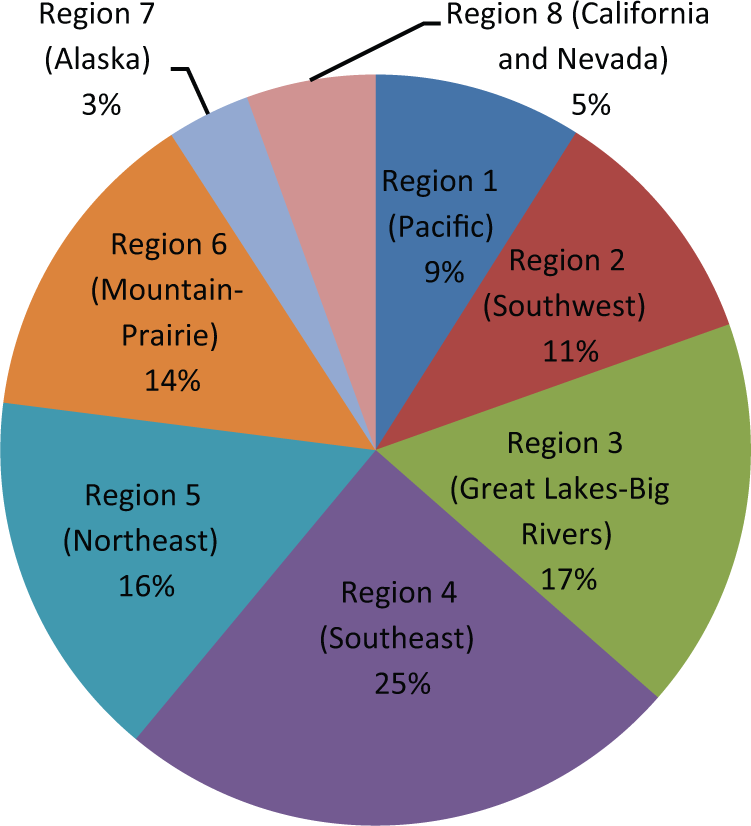
Survey response by U.S. Fish and Wildlife Service Region.
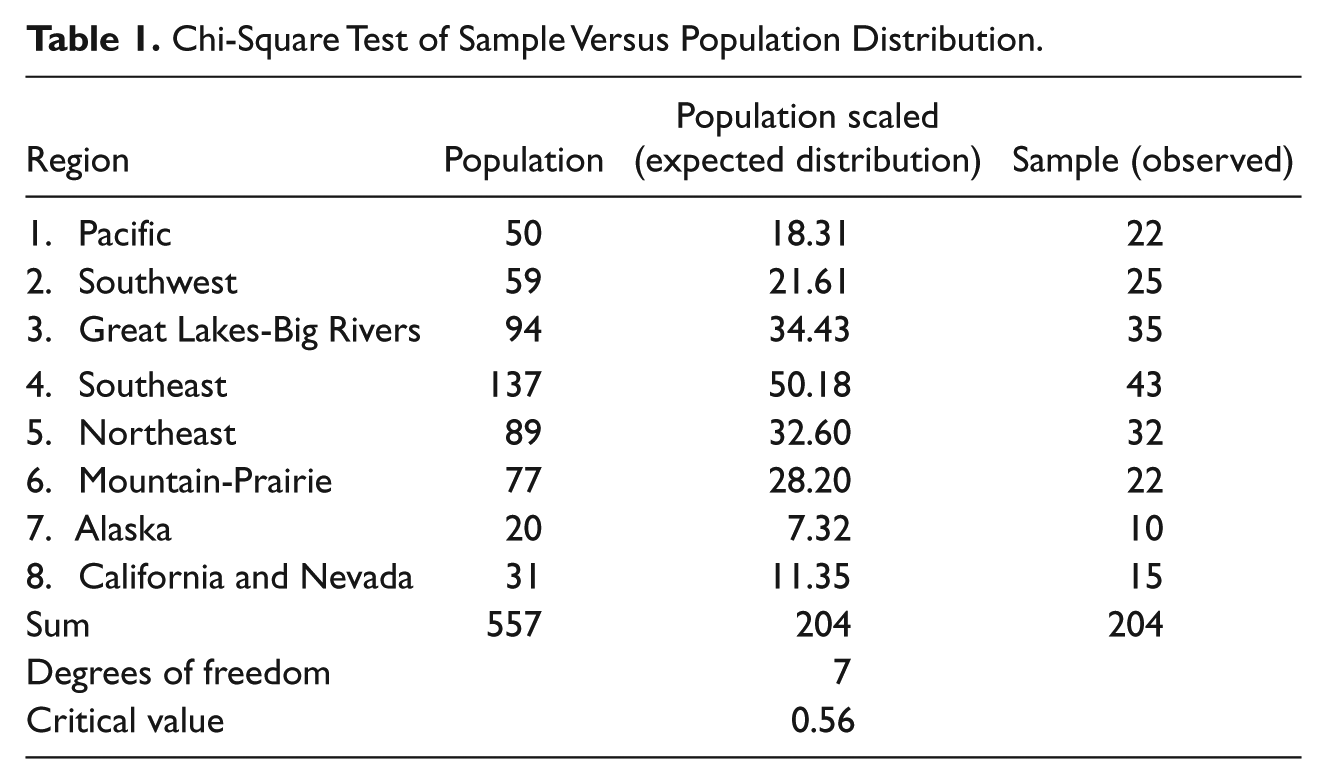
Table 1 illustrates a chi-square goodness of fit test that revealed that the distribution of survey responses by region is not significantly different from what would be expected based on the actual distribution of field offices surveyed by region (p = .56).
Chi-Square Test of Sample Versus Population Distribution.
Measures
The survey instrument was constructed based on consultation with USFWS professionals, review of the NBII database, and a small pilot study (Gerlach, 2005; NBII, 2011). The pilot study asked 55 faculty members within the College of Natural Resources at North Carolina State University to comment on variable measures and survey flow. The main purpose of the pilot study was to assure face and content validity. For the purposes of this study, we collected data on a total of three dependent and eight independent variables. We also used one control variable to account for regional differences in USFWS field office decision making.
Dependent variables
We assessed data selection by asking respondents to rate the frequency with which they use federal, state or local, and nongovernmental data sources. We asked the following question:
“When selecting data, how frequently does your field office use the following data sources in making biodiversity management decisions?”
Respondents were presented with a 7-point scale (1 = never, 2 = rarely, 3 = annually, 4 = quarterly, 5 = monthly, 6 = weekly, and 7 = daily) and asked to answer for each data source. This question measured our data selection–dependent variables: federal data frequency of use, state or local data frequency of use, and nongovernmental data frequency of use. We initially measured the importance level that respondents attach to each of the data sources as well. However, there was very little variance in the responses for each data source, and an initial review of the data collected provided us with ample confidence that frequency of use reflects actual data selection more accurately than perception of importance. Importance levels appear biased upward, as it stands to reason that USFWS professionals may attach greater importance to federal data, even if they do not select it for use as often as other sources.
As our dependent variables are ordinal measures of data frequency, traditional ordinary least squares (OLS) regression models are inappropriate because the values reflect a ranking and thus cannot be treated as equivalent to interval measures (Kennedy, 2003). One alternative is to dichotomize the measure so that we estimate a logit or probit regression. Unfortunately, this approach wastes a great deal of information and masks the variation in data frequency that we seek to explain. Instead, we estimate ordered logit models for each level of data. One potential difficulty is that the original survey measures offer very little variation at the lower levels of usage (i.e., never, rarely, annually, quarterly). Table 2 provides frequency distributions for each of the three dependent variables.
Distribution of Frequency of Federal, State/Local, and Nongovernmental Data Usage.
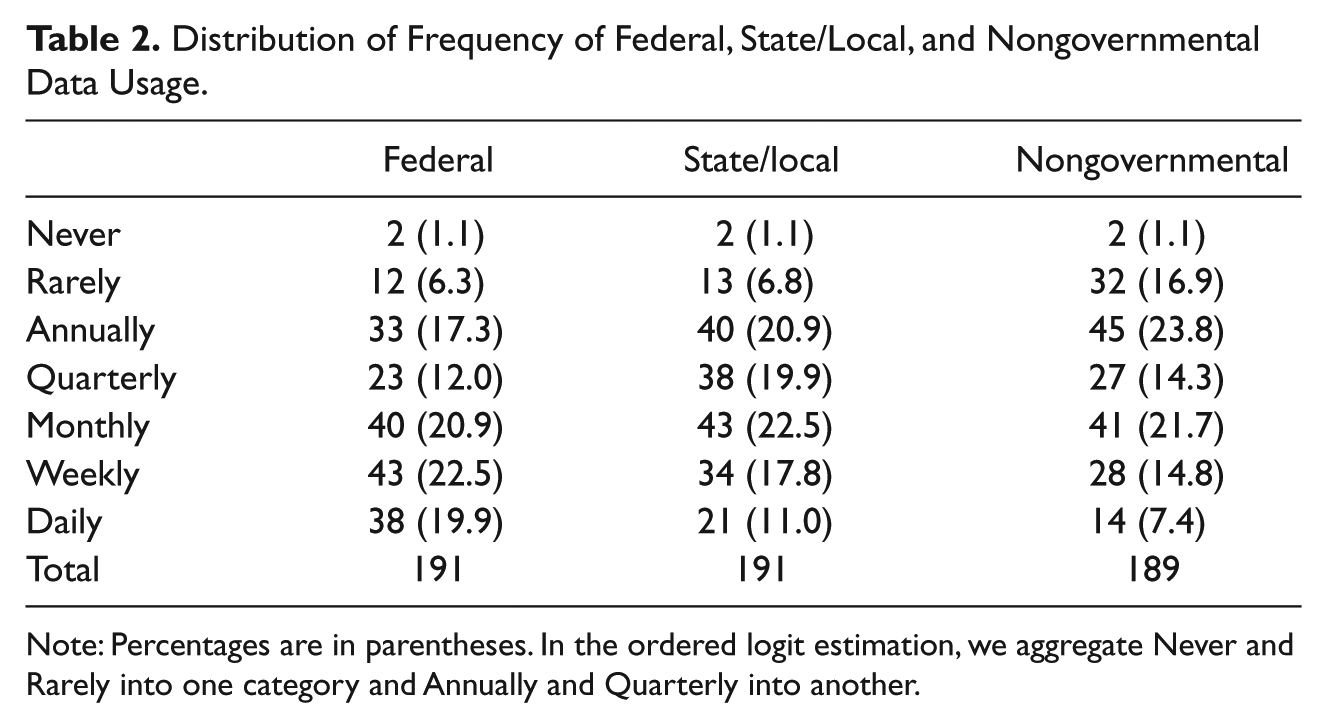
Note: Percentages are in parentheses. In the ordered logit estimation, we aggregate Never and Rarely into one category and Annually and Quarterly into another.
The lack of variation at lower levels would increase the difficulty of retrieving estimates for these parameters. We therefore transform the original measure so that “never” and “rarely” are in one category and “annually” and “quarterly” are in another category. This maintains the value of ordered responses while still allowing us to explain the more frequent uses of data, which is of greater theoretical importance for this project.
Independent variables
To test our three hypotheses, we assessed collaboration with other field offices, agencies, or organizations when making biodiversity management decisions as well as field office perception of gain related to data selection and past experiences using data from the three sources. Collaboration variables (information exchange with other USFWS field offices, information exchange with other federal agencies, information exchange with state or local agencies, and information exchange with nongovernmental organizations) were measured by the following item:
“How important is the exchange of information relevant to making biodiversity management decisions with the following?”
Respondents were asked to answer on a 10-point scale where 1 = very unimportant and 10 = very important for each of the four collaboration variables. These collaboration variables were used to assess the potential effect of normative isomorphism on data selection.
To study the potential effect of coercive isomorphism on data selection, we used the variable parent agency influence, which was measured by the following item:
“Which of the following choices makes this statement most true? ‘My office receives additional resources (funding, information technology capabilities, staffing) from the U.S. Fish and Wildlife Service for using ______ in making biodiversity management decisions.’”
Responses were rated on a 5-point scale (1 = federal data, 2 = state or local data, 3 = nongovernmental data, 4 = a combination of the above, and 5 = doesn’t make a difference). We created three dummy variables based on whether the parent agency influences the use of those data. For example, the federal parent agency influence is coded “1” if the respondent selects either federal data (1) or a combination (4), and “0” otherwise.
The neo-institutional theory tenet of path dependency was assessed by measuring USFWS field offices’ perceptions of past experiences using federal, state or local, and nongovernmental data when making biodiversity management decisions. To measure the variables past federal data use experiences, past state or local data use experiences, and past nongovernmental data use experiences, we used the following survey item:
“On average, my field office has had positive experiences using the following data sources in making biodiversity management decisions.”
Respondents were asked to respond for each of the three experience variables on a 5-point scale (1 = strongly disagree, 2 = disagree, 3 = neutral, 4 = agree, and 5 = strongly agree). This 5-point scale is recommended by Patten (2001) for this type of survey question structure.
Controlling for region
Some regional differences among USFWS field offices exist in the types of ground-level policy decisions with which they are faced and the species and habitats they are charged with managing (Gerlach, 2005; USFWS, 2011). It is also possible that these differences may occur as a result of various spatial diffusion patterns across regions (Strang & Meyer, 1993). However, our primary reason for examining a regional control variable revolves around the fact that species and habitat needs vary across the United States, as do biodiversity management needs (USFWS, 2011). These variations have the potential to affect data selection. To account for the potential influence of these regional differences, we assessed service region via the following survey item:
“To which region of the U.S. Fish and Wildlife Service does your field office belong?”
Respondents were asked to select from the eight regions of the agency (Pacific, Southwest, Great Lakes-Big Rivers, Southeast, Northeast, Mountain-Prairie, Alaska, and California-Nevada). Region names are set by the USFWS (USFWS, 2011). To control for the possibility that some regions use data sources in a manner unexplained by our model, we estimate each ordered logit with dichotomous variables representing each region (California-Nevada serves as the reference category). Although this is not the ideal test of the spatial diffusion theory, we will be able to shed light on two empirical patterns that are consistent with spatial diffusion patterns. First, we may observe that some regions use one or the other data source at a much higher or lower rate than other regions. This would be consistent with data usage diffusing at the subregional level. Second, if the regions use the different data sources in a geographical cluster, then it would lend greater support for the diffusion of these data-selection choices. For example, if the Pacific, California-Nevada, and Southwest regions were all more or less prone to using one data source over another, this would be consistent with a spatial diffusion pattern across regions.
We provide the summary statistics for all these variables in Table 3.
Summary Statistics.
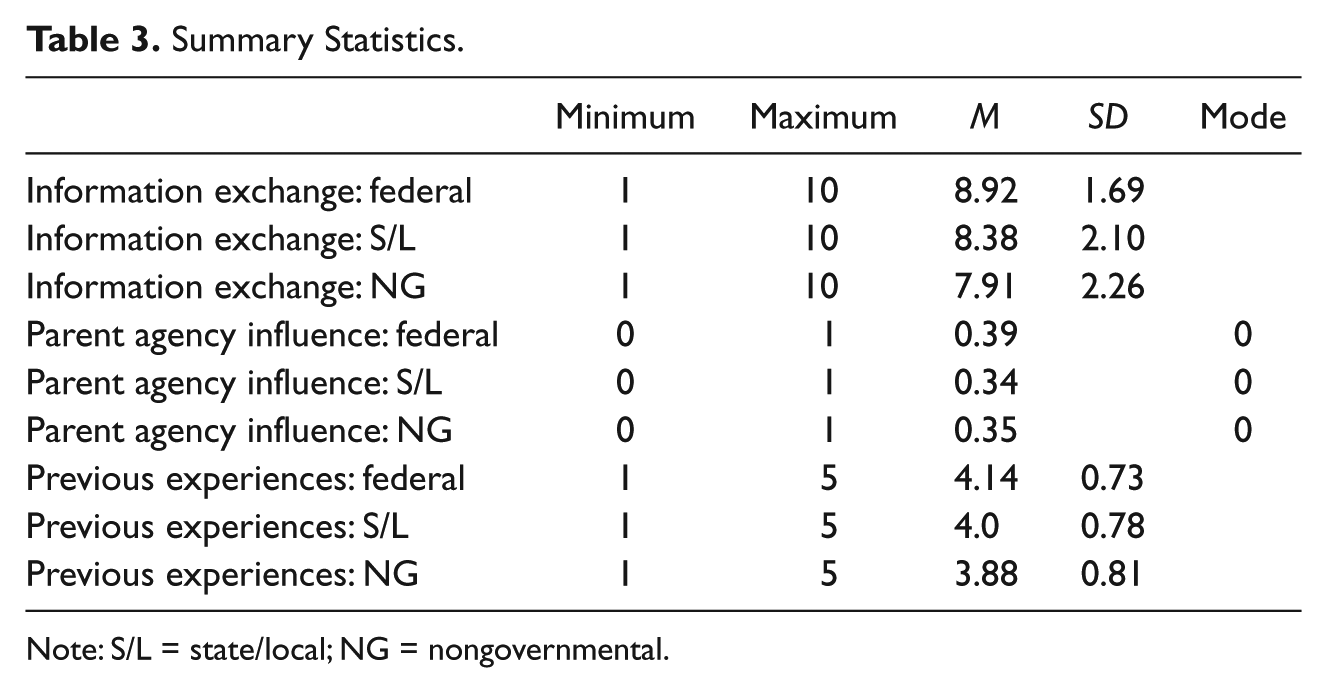
Note: S/L = state/local; NG = nongovernmental.
Statistical Analysis
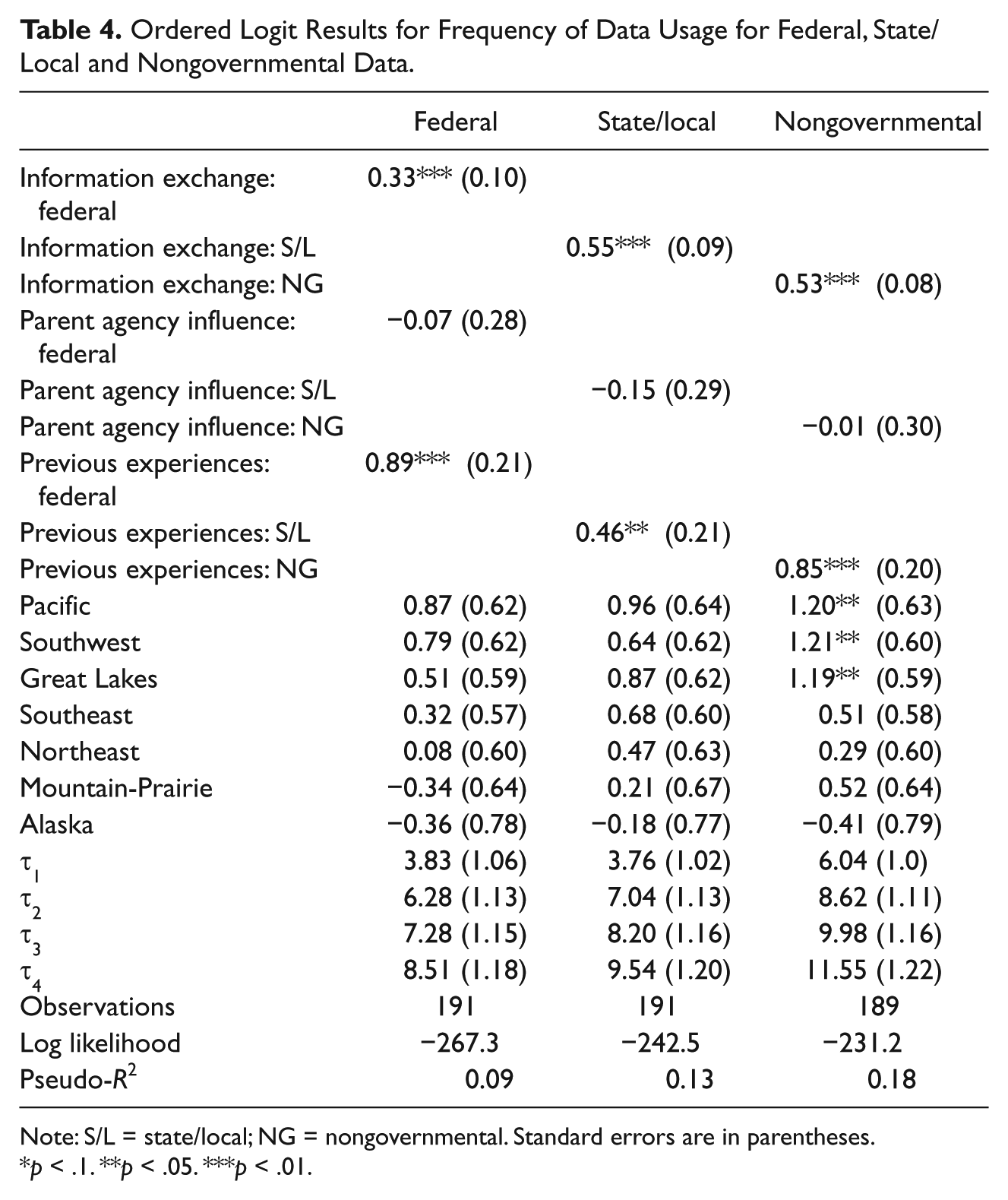
We theorize that biodiversity management decisions are made in a number of ways that reflect neo-institutional theory. Our data set provides a unique opportunity to assess the validity of each of these theories in terms of the frequency of data usage. Table 4 provides the ordered logit models that test all three hypotheses for the usage frequency of each of the three data sources: federal data, state or local data, and nongovernmental data.
Ordered Logit Results for Frequency of Data Usage for Federal, State/Local and Nongovernmental Data.
Note: S/L = state/local; NG = nongovernmental. Standard errors are in parentheses.
p < .1. **p < .05. ***p < .01.
We should first note that the pseudo-R2 is largest in the nongovernmental model, indicating that these three theories explain the usage of nongovernmental data better than either federal or state/local data. One potential explanation is that nongovernmental data are on the outside of the governmental process in many ways, whereas federal and state or local data are collected by government agencies and may be more routinely recognized by field offices. Thus, our theories that deal with acceptability, usage incentives, and previous positive experiences are potentially more explanatory of nongovernmental data selection, the less established source.
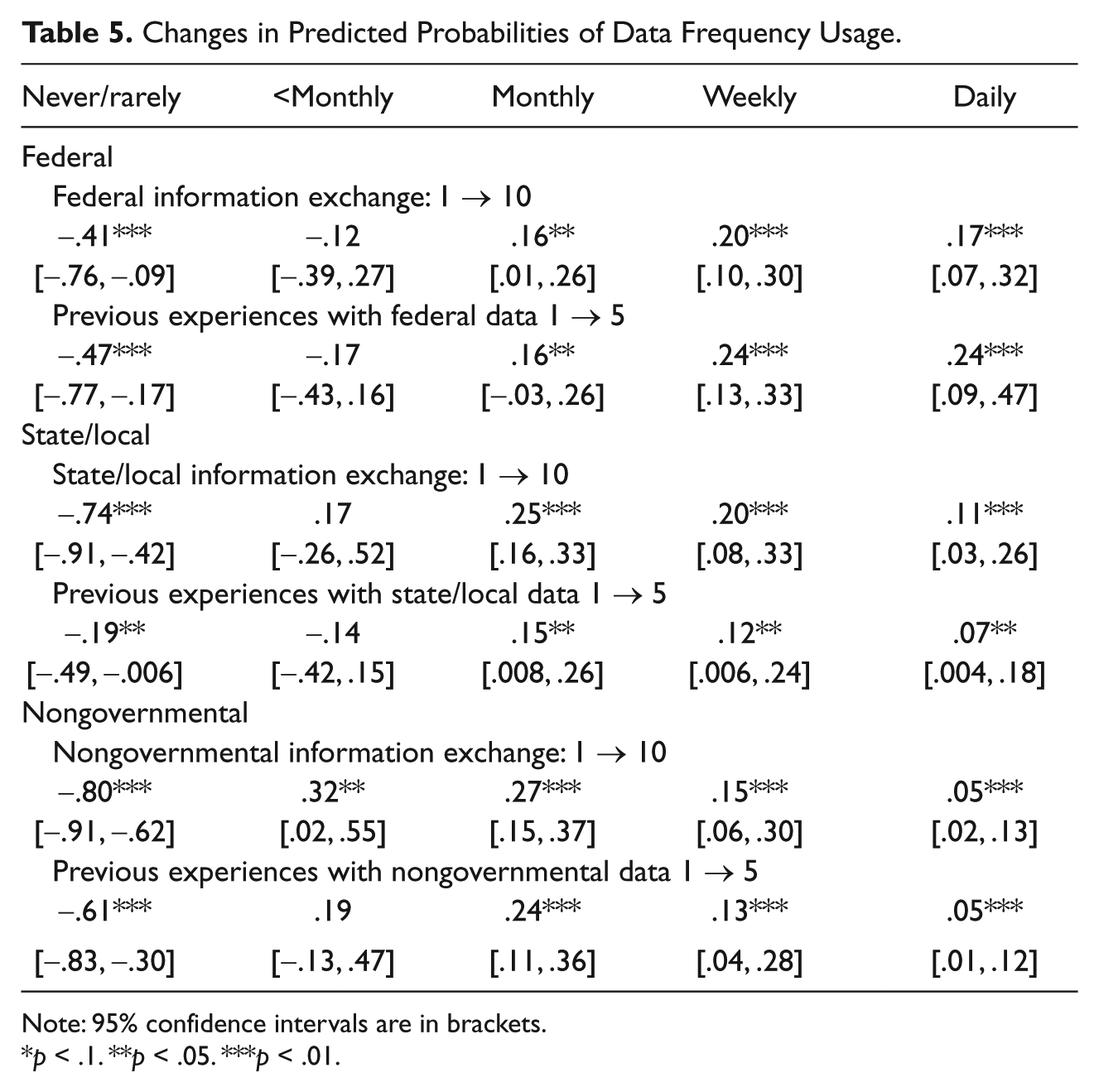
We will examine how each hypothesis fares in turn. Our first hypothesis states that collaborating with agencies or organizations through information exchange encourages the selection of those data sources. We find strong support for this theory, as increasing the importance of information exchange is positively (and statistically significantly) related with the frequency of using that data source in all three models. Although the coefficients themselves are useful in determining the direction of the relationship, it is much more helpful to calculate the predicted probabilities of choosing each of the five outcomes for data frequency. In Table 5, we provide the change in predicted probabilities of each outcome (and 95% confidence intervals) as we vary the independent variable of interest (King, Tomz, & Wittenberg, 2000). 1
Changes in Predicted Probabilities of Data Frequency Usage.
Note: 95% confidence intervals are in brackets.
p < .1. **p < .05. ***p < .01.
For example, varying the information exchange with federal agencies variable from 1 (extremely unimportant) to 10 (extremely important) decreases the probability of the respondent choosing never/rarely by .41 (a change that is statistically significant at the 95% confidence level) and increases the probability of the respondent choosing daily by .17 (also statistically significant). Perhaps a better way of demonstrating these substantive effects is with Figure 2, which shows how the probability of choosing each outcome changes across the range of values of information exchange with federal agencies.

Frequency of federal data usage across values of importance of federal data exchange.
As field offices consider federal data exchange more important, they are much more likely to use those data sources often. For example, if one considers federal information exchange as unimportant, then that field office will most likely use federal data on a less-than-monthly basis.
Collaboration with state or local and nongovernmental agencies or organizations also influences the selection of those sources, as shown in the state/local and nongovernmental models in Table 4. As a field office increases its importance of state/local information exchange from very unimportant to very important (a change from 1-10), the probability that they will never or rarely use state/local data drops by .74. Understandably, the field office becomes more likely to be regular users of state/local data. We observe a similar pattern with the importance of nongovernmental information exchange. Indeed, increasing collaboration with all three data sources from 1 to 10 increases the probability of frequent use of those data sources.
Our second hypothesis flows from the notion of coercive isomorphism or that the data sources that gain the favor of agency headquarters will encourage the frequent selection of those sources. We find no support for this hypothesis, as the parent agency influence variable fails to reach conventional levels of statistical significance in all three models. This suggests that parent agencies are largely ineffective in pressuring field offices to select certain sources of data. With specific regard to our study, we find no evidence that USFWS headquarters influences field office data selection through the assurance of additional resources.
Our final hypothesis is that biodiversity management decisions exhibit a great deal of path dependency and that previous positive experiences with using data sources increases the frequency of using those data. We find that this is the case with all three data sources. The coefficients for past federal data use experiences (federal model), past state/local data use experiences (state/local model), and past nongovernmental data use experiences (nongovernmental model) are positive and statistically significant. Table 5 shows that having more positive previous experiences with federal, state/local, and nongovernmental data increases the probability of selecting those specific data sources. Figure 3 paints a more complete picture of the substantive effects of path dependency, showing the probability of selecting each outcome for nongovernmental data selection (nongovernmental model) across values of past nongovernmental data use experiences. If the respondent strongly disagrees with having positive past experiences, then the most likely choice is either never/rarely or less than monthly. However, as previous experiences become more favorable, respondents become more likely to use those data more frequently (monthly or weekly).
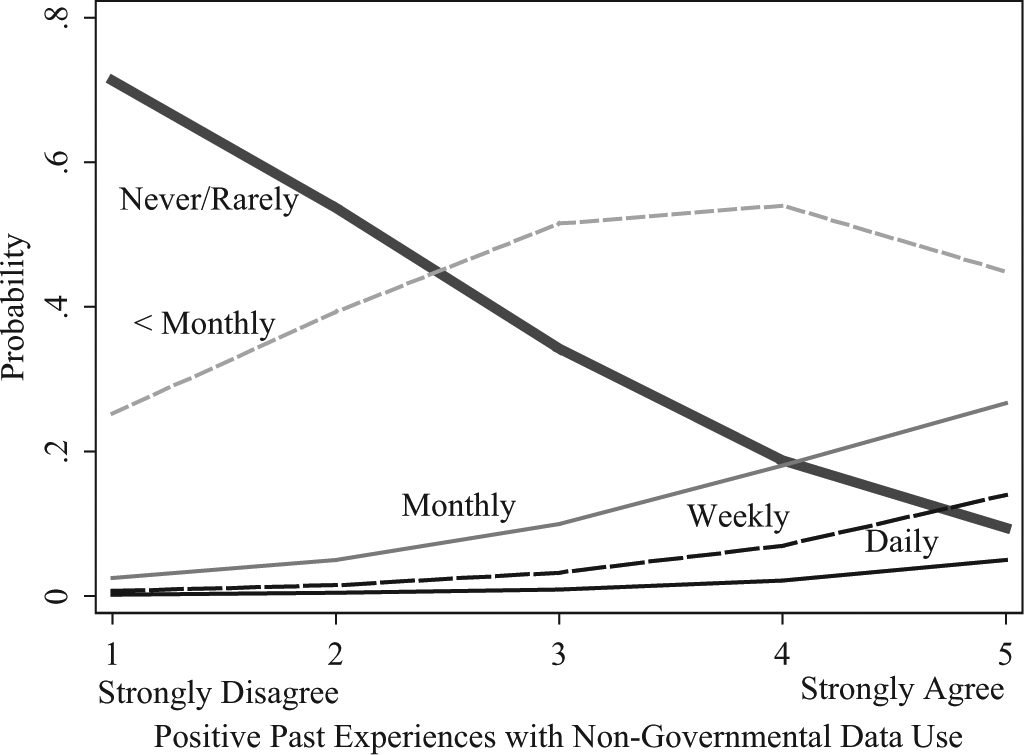
Frequency of nongovernmental data usage across values of past nongovernmental data use experiences.
It is also important to note that we included regional dummy variables in each model to control for (a) variations in data needs across regions and (b) the possibility that diffusion patterns may cause some regions to exhibit different data-selection procedures. For the federal and state/local models, none of the regional dummy variables are statistically significant, indicating that there are no unobserved differences at the regional level. This would suggest that there are no spatial patterns of diffusion for these data sources. The selection of nongovernmental data, however, exhibits some important cross-regional variation. The coefficients for Pacific, Southwest, and Great Lakes regions are statistically significant and positive, indicating that the field offices in those regions are statistically more likely to frequently use nongovernmental data than the excluded category, California–Nevada. Indeed, field offices in the California–Nevada region are statistically less likely to use nongovernmental data monthly (.17), weekly (.07), or daily (.02) than either the Pacific (.30, .16, and .06, respectively), Southwest (.30, .17, .06, respectively), or Great Lakes (.30, .16, and .06, respectively). These regional differences raise the possibility that there are subregional spatial diffusion patterns, although the dispersed locations of the three most supportive regions cast doubt on clear patterns of diffusion across regions.
Discussion
Best available is the desired standard for the use of science in making U.S. environmental and natural resource policies (Endangered Species Act, 2011; Magnuson-Stevens Fishery Conservation and Management Act, 2011; Sullivan et al., 2006; USEPA, 1997). However, this standard has been called into question for its inherent ambiguity and lack of a uniform definition (Bisbal, 2002; M. W. Meyer, 1998; Mills et al., 2009; Ryder et al., 2010; Sullivan et al., 2006). Intuitively, any misunderstanding regarding what does and does not constitute best available science threatens the practical application of the standard. Such misunderstandings seem easy on which to stumble, especially given the abundance of biological information available to biologists, managers, and policy makers (NBII, 2011). We hypothesize that the term best available science is less meaningful than is commonly perceived. Either best available science rationales are similar to, if not the same as, neo-institutional rationales, or neo-institutional theory is sufficient in explaining data-selection practices regardless of the standard of best available science and the lofty ideals it embodies.
This study tested the salience of neo-institutional theory in explaining data-selection decisions in the biodiversity management decision-making process. In so doing, we empirically proved the worth of two tenets of the theory with regard to more fully understanding why data are selected to inform biodiversity management decisions. Normative isomorphism and path dependency, in part, explain data selection. However, we found no evidence that coercive isomorphism has explanatory value.
J. W. Meyer and Scott (1992) advanced the theory that normative isomorphism may occur when an entity within a particular community perceives that established decision-making practices have been sociologically sanctioned as successful. We found evidence of this theory at play in data-selection practices in all three models (see Table 5). Ground-level natural resource policy making is increasingly characterized by collaboration with other natural resource agencies and organizations (Brunner et al., 2005; Thomas, 2003). We found this collaboration, or exchange of information when making biodiversity management decisions, to be a significant factor in the selection of a data source for use in the decision-making process. This finding indicates that fellow collaborators may influence data-selection decisions of USFWS field offices by recommending a successful data source. Although it is entirely possible that this data source contains a best available data set as perceived by the collaborator, this finding calls into question the very process by which a field office identifies best available science for the purposes of making its own biodiversity management decisions. Is best available science determined by the individual field office for use in making a particular biodiversity management decision, or is it simply what other agencies, organizations, or offices perceive to be successful?
Perhaps the most impactful finding of this study is that path dependency plays a significant and pronounced role in USFWS field office data selection. Our findings support previous findings related to path dependency (Pierson, 2000; Pierson & Skocpol, 2002) and repetitive momentum (Baum, 1996). We find that previous positive experiences using data from federal sources increase the probability of using federal data when making biodiversity management decisions (see Table 5, Model 1). This study produced similar findings related to previous positive experiences using nongovernmental data sources and the use of nongovernmental data for decision making (see Table 5, Model 3 and Figure 3). These findings indicate that the use of data from federal and nongovernmental sources is path dependent. This path dependency may describe how perceived best available science is identified. However, this perception and repeated selection certainly calls into question the process by which best available science is not only selected but updated. Although there is comfort in familiarity, we argue the standard of best available science should not solely be based on a sense of intimacy with particular data. Rather, best available should be a fluid term. Path-dependent data selection is institutionalized data selection, and institutionalized norms are difficult with which to part even when a better alternative exists (Pierson & Skocpol, 2002). In the ever-changing field of biological science, a better alternative based on new intellectual advancements often exists. If this better alternative is overlooked due to the path-dependent data-selection practices of natural resource entities, the standard of best available science loses its inherent objective value.
Results of this study suggest that USFWS field offices may “satisfice” with regard to their identification of best available science. Herbert Simon (1947) hypothesized that humans lack the cognitive resources to make the best available choices. Rather, decisions are made based on information that is readily available at the time (Simon, 1947). Simon asserted that decisions are made under heavy limitations—not knowing outcome probabilities, without reliable assessments of history, and so on. This study found that information that is readily available (i.e., perceptions of what is acceptable in the natural resource community, perceptions of parent agency preference, and recollections of positive previous experiences), at the very least, is part of the process by which best available science is identified and selected. It is apparent that field offices associate best available science with a myriad of information sources. This study suggests that a rigorous internal investigation of the quality and appropriateness of data is not the only mechanism by which science becomes best available. Again, it may indeed be easier for field offices to rely on familiarity and institutionalized processes.
Limitations and Future Research
Although this work offers significant insight into the role that neo-institutional theory plays in explaining the selection of best available science in making biodiversity management decisions, it is not without its limitations. This work should not be interpreted as a zero-sum contest between the standard of best available science versus the salience of neo-institutional theory in explaining data selection. We contend the standard of best available science has prominent company in explaining the data-selection process, and neo-institutional theory demands attention as either a proxy for identifying best available science or an alternative explanation of data selection. Although the possibility exists that objective best available science has been institutionalized within USFWS field offices, the likelihood of that being the case is extremely low. Rather, we may be witnessing the institutionalization of the common perception of best available science. A brief scan of the NBII (2011) data portal shows the ever-changing nature of biological data. Updates have the potential to be made available quickly and often. Our contention is that tenets of neo-institutional theory are at play in the data-selection process and may serve as mechanisms by which best available science is identified and perceived. If this is indeed the case, it is problematic in that institutional isomorphism and path dependency do not lend themselves well to the continual objective evaluation of new, updated, and cutting-edge biological data which may be better suited to meet the intended best available science standard.
A second limitation to the study is the measurement of frequency of using data from federal, state or local, and nongovernmental sources. A more in-depth examination would constitute measuring the frequency with which USFWS field offices use individual data sets (found within the three data sources tested). We studied data sources for two reasons. First, the NBII (2011) data portal is easy to split into our three data source categories—federal, state or local, and nongovernmental. Second, the measurement of three dependent variables is preferable to an attempt to pick and choose from hundreds of data sets available for use in making biodiversity management decisions. A more detailed exploration of frequency of data set selection is certainly an area for future research, though we feel confident that our dependent variables allow us to make a substantial contribution to the understanding of the data-selection process and the factors which influence the identification of best available science.
A second very obvious direction for future research is to apply our model for understanding data-selection decisions within the USFWS to other natural resource agencies. The standard of best available science is used by a variety of federal, state, and local environmental or natural resource agencies in making a broad range of policies. This study could be expanded on merely by testing the robustness of our findings across other agencies that deal with similar policy areas and management issues.
A third direction for future research is to fully explore the manners in which data-selection decisions are diffused over time (temporally) and/or across regions (spatially). These results suggest that the use of federal and state/local data resources is not limited to specific regions or broader geographical areas. However, the empirical results identify some regions (Pacific, Southwest, and Great Lakes) as being much more willing to frequently use nongovernmental data than other regions. Although certainly interesting, these results cannot be treated as a definitive test of the spatial diffusion hypothesis because of two constraints. The first constraint is that the cross-sectional nature of the data prevents us from observing diffusion patterns over time. The second constraint is that while an ordered logit can potentially identify patterns of data usage that are more or less consistent with the spatial diffusion hypothesis, we are unable to use the model to make inferences about the process of spatial diffusion. In a future project, we plan on exploring spatial diffusion patterns with empirical techniques (network analysis or spatial econometrics) that are better suited for observations that are spatially connected via geographical proximity.
Conclusion
This study explored the salience of neo-institutional theory in explaining how data are selected for use in making biodiversity management decisions. A major contribution of this research to the literature on natural resource policy and administration as well as the standard of best available science is the empirical confirmation of institutional factors heavily informing the data-selection process. There is a tremendous ongoing discussion of best available science in the scholarly literature (Bisbal, 2002; Francis et al., 2005; M. W. Meyer, 1998; Mills et al., 2009; Ryder et al., 2010; Sullivan et al., 2006). However, this study sought an alternative explanation of the identification and selection of best available science. We found that data-selection decisions within the USFWS appear very path dependent and somewhat isomorphic. Although this work supplied many answers regarding the explanatory value of neo-institutional theory with regard to data selection, it also leaves the door open to further exploration of social science theory into the process. It seems quite clear the standard of best available science is ambiguous. This study contributes a neo-institutional perspective on how best available science is selected and without accounting for the empirical results of our work that selection process cannot be fully understood.
Footnotes
Declaration of Conflicting Interests
The author(s) declared no potential conflicts of interest with respect to the research, authorship, and/or publication of this article.
Funding
The author(s) received no financial support for the research, authorship, and/or publication of this article.