



Abstract
The article presents a framework of nonprofit human resource management (NHRM) that emphasizes the context of nonprofits, organizational and employee characteristics. Drawing on contingency theory and social exchange theory, the article examines the multidimensional contingencies in the environment of nonprofit organizations and the characteristics of employees that underlie NHRM. Three underlying principles and five models of NHRM are presented to explain the dimensions of NHRM. The concept of social alignment, implications for nonprofit management research, and practice are discussed.
Keywords
It is not uncommon for nonprofit organizations (NPOs) to commence operations with volunteers and gradually integrate employees as they evolve in their organizational life cycle (Anheier, Hollerweger, Badelt, & Kendall, 2003). However, the increased economic and social contribution of NPOs coupled with the key drivers of change in their operating environment such as competition and accountability have emphasized the need for nonprofit managers to embrace strategic management to effectively manage human resources (Akingbola, 2006). In fact, managers and academics alike are not only emphasizing the importance of strategy but they are also increasingly recognizing the need for strategy to reflect the complex environment of the sector (Akingbola, 2005; Courtney, 2002; Stone, Bigelow, & Crittenden, 1999). This need is perhaps most evident in nonprofit human resource management (NHRM). Research on human resource management (HRM) in NPOs has reinforced nonprofit organizational capacity that emphasizes HR challenges as one of the most problematic issues in NPOs (Hall et al., 2003; Light, 2000; Salamon, 2002). Hence, it is important to understand the underpinnings and the generic types of HR practices that evolve from these factors.
This article draws on contingency theory (Burns & Stalker, 1961; Donaldson, 2001; Lawrence & Lorsch, 1967), social exchange theory (Blau, 1964), and nonprofit management research to develop a framework to explain the context and generic typology of HRM in NPOs. The NHRM framework emphasizes contextual drivers as the critical factors required to understand the environment and HR practices in NPOs. The framework distinguishes five models of NHRM. It suggests that the underlying factors, premises, and practices of NHRM form a distinct stream of HRM research that could further our understanding of how organizational goals, characteristics, and contextual factors drive HR practices.
The article begins with a brief overview of contingency theory—as a dominant perspective scholars have employed to explain the context of HRM—and social exchange theory. This is followed by a review of nonprofit research and literature to examine the important characteristics of NPOs evidenced in the HRM theoretical perspectives. It then discuss the integrative framework starting with key principles that underlie the five proposed models of NHRM. The article concludes with possible opportunity for future research and implications for managers.
Overview of Theoretical Perspectives
The importance of the context of organizations in HRM has been explained from different theoretical perspectives. One common thread in the literature is to focus on the context of organizations or specific aspects of the internal and external environments (Jackson & Schuler, 1995; Jackson, Schuler, & Rivero, 1989). In this brief overview, I highlight contingency theory and introduce social exchange theory as two particularly relevant perspectives for the analysis of NPOs.
Contingency Theory
Contingency theory signifies the shift from the core notion of classical management theory that there is “one best way” to organize (Donaldson, 1995). The contingency approach is premised on the argument that the extent of fit or congruence between contingencies that reflect the environment and the characteristics of the organization such as structure, processes, and practices impact the effectiveness of the organization (Burns & Stalker, 1961; Donaldson, 2001; Lawrence & Lorsch, 1967; Pennings, 1992). The interaction between the organization and the environment is not only important but it also underlies and largely determines many aspects of the organization. In effect, the need to achieve fit between the organization and its external environment is central to contingency theory (Donaldson, 2001; Miles & Snow, 1984).
Contingency, fit, and strategic contribution underlie much of strategic HRM (SHRM) and have continued to frame HRM research (Lengnick-Hall, Lengnick-Hall, Andrade, & Drake, 2009). The basic premise of SHRM is anchored on the critical importance of HR to strategy, organizational capability to adapt to change, and the goals of the organization (Wright & Boswell, 2002; Wright & McMahan, 1992; Wright & Snell, 1998). Wright and McMahan (1992) describe the focus of SHRM as “the pattern of planned human resource deployments and activities intended to enable the firm to achieve its goals” (p. 298). For an organization to be effective, HR practices must be aligned with strategy (Miles & Snow, 1984; Schuler & Jackson, 1987; Wright & Boswell, 2002; Wright, Dunford, & Snell, 2001). As strategy is an indication of the context of an organization and it is through strategy that managers understand the context of events at multiple levels of an organization (Taggar, Sulsky, & MacDonald, 2008), SHRM continuously scans and analyzes the environment through the lens of strategy, to develop and deploy appropriate HR practices to enable the organization to achieve its goals. The conceptualization of fit has evolved in SHRM research over time. In the early days, SHRM literature focused on the relationship between organizational characteristics, contingencies, and how to achieve fit between strategy and HRM practices (Lengnick-Hall et al., 2009). It is suggested that different strategy types align or fit specific HR practices (Miles & Snow, 1984; Schuler & Jackson, 1987). Researchers have added system-level resources such as human and social capital to examine SHRM (Collins & Clark, 2003; Snell, 1999). For extensive discussion of contingency, fit, and SHRM, see Lengnick-Hall et al. (2009), Lengnick-Hall and Lengnick-Hall (1988), and Wright and Snell (1998). This article draws on contingency theory to provide a broad insight into the environment and organizational characteristics that underlie NHRM and the generic models of NHRM.
Social Exchange Theory
Social exchange theory focuses on the obligations that evolve from the relationship between the organization and employees (Gould-Williams & Davies, 2005). Blau (1964) defines social exchange as “favors that create diffuse future obligations, not precisely specified ones, and the nature of the return cannot be bargained about but must be left to the discretion of the one who makes it” (p. 93). At the core of social exchange theory is the norm of reciprocity of action between parties that are not set in any contractual framework to define the form, time, and degree of payback obligation. It is a voluntary reciprocal obligation behavior mediated by trust and gratitude that propels the individual making the gratuitous repayment (Gould-Williams & Davies, 2005).
The social exchange perspective has been employed to explain the relationship between HR practices, trust-in-management, employee commitment, and employee engagement (Eisenberger, Fasolo, & Davis-Lamastro, 1990; Saks, 2006; Settoon, Bennett, & Liden, 1996). This body of research suggests that employees’ commitment and engagement flow from their perception of organizational support and commitment. Employees interpret HR practices as part of organizational actions (Settoon, Bennett, & Liden, 1996), which they draw on to explain the level of commitment of the organization to them (Whitener, 2001). If HR practices convey appreciation, investment in, and recognition of employees by the organization, employees develop social exchange, as opposed to a purely business relationship (Shore & Shore, 1995). What employees perceive in HR practices form part of the basis of the obligation to pay back the organization in terms of commitment.
Both contingency and social exchange theories are important to understand NHRM. The question of fit is important to explain how HR practices evolve from the interaction between the organization and contingency variables, the strategy it adopts to deploy employee skills, behaviors, and how HR systems are managed. Social exchange can further our understanding of the unique relationship between the employee and a NPO. Together with the characteristics of NPOs discussed below, these theories underlie the NHRM framework.
Contextual Drivers of NPOs
NPOs are organizations established primarily to achieve social objectives (Drucker, 1992; Quarter, 1992). One primary characteristic of nonprofits is the “absence of stock and other reflections of proprietorship” (Quarter, 1992, p. 42). Unlike for-profit organizations, the goal of a typical nonprofit is not profit maximization. As there are no owners, nonprofits do not generally distribute profit. At the same time, nonprofits are diverse, they run businesses, provide market and nonmarket services, and facilitate economic development activities (Quarter, Mook, & Armstrong, 2009; Quarter, Mook, & Richmond, 2003). Research has identified the following as four core characteristics that could shape the strategy, structure, and performance of nonprofits: social objectives, multiple stakeholders, importance of government, and multidimensional indicators of effectiveness.
The social objectives at the core of NPOs are embedded in the complexities and values of society. The incorporation of NPOs is a translation of shared values and common concerns in the community to problem-solving activities (Smith & Lipsky, 1993). Similarly, Salamon and Anheier (1998) posit that NPOs are the product of the broader social, political, economic relationships and complex set of historical forces. Hence, the values enshrined in the complex environment are central to what NPOs are all about (Hailey, 2001; Jeavons, 1992). It is therefore imperative for NPOs to fit their structure and practices to the contingency variables that are products of their environment to gain social legitimacy (DiMaggio & Anheier, 1990). Due to the variability of contingency factors, the challenge of attaining a fit at any level of the organization is complex and could extend beyond the fit between strategy and HRM.
NPOs operate in an environment characterized by multiple stakeholders who directly impact and are impacted by the mission, strategy, operation, structure, products, services, and performance of the organization (Herman & Renz, 2004; Quarter et al., 2009; Speckbacher, 2003). Stakeholders are very important to NPOs to the point that these organizations cannot afford to alienate anyone (Courtney, 2002). Stakeholders from employees, volunteers, and board members in the internal environment to clients, government, funding organizations, advocacy groups, and the public in the external environment have varying degrees of expectations and goals for the nonprofit enterprise. The divergence and heterogeneity of expectations and goals imply that performance of NPOs is susceptible to the perception of stakeholders (Herman & Renz, 2004). Drawing on contingency theory (Donaldson, 2001), an organizational performance that signifies fit and is positive for one group of stakeholders could indicate misfit and negative result for another group of stakeholders.
Different types of NPOs have varying levels of interactions with the government. This could range from contracting relationship in public service and partnership in economic development to pipeline for civic engagement. Basically, government is a major stakeholder and core source of revenue for many NPOs (Quarter et al., 2009; K. Scott, 2003). Drawing on contingency theory, Foster and Meinhard (2002) found that NPOs focus more on actions that facilitate raising funds to manage the contingency of government funding rather than to implement cost containment strategy. Other studies have highlighted the importance of government funding as the driver of the adaptive strategy of NPOs (Alexander, 2000; Hall et al., 2003; K. Scott, 2003; Smith & Lipsky, 1993).
A major defining characteristic of NPOs is the lack of a universally accepted measure of organizational performance, particularly one that is similar to the bottom line indicator of performance of for-profit business organizations (Herman & Renz, 2004). As a result, research on NPOs has reminded us that although the bottom line is important, the financial result is not the primary emphasis of the nonprofit enterprise and cannot be an indicator of the effectiveness of the organization (Brown & Yoshioka, 2003; McFarlan, 1999). Instead, it is argued that the essential indicator of performance is the extent to which NPOs achieve their mission (Herman & Renz, 2004; Moore, 2000). One consensus in the literature is that NPO effectiveness is multidimensional and social in nature (Crittenden, 2000; Herman & Renz, 1997, 1999; Weisbrod, 1998). In NPOs, the multidimensional indicators of effectiveness emphasize the importance of contingency theory.
Together, the underlying characteristics suggest that NPOs operate in an environment characterized by diverse contingency variables. Given the complexity of the contingency variables in the environment of NPOs (Crittenden, 2000; Oliver, 1991), the need to achieve congruence with social drivers could be equally if not more important than strategic alignment for NPOs.
NHRM
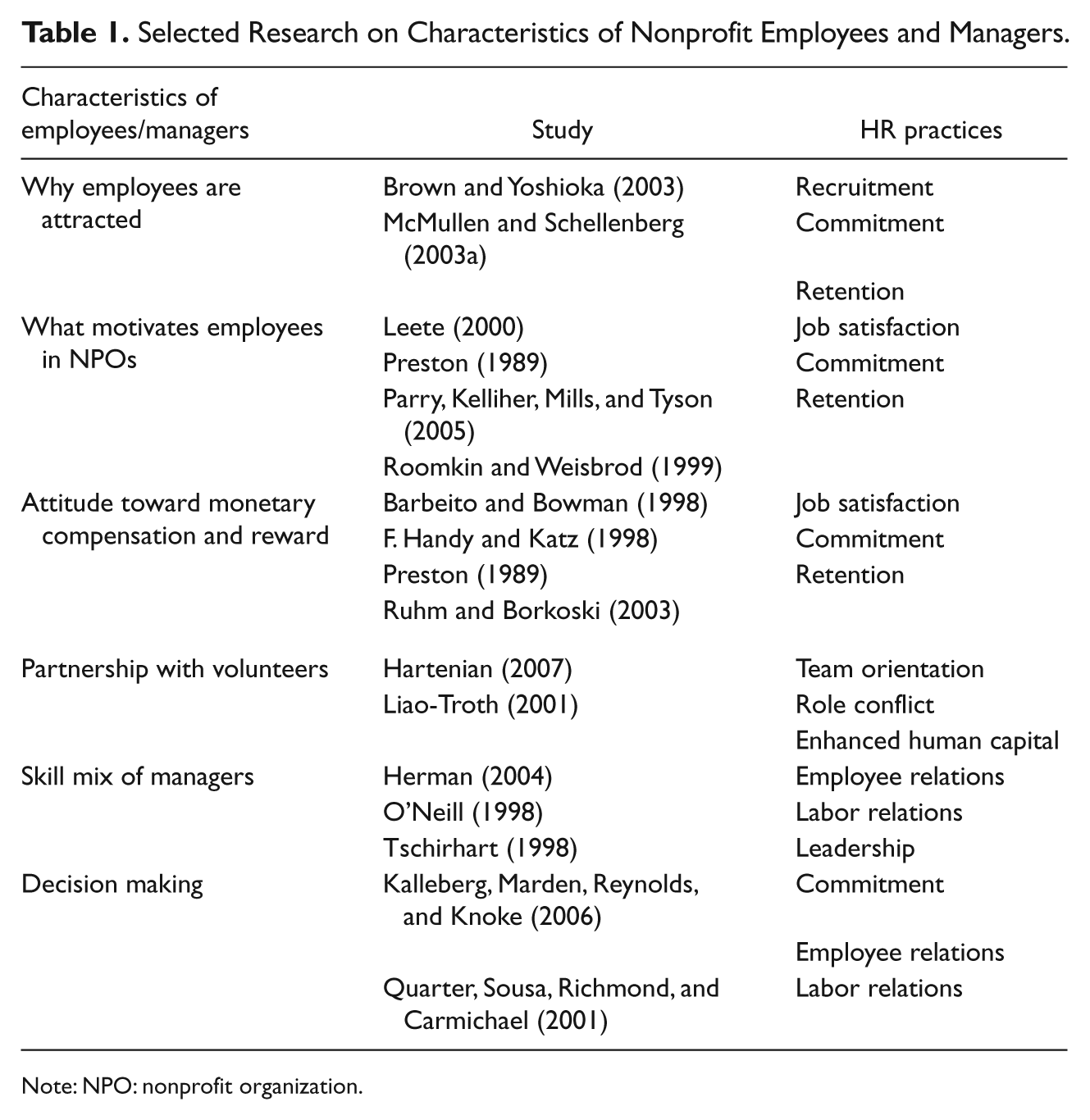
HRM research has demonstrated that the context of organizations affects HRM strategy and practices (Batt, 2000; Jackson et al., 1989). Due to the centrality of social objectives and the labor-intensive nature of the services of nonprofits, the organization cannot substitute human capital with investment in physical capital (Akingbola, 2006). Human capital often constitutes the core asset of the organization (Akingbola, 2006; Barbeito & Bowman, 1998; Light, 2003). Thus, nonprofit research has identified a number of unique characteristics that set employees of NPOs apart from those of other organizations. These characteristics, which are discussed extensively in nonprofit management research, include: why employees are attracted to NPOs and what motivates them; emphasis on nonmonetary compensation and reward; unique skill mix; expectation of egalitarian decision-making process; and partnership with volunteers. Table 1 outlines some relevant research studies that have examined the characteristics of nonprofit employees and managers, and the HR practices or outcomes that could be impacted by the characteristics.
Selected Research on Characteristics of Nonprofit Employees and Managers.
Note: NPO: nonprofit organization.
However, based on the available literature, a systematic framework that explains how the unique characteristics are reflected in NHRM practices is scarce. The recent article by Ridder and McCandless (2010) published during the writing of the article includes some elements of the context of NPOs. Drawing primarily on broad strategic and resource-based theoretical approaches, Ridder and McCandless (2010) proposed an analytical framework that differentiated HRM in NPOs into four types: motivational, administrative, values driven, and strategic. The key assumption of their framework is that HRM is influenced either by different needs and motivations of employees or values, missions, and goals. The strength of their analysis is the attempt to examine strategic orientation, which provides an opportunity to explore specific drivers in the environment of NPOs. However, there are significant limitations in their theoretical framework, conceptualization of HRM, and environment of NPOs.
First, Ridder and McCandless adopted a broad description of strategic orientation that de-emphasized the social and institutional characteristics that underpin the environment of nonprofits. The framework minimizes the complex multidimensional characteristics of nonprofits (Quarter et al., 2009; Weisbrod, 1998). Second, the framework also omitted complex interactions with government and funders not only as external stakeholders but also as the source of revenue. Importantly, the framework is silent on the resource dependence relationship that characterizes nonprofit enterprise. Finally, the framework is also silent on the level of organizational development of nonprofits. This minimizes the life cycle stage of different NPOs.
As a result, the NHRM framework I propose combines contingency and social exchange perspectives to explain critical factors in the environment and the characteristics of NPOs that shape NHRM. Consistent with den Hartog, Boselie, and Paauwe (2004), the framework emphasizes that NHRM consists of multiple foundations with internal and external contingency factors incorporated into each dimension. The factors mediate how NPOs attract, recruit, develop, deploy, motivate, and retain employees.
It is important to note that the NHRM framework is based on some key assumptions. First, it assumes that the NPO is a formal organization with goals, structure, and processes as opposed to an informal organization. Second, it assumes that NPO leaders understand that they are accountable for the development and implementation of strategy, including SHRM, to achieve the mission and goals of the organization. Third, consistent with Wright and Snell (1998), it assumes that the NPO leaders can specify and control all HRM practices of the organization. Finally, it assumes that the HR of the NPO is not entirely constituted by volunteers
NHRM Framework
Figure 1 depicts the NHRM framework. It has the following three levels that are based on the interplay between contingency factors, organizational characteristics, and HR practices of the organization: (1) core foundation, (2) organizational conversion, and (3) NHRM practices and dimensions. The first level, the core foundation, consists of contextual drivers: social origin, government, funding organizations, and multiple stakeholders. These contextual drivers underlie the values, mission, and strategic vision of the organization. They facilitate the translation of shared values into an organization established to solve common concerns in the community. The institutional nature of the contextual drivers ensures that the mission and vision focus more on the social and cultural drivers that support the activities of nonprofits (Baum & Oliver, 1991; Crittenden, 2000). In effect, the core foundation contextual drivers influence the mission and goals of the organization and link directly to the process of strategy formulation (Ansoff, 1984). It is at this level that the fit between the organization and its environment that is central to contingency theory (Donaldson, 2001; Miles & Snow, 1984) is achieved. This level is also the end point of the fit between strategy and HR practices.

Nonprofit human resource management (NHRM) framework.
At Level 2, the organization analyzes the internal environment, external opportunities, and threats. The result is the choice of strategy an organization adopts (Wright & Snell, 1998). The mission and strategic goals defined from the interaction with contextual drivers also assess the internal environment such as employee and organizational characteristics to identify strengths and weaknesses. Organizational characteristics, including stage in life cycle and size, are important determinants of strengths and weaknesses. For example, small NPOs are unable to compete with large and older organizations and have less resources to draw on (Baum, 1994; Hager & Galaskiewicz, 2000; Hager, Galaskiewicz, Bielefeld, & Pins, 1996; Tucker, Baum, & Singh, 1992). However as noted above, human capital is often the core asset of nonprofits. As a result, the skills and behaviors of employees are critical. Employees are attracted to the organization and motivated to contribute to the achievement of organizational goals through the opportunity for social exchange. As explained below, this is a vital ingredient in NHRM. Thus, the SHRM perspective that emphasizes the need for strategy to fit with three generic conceptual variables—HRM practices, employee skills, and employee behaviors (Wright & Snell, 1998)—is particularly relevant in NHRM.
Level 3 is the outcome of Levels 1 and 2 in the sense that HR practices evolve from the management processes for linking NPO environment to the strategic goals, organizational and employee characteristics. The HR practices that result will reflect employee characteristics, including skills and behavioral repertoires as well as the mediating drivers, that make up the core foundation of the organization. Consistent with Jackson and Schuler (1995), NPO leaders characterize and interpret their environment to create mission, prioritize organizational objectives, and develop HR practices. However, the multidimensional contingencies of NPOs and the characteristics of employees suggest that leaders require different levels of analysis and systems thinking to shape and deploy HR practices. NPO leaders and managers must plan, coordinate, and integrate value-adding activities and NHRM practices that are products of the context and characteristics of the organization. The practices are captured in the NHRM models that emphasize the unique relationship between contingency variables and NPOs. Before presenting the specific NHRM models in the framework and the relevant research, the next section discusses the guiding principles that underlie the framework and its models. In line with the contingency factors and organizational characteristics of nonprofits discussed above, the guiding principles are the overarching assumptions about options on values, approaches, interactions, and outcomes the management and/or the board of directors of a nonprofit may emphasize in the design of their NHRM system.
Principle 1: NHRM Consists of Four Dimensions Each of Which Is Interrelated; the Dimensions Are Social Exchange, Strategic, Nonstrategic, and Informal
Social exchange dimension
NHRM is characterized by nested social exchange. Drawing on the empirical evidence of the link between social objectives, values and why employees are attracted, motivated, and committed to the goals of NPOs (Brown & Yoshioka, 2003; Parry, Kelliher, Mills, & Tyson, 2005; Roomkin & Weisbrod, 1999), I posit that NPOs operate in a system of nested exchange between employees and the organization. The two traditional forms of exchange, economic and social, are nested in a third exchange that derives from the social objectives, values, and the environment of NPOs. Economic exchange in employment relationship is characterized by the contractual exchange of extrinsic reward such as compensation and benefits for labor (Aryee, Budhwar, & Chen, 2002). According to social exchange theory, social exchange relationship is developed when the organization cares for, respects, and treats employees fairly, which in turn creates a reciprocal personal obligation for the employee to remain with, trust the organization, perform at a higher level, and exercise organizational citizenship behaviors (Blau, 1964; Cropanzano & Mitchell, 2005; Gould-Williams & Davies, 2005).
NPOs are further embedded in a nested social exchange that requires social and strategic alignment to achieve organizational goals. NPO leaders must characterize and interpret their environment first to create social alignment between the environment, mission, values, and organizational objectives. At the organizational level, social alignment is the outcome of the nested social exchange between the organization, institutional forces, stakeholders, and funding organizations. It emphasizes the importance of institutions, social forces, and social origin in the formulation of the goals of NPOs (Salamon & Anheier, 1998). NPOs must align social and strategic goals to facilitate organizational effectiveness.
In the NHRM domain, social alignment is the outcome of the relationship between the NPO’s inherent organizational culture, roles, opportunity for civic engagement, and employee characteristics. This underlies the distinct employee expectations, motivation, commitment, and organizational citizenship behaviors. In other words, the social objectives and values foster a system of built-in social exchange between employees and NPOs. Based on the social goals and values of NPOs, employees expect egalitarian policies and practices, a work environment that actualize their values and opportunity to contribute to social causes (Berry, Broadbent, & Otley, 1995; Quarter, Sousa, Richmond, & Carmichael, 2001; Schepers et al., 2005). This is the root of the social exchange dimension of NHRM. In the social exchange dimension, social objectives, values, and the employee characteristics drive NHRM. NHRM practices are developed and implemented with social objectives, values, and opportunity for civic engagement as core drivers to induce high performance and commitment behaviors. In the social exchange dimension, the “fit” between employees and the values and social objectives of the NPO is as important if not more important than the job skills (Meinhard, 2006). Consequently, one would expect a positive relationship between the degree of social alignment and level of HRM as depicted in Figure 2. Social alignment incorporates strategic drivers to shape NHRM practices and indicators such as turnover, team orientation, and employee engagement.
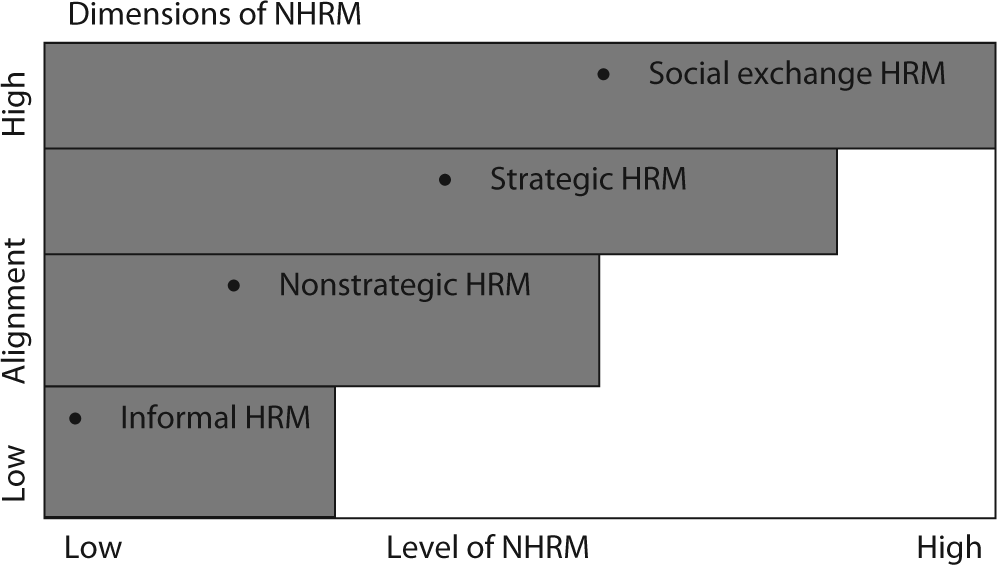
Dimensions of NHRM.
Strategic dimension
Strategy builds on the social alignment created through social exchange to further align the mission, values, and organizational characteristics with the external environment for competitive advantage (Wright & McMahan, 1992). In this dimension, NHRM is based on internal and external fits, and the ability to adapt to change (de Pablos, 2005). However, the highest level of alignment can only be achieved if the strategic dimension incorporates social alignment, as indicated in Figure 2. Drawing on Brockbank (1999), the NHRM strategic dimension may also include operational reactive and proactive practices that enable the organization to manage resource dependence and institutional factors such as funding and government policy. How NPOs attract, recruit, deploy, motivate, and retain employees is a critical aspect of the strategic adaptive behavior, which incorporates contextual drivers and organizational characteristics. NHRM practices are consistent with strategic choices (Miles & Snow, 1984) and could include components of other dimensions.
Nonstrategic dimension: In the nonstrategic dimension, NHRM practices are determined mainly by institutional and resource dependence factors
Drawing on Wright and McMahan (1992), institutional forces, such as government employment legislations, accreditation standards, HR practices of other NPOs or for-profit organizations, and institutionalized social objectives, determine the NHRM practices. NHRM is one of the outcomes of the process through which NPOs gain legitimacy from the institutionalized environment. Similarly, power and politics of resource dependence especially with government and funding organizations influence NHRM practices. Funding organizations often include specific HR practices such as training in the requirements for funding (Akingbola, 2004; Hall et al., 2003). The focus for NPOs in this dimension is to ensure that NHRM practices, including compensation and training, are amenable to the resource dependence dynamics and expectations of powerful stakeholders. As depicted in Figure 2, alignment and level of HRM are lower. NHRM practices are largely unplanned and inconsistent due to the changing impulse of resource providers, for example, when employees are recruited on contingent basis.
Informal dimension
NHRM is either nonexistent or mainly operating at the most basic level. In this dimension, NHRM is not explicitly recognized as a function of management in the organization. The informal dimension is also characterized by the absence of policies, guidelines, and systems to facilitate NHRM practices and processes. Any semblance of NHRM will focus on the individual and personal relationship without clear delineation between work and private activities (Pichault & Schoenaers, 2003). In the informal dimension, it is difficult to make a distinction between an employer and employee often because of the size of the organization (HR Council for the Voluntary & Non-profit Sector, 2008).
Principle 2: Organizational Characteristics Are Important to Understand Variation in NHRM Practices
NPOs vary in terms of their organizational development and life cycle processes (Chambre, 1997; Chambré & Fatt, 2002; Nitterhouse, 1997). As a result, the determinants of life cycle particularly age, size, and professional staff—the use of paid staff as opposed to volunteers—impact NHRM practices. Although NPOs are different in their goals, legal structure, funding, tax status, and performance indicators (Kreutzer, 2009), progression through stages in their life cycle requires these organizations to overcome at a minimum, one challenge that is similar to for-profit organizations. As noted above, new and small NPOs are unable to compete with large and older organizations and have less resources to draw on (Baum, 1994; Hager et al., 1996; Hager & Galaskiewicz, 2000; Tucker et al., 1992). Consequently, new and small NPOs with less professional staff may have low-level NHRM practices and low social and strategic alignment, as depicted in Figure 2. Conversely, older and large NPOs may have more resources and be better positioned to achieve social and strategic alignment in their NHRM practices. For example, recruitment practices may incorporate components of social, strategic, and employee characteristics. In addition, compensation and training may be aligned with social and strategic drivers in older and large NPOs than in smaller ones.
Principle 3: The Indicators of NHRM Effectiveness Have Multiple Dimensions and Include Employee Social Engagement
Consistent with the multidimensional character of NPO effectiveness (Crittenden, 2000; Herman & Renz, 1997, 1999; Weisbrod, 1998), the indicators of NHRM effectiveness are multidimensional. Similar to Jackson and Schuler (1995), the NHRM framework is based on the premise that organizational effectiveness in the context of NPOs includes societal- and organizational-level outcomes. In addition, NHRM framework incorporates employee social engagement. Objective and perceptual measures of service performance such as number of clients served, client satisfaction, and the extent to which service goals are achieved coupled with management outcomes of the financial health of the organization (Sowa, Selden, & Sandfort, 2004) are components of NHRM organizational and societal outcomes. Employee social engagement synthesizes management and individual outcomes such as employee turnover, commitment, satisfaction, and performance. In addition, and most important, it also includes employees’ perception of how they contribute to social objectives through the organization, and the ability of the organization to attract new employees through its mission and values. The employee social engagement indicators differentiate NHRM in the sense that employees perceive the social objectives of the organization as part of their personal objectives. Effectiveness at this level links the organizational, societal, and employees’ outcomes through a system of social exchange. NPOs will differ in terms of what measure they focus on to determine NHRM effectiveness based on the level of HRM and organizational characteristics. For example, a human service NPO in health care may emphasize organizational effectiveness and employee social engagement outcomes to showcase how employees contribute to public good beyond their job, whereas a new NPO in community service may focus on attraction and retention as key HRM indicators.
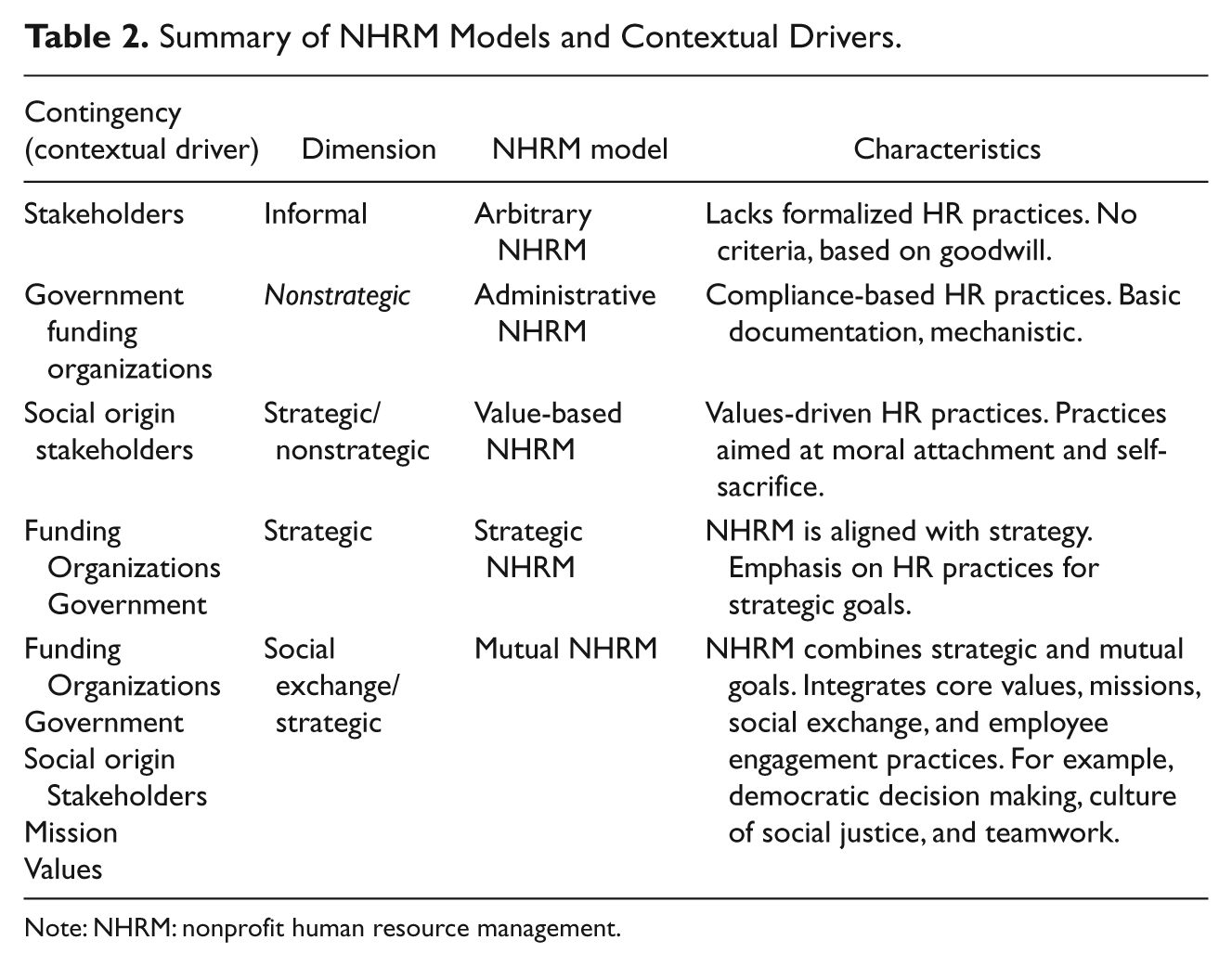
In sum, the three guiding principles emphasize the contexts that give rise to options in terms of the level of HRM. Drawing on contingency theory (Donaldson, 2001; Lawrence & Lorsch, 1967) and social exchange (Blau, 1964; Gould-Williams & Davies, 2005), the effects of the contextual factors and processes are the basis of HR principles and practices. The NHRM models are upshot of the organization’s context, characteristics, and social exchange interaction. The principles are interrelated and reflect the multidimensional characteristics of NPOs. The degree of variation in the guiding principles could highlight the extent of the relationship between the contextual drivers, employee and organizational characteristics and NHRM practices. Thus, the degree of fit between the substantive contextual factors, social objectives, strategy, and NHRM practices can determine the specific model of NHRM that results in each NPO. As depicted in Figure 1 and Table 2, the five main models of NHRM are arbitrary, administrative, values-based, strategic, and mutual. Table 2 provides a summary of the models with the core contextual driver(s) that underlie each model. The next section discusses the five models and the pertinent research that support each model.
Summary of NHRM Models and Contextual Drivers.
Note: NHRM: nonprofit human resource management.
Arbitrary NHRM
Arbitrary NHRM is evidenced by the lack of formalized HR practices and system in a NPO. HRM functions from recruitment, performance management to compensation are determined by informal interpersonal processes and factors. Employment relationship is often not clearly defined; employee may oscillate between different responsibilities depending on organizational goals and expectations (Pichault & Schoenaers, 2003). Aspects of employment relationship may contravene employment legislation. The arbitrary NHRM model is linked to NPOs in which HR practices are at the informal stage. The organization is often small. Studies have found that many small NPOs have difficulty in providing HRM support such as training (Clark, 2007; McMullen & Schellenberg, 2002) and tend not to have a written contract of employment (Lowe & Schellenberg, 2001). The key driver of NHRM practices in this context is the quality of interpersonal relationships between employees and other stakeholders.
Administrative NHRM
Administrative NHRM focuses on the basic transactional processes and requirements of the NPO. The organization is either lacking the resources and competencies or the strategic know-how to develop HR practices aligned to its social and strategic goals. The goal of administrative NHRM is to ensure basic compliance with employment legislation and documentation of employee information. Although the jobs may have significant strategic value to the organization, the goal of recruitment practices, for example, is to facilitate employment contracting and compliance HR (Lepak & Snell, 1999).
Government and funding organizations are the contextual drivers of administrative NHRM practices. Research suggests that NPOs attract and recruit professional employees in response to government and funding organizations’ demand for service standard (Smith & Lipsky, 1993). NHRM is often focused on administrative practices and systems required for compliance (Akingbola, 2004; Cunningham, 2001). Studies have also shown that accountability requirements, legal risk management, and concern over liability have increased the focus on administrative processes at the expense of organizational effectiveness of NPOs (Howe & McDonald, 2001; Reed & Howe, 1999). The need for NPOs to juggle the imperatives of survival and effectiveness, mission, values, and funding suggests that NHRM practices required to engage, motivate, reward, and recognize employees are de-emphasized for administrative compliance (Akingbola, 2004; Cunningham, 2001; Reed & Howe, 1999).
Administrative NHRM practices have also been attributed to the absence of HR expertise in NPOs (Meinhard, 2006; Parry et al., 2005). Although administrative NHRM is a step up from arbitrary NHRM, evidence suggests that the level of HRM in NPOs is generally less developed and rudimentary (Ban, Drahnak-Faller, & Towers, 2003; Parry et al., 2005). Basically, nonprofit literature points to organizational characteristics and resource dependence of NPOs as important contributing factors to the focus on administrative NHRM. However, the practice also highlights challenges of strategic planning (Meinhard & Foster, 2003). The imperative of aligning HR practices to the mission, values, and strategy to achieve social and strategic goals is lost in this model of NHRM.
Values-Based NHRM
Values-based NHRM is the inherent domain of NPOs. This model suggests that NHRM practices are primarily developed, implemented, and evaluated with values as the core driver. How employees are attracted, recruited, motivated, and retained is closely aligned and incorporates the values of the NPO. In this model, compensation becomes less of a factor in place of the moral attachment of employees to the mission of the organization. As a result, reward and recognition are intrinsic but not systematic (Pichault & Schoenaers, 2003). Basically, the value-expressive character of the NPO (Jeavons, 1992) drives the NHRM strategy and shapes the practices. Although social origin and stakeholders are the key contextual drivers of the values-based NHRM model, government and funding organizations could impact the extent to which NPOs emphasize mission and organizational values (Froelich, 1999; Kim, 2005; Weisbrod, 1998).
One NHRM practice that is inextricably connected to the mission and values of NPOs is training. Training aligns employee characteristics and skills with the mission and values of NPOs (Pynes, 1997). For many NPOs, training is critical to the very process of actualizing the mission and values of the organization. Research has compared training in NPOs with for-profit and public sector organizations. Parry et al. (2005) found that compared with the public sector, NPOs provide similar number of off-the-job training to employees. McMullen and Schellenberg (2003b) reported that NPOs were more likely to provide training for their employees than for-profit organizations. Similarly, managers in NPOs have positive attitude toward training (Beattie, McDougall, & Solomon, 1994). These findings emphasize the importance of training to the creation of a values-based NHRM practice environment. As a result, mission-based training is often the only formal HR function in many of NPOs.
Values-based NHRM practices highlight the emphasis on achieving fit between employees, mission, and values to foster commitment and employee engagement. As a result, the model underscores the strategy of NPOs to draw on employee characteristics and align them with mission and values to facilitate competitive advantage. This is consistent with the position of Frumkin and Andre-Clark (2000) that the ability of NPOs to emphasize the values-driven side of strategy could provide sustainable competitive advantage. Research on recruitment, motivation, and compensation in NPOs has provided significant evidence of the relationship between mission, values, and employee characteristics and behavior (Borzaga & Tortia, 2006; Brown & Yoshioka, 2003; Light, 2002; McMullen & Schellenberg, 2003a; Schepers et al., 2005; Zimmeck, 1998). Although the literature has identified the benefits of the relationship for NPOs, only a small number of studies have specifically explained the relationship in terms of NHRM strategy adopted by NPOs. Research on compensation suggests that NPOs adopt low wages to attract employees who have intrinsic motivation and commitment to the mission and values of the organization (Handy & Katz, 1998). NPOs also provide superior benefits such as family leave (Barbeito & Bowman, 1998; McMullen & Schellenberg, 2003a; Pitt-Catsouphes, Swanberg, Bond, & Galinsky, 2004), which are consistent with their mission and values.
The importance of values-based NHRM practices is also evidenced in labor relations. Research on labor relations has identified discontent among employees about practices that are inconsistent with values as one of the contributory factors for increased unionization in NPOs (Akingbola, 2005; Peters & Masaoka, 2000). In sum, values-based NHRM model anchors HR practices to the core strength of NPOs and signifies management’s attempt toward a form of strategic orientation. It straddles strategic and nonstrategic levels of NHRM.
Strategic NHRM
In this model, NHRM is formalized, recognized, and integrated into the corporate strategy of the NPO. NHRM practices are proactively and reactively planned and aligned with the changing contingencies in the operating environment, the mission, values, and strategic objectives. HRM practices such as recruitment, performance management, and compensation are planned with some level of HRM expertise. As these NPOs scan the environment for opportunities and threats and develop strategy, human capital is front and center of the organizational resource base that they leverage to facilitate the the mission and to achieve the strategic goals. For example, if a NPO makes the strategic choice to target new funding opportunities that are consistent with the mission and values but will require diversification to a new service domain, NHRM practices are recalibrated to facilitate internal fit with the strategic direction. The key point is that NHRM is aligned with strategy for competitive advantage (Rutherford, Buller, & McMullen, 2003).
The “defining source” of revenue shapes the strategy of NPOs (Moore, 2000, p. 183). Consequently, one critical organizational imperative for NPOs is to adapt to the strategic contingency of the defining source of revenue. The contextual drivers of this model of NHRM are the core contingencies such as government, funding organizations, and social origin factors with more emphasis on the former than the latter.
Research has found a differing link between HR and strategy in NPOs. A recent study found that larger NPOs are more likely to adopt SHRM (Guo, Brown, Ashcraft, Yoshioka, & Dong, 2011). Similarly, Akingbola (2006) found that strategy of public service NPOs is not aligned with the level of NHRM practices in recruitment, compensation, and labor relations. However, the research noted that the importance of training was different between NPOs that adopted different strategies. Other research examined how NPOs adapt to change in strategic contingency without specific focus on the relationship between strategy and NHRM (Alexander, 2000). This research suggests that NPOs adopt varied adaptive strategies to manage the impact of change in contingency drivers, including diversification, improving technological capacity, marketing, management style, retention of trained employee, and increased opportunity for employee participation. These findings emphasize the importance of NHRM practices in the adaptive strategies of NPOs. Employee retention and engagement were identified as key elements of the adaptive strategies of the organizations.
Strategic NHRM practices stress the alignment of strategy with how NPOs attract, recruit, motivate employees, and adapt to change in the operating environment. Although not emphasized, employee characteristics mediate and facilitate the adaptive strategies of NPOs. It has been suggested that employees of NPOs are more likely to experience job dissatisfaction if (a) they perceive that their organization is not achieving the public good that attracted them, (b) the mission is de-emphasized or derailed by other exigencies, and (c) the espoused values are inconsistent with those in use in the organization (Akingbola, 2006; Kim, 2005). Strategy formulation therefore seriously analyzes employee characteristics to ensure effective deployment and outcomes.
Mutual NHRM
Mutual NHRM model is premised on dual alignment of social and strategic goals. NPOs that adopt mutual NHRM practices have a grand NHRM strategy for social alignment and a substrategy for competitive advantage. At the grand strategy level, NHRM practices are anchored on social drivers and employee characteristics to facilitate organizational goals and social exchange. Recruitment, performance management, employee engagement, and compensation practices are developed and implemented based on core values, and social objectives, to achieve social alignment. Social origin and stakeholders are the key contingencies in the environment that influence NHRM practices. The goal of NHRM practices is not only to induce high performance and commitment behaviors but also to align organizational practices with the expectations of key stakeholders of the organization, especially in terms of organizational culture. This type of emphasis on HR practices to reinforce organizational culture has been advocated by management scholars (Jehn & Bezrukova, 2004; Morgan, 1993; Ulrich, 1995).
NPOs that adopt mutual NHRM model will also proactively and reactively align HR practices to mission, values, and contingencies in the operating environment. This level of alignment is considered the substrategy required to facilitate competitive advantage in funding and achievement of strategic objectives. NHRM practices, including recruitment, performance management, training, and compensation, are planned and implemented based on strategic objectives, with significant emphasis on social alignment goals. In other words, NHRM practices that are aimed at social alignment are the antecedents to the NHRM practices deployed for strategic choices in funding and organizational objectives. For example, the NHRM practices at social alignment level might focus on improving efficiencies of a culture of social justice, whereas NHRM practices at the strategic level might emphasize teamwork in work processes and training. In the mutual NHRM model, HRM processes and outcomes are linked to the social alignment goals of the NPO.
Research on social economy organizations specifically on worker cooperatives and small collective feminist NPOs provide some evidence of a mutual HRM model in compensation, democratic decision making, and commitment to community (see Quarter et al., 2009). However, more formally incorporated NPOs that are also part of the social economy are yet to be examined on this dimension in empirical research.
In all, the models of NHRM outlined above represent probable dimension of NHRM practices drawing on the available empirical research and studies. One common thread in each of the five models is the relationship between factors in the internal and external environments, institutional forces, and NHRM practices. Although the models reflect the dimension of NHRM practices and level of alignment, the complex reality of NPOs may not adhere to progression along the levels. In fact, it is possible that a NPO at the renewal stage of its life cycle could have administrative NHRM model as the overriding practice.
Conclusion and Implications
This article draws on contingency theory (Burns & Stalker, 1961; Donaldson, 2001; Lawrence & Lorsch, 1967), social exchange theory (Blau, 1964), and nonprofit management research to develop a framework that emphasizes the context and environment of NPOs. The framework proposes five types of NHRM to explain the relationship between the contextual factors, organizational characteristics, and dimension of HR practices in NPOs. Although it is important to note that research on NHRM structure, strategy, and practices is still at the early stage, the framework provides a broader and in-depth perspective to expand our understanding of the determinants and dimensions of NHRM.
One major contribution of the framework is the importance of the unique context of NPOs as critical factors that could shape NHRM along different models. The role of contingency factors and the institutional nature of the environment of NPOs emphasize the important interplay between NHRM practices, employee characteristics, external and internal organizational environments. This could help to frame research to explain how the challenges of attaining effectiveness in a complex environment extend beyond the linkage between strategy, opportunities, and HRM capabilities.
Another important contribution of the framework is the recognition of the goal of social alignment that highlights social objectives of NPOs. Although strategic orientation could offer substantial explanation of NHRM practices, the contextual characteristics that emphasize the complex social and political factors in the operating environment of NPOs (Moore, 2000) suggest that social objectives could drive NHRM. Strategies adopted to manage the external environment must be congruent and compatible with the social and strategic goals of the organization. As explained above, the attitudes and behavior of employees are influenced by the social objectives and values in their work. This presents an opportunity for research to examine different perspectives of how an HRM environment driven by social alignment mediated by the strategic imperative of service, funding, and varying indicators of effectiveness will play out. In addition, research could examine the HRM dimensions of the internal environment, conflict, and boundary that are not clear between roles of employees and stakeholders, and employees and volunteers.
Future research and NPO managers will also benefit from the contribution of the framework in terms of the three theoretical foundations as a springboard for later applied NHRM research. The guiding principles link the level of HRM with alignment and emphasize organizational characteristics and layered indicators of HRM effectiveness. The principles offer a particularly relevant and coherent level of analysis for researchers and managers in NPOs.
Beyond its contribution to NHRM, the discussion of nested social exchange between the organization, institutional forces, stakeholders, and funding organizations has implication for nonprofit management in general. The implicit social exchange between NPOs and funding organizations could have impact on the social alignment and strategic goals of the organization. Research could explore questions about trust, engagement, and partnership in the NPO environment characterized by businesslike contractual relationship between funding organizations and NPOs. This type of research will inevitably link back to questions about implications for NHRM and help managers to better understand how to navigate their environment.
NHRM is experienced through the NPO’s social and strategic goals, the organization’s values, the network of social relationships and how it adapts to the environment. Detailed attention to the requirement of the social, strategic, and contingent factors is vital to our understanding of NHRM. It is through this multidimensional social and strategic perspective that managers can understand the context of NHRM at multiple levels of the NPO.
Footnotes
Declaration of Conflicting Interests
The author(s) declared no potential conflicts of interest with respect to the research, authorship, and/or publication of this article.
Funding
The author(s) received no financial support for the research, authorship, and/or publication of this article.