



Abstract
The Government of Bangladesh with the help of international development agencies has been trying to develop good governance through effective people’s participation with the aim of realizing effective outcomes from aid-assisted development projects. This research was conducted to explore how theories of people’s participation could be understood and adapted to support effective implementation of development programs through good governance in Bangladesh. Findings from case studies, including the interviews of different stakeholders responsible for ensuring participatory governance, reveal that existing structural, conceptual, and cultural gaps hinder the proper implementation and interpretation of the theory of participatory governance in rural Bangladesh.
Introduction
International development agencies and donor countries are demanding participatory good governance in local government bodies in developing countries to maximize outcomes from development programs implementations (Andrews, 2003; Doornbos, 2001; Santiso, 2003). The reasoning behind such demand is that where there is good governance, “citizens and State officials can interact to express their interest, exercise their rights and obligations, work out their differences and cooperate to produce public goods and services” (Brinkerhoff & Goldsmith, 2005, p. 200). Thus, good governance can ensure effective use of aid funds. 1 Mr. Kofi Annan, former Secretary General of the United Nations, once declared that “good governance is vital for the protection of the rights of citizens and the advancement of economic and social development” (Kim, Halligan, Cho, Oh, & Eikenberry, 2005, p. 647). Moreover, countries with good governance are attractive locations for local and foreign investments, which consequently promote economic growth and reduce poverty (Aguilera & Cuervo-Cazurra, 2004).
Research has shown that people’s participation in local government affairs increases the accountability of the authority and the transparency of the works, which are, in turn, conducive to local good governance and sustainable development (Hickey & Mohan, 2004; Sirker & Cosic, 2007). With this assumption, governments of aid-recipient countries, such as Bangladesh, have taken several initiatives through decentralization and reforms in the governing system, particularly in the local government systems to ensure good governance through people’s participation (Sarker, 2006; Siddiqui, 2005). The Government of Bangladesh has reformed local government institutions in rural areas and formed locally elected management and monitoring committees to ensure direct people’s participation in local development programs (Directorate of Primary Education, 1998; Local Government Engineering Department [LGED], 2007). Ideally, through these committees, 2 local people in Bangladesh ought to have opportunity to participate in local development programs.
However, participation is not a one-sided event; it is a process that involves service providers and service receivers (Gaventa, 2004). For instance, for local people to participate in decision making, local government officials need to have the attitude to involve local people in their decisions. Particularly in developing countries, participation greatly depends on the activities and attitudes of the elected representatives and government officials who are working in local government institutions (Aminuzzaman, 2006; Bardhan, 2002). It is in consideration of such situations that the research reported here set out to explore how the theoretical concepts of participatory governance could be interpreted and adapted to the context for utilization and grounded through various concerned stakeholders in rural Bangladesh, such as government officials, public representatives, private sectors, and local citizens, to ensure people’s engagement in local development programs. However, the study did not intend to look at these networks at a macrolevel; rather the interest is in exploring strategies at the microlevel. Six local government development programs have been examined as a case study to see how well all local stakeholders network to make participation effective, an outcome that can establish elements of good governance, namely, accountability, transparency, and predictability of development works.
People’s Participation in Local Development Programs
In developing countries, the slogan of “people or community participation” or “bottom–up approach” has been ushered into development programs since the end of the 1990s by development partners who provide aid assistance (Azmat, Alam, & Coghill, 2009; Khwaja, 2004; Parker & Gould, 1999). In fact, people’s participation, together with good governance, have been introduced as the vital elements in achieving effective outcomes of aid assistance in developing countries (Cornwall, 2004; Johnson, 2001; Lange, 2008). In regard to the efficacy attributed to these two elements, there is consensus between social researchers and donors; they stipulate that good governance can be achieved by incorporating the community’s knowledge into their social and political life (Gaventa, 2002; Lowndes & Wilson, 2001). This local knowledge helps to find the best use of project funds. To this end, Gaventa (2004) argues that “a first key challenge for the 21st century is the construction of new relationships between ordinary people and the institutions—especially those of government—which affect their lives” (p. 25).
In explaining the above concept of “development through participation,” researchers have stated that now local governance is not a single actor’s function. It is a pluralistic function and more definitely it is a local people-led function, which can be termed as community governance (Carley, 2006; Rhodes, 1997; Sullivan, 2001). Evans (2010) points out that in a strong democracy, “the public administrator’s role undergoes a transition from expert to enabler. The citizen’s role undergoes a transition as well, from passive observer to active participant” (p. 877). Empirical evidence suggests that community participation is an “unqualified good” in terms of project outcomes and sustainability (Isham, Narayan, & Pritchett, 1995; Khwaja, 2004, p. 428). For example, a model project of participatory budgeting at a village level in Sirajganj District of Bangladesh, assisted and run by the United Nations Development Program (UNDP), demonstrates that participation processes could ensure accountability of service providers, increase transparency of works, reduce project costs, and reduce corruption during implementation of local development projects (Sarker & Hassan, 2010). Similarly, analysis of a community-driven project in Jamaica, assisted by the World Bank, found out that project outcomes bring more customer satisfaction as well as develop trust between service providers and service receivers (Rao & Ibáñez, 2005). Based on analyses of community-driven projects, Khwaja (2004) asserts that development works without people’s participation fail to alleviate poverty and “suffer from a lack of sustainability” (p. 427). In recognition of the ramifications of nonparticipation of local communities’ results, international aid agencies such as the World Bank have introduced poverty reduction strategies in developing countries that are driven by a participatory philosophy (Eversole, McNeish, & Cimadamore, 2006). It is on record that aid assistance by the World Bank for community-driven development projects has risen from $325 million in 1996 to $2 billion in 2003 (Mansuri & Rao, 2004). These data thus indicates a growing trend of aid support in recognition of serious attempts to institutionalize people’s participation. However, the question remains as to how effective the participation is. As such, research to establish effectiveness or indeed institutionalization of participation is desirable.
There is a general consensus in the literature that “citizen engagement is critical” for effective development and public service delivery (Jones, Hackney, & Irani, 2007, p. 148), particularly for the developing countries (Fung & Wright, 2001). In this regard, effective development means development that will come under productive use by the maximum populace or the highest number of users (World Bank, 1996). It is observed that initiatives for direct participation of people in many developing countries have gained momentum recently when elected representatives in those countries were seen to have failed to fully represent the grassroots in local development programs (Manowong & Ogunlana, 2006; Parent, Vandebeek, & Gemino, 2004; Tosun, 2000). It is important at this point to mention that although representatives notionally represent their communities, in practice, particularly in developing countries, representatives are often distanced from various sectors of the communities (As-Saber, 2011). In this article, the view of direct participation is the involvement of a cross section of the various sectors of communities, the vulnerable and disadvantaged inclusive.
Researchers have argued that effective people’s participation can ensure accountability, transparency, and legitimacy, that is, good governance, during implementation of any development programs, which consequently ensures effective development (Sirker & Cosic, 2007; Sullivan, 2001). Notwithstanding, several researchers have articulated the view that the impact of people’s participation is not so straightforward in achieving good governance and effective development (Creighton, 2005; Gaventa, 2004; Momen & Begum, 2005). Some have found out that people’s participation in development programs actually helps in two ways. On one hand, it helps to empower people; on the other hand, it enables a suitable structure within institutions for establishing good governance (Gaventa, 2002). People’s participation in a normative way helps to achieve good governance, whereas in an instrumental way, it helps to bring about effective people empowerment, the synergies of which offer possibilities of effective development (Khwaja, 2004; Paul, 1987; Riddell, 2007). However, a quick survey of the literature shows that people’s participation is not a “turn on and off” event (Wenger, 2003, p. 57). Empowerment of people happens through a continuous process, which goes through different stages (Creighton, 2005). As a corollary to the changes, the level of governance may shift according to the level of participation (Gibson, Lacy, & Dougherty, 2005).
Participation, as the World Bank (1996) defines it, is a process through which people influence and share control over development initiatives and the decisions and resources that affect them. Various scholars have taken different positions as to how or when participation is observable in development initiatives. Some researchers have argued that participation is a social transformation process where the power of the implementing agency is transferred to the civil society (Brett, 2003; Cooper, Bryer, & Meek, 2006; Creighton, 2005). That means, civil society groups, private sector organizations, not-for-profit organizations, elected representatives, and local people in general share power if meaningful participation exists in the society. Other researchers have further argued that people’s participation is effective when people’s empowerment reaches a position that results in enhanced influence over decision making, implementation, monitoring, and evaluation processes of local government programs (Brett, 2003; Cooper et al., 2006). The views above are supported by a study (Momen & Begum, 2005), which found out that local development programs become effective and sustainable if local people can be involved in all above-mentioned stages of project implementation cycle.
Different social researchers have enunciated different understandings of stages of people’s participation in local development programs. A metaphoric eight-rung ladder of the participation process has been articulated by Arnstein (1971), which is as follows: (a) manipulation, (b) therapy, (c) informing, (d) consultation, (e) placation, (f) partnership, (g) delegated power, and (h) citizen control. In contrast, Wilcox (1994) and the International Association for Public Participation (IAP2, 2003) proposed five stages of people’s participation, which are as follows: (a) informing—one-way communication, (b) consulting—two-way communication, (c) involving—deciding together, (d) collaborating—acting together, and (e) empowering—supporting independent community interests. However, the stages “involving” and “collaborating” are symbiotic, together covering people’s participation as working jointly (Creighton, 2005; Wilcox, 1994); as such, this study merges them and identifies the four stages of participation as (a) informing, (b) consulting, (c) involving, and (d) empowering.
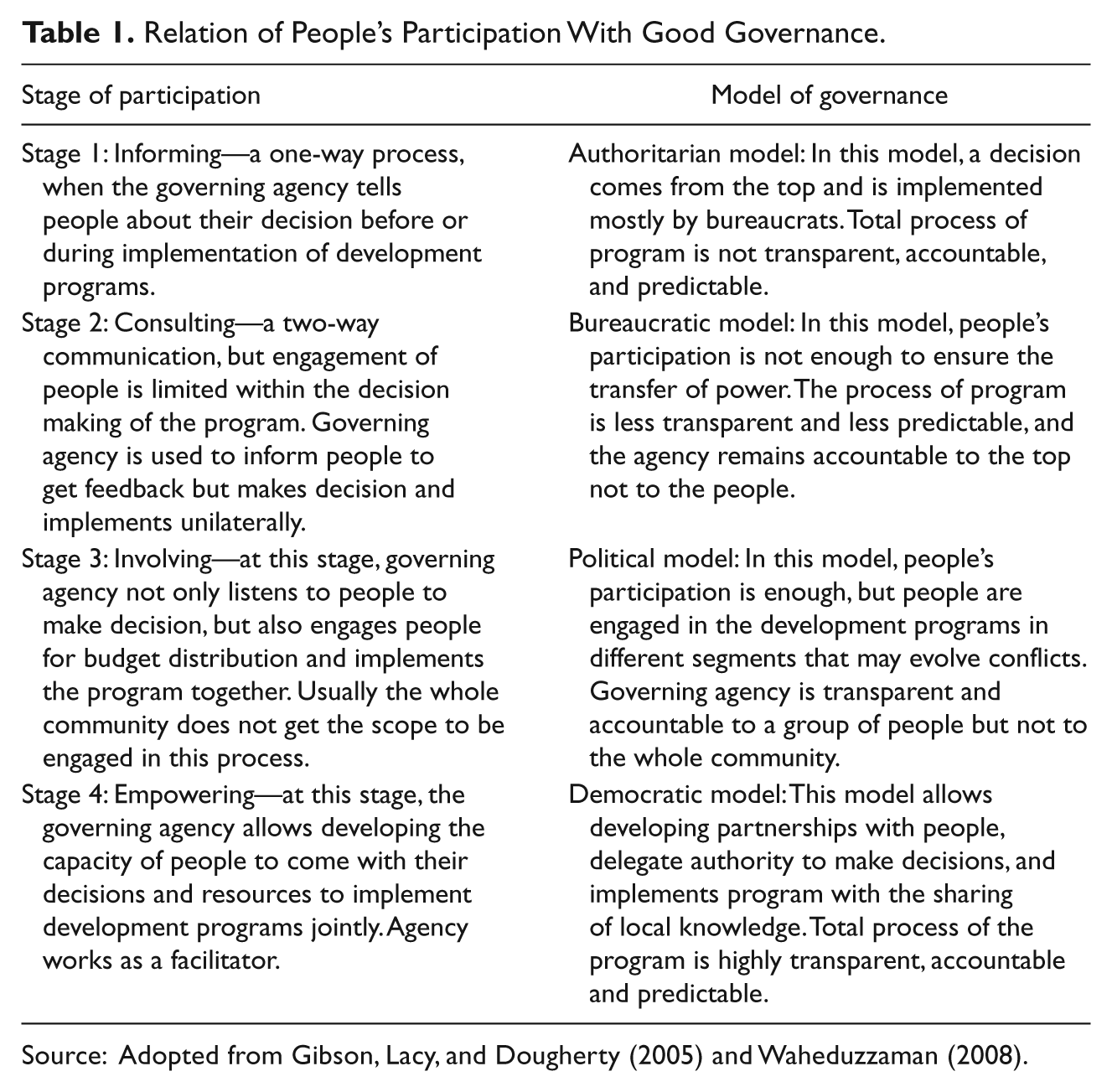
The above literature reveals that people’s empowerment happens gradually, and more empowerment means more control over the governing process. The higher empowered people can ensure higher accountability, transparency, and predictability of governing agencies. Thus, it is evident that the level of good governance increases through higher people’s participation in development programs (Arko-cobbah, 2006; Hickey & Mohan, 2004; JICA, 1995). Based on the level of people’s participation, different models with different nomenclatures have been developed by researchers to describe qualities of governance (Chadwick & May, 2003; Gibson et al., 2005; Newman, 2007). An analysis of all those models reveals that there is a strong correlation between the stages of participation and the stages of governance improvement. Table 1 has been developed as a working proposition, to show links between the four stages of participation and the four models of governance.
Relation of People’s Participation With Good Governance.
Source: Adopted from Gibson, Lacy, and Dougherty (2005) and Waheduzzaman (2008).
Table 1 indicates that good governance can be achieved through continuous endeavor to empower the people and the levels of governance qualities increase with heightened participation levels. Table 1 also indicates that of these four models of governance, the democratic model is actually the model that development agencies aim for when they demand good governance. In other words, democratic model of governance is actually desired by the development agencies where people could control decisions entirely as well as effectively (Asian Development Bank [ADB], 2004; JICA, 1995; World Bank, 2002). However, achieving democratic model of governance is not a one-off event; a system is required where people will gradually go to the higher level of participation until they attain to the control of decision making. Systematically governing agencies need to go closer to people; at the same time, a structure is required, which would allow local people to engage fully with the governing bodies. On one hand, strong civil society groups and vibrant private sector organizations are required to sensitize local people about their citizen rights (Agere, 2000; Rhodes, 2007). On the other hand, local institutions and legal instruments are required to ensure power balance and networks between all actors work toward ensuring participatory governance (Parnini, 2006). Hence, considering all the above concepts, the following conceptual framework, represented graphically (Figure 1), has been developed to bring together all theoretical ideas in regard to participatory good governance for effective development.
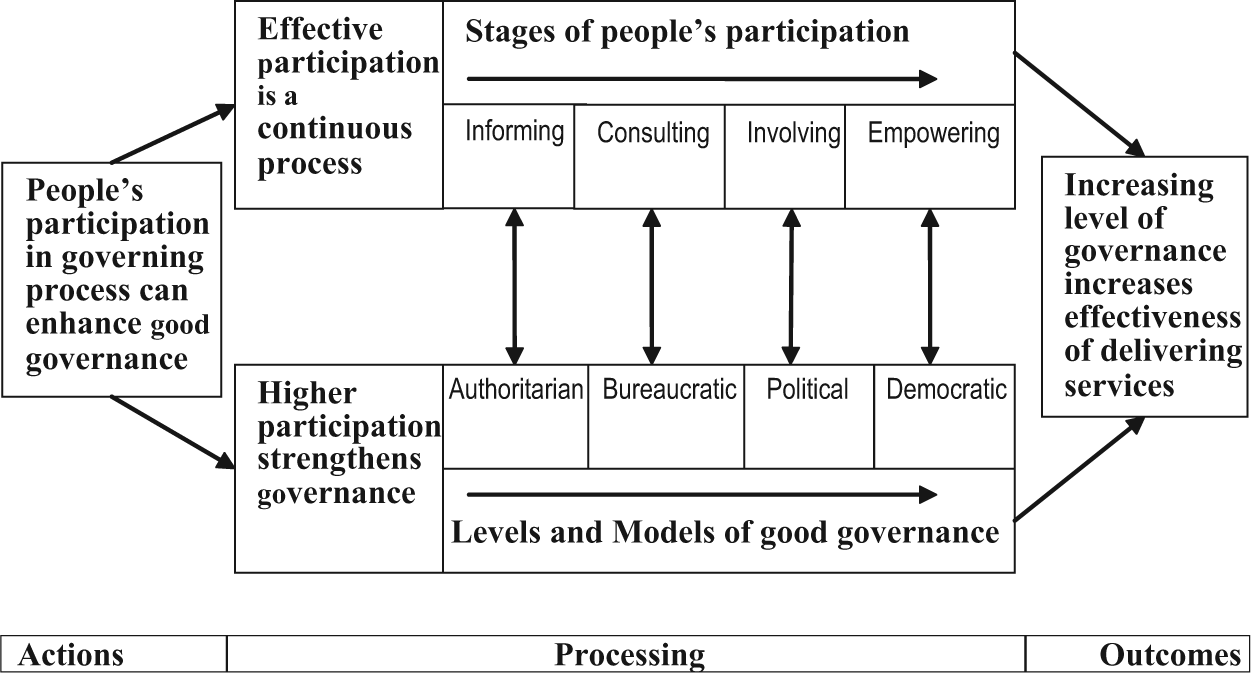
Conceptualized theoretical framework.
This conceptual framework provides an outline of the interrelated factors. The independent variable, that is, “people’s participation,” has direct impact on immediate dependant variables, namely, “good governance” and “empowerment of people.” All these, subsequently, have holistic impact on ensuring effective development. This research has selected this theoretical framework to explore how processes and activities of participation translate into outcomes of effective services. Most importantly, this research aims to find out interpretational dimensions and application of the “Processing” part of the above framework in the Bangladesh context.
The Case Study and Data Collection
A qualitative methodology has guided this research as the interest of the study was views of stakeholders in regard to their roles in the development projects. Views of stakeholders could not lend themselves easily to measurements “on a physical scale” (Kaplan & Maxwell, 2005; Schulze, 2003, p. 12). Three Bangladesh local government institutions (the structure of the local government system can be seen in the appendix) were selected for the study during February-July 2008. Two local development projects, namely, the “Rural Growth Centre (rural market) Development Project” and the “Primary School Development Project,” from three selected rural local government bodies (Upazila) in Bangladesh were selected for the case study. These three Upazilas (subdistricts) are distinguished by different socioeconomic parameters: mainly, economic status and literacy rate. Two factors, such as aid-assisted and recently completed projects, were highly emphasized during case selection, because people’s participation has been made compulsory for all aid-assisted projects (Planning Ministry, 2005), and all stakeholders in a recently completed project would be able to share their views from recent memories.
Those who were recruited for interviews included all who had roles in the implementation and use of selected development projects. These included all government officials from local council (Union–sub-sub-district) to ministry levels; local elected representatives; and local expected beneficiaries. 3 In total, 13 government officials, 21 elected representatives and 106 expected beneficiaries were interviewed individually and in groups. The semistructured questionnaires were used for interviews. Previously used procedures by different organizations such as the ADB and the Ministry of Planning (ADB, 2006a, 2006b; Implementation Monitoring and Evaluation Division, 2006) for assessing project performance were used to frame questions for interviews. Selected schools and growth centers were also physically observed along with the expected beneficiaries to see their present status of uses. Documents related to those projects, mainly preevaluation reports, project proposals, and postevaluation reports, were also collected from concerned local government offices, ministries, and development agencies’ offices. It is notable that no private sector organizations were found involved in the implementation process of aid-assisted local development projects.
The tape-recorded interviews were transcribed into text manually. The interview texts were then organized under different broad descriptive codes with NVivo software. Once organized, data were further coded into different categories to allow emergence of thematic ideas for necessary analysis. Data from different sources, local government bodies and projects regarding every single question, have been taken into account for triangulation; this was done “to avoid the charge of bias” in answering research questions (Funnell, 1996, p. 169). However, analyses were mostly completed manually to get deep understandings (Welsh, 2002) of research data. Analyzed data were then continuously compared and contrasted (Strauss & Corbin, 1998) with the relevant theories to interpret the perceived values for people’s participation by different actors responsible for establishing good governance in rural Bangladesh.
Effectiveness of People’s Participation in Bangladesh
The analyzed data revealed that the theories of effective people’s participation are not grounded practically in achieving good governance in rural Bangladesh. Although theories indicate that continuous people’s participation can ensure the control over decision making and influence the outcome in their favor, this is not truly happening in rural Bangladesh. Local government institutions in rural Bangladesh are very old, but although the local people participate in local development programs through these institutions (Sarker, 2003; Siddiqui, 2005), there are not enough strong networks that have been established that can ensure meaningful participation. The analyses show a number of gaps that can be associated with the weakening effect on networking and pose as barriers to local people’s effective participation to get an outcome in their favor. Elaborations on the gaps are made in the following sections.
Structural Gap
Since independence in 1971, the governments of Bangladesh have emphasized the development of local government bodies and people’s participation at all levels of administration. As Articles 59 and 60 (Chapter III of the Part IV) of the Constitution (Government of the People’s Republic of Bangladesh [GOB], 1972) of the country state, Article 59: Local Government . . . in every administrative unit of the Republic shall be entrusted to bodies, composed of persons elected in accordance with the law. [Local governments] . . . may include functions relating to: Administration and the work of public officers; the maintenance of public order; the preparation and implementation of plans relating to public services and economic development. Article 60: Powers of local government bodies for the purpose of giving full effect to the provisions of article 59, Parliament shall, by law, confer powers on the local government bodies referred to in that article, including power to impose taxes for local purposes, to prepare their budgets and to maintain funds.
Thus, the constitution directs the local government to grow as an inseparable part of the central government to administer development programs democratically with the local people. It is, therefore, provided so that people should participate directly in constituting local bodies and in managing the affairs of such bodies. Accordingly, government has reformed local government institutions in the rural areas and introduced locally elected management committees and monitoring committees to ensure effective people’s participation. However, analysis of this research data has revealed a different picture. For example, while it is provided for that a Hat-Bazaar Management Committee (HBMC or Market Management Committee [MMC]) should monitor development works of any growth center (LGED, 2007), such committees in most cases do not exist. During data collection, 92% of businessmen responded in the same manner: We never have heard about HBMC/MMC. We had a Banik Samity (unofficial association of Businessmen), which has also been abolished due to poor business [after renovation of the growth center].
A newly made MMC office, though found in every growth center during data collection, is not used by targeted groups. In most cases, those offices are either closed or used for some other purposes. During field visit, one businessman pointed out that, The Government built a MMC office that is now used by the leaseholder [market leased to private organizers who collect toll from businessmen] as his office room. This leaseholder is an outsider and wealthy and a muscleman.
Nonetheless, in the case of the Primary School, local management committees were found to be active. However, those committees are fully controlled by government officials. Though theoretically these committees are responsible for looking after all development programs in the concerned school (Directorate of Primary Education, 1998), in practice the management committees have no voice. One President of the School Management Committee (SMC) mentioned, I am the president of the SMC but they [government officials] did not discuss planning, implementing, monitoring; only when they needed help to implement the project they did ask us for help. After completion of work, they asked for a completion certificate that would be signed by the president and member-secretary.
Similarly, no locally elected “Project Monitoring Team” was found that is monitoring development programs led by local government institutions. The ADB asserts that, to avoid accountability, local government officials do not form management committees appropriately (i.e., according to government instruction) and do not form any monitoring committee to monitor development programs (ADB, 2004).
In view of the foregoing, it is evident that there are obvious structural gaps in rural Bangladesh, which create barriers to effective people’s participation. In addition, because of these gaps, government officials and elected representatives avoid being accountable for services that are rendered by them. Truly, lack of accountability, particularly social accountability, of the local service providers has been a major concern in developing countries in efforts to ensure effective local governance (Khan, 2000; Mehrotra, 2006). Although researchers argue that social accountability or being accountable to the local people confirms direct accountability relationships between people and the government and puts them into establishing good governance (Sirker & Cosic, 2007), the case in rural Bangladesh runs contrary. Although in representative democracy elected representatives should hold the government officials accountable for their services (Mollah, 2008), in rural Bangladesh, these representatives are overlooking this issue. It could be assumed that authority over and control of funds makes the representatives dependent on the local government officials, a situation that has consequently inclined them to overlook the accountability of the government officials.
Moreover, there is no effective statutory mechanism to make the local government officials directly accountable to the local people. Available laws regarding ensuring accountability of elected officials are also inadequate. Any process and procedures, mainly for lodging a complaint against any anomalies by any section are found insufficiently indicated. Section 61 of the existing Upazila Parishad Act, 1998, illustrates the hearing of any appeal (GOB, 1999) but does not mention details, such as where to go and whom to go to for lodging complaints. Because the nexus between elected representatives and government officials predominately run the local government, the poor are not getting any remedy from this legal instrument. Moreover, laws related to local government (Local Government Ordinance, 1983, or Upazila Parishad Act, 1998) do not mention anything about curbing measures for forceful disengagement of local representatives or people associated with concerned local development programs.
In rural Bangladesh, most of the elected representatives come from local elite families who maintain their own musclemen; these men allegedly restrain local people from tracking any complaint to the higher authorities (Blair, 2005). During field study, local people complained that government and elected officials surround the high officials when they pay visits to the locality. Consequently, local people have no space to air any views or lodge complaints to those visiting higher authorities. Above all, it is well known in Bangladesh that all the elected representatives have their own “mastaans” (criminal bodies) to handle any complaints against them; even state police also help these corrupted representatives (Blair, 2005; Devine, 2007). When these lines were being written (July 29, 2009), some “mastaans” of a Union Parishad (UP) Chairman beat the complainers who lodged a complaint to the District Government official for stealing of relief by that Chairman (Prothom Alo, 2009).
In reality, the only mechanism available in the current state of affairs to hold elected officials in rural Bangladesh accountable is the council election, which happens only once in a 5-year time period (Siddiqui, 2005). In the absence of accountability mechanisms, local government officials and elected representatives do not see any value of direct people’s participation in local government affairs nor do they want to attend to this structural gap for fear it would work against them, that is, to be held accountable to the local people. Actually, as the World Bank has observed, too little attention has been given to hold government and elected officials accountable in Bangladesh (World Bank, 2002). As Lange (2008) asserts, establishing “downward accountability” is the greatest challenge to “institutionalize real representative democracy” in developing countries (p. 1141). Although some researchers claim that government bureaucrats are the only barrier in making people’s participation effective (Sarker, 2008; Zafarullah & Huque, 2001), this research has also found out that local elected representatives are not interested to make people’s participation effective in rural Bangladesh.
Conceptual Gap
Data analysis revealed that the three actors—government officials, representatives, and local people—perceive the meaning of people’s participation in different ways. The government bureaucrats are of the view that representatives are enough for effective participation if they are controlled properly. In their view, rural people are illiterate and are always troublemakers. Thus, bureaucrats are not interested in bringing local people to the decision-making table; rather, as they believe, informing local people is enough to achieve effective development. Five of 13 government officials interviewed, mainly midlevel engineers and officials in the education department, claimed that they have more knowledge and information than local people do, and hence, they constitute a legitimate cohort to make decisions that will effectively benefit the local people. We are working in this area and we know all the pros and cons better than local people and their representatives; thus, we are the best section to identify and select any development project within this area.
From the interviews, it is clear that the expected users/beneficiaries are hardly informed about the local government programs that affect them. However, this informing mechanism is also unique in rural Bangladesh. Local government officials just hang a signboard with a brief description of the project to inform local people and invite them to participate. Sometimes these signboards, besides bearing insufficient information, are written in English, a language that local people can hardly understand. One local engineer, though, claimed that he was perfectly engaging locals in the programs: For every development work, we hang a signboard at the site. If donors fund the project, we usually write it in English for the convenience of donors when they visit the project area.
Like bureaucrats, local elected representatives also believe that they (public leaders) are a kind of proper stewards to ensure people’s participation in local development programs, and they are adequately representing local people. In their views, they are elected by the local people through the democratic process so that they are actually working as spokespersons at the decision-making table instead of the people, and the people have bestowed a mandate on them to do so. Eighty-six percent of public leaders interviewed expressed the view: People elected us to look after all the “positives and negatives” that affect them, so I don’t find any further need to ask every person to make a decision.
When they were asked about direct people’s participation through locally elected management committees, they replied like bureaucrats: “inviting people [for any decision] means inviting trouble.” Elected representatives do not want any means of direct people’s participation mainly through locally elected management committees. One local council Chairman interviewed mentioned: I don’t want more independent management committees like SMC [School Management Committee]; because of SMC we, the chairmen, [Union Council Chairman] have lost our authority over the local schools.
On the other hand, local people are completely unaware of their potential for participation. Most of the local people do not have any idea about their participation in local development programs. They believe that they should not have any scope to participate in development activities that are carried out by local government bodies. Seventy-five percent of expected beneficiaries interviewed, consider all local development works are government’s function, which should be done by government officials. This [a primary school] is a government program and government is paying local officials to look after these activities. This is their [officials] job to conduct; our involvement may cause annoyance to them.
Conversely, 14 of 21 public leaders interviewed believe that they have been truly representing rural people for a long time, and this is the most suitable practice to ensure people’s participation is effective. However, these public leaders, mostly from rich socioeconomic backgrounds, expressed their limitations (controlling power regarding authority and funds) in being able to act unreservedly to reflect people’s intentions in local development programs. They perceived that involving locals will not lead to any change unless they are provided with adequate power for handling authority and funds.
No, involving locals could not bring any better results while the funds are controlled by the officials. We need more power, both to handle the funds and, at the same time, to control the officials. People are already participating through their representatives at the moment, but we need more power over the local bureaucrats. And we need direct funding so that we can implement development programs according to our choice.
The above findings thus indicate that government bureaucrats and representatives think of local development projects as their own work, and they want to perform it as assigned. Government bureaucrats are only concerned about their power over representatives, and similarly, representatives are concerned about their controlling power over bureaucrats. Nevertheless, none of them think about local people, as both groups perceive that “more people mean more trouble.” No doubt, such attitudes show that there is a clear conceptual gap about people’s participation by all actors responsible for ensuring good governance in rural Bangladesh.
Cultural Gap
According to scholars, good governance means making a bridge between government and the governed (Barten, Montiel, Espinoza, & Morales, 2002); officials in local government bodies and local people need to uphold the value of direct people’s participation. Social norms and trust are two major aspects of social capital, which help people in networking with each other (Graddy & Wang, 2009; Klijn, Edelenbos, & Steijn, 2010). With the help of these networks, people share values and concerns, which consequently transform into group energy (Stivers, 2009). This group energy then helps to demand and uphold accountability, transparency, and legitimacy of the local authority in delivering services and development work. In this way, good governance can be achieved by drawing on aspects of social capital (Putnam, 1993). Governing agencies and civil society along with private sectors need to act mutually to develop trust and norms, that is, social capital. Where social capital is high, all the actors in the society possess common normative values and do work more cohesively in fulfilling their common interests (Kingsbury, 2004). Effective participation is not possible if normative values of that particular society are overlooked.
However, this study has shown that there is a cultural gap in Bangladesh rural society, which is creating a barrier in developing normative values, a situation that ultimately hampers emergence of vibrant social capital. In the democratic process, public officials should be accountable to the elected representatives for the services rendered by them. However, that is not happening in the local government institutions in Bangladesh. A total of 75% of UP (UP–sub-sub district council) Chairmen, during interviews, pointed out, The officials are the main barrier as they don’t listen to us. They perform the development works according to their discretion. They should be accountable to the local elected representatives.
On the other hand, because of the legacy of a colonial culture, government officials undermine the abilities of the elected representatives. During interview, one government official expressed the following view: You know Most of the representatives are corrupt; lowly educated [almost illiterate] and corrupt. We always try to control their capacity for malpractice.
The view of another official working in an executive capacity of an Upazila Parishad (sub-district council): In my experience, I do not think public representatives do work or are interested to involve the mass of the people. They don’t perform any service properly that is delegated to them, such as: TR [test relief] works for vulnerable groups or for adults, distributing food for works etc. If we don’t monitor them, they [mis]appropriate all funds.
Local people conversely blame officials and their representatives for not listening to them. They believe their elected representatives work for officials, not for ordinary people in the society. A total of 56% of the local people expressed similar disappointment: Local leaders or bureaucrats are not accountable to us. Actually they were never accountable to us for their jobs. We can change a chairman after five years, i.e. through election. But where is a good candidate? Those who are good are penniless. They have no capacity to spend money for election. Even if a good person got elected, he would become changed after holding that chair.
The above analysis thus indicates that although there are mechanisms of democracy, the practice does not lead to trust in each other in rural Bangladesh. This state of affairs results in weakening networking among all stakeholders. Although researchers argue that trust is very important for sustainable governance networks (Klijn et al., 2010), the evidence shows that it is substantially absent in rural Bangladesh. One of the main reasons of this setback is the presence of an eclectic social structure in rural Bangladesh (As-Saber, Hossain, & Srivastava, 2007).
Traditionally and historically, the rural society in the Bengal region was divided horizontally, that is, stratified in different castes where every caste had a specific task (Heller, Harilal, & Chaudhuri, 2007). During colonialism in the 17th to 18th centuries, this society became further divided based on land ownership. The then central government appointed zamindars (landlords) by promulgating the Permanent Settlement Act in 1793. The zamindars ruled an estate and collected land tax on lands leased (Khan, 1995). These zamindars (also talukdars—subleasers) rented their land and collected land taxes from peasants—bargadars. The central government also appointed administrators and armed forces to help those landlords to collect land taxes without resistance (Khan, 1995). Thus, societies in rural Bangladesh have been divided in different power groups since the colonial time. At the upper end were local elites—zaminders (feudal landlords) and talukders (semifeudal landlords), who had good relations with the colonial ruler, owned lands, and were supported with the power they used against poor tenants to collect tax. At the lower end were the local poor—bargadars; they were bound to follow the orders of the upper class for their survival. This is the class that cultivated rented lands. Even after decolonization in 1947, local elites (feudal and semifeudal) held the power in connection with the local representatives of the central government; their new label is matbaar (Lewis & Hossain, 2008). Most of these matbaar are now actually getting elected in the local government bodies (Lewis & Hossain, 2008). These elected leaders thus generally try to avoid direct people’s participation in decision making. Researchers term this phenomenon as dysfunctional democracy; local leaders use democratic election processes to come in power, but corruptly exploit local citizens after election (As-Saber, 2011). These elected leaders are “largely isolated from the citizenry” and “consider themselves above law” (As-Saber, 2011, p. 5) and tend to control local development programs according to their own choice and taste. The ADB points out that In most UPs [Union Parishads/Councils] decisions about resource allocation and the selection of schemes under the ADP [annual development programs] are made in closed meeting of the UP, perhaps after informal consultation with a limited number of trusted individuals in the area. (ADB, 2004, p. 21)
Seemingly, as a result of this rural politics and exercise of power by the local leaders, the rural poor are becoming marginalized. Consequently, there is failure to bind social or community ties with elected officials (Green & Curtis, 2005; Timm, 1983). Nonetheless, the local poor also depend on the matbaar class for their livelihood by cultivating their lands (Blair, 2005) or by putting their name on the list of government relief by satisfying them (Devine, 2006, 2007). One local council Chairman during interviews also commented along the same lines: People are happy if we can donate money to them. You know, presently we are getting 750 taka [US 1$=70 taka], but we spend almost 15 thousand in a month; the government should increase this honorarium.
Elected representatives in local government bodies therefore do not care about their accountability to the local people. They start making money once they have been elected, and they use that wealth to win the next election. However, local people, because of their poverty, elect a wealthy leader to get financial support when they need it. Mahmud (2002, 2004) mentions lack of knowledge of citizen rights inhibits rural people in Bangladesh to participate in local development activities. However, this research found not only knowledge gap but also a cultural gap inclining local people to keep themselves out of local development programs.
Pursuing Good Governance in Rural Bangladesh
The above analysis presents a picture of attitudes, practices, and knowledge as well as skills that are largely inimical to citizen participation or good governance that emerges as a result of nurtured participation. The majority of the actors—government officials, elected representatives, and local stakeholders—did not demonstrate awareness of the higher stages of people’s participation that can ensure better levels of good governance. Local government officials think they are perfectly pursuing a “Democratic model” of good governance (see Table 1) by simply informing local people about development programs. In fact, these officials are pursuing an “Authoritarian model” of governance by only informing local people about their programs. These officials do not know that more involvement of local people is needed in local government affairs to reach intended ends. Although in developed societies people’s empowerment grows through proper education and continuous participation in local government works (Akkerman, 2003; Morphet, 2008), in Bangladesh, government bureaucrats and representatives decidedly exclude the local people for fear of loss of power. Unfortunately, locals—the majority of whom are illiterate (Sen, Mujeri, & Shahabuddin, 2004)—are not receiving any helping hand to bring about awareness and empowerment (Bebbington, Lewis, Batterbury, Olson, & Siddiqi, 2007). Because of insufficient knowledge and inadequate empowerment mechanisms, local people are also happy if they only are informed about local development projects. This state of affairs shows that all concerned stakeholders only know about the first stage of people’s participation, and they have been practicing it to improve the quality of governance. Besides this conceptual gap, unfortunately, structural and cultural issues in rural Bangladesh also help to widen the gap between different stakeholders responsible for ensuring good governance. Diagrammatically, Figure 2 depicts findings of this study measured against the research framework.
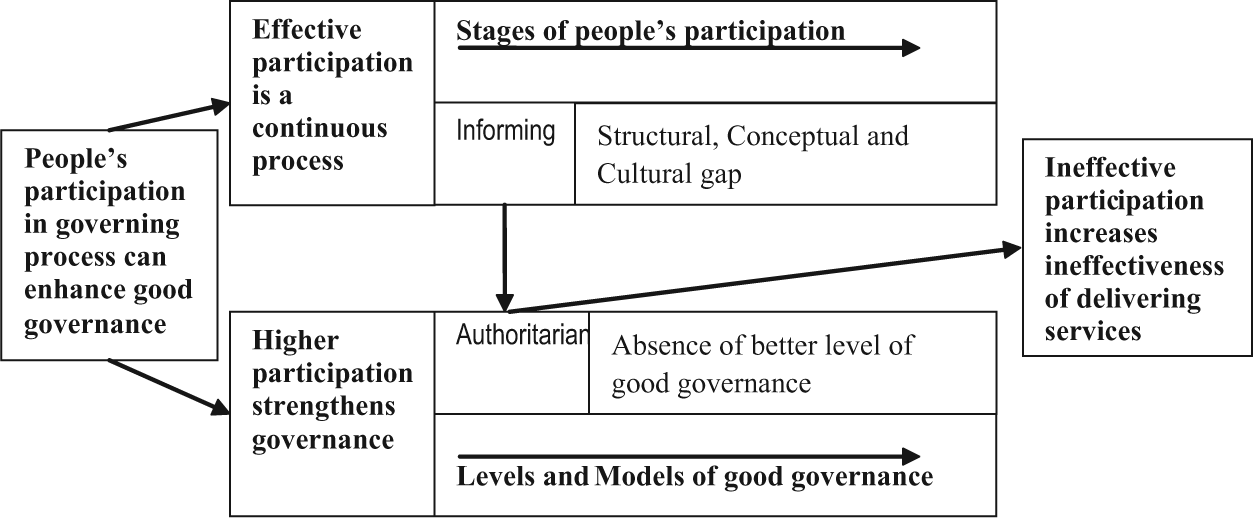
Gap that leads to ineffective participation.
Figure 2 indicates that the local government institutions in Bangladesh have been practicing an authoritarian model of governance. Stages of people’s participation are not progressing because of structural, conceptual, and cultural gaps in the rural society. Therefore, the governing process is not improving according to the desired pace, which consequently are bringing ineffective outcomes from aid-assisted development projects.
The Government of Bangladesh, as well as other development partners who are working in Bangladesh, apparently are not aware of these gaps, which are making participation ineffective at rural levels. Since Bangladesh’s independence in 1971, successive governments have formed more than five committees and commissions to formulate the means to ensure effective people’s participation in rural Bangladesh (Morshed, 2007). The analyses of those recommendations suggest a range of ways to arrive at a solution. One group suggested creation of local government institutions at the ground level that will empower people (Khan, 2000; Sarker, 2003); another group suggested that delegating authority to existing local government bodies will empower local people (Morshed, 2007; Zafarullah & Khan, 2005), and these empowered people will then be encouraged spontaneously to participate in local government affairs. Interestingly, none of these recommendations suggested any mechanism to develop awareness of different stakeholders in matters pertaining to people’s participation in rural Bangladesh. Researchers, however, have suggested that “public sector organizations need to understand how citizens want to engage with the council, what are their needs, and what are their perceptions about the council” (Jones et al., 2007, p. 148). A point to underline here is that recommendations of concerned committees and commissions expressed doubt that the Government of Bangladesh sees any value in direct citizen’s engagement. These foregoing points indicate that not only the local stakeholders but also the central government and perhaps international development agencies have a conceptual gap over various shades to make people’s participation effective in rural Bangladesh.
Some recent initiatives, taken by the central government of Bangladesh in consultation with the development agencies, indicate a change of their traditional approach. For example, locally elected management committees, project implementation committees, and monitoring committees are expected to look after local development programs. However, this research found out that these committees are either not properly formed or not properly functioning because of structural and sociocultural gaps that are evident in the rural society. Although participation in advanced societies is enabled by vibrant social instruments, in rural Bangladesh, as findings of this research show, legal instruments are either unavailable or tokenistic. A clear example is the fact that there is widespread acceptance of the phenomenon of “musclemen”; elected representatives maintain their mastaans (musclemen) to avoid their accountability. The only mechanism to hold them accountable is election. In regard to the vote as a mechanism for ensuring good governance and its constitutive practices, Joseph Stiglitz, former Chief Economist of the World Bank and Nobel laureate, is instructive “Participation does not refer simply to voting . . . [but] requires that individuals have a voice in the decisions that affect them” (Pruitt & Thomas, 2007, p. 13). Good governance needs direct democracy, that is, people’s direct participation (Bovaird & Löffler, 2002). So far, the practices of the Government of Bangladesh and development agencies have fallen short of mechanisms to ensure good governance in rural Bangladesh.
The Government of Bangladesh along with the development agencies needs to understand the localized environment in rural Bangladesh that misinterprets the theories of participatory governance resulting in ineffective development. Local stakeholders, particularly government and elected officials in the local government bodies, need to be provided with proper knowledge and training to understand the value of people’s participation and practice it profitably. Adequate legal instruments and monitoring bodies also need to be developed to ensure participation of local people in local development programs. Above all, the Government of Bangladesh and development agencies need to bridge the gaps that have surfaced through this research; otherwise, the country will not achieve good governance or will instead tend toward bad governance. 4
Conclusion
The article has shown that in response to the international development agencies’ and donor countries’ demand for good governance in developing countries to see the best use of their aid funds for local development programs, developing countries have been trying to ensure people’s participation in aid-assisted projects. In step with such efforts, the Government of Bangladesh has been trying to ensure effective people’s engagement in local development programs through different reforms and decentralizations of local government institutions. This research was conducted to explore the understandings and implementation of the theories of participatory governance in rural Bangladesh. The thematic analyses of this study indicate that people’s participation in rural Bangladesh is not being effective because of structural, conceptual, and cultural gaps that create a general societal ineptitude to realize good governance through people’s participation.
First, because of a structural gap, service providers evade their accountability in project implementation to the local people. This article has also shown that administrative structures and statutory instruments to ensure people’s participation are either insufficient or not enforced in rural Bangladesh. Second, because of a perception gap, all stakeholders are only pursuing the first stage of the participation process in pursuing good governance. More specifically, government officials and elected representatives do not value direct people’s participation; they exercise domineering authority over the local people and ill use of funds. However, local people, most of whom are illiterate, are unaware of ways to assess the value of their own engagement with local development programs. Finally, networks and norms of collaborative action are not being effectively established or drawn upon because of a cultural gap in rural Bangladesh. Furthermore, the article has shown that counterproductive attitudes are prevalent among various stakeholders in Bangladesh. Public representatives and government officials do not want to share knowledge with locals.
It is the contention in this article that good governance in developing countries such as Bangladesh cannot be achieved unless these gaps are attended to decisively and effectively. Development agencies and the central Government of Bangladesh need to understand these gaps that prevail in rural Bangladesh; otherwise, the efforts invested in nurturing meaningful people’s participation to attain to good governance may inadvertently breed bad governance.
Footnotes
Appendix
Declaration of Conflicting Interests
The author(s) declared no potential conflicts of interests with respect to the authorship and/or publication of this article.
Funding
The author(s) received no financial support for the research and/or authorship of this article.