



Abstract
Scholars have provided great theoretical insight and empirical understanding to the concept of representative bureaucracy, documenting the changing makeup of the civil service and demonstrating the importance of representative bureaucracy toward democratic governance. Yet, important questions remain. What specifically does bureaucratic representation mean? Is descriptive representation necessary for policy representation? What characteristics are important? How do we measure representation? Finally, are there any negative effects of representative bureaucracy? This article provides an overview and analysis of the literature focusing on how scholars define and measure representative bureaucracy. Efforts are made to emphasize achievements and highlight areas that need attention.
Introduction
Contemporary bureaucracies wield considerable power throughout the policy process, yet lack electoral accountability leading to tensions between bureaucracy and democratic theory. Scholars attempt to reconcile this tension through the notion of representative bureaucracy (Saltzstein, 1979; Selden, 1997). The basic premise of representative bureaucracy is that a diverse bureaucracy will lead to more responsive public policy. In this way, representative bureaucracy may help ensure that all interests are represented in the formulation and implementation of policy (Selden, 1997).
While there is consensus regarding the most basic underlying idea of representative bureaucracy, several important questions remain. What specifically does representation mean as it applies to the bureaucracy? Is descriptive representation necessary for substantive/policy representation? If so, what characteristics are important? How do we measure passive and active representation? Finally, are there negative effects of representative bureaucracy? Focusing on these questions, this article provides a systematic and comprehensive analysis of existing literature. To facilitate this analysis, a database was constructed that includes 93 works analyzed according to seven concepts. This analysis highlights progress in the field and uncovers limitations, identifying critical areas that need theoretical and empirical attention.
The results reveal important trends. Scholars have produced extensive knowledge concerning the extent to which various organizations demographically represent specific groups. For decades, scholars have measured passive representation of local, state, and federal agencies. These works show the changing makeup of the civil service over time as women and minorities increase their presence. They also indicate where improvements are still needed.
In addition, a growing body of research links passive or demographic representation to active or policy representation. While early work sought to explain the importance of diverse organizations and measure the representation of various groups, contemporary work focuses on the link between passive and active representation, analyzing the extent to which descriptive representation leads to enhanced policy representation. These findings are critical to understanding the impact of bureaucratic representation on the quality of democratic governance.
Despite a rich and growing body of literature, several weaknesses remain. Scholars offer a variety of definitions and measures of representative bureaucracy that may complicate theoretical development and aggregation of results. In addition, the scope of inquiry has been limited. Contemporary works focus almost exclusively on descriptive representation of race and gender. However, recent work suggests descriptive representation may not be necessary and characteristics other than race and gender may be important. Maintaining the current focus may result in empirically overlooking important instances of bureaucratic representation.
Contemporary studies are also contextually circumscribed, studying representation primarily among street- and executive-level bureaucrats within redistributive agencies. Such a limited setting may provide an incomplete view of representative bureaucracy and pose obstacles toward accomplishing the original goal of this concept. If representation legitimizes the power of bureaucracy, but its study is restricted to certain levels and policy areas, how do we legitimize the power of the remaining bureaucrats and organizations? Evidence from this analysis suggests the lens by which representative bureaucracy is studied should be expanded to include a variety of levels and organizations. In addition, few studies compare representation across levels or policy areas. Further analysis is needed to determine how these differences may shape the process of representation.
The existing limitations appear to be driven in part by theoretical restrictions and data availability. Most empirical studies rely on quantitative policy outputs. For example, education studies typically use standardized test scores to measure active representation. Although these studies have provided a great deal of knowledge, overreliance on quantitative data may limit full understanding of representative bureaucracy, narrowing its study to empirical questions and settings with easily accessible quantitative data. The use of qualitative analysis such as interviews, focus groups, participant observation, and case studies may be critical for advancing understanding in the field. By probing how bureaucrats perceive representation, qualitative data could clarify existing theoretical questions surrounding the definition of the term and allow scholars to move beyond descriptive representation of race and gender that are easily identifiable and measurable. Qualitative studies can also allow expansion of the organizational setting, permitting the study of organizations lacking easily accessible quantitative outputs. Finally, exploratory qualitative analysis can uncover new theoretical and empirical questions.
Scholars have long noted the positive effects of representative bureaucracy, including commitment to equal access to power, bureaucratic expertise and experience, accurate reflection of group preferences, group willingness to cooperate, and efficient use of resources (Selden, 1997). In addition to the positive effects, it is imperative that scholars examine the potential costs of representative bureaucracy. There are several areas where trade-offs may occur. Increasing representation for one group may occur at the expense of another group. In addition, active representation may have negative effects on other goals such as organizational performance and accountability. Scholars need to understand the potential costs to develop mechanisms by which to mediate them. To date, studies of potential trade-offs have been limited and produced contradictory findings. Qualitative studies could be important for examining the trade-offs that may be occurring. What types of trade-offs or negative effects do bureaucrats perceive?
This project explores the aforementioned questions through a systematic analysis of the literature. The primary focus is how scholars define and measure representative bureaucracy, and how they assess its overall effects. This analysis provides a detailed overview of literature, highlights accomplishments in the field, and identifies critical areas that need attention.
Method
A database was constructed to facilitate analysis of the literature. The database, while not exhaustive, represents work characteristic of this field. Several criteria were used to identify and ensure a representative sample of work. Each piece included in the database deals specifically with the concept of “representative bureaucracy.” To provide analytical clarity, works dealing with related topics such as affirmative action/workplace diversity are not included in the current analysis. An Internet search was performed on the term representative bureaucracy through JSTOR and Google Scholar. From this search, the top 75 articles/books returned from each database were included. Moving beyond the top 75 works, the concept of representative bureaucracy becomes less central to the overall aim of the piece. Book reviews were excluded as well as pieces where representative bureaucracy was not the central focus. Additional pieces were included if used elsewhere in the article for theoretical development and met the other criteria. To ensure inclusion of the most recent publications, a search was conducted limiting results to works published between 2008 and 2011. This method yielded 48 pieces from Google Scholar, 15 from JSTOR, 9 from overlapping searches, and 13 from the most recent publications. In addition, 8 pieces were included because of their use elsewhere in the article. The works included in the database are indicated on the reference list. A total of 93 scholarly articles/books were included. The overall sample includes theoretical and empirical pieces with a publication range from 1944 through 2011 written by a variety of authors.
Concepts
The pieces were coded and analyzed according to seven central concepts selected on their ability to assess how scholars define and measure representative bureaucracy.
Definition: Does the article provide a formal definition of representative bureaucracy?
Descriptive representation: Does the article discuss or measure any forms of representation other than descriptive representation?
Characteristics: What specific demographic variables are examined?
Level: What level of the bureaucracy is examined? The categories include street level, management, and executive reflecting Guyot’s (1998) head, shoulder, and body analogy. Pieces were also coded as mixed/unspecified if they fail to indicate level and/or do not isolate the levels in the analysis.
Policy type: What type of policy area is examined? The categories are based on Lowi’s (1985) typology and include distributive, regulatory, redistributive, and constituent. Pieces were also coded as mixed/unspecified if they fail to indicate policy type and/or do not isolate specific policy areas in the analysis.
Trade-offs: Does the article analyze potentially negative outcomes?
Method: Categories include quantitative, qualitative, mixed method, historical, or theoretical.
Findings and Discussion
Defining Representative Bureaucracy
An ongoing problem in the field of representative bureaucracy is difficulty defining the concept (Meier, 1975; Meier & Nigro, 1976; Subramaniam, 1967). Although most scholars agree on the central features, subtle differences and inconsistencies exist. According to Subramaniam (1967), the confusion begins with Kingsley (1944) who never explicitly defines representative bureaucracy and offers several inconsistent definitions. At times he uses representation in a manner consistent with classic interpretations of descriptive representation. Kingsley argues the Foreign Service is “unrepresentative” (p. 163) because it is composed primarily of an elite social class and is out of touch with public opinion. At other points, he argues the bureaucracy is representative when civil servants share background characteristics with the governing body. Sometimes, Kingsley is ambiguous on the term’s meaning. At one point, he suggests the bureaucracy must represent those they serve. But, whom do they serve?
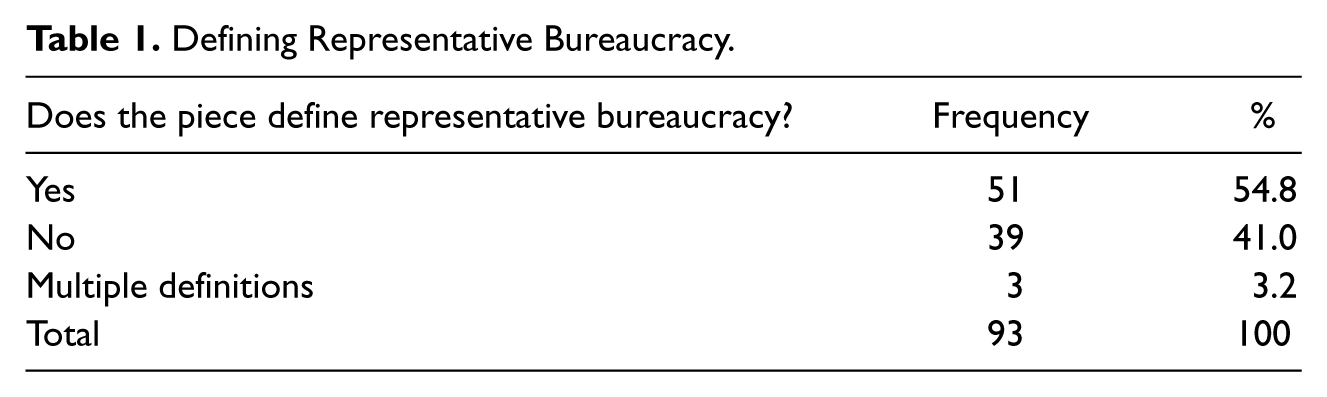
These contradictions point to one of the enduring questions in this literature: How do we define representative bureaucracy? As Table 1 shows, the majority of the works provide a definition. However, 41% offer no definition, and an additional 3% include multiple definitions.
Defining Representative Bureaucracy.
Examining the definitions across pieces reveals subtle inconsistencies and contradictions. The following examples illustrate variations throughout the literature.
Dresang (1974): “Representative bureaucracy is defined as balance, i.e., equivalent shares of positions by each of the major ethnic groups” (p. 1611).
Stahl (1975): “Years ago what we meant by representative bureaucracy was one to which all elements of society had access to public employment” (p. 121).
Kranz (1975): “Representative bureaucracy is one in which the ratio of each minority group in a particular government agency equals that group’s percentage in the population in the area served by that office” (p. 123).
Rehfuss (1986): “Representative bureaucracies, composed of individuals with commitments to varied group interests, occupations and classes, presumably assure internal bureaucracy struggles will produce broadly representative policies” (p. 454).
Meier (1993a): “A bureaucracy is representative in the passive sense if the bureaucrats share the same demographic origins (race, sex, education, religion, etc.) as the general population . . . A bureaucracy is an active representative if it produces policy outputs that benefit the individuals who are passively represented” (p. 393).
Meier, Wrinkle, and Polinard (1999): “Representative bureaucracy suggests that if a bureaucracy is broadly representative of the public it serves, then it is more likely to make decisions that benefit that public” (p. 1026).
Bradbury and Kellough (2008): “The theory of representative bureaucracy suggests that diversity within the public workforce, especially in terms of characteristics such as race and ethnicity will help to ensure that the interests of diverse groups are represented in policy formulation and implementation processes” (p. 697).
Although these definitions share elements, close examination reveals important differences. For example, Stahl (1975) suggests access is the defining feature, whereas attainment of equivalent position shares is central for Dresang (1974). Kranz (1975) requires each group’s presence in the agency to be in proportion to their presence in the population of a given area, whereas Rehfuss (1986) gives a very broad definition highlighting the values of the individuals as opposed to their demographic characteristics. Meier (1993a) and Bradbury and Kellough (2008) explicate which demographic characteristics are important. However, although Meier includes a variety of characteristics, Bradbury and Kellough focus on race and ethnicity. Finally, Meier et al. (1999) simply suggest the bureaucracy should be “broadly representative.” These subtle differences form the basis of the remaining analysis. Does bureaucratic representation require passive representation? What demographic characteristics should be analyzed? How should passive and active representation be measured? What level of bureaucracy and policy areas should be included? What are the potentially negative effects?
A Descriptively Representative Bureaucracy
Kingsley’s (1944) major concern is descriptive representation of the bureaucracy, specifically social class composition. While scholars such as Long (1952) extend representative bureaucracy to include policy aspects, scholars typically credit Mosher (1968) with the distinction between active and passive representation. Most contemporary scholars utilize Mosher’s division (Lim, 2006). Passive representation refers to shared demographic characteristics, whereas active representation suggests the individual makes decisions on behalf of the represented.
Scholars have produced a wealth of literature measuring passive representation across local, state, and federal agencies, providing important information about the changing composition of bureaucratic agencies. Although the findings suggest women and minorities are broadly represented, they tend to be underrepresented at the upper levels (Selden, 1997). In addition, representation may vary by the type of organization. Newman (1994) finds females concentrated in redistributive agencies, with fewer women in distributive and regulatory agencies. Understanding the extent to which various groups are represented and the distribution of representation across agencies and levels is critical for scholars as well as policy makers.
Whereas early scholars focused on measuring passive representation, contemporary scholars focus primarily on active representation. Using Mosher’s distinction, scholars attempt to measure the extent to which passive representation influences policy outputs. Scholars have found that increasing representation among minorities and females is related to substantive changes in policy outputs favoring these groups (Hindera, 1993a; Meier & Stewart, 1992; Selden, 1997).
Although scholars have provided important information about passive and active representation, several weaknesses remain. Looking more closely at contemporary studies, it appears that scholars not only utilize Mosher’s distinction but also argue that passive representation is necessary for active representation. In other words, Bureaucrat A shares a characteristic such as gender with a segment of the population. Because of this shared characteristic, Bureaucrat A is more likely to actively represent this segment of the population than Bureaucrat B who does not share this characteristic. While Mosher’s (1968) discussion allows for this type of linkage, Mosher also argues that active representation can occur without passive representation. For example, Mosher argues that top-level appointees in the bureaucracy do not passively represent the population in terms of wealth, education, and region. However, they may assure active representation of broad interests due to their education, experience, and political orientations.
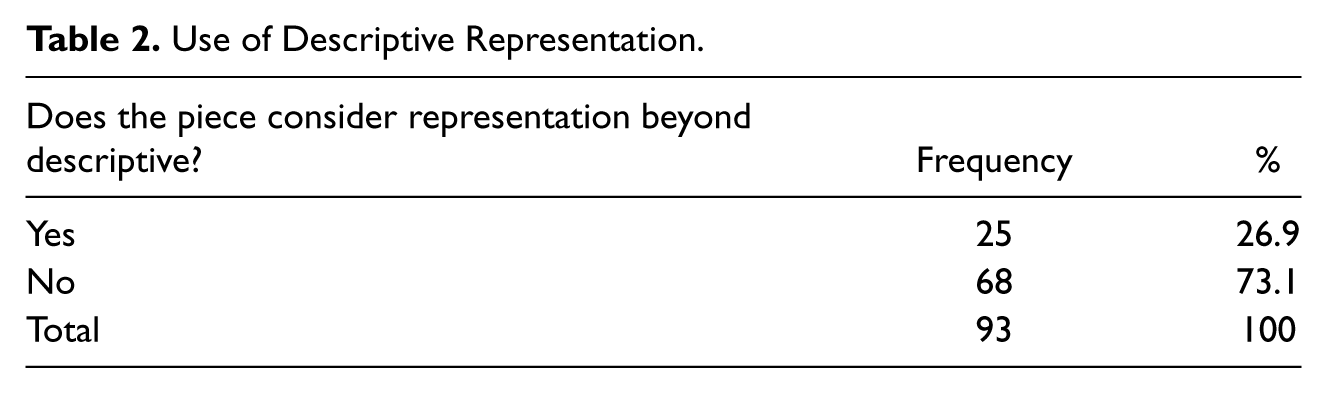
While not typically associated with social class, most contemporary scholars continue to rely solely on descriptive representation. As Table 2 illustrates, 73% of the pieces focus only on descriptive representation. Of the articles that do look beyond descriptive representation, few attempt to examine representative empirically.
Use of Descriptive Representation.
Recent evidence suggests bureaucrats not demographically representative of their constituents are capable of (and perhaps necessary for) making policy decisions that favor them. Slack (2001) argues that direct (descriptive) and indirect representatives (those who are sympathetic but not part of the social group in question) are necessary for representative bureaucracy. Slack finds evidence of direct and indirect representation among those involved in advocating on behalf of AIDS victims. Specifically, he finds considerable support among heterosexual and uninfected persons in the community.
Analyzing what she terms the “minority representative role,” Selden (1997) finds similar evidence. Selden explains, “Administrators who embrace the minority representative role perception most strongly believe that they should act in favor of policies that address the needs of minority clients” (p. 124). Although Selden finds minority status related to the minority representative role perception, it is not exclusive to minorities.
By maintaining a requirement for demographic representation, scholars may be ignoring instances of representation within the bureaucracy and preventing complete understanding of the factors contributing to or prohibiting representation. Scholars should explore the possibility for representation outside of demographic congruence. The concept of bureaucratic role perception offers a viable framework and needs to be explored further. Qualitative studies such as interviews, focus groups, and case studies offer a potential vehicle for exploring the concept of role perception and may allow scholars to move beyond descriptive representation by allowing all bureaucrats to be considered rather than focusing on those with shared demographic characteristics that are easily measurable.
What Characteristics Are Important?
Examining early work in the field raises another important question: If descriptive representation is important, what characteristics are influential? Following Kingsley, scholars expanded representative bureaucracy to include characteristics beyond social class. However, there is no clear consensus regarding what characteristics are important. In fact, some early scholars fail to identify specific characteristics at all. According to Van Riper (1958), A representative bureaucracy is one in which there is a minimal distinction between the bureaucrats as a group and their administrative behavior and practices on the one hand and the community or societal membership and its administrative behavior, practices and expectations of government on the other. Or to put it another way, the term representative bureaucracy is meant to suggest a body of officials which is broadly representative of the society in which it functions and which in social ideals is as close as possible to the grass roots of the nation. (p. 552)
Scholars specifying characteristics initially examined a variety of value sources (Meier et al., 1999). For example, Krislov (1974) includes race, language, gender, education, income, religious preference, age, veteran status, disabilities, whether a person is from a rural or metropolitan area, and party identification in his analysis and discussion.
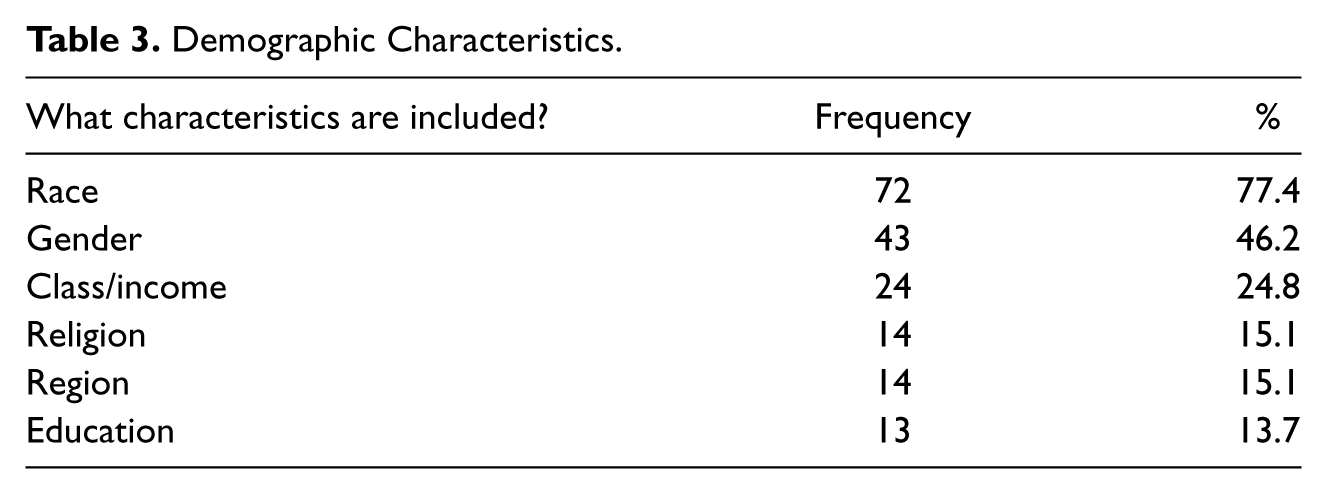
Contemporary scholars focus primarily on race and gender. Table 3 shows the top six characteristics that scholars discuss and/or measure. Race is the most common, appearing in 77% of pieces. Gender appears in almost half of the work. Class/income shows up in nearly 25% of the pieces. Religion, education, and region appear in about 15%. A variety of other descriptors such as age, attitudes, marital status, party affiliation, language, and sexual orientation are found scattered throughout the literature. Although multiple characteristics appear, pieces linking active and passive representation focus almost exclusively on race and gender.
Demographic Characteristics.
Some argue race and gender should be the primary focus because these are the most salient characteristics in the United States and have the largest impact on policy-relevant attitudes. Thus, other characteristics are not expected to influence administrative behavior (Hindera, 1993a; Meier & Stewart, 1992; Meier et al., 1999). Meier and Stewart (1992) state, The only social origin that has a major impact on political attitudes and is continually reinforced in American society is race. Research examining representative bureaucracy as an independent variable, therefore, best focuses on questions of representation and policy directly linked to race. (p. 161)
Others have extended this view arguing that gender is also a highly salient characteristic (Hindera, 1993a; Keiser, Wilkins, Meier, & Holland, 2002).
Limiting the analysis of representation to race and gender may provide an incomplete image of representative bureaucracy. Several recent scholars look at sexual orientation as a characteristic potentially influencing bureaucratic behavior (Slack, 2001; Theilemann & Stewart, 1996). In addition, Kelly (1998) argues that age and whether a person is disabled may also be important. Theoretical and empirical work needs to investigate which characteristics may influence bureaucratic representation. Inclusion of characteristics that are already under protected status such as age, religion, disability, and sexual orientation is particularly relevant to this field of study and should be analyzed more closely.
Recent scholars have explored mediating factors, such as region. Grissom, Nicholson-Crotty, and Nicholson-Crotty (2009) argue region influences the salience of race and subsequently its effect on policy decisions. The findings suggest active representation may be more likely among Black bureaucrats in the South compared with their non-Southern counterparts due to variations in the salience of race. This highlights the need for further attention toward the context in which representative bureaucracy occurs, identifying factors that may facilitate or hinder representation.
Measuring Representative Bureaucracy
The literature on representative bureaucracy is riddled with empirical questions. First, what organizational contexts are relevant to the study of representative bureaucracy? Second, how should scholars measure passive and active representation?
Organizational factors: Level of the bureaucracy
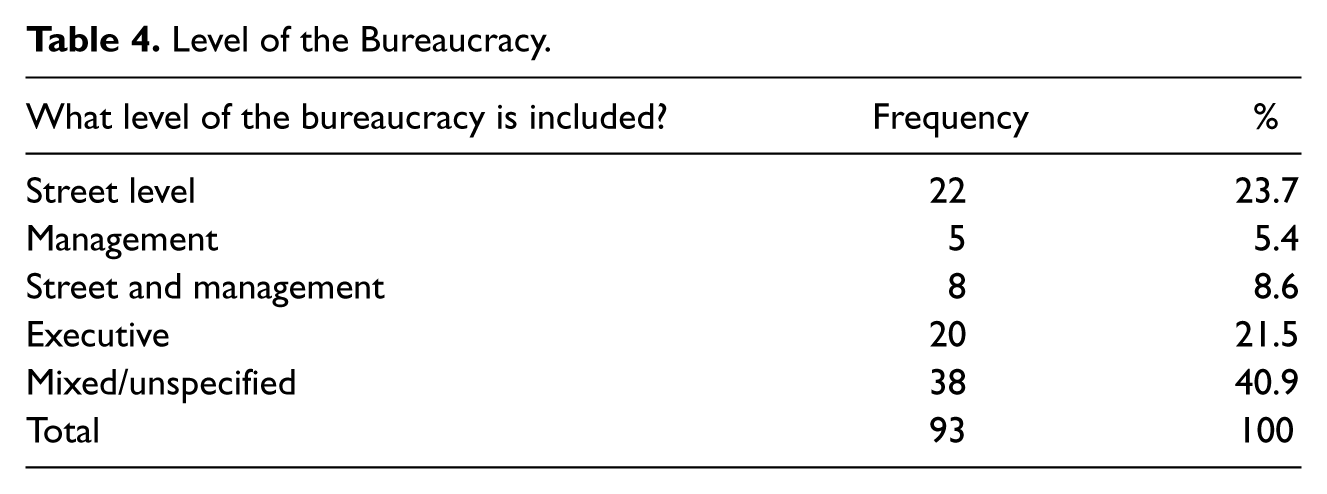
In general, scholars fail to theoretically differentiate various levels of the bureaucracy when analyzing representative bureaucracy (Meier & Nigro, 1976). As Table 4 illustrates, about 40% of the articles use a mixed or unspecified sample. These articles either failed to indicate the level of the bureaucracy being studied or failed to differentiate levels in their analysis. Of the articles focusing on specific levels, the database shows a preference for studying street- and upper-level bureaucrats. Studies of management are lesson common.
Level of the Bureaucracy.
Scholars argue certain criteria must be met to study active representation that may unnecessarily limit attention directed toward management. First, the bureaucrats in question must have discretion. Second, the policy decisions must have direct relevance to the passively represented group or characteristic. Finally, there must be a way to link the bureaucrat to a specific policy output (Meier, 1993a; Meier & Stewart, 1992; Selden, 1997). These theoretical restrictions have (perhaps artificially) circumscribed the study of active representation and should be reconsidered. The absence of a quantitative policy output with a direct linkage to a specific bureaucrat does not negate the act of representation and should not preclude its study.
In addition, little research has systematically compared variation in level of employment and representation. Scholars have argued that the environment at different levels of the bureaucracy may influence bureaucratic decision making and discretion (Lipsky, 1980; Selden, 1997; J. Wilson, 1989). These variables may also be key to understanding representation in the bureaucratic context. Sowa and Selden (2003) find one’s perception of discretion positively related to the assumption of a minority representative role. Similarly, Meier and Bohte (2001) find discretion positively related to active representation.
A limited body of research has used the level of employment as an independent variable. For example, Meier (1993a) compares the effects of increasing the number of minority teachers and administrators on minorities’ school performance. The findings suggest street-level bureaucrats are more likely to actively represent constituents than their management counterparts. However, increasing the numbers of minority administrators still produces positive results (albeit weaker). In contrast, looking at child support enforcement, Wilkins and Keiser (2006) find increasing the number of female supervisors positively related to enforcement, while increasing the female caseworkers was not statistically significant.
More work analyzing the influence of organizational level and representation is needed. In addition, further attention toward the role of management-level bureaucrats is necessary. Qualitative information such as surveys and interviews may help fill this gap by providing evidence of representation without a linkage between a specific output and bureaucrat. Additional work should explore the nuanced effect that the level of employment has on the process of representation.
Organizational factors: Policy area
When considering bureaucratic representation, another important question is what policy area to study. As Table 5 illustrates, most studies use a mixed or unspecified sample. These articles either failed to indicate the policy area being studied or failed to differentiate the types of agencies in their analysis. Of those examining a single, specified agency type, there is a clear preference for redistributive agencies.
Agency Type.
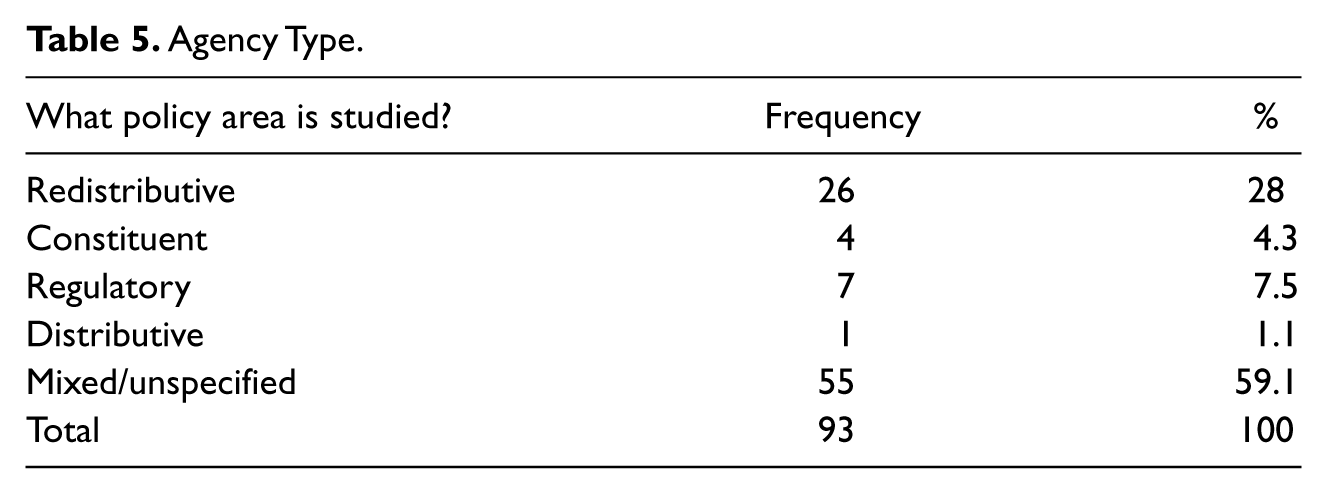
Selden (1997) argues that work measuring the link between active and passive representation has focused solely on the Equal Employment Opportunity Commission and education policy. Selden examines the Farmers Home Administration, but few other scholars provide any variation in policy area. This circumscription may also be due to the aforementioned criteria requiring bureaucratic discretion, policy decisions relevant to salient characteristics, and a way to link specific bureaucrats to decisions. Although these conditions may easily be met with redistributive agencies, the importance of representation should not be overlooked in other agency types. If representation is the key to legitimizing the overall power of bureaucratic agencies, all agency types need to be considered.
Scholars have recently begun to look at other types of agencies such as law enforcement. Meier and Nicholson-Crotty (2006) examine the relationship between the gender of police officers and sexual assault reports and arrests. The study finds that police forces with larger numbers of female officers file more sexual assault reports and make more sexual assault arrests. Wilkins and Williams (2008) examine the relationship between passive and active representation using race and racial profiling in police departments. Their study finds that increasing Black police officers increases racial disparity in vehicle stops. They argue socialization within police departments may hinder the translation of passive into active representation. The authors call for more qualitative data in this area to better understand these findings.
Other organizations that could provide insight might include immigration services, health and human services such as child protective services and mental health services, budgeting and economic development offices, and human resource compliance offices.
In addition to simply adding different types of agencies, scholars also need to compare agencies. The variations Lowi discusses (political culture, political process, elites and group relationships) may also be important in the representational context. Several scholars have used agency type to explain promotion and hiring decisions (Cayer & Sigelman, 1980; Dometrius, 1984; Newman, 1994). However, the use of this variable has been restricted to studies of passive representation. The same variables that structure hiring and promotion practices may also influence relationships between the bureaucrats within the agency and their clientele.
Measuring passive and active representation
What is the most appropriate way to measure whether an organization’s composition adequately reflects the public (passive representation)? Scholars in the field use a wide variety of techniques, including percentages (Meier, 1993a), regression analysis (Stewart, England, & Meier, 1989), Gini Index/Lorenz Curve (Meier & Nigro, 1976), and representation ratios (Selden, 1997). Some scholars argue the difference in choice of measurement is inconsequential (Selden, 1997). However, others take issue with some of the measurement choices arguing some are superior to others (Stewart et al., 1989). Measurement issues are further complicated by the lack of a consistent definition. According to some definitions, passive representation should be measured by the percentage of bureaucrats within an agency as compared with the population at large. According to other definitions, specific agencies should be compared with the specific population they serve. This may distort any attempt to aggregate data or make an overall evaluation of representative bureaucracy.
There are also important questions over how to best measure active representation. Most work has focused on policy outputs at the aggregate level. Such studies have provided valuable information about the relationship between passive and active representation, deepening our understanding of the effects representative bureaucracy can have on democratic governance. However, this view may mask unsuccessful attempts at representation, and it may obscure the sources of substantive benefits.
Saltzstein (1979) explains there is disagreement over what constitutes substantive representation. One perspective suggests substantive representation occurs if the interests of groups have been adequately articulated, whereas another suggests substantive representation requires increases in tangible advantages to the group. Contemporary scholars typically take the second approach, measuring active representation primarily through policy outputs that provide identifiable benefits to the group. Does active representation occur when attempts are made to articulate interests or when these attempts are successful at attaining a tangible policy output? Examining instances of failed attempts to represent could provide critical information about the context in which active representation occurs.
In addition, Lim (2006) argues contemporary studies have taken a short-sighted approach to the sources of substantive benefits from passive representation. Lim distinguishes direct and indirect sources of benefits. Direct sources of representation result from the actions of the bureaucrat in question. He argues this is where most contemporary studies focus their attention. However, he contends there are multiple indirect methods by which active representation may occur. Indirect methods occur by influencing the behavior of others—either others in the organization or constituents’ behavior. For example, a minority bureaucrat may express disapproval of discriminatory behavior. Perhaps more important, they may also prevent discrimination through prior restraint, where bureaucrats resist acting on their biases for fear of disapproval or exposure by minority bureaucrats. In addition, increasing the number of minority bureaucrats may lead to resocialization, whereby over time the minority bureaucrats may actually change values and beliefs of nonminorities in the organization. Minority bureaucrats may also lead to positive outcomes for their social groups by influencing the behavior of the client through either demand inducement and/or coproduction. Under demand inducement, the presence of minority bureaucrats stimulates demand for services from minority clients. Coproduction leads to behavioral changes among minority clients that can improve program outputs and effectiveness for clients. These indirect methods merit further attention.
Theobald and Haider-Markel (2008) argue that the use of policy outputs and aggregate data is problematic for distinguishing between direct and indirect representation. In studies finding links between active and passive representation, the output could be due to active representation, the acts of nonminority bureaucrats, or different behaviors from the recipient group. Looking at citizen perceptions of police officers, they find that passive representation leads to higher perceptions of legitimacy of police actions. In other words, Blacks are more likely to perceive the actions of Black officers as legitimate, whereas Whites are more likely to perceive the actions of White officers as legitimate.
Meier and Smith (1994) also address the question of active representation from an interesting perspective. One typical area of interest is how increasing representation among elected officials leads to enhanced passive representation in the bureaucracy. Meier and Smith call this the top–down model and suggest there is also a bottom–up relationship. Analyzing Florida school districts, they find minority employment is a causal variable increasing the election of minority politicians. Thus, they conclude minority employment may lead to enhanced political representation that could in turn lead to substantive policy representation.
The current analysis coupled with discussions by scholars such as Lim (2006), Meier and Smith (1994), and Theobald and Haider-Markel (2008) suggest a more nuanced understanding of the relationship between passive and active representation is needed. The theoretical framework and empirical lens by which we analyze active representation should be expanded. Attention should be directed toward exploring other potential sources of passive representation, including unsuccessful attempts, indirect representation, coproduction, and demand inducement. The development of alternative data sources may be necessary to explore these questions. This is another area where qualitative analysis may be useful. Case studies and interviews allow representation to be studied without the necessity of tangible policy outputs. Qualitative analysis may also indicate what types of alternative data sources could be used in future studies.
Quantitative Analysis
One factor potentially contributing to these limitations is an overreliance on quantitative data and analysis. Such analyses have yielded crucial information about the makeup of bureaucratic agencies and critical information about the relationship between passive and active representation. However, overreliance on these measures has (perhaps artificially) circumscribed analysis and interpretation. Table 6 shows the distribution of methodologies. A sizeable majority (65%) are quantitative. Furthermore, only 16% of the works have qualitative and empirical components. The remaining pieces are completely theoretical.
Method.
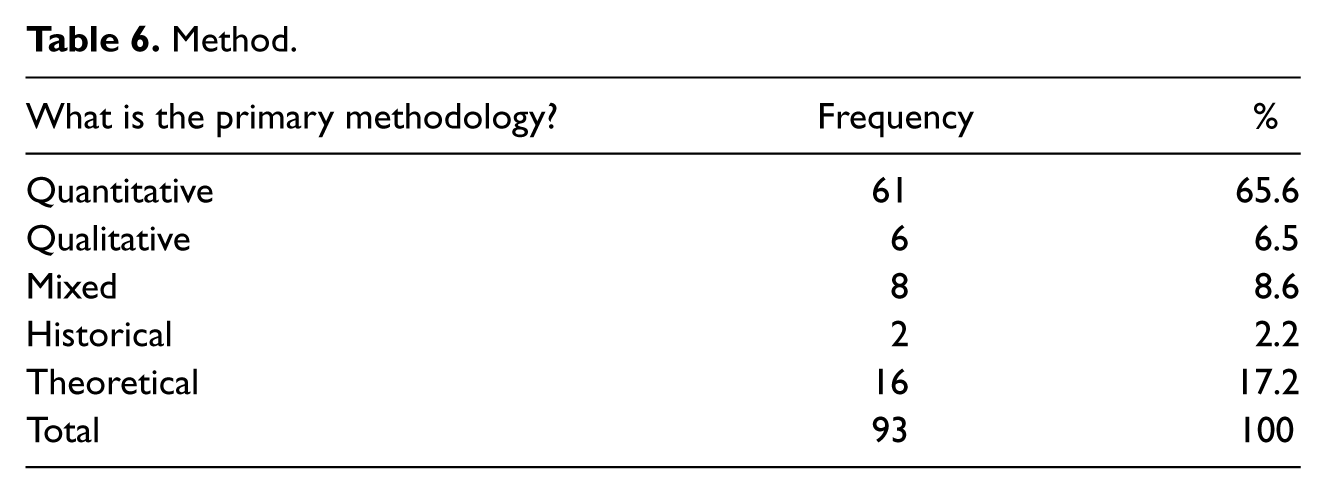
Qualitative methods such as interviews and focus groups often lend useful insight into areas that need theoretical improvement (Putnam, 1993). Qualitative analysis may allow scholars to develop a more consistent definition of representative bureaucracy. Through interviews and focus groups, scholars should explore how bureaucrats perceive the concept of representation.
The heavy use of quantitative data may have potentially skewed the bureaucrats and policy areas studied. Schools and agencies such as Farmers Home Administration have easily accessible quantitative data that readily lend itself to analysis. However, there are a wide variety of other agencies and bureaucrats that may provide further insight. Scholars could interview and observe bureaucrats in a variety of settings to discern their role in the process of representation. This could also facilitate comparison at various levels and policy areas.
The overly positivist approach may also contribute to a narrow understanding of the relationship between passive and active representation. The choice to focus on race and gender may be because these are identifiable and quantifiable categories. Other characteristics such as sexual orientation may be undisclosed making their study more difficult. However, if these characteristics influence representative bureaucracy, then attention should be directed toward trying to develop measures that can capture this relationship. Again, qualitative studies can provide insight into what characteristics are important in the process of representation.
Win-Win or Zero-Sum?
There is a substantial amount of work highlighting the positive effects of representative bureaucracy. However, very little scholarship addresses the potential for negative consequences (Lim, 2006). The potential trade-offs may take several forms, including trade-offs between representation and other organizational goals or trade-offs between recipient groups. Although these may not outweigh the positive effects, understanding these trade-offs is critical for developing mechanisms by which to mediate them.
One potential trade-off may arise between representing specific groups in society and maintaining the public interest. Mosher (1968) repeatedly expresses the potential incompatibilities between an active representative bureaucracy and democracy. Mosher states, “It may be noted that active representativeness run rampant within a bureaucracy would constitute a major threat to orderly democratic government. The summing up of the multitude of special interests seeking effective representation does not constitute the general intent” (p. 12). Mosher concludes that representative bureaucracy has taken on a meaning that does not ensure that the general public interest will be served.
Similarly, Subramaniam (1967) questions whether the bureaucracy can adequately serve sectional and general interests. If each member of the bureaucracy represents the sectional interests he or she reflects, the overall bureaucracy will be riddled with conflict and ineffective at serving the broad public interest. What are the potential trade-offs between representing specific groups within the society and maintaining representation for the public interest broadly?
Work examining the relationship between other goals such as organizational performance, accountability, and representative bureaucracy has been limited and inconclusive. Using citizens’ evaluations and objective measures of performance, Andrews, Boyne, Meier, O’Toole, and Walker (2005) find that representative bureaucracy is largely associated with poor performance on both measures. Looking at school districts, Pitts (2005) compares the effects of increasing representation among administrators and teachers on performance, and finds increasing representation among administrators leads to positive results but among teachers produces negative results. More analysis is needed to evaluate the effects of representative bureaucracy and organizational performance.
Representative bureaucracy has been advanced as a way to ensure bureaucratic responsibility despite a lack of formal accountability (Dauda, 1990; Krislov, 1974; Saltzstein, 1979). However, very little representative bureaucracy research discusses accountability, and fewer examine the relationship between accountability and representative bureaucracy. Daley (1985) analyzes administrative, executive, and legislative attitudes on the relationship between representative bureaucracy and accountability. Interestingly, the results suggest administrators believe increasing representative bureaucracy has a negative effect on accountability. This question merits further attention.
Another potential concern is whether the benefits to one group come at the expense of another group. Slack (2001) argues that policy making within the bureaucracy often occurs with a zero-sum perspective that produces clear “winners and losers.” This tendency is particularly pronounced when resources are scarce or perceived by the participants as scarce. The literature measuring trade-offs between groups is limited, contradictory, and ultimately inconclusive.
Meier et al. (1999) analyze the distributional equity between groups as a result of representative bureaucracy. The piece specifically asks whether minorities gain at the expense of nonminorities. Looking at the effects of increasing Black and Latino teachers on student performance, they conclude increasing minority teachers enhances student performance across all groups. Therefore, both minorities and nonminorities benefit from representative bureaucracy. Nielsen and Wolf (2001) question this conclusion, explaining that Meier et al. have a variety of methodological weaknesses, including measurement and specification errors. They claim the data actually indicate student performance declined across all groups as minority teachers increases. In response, Meier, Eller, Wrinkle, and Polinard (2003) stand by their conclusions arguing Neilson and Wolf’s analysis is based on “misguided estimation strategies, erroneous results, and an inattention to existing theory and scholarship” (p. 616).
After this important exchange, there is curiously little attention paid to this question. Pitts (2007) examines representation and performance among various groups. The findings suggest that there are differences among group effects of representation. The study suggests increasing representation among minority teachers has positive effects on minority students but negative effects on White students.
The potential trade-off between groups requires further analysis. This is an area where the policy type in question is particularly important. Looking at education policy may have specific results because there are not a limited number of students who can graduate or score well on standardized tests. However, in other contexts, the policy outputs may include more finite resource distribution that may alter the overall effects toward different groups.
Another potential area of concern is the ability to transfer the concept of representative bureaucracy to other countries. Whereas the effects may be benign in the U.S. context, there may be different effects in other countries. For example, Dauda (1990) suggests that there have been negative effects from trying to attain representative bureaucracies in other countries. Looking at the case of Nigeria, Dauda explains, “There are many cases which vividly demonstrate the corrupt nature of representative bureaucracy” (p. 483). Each of these potentially negative consequences of representative bureaucracy needs further investigation theoretically as well as empirically. More attention should be aimed at exploring how the context in which representative bureaucracy occurs may influence the outcomes.
Conclusion
This article highlights accomplishments, continued progress, and ongoing weaknesses in the field of representative bureaucracy. Although a great deal of knowledge has been gained, important questions remain. Overcoming the various limitations is critical for advancing the theory toward meeting its original goal—legitimizing bureaucratic power. Areas in need of particular attention include understanding the role of descriptive representation, the effects of various organizational contexts, and potential trade-offs. One of the most illuminating ways that scholars can do this is to break down the barriers created by an overreliance on quantitative data by introducing more qualitative methods.
One avenue for research in this area is representative role perception. Very few scholars have attempted to analyze how bureaucrats see their role as representatives. The concept of role perception may allow scholars to analyze how bureaucrats see themselves (or do not see themselves) in the process of representation providing insight for future theoretical and empirical analysis and avoiding existing data limitations.
Theoretically scholars need to develop a consistent and operational definition of representative bureaucracy. Qualitative analysis may provide insight into a more meaningful way to define representative bureaucracy by providing contextual information that is currently missing. Methods such as focus groups and interviews may provide rich insight directly from bureaucrats themselves, which could inform scholars on how to proceed with future research.
In addition, scholars need to examine all potential avenues for active representation, allowing for representation without descriptive likeness as well as studying multiple characteristics. Again, qualitative analysis can aid in this area of research. Open-ended surveys, focus groups, and interviews may be crucial in identifying representation outside of the descriptive context as well as measuring alternative characteristics and allowing scholars to move beyond strict reliance on easily identifiable and quantifiable characteristics such as race and gender. In addition, the concept and measurements of active representation need to be expanded to include potential forms of indirect representation and other substantive forms of representation.
Scholars also need to broaden the organizational context in which they study representative bureaucracy by including all levels of the bureaucracy and diversifying the policy areas studied. In addition, comparative studies of the separate levels and policy areas could provide scholars with a more nuanced understanding of representative bureaucracy. Qualitative analysis can allow scholars to move beyond the limitations scholars currently face when quantifiable data do not exist.
Finally, scholars need to analyze the potentially negative effects of representative bureaucracy. To this point, research on this topic has been particularly limited in the field. These trade-offs may take a variety of forms and scholars need to examine them theoretically and empirically. Ignoring the potential trade-offs again poses problems for the concept meeting its original goal of legitimizing bureaucratic power. Potential trade-offs need to be understood to find ways to mediate them without obscuring the importance of bureaucratic representation. Until these limitations are overcome, meeting the original goal of representative bureaucracy theory, legitimizing bureaucratic power, remains elusive.
Footnotes
Declaration of Conflicting Interests
The author(s) declared no potential conflicts of interest with respect to the research, authorship, and/or publication of this article.
Funding
The author(s) received no financial support for the research, authorship, and/or publication of this article.