



Abstract
Sprawling and leapfrogging suburbs, as opposed to compact central cities, appear peaceful, clean, and safe. They appear happy and healthy. On the other hand, suburbs look and feel fake, dull, and alienating. Which one is happier and healthier, sprawling or compact areas? I discuss pros and cons of sprawling and compact counties drawing on social and natural sciences. I also perform a simple quantitative exercise—I regress several wellbeing/health measures on sprawl and density at county level. Sprawl is measured with Ewing’s index. Sprawling and low-density counties are healthier in terms of mentally and physically healthy days than non-sprawling counties, controlling for many predictors of health. I interpret it as the advantage of low-density living close to nature. Given rather unaesthetic nature of American suburbia, I argue that if we left more nature in suburbs, people living there would be even happier.
It is a common wisdom in public policy and public administration that sprawl/suburbanization is bad for people. But is it? Nobody has tested the link between sprawl/suburbanization and wellbeing—I will do it here. A major motivation for this study is to try to understand better the paradox of apparent happiness among suburbanites despite problems of sprawl: Americans prefer suburbs to big cities and are more satisfied with community and with their lives in suburbs than in cities. 1 First, let’s go back in time—why did we want suburbs in the first place?
The Problem: Old, Dirty, Crowded, Dangerous, Stressful, and Expensive Metropolis
In a rather deep hole, in a curve of the Medlock and surrounded on all four sides by tall factories and high embankments, covered with buildings, stand two groups of about two hundred cottages, built chiefly back to back, in which live about four thousand human beings, most of them Irish. The cottages are old, dirty, and of the smallest sort, the streets uneven, fallen into ruts and in part without drains or pavement; masses of refuse, offal and sickening filth lie among standing pools in all directions; the atmosphere is poisoned by the effluvia from these, and laden and darkened by the smoke of a dozen tall factory chimneys. A horde of ragged women and children swarm about here, as filthy as the swine that thrive upon the garbage heaps and in the puddles. In short, the whole rookery furnishes such a hateful and repulsive spectacle as can hardly be equalled in the worst court on the Irk. The race that lives in these ruinous cottages, behind broken windows, mended with oilskin, sprung doors, and rotten door-posts, or in dark, wet cellars, in measureless filth and stench, in this atmosphere penned in as if with a purpose, this race must really have reached the lowest stage of humanity. (Engels, 1987, p. 98)
This is how industrialization started a modern city. How did industrialization leave the city? In 2012, more than 150 years after Engels wrote the above description of Manchester, I came to Philadelphia, one of the “rust belt” (postindustrial) cities, and here are my impressions:
2
I saw in Philadelphia rotten infrastructure. There are old brick houses that are literally falling apart. In worst areas, for instance in Camden, which is a part of Philadelphia metropolitan area, there are streets where about every tenth house is either burnt down or part of it fell down. Most houses have ugly bars around the porch to prevent a burglary, many houses have either windows broken or covered with a piece of wood. There is a commuter train, PATCO speedline. It is old, dirty and quite repulsive.
3
But the attractiveness of the physical capital is secondary. What matters is people, and that’s the problem, too. There are people stumbling and lying on the streets, you have to be careful when you drive. There are many disabled people and many beggars. People push shopping carts on the sidewalks. I have seen in those carts collected cans and bottles, groceries, babies, and pets—sometimes all of them in the same cart.
4
Every time I go to work, and I only drive about half a mile through Camden, I see a beggar, often the same one, sitting on the ground, whether it rains or snows. Usually I see several beggars, some on wheelchairs. City of Camden motto is an irony: “I saw a city invincible.”
Was it all worth it to build the cities? Yes. Civilization is the cities, but we pay the price: the misery of city life. 5 Civilization’s wonders are made in cities, but so are its problems. Labor specialization, economies of scale, invention, and creativity are all made possible by high-density living (e.g., Florida, 2008; Glaeser, 2011; O’Sullivan, 2009). But high-density living also fosters crime, disease spread, stress, cognitive overload, and other problems. 6 A great achievement of our civilization is ever-increasing standard of living. Since Engels time, 1800s, standard of living has improved tremendously. By one estimate, today’s bottom decile has better standard of living than everyone, but top decile one hundred years ago (Bok, 2010). On the other hand, despite all that progress, we did not become any happier over time (Easterlin, 1974), and among all places we are least happy in cities (Berry & Okulicz-Kozaryn, 2011).
In a classic critique of city life, Wirth (1938) complained about alienation, impersonality, superficiality, lack of social support, and crime. And there is recent evidence corroborating Wirth’s complains about cities: density and heterogeneity predict lower trust (Helliwell & Wang, 2010). Trust is a measure of social capital (e.g., Putnam, 2001) and we know that social capital is good for mental health, and in general for overall health: “Socially isolated people die at two or three times the rate of people with a network of social relationships and sources of emotional and instrumental support” (Kawachi & Kennedy, 1997, p. 1038). Low social capital is associated with poor health (Kawachi, Kennedy, Lochner, & Prothrow-Stith, 1997; Subramanian, Kim, & Kawachi, 2002). And there is more direct evidence. Lawless and Lucas (2011) and Fassio, Rollero, and De Piccoli (2013) 7 find that high density predicts low happiness. Also, there is recent neurological evidence showing that city living is not healthy for our brains (Lederbogen et al., 2011). Finally, cities have high crime, and high crime predicts poor health (Lynch et al., 2004; Zimmerman & Bell, 2006).
The Solution: Soothing and Restorative Nature
The beauty of the country, besides, the pleasures of a country life, the tranquility of mind which it promises, and wherever the injustice of human laws does not disturb it, the independency which it really affords, have charms that more or less attract everybody. (Smith, 1776/1981, p. IIIi) Solitude in the presence of mutual beauty and grandeur is the cradle of thoughts and aspirations, which are not only good for life for the individuals, but which society could ill do without. (J. S Mill cited in Pretty, 2012, p. 30)
E. O. Wilson’s “biophilia” hypothesis says that humans have innate/instinctive attraction to nature/other living organisms. 8 Animals, plants, landscapes, and wilderness benefit our health (Frumkin, 2001). Exposure to nature produces positive emotions and positive affect (Mayer, Frantz, Bruehlman-Senecal, & Dolliver, 2009). People want to be close to nature: Being close to nature is not only aesthetic, but also soothing and restorative—it helps to escape city turmoil. In short, contact with nature improves health. An excellent review of benefits coming from contact with nature is Pretty (2012), which is briefly summarized in the following paragraph.
Nature helps us recover from pre-existing stress, immunizes and protects from future problems, and helps us concentrate and think more clearly. There are likely to be evolutionary reasons for it—We have lived close to nature for almost all human history; it’s only past few hundred years, since industrialization, that we have abandoned nature. Why do we need nature? Nature provides sensory stimulation: colors, sounds, smells, and so forth. Humans have a need for connection (bond) with nature. It is almost spiritual. Physical activity and manual tasks in natural settings (e.g., chopping wood, building a fire) provide enjoyment. Green spaces increase life expectancy and decrease risk of mental health problems. Even window views and gardens have health benefits: fewer illnesses, less frustration, and more patience. Pretty (2012) cites Gary Snyder: “nature is not a place to visit, it is home”—and this is the message of his book.
The Contemporary Suburban Solution: Asphalt, Malls, Landscaping, Pools, Fountains, and McMansions (aka Cookie Cutter Housing)
We must create the mass-production spirit. The spirit of constructing mass-production houses. The spirit of living in mass-production houses. The spirit of conceiving mass-production houses. (Le Corbusier, 1985, p. 228)
Suburbs look and feel fake and they are fake 9 —they did not develop naturally, but were engineered to look as good as possible at prices as low as possible, like fast food. Hence the name for the suburban housing: McMansions (like McDonald’s). Why do people live there? You get the best value for your dollar: new construction, lots of space, not much noise, low rent, low crime, good schools, and so forth. But, like at McDonald’s, there are “unanticipated” (we don’t realize them) bad consequences: traffic, congestion, long commute, environmental degradation, and so forth (Duany, Plater-Zyberk, & Speck, 2001). 10 Americans have a “love of newness” and a desire to be “next to nature” (Berry, 1976). But what came out of this love and desire is “fake” nature: just look around suburbs, fountains in fake ponds and fake trees around them. By fake I mean human-made/human-planted. 11 It defeats the purpose. Sprawl takes up the space that was covered by natural nature. Natural nature means nature that was not altered by humans. A fundamental problem with suburbanization is waste—We destroy nature and replace it with fake nature, and we also leave the infrastructure unused in the city, let it deteriorate, and build the new infrastructure from scratch outside of the city (e.g., Duany et al., 2001). A balanced overview of goods and bads of sprawl can be found in Frumkin (2002). To summarize, sprawl means more nature than city living, but it also eats up lots of nature for highways, parking lots, strip malls, and McMansions: We need smart sprawl; leave as much of nature as untouched as possible.
Escaping Engels’ Manchester to nature we ended up with nature caricature, a contemporary suburb. 12 How did it happen? I already gave one explanation: best value for your dollar—shiny, roomy, and luxurious, yet cheap construction is what sells well. A related explanation is consumerism (Veblen, 2005a, 2005b). You can consume more and more cheaply in suburbs than in the cities. The bad news is that consumerism/conspicuous consumption does not result in a lasting happiness. Material possessions, such as SUVs and McMansions, at which sprawling suburbia excels, don’t make you happy—you are on hedonic treadmill, and you adjust to material possessions. We should buy experiences (bowling, vacations, etc), not things (Louis Vuitton handbags, Lexuses, McMansions, etc.). According to economic theory, the burden of commuting is chosen when compensated either on the labor or on the housing market so that individuals’ happiness is equalized. But people with longer commutes are less happy (Stutzer, Frey, & U. Z. I. fur Empirische Wirtschaftsforschung, 2003). Actually, commute is the least enjoyable thing you can do (Kahneman, Krueger, Schkade, Schwarz, & Stone, 2004). 13
Many (if not most) suburban houses, SUVs, Louis Vuitton handbags, and so forth are positional goods—You buy them to have a better position in a society, not to have a better quality of life. But the problem with positional goods is that acquiring them leads to consumption arms-race. You can never win—You are on hedonic treadmill. Due to this arms-race, we ended up with ridiculously big and expensive McMansions, SUVs, and other building blocks of American suburbia. Even worse, we adapt to big houses and shiny cars, but they don’t make us any happier after some time, and in a vicious cycle we need ever bigger cars and houses. But we don’t adapt to our commutes; it consistently makes us miserable (Frank, 2005).
America is suburbanizing: Over the 20th century, the share of population living in central cities went up from 20% to 30%, while the corresponding increase for suburbs is 10% to 50%. Today, more than half of the population lives in suburbs (Hobbs & Stoops, 2002, p. 33). 14 And we’re actually doing the opposite of what we should do to increase happiness: We pour more concrete, instead of leaving nature untouched. The median square footage of a single-family home built in the 1960s or earlier is 1,500 square feet, and a corresponding number for houses built between 2005 and 2009 is 2,200 square feet—our houses are 50% bigger than in the 60s. At the same time, the median lot size remained flat at 0.25 acres, so we have more concrete and less nature. 15
To summarize, we escaped Engel’s Manchester to nature, but due to irrational consumerist drive, we ended up with contemporary suburbs. Now the problem is that scholars mistakenly, I think, advocate to go back to cities (Dreier, Swanstrom, & Mollenkopf, 2005; Duany et al., 2001; Jacobs, 1993). Ed Glaeser recently pronounced “Triumph of the City: How Our Greatest Invention Makes Us Richer, Smarter, Greener, Healthier, and Happier”—the last two “healthier and happier” appear false. People are happier in plastic-fantastic contemporary suburbs than Glaeser’s triumphant cities. This was the point of this section to show that suburbs have many problems, yet people are happier there than in cities. Humans want to be close to nature, and by definition, you cannot have much nature in cities, but there could be more nature in suburbs.
Data
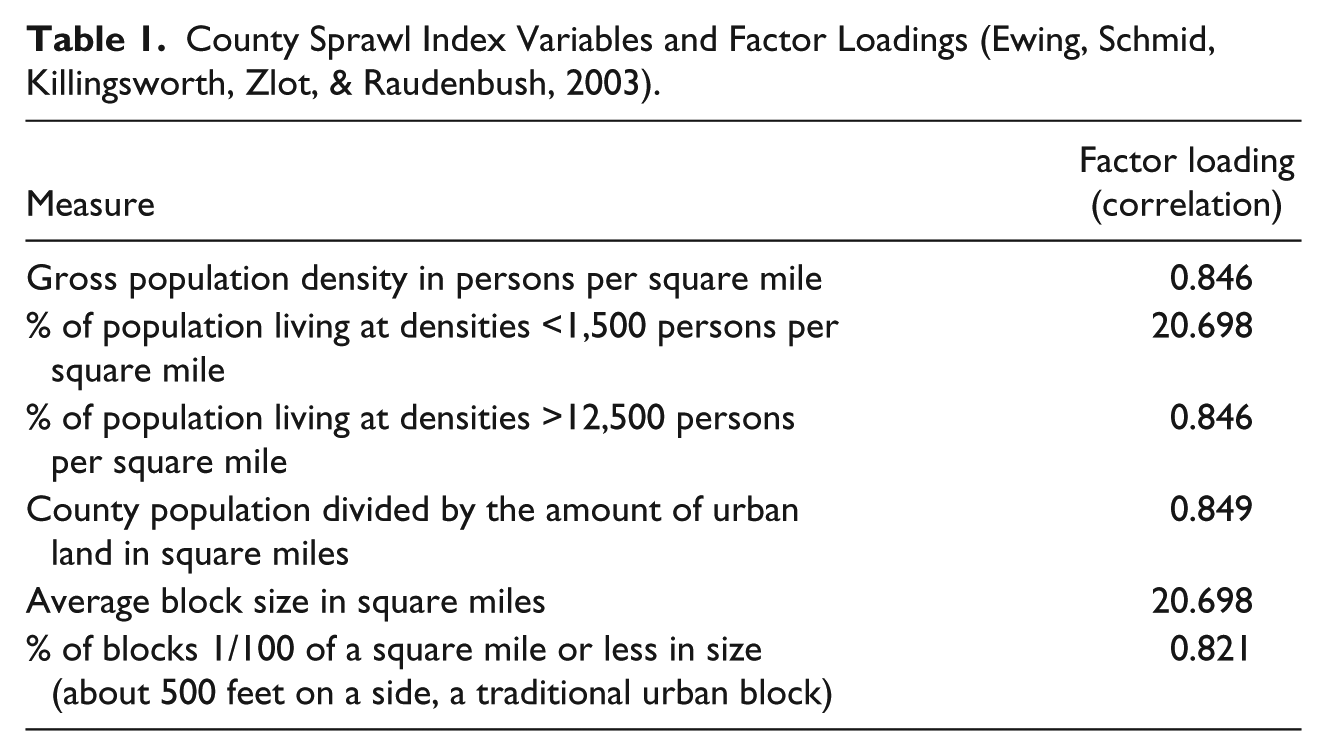
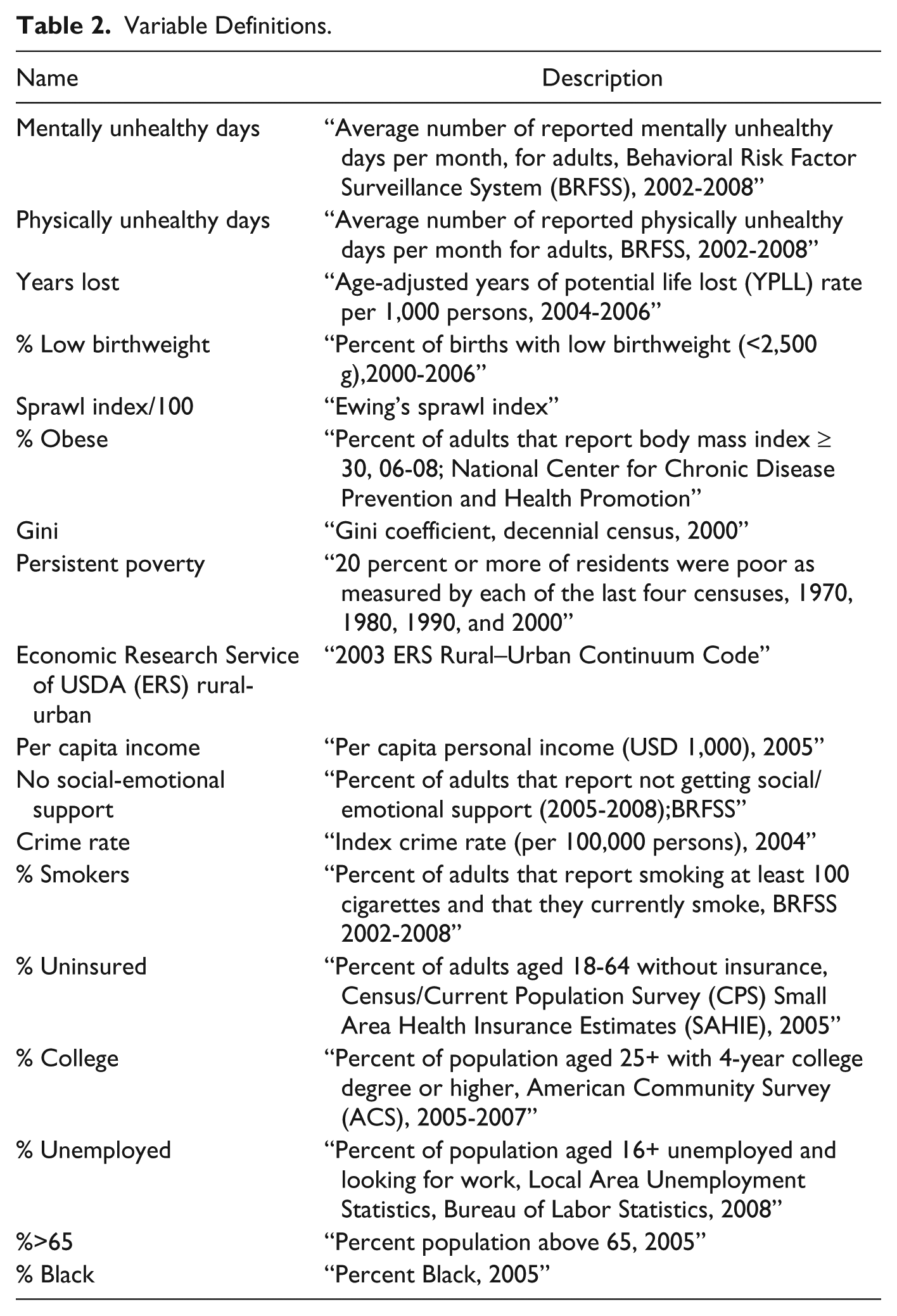
I measure sprawl with Ewing’s (2003) index: Its components are shown in Table 1. Wellbeing is measured using the County Health Rankings data set and I supplement it with data from ICPSR Study No. 20660. Data sets are described in the data appendices. The main variables are defined in Table 2, and variable distributions are shown in the appendix. Many variables are measured over time interval, which makes them more reliable, because these measures are estimates, not the actual values (they have a confidence interval).
County Sprawl Index Variables and Factor Loadings (Ewing, Schmid, Killingsworth, Zlot, & Raudenbush, 2003).
Variable Definitions.
Results
Analysis is at county level. First, I focus on MSAs (Metropolitan Statistical Areas) only and look at sprawl. There are about 1,000 metropolitan counties. Later I will look at all counties, about 3,000 of them. 16 In the choice of controls for regressions, I follow Ewing, Schmid, Killingsworth, Zlot, and Raudenbush (2003). I add few more controls: Older people may disproportionally live in low-density areas (>65%). There may be a difference in income inequality (Gini index) between compact and sprawling areas, and income inequality may affect wellbeing (Kawachi & Kennedy, 2006). Compact areas may be miserable because there are poor people stuck there (persistent poverty), and of course, poverty depresses wellbeing. Heterogeneous areas (% Black) have lower trust (Luttmer, 2001; Luttmer & Singhal, 2008) and trust predicts higher wellbeing (Putnam, 2001). Finally, I control for crime and lack of social support that predict lower wellbeing (Kawachi & Kennedy, 1997; Lynch et al., 2004; Zimmerman & Bell, 2006), and they are also likely to be lower in dense areas than in compact areas. 17 The purpose of controlling for the above factors is, of course, to show that there is an independent effect of sprawl/density on wellbeing/health in addition to these factors. Results are set in Table 3.
Ordinary Least Squares Regressions of Various Health Measures (State Dummies Included).

p < .05. **p < .01. ***p < .001; robust standard errors.
The higher the value of the sprawl index, the more compact is the place. 18 There is a highly significant effect on mental and physical health: The more compact the place, the more unhealthy are people.
In the second step, I look at about 3,000 counties. And instead of sprawl index, I will use density—they correlate at 0.8. I expect results to be similar and if anything more significant due to more observations. Results are set in Table 4.
Ordinary Least Squares Regressions: Density Instead of Sprawl (State Dummies Included).
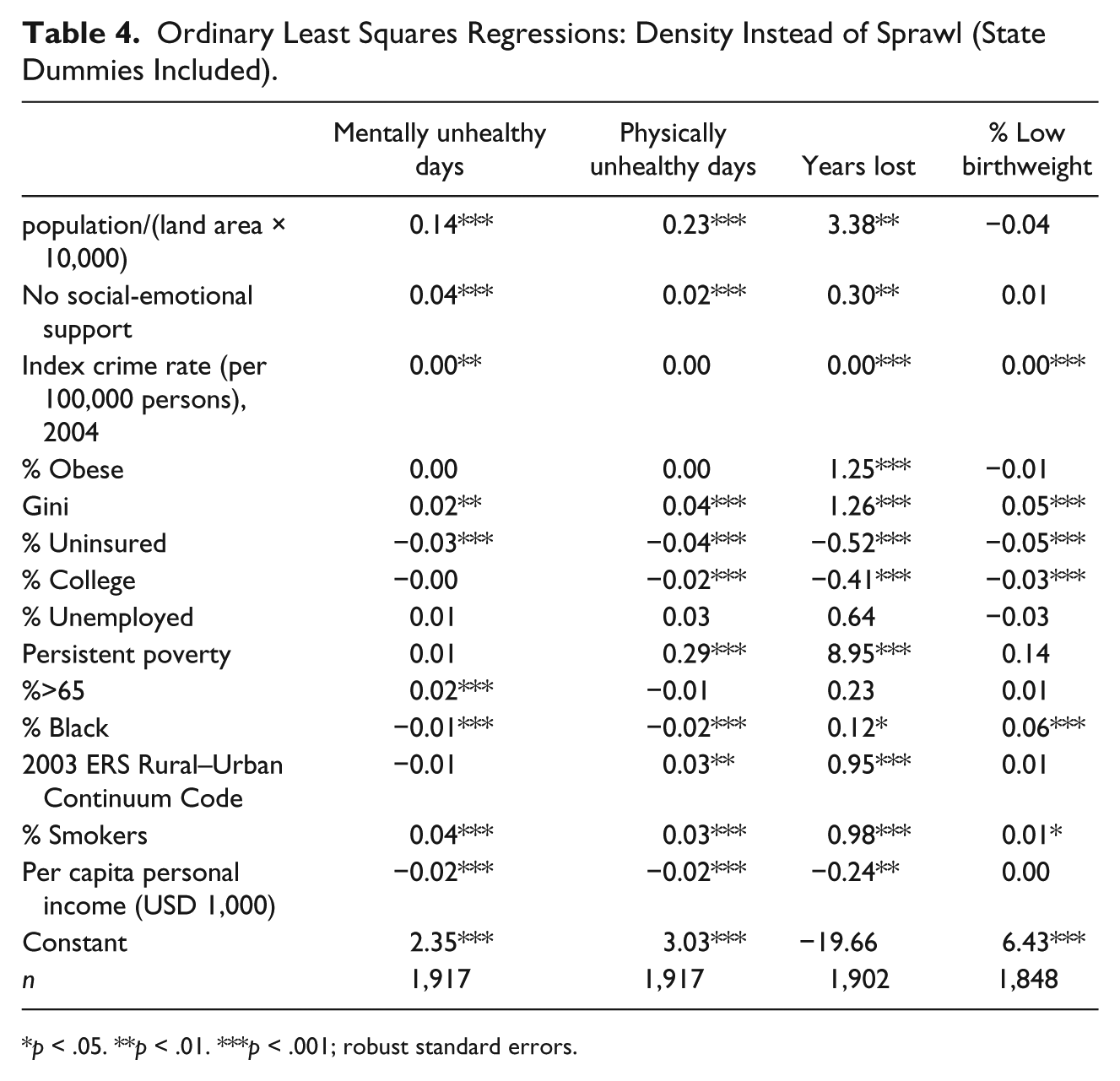
p < .05. **p < .01. ***p < .001; robust standard errors.
Results are similar to those for MSAs, except that now there is also a significant effect of density on years lost. 19 What have we learned? Both cities and suburbs have their problems, 20 but people are happier in less densely populated areas, and policy makers should take a note: People want low-density living.
Sprawl is treated as a problem by policy makers. A popular and reasonable strategy to deal with it is so called “smart growth” (http://www.smartgrowthamerica.org). It promotes high-density living and redevelopment of cities. It is a reasonable strategy, but it misses the point that I am trying to make here that people who live in low-density areas are likely to be happier, despite commute and “fake” feel of contemporary American suburbia. If we could redevelop low-density areas by retaining more nature there, people would be even happier there. 21 My point is that you can stay eco-friendly while living in suburbs, but you cannot have lots of nature in cities. 22 Reynolds (2002) is one example of a discussion of how suburbs can be nature friendly. I believe that we can have natural suburbs and I think that most people know such suburbs. I know several: Prairie Creek Dr. in Richardson, TX, feels quite natural as opposed to fake River Rock Ln in Plano, TX, or Maidens Castle Dr., Lewisville, TX. Again, the rule is to leave the nature untouched as much as possible, to keep the nature natural, instead of building fake ponds with fake fountains and plant fake trees around it. Given that people are still happier in these fake, ugly, and unnatural suburbs than in big cities, we will have even more happiness if we have natural suburbs. 23
Limitations
Does sprawl and low density make us healthier and happier? I do not answer this question here. This study is ecological (county level), not causal. Counties and MSAs are big areas. Most counties include some urban, suburban, and rural areas. There are population density data at lower resolution, but there is a problem with health and wellbeing measures and some of the controls at lower resolution. There is no sprawl index at lower resolution, either.
Footnotes
Appendix
Declaration of Conflicting Interests
The author(s) declared no potential conflicts of interest with respect to the research, authorship, and/or publication of this article.
Funding
The author(s) received no financial support for the research, authorship, and/or publication of this article.