




Abstract
A national financial collapse can engender a heightened gubernatorial sense of accountability, leadership, and learning. An attempt at theory building on this theme uses governors’ 2009 speeches as an historical artifact and policy document recording the kind of rhetoric they employed during the “Great Recession.” A quantitative analysis reveals correlations between gubernatorial characteristics and rhetoric. A qualitative approach yields gubernatorial constructs of accountability, leadership, and learning at a time of crisis. The results offer a foundation for further theory building using cross-sectional and longitudinal data.
Introduction
As the year 2009 began, 29 Democrats and 21 Republicans stood at the helm of state governments throughout the United States. Most had served more than one term; a higher percentage on their first term was Democrats. Most possessed prior experience in elective office or private management. Some were presiding over unified state assemblies; some had preceded governors of the opposing party. In the White House, the first African American President, a Democrat, had just been inaugurated. All of them were confronted with the longest, worst recession since the Great Depression (Center on Budget and Policy Priorities [CBPP], 2013). This is an exploratory study of gubernatorial accountability at a time of crisis, in particular, the extent to which accountability, learning, and policy response themes dominated their State of the State (SOS) addresses in 2009, and if these themes correlated with certain gubernatorial characteristics.
The 2009 speeches were chosen because they were given in the year when governors had acquired a full sense of the recession’s magnitude and had to publicly address it in a formal venue. Without aiming to generalize beyond this critical period, we assumed that 2009 could suggest some potential relationships between gubernatorial attributes and leadership pronouncements as well as allow us to speculate how rhetoric might adapt in the face of extraordinary crisis. More a theory-building effort, this study does not examine gubernatorial rhetoric in a historical context, but we intend to carry this forward. The current study is limited in that it takes a snapshot rather than long-term analysis of state leadership, serving as our exploratory platform to refine future research.
The governors delivered SOS addresses to their legislative assemblies around January of that year. These annual speeches combine broad policy priorities and specific legislative goals and reflect a governor’s leadership style, strategy, or philosophy of governing, ideological stance, and approach to communicating with the public (see Coffey, 2005; Dileo, 1997; Ferguson, 2003; Jackson & Kingdon, 1992; Segal & Cover, 1989; Van Assendelft, 1997). For this article, the 2009 speeches are treated as artifacts that captured portraits of accountability and learning at a pivotal moment of fiscal leadership. “Words matter” (Crew & Lewis, 2011) and understanding political leadership also calls for looking at the way solutions are sought for the state’s problems (Crew, 1998). In this article we ask, how were accountability and learning expressed during fiscal stress? Were budget lessons imbibed, framed, communicated to the public, and/or applied as policy response? Were personal, political, and institutional variables associated with these pronouncements?
Accountability During a Fiscal Crisis
Our research framework inquires about gubernatorial claims of control over solutions for local budget or economic challenges. Accountability, however, presupposes powers or control over the factors that would allow one to account for performance. Scholars have noted the weak control that governors wield over the economic conditions of their state (Forsythe, 2004; Rosenthal, 2013), which the Great Recession put on display. The National Council of State Legislatures found that the recession’s impact on revenue collections contributed to state deficits totaling $62.4 billion (Conant, 2010b).
States are often seen as surfing good or bad national (and increasingly global) economic waves (Forsythe, 2004). Phil Bredesen, Tennessee’s governor, invoked this in his 2009 speech with the sailor’s adage, “You can’t control the wind, but you can adjust your sails. We can’t control the national economy, but we can make the adjustments that let us ride it out.” Globalization has also weakened fiscal policies and reduced governmental actors’ control within their geographical boundaries (Brand, 1992). Past miscalculations by officials also do not help: the Center on Budget and Policy Priorities notes that economic problems tend to be magnified by structural weaknesses caused by poor decision making in the past (as cited in Conant, 2010b).
Accountability for righting the deep imbalances in the states’ budget positions calls into review gubernatorial powers as described in the literature. Some argue that the institutional, organizational, and popular advantages of the governorship may exceed those of the U.S. President and that governors have amassed more power over time, due to devolution (Heidbreder, 2012). The work of Ferguson enjoins us to view gubernatorial action and efficacy within a larger framework of powers that the institution confers upon state leaders. Ferguson (2013) defines institutional power as
those powers given to the governor by the state constitution, state statutes, and the voters when they vote on constitutions and referenda . . . these powers are the structure into which the governor moves after being elected to office. (p. 220)
To Ferguson (2013), institutional power may be indexed by combining the tenure potential of the governor in office, appointment power, budget power, veto power, party control, and whether officials of the state government are separately elected. This framing later on helps in the design of our research. Each variable is important, and with the context of the Great Recession, we here focus on the fiscal or budgetary powers of the governor, and the role that rhetoric may play in this repertoire of powers, when times become more turbulent.
Traditionally, governors are viewed as “chief legislator” in political science literature (Bernick & Wiggins, 1991, as cited in Heidbreder, 2012). Governors are seen as having more authority in state fiscal policy than state legislators (Anton, 1966; Howard, 1973; Schick, 1971, as cited by Hale, 2013), in large part because they tend to be more visible and seen as being out front in the development of the legislative agenda (Bernick & Wiggins, 1991, as cited by Taylor, 2012).
Power can come from having the sole authority to produce revenue and expenditure estimates in the state (Lauth, 2010) compared to other places where governors must collaborate with legislatures (Wallin & Snow, 2010) to trim allotments to agencies in response to lower revenues or higher expenditures (Dautrich, Robbins, & Simonsen, 2010) and to make “course corrections” to the budget in the midst of the budget biennium (Conant, 2010a). The line-item veto power as well as gubernatorial potential to remain in office for longer periods of time were previously associated with a governor’s ability to accomplish outcomes (Sharkansky, 1968, as cited in Crew & Lewis, 2011). While gubernatorial leadership is important, fiscal responsibility can only be achieved in a bipartisan environment (Hale, 2013). Lacking such an environment, governors may turn to tactics to dodge fiscal accountability (Krause & Melusky, 2012).
Rhetoric in the Repertoire of Gubernatorial Powers
In trying to improve the fiscal health of the state, governors can turn to another medium: the bully pulpit (Heidbreder, 2012), under which we can place the “SOS” speeches. For many citizens in a state, the governor is the face of the government (Gross, 1991; Herzik & Brown, 1991; Rosenthal, 1990, as cited in Carpenter & Hughes, 2011). Governors hold a number of advantages when it comes to using the pulpit: They can put issues on the agenda, mobilize media access, and create a shift in public awareness (Kunin, 1990; Mazzoni, 1995, as cited in Carpenter & Hughes, 2011).
SOS speeches, our focus on this article, often contain a combination of broad policy goals and specific legislative goals, and also reflect the governor’s style of leadership, strategy or philosophy of governing, ideological position, and approach to communicating with the public (see Coffey, 2005; Ferguson, 2003; Jackson & Kingdon, 1992; Segal & Cover, 1989; Van Assendelft, 1997). They tend to be valid indicators of gubernatorial ideology on economic and social issues, within and across parties (Coffey, 2005).
Gubernatorial addresses have been found to forecast validly the type of policy later pursued (Carpenter & Hughes, 2011; Ferguson, 2003). Placement of agenda items on the speech also indicates what governors considered more important (Crew & Lewis, 2011). In addition, rhetoric that emphasizes enthusiasm and activity increase gubernatorial potential for legislative support and overcoming political and institutional barriers (Crew & Lewis, 2011).
One author who believes that SOS speeches are inadequate proxies for studying the real agenda of governors is Rosenthal (2013): In his view, some agenda items may not have been formulated by the time of the governor’s address, some items are included for strategic purposes, and, the long address lends itself to very general enunciation of policy initiatives. Some of those items serve as “political or symbolic weight” (Rosenthal, 2013, p. 91). Nonetheless, symbolism can be powerful in a time of crisis.
While governors continue to possess a number of advantages, a trend of erosion in gubernatorial powers over the last few decades has been observed (Abney & Lauth, 1998; Dometrius & Wright, 2010; Goodman, 2007; as cited in Krause & Melusky, 2012). Political and economic conditions constrain a governor’s ability to get something on the agenda or keep attention on it (Heidbreder, 2012). This can lead governors to increasingly rely upon political rhetoric to bolster the perception of their power, or avert blame during dire economic situations. The allure of demonstrating relevance is observed to be often behind actions engaging in symbolic politics, credit claiming, and position taking (Hansen, 1999). Governors routinely use SOS speeches to claim credit for positive developments or to distance themselves from mistakes (Heidbreder, 2012). Reforms may be floated to provide political cover.
These prompt us to explore if symbolic or rhetorical accountability compensates for a perception of weak control during a time of recession and political polarization, if accountability leans outward, and if lessons learned are effectively expressed. Rosenthal (2013) seems to argue that budget addresses in and of themselves are an exercise in symbolism over substance. Our study is an attempt to determine to what degree the governor attempts to utilize the speeches to account for and/or propose actual goals.
The theme of learning is pursued here as well due to the dearth of empirical studies that tell us how governors conceive of their jobs as they perform them and how they learn as they lead. In Rosenthal’s (2013) book, we see glimpses of formers governors recalling, in memoirs, that nothing really prepared them for the job; that they all “learned on the go.”
Ideally, leaders learn, over time, what fiscal measures work or do not work for the states, and their personal ways of finding solutions. That is in turn assumed to be communicated to the public to show that leaders cultivate wisdom in “laboratories” of innovation and democracy. Governors must educate, especially when creating public understanding of the gubernatorial agenda could give them some political advantage over the legislature in negotiations over budget directions (Rosenthal, 2013, p. 156).
With this basis in literature, this study examines the rhetoric of U.S. governors in the year 2009 for references to accountability, leadership, and learning, as they respond to an enormous crisis. If governors were ever in need of rhetorical strategies to bolster the perception of their power, it was during the Great Recession.
Research Data and Methodology
The analysis was conducted in two stages. The first involved the qualitative coding of the speeches (Stateline.org, 2009) based on themes and unique subject areas, to make sure we had a full understanding of our data and how it might be used for the purpose of content analysis. Once it was established whether and to what degree such themes were present, we were able to engage in a more quantitative analysis of rhetoric and gubernatorial characteristics. Establishing the presence of the coded themes and how we conceptualized them will allow the reader to better evaluate the statistical findings once they are presented.
We loaded the 2009 SOS speeches from all 50 governors into the Provalis Research QDA Miner program and coded for the themes. Table 1 shows how the themes were defined, based not only on the literature but also how they emerged, in context, from the data, as qualitative research method requires (Rubin & Rubin, 2011). These were then elaborated into categories or sub-themes to code the sentences in the speech.
Code Segments Used in Content Analyzing the Speeches.

As an exploratory study, we incorporate our assumption, based on the literature that some independent variables may be associated with the governor’s speeches, but rather than testing causation and directions of influence, we are merely interested, within certain parameters, in finding what relationships would emerge. Considering the environment in which governors must exhibit leadership qualities, it is possible that some political variables are associated with their responses to the crisis. These variables are enumerated in Table 2.
Descriptions of Gubernatorial and State Variables.

This research utilized two qualitative analysis software programs—QDA Miner and Sim Stat. The QDA Miner program allows researchers to more easily explore texts to code the texts for particular themes. Variables can be computed based on the frequency with which a code appears in a document, the number of words used to discuss a particular code in the document, and the percentage of the total words in the document used to discuss a particular code. We focused on computing the frequencies with which the code segments appeared in the document, and used them to further draw some insights on gubernatorial accountability and learning.
Statistical analysis on coded data was made possible through the Sim Stat program. While correlation is not indicative of causation and this study only measures the messages of U.S. governors at one particular moment, the two-pronged approach of qualitative analysis of the speeches and correlation analysis of coded segments with gubernatorial characteristics provides, in our view, a meaningful assessment of state leadership at a time of national crisis.
The results of the quantitative analyses are provided in Tables 3 and 4. Throughout the findings sections that follow, we will highlight the statistical results that have significance after discussing the broader context of the different themes that emerged from the qualitative analysis.
Correlations Between Gubernatorial Variables and Accountability Themes.

p<0.05, **p<0.01.
Correlations Between Gubernatorial Variables and Learning and Response Themes.

p<0.05, **p<0.01.
The Anatomy of Blame and Accountability
Budgeting is conflict ridden; in this context, we attempt to find how worldviews, leadership, and learning processes were expressed; what kind of control and responsibility governors perceived they had; and whether they blamed forces outside themselves.
Blaming Other Governments, Sectors, and Actors
According to Rosenthal (2013, p. 73), “One reason that governors assume responsibility is that they cannot escape it,” and that “when it comes to fiscal policy, in particular, the governor will be blamed (not the legislators).” Yet in 2009, the White House and federal actions loomed large in the national political psyche. Many governors blamed Washington, D.C., or the federal government for their budget and economic difficulties. Some attributed the origins of the economic woes to Wall Street or private corporations and the boom and bust market cycle. Other entities that were linked to budget woes were employee unions/bureaucrats, and local governments, including school districts. The recession also provided some governors grounds to tie anti-tax sentiments to anti-bureaucratic sentiments. For example, some governors decried the growth of school administrators/staff count relative to student enrollment; the ratio of overhead budget to teaching budgets; the lack of accountability among school heads; and the un-sustainability of the benefits of unionized teachers and other public employees. Some governors linked the fiscal problems to previous sets of officials (governors and/or legislators). Some also blamed previous governors and previous legislators, confirming the partisan split in state houses and capitols across the nation.
Correlation analyses provide support for the notion that personal and institutional variables were associated with the use of particular rhetoric. Political party was significantly correlated (negatively) with Blame Avoidance, Blaming Washington, and Blaming the Bureaucracy (indicating that Democrats used this rhetoric less than Republicans). Whether the governor was new or had served a previous term had a positive association with Blaming Washington, indicating that governors with more experience were more likely to hold the federal government accountable for economic conditions. The level of institutional power a governor possessed in his or her state relative to the legislature was positively associated with blaming budgetary problems on the private sector, indicating that possessing higher levels of constitutional and statutory power did not mean that some governors did not look for others to blame. However, a negative association showed between the institutional power and Blaming Special Interests. Previous legislative experience in the state legislature or Congress was negatively associated with Blaming the Previous Administration for the budget crisis.
Blaming the System
The use of the passive tone (blame avoidance) by the governors involved talking about this “system”—of uncontrollable mandates, external economic forces, uncontrollable debt and spending, service demands, and inflexible rules. Some spoke of government in the third person, extricating themselves, such as: “ . . . in these difficult times, they are skeptical of the ability of government to solve the very real problems they read about and are living with every day” (OR).
Statistical analysis indicates that whether or not a state has a progressive income tax system was negatively associated with Blaming the Private Sector. This could be interpreted in a couple of ways. One interpretation could be that in states with more progressive systems, there is a greater perception that the wealthy do pay their fair share. Another interpretation would be that, in times of economic hardship, governors choose not to antagonize those that could potentially help spur the economy.
The theme of Blame Avoidance consists of some sub-categories of the justifications (Figure 1).
The state as a victim. Some conjured the image of hapless citizens swept by an economic tornado “through no fault of their own.” This rhetoric removes the role of the state government in creating or preventing the problem.
Path dependence and lack of ownership. The speeches were dominated by the passive voice blaming forces that were set early on, problems that had accumulated from the time of their predecessors, the public’s cultural stubbornness, or the insatiable demand for spending. This suggests that failure in budget stewardships either rests on everyone or on none at all; and the governor’s office is an obscure player in systemic problems.
Lack of control over the economy. Some emphasized the relative weakness of their state’s economy given the larger environment, telling their audience that “we are not immune from the global economic downturn” (ID); “the bottom fell out of the national economy” (MI); and “we were dealt a terrible hand by forces beyond our control” (WA). They highlighted the historical magnitude of the collapse as causing the deficits. Our correlation analysis found that an incumbent governor was less likely to blame the revenue system for budget troubles, perhaps because after a term they had come to accept the system as it is.
Other passive accounting. By saying that other states and business corporations were also struggling, governors further removed themselves and their previous actions from accountability. A few hid behind the letters of the law in explaining their budget deficits: They were made to do things by federal mandate, or by state constitutions or other budget process rules.
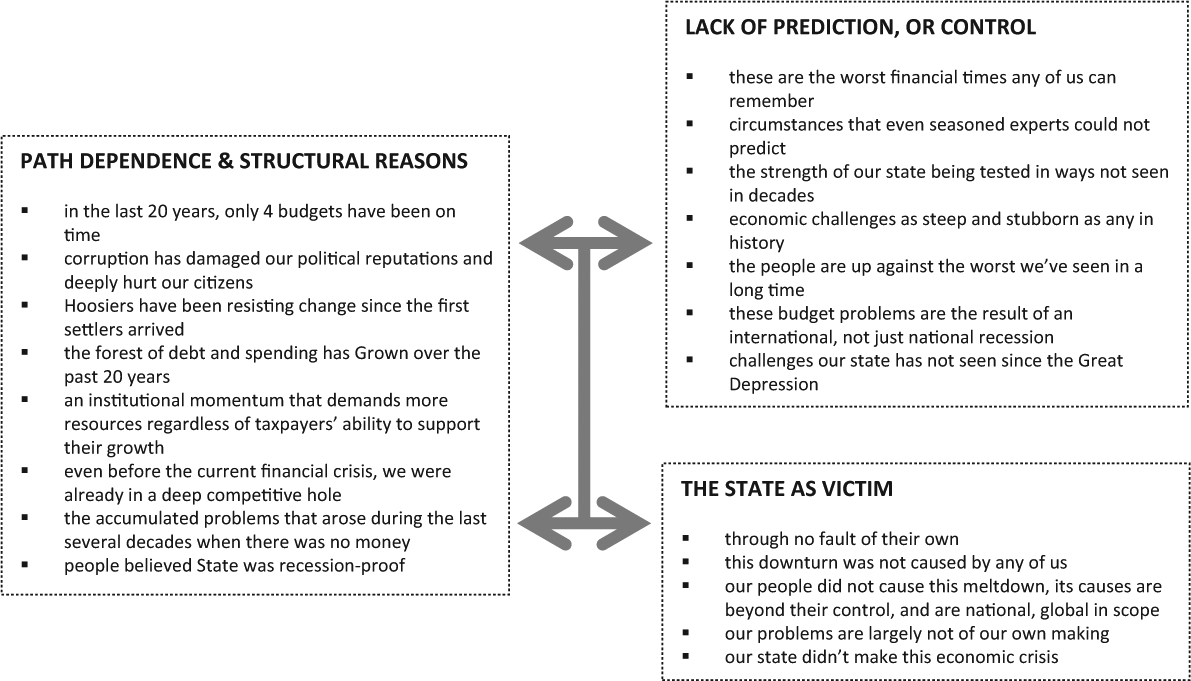
Blaming the system: Three facets emerging from the speeches.
Lessons in Deliberative Democracy
“Leadership and learning are indispensable to each other.”
Policy Learning: To Learn, Acknowledge. To Master, Teach
Governors are said to be good presidential material because they gain lessons from leading the “laboratories of democracy.” The 2009 speeches were replete with passive acknowledgment of leadership shortcomings and active admission that mistakes were made in certain areas (Figure 2). An important aspect of learning is being able to communicate the lessons. We found evidence of governors trying to educate citizens and elucidating their understanding of budgeting. They appeared to want to impart three major lessons: on budgeting complexities in a democracy, adaptation challenges, and the intricacies of the budget rules themselves. Notably, only eight governors, with Wyoming’s being the most notable, included these kinds of lessons in their speeches. It would be interesting to see if future addresses come back to these themes as it would indicate whether governors really are internalizing lessons learned or if it is rhetoric for temporary political benefit.

Mistakes and lessons in fiscal leadership.
Policy Learning: The Search for Policy Ideas
An important learning aspect is efficiency and resourcefulness in identifying where potentially vital information lies (Simon, 1947). Gubernatorial legislative success has been linked to their information-gathering resources or “enabling resources” (Dilger, Krause, & Moffett, 1995). In 2009, governors provided clues to what they deemed as important sources of policy ideas (Table 5) and the reasons why governors might be open to certain ideas. We grouped the sources of ideas according to the entities and strategies involved. As an inspiration for gubernatorial policy, the most prominent in use were task forces and commissions, presumably created by executive order or with legislative participation. In comparison, scarcely mentioned were experiments (pilot programs) or initiatives that were borne out of the results of experiments. As evidence to back up some of the governors’ proposals to address their states’ problems, they hewed to reasoning such as the strategies had worked in the past, or they had received awards and media coverage, or other states had even borrowed their ideas (Table 6).
Sources of Policy Ideas and Learning.

Sources of Evidence to Support Policy Ideas.

The correlation analysis indicates that Republican governors, in keeping with their party’s focus on state-level solutions, devoted significantly more rhetoric to Comparing State Solutions to the fiscal crisis than the Democrats. However, overall the focus on innovative and new approaches was limited. This may be indicative that a time of economic crisis was not the best time to talk about innovation, or results of innovations. Was it more critical to examine mistakes, lessons, and accountability?
Meta Learning and Process Learning
Learning is better when it involves process learning or meta learning (increased feedback/self-awareness of habits and strategies). This was evident in California, when the governor explained the context and history of budget negotiations in the state as a clue to what was unfolding. In Connecticut, the governor explained to the audience the paradox of government’s role—more families need government during crises when the government is also strapped for funds, while in Delaware, the governor acknowledged uncertainty about some potential solutions. New Hampshire’s governor admitted that “the direction may or may not be right, but must be explored.”
Learning and the Three Pillars of Crisis Response
The crisis prompted governors to pepper their speeches with immediate and long-range proposals. A three-pronged approach emerged from the governors’ explanations of the government’s role and the reforms that they thought must take place (see Figure 3).

Governmental reform: Three facets emerging from the speeches.
The Need for Government
The magnitude of the financial collapse brought on some soul-searching about government’s role in both causing the problem and in finding a solution. Some governors carried the message that government can positively affect the lives of their citizens. Those passages mostly speak to key areas where government funding is needed, especially in critical times; the role of the bureaucracy; the role of the market and individuals versus government; and the federalist form’s contribution to successful government.
The statistical analysis found that Term of Office was negatively associated with the speech theme of Government Matters, indicating that governors that had held office for a longer period of time were less likely to actively defend the role of government.
The Need for Government Image Reform
Most governors expressed that government lost a lot of people’s trust during the recession. Of those who thought the image of government needed improving, many were on their first term. In comparison, those who had been in office for a while must have learned what was broken in the budgeting system, so that an almost equal portion of them called for budget reforms. Incumbency was positively associated with Reorganization and Consolidation, suggesting that incumbent governors may turn to such strategies in the midst of a budgetary crisis, rather than souring on that strategy after a long time in office. The state’s tax progressivity correlated negatively with calls for Intergovernmental Partnership. Intergovernmental Partnership can represent a form of image reform, as such initiatives can serve to make the state appear more collaborative with other levels of government and increase the perception that the state seeks to create efficiencies.
The Need for Fiscal Reforms
Whether or not governors expressed a positive role for government, many of them did call for reforming budgeting, some in connection to their response to fiscal shortfalls. Many of these proposals were about transparency and removal of budget gimmickry that subverts discipline, to project figures accurately, allocate wisely, and understand structural factors behind budgeting.
From a statistical standpoint, rhetoric regarding fiscal reform correlated with a number of variables. Whether a state has an annual or biennial budgeting system was found to be negatively associated Calling for Private Sector Responsibility and Reforming Budgeting Philosophy and Culture. This could suggest that governors in states that budget for 2 years are more focused on setting a longer term strategy and making necessary adjustments to the budget than placing blame.
Governors with previous experience in the executive branch of state government devoted less emphasis in their speeches to Reorganization/Consolidation of government or Reforming the Pension System. They also devoted less discussion to the strategy of Borrowing to address the budget crisis. This may indicate that these governors’ other professional experiences in the executive branch led them to form negative opinions of these policy alternatives.
Because these proposals for change were advocated at a time of crisis, future research can examine if reform rhetoric has ebbed and flowed after the Great Recession.
We found other results from the correlation analyses: a negative association between Party and Freezing Tax Rates supports the idea that Democratic policy makers more often want to leave open the possibility of additional revenue through tax rates. Term of Office was negatively associated with advocating for Economic Stimulus to address budget shortfalls: Incumbent governors appear to be more inclined toward belt-tightening as opposed to expenditure increases. Biennial budgeting was found to be positively correlated with references in the speeches to Economic Development Incentives and Local Government Transfers. Perhaps due to their need to budget over a longer time frame, governors wished to devote more attention to directly controllable areas (such as tax incentives to attract business or increasing cost sharing with local governments).
Conclusion and Future Directions
Policy or budget addresses create an opportunity for leaders to frame a crisis, outline a way through it, and rally the legislature, the public, and special interests to that path. Part of what may determine their success is the degree to which governors are willing to take responsibility, exercise leadership, communicate lessons that they have learned, and advocate for action. Studying the degrees that governors did this during the Great Recession and certain factors that related to those differences can offer us a window to understand why some states weathered the recession better than others. This can be gleaned in part by whether a governor focused on blame avoidance or accountability, leadership, and learning. An initial step, this study suggests the importance of such addresses to understand how the budgetary crises played out across the states, and the perspectives of the leaders who would steer the course.
This research aimed to show whether governors attempt to use their budget speeches at a pivotal time to open a learning conversation with legislators and the public and exercise leadership, or as a political opportunity to distance themselves from public wrath. From hereon, a larger sample or a longitudinal study (for example, looking at the decade of 2001-2010, spanning two huge recessions and contentious national elections) may answer questions that go back to the roots of the educative nature of public office: Considering today’s strong anti-government sentiments, how seriously do state leaders take their roles of communicating with the masses what leaders perceive to be the evolving work and processes of government? Are gubernatorial addresses forever locked into a legislative or political strategy, bereft of any educative role? What contexts enable this to change?
Footnotes
Declaration of Conflicting Interests
The author(s) declared no potential conflicts of interest with respect to the research, authorship, and/or publication of this article.
Funding
The author(s) received no financial support for the research, authorship, and/or publication of this article.