




Abstract
Despite more than 40 years of experience with Environmental Impact Assessment (EIA) in the United States, little is known about who participates, how they participate, and whether agencies are responsive. This study explores the role of public participation in the American federal government EIA context, focusing on the different languages used by residents and administrators. Residents of affected geographic areas use nontechnical language to address concern over individual impacts, whereas administrators use technical language about aggregate impacts and focus on justification of decisions, rather than altering decisions based on public feedback.
Introduction
The National Environmental Policy Act of 1969 (NEPA) codified Environmental Impact Assessment (EIA) in the United States. One of the key principles of NEPA was to foster participation and ensure access for the public to bureaucratic decision makers. Although NEPA was not the first or perhaps even the most robust federal government effort to engage policy stakeholders to provide feedback, it was arguably the first that extended the practice beyond the generally esoteric regulatory policies for which comments were solicited under the Administrative Procedure Act of 1946 (APA). Whereas the APA came about as part of an effort to institutionalize the regulatory designs of New Deal policy (McCubbins, Noll, & Weingast, 1999), NEPA arose from the ethos of the environmental movement with a democratic intent to (a) ensure access, especially for traditionally underserved stakeholders so that decision makers have access to information; (b) bring disparate interests together; (c) build the credibility of agency decisions; and (d) generally build trust in government (Gregory, Keeney, & von Winterfeldt, 1992; Wang, 2001). The premise undergirding public engagement is that increasing access would lead to better, more inclusive, decisions (Coglianese, 2003).
It is fairly well documented at this point that, outside of a few examples of engaged collaborative structures, the general public, and even organized interests tend to have little effect on bureaucratic decisions, especially when comment–response, such as the process used under NEPA, is the method of participation (Cigler & Loomis, 2002; Cuellar, 2005; Naughton, Schmid, Yackee, & Zhan, 2009; West, 2004). Although in some cases participation has resulted in positive feelings (Coglianese, 2003) or outcomes that are favorable for some particular group (S. Yackee, 2006; J. Yackee & Yackee, 2006), the result has more frequently been perceptions of unfairness, distrust, anger, and intractable disagreement on both the government and citizen side (Ibitayo & Pijawka, 1999; Matheny & Williams, 1985). Yet, regardless of these challenges and the low perception of the effectiveness of participation, the public still gets involved.
Despite 40 years of public mandated public involvement under NEPA, little is actually known about who participates in federal government environmental decision making, why they participate, how they participate, and whether that participation affects decision making. This study aims to address this gap by considering participation trends within three NEPA-based projects, and assessing the extent to which different participants, utilizing different participatory languages affect administrative decisions.
Public Participation in Public Decisions
As the bureaucracy grew in the 20th century and particularly during the Great Society programs of the 1960s in response to a perceived unresponsive bureaucracy, Congress recognized the need to provide the public with more access to bureaucratic decision makers. It is from this general context that NEPA sought to enable public access to federal agencies when those agencies’ projects affected the environment. However, even at this early stage in public involvement, challenges were realized. Writing about public participation in the Model Cities Program, Arnstein (1969) noted that public involvement can easily degrade to an empty ritual that reinforces the status quo. Arnstein’s (1969) “ladder of citizen participation” describes a continuum of power sharing from pure bureaucratic control (“manipulation”) where public involvement is merely a box to check, to pure citizen control, where the government role is to implement the will of the most powerful coalition. Public participation in the Model Cities program tended to be near the bottom of the ladder; administrators had generally made decisions and to the extent the public was involved, it was to legitimize the decisions that administrators had already made.
The typical response subsequent to the recognition the public was not meaningfully involved was to critique the process, usually focusing on the inadequacy of comment–response and public meetings (Hajer, 2005; King, Felty, & Susel, 1998). This shifted focus to more collaborative structures, and often on smaller scales than federal government projects (Ryfe, 2005; Vigoda, 2002; Wang, 2001). These examples along with streams of research on deliberative democracy (Nabatchi, 2010), direct citizen participation (Roberts, 2008), and active citizen engagement (Stivers, 1990) can trace a lineage from Habermas’s (1970) idea of communicative rationality and using discourse to move up Arnstein’s (1969) ladder. According to these lines of thought, gathering stakeholders together in a collaborative framework can engender genuine communication, exchange of ideas, and finally, consensus.
However, as Williams and Matheny (1995) noted, there are different languages of democratic dialogue, and without recognition of and conversation across these languages, even the most well-designed collaborative structure can fail. Williams and Matheny (1995) described three different languages that are used in policy discussions: a managerial language, rooted in technocratic understanding of a public interest that can be determined by experts through analysis; a pluralist language, based on a presumption that public interest is determined through political conflict and suasion; and a communitarian language, rooted in the ethos of democracy and challenge where a public interest that does not exist as an objective notion to be determined, instead emerges in each unique context from the reasoned exchange of ideas among citizens and administrators. Unless the underlying logics of these languages can be brought together to solve problems, one or another is likely to dominate, with, generally, policy makers relying on managerial language, interest groups on pluralist language, and citizens on communitarian language.
Little is known about the languages used in federal policy. Much of the research on how citizens participate in American environmental projects is based either at the local level or in cases only marginally involving the federal government (Halvorsen, 2003; Koontz, 1999; Rich, Edelstein, Hallman, & Wandersman, 1995). NEPA is, however, a federal law encompassing projects whose scale often dwarfs more locally oriented projects. The participation that occurs under NEPA is centered on the development of an Environmental Impact Statement (EIS). Federal agencies must include the public during initial scoping of planned projects, issue a Draft EIS that contains a set of alternatives, receive public comments, and then issue a Final EIS that includes all public comments and agency responses to each comment along with the final selected alternative. Whereas public participation is part of the ethos of EIA and was a key impetus for NEPA (Hartley & Wood, 2005; Stewart & Sinclair, 2007), the NEPA form of participation has been critiqued as ineffective (Chavez & Bernal, 2008; Cooper & Elliott, 2000). The process has little in common with more localized and collaborative projects like those described by Koontz (1999), but it is quite similar to the APA process. While there is little research on participation under NEPA, there is much more about APA participation (and similar regulatory rule-making policies) and despite the very different circumstances and rationales under which these two laws came about, it may offer insights for NEPA.
Before bureaucratic agencies issue final rules detailing the implementation procedures for regulatory policies, the APA requires that rules be proposed first in the Federal Register, followed by an open comment period enabling any interested party to provide comments. After receiving comments, the agency responds and issues final rules that may or may not incorporate aspects of the feedback received. Perhaps not surprisingly given the generally regulatory focus of APA, business groups tend to provide the most comments (Yackee, 2006; J. Yackee & Yackee, 2006), but regardless of source, comments tend to have little impact on subsequent decisions (Golden, 1998; Nixon, Howard, & DeWitt, 2002). Rule changes in response to comments appear most likely whenever there is a plurality of relatively uniform comments, and whichever side of an issue provides the most comments tends to be more influential (Yackee, 2006; J. Yackee & Yackee, 2006). Analysis and technical argumentation can also be influential under some circumstances (Weiss, 1989), and administrators are likely to respond substantively to comments that are clear, concise, and well documented (Cigler & Loomis, 2002), or at the very least appear to be “sophisticated” and provided by “high status” groups (Cuellar, 2005). Interest groups, especially business groups, tend to use more scientifically based arguments, with citations and statistics (Jewell & Bero, 2007), but even so, these arguments mostly have marginal effects on final rules (Naughton et al., 2009; West, 2004). In short, this research suggests that the status of the groups that are participating and the tone and frame of the argument, and specifically reliance on managerial language (Williams & Matheny, 1995), may affect the extent to which administrators utilize the information they receive.
The federal government acknowledges these factors as important in their own recommendations for the public. In their 2007 Citizen’s Guide to the NEPA, the Council on Environmental Quality (CEQ), the agency responsible for implementing NEPA, recommends that the public keep informed and active about potential EISs and make sure that comments are “clear, concise, and relevant,” “polite and respectful,” and more crucially, be “solution oriented and provide specific examples . . . ” rather than “ . . . simply oppos[ing] the proposed project.” The guide also tacitly suggests that providing “operational and technical information” is much more likely to be influential than providing a negative response to a proposed alternative (CEQ, 2007, p. 27). Read another way, the recommendations suggest that, like with APA, those with technical expertise and the time and resources to develop sophisticated, managerially oriented arguments are most likely to have an effect on the decision.
Like NEPA, the APA was intended to foster access to governmental decision making (Yackee, 2006), but unlike APA, the intent of NEPA (and EIA more generally) was to provide access to decision makers for those who would otherwise have difficulty accessing them (Shepherd & Bowler, 1997). While we know that the interests that participate under APA tend to be more influential when they use managerial language, we do not know if the same is true of NEPA. Even more fundamentally, while we expect that NEPA would draw more participation from the general public and less from organized interests, we do not know the extent to which NEPA actually provides an opportunity for more citizen engagement. The purpose of this research is to explore if the participants under NEPA tend to be technical experts and elites or the public more generally, what languages are used, and if the public appears to have any influence on decisions that are made.
Each EIS is authored by the lead federal agency that is responsible for the project. NEPA stipulates that whenever any federal government agency is considering a project that will have a “significant” 1 impact on the environment, an EIS must be prepared and written such that nontechnical people can understand it. Early in the process, stakeholders are consulted, generally in a specific invited way, for their interests and expertise regarding what the potential alternatives may be. An EIS is drafted detailing these alternatives and is then open for comment. Anyone may comment either in writing or at public meetings, and comment periods are usually at least 30 days. The final EIS includes these comments and minutes of public meetings. The agency can use any information or comment(s) to determine the final alternative, which can be one of the alternatives from the draft EIS, a hybrid of several alternatives, or a different plan altogether. In the final EIS, the public agency explains the rationale for its decision, and must respond to the comments, while also detailing the implementation plan for the selected alternative.
Data and Method
To investigate participation under NEPA, data are derived from a purposive sample of three EISs from projects undertaken by three different federal agencies all within Washington, D.C., with the comment–response dyad as the unit of analysis. Given direction from the importance of technical sophistication and social status in affecting rule changes under the APA, the three EISs were chosen purposefully to vary the technicality of the lead agency and the demographic characteristics of the communities most affected by the project. However, to maintain regional and temporal consistency, all three projects were located in Washington, D.C., during the time period between 2004 and 2009. A content analysis procedure similar to Kraft and Clary (1991), Yackee (2006), and Jewell and Bero (2007) is used, following Krippendorff (2004).
Cases
Case 1: Armed Forces Retirement Home (AFRH)
The AFRH or Home was established in 1851 as a care facility for aging veterans of the Mexican War. The Home was built in (then) rural Washington overlooking the Capitol and the Potomac River, and has served retired veterans from every conflict since it was established. Many of the buildings on the Home site were constructed between the 1850s and the early 1900s, with several listed on the National Register of Historic Places. The most famous building on the site is the Lincoln Cottage, where President Lincoln spent much of the Civil War. As the city grew, the area around the Home began to develop, most notably the Petworth neighborhood to the northwest, the Park View neighborhood to the west (so named due to the parklike setting of the Home), and Catholic University to the east. The neighborhoods surrounding the site are mostly residential, with middle density developments. The communities nearby are poor compared with the region as a whole, but not as poor as other areas of the city, and the proximity of the site to downtown and a boom in development in the area led to recent changes and an influx of wealthier residents. The Home site is nearly 300 acres including wooded areas, ponds, a golf course, and walking trails. Prior to the 1960s, the grounds were open to the public but the site was fenced in for security, although the green space remains an integral, if inaccessible, feature of the site.
In the late 1990s, the Home needed numerous modernization updates. Moreover, in the early 2000s, the Home began experiencing financial shortfalls. The Home is self-sustaining, relying on a trust fund supported by payroll deductions of active military personnel. With the trust fund depleting, and as real estate values in the immediate area had escalated, the Home recognized that it could potentially close funding gaps by developing some of its acreage for commercial and residential uses in its transitional community.
The EIA process, with the AFRH (an independent federal agency) as the lead agency, began in 2004, a draft EIS was issued in May 2005 and open for public comment, and the Final EIS was released in November 2007. Four alternative plans were considered, three of which included developing land on various parts of the campus, and a no action alternative as required by EIS preparation guidelines. The Home held one public meeting in July 2005, during which 33 individuals commented and written comments were received from 67 individuals, agencies, and organizations constituting a total of 320 separate comments.
Case 2: 11th Street Bridges
The 11th Street Bridges (Bridges) were 2 one-way bridges that crossed the Anacostia river, connecting downtown Washington to the easternmost portions of the city. The western side of the river in this area includes the Navy Yard, the recently constructed baseball stadium, and neighborhoods that have experienced redevelopment. The eastern side includes many of the poorest communities in the city, including the Anacostia neighborhood, a historic African American neighborhood that is also one of the poorest and least economically developed neighborhoods in the city. Over the last several decades, the 11th Street Bridges became overwhelmed by traffic congestion, owing to a location connecting Interstate 395 and the Southeast Freeway with Interstate 295. The bridges were never intended to carry freeway traffic, and as such, there were no direct linkages between the western side of the river and north I-295 on the eastern side, nor from south-bound I-295 to the west. Without these linkages, commuters to Maryland took to side streets in the neighborhoods.
Interstate 95 was originally intended to follow a path through downtown Washington, connecting with the existing route between Springfield, Virginia, and College Park, Maryland. However, strong neighborhood opposition in the 1960s and 1970s in the District kept much of the freeway from being built. Residents strongly opposed construction of the highway through District neighborhoods, and only the portion of the highway running from Springfield, Virginia, to downtown Washington was actually completed (and is now I-395). I-395 ends in downtown Washington, with a spur connecting I-395 to the 11th Street Bridges over the Anacostia River. As the Maryland suburbs grew, traffic increased on these freeways and without direct freeway connections, congestion increased on the bridges with clogged left turn lanes and in the residential communities nearby. The 11th Street Bridges project is intended to address the lack of a connection between the freeways on both sides of the river, allowing traffic to flow at speed without diverting to neighborhood streets.
The Federal Highway Administration (FHA) is the lead federal agency. Scoping for the project began in 2004, and a draft EIS was issued in June 2006 after which public comment was solicited via six public meetings and various media outreach efforts. Five build alternatives were considered, all of which included provisions to connect the freeways on each side of the river. There were 392 distinct comments received from approximately 200 individuals, agencies, and organizations. The final EIS was issued in October 2007.
Case 3: Washington Aqueduct
The Washington Aqueduct provides drinking water for Washington, D.C., and parts of Northern Virginia. The Aqueduct consists of a series of reservoirs, tunnels, and piping systems throughout this area. Water for the reservoirs comes from the Potomac River upstream from Montgomery County, Maryland. The Aqueduct is managed by the Army Corps of Engineers (ACE or the Corps), which is responsible for maintenance and delivery of water to residents in the area. To comply with provisions of the Clean Water Act (U.S.C. §§1251-1387) regarding iron and aluminum particulates, it was necessary to remove these residuals from the intake water. Residuals could be returned to the river, but only at a level of dilution higher than the capacity that currently existed at the Aqueduct’s facilities. As the initial intake reservoir, the Corps determined that the residual processing capacity would be constructed at the Dalecarlia Reservoir.
The Dalecarlia Reservoir is bisected by the boundary between Washington and Maryland, located in the upper northwest portion of the city. The area is among the wealthiest in the entire region, with a much larger proportion of White residents than the rest of the city at large. The Reservoir is surrounded by parkland and woody forests to the west, north, and east on land owned by the Aqueduct, and it has been in operation since it was built in 1858. The plan calls for the removal of residuals from the water at the Dalecarlia site, with options for subsequently removing the residuals from the site either by trucking them out of the city, piping them back to the river at the appropriate level of dilution required, or retaining the residuals in a landfill (technically referred to as a monofill as there would only be one type of material).
The planning process began in early 2004, the draft EIS was issued in April 2005, and the final EIS was issued in September 2005. A total of 530 comments were received from a combination of about 200 written comment submissions and participation at five public meetings.
Content Analysis Procedure and Variables
Coding of the three EISs resulted in 1,242 comments and agency responses. As elaborated in detail in Online Appendix A, the content analysis process was developed both inductively from theory and deductively from a preliminary reading of the three EISs, following the procedure outlined by Krippendorff (2004); each EIS was read fully, including all comments and responses, prior to developing the content analysis plan. After this initial read, each comment and response was reread and coded according to the variables described below. Subsequently, seven additional coders were given a random sample of 50 comment–response dyads. Krippendorff (2004) alpha intercoder reliability values ranged between .717 and .976 for the key categorical variables, with an overall average of .825, which is within the acceptable range. High levels of agreement are particularly important when considering the measurement of the highly contextualized variables used here, although it is worth noting that agreement does not necessarily eliminate potential biases of the group of coders, but does indicate the reliability of the coding scheme (Krippendorff, 2004).
Commenter variables
Comments were provided by a variety of different individuals, ranging from residents, nonprofits, representatives of government agencies, and interested individuals. A number of variables were identified both from a reading of relevant literature (Cuellar, 2005; Golden, 1998; Nixon et al., 2002; Williams & Matheny, 1995; S. Yackee, 2006), as well as the preliminary reading of the EISs. The type of commenter was collected. Each comment was then coded by the extent to which it utilized the three languages identified by Williams and Matheny (1995)—managerial, pluralist, and communitarian. Managerial language was identified by the following: viewing project outcomes as knowable and controllable (at least to an extent), focusing on aggregate impacts, and using technical/scientific argumentation. Because of its underlying logic based on a marketplace of ideas, pluralist language was used, as identified in comments focused on outcomes individual to the commenter, more emotive/less technical argumentation, with more of a focus on human impacts, and commenting on the equity of public involvement. Williams and Matheny describe the communitarian language as a “language of challenge” (Williams & Matheny, 1995, p. 24), and thus communitarian language was identified by comments that challenged the premise of EIA, the need for the project in question, and the process of public comment solicitation. This was most often presented by arguing that the impacts of a project were unknowable, or that the process was undemocratic, often disputing the premise that the EIA process could arrive at any sort of consensus, given the managerial focus of the policy makers. In practice, there were many comments that incorporated aspects of both pluralist and communitarian language (but little overlap of either with managerial language) so each comment was broken down into the component parts, as well as assessed for the language that was dominant in the comment. These component parts included coding the aggregate effects, or whether the commenter tended to focus on potential aggregate effects, or on outcomes individual to the commenter; and focus of impact, or whether the impacts of policies were viewed as primarily being borne by humans or the natural environment. The view of risk differentiates those comments where risk is perceived as objectivist—risk is knowable and is inherently controllable (at least to an extent)—from those with a constructivist view—risk is perceived as being unknown, unmanageable, and to be avoided (Cvetkovich & Earle, 1992). The technicality differentiated between technical/scientific comments and broadly defined nontechnical comments, and the nature of comment recorded whether some problem or potential problem was noted with the EIS, the project, the alternatives, or the decision-making process. Full details and examples of comments coded in each category are provided in Online Appendix A.
Agency response variables
Agency responses were coded for language type as well (managerial, pluralist, or communitarian), as well as the more detailed distinctions described above. Furthermore, responses were coded to capture constructs identified by APA research (Cuellar, 2005; Golden, 1998; Nixon et al., 2002; S. Yackee, 2006). Agencies are required to reply to each individual comment, but they are not required to reply with a great deal of substance or in any particular way. Some responses are detailed and deliberative, whereas others merely acknowledge the comment without further elaboration. A typical response from agencies fits with the lowest rung of Arnstein’s (1969) participation ladder, with participation serving mainly to justify decisions that had already been made. This was measured in responses as justification. To be coded as a justification, a response had to be of sufficient length to address the broad point of the comment, but clearly not engage or otherwise indicate that it had any effect on the decision. Categorization of these responses was based on clear evidence that the agency had previously made the decision, as indicated by conformance between the alternative in the draft EIS and in the final EIS.
Decision altering codes assessed whether comments had an effect on the ultimate decisions that the agencies made. This measure was not the inverse of the justification variable as many responses were not detailed enough to be considered as either a justification or as decision altering. Moreover, few changes were made between the alternatives described in the draft EIS and in the final EIS. There were, however, several clear instances where the comment provided information that altered final plans (however slightly in some cases).
Last, because participation is not one-sided, some comments and languages tended to elicit responses that offered the potential for genuine participation. Engagement is assessed by whether the response is a unique response that directly engaged the topic of the comment. Although agencies are required to respond to each comment received, they are not required to respond to each comment individually, nor in any detail. Thus, when commenters organized and provided very similar comments, or even when commenters address generally similar topics, agencies tended to use the same boilerplate language to respond in bulk. These boilerplate responses were the most common type of response, with agencies opting to repeat language whenever possible. However, some responses specifically address the unique points of comments.
Project context variables
Finally, each of the three projects has some defining characteristics, both with regard to the project itself and the locational context in which the project took place. Projects can vary significantly in their level of technical complexity. As a relatively straightforward economic development plan, the Home project is the least complex; the Army Corps case involves a complex removal of residuals from water and subsequent handling of the residuals and is the most complex; and the 11th Street Bridges project is in between, as a technical engineering project, but not an overly complex bridge structure or construction site. One would expect that the public could be much more involved in a project if it is not technically complex (Jewell & Bero, 2007). The three cases selected for the analysis were also chosen purposefully to vary the residential context in which projects were taking place. The Washington Aqueduct project is located in one of the wealthiest areas of the entire Washington, D.C., region with a predominantly White population, while conversely, the neighborhoods directly affected by the 11th Street Bridges project are among the poorest in the city, with mostly African American residents. The neighborhoods near the Home are in transition. This distinction serves to assess how participation takes place in three different types of communities.
Participation in the Cases
The goal of this research is primarily exploratory; thus, the analysis consists of a combination of descriptive results from the content analysis and relevant examples of comments and responses. A series of logistic regressions are also used to assess the extent to which characteristics of the comment and commenter were associated with different agency responses.
Comments and Commenters
Table 1 shows the overall proportions of comments provided by different types of commenters. Local residents or local resident associations provided nearly 70% of the total comments for these projects. Individuals who are nonresidents, but have some interest in the project or project area, made another 6% of the comments; political representatives provided 2%; and locally based interest groups made 5% of the comments. All told, actors with local ties provided more than 85% of the comments in these three projects. In the APA-related studies (Nixon et al., 2002; Yackee & Yackee, 2006), it was generally found that businesses and business interest groups provided the plurality of comments, but as intended by the policy at the time it was adopted; NEPA appears to solicit different actors to comment.
Comments Provided by Type of Commenter.
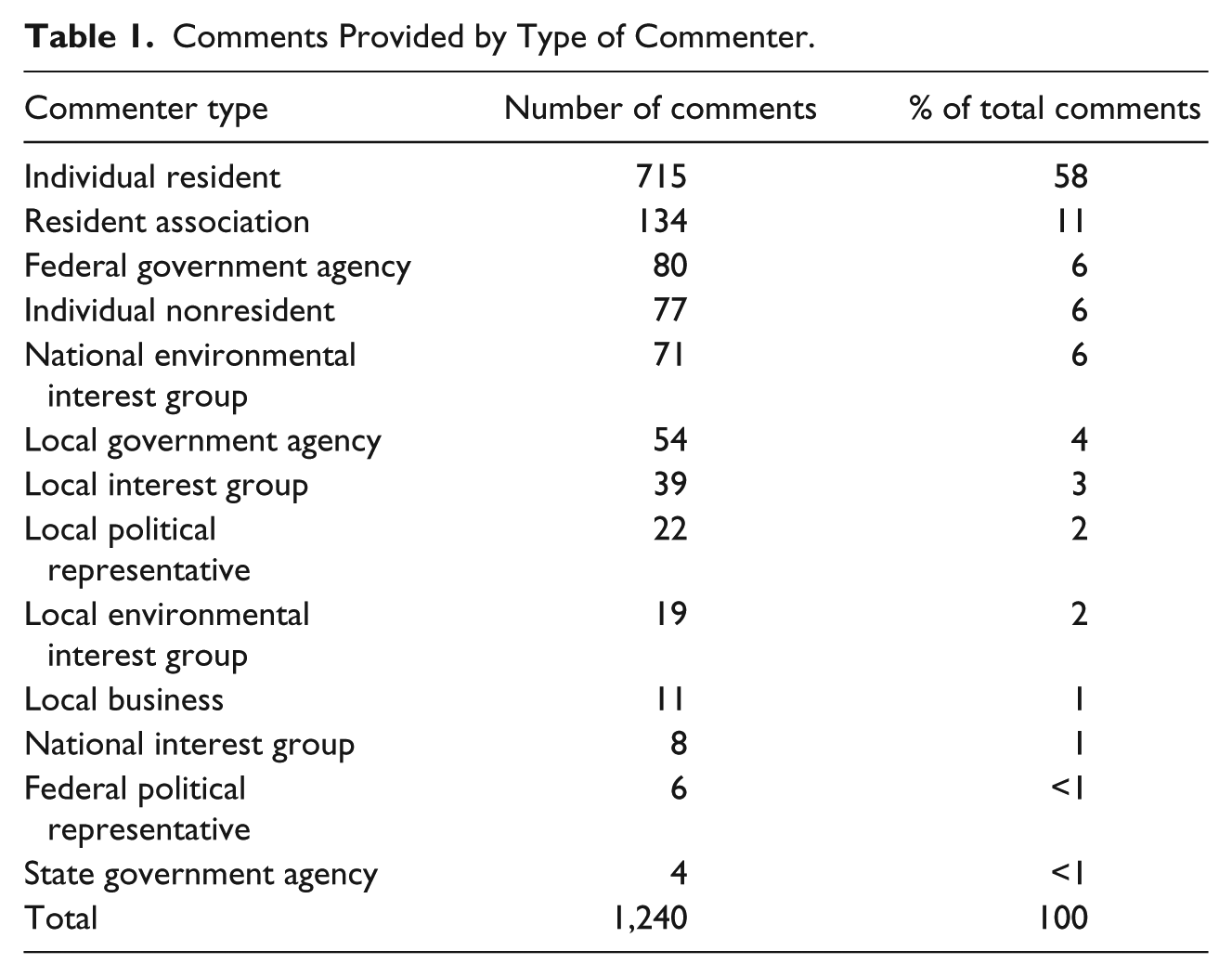
Table 2 provides a breakdown of comments for each project. Comments about the aqueduct are heavily local, with either residents, local representatives, or interest groups providing more than 90% of the comments. Resident associations provided more comments for the aqueduct (20%) than for the bridges or Home projects (8% and 0%, respectively). Neighborhoods near the aqueduct have long been stable and wealthy, and residents appeared to be well informed. Neighborhoods near the bridges, although not wealthy, have tended to be stable, and although there appears to be less organization, there is still participation by resident associations. Near the Home, where the neighborhoods are in transition, there were no comments provided by an association of residents, and this project saw the largest proportion of comments provided by individual residents. The bridge project is the only one of the three in which local residents, either speaking individually or through associations, did not provide the majority of the comments received, although they did still provide a plurality. Virtually, all of the nonresident participation over the three projects took place in the bridges project, and nearly all of this was related to the fate of a recreational boathouse facility that would be affected by construction. Finally, the only case where Members of Congress provided comments were those in support of their constituents near the aqueduct. While this may be due to the more direct impact of that project on Maryland residents, this was also the only case where the District of Columbia’s nonvoting House Delegate was involved.
Comments Provided for Each Project by Type of Commenter.
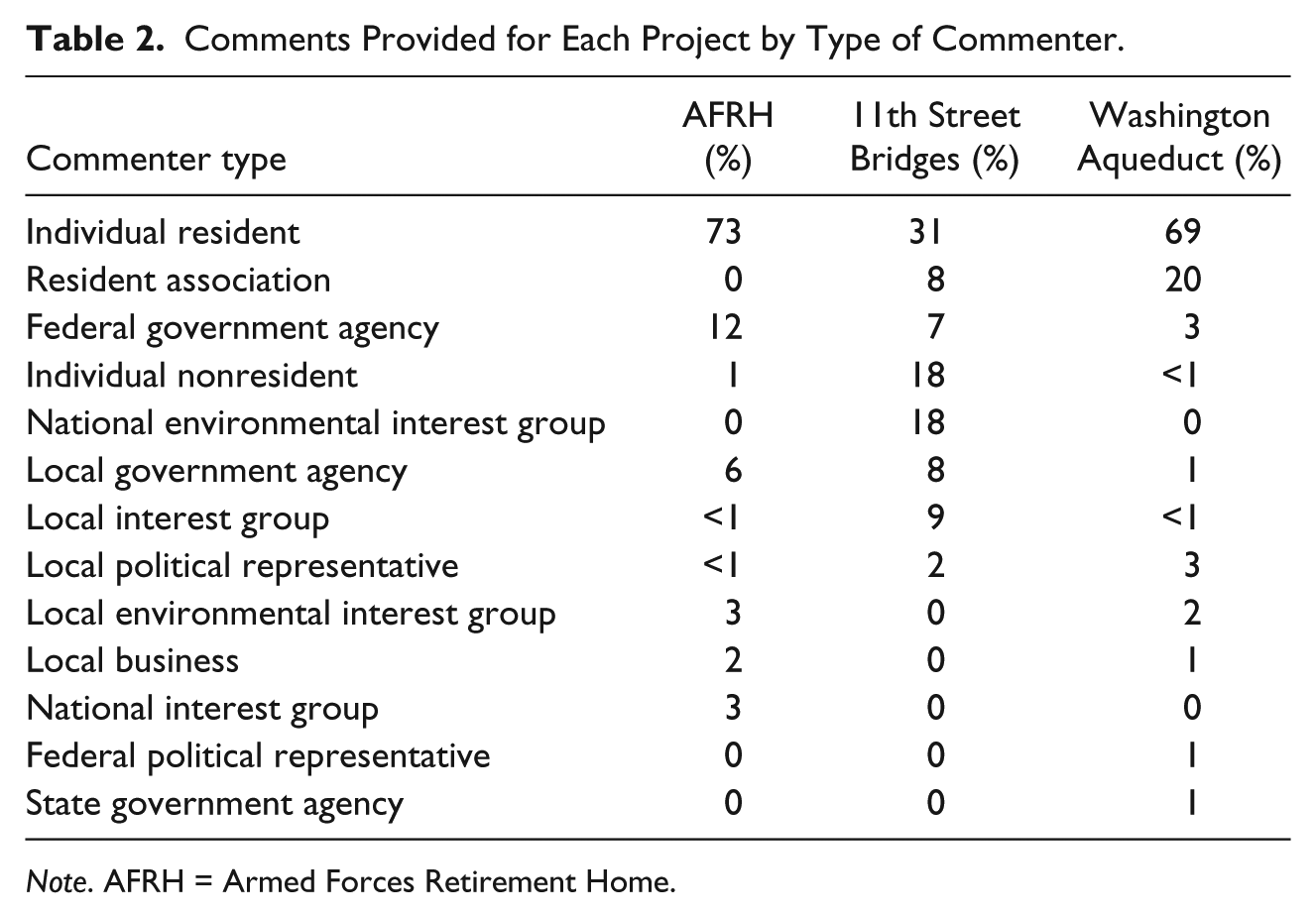
Note. AFRH = Armed Forces Retirement Home.
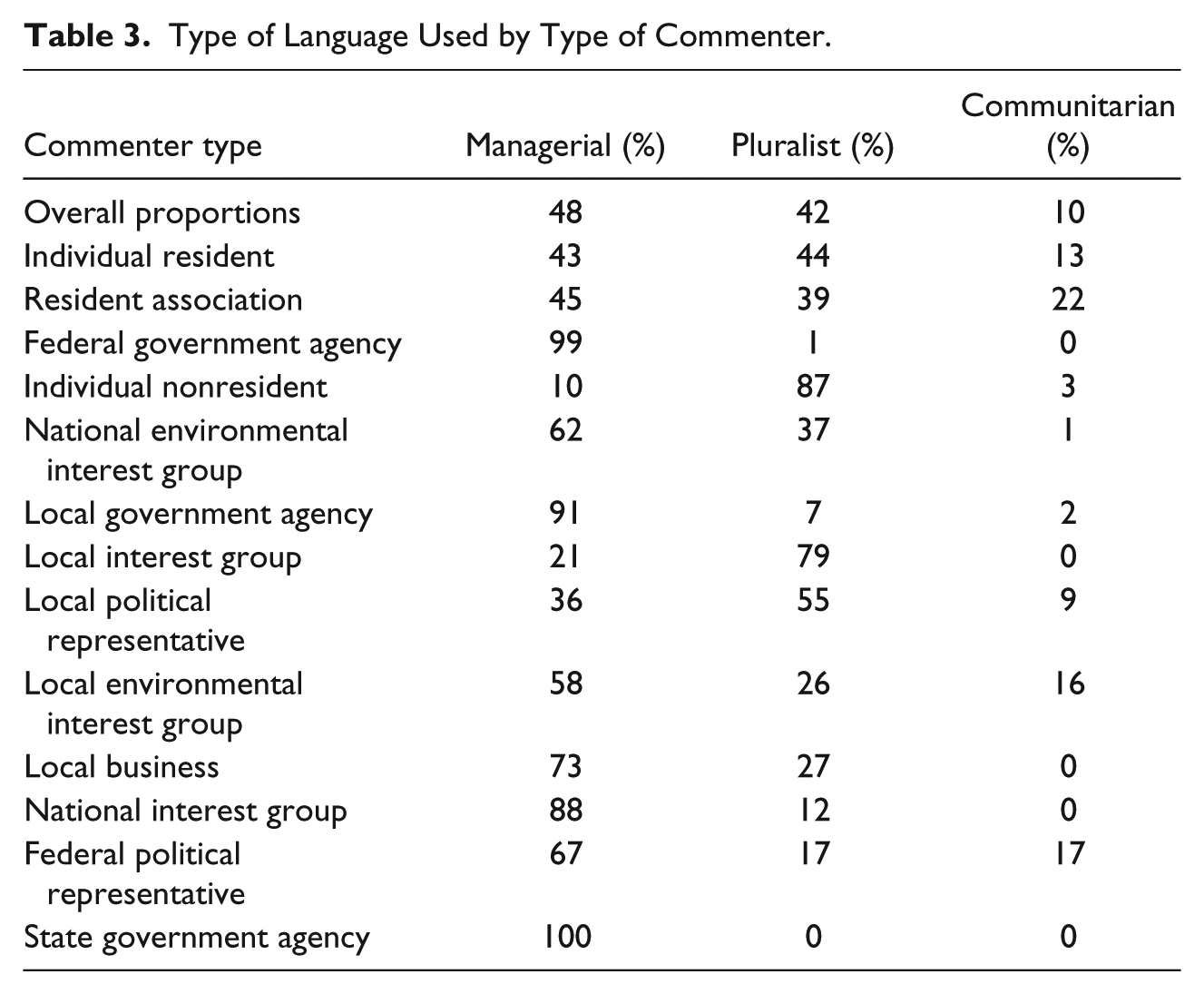
Languages used by different types of commenters show expected trends. As Table 3 indicates, individual residents, resident associations, and the political representatives are far more likely to use communitarian language than any other commenter. Conversely, government agencies when participating as commenters (generally as experts on a topic not in the purview of the lead agency) are far more likely to use managerial language, with national interest groups and businesses also most likely to use managerial language. Local interest groups and particularly nonresidents are most likely to use pluralist language—the bulk of these comments came from two sources: Nonresidents were mostly writing through a coordinated effort of common interests in recreational boating in the bridges case, and local interest group participation was mostly due to an effort in the aqueduct case where residents created an interest group for the purposes of halting the proposed project. Overall, trends in language usage are consistent across the cases.
Type of Language Used by Type of Commenter.
Looking at the comments in more detail, as seen in Table 4, 80% or more of the comments spoke to the effect of the projects on human or social conditions and less than 20% focused on the natural environment. Participation in these cases is clearly problem focused. Virtually, all the comments indicated some problem with either the plans or with the process, and contrary to the advice of the CEQ (2007), only 4% of the comments offered a solution.
Argumentation Type Used in Comments Overall and by Project.
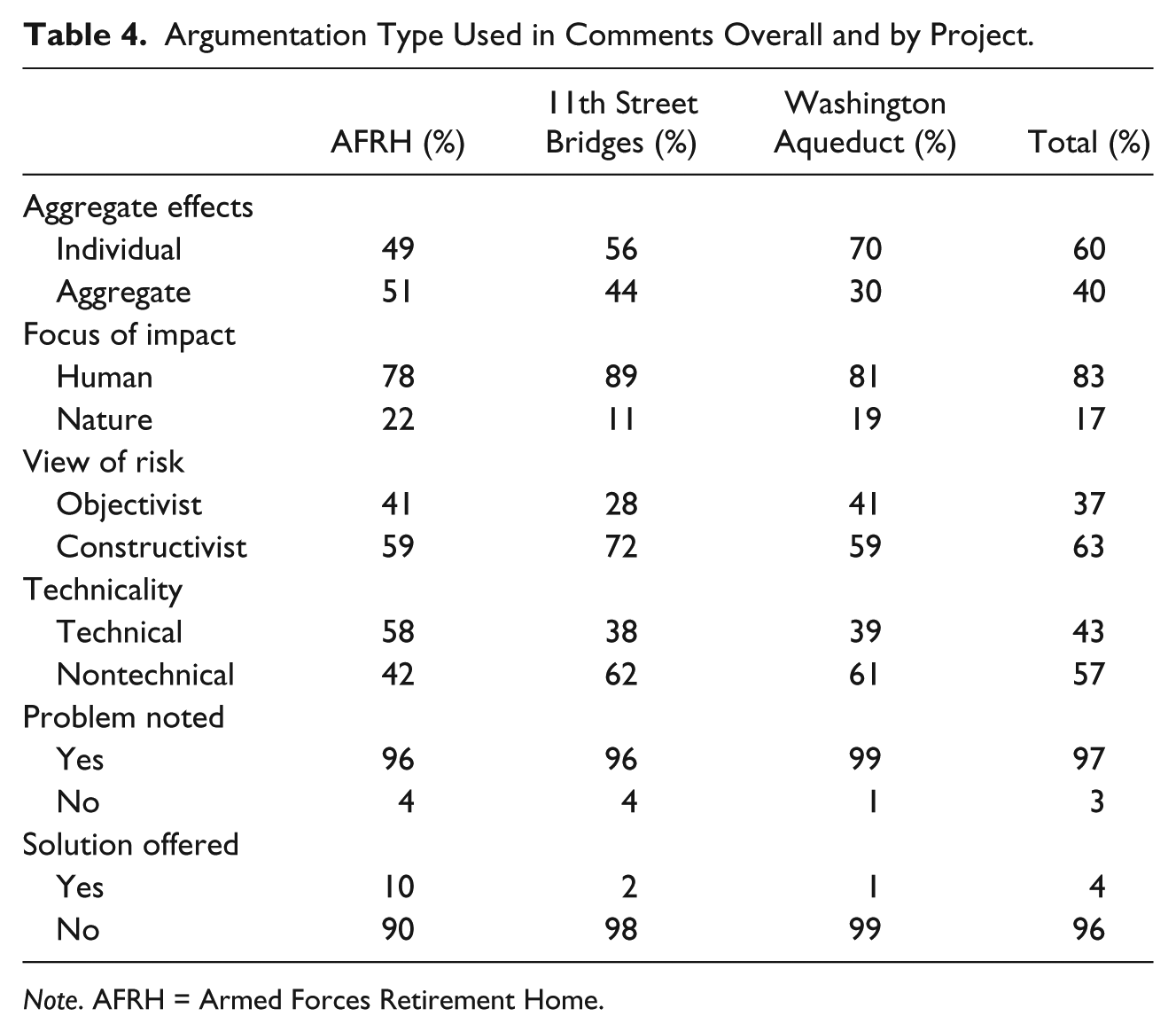
Note. AFRH = Armed Forces Retirement Home.
About half of the comments regarding the Home focused on aggregate effects, while 70% of the aqueduct comments dealt with individual impacts. Technical arguments were a bit more likely to be made in the Home case as well, which may be due to the fact that the case, an economic development plan, is the least complex, allowing for the public to understand the details and likely impacts more than the other cases. Finally, the view of risk was fairly consistent across the cases, with comments taking an objectivist tone clearly in the minority.
These trends are broken down further in Table 5 by a subset of types of commenter. Similar to the propensity to use managerial language in their comments, government agencies predominantly take an aggregate and technical view, and nearly always assert that risks are manageable. Residents and their associations, as with their propensity to use pluralist and communitarian language, also tend to focus on individual and human effects; they do not see risk as manageable, and are much less technical than other commenters. Interest groups tend toward less technical arguments, and focus on human impacts, usually at the aggregate level.
Argumentation Type Used in Comments by Commenter Type.

Agency Responses
Although the intent was to code responses with the same variables as the comments, on reading the EISs, it was apparent that this was unnecessary. All agency responses were identified as using managerial language, technical argumentation, focused on aggregate outcomes, and objectivist about risk. Furthermore, as can be seen in Table 6, there was very little evidence that decisions were changed in any way in response to comments and the focus of responses was usually to justify decisions. A few changes were identified, however. The original plan for the Home did not provide access to parks for community residents, but the agency indicated that it would consider the idea in the selected alternative. The Army Corps did not make any substantial changes to its plans, but did slightly alter residual trucking numbers and routes. The FHA made more changes, most significantly in ensuring better community access to the freeway bridges and adding a local span with wide bike/pedestrian lanes providing easier access to downtown. However, in all, only 6% of the total comments were related to these issues.
Agency Responses Overall and by Agency.

Note. AFRH = Armed Forces Retirement Home; FHA = Federal Highway Administration; ACE = Army Corps of Engineers.
Most comments were addressed with boilerplate language; only 13% of the comments received unique individualized responses. The Corps used boilerplate language in 99% of its responses, whereas FHA individually addressed more than one quarter of the comments it received. In all three cases, around 80% of the responses were categorized as justification, and less than 20% of the responses either provided evidence that the comment had an effect on the decision, or otherwise did not try to justify a decision previously made.
Matching Comments and Responses
Three logistic regression models were estimated with the language used in the comment and variables identifying the commenter (condensed to broad categories) as the independent variables and three different dependent variables corresponding to the outcomes shown in Table 6. 2 In addition, the fixed effects of each individual project were controlled to account for the nature of the agency, the complexity of the project, and the differing residential contexts. Based on previous research in the comment–response framework, it may be expected that comments using managerial language are more likely to receive unique responses and change decisions and that comments using communitarian or pluralist languages are more likely to receive responses that justify decisions previously made.
As can be seen in Table 7, some results are in line with these expectations, whereas others are not. As expected, unique responses to pluralist and communitarian comments are much less likely than to managerial comments. However, managerial comments are also more likely to receive responses that justify decisions already made than either pluralist or communitarian comments. So although agencies provide more unique responses to comments that share their managerial language point of view, those responses tend not to engage the argument so much as counter it with a justification for the agencies’ decisions. None of the three language types was more or less likely to alter the final decision of the agency. However, there are interesting trends with respect to the commenter, rather than the nature of the comment itself.
Logistic Regression Results.

Note. N = 1,243. ACE = Army Corps of Engineers; FHA = Federal Highway Administration.
Managerial language is referent category.
Local area resident is referent category.
AFRH is referent agency.
p < .05.
Perhaps not surprisingly, as compared with local community residents, political representatives’ comments were much more likely to alter decisions, as were comments from business groups (although it is worth noting that less than 5% of the total comments came from these two sources). Comments from other government agencies were also more likely to alter decisions, as were interest groups and resident associations. Besides individual residents (the referent group), the other unorganized category of commenters were nonresidents and their comments were less likely to receive unique responses and more likely to receive justification responses. Finally, it is worth noting that, in contrast to AFRH, the Corps was much less likely to provide unique responses, and FHA was more likely to alter its decision and provide unique responses and also less likely to provide justification responses.
Discussion
Although three cases in one jurisdiction cannot be generalized, these results suggest that while NEPA participation may share some similarities with other comment–response frameworks, the regulatory and institutional nature of NEPA makes it different from that of APA. While APA studies have shown that the content of a comment tended to affect the extent to which policies were changed (Cuellar, 2005; Jewell & Bero, 2007; S. Yackee, 2006), results for the comment content are very mixed in this case, and somewhat different than expected. It is not surprising that comments using managerial language are responded to more directly, given the technical nature of all responses, but it is surprising that these comments are not likely to change decisions and usually result in responses that justify decisions that had already been made.
In these cases, the commenter appears much more relevant to the impact of the comment than does the tone or content. While generally no more or less likely to receive engaged or justification responses, organized interests are clearly more likely to change decisions, and on a sliding scale, with the odds of political representative or business changing a policy more than 20 times the odds of a resident having such an effect. Next, other government agencies are about 4 times more likely than residents to change a decision, and interest groups are about 3.5 times more likely to. Finally, when residents organize through associations, they are about 3 times more likely to alter a decision than residents acting alone.
However, it is worth taking these results in context. All agency responses used highly technical managerial language, whereas most commenters did not. Furthermore, the evidence suggests that the agencies’ primary goal for participation was to justify decisions, as about 82% of responses fit this profile, compared with only 6% focusing on gathering information/changing decisions, and 13% indicating any direct engagement with the ideas provided by the public. The agencies particularly focused on trying to justify decisions to comments using managerial language, which is interesting considering the agencies’ managerial outlooks. One could infer that agencies were most eager to justify their decisions with those comments that were of a similar mind-set to the technical decision makers at the agencies, or that other comments did not receive justification responses because the respondents only felt the need to justify decisions with commenters coming from a similar perspective. Given the mixed results, it could also be inferred that the goal was simply to meet the legal requirements of NEPA.
A common qualitative theme, particularly of communitarian comments, was frustration that the process was “for show”; people often expressed doubt that agencies had any interest in hearing their comments or would take any steps to incorporate their preferences into the final alternatives selected. Many comments were similar to the following: The entire process has been fundamentally flawed, beginning with the Corps’ failure to appropriately involve the community when it started the scoping process for this project in January 2004.
Indeed, none of the agencies dramatically altered the main substance of the alternatives in the final alternative selected. The Home clearly intended to develop a portion of its property to address its budgetary issues, and its final plan intended to do so. 3 The FHA officials intended to create a freeway grade connection between existing freeways on the eastern and western shores of the Anacostia River, and despite more opposition than support for this idea, it did so. 4 The Army Corps intended to use the Dalecarlia site to remove residuals from the water and truck them away from the site, and despite intense, universal opposition, it did so. 5
However, the public participation that did occur was overwhelmingly focused on opposition. The public, generally speaking, came into the process with expectations that their concerns would not be addressed and were far more likely to argue about problems without offering solutions. Thus, although one could take the position that government agencies did not enter the process open to alternative points of view, neither did the public, and this may speak to a broader lack of trust in government and past experience with government engagement. Indeed, commenters in all three cases had a tendency to show frustration with the process.
The current decision-making process is a sham. The Corp cannot continue this charade. When I was younger, I resided briefly in a totalitarian country, whose leaders smiled and claimed that their citizens enjoyed a democratically elected government, meaning that the citizens were allowed to vote for the one and only candidate running for a particular office. This process reminds me of that time in my life because from the outset there was only one choice.
Focusing just on resident comments across the different socioeconomic contexts of the cases, the differences in the type of and reaction to participation show some interesting trends regarding political power under NEPA. Given research on the siting of environmental disamenities (McAvoy, 1998), and the location of the Washington Aqueduct project, it is surprising that the site was even considered for the residual removal facility. One would expect wealthy neighborhoods to epitomize the ability to “use” unexercised power to keep their communities from being considered as hosts of disamenities (Bachrach & Baratz, 1962). However, the Corps chose the location early in the EIS scoping process as the only viable site on which to build the facility. Residents were angry about both the project and the process.
I am extremely concerned both about the process that you have used to arrive at your current proposed siting of an 80-foot tall dump site for heavy mineral and toxic materials extracted by the proposed industrial dewatering facility you are proposing.
Nevertheless, the Corps selected an alternative that was not palatable to local residents although they did not select the alternative that was most clearly objectionable (residuals were trucked out, rather than landfilled on-site). The inability of wealthy residents to thwart the proposed facility is particularly surprising given the unanimity of their opposition to the placement of the facility in their area and the level of organization and coordination among local residents; there were no contrary opinions, nor any substantive support for the Corps’ proposals among the comments from any source, and residents even went so far as to create a nonprofit organization to coordinate this opposition. It was clear, however, that the Army Corps was the empowered actor and it followed through according to its stated preferences.
An interesting difference can be noted between comments to the Corps and to the AFRH. In the Corps case, universal opposition tended to be treated as a fairness issue. Commenters decried their lack of input in the process, and reacted with vehement, often starkly angry opposition to the agency’s plans. Although generally opposed to the development plans, commenters on the Home were much more likely to take as a given that some form of development would occur and try to ensure that nearby residents benefited in some way from this development, either through access to affordable housing on the site, or access to the green space that would remain.
I am a resident of Columbia Heights on Princeton Place, NW. I ask that the EIS look into having a public park . . . I also ask that the community have strong voice in the development of the land. Substantial efforts (e.g., a set aside of jobs) should be made to ensure that DC residents benefit from job opportunities associated with construction and development.
Whereas the wealthy residents near the Washington Aqueduct focused on avoidance of the project, the poor and middle income residents near the Home focused on ensuring some form of benefit from the plan. The Bridges are located in predominantly poor, minority–majority neighborhoods. The residents commenting from these areas tended to focus on the viability of their community and ensuring that residents would have access to any of the improvements that would be made to the freeway system. They treated the new bridges as a given, and did not often express much opposition; the focus of most comments from local residents was ensuring that they benefited through improved access to jobs downtown, public transportation, and the potential economic development that might follow improved access.
I want to emphasize how important it is for the residents of Anacostia to have the same access to I395 as we do now . . . Additionally, there needs to be a way to get onto 295 south from the neighborhood. No matter what happens, Anacostia residents do not want to lose highway access. We want it improved.
It is on this last point where the most meaningful change from the draft EIS to the final EIS took place. FHA altered its plans to include better freeway access for residents on the eastern side of the river, and also agreed to pedestrian bridge access to downtown (which has since become a planned park bridge). Qualitatively, the wealthy opposition to the aqueduct project was ineffectual, whereas the poor community acquiescence to the bridge, but request to ensure better community access to transportation and to downtown, was heeded.
Speaking in general, these cases appear to illustrate that participation is more about legitimizing and justifying a decision that is clearly a dominant preference. However, one of the original intents of mandated public participation was to engage the public in bureaucratic decision making and, perhaps more important, ensure that marginalized groups had access to decision makers (O’Faircheallaigh, 2010). There is some evidence that marginalized groups did have an effect on the final decision. Although this evidence is limited to the 11th Street Bridges case, and the result could be a function of the institutional nature of FHA rather the specific influence of a set of stakeholders, that the bridges were altered to ensure better freeway and pedestrian access (and perhaps eventually streetcars) to poor residents is consistent with an intent to ensure access for marginalized groups—particularly if those groups inform administrators about their needs rather than express only opposition to agency plans.
Conclusion
This research explored public participation in the EIA process in three projects in Washington, D.C. Although three cases cannot be generalized to the entirety of public participation under NEPA, the results here are likely not surprising given past research on comment–response approaches (Brooks & Harris, 2008; Burch, 1976; Gregory et al., 1992). Administrators spoke exclusively using highly technical, managerial language, whereas the public used more arguments based on pluralism and democracy. The agencies largely treated participation as a formality; involving the public met the legal requirement to do so, and for the most part, the agencies’ decisions were made prior to public involvement. Regardless of the amount of involvement, types of participants, or languages used in comments, the public had little influence on the decisions that were made, and rarely garnered an engaged response that did anything other than justify a previously made decision. For the most part, the comments were opposed to proposed governmental action, and in each case the lead agency followed through on the plan that it appeared to prefer prior to the public getting involved. The one exception, however, proved interesting. The concerns of wealthy residents opposed to one of the projects were largely ignored, whereas poor residents, who accepted that another project was going to happen and instead of opposing it asked for marginal changes to ensure better transportation access for their community, were heeded.
Footnotes
Declaration of Conflicting Interests
The author(s) declared no potential conflicts of interest with respect to the research, authorship, and/or publication of this article.
Funding
The author(s) received no financial support for the research, authorship, and/or publication of this article.