



Abstract
Bad policy design affects public service delivery and the conditions for providing public services at operational level. Fragmentation of public management due to governance reforms becomes visible in policy failure; a problem for governments, public service providers, and citizens. The poor outcome of a reformed regional museum education policy is the starting point for a study of paradoxes of regional cultural policy implementation. The article opens up the black box of policy implementation and identifies goal conflicts in regional development policy, conflicting expectations among stakeholders, as well as governance paradoxes resulting in gaps between policy intentions, output, and outcome.
Introduction
Collaborative policy implementation entails dilemmas and paradoxes for involved parties, as expectations on roles and decision-making power differ between actors. This has effects on several aspects of the policy process, not least policy outcome. Therefore, policy learning becomes increasingly important both from a government and public management perspective (Toens & Landwehr, 2009). Politicians have for more than a decade urged the public sector to “join up” based on the assumption that coordination and collaboration with external parties improve public policy and service delivery (Christensen, Fimreite, & Lægreid, 2014; Downe & Martin, 2006). Evidence of such benefits is not concordant, however (Hupe, 2011; Kalu, 2012; Lynn & Robichau, 2013). Collaborative policy implementation is complex (McGuire, 2006) and is even claimed to demand inconsistent governance (Bannink & Ossewaarde, 2012). Governments are held accountable for policy output and outcome, whether delivered in collaboration or not, something which makes collaborative implementation risky. Policy development demands furthermore add complexity to policy implementation over time, for example, in creative industries policy (Cooke & De Propris, 2011; Lee, Hesmondhalgh, Oakley, & Nisbett, 2014; Taylor, 2015). To enable policy learning with the aim of improving governments’ and public administration’s future policy making and implementation, evaluation of previous implementation is vital. This article addresses dilemmas and paradoxes in collaborative policy implementation in the cultural sector (Moon, 2001; O’Brien & Miles, 2010), an area poorly researched from a policy implementation and governance perspective. In particular, it explores not only the impact of governance mode and development criteria on policy outcome in collaborative policy settings but also expectations on relationships between collaborative parties linked to governance modes. This will be done through an analysis of regional museum education policy in Skåne, Sweden.
Policy implementation is here understood as a process characterized by inherent insecurity and conflict, generating genuine ambiguity in the policy process, and a process containing several steps, in which policy intentions affect outcome and vice versa (Lindblom, 1959; Matland, 1995). The analysis of the case study shows that strong control in collaborative policy implementation is suboptimal as it does not allow the utilization of expertise of implementing parties. This is because centralized (authority-based) governance disregards the expertise of external implementation partners, something which may well result in poor policy outcome and discontent with governance relationships. Furthermore, the development element of regional cultural policy introduces continuous change to implementation, which may be at odds with good policy design and outcome. In recent policy implementation research, more detailed studies of policy implementation have been called for, especially regarding failures, to develop more elaborate understanding of mechanisms and dynamics in increasingly collaborative governance contexts (McConnell, 2015). This article contributes to research on policy implementation through a detailed study of policy settings, governance relationships, and their impact on outcome in the field of cultural policy.
To shed light on how collaborative relationships affect implementation and policy outcome, the analytical framework used in this article to analyze a case of development policy implementation is based on Bannink and Ossewaarde’s (2012) matrix of paradoxes of decentralized governance, and M. Hill and Hupe’s (2002) matrices of policy settings and related appropriate governance modes (and management approaches) in collaborative policy implementation. This is because these three matrices as theoretical models illustrate not only the governance alternatives available for governments in policy implementation but also alternatives for governance relationships between actors and interaction patterns are of relevance for the entire policy process.
The article opens with a comparison of collaborative policy implementation with collaborative governance and public management, and an ensuing presentation of the analytical framework based on Bannink and Ossewaarde’s (2012) and M. Hill and Hupe’s (2002) categorizations of governance relationships in policy implementation. After that, the case is presented in terms of both material and method of study as well as to its contents and history. This presentation is followed by an analysis of the case along the lines of the theoretical framework, and conclusions and suggestions for further research close the article.
Research on Collaborative Policy Implementation, Governance, and Public Management
Identifying independent factors in collaborative policy implementation demands a useful theoretical framework. In this section, a framework for analysis is proposed after an introductory discussion on factors affecting policy implementation, from collaboration over processes to relationships between parties in policy implementation. Research on various aspects of policy design and implementation emphasizes the complexity of policy processes. As a stages model of the policy process does not suffice to analyze relationships between collaborating parties, models of policy settings and governance relationships will be presented as addressing expectations on and the practice of collaborative policy implementation.
Distinguishing Between Collaborative Governance, Public Management, and Policy Implementation
At the same as collaborative practices are increasingly frequent in public services, research on policy implementation and governance as well as public management is becoming increasingly intertwined (Emerson, Nabatchi, & Balogh, 2012; Torfing, Peters, Pierre, & Sørensen, 2012; cf. Lecy, Mergel, & Schmitz, 2014). This is not the place to do an in-depth comparison of the frequency of the notion of collaboration in the areas of policy implementation, governance, and public management, respectively, but a brief overview of the differences in focus in the respective areas as regards the issue of collaboration serves to clarify the scope of each research area in relation to collaborative practice and of this article. First, collaboration as defined in governance research will be explored.
Collaborative governance as a term refers to governance based on collaboration. Whereas the notion of governance itself indicates non-public stakeholders involved in regulating the relationships between actors in society (for a presentation of different uses of governance, see Kooiman, 1999, or Emerson et al., 2012), the concept of collaborative governance implies even more concrete collaboration such as that in public–private partnerships and network-based policy development (Gugu & Dal Molin, 2015; Huxham, 2000). Ansell and Gash (2008) define collaborative governance as “[a] governing arrangement where one or more public agencies directly engage non-state stakeholders in a collective decision-making process that is formal, consensus-oriented, and deliberative and that aims to make or implement public policy or manage public programs or assets” (p. 544). According to this perspective, governance includes both policy implementation and public management. In governance research, the analytical focus is on interaction between organizations from a system (macro) perspective (Geddes, 2012; McGuire, 2006).
Collaborative public management, however, is a notion that refers to collaboration on an operational level and may even address issues of leadership. McGuire (2006) defines public management as “the process of facilitating and operating in multiorganizational arrangements in order to remedy problems that cannot be solved—or solved easily—by single organizations” (p. 33).
In policy implementation research, finally, the term collaboration is seldom used as a specifying notion. Probably because the same idea is conveyed through the notion of policy networks (Bryson, Crosby, & Middleton Stone, 2006; Compston, 2009; Head, 2008; Klijn, 2002), but perhaps also because policy implementation as a notion already implies coordinated interaction, a notion coming close to collaboration (Hjern & Porter, 1981; Peters, 2014). Policy implementation is the action undertaken to realize policies, which in turn can be defined as propositions to solve societal problems, including goals and tools for achieving these (M. Hill & Hupe, 2002). Policies are conceptualized, designed, implemented, and possibly evaluated in a complex process, and policy implementation is only one of several intertwined stages of the policy process (Hupe & Hill, 2006; Lasswell, 1956). Leaving the issue of collaborative policy implementation aside, it can be concluded that policy implementation in practice entails collaboration defined as coordinated interaction among a range of actors inside and outside government. Public policy analysis research consequently investigates processes, relationships, and performances that have a basis in government decisions (M. Hill & Hupe, 2002). A distinction between policy implementation research on one hand and governance and public management research on the other is that the latter ones mainly focus on the forms of organizing public issues, whereas policy research is also interested in the contents of policies and their outcomes.
What About Policy Networks?
Networks have been popular in policy and governance research for more than two decades. Yet, collaboration in policy contexts also takes other forms than networks. Collaboration is a broader concept than policy networks. A network is based on, or supposed to be based on, mutual independence between parties leading to consensus-based decision making in brief terms. However, collaboration in policy implementation may take place in either hierarchical, market, or network settings, as will be discussed later in this article. It will be claimed that the governance mode applied in the studied case did not display any network characteristics, and therefore, network governance and policy theories will not be discussed further in this text.
The policy process
The process of policy formation and implementation involves several actors and types of resources (inputs). Actors with the help of resources through action and interaction (throughput) generate output in the form of services or other actions oriented at policy target groups, and outcome in the form of effect on the problem at which the policy is addressed (Dugan & Hernon, 2002; see Figure 1). The outcome of a policy depends on these in a complex way (Bovens & ’t Hart, 1995). The analytical figure of the policy process (Figure 1) does not convey any relational information, including distribution of decision-making power between involved parties, but gives us an understanding of how different actions and stages of the policy process are linked to each other analytically.

Analytical illustration of the policy process, or, an input/output model of public management as in Pollitt and Bouckaert (2000, p. 13).
Due to the complexity of the political decision-making process, including many stakeholders, policies tend to have vague objectives, resulting in further negotiations and interpretations at both policy formation and implementation stages (Hupe & Hill, 2007; Lægreid & Verhoest, 2010; Matland, 1995; Sørensen, 2007), and with the increasing emphasis on collaborative approaches to policy implementation, ambiguity increases. This means that implementation is far from straightforward (Sabatier & Weible, 2014). Decisions on and issues of distribution of power between actors involved in various stages of the policy process are accentuated by this ambiguity, as lines of command are blurred (Howlett, Ramesh, & Perl, 1995).
Regional Policy and Collaboration
Governments, not only regional, have increasingly taken on a role as regional development agents with networks and enabling structures as important strategic tools for the implementation of development policies (Agranoff, 2007; McCallion, 2008; Niklasson, 2007; Tolkki, Haveri, Airaksinen, & Valkonen, 2011). Regional development is therefore outlined in policies implemented in collaborative settings. An element of development can probably be discovered in most policies, but in development policy, development is the main focus, whereas in other policies it can be an element of a policy. Development policy aims at generating increasing growth in a region, both economic and social (Perrons & Dunford, 2013; Pike, Rodríguez-Pose, & Tomaney, 2006), whereas other policies aim at solving more immediate problems in society. Cultural policies can be either traditional or development oriented, as in the case of policies relating to creative industries and destination branding (Grodach, 2012; Moeran & Alacovska, 2011; Tafel-Viia, Viia, Terk, & Lassur, 2014).
Paradoxes of Decentralized Policy Implementation
Collaborative policy implementation implies sharing decision-making power, but from a government perspective this arrangement brings along a number of related challenges. These challenges have been mapped in both governance and policy implementation research, often with a normative approach. Exploring these challenges, Bannink and Ossewaarde (2012) identify some paradoxes that governments may face in such collaborative (decentralized) governance (using concepts developed by Bovens, 1998; see Figure 2).

Governance paradoxes of three decentralization modes of policy implementation.
Addressing the issue of capacity sharing, Bannink and Ossewaarde (2012) recognize the differing stakes and interests of participants in collaborative policy implementation, and define governance (apart from a normative definition) as “the relative capacity of alternative constellations of government to perform specific policy functions” (p. 596). Adhering explicitly neither to the governance network nor to policy networks school (Fawcett & Daugbjerg, 2012), but political science in general, Bannink and Ossewaarde identify two types of resources, over which power in collaborative policy implementation may be decentralized outside (central) government: financial resources and expertise (competence). Bannink and Ossewaarde (2012) state that decentralization of decision making in policy implementation intended to improve legitimacy and effectiveness can generate potential negative outcomes and governance paradoxes. Paradoxes, according to the authors, are generated by differing logics and related expectations on behavior between parties in governance relationships. As seen in Figure 2, one option is for government to implement policy entirely within its own organization. This means that decision making is fully centralized to government, and that no organizations outside government are involved in policy implementation or that they have no discretion as regards policy content or financial resources for its implementation (upper left-hand box). A second option is partial decentralization of decision-making power over policy implementation and refers to the dimensions of policy content and financial resources, respectively. A governance mode where decision-making power over financial resources is decentralized, whereas that over policy content remains centralized, Bannink and Ossewaarde call responsibility as accountability (lower left-hand box). This governance mode can be characterized as a market mode, where policy implementers receive financial resources for the implementation of a defined policy and have an accountability that is mainly economic in character. Incentives are often used to steer implementers behavior in this governance mode. When decision-making power over policy content but not financial resources is decentralized, responsibility of the implementing agent can be defined as task. This governance mode implies shifting power over policy content to organized implementers in the field concerned with institutionalized professional ethical guidelines (upper right-hand box). The fourth and final option is full transfer of capacity or decision-making power to a decentralized policy implementation level, where virtue becomes a key concept (lower right-hand box). In such an arrangement, government becomes subsidiary. To summarize, centralized implementation is characterized by a hierarchical government mode, whereas decentralization of economic responsibility indicates a market mode of governance, and finally decentralization to the field and subsidiarity through full decentralization of policy implementation are variants of a network mode of governance.
The delegation of decision making may bring about policy outcome that contradicts the aim of decentralizing decision making in the first place. For example, in the case of economic decentralization, government may increase its control to secure policy compliance. This, however, may have as result that implementing agents resort to “creaming” if performance indicators are too detailed, an effect seen in many policy areas (Koning & Heinrich, 2013). If decision-making discretion is allowed for policy content rather than financial means, another paradox—that of self-regulation—may occur. This is a paradox of policy implementers acting in their own benefit rather than according to the aim of the policy, if not controlled enough. This rent-seeking behavior may be the result of ambitions to increase policy legitimacy among actors in the field concerned. A paradoxical outcome may be the result even of full decentralization in policy implementation. If the policy contains conflicts of interest, the policy may be difficult to manage at a lower level by agents with invested stakes and result in reproduced conflicts at the decentralized level.
Bannink and Ossewaarde’s model of governance paradoxes maps the locus of origin in the type of relationship between government and collaborating policy implementation partners in a way that is more aggregate than the management approach of public collaborative management research, and is more elaborate than most macro-level governance research. Therefore, it is of relevance for the analysis of the case referred in this article, the understanding of which is approached at intermediate level. The matrix also indicates a relationship between governance parties that assume certain behavior along principles of policy responsibility. Bannink and Ossewaarde’s matrix has a government focus, as paradoxes are indicated for government rather than for implementing parties. Nevertheless, it indicates the differing expectations of governance relationships that may exist or develop in collaboration, and how different stakes in such relationships affect policy outcome. Bannink and Ossewaarde discuss three modes of governance based on the level of decentralization of decision-making power (responsibility) and cover all the three modes of organizing societal relations used in social science: hierarchy, market, and network. Both the centralized governance mode (see Figure 2) and the partially decentralized governance mode based on outsourcing of decisions based on sector expertise (responsibility as task) can be described as versions of a hierarchical governance relationship, whereas the responsibility as accountability mode of governance represents a market governance relationship. The full decentralization of decision making (subsidiarity), finally, comes close to the network governance mode, where decisions are taken by the partners implementing policies. The network model, as described in network governance literature, can possibly be said to stretch from the subsidiarity mode of governance to the responsibility as task mode, as governments can play different roles in governance and policy implementation networks (Kapucu, Hu, & Khosa, 2014; Klijn & Koppenjan, 2000).
Governance Modes and Roles of Collaborative Parties in Policy Implementation
Governance relationships in policy implementation are discussed also by M. Hill and Hupe (2002). Whereas Bannink and Ossewaarde (2012) did not want to discuss the normative aspects of power distribution, M. Hill and Hupe recognize the centrality of normative aspects of governance relationships in implementation. Research has pointed to the remaining strong impact of hierarchical structures in policy implementation and governance, regardless of lip service to networked and collaborative governance (C. Hill & Lynn, 2005; Lynn & Robichau, 2013). Given the normative interest of M. Hill and Hupe (2002) as regards government roles and action, they suggest that appropriate governance approaches follow the nature of the relationship between government and policy implementing bodies, as this relationship is based on mutual expectations on certain kinds of behavior. They propose that appropriate governance behavior on the part of government in policy implementation be analyzed according to the level of steering ambitions (political will) and the degree of independence (administrative competence) of government in relation to implementing bodies. Based on the ideal types of hierarchy, market, and network as regulating mechanisms for relationships between actors, several researchers have developed models of governance modes (Christopoulos, Horvath, & Kull, 2012; Jessop, 2003). M. Hill and Hupe (2002) propose a categorization of settings of policy implementation based on these three logics of interaction between government and policy implementing bodies, as based on either authority, transaction, or persuasion (Table 1).
Organizational Relationships of Policy Settings.
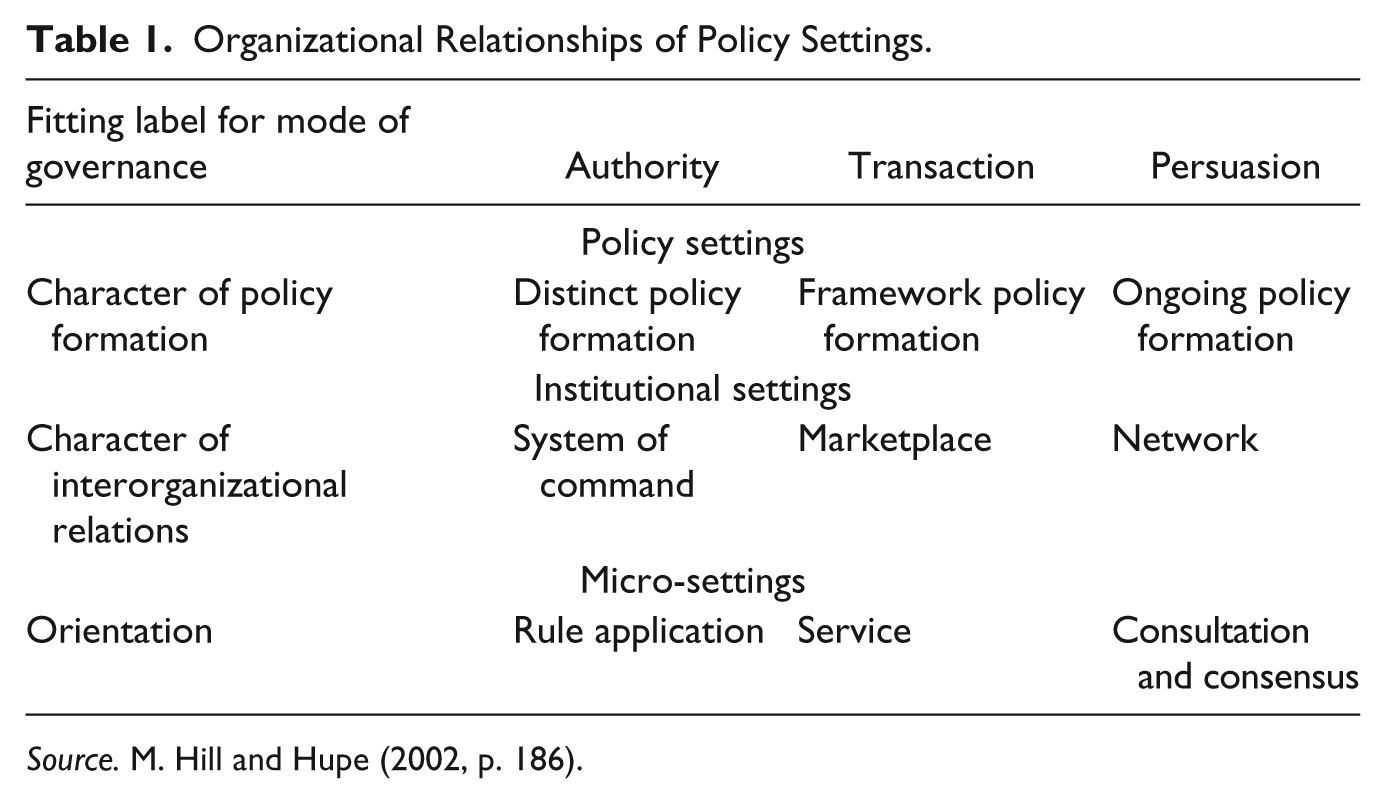
Source. M. Hill and Hupe (2002, p. 186).
M. Hill and Hupe’s (2002) matrix of organizational relationships of policy settings (Table 1) shows how different policy settings are structured and what assumptions guide interaction between stakeholders. M. Hill and Hupe also develop a second matrix presenting prescribed management approaches in policy implementation, based on the related logics of interaction (as displayed in Table 1). This matrix (Table 2) indicates most effective management of policy implementation relationships for each of the three ideal types of governance and policy settings. As certain policy settings create different power and competence distribution among policy actors, certain approaches to manage relationships and implementation are more appropriate than others, from a policy effectiveness perspective. The different policy settings entail expectations on involved actors to behave according to policy setting scripts. These two matrices will be used in the analysis of the case presented, to answer the research questions.
Prescriptive Perspectives on Managing Implementation.
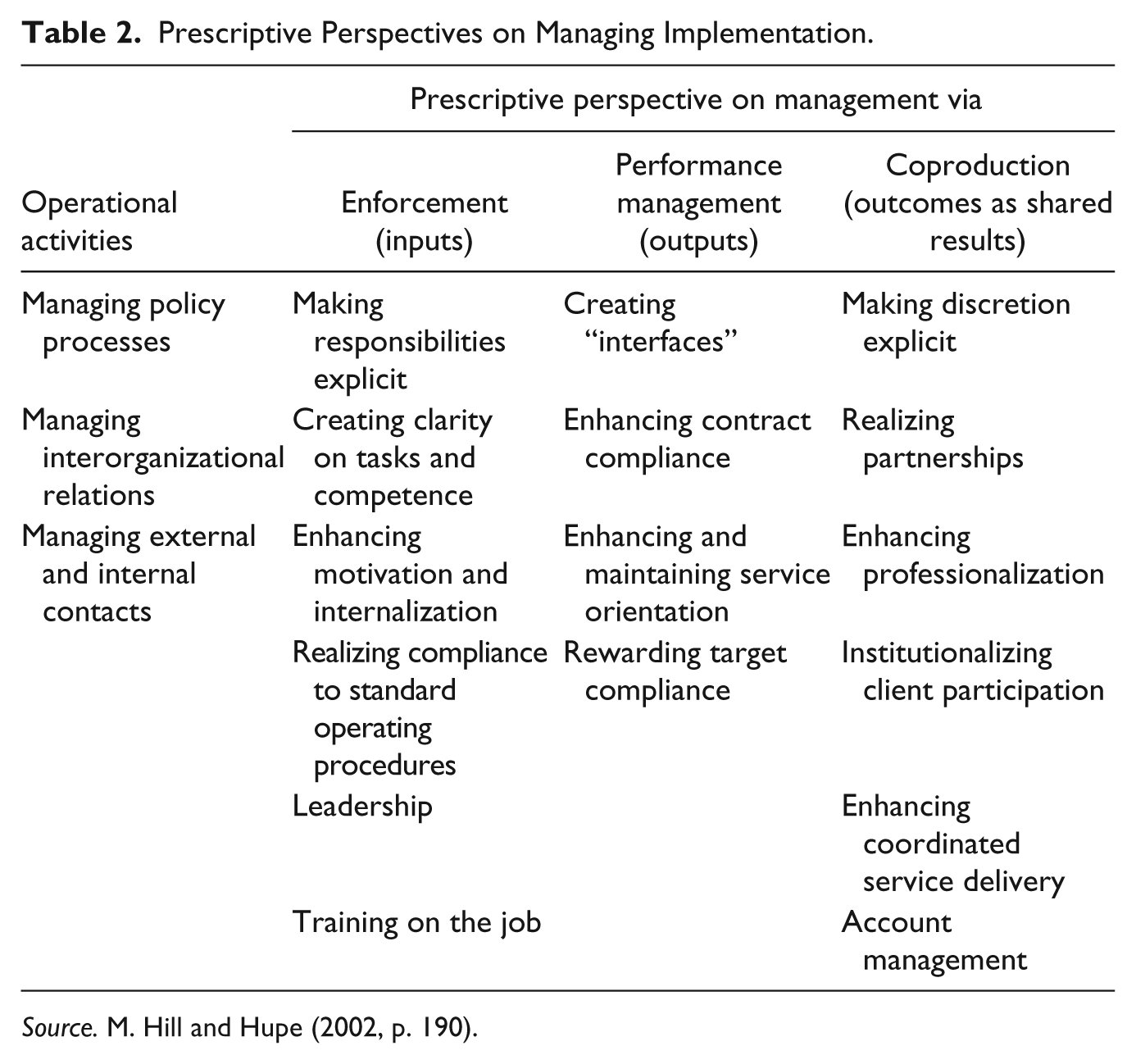
Source. M. Hill and Hupe (2002, p. 190).
Analytical Framework
To offer more profound knowledge of the dilemmas and paradoxes of policy implementation, in particular development policy implementation, theoretical models for understanding the policy process and relationships between parties involved in it will be applied on a case of a regional cultural policy for better outreach of museum education. In particular, Bannink and Ossewaarde’s (2012) matrix of decision-making decentralization will be used in combination with M. Hill and Hupe’s (2002) normative models of appropriate management modes in differing policy settings. M. Hill and Hupe’s models identify different policy settings, linked governance modes, and prescribed management approaches. The analytical framework is delineated in Figure 3.

Analytical framework of the study.
The relationship between partners in collaborative governance and policy implementation is a central element in Bannink and Ossewaarde’s model, which acknowledges the differing stakes of participants in collaborative governance. An understanding of the reasons for governance paradoxes and alternatives to specific outcomes based on governance roles is offered by M. Hill and Hupe’s matrix of organizational relationships in policy settings and prescriptions for policy implementation management.
Case Study
Material and Method
To generate in-depth knowledge of governance modes, detailed case studies still fulfill a role in contexts of high complexity, for example, between government and sectorial governance, and have been called for to elaborate knowledge on policy failure in particular (Héritier & Lehmkuhl, 2008; Hupe, Hill, & Nangia, 2014; Rodríguez, Langley, Béland, & Denis, 2007). The study aims at theoretical generalization rather than generalization to a population (Schout, 2011; Yin, 2009).
The empirical study and this article have developed out of interest in the poor outcome of a regional museum education policy that had been in place for a decade with different designs, when being evaluated after yet a reform in 2009 (Lindqvist, 2011). The museums implementing the regional policy were discontent with their role in the implementation of the policy, which had changed from previous years. Furthermore, the policy in question generated poor outcome notwithstanding high levels of output. Empirical data were collected through document analysis of formal reports and meeting minutes, informal documents and archive material, and from interviews with educators and management at the museums involved in policy implementation. Representatives at various levels of the Region of Skåne were also interviewed regarding the aims and implementation process. Interviews were relatively highly structured. A total of 20 interviews were undertaken, and various types of formal documents consulted, including annual reports on performance, applications, political decision protocols, and formal meeting minutes. The policy process was traced backward from the outcomes and outputs with the help of empirical data in line with Elmore’s (1980) suggestion for backward mapping. The qualitative approach allowed asking respondents with firsthand experience of various stages of the policy implementation process questions about policy outcome and possible causes of documented output and outcome. To contextualize the case study, a background to the reformed policy in question is given next. The section gives important information about the development of governance relationships between parties involved in the implementation of the policy in question and regional cultural policy in Skåne. Many details in the policy formation and implementation process are not possible to convey due to space limitations, so only information of relevance for the focus of the article is referred.
Background and Context
A particular characteristic of the Swedish political and public administration system is that it has three independent levels with tax-levying rights and polity. The independence of local and regional levels makes governance quite complex, especially at local and operational levels. In the last decades, regions have been formed in some parts of the country, the oldest being Skåne and Västra Götaland formed in 1999, taking on a role of strong regional development agents. Following the general trend of regions being networking agents, the Region of Skåne supports independent as well as public organizations on national, regional, and local levels to develop individuals and the region as a whole striving for social and economic growth. Decisions on cultural policy are made by the Culture Committee of the Regional Assembly of Skåne, based on suggestions developed by the administration, the Office of Culture (Kultur Skåne). As the Region of Skåne is not itself an operational body, it relies on other public and private actors in the cultural sphere for implementation of regional cultural policy.
Following the aims of the newly established Region of Skåne, the Political Board of Cultural Affairs of the Region of Skåne in the early 2000s decided to support measures aiming at increasing access to cultural heritage in the region. They did this by introducing a catalogue of cultural activities available at arts and cultural heritage organizations in the region, distributed to schools. This Culture Catalogue of Skåne was coordinated by the Office of Culture.
After a few years, Office of Culture employees recognized a need for communication among professionals in the field of museum and gallery education, as these were few and far apart. This led to the introduction of regionally employed educators who were mobile and worked at various museums and galleries. Soon after the implementation of this policy, however, it became evident that the knowledge of regional educators of the specific collections of individual institutions remained superficial. A revision of the policy resulted in regional educators being physically located and employed by 16 selected museums with funding provided by the Region. This enabled regionally funded educators to complement or initiate educational services than that would not have materialized otherwise. This revised policy allowed the region to stimulate development of education at museums in the region. A chronological illustration of the various reformed policies is given in Figure 4.

Different policies within the regional museum education support framework of the Region of Skåne in the 2000s.
A Reformed Policy: Input
In 2007 again, the Board of Cultural Affairs of the Regional Council of Skåne decided to reform the regional museum education policy, as auditors had criticized performance measurement possibilities with the existing goals stated for many policies of the cultural field within the Region. The Board of Cultural Affairs of the Region wanted the new and revised regional museum education policy to be even more ambitious than the previous. They wanted resources allocated to regional museum education to result in greater impact by reaching more children with the same amount of resources as already allocated. Not only increased clarity, effectiveness, and control but also flexibility, innovation, and development were to be achieved by the revised museum education policy (Kulturnämnden, Region Skåne, 2007). The previous version of the policy had resulted in the establishment of well-developed educational services at individual museums. Having achieved this, such services should now be considered regular education work at museums and funded by museum principals, according to the Board of Cultural Affairs. The overarching goal of the revised policy, to be implemented from 2009, was to stimulate innovation and development at museums with the aim of achieving educational services that reached more children. Stated operational objectives of the policy are listed in Table 3.
Stated Goals of the Reformed Regional Museum Education Policy of the Region of Skåne, 2009.
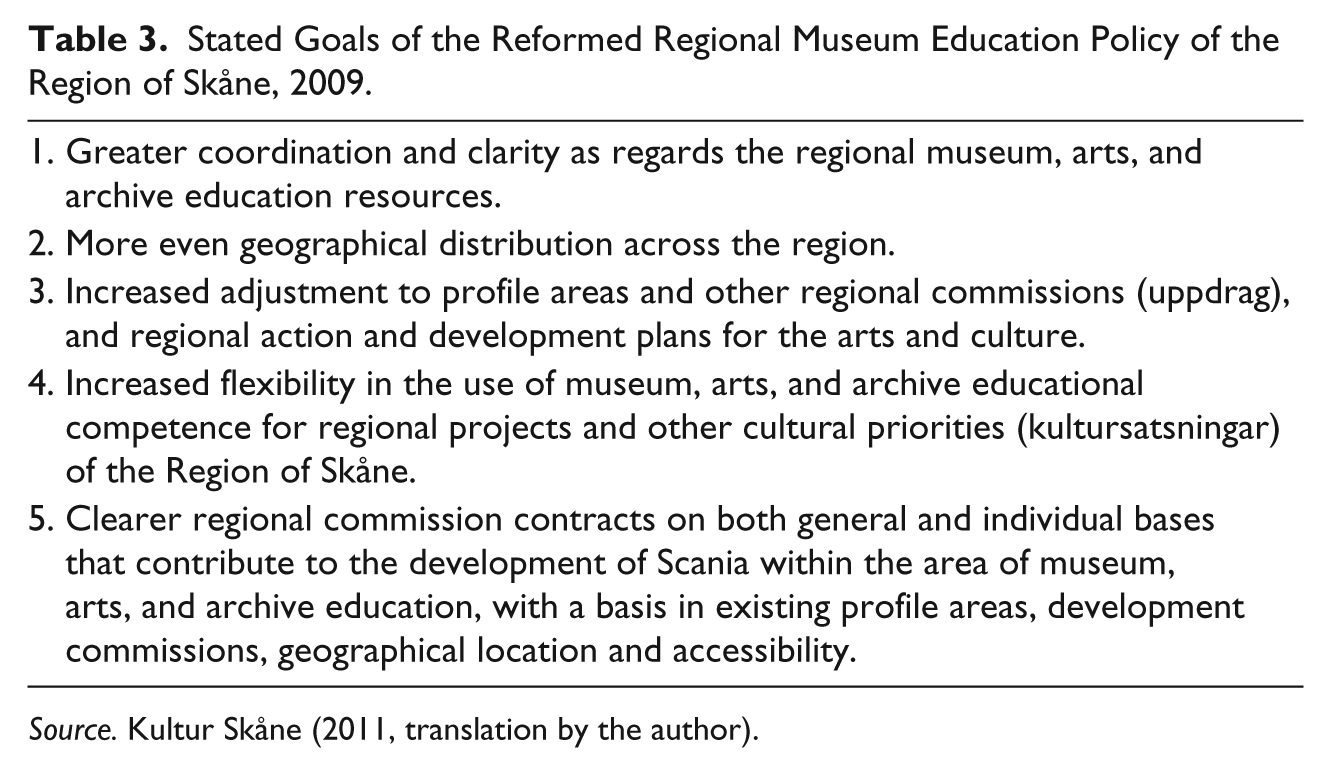
Source. Kultur Skåne (2011, translation by the author).
The Office of Culture and the Operationalization of New Policy Goals: Throughput
The Office of Culture had the task to conduct the implementation of the policy according to the new policy objectives to be implemented from 2009. It was officials at the Office of Culture that decided to shift the target group of museum education activities supported by regional funds from children to their teachers to achieve an increase in the impact of the regional funds to museum education. Officials at the Office of Culture visited and interviewed the museums about their areas of competence and current educational services. On the basis of these interviews, the Office of Culture reformulated the commissions of museums involved in the policy implementation without any further dialogue with the concerned museums, adding detailed instructions to the goals to be achieved with regional monies (see Table 4). This was due to the Region perceiving museums as hesitant to change their ways of working. Yet, until 2009, the museums had been allowed discretion in how to achieve the regional policy goals stipulated (see Table 5). To further secure development in the provision of museum education services, the Office of Culture divided the involved 16 museums into collaboration teams, based on the expertise and profile of each museum. Each collaboration team consisted of two to five museums.
Commission for the Implementation of the Regional Policy, Example.
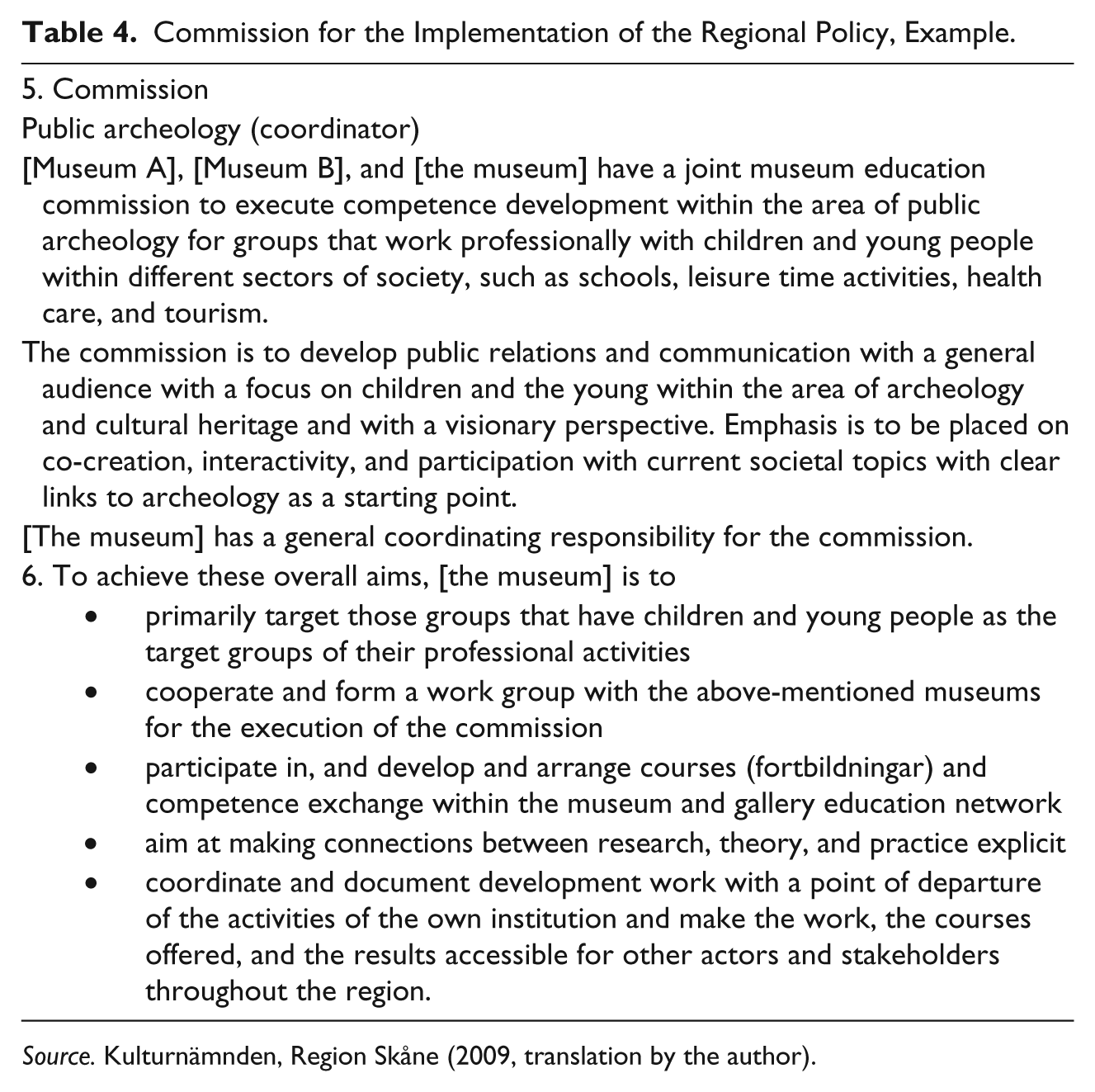
Source. Kulturnämnden, Region Skåne (2009, translation by the author).
Commissions From 2007 for the Implementation of the Previous Regional Policy of Skåne, Example.
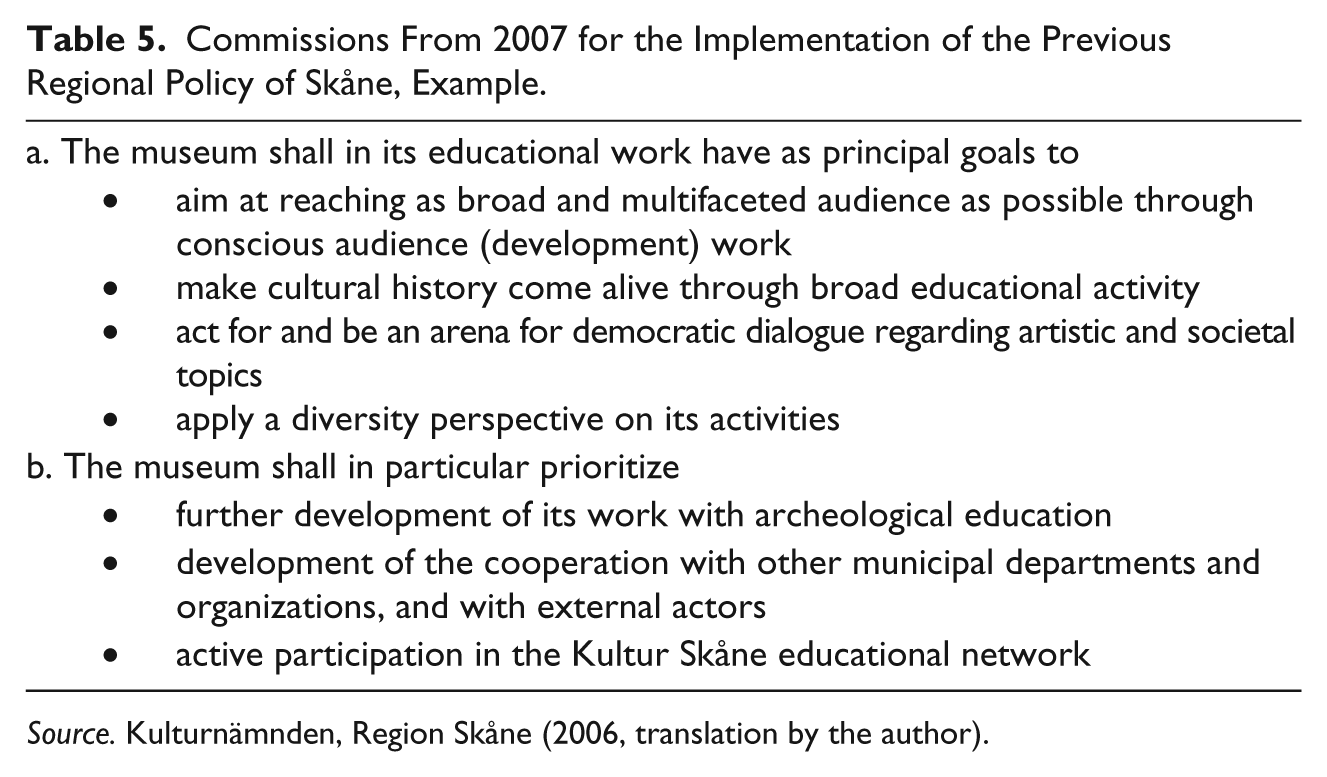
Source. Kulturnämnden, Region Skåne (2006, translation by the author).
Output
The museums in their thematic groups, following the instructions from the Region, developed joint educational packages for teachers in the region to enroll on during their annual competence development days. Other forms of output were teacher tutorials for displayed exhibitions and workshops for groups of teachers and schoolchildren. It became evident for the museums quite soon, however, that teachers did not have time to attend teacher instruction days at museums and galleries. There was simply too much competition for the few competence development days that teachers have at their disposal annually. The result was that the museum offers were poorly utilized. Output was delivered as stated in the instructions from the Region.
Outcome
As regards outcome, it was difficult for the museums to operationalize the goals of the policy (listed in Table 3). Several of the policy goals were overlapping and difficult to understand from an external point of view, for example, for the museums involved. The stated policy goals did not have very much to do with the output that museums delivered. Rather, as the stated policy goals addressed the work of the Office of Culture, the goal fulfillment was rather an indication of how well the policy was designed than implemented. The main aim of the policy, reaching a larger number of schoolchildren with museum education services, was not achieved. This was, according to respondents, due to target groups not behaving as assumed by the Region. The museums interpreted the policy as a desk product that had not been designed with expert knowledge of the field of implementation. As discretion for the museums in the policy implementation phase was virtually non-existent, alternative solutions were impossible for the museums to explore to achieve better outcome.
Findings
The Double Bind of Combined Governance Modes
Using M. Hill and Hupe’s (2002) matrix of policy settings and corresponding organizational relationships (Table 2), as well as their prescriptive matrix of implementation management (Table 3), to analyze the case, it can be concluded that the governance mode chosen for the policy implementation process was characterized by a combination of distinct policy formation (an authority mode of governance) and a framework policy formation (a transaction mode of governance). The Region not only made responsibilities and tasks clear, securing implementation compliance from museums through detailed instructions, but they also left to the museums to market educational packages to teachers. In all of this, the museums had only limited and indirect influence over the policy they were to implement. The museums, however, approached the collaboration as a policy implementation network, having collaborated with the Region regarding museum education for almost a decade in implementing regional cultural policy. They saw their own competence and discretion (had it been allowed) in decision making on implementation as a guarantee for the success of the policy, and expected a matching governance approach on the part of the Region. The museums in other words expected an ongoing policy formation process (persuasion mode of governance) rather than authority mode of governance. The hierarchical model secured command efficiency but generated poor outcome as vital feedback was not allowed. The market mode of governance left museums responsible for output, but the strict control of the implementation hampered the use of museum expertise. Leaving the museums outside the policy design phase meant that the Region missed important early feedback regarding realistic expectations of vital elements of the policy. Also, a purely market-based governance mode or even an authority-based governance mode, as in the previous versions of the policy, would have allowed more expertise of the museums to be used in policy implementation. A persuasion (network) based governance mode and consequent coproduction-oriented implementation management, or even a market mode of governance with discretion regarding implementation, would certainly have increased the level of informed decision making and the level of satisfaction among museums with the policy implementation process. A persuasion or market mode of governance would furthermore probably had led to a slower policy design process, a rather different design of the policy instrument, and finally, to be sure, to a different outcome.
The idea of the Office of Culture to shift the target group from children to teachers can in itself be reasonable. Policies based on certain response from the target group of the policy can be risky, however, as pointed out by Ethridge and Percy (1993). The Region seems to have defined the issue of attracting teachers to educational courses at museums as a market communication issue, as they never contextualized or problematized the degree of interest from the side of school teachers toward opportunities to attend museum education courses. Basing the success of the policy on assumed market behavior rather than on intimate knowledge of the field of education was a faux pas on the part of the Office of Culture. More of discretion in the implementation phase would probably have improved the policy outcome. As pointed out by Bell, Hindmoor, and Mols (2010) among others, governments do not lose their key position in governance relationships even if they opt for network forms of interaction.
The Paradox of Strong Control Resulting in Poor Outcome
One of the paradoxes of the double governance mode chosen by the Region of Skåne was that strong control without expertise led to poor outcome. Analyzing the case according to the decentralization matrix of Bannink and Ossewaarde (2012), we can see that through the design of the policy, the Region of Skåne wanted to avoid both the self-regulation and performance paradoxes relating to a decentralization of power over policy content and financial resources, respectively. As the Region nevertheless depended on the museums to implement the policy, they chose responsibility as accountability (i.e., market) mode of power distribution with very tight control over performance. This is the explanation of the paradoxical result of full output compliance yet poor outcome of the policy. The museums were only allowed to deliver literally what was stated in the instructions of the commissions. The Region’s chosen governance mode, responsibility as accountability with strict performance control through detailed instructions in Bannink and Ossewaarde’s model, eliminated the risk of creaming but at the same time failed to recognize the expertise of the involved museums. Rent-seeking was avoided with strong control, but this led to the paradoxical result of poor outcome as a result of lack of discretion on the part of museums. If more discretion in the implementation phase had been allowed, in other words a responsibility as accountability or as task mode strictly applied, the outcome would probably have been more successful.
The Paradox of Development Policy Failure Despite Collaborative History
A paradoxical finding is that despite a decade of collaboration in the implementation of the regional museum education policy, the revised policy implemented from 2009 generated poor outcome. This result is linked to the development element of the policy, rather substantially changing the content of the policy from one policy period to the next (see Figure 4).
There was a significant change in the kind of development implied by the revised policy in 2009 as compared with the preceding versions (see Figure 4). The first two versions of the regional museum education policy could be described as development policy simply by being created; the Culture Catalogue and the mobile educators were completely new features in the regional museum education policy. The development implied by the third version of the policy consisted of a shift in location of educators being placed at individual museums in contrast to the previous central location at the Region itself. The fourth policy version, our case study, in turn, operationalized development as increase in the impact of the work of museum educators through development of new educational offers for a new target group, teachers. The Office of Culture officials, however, did not have firsthand experience of the dynamics of the demand of museum education at schools, and important knowledge and experience of the demand for educational services could not be put forward by the museums as there was no dialogue during the policy formation phase. This was a major factor contributing to the poor policy outcome.
An important reason for the poor policy outcome arguably was that the type of aim pursued by the Region—development and change—was not, from an implementation perspective, sufficiently based on knowledge of the behavior of target groups. This knowledge was available in the museum field but not used to any significant extent in the design of the policy. The fact that the development element was part of the reason that the policy generated poor outcome gives some perspective on incremental politics, as discussed by Lindblom (1959, 1979), who states that if incremental change of policy is not based on knowledge of the context of the policy, it might well fail. The Region did, however, take policy learning seriously and commissioned an evaluation of the policy (Lindqvist, 2011). In consequence of the results of the evaluation, they revised the policy in 2014, in a way that allowed museums more discretion over how to pursue the policy goals (Kulturnämnden, Region Skåne, 2012).
The case study suggests that regional policies, to the extent that they have as overarching goal to generate development and change, may end up in paradoxes of implementation, as there may be conflicts between policy goals. A conclusion is that regional or other governments with a development goal for their policies should pay attention throughout the policy process for these goal conflicts, and not only pass on this conflict to implementation levels to solve.
Conclusion
The analysis of a regional museum education policy in this article has resulted in the identification of paradoxes and dilemmas in collaborative development policy implementation. First, a paradox for government is that keeping control centralized in collaborative policy implementation means that leaving the expertise of external partners unutilized. This in turn will probably result in poor policy outcome. In other words, when government keeps decision-making control, policy outcome suffers due to lack of sector expertise. In the studied case, strong control was achieved by combining hierarchical and market modes of governance, whereby both input and output are closely monitored, worsening the policy outcome by doubly restricting the discretion of implementing museums. The poor policy outcome of the studied policy depended essentially on an uninformed assumption on the part of the public administration in charge of developing the policy of the behavior of a new target group. The change of target group in turn was based on a single-eyed focus on driving development and change in the cultural sector of Skåne. The urge to avoid negotiation of goals and implementation with the involved museums also meant neglecting their expertise. Of course, this paradox and dilemma is also a problem for the implementing partners, who are not allowed to perform at their optimum.
Second, there is a dilemma for government linked to development as an absolute criterion for policy reform. In the case analyzed, development policy in the cultural sector entailed a regular change in the policy, thereby limiting the organizational learning of all collaborating partners. This again increases the probability of policy failure.
Third, a conclusion from the study is that there are expectations on roles and behavior in the implementation collaboration among participants, which may or may not coincide. It is a dilemma for both governments and collaborating parties in case the expectations are not coinciding, and they enter the collaboration with unrealistic assumptions of discretion and negotiation power. The stated reason for the Culture Office of the Region of Skåne to not engage in a persuasive (network) governance relationship with the implementing parties was that they saw a danger of rent-seeking on the part of the implementing museums.
A final dilemma is that of the implementing parties, in the studied case the collaborating museums, which already had long experience of implementation of various versions of regional museum education policy, finding themselves subject to control both of goals and of the means of achieving these, whereas they were expecting a network setting for the policy implementation. To be sure, either a network or a hierarchical approach to policy implementation relationships would have generated better outcome and output. The change that the Region of Skåne implemented from 2013 meant a return to a more traditional authority-based relationship between museums and the Region in museum education policy (Kulturnämnden, Region Skåne, 2012). However, a network approach to governance could be the best option, given the development element of regional cultural policy, continuing to propel change in regional museum education services.
A further conclusion of the case study is that the sources of policy failure were to be found at the policy formation rather than at the implementation stage of the policy process. As shown by previous research, it is not necessarily only at the implementation stage that things may divert from good intentions. Neither does long collaborative experience in policy implementation as such secure from policy failure.
The matrices of the theoretical framework not only help explain the mechanisms and elements resulting in a policy failure but also indicate alternative avenues of governance behavior. Both Bannink and Ossewaarde’s matrix and M. Hill and Hupe’s matrices outline alternatives for governance in collaboration with external partners, and indicate the importance of expectations on mutual behavior for the governance relationship. The chosen governance mode proved to be suboptimal from an outcome perspective, as implementation was dependent on external competence that was never used to its full capacity. Incongruent implementation on the part of the museums might even have improved the policy outcome. This would, however, have meant a breach of contract on the part of the museums.
As a regional development agent, the Region would need to take its networking role seriously, to utilize the competence of the external parties to its maximum. An increased use of a network or market governance approach would definitely had increased the chances of a better potential at the policy formation stage, and certainly also the later implementation stage.
To avoid the paradoxes and dilemmas of the case study, and to develop successful governance relationships, government needs to acknowledge expectations of non-hierarchical relationships in the case of collaboration to increase legitimacy, and more importantly the expertise of external partners in policy implementation. External parties are vital for regional policy implementation and contribute with new views on how policy innovation can be achieved. Differing views on implementation effectiveness does not necessarily mean unwillingness to implement government policy. The case also illustrates the dilemmas of museums in the implementation of regional policy. Museums on a daily basis manage activities aligned with up to three different policy levels (local, regional, national), delivering stipulated output, and there is a need for more research on the management at individual cultural institutions of such multiple level policy implementation.
Dialogue-based policy formation takes time and is not always popular among politicians wanting to see results. Formative (ongoing) evaluation is an option in policy processes as the studied case, where an independent researcher acting as action researcher supports civil servants in their policy formation and implementation work. This is suitable especially where government is reluctant to delegate decision making to external implementing parties. If poor outcomes can be avoided by switching from summative evaluation at the end of a policy period to formative evaluation, legitimacy for sure would increase for the policy and government. Finally, there is today little research on cultural and regional policy implementation, and the lack of cultural policy research references in this article points to the urgency of more research on developments in this field. There is also need for more research on development criteria in policies, as described in the case, as such criteria may sound well in theory but apparently can cause policy failure as in the studied case.
Footnotes
Acknowledgements
The author would like to thank Gustaf Kastberg and three anonymous reviewers for their constructive and valuable advice during the process of preparation of this article.
Declaration of Conflicting Interests
The author declared no potential conflicts of interest with respect to the research, authorship, and/or publication of this article.
Funding
The author received no financial support for the research, authorship, and/or publication of this article.