



Abstract
The study attempts to reveal the doctrinal foundations of Hungary’s sweeping sub-national governance reforms (SGRs) that took place in the period 2010-2014. It compares actual SGRs with internationally mainstream doctrines of major contemporary reform, to determine the extent to and the ways in which Hungarian SGRs are a mixture of these trends as opposed to being a novel paradigm of its own. The study concludes that Hungary’s reform path substantially diverges from all three major reform paradigms examined—that is, New Public Management, New Public Governance, and the Neo-Weberian State. We end with the proposition that this deviation is not of an unintended or accidental nature; rather, it seems to be part of a coherent and rationally pursued vision of (sub-national) governance, possibly referred to as “illiberal.”
Keywords
Introduction: Research Questions, Data, and Method 1
As part of their overarching changes to the state architecture, in the 2010-2014 governmental cycle, the FIDESZ-led government implemented a fundamental re-shaping of Hungary’s sub-national governance. 2 The broader state reforms extended to Hungary’s constitution, all fundamental political institutions (such as the legislature, the electoral system, judiciary, the Constitutional Court, and the ombudsman, along with other institutions of checks and balances), as well as many substantive policy areas (social policy, health care, public education, higher education, labor policy, etc.). These changes are revolutionary and not only in terms of governmental rhetoric. Many, though definitely only a minority, of these reforms received intense international political and media attention, triggering large debates and even concerns over possible violations of rule of law and liberal democratic values (Krugman, 2012; Tavares, 2012).
The particular, idiosyncratic pattern of governance reform—which Hungary, along with other new European Union (EU) Member States from Central and Eastern Europe such as Poland, Russia, or Slovakia (Jenne & Mudde, 2012; Szelényi & Csillag, 2015), seems to follow—has been labeled in various ways in recent years. According to some interpretations, these changes are part of a broader “illiberal turn” (see the symposium in the July 2012 issue of Journal of Democracy) or a “populist backlash” (Rupnik, 2007) in Central and Eastern Europe. Thus, they have a much broader significance geographically. Nevertheless, systematic scholarly interpretations and assessments are still severely lacking (although see Greskovits, 2015; Pappas, 2014).
This is particularly so in the less visible area of sub-national governance reforms (SGRs), where most of the (modest amount of) published work focuses on particular aspects of SGRs such as elected local governments (Dobos & Soós, 2014), territorial state administration (Pálné Kovács, 2011), or selected local services (Horváth, 2014). In our view, however, these approaches are bound to be incomplete, because they disregard the systemic nature of such reforms and the qualitatively new patterns emerging from them. This gap in available knowledge provided the primary motivation for this research. The broad ambition of the article is to locate Hungarian reforms, comparatively speaking, in the coordinate system of the most important contemporary doctrines. Thereby, we hope to contribute to a better understanding of whether Hungary’s reform path fits with these doctrines or how it possibly diverges from them. Although based on a single-case study, our approach is comparative in that it uses “concepts applicable to other countries, develops concepts applicable to other countries, and/or seeks to make larger inferences” (Landman, 2003, p. 34; see also Ragin & Rubinson, 2009, p. 20 ff.).
Research Questions
Administrative and governance reforms are typically characterized by some set of (more or less) coherent ideas that express the proposed trajectory of reforms. On one hand—as we will argue in the “Conclusion” section—Hungary’s SGRs seem to be driven by a consistent doctrine. On the other hand, however, it appears to be markedly different from the well-known policies found in public administrative reform practices throughout Europe. This perceived contradiction gives rise to the following research questions:
Note that the focus of RQ2 and RQ3 are not the same. By answering RQ2, we examine whether Hungarian SGRs can be derived from (some mix of) contemporary doctrines, and if so, which one(s). In contrast, RQ3 explores possible deviations from all three doctrines, which would make Hungarian SGRs, in some sense, novel. Our research questions point to a further question of broader significance. Are deviations from the well-established Western models of development fundamentally erratic and unintended, or are they rather of a coherent and systemic nature? The former views appeared frequently in Central- and Eastern European area studies (e.g., Nunberg, 1999; VanDeveer & Dabelko, 2001); nevertheless, scholarly reflections upon recent politico-administrative developments suggest the opposite (Szelényi & Csillag, 2015).
Data and Method
Our answers to the above research questions will be based on the following evidence and method:
In relation to all three research questions, our tasks include (a) identifying the most relevant doctrines of administrative reform, (b) defining the key analytical dimensions whereby these doctrines may be described and compared with respect to SGRs, (c) defining the attribute values implied by each individual doctrine and each analytical dimension, and finally (d) locating Hungary’s actual position in the resulting “prediction matrix.” This method is a version of the method of “pattern matching” (Yin, 2003).
Basic features of Hungary’s recent (post-2010) SGRs will be based on a systematic overview of existing studies, supplemented with documentary analysis of key pieces of legislation.
The structure of the article is as follows. In “Conceptual Foundations” section, we scrutinize the core concepts and the main design features of the study. The section “Hungarian SGRs (2010-2014): Findings and Analysis” describes Hungary’s SGRs in the proposed comparative framework, and the section “Discussion” ends with a summary and discussion of the results and conclusions.
Conceptual Foundations
Basic Concepts
By the term (SGR) reform, we refer to a well-circumscribed set of “deliberate changes to the structures and processes” taking place both within sub-national organizations as well as between sub-national and national-level organizations “with the objective of getting them (in some sense) to run better” (Pollitt & Bouckaert, 2011, p. 2). Throughout this article, our use of the word reform refers primarily to formal decisions taken. This choice is justified by the ongoing nature (short-term perspective) of the analysis. Similarly, we focus upon doctrines as normative, ideological sources of action which can, at best, be expected to orient decisions and immediate activities. Our focus is not upon the more distant, long-term outcomes of given decisions.
Throughout this study, we use our second core term, reform doctrine, to refer to a set of more or less coherent, normative principles describing the current and anticipated governance arrangements, along with some guidelines as to how to arrive at a specified end.
Major Doctrines of Administrative Reform
We base our selection of doctrines, first, on a survey of recent academic scholarship on reform doctrines in general (Ashworth, Ferlie, Hammerschmid, Moon, & Reay, 2013; S. P. Osborne, 2006, 2010; Pollitt & Bouckaert, 2011).
On the basis of these considerations, we consider the following reform doctrines the most relevant in locating Hungary’s SGRs in terms of their ideological foundations:
New Public Management (NPM),
Neo-Weberian State (NWS), and
New Public Governance (NPG).
There is a relative abundance of authoritative literature describing these doctrines in a comparative manner so as to classify public administration and management reforms. These include Dunsire (1995), Hood (1991), D. Osborne and Gaebler (1992), and S. P. Osborne (2010) with regard to NPM; Drechsler and Kattel (2008) and Pollitt and Bouckaert (2011, Chapter 4) related to NWS; and S. P. Osborne (2010) in relation to NPG. We do not intend to reiterate these contributions; rather, we will focus only on their most distinctive features, particularly in relation to reforms that occur at sub-national levels. Moreover, throughout the article (unless otherwise indicated), we will focus on the normative claims of the different doctrines, not the actual practice.
A Framework for Analyzing SGRs
To create a framework for empirically analyzing SGRs, we will proceed to identify comparative analytical dimensions. These dimensions are, ideally, supposed to satisfy a number of criteria.
They should be related not so much to administrative and governance reforms in general, but to SGRs in particular. The key difficulty here is that SGRs have their specific agendas and issues, many of which are not (clearly) touched upon by generic reform doctrines.
All three doctrines should have at least some implications regarding every analytical dimension. The difficulty here is that the different doctrines put forward different reform issues; thus, for example, NPM may have direct implications for Issues A and B, but no recognizable implications for Issues C and D, with NPG just the other way around.
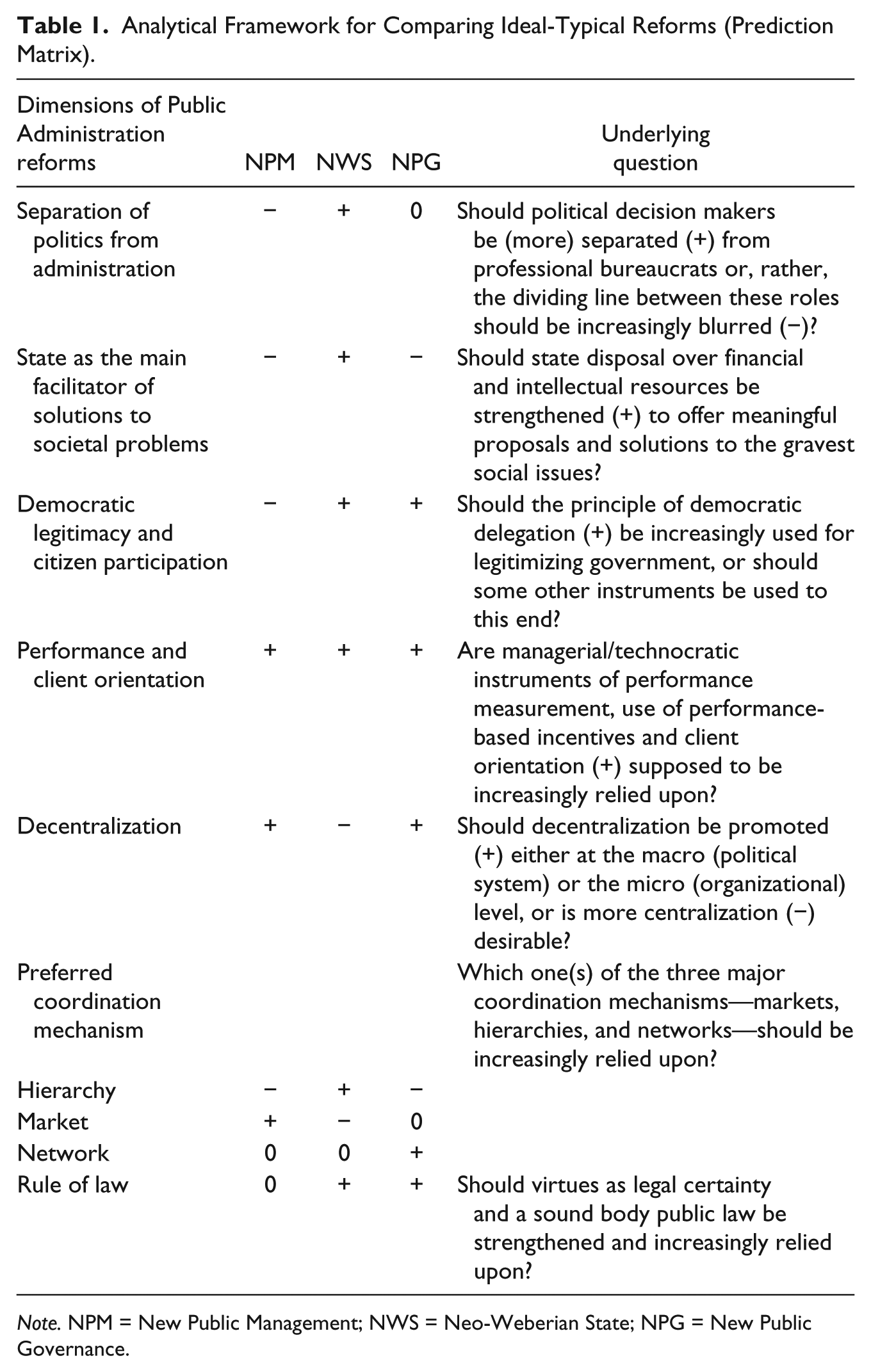
With this is mind, we propose nine analytical dimensions as follows (see Table 1). The relation between a particular reform doctrine and analytical dimension is marked with either a “+” or a “−” (indicating whether the doctrine promotes the positive or negative end of the continuum, respectively). “0” is used if a doctrine does not imply any association (either positive or negative) with the given dimension—either because there are no characteristics claims put forward by the doctrine, or they are so contradictory that we could not decide upon an unambiguous “−” or “+.” We emphasize that, in all cases, neither the positive nor the negative end of the spectrum is to be regarded as “good” or “bad.”
Analytical Framework for Comparing Ideal-Typical Reforms (Prediction Matrix).
Note. NPM = New Public Management; NWS = Neo-Weberian State; NPG = New Public Governance.
Below, we briefly examine the individual dimensions enumerated.
Separation of politics from administration
Separation of roles means that the tasks of politicians and civil servants are clearly defined with little overlap, and interaction between them is extensively and effectively regulated. This is primarily ensured by some version of a career-type civil service system (Demmke & Moilanen, 2010). One of the most crucial claims of NPM is to eliminate the “red tape” associated with career-type systems and, in general, the institutional framework separating politicians and civil servants (Bordogna, 2008). Quite the contrary, NWS strives to create or maintain a distinct, professionally autonomous group of civil servants (Pollitt & Bouckaert, 2011, p. 118). With regard to NPG, we were not able to identify any significant normative claims regarding this dimension.
The state as the main facilitator of solutions to new societal problems
The state’s role in society can be augmented by various means, including
the restriction of resources available to other, non-state social spheres (through rises in tax burden, restriction of foreign funding to non-governmental organizations (NGOs), decrease in state funding to NGOs, or a decrease in contracting out); and
the nationalization or regulation of industry sectors.
In their detailed description of NWS, Pollitt and Bouckaert (2011) mention this as the first and most important element of the Weberian doctrine (p. 118). NPM, on the contrary, strives to roll back or downsize the state. Nevertheless, even in its more modest versions, it tends to expect initiatives by the market actors and customers (Hood, 1991). Finally, NPG stresses the importance of “co-” arrangements (co-design, co-production, etc.), implying a distribution of tasks that is more diversified and balanced among the state, the market, and civil society.
Democratic legitimacy and citizen participation
Increased emphasis on democratic, input-based legitimacy (Vabo & Aars, 2013) may imply a diverse set of measures, including
electoral reform involving direct election of mayors,
nurturing of consultative mechanisms in the policy process, or
Freedom of Information (FoI) policies.
Pollitt and Bouckaert (2011) mention “reaffirmation of the role of representative democracy” (p. 118) as a key element of NWS. NPM, however, promotes a weakened role for the democratic chain of accountability by vesting an increased role in market mechanisms (user- or client-to-provider relationships) and contractual arrangements, increasingly substituting client for citizen. In contrast, NPG supports the “third wave of democracy,” or participatory democracy, by emphasizing the input legitimacy derived from citizens’ participation in public services delivery (Pestoff, 2009, p. 206). The NPG recommended new modes of service delivery increase the trust between citizens and the government and generate legitimacy gains (Fledderus, Brandsen, & Honingh, 2015; S. P. Osborne, Radnor, & Nasi, 2013).
Performance and client orientation
Performance orientation can be promoted by several means: various sorts of performance measurement and monitoring or evaluation regimes and incentives at the individual or organizational level based on performance data. A different but related approach is to emphasize and promote values of client service and client satisfaction, primarily through a variety of quality management techniques.
NPM is clearly associated with an emphasis on performance and customer service (Grüning, 2001; Hood, 1991). Although the case is somewhat more blurred with regard to NWS, in the final analysis, its “greater orientation on the achievement of results, rather than merely the correct following of procedure” as one of the key “neo” elements of NWS suggests a plus sign in this table cell (Pollitt & Bouckaert, 2011, p. 119). NPG is less unambiguous than NPM. Nevertheless, by putting emphasis on co-production, NPG significantly contributes to increasing trust and to public service customers’ satisfaction (S. P. Osborne et al., 2013). By adopting network-type arrangements, recommendations of NPG have a clear potential to increase efficiency of public service delivery (Bao, Wang, Larsen, & Morgan, 2013, pp. 446-447).
Decentralization versus centralization
By centralization, we mean a change that affects the decision making, control, and instruction competencies by partially or wholly transferring them to an upper level of the administrative hierarchy (Hutchcroft, 2001; Pollitt & Bouckaert, 2011, p. 104). Decentralization means a movement in the opposite direction. Frequent examples of decentralization measures include the delegation of tasks and resources to regional or local tiers of municipal government, as well as flexible or multi-year budgeting.
Most scholars agree that NPM tends to favor decentralization in the sense defined above (Barzelay, 2001; Grüning, 2001; Hood, 1991; Pollitt, 1995). Although the situation is less clear-cut in the case of NPG, more evidence-based research can be found on decentralizing policy making and implementation (Keast, Mandell, & Brown, 2006; McCourt, 2008). NWS, in our view, clearly implies centralization by tightening political control over administrative apparatuses and placing increased emphasis on the preeminence of state functions.
Using market-type mechanisms (MTMs), network-type mechanisms (NTMs), or hierarchical-type mechanisms (HTMs)
MTMs are defined as “encompassing all arrangements where at least one significant characteristic of markets is present” (Blöndal, 2005, p. 79; cf. Thompson, Frances, Levaĉič, & Mitchell, 1998). The main instruments include outsourcing, public–private partnerships, vouchers, public sector league tables, and performance-related pay.
NTMs operate through a closer cooperation between various interdependent actors (Provan & Kenis, 2008). Network coordination is strengthened by reforms that result in closer horizontal cooperation among the agencies in the public sphere or among public, private, and civil organizations (S. P. Osborne, 2010, p. 7). Examples include various co-design, co-planning, and co-production arrangements; user boards; and partnerships with private actors or NGOs.
HTMs signify a predominantly command-and-control relationship between the coordinators and those coordinated. Examples include nationalization, the exclusion of civil actors and the market from the delivery of public services, and increasingly detailed and stringent regulations.
NPM promotes MTMs, whereas NWS favors HTMs, and NPG opts for NTMs (Hood, 1991; S. P. Osborne, 2010; Pollitt & Bouckaert, 2011, p. 99).
Rule of law
At a general level, rule of law is a principle of governance in which all persons, institutions and entities, public and private, including the State itself, are accountable to laws that are publicly promulgated, equally enforced and independently adjudicated, and which are consistent with international human rights norms and standards. It requires . . . separation of powers, participation in decision-making, legal certainty, avoidance of arbitrariness and procedural and legal transparency. (UN Security Council, 2004, p. 4)
Examples of reforms that strengthen the rule of law include bolstered FoI measures, as well as institutional reforms that strengthen the separation of state powers and the role of institutional checks and balances such as the Constitutional Court.
The strengthening of the rule of law is central to NWS (Pollitt & Bouckaert, 2011, p. 118). In contrast, NPM does not take a strong and explicit position regarding the rule of law or its strengthening (Bao et al., 2013, p. 453). The NPG doctrine however promotes instruments accountability and certain elements of rule of law such as “deliberative democracy, e-democracy, public conversations, participatory budgeting, citizen juries, study circles, collaborative policy making, and alternative dispute resolution” (Bingham, Nabatchi, & O’Leary, 2005, p. 547, also cited by S. P. Osborne, 2010, p. 112).
Limitations and Delimitations of the Study
We would stress two caveats regarding the limited ambitions of this study:
We do not intend to enumerate all major components of Hungarian SGRs (e.g., the drastically increased share of primary education institutions run by major churches). Instead, we shall focus on components that lend themselves to comparison with the major reform paradigms under review.
In particular, we do not wish to determine whether reform doctrines actually influenced reform practice. Rather, reform doctrines are mainly used as reference points facilitating the location, description, and —to some extent—understanding of reform reality.
Hungarian SGRs (2010-2014): Findings and Analysis
When it comes to evaluating the FIDESZ-led central-right government, in power since 2010, one must recognize the fact that it has significantly reorganized the entire politico-administrative system (Hajnal & Csengődi, 2014; Pogány, 2013). These sweeping reforms reflect a marked change in the set of values behind the operation of the Hungarian state. Their most defining feature so far has been a powerful tendency toward centralization, extending political control over state apparatuses and other sectors of society. For the strategic intentions, see the governmental blueprint (Ministry of Public Administration and Justice [MPAJ], 2011, 2012). 3
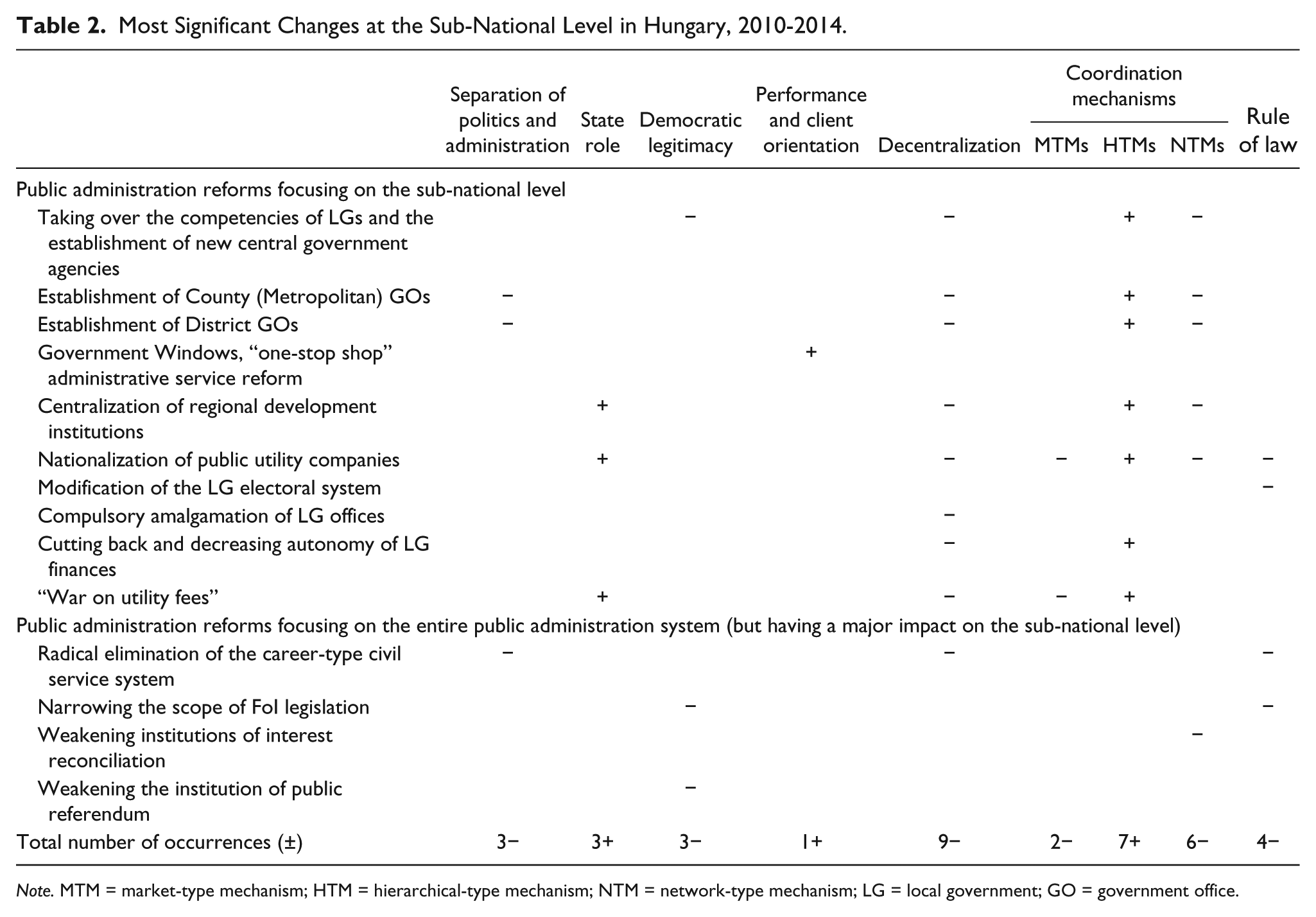
Focusing on the sub-national elements of these reforms, Table 2 below presents the most significant components affecting, directly or indirectly, sub-national governance. The columns represent the dimensions identified earlier in Table 1. For each cell in the table, we examine whether the given reform measures (in rows) effected a shift along the dimensions indicated in the columns. Given the multiplicity of criteria and the heavily context-bound nature of their evaluation measurement, we do not specify an explicit scale of measurement. Rather, in the text following Table 2, we justify each assessment briefly by giving a qualitative summary of what Blatter and Haverland (2012) call “variable-scoring observations” (p. 23).
Most Significant Changes at the Sub-National Level in Hungary, 2010-2014.
Note. MTM = market-type mechanism; HTM = hierarchical-type mechanism; NTM = network-type mechanism; LG = local government; GO = government office.
The last row of the table shows the number of measures that trigger a positive (+) or negative (−) movement in the given dimension. We note, however, that these values do not represent arithmetic evaluations, because one occurrence of a given phenomenon—say, centralization—cannot be calculated alongside an opposite or another similar measure. We are also aware of the fact that these measures are not of equal significance. Consequently, when interpreting the results, one should keep in mind the important qualitative as well as quantitative differences hiding behind the individual plus and minus signs. Therefore, we treat the number of occurrences as indicators on the ordinal scale rather than true numbers in any sense.
The individual SGR measures are briefly described and examined below.
Public Administration Reforms Focusing on the Sub-National Level
Taking over the competencies of local governments.
The central government took over from sub-national governments the key operational tasks of supervising primary and secondary schools and hospitals. The emerging mammoth agencies abound in red tape. Coordination mechanisms that are not of the HTM type are minimal, and politicization is so strong that even primary school or hospital directors are directly appointed by the minister (GYEMSZI—National Institute of Quality and Organizational Development in Healthcare and Medicine, 2013; KLIK—Klebelsberg Institution Maintenance Centre, 2013). The involvement of autonomous organizations (such as parents’ or patients’ associations) in decision making has radically decreased. Decisions once made by the local government are now made by the agency headquarters. These features of the new system represent a clear setback to democratic legitimacy and decentralization.
From 1990 to 2010, the principal task of municipal governments at the county level was to run county-level public services. By transferring hospitals and public educational institutions to the central level, the counties suffered a major loss of function and budget (Pálné Kovács, 2014). These centralizing reforms reduce input-based legitimacy, too, as they transfer the competencies of directly elected bodies to centrally controlled organs.
2. Establishment of County (Metropolitan) Government Offices.
The government created new, general-purpose, middle-tier administrative organs in each county and the capital city (Act CXXVI of 2010; Government Decree 288/2010 [XII. 21.]) headed by government commissioners who are explicitly political figures (oftentimes former members of parliament [MPs] of the governing party) appointed by the prime minister.
County Government Offices (CGOs) exert certain control functions over 17 different specialized administrative services (such as public health or veterinary authorities), thereby radically increasing centralization and, to some extent, blurring the boundary between the tasks and competencies of professionals and politicians. (Note, though, that important control functions over specialized field offices remain within the respective, specialized central agency.) This constitutes a clear shift toward weakening NTMs and increasing HTMs.
3. Establishment of District Government Offices (DGOs).
In a subsequent wave of centralization, DGOs were created, subordinate to the county-level parent CGOs (Act CXXVI of 2010; Government Decree 218/2012 [VIII. 13.]). The new DGOs took over most of the public administration tasks formerly performed by local governments. In addition to career civil servants, DGO directors can be appointed from the ranks of local and national politicians (past MPs or mayors), thus blurring the boundary between civil servants and politicians (Act CXXVI of 2010, 20/D §, 2.).
4. Government Windows, “one-stop shop” administrative service reform.
CGOs and DGOs maintain a (partially) new, integrated structure of administrative one-stop shops called “Government Windows.” They handle, in a uniform and customer-friendly way, a few hundred different types of public administration procedures. This measure is the most visible governmental effort to increase client orientation (Kovács & Hajnal, 2014).
5. Centralization of regional development institutions.
Before 2012, the regional development system was made up of municipal development councils at county, regional, and micro-regional levels. The members of the councils were delegated by the central government and the local governments. Central agencies and NGOs were also represented with a consultation right (Act XXI of 1996). Subsequently, the development councils were abolished, and consultative organs with minimal influence were established instead. The role of county-level local governments is now rather formal, because central government organizations have retained decision-making rights in all aspects of regional development.
As a result, centralization and HTMs are strengthened, whereas NTMs have practically disappeared.
6. Nationalization of public utility companies.
The government “nationalized” public utility companies in different ways: by buying back shares from foreign investors and by taking over the shares from local governments (Horváth & Péteri, 2013). The administration not only takes part in individual transactions to acquire shares but also regulates whole industries to nationalize them (see Nationalization of Waste Management Industry, Act CLXXXV of 2012, §81, which declares that only central or local government-owned companies are allowed to deal with waste management). The nationalization of these sectors means strong centralization and increasing reliance on HTMs to the detriment of MTMs and NTMs.
In combination with increasingly stringent price regulations on utility fees (Act LIV. of 2013), which results in a decrease in the value of utility companies, this pursuit of nationalization by means of open market operations can be viewed as weakening the rule of law.
7. Modification of the local government electoral system.
Legislation on local government elections was amended in two steps (Act L of 2010; Act XXIII of 2014). As a result, the majority[-focused] elements of the system were further strengthened . . . The winners of the changes are the bigger national parties, who can dominate the single-member districts and are able to fulfill the criteria to set up party lists. With a fragmented left-wing opposition (since its collapse in 2010), these characteristics describe FIDESZ. (Dobos, 2014, pp. 10-11)
In addition, the government modified the boundaries of some constituencies to favor candidates of the governing party (“gerrymandering”; Bánkuti, Halmai, & Scheppele, 2012). The capital city Budapest’s election system was also changed in a hasty and politically driven process, to avoid the risk of an opposition takeover in the city council (Helsinki Committee, 2014).
These steps go against the principle of the rule of law, because changes to the election system are supposed to be neutral to any party or ideology. Also, they should have come into effect only after the next elections.
8. Compulsory amalgamation of local government offices.
Mayor’s offices in settlements with less than 2,000 inhabitants were amalgamated, so they have to serve at least 2,000 inhabitants or seven municipalities (Act CLXXXIX of 2011, §85). Offices that became redundant were closed. This measure is a step toward centralization, although these amalgamated offices might work more efficiently than their individual predecessors.
9. Cutting back and decreasing autonomy of local government finances.
On the revenue side, the government radically decreased local government funding from 11.8% of GDP (2010) to 10% in 2013 (Eurostat). Financial latitude of local governments was further decreased by “earmarking” 100% of central governmental grants. Now local governments must obtain prior government approval when entering into commitments that give rise to debt (Sivák, 2014, p. 290). 4 The most important shared tax, the personal income tax, disappeared from the local government financial system, though it had been a key source of revenue since 1990.
On the expenditure side, the resulting cutbacks are even more drastic. Total expenditure fell from 12.6% in 2010 to 7.5% (Eurostat). These figures reflect the measures—discussed earlier—that transfer key local public services to central government control.
Taken together, these changes convey both a sharp increase in centralization and a stronger reliance on HTMs.
10. “War on utility fees.”
By cutting household utility fees (electricity, gas, waste management, district heating) through new, stringent price and service regulations, the government strongly interfered in market processes and weakened the MTMs, thereby strengthening the HTMs (Pina, 2014).
Public Administration Reforms Focusing on the Entire Public Administration System
Radical elimination of the career-type civil service system.
After 2010, new acts on civil servants abolished literally all protection against arbitrary dismissal, and dismissal without any justification became possible (Act CLXXIV of 2010, §17, section 1). Although the Constitutional Court later annulled the most severe changes, the law continues to stipulate that a civil servant can be dismissed on grounds of unworthiness of office or loss of superior’s confidence (Act CXCIX of 2011, §63, section 2, points a and e). These steps significantly contribute to blurring the boundary between politicians and bureaucrats, leading to the over-politicization of the civil service. Moreover, superiors’ ability to hire and fire contrary to the rule of law is barely limited (Nacsa, 2014).
2. Narrowing the scope of FoI legislation.
Act CXII of 2011 on Informational Self-determination and Freedom of Information introduced a series of limitations on FoI institutions and procedures (Act CXII of 2011). First, the position of Parliamentary Commissioner for Data Protection and Freedom of Information was abolished. According to the European Court of Justice, this step amounts to Hungary having failed to fulfill its obligations to protect individuals with regard to the processing of personal data and the free movement of such data (European Court of Justice, 2014). A new authority, the National Authority for Data Protection and Freedom of Information was created instead (Eötvös Károly Institute, 2014). Second, FoI as a universal right was relativized by the new law, restricting the possibility of requesting information of public interest on grounds of “potential misuse of information” by the requester (Szabó, 2014, p. 1). Subsequently, Act XCI of 2013 further weakened the ability of citizens to enforce their rights to acquire information from public authorities (Act XCI of 2013; for further details, see Eötvös Károly Institute, 2014).
These steps weakened the democratic legitimacy of the state and worked against the principles of the rule of law.
3. Weakening institutions of interest reconciliation.
After 2010, the government substantially weakened the institutional framework for reconciliation of interests (Neumann, Berki, & Edelényi, 2014). As Berki, Neumann, Edelényi, and Varadovics (2012) state, [The National Public Service Interest Reconciliation Council’s] functioning has been to some extent restrained, since, in practice, it has exercised no influence or voice over the series of major laws reshaping public administration and public services. Moreover, it has not been able to negotiate on wage scales, which have been frozen in the public sector since 2006. (pp. 14-15)
The government’s intention to weaken the unions was also the primary reason for the establishment of a new organ, the Hungarian Government Officials Corps, which has represented government officials since 2011 (Act CXCIX of 2011, §6, point 22). The role of other interest representation organs, the Hungarian Civil Servants and Public Employees Trade Union, has decreased. The above-mentioned steps weakened the democratic legitimacy of the state system, as well as the scope and role of deliberative, network-type coordination processes (NTMs).
4. Weakening the institution of public referendum.
Following its rise to power, the governing party FIDESZ, which had used public referendum very successfully against the former social-liberal government, made major changes to the institution itself. The new framework—set by the Fundamental Law of Hungary and Act CCXXXVIII of 2013—encumbers both national and local referenda (Fundamental Law of Hungary 2011; Act CCXXXVIII of 2013). The minimum turnout for valid national referenda was increased from 25% to 50%. So-called consultative referenda were abolished, as were national popular initiatives. Furthermore, a range of issues became excluded from the scope of public referenda, including those affecting the Fundamental Law and election laws (see Komáromi, 2014).
These modifications restrict public participation, thus weakening the input-based legitimacy of the state.
Discussion
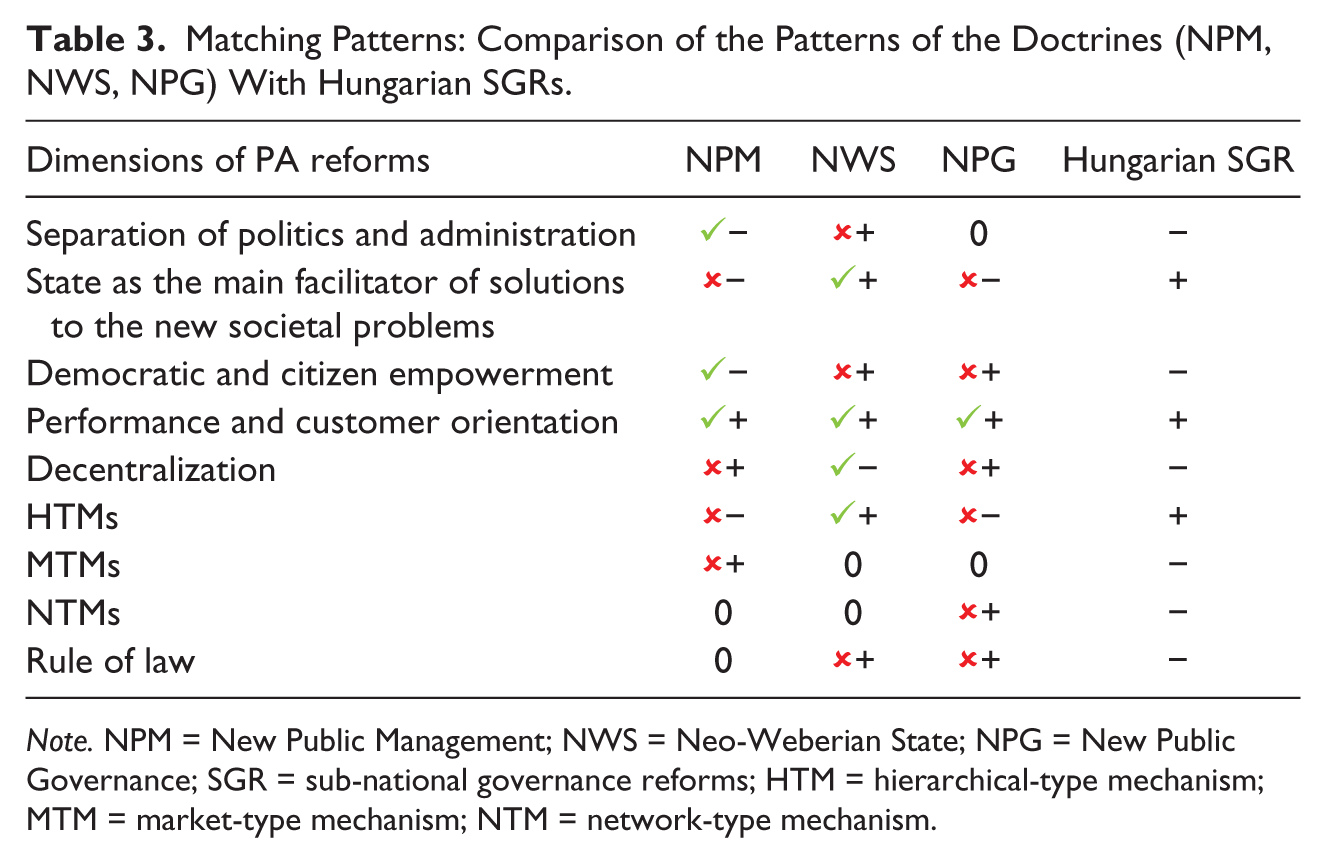
Below, in Table 3, we compare actual Hungarian SGR patterns with those derived from the three major doctrines. The first three columns are identical with the respective columns of the prediction table (Table 1), whereas the last column represents the findings established in the previous section. A check mark signifies a correspondence, whereas a red “X” denotes a contradiction. If neither a clear agreement nor a clear contradiction is found—which is indicated by a “0” sign in the given cell—then neither a check nor an “X” is assigned.
Matching Patterns: Comparison of the Patterns of the Doctrines (NPM, NWS, NPG) With Hungarian SGRs.
Note. NPM = New Public Management; NWS = Neo-Weberian State; NPG = New Public Governance; SGR = sub-national governance reforms; HTM = hierarchical-type mechanism; MTM = market-type mechanism; NTM = network-type mechanism.
The overall pattern suggests that the Hungarian SGRs do not closely match any one of the three doctrines.
As for NPM, we found three matching elements—namely, the weakening of the separation between politics and administration; the weakening of classical, democratic legitimacy of politico-administrative institutions; and an increased focus on performance or customer service. (Note that the performance agenda did not apply to Hungarian reforms at all; rather, customer orientation came into play.)
Regarding NWS, although the doctrine advocates the separation of politics and administration and promotes a career-type civil service system, the Hungarian reforms move in exactly the opposite direction. Another important deviation is, whereas NWS would strengthen input-based legitimacy, Hungarian reforms tend to weaken it. Moreover, the Hungarian SGRs, quite significantly, run counter to the NWS principle of strengthening the rule of law.
Spectacularly, though less surprisingly, there is only one match between the NPG doctrine and the Hungarian governance reforms, as the two point in opposite directions in relation to all but one dimension.
Conclusion
In the light of the above findings, we may establish the following conclusions.
RQ1
Hungarian SGRs reflect a very coherent vision of transformation. This is shown by the unequivocal character of major SGR components. In all the nine dimensions, the measures taken by the government indicate movement in a certain direction, either in the “plus” or “minus” direction (see the last row of Table 2). This suggests that the various SGR components are not a result of some unstructured and erratic, bottom-up processes. Rather, they are conceived and initiated in a centralized, top-down manner.
RQ2
Hungarian SGRs do not conform to any one of the three doctrines as described in the academic literature. Although they represent a mix of existing doctrines to some extent, they differ from each of them to a varying, though always substantial degree. Whereas (quasi-) official reform rhetoric denounces NPM (Rosta, 2012), there are important NPM-like features of Hungarian SGRs; and although reforms are touted as promoting the NWS, they show significant deviations from the NWS blueprint. Also worthy of note is the almost total lack of agreement—except one dimension—with the NPG ideal.
RQ3
As the last three rows of Table 3 suggest, there are three (of nine) dimensions in which Hungarian SGRs do not align with, or even contradict, all three doctrines. The radical rolling back of the market (and MTMs), the harsh downplaying of network-type coordination instruments, and the degradation of rule of law are tendencies that make Hungarian SGRs truly distinct from all the major paradigms.
Thus, we may hypothesize that the Hungarian SGRs follow some sort of a blueprint inherently different from existing doctrines.
In sum, it is our view that one should abandon the idea that the features and patterns representing a deviation from, or even a conflict with, consensual Western values of liberal democratic governance constitute some sort of an unintended error or an inability of the central power to exert control. Rather, the defining features of SGRs are surprisingly coherent and seem to be the result top-level political will. In relation to the purposeful, paradigmatic nature of the emerging pattern of (sub-national) governance, it is very telling that in a public speech, held on July 28, 2014, Prime Minister Viktor Orbán himself presented this newly envisioned state model—calling it an “illiberal state”—in contrast to the supposedly outmoded, liberal Western democracies (Orbán, 2014).
In this article, we compared the Orbán government’s SGRs with the normative content of key reform doctrines, that is, with the proposed ends and values to be promoted. Our above conclusions, naturally, trigger the question of how much they can be generalized to other, neighboring EU Member States. There are arguments supporting the view the aims and the actual reform steps introduced by the Orbán-government fit in a new, broader, “illiberal” tendency in Central and Eastern Europe. We can draw parallels with reforms carried out by Vladimír Mečiar or Robert Fico in Slovakia, by Lech Aleksander Kaczyński and his twin brother in Poland or Franjo Tudjman in Croatia (see Pop-Eleches, 2007; Tomini, 2014). In our view there is a severe need for more systematic comparative research on the public administration reforms of these governments.
Footnotes
Declaration of Conflicting Interests
The author(s) declared no potential conflicts of interest with respect to the research, authorship, and/or publication of this article.
Funding
The author(s) received no financial support for the research, authorship, and/or publication of this article.