




Abstract
Reputation management or branding is increasingly important for public organizations. Based on organization theory perspectives and reputation management theory, reputation profiles of four agencies—from the financial and education sectors—are compared. The data used were retrieved from the websites of the agencies at two points in time (2006 and 2016). The main results show not only that the performance dimension of the reputation profile is the most prominent but also that it is more balanced with moral and professional dimensions over time. This shows the increasing multiplicity of reputation management, catering to many and diverse internal and external stakeholders.
Introduction
Reputation management or branding is increasingly important for public organizations for various reasons (Wæraas & Maor, 2015). The world has become more globalized, complex, and insecure than it used to be, making it more difficult for public leaderships to know what measures to take to fulfill public goals and to gain insight into the effects of measures taken. This leads to more “talk,” either as a substitute for action or to supplement action (Brunsson, 1989). This balance between talk and action is meant to increase support and legitimacy from other public organizations, from stakeholders in the environment, or from citizens at large. Reputation management has much to do with accountability—to provide information about measures taken, to make assessments based on that information, and eventually to pass judgment, reward, or punish (Bovens, 2007). Reputation management may have internal purposes, but often it relates more specifically to social or horizontal accountability, meaning that an organization, often without having a formal obligation to do so, tries to provide information and justify its actions toward different audiences in the environment (Schillemans, 2008).
In essence, agencies care about what others think about them and try to advance their standing among different audiences (Maor, 2016, p. 821). Consequently, reputation management is about image-building, impression management, and “window-dressing” (Meyer & Rowan, 1977). It can be about pretending to be something or acting in different ways without really committing to a course of action. It communicates information of a symbolic nature to diverse stakeholders and tries to justify the decisions and actions taken by executive political leaders. It may report on the current situation in an organization or detail plans and aspirations for the future (Morphew & Hartley, 2006).
A crucial aspect of reputation management, however, is how the messages are received by internal and external stakeholders. So the potential success of reputation management is relational, meaning that efforts to boost an organization’s reputation must resonate with the receivers of information, which depends not only on the quality of the reputation management but potentially also on many internal and external contextual factors. Although our data cover reputation management from the perspective of the senders of information symbols rather than the receivers, we can systematically address the dynamics of how agencies manage their reputation over time and in varying contexts.
In this article, we focus on reputation management in public agencies or, more specifically, regulatory agencies. Overall, around the world, such agencies often emerged in the wake of New Public Management (NPM) reforms (Pollitt & Bouckaert, 2011). The main feature is that the central government takes a step back from controlling the agencies or controls them by other means at arm’s length (Lodge & Wegrich, 2012). This means in reality that executive superior control is made more difficult and that the agencies put relatively less weight on signals from political executive leaders and more emphasis on professional considerations, but they also interact more closely with stakeholders in the environment. This has implications for how such agencies go about managing their reputation: It will probably change their reputation management to become more self-centered, more externally directed, and more diversified. But complexity has been added to this profile with the implementation of post-NPM measures from the late 1990s in many countries, which have again focused more on centralization and coordination (Pollitt & Bouckaert, 2011). This has probably affected reputation management, too, with more weight being allocated to achieving collective goals, and it has certainly added complexity and hybridity.
Accordingly, our research questions are the following:
We compare two agencies from the financial sector and two from the education sector in Norway—the Competition Authority (KT), the Financial Supervisory Authority of Norway (FT), the Norwegian Directorate for Education and Training (UDIR), and the Norwegian Agency for Quality Assurance in Education (NOKUT). The data used are from information the agencies published on their websites in 2006 and 2016. 1
The article starts with a theoretical section where we discuss what is meant by reputation management and the types of reputation we will look at, followed by an outline of three organization theory perspectives and how we can use them to explain reputation management. Then, a context section gives an overview of the four cases from the two sectors, followed by a description and analysis of the main results. We conclude by discussing the implications of our results and the added theoretical and empirical value.
Theoretical Perspectives
Reputation and Reputation Management
Carpenter (2010) defines organizational reputation as “a set of beliefs about an organization’s capacities, intentions, history, and mission that are embedded in a network of multiple audiences” (p. 33). This implies that leaders of an organization, in our case agencies, have to use symbols to reach and appeal to diverse audiences to build a reputation (Wæraas & Maor, 2015). Doing this in an organized and systematic way is what we call reputation management. Aside from their own organization and the superior ministry, the stakeholders for agencies would be other ministries and agencies, subordinate public levels and institutions, public and private organizations that are regulated, users or citizens affected by regulations or who receive services, and so on. Reputation management might be about convincing stakeholders that an agency’s own performance is good, which is always better when it is true, but actual performance and symbols can sometimes also be rather loosely coupled (March & Olsen, 1976). Effects of reputation management could be general support, building goodwill and increased slack in general (Cyert & March, 1963), and also more specific support, leading to the provision of more resources (Easton, 1965). Hence, the standing of a public organization is important for organizational well-being, position in a political-administrative system, and their ability to act effectively (Carpenter, 2010).
One of the crucial decisions in reputation management is whether to choose a broad or narrow reputation profile (Van Riel & Fombrun, 2007). If the public organization, in our case an agency, is multifunctional and has a broad portfolio of tasks, a broad symbolic profile is often typical. This makes it easier to please diverse internal and external stakeholders, in a bridging way (Røvik, 2002); the downside is that the profile will be ambiguous and lack sharpness. If such an organization chooses a more specific profile, this often creates conflicts (Wæraas & Solbakk, 2009). A single-purpose organization may often choose a rather narrow set of symbols, which may create certainty about what it stands for, but such organizations may also try to appeal more broadly, in a bid to expand or build up a broad support basis.
According to Carpenter (2010, pp. 45-46), the reputation of a public organization can be divided into four dimensions, and we will organize our data presentation accordingly. First, the performative dimension focuses on whether leaders manage to create the impression among the various stakeholders that their own organization is delivering instrumentally on outputs and outcomes closely related to core mission and goals (Chapleo, Duran, & Diaz, 2011). Depending on how many and what types of tasks and functions a public organization has, effectiveness and efficiency may vary concerning how easy they are to assess. If very difficult, then the persuasiveness of the symbols is particularly important, that is, to create the perception of rationality and success (March, 1994).
Second, the moral dimension is related to whether a public organization is emotionally appealing and a carrier of moral values, that is, whether it is perceived as “compassionate, flexible and honest” (Carpenter & Krause, 2012, p. 27). Giving the impression that one is following high ethical standards is always an advantage, as is creating the feeling of protecting different stakeholders or the public at large. This is particularly important for regulatory agencies in sectors such as food safety, environmental policy, and financial institutions (Christensen & Lodge, 2016).
Third, the technical/professional dimension focuses on creating an image of a public organization that scores high on professional capacity and competence, which is often seen as the backbone for public decisions and activities (Wæraas & Byrkjeflot, 2012). Creating a sense of competence will make it overall easier to get actors that are regulated to accept the regulations or to elicit overall support in the public at large. This could also be related to recruiting new groups or reconfirming an existing competence profile.
Fourth, the procedural dimension deals with whether a public organization creates the impression that it adheres to appropriate procedural and legal requirements in decision making. This applies internally to rule-of-law and users’/citizens’ rights but externally to whether it attends to the legal framework, including laws and rules regulating its activities, in an appropriate way. For an agency, this dimension also relates to how formal affiliation to the ministries upward and to lower levels and institutions downward is handled.
Instrumental, Cultural, and Symbolic Perspectives
Overall, the instrumental perspective in organization theory takes as a point of departure the assumption that actors with bounded rationality, like leaders, will further goals through the systematic use of different instruments, of which the structural design of organizations is the most important (March & Olsen, 1983). They score high on control of decision-making processes and on rational calculation, that is, clear organizational thinking (Dahl & Lindblom, 1953). Wæraas and Maor (2015) refer to this instrumental perspective as a political science approach as it emphasizes leadership control, strategic action, and the underlying logic of consequentiality in reputation management. However, the perspective comes in different versions. First, leaders may try to attend tightly to strong instrumental features of the organization, that is, use symbols to tell the outside world how effective, efficient, competent, service-oriented, and so on the public organization is. The purpose is to strengthen the instrumental achievements with symbols telling the truth (Fombrun & van Riel, 2004). This can be done with a single unambiguous instrumental message or different instrumental messages for different audiences, which allow leaders to be more flexible.
Second, the leaders can deliberately engage in “double-talk” (Brunsson, 1989; Meyer & Rowan, 1977), meaning that they promote a strong set of instrumental symbols while knowing that they do not intend to follow this up with real action or that reality is in any case already different from their talk. This loose coupling of talk and action also gives leaders flexibility, allowing them to obtain legitimacy and support for both their talk and their actions (March, 1994).
A cultural perspective takes as a point of departure the idea that organizations gradually develop unique informal norms and values by adapting to internal and external pressure (task environment) through a process of institutionalization (Selznick, 1957). The unique cultural identity is developed gradually over time in a process of path-dependency, that is, cultural norms and values from a public organization’s formative years are currently overrepresented, meaning that historical traditions are important. When organizations with such institutional features experience changes or reforms, the degree of compatibility with cultural traditions and a logic of appropriateness will be important, that is, leaders will try to match situation, identities, and decision-making rules (March, 1994).
The basis for reputation management according to such a perspective is the historical-cultural path and traditions (Maor, 2011). Leaders will try to reflect such a path in the reputation symbols they use, which can be both a strength and a constraint. They will stress what the public organizational tradition has been known to represent, meaning values more than action, also related to main tasks, groups catered to, and professional competence. But leaders may also try deliberately to change the image of a traditional path because they would like to be seen as more modern and service-oriented, because they have experienced a crisis, or because there are other windows of opportunity for change in the organization’s cultural identity (cf., Kingdon, 1984).
A neo-institutional perspective on reputation management starts with the distinction Meyer and Rowan (1977) make between an organization’s technical and institutional environments, with the first alluding to instrumental aspects while the second is noninstrumental. In the institutional environment, which is often labeled the macro environment, there are established myths or symbols, based on the “social construction of reality” (Berger & Luckman, 1967), that quickly spread around the world, often from private to public organizations. These myths, often connected to international actors, contain taken-for-granted assumptions about, for example, how to organize or structure public organizations. These assumptions become strong pressures that national political-administrative organizations are faced with (Sahlin-Andersson, 2001). These myths may also be seen as fashionable recipes or institutional standards (Røvik, 2002). The difference between this perspective and the other two is that their point of departure for reputation is, respectively, the structure or culture of an organization, whereas the neo-institutional perspective is based on broad societal and cultural processes in a macro-international environment.
What Conditions Reputation Management: The Relevance of Time, Sector, Task, and Audience
In his book on time, policy, and management, Pollitt (2008, pp. 16-17) relates time in public administration studies to two aspects. First, change processes—be it generational change, cultural change, organizational restructuring, training professional staff, or making new political coalitions—take a long time. Second, contextual events in temporal sequences are important for the outcome, like internal leadership change or external crises.
In terms of the perspectives used, the instrumental one is primarily related to time-consuming processes, and reputation management may reflect the many facets of instrumental activities over time (Christensen & Gornitzka, 2017). The cultural perspective will not only allude to time-consuming processes over time and to gradual and slow adaptation but also to temporal contexts which are both a threat to and an opportunity for reputation management. The neo-institutional perspective relates most to temporal context, which opens up opportunities to use reputation management to relabel and redefine and to further myths “whose time has come” (Zeitgeist), which alludes to the dynamic in reputation management between myths and counter-myths (Røvik, 2002).
Sector is defined by Gulick (1937) as horizontal specialization using a principle of purpose, and this is often the main principle on which most public organizations are founded. Seen from an instrumental perspective, sector is structurally characterized by a set of formal organizations and their relationships. We focus on central agencies—that is, regulatory agencies at the central/national level of government—So one crucial factor is how the formal relationship between ministries and agencies is organized. Yet, the formal relationships with lower levels and institutions are also important, as are connections to private sector organizations, all of which create diverse preconditions for reputation management. From a cultural perspective, we will be interested in the traditions for organizing agencies, that is, in some sectors there are long traditions of subordinate agencies with relatively high autonomy, whereas others traditionally have more integrated solutions. The historical-cultural path may be important for how the agencies function and the potential for reputation management. A neo-institutional perspective will focus more on what kind of symbols or myths have been popular or appropriate in a sector related to agencies, that is, sector-specific institutional environments within which agencies are embedded. In what way do agencies present themselves as fostering modernity, rationality, and efficiency?
Task may relate to many aspects with different possible implications for reputation management. Wilson (1990) draws a seminal distinction between whether outputs and outcomes are visible. Reputation management may relate to tasks that are specific and visible on both output and outcome or they may be difficult to grasp, in particular with respect to outcomes. Political sensitivity and public resources committed may also be significant for reputation management, as will target population, something that we will discuss below (Pollitt, 2011; Pollitt, Talbot, Caulfield, & Smullen, 2004). Task is a very typical structural variable belonging to the instrumental perspective, which alludes to performative aspects of reputation management. But public organizations also have diverse historical paths concerning how they have defined and handled tasks, which may constrain their reputation management. According to a neo-institutional perspective, tasks have different potential for how symbols and myths are used in reputation management.
Audience, user, or stakeholder groups are central actors primarily in the task environment of public organizations and as such part of an organization’s domain, meaning that they are important for the organization’s activities (cf., Thompson, 1967). For an agency, the major stakeholders are the superior ministry and the subordinate actors related to their services and regulations. What Schillemans (2008) labels horizontal accountability deals much more with giving an account to media and the public in general, particularly in crises situations. But for agencies, “horizontal association,” for example, dealing with other agencies nationally or internationally, may enhance their image.
A public organization may not only be homogeneous and construct a common image, but it may also be heterogeneous and have subunits that symbolically cater to different stakeholders in the environment (Wæraas & Maor, 2015). The environment may be rather homogeneous, too, which makes “window-dressing” easier, or diverse and heterogeneous, which is more challenging. Seen from a cultural perspective, reputation management must try to create some kind of cultural compatibility with the stakeholders, meaning signaling the cultural norms and values that they have in common. This is easier the more culturally homogeneous the audience is. From a neo-institutional perspective, reputation management may either try to further a broad decontextualized symbolic message, which may please most of the stakeholders, or try to target specific parts of the audience with specific symbols/myths (Røvik, 2002).
Method
To address the main research questions and expectations concerning what factors might affect reputation management in these kinds of public organizations, we sampled organizations that vary in sector and tasks. Two of the agencies relate to service provision and regulation of commercial markets (financial and consumer markets), whereas the two agencies in the education sector have tasks related to key public sector institutions and regulation of national systems of public service provision. The latter has traditionally been close to the core of the nation state. Education is a basic right of citizens—Parents are under obligation to send their children to school and the state is constitutionally obliged to provide education. Higher education is seen as a “public good” in Norway with high levels of public funding, and most institutions in this sector are state-owned rather than private. The basic distinction between the agencies is, thus, whether they regulate public or private actors. We would expect this to affect how they present themselves and manage their reputation.
This study is based on a systematic analysis of symbols used in texts that these selected agencies have posted online on their official websites, that is, online reputation management. Websites have become the main arena in which organizations—public or private—try to shape their standing. Here, they present themselves, their history, their strategies, and their activities to their audiences. Hence, organizational websites have become a key data source in the study of branding and reputation management (Chapleo et al., 2011). We collected the data from official websites for three points in time (2006, 2011, and 2016) in December 2016. We analyzed the symbols using a two-step approach. To identify differences in reputation management according to the type of activities and audiences (see above), we structured the information on the official websites in Step 1 according to the following six predefined categories: (a) agency overall strategy (found under “about us” heading), (b) internal audience (employees and prospective employees), (c) regulatees (those being regulated), (d) information on regulators/coregulators (ministry/superior authority), (e) information about services the agency provides, and (f) the agency’s cooperation (national or international). The texts were drawn from site maps as well as the links to the agency’s letter of appropriation from government to cover Category (d).
In Step 2, we analyzed the content retrieved under each heading to score the agencies according to the type of reputation symbol used (Carpenter, 2010). We allocated scores for the four main analytical categories: performative dimension—covering instrumental aspects of agency performance, such as descriptions and facts/figures on regulatory output and outcomes; moral dimension—alluding to whether the agency uses symbols that make it “emotionally appealing” and highlight its moral values; professional or technical dimension, which stresses knowledge, professional capacity, competence, and responsibility for the agency; procedural dimension, which refers to agencies following due procedure and rules. For all four dimensions, scoring high (3) means not only mentioning the different types of symbols but also emphasizing them strongly, scoring medium (2) means mentioning these types of symbols without elaborating, and scoring low (1) means not mentioning them directly. A zero score was given in cases where there was no content found that was relevant for the particular reputation category. The numerical scores were used to highlight the overall patterns. The overall score is simply the nonweighted sum of the agency’s score for each of the four reputational dimensions under each of the six headings. The highest possible score is 18 for each agency for each reputation type.
To trace changes over time, we collected data from the websites at three points in time and performed the same stepwise procedure for information retrieved from websites in December 2016 and that retrieved 10 and 5 years earlier. The information from 2006 and 2011 was retrieved using Wayback Machine (http://archive.org/web/). We used a three-way comparative approach to analyze website content. We compared the websites over time for each agency and the reputation profiles and use of symbols according to different categories/audiences. We also examined interagency differences and similarities.
Context
The Norwegian system is a parliamentary system in an unitary state with strong central institutions. As a regulatory state, the Norwegian system is hybrid, combining hands-off regulatory mechanisms with more active political steering, depending on the political salience of policy sectors and single issues. Despite stressing autonomy for regulatory agencies, the model also allows control by political executive leaders if necessary (Christensen & Lægreid, 2007, pp. 509-514). It is, thus, a hybrid regulatory model, combining more autonomy than before with the room for political executive leaders to exercise political control. Norway’s first state agency was not founded until the 1850s (Christensen, 2003). One of the main rationales for the establishment of state agencies has been to structurally protect expertise and a technical rationality from direct political control and a political rationality, even in a political-administrative system based on the principle of “ministerial responsibility.” Typically, until the early 1990s, Norwegian agencies were multifunctional agencies with regulation as one of many tasks. But as part of an NPM-inspired development, the whole structure changed in the direction of more purely regulatory agencies with more autonomy than ordinary agencies (Christensen & Lægreid, 2007).
We describe and analyze reputation management by agencies in two sectors with somewhat different regulatory traditions: the education sector—the UDIR and the NOKUT—and the financial/competition sector—the KT and the FT.
The UDIR was established in 2004 as a rather traditional agency under the Ministry of Education and Research. It was tasked with the responsibility for the development and supervision of kindergarten and primary and secondary education. The directorate’s precursors date back to the postwar period when several small specialist councils for diverse types of schools were established. Instead of having a consolidated agency for all types of schools from elementary to high school, this fragmented structure existed for a long time. During the 1980s and early 1990s, this structure was gradually dissolved and many of its tasks integrated into the ministry (Ophaug, 2015). This, however, created capacity problems in the ministry and it was decided to “hive” off’ many of the typical agency tasks and establish the agency. Although there have been several reforms in the sector over the past decade, the agency has had a rather low political profile (see online appendix for a fuller description of agency tasks). Currently, the agency has about 280 staff.
The NOKUT was established, also under the Ministry of Education and Research, in 2004 as part of a comprehensive reform of higher education, which included the introduction of a new degree structure, grading system, governance of higher education institutions, and a new, more performance-based public funding system (Stensaker, Langfeldt, Harvey, Huisman, & Westerheijden, 2011). NOKUT marked the transition toward a formal accreditation system organized at the agency level. The agency today has a broad spectrum of tasks related to “quality policy.” In addition to regulatory tasks, addressing both public and private institutions, it also offers advice to the sector and conducts evaluations. Two features of NOKUT set it apart from the other agencies in the sample. First, NOKUT has a board as its supreme governing body with strong stakeholder representation. Moreover, the agency’s administration—currently numbering about 70 staff—draws heavily on the professional adjunct capacity of academic peers in conducting evaluations, audits, and accreditations. Consequently, core audiences are part of the agency’s governance structure and/or take part in the regulatory activities.
The KT has a history that dates back to 1917 when the Price Directorate was established in connection with a new law regulating the price of consumer goods (Folmo, 2005). Its history is marked by a transition from being tasked to deal with price regulation to regulation of competition. In 1983, the agency got a new director from the industry. He became rather visible in the media, a feature that has characterized both the directors and the agency ever since, indicating a rather high degree of politicization of the field. In relation to a new competition law in 1993, the KT was established as a successor to the old agency, but with far more resources. Its job was to regulate competition in diverse markets, scrutinize public regulations and enact the competition rules of the European Economic Area (EEA)/EU. The agency also became more autonomous as a result of an NPM-oriented administrative policy. Over the past decade, the agency has increasingly worked on international questions (Solstad, 2009). The KT is today subordinated to the Ministry of Trade, Industry and Fisheries and has 105 employees, down from 134 in 2001, mainly economists and lawyers.
The FT has its historical roots in the period before 1900, when life insurance companies and banks were expanding and encountering problems, with severe societal consequences (Hytten, 2009). This led to the first regulatory agencies in the field of banks, insurance, and brokerage firms. From the 1970s, the liberalization of financial markets and the information and communication technology (ICT) revolution in financial institutions changed the whole field, giving the regulatory authorities more tasks and hence more resources. A new law in 1985 ended the long historical period of fragmented scrutiny in the field and established a consolidated agency named the Credit Supervisory Authority. Norway then became the first Western country to establish such a coordinated agency (Isaksen, 2012). In 2009, it changed its name to FT, which reflected better the wide spectrum of scrutiny tasks entrusted to it and its role as part of an increasingly important international market. Unlike the competition agency, the financial agency’s directors have had a much lower public profile, which is an indicator of lower politicization. Today, the agency is subordinated to the Ministry of Finance and has 270 employees, a large increase over the 78 people it employed in 1987. The agency regulates and scrutinizes banks, financial businesses, insurance companies, financial e-trade, pension funds, security companies and management, market behavior in the security market, stock markets, and other regulated markets.
Main Results
Overall Reputation Profile
Overall, performance reputation is the most prominent feature when we summarize the results for the four agencies—This implies that these agencies provide most information on outputs and outcomes of their activities. This overall pattern—the predominance of performance—has changed over time (Figure 1), meaning that two of the other three types of reputation were used relatively more frequently in 2016 than 2006. The presentation of the agencies’ performance looms large also in 2016, but is matched with increasing emphasis on the presentation of their professional/technical as well as moral values and standing. Reference to the procedural qualities of these agencies remains on the same level. In sum, the performance management profiles have become more complex and hybrid as moral and technical/professional reputation almost match the emphasis on agency performance.
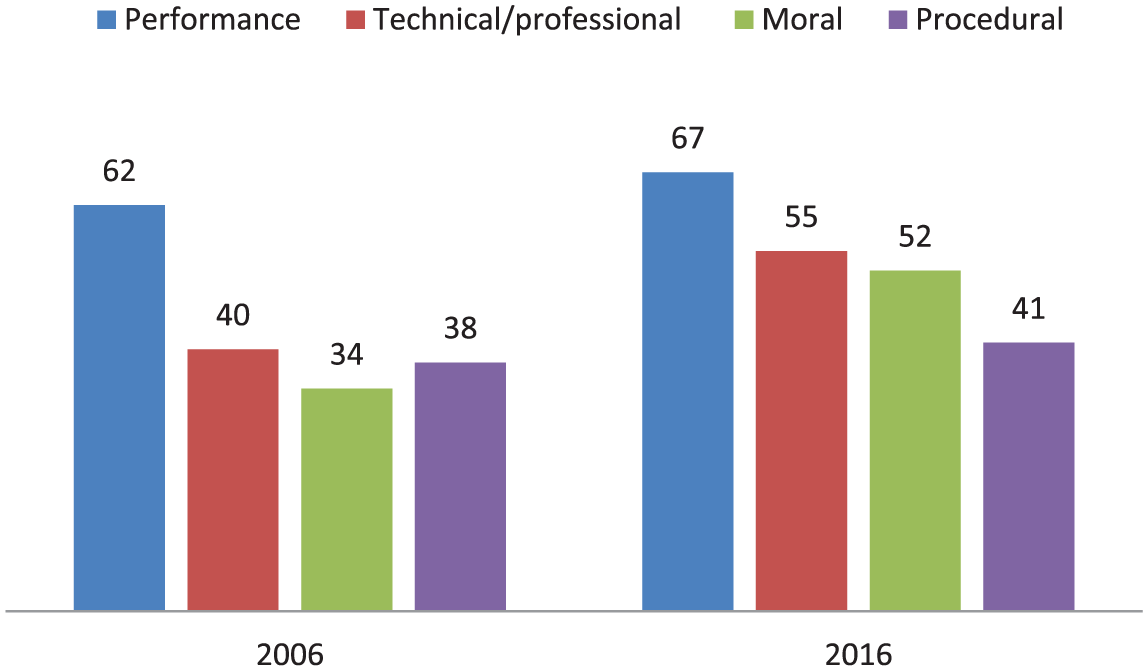
Overall reputation profiles of Norwegian regulatory agencies—change over time, 2006 and 2016.
Reputation by Agency
When we analyze the specifics of reputation management, some agency differences come to the fore. The current reputation profile of the NOKUT strongly emphasizes its performance. NOKUT’s online presentation showcases its output by documenting and providing information about the quality of higher education/vocational studies in Norway (e.g., the publication of an annual student survey). The agency also underlines its recently added role of administrating and implementing a new government program for Centres for Excellence in Education. The reference to its performance records is matched with high attention to its professional and technical capacity. This is especially visible in the reference to how the work of the agency adheres to European and international standards and how it draws on international/Nordic experts in the audits and evaluations it conducts. Presenting itself as competent and “standing on the shoulders” of its network of external experts is to be expected from a regulatory agency that relates to a sector with high thresholds for direct government interference and strong traditions and formal rules for academic freedom (Christensen & Lodge, 2016). The professional standards refer not only to its use of external expertise but also to the increased internal staff capacity for analysis and research, for example, the agency boasts a “stronger capacity for analysis as a basis for stimulating quality.” We also note that NOKUT’s use of professional symbols has increased considerably over time (Figure 2). This transformation of the agency’s reputational profile becomes visible when we compare the self-presentation of the agency as a fairly new unit in the governance system in the education sector in 2006 with that 10 years later—Its procedural framework is emphasized less, whereas professional and moral/ethical symbols are used much more prominently over time.

Reputation profile by agency, 2006 and 2016.
The breadth of responsibilities of the UDIR is clearly demonstrated on its websites—where the volume of information provided on the activities of this agency in 2016 is massive and differs considerably from the limited presentation of its profile in 2006, only 2 years into its existence. After 10 years, the agency presents the full panoply of outputs and outcomes—be it distribution of funds, giving advice to the government, recognition of education, audit of schools, or developing national standard tests to be used in primary and secondary schools. In particular, it provides in-depth descriptions of how site audits of kindergartens and public/private schools take place. The performative profile is also backed by statistics: Data on preschool, primary, secondary, and vocational education are accessible online via the agency’s websites and so are the results from student satisfaction surveys. No other agency in our sample has changed its reputational profile to the extent that this directorate has done. From keeping a low profile on its technical/professional qualities, moral commitments, and adherence to due procedure in 2006, the Directorate of Education as of 2016 has clearly stepped up its profile on all four reputational dimensions.
The reputation profile of the FT addresses the regulatees—its performance when it comes to its legally defined authority to regulate operators in the financial sector and how this regulation is based on the professional and independent authority of the agency. It is not only specific on the legal basis for its activities but also presents its commitment to moral values and ethics: being loyal and discrete in dealing with sensitive information, maintaining independence from business and economic interests, and so on. It is explicit about its ethical guidelines and its moral position and performance on highly sensitive issues, such as its role in combating money laundering and financial transactions involved in the funding of terrorism. The use of moral symbols has become much more prominent in 2016 compared with the reputation profile in 2006. In addition, it underlines how the agency has been mandated to provide services for consumers in the financial services market. Given the turbulence on the financial markets and several failures to regulate them during this 10-year period, this change is to be expected. We also note that for this particular agency the moral profiling of the agency peeked in 2011 (with a 17-point score—Appendix Table A1), that is, in the wake of the financial crisis.
The KT has the most stable reputation management profile of the agencies in the sample: The backbone of this agency is its performative reputation as an independent regulator set to intervene in cases of misuse of market power by business. In its presentation of strategy, it highlights its performance as an outspoken, independent assessor of government competition policy with responsibility to pinpoint the implications of public policies for the functioning of consumer markets. Despite its power to interfere in practices in breach of competition law and regulations, it profiles itself as a user-oriented agency based on professionalism and implementation of European Union (EU) competition law. Complying with international standards of competition authorities is presented as a professional norm, and the procedural requirements are clearly spelled out. In addition, the agency highlights its set of values, “a well-functioning competitive consumer market” as well as the “consumer’s interest,” that is, being on the side of the ordinary consumer.
Reputation Management Profiles by Sector
Unpacking the score by agency, we see that differences in agencies’ overall reputation profiles cannot be explained by sector differences per se: Regulation of the education sector produces similar patterns of reputation management compared with the regulation of financial/consumer markets. The only significant sectoral difference concerns a larger increase over time in professional symbols in the education sector compared with the financial. Most likely, this has more to do with agency age than with specific sector characteristics. The education agencies are much younger and need to establish their professional credentials. They do not have a deep-rooted agency tradition to build its reputation upon. Moreover, there are some sector-internal differences and cross-sectoral similarities that speak against a strong sector effect. The difference between the NOKUT and UDIR when it comes to using procedural symbols is telling of the former. As an illustration of the latter, the agencies have in sum developed a stronger balance between underlining their performance and the use of professional/technical, procedural, and moral symbols, that is, a more complex reputation profile. Our data do not allow statistical measure of development toward convergence or increased divergence in reputation management over time—But the differences between the profiles of the selected agencies in 2006 and 2016 suggest some changes toward convergence. The underlying mechanism of convergence cannot be detected based on our data. Our findings could indicate, however, that each agency adapts to its audiences in a similar way, or they learn from each other’s practices or that they have adapted to common national agency website policy. The latter mechanism is unlikely given the fact that there is no national compulsory website policy for the agency level. There is an agency advising on digitalization issues for the national government sector, but website maintenance and construction are in the hands of each agency.
Reputation Management Profiles by Audience
There are, however, some interesting differences in how these agencies manage their reputation when they address different audiences (Figure 3). In 2016, agencies, addressing an internal audience or prospective staff, put less emphasis on the performance of the agency than on its technical and professional reputation, which is a change from 2006. Agencies increasingly refer to the professional qualities of the unit when they address employees and portray themselves as meritocratic and adhering to formal professional standards. Some are also quite specific in conveying what kind of professional backgrounds the agency values, such as in the case of the KT where “professional” means a degree in economics or law (preferably EU law). The FT is less specific with respect to what the agency’s professionalism entails. Here, the plurality of competence and the “knowledge-intensive” nature of the work are highlighted. NOKUT is even less specific when addressing the internal audience and prospective employees.

Reputation profile of agencies by sector, task, and audience, 2006 and 2016.
On the contrary, NOKUT puts a lot of emphasis on the moral and cultural values that prevail in the organization. It ties its professionalism to its procedural reputation—following due procedure while being “service-oriented and creative.” In its communication with prospective employees, the Directorate for Education and Training projects a more diffuse image of what it means to be professional.
When the agencies talk to the actors they regulate—be it schools, higher education institutions, or financial institutions or actors in consumer markets—their adherence to due procedure comes to the forefront. Yet, the agencies’ reputation profile in providing services in their sector is not that different from their profile when they present themselves as regulators. We find a combination of performance orientation (delivering the goods of information and regulation), adherence to due procedure, having the proper professional capacity, and, also importantly, being the carrier of specific agency values, that is, promoting their moral reputation. The regulatory tasks and service production are portrayed as intermeshed. For instance, the FT merges its regulatory and service-producing role in the financial markets—producing transparent and predictable regulation is seen as a service to the users—and regulation should be performed in a timely manner and “with respect.” This agency also produces reports on the state of the sector as a supplementary service (e.g., “analysis and prospects for potential financial stability problems in the financial market”) as does the NOKUT (e.g., student satisfaction surveys).
Reputation symbols used to portray their relationship to the superior ministry have changed over time, with procedural symbols remaining stable, whereas the other three categories have all increased in importance over time. The agencies score highest on the use of performance symbols with more emphasis on performance management and performance indicators.
Reputation, Delegation, and Cooperation
The reputation profiles of these agencies not only display the multiple audiences of the agency but also show how the agency brands itself in terms of its ties with other government agencies and networks of authorities within their respective sector, vertically and horizontally. The FT is a case in point: This agency clearly states how it operates on the delegated authority from the Ministry of Finance. Moreover, it highlights its contacts with, for instance, the Norwegian Central Bank, the Consumer Protection Agency, and the Ombudsman at the national level, as well as the strong links to a range of global networks of regulators. The same can be said for the KT, which also points to its formal role in the application of EEA/EU competition law. This agency does not elaborate its relationship to the parent ministry in any detail. It is, on the contrary, quite explicit in listing its relationship to other national agencies and membership in different networks of regulators.
Its reputation as a European and internationally well-connected agency is clearly also part of the branding of NOKUT. Membership in seven international organizations is flagged as a sign of the agency being part of the international forefront with respect to the theory, methods, and practice of “quality work.” The relationship to its parent ministry is portrayed more in terms of its autonomy than in terms of delegation and hierarchy—citing, for instance, in 2016 how the agency’s “professional independence implies that its decisions in auditing and accreditation cannot be reversed politically.” In comparison, the Directorate for Education and Training does not profile itself as an internationally connected agency (with the exception of its participation in the Organisation for Economic Co-operation and Development [OECD] Program for International Student Assessment [PISA] study)—Its audience and connections are national and it is branded as part of a national system of education/preschool education that connects the national ministerial level to the regional and local levels. The legacy from the agency’s predecessors also encompasses tight connections to the national stakeholders’ councils.
Reputation Management—Do Time, Sector, Tasks, and Audience Matter?
Organizational reputation assigns roles and attributes identity to organizations (Carpenter, 2010, pp. 50-51). This is clearly also the case in the reputation pattern seen in the four sampled regulatory agencies. We have seen how each of these agencies has profiled its activities and performance and thereby defined its role in the larger system of regulatory chains of command, networks of regulators, and numerous relationships with stakeholders and regulatees. However, with one exception, the reputation profiles have not remained stable but have changed significantly over time. The main change is the increase in breadth—The performative dimension has over time increasingly been balanced with symbols that communicate the agency’s moral, professional, and procedural qualities. Especially the focus on the moral dimension has become stronger. We observe, in other words, an increase in the multiplicity of agency reputation.
Change in reputation management seems to be related to agency age; at least this is the case when we compare the profile of the two regulatory agencies as young additions to the regulation of the education sector over time. The oldest agency (KT) has fairly stable reputation profile. However, changes in the FT’s profile cannot be linked to age/organizational maturity but to turbulence in the agency’s environment—that is, the overall and global breakdown in the regulatory regime in the financial sector. The boost in presentation of its moral qualities as an ethically sound agency in the wake of the credit crunch crisis speaks of the relevance of crisis for the dynamics of reputation management—in this case the attempt to deal with the drop in the moral esteem and output legitimacy of the family of financial regulators.
We also observe how dimensions of reputation relate to each other. Agencies have accorded attention to their procedural qualities—concern for due process, predictability in regulation, transparency, and “rule of law.” These professional qualities are rooted in their role as safeguards of “good regulation practices.” Nonetheless, the professionalism of these agencies seems increasingly to be linked to the provision of services and analyses of sector developments.
The overall patterns of reputation management do not follow very distinct sectoral divisions. There are no clear substantial differences in reputation profile between agencies active in the regulation of predominantly public sector systems (schools/education and higher education) compared with organizations regulating private market actors. With the exception of the Directorate for Education and Training, the agencies profile themselves as having delegated autonomy to perform their regulatory activities and provide services to their sector. Moreover, regulatory networks and membership in international associations are used to position the agencies in the sector and brand these organizations as competent and part of similar sister/brother agencies in Europe and beyond. There are, on the contrary, some differences in how professionalism is defined—The market regulators are more specific in what kind of professional competence they seek and represent (economics/law) compared with the regulators in the education sector. Given our research design, where the national political-administrative context is “held constant,” we cannot say with certainty how generalizable this finding is. Yet, how differences in structure of the agencies’ task environment seem to have weak or conditional effect on reputation management is certainly food for further research.
If we look across the four types of reputation symbols and six types of audiences and take into account changes over time, does this indicate that type of audience agency address matters? To some extent, this seems to be the case. Moral symbols are used unevenly across audiences in both 2006 and 2016. Such symbols are mostly used toward regulated actors and much less used in relation to audiences they cooperate with. In 2016, the use of professional symbols is most typical for communication toward the internal audience. Procedural symbols are unevenly used and are mostly directed toward regulatees. Performance symbols are rather evenly distributed between the audiences both in 2006 and in 2016, and the use of such symbols does not change much over time, but increasingly focus on the superior ministry.
It is rather difficult to find any systematic variation related to the tasks of the agencies. With respect to visible output and outcomes, all score relatively high, with the agencies in the education sector scoring slightly higher. They all represent sectors and tasks involving a lot of resources. The competition agency’s tradition of having high-profile directors and being more in the public debate is not reproduced in their reputation profile. The same goes for NOKUT, which is periodically involved in heated debates about certification of institutions such as universities and colleges.
Revisiting an Organization Theory Approach on Reputation Management
Starting with the instrumental perspective, performance reputation symbols are most important for the agencies overall, indicating that instrumental aspects are typical for regulatory agencies in their reputation management. The way this reputation is substantiated and supported over time with more facts about outputs and outcomes strengthens this feature. We may interpret this according to Meyer et al. (2006, pp. 31-32) and say that a development toward globalization, universalism, formalization, and rationalization of (public) organizations means that it is important that reputation management is based on “objective facts.” Or as Røvik (2002) argues, what is important in using myths and symbols is not whether facts are objective but whether they are believed to be objective, as, for example, in the debate about how good and reliable the international league tables for universities are (Christensen & Gornitzka, 2017).
How could we interpret the fact that performance-oriented reputation symbols are used relatively less prominently over time, making the reputation profile more complex and hybrid? One interpretation could be that using the other types of reputation symbols more intensively could support the performative feature, as the latter is the backbone. Another would be that a broader reputation profile has the potential to cater better to broader audiences, strengthening “double-talk” (Brunsson, 1989) and providing more flexibility for leaders, but not necessarily clearly supporting the performative aspect. Especially moral symbols of a softer character may be more appealing (Wæraas, 2018), what Maor (2016) labels “manipulation with emotions.”
How can we interpret sector, task, and audience based on the instrumental perspective? First, sector does not seem overall to result in any significant variation in the reputation profile, which is also the case for tasks. This finding may reflect the simple fact that all of them are regulatory agencies, that is, studying more different types of agencies might have given a different result. By contrast, we find that the reputation profile differs according to audiences, which is a finding supporting the instrumental perspective, that is, it shows the different structural relationships. Different types and combinations of symbols are needed for employees, the superior ministry, those being regulated, those getting services, or for collaborative contact.
The cultural perspective can be used in interpreting the result that all the agencies seem to have an agency-specific reputation profile, which alludes to different historical traditions, path-dependency, and a distinct cultural profile (cf., Selznick, 1957). This is an argument that may run counter to the reasoning above that our results show formalization or globalization processes. But we do not have data showing whether these historical paths might reflect and filter global trends or what Røvik (2002) calls combining decontextualization and contextualization features. The probability for this is obviously highest for the two newer agencies from the education sector.
We also see a particular increase in the use of professional symbols in the education agencies over time, which may be seen as a kind of cultural maturing of the agencies. The FT’s increasing use of moral symbols, not to mention its increasing service orientation over time, may be seen as reflecting a break in a cultural path (cf., Kingdon, 1984), at least temporarily because of the financial crisis in 2008 and the lack of success in regulating private financial institutions. Differences between sectors in how specifically professionalism is defined is also a typical cultural feature.
The neo-institutional perspective, alluding to the institutional environment of public organizations (cf., Meyer & Rowan, 1977), can be used to interpret the main result that the complexity of reputation symbols increases over time but also that variety increases over time. Increased complexity indicates that delivering on performance, whether the focus is on effectiveness or efficiency, is not enough for public organizations. Performative symbols, that is, symbols that create meaning or make sense of what a public organization actually does, must be supplemented and mixed with moral, professional, and procedural symbols (cf., Weick, 1995). This is a way to manage diverse accountability expectations (Busuioc & Lodge, 2017).
This is also seen in the differentiated reputation profile related to different audiences, indicating that the demand and pressure on reputation management are increasing. The differentiated pattern is seen in moral symbols used most frequently toward those regulated, like with procedural symbols, whereas professional symbols are most strongly connected with internal branding and performance symbols are most strongly connected with the relationship with the superior ministry. It is also interesting to observe that complexity in reputation management also means that different audiences increasingly are connected, as seen in how the agencies use their international connections to brand their own sector, mostly connected to professional symbols.
Conclusion
Overall, performative reputation is the most prominent feature of these regulatory agencies. Yet over time this performative dimension is increasingly balanced with profiling themselves as moral institutions and as agencies with considerable technical-professional expertise. Focusing on the moral dimension alludes to an emerging trend of public organizations to focusing on “soft” values. In an extensive study of U.S. federal agencies and how they brand themselves, Wæraas (2018) finds that soft values are dominating even in so-called “hard” organizations. This fits into our main result in that there are no sectoral differences in this regard, that is, the “hard” financial sector is not different from the “softer” educational sector.
The esteem such agencies seek is composite and goes far beyond sticking to the legal procedures for how to regulate—Regulatory agencies seek to establish a reputation as moral beings (representing particular values) and being accountable to multiple audiences for their professional qualities. These types of organizations put emphasis on cultivating and safeguarding a favorable reputation (Wæraas & Maor, 2015, p. 2). The claim to agency identity and autonomy is in this way based on more than their output. Over time, this multiplicity of reputation management has increased. Reputation management is in this respect dynamic not static. We cannot assess how agencies’ management of reputation is related to agency output (Maor & Sulitzeanu-Kenan, 2016), or how audiences respond to this multiplicity, Yet one possible implication is that being a modern regulatory agency means “being more” to many audiences and attempting to manage the four faces of agency reputation: how they are esteemed as moral and professional agencies following due procedure irrespectively of how they actually perform (Maor, 2016).
Moreover, it is the extent to which these agencies brand themselves “by horizontal association.” This could imply that reputation management is not so much about the agency’s uniqueness (cf., Carpenter’s, 2010 original argument), as it is about branding as part of a group or family of agencies. They do so by referring to how they work with other regulatory national agencies, but mostly via their membership in transnational networks of similar regulatory agencies, irrespective of whether they practice similar procedures or standards for regulation, such as noted in the case of EU regulatory networks (Egeberg & Trondal, 2017). Displaying their links to transnational networks and regulatory standards is an intrinsic part of how these agencies manage their reputation when faced with multiple audiences. Such “bonding” implies increased cooperation, potentially strengthening the reputation and participating in avoiding threats in relation to other stakeholders (Heugens, Van Riel, & Van den Bosch, 2004).
Moreover, we observe how the multiple audiences of regulatory agencies lead to differentiated reputation profiles—Depending on whether they are relating to the employees, the superior ministry, the regulatees, service-users, or collaborative contact, different types and composition of reputation symbols are needed. Although we do not find strong effects of sector differences overall, we do find some marked differences in how the agencies from the two sectors portray their professionalism for an internal audience—With the market regulating agencies branding their organization as housing economists and the legal profession, the education sector agencies are much less specific about their professional qualities.
Time is relevant for understanding the dynamics of reputation management in two ways. First, time and agency age operate in tandem—Our findings suggest that new agencies seek to establish their profiles as professional organizations. As they mature, their quest for reputation changes and so does the balance between the different types of reputational symbols. Second, events in time and external shocks (Pollitt, 2008) generate changes in reputation management—as demonstrated in the case of financial regulation. The latter mechanism also involves how agencies respond to changes in how emotionally charged and politicized the subject matter is.
In sum, these results demonstrate the relevance of a reputational perspective on regulation (Carpenter, 2010) and the need to disentangle and further theorize, not only the classification of reputation activities but also the instrumental, cultural, and institutional dynamics of regulatory agencies’ pursuit of reputation. One of the main insights in the reputation management literature is the increasing influence on public organizations from global processes of formalization and rationalization, resulting in increasing use of diverse reputation instruments (Wæraas & Maor, 2015). Our study shows this clearly in the increasing multiplicity of reputation management over time in two different sectors. We interpret this according to the insights of Busuioc and Lodge (2017), that this is a way of managing accountability expectations.
Our data are selected in a national context, which limits the generalizability of our findings. There are also limits from using website data source, which represents the external face of public organizations, but such studies have recently been much more common and valued (Wæraas & Maor, 2015). Interviews, yearly reports, audit reports, and so on are important supplementary sources, as are reactions from external stakeholders, and something that may be included in further studies.
Footnotes
Appendix
Main Results.

| Strategy |
Internal |
Regulated |
Ministry |
Service |
Cooperation |
Sum |
|
|---|---|---|---|---|---|---|---|
| Perform |
Perform |
Perform |
Perform |
Perform |
Perform |
Perform |
|
| NOKUT 2006 | 3 | 3 | 3 | 3 | 3 | 3 | 18 |
| UDIR 2006 | 3 | 0 | 3 | 3 | 3 | 2 | 14 |
| FT 2006 | 3 | 3 | 3 | 1 | 3 | 3 | 16 |
| KT 2006 | 3 | 2 | 3 | 0 | 3 | 3 | 14 |
| 2006 | 12 | 8 | 12 | 7 | 12 | 11 | 62 |
| NOKUT 2011 | 3 | 3 | 3 | 0 | 3 | 3 | 15 |
| UDIR 2011 | 3 | 3 | 3 | 3 | 3 | 3 | 15 |
| FT 2011 | 3 | 1 | 3 | 3 | 3 | 3 | 16 |
| KT 2011 | 3 | 3 | 3 | 0 | 3 | 3 | 15 |
| 2011 | 12 | 10 | 12 | 6 | 12 | 12 | 64 |
| NOKUT 2016 | 3 | 3 | 3 | 3 | 3 | 3 | 18 |
| UDIR 2016 | 3 | 1 | 3 | 3 | 3 | 3 | 16 |
| FT 2016 | 3 | 2 | 3 | 3 | 3 | 3 | 17 |
| KT 2016 | 3 | 1 | 3 | 3 | 3 | 3 | 16 |
| 2016 | 12 | 7 | 12 | 12 | 12 | 12 | 67 |
| Strategy | Internal | Regulated | Ministry | Service | Cooperation | Sum | |
| Procedural | Procedural | Procedural | Procedural | Procedural | Procedural | Procedural | |
| NOKUT 2006 | 2 | 3 | 3 | 3 | 1 | 1 | 13 |
| UDIR 2006 | 1 | 0 | 1 | 3 | 1 | 1 | 7 |
| FT 2006 | 2 | 1 | 3 | 1 | 1 | 1 | 9 |
| KT 2006 | 2 | 1 | 3 | 0 | 2 | 1 | 9 |
| 2006 | 7 | 5 | 10 | 7 | 5 | 4 | 38 |
| NOKUT 2011 | 3 | 1 | 3 | 0 | 2 | 1 | 10 |
| UDIR 2011 | 1 | 3 | 3 | 3 | 1 | 1 | 12 |
| FT 2011 | 2 | 1 | 3 | 2 | 3 | 1 | 12 |
| KT 2011 | 1 | 3 | 3 | 3 | 3 | 1 | 14 |
| 2011 | 7 | 8 | 12 | 8 | 9 | 4 | 48 |
| NOKUT 2016 | 1 | 2 | 3 | 1 | 1 | 1 | 9 |
| UDIR 2016 | 1 | 1 | 3 | 3 | 3 | 1 | 12 |
| FT 2016 | 3 | 1 | 2 | 2 | 1 | 1 | 10 |
| KT 2016 | 1 | 1 | 3 | 2 | 2 | 1 | 10 |
| Technical/professional 2016 | 6 | 5 | 11 | 8 | 7 | 4 | 41 |
| NOKUT 2006 | 3 | 3 | 3 | 1 | 1 | 1 | 12 |
| UDIR 2006 | 2 | 0 | 1 | 1 | 1 | 1 | 6 |
| FT 2006 | 3 | 3 | 1 | 1 | 1 | 1 | 10 |
| KT 2006 | 2 | 1 | 3 | 3 | 2 | 1 | 12 |
| 2006 | 10 | 7 | 8 | 6 | 5 | 4 | 40 |
| NOKUT 2011 | 3 | 3 | 3 | 0 | 2 | 2 | 13 |
| UDIR 2011 | 1 | 1 | 1 | 2 | 3 | 2 | 10 |
| FT 2011 | 2 | 3 | 1 | 3 | 2 | 2 | 13 |
| KT 2011 | 2 | 3 | 2 | 2 | 2 | 2 | 13 |
| 2011 | 8 | 10 | 7 | 7 | 9 | 8 | 49 |
| NOKUT 2016 | 3 | 3 | 3 | 2 | 3 | 2 | 16 |
| UDIR 2016 | 1 | 3 | 3 | 2 | 2 | 2 | 13 |
| FT 2016 | 2 | 3 | 1 | 3 | 3 | 2 | 14 |
| KT 2016 | 2 | 3 | 1 | 2 | 2 | 2 | 12 |
| 2016 | 8 | 12 | 8 | 9 | 10 | 8 | 55 |
| Strategy | Internal | Regulated | Ministry | Service | Cooperation | Sum | |
| Moral | Moral | Moral | Moral | Moral | Moral | Moral | |
| NOKUT 2006 | 2 | 2 | 1 | 1 | 1 | 1 | 8 |
| UDIR 2006 | 2 | 0 | 2 | 1 | 1 | 1 | 7 |
| FT 2006 | 2 | 1 | 2 | 1 | 1 | 1 | 8 |
| KT 2006 | 2 | 2 | 3 | 0 | 3 | 1 | 11 |
| 2006 | 8 | 5 | 8 | 3 | 6 | 4 | 34 |
| NOKUT 2011 | 3 | 3 | 2 | 0 | 2 | 1 | 11 |
| UDIR 2011 | 2 | 2 | 2 | 2 | 1 | 2 | 11 |
| FT 2011 | 3 | 3 | 3 | 3 | 3 | 2 | 17 |
| KT 2011 | 2 | 3 | 2 | 2 | 2 | 1 | 12 |
| 2011 | 10 | 11 | 9 | 7 | 8 | 6 | 51 |
| Strategy | Internal | Regulated | Ministry | Service | Cooperation | Sum | |
| Moral | Moral | Moral | Moral | Moral | Moral | Moral | |
| NOKUT 2016 | 2 | 3 | 3 | 2 | 3 | 1 | 14 |
| UDIR 2016 | 3 | 2 | 2 | 2 | 2 | 2 | 13 |
| FT 2016 | 3 | 2 | 3 | 2 | 3 | 2 | 15 |
| KT 2016 | 2 | 1 | 3 | 2 | 2 | 1 | 11 |
| 2016 | 10 | 8 | 11 | 8 | 10 | 6 | 53 |
Note. NOKUT = Norwegian Agency for Quality Assurance in Education; UDIR = Norwegian Directorate for Education and Training; FT = Financial Supervisory Authority of Norway; KT = Competition Authority.
Declaration of Conflicting Interests
The author(s) declared no potential conflicts of interest with respect to the research, authorship, and/or publication of this article.
Funding
The author(s) received no financial support for the research, authorship, and/or publication of this article.