




Abstract
This article investigates trust between politicians and public officials in local government. Beginning with Svara’s claim that such relations are characterized by complementarity, we point to the importance of trust as the micro foundation for these relationships. Applying a mixed-methods strategy, we investigate a number of factors we expect to be related to the level of trust between politicians and public officials, as perceived by the latter. We find that the communication climate and a clear distribution of tasks correlate positively with trust, whereas an unstable environment correlates negatively with trust.
Introduction: Politico-Administrative Relations and the Importance of Trust
The notion of a clear separation of politics and administration has been shown to be a myth when analyzing and conceptualizing the relationship between top officials and politicians. Whether described as a bargain (Hood & Lodge, 2006), in terms of concepts of politicization (Hustedt & Salomonsen, 2014), or different role-and-relation typologies (Aberbach, Putnam, & Rockman, 1981; Svara, 2001, 2006a) these descriptions reflect how, for some officials, their life with their minister or mayor is experienced in what is often referred to as a “gray zone” between the administrative and political spheres. A rather dominant approach in local government research is the four-role model formulated by Svara (2001, 2006a). This approach has been applied in a number of studies of local governments throughout the Western world (e.g., Mouritzen & Svara, 2002; Navarro et al., 2018). Departing from the more “realistic” and empirically valid account of the relationship than that forwarded in the classical theories of Weber and Wilson, Svara points out the relevance of conceptualizing the relationship between top officials and their political principals in terms of complementarity (Svara, 2001, pp. 178-180; 2006a, pp. 966-970). This reflects how officials enter the political domain just as politicians enter the administrative realm, creating a gray zone between the two.
Complementarity has been critically assessed with respect to questions of political and ultimately democratic control and accountability (Mulgan, 2007, 2008; Svara, 2006a). However, these are not the only issues at stake. On one hand, political control over the administration to ensure responsiveness and curb bureaucratic drift is needed; on the other, the preservation of professional values and standards of formally neutral public officials (Svara, 2001) is also essential.
The argument in this article is that gray zones require more than formal political control on the part of the politicians; they also demand trust between the parties. In contrast to formal political control, however, trust is not merely reflected in the institutional design choices made in any given polity, residing on the relational level between the types of actors. We, therefore, argue for trust being part of the micro foundation of politico-administrative relations, especially those of a complementary type. Hence, while control mechanisms may generally be seen as a means for politicians to reduce uncertainty and ensure political responsiveness to political goals vis-à-vis the administration due to the information asymmetry characterizing the principal–agent relation (Dixit, 2002), officials entering the gray zones also become much more vulnerable to criticism and blame due to their involvement in work of a political nature. For their part, the administration must, therefore, trust their political masters to interpret their actions benevolently and to act benevolently, not intentionally compromising the neutrality of the administrative actors beyond professional, political, and public acceptance. In the words of Miller and Whitford (2016), just as politicians need assurance against an agent’s moral hazard, agents require assurance against the principal’s moral hazard. The argument forwarded in this article is, thus, that a complimentary relationship between politicians and public officials is essentially characterized by risk-taking by both parties, which requires a degree of mutual trust between the politicians and the administration.
The importance of trust, which could also be referred to as good chemistry in politico-administrative relations, has already been emphasized in the public administration literature on politico-administrative relations, both on the central (Aberbach & Rockman, 1994; Hart & Wille, 2006; Hood & Lodge, 2006; Mulgan, 2008) and local governmental levels (Christensen, Klemmensen, & Opstrup, 2014). The concept appears underdeveloped when considering the extensive literature on organizational trust, however, with the limited literature on the relationship between politicians and public officials resulting in a lack of empirical investigation of the trust dimension (Boateng & Cox, 2016, pp. 240-241), including the crucial question of how trust relations are established and maintained (however, see for example, Boateng & Cox, 2016). This article attempts to fill part of this gap. By combining Svara’s model with insights from the generic literature on trust in organizations, this article investigates, Which factors are related to trust in politico-administrative relations at the apex of public bureaucracies? The empirical foundation for assessing the relevance of trust as a micro foundation is Danish local government, which provides for an example par excellence of a context characterized by complementarity (Mouritzen & Svara, 2002, p. 168). This investigation is performed using a mixed-methods strategy to obtain a better understanding of how trust is built and maintained, as accounted for by the administrative part of this dyadic relationship; that is, how public officials perceive their political masters and the extent to which they find them trustworthy.
The article proceeds as follows: The first section presents the theoretical framework, which is rounded off by a number of hypotheses on factors we expect to be related to the level of trust between top officials and their politicians. After having introduced the research context as well as the research design, methods, and data, the article proceeds with the empirical analysis of the hypotheses. The article concludes with a discussion of the main findings and their implications for our understanding of the relationship between top officials and politicians.
Conceptualizing Politico-Administrative Relations and the Relevance of Trust
In local government research, the relationship between public officials and politicians in local government is often identified as complementary (see for example, Demir, 2009; Demir & Nyhan, 2008; Demir & Reddick, 2012; Jacobsen, 2006; Mouritzen & Svara, 2002).
The notion of complementarity departs from the four-role model identifying four types of politico-administrative relationships formulated by Svara (2001, 2006a; see applications, for example, Mouritzen & Svara, 2002; Svara, 2006a). The four types differ along two central dimensions: the level of control by political principals and the degree of distance and differentiation separating officials and politicians. Based on these two dimensions, four distinct roles become apparent:
Svara’s model is summarized in Figure 1. The model suggests “separated,” “autonomous,” “responsive,” and “overlapping” models (Mouritzen & Svara, 2002, p. 34; Svara, 2006a, pp. 957ff). Based on these four types, Svara (2006a, p. 966) argues for complementarity based on the notion that “. . . elected officials and administrators interact extensively but in a way that preserves the unique contributions of each set of actors.” This model is primarily based on the overlapping model but includes elements from the three others. First, it emphasizes respect for the distinctive roles of the administration and politicians and the values and norms regulating these roles (Svara, 2006a, p. 967).
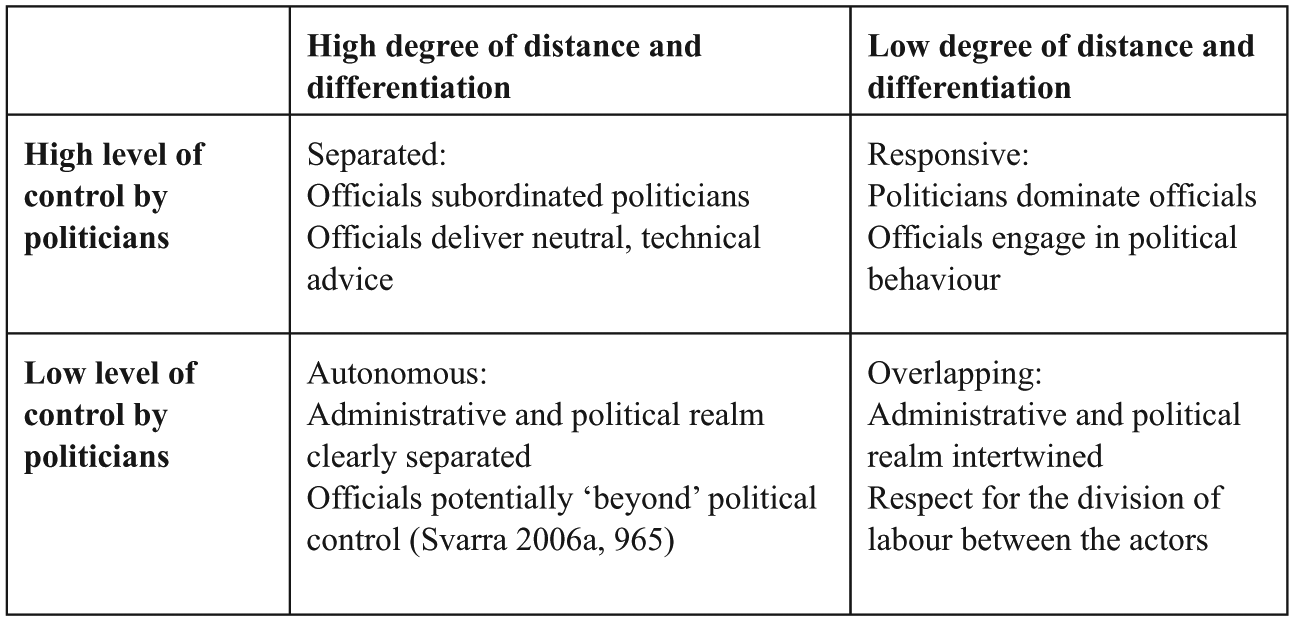
Svara’s four-role model (Svara, 2001).
Second, complementarity involves an element of responsiveness to the political principals beyond the provision of expertise—but within the limits of partisan behavior (Mouritzen & Svara, 2002, p. 277). And third, it involves an element of autonomy for the administration to exert some influence on policies and strategies as well as balancing the responsiveness with responsible advice, which may go against the politicians’ immediate preferences (Mulgan, 2008, p. 347). In other words, a complementary relationship is characterized by genuinely reciprocal values (Mouritzen & Svara, 2002, p. 275) or that which Thompson (1967) describes as “reciprocal interdependence,” where one actor’s contribution is necessitated by the work of the other while preserving a distinct role for each of the actors within this relationship.
Complementarity reflects the gray zone discussed above, including a low degree of formal political control and low distance in the political and administrative roles. Hence, in such relationships, the means to manage bureaucrats is not “merely” formal control from the politician vis-à-vis the administration (Hood, 2001, p. 18). Trust, therefore, becomes vital as an alternative mechanism for the political principal to ensure political responsiveness from the bureaucracy. Trust further serves as a mechanism enabling the administration to enter the political sphere by reducing the risk compromising their neutrality or anonymity (e.g., in the event of policy failure, they may trust the politicians to stand up to their formal responsibility for policy decisions). Hence, whereas the political principal indeed needs to trust that the discretion that is inevitably granted to the administrative actors in a complementary relationship is used to promote the political interest, goals, and values, the administrative part must trust their principal to be loyal to the political signals, goals, and priorities sent to, set for, and communicated to the administration to guide their behavior, as well as to refrain from blame and responsibility-avoiding behavior (Hood, 2011) in this potentially highly political and politicized space.
In the following, we bridge the literature on relationships between politicians and top public officials and the literature on organizational trust to increase our understanding of how trust is established as part of the micro foundations on which complementarity rests.
Conceptualizing Trust
Trust can be generated and based on a number of factors when developed within an organizational context, and it has been a key theme in organization theory for years (e.g., Bachmann & Zaheer, 2006; Six, 2005, pp. 2-3). The concept of trust has been used both as a dependent and independent variable, perceived as a desirable outcome per se, and used to explain a number of positive outcomes in organizational affairs (e.g., Bijlsma-Frankema & Costa, 2005). The literature on trust has perceived it both as a structural phenomenon, where levels of generalized trust between countries are compared (e.g., Fukuyama, 1996; Putnam, 1993), and a relational phenomenon, either among collective actors (Das & Teng, 2001) or individuals (Dietz & Den Hartog, 2006). Finally, trust has also been conceptualized as a propensity of an individual (Uslaner, 2002) formed in early childhood.
Given that we are investigating trust in political and administrative relations, we apply a relational approach to our conceptualization of trust. We begin with Dietz and Den Hartog’s (2006) definition of trust as “[a]n expectation, a willingness to be vulnerable and a risk-taking act” (Dietz & Den Hartog, 2006, p. 560), a definition of trust that is widely acknowledged in the literature (Costa & Bijlsma-Frankeman, 2007, p. 395; Schoorman, Mayer, & Davis, 2007). However, this definition differs from more utilitarian definitions (e.g., Gambetta cited in Bradach & Eccles, 1989, p. 104; Kramer, 1999; Miller, 1992) focusing more on trust as a cost–benefit calculation, as it points to the central concepts of vulnerability (e.g., also Bijlsma-Frankema & Costa, 2005; Schoorman et al., 2007) and risk-taking (Das & Teng, 2001). In that quality, the definition matches how Svara conceptualizes complimentary, underlining the vulnerability of both parts in the relationship and their mutual dependence. However, while we do perceive trust to be potentially based on more than a cost–benefit analysis, we acknowledge and base our understanding on trust, which also allows for the underlying theorizations of principal–agent theory.
Following Dietz and Den Hartog (2006) and their meta-study of the literature on relational trust, we further understand trust as being reflected in four distinct dimensions: the perception of the competence, benevolence, integrity, and predictability of the trustee. Competence refers to the actual skills of a given trustee, their ability to act upon intention. Benevolence and integrity address the intentions of the trustee; the intention to act in a “kind” way toward the trustor and the underlying moral principles guiding behavior (Dietz & Den Hartog, 2006, p. 560). This distinction matches that drawn by Das and Teng (2001) between competence and goodwill trust. Finally, predictability reflects the regularity of the behavior of the trustee, emphasizing the need to reduce uncertainty in vulnerable relations. Together, these dimensions determine an individual’s trustworthiness. In our case, the degree to which a public official will trust a politician will, we argue, be contingent on their evaluation of the politician’s competence, benevolence, integrity, and predictability, at least to some extent.
How Does Trust Develop?
We develop four hypotheses in the following, which allow for investigating the relationship from three different angles. The first two angles include a hypothesis on the quantitative side of the relation, in terms of the time parties have worked together, and two hypotheses on the quality of the relationship in terms of the agreement on task-sharing and the communication climate among actors. Although politico-administrative relations are expectedly distinct in terms of how trust develops in such asymmetrical, dyadic relationships, these hypotheses depart from the main antecedents identified in the generic literature on relational trust, as they refer to rather generic aspects of relationships across hierarchies in the context of organizations (e.g., Dietz & Den Hartog, 2006; Zucker, 1986). In a more explorative manner, we also include the context within which the relationship is situated, examining more specifically the stability of the environment, which we argue may be of particular relevance for the development of trusting relationships in local government organizations given the environmental distinctiveness of public sector organizations.
Regarding the quantitative aspect of the relationship, the generic literature on building trust in relationships identifies previous experience as a central antecedent. Zucker (1986) identifies this as an important factor in her seminal work, just as Dietz and Den Hartog (2006, p. 563) label the knowledge of previous behavior as an antecedent of trust. In so doing, they reflect the established, more utilitarian understanding of trust (e.g., Kramer, 1999; Miller, 1992). In this tradition, trust develops in repeated games, emphasizing the predictability dimension. We find this line of argument to be applicable in the context of a complimentary relationship: public officials and politicians who gain experience working together are able to build trust based on knowledge of past behavior, in this way potentially increasing predictability and reducing uncertainty. This argument is in line with the findings of van Berkel, Ferguson, and Groenewegen (2016) in a public sector context, who point out the importance of pervious experiences in building trust. We operationalize this antecedent as the time a politician and official have been working together and expect:
Turning to the quality dimension of the relationship, we first address the extent to which the actors agree on the distribution of tasks. In complimentary relations, the distribution of tasks is an ongoing accomplishment, acknowledging that the division of labor at the upper echelons of the hierarchy may be subject to continuous negotiations, reinterpretation, and change (Hood & Lodge, 2006), we argue that establishing some sort of baseline agreement on the distribution of tasks is essential to ensure trust. Such an agreement increases predictability and potentially ensures competence within a certain domain, as it defines the task portfolio and can improve a common understanding of integrity, because it can ensure mutual respect regarding the respective domains of political and administrative actors. We, therefore, expect that
Second, in terms of the quality of the relationship, we expect the communication climate to be related to trust. Drawing on Zand (1972) and Becerra and Gupta (2003), we understand the communication climate as consisting of two dimensions: frequency and quality, understood as the degree of responsiveness and openness in the communication. Previous studies have provided evidence of the vital importance of the communication climate (Becerra & Gupta, 2003; Illes & Mathews, 2015; Zand, 1972) for establishing and maintaining trust in organizational relationships in general. Furthermore, the communication has been argued to be vital for the development of trust between politically appointed and permanent civil servants in particular, as good communication “. . . anchor[s] the appropriate environment characterized by certainty, limited vulnerability, positive expectation, and reciprocity of good will,” which is fundamental to developing trust (Boateng & Cox, 2016, p. 243). Frequency allows for the actors to be engaged in continuous dialogue on political priorities and administrative advice, enabling feedback on the respective actions of the politicians and officials, thereby reducing potential “ambiguities and uncertainties” (Boateng & Cox, 2016, p. 243). This provides opportunity to gain insight into competences and establishing a sense of predictability. Openness reflects the reciprocal disclosure between the actors (Knapp, 1984), which enables the demonstration of benevolence and integrity. We therefore expect,
Finally, we investigate the relationship between the organizational environment and trust. Local governments are open systems (Mintzberg, 1980) and depend on interactions with central governments, voters, the media, and so on. Therefore, we expect that the predictability of the politician–official relationship is, at least somewhat, contingent on the organizational environment. Unstable environments render it more difficult to predict outcomes and, hence, increase the level of risk in an organization (e.g., Galbraith, 1977). In turn, this can make the gray zone even more difficult to navigate, as it reduces the ability to act predictably. Uncertainty also makes it more difficult to act competently, as much more information and information-processing capacity are required to act in a rational manner (following the vocabulary of Galbraith, 1977). Public organizations face environmentally generated uncertainty even more than do private organizations. This, uncertainty and instability may stem from ambiguity, for example, due to multiple principals (Moe, 1984). To understand this contingency, we investigate the degree to which the organizational environment is perceived as stable or volatile and whether this is related to the experience of a trusting relationship between the two parties. We, therefore, expect that
Research Context
The data is collected from a survey sent to all top-level managers in Danish local governments, which can formally be described as a “committee-leader form” in which there is an identifiable “political leader”: the mayor (Mouritzen & Svara, 2002, p. 56). Officials are employed based on merit and, in a formal sense, considered agents of the city council who serve a collegiate, political body. The mayors are the only full-time politicians, enjoying relatively restricted formal power, as they can neither interfere with nor block city council decisions (Mouritzen & Svara, 2002, p. 60). Despite this relatively restricted formal role, the mayor is in practice clearly one of the most powerful politicians in the sphere of Danish local government (Berg & Kjær, 2007, p. 14). This obviously complicates the lives of the officials, being simultaneously the agent of both the city council and the mayor.
Although most politico-administrative relationships at the local government level in the Western world have elements of complementarity (Mouritzen & Svara, 2002; Svara, 2006b), this is especially prevalent in the Danish context (Mouritzen & Svara, 2002, chap. 9; Svara, 2006a, p. 969). In a comparative perspective, Danish chief administrative officers (CAOs) are found to be “the least anxious” to be in “the political room” and provide political sparring (Mouritzen & Svara, 2002, p. 168). On this basis, we argue that the Danish case may be characterized as one in which complementarity is “most likely” (Andersen, Binderkrantz, & Hansen, 2012, p. 90) and, hence, a context in which trust is highly required for the relationship to work. This poses numerous limitations on the external validity of our findings, which we address in the conclusion. As a best case, however, the Danish local governments are rich and, therefore, an appropriate choice for beginning the exploration of relational trust.
It might also be worth mentioning that while mayors are able to replace the CAO, officials further down the hierarchy are not usually replaced by politicians. Replacements occur but are costly, and although becoming more commonplace in recent years (Christensen et al., 2014), this remains a relatively rare phenomenon, partly because most managers are on fixed-term contracts, meaning that simply allowing the contract to expire is the cautious solution. Hence, we do not see any evident replacement effects in our data.
When considering our results, the cultural characteristics of Danish local governments also seem important. Demark is generally a “high trust” society (Hansen & Jørgensen, 2009). This trust is found within the public sector as well as between the citizenry and public sector. The Danish public sector has lengthy traditions for autonomy and room for “local” solutions at the municipal level, and while recent years may have seen economic restrictions on municipal autonomy (Sørensen, 2014), local governments do remain relatively autonomous in a comparative perspective. Hence, we should consider high trust as an important contextual variable when discussing the generalizability of our findings. This comes with a caveat, however, as the data were collected during a period in which Danish officials were subject to extensive public scrutiny due to a number of scandals (Bo-Smith Commission, 2015). While the public debate primarily targeted the central-government aspect of the civil service, it also led to discussion of the role of the civil service vis-á-vis the politicians at the local level (LGDK, 2016).
Methods, Data, and Analysis
Mixed-Methods Strategy and the Issue of Causality
We apply a mixed-methods approach to investigate our research question. Mixed methods can be defined as a “type of research in which a researcher [. . .] combines elements of qualitative and quantitative research approaches [. . .] for the purpose of breadth and depth of understanding and corroboration” (Johnson et al., 2007, p. 123, cited in Creswell, 2010, p. 51). Mixed-methods approaches can be categorized in many different ways (Lieberman, 2005). We use a sequential approach, departing from a quantitative test of our hypothesis and proceeding to a qualitative analysis of the interesting findings of our quantitative analysis (Creswell, 2010, p. 57).
More specifically, we apply a mixed-methods design for three reasons.
First, we find that combining quantitative and qualitative data sources allows us to obtain a deeper understanding of the mechanisms of trust in the politician–official relationship. The two data sources substantiate each other and increase the validity of our findings. Whereas our quantitative data allows us to identify relationships, our qualitative data gives us a better understanding of the mechanisms at play in their establishment.
Second, and related, an important limitation is the fact that our data does not allow for causal claims. The factors that we expect are related to trust are treated as antecedents of trust in the generic literature on relational trust in organizations. However, our cross-sectional design limits our ability to make any claims regarding causality. While qualitative data has its own limitations in relation to identifying causality, we do find that combining cross-sectional quantitative data with “thicker” qualitative descriptions of particular relationships gives us a better understanding of how the actors in the field see the temporal relationships between factors. In a sense, we obtain access to how actors perceive causality in the field.
Third, as both the dependent and independent variables are measured quantitatively in the same survey, our analysis is vulnerable to common method bias. As suggested by Jakobsen and Jensen (2015, pp. 13-17), we try to accommodate this risk in our design by using different scale types for our variables and reducing the abstractness of the wording of items. Moreover, by combining qualitative and quantitative data sources, we further aim to reduce the risk of drawing wrong conclusions due to a common method bias.
Hence, we find that combining qualitative and quantitative data mitigates some of the drawbacks in our study. They are not completely eliminated, however, as will be discussed in the conclusion.
Data
We have tested our hypotheses using data from a survey of 1,411 public managers in Danish local governments (783 responses, 55% response rate). 1 The respondents are all employed in Danish local governments and are either level 2 or 3 mangers (n = 721) or responsible for communications (n = 62). In practical terms, this means that we have not surveyed CAOs but rather the two tiers of managers below them. Due to the many tasks carried out by bodies of the Danish local government, these two levels of managers are still working in city hall and interact frequently with politicians. While these managers do not interact as frequently with politicians as CAOs do, 86% still report talking to a politician at least several times monthly. A level 2 manager might be the director of social services, for example, while a level 3 manager might head a unit responsible for all of the schools in the municipality. These managers typically have an academic background in law or political science or they can be recruited from professions such as teaching or nursing. For both the managers and those responsible for communications, slightly fewer than 60% are men and the average age of respondents is 48 years for those working with communications and 54 years for managers. The survey was carried out in the spring of 2015 and is representative of Danish local governments regarding the number of inhabitants (our sample of local governments are marginally smaller than average). In terms of their geographic location, our sample is representative both with respect to the region in which the local government is situated as well as its character. 2 We have used the “Municipal Yearbook” to identify the relevant respondents and contacted them by e-mail. Table 1 summarises the measurement of our variables.
Measurement of Independent Variables.
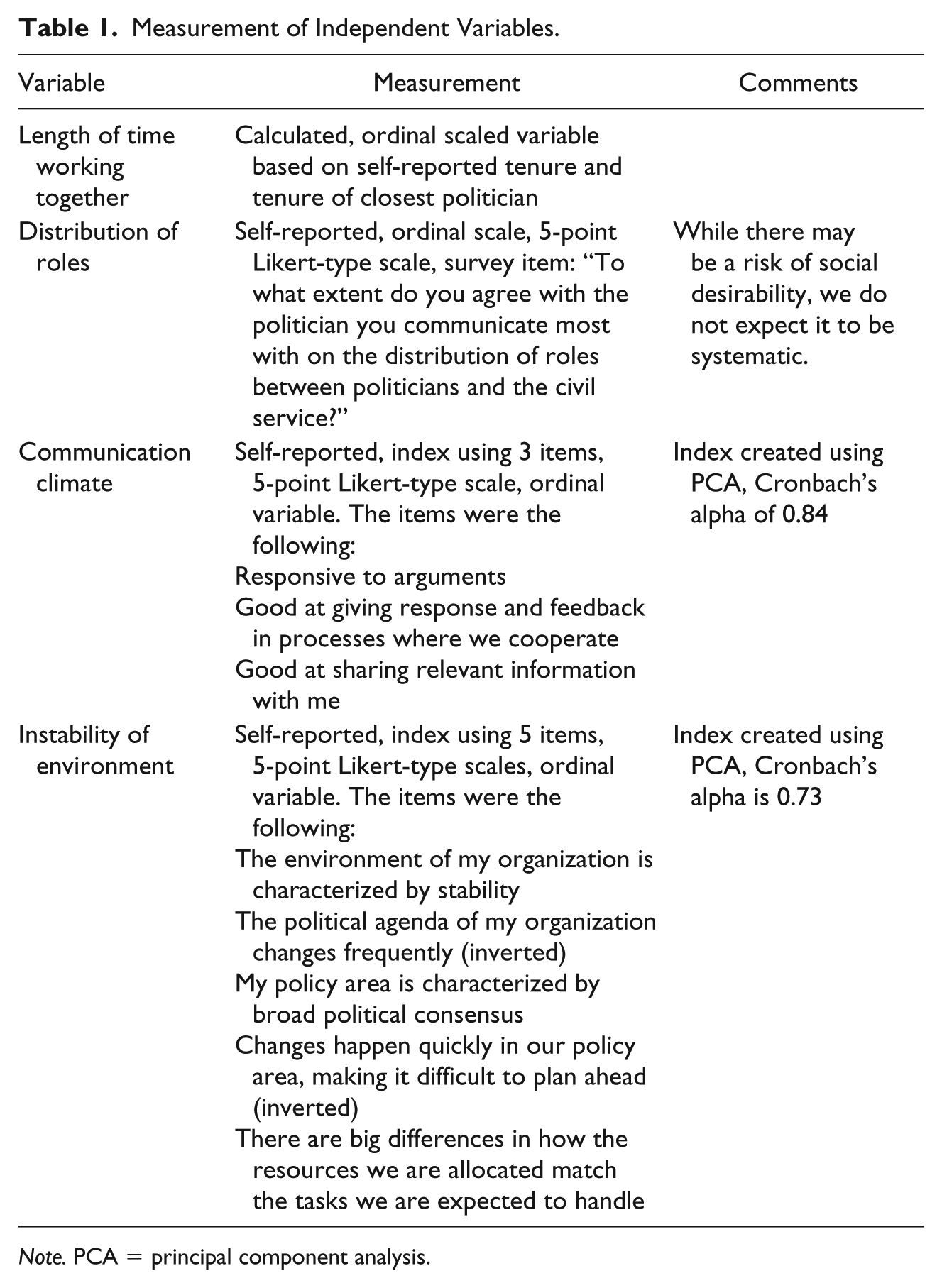
Note. PCA = principal component analysis.
Based on a pilot test of our survey among senior officials, we chose to exclude the CAOs from our trust survey, because our pilot respondents found it difficult to evaluate a politician with whom they had such close ties in terms of competence, benevolence, and so forth in a survey (compared to a qualitative interview) without appearing disloyal. Low-ranking officials did not comment on this. As we are unable to show causality between the factors with our data, we have chosen to carry out a quantitative bivariate analysis rather than an ordinary least squares (OLS) regression. With a regression controlling for the effects of gender, age, and length of time working as an official, however, we almost arrive at similar results. We include these controls to ensure that gender or generational differences do not generate the variations we identify, as previous research has shown gender-specific differences in management behaviors (Bass, Avolio, & Atwater, 1996) and age (Christensen et al., 2014). We have attached the regression as Appendix.
The qualitative data consists of 20 interviews with CAOs out of the entire population of 98 Danish CAOs (20%). The CAOs were chosen to cover the variation among Danish local governments in terms of the size, geography, financial situation, and political stability of the local government. The interviews were conducted as semi-structured following the themes of the survey and all lasted around 1 hr. Subsequently, the interviews were transcribed and coded with NVIVO following the interview. They were coded according to accounts of (a) the four dimensions of trust, (b) communication, (c) division of labor, and (d) environmental stability. To ensure the reliability of the coding, the interviews were all coded by two coders independently, including one of the authors.
While the two types of data are collected from different hierarchical levels within the local bureaucracy, they are all positioned in the very upper echelons, which makes it possible to benefit from a mixed-methods design.
Operationalization of Variables
As reflected in the description of the research context, officials at least formally have a number of political principals to serve. To ensure that the respondent provided answers referring to the same relationship, so to speak, all of the questions were framed in terms of the “politician with whom you interact most,” and we explicitly stated in the beginning of the questionnaire that respondents should use the same person as their reference point throughout. We now begin by examining the dependent variable and relational trust before proceeding to the independent variables. We use this terminology, well aware that we are not dealing with causal relationships.
The Dependent Variable
Dietz and Den Hartog’s (2006) four dimensions of trust are operationalized and measured, inspired by items they discuss (see Table 3). The four dimensions form a reflexive index. We have carried out a principal component analysis (PCA) of the items we use to measure trust as a characteristic of a relationship between an official and a politician, which clearly indicates one of the underlying dimensions among the items. The integrated trust index produces a Cronbach’s alpha of 0.9, which indicates a very strong correlation between the items. The index is our dependent variable. It constitutes an ordinal variable and is left-skewed, with relatively limited variation—most of our respondents have high levels of trust in the politician with whom they interact most. We are obviously aware that this may reflect a certain level of desirability among our respondents. As with other bias-prone items, however, we have no reason to expect this bias to affect our data beyond generating an overrepresentation of positive responses. We do not expect any systematic variation regarding hierarchical level, gender, or otherwise.
The Independent Variables
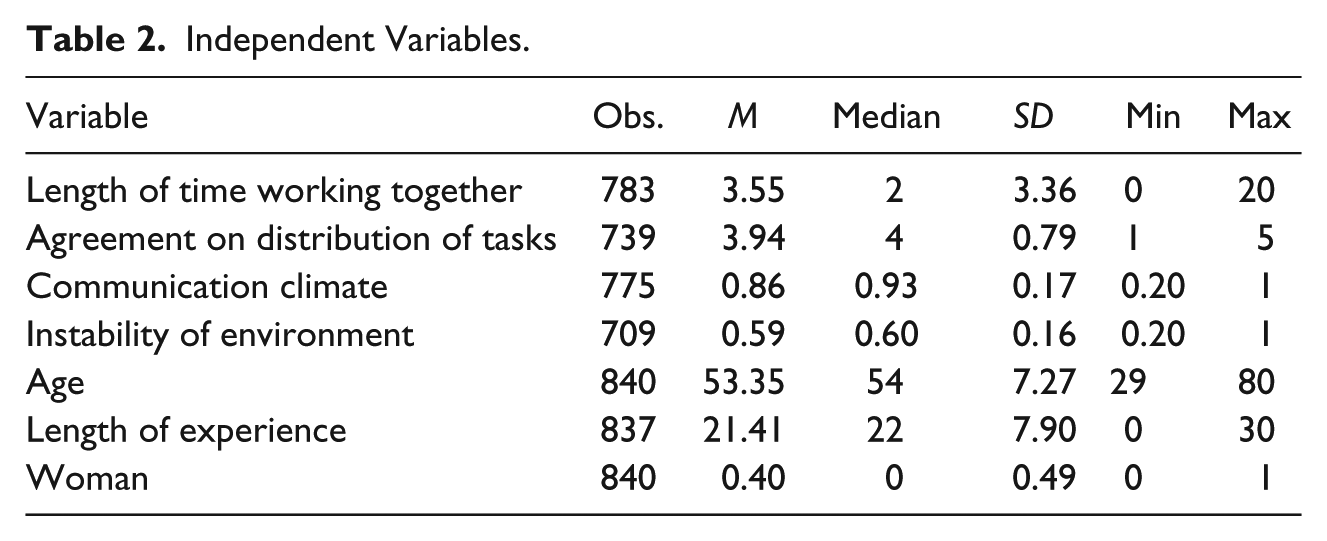
Table 2 summarizes the descriptive statistics for the independent variables.
Independent Variables.
Empirical Findings
We begin by examining our dependent variable: trust in a given politician. As written above, the index is left-skewed. Looking at the averages (Table 3), we see that this is due to high ratings across the dimensions of our trust concept. Only predictability scores an average below 4- on a 5-point Likert-type scale. Hence, we see that predictability, while remaining relatively high, is the dimension scoring lowest in our trust constructs. This is not particularly surprising given the nature of politics in Danish local government, typically a high-trust context. We explore this further below.
Trust Dimensions.

Looking at standard deviations, we do not identify extensive variation. The respondents primarily vary in how they evaluate the competence and benevolence of the official. They agree most on the dimensions of benevolence and integrity, underlining the assumptions that politicians have good intentions. These two dimensions also have the highest overall scores, which might indicate that the respondents generally perceive politicians to have noble intentions but that they do not always succeed in converting these intentions into actions.
Turning to the analysis of our hypothesis, the results of the bivariate analysis of the relationship between trust and our independent variables are presented below.
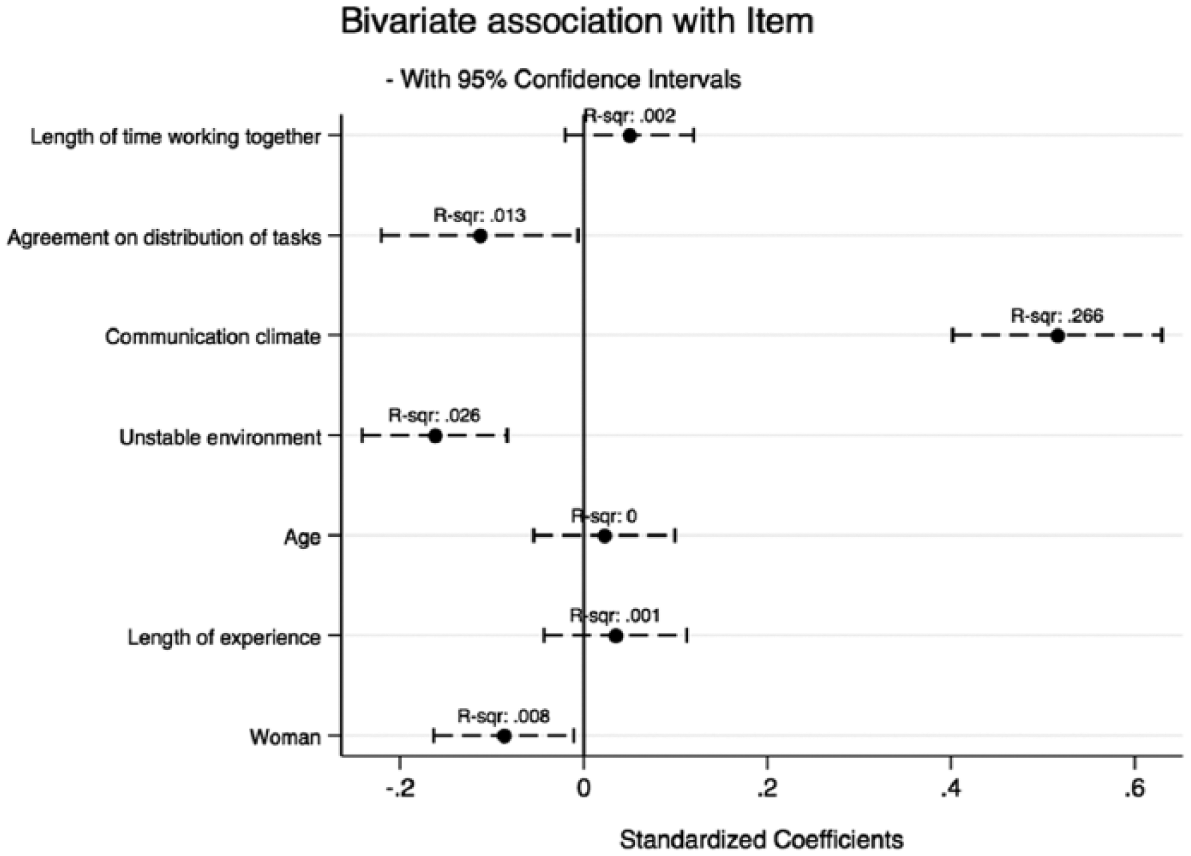
Bivariate analysis.
Based on our analysis, we draw the following conclusions regarding our hypotheses.
We do not identify a significant relation between the length of time working together and trust (H1). This is surprising, as many of our interviewees mention trust as something that develops over time, the result of officials and politicians sharing experiences that lead them to trust each other. Hence, we seem to detect a certain disagreement between our quantitative and qualitative data sources regarding the importance of shared working experiences.
We do, however, find a significant, positive relationship between trust and the extent to which officials and politicians agree on the distribution of tasks (H2). This is also reflected in the qualitative accounts given by the CAOs. While most of the CAOs do not describe a deliberate process related to a distribution of work, they all point to this as being essential to developing trust. One CAO explains how, when he was recruited, the mayor needed to ensure that the CAO would be interested in taking care of specific work that the mayor found uninteresting. While Svara points to the relationship between CAOs and mayors as complementary, we find that CAOs generally seek a clear distinction between the political and administrative realms. As one CAO explains, he “stands in the doorway to the administration” of the local government. While the mayor may formally be the administrative head of the local government, the CAO is clearly expected to take care of what goes on in the administration while the mayor deals with political skirmishes. As one CAO explained, the mayor deals with what goes on outside the organization (which he sees as including the city council), while the CAO deals with what goes on within the organization. However, all of the CAOs accept that the division of labor cannot be completely clear-cut. Political strategy sometimes calls for the CAO to be the one to talk to the media, whereas the mayor presenting a decision to the local administration sometimes makes it seem more legitimate. By and large, however, the CAOs think a relatively clear division of tasks between the mayor and CAO is key to ensuring a trusting relationship. Failing to clarify the distribution of work may lead to power struggles between the two actors or make the mayor look weak in the eyes of the other politicians vis-à-vis the administration. Studies of politicians’ motivations to become involved in local politics may qualify our findings. Oliver, Ha, and Callen (2012) find that politicians largely seek office to make a difference in the administration of their community. While the general impression is that this motivation might also explain the behavior of local Danish politicians, this testifies to the necessity of continuously have conversations across the political and administrative spheres of local government to ensure the alignment of how the actors perceive the division of labor.
When considering communication, we find that the quality of the communication climate is strongly and positively related to trust (H3). The qualitative material testifies to the importance of communication, as CAOs generally view their communication with their mayor—and the rest of the city council—as being very important. Most of the CAOs emphasize the importance of having frank, candid communications with the mayor; one going so far as to state that “if you can’t have a quick argument, it’s difficult to trust one another.” The CAOs are in general very aware that they must be truthful in their communications. They need to assure the politicians that the administration is not keeping things from them and that whenever something goes wrong, the politicians should feel well informed and included. Things can go wrong when running a local government, and CAOs emphasize the importance of communicating risk to the politicians to appear trustworthy. While communication is often formalized, the respondents also emphasize the importance of informal communication, such as having a drink at the bar when CAOs and politicians are at conferences together, inviting city councilors for a cup of coffee in the CAO’s office if they have questions, and so forth. However, many of them also explicitly mention that the relationship must remain “professional”; several mention that they generally avoid socializing with their mayor away from work. It is important to keep a distance between their working and personal, private lives.
Finally, we see that trust is strongly but negatively associated with an unstable environment (H4). In our qualitative interviews, we ask both about the financial situation in the local government as well as the political situation in the city council. The qualitative accounts clearly reveal that while most Danish local governments struggle to balance their finances, the CAOs are aware of the situation and dealing with it. The factor generating most instability for the CAOs is the political level. While some local governments are characterized by consensus, others have a more toxic political climate characterized by narrow majorities and bad personal relationships among the politicians that affect city council operations. In Denmark, city council elections are proportional, meaning that mayors are chosen based on an agreement between a majority of the city council members after an election. The negotiations are easy and straightforward in some local governments, where there might be a single party with an absolute majority or a coalition of parties with lengthy traditions for working together. In other local governments, however, the exercise can be very complicated, and party defections have become more common in recent years, where newly elected councilors are persuaded to switch parties to support another party’s mayoral candidate (typically rewarded with a committee chairmanship). This affects the CAOs in two ways:
First, part of the “deal” between the CAO and mayor is that the former provides a basis for decision-making that matches the existing political preferences while the latter gets it through city council. While this usually works relatively seamlessly, there have been several examples in recent years where this is not the case, and several of the respondents who are now in “stable” local governments report having earlier worked in “unstable” local governments previously. If the politicians cannot “deliver” decisions, the administration cannot keep their end of the bargain, which becomes a strain on the CAO–mayor relationship. As illustrated above in Table 3, predictability is the element in the trusting relationship in which the politicians fare the poorest in our survey, which may be due to the politicians struggling to ensure agreement in the city council. Further complicating the matter is the local governments in which respondents report politicians failing to honor agreements due to a lack of trust among the politicians. In such instances, a CAO might find that they have made a proposal that would garner support based on previous negotiations, only to find that the politicians do not hold their word due to, for example, personal conflicts.
Second, the toxic environment among politicians in a few local governments may be reflected in the administration, as one respondent reports politicians speaking very harshly to officials and generally questioning the trustworthiness of the administration; here, the efforts made by CAOs to strike a balance between the mayor and the rest of the city council can make it difficult for the CAO to remain neutral in the event of intense conflicts between the mayor and other city council members.
Discussion and Conclusion
When politicians and officials work together closely, the language of control in principal–agent analysis does not enable a full understanding of the relationship. Based on the observation by Svara (2001) that the relationship at the apex of public organizations is often best described as complimentary, as characterized by a low degree of formal political control over the administration, we have argued that the micro foundation of such relationships is trust. Investigating which factors are related to trust in politico-administrative relations at the apex of public bureaucracies, the empirical analysis points to the importance of what we refer to as the qualitative elements of the relationship, namely the communication climate and agreement on the distribution of tasks. However, the empirical analysis also illustrates the importance of environmental factors when trust is to be established and maintained between officials and politicians. These findings contribute to the literature on politico-administrative relations and trust in at least three ways.
First, regarding the literature on politico-administrative relations, the empirical analysis points to the relevance of trust per se as a central micro foundation for a well-functioning relationship in the context of complementarity. Hence, future research on such relations may pursue the role of trust more explicitly. Furthermore, and more specifically in relation to Svara’s model of complementarity, our findings confirm Svara’s point (as quoted in the introduction to this article) that a certain distinctiveness in the political vis-à-vis the administrative roles, here investigated as the division of tasks, is vital for complementary relationships to work well despite their overlapping nature. The qualitative data indicated that an unclear distribution of tasks might pose a threat to any trust relationship. The CAOs in our sample generally perceived a certain overlap in tasks but emphasize how a certain clarity in the distribution of tasks is essential. This finding further contributes to our understanding of the politico-administrative relations at the apex of public organizations. While gray zones are generally considered to be a necessary element in any modern local or national government, the “grayness” in terms of the division of labor should be based on some sort of basic agreement on the division of labor. Trust can mitigate uncertainty, but the uncertainty cannot be all-encompassing. Regarding this point, future research might investigate more specifically which tasks and what behavior require distinctiveness and which may overlap.
Second, our findings contribute to the generic literature on trust in organizations. This literature has not previously been applied at the apex of public organizations, instead having a more generic understanding of organizations and its applicability. While our definition of trust departed from this literature focusing on the relational aspects of trust, our analysis made clear that we should not forget the context of trust relations. Our study illustrates that environmental factors are related to trust. According to the CAOs, environmental instability comes primarily from the political level of local government. While this clearly illustrates that the conditions for developing trust in public organizations can be qualitatively different from developing trust within a private organization in terms of the source of environmental instability, our study could bring a sensitivity to the importance of the organizational environment or context to the generic literature on trust-building. While trust can be understood as a relational phenomenon, relationships exist in a particular context, where the degree of environmental uncertainty may affect trust-building.
Third, the fact that we do not find a correlation between trust and the length of time actors have been working together may also provide interesting insights into the generic literature on trust (e.g., Miller, 1992), emphasizing trust as an example of repeated games. One might speculate that experience does matter in trust-building, but only early in a relationship. Hence, experience may matter for a year or so in the politician–public official relationship. The emphasis CAOs put on a trusting relationship may also indicate that, at least for this population, if trust is not established after around a year, the relationship with the mayor ends with the CAO finding another job or getting fired. Hence, perceiving the politician–public official relationship as repeated games may only be appropriate in the early stages of a relationship.
Our study must be read with its limitations in mind. Whereas our qualitative data provides us with an understanding of how actors in the field perceive the causality in the relations between trust and our independent variables, we can make no hard claims in this regard. Does a healthy communication climate result from trust between politicians and officials? Or is it the healthy climate of communications that contributes to the development of trust? While our quantitative data examines trust as a one-way relationship, the qualitative accounts make clear that the CAOs clearly view trust as a relational, iterative phenomenon. However, they further describe frank and honest communication as essential for building trust between officials and politicians, which is why they view communication as an antecedent to trust when trying to establish the latter.
A further caveat in our data is that our analysis involves the risk of common method bias as well as social desirability bias. The fact that we find limited variation in our trust index further warrants this concern. However, it may also be due to the variation in our population simply being so limited.
Regarding the external validity, we may ask as to whether the Mouritzen and Svara (2002) finding of Denmark as a clear case of complementarity might depend on the high initial trust on the structural/institutional level in Denmark. Performing a similar study in a context characterized by low levels of trust may provide a better understanding of the relative importance of relational and structural variables when trying to explain the trust levels between politicians and officials. However, this should not be understood as our study only being relevant in the Danish context. As Mouritzen and Svara demonstrate, complementarity can be found in a number of countries, and we therefore expect the findings to be valid beyond the high-trust Danish context.
In terms of practical implications, our analysis emphasizes that in a political system like Danish municipalities, it is difficult to imagine a CAO staying in office should the mayor not trust them. Our emphasis on trust in this relationship is further supported by our CAO respondents, who underline the importance of trust in politico-administrative relations and who point to “chemistry” as essential in this regard. As one CAO explains, “I don’t spend a lot of time on the trust score, but I’m extremely aware that it is the only score there is.”
The practical importance of trust raises the question about what the actors can do: which levers can the actors pull to facilitate and/or maintain trust? Here, our results emphasize communication. Trust levels benefit from a good communication climate together with agreement on the distribution of work, generating the distinctiveness required for a well-functioning, complimentary relationship. These issues can be worked on deliberately from both the political and administrative sides of the relationship. In all likelihood, such findings will prove relevant beyond the Danish context at the local government level. While Denmark may be a most likely case in terms of complementarity, complementarity is also found in numerous other contexts. Hence, the need to deal with the complexities generated by working together in a gray zone is relevant for other countries where complementarity exists, even though it may be present to a lesser extent than as found in the Danish case. Returning to Svara’s model, our insights regarding the importance of trust and communication would clearly also be relevant in contexts characterized by responsive roles. However, our understanding of these mechanisms would greatly benefit from studies in other national contexts, supplementing the comparative work done on complementarity (Mouritzen & Svara, 2002). Furthermore, as the gray zone is by no means a phenomenon that is specific to local government, we would expect this finding to be of both academic and practical relevance on the national governmental level as well. Studying complementarity at the national level could also prove a fruitful avenue for future research.
Footnotes
Appendix
OLS Regression.
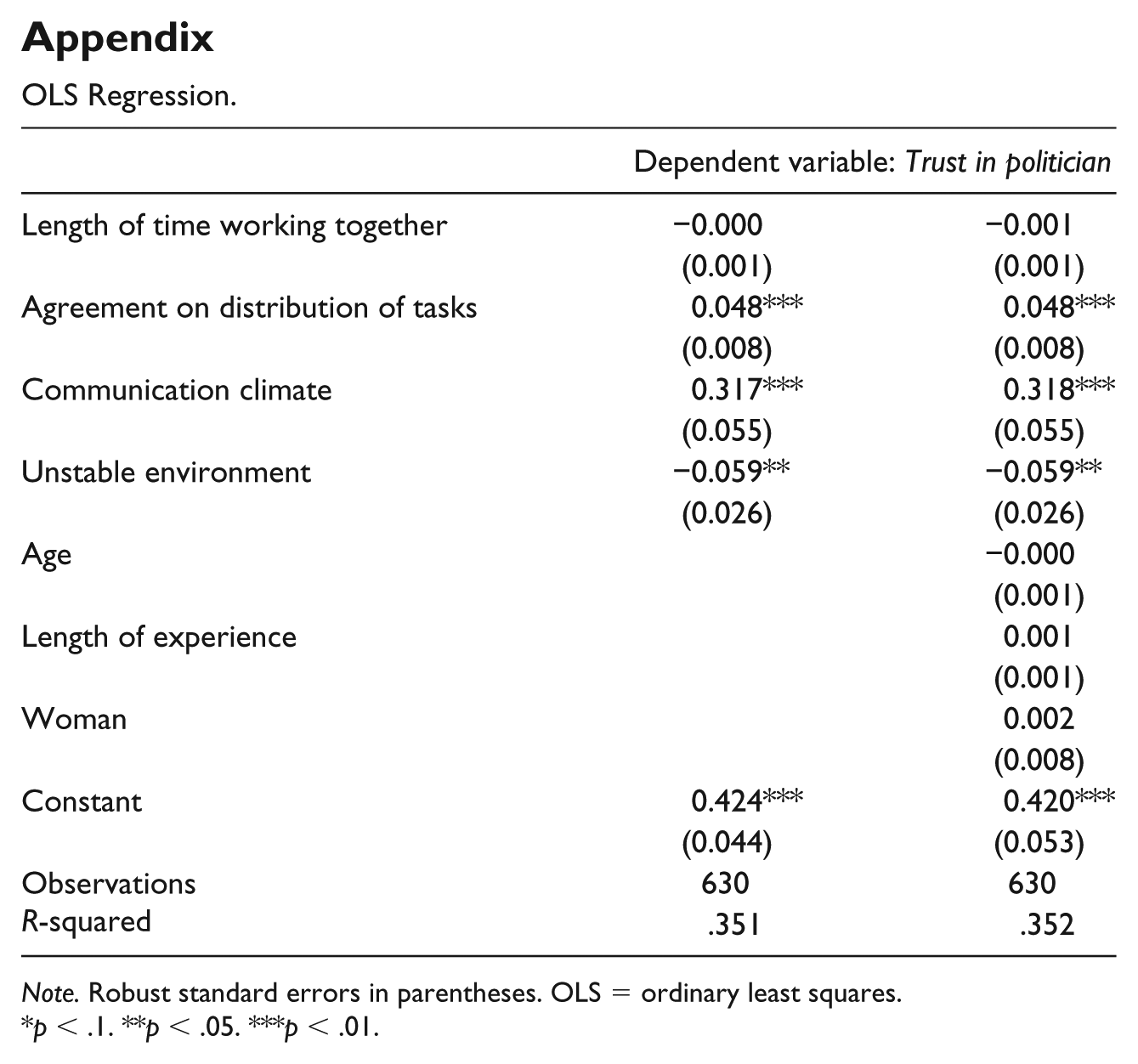
| Dependent variable: Trust in politician | ||
|---|---|---|
| Length of time working together | −0.000 | −0.001 |
| (0.001) | (0.001) | |
| Agreement on distribution of tasks | 0.048*** | 0.048*** |
| (0.008) | (0.008) | |
| Communication climate | 0.317*** | 0.318*** |
| (0.055) | (0.055) | |
| Unstable environment | −0.059** | −0.059** |
| (0.026) | (0.026) | |
| Age | −0.000 | |
| (0.001) | ||
| Length of experience | 0.001 | |
| (0.001) | ||
| Woman | 0.002 | |
| (0.008) | ||
| Constant | 0.424*** | 0.420*** |
| (0.044) | (0.053) | |
| Observations |
630 | 630 |
| .351 | .352 | |
Note. Robust standard errors in parentheses. OLS = ordinary least squares.
p < .1. **p < .05. ***p < .01.
Acknowledgements
The authors would like to thank Mathias Pedersen Heinze and Marie-Louise Brødsgaard for their contributions to this article.
Declaration of Conflicting Interests
The author(s) declared no potential conflicts of interest with respect to the research, authorship, and/or publication of this article.
Funding
The author(s) disclosed receipt of the following financial support for the research, authorship, and/or publication of this article: The research was made possible by a grant from the Master of Public Governance (MPG) at the University of Copenhagen and the Copenhagen Business School.