




Abstract
The National Archives and Records Administration, in partnership with private support foundations, administers 13 individual presidential libraries comprising the Presidential Library System. These privately constructed, publicly supported archives not only preserve official presidential records but through their museum displays offer visitors a glimpse into the life and times of specific presidents. Utilizing legislation, archival documents, and elite interviews to characterize governance and administration structures of these relationships, this study outlines the nature of current public–private partnerships within the Presidential Library System, as well as the potential departure from existing frameworks for future partnerships absent formalized guidance procedures.
Introduction
Every former U.S. president has at least one museum, monument, or memorial honoring his memory. Importantly, sites dedicated to the memory of a former president have been created and preserved by both public and private actors. While some presidential tribute sites are overseen solely by federal, state, or local government agencies, many are administered through public–private partnerships (PPPs) between governmental and nongovernmental organizations (Clotworthy, 2008). In the United States, the preservation of cultural and historical sites is often seen as beyond the proper scope of government action. This approach contrasts to other nations, as nongovernmental organizations operate most historical sites in the United States, thus underscoring the significant cultural roles which nongovernmental organizations play in preserving history (Bratich et al., 2003). Starting in the late 19th and continuing into the 20th century, the federal government became more involved in creating sites of collective memory, many of which are maintained cooperatively with nongovernmental partners. Despite the historical legacy of these arrangements, questions concerning the nature, extent, and ethical dynamics of such partnerships remain largely unanswered.
Currently, the National Archives and Records Administration (NARA) 1 administers 13 presidential libraries (see Table 1) in supportive partnerships with private foundations created by former presidents, 2 each reflecting a distinct relationship (Cochrane, 1998). The PPPs between NARA and its presidential foundation partners in the Presidential Library System (PLS) are some of the oldest continuing PPPs in the U.S. federal government (NARA, 2009b). Once a presidential library is constructed and turned over to the federal government, existing partnerships need not continue. However, most presidential support foundations have maintained close relationships with NARA (Fawcett, 2006), as NARA recognizes activities of PPPs as integral to the success of each presidential library (NARA, 2009a).
Current Institutions in the Presidential Library System.
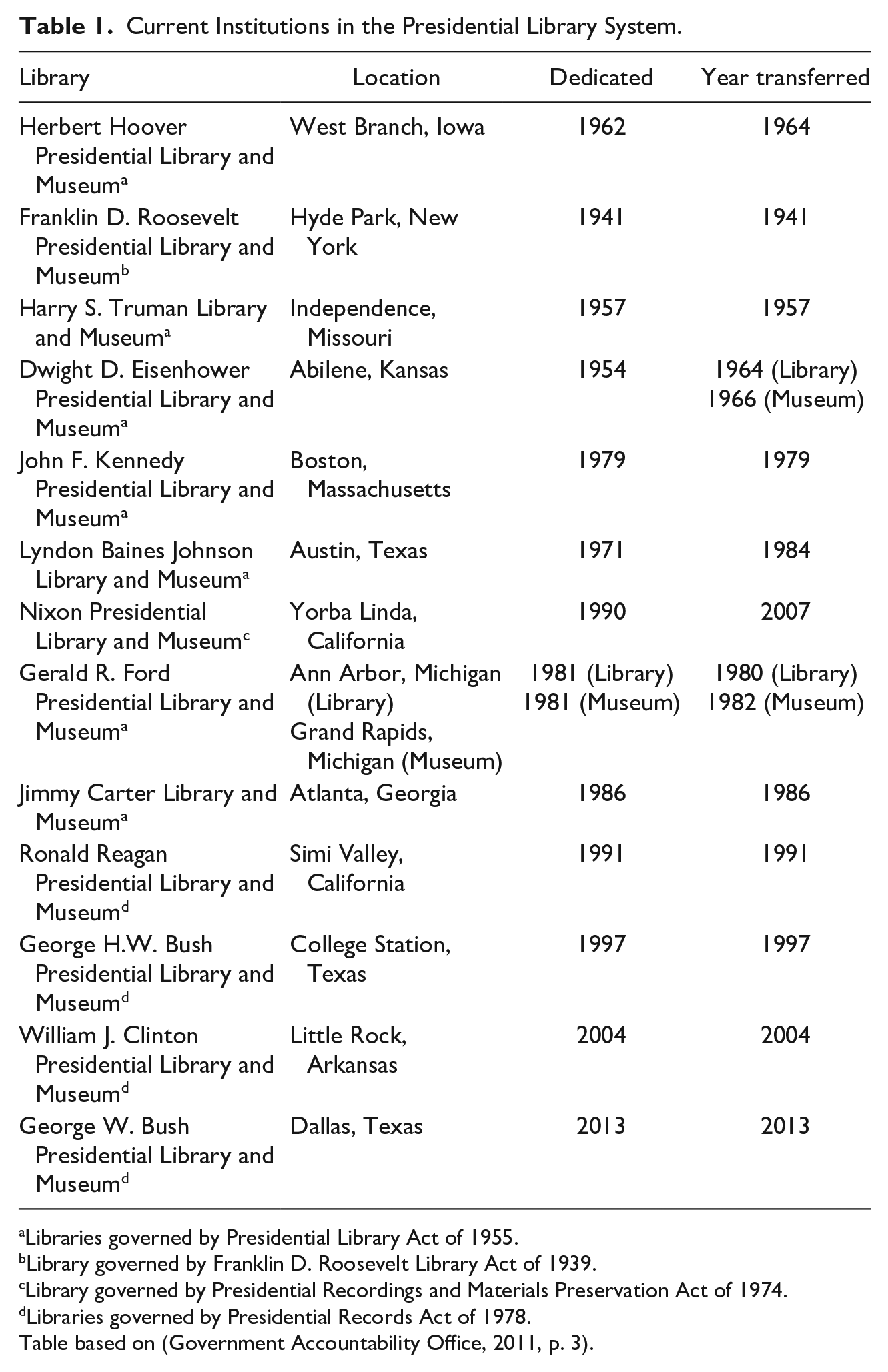
Libraries governed by Presidential Library Act of 1955.
Library governed by Franklin D. Roosevelt Library Act of 1939.
Library governed by Presidential Recordings and Materials Preservation Act of 1974.
Libraries governed by Presidential Records Act of 1978.
Table based on (Government Accountability Office, 2011, p. 3).
Critically, former presidents are not required to construct a facility to house their records. 3 By choosing to do so, however, former presidents obligate NARA to cooperate with their support foundation regardless of the nature and structure of the cooperative relationship. The variation of relationships stems from the fact that NARA must react to the mission and interests of the individual foundations. Although these partnerships are considered vital for the continued success of the PLS, concerns remain that such partnerships “. . . are little understood and are largely ignored—or avoided—in writings about presidential libraries” (Fawcett, 2006; Hackman, 2006, p. 8). Without sufficient understanding of relationship dynamics between NARA and presidential support foundations, little information exists to understand how future PPPs within the PLS may manifest.
Examining PPPs in the PLS affords the opportunity to carefully analyze such voluntary partnerships extending beyond the initial mandated period. This study explores these distinct relationships by addressing lingering questions concerning existing PPPs within the PLS. First, the study seeks to characterize the nature and extent of the relationships between NARA and presidential foundations in the PLS. Understanding the nature and extent of these relationships fosters a second question for the study concerning why such relationships form and how they endure. Finally, the study probes the evolution of such relationships from the lens of ethical obligations to adhere to the Presidential Records Act (PRA) of 1978. As a result, this study illustrates the fluidity of existing PPPs in the PLS while accentuating uncertainties as to how future relationships between NARA and presidential foundations will unfold.
Theoretical Framework
Nongovernmental organizations have played a significant role in delivering public goods and services, and PPPs are increasingly growing in application (Grossman, 2012; Hammack, 2002). Early literature related to PPPs is rooted within scholarship highlighting the benefits of collaborative multi-organizational relationships (Hardy & Phillips, 1998). More recently, scholars have presented a richer view of PPPs, acknowledging their potential drawbacks as well as their potential benefits (Bovaird, 2004; Brinkerhoff, 2002; Edgar et al., 2006; Gazley & Brudney, 2007; Hodge & Coghill, 2007; Krawchenko & Stoney, 2011; Rosenau, 1999; Teamey, 2007); however, investigations into the effectiveness or efficiency of PPPs often fail to consider how these relationships emerge, evolve, and endure over time.
As PPPs can involve a variety of multi-sector relationships intertwining government, for-profit, and not-for-profit organizations, variances in both public and private actors may obscure what distinguishes such a relationship from contracting and other methods of multi-organizational collaboration (Mcloughlin, 2011; Selsky & Parker, 2005). This review focuses on partnerships between nonprofit organizations and government agencies, as such relationships have become an important aspect of public administration practice and theory globally (Krawchenko & Stoney, 2011; Wettenhall, 2003).
Despite scholarly efforts by various disciplines, the precise nature of multi-sector, multi-organizational relationships remain vaguely understood (Hodge & Greve, 2007; Mcloughlin, 2011; Teamey, 2007). The lack of a clear, distinct definition of what constitutes a PPP stems largely from previous studies producing varied and contradictory outcomes devoid of consensus (Linder, 1999; Peters, 1998; Teamey, 2010; Weihe, 2008). Lack of an agreed upon definition notwithstanding, Najam (2000) contends that a uniform definition of what constitutes a PPP may be an unrealistic expectation given variations in size and capacity of governmental or nongovernmental organizations.
The framing of organizations as purposive creations of strategic actors’ shapes discussion of PPP positions within the PLS (Ashby, 1966; Knott & Miller, 1987). As organizational positions within specific environments are relative to other organizations existing within the same environment, organizations often seek to adjust to their environment to exert control over external resources (Pfeffer & Salancik, 1978). Such adjustments to multi-organizational collaboration produce structures simultaneously encouraging and obstructing specific actions (Giddens, 1984). Notably, organizational actions such as collaborative arrangements underscore the vitality of organizational interdependence and exemplify foundational components of resource dependency theory (Hillman et al., 2009; Pfeffer & Nowak, 1976).
Resource dependency theory seeks to understand specific environments in which an organization operates to identify where critical resources are both located and obtained (Hatch & Cunliffe, 2013). Organizational resources such as capital and information are essential for both existence and operation. Without these resources, organizations are vulnerable to external threats thus enhancing the viability of interdependence as a means to mitigate threats and ensure survival through mutual cooperation. However, organizations engaging in interdependent arrangements often do so at the price of decreased or relinquished autonomy, typically reflecting imbalances of both autonomy and resources (Provan, 1984). Organizational survival, therefore, comes at the expense of sovereign control.
Importantly, not all resources are tangible, as organizations require both credibility and social acceptability to survive (Scott et al., 2000, p. 237). Convergence of intangible resources fosters organizational legitimacy, which concerns the “general perception or assumption that the actions of an entity are desirable, proper, or appropriate within some socially constructed system of norms, values, beliefs, and definitions” (Suchman, 1995, p. 574). In this lens, organizational legitimacy can be considered an external evaluation of organizational activities embedded within an organization’s operational environment (Pfeffer & Salancik, 1978). Although multiple organizations engaging in interdependent relationships may be viewed as individually legitimate, this designation does not guarantee mutually shared or agreed upon organizational norms, values, and beliefs. Resultingly, incongruent or incompatible organizational values and beliefs remain a distinct possibility in such interdependent relationships.
Incompatibility of organizational norms, values, and beliefs within interdependent relationships between organizations raises questions concerning agreed ethical principles. Existing incompatibilities may exacerbate within interdependent relationships spanning public, private, and nonprofit sectors. Aside from distribution of resources and autonomy, organizational ethics may be neglected or unaddressed when multiple organizations enter into cooperative agreements. Coercive enforcement of ethical standards by governmental entities in cooperative ventures may ultimately strain relationships with nongovernmental actors (Ghere, 1996). As a potential remedy, Kettl (1993) suggests that governmental organizations in such partnerships consider safeguarding against potential conflicts of interest from dependent organizations seeking public resources.
Consistent with resource dependency theory, Thomson and Perry’s (2006) process model of collaboration seeks to address questions of why and how organizations collaborate. Building on the work of Wood and Gray (1991), Thomson and Perry’s (2006) model asserts multi-organizational relationships, including PPPs, are not inevitable but are rather formed to achieve specific purposes. To reveal the contents of the “black box” of collaboration, Thomson and Perry (2006) suggest that collaboration consists of five key dimensions: governance, administration, organizational autonomy, mutuality, and norms of trust and reciprocity (p. 21). This study evaluates each collaborative process component as multi-dimensional to illustrate the complexity of multi-organizational relationships. Although this multi-dimensionality makes each component challenging to operationalize, it provides a fuller understanding of the richness and complexity of the collaborative relationships in the PLS.
Governance, the first dimension in Thomson and Perry’s (2006) framework, relates to the defining structures of these partnerships, emphasizing the roles and responsibilities of each organizational partner. Conceptually, these structures generate rules guiding the operational definitions, sanctioning, and constrains of the partnership (p. 24). Ansell and Gash (2008) define collaborative governance as “a governing arrangement where one or more public agencies directly engage non-state stakeholders in a collective decision-making-process that is formal, consensus-oriented, and deliberative and that aims to make or implement public policy or manage public programs or assets” (p. 544). Similarly, Emerson et al. (2012) define collaborative governance as the processes and structures of public policy decision making and management that engage people constructively across the boundaries of public agencies, levels of government, and/or the public, private and civic spheres in order to carry out a public purpose that could not otherwise be accomplished. (p. 2)
Although beneficially instructive, these definitions effectively equate collaboration with cooperation. As such, these definitions neglect to account for the fact that terms like collaboration and partnerships can be as a rhetorical device designed to legitimize specific organizational relationships (Abrahamsen, 2004). The resulting conceptualization may distort the capabilities of private-sector actors and mistakenly imply an equal distribution of power, resources, skills, and responsibilities (Edgar et al., 2006; Jones & Bird, 2000). These distortions become most evident within instances of disproportionate resource accessibility.
The relationship between agency and structure is central to Pfeffer and Salancik’s (1978) view of resource dependency theory: Organizations structure and are structured by individual actions (p. 258). This paradigm raises important questions for how and why PPPs have formed and persisted. A focus on the resources each partner brings to and receives from a specific multi-organizational relationship shifts the focus of such inquiries from descriptive questions, such as what are the positive or negative outcomes derived from PPPs, to normative questions, such as are the outcomes of such relationships in the public interest.
Data and Method
Methodological Approach
This study utilizes qualitative case studies to investigate the nature and evolution of the multi-organizational relationships in the PLS. The case study approach allows for depth of analysis through exploration indicating the creation and evolution of complex conditions over time (Gerring, 2004; Marshall & Rossman, 2010). To refine the scope of the study, this project focuses specifically on multi-organizational relationships in the system following the PRA of 1978 (44 U.S.C. §§2201-2207). The PRA marked a qualitative shift in resources that both NARA and presidential foundations bring to their cooperative relationships. As a result, greater attention is paid to partnerships between NARA and libraries covered by the PRA, beginning with the Ronald Reagan Library and Museum and ending with the George W. Bush Library and Museum. As the relationships between presidential libraries and their cooperative partners are distinct, variations among the relationships yield important clues concerning the nature of such partnerships affected by the PRA.
Data
Document analysis and elite interviews are utilized to better understand how and why NARA’s relationships with its private partners have transformed over time. Data collection occurred in two phases, beginning in the spring of 2011 and continuing through the fall of 2012. First, administrative documents were collected through a series of internet searches and Freedom of Information Act (FOIA) requests specifically seeking documents detailing the initiation and alteration of relationships between NARA and foundation partners. These documents provide critical information for understanding the governance of PPPs.
Second, following approval from the institutional review board (IRB), elite interviews were conducted during the summer and fall of 2012. Interview participants included current and former NARA and support foundation representatives, as well as scholars with intimate knowledge and experience concerning operational history of individual presidential libraries. Several individuals taking part in the study were instrumental in creating a number of administrative documents used for this study, allowing for the generation of specific questions concerning the intent and utilization of specific document (Marshall & Rossman, 2010). Data obtained through interviews, combined with analysis of organizational documents allowed for the triangulation of data; providing a richer perspective of the complex nature of the PPPs examined. A summary of interview participants by position held is indicated in Table 2.
Profession of Elite Interview Participants.
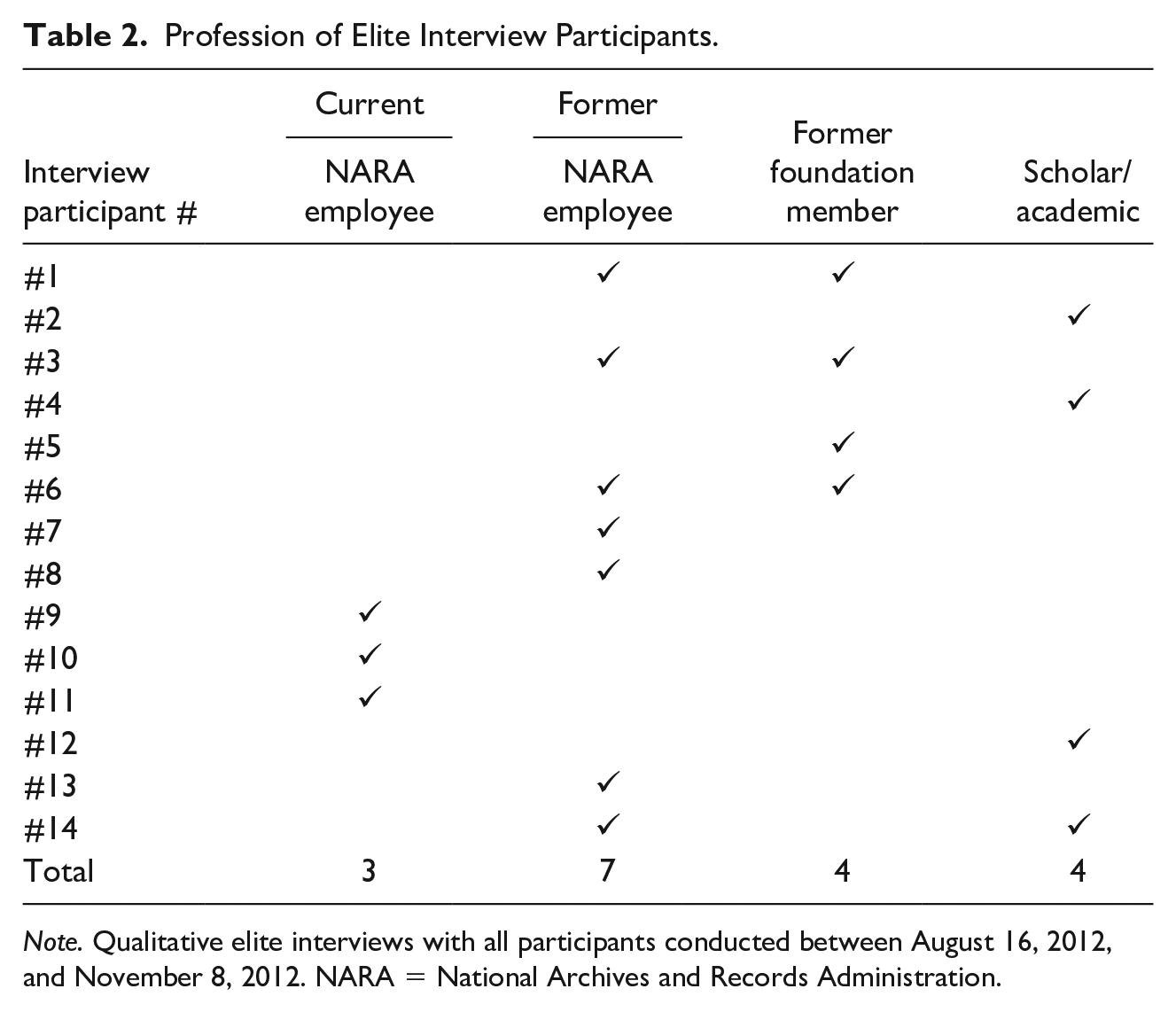
Note. Qualitative elite interviews with all participants conducted between August 16, 2012, and November 8, 2012. NARA = National Archives and Records Administration.
Data analysis occurred in several phases. First, content analysis was employed to systematically identify categories within the data as recommended by Krippendorff (2004), beginning with sequential reviews of both documents and interview transcripts related to the study. Review of the data identified key concepts and themes related to the nature and evolution of the relationships between NARA and presidential foundations, simultaneously illustrating how the relationships developed and persisted over time. The resulting analysis produced broadly defined categories allowing for identification of specific examples of interaction between the organizations, producing initial codes which extract or impose meaning to analyzed data (Eller et al., 2013, p. 217).
A second coding phase elucidated explicit examples of the nature, extent, and evolution of these multi-organizational relationships. Data were coded based on Thomson and Perry’s (2006) five dimensions of collaboration: governance, administration, organizational autonomy, mutuality, and norms of trust and reciprocity (p. 21). Data were then recoded to identify specific examples of each element of multi-organizational collaboration. The resultant codes defined questions of mutuality in terms of benefits generated by PPPs.
Following the original coding phases, a third coding phase refined and clarified the preliminary codes based on Thomson and Perry’s model. During this axial phase, themes and patterns disassembled during the open coding phase were reconstructed (Strauss & Corbin, 2008, p. 193) and compared with scholarly literature relevant to PPPs. Table 3 illustrates the application of accepted codes to Thomson and Perry’s model of dimensional collaboration.
Character of Mutually Beneficial Partnerships.
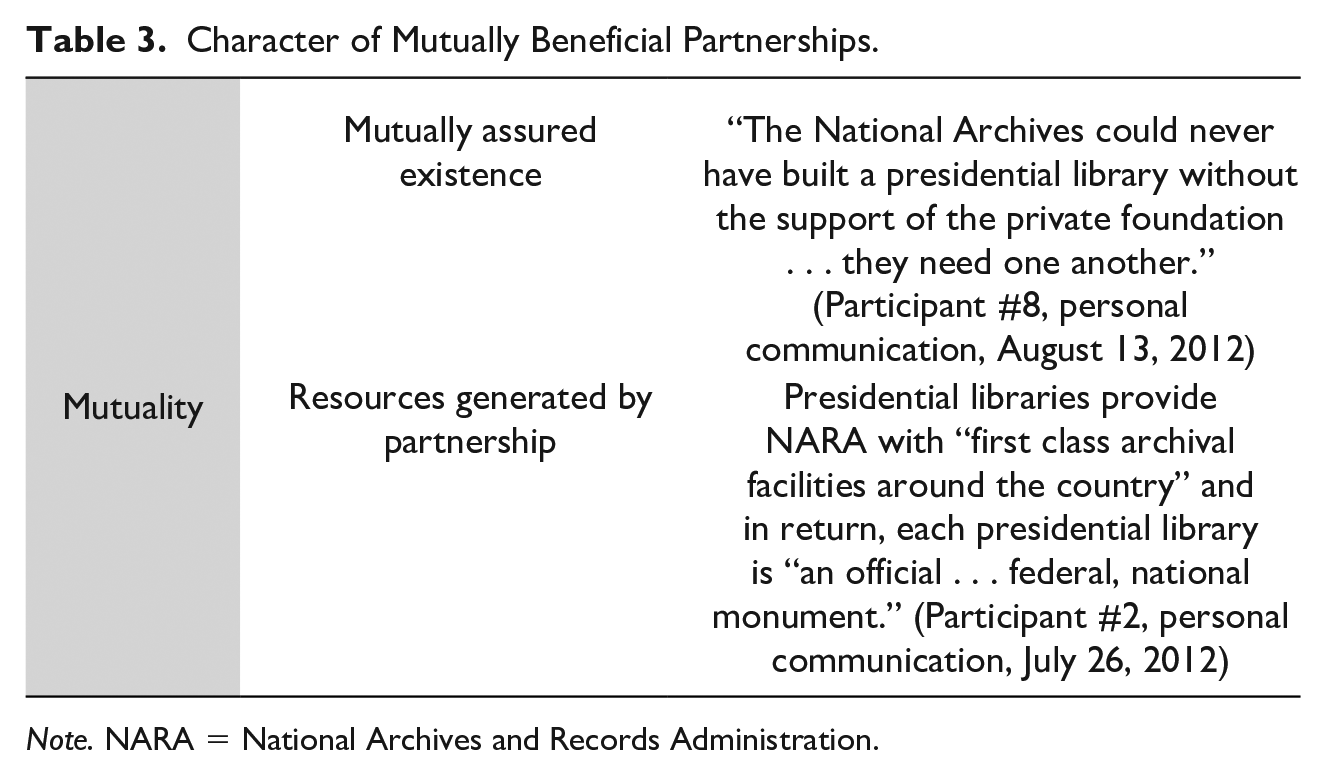
Note. NARA = National Archives and Records Administration.
Findings
NARA as a Cultural Institution
Analysis of the data collected reveals that the relationships between the NARA and PLS support foundations are complex, to say the very least. Legislatively mandated “to receive, preserve, and make available permanently valuable Federal and Presidential records” (NARA, 2009a, p. vi), the National Archives represents a bureaucratic organization of considerable size and scope. Despite the large size of the National Archives, the administration of presidential records within the PLS is but a small portion of the agency’s statutory responsibilities (Participant #3, personal communication, August 1, 2012).
Don W. Wilson (1996), seventh Archivist of the United States, argued that the National Archives, like the Library of Congress and the Smithsonian, represents a “cultural institution” rather than merely a “recordkeeper” of information (p. 196). From this perspective, it is easy to see how some at NARA have come to view presidential libraries as “classrooms of democracy” (Wilson, 1991, p. 773). Even as a “cultural agency” (Participant #1, personal communication, July 25, 2012), NARA’s legislative mandate far exceeds its appropriated resources to support presidential libraries (Participant #2, personal communication, July 26, 2012). The dual responsibilities of preserving presidential records and providing nonpartisan educational programs have been difficult at times, considering that the records contained in presidential libraries represent a fraction of the federal records NARA is accountable for administering (Participant #3, personal communication, August 1, 2012). In an era of decreasing appropriated funds, NARA has become increasingly reliant on private foundation partners at presidential libraries to supplement administrative responsibilities.
Mutually Assured Existence
Partnerships within the PLS create a situation of “mutually assured existence” for both the library and the foundation (Participant #5, personal communication, August 13, 2012). Following construction and donation of a facility to the federal government, the National Archives maintains the facility thus allowing foundations to add additional programming it otherwise might not be able to without NARA’s appropriations (Participant #13, personal communication, October 30, 2012). In addition to ensuring the libraries persist long after the former president and his supporters are deceased, partnerships in the PLS allow participants to reduce some of the financial burden of preserving and maintaining a historical site. While such efforts may reduce financial strains, the National Archives remain fiscally responsible for core functions at many presidential library campuses, ranging from staffing and utilities to security measures. As a result, foundations can operate library programs at lower costs than if the partnerships did not exist (Participant #14, personal communication, November 8, 2012).
Although the potential for mutual benefit exists, the resources which participating partners can contribute do not remain static over time. When asked about the benefits the partnerships provide to each organization, Participant #1 noted that the resources each partner can contribute change over time. Moreover, if unforeseen circumstances arise, an organization—NARA, a private support foundation, or another public institution such as a university, for example—may respond to the needs of the presidential library. This organizational interdependence suggests that if one organizational partner is unable to maintain a certain level of support, another might take on additional responsibility. The level of involvement by different organizational parties “can grow or it can expand or it can contract as much as necessary,” but NARA will preserve important presidential records, and the American public will “continue to have [their] history maintained” (Participant #1, personal communication, July 25, 2012).
To effectively safeguard the future of presidential libraries, NARA and foundation officials have utilized external relationships to enhance both tangible and intangible resources and support. In addition to the increased support and resources afforded by mutual partnerships, presidential libraries have benefited considerably from Congressional earmarks and political capital (Participant #3, personal communication, August 1, 2012). Individuals serving on foundation boards typically have connections to a current administration or to members of Congress who can lobby on behalf of NARA, whether generally or for a specific presidential library. Furthermore, the passing of a former president may reinforce support for presidential libraries, as surviving family members may represent powerful allies which can “carry influence on both sides of the aisle and a lot of political influence” (Participant #1, personal communication, July 25, 2012). One interviewee illustrates this dynamic, recalling an instance occurring in the 1990s when a board member of a partnership foundation successfully lobbied Congress twice to obtain additional funding for two separate presidential libraries (Participant #3, personal communication, August 1, 2012).
Supplementing their ability to secure additional resources for a presidential library, the partnerships can similarly serve to protect existing resources. Shortly after being named Speaker of the House, Representative Newt Gingrich suggested privatizing all existing and future presidential libraries (Larson, 1995). The suggestion prompted Trudy Huskamp-Peterson, then-Acting Archivist of the United States, to respond in writing to Speaker Gingrich’s comments—first to Gingrich, then to former President Gerald Ford. Rebuffing Gingrich’s idea, Huskamp-Peterson praised the presidential library partnerships as crucial to their success, stressing the partnerships as proud models of effective public and private cooperation (NARA, 1995a). Moved by Huskamp-Peterson’s defense of the partnerships, President Ford requested updates on the matter (NARA, 1995b), prompting one Archives employee to suggest inviting Representative Gingrich to speak at the Ford Library and cement President Ford’s support for retaining the partnership model in response (NARA, 1995c).
Balancing operational independence and cooperative arrangements with additional organizations places NARA in a unique position. While the National Archives retains a great deal of independence, the previous examples outline the considerable benefit presidential support foundations represent within structured partnerships. Presidential support foundation representatives, along with family members of former presidents, can be instrumental in lobbying for Congressional support and resources (Warner, 2005). It comes as little surprise then that NARA officials are supportive of their presidential library foundation partners.
PRA and a Shift in Resources
While cooperative agreements between organizations reflect mutual benefits, such relationships do not provide clear boundaries concerning autonomy and sovereignty over operations. Cooperative agreements demonstrating asymmetrical dependence levels run the risk of effectively decreasing the autonomy of one (or more) of the organizations engaged in the partnership (Provan, 1984). The resulting imbalance of autonomy and control over resources may influence the degree to which one organization is dependent upon another organization for survival (Morgan, 2006; Pfeffer & Salancik, 1978). Given the mission of NARA as a vanguard of governmental documents, it is unsurprising that presidential records represent a critical dispute in the category of critical resources.
Questions concerning ownership of presidential records were answered in 1978 when Congress passed the PRA, which made presidential records created on or after January 20, 1981, public property. The PRA marked an important qualitative shift in the preservation of presidential papers, shifting NARA’s statutory obligation regarding presidential papers from custodian to trustee. Prior to passage of the PRA, records archived in each presidential library were public property, often through a deed of gift. Following the PRA, however, NARA no longer accepts the personal property of a former president when taking possession of a presidential library. This shift in ownership of presidential papers effectively altered precisely what resources NARA and its presidential foundation partners bring to the relationship.
While the PRA made presidential records official property of the federal government, they do not provide a full illustration of a presidential administration. The PRA encourages a president to segregate his “personal files while he was president from his official files,” which potentially means a president could “have a whole parallel set of files that he doesn’t have to give to anybody” (Participant #7, personal communication, August 21, 2012). Therefore, the practice of distinguishing personal records from the official records of a president’s tenure in office proves challenging, resulting in the cumbersome sorting of intermingled records at the end of presidential terms (Participant #6, personal communication, August 16, 2012).
The shifting of resources within PPPs in the PLS was viewed as an opportunity to move preservation of presidential records away from individual libraries toward a centralized presidential archive located in or around Washington, D.C. (Elliott, 1981). Hypothetically, such a decision would effectively eliminate the need for presidential foundations and their partnerships with NARA. Although centralization of presidential archives has not materialized, the proposal remains a possible alternative to existing administrative structure (NARA, 2009b).
Without statutory authorization, the National Archives is subject to the discretion of former presidents as to precisely which personal and political records are accessible. Unsurprisingly, some NARA officials are therefore willing to accept federally administered “presidential temples” (Hufbauer, 2005) to obtain more complete records. One respondent depicted attempts by a former president, his family, and his foundation to produce museum exhibits promoting a positive legacy of his presidency as “a small price to pay for . . . getting a first-rate research institution” like a presidential library (Participant #1, personal communication, July 25, 2012). Another participant described such arrangements as “a bargain with the Devil, [but] a bargain worth making” (Participant #4, personal communication, August 7, 2012). The characterization of such partnerships suggests that supporters of presidential libraries are not oblivious to the considerable influence of private partners.
Distinguishing private and presidential papers is unnecessary in presidential libraries falling outside the purview of the PRA. Deed of gift libraries, which contain only materials which former presidents decide to donate to the federal government, are often personal in nature. However, public availability of all records within the archives is subject to the deed of gift or the discretion of a former president or his appointed representatives. Several former presidents have donated private materials carrying embargo stipulations (Participant #1, personal communication, July 25, 2012). Former President Reagan, for example, donated many of his personal papers to his library without considerable stipulations. Conversely, the personal papers of Presidents George H.W. Bush and Bill Clinton are “on deposit” at their respective libraries though publicly inaccessible until permanently donated (Participant # 11, personal communication, October 1, 2012).
Legitimacy for Both Library and Foundations
PPPs are central to the existence and operation of the PLS (Participant #3, personal communication, August 1, 2012). Although PPPs flourished considerably during the 1980s and 1990s, President Franklin D. Roosevelt’s proposal to construct a presidential library with nonfederal funds represents one of the earliest attempts to ease taxpayer burdens (Participant #10, personal communication, October 1, 2013). Despite the federal government continuing to finance many activities at presidential libraries, interviewees clearly indicate that NARA could not have achieved the development of presidential libraries without private support (Participant #7, personal communication, August 24, 2013), a sentiment echoed by the National Archives itself (NARA, 2009b).
Importantly, the commitment of presidential support foundations to construct premier archival facilities housing professionally preserved presidential records serves to benefit both the National Archives and library patrons. While the construction of such facilities requires considerable resources from presidential support foundations, the libraries are endowed legitimacy through “. . . being accepted and run by the federal government, run by the National Archives,” as well as the “sense of [being] an official . . . federal, national monument” (Participant #2, personal communication, July 26, 2012).
A key advantage of using nonfederal funds for presidential library construction is that it makes such initiatives politically feasible while reinforcing limited government principles. Involving nongovernmental organizations in the preservation and maintenance of national sites imbues presidential libraries with both legitimacy and sustainability. While NARA would still preserve official presidential records without private support, the dissolving of such partnerships would like result in “. . . much smaller facilities . . . [and] probably [would] have [to be] a co-mingled facility . . . [with both] presidential records and other federal records” (Participant #13, personal communication, October 30, 2012). Such a shift would be significant for both NARA and modern administrations reliant on digitalized records, as well as for archivists reliant on such facilities to effectively manage, process, and distribute presidential information.
Although most presidential library patrons disregard the archival facilities, many enjoy the museum exhibits which are funded through private donations by friends and supporters of former presidents (Participant #3, personal communication, August 1, 2012; Participant #10, personal communication, October 1, 2012). The paradigmatic nature of these relationships is clear to NARA officials, noting that . . . the foundation wants to preserve the legacy of the president and to present it in the best possible light; . . . [NARA’s] dependency on the foundations is huge in terms of the longevity and sustainability of the library so that gives them a lot of power, a lot of say about what is, goes on in their particular library. (Participant #13, personal communication, October 30, 2012)
Moreover, National Archive officials understand that such reciprocal relationships are not always endearing, assuming that when a former president and his supporters have passed, the resources of his foundation most likely will diminish. However, such events inevitably allow NARA greater influence over the content of a particular museum (Participant #1, personal communication, July 25, 2012).
The PRA and Governmental Transparency
Axioms of transparency and accountability have long been held as principles of ethical governance in the United States. As a federal agency, the National Archives is held to the same expectations of transparency and accountability as other governmental entities. However, the introduction and continuance of PPPs existing within the PLS underscore lingering questions concerning the extent to which private organizations must adhere to governmental principles when serving the public cooperatively.
Little dispute exists as to whether Presidential Libraries represent a form of public or collective good; providing information to the public epitomizes a benefit to the public interest, regardless of the complexity of the unit of analysis (Ostrom, 1990). Underlying the facilitation of public interests by PPPs rests a continual balancing of both resource allocation and ethical standards. While governmental actors enter into PPPs as a means of improving the efficiency and effectiveness of service delivery, sectoral variances in terms of authority, resources, and legitimacy may prove problematic. Advocating government entrance into such relationships as a “smart buyer,” Kettl (1993) notes that safeguards against conflicts of interest arising from resource-dependent partnerships are essential to minimizing political and technical uncertainties. Despite the abilities to wield legitimate governmental authority to enforce ethical standards within such partnerships, doing so runs the risk of deteriorating or dissolving working relationships with nongovernmental actors (Ghere, 1996).
A critical factor relating to the ethical boundaries of acquisition, retention, and publicization of presidential records concerns the 2014 amendments to the PRA. Although the primary legal mechanism for obtaining and preserving presidential records outlined in §2203 through §2205 of the PRA outlines the statutorily enforceable elements of the law, the broad language within these sections permits considerable discretion as to precisely what records may be withheld by presidential administrations for confidentiality and national security purposes. 4 Importantly, the Presidential Records Act amendments of 2014 (44 U.S.C. §§2201-2209) introduced §2209 to the law outlining disclosure requirements for official business conducted using nonofficial electronic messaging accounts. Factoring for the acceptance of social media platforms to communicate to broader audiences, this crucial addition to the law now subjects the electronic messaging activity of presidential administrations to the same standards as legacy documents for the purposes of National Archive storage and preservation.
Pivotally, while the statutory section clearly identifies the disclosure requirements for official administrative business through nonofficial electronic messaging account, the broad language of section does not provide guidance concerning authorized ownership of records transmitted through interpersonal electronic devices using short message service (SMS) or encrypted messaging applications. Such caveats to the scope and authority of the National Archives in obtaining presidential records, as well as the records of Executive Office employees, present a concerning dilemma toward administrative transparency and accountability efforts. With little precedent to serve as guidance, it remains to be seen whether the National Archives will be able to effectively secure and retain pertinent documents and communications from Executive Office officials in the face of evolving electronic communications applications utilizing advanced encryption protocols.
Discussion and Conclusion
Concluding his second term, President Franklin D. Roosevelt proposed the creation of a facility archiving his presidential records and providing a museum for visitors to view artifacts from his life and presidency. Pivotally, Roosevelt proposed the structure be privately constructed and subsequently donated to the federal government for perpetual support (Hufbauer, 2001). While the Franklin D. Roosevelt Library and Museum established an enduring pattern for preserving presidential records, future presidential institutions are not obligated to follow this precedent. Diverging approaches to presidential institutions, including the proposed presidential center of President Barack Obama, illustrate an impending departure from existing relationships between NARA and presidential foundations within the PLS. The potential for change to future PPPs stresses the need to understand dynamics of these relationships, how they form, and the propensity of such changes to augment the PLS.
This study investigates the nature and extent of the PPPs existing in the PLS to further understand why and how multi-organizational relationships form and persist at sites of collective memory. While PPPs in the PLS are largely informal in nature, Congress has provided a degree of guidance to both NARA and their respective presidential foundation partners to allow for varied interpretation. Modern presidents may anticipate the future construction of their own presidential library, albeit with little rules or guidance for proceeding. In addition, the absence of formal procedures complicates the path toward forging future partnerships between the National Archives and presidential support foundations. Although the relationships between older presidential support foundations and NARA serve as general templates for newer foundations, there are no strict guidelines for structuring these relationships. Relevant statutes and agency policies offer little guidance concerning governance and administration of PPPs in the PLS, allowing individual presidents and their foundations considerable latitude in shaping these relationships. Devoid of formalized guidance for establishing such PPPs, the precise character and nature of future presidential libraries remain unclear at best.
Legitimacy is an unquestionably vital resource derived from the PPPs in the PLS. The partnerships establish a public presence in a policy or service area where nongovernmental organizations may be preferred to government actors (Boris, 2006, p. 18). Coincidently, this view was critical to President Franklin D. Roosevelt’s proposal for creating a federally administered facility to archive presidential records. While the National Archives could have simply accepted President Roosevelt’s records during a period of economic distress, the proposed involvement of private funding galvanized support. The legitimacy deriving from the partnership mobilized the unusual situation of a private group gaining substantial influence over management of government property (Hufbauer, 2005, p. 27). In this context, PPPs serve as a mechanism for organizations to shape their external environment while aspiring for greater effectiveness and efficiency.
Vaguely defined collaborative relationships, such as PPPs, can be manipulated to accomplish certain political ends and advance self-interests over public benefit (Jones & Bird, 2000; Peters, 2005; Reenock & Gerber, 2008). Such an understanding complicates these relationships, considering that partnerships are designed to be somewhat informal by nature. Expectations of partnerships extending beyond formalized agreements foster conditions where the means of one partner can be co-opted to achieve the ends of another. As it relates to preservation of information, the formation of PPPs has grown exponentially over the past several decades. Kammen (1991) highlights the growing acceptance of such relationships in the United States by noting that many citizens consider private entities, and not the federal government, to be legitimate vanguards of site of historical significance (p. 13). Whereas PPPs legitimized the role of government toward preserving private presidential records before the PRA of 1978, the domain of the legitimization of such relationships shifted toward private foundation roles in shaping the presentation of history at presidential libraries following the law. The question of who remembers is of particular interest in the United States because, as opposed to other nations, most sites of collective memory are operated by private nongovernmental organizations (Sterne, 2003).
Perhaps unsurprisingly, the museum exhibits at several presidential libraries have been the cause of some controversy. Proponents of the PPPs in the PLS highlight public benefits of relationships, such as access to the private records of a former president and downplay the role of private foundations in memory creation, while critics have decried private foundations as carrying commemoration aspects of presidential libraries too far (Clark, 2015; Cox, 2002; Fawcett, 2006; Hufbauer, 2005; Mitchell & Kirk, 2008). Considering the differing and occasionally conflicting missions of NARA and presidential support foundations, such criticisms may be justifiable (Cable-Satellite Public Affairs Network, 2010). Nevertheless, presidential libraries account for but a fraction of NARA’s statutory obligation, providing some explanation for the agency’s exclusion in the museum component of these institutions (Craig, 2006; Hackman, 2006). Critiques of the influence presidents and their supporters have been given in crafting the narratives within presidential libraries administered by NARA are significant and should not be easily dismissed. While beyond the scope of this study, the implications of having private hands influence sites of public memory are important and underappreciated in public administration scholarship.
As currently structured, PPPs continue to be important to the PLS. Given the value of existing PPPs, exploring the process from which they form is paramount toward understanding sectoral approaches toward resource allocation, scope of authority, as well as expectations of transparency and ethical obligations. Through museum exhibits and educational programs, presidential libraries help shape the nation’s understanding of a particular president as well as the presidency. By selectively framing information about particular presidents and administrations, presidential libraries, like all administered sites, seek to influence the conclusions their visitors take away with them (Young, 1993), raising questions concerning private entities acting in partnership with public organizations to create such sites. The majority of those interviewed for this study expressed the opinion that NARA will become increasingly dependent on the private resources afforded by the PPPs in the PLS. However, few were inclined to express concerns as to whether incongruent organizational beliefs concerning transparency and ethicality exist between public entities such as NARA and their private-sector partners. Given NARA’s aim to ensure nonpartisan environments in presidential libraries (Naftali, 2013), notifying governmental organizations that private organizations within multi-organizational relationships do not hold the same obligation to public accountability becomes crucial (Goodsell, 2006).
Limitations
This study is an intrinsic case analysis with instrumental value rooted in the missions of the NARA and presidential libraries. An invaluable resource, the National Archives retention and preservation of official government records, provides a scaffolding for constructing narratives, forming collective memory, and shaping national identity (Brown & Davis-Brown, 1998; Cox & Wallace, 2002). This highlights the importance of the NARA and emphasizes the value in understanding better the multi-organizational relationships in presidential libraries, notable when considering the unique character of each Presidential Library. While the diverse nature of these relationships may limit the instrumental value of the study, further understanding multi-organizational collaborations between NARA and its presidential support foundation partners facilitates understanding of similar collaborative arrangements between governmental and nongovernmental actors promoting public interests.
Although the study provides an understanding of the dynamics underlying PPPs within the PLS, it is not without limitations. A key limitation to this study relates to the time frame in which in-depth qualitative interview was conducted. The interviews conducted for this study occurred shortly before the completion of the most recent presidential library within the United States, the George W. Bush Presidential Center in Dallas, Texas. Given the considerable amount of time between openings of presidential libraries and presidential centers, the character and nature of PPPs existing within the PLS have undoubtedly changed in numerous ways which the existing study cannot illustrate.
Construction of future presidential libraries will undoubtedly shed more light on these peculiar relationships between public and private entities. Announced for development in 2015, the Barack Obama Presidential Library may provide clues as to how such relationships evolve. Partnering with the University of Chicago, the library’s offerings will diverge from existing presidential libraries by including the first fully digital library catalog, athletic facilities, and adjacent commercial development space (Onley, 2020). Unique architecture and facilities aside, progress on the development of the library has faced considerable headwinds. Issues ranging from concerns over gentrification of surrounding neighborhoods to bureaucratic review of the proposed location resting on the National Register of Historic Places have considerably delayed development of the vast project. The culmination of administrative barriers and community feedback has pushed initial groundbreaking for construction from 2018 to an undermined date, thus eliminating the 2021 time frame for public opening (Bowean, 2019).
Developmental challenges aside, the formation of a privately operated presidential library raises pertinent questions concerning ethicality and transparency. Although a wealth of private records and artifacts at the Obama Presidential Center will be loaned by the private foundation to NARA, the Center itself will be operated and overseen by the Obama Foundation—a private, nonfederal organization. This departure from the PLS model established by Roosevelt is in many ways a return to historical precedent when the federal government was not actively involved in the preservation of presidential sites or memory. Although NARA will not administer a federally owned Barack H. Obama Presidential Library, because of its responsibility to preserve presidential records, the agency will have a relationship with the Obama Presidential Center and by extension the Obama Foundation. Unsurprising, this approach has spurred polarizing viewpoints concerning future presidential legacy establishments. Whereas supporters laud the autonomy and sovereignty the arrangement provides former presidents in telling the story of their presidency from their own perspective, others warn that such efforts may result in the whitewashing of artifacts and documentation from future presidential administrations (Clark, 2017; Schuessler, 2019). These divided opinions concerning the relational structure of the Obama Presidential Center underscore both the uncertainties of future presidential libraries and the requisite drive to understand PLS partnerships past, present, and future.
Footnotes
Declaration of Conflicting Interests
The author(s) declared no potential conflicts of interest with respect to the research, authorship, and/or publication of this article.
Funding
The author(s) received no financial support for the research, authorship, and/or publication of this article.
