




Abstract
This study examines when and how community involvement occurs in the remediation processes of brownfield sites in Los Angeles County, California. Although community participation is usually considered important for determining what happens with these sites, our results indicate that, except in sometimes triggering evaluation by alerting authorities about it, community involvement almost never occurs when important decisions are made. Participation does sometimes occur, but when and how cleanup occurs is driven by administrative processes, with bureaucrats following procedure, rather than following community preferences. The findings suggest that the best space for communities in the process may be the identification of sites that need remediation.
Introduction
Although many environmental challenges are national or global in nature, hazardous land uses are local in nature. Hazardous sites can be any form of undesirable land use, usually in the form of a shuttered business, waste facility, or industrial site upon which there is residual pollution that must be cleaned up before the site can be reused (Alberini et al., 2005). Hazardous sites can reduce property values, foster neighborhood blight, decrease the overall livability of a community (Hite et al., 2001), and contribute to environmental injustice (Campbell et al., 2015). Their remediation can reverse these effects, leading to reduced pollution, increased property values, business investment, neighborhood beautification, and even gentrification (Eckerd, 2011; Eckerd et al., 2019; Haninger et al., 2017; Woo & Lee, 2016). Although the effects of environmental problems such as air pollution or climate change tend to be more diffused, the effects of these sites are often limited to their immediate surroundings, but even so they may be highly salient and present in the daily life of a community, much more so than more diffuse environmental concerns (Leyden et al., 2011). We might, therefore, expect that community residents would be highly engaged with what happens (or does not happen) with a local hazardous site, particularly in light of administrative systems that encourage community involvement in environmental decision making.
Hazardous sites or locally undesirable land uses (LULUs) can threaten environmental and public health. The U.S. Environmental Protection Agency (EPA) distinguishes different types of such sites as Superfund sites, brownfield sites, and other hazardous waste sites (e.g., treatment, storage, and disposal facilities). 1 Superfund sites are generally the most risky and most expensive of hazardous sites as identified by the federal government. In this article, our focus is on non-Superfund brownfield sites, the most local and prevalent of hazardous sites. Brownfields are “real property, the expansion, redevelopment, or reuse of which may be complicated by the presence or potential presence of a hazardous substance, pollutant, or contaminant.” 2 The number of brownfield sites and the magnitude of contamination at brownfield sites are largely unknown (Rechtschaffen et al., 2009). There are some estimates of the number of brownfields in the United States, and such estimates range from 450,000 (EPA website) to “at least 500,000 to 600,000 or more” (Simons, 1998), to between 500,000 and 1 million (Kim 2018; Solitare, 2005). The magnitude of contamination—including types of contaminants—is even less well quantified. These numbers stand in stark contrast to the number of Superfund sites, which is 1,335, with an additional 51 proposed, as of May 2020 (EPA, 2020). Thus, brownfields are much more relevant to the daily lives of community members.
The EPA and its state-level counterparts perform and oversee the investigation and cleanup process at active or abandoned waste sites (Dull & Wernstedt, 2010), but little is known about how members of the community are involved in decisions as they relate to these local, lower risk, or moderate-risk hazardous sites. Virtually everyone, from the highest levels of government to the communities themselves, agrees that these sites should be cleaned up (Greenberg et al., 2001). The federal government and most states require public participation to be part of the hazardous site remediation process, typically encouraging local participation in both alerting officials to the presence of a hazardous site and participating in the planning for postremediation. The intent of policies that encourage (or require) public participation is usually to ensure that decision makers have access to more information about a site, as well as to ensure that residents have a voice in how sites in their community will be cleaned up and redeveloped (Eckerd, 2014). In contrast to many other types of environmental issues (Eckerd and Heidelberg, 2020), brownfields should offer an excellent scenario for robust public engagement—they are likely salient to the community, most are not technically complex, most are managed locally, and there are existing processes and procedures in place to facilitate public involvement.
In this article, we first review general literature regarding public participation in administrative decision making and hazardous-site remediation, and community involvement in environmental decision making, arguing that brownfields provide an ideal venue to examine public participation. We report on our approach to assess community involvement in hazardous sites in Los Angeles (LA) County, California. From the analysis of hazardous site remediation and community involvement in LA County, we have four key findings: (a) Communities can play a role in trigging site examination; (b) otherwise, recognized community involvement almost never occurs for sites under the early evaluation stage of remediation, but can occur later in the process for sites undergoing cleanup, though this is usually too late in the process to affect the remediation; (c) school-related cleanup sites, which are presumably the most salient types of site, are more likely to include recognized community involvement; and (d) when cleanup occurs, it is generally done following administrative operating procedures, rather than participant preferences, with bureaucrats doing their due diligence under state and federal laws and regulations. These findings suggest that, even though brownfield remediation offers a very local venue that could engender a robust public participation process, the cleanup of these hazardous sites functions similarly to more complex environmental projects: There is limited effectual public engagement.
Participation in Hazardous Site Cleanups
Hazardous sites can have significant effects on communities, both in negative impacts from contamination and blight and in positive ways from their remediation, which should motivate the public to be engaged. In addition to the potential health consequences of polluted sites, brownfields are often shuttered sites and community eyesores that virtually everyone wants to see cleaned up. For example, increasing evidence shows that a lack of greenspace has both physical and psychological health consequences, with some urbanists, therefore, focusing “urban brownfield remediation projects on urban green space to address public health and environmental justice concerns” (Wolch et al., 2014, p. 239).
However, there is little research on community involvement in the remediation of moderately contaminated sites such as brownfields. One of the great challenges of brownfield sites is involving multiple stakeholders (Solitare, 2005), and evidence of meaningful participation in brownfield remediation is scant (Solitare, 2005; Wolch et al., 2014). Owing to their very local, and typically relatively uncomplicated nature, brownfield sites could offer an exemplar of public engagement that provides useful administrative information as well as meaningfully involves a community in administrative decision making, and thus is directly a democratic activity.
Some Terms of Focus: Remediation and Community Involvement
To move forward on discussing community involvement in environmental decision making on brownfield cleanup, we clarify our use of some terms. This research focuses on site remediation (or cleanup), rather than redevelopment, which is about the specifics of site reuse. We focus on remediation for a few reasons. First, government is always involved in remediation, as it is the arbiter of validating the presence of contamination and verifying its removal. Although the actual work is typically done by consultants and contractors, government oversees the remediation process as part of a normal administrative process. Government is often minimally involved in redevelopment of small-scale brownfield sites beyond approving permit approval. Second, remediation nearly always occurs with some level of public funding, often in the form of a site evaluation grant or a liability waiver. Again, although some redevelopment projects use public money, many are privately funded. Third, our interest is in remediation given literature on public participation, as we describe below, illustrating that the earlier that the public gets involved, the more they are able to influence the eventual decision (Fung, 2006). By the time a site reaches the redevelopment stage, many key decisions have already been made—most importantly, the standard to which the site is remediated, which then constrains reuse options.
We also note that there are many terms used for what we call here “community involvement,” including public participation, citizen engagement, and deliberative democracy (and combinations of all of these). There have been several attempts to define such imprecise terms, emphasizing different dimensions of public engagement (Arnstein, 1969; Chilvers, 2007; Rowe & Frewer, 2005), but we do not delve into those distinctions here. In reviewing the literature, we use a number of these terms, but, no matter the term, our focus is the extent to which the individual members of a community become involved in decisions around the remediation of non-Superfund brownfields in their community, and the consequences of that involvement.
Public Participation in Administrative Decision Making
To consider how community engagement is structured in brownfield remediation, it is useful to review how participation in administrative decision making functions more generally. The earliest strands of literature are largely normative in nature, related to a 1960’s reaction against the perception of the distant, unelected bureaucrat who was beholden to the process of administration rather than to the needs of the citizenry (Frederickson, 1989). This work influenced the content of several key environmental laws that were implemented during this time, most of which include provisions for public engagement. Most important, although public engagement was not the sole basis for the National Environmental Policy Act (NEPA) of 1969, in its implementation and the implementation of “little NEPAs” (passed in about 20 states shortly afterward), public participation was codified as a crucial aspect of environmental administration (Eckerd, 2014).
NEPA requires environmental review for any proposed federal government action that would have an impact on the natural, social, or historic environment, with mandates that the public be involved both in determining the extent of likely environmental impacts and in providing feedback on draft plans once they have been prepared (Eckerd & Heidelberg, 2020). Since the passage of these laws, numerous other laws have mandated that the public be informed and offered the opportunity to engage administrators as they make decisions that might affect a community. Our study is based in California, where the California Environmental Quality Act (CEQA) codifies similar requirements for any proposed state or local government action. Furthermore, state law requires that school sites, in particular, undergo an environmental examination (California, 2008).
There is little evidence about the extent or the effect of participation that takes place when cleaning up brownfields. However, there has been considerable research into participation that takes place not only in other settings, particularly as they relate to federal government rulemaking (Golden, 1998; Halvorsen, 2003; Irvin & Stansbury, 2004; West, 2004), but also in state government and environmental management (Daley, 2007; Neshkova & Guo, 2011). Much of this work is based on participation that occurred in nonenvironmental settings (particularly under the federal rulemaking process under the Administrative Procedures Act [APA]); it has tended to find that, although the public did participate, that participation did not substantially affect the decisions that were ultimately made. This finding has generally been consistent across a large range of different settings, including business and labor regulation (Yackee & Yackee, 2006) and finance (Nixon et al., 2002). However, the bulk of this work has been based on the federal level, with respect to issues that, although salient to regulated industries, are not particularly salient to the average city resident. Brownfields are very local in nature, are unlikely to attract organized interests (with the possible exception of developers or environmental groups in some cases), and are mostly managed by local government authorities.
We can garner some clues from studies of other environmental decision-making settings. In some cases, the participation that occurs tends to be rather rote or one sided, and citizens often leave the effort feeling frustrated at having not been listened to rather than empowered to help make decisions for their community (Irvin & Stansbury, 2004). Community involvement can also delay, or potentially even halt, environmental remediation efforts (Rechtschaffen et al., 2009). In contrast, work specifically focusing on collaborative environmental management has tended to find that a well-organized and engaged community can play a significant role in shaping environmental policy decisions (Daley, 2007; Koontz, 2005; Koontz & Thomas, 2006). These sorts of processes require commitment, however, from the community and the decision makers charged with managing resources. Ongoing environmental programs, such as watershed management, have the time to foster the commitment and trust of stakeholders and administrators.
Brownfields, conversely, are generally one-shot programs—even if the remediation process itself takes a long time, the scope is quite narrow. Yet, brownfields could be an opportune project with which to engage the public. The relative lack of technical complexity and the obviousness of most brownfield sites (many are shuttered businesses such as gas stations, metal plating firms, dry cleaners, or the like) could provide an opportunity for democratically oriented administrators to engage with the public about what sites need remediation and how that remediation will take place. Funds are lacking to clean up most brownfield sites; thus, the first key consideration is determining which sites are or are not going to be remediated. Second, because of their in-depth local knowledge, the public could have a role in alerting authorities to previously unknown hazardous sites or conditions of a site. Third, the remediation itself requires several considerations that the public may seek to influence.
The Remediation Process
Here, we overview the remediation process and potential opportunities for engagement. Although the process varies to an extent by state and there may be exceptions, the general process of remediation is straightforward. As noted above, the first decision is to identify a site as a potential brownfield. Once identified, the site goes through a visual evaluation, typically done by an environmental consultant. This inspection includes a review of known uses of the site, and frequently involves asking for information from a community about the use of the site. If the visual/historical evaluation suggests no evidence of contamination, the site is considered safe for reuse. If there is visual evidence of contamination, then sites are examined physically by taking soil, groundwater, and ambient air samples to assess the prevalence of contamination, which also frequently involves testing water and air quality in homes or businesses that are close to the site. If contamination is at levels legally or regulatorily defined as safe, then the site is determined to be safe for reuse, but if not, then a remediation is planned to determine how contamination is to be ameliorated and the level of remediation that will be obtained. There are three likely outcomes of a remediation: Contamination on a site is entombed on the site, it is diluted to safe levels on the site, or it is removed from the site—and each of these would obviously affect the neighboring community. Sites can be remediated to a range of different standards, but, in practice, in order of safety from least to most, they are remediated to an industrial reuse standard, a public use (i.e., park) standard, or a residential standard. Whatever the case, the remediation determines the bounds of redevelopment, and multiple decisions are made that ought to draw the interest of the focal community. 3
Despite this, because the nature of brownfield remediation is often rote, a number of states do not actually mandate community involvement in brownfield voluntary cleanup programs (Rechtschaffen et al., 2009). Even those states that mandate community involvement, such as California, generally require little more than that the affected community to be notified of proposed cleanup plans. State brownfield programs vary widely in terms of public participation tools required, and these requirements often lack specificity (Gallagher & Jackson, 2008). Community involvement can simply be, and often is, in the form of a brief notice and comment period on the proposed remediation plan (Rechtschaffen et al., 2009). This can change when there is some involvement from the federal level, for the EPA often provides funds to cities that have specific community involvement plans (Kim, 2018), and EPA’s Public Involvement Policy
4
provides a set of recommended procedures and methods for community involvement for the remediation of a brownfield site (not for the use and redevelopment of the site). Beyond simply being good stewardship of a democratic system, the EPA articulates why involving the public makes sense from a programmatic perspective: Identifying the interested and affected public is the cornerstone of public involvement processes. Get this step right and everything else will be easier; get it wrong and your process will fail. If you have the wrong people join in, you’ll gather incomplete information, miss critical input, and end with a decision that you cannot carry out. This step enables EPA to have direct exchanges of information, feedback, and involvement with people our decisions may affect. It helps EPA to base its decisions on the best available information and feedback and sets the conditions for the effective use of limited time and resources.
5
However, the extent to which these federal government practices are followed is not really known, by either the federal or state and local governments, or by scholars. It appears that information obtained during community involvement is often disregarded (Eckerd, 2014) or simply does not factor into the decision that is ultimately made (Eckerd & Heidelberg, 2020). Community involvement in environmental decision making may be so underutilized that some, such as Tang (2013), argue that, because brownfield remediation provisions and programs rarely provide for adequate public participation, it is more effective to use existing zoning processes as a vehicle for community participation.
Most of the research cited in the paragraphs above relates to participation that took place under traditional forms of public participation, typically the notice-and-comment or public-meeting approach first articulated by the APA and also used with NEPA. In these structures, agencies will issue proposed rules or plans and provide the public with an open comment period during which they may respond to the proposal, either in writing or via some sort of public meeting. These methods have been critiqued for a variety of different reasons, including the nonrepresentativeness of the people who participate and the often highly technical nature of the proposals being commented on, but, perhaps more crucially, critiques have focused on the absence of genuine engagement during notice-and-comment exchanges, and the fact that by the time a proposal has been written, the most important policy decisions have already been made (Fung, 2006; Halvorsen, 2003; Innes & Booher, 2004; King et al., 1998; Nabatchi, 2012). Suggested remedies have, therefore, focused on both the structure and timing of public engagement, arguing for participation that occurs much earlier in the decision-making process, at a point where the public may still actually have influence on key decisions, and with a setting for participation that is based on dialogue and consensus seeking rather than less interactive modes.
By this reckoning, there can be more opportunity, not only for the public to have a more meaningful influence on the decisions that are made but also for administrators to access important local information that may not otherwise factor into the ultimate decision that is made. For this to work out as intended for both the public and administrators, however, the community must be willing and able to be meaningfully engaged and, should administrators’ expert opinion vary significantly from public wishes, administrators must be open to collaboration and willing to veer away from their own preconceptions. When this process works, it is evident that all the parties involved can find the outcome much more beneficial than may have otherwise been the case (Bovaird, 2007; King et al., 1998; Nabatchi, 2012). For example, in research on postindustrial redevelopment, communities seem to hold a positive attitude toward brownfield redevelopment compared with consuming new green areas (Loures et al., 2016), and this type of information is useful for public administrators. However, as mentioned above, the commitment required for these success stories is extensive for both the public and the administrators. The public must be willing and able to be consistently engaged and be trusting of decision makers. Administrators must be open to new perspectives on issues for which they have expertise, in addition to needing to acquire the skills to meaningfully engage (Eckerd & Heidelberg, 2020).
There are other broader issues that go beyond the structural and timing aspects of participation in environmental decision making. The time span of environmental projects themselves is an issue. Decision making to improve environmental conditions such as through hazardous site remediation takes a long time from the onset to the completion of the project—perhaps several years. For instance, under NEPA or its state-level corollaries, the environmental impact analysis (EIA) process alone may take several years to complete due to various contextual contingencies, as illustrated in the cases of European countries in Bond et al. (2004). In terms of hazardous sites, the Tar Creek site in Oklahoma was added to the Superfund program in 1983, and remains unremediated today—and although this is an extreme example, it is not uncommon for remediation to take many years.
Although generally less complex than Superfund sites, brownfield remediation also can take an average of 3 to 4 years (Eckerd & Keeler, 2012). It is difficult to expect that community engagement will be sustained with much intensity throughout the process. That said, as noted above, there are some key decision points in the remediation process because much of that duration is focused on the assessment and physical cleanup. Although the process can be lengthy, the time needed for community engagement may be smaller. Time constraints may not play as large a factor in participation about a brownfield. Second, brownfields tend to be located in poor communities and often communities of color—suggesting that brownfields may provide a greater opportunity for less-privileged communities to be engaged with administrators in environmental management than do other venues. Finally, brownfield sites are often relatively unknown to regulators, and information gleaned from the community can provide genuinely useful information for administrators charged with site remediation.
In sum, it is generally accepted that the earlier that citizens are involved in the process of an environmental decision, the more influence they have, but we know little about the right contexts in which community involvement can bring value to the different stages of environmental decision making (Krütli et al., 2010). Brownfield remediation represents an ideal venue for genuine engagement— in most cases, engagement should not be overly onerous on either the community or administrators, and the process has the potential to help both. In this research, we investigate whether brownfield remediation is meeting this community engagement ideal.
Brownfield Cleanup in LA County
To look into this in more detail, our investigation focuses on brownfield sites in LA County, California. We selected LA County for several reasons, most notably the wide diversity of the county’s residents combined with a diversity of different development types located within the same county, including dense urban, suburban, and rural land uses, but with all of these different uses fitting within the same governmental context. LA’s environmental situation also has been examined many times by other scholars (see Pulido, 2000, p. 21, for an overview). Furthermore, LA County is one of the largest counties in the United States (by both area and population) and has many brownfield sites that offer diversity in site characteristics and settings. By studying LA County, we are able to identify a set of sites that meet certain characteristics in a careful selection process, as well as access documents and identify decision makers and other interested parties, to learn about the selected sites—and community involvement—in more detail. Below, we explain data and our brownfield site-selection process.
Data Sources 6
Data for brownfield sites were acquired from the California Department of Toxic Substances Control’s (DTSC’s) EnviroStor database (http://www.envirostor.dtsc.ca.gov/public/). EnviroStor is the state’s “data management system for tracking our cleanup, permitting, enforcement and investigation efforts at hazardous waste facilities and sites with known contamination or sites where there may be reasons to investigate further” (EnviroStor, 2018, n.p.). The information includes geographic data about the sites, as well as information about the sites’ previous uses, pollutants/suspected pollutants, permits, current status, and (sometimes) community involvement. According to the California DTSC, there are over 8,200 properties currently in the database with properties being added or removed as necessary. The EnviroStor database is updated by DTSC staff entering data on a regular basis and is a “point in time” database. However, download files are updated nightly.
7
Using the EnviroStor database, we began with information on 885 brownfield sites in LA County, with status dates between January 2005 and January 2016; Table 1 shows descriptive statistics for these cases, and Figure 1 shows their distribution within LA County.
LA County Brownfield Site Characteristics.

Source. California EnviroStor data set.
Note. N = 885 brownfield ssites in LA County with status dates of January 2005 to January 2016. LA County = Los Angeles County.

Brownfields in LA County.
Figure 2 presents our data collection and analysis procedures. The initial data set downloaded for LA County included a total of 2,666 brownfield sites. From these, we selected a subset of sites meeting the following criteria: (a) We focus on brownfields sites where recent cleanup or cleanup planning activity had taken place, indicated by a status date 8 between January 2005 and January 2016; (b) because their cleanup is a different policy process, we excluded Federal superfund sites and military evaluation sites, and we also removed sites from an older database where no site type was identified; and (c) we further cleaned the data by removing duplicate cases, reviewing site names and addresses for this purpose. The final data set identified from this process includes a total of 885 brownfield sites in LA County.

Data collection, analysis, and methods.
Fundamentally, our approach to the research is as follows. First, it is a normative stance in the public administration literature that community participation in such functions as brownfield assessment and remediation is desirable for at least two reasons: (a) It provides local knowledge that administrators may lack and (b) it is in keeping with democratic ideals for local residents to have influence over governmental actions in their areas. Many also expect that a democratic response to community influence is most likely at the most local levels. Using the selection process outlined in Figure 2, it is our goal to understand the following: (a) Does community participation occur in the very local decisions around brownfield remediation? (b) If yes, does it provide local knowledge that administrators did not already know, and is that knowledge used? and (c) Is it democratic, in that, residents’ wishes are incorporated? Using the selection method outlined in Figure 2 allows us to choose cases using a process that avoids selection bias and, therefore, allows greater ability to generalize than is usually the case in related studies.
The EnviroStor website is set up such that each site’s webpage has a series of tabs (or subfiles) regarding different information about each brownfield site, including the site’s history, geography, and potential contamination. Our key interest is evidence of community involvement in brownfield remediation. One of the tabs relates to community involvement, and this tab appears to be present when the managers responsible for the remediation include information regarding community involvement.
As shown in Table 1, about 22% of the 885 sites have a community involvement page 9 in the EnviroStor website. Brownfield sites in the database are categorized into two different stages: evaluation and cleanup. A majority of these 885 brownfield sites (68%) are in the cleanup stage, whereas the remaining 32% of sites are in the evaluation stage. Almost 12% of sites are classified as schools. Thirty-seven percent of the sites have received some amount of federal, state, or school district remediation funding, whereas 34% of sites are funded by legally defined “responsible parties.” 10 About 30% of our 885 brownfield sites do not have funding-source information. We cannot distinguish whether these sites are not funded at all or funding information is missing. In terms of site size, 20% of sites are larger than or equal to 10 acres, whereas about 63% are smaller than 10 acres. Seventeen percent of sites do not include site-size information in the data set.
Given other missing data outlined above, we recognized the limitation of using the presence of a community involvement tab as a proxy for actual community involvement. The presence of the community involvement tab in the EnviroStor database indicates that public managers responsible for the brownfield site in question reported public involvement in this database—and this is what we call recognized community involvement. But it does not necessarily provide detailed information and may not actually reflect the full reality of community involvement, as we noted in several cases when we attempted to corroborate the online information with paper records at field offices.
Because of this limitation and our broader interest in identifying the characteristics of a mix of different types of sites, we randomly selected a subset of sites and undertook a more detailed examination. We opted for a random selection first to differentiate our study from previous research, which was often selected on the dependent variable of projects that either had exemplary or problematic public engagement. Second, we wanted to be able to make some claims of possible generalizability, even as we recognize that a small subset of sites cannot make broad claims of generalizability. For a subset of the randomly selected sites, we further visited a DTSC field office and collected supplemental, in-office, documentary information on public participation. We analyzed the documents to dig deeper into how the public and stakeholders were involved in the remediation process.
Findings
When Does Community Involvement Occur?
There are differences in the characteristics of evaluation-phase versus cleanup-phase sites, most importantly in terms of community involvement information. We begin with some descriptive statistics from our full sample of sites, and Table 2 presents how this information varies in different stages of remediation. In the evaluation stage (i.e., the period before cleanup begins), there are only three EnviroStor records in our data set 11 that include community involvement pages out of 279 brownfield sites; this is about 1% of the evaluation-phase sites. Two out of the three cases where community involvement pages are provided are schools. For the Newcomb Academy site, examination of the EnviroStor record indicates that the only listed “community involvement” was the submission of a draft preliminary endangerment assessment to the Long Beach Unified School district. For the LA Breakers–Gordillo property, the very act of requesting an investigation constitutes community involvement, but here by a school district rather than by individual citizens or a local community-action group such as we usually consider public involvement. Further examination of the EnviroStor record again indicates that other “community involvement” involved presentation of a Soil Vapor Assessment Report to Mr. Ruben Gordillo, who had been considered a potential responsible party. Similarly, for the third evaluation-phase site, Lynwood Redevelopment–Phase II, the only community involvement visible in the EnviroStor record is the presentation of a report to the City of Lynwood Community Development Department.
Community Involvement Page Availability in Different Remediation Stages.
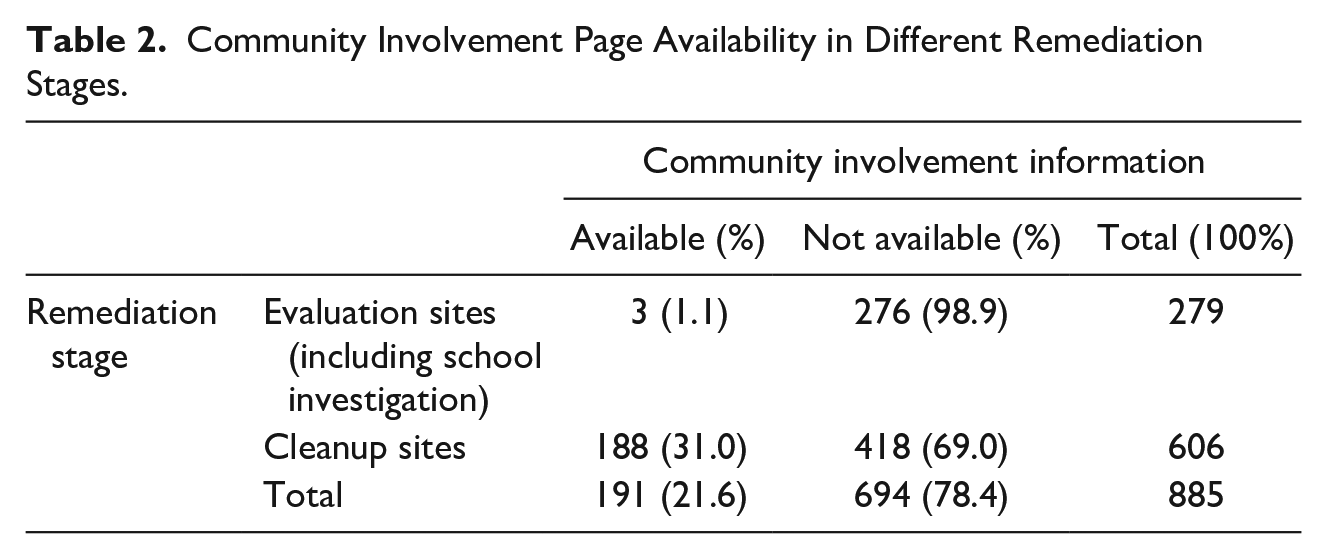
In the evaluation phase, therefore, “community involvement” as it is normally thought of—involvement by individual citizens or community activists—is unlikely, or at least undocumented, in the case of these brownfields in the LA County area. Although basic and descriptive, this itself is an important finding, for previous research has suggested that early involvement is key for public participation to be effective (Eckerd, 2014; West, 2004). But the EnviroStor database indicates that participation that is occurring for local brownfield sites is happening much later in the process. If results from West (2004) and Eckerd (2014) and the EnviroStor database are all correct, this indicates that community members in LA County are potentially missing the most important time for their involvement because they do not appear to be involved at all in the evaluation stage.
Among 606 cleanup sites in Table 2, 188 EnviroStor records (31%) report government recognition of community involvement, whereas 69% do not. Specifically, Table 3 shows that school sites are much more likely to have EnviroStor community involvement information (58% of school sites) compared with nonschool sites (25% of nonschool sites). This is not surprising, as people often take children’s health issues more seriously (and indeed children are more susceptible to certain pollutants such as lead). Information on brownfield cleanup sites funded by government (including school districts) is more likely to include community involvement pages (53%) compared with sites funded by responsible parties (33%). Information for brownfield sites that are 10 acres or greater in size is more likely to include community involvement pages (47%) compared with sites that are less than 10 acres in size (35%). Again, this makes sense because it is likely that larger sites are more salient to people in the area, and work by McMillen and Thorsnes (2003) indicates that salience matters.
Community Involvement Information for Cleanup Sites by Site Characteristics.
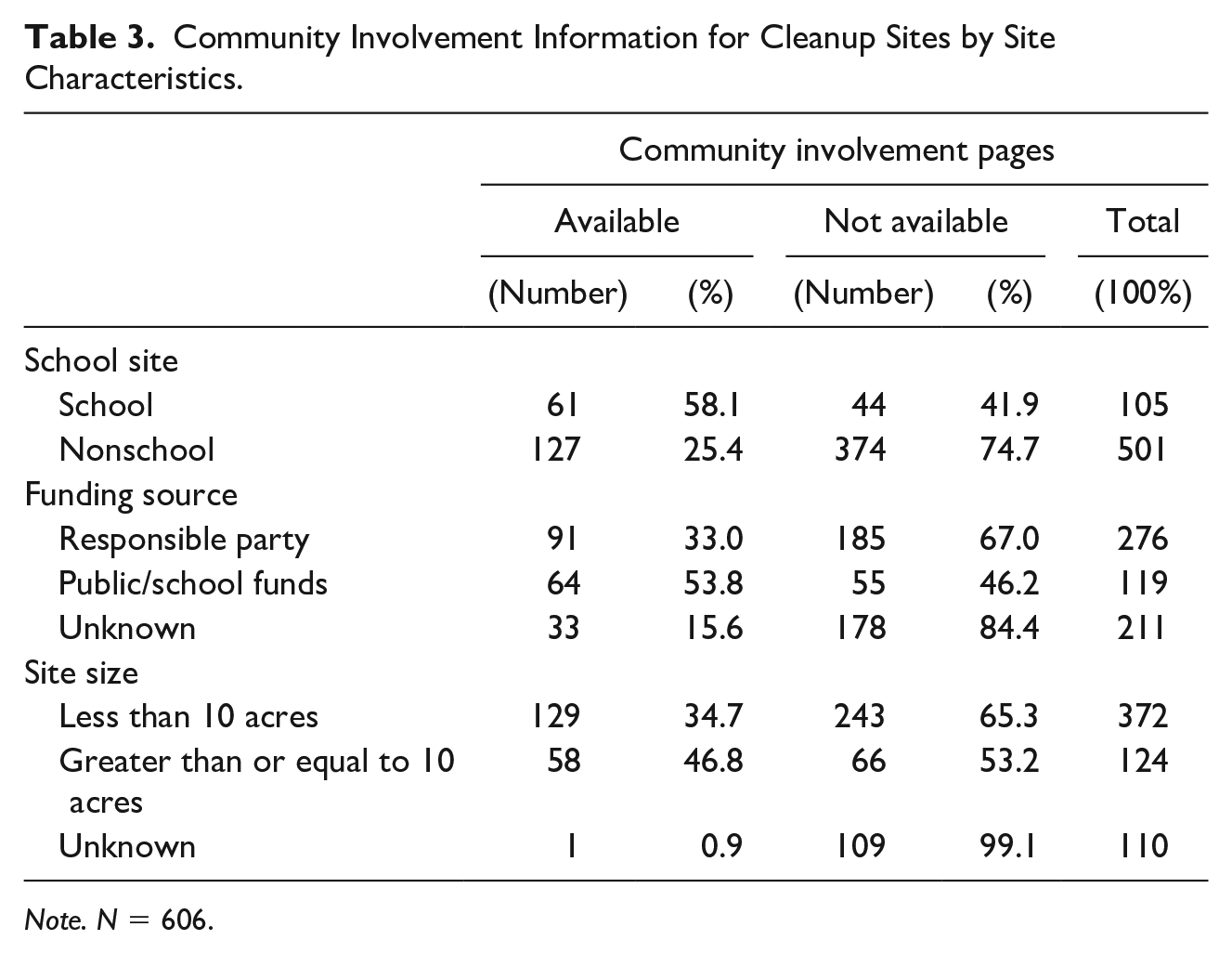
Note. N = 606.
Unlike in the evaluation phase, community involvement is recognized to occur in the cleanup phase. Over all types, the government agency recognized 30% of cleanup sites as involving community members. Schools sites, government-funded sites, or large sites were more likely to involve community members.
To dig deeper into the cases, we chose a random 15 sites that were in the cleanup phase. Because school sites are more likely to involve a community involvement page, we stratified our random selection by whether they were school sites or not. Columns 2 through 4 of Table 4 provide overview information regarding the locations, sizes, 30-day comment periods, and responses listed in the CalEnviroStor database for the 15 cleanup-phase cases. Column 4 of the table describes the type of community involvement information found in the community involvement tab. In most of these cases, there was an indication that public participation was solicited but little indication of actual community involvement.
Fifteen Randomly Selected Brownfield Sites in Cleanup Phase.

Source. Cal EnviroStor; and various in-office files, Cypress office of DTSC.
Note. Detailed information about the 15 sites is available on the EnviroStor datasite using the ID numbers given. DTSC = Department of Toxic Substances Control.
We became concerned about whether the information provided in the EnviroStor database community involvement tabs was actually complete. As noted by other scholars, “These agencies operate within highly constrained budgets and with limited staff” (Frickel & Elliott, 2018, p. 95), and the sparseness of the reported involvement did not match other reports—both scholarly and in the media—indicating that communities are quite engaged in at least some cases. Therefore, we decided to examine the physical records held in a DTSC regional office to see whether the information in the online files was complete. We put in a Public Records Request and made an appointment to view physical files at the Cypress regional office. Examining these files confirmed that the EnviroStor database is incomplete in reporting community involvement.
How Does Community Involvement Occur in the Cleanup Phase?
Based on the much richer information provided in the physical files at the regional office, we were able to learn much greater detail about the seven cleanup-phase cases examined. As indicated in column 5 of Table 4, our qualitative assessments of the EnviroStor site information and physical files of the seven sites we were able to indicate that community involvement primarily occurred due to (a) legislative requirement (especially for school sites) or (b) resident complaints. There was one case that does not belong to either. For the Valmont CalWest Galvanizing Facility site, the cleanup was initiated because someone was interested in developing the site and the concern was heavy-metal contamination. The soil was classified as a hazardous substance, and restrictions were placed on drilling for drinking water. There was no mention of children in the records we found, nor was there mention of community race/ethnicity or wealth. The DTSC proposed to issue a notice of exemption because no adverse health effects were expected. In the field office records, we found no additional evidence of participation. Below, we further examine the two triggers of community involvement in brownfield cleanup using the six remaining cases.
In Cleanup Sites Triggered by Legislative Requirement
The cleanup process of four brownfield sites we examined was started due to the requirement to check schools sites. The concerns in South Region Middle School 3 were lead and arsenic (arsenic is a known carcinogen). Middle school–aged children were involved, but there was no mention of community demographics in the material we found. Thirteen people participated in Spanish and three in English. Community participation resulted in no change to the workplan, and the site was cleaned up according to the original plan.
The concerns in Valley Elementary School 7, Site 14, were lead-based paint and asbestos. Many children were involved because the purpose of this new school was to relieve overcrowding at five other elementary schools. A further factor was that the proposed site was near five places of worship. Records in the regional office included thorough demographic information including race, income, the fact that 73% in the area were Spanish speaking, and education levels. Regional office records showed that there was community participation via written comments and questions. Planned removal actions were achieved, and then predicted blood-level results were recalculated, and it was decided that the predicted levels based on remaining exposure were acceptable.
The concerns in the Blythe Elementary School Addition were lead-based paint and arsenic. Members of the community also expressed concern regarding asthma. Children were involved because this was an addition to an existing elementary school. The records contained thorough demographic information including race, income, that 43% in the community were Spanish speaking and 11.5% were “Asian” speaking, and education levels. There was community participation via community interviews; six comments were in English and one in Spanish. However, participation resulted in no changes to the draft workplan; the resolution was to follow the initial cleanup workplan.
The concern in South Region Elementary School 11 was lead. Children were involved because this was a proposed new elementary school. Records contained thorough demographic information including race, income, that 41% were English speaking and that Spanish and Korean were the second most common languages, and education levels. There was community participation via 22 questions and concerns; 43 survey responses, including 22 open-ended comments; and community interviews. Participation resulted in no changes to the draft workplan; DTSC followed and completed the initial workplan.
Community involvement in the cleanup cases triggered by legislative requirement showed the following characteristics: (a) Community demographics of the brownfield site tended to be profiled, (b) public participation was solicited via traditional participation forms such as written comments and questions as well as community interviews, and (c) community participation resulted in no changes to workplans.
In Cleanup Sites Triggered by Resident Complaints
Two brownfield cleanup cases were initiated due to resident complaints made to the government agency and evidenced denser interactions and involvements from the community. First, the Tower’s Elementary cleanup case began due to a single complaint made to DTSC by a local resident that a nearby police firing range might affect an elementary school. There had been years of complaints about this firing range to other government entities, but these complaints did not lead to resolution, but this single complaint led DTSC to send out an inspector. For this case, the concerns were bullet fragments and lead. Numerous bullet fragments, including bullet fragments up to 1.25 inches long, were found at the elementary school, including fragments in the kindergarten sandbox, which was temporarily closed. Newspaper articles included photos of the closed sandbox, and one newspaper article included in the DTSC physical file stated “lead-tainted Torrence playground closed.” Young children were involved because this was an elementary school playground, and there was the symbolism of the kindergarten sandbox being littered with bullet fragments. There was no mention of community demographics in the material we found. However, the community is about half minority and has a median household income above the U.S. national average. In the richer records in the field office, we found that there was community participation via attendance at a city council meeting. First the sandbox was declared off-limits and capped, and then it was cleaned up. Eventually, the police, who used the firing range to maintain gun skills, said they would switch to (more expensive) lead-free bullets. The site was retested and declared safe.
The Beverly Hills High School (BHHS) case, which was selected by chance, was extraordinary in a number of ways. First, the BHHS site had an active petroleum well on campus, which had been there for decades. The school earned significant revenue from the well (around US$100,000 per year), and this well, covered with colorful tiles, was a known landmark. Investigation began when a BHHS alumna with cancer contacted Erin Brockovich (the real person depicted in the famous movie); Brokovich’s firm, Masry and Vititoe, brought television station KCBS on campus and did air tests near the active petrol well; they stated that these air tests found high levels of toxic chemicals. KCBS aired a two-part piece. Information on this situation was spread nationwide, including through a multipage article in a national magazine.
This case was highly salient in the community. There was fear of a cancer cluster (Hodgkin’s and non-Hodgkin’s lymphoma and thyroid cancer). Some sources claimed the rate of these cancers was up to 30 times the national average. Chemicals that Brokovich’s firm argued were present at levels of concern included benzene, which is cancer causing, and n-hexane, a neurotoxin. This was a high school site, so older children were involved. In the extensive files in the regional office, there were multiple mentions that Beverly Hills is a wealthy community, but there were no other demographic data. Files also mentioned that the Centers for Disease Control (CDC) says that assessing whether cancer rates are higher than expected is a major undertaking requiring statistics on age, race, gender, and so on.
As might be expected in a well-educated and wealthy community, there were enormous amounts of community participation. Masry and Vititoe held a community meeting and 600 people attended. There was a 2,000-signature petition, and a parent group was formed. These events led to extra DTSC investigations at the site. These found only minor violations, which were fixed to DTSC standards. Accusations and counteraccusations went on for more than a year with dueling experts and dueling sampling—and lots of sampling. Agencies involved included DTSC and South Coast Air Quality Management District (AQMD), and the California Senate held hearings on the topic. Class-action lawsuits were filed, but eventually, the cases were dismissed due to lack of evidence. In spite of the enormous amounts of participation, no additional action was taken by DTSC other than extra examinations and the correction of minor violations.
These two brownfield cleanup cases triggered by resident complaints showed evidence of rich community involvement in the process. For both cases, it started with a single resident who triggered the government’s investigation. Community participation in the process was substantive as well as significant. However, the outcome of community involvement differed: The Tower’s Elementary site was cleaned up and became safer, but the BHHS case was dismissed with only minor additional cleanup.
Discussion
Community involvement has often been posed as a way to ensure that the interests of people affected by hazardous sites are solicited, listened to, and factored into the decisions that are made regarding the remediation of those sites. The extent to which community involvement actually achieves these aims, particularly for small-scale hazardous sites such as non-Superfund brownfields, remains relatively open. We argue that brownfield remediation offers a unique opportunity for the public to be engaged meaningfully and feasibly. Our goal in this research was to explore when and how communities are involved in brownfield remediation, and how that involvement affects decisions about sites.
The results suggest that community involvement in non-Superfund brownfield sites in LA County is rare except when schools are involved. We examine 885 brownfields sites in LA County where either cleanup activity or planning took place between January 2005 and January 2016. In the evaluation phase (32% of the sites), our data indicate that the community is essentially never involved. We observed three cases (about 1%) for which the records included recognized community involvement (i.e., a community involvement page), but in none of their EnviroStor records was there in fact what we would think of as genuine community involvement. In total, 22% of the 885 records we study had a community involvement page. Almost 12% of sites are school sites, and this is the most important factor in a record including a community involvement page. As indicated above, 58% of school sites in the cleanup phase included a community involvement page.
Serious health risk concerns identified from the cleanup sites, such as lead, arsenic, and asbestos, and a contrarily low level of community involvement, suggest that people respond to these local risks in limited ways. It is possible that community members respond to the visual impact of brownfield sites rather than to chemical risks (which are largely unknown): Limited evidence of this characteristic is found in Table 3, in which we found that large sites (greater than 10 acres) tended to involve recognized community participation more than the smaller sites.
Our qualitative examination shows that the EnviroStor records are not complete. We examined physical files for seven sites to see whether all materials are online. We discovered that they most certainly are not and that the EnviroStor website, though still a useful resource, should be recognized as a minimum indicator of the information that DTSC has on community involvement in brownfield sites and not as complete files. In short, the information provided in the EnviroStor pages on community involvement, which indicated little community involvement, did not match the reality that, in our field office examination of physical documents for seven sites, we found some cases with much more evidence of community involvement. An online database requires that administrators enter information, and we wonder whether the DTSC, which is focused on examination and cleanup of physical sites, had the time, attention, and resources to include all information on the EnviroStor website. It may also be the case that the administrators were simply focused on what they viewed as the task at hand: site remediation (Eckerd & Heidelberg, 2020).
To understand the nature of community involvement in LA County brownfields sites requires accessing physical records held in DTSC offices. The choice to include community involvement information in the EnviroStor database appears, in line with what we might expect from related public administration literature (Eckerd & Heidelberg, 2020), to be discretionary. In some cases, community involvement was reported when very little actual engagement took place (e.g., Newcomb Academy), and in other cases, it appeared that community involvement occurred that was not reflected in the digital record (e.g., Beverly Hills High). Perhaps the presence of digital community involvement information reflects the importance of community involvement to the public manager responsible for the site more than the actual extent to which the community is involved. Or at least, the extent to which the public manager felt comfortable making that public engagement part of a visible public record.
Broadly speaking, the review of physical records indicates that community-level attributes do not seem to be important to what happens; the law is important. Community involvement can trigger an investigation but, as in the Towers Elementary School case, it may take only one person—not generally what is meant by “the community.” The results also suggest that, along the lines of Eckerd and Heidelberg (2020), even where there is significant community involvement, administrative processes remain the key to what actually happens. In no case did we observe community questioning of a remediation plan leading to change in the remediation plan. People could trigger examination of a site, but even a wealthy and well-educated community engaging in significant and highly publicized community involvement, as in Beverly Hills, could only bring about more testing and oversight rather than actual remediation. In the Beverly Hills case, and indeed in all the cases we reviewed, decisions were based on science and standard procedures rather than on community involvement.
At the start of this investigation, we expected to find evidence of public participation that was close to meeting the goals of engaging the public to improve project outcomes, gain local information about specific projects, garner buy-in from communities, and foster democracy. Instead, as with other venues of public participation, we learned a story of bureaucracy simply doing its job. In these cases in LA County, California, when cleanup occurs, it is due to administrative processes, with bureaucrats doing their due diligence, as technical experts, under state and federal laws and regulations. A complaint from a citizen can get DTSC to examine a site, but even 2,000+ citizens in a wealthy community cannot move DTSC to close or clean up a site that testing does not show exceeds regulatory standards. The implication of this finding is that if public participation is limited even in a progressive place such as LA County, there might be even less participation in other places in the United States. This calls for further works to examine brownfield cleanups and public participation in other places to see whether this expectation is borne out.
In the cases we reviewed, communities can be involved by making a credible claim that a brownfield site in their neighborhood is causing harm. If this is supported by the evidence, the site will be ameliorated—but ameliorated in the way that things are to be done within the administrative structure (Eckerd & Heidelberg, 2020). If this process was consistent with community preferences, then the community achieved its interest, but if not, community involvement appeared to do little to change what was going to happen before the community became involved. Whether the community was involved or not, the state did what it set out to do.
Although found in a little examined and very local context, this general finding is not new. That administrators both follow rules and utilize discretion is a pillar of public administration theory (Blau, 1956; March & Olsen, 1989; Meier, 1997; Olsen, 2006). Although we did not see much evidence of meaningful community engagement, others have observed cases where communities are involved and engaged and coproducing a decision (e.g., Bovaird, 2007). However, from the evidence we have, these cases may be few and far between. It seems far more likely that administrators hew closely to established technical protocols and rules. Some of those rules require minimal levels of community involvement, and that minimal level is likely achieved in most cases, even in a setting that could offer more tangible benefits to administrators (in terms of information) and in a setting that may be relatively feasible for the community to be meaningfully engaged.
Conclusion
Much of the literature on NIMBYism and community involvement seems to indicate that neighborhoods are seething hotbeds of activism directed against pollution and other unwanted uses in the community, whereas literature on public engagement in administrative processes suggests ways for the community to be meaningful participants in policies that affect their communities. We expected that brownfields would be in a unique position to bring out an interest in both sides for collaboration. For the LA County local-level brownfield cases analyzed here, it is instead perhaps the case that community involvement is generally limited (though there can be exceptions), and that when cleanup occurs, it is due to government-as-usual, with bureaucrats doing their due diligence under state and federal laws and regulations.
Can community activism be generated to cause cleanup of a brownfield site? If so, would it be effective, and under what circumstances? From previous literature, we do know that community activism can sometimes be effective—though we know less about when. The records we have reviewed in the EnviroStor data set draw a picture of government following regulations according to the rules—including the rules regarding seeking community input—but acting, not on community involvement or characteristics, but on expertise and regulation.
This finding, along with other recent work, calls into question the efficacy of mandated public engagement. In the projects we considered here, the mandated public engagement seemed to offer little in the way of change. It was spontaneous engagement that, by triggering new investigation, had the most potential to cause change. Furthermore, there almost certainly would have been significant public participation in the cases where it was extensive even if there had not been mandated public engagement. Regardless, however, the public did not ultimately change much about what happened with these sites once they entered the cleanup process.
That said, there was at least some evidence that the public could spur activity that had not been taking place. We did see evidence that even just one contact from a member of the public could spur a cleanup process to begin. This suggests that, when there are science-supported hazards that need to be remediated, community contact can lead to cleanup. Community involvement to trigger investigation should at least bring governmental attention to brownfields that may not be on the government’s radar; this is the use of local knowledge. It is encouraging that the context of the site (i.e., the demographics of the community in which the site was located) did not seem to matter in the decision to clean up a site; spurring examination may be available to all—though we do also know from other work that certain types of people are much more likely to report issues and/or know that there is an avenue available to report.
In terms of the research approach outlined above, we found that community participation does sometimes occur in the very local decisions around brownfield remediation. Community participation can provide used and useful local knowledge when it spurs investigation of a site that DTSC was not considering at the time. But, the response to participation does not appear democratic at this level because residents’ wishes regarding remediation of the specific case are largely irrelevant; what determines outcomes is bureaucratic procedure using science and law. Based on these findings, it may perhaps be more productive to focus on engaging the public so that they know how to inform administrators about sites they want addressed. At least in LA County, this should cause examination and cleanup when there are violations. However, our conclusion from this work is less encouraging for advocates of public engagement broadly. Beyond triggering investigation of sites, when it comes to brownfields, community involvement itself seems to be secondary to administrative concerns, even in a context where there are good reasons to expect it to be otherwise.
Footnotes
Declaration of Conflicting Interests
The author(s) declared no potential conflicts of interest with respect to the research, authorship, and/or publication of this article.
Funding
The author(s) received no financial support for the research, authorship, and/or publication of this article.
