




Abstract
Patronage is typically studied following government terminations when political parties appoint their nominees into the state administration. However, patronage is understudied in cases when a change of minister takes place without government termination. Taking individual government ministers as the units of analysis, we identify four modalities of ministerial alterations: replacing, successive, incumbent, and switching ministers. We show that politicization occurs under “replacing ministers” following government termination, but the bureaucratic turnover is equally high under “successive ministers.” That suggests that patronage can be seen as an individualized power resource of autonomous ministers who exercise influence independently of their political parties.
Introduction
Governing in contemporary democracies is commonly associated with discretionary appointments of top administrators exercised by politicians in the executive office. They surround themselves with reliable aides and often staff the ranks of public service, regulatory bodies, diplomatic service, and other nonelected positions with their political associates. Although there are differences across time and space, while in office, politicians enjoying executive powers at different levels of political systems take advantage of the formal and informal rights to select their close associates in public administration.
Why are political leaders prepared to engage in this practice? What motivates them, how extensive is its use, and who are the key players involved in the process? Even though many important scholarly contributions enhance our understanding of these phenomena, essential questions remain unanswered. There are disagreements and conflicting conclusions regarding who is in charge of the appointments, what the motivations of political leaders are, as well as methodological puzzles concerning the best approach to measure the phenomenon. The present contribution seeks to add to the debate by examining the following questions: In situations where patronage is extensive, is it the individual government ministers or political parties that decide who is appointed to managerial civil service positions at the ministries?
In comparative literature, the concepts of civil service politicization and patronage are often used interchangeably. Both are broad terms that cover a variety of meanings and mechanisms at the political-administrative nexus (Aberbach et al., 1981; Hood & Lodge, 2006). Politicization is typically viewed as “the substitution of political criteria for merit-based criteria” (Peters & Pierre, 2004, p. 2), mostly in recruitment and promotion. In addition, politicization takes many other forms, and not all of them require the replacement of civil servants with the appointees of the incoming political leaders (Hustedt & Salomonsen, 2014; Peters, 2013). For example, politicization also refers to changing behavior of the civil service, as it is the case in the so-called functional (Pierre, 2004) and administrative types of politicization (Eichbaum & Shaw, 2008).
On the contrary, the study of patronage focuses on party-political appointments to top civil service ranks and is understood as “the ability of political parties [emphasis added by the authors] to appoint individuals to (nonelected) positions” in the public sector (Kopecký et al., 2016, p. 418). This understanding is derived from a party politics approach, where patronage is linked to parties’ clientelistic electoral strategies, chiefly vote-buying, and grassroots activism (Kitschelt & Wilkinson, 2007; Piattoni, 2001). Throughout this article, we use civil service politicization and patronage interchangeably to denote the practice of discretionary appointments to nonelected public positions by elected politicians.
The recent increase in patronage practices in Western democracies (Dahlström & Holmgren, 2017; Peters & Pierre, 2004) connects patronage to an attempt to reclaim party control over the state institutions (Ennser-Jedenastik, 2015). Public service jobs are used by party political actors to increase control, whereby policy-making capacities are strengthened, and policy implementation is seen as a key goal. In new democracies, patronage is even higher (Meyer-Sahling & Veen, 2012) and often seen as a function of party-building (Grzymala-Busse, 2007), typically observable when governments terminate and are replaced by a different configuration of party-political actors. This suggests that parties use patronage as a resource for both control and reward for political support.
This article examines the change of a minister as a unit of analysis and studies its effect on the turnover of the top managerial bureaucratic layers. One would expect a link between civil servants’ turnover and government termination, involving a change of parties in government. Much less is known about patterns of patronage in cases when a change of minister takes place without a change of government. Put differently, how do the patterns of civil servants’ turnover relate to a ministerial change in between elections? Our analysis examines the patterns of patronage under diverse political circumstances and addresses two important issues.
First, we propose a new typology of ministerial alterations that aims to assess the relative importance of collective (political parties) vis-a-vis personal (individual government ministers) actors in patronage appointments by introducing modalities of party/person change and their impact on bureaucratic turnover. We test the proposed typology against ideological and party-political government configurations. Our contribution thus shifts the attention from the study of the politicization at the country level and after government changes to politicization after changes of individual cabinet ministers as the unit of analysis. We assume that it is sufficiently innovative, as it goes beyond conventional studies of party patronage (e.g., Kopecký et al., 2012).
Second, we present a novel method of assessing the level of patronage in the state bureaucracy. Patronage is one of those practices that is notoriously difficult to study due to the absence of empirical data. There are various approaches on how to study patronage appointments, each trying to capture and measure the degree of the phenomenon (its scope and depth) occurring in civil service. These range from looking at the absence/existence of civil service laws (Dimitrova, 2005) to analyzing them for potential loopholes for elected politicians’ discretion for voluntary action (Gajduschek, 2007). Some comparative studies look at changes in the size of bureaucracies (Grzymala-Busse, 2007; O’Dwyer, 2004, 2006) with the assumption that an increase in size indicates politicization. Similarly, an increase in the number of political positions within bureaucracies (Beblavý et al., 2012), such as heads of agencies and local state administration, suggests political appointment practices. Yet another way is to look at changes in formal bureaucratic structures (Zankina, 2016) since it is a way to bypass legal restrictions of civil service laws. Expert surveys (Bach et al., 2018; Kopecký et al., 2016; Panizza et al., 2019) have also been used. Although these measures are useful proxies, reliance on external expert opinions and indirect observations of the practice do not typically allow for an unequivocal and quantifiable grasp of patronage and its changes.
We propose to measure civil service politicization by looking at how changes of individual government ministers relate to the replacement rates in the ministerial bureaucracy. Our method allows us to quantify variation over time and helps to gauge the level of natural fluctuation in administrative positions. Turnover levels above such a benchmark indicate the political influence of the elected politicians. We posit that the mechanism causing the spikes in the level of bureaucratic turnover involves firing and hiring decisions initiated by incoming ministers. The contexts that display frequent changes to state administrative structures, especially when accompanied by highly polarized party competition, provide elected politicians with incentives to use state administration jobs to further their political goals. This has certainly been the case in many countries of Eastern Europe (e.g., Meyer-Sahling & Veen, 2012), Latin America (e.g., Scherlis, 2013), and Africa (e.g., Brierley, 2020). As we explain below, the settings with loose rules of bureaucratic recruitment and promotion provide further encouragement to state exploitation by means of patronage.
We now proceed as follows. First, we review the literature’s key claims and findings regarding the scope of patronage, the key players involved in the process, and their motivations to develop our theoretical approach. Second, we introduce our empirical case and hypotheses, describe the dataset, and explain the methods used in our analysis. Following that, the empirical findings are presented. The final section discusses some of the implications of our findings and suggests ways for further research.
The Reasons for Patronage in the State Administration
The notion of patronage implies a patron–client relationship between a person of power, influence, and authority—the patron—who protects his dependent clients in return for their loyalty and service (Hicken, 2011). Party patronage is typically assumed to involve a collective patron—a political party—that is in charge of patronage appointments, even if technically the decisions may be carried out by those who represent the party in leadership positions of state institutions.
The United States is a prototypical example. To boost their legitimacy and public acceptance, both major parties tried to share the spoils of office with as many party activists as possible. Lewis (2011) argues that national party leaders de facto controlled appointments to patronage positions that were a formal presidential prerogative. Similarly, in many European democracies, the key role of parties in linking electoral, governmental and parliamentary arenas also resulted in a full-fledged patronage system controlled by the party organizations. In the same vein, attempts to explain patronage practices in new European democracies emphasize the key role-played by parties as collective agents. patronage is often seen as a function of party-building (e.g., Ikstens, 2006; Rybář, 2006). Such accounts also attribute the primacy to political parties and tend to underplay the role of individual political leaders in elected offices, particularly when it comes to the hyper-politicized systems. For example, O’Dwyer (2006) and Grzymala-Busse (2007), in their analysis of post-Communist cases, link the high levels of civil service politicization to patterns of party competition, tacitly assuming that parties are the primary beneficiaries of patronage.
However, the role of parties in patronage appointments underwent a far-reaching transformation. In the second half of the 20th century, U.S. presidents gradually emancipated themselves from the influence of their political parties (Thompson & Brown, 1997, pp. 30−31). The unlinking of presidents and their party organizations was accompanied by the increase of the size of the White House staff, resulting in an almost complete exclusion of the national parties from the presidential appointment process. Hence, presidential candidates “were freed from party control by the rise in primaries, the declining utility of party workers campaigning door-to-door, and the ability of candidates to raise funds outside the party” (Lewis, 2011, p. 51).
The record of European political parties in maintaining a strong foot in the patronage appointments is varied. Parties in Central and Eastern Europe (CEE) are said to reward both their loyal followers and the supporters of competing intraparty fractions (Kopecký & Scherlis, 2008). Van Biezen and Kopecký (2014) name Hungary, Spain, and the Netherlands, where the central party office remains an important venue of patronage decisions. They also note that there may be room for important cross-party differences, thus suggesting the relevance of factors not captured by analyzing the existing administrative traditions. Patronage and politicization of the ministerial bureaucracies are also on the rise in most Western democracies (Dahlström & Holmgren, 2017; Peters & Pierre, 2004). In CEE, the levels of politicization have even resurged since accession to the European Union (Meyer-Sahling, 2008).
In countries where the civil service is strongly protected by both formal rules and informal norms, bureaucratic turnover rates related to ministerial changes may reflect an established practice of senior civil servants voluntarily departing from their posts. This may happen because the civil servants do not wish to work under new leadership or want to allow the new minister to work with a fresh pool of administrators. This so-called anticipatory politicization (Peters, 2013) represents an important, if understudied, a phenomenon that causes personnel change without direct action of incoming ministers. Similarly, the departure of senior civil servants may be caused by an unsatisfactory performance of the ministry, where incoming patrons are seeking administrative competence and performance (Hollibaugh, 2015; Jiang, 2018). When performance matters in postings and thus is reflected in high bureaucratic turnover, the principals (the incoming minister, his political party, or a coalition of parties controlling the executive) observe the performance of civil servants and use appointments as punishment or ex-ante incentive for administrative competence.
However relevant such patterns of politicization may be in some contexts, elected politicians tend to play the key role in discretionary hiring and firing of civil servants, especially in countries with the unstable structure of state administration, polarized party competition, and the recruitment rules open to political manipulation. In section “Explaining Patronage Practice: Findings,” we provide evidence that direct patronage by ministers is dominant in the case under investigation. Therefore, it is possible to juxtapose sequences of ministerial change to changing levels of turnover in the ministerial bureaucracy and to establish the relative importance of political parties and individual ministers in patronage appointments.
Analytical Framework
A Typology of Ministerial Alterations
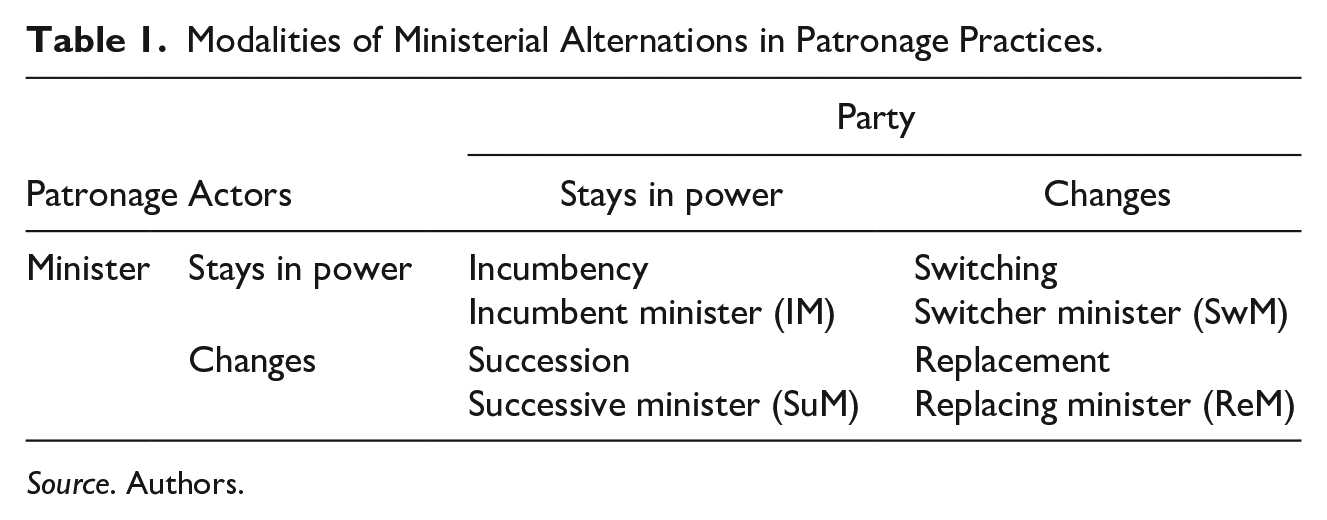
Taking political parties and government ministers as the key players in the process, we can identify four modalities of ministerial alterations (Table 1), each having its consequences for the nature of patronage. The typology is based on whether there is a personal and party continuity in the leadership positions of government ministries.
Modalities of Ministerial Alternations in Patronage Practices.
Source. Authors.
The first modality—replacement—refers to the most typical situation described by traditional party research of patronage appointments. This is a situation when political control over ministry changes from one party to another. In parliamentary systems, it occurs with government terminations, typically following parliamentary elections and/or after the government collapses and is replaced by another government due to other terminal events, such as voluntary resignations, changes in the party composition, defeats in confidence votes, and interventions by the head of the state. The incoming party, nominating a new (replacing) minister, also faces a dilemma whether or not to retain the inherited civil servants at top levels of public organization. Thus, we assume that the turnover should be highest in this context, particularly if major ideological shifts in the new government composition (and party coalition) is expected. Meyer-Sahling and Veen (2012) assume that the levels of civil service politicization are more likely to be extreme when there is a wholesale alternation of political parties in governments, while it is comparatively lowest when government alternations are limited to the replacement of the prime minister, while the partisan composition of government remains unchanged. Thus, they also tacitly assume the primacy of political parties in patronage practices.
Whether turnover resulting from party shifts in new government composition is possible should depend on context. If civil service laws permit, civil servants are directly replaced by the appointees of the new party. When the existing legal framework provides for a more autonomous civil service, the political leadership of the ministry may still opt to bypass the civil service laws, for example, by restructuring the organization (Zankina, 2016).
Literature typically distinguishes between two kinds of motivations: reward and control. In the former, patronage positions are assumed to provide benefits by the patrons to their backers, typically for their support during the election campaign. In the latter, patronage positions are distributed to increase the capacities of the political office holders to manage their offices and thus “control the policy-making process, control the content, control economic power and control corruption” (Spirova, 2012: 64).
Incumbency—a second modality—is the mirror opposite of replacement. It describes a situation in which the party controlling the ministry remains in charge in the next government and nominates the same person (incumbent minister) to head the ministry. Huber and Martinez-Gallardo (2008) conclude that the number of ministers who stay in their posts at the time of a government termination is higher than the number of ministers who leave the government. Due to partisan and personal continuity at the helm of the ministry, it is expected that political leaders will have no incentives to replace the top civil servants. Patronage appointments are thus kept to a minimum.
The third modality—succession—reflects a situation when a party retains its hold on the ministry but decides to put a different person to the ministerial position (successor, or successive minister). From the party patronage perspective, the incoming minister does not have the incentives to replace the inherited bureaucrats appointed by his co-partisan predecessor, as their loyalty, political responsiveness, and ideological support are guaranteed by the fact that their appointment was sanctioned by the political party controlling the ministry. In this sense, both outgoing and incoming ministers act as agents of the same political party. Such considerations are behind the expectations that partial alternation of governments leads to lower levels of patronage appointments: while the new governing parties utilize patronage, its coalition partner party that continues in power will not resort to new rounds of bureaucratic replacement.
Alternatively, and in line with some accounts of increasing personalization of party politics (Rahat & Kening, 2018), it is the growing importance of individual patrons within the party that may result in unlinking parties from patronage appointments. That would usher in a situation in which patronage decisions are also personalized, controlled by the political leaders at the top of the respective administrative units.
Finally, switching is a situation in which the minister remains in office even though his party affiliation changes. This, arguably, is an infrequent situation but not uncommon in unstable party settings. It happens when a party in power splits and a breakaway faction establishes itself as a new governing party, with or without going through parliamentary elections. In line with the party patronage thesis, the switching minister may be expected to act as the agent of his new party, appointing loyal activists of his new party into civil service positions. This scenario is assumed by the authors who see patronage appointments as a tool used for party-building purposes (Ikstens, 2006; Rybář, 2006). Alternatively, if the personalization perspective of bureaucratic appointments holds, there may be fewer incentives to replace top civil servants, since the switching minister who had appointed them before, keeps his government position.
Structural conditions and intra-party factors suggest that in many parties and countries, the role of parties in distributing patronage appointments has weakened. Furthermore, patronage as reward is typically ascribed to collective actors, while patronage as a control mechanism is usually linked to situations in which individual patrons are in charge. Patronage as personal resource highlights the autonomy of ministers in their decisions to appoint civil servants. One implication of our assumption that personal (rather than partisan) patronage is responsible for high turnover rates in managerial civil service ranks, and that political figures of ministers have more power over appointments, is that ministers have more discretion and stronger incentives to make such changes.
Measuring Patronage by Changes in Civil Service
Public administration literature is surprisingly silent on employee turnover in general, and on natural level of personnel change in particular. One exception is the New Public Management literature which sees moderate rates of turnover as beneficial. Even there, Longo (2007, pp. 15−16), estimates the annual level of natural fluctuation at 5%, with maximum reaching 20% to 30% over the period of 5 to 7 years.
Fluctuation (bureaucrats die, retire, and find jobs in other organizations) is a natural phenomenon occurring in all organizations. However, patronage also adds to personnel change, as ministers replace some civil servants by their trusted aides. We utilize the concept turnover as a summary concept that refers to any person-by-person change in the designated posts in public administration, regardless of the reason for change.
Patronage and fluctuation as the sources of personnel change can be identified directly by examining motivations of the actors involved. That would require, for example, in-depth interviews with government ministers (who control patronage appointments) and civil servants (who decide to retire or seek jobs in other spheres). Nevertheless, we contend that the level of patronage can also be assessed indirectly, on the basis of turnover in the public bureaucracy: It is because we assume that the level of fluctuation is evenly distributed over time, while patronage appointments are probably disproportionately higher in the first weeks and months after ministerial change. Consequently, overall turnover levels can serve as a proxy for patronage appointments. The higher the turnover, the higher share of it is motivated by patronage.
We are interested in whether the data give support to what we call a general patronage thesis. As explained, turnover rates should be highest after government ministers assume control over their ministries. Hence, the general patronage thesis leads us to expect that:
We look into the turnover in the immediate (first), second, and all the remaining subsequent 6-month terms after any change of an individual minister within an electoral cycle and due to government alternations after elections. Our dependent variable is the immediate turnover in bureaucratic positions during the first 6-month term following the change of minister. In this way, we also establish a benchmark for the assumed level of fluctuation against which all peaks of turnover are compared.
Next, we consider the source of patronage practices. In an ideal-typical way, we may distinguish between party patronage (i.e., controlled by the political parties) and personalized patronage as a personal resource of the ministers themselves. In the former, ministers serve as a tool of their parties and use patronage at the ministries as a beneficial resource for satisfying party members and supporters. In the latter, patronage is controlled by the ministers who act as autonomous agents and allocate patronage positions at their own discretion. As suggested by Kopecký and Spirova (2011), both models exist in new democracies of CEE: In the Czech Republic, patronage is controlled by political parties, while in Bulgaria it is an individual resource at the disposal of the ministers. Nevertheless, most authors still ascribe control over patronage to the political parties. To test that expectation, we turn to our second hypothesis:
If political parties are in charge patronage, turnover levels under successive ministers (ministers from the same party) should be lower than turnover levels of replacing ministers (ministers from different parties). Because successive ministers share party affiliation, their political party should have no incentives to replace their own patronage appointees at the ministry that it controls.
Continuity in the partisan composition of government is said to lead to higher bureaucratic stability and less patronage in the civil service (Meyer-Sahling & Veen, 2012). Our approach allows us to see whether the immediate turnover variable reflects the variance in the type of government alternations. By comparing bureaucratic turnover in wholesale partisan cabinet alternation with that in partial alternation, we can establish whether the partisan continuity in government decreases patronage in ministerial administration:
Data and Method
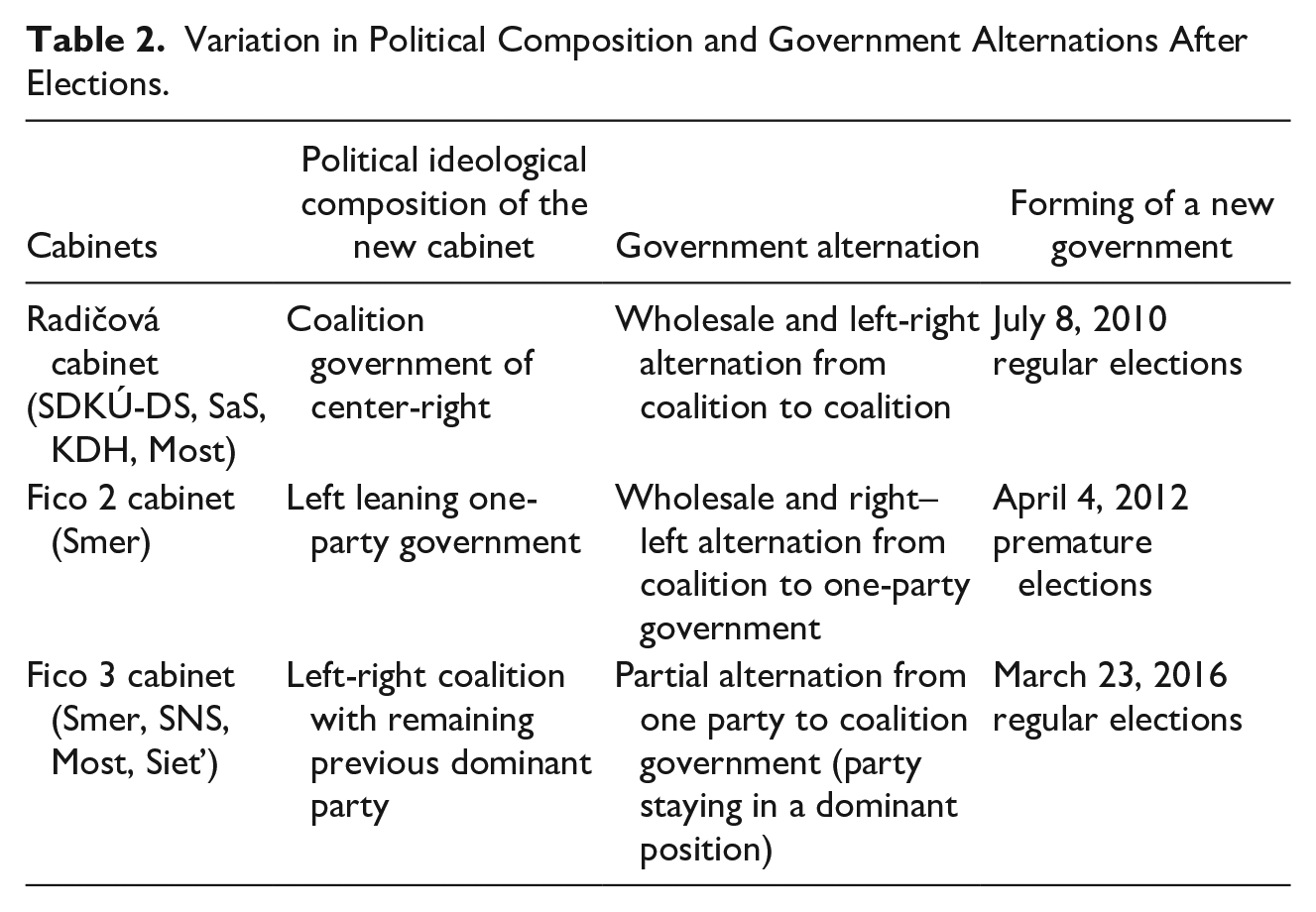
We test our empirical model by exploring patronage appointments in Slovakia over the period of 2010–2018. Slovakia is particularly well suited for our investigation since it is regarded as one of the most politicized countries in Europe (e.g., Meyer-Sahling & Veen, 2012). It also offers a welcome variation in the political-ideological composition of its cabinets, and in patterns of government alternations (see Table 2).
Variation in Political Composition and Government Alternations After Elections.
Of the four modalities of ministerial alternations, three occurred in our case between 2010 and 2018: replacement, succession, and incumbency. Hence, we do not have cases of switching, that is, when the minister remains the same but represents a new party. From a total of 43 ministerial terms studied during the 8 years and three cabinet periods, 30 were replaced following elections and government change (party change), eight ministries had a new political head—the minister—from the same party either within the electoral cycle (6) or following elections with a new government but the same party staying in the same ministry (2), and five incumbent ministers remained in the same office after the elections.
Although our study takes individual cabinet ministers as the unit of analysis, it is useful to note that they were present in three different types of governments: in the coalition government of center-right parties led by Prime Minister Iveta Radičová (2010–2012), in a left-leaning single-party (Smer) majority government of Prime Minister Robert Fico 2 (2012–2016), and in the left–right coalition government led by Prime Minister Fico 3 (2016–2018). At the same time, it captures variation in patterns of alternation of the governments: one wholesale inter-bloc alternation between parties from competing ideological blocs (from left-wing coalition to right-leaning coalition), one wholesale alternation from right-leaning coalition to left-leaning single-party government, and one partial alternation from single-party government which stayed in power after elections as a dominant party and took on two additional minor coalition partners.
Civil service ministerial hierarchy in the country is divided into two kinds of positions: formal political appointees and permanent civil service. The first comprises designated political positions of the state secretary and the head of office, with the latter formally responsible for the overall human resources policy of the ministry. The ratio and distribution of these positions is part of coalition negotiations as a source of control and/or cooperation (Staronova & Malíková, 2003). Besides, the group of formal political appointees also includes ministerial political advisors who have a temporary civil service status and whose number, recruitment and remuneration are at the discretion of government ministers. Political advisors, however, are not part of the formal bureaucratic hierarchy, lack managerial powers, and their influence primarily rests in their direct access to the minister.
The permanent civil service includes the general directors, directors, and heads of units, who, together with the ordinary civil servants, constitute ministerial bureaucracy, who are formally selected on the basis of merit. In our analysis, we focus on this group. Despite being designated as permanent and merit-based, country specialists consistently report that government ministers frequently interfere in the selection and promotion processes and exert extremely strong pressure on the permanent bureaucracy.
The few existing comparative studies of patronage put Slovakia above other Eastern European cases. For example, Meyer-Sahling and Veen (2012, p. 6) considered the previous political experience of senior bureaucrats, their turnover after elections, and the importance of political connection for their career advancement, all indicators of active firing and hiring by the new ministers. A strong role of Slovak ministers in influencing the outcomes of the supposedly objective and merit-based selection of civil servants has also been well-documented (Meyer-Sahling, 2009), as was the existence of the rules that had given the ministers the right to sack the civil servants without justification (Staroňová & Gajduschek 2013). Reports of international bodies (e.g., European & Commission, 2012, 2018) also highlight the unusually high fluctuation of top civil servants, especially at the beginning of electoral cycles.
Close observers of Slovak politics come to very similar conclusions. An analysis by the Value for Money Unit of the Ministry of Finance (2020) shows that by far the highest layoff compensations paid to the fired civil servants occurs shortly after parliamentary elections. Since bureaucrats who depart voluntarily, or leave their posts following reshuffles in the state administration, do not receive layoff compensations, it is a clear indication that they are forced out by the new ministers. Such conclusion is reached in numerous studies by country specialists. For example, Scherpereel (2009) describes that Slovak political parties actively fired and hired appointees to jobs in the state administration.
One further objection to using turnover as a proxy for patronage is that opening top managerial positions may lead bureaucrats from lower levels to fill those positions. This is unlikely in the case under examination. Kuperus and Rode (2016) noted that Slovakia in the past decade shifted from a hybrid system to a position-based one, with the internal career advancement between the three managerial levels dramatically reduced. More importantly, external recruitment dominates. Official data indicate that nearly 70% civil service positions are filled by candidates who come from outside public administration (Government Office, 2014, p. 24). Thus, an overwhelming majority of civil service managers do not get promoted from lower ranks of ministerial hierarchy.
To determine the turnover rates for each ministerial modality, we have constructed a new dataset from freedom of information requests to all ministries and the Government Office, asking for names of every managerial civil servant in civil service in the period of July 1, 2010 to July 1, 2017, noting change in the position in a semi-annual periodicity (as of the January 1 and the July 1). Our operationalization of turnover includes all the instances when there was a change of person holding the managerial position.
In total, we coded all 50 ministers holding a position in 13 ministries and the Government Office and observed a total of 11,160 top and middle permanent bureaucratic positions over 14 terms (one term of 6 months of an average-sized ministry encompasses approximately 80 to 100 managerial bureaucratic posts within the three top levels of the hierarchy). We had to exclude Ministry of Foreign Affairs from our sample, since personnel changes there also include appointment to, and return from, foreign missions and embassies. Such changes do not capture the expected patronage causes for fluctuation, and we found no way to filter them out.
Explaining Patronage Practice: Findings
Our empirical analysis reveals that each election year brings turnover into ministries in managerial levels of permanent bureaucratic hierarchy (Figure 1) followed by periods of relative stability. The peaks correspond to the months following the elections and installation of a new government, reaching close to 30% in changes in the three managerial levels of permanent bureaucracy combined together. In the subsequent months of stability, the turnover is about 8% to 9%. Also, although there is some variance among the ministries, in this article we look into the turnover of all ministries together.
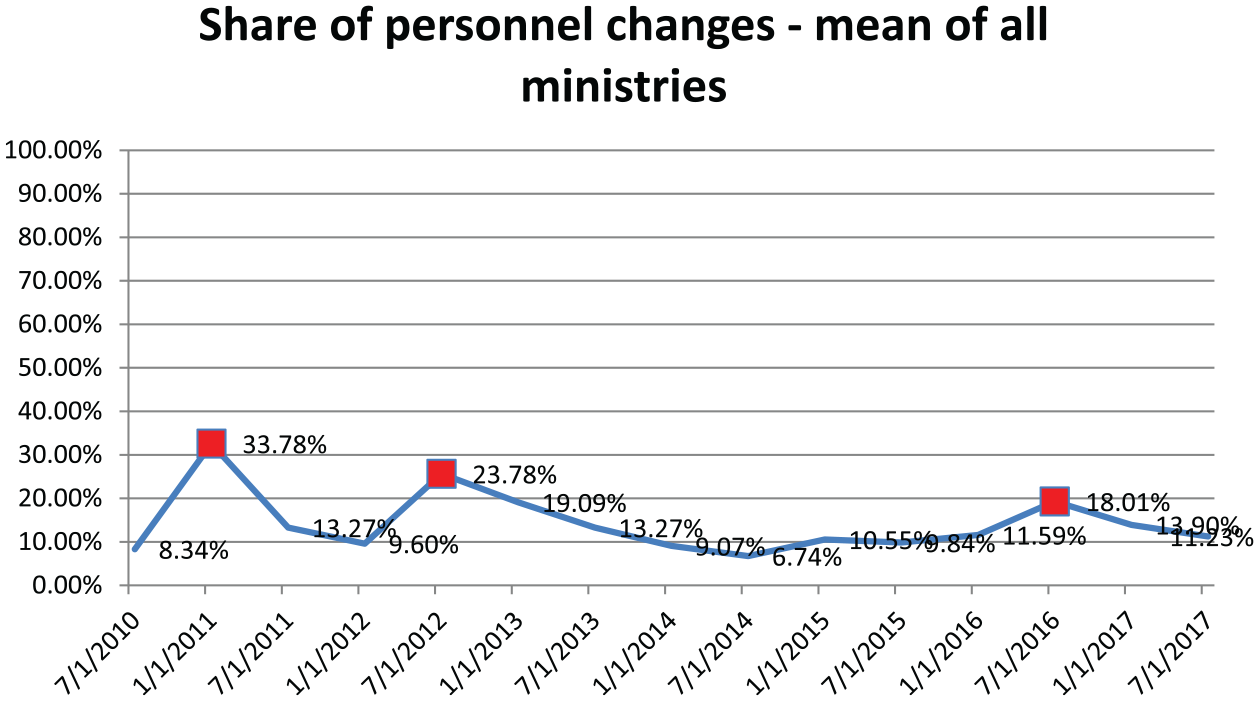
Mean of personnel changes in top three permanent civil service levels in time (2010–2017).
General Patronage Thesis (H1)
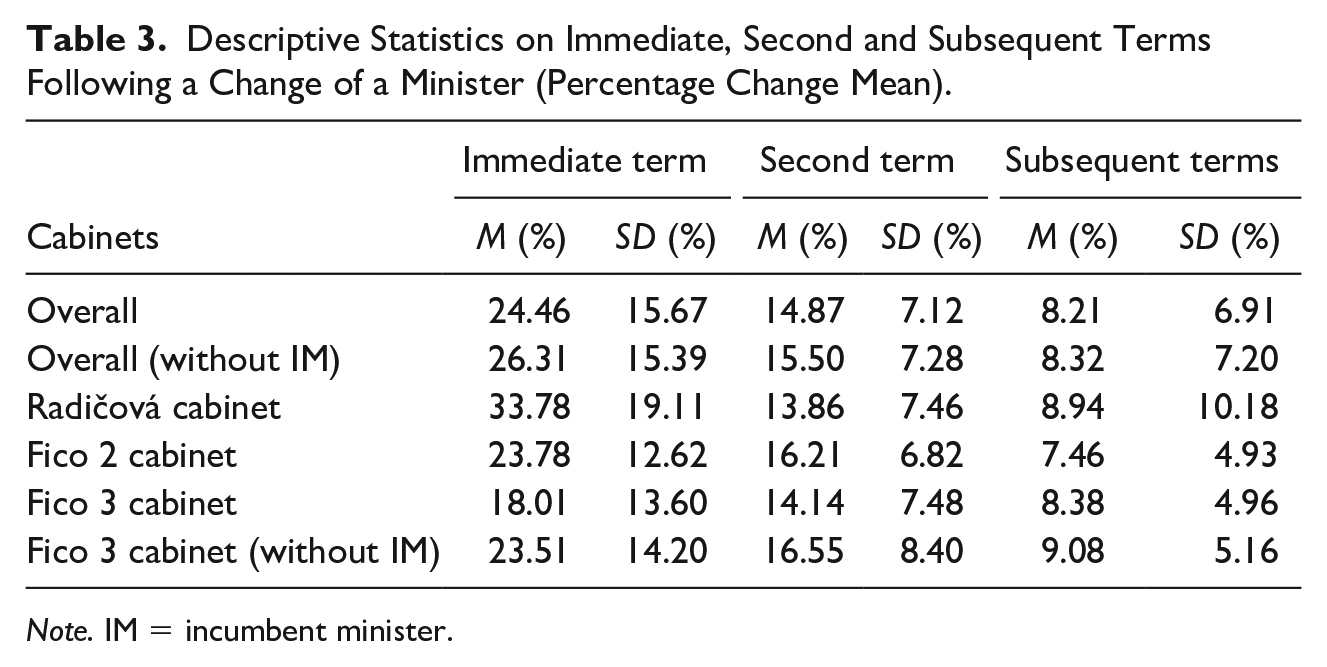
To assess the general patronage hypothesis, we consider the immediate period under a new minister, the second 6-month period of the new minister, and the mean of all the subsequent periods (Table 3) regardless of the time or reason for ministerial termination and/or change. We expect that incoming new ministers replace more top civil servants in the immediate term in office than in the subsequent periods.
Descriptive Statistics on Immediate, Second and Subsequent Terms Following a Change of a Minister (Percentage Change Mean).
Note. IM = incumbent minister.
Table 3 shows that immediately after a change in the political leadership of the ministry when new ministers seize their mandates, the largest personnel turnover rates take place: 24.6% of the three levels of the civil service or 26.31% without incumbent ministers. The second full 6-month period controlled by the new minister still shows relatively high in turnover of 14.87%. In the subsequent 6-month periods, the personnel turnover rates are the lowest in mean (8.21%). This pattern repeats itself regardless of the cabinet in power. Thus, in the periods of no change in the political leadership of the ministry, the managerial positions have the lowest turnover, possibly indicating the natural fluctuation. The relatively high second-term turnover can be explained by the need for a new minister to consolidate power in the ministry. In all cabinets, the turnover is between 14% and 17% of the top three levels of civil servants. The lowest second term turnover is with the Radičová cabinet, which at the same time has the highest immediate term turnover. This is due to the timing of the taking of the mandate after the elections, which in case of Radičová coincides exactly with semi-annual measurements. Hence, the immediate term is not shared with its predecessor and there is a longer time period for a new minister to complete all the essential personnel changes in the immediate 6-month term.
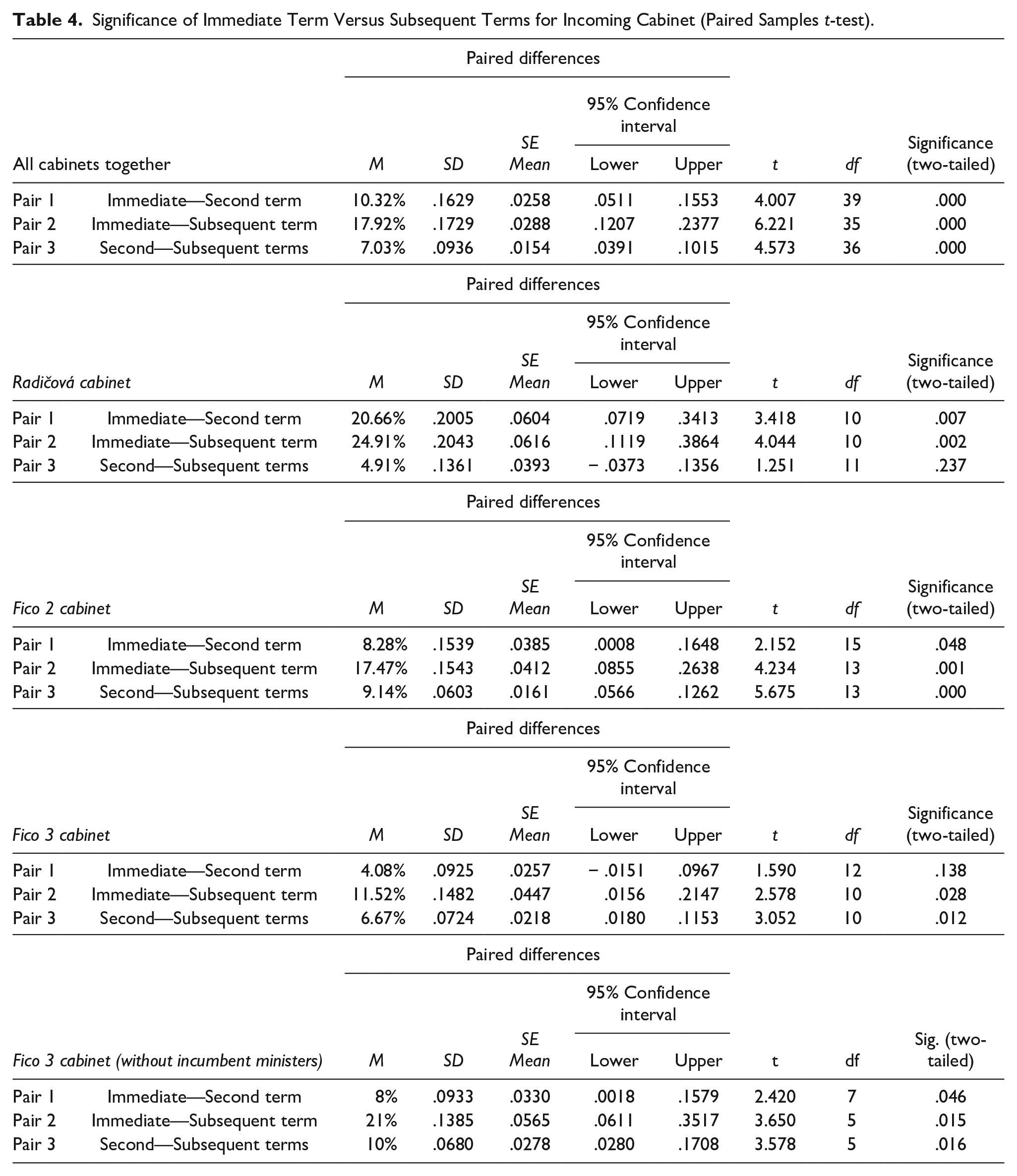
To be able to reject the null hypothesis (there is no difference between an incoming minister’s replacements of top civil servants in the immediate term in office and in the subsequent periods), we looked into inferential statistics. Using a paired samples t-test, we tested the statistical significance of the difference of the share mean scores between immediate, second and subsequent terms in general, and for individual cabinets. The t-test is significant at alpha level .05 in all the pairs, except for the Fico 3 cabinet comparison of immediate and second terms because of the influence of incumbents. If we take the incumbent ministers out, this test is significant as well. The other nonsignificant pair is between the second and subsequent terms of the Radičová cabinet, but this was not included in the hypothesis.
Taken together, the results suggest that an incoming new minister’s immediate term in power differs from the subsequent terms in turnover shares, supporting our hypothesis.
H2: Personal Patronage
The question at this point is if the successive ministers replace a smaller share of top permanent civil servants as replacing ministers. On average, in the immediate term, the replacing ministers change 28.11% of permanent civil servants in three bureaucratic managerial positions (Table 5). However, we found out that successive ministers also make replacements to a considerable number of civil servants (21%). This contradicts traditional party patronage theories. The smallest number of civil servant changes in the first 6-month term (8.11%) occurs under incumbent ministers. This is remarkably similar to 8.21% turnover rates in the time periods without changes at the political level of the ministries, and it offers additional indication of (the natural) fluctuation in the public administration.
A general linear regression was calculated to predict the share of immediate term turnover based on three modalities of personal patronage variable: for the groups of incumbent ministers, successive ministers and replacing ministers (Table 6). F test of analysis of variance (ANOVA; df = 2, F = 4.319, p = .020) showed that the personal patronage model is statistically significant. Thus, we can reject the null hypothesis that there is no difference between the groups and can expect that at least one of the three groups’ mean is not equal to the others (all coefficients of the regression equation are equal zero).
The statistical significance of the findings regarding incumbent ministers expresses the fact that if an incumbent minister is in office then, in general, the share of turnover drops to 8% (by 20 percentage points). As the categories are treated as binary variables, this means that (on average) under incumbent minister the civil servants’ turnover is 20.0 percentage points lower than under the other two modalities of ministerial alterations (successive minister and replacing minister).
To determine which specific pairs of mean values of the three-personal patronage model groups are significantly different, we moved for ad hoc parameter testing. As the Levene test manifested that variances of the groups are heterogeneous (F = 8.730, df1 = 2, df2 = 40, p = .001), we have used a Games-Howell multiple comparison to determine whether there are any statistically significant differences between the means of these three groups (Table 7): incumbent minister (the same party and the same patron), successive minister (minister changes, party remains) and replacing minister (both minister and party change). There is a significant difference of incumbent ministers from the other two groups in immediate term: from successive minister (Sig. = .003) and replacing minister (Sig. = .000). According to paired comparisons, the difference between successive minister and replacing minister is not significant (Sig. = .189) and we must retain the null hypothesis that there is no difference between the latter two. For other terms (second and subsequent) we must retain the null hypotheses for all pairs (incumbent minister [IM], successive minister [SuM], and replacing minister [ReM]). Thus, our analysis shows that the same party-political affiliation of the successive ministers does not bring any significant decrease to the level of bureaucratic turnover at the ministry.
Partial Versus Wholesale Alternation of Governing Parties (H3)
From the perspective of government alternations variance (H3), the wholesale government alternation after the elections of 2010 (Radičová) and 2012 (Fico 2) resulted in 33.78% and 23.78% permanent civil service change on the top three permanent civil service levels, respectively (see Tables 3 and 4). The elections in 2016 (Fico 3) left the then only ruling party in government as a dominant coalition party (and five of eight ministers in the same position), adding two additional parties as coalition partners, still resulting in almost 20% civil service turnover. As Smer retained some of its ministers in their positions, we look into the incumbency effect as well. Partial government alternation without incumbent ministers has almost the same turnover effect (23.51%) as a wholesale alternation. This runs contrary to the theoretical assumptions of Meyer-Sahling and Veen (2012) and suggests that personal rather than party patronage plays a role.
Significance of Immediate Term Versus Subsequent Terms for Incoming Cabinet (Paired Samples t-test).
Summary Statistics.
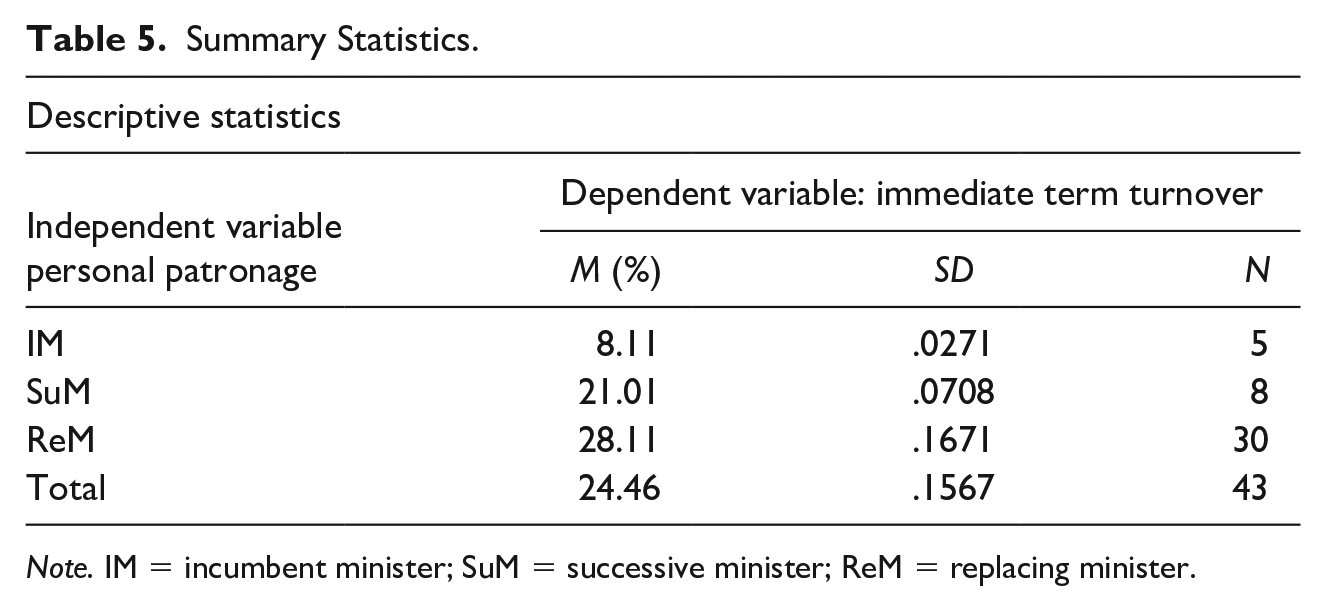
Note. IM = incumbent minister; SuM = successive minister; ReM = replacing minister.
General Linear Regression.
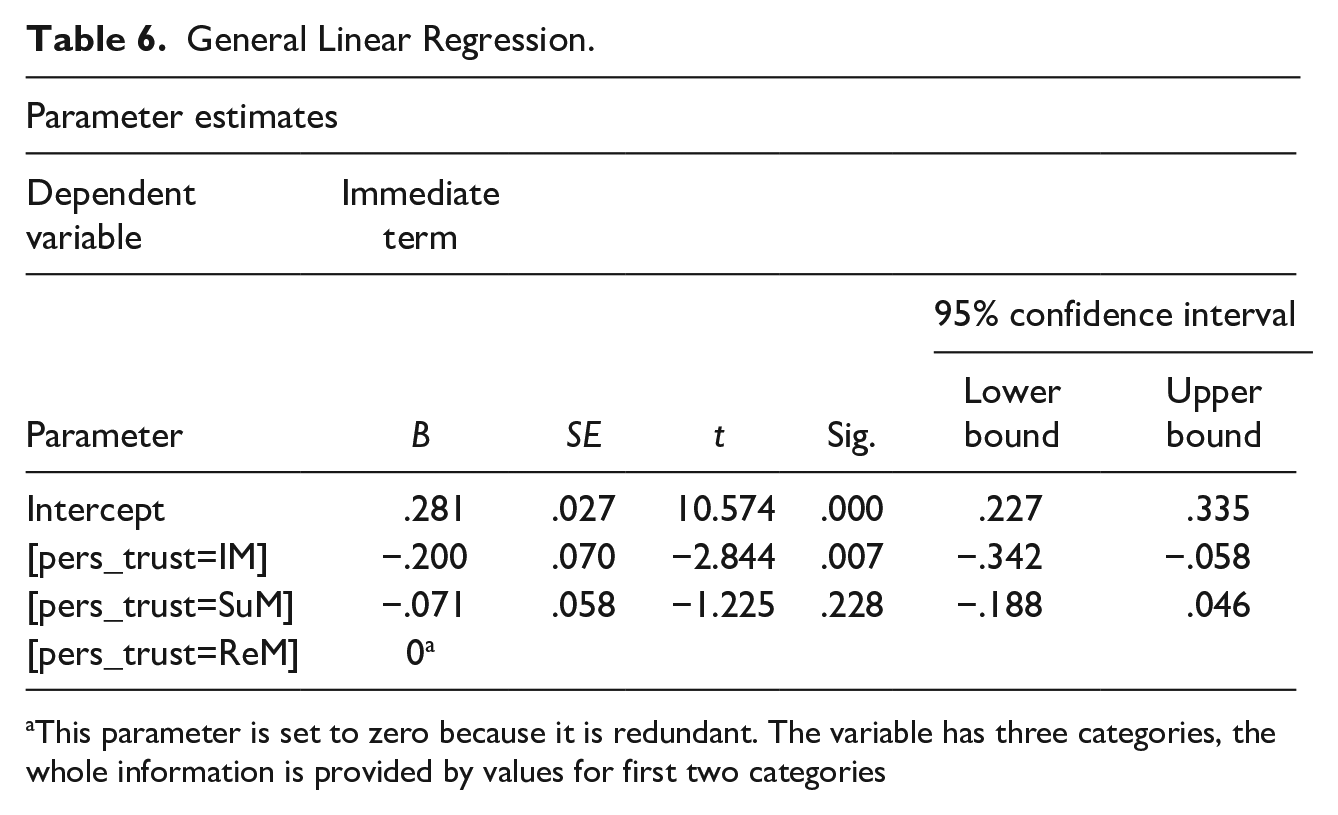
This parameter is set to zero because it is redundant. The variable has three categories, the whole information is provided by values for first two categories
Personal Trust Model.
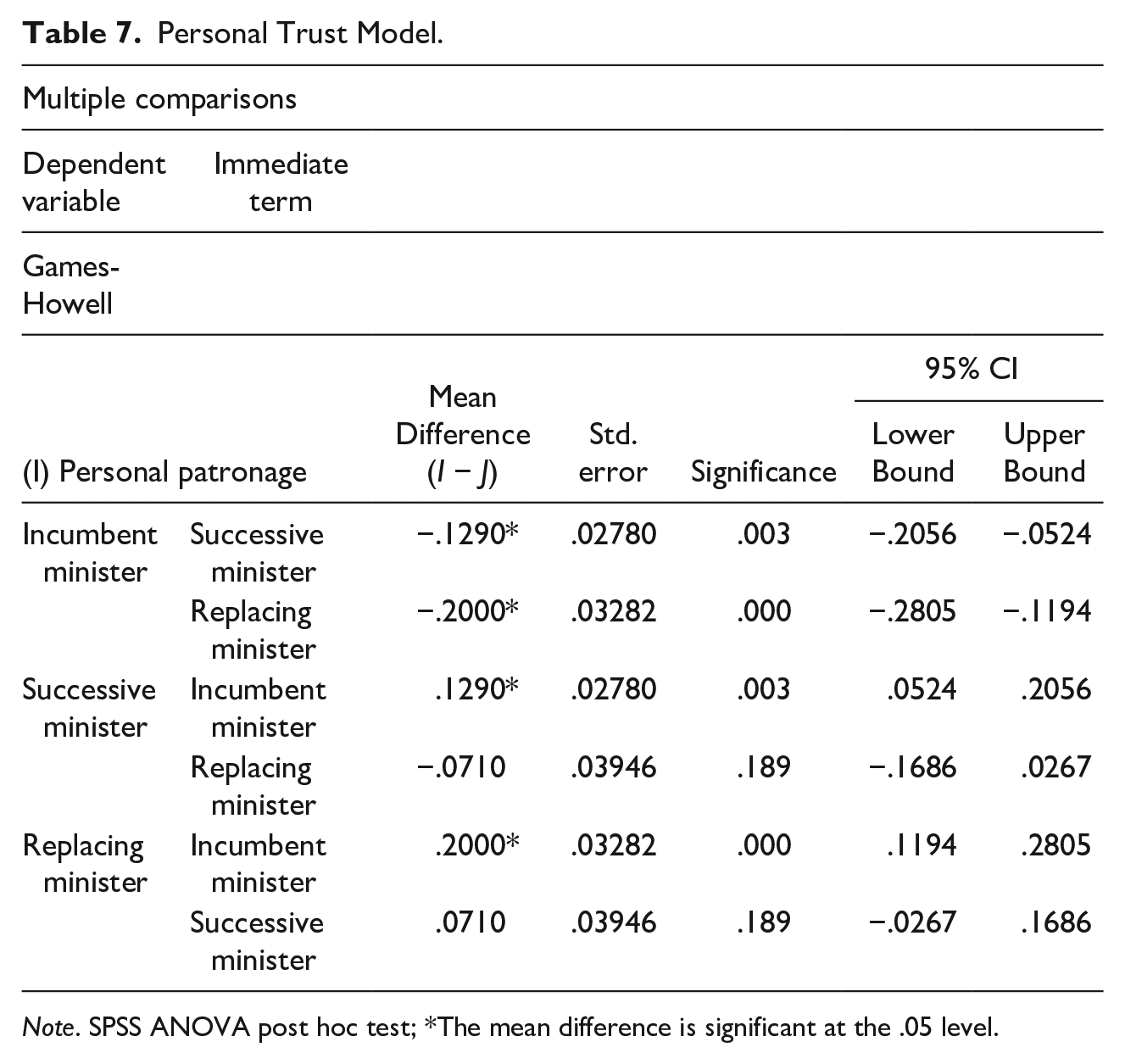
Note. SPSS ANOVA post hoc test; *The mean difference is significant at the .05 level.
Discussion, Conclusion, and Implications
The central question that we explored concerns the role of government ministers—as distinct and autonomous players from their political parties—in the politicization of the professional bureaucracy. To that end, we have proposed a new typology of ministerial alterations that take individual ministers as the unit of analysis. The theoretical concept highlights variance in political leadership changes that are not solely related to electoral cycles. The degree to which we can understand managerial civil servants’ turnover rates by relying on insights derived from the study of electoral cycles is limited because it does not consider the degree of politicization taking place under successive ministers from the same party.
Our empirical analysis first explored a general patronage thesis. We assessed the level of turnover during the first (immediate), second, and all subsequent terms after any change of a minister both within an electoral cycle and due to government change after elections. We have found that the observed bureaucratic turnover rates are consistent with the behavior of government ministers who politicize civil service: the likelihood that a middle and senior civil servant in the top three levels will be replaced is 4.5 times higher in the initial phase of ministerial terms than in subsequent periods. In other words, every middle and upper level bureaucrat knows that the chances of not continuing in his or her present position after the change of a minister are extremely high.
In addition, the stark difference in bureaucratic turnover between the first two semi-annual periods and the subsequent periods following the change of minister, suggests this is a good way to differentiate between patronage changes and the natural level of fluctuation in the civil service. Not all changes in the civil service are the result of political pressures and patronage practices, some are natural and not unlike employee turnover in other settings. Our data suggest the annual average level of fluctuation averages slightly above 8%.
Next, we have looked into whether the turnover at the three layers of bureaucratic hierarchy vary with the political alternations of the leadership in relation to party change (replacing minister) or no party change (successive minister). Our analysis of ministerial succession, when ministers from the same party succeed one another, shows that patronage is high despite the same party affiliation of the changing ministers. These results suggest that parties do not play a decisive role in appointing senior civil servants. Rather, ministers enjoy considerable autonomy in the process. This finding runs contrary to the mainstream comparative literature that suggests that, at least in parliamentary democracies and/or in highly politicized countries, political parties are the principals and their ministers are their agents in patronage appointments. By the same token, we do not find support for the notion of patronage as used by political parties to reward their followers, nor for the argument that patronage is used for party-building purposes, a specific argument regarding new political parties in new democracies.
Finally, when the optics of electoral cycles is applied, we also find some evidence that in comparison to the wholesale partisan alternation of the government, patronage tends to be comparable with a partial alternation of coalition government if incumbency effect is considered, that is, when the new government consists of the previously governing parties as well as new parties. Moreover, the party that continues in power after a partial government alternation also contributes significantly to high levels of patronage. This suggests that, contrary to the traditional assumptions of the literature (e.g., Kopecký et al., 2012; Meyer-Sahling & Veen, 2012), partisan continuity in power is no guarantee of lower levels of patronage. Furthermore, Grzymala-Busse (2007) postulates a direct link between the dynamics of party competition and state politicization, and O’Dwyer (2004, 2006) concludes that governing coalitions in low-institutionalized party systems exploit the state more than coalitions of stable parties. We show that if patronage is an individualized power resource of government ministers, party competition explanations are incomplete in explaining variation in patronage.
We analyzed the case in which incoming ministers drive civil service politicization. Alternative explanations have limited explanatory potential. For example, if performance were the factor for increased bureaucratic turnover, it would be based on nonambiguous rules and information on performance, otherwise biased and discretionary decision-making over positions was a sign of patronage. Principals would need both the time and evidence for performance-driven firing and hiring. Neither is the case in our setting. In terms of time, the shortage of time between ministers assuming office and firing the managerial civil servants (in our case, it is 2–3 months) is insufficient for unbiased performance evaluation. In terms of evidence, CEE countries represent the environment where performance is notoriously difficult to evaluate due to the lack of rules setting the objectives, results measuring, and overall managerial culture, both on organizational and individual levels (European Commission, 2019; Hammerschmid et al., 2016).
There might be cases of voluntary exit by civil servants who do not wish to work under the incoming ministers. Systematic research of the issue in CEE is limited (but see Rattus & Randma-Liiv, 2019). Our method does not allow us to establish precisely how often this happens. With top civil servants typically replaced after each change of government, however, voluntary departures may differ from forced exits only in timing: Departing civil servants may leave for the private sector in anticipation of them being fired by the new ministers. More research is needed to corroborate the anecdotal evidence currently available in the case of Slovak civil service.
The literature remains uncertain as to what drives personal rather than partisan decisions, and where the top civil servant appointees come from (internal or external recruitment). More research is required to explore the motivation behind patronage appointments by government ministers. Political leaders may desire to implement a particular set of policies within their ministerial portfolio and realize that their political parties are unlikely to provide qualified and experienced candidates for patronage appointments. Professional traits and career backgrounds of the top civil servants may explain why ministers keep some civil servants and fire others (Bach & Veit, 2017; Fleischer, 2016; Veit & Scholz, 2016). Less sanguine accounts point out the potentially exploitative function of patronage, serving the political elites’ personal gain via channeling state resources to private coffers (Innes, 2014; Volintiru, 2015). Alternatively, ministers may reach out to their networks to seek administrators whom they trust.
Trust, a personal connection between the political head and the top administrative personnel, fundamentally differs both from party political affiliation shared by the ministers and their appointees, and from policy competence of the administrator, and as such might be essential for effective collaboration (Gajduschek, 2007; Staroňová & Gajduschek, 2013). The typology elaborated by Panizza et al. (2019), based on examples from several Latin American countries, also introduces personal trust as a criterion for ministerial patronage.
Another important area for further research has to do with the consequences of personalization of patronage appointments. If the role of a party in the central office, and of the party organizations at large, decreases, their internal cohesion may decrease as well. On one hand, this may have negative consequences for policy coordination, policy implementation, and general performance of the public sector, as suggested by Dimitrova (2005), Meyer-Sahling (2008, 2009) and Staroňová and Gajduschek (2013). In contrast, Peters (2013) points out that the so-called professional politicization may not inevitably decrease the capacity of bureaucracy. In fact, these personal political appointees may be at the same time professionals in their field who might simply be unavailable for permanent civil service (Sedlačko & Staroňová, 2018).
Footnotes
Acknowledgements
Earlier versions of this article were presented at the 2018 Executive Politics and Governance Specialist Groups Panel of the Political Studies Association Annual Conference, and at the 2018 Midwest Political Science Association Annual Conference in Chicago. We thank the participants at these events for their helpful comments and advice. We are grateful to Tobias Bach and Sylvia Veit for excellent comments to an earlier version of this paper, Veronika Pracharova for her assistance with data collection, and to Joze Bencina for his help with data analysis.
Declaration of Conflicting Interests
The author(s) declared no potential conflicts of interest with respect to the research, authorship, and/or publication of this article.
Funding
The author(s) disclosed receipt of the following financial support for the research, authorship, and/or publication of this article: K.S.’s work on this article is the result of a research project supported by the Ministry of Education of Slovakia under VEGA grant scheme 1/0628/19. M.R.’s work was supported by the Czech Science Foundation (GA 18-15700S).
