



Abstract
Probation officers (POs) operate in a high-risk environment. They are vulnerable to mediatic and political backlash and are confronted with managerial innovations that can conflict with their values. A thematic analysis of 29 interviews with Belgian POs reveals that classical coping mechanisms caused by time shortages, such as rationing and prioritization, are amplified by managerialism. POs also break rules which present limited meaningfulness and routinize offender control to alleviate pressure from accountabilities to both managers and the general public. The study demonstrates that managerialism and accountabilities to the managers, the public, and the politicians model coping mechanisms in high-risk environments.
Introduction
Every country has its stories about a convicted felon who committed a crime while on probation. In this case, media attention is immediate. Politicians are quick to demand accountability to the probation officers (POs). Did POs miss something during supervision? Should measures be adopted to regulate more closely POs’ monitoring of offenders? Should officers act as policing agents more than social workers? Should they be allowed to avoid contact with the police to gain offenders’ trust? POs operate in a challenging work environment.
POs are street-level bureaucrats (SLBs; Hupe et al., 2015; Lipsky, 2010). They face constraints such as high caseloads with limited time and resources to make quick yet consequential decisions about offenders’ futures and the community’s safety (e.g., Ahlin et al., 2016; Kerbs et al., 2009). Compared with other SLBs such as tax officials (Raaphorst, 2018) or schoolteachers (e.g., Baviskar, 2019), POs run a greater risk of mediatic and political backlash (Kemshall, 2008). They are expected to manage risk via their interactions with offenders. In doing so, they supposedly ensure the society’s safety. To assist POs in doing so, new managerial practices, regulations, and tools have been adopted in the wake of new penology. But such managerial novelties increasingly conflict with POs’ preferences about frontline work (e.g., Grant, 2015; Persson & Svensson, 2012). The new public management has challenged established practices in street-level organizations (Brodkin, 2011, 2012). Likewise, new penology—and its emphasis on system management and risk-based actuarial penal strategies—has undermined the traditional social work values of probation systems since the 1980s (Feeley & Simon, 1992; Pratt et al., 2013). Given all these constraints, POs essentially walk on thin ice when supervising offenders.
Considerable research has examined how SLBs implement coping mechanisms (Lipsky, 2010) when exposed to constraints and changes at the frontline (e.g., Baviskar, 2019; Brodkin, 2011; Maynard-Moody & Musheno, 2003; Thorén, 2008; Tummers et al., 2015). Yet, empirical evidence remains limited for probation work as most of the existing knowledge derives from criminology without addressing coping. By extension, the impact of new penology reforms on POs’ coping mechanisms also remain under-documented. The public administration (PA) literature provides limited insights regarding how SLBs, and especially POs, deal with constraints from beyond their organization. POs’ risk management efforts are not infallible, which exposes them to multiple public accountabilities besides their managers. As such, it remains unclear how POs’ mechanisms are affected by a diffuse pressure from the medias and political authorities.
How do POs cope during public service delivery, and in response to which specific constraints? To what extent are such constraints related to recent managerial innovations and to public accountabilities? These research questions are examined with a thematic analysis of 29 interviews conducted with Belgian POs. Over the past few years, just like in other Western countries, Belgian POs have experienced publicized incidents related to probationers, growing caseloads, and a stream of managerial reforms to better monitor offenders (Bauwens & Roose, 2017). Our findings suggest that, when SLBs operate in such a high-risk environment with fear mediatic and political backlash, not only managerialism but also public accountabilities model their coping mechanisms.
Our contribution to PA research and criminology is threefold. First, we show that new penology affects POs’ coping mechanisms by amplifying preexisting constraints and reducing the meaningfulness of work instructions. Second, our study contributes to the general understanding of how coping works in a high-risk policy sector, that is, probations, where small administrative mistakes can have serious consequences. Third, our results highlight how SLBs routinize monitoring and control strategies to shield themselves from pressure exerted by strong accountabilities to both their managers and the general public.
In a first section, we present the research context before moving to the concepts and definitions. We then explain the methods used for data collection and analysis before presenting the results in the fourth section. We conclude with a discussion on the theoretical implications of the results and suggest avenues for future research.
The Belgian Probation System and POs’ Duties
Probation mainly consists of alternatives to custodial sentences whereby probationers have to comply with the conditions imposed by a judge for a given period of time. These conditions are usually tailored to the background of the offender and to the nature of the offense. For instance, an offender could be asked to enroll for a drug rehabilitation program or a psychological follow-up. In Belgium, a probation board monitors the offenders’ compliance with these probationary conditions with the help of POs’ periodic reports. In case of noncompliance, the probation board may notify the court, which can lead to the revocation of probation. This management of probationers is a defederalized competence. Each federated entity relies on POs working in the so-called Houses of Justice.
POs hold an intermediary position, halfway between the probationers and the penal authorities. Their role is to monitor offenders’ compliance with probationary conditions and to contribute to their reinsertion. To that end, POs must regularly meet with offenders in dedicated parlors and conduct home visits. POs verify the information transmitted by offenders and collect formal evidence of their compliance. They also keep regular contacts with the police to ensure that new offenses are not committed. Based on these elements, POs produce periodic reports so that judicial and administrative authorities can make the appropriate decisions. POs’ role is also to provide guidance and support to offenders. Officers should ideally discuss the progress of supervision, provide legal and social assistance, and gain insights into the offenders’ social and domestic backgrounds. This is not only meant to support offenders in their reinsertion efforts, but also to contextualize the reports for penal authorities.
Scholars notice a progressive shift toward a more rational-technical approach to probation work and its management in Belgium (e.g., Bauwens & Roose, 2017; Beyens & Roosen, 2013; Jonckheere, 2013). Since the end of the 2000s, POs carry out probation work in accordance with an adapted Business Process Reengineering (BPR) protocol that provides hands-on systematic procedures for each specific step of supervision. For instance, the BPR specifies in detail the matters to be discussed during the first meeting with probationers. In 2005, POs were also introduced to an integrated data-processing platform called SIPAR (“Parajudicial computer system”). It comprises a database, dedicated interfaces, and computerized tools that support POs with their tasks. POs have to enter all their activities into the SIPAR database, including phone calls and e-mails. The compiled data are used by both officers, for task planning and case management, and their managers who monitor officers’ activity. More recently, highly publicized reoffenses and the looming issue of terrorist threats have boosted procedures to better monitor probationers (Bauwens & Roose, 2017). The most notable changes were introduced in May 2015 and December 2016 with the so-called verification directive. This regulation adds new requirements for monitoring procedures such as the compulsory consultation of the criminal records of both offenders and their entourage and the obligation to carry out at least one home visit during supervision. It also aims at enhancing POs’ contacts with the police (Administration générale des Maisons de justice [AGMJ], 2016).
Belgian probation is an excellent case to examine the effect of risk management and accountability on coping mechanisms at the frontline, in a context of managerialism. Little is known about POs’ perceptions and responses to the managerial control, additional paperwork, and complex procedures brought by the new penology. New guidelines sometimes appear in contradiction with the social objectives of supervision, as it is the case with the verification directive. Coincidentally, figures indicate a swelling of new probation cases with a 86.6% increase between 2013 and 2017 (AGMJ, 2019). Beyond probation, it is unclear how officers react to such organizational challenges in a policy context in which risk management and accountabilities have progressively overridden frontline work. And yet, such contexts are more and more numerous: teachers, cops, or doctors, to take only a few examples, are more and more concerned that their decisions or behaviors could be publicized by the (social) media and, in turn, criticized by their hierarchy and the general public (e.g., Terry, 2012). In other words, the Belgian probation services a “critical” case (Flyvberg, 2006) which allows to draw lessons for other, similar contexts.
Coping Mechanisms at the Frontline
In this section, we present the PA literature on coping mechanisms at the frontline of public services, before examining the clues provided by the literature in criminology regarding this issue in probation services.
Coping Mechanisms
In a broad sense, coping is defined as “the cognitive and behavioral efforts made to master, tolerate, or reduce external and internal demands and conflicts among them” (Folkman & Lazarus, 1980, p. 223). It designates the set of routines, shortcuts and compromises that SLBs develop to ease working conditions and better manage their activities to attain imposed objectives (Lipsky, 2010; Tummers et al., 2015; Winter, 2003). This is a central point of attention for PA research because coping mechanisms shape policy on the ground (Brodkin, 2012) and affect the way public services are delivered to citizens (Bartels, 2013; Hill & Hupe, 2009).
Early in his work, Lipsky suggested ideal types of coping that were further tested and expanded by scholars throughout the years (Tummers et al., 2015; Winter, 2003). Examples of well-known coping mechanisms include rationing, whereby public goods and services are distributed differentially (e.g., Baviskar & Winter, 2017; van Loon & Jakobsen, 2017); cherry-picking and the prioritization of clients who seem worthier (e.g., Smith & Donovan, 2003; Vedung, 2015); and routinization to manage the mass processing of tasks and clients (e.g., Silbey, 1980; Thorén, 2008). Some rule-bending or breaking practices can be understood as situational coping. As argued by Maynard-Moody and Musheno (2003), these behaviors arise when rules and guidelines interfere with frontline workers’ professional values and their perceptions of clients’ needs.
Several factors foster coping: large workloads and caseloads (e.g., Baviskar, 2019; Brodkin, 2011), role conflicts (Maynard-Moody & Musheno, 2003; Tummers et al., 2012), or managerial support (e.g., Walker & Gilson, 2004). Broadly speaking, SLBs need resources to perform properly (Brodkin, 2011; Thomann, 2015) and resource limitations or inadequacies “overdetermine the development of informal practices” (Brodkin, 2012, p. 943). The term resources can either refer to SLBs’ personal resources—such as training and experience—or organizational resources—such as time availability or caseload size (Lipsky, 2010). Changes in management styles—particularly with the advent of new public management—are also pinpointed as a source to coping (Brodkin, 2011).
The growing importance of management control in street-level agencies has resulted in an increase of work constraints (Thorén, 2008; Wright, 2003) and fostered the adoption of countering strategies against managerial pressure (Dias & Maynard-Moody, 2007). However, the PA literature provides limited insight into how SLBs deal with public accountabilities, particularly in policy sectors such as probation where frontline workers can be exposed to the consequences of mediatic and political backlash.
Delineating the Nature and Conditions of POs’ Coping Mechanisms
Criminology research provides clues about the nature and causes of coping mechanisms in probation services. In terms of organizational constraints, the literature pinpoints excessive caseloads and workloads as a recurring concern in probation services (Ahlin et al., 2016; Kerbs et al., 2009). In response, POs cherry-pick and prioritize special probationers (Ahlin et al., 2016). They also use routinizing techniques to avoid a surplus of paperwork, for instance, by letting slide offenders’ minor rule violations (Clear et al., 1992; Viglione et al., 2015). A lack of organizational and managerial support leads to routinizing via the implementation of systematic risk-avoidance practices (Denney & O’Beirne, 2003).
At the individual level, POs also cope as a result of a lack of personal resources. Officers tend to prioritize offenders with whom they feel better trained to work with, usually those coming from less privileged socioeconomic backgrounds (Benson, 1985). POs also experience role conflicts when they are exposed to an “external punitive discourse” that challenges their own professional values (Persson & Svensson, 2012, p. 10). Some officers resist by promoting transformative work instead of focusing on risk management and control (e.g., Digard, 2014).
Similar constraints seem to be at play in the Belgian context such as high workloads, a trend toward managerialism, and a rise of punitive procedures. However, interpretations should be taken with a grain of salt as these studies did not directly aim to study coping and its causes.
Data Collection, Participants, and Data Analysis
From February to October 2018, we conducted 29 semi-structured interviews among French-speaking judicial assistants specialized in probations. Several local managers were contacted prior to the study. They provided us with organizational e-mail addresses of judicial assistants, and we contacted those who were willing to participate in the study. To limit any bias associated with managers’ preselection of respondents, we asked the participating officers to recommend other colleagues. Sampling was conducted according to the principle of maximal variation, whereby “the number of individuals or situations studied is less decisive than the differences between cases involved” (Flick, 2014, p. 130). To ensure that each case was as insightful as possible, we targeted agencies of various sizes and covering geographical areas with different demographic characteristics and social challenges. The interviews were conducted in nine out of the 13 Houses of Justice of the Wallonia-Brussels Federation, one of the Belgian federated entities. The largest agencies are situated in major French-speaking urban centers and host up to several hundred officers, whereas the smallest agencies, in towns, employ less than a dozen collaborators. The latter usually oversee vast judicial districts, which exposes POs to longer trips to perform home visits. Sampling ceased when theoretical saturation (Glaser & Strauss, 2017) was reached.
The interviews were conducted at officers’ workplace, during work hours, in their managers’ absence. The interview guide addressed various topics related to POs’ work conditions (workloads, equipment, etc.), their compliance with instructions, their experiences with probationers, and their overall job perceptions. The interviews lasted 56 min on average. Audio records were manually transcribed and anonymized using code letters.
A vast majority of respondents were women (80%) aged in their 40s. They had, on average, 13 years of experience, ranging from four up to 20 years. Most graduated as social workers (60%) but other educational backgrounds include criminology (20%), psychology (15%), and sociology-anthropology (5%). Overall, these sample characteristics coincide with the personnel data published in the 2018 annual report (AGMJ, 2019). In Belgium, social work and psychology trainings are overwhelmingly attended by female students, which may explain why most POs are women.
A thematic analysis (Braun & Clarke, 2006; Miles & Huberman, 1994) was implemented on the transcriptions. This analysis consists of the systematic identification, aggregation, and interpretation of themes discussed in a corpus in connection with the research topic. It is a proven method for summarizing and identifying patterns of meaning across qualitative data that have been successfully implemented in some SLB studies (e.g., Hunter et al., 2016; Hysing, 2014). We privileged a continuous thematization process to allow for a more in-depth analysis. Contrary to sequenced approaches—
The analysis was manually performed to better fit with the continuous approach, which requires a constant back and forth between the thematization and the theme compilation. Each interview transcription was successively broken down into a theme record synthetizing all the themes, the corresponding verbatim excerpts, and theme categories. A general theme record compiling all the themes found in the interview transcriptions was simultaneously constructed. Relevant themes and categories were regrouped when they conveyed a similar meaning and substance. Oppositions and overlapping themes were signaled using new categories. Finally, we constructed a full thematic tree based on the completed general theme record. Figure 1 displays a branch of the thematic tree addressing POs’ fear of offender reoffense.
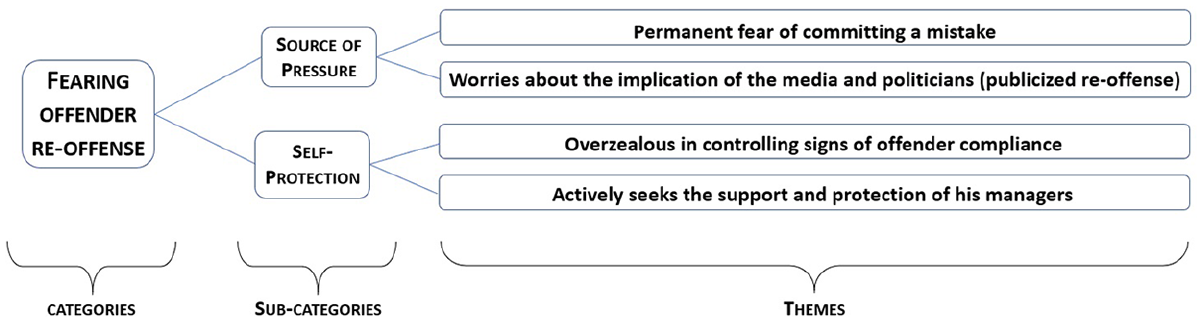
Illustrative branch of the thematic tree.
Overcoming the Struggles of Offender Supervision
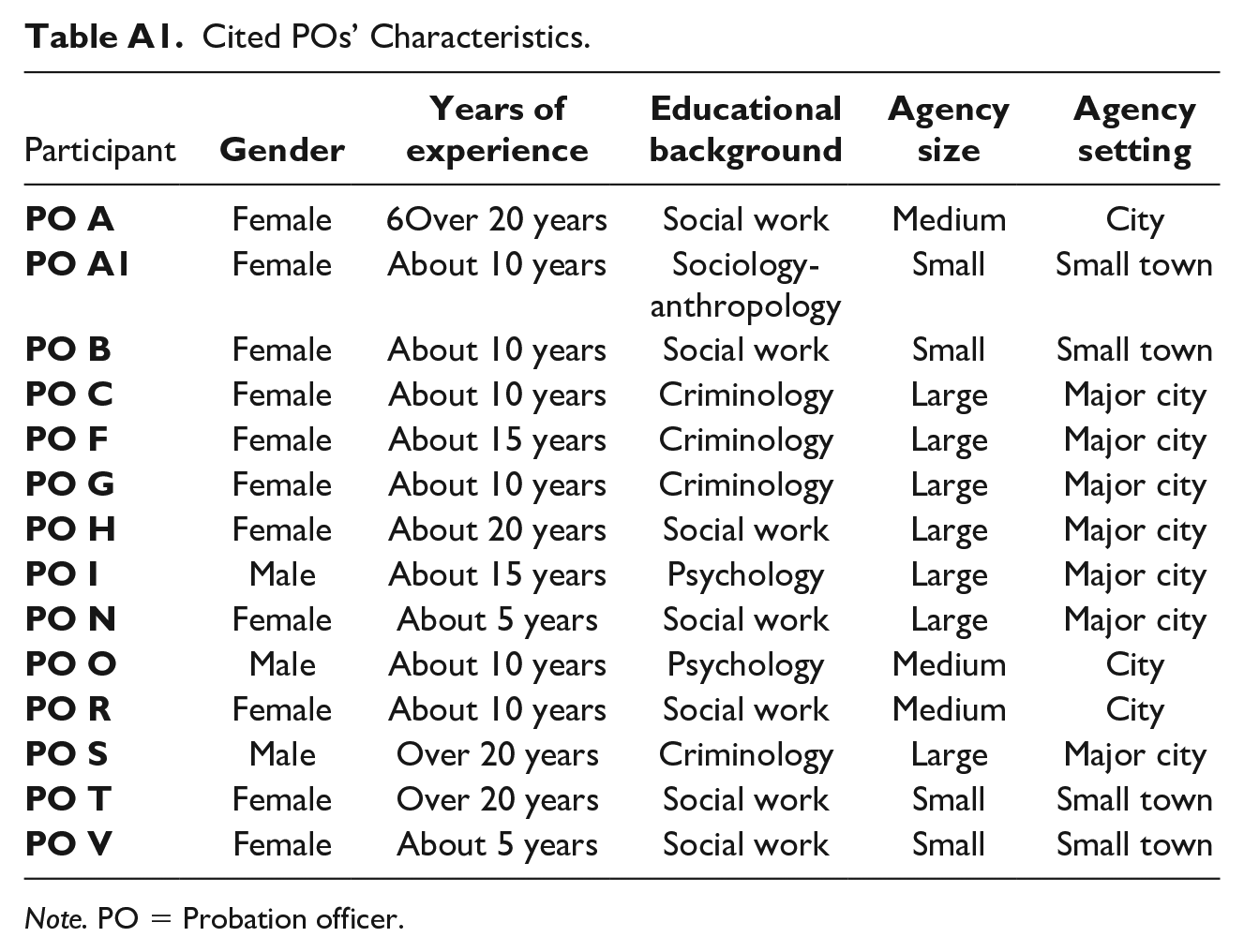
This section reports the results of the thematic analysis. First, we provide evidence on POs’ ways of coping. Second, we link those coping mechanisms to specific factors mentioned in the interviews. The results are illustrated with relevant verbatim excerpts. The cited POs’ characteristics are reported in appendix.
Coping Florilegium
Five coping mechanisms were identified throughout the analysis. This section reports how POs implement these mechanisms during public service delivery.
Prioritization: Selecting the most demanding cases
Nearly half (14) POs declared dedicating significantly more time and dedication to the supervision of specific categories of probationers. Most POs tend to practice a form of intuitive offender profiling at the beginning of the supervision process. On that basis, they quickly identify and eventually prioritize probationers who require more attention. Eleven respondents, however, insisted that such judgments must be made with caution as they are often based on little more than intuition.
The most common criteria for prioritization derive from POs’ immediate perceptions of probationers’ characteristics. Officers target the probationers who appear to need care and support. Socially isolated probationers, those with complicated social and familial backgrounds, and those who show signs of alcohol or drug addiction are particularly watched. Other criteria for prioritization are linked to the specifics of the case record. Some cases are viewed as intrinsically demanding. Those involving terrorism and publicized offenses, for instance, require more attention, as POs feel they are “constantly walking on eggshells” in those situations (PO I). Other cases are considered lower priority, judging by the causes of condemnation. For instance, probationers who have been convicted of traffic violations often fall into this category. These offenders are usually expected to attend short specialized trainings in road safety that should not necessitate much PO involvement.
I’ll be honest: there are people that I’ll just see for fifteen minutes, even less . . . because they are not in a social situation that requires my help and support and so our meetings are sometimes very brief. I just collect the evidence showing that he respects the conditions . . . For others, well it takes more time. You see, from a social perspective, people are sometimes facing dire situations and so . . . we contribute to helping. (PO H) There is also a huge difference between someone who drove at 85 kilometers per hour and got caught by a speed camera and someone who has a criminal record and committed an offense while under the influence of alcohol. I will obviously allocate more time to the case where there is a drinking problem. (PO T)
Prioritization is common and occurs when POs adjust their behavior to respond to the needs of a limited number of probationers. It is often intertwined with rationing: there is an overall tendency to ration services, but officers prioritize work with the cases they find the most challenging and demanding.
Instrumental actions: Long-lasting solutions to ease supervision
A majority of POs (19) described the use of long-term solutions to solve frontline work issues while simultaneously responding to the needs of probationers. Offenders are often distrustful with respect to POs, at the beginning of supervision. This is challenging for officers because, if not addressed, a defensive posture can strain the relationship and seriously hamper both the social and monitoring goals of supervision. According to participants, such issues mostly occur with probationers who depict themselves as victims of an unfair court proceeding. These offenders are generally unwilling to accept the supervision framework and to comply with the conditions imposed by the judge. Consequently, POs must spend considerable time and energy to keep these offenders invested in the supervision process.
It’s hard to put words on it. It’s in his attitude: if he is withdrawn, if he still refuses to accept the judge’s sentence, if he still doesn’t admit his guilt at this point . . . That’s usually someone who will unwillingly go through his supervision during the next three or five years instead of sharing his journey with me. He will be antagonistic right from the beginning, closed, and uncommunicative. (PO I)
Judicial assistants’ approach to solving this issue is to invest in relationship building with problematic offenders in hopes of achieving a mutually beneficial trusting relationship. The solutions they implement are instrumental because they serve the purpose of facilitating supervision work. A first group of eight officers reported reading aloud or allowing their supervisees to read the reports intended for judicial authorities. This way, POs hope fostering mutual transparency. Offenders progressively realize that they can trust their PO and that concealing any relevant information is counterproductive. This practice is informal but not explicitly discouraged by institutional guidelines. Officers use this gap in the existing rules to their own advantage and to the benefit of probationers.
Well, another interesting trick to use is when I make them read my reports . . . this puts them in a position of confidence, meaning that they will start thinking: “well, I know she’s not going to backstab me. It’s transparent; I understand what is happening . . .” (PO W)
Another 16 POs reported adopting a listening strategy. These officers allow, and sometimes invite, defensive offenders to express their grievances about the penal process. In doing so, judicial assistants demonstrate their consideration for offenders’ feelings of injustice and mistrust. Respondents argue that this mindful attention usually defuses offenders’ resentment about the probationary conditions and the supervision framework. Ultimately, this strategy helps to establish a mutually beneficial relationship with the offender.
After being able to express himself and seeing that I was able to relate to his own reality, he completely changed his stance. And so, from an antagonistic stance he changed to become really, really . . . collaborative. I think that he is one of the most collaborative offenders I ever had to supervise. (PO A)
Judicial assistants’ rationale in favor of instrumental actions is twofold. First, they consider that transparent and compliant probationers are easier to supervise. Obtaining information from these individuals is simpler and less efforts are needed to keep them invested in the supervision process. Second, officers argue that offenders ultimately benefit from these practices: improving the communication with defensive offenders allows to better adjust supervision and support reinsertion efforts.
Rule breaking: Noncompliance with work instructions
Seven POs reported breaking the rules to ease offenders’ adaptation to the supervisory process. The PBR requires POs to discuss probationers’ offenses during the first meeting. However, some POs view this rule as counterproductive as broaching this topic may generate unnecessary tension and further entrench new supervisees in their defensive postures. Furthermore, these officers believe that there are more important matters to address during the first meeting, such as relationship building and explaining the supervisory framework. As a result, they refuse to discuss the offense during the first encounter with offenders, or at least avoid doing so. The interviewees suggested that probationers are more at ease and in a better mind-set to comply with the probation framework when this topic is not discussed, which ultimately facilitates supervision work. To some extent, this rule-breaking behavior can also be assimilated to a form of instrumental action. By avoiding a controversial topic, the judicial assistant shows receptiveness to and consideration for the offender’s difficult situation. He ensures that the relationship starts in a nonconfrontational way, which ultimately serves the purpose of facilitating supervision work.
I try to make sure that the person is at ease. I do not systematically evoke the offense and the facts that brought the person here during the first interview, but instead I try to explain why it is important to discuss life trajectories. (PO H)
Since the adoption of the verification directive, judicial assistants are also required to perform at least one home visit during offender supervision. However, most officers consider home visits to be particularly time-consuming, especially those operating in large judicial districts. Some also view this tool as superfluous, or even counterproductive, depending on the individual situation of the probationer. Consequently, nine respondents reported not always performing home visits. These officers tend to confine their use to cases where they seem the most relevant.
They made it [conducting home visits] compulsory, but I don’t find it relevant in some cases. So, I take full responsibility when I don’t implement them. I explain my point of view in my reports to my superiors and to the penal authorities . . . so far, they have never asked about anything. Maybe someday it will become an issue . . . (PO B)
Judicial assistants usually explain to their managers and to the penal authorities why they did not perform the visits. This means that managers are probably aware of, and perhaps turning a blind eye to, some of their staffs’ decisions regarding home visits.
Rationing: Privileging quantity over quality
Most officers struggle to maintain an adequate caseload management in the current work conditions. Seventeen POs acknowledged rationing service delivery to keep up with essential tasks despite severe time shortages and growing demands. Officers especially mentioned a reduction of the average time and efforts allocated to face-to-face interactions. They usually shorten the duration of the follow-up interviews with offenders and dedicate less time for their preparation. Officers also reported rationing the overall provision of the social supervision. Although treasured by POs, the active counsel and support of probationers is a time-consuming activity for which existing guidelines and procedures are less constraining. By contrast, POs cannot afford to make compromises with the monitoring of offenders’ compliance with rules. It is the adequate implementation of these verification procedures that is usually inspected by managers if there is an issue with the case. This leaves officers with little choice but to maintain offender monitoring while rationing the overall provision of help and support to the offenders.
These days I honestly dedicate less time to my files than before, I mean less than a few years ago. This means that my interviews are indeed shorter, that I no longer systematically dig into things that I would have explored before and that I do skip some part of the aid I should otherwise provide to people. I can’t skip the part that concerns offenders’ compliance with probationary conditions though. But if one of my supervisees is in trouble, if he has drug issues for instance . . . then yes, I will help him. (PO F)
As illustrated, POs tend to shorten the overall length of interactions, ration care, and support and try to maintain some availability for the most urgent cases. Overall, officers describe a loss of quality in their services because they have to focus on quantity.
Routinization and simplification: Narrowing supervision efforts to monitoring
Beyond new procedures that emphasize offender monitoring, some POs declared routinizing their tasks in ways that further accentuate this logic. Eleven respondents expressed anxiety about offender reoffenses which would put them at risk of blame if the file records are not kept up to date. To these POs, the appropriate response is the implementation of double-checking practices. This involves performing monitoring procedures that are not imposed by the book, such as actively seeking any evidence required by the supervisory conditions, double-checking offenders’ formal signs of compliance, strict rule following, and extra contacts with police.
With the swelling number of cases, the administrative tasks that are getting increasingly demanding, the verification directive, the events that we witnessed here, like the attack on the boulevard . . . we start thinking that we should get tougher! Because if by misfortune one of our supervisees gets involved . . . well, they are going to check on our files and, unfortunately, none of us are perfect . . . They say that we should file a report after two unanswered meeting notices. Personally, I tend to send [the probationer] a third meeting notice just to be sure. (PO I)
Routinization is often implemented at the expense of time-consuming activities, such as care and support (see rationing). However, by narrowing efforts to monitoring and checking offenders’ formal signs of compliance, the supervision process tends to become increasingly automated. This leaves less space for social work and contextualization. This process is visible in the simplification of administrative tasks. For instance, five POs acknowledged simplifying periodic reports for the probation board. These simplified reports typically minimize the amount of contextual information provided about offenders’ social and familial conditions.
A Matter of Survival
In this second section, we provide details about the causes and context of the coping mechanisms described in the previous section. Three clusters of factors were identified. Time shortages are associated with all the aforementioned coping mechanisms, public accountabilities are linked with routinization practices, and the meaninglessness of work instructions is associated with rule breaking.
The common denominator: Increasing workloads and time scarcity
Time management appears as POs’ most salient issue. Eighty-three percent of respondents reported facing time constraints that disrupt the adequate management of their cases. POs invoked time constraints to explain either fully or in part the use of each of the coping mechanisms described above. All of the interviewees associated time scarcity with the rationing of social work and the overall decline of face-to-face interactions with probationers.
Well, I personally make my interviews a bit shorter so I can fit a few more appointments during the day. That’s a little frustrating because we would like to go a bit further in our work with people . . . but we don’t have the time. Materially speaking, we don’t have time. (PO V)
In hopes of achieving a better time management, POs also prioritize work efforts on the most urgent, demanding, and challenging cases.
I clearly try to keep more regular contacts with unstable and insecure people. But also, we must say so, with the cases that “smell bad” . . . the things that might eventually break out. It is not currently my situation, but if I had a terrorist case, I would very regularly meet with the offender . . . even in case of work overload. . . . In turn, I would limit my interactions with road traffic offenders. (PO R)
Rule-breaking practices are also associated with time limitations. Because of time shortages, judicial assistants perform a cost–benefit analysis before carrying out tasks that are particularly time-consuming or which not seem particularly adapted given the circumstances.
The time I spend going on a home visit equates to two interviews that I could be doing here [at the office]. So, I really have no choice at some point. (PO F)
Instrumental actions are used to ease offenders’ acceptance of the supervision process. In doing so, officers also reduce the amount of time and efforts that would otherwise be needed to supervise an uncompliant probationer.
In this way, we might avoid working with someone who is uninvested in the supervision and who will just come to the interviews because he is required to. And I also believe that the risks of reoffense are vastly reduced. (PO N)
Time scarcity encompasses a wide variety of interconnected institutional and organizational factors. Overall, the research participants identified four factors linking to growing time constraints in Houses of Justice. First, most officers related this issue with a significant increase in the sheer volume and complexity of caseloads. Eleven of them specifically blamed soaring case numbers. Most of this increase results from less-demanding cases, such as mild traffic violations. However, contrary to the assumption of some managers, POs argue that the management of these cases can be particularly time-consuming and considerably affect workloads. Surprisingly, a few other respondents from diverse backgrounds did not specifically notice such an increase in case numbers. Rather, they reported a growing complexity of individual cases due to a worsening societal environment. Supervising these complex cases requires additional time and commitment.
I remember when I arrived [here], I had cases of neighborhood conflicts and frog poaching . . . Now I can’t even imagine getting cases like that. . . . The population has more and more difficulties in general and we end up with files that are getting increasingly problematic and complex. We no longer have a small problem to manage. (PO T)
Staff shortages are intimately linked to the growth of individual caseloads and managerial choices. Nearly half of the respondents consider their team numbers insufficient to absorb the ever-increasing workloads. Apart from localized counterexamples, few POs mentioned any recent increase in team numbers. The respondents’ demographic characteristics support this idea: only one PO had less than 5 years of experience at the time of the study. These staff shortages, coupled with increasing demands, ultimately impose severe time constraints on POs.
We lack four full-time judicial assistants in here. It has been a recurring issue for years. They already sent us reinforcements, but we have always simultaneously lost an equal amount in staff. . . . Workloads are soaring in the meantime. Since January, we almost doubled the number of probation cases. (PO S)
Additional time pressure has also been brought by the verification directive. This directive introduced new requirements, such as contacting and asking police services about any potential new offenses before writing a report. While some interviewees acknowledged the necessity of such reforms, 13 respondents agreed that they contributed to the ever-increasing complexity and burdensomeness of the probationary framework. With even less time on their hands, POs try to adapt and conform to the new guidelines. In the process, many are tempted to ration time-consuming activities such as social work, which produces less quantifiable outcomes than verification procedures.
[The verification directive] brought about more administrative work for each case. Yes, a lot more, because you have to manage different categories of mail, new contacts, additional interviews, email exchanges, search for new police reports when they are out there, etc. Yes, administratively it’s much more unwieldy. (PO V)
Finally, POs blamed managerial choices regarding case distribution. Since the advent of SIPAR, local managers have been using a computerized tool to assess POs’ caseloads and produce indicative figures about individual occupation rates. These workload estimates are used to assign new cases to officers. Two thirds of the respondents agreed that this computerized tool severely underestimates actual workloads, as it fails to take exceptional circumstances into consideration and does not adequately weight cases.
New case files account for a lot [in the calculation] and the old cases account for much less. But clearly it doesn’t always portray the truth. We can have a case that goes very well for two years and then it starts causing trouble after the second year. However, at that point, the case will only be worth a few X percent according to SIPAR. (PO R)
Consequently, many POs blame local managers’ overreliance on this managerial tool for their large workloads and time constraints. Some even argued that this tool is being deliberately instrumentalized by local managers to justify extra case attributions.
Walking on thin ice: The weight of accountabilities
In addition to time constraints, two distinct yet interconnected forms of accountability were mentioned by respondents to explain routinization practices. The first is POs’ accountability to their managers in cases of offender reoffense. When a reoffense occurs, the probationer’s file is scrutinized by penal authorities and managers who check whether the PO conducted the supervision in accordance with work instructions. However, probationer reoffense is particularly difficult to predict, and POs are never fully prepared for this eventuality. Twelve respondents reported experiencing a constant fear of missing out signs of potential reoffense. These POs express anxiety at the prospect of being blamed and held responsible if “something goes wrong” during the supervision of an offender. Consequently, they devise self-protective measures to be sure that nothing can be held against them in the event of a reoffense. Such strategies consist in the routinization of monitoring practices such as the regular use of unsolicited contacts with the police or double-checking supervisees’ signs of compliance.
I need my work to be kept in order, up to date. Otherwise yes, it can generate stress. Personally, it’s mostly related to the recent events . . . you know, I really fear having one of my cases getting out of control after having missed something important. It can always happen of course, but I always make sure that all the important stuff is done. . . . I immediately deal with it, otherwise it will end badly for me. (PO G)
The second form of accountability is oriented toward the general public, beyond the boundaries of the institution. POs sometimes supervise highly publicized or sensitive cases, such as offenders sharing ties with terrorist networks. Twelve respondents stated that in the case of a reoffense, the ensuing public exposure would leave the PO in a particularly vulnerable situation. Public awareness would urge the media and the political sphere to establish responsibilities and identify scapegoats. Since public exposure considerably increases the odds of being held responsible, POs try their best to seek the protection of their managers by strictly following monitoring procedures. The following excerpt illustrates this fear of mediatic and political backlash.
I would really not want to be in the shoes of the judicial assistants who are currently managing all the terrorist files and things like that. Or anything where the media is involved, because the judicial assistant is really . . . well, he is at the end of the chain, so to speak, and it’s always the “little guy” who will pay for all the consequences. (PO A1)
Officers are aware of the severe emotional and professional consequences if disavowed by their managers or used as scapegoats by politicians and the media. In the hope of eluding the prospect of blame and shield themselves from any risk of accusation, POs implement routines to check on supervisees’ signs of compliance. They serve a dual purpose: detecting any potential risk of reoffense and, more importantly, averting any risk of being blamed. Routinizing control strategies is considered as a cost-effective, yet unpleasant, way of addressing accountability issues.
The (muffled) virtues of circumstantial professionalism
POs acknowledged breaking some specific rules. Two work instructions were particularly scorned by respondents on the grounds that they sometimes contradict their professional judgments and preferences. The first are related to home visits. Eighteen POs declared encountering at least one of the following concerns that prevent them from following the procedure. First, officers stressed that home visits take much time to perform, notably in vast judicial districts where considerable time is spent on transport. In those contexts, POs must sometimes carry out extra visits to substitute for office meetings when offenders are not able to reach the office by their own means. Safety issues are a second source of concern, as some POs with a background in social work mentioned feeling ill-prepared to meet an aggressive probationer in his or her own house. Finally, POs questioned the actual usefulness of compulsory home visits. Officers doubt the meaningfulness of this tool, arguing that—depending on individual circumstances—home visits may prove irrelevant or even detrimental to the probationer. This, for instance, is the case when the probationer is trying to keep his or her friends and family unaware of the ongoing penal procedures.
Well, in my opinion, a home visit is already a constraint in itself . . . Therefore, if it doesn’t make sense for the client, it turns it into a double constraint for me. I am just saying that I generally won’t argue if someone tells me that he lives all alone and that he does not see the interest of the visit. (PO O)
POs voiced their disagreement with another work instruction. Along with other topics, the BPR requires POs to discuss probationers’ offense during the first meeting. However, one third of the respondents criticized this rule. New supervisees can prove reluctant to collaborate with the POs and, if not swiftly addressed, this resistance can hinder both the social and monitoring aspects of supervision. In that context, some POs believe that bringing up the offense during the first encounter might be misinterpreted by probationers. This could trigger probationers’ defense mechanisms and potentially transform supervision into a grueling task. Thus, when meeting new probationers, these POs prefer to focus on relationship building instead of following counterproductive work instructions.
According to work instructions, we are supposed to discuss the offense during the first meeting but personally, I don’t . . . as a matter of principle, I mean. I almost never do it. Why? First, because getting information about offenders’ situation and explaining the probationary framework already takes a lot of time. . . . And the second aspect is that I give so much importance to relationship building that . . . you see, I don’t know him, he doesn’t know me. It can be very tricky to mention the offense during the first meeting. (PO C)
Overall, frontline POs do not passively implement tools and guidelines. When facing instructions that lack meaningfulness and challenge their practical knowledge about what is best, POs sometimes refuse to follow instructions. Some refuse to discuss the offense because it interferes with relationship building. Others sometimes abstain from conducting home visits because they are time-consuming, dangerous, or irrelevant.
Discussion and Conclusion
How and why do frontline officers cope with managerialism, accountability, and risk? To answer this research question, we have presented the results of a thematic analysis (Paillé & Mucchielli, 2016) of 29 semi-structured interviews with frontline officers in Belgian probation services. Frontline officers, in probation services, are SLBs (Hupe et al., 2015; Lipsky, 2010) who hold some discretion to supervise and interact with probationers. In doing so, they walk on thin ice. They have to deal with high caseloads to make quick yet consequential decisions about probationers with limited time and resources. At the same time, as a result of new public management (Brodkin, 2011, 2012) and new penology (Feeley & Simon, 1992; Pratt et al., 2013), they are expected to manage risks of reoffense, often at the expense of social work. Existing research evidence remained limited about how SLBs, in general, and POs, in particular, “cope” (Lipsky, 2010; Tummers et al., 2015) with such constraints, especially in a context in which frontline officers fear mediatic and political backlash and feel accountable to their managers as well as to the general public. In this respect, the Belgian probation services are a “critical” case (Flyvberg, 2006).
Our analysis reveals that POs implement five main coping mechanisms during public service delivery: rationing, case prioritization, routinization, instrumental actions, and rule breaking. The analysis also provides evidence on three explanatory factors. First, the most prominent cause of coping is time scarcity. When POs prioritize offenders based on specific criteria—such as familial background or addiction—they aim to maintain efficient caseload management despite time limitations. The use of instrumental actions to ease offenders’ acceptance of the supervision process allows to save considerable time in the long run. Similarly, POs use rationing and rule-breaking practices to save time on time-consuming duties such as the delivery of care and support. Time scarcity itself results from a variety of factors, such as ever-increasing demands, staff shortages, and the introduction of new managerial tools and procedures. While time limitations are determinant across all POs’ adaptations, other factors were associated with specific coping mechanisms. Accountabilities, for instance, are concomitant with the implementation of routinizing practices. POs are subjected to two types of accountabilities: on one hand, toward the management and, on the other hand, toward the public sphere. To better anticipate the risks of reoffense and avoid potential blame, POs extend and routinize offender monitoring using double-checking practices. The third explanatory factor consists of POs’ personal views over the meaningfulness of work instructions, such as compulsory home visits or the way meetings with offenders should be handled. POs are susceptible to break the rules to follow their professional intuitions about what makes the most sense in the given circumstances. Strikingly, managerial innovations seem to have an indirect impact on POs’ coping mechanisms by amplifying existing organizational constraints and reducing the meaningfulness of work instructions. Overall, this study has not only confirmed that the way SLBs cope with managerialism results from self-preservation and professional values at the same time: in addition, when they operate in a high-risk environment, public accountabilities further model their coping mechanisms.
To conclude, we discuss the theoretical implications of our findings with regard to three key aspects of our initial inquiry: (a) the nature of coping, (b) the role of public accountabilities, and (c) the effect of managerial innovations. First, the results indicate that POs do not necessarily opt for the most efficient and comfortable solutions to face heavy workloads and time limitations. POs can break rules to privilege relationship-building over the cold fact-checking imposed by work instructions. Instead of focusing on the simplest cases or the most promising ones in “terms of bureaucratic success” (Lipsky, 2010, p. 107), POs prioritize work with the probationers who present the riskiest and the most challenging profiles. By acting altruistically in the interest of those in special need, many POs’ coping mechanisms are oriented toward clients (Tummers et al., 2015). Not only does this match the citizen-agent narrative depicted by Maynard-Moody and Musheno (2000, 2003), but it also suggests that, instead of relying solely on self-protective behaviors to cope with constraints, frontline workers also engage in value rational actions in the pursuit of meaningful and rewarding experiences (e.g., Halliday et al., 2009; Nielsen, 2006). As such, these results propose a different perspective on frontline workers’ use of coping and discretion because they contrast with Lipsky’s assumption that SLBs’ actions are predominantly instrumentally rational and driven by self-preservation. In essence, this study brings additional evidence that frontline work adaptations result from a complex arbitration between SLBs’ own self-interests and a genuine, selfless desire to help the citizens they interact with (May & Winter, 2007; Maynard-Moody & Musheno, 2012).
Second, this study brings insights into how SLBs perceive accountabilities in high-risk policy sectors and how they adjust their behaviors accordingly. Public accountability is central, in PA (Bovens et al., 2014), and scholars have repeatedly acknowledged its relevance as an inevitable part of SLBs’ work experience (Brodkin, 2008; Murphy & Skillen, 2015; Thomann, 2015). While it is accepted that SLBs are subject to various forms of accountabilities (Hupe & Hill, 2007), few studies have examined the effect of these different accountabilities on coping. Most studies assume that SLBs are subject to a form of administrative accountability and examine how SLBs deal with resource limitations and institutional or organizational changes (e.g., Brodkin, 2011; Taylor & Kelly, 2006; Thomann, 2015; Tummers et al., 2009). However, this approach minimizes the factors that lie beyond the boundaries of the administration, especially when risk is at stake such as with probation. As demonstrated by POs’ repeated allusions to the role of the media and politics, SLBs internalize a strong sense of accountability toward the public. They are well aware of their public image and the way society expects them to behave (e.g., Collings & Murray, 1996). As a result, in a logic of risk and blame avoidance, they routinize monitoring practices to shield themselves from what they view as untamable forces lying beyond the familiar institutional boundary. This can have far-reaching consequences for frontline practices because the influence exercised by the media, politics, and public opinion does not stem from formal rules. Future studies should investigate how SLBs perceive accountabilities at the frontline and how these affect their practices, especially in policy fields that receive strong attention from politics and the media.
Third, our findings support that managerial innovations foster coping in two ways. On one hand, consistent with a growing pool of studies showing how managerial reforms interact with street-level practices (e.g., Brodkin, 2011; Ellis, 2011; Hjörne et al., 2010), the results suggest that managerialism amplifies organizational constraints such as workloads or time shortages. For instance, the research participants repeatedly pointed to the verification directive and SIPAR as sources of additional paperwork and time-consuming tasks. Officers also attributed their workloads to managers’ heavy reliance on new computerized tools. Not only do these tools underestimate actual workloads but, given the growing case numbers, managers tend to instrumentalize the figures they produce to keep assigning extra cases. POs adapt to these constraints by further rationing time-consuming activities, prioritizing work with the most urgent cases, and routinizing the processing of clients.
On the other hand, the results indicate that managerial changes affect coping via the introduction of procedures that lack POs’ support, which makes them prone to rule-breaking. POs’ critiques of the feasibility and relevance of compulsory home visits provide a good illustration of this phenomenon. POs who perceive limited meaningfulness (Tummers, 2011; Tummers & Bekkers, 2014) in the implementation of a visit are unwilling to comply and often end up skipping the visit. Other studies have demonstrated that meaninglessness is a strong deterrent to SLBs’ willingness to implement a policy as well as its administrative tools and instruments (e.g., Higgs & Rowland, 2005; Tummers, 2011). Ultimately, our results also suggest that over-proceduralizing frontline workers’ tasks can strip work instructions from their meaningfulness. Further studies should examine how managerialism interacts with SLBs’ perceptions of the meaningfulness of policy instruments. At a time when penal cultures are increasingly penetrated by managerialist approaches, additional research is needed to assess the evolution of frontline practices and their actual impact on policy delivery, especially in risky contexts with multiple accountabilities such as street-level justice (Portillo & Rudes, 2014).
Footnotes
Appendix
Cited POs’ Characteristics.
| Participant |
|
|
|
|
|
|---|---|---|---|---|---|
|
|
Female | 6Over 20 years | Social work | Medium | City |
|
|
Female | About 10 years | Sociology-anthropology | Small | Small town |
|
|
Female | About 10 years | Social work | Small | Small town |
|
|
Female | About 10 years | Criminology | Large | Major city |
|
|
Female | About 15 years | Criminology | Large | Major city |
|
|
Female | About 10 years | Criminology | Large | Major city |
|
|
Female | About 20 years | Social work | Large | Major city |
|
|
Male | About 15 years | Psychology | Large | Major city |
|
|
Female | About 5 years | Social work | Large | Major city |
|
|
Male | About 10 years | Psychology | Medium | City |
|
|
Female | About 10 years | Social work | Medium | City |
|
|
Male | Over 20 years | Criminology | Large | Major city |
|
|
Female | Over 20 years | Social work | Small | Small town |
|
|
Female | About 5 years | Social work | Small | Small town |
Note. PO = Probation officer.
Acknowledgements
We are grateful to the reviewers of Administration & Society for their comments about an earlier version of this article.
Declaration of Conflicting Interests
The author(s) declared no potential conflicts of interest with respect to the research, authorship, and/or publication of this article.
Funding
The author(s) disclosed receipt of the following financial support for the research, authorship, and/or publication of this article: This work was supported by the Belgian Fund for Scientific Research (Fonds De La Recherche Scientifique—FNRS).
