



Abstract
We assess to what extent a (co)evolutionary macro level approach enhances our understanding of learning in governance processes. We ask the question: in what ways do actors learn to improve their chances of long-term survival in complex governance processes? We deploy a model of collective decision making moulded upon fitness landscapes to analyze a longitudinal case study of collective (political and administrative) decision making, namely the process of developing and acquiring the F35 Lightning II fighter jet. The study demonstrates that actors learn how to ensure survival over time but create a failing megaproject in the process.
The Multi-Trillion Fighter Plane
Early 1990s, the US Marine Corps planned for a new fighter jet to replace the aging Harrier. The US Congress, worried about the prospect of massive costs associated with the development, procurement, operation, and support of different aircrafts for the various branches of the US military, sought to merge the demands of the Marine Corps with those of the US Airforce and US Navy (Congressional Research Service [CSR], 2020). The stated goal was to develop three variants of the same basic aircraft with high commonality to save on building and operations costs (Institute for Defense Analyses [IDA], 2010). Consequently, the Joint Advance Strike Technology (JAST) program was established, from which the F35 Lightning II fighter jet emerged.
The program run out of control, subject as it was to massive cost overruns, severe technical delays, and constant bickering between all actors involved. The lifetime costs of a single airframe may be up to $1.5 trillion (2015 prices, see Bender et al., 2015). As such, it has become the single most expensive project in US-history (Hughes, 2015). It fits in a long history of so-called megaprojects: governments and private actors engaging in projects that promise the technological sublime (Frick, 2008) but that in most cases tend to run out of control (Flyvbjerg, 2014; Flyvbjerg et al., 2003). With so much evidence about the troublesome nature of megaprojects, one can be forgiven for asking “haven’t they learnt?” This is especially the case with the F35, which was preceded by the equally troublesome (but less expensive) F22A Raptor program of the US Air Force. While the obvious answer to that question seems a resounding “no,” a coevolutionary perspective may generate a different kind of answer that aligns more closely to the nature of such complex processes.
Our contribution to this special issue will assess to what extent a (co)evolutionary view on learning may enhance our understanding of learning in governance processes. Generally speaking, evolution and co-evolution explain the emergence of speciation through variation, selection, and retention under selection pressure to establish fit with the environment. Such a fit would ensure long-term survival. We therefore ask the question: in what ways do actors learn to improve their chances of long-term survival in complex governance processes? To answer this question, we first introduce the concept of coevolution and its relationship to learning in Section 2. From this, we derive a fitness landscape model of collective decision making that structures the roles, relationships, preferences, and behaviors of actors, and the extent to which they are successful in achieving long-term survival, in governance processes (Section 3). In Section 4, this model is applied to the JAST/JSF-program, followed by the analysis in what ways the involved actors have learnt to increase their chances of survival in Section 5. We conclude that actors that have learnt the best how to survive the changing environment did so at the cost of a dysfunctional technological program that has cost billions of tax money across the globe. We reflect on different modes of learning in relationship to coevolution.
Learning in Coevolution
Broadly speaking, evolution is the change of characteristics in systems—species, actors, technologies, institutions, etc.—under selection pressure and in duration. Arguably, evolution is reciprocal as a change of properties under environmental selection pressure may cause selection pressure on the environment in return. Adaptation concerns the selection of those characteristics within a given system to suit selection pressures; coevolution expresses; and maps that this adaptation causes the environment to change, too (Gerrits, 2008; Gerrits et al., 2009). Owing to the nature of selection in a coevolutionary interaction, certain systems may benefit from the interaction while the other (coevolving) system is not, negatively or positively affected. In other words, coevolution can be beneficial or detrimental, or all shades of gray in between, for either or both populations (Gerrits & Marks, 2017; Odum, 2004).
Coevolution, as originally coined by evolutionary biologists Ehrlich and Raven (1964), has spilled-over into the social sciences as a way of conceptualizing reciprocity between different types of systems, and between agents within systems (e.g., Norgaard, 1994, 1995; see also elsewhere in this thematic issue). The concept has proven to feature explanatory value (Gual & Norgaard, 2010; Hird, 2010; Holling, 2001; Weisz & Clark, 2011), in particular when it comes to socio-ecological interaction where it has been studied extensively. It spawned an entire school of research, with applications covering diverse topics such as the exploitation of (rain)forests (e.g., Lambin & Meyfroidt, 2010; Norgaard, 1994), water resource management (e.g., Kallis, 2010; Van Staveren et al., 2018), flood risk management (e.g., Tempels, 2017), development of estuaries (e.g., Gerrits, 2008, 2011), agriculture and its land use (e.g., Moreno-Peñaranda & Kallis, 2010), and hydrology (e.g., M. R. Sanderson, 2018). Coevolution also speaks to matters of Public Administration. For example Norgaard (1994, 1995) and Rammel et al. (2007) incorporate institutional analysis and individual behavior, while Gerrits (2008, 2011) and Hood (2017) focus on the dynamics of policy making in relationship to governing of ecosystems. Key texts include Teisman et al. (2009), Van Assche et al. (2014), and Beunen et al. (2015).
As with many other concepts that have travelled between scientific domains, coevolution has been interpreted and used in a variety of ways in target domains. As mentioned in the introduction to this special issue, some of these interpretations and uses are complementary where others are incompatible. A principal distinction must be drawn between the general, conceptual idea of things changing in tandem on the one hand, and the analysis of the mechanisms of such tandems on the other hand (S. Sanderson, 1990). While the first articulates the general logic on a conceptual level without much further analytical depth, the second attempts to map and explain the causal dependencies that drive the coevolution between, for example, systems or actors. A second distinction must be drawn between coevolution as a concept that explains reciprocity—indifferent of the outcomes—and coevolution as a normative value, that is, coevolution as something that is inherently good. While the first departs from a systems perspective where certain behaviors are selected for given the circumstances, the latter starts from the perspective of individual agents having purposeful action. Key point is the difference between intentional adaptation through learning—where actors search for options and learn what works and what does not work in a given situation (e.g., Siggelkow, 2002; Siggelkow & Rivkin, 2006)—and blind selection where certain environmental pressures select for characteristics regardless of learning effects (e.g., Gavrilets, 2003). Given these two distinctions we follow the analytical approach from a systems perspective where behaviors are selected reciprocally and without teleological assumptions. Hence, we discard the normative route.
Environmental pressures select for particular properties that then survive in the long run. This requires some additional explanation when applied to the social realm. Survival is achieved when something—for example, an actor—has adapted to selection pressures such that it fits with its environment and can continue to exist. The notion of fitness stretches beyond a mere “survival” when it comes to the topics central in Public Administration. Lasswell’s (1936) “who gets what, when, and how” is the key to fitness. Fitness may be achieved in direct and indirect ways. It is therefore better to speak of inclusive fitness, which denotes the effect of an actor’s actions on its own fitness and that of others directly related to this actor (Grafen, 2006; Hamilton, 1964), which may be reciprocal. This also takes into account that actors may do things that are directly beneficial to others but not themselves, at least not in the short run (Birch, 2016) In other words, inclusive fitness is the extent to which actors reach their goals given the dynamic environment they are in, where other actors are also trying to reach their goals. There are many ways in which actors can obtain fitness in governance processes; for example, one may accept a short-term loss in exchange for long-term survival. An importance difference with biology is that human actors can try to forecast, plan, anticipate, and reflect on the effects of actions undertaken of one’s own survival chances. This is where learning comes into focus.
Learning in coevolutionary processes may be analyzed at various levels—from the individual, day-to-day interactions, to system-wide perspectives. From a system’s perspective—the one adopted in this paper—actors receive feedback about what strategies and behaviors contribute to an actor’s fitness (and therefore survival) given the environmental conditions in which they have to survive. That is: learning through reflexivity (Newig et al., 2016). Comparison (cf. Dunlop, 2017) of strategies deployed and behaviors shown by various actors in the same arena in relationship to their ability to obtain relative fitness helps actors to learn about what is more effective in certain situations.
A change in environmental conditions may render the adopted behaviors obsolete, as such necessitating a new learning effort through variation of behaviors (searching for the best way forward) and subsequent selection and retention of the best fitting strategies and goals. Arguably, those who survive in the long run are the ones who learnt best how to deal with the selection pressures in coevolution, that is, those actors have the highest fitness as they achieved most of their goals. The necessity to learn is driven by a desire for survival. This is not to say that learning is always an intentional strategy directly focused on reaching a better fit. Indeed, there is much uncertainty about what a better fit may constitute in the first place. As such, actors will experiment with strategies and behaviors in an attempt to get a feeling for what the environment demands from them (cf. learning through experimentation). This includes the possibility of getting it entirely wrong and losing evolutionary advantages.
Fitness Landscapes as Mapping Device
To study the evolutionary dynamics outlined above in governance processes, we deploy a fitness landscape model, which is a common model for analysing such dynamics (Gavrilets, 1998, 2004, 2014), and that suits the study of collective decision-making equally well (Gavrilets & Richerson, 2017; Gerrits & Marks, 2017; Marks et al., 2019), in order to track the strategies, behaviors, goals, and fitness of actors in a collective decision-making process. We will explain the model below. As per Marks et al. (2019) and Weisberg (2007), this concerns both the semantic and syntactic structure of collective decision-making, that is: the conceptualization of the process and the definition of the model go hand-in-hand.
In this conceptualization, actors coordinated repeatedly over a specific issue in multiple governance arenas. Repeated coordination over time ensures learning effects as actors receive feedback about what works and what does not. This repeated coordination is structured into a series of connected events that together form a lineage. Following Abbott (2001), descriptions that bring together the contextual information lead the researchers to select and assign events to a lineage. As per the rounds model (Teisman, 2000), major events may significantly impact the issue, demarcate the start or end of such a process, or new actors may enter or depart. Each string of events between those major events is captured in a fitness field populated by the actors active in that field. The aforementioned “who gets what, when, and how” brings in the actors involved and their related goals. A lineage ends when the collective decision about the issue is reached. There can be multiple lineages—for example, technical, market-oriented, or political—that diverge, converge, or intersect. Owing to the coevolutionary nature of all (complex) governance decision-making processes, lineages represent different aspects of those decision-making issues that may influence reciprocally (Gerrits & Marks, 2017).For example, decision-making about financing fighter jets is intertwined with international and diplomatic coalition-forming.
Actors hold problem definitions of the issue as they perceive and frame it in their own actor-specific ways, and they formulate their own solution definitions as they have specific ideas how the issue should be solved (i.e., framing of an issue, see Fischer, 1998; Fischer & Forester, 1993; Rein & Schön, 1996). These combine in problem and solution definitions (PSDs) that express the ways in which actors think of the issue at hand. The space of possible problem and solution definitions is defined by the number of PSDs observed empirically in a given fitness field, where

As all actors can hold multiple PSDs about the issue the chance of realizing certain PSDs is strongly related to the PSDs of the other actors. The interdependence of the actors is also prevalent in resource dependencies (e.g., finance, knowledge, etc.) and formal responsibilities (e.g., as defined in a constitution, rules and regulations, etc.). How well actors are connected in a fitness field is measured by the number of actual links that an actor in a network has as a rate of the number of possible links (c_score, cf. density in social network analysis, Tichy et al., 1979), thus

Not all actors will reach their goals, as is common in collective decision-making. While failure to reach a goal does not end an actor’s existence instantly, actors do need to succeed in (partial) realization of their goals if they want to survive in the long run. Actors may deploy two principal strategies to realize the most of their PSDs. First, they can seek alignment with certain actors, and increase distances with others if they think this will contribute to goal attainment for a given issue based on their perceptions, strategies, perceived distances, and motives of those other actors (March, 1994; Marks & Gerrits, 2018). Second, they learn which strategies and alliances may work better through comparison and reflection (Dunlop, 2017). Actors will seek to align their PSDs with similar PSDs (e.g., package deals) while distancing from dissimilar PSDs (e.g., non-negotiable differences). This process of reciprocal informing means that a qualitative adjustment based on content (similar elements of the PSD) enters, attributing weight (w) to the c_score for every actor. In other words,

This allows mapping the actors involved in a certain issue relative to each other and over time. Throughout the process, actors may change in either or both dimensions, or stay put if they feel that this is the best strategy for the moment. Naturally, the field will change as soon as actors start moving (internal to the field) and/or major events take place (external to the field). As such, it may be that an actor doesn’t intend to change in the principal dimensions but still finds itself in a different place because others have changed theirs. The movements of all actors together impact the likelihood of goal attainment. Goal attainment, which we see as a proxy for fitness and therefore long-term survival is expressed as fitness (f) in the model, where,

where v is the value attributed in retrospect by the researchers using case-based knowledge. The model does not assume an a priori fixed relationship between v(PSDi, c_scorei) and fi. Exactly which combinations of PSD and c_score will lead to goal attainment or loss is something that needs to be investigated empirically. Given sufficient data, one will be able to tease out persistent configurations of all three dimensions over time.
Strategies in governance processes concern the combinations of problem and solution definitions, and the extent to which actors are connected to actors. As mentioned above, actors considered in the analysis of governance have agency, that is, the ability to anticipate, forecast, plan, respond, learn, and reflect. Actors will learn about what strategies work and which not via changes in their fitness value. Over time, strategies contributing to fitness are retained, and strategies not contributing to fitness are selected against. Arguably, the model is an abstraction that ignores details at the level of individual actors, but it allows for unambiguous assessment that uncovers persistent patterns between content, connection, and fitness.
Data and Methods
We use the fitness landscape model to analyze the collective decision-making process leading up to the acquisition of the F35 Lightning II fighter jet to demonstrate how actors learn the strategies needed to ensure long-term survival. To this end, we traced the decision-making process between 1996 and 2016 through 492 articles published on the topic in newspapers from the USA, Canada, Australia, and the United Kingdom. In addition, we used 10 policy documents from the US government; particularly the 2009 root cause report issued by the Office of the Under Secretary of Defense, the Selected Acquisition Report (SAR) issued by the Department of Defense (DoD), and the 2020 updated F-35 JSF program report by the Congressional Research Service. 1
All articles were chronologically structured into a database and then coded to reconstruct how different events evolved over time. This made it possible to select the significant events to form the lineages. The dynamics of those events were fleshed out using the government documents. This enabled us to reconstruct the connections between actors, their PSDs, the decisions they took, and the context of those decisions; that is, the main actors and the main events per lineage and related fitness fields are identified. After the DoD announced it wanted three versions of a new hi-tech fighter jet (1994), two decades of subsequent decision-making can be divided into three main lineages:
Decisions and debates about who may build the jet at what cost: that is, all events of the competition between potential manufacturers.
Decisions about what the jet should be able to do given budget constraints: that is, all events related to the actual design and building of the aircraft.
Decisions about attracting other countries into the program: that is, events related to the building of an international alliance around the program.
Owing to the coevolutionary nature of decision-making processes certain actors, decision or outcomes in one field or lineage may intersect with another related field in another lineage. The three lineages and their coevolutionary links are depicted in Figure 1, followed by a short description in the following section.
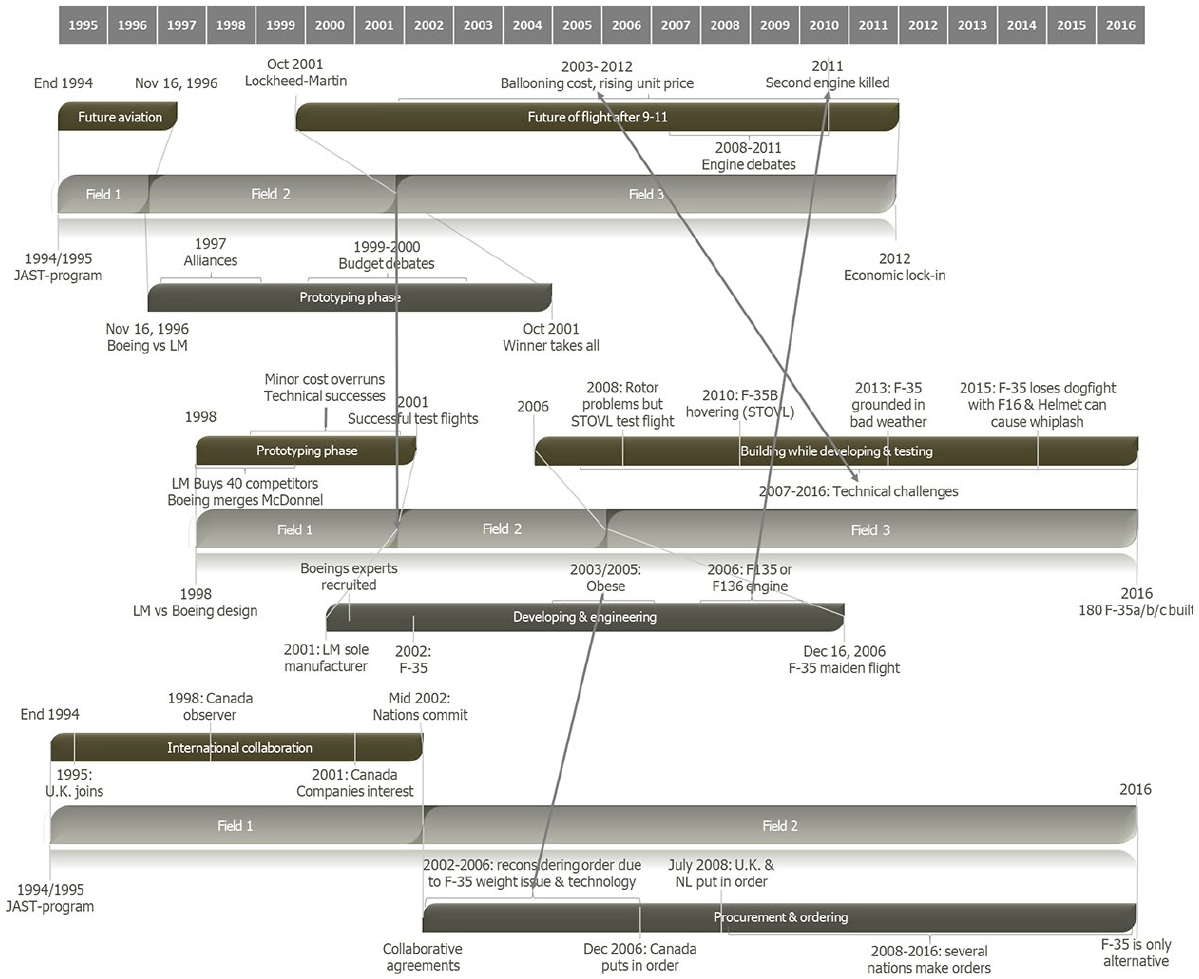
The three lineages comprising the JAST-JSF study, including the moments in time when these lineages were linked reciprocally (vertical lines in gray).
The Joint Advance Strike Technology/Joint Strike Fighter program
The purpose of the JAST/JSF program was to develop a joint airframe that could be adjusted to suit the different tasks of the different branches of the US armed forces. Along the way, allied nations were offered the opportunity to join the program as a co-developer and possible customer. As such, the program was a technical one, but even more a political one that sought to bring countries together under the same protection shield, promising beneficial industrial deals, and a joint defence platform in return for firm orders of the airplane. The resulting F35 Lightning II came into service with the US Marine Corps in July 2015, followed by other armed services and then other countries. The airplanes are scheduled to stay into service until approximately 2070.
Initially, US would purchase 2,443 planes and partnering nations another 783 (IDA, 2010) at around $122 million per plane, excluding the engine program which would cost an additional $17.7 million to $23 million (Zaffran & Erwes, 2015). These costs were a gross underestimation. Owing to several technical problems as well as strategic concerns, the cost of building the F35 has risen from around $400 billion with a lifetime cost of up to $1.5 trillion (Bender et al., 2015).
Lineage 1: Political engineering
Field 1 starts in 1994 when Boeing, Lockheed Martin (LM) & McDonnell Douglas propose three different designs to DoD. The field ends, and starts the second, in November 1996 when DoD awards Boeing and LM contracts to build and test-fly two aircrafts to show the three variants. Several alliances between builders are formed: Boeing and McDonnel Douglas merge, LM & British Aerospace buy Northrop Grumman. After political debates about whether creating a monopoly position for the builder will provide the best and cheapest aircraft, Pentagon sticks to “winner takes all.” October 2001, DoD selects LM’s design as the winner. This starts the last field in which budget keeps rising year after year, even though Pentagon, Congress, or Senate are seemingly trying to cut costs. In those years industrial consortia are set up across contractors and states; ending up producing parts in 47 states providing tens of thousands of jobs across the U.S.
Lineage 2: Design and building
Field 1 starts in 1998 with LM designing the prototype while buying 40 competitors to become the largest US-defence contractor. In 2001 LM as sole builder (see lineage 1) starts developing and engineering the JSF; start of Field 2. In 2002 LM contracts many OEM’s from outside the US first, and later also from inside the US. LM opts for the navy variant with the Short Take-Off and Vertical Landing (STOVL) to form the basic airframe and renames it F35 Lightning II. The STOVL-technique was the key element in LM winning the contract. LM encountered many minor technical successes, but also technical problems, delays, and cost overruns; especially the weight of the aircraft created problems. December 16th, 2006 the F-35A took its maiden flight, bringing Field 2 to an end. The following years are filled with various technical and practical problems, testing problems, delivery to customers (including international customers), and subsequent teething problems as poorly tested but approved designs were put into production. Until 2016, 180 aircrafts have been built, all of them a bit different as they were adapted to the most recent experiences.
Lineage 3: Forging international alliances
At the start of the JAST-program DoD puts forward the idea that attracting foreign partners would offset the high development costs and ensures that the airplanes would sell in high enough quantities to earn back the sunk costs. The United Kingdom joined from the start as it sought to replace the aging Sea Harriers. Several countries stated their interest; for example, Canada in January 1998. Canada joined as observer—only for the “demonstrator” stage—with no intent of buying. Australia, Canada, Denmark, Italy, the Netherlands, Norway, and Turkey officially become partners of the JSF-program in the first half of 2002. Naturally, the respective countries all have their requests about specific contractors (e.g., UK-based Rolls Royce for the alternative engine) or technical issues with the aircraft. They threaten to withdraw if technologies are not shared, or they critique the rising costs. Several nations are reconsidering their long-term plans, but they continue to pump research funding and orders into the US to support the over-inflated budget of the F-35 program. From 2010 onwards more countries put in orders for small numbers of aircrafts.
Analysis: Learning in Coevolution
The 20 odd years between the first plans and the actual flying airplane are characterized by goal dependency, path-dependence, and lock-in (Van Assche et al., 2014). The vision shared initially of the range of futuristic technical standards for the fighter jet (as strongly promoted by the powerful DoD), but also the expansion of potential customers through reciprocal industrial deals, influenced the decision-making process. In conjunction with the initial decision to have two competing bids with a winner-takes-all outcome, massive sunk costs created. The mutual dependencies between the main actors meant that a change of course, or a complete abandonment of the ballooning program, was often discussed but never enacted.
Naturally, none of the partners were sucked into the program unintentionally and powerlessly. Indeed, all actors had their considerations to keep going. Lockheed-Martin needed the airplane to run a viable business as much as the US Navy wanted to have a futuristic tool. It would be short-sighted to suggest that those actors were passive and victim of the situation. Indeed, we believe that there is a great deal of learning going on, if only because certain actors got what they wanted, that is: safeguarded long-term survival, while others did not adapt quickly enough to stay in the game. Reconstructing the collective decision-making about the development and purchase of the F35 reveals that actors that gained fitness were the ones who found the right combination of PSD and connections—at least sooner than others did.
To align or not to align
Learning takes place in a dynamical environment as all actors change positions, depending on what they perceive as the most promising combinations. This is learnt through comparison. Actors may move closer or further away if they feel that such moves increase chances of success. Even actors that do not intend to change their PSD and connections may still find themselves in a different spot in the field if other actors decide to readjust in either one or both dimensions. As such, actors are subject to reciprocity providing them opportunities (enabling adaptive walks) or denying them opportunities (cutting off certain routes).
For example, DoD’s original PSD included the desire that a single company builds the JSF. They provide Boeing and Lockheed-Martin around US$700 million to build the prototypes, as these funds were necessary for the companies to avoid bankruptcy in the effort. The two companies quickly merged with respectively McDonnel and British Aerospace & Northrop Grumman to obtain their knowledge and technology to build the prototypes. As STOVL was a very specific requirement, LM made the best effort to match that requirement thus getting the contract. In contrast Boeing’s decision to stick closer to existing technologies—to save costs in the long run—proved to be an unfortunate choice as it delivered a more conservative solution that would be rejected in the competition with LM.
LM winning the tender made other actors seeking alignment with the PSDs of both LM and DoD. Actors were trying to push elements of their PSDs, which are not about an affordable fighter jet per se, into the PSD of DoD. These actors include other companies vying for (sub)contracts but also Members of Congress who learnt to connect and align PSDs such that work would be carried out within their respective states. The historical (path-dependent) relationship of Member of Congress and their home-state workforce is being articulated in the PSDs of the Members of Congress, which LM learns to incorporate into its PSD by spreading the manufacturing of the parts of the jet over different states in the US. Winning the tender also meant that given that many technical issues were created that LM had to overcome somehow in the years to follow. Arguably, LM, including its sub-manufacturers, had little to worry as US government in all its forms—DoD, Congress, Senate, or presidents—never really killed off any the project and its budget. Instead, they raised budget in the belief that it would solve the technical issues. In other words, DoD’s PSD taught LM that the only necessary condition for long-term survival was to win the tender. In contrast, Rolls Royce, originally the preferred supplier for the engines, didn’t anticipate the perceived importance of having a local production facility in the U.S., thus being swapped for U.S.-based Pratt & Whitney. This reflexive serial learning (Newig et al., 2016, p. 354), where actors adapt previously successive decisions to the current situation turned out to be unsuccessful, whereas other actors learnt that aligning with DoD and LM returned the best chances of success.
This does not mean that the actor that most actors are trying to align with is automatically a winner. DoD upholds a wide range of PSDs as promoted by other actors because its survival strategy depends on its ability to keep many parties happy (i.e., from Members of Congress demanding that the project gets cheaper, to the armed forces demanding more functions to be added to the fighter jet). The DoD survives by catering for different needs, which is to be expected from such a considerable political and administrative force. As such the DoD can realize many PSDs but not all of them: that is, it achieves relatively high fitness on the back of it having learnt that this strategy tends to work well enough. The PSDs of the DoD functioned as a beacon for the other actors: especially LM learnt to accommodate the DoD’s PSDs and as such became a monopolist owning the largest military contract in world history without the threat of losing it.
Learning to diversify PSD and connections
While LM is the main contractor, it has engaged multiple (sub)contractors to manufacture parts of the F35, both within the US and other participating countries. The decision to subcontract globally instead of nationally was initiated by DoD’s PSD that the cost of development and building could be reduced by utilizing the expertise of (inter)national sub-contractors. The alliances of different contractors and nations also meant that more and different specific requirements were pushed forward; that is, both connections and PSDs increased in number and quality. Note that this is primarily about connecting with diverse (not similar) actors, as such raising the number of dissimilar PSDs, which promotes a learning through comparison. In the process, all actors are learning about the PSDs of the other actors and seeing the value (or inevitability) to incorporate them into their own set. The diverse technical and financial PSDs of the respective (sub)contractors and countries meant that a seemingly unstoppable growth of demands was put on the table. To regain control of the situation, the US-government decided not to share their technologies with other nations, which led to those nations threatening to withdraw their order. Yet, no country left the program at any point and technology was shared between the full partners.
The proliferation of connections and hence the inclusion of more diverse actor PSDs run into the limits of time and money. Owing to the growing number of US subcontractors, the growing number of partnering nations (all with their own specific technical and financial wish list), and the constantly changing financial demands by Congress, the development of the aircraft was getting behind schedule. Such was the delay that DoD had to lower the performance bar for the F35 in order to stay more or less on track. Here, the US government learnt that cutting the budget for the F35 was becoming less and less likely, because the different PSDs needed to be taken into consideration as well as the (political) connections with other nation states. Ignoring that would be cheaper but would put the whole project into jeopardy. Thus, the drive for long-term survival required governments in the US and elsewhere to keep going.
Self-organized entrapment
The fact that certain combinations of PSDs and connections are more promising than others, a fact that gets ascertained at various points in time, implies that bandwagon effects come into play. The drive for survival means that clustering around certain PSDs, as well as the building-up of certain alliances, is inevitable. Actors try to learn from their knowledge of past interactions (Newig et al., 2016) and PSDs of other actors to improve their position. Again, actors may still find themselves in a less advantageous position if others move in a different direction. Actors may even learn that abandoning their original goals may raise their fitness. An example of that is the extent to which Congress wants DoD to bring the budget for the program back under control whilst at the same time encouraging a further ballooning of the project in order to gain employment for the states.
From the first moment onwards US-Congress/DoD holds three key definitions in its PSD: (1) the JSF/F35 should be a common airframe and powerplant core, procured in three distinct versions tailored to the varied needs of the military services; (2) the winner takes all, that is, only one company will be awarded the main contract; and (3) the unit price should be kept low by attracting customers into the program. These PSD elements dominate such that, in evolutionary terms, other partners would be selected against if they would not follow at least large parts of this PSD. As such many companies across the US, Canada, and other nations learnt to align their PSDs with that of the DoD and LM in order to ensure long-term survival. It allowed them to generate work and jobs for both the U.S. and other partnering nations. This reflexive learning of both Members of Congress and LM is mutually reinforced creating the self-organized entrapment. Lockheed-Martin has carved out its own niche through repeated alignment with DoD through which they were able to become the biggest single US-manufacturer of military aircraft ever. Subsequently, a monster was created over the years: in the US all but five states were economically tied for 32,500 jobs and with 18 states counting for over $100 million of economic activity; and internationally nine others had tied their faith to the F35 whilst economically subcontracting creating employment and income.
In addition, the monopoly of LM, as created through the initial conditions, means that very few alternative aircrafts remained available: the air forces of nations such as Britain, Australia, Turkey, and so on, had little alternative but to continue to pump research funding and orders into the US to support the already-inflated budget as competition fell by the wayside. The F35 program ate the budgets from possible customers for alternative airplanes, as well as the budget needed to design a homegrown airplane.
The development costs spiked again in 2009 and 2010, causing the Obama administration and the Pentagon to argue for new rules to end the massive cost overruns, but they lose out because of congressional efforts protect the home-district jobs. A year later DoD stated that there is no alternative for the F35 so budget cannot be cut. Stronger still, 2012 saw the US government trapped when they seek to save $150 billion by reducing the order by approximately 1,000 airplanes. However, this would raise the per unit price, which created the risk that other nations would lower their order too; that is, creating a positive feedback loop with a constantly rising price and lowering orders. In short: while there were plenty of opportunities to reverse course, at least on paper, these were not used because actors had learnt how to ensure their own long-term survival despite the obvious problems with the design and building of the fighter jet.
Discussion and Conclusions
While the future will tell if the F35 Lightning II was worth the trouble, the current situation shows all the hallmarks of a botched megaproject. Notwithstanding the intuitive but ultimately naïve response that it appears as if none of the actors learnt from the pitfalls of such megaprojects (e.g., Flyvbjerg et al., 2003), the evolutionary view shows that the outcome is the result of actors learning how to safeguard their own long-term survival—in terms of contracts, investments, employment, obtaining jet fighters, and so on. These actors learn to align with the DoD by connecting and incorporating elements of DoD’s PSD. LM learns to repeatedly align with DoD PSDs and also to incorporate PSDs of Members of Congress to ensure fitness. In doing this, LM created the certainty that even if they encountered problems in the production or technical specifications, funding would be guaranteed because Members of Congress would protect their workforce and getting the funds necessary (notice the coevolutionary relation between PSDs and connections between lineage 1 and 2 here). Both Member of Congress and LM are learning through updating their prior approaches in the light of the reciprocally updated information of each other (Newig et al., 2016). Similarly other nations connected their faith to the DoD; wanting to safeguard their homeland jobs and income generated by the production or maintenance of the fighter jet constantly make these nations align with DoD’s PSD. Again, an affordable fighter jet was only part of the respective PSDs. Once sunk costs were so high no viable alternative remained.
What do the results of this study show about learning in coevolutionary governance processes? As mentioned in the introduction of the special issue, coevolution is a given, that is, something that will take place regardless of intentions of actors. As actors change positions in the policy arena, other actors will have to find out if they want to move along or search for alternative routes through the shifting landscape. The drive for survival is expressed system-wide in terms of alignment and divergence, propagation of substantive and network diversity, and self-organized entrapment. These three dynamics are reinforced because of two principal learning processes: experimentation with, and evaluation of (combinations of) PSD and connections in relationship to perceived fitness gains and losses; and comparison of (combinations of) PSD and connections between actors to identify successful combinations that may be adopted in an attempt to improve one’s fitness. The study shows that the initial stage of such governance processes is pivotal in how things play out: a high diversity of problem and solution definitions and coalitions converges toward the main set of PSD and network structure over time. Actors can opt to align further with other actors, or opt for a go-alone strategy, depending on the outcome of the evaluation. Alignment implies further exposure to alternative problem and solution definitions and strategies, often fueled by input from external experts and practices observed elsewhere. A positive feedback loop driving further diversification may emerge. Likewise, too much alignment can lead to self-organized entrapment. Results from all movements feed back into the actors’ evaluation of their own fitness in contrast to the fitness of others. The process is summarized in Figure 2 below.
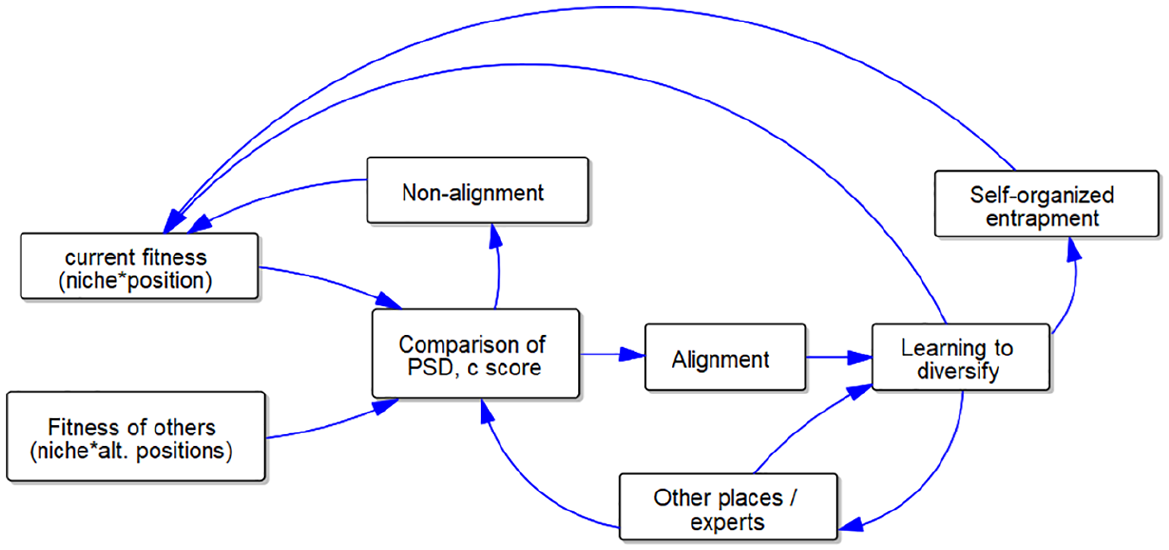
Primary learning mechanisms as seen from the coevolutionary framework used in this paper. Any actor will compare its own fitness against the fitness of others elsewhere in the landscape. Observing that improvement of fitness is possible, the actor will compare its own PSD and c_score against that of others to determine what strategies (expressed in the c_score) and goals (expressed in PSD) are more likely to bring improvement of fitness (Van Assche et al., 2021, p. 13). Subsequently, actors may align with other actors in terms of c_score and PSD. Alignment implies an exposure to alternative ideas and strategies (Van Assche et al., 2021, p. 13), that is, higher diversity. This is also fuelled by exposure to experts and practices from elsewhere (a positive feedback loop between exposure and learning to diversify may emerge; Van Assche et al., 2021, pp. 13, 14). Excessive alignment leads to self-organized entrapment. Non-alignment, alignment on the basis of diversification, and self-organized entrapment all feed back into actor’s evaluation of its own fitness vis-à-vis the fitness of others.
Naturally, this process is not cast in concrete. In particular, we expect initial stages to be characterized by diversification and experimentation while later stages may be more dominated by convergence. Over time, the space-of-possibilities becomes delineated and more restricted by those serial learning experiences (Newig et al., 2016, p. 354; Van Assche et al., 2021, p. 13) about what works and what doesn’t. If a certain combination turns out to be successful, it is very likely that this combination is repeated elsewhere in time and place, as was shown in this study.
The failures of certain actors (who may even disappear from the process altogether) is as instructive as is the characteristics of the successful actor(s). And while the most fitting combinations will be clear in hindsight, one has to understand and appreciate that actors find themselves in considerably more uncertain conditions—especially in the early stages—that requires from them to be reflexive and adaptive. It confirms that history and the present are the most important drivers behind learning (Dunlop & Radaelli, 2013; Newig et al., 2016; Van Assche et al., 2021). Importantly, it is not only their own intentions that matter—even DoD didn’t control every field—but above all the movements of others in the field, as well as the impact of external events they have to deal with. This perspective puts much emphasis on adaptive behavior in the face of coevolving processes. The larger objective—a functional and affordable fighter jet—seems to be of secondary importance in the light of the struggle for survival. The F35 case is far from unique, in the sense that actors went for those combinations that were most likely to be successful. It is not uncommon for the military to ask for future-proof (speculative) technology, or for members of Congress to direct funds to their states. The experience that these goals often contributed to long-term survival (of the military and of members of Congress) means that they are taken into consideration in the next project. In other words, the space of possibilities is also delineated by earlier learning experiences. As such, it is no surprise that actors are willing to embark on yet another megaproject as they have learnt that this is an opportunity for survival.
The study presented here contributes to the questions raised in the special issue from the vantage point of governance as an ecosystem. This view allows us to consider the very long-time spans inherent to coevolutionary processes. The study could be criticized for taking the view that survival is the best indicator for learning, as this may ignore individual learning in coevolution, as such not addressing the dialectic learning mentioned elsewhere in this special issue—even though one can sense from the results of our study that little actual reflection on the nature of the governance process took place. We understand that criticism but would like to highlight that the perspective selected in this paper demonstrates that, ultimately, selection is blind. That implies that authors can (and will) try to achieve fitness gains but always against a background of uncertainty. The outcomes emerge—literally—from the many micro-interactions and distributed learning effects that have taken place. The structural mechanisms of variation, selection, retention, and fitness underneath coevolution explain why this is so. As such, they highlight why actors went ahead despite the mounting problems. The model and method presented here can unearth those mechanisms and may complement a micro-level analysis.
Footnotes
Acknowledgements
The authors would like to thank Loránd Bodó at the Otto-Friedrich University of Bamberg (Germany) for collecting the data for this research, as well as the anonymous reviewers for their constructive feedback.
Declaration of Conflicting Interests
The author(s) declared no potential conflicts of interest with respect to the research, authorship, and/or publication of this article.
Funding
The author(s) received no financial support for the research, authorship, and/or publication of this article.
