



Abstract
What leads to more age-friendly cities: professional management, passive gender representation in management, or active public engagement? In a survey of 1,378 local governments, age-friendly features were measured in the community comprehensive plan, zoning codes, and economic development plan. Gender representation does not distinguish level of age-friendly planning, but public engagement promotes age-friendly practices in all three areas: comprehensive plans, zoning, and economic development plans. Structural equation models find professionalism and public engagement matter more than gender representation in management, as they promote active representation, which leads to more age-friendly practices.
Keywords
Introduction
Public administration scholars are giving more attention to gender representation, but this has been understudied with respect to female city managers (Hamidullah et al., 2015). Women are underrepresented in local government management in the United States (Caceres-Rodriguez, 2013; Holman, 2017) and hold under 17% of city/county management positions (ICMA, 2019).
This article presents results from a nationwide survey of US cities and counties to assess which factors distinguish communities with more age-friendly planning and zoning (such as mixed use zoning and walkability). It explores the effect of professional management, passive gender representation in management, and active public engagement in planning for child and age-friendly cities. Models analyze the level of attention to age-friendly issues in comprehensive plans, zoning codes, and economic development plans by gender, professional management, and level of public engagement. This research enables us to explore the effect of professional management and gender in distinguishing communities with more age-friendly planning. We are also able to explore the effect of public engagement on age-friendly outcomes: planning, zoning, and economic development. Public administration recognizes the need to address a wider set of residents, especially children and older adults who have traditionally been marginalized in the planning process. This paper helps clarify the importance of active representation of the public, gender representation in management, and the professional council manager form of government.
Literature Review
Professional Management and Active Public Engagement
US society is aging, but cities are only beginning to recognize the challenges this brings for city services, comprehensive planning, and the built environment (Lehning, 2012; Warner & Zhang, 2022; Wolf & Amirkhanyan, 2010). The World Health Organization (WHO, 2007), United Nations Children’s Fund (UNICEF, 2004), and the American Association of Retired Persons (AARP, n.d.) have outlined the key domains where cities need to give attention to the needs of older adults and children. These include housing, transportation, services, built environment, public engagement, and social inclusion. The American Planning Association (APA, 2014) has articulated guidelines for age-friendly cities, that call for attention to the needs of children and older adults in comprehensive plans, zoning and land use, and economic development. While these frameworks for age-friendly cities give attention to the importance of public engagement, they are silent on the role of public management.
This paper looks specifically at the effect of professional management, gender representation in management, and public engagement in distinguishing local governments with more age-friendly practices. City managers are appointed professionals in the United States, and local governments of the council manager (CM) form are considered more professional (Carr, 2015; Hefetz et al., 2014; K. L. Nelson & Svara, 2012). Professional city managers oversee the day-to-day administration of the municipality. Council manager governments tend to be more aware of new practices in public administration and planning due to their participation in professional associations such as International City/County Management Association (ICMA) and the APA (K. L. Nelson & Svara, 2012), and are more likely to engage in comprehensive policy actions that address broader community benefits and promote innovative planning, zoning, and economic development practice (Carr, 2015; Feiock et al., 2014; Warner et al., 2017).
While the separation between politics and management is a core feature of council manager governments, research and practice show the city manager influences policy design and implementation through actions complementary to the political role of councils (Demir & Nyhan, 2008; Nalbandian et al., 2013; Svara, 2001). Professional managers are more likely to negotiate the divides between political and administrative functions—leading to more interaction with their councils (Svara & Nelson, 2008) and the public (Nalbandian et al., 2013).
Professional managers recognize the importance of public engagement, and much work has been done on how to promote public engagement, especially from marginalized groups. Council manager governments are more likely to promote citizen participation (Nalbandian et al., 2013) and best practices for citizen engagement (B. Nelson & Wood, 2010). Strategies for engaging women, children, older adults, low income, and people of color reach beyond the traditional planning board meeting to new modalities such as photovoice (Sancar & Severcan, 2010) and charettes (Keyes & Benavides, 2017) to promote direct public engagement (Nabatchi & Amsler, 2014). Engagement can facilitate active representation, and this is why it is recognized as a core pillar in the age-friendly recommendations of WHO (2007), UNICEF (2004), AARP (n.d.), and the APA (2014). Empirical work has found engagement of families with children and older adults in the planning process is one of the strongest factors distinguishing communities with more age-friendly planning and services (Keyes & Benavides, 2017; Lehning, 2012; Warner et al., 2017; Warner & Zhang, 2022), but zoning and economic development planning have been more resistant to change (Micklow & Warner, 2014; Reese & Ye, 2015; Zhang et al., 2017). Power and organizational structure limit public participation and gender representation in the regulatory aspects of planning such as zoning, infrastructure, and economic development (Siemiatycki et al., 2020).
Gender Representation in Public Administration
Representative bureaucracy theory addresses both participation and organizational structure (Bishu & Kennedy, 2020; Kennedy et al., 2020; Krislov & Rosenbloom, 1981; Meier, 2018; Sowa & Selden, 2003) and acknowledges the difference between passive and active representation. The links between the two depend on both organizational and community characteristics and leadership discretion (Meier, 2018; Sowa & Selden, 2003). While diversifying voices inside local government can increase identity salience, active policy change requires critical mass, and administrative discretion to promote shifts in organizational culture (Bishu & Kennedy, 2020; Meier, 2018). Male domination historically has led to less attention to gender issues in city government (Stivers, 2000). Bureaucracies are not neutral (Portillo et al., 2020). Administrative discretion is important in enacting policies representative of emerging minority interests (Sowa & Selden, 2003). Representation can move from symbolic to active when there is critical mass for emerging or minority interests within the government organization (Bishu & Kennedy, 2020).
Research needs to explore if communities with women managers will be more likely to include attention to age-friendly issues in their plans or more constrained in raising these matters due to traditional gendered norms about land use, zoning, and economic development. Prior research has found when women are in leadership roles, they are more likely to promote policies of interest to women and their families (Caceres-Rodriguez, 2013; Park, 2012), and improve organizational performance (D’Agostino, 2015). Women leaders in economic development and environmental management have paid more attention to social equity issues (Homsy & Lambright, 2021; Read & Leland, 2019), but women are often less likely to be heard in policy discussions (Turesky & Warner, 2020), especially those around physical infrastructure in transportation and planning agencies (Siemiatycki et al., 2020).
While some research finds gender differences in attitudes and actions (DeHart-Davis et al., 2006; Kennedy et al., 2020), these may not receive full expression due to organizational constraints and bias in the workplace (Bishu & Headley, 2020). Public administration scholars have called for the need to look at the intersection between gender and professional government (Bearfield, 2009; Riccucci, 2018). Organizational context helps determine if women’s voices are heard inside the bureaucracy. Job segregation and lack of recognition of the emotional labor in public service contributes to gender differences (Guy & Newman, 2004). In local government, women are more likely to be occupationally segregated into social services or redistributive functions (Johnson & Crum-Cano, 2011). Lowi’s (1972) typology of policy arenas suggests that redistributive policy arenas will be more likely to be represented by women, while regulatiory, distributive, and constituent policies will have an imbalance toward men. For example, gendered power differences in economic development and infrastructure planning agencies (Siemiatycki et al., 2020) limit the voice of women, and this gender bias gets reflected in the focus and choice of planning policies (Johnson & Crum-Cano, 2011), and in the lack of attention to paradigm change to address the needs of women and the aging (Hirt, 2013: Micklow & Warner, 2014; Zhang et al., 2023).
Research on the organizational dynamics of planning workplaces finds it is not the gender of the planner, but the nature of the leadership which enables women’s voices to be heard (Turesky & Warner, 2020). Organizational psychology recognizes the importance of role congruity and expectation states on why women and their concerns may remain unheard in bureaucratic settings (Bosak et al., 2012; Correll & Ridgeway, 2006). In council manager governments, professional managers have been found to devote more time to managerial processes and innovation (Carr, 2015; Feiock et al., 2014); thus women may be more likely to heard in governments of the council manager form.
With the aging of America, addressing the broader care needs of society is gaining attention, but it requires a paradigm change to address new modalities for planning, zoning, and economic development (Lehning, 2012; Reese & Ye, 2015; Warner & Zhang, 2022; Zhang et al., 2023). What distinguishes the level of age-friendly planning and zoning across US cities and counties? What role do professional management, gender, and public engagement play? This article draws from a nationwide survey of local governments to examine differences by gender, professionalization (council manager form) of government and public engagement in comprehensive planning and zoning, and economic development.
Data and Method
In 2013, we conducted a nationwide survey with the International City County Management Association (ICMA) of local government actions on age-friendly planning. Surveys were mailed to the chief administrative officers in cities and counties across the United States. The sample frame included all counties, all municipalities over 25,000 people, a one in three sample of municipalities under 25,000, for a total of 7,948 local governments. We received responses from 1,474 municipalities. The survey asked the respondents’ gender, and 1,378 municipalities provided this information. That is the sample used in this analysis, with a 17% response rate. A two-sample Kolmogorov–Smirnov test shows the distribution of population between the universe and the sample data are not significantly different.
The survey measures age-friendly community practices. These include attention to the level of age-friendly planning in the comprehensive and the economic development plans and the extent of the community covered by age-friendly zoning codes. The survey also has measures of the level of public engagement in planning, the professionalism of the local government, and the composition of the community governing board/council. Planning and zoning authority varies by government type and includes various volunteer planning and zoning boards. This analysis focuses on the jurisdictional level and asks if the jurisdiction has plans and zoning codes in place. Counties are included in the analysis because they provide technical assistance to jurisdictions within the county. Each survey respondent is identified by their community’s respective FIPS code. Based on the FIPS code, survey data are linked with socio-economic data from the American Community Survey to control for demographic and place characteristics.
Dependent Variables
Age-friendly planning
The survey asked if a community has a comprehensive plan and an economic development plan, and if those plans “specifically address the needs of children and older adults.” The extent of age-friendly planning is measured as (no plan), 1 (plan does not address the needs of children or older adults), 2 (plan addresses only children or older adults), and 3 (plan addresses both children and older adults). Comprehensive plans are commonly adopted by communities (80%), and 39% of respondents indicated that their comprehensive plan addresses the needs of both children and older adults. Only 62% of the communities had an economic development plan, and only 16% of the respondents reported that their economic plan addresses the needs of both children and older adults. Only comprehensive plans require a public engagement process, so lack of attention to age-friendly needs in economic development plans may be explained by the lack of public engagement.
Age-friendly zoning codes
Zoning codes regulate development. The survey measured 14 age-friendly zoning codes on a scale of 1 to 5 for the percent of the community covered by each code (0% = 1, 0–25% = 2, 26–50% = 3, 51–75% = 4, >75% = 5). The zoning code index is the aggregate sum of each zoning code by the percent of community covered. The zoning codes with the highest coverage “allow family sized housing (with 2 or more bedrooms,” “mandate sidewalk systems,” and “promote parks and recreation facilities in all neighborhoods.” More than half of respondents reported that those zoning codes cover more than 50% if the community. The least common zoning elements were “provide density bonuses (for affordable housing, open space and transit),” “mandate universal design for new housing construction (physically accessible to people with limited mobility),” “allow accessory dwelling units,” and “require complete streets (street designs for multiple users—cars, bikes, pedestrians).” While these zoning codes would enable residents to age in place, more than half of respondents reported these zoning codes cover less than 25% of the community. Other zoning codes include: “promote affordable housing,” “allow multi-family housing,” “allow childcare centers,” “allow childcare business in residential units by right,” “allow mixed-use (e.g., retail and services in residential areas),” “contain pedestrian-friendly design guidelines,” and “require street connections between adjacent developments.” These zoning elements provide the mix of services residents need to age in place. Despite the best practice recommendations from APA (2014) and AARP (n.d.), the survey finds less than half the communities have most of these zoning codes in place.
Independent Variables
The key variables of interest in this analysis are whether professional management, gender, and public engagement distinguish communities with more age-friendly planning and zoning. We also control for governing board, professional interest, community demographics, county, and metro status.
Gender and professional management
The survey was mailed to the chief administrative officer of each community. Thirty-four percent of respondents were female and 66% were male. Forty-nine percent of respondents were in council manager (CM) governments, with the remaining 51% in other forms of government. We created interaction terms between gender and professional management to measure gender representation in management: 10.23% of female respondents were in CM government, 23.44 % of female respondents were in other forms of government, 38.32% of male respondents were in CM government, and 28.01 % of male respondents were in other form of government. Table 1 uses the Scheffe test for differences in subgroup means. Respondents from CM forms of government are more likely to report comprehensive plans and zoning that address the needs of children and older adults than respondents from other government types (Table 1). However, Table 1 reports few differences between male and female respondents in CM forms of government. Regarding age-friendly economic development plans, there was no difference by gender or professional management (Table 1). Where differences appear is between female and male respondents in non-CM governments, where female respondents report significantly less attention to age-friendly issues in their comprehensive plans (Table 1). These results suggest it is professional management more than gender that helps explain communities with more age-friendly practices. A closer look shows female respondents in non-CM forms of government are more likely to work in smaller, rural communities.
Age-Friendly Planning: Descriptive Statistics by Gender and Form of Government.
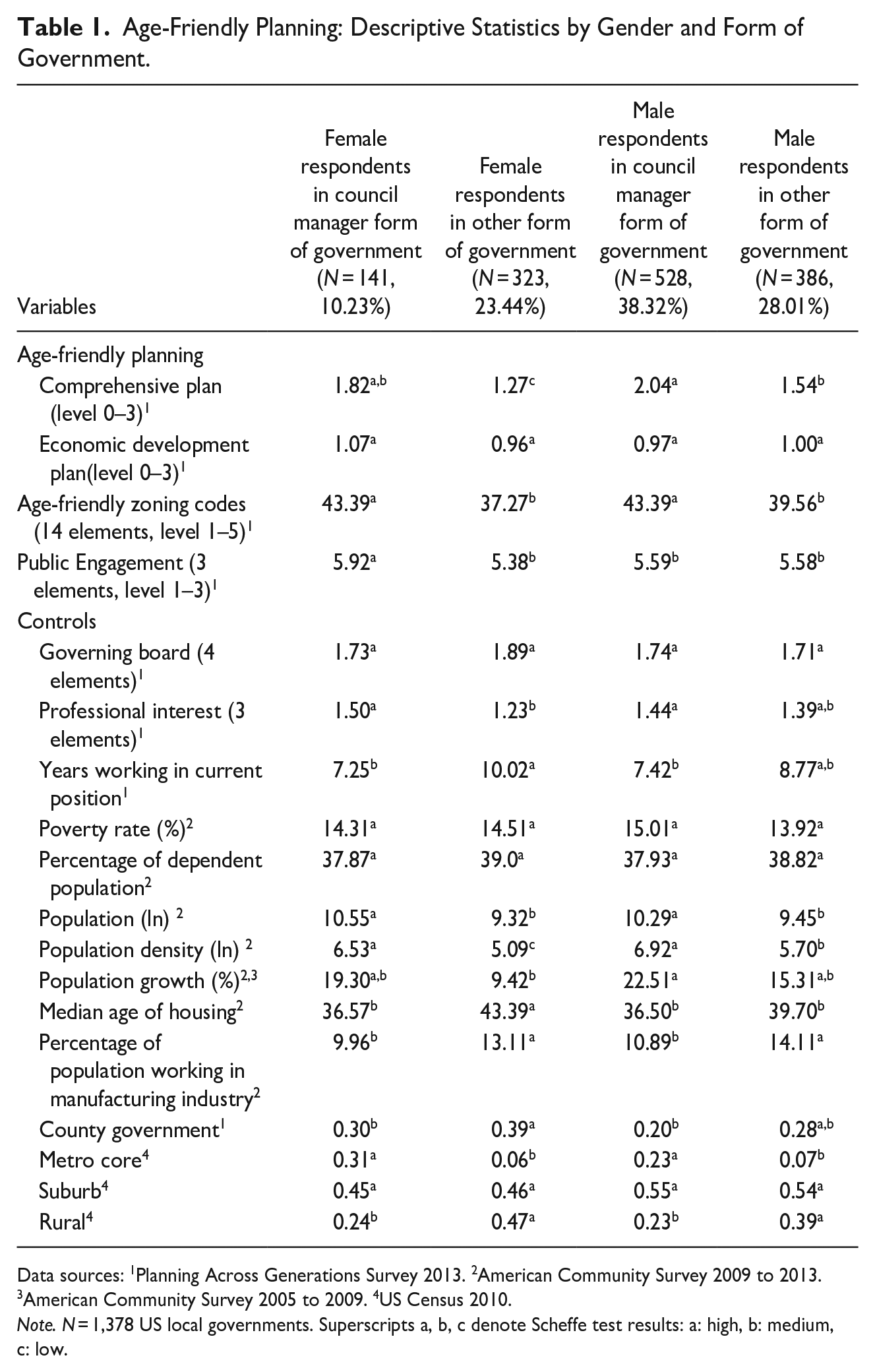
Data sources: 1Planning Across Generations Survey 2013. 2American Community Survey 2009 to 2013. 3American Community Survey 2005 to 2009. 4US Census 2010.
Note. N = 1,378 US local governments. Superscripts a, b, c denote Scheffe test results: a: high, b: medium, c: low.
Public engagement
The survey asked about the “level of engagement of seniors, youth and families with children in planning for their needs.” Engagement of each group was measured on a three-point scale (1 = not at all engaged, 2 = somewhat engaged, and 3 = very engaged). Seniors were reported to have the highest level of engagement, followed by families with young children and youth. Engagement is statistically significantly higher in communities with female managers and in CM governments (Table 1). Communities with more public engagement are expected to have more age-friendly planning and zoning.
Controls
Governing board
The survey asked four questions about the composition of the community governing board. The questions were structured on a continuum with three options; for example, “My community’s board/council is predominantly: long-time residents, evenly mixed, newcomers.” The index to measure if the governing board was evenly mixed aggregates across four sub-questions: (1) evenly mixed between long-time residents and newcomers (32% of respondents), (2) evenly mixed between older residents and younger residents (58%), (3) evenly mixed between conservative and liberal (48%), and (4) evenly mixed between male and female (36%). Communities were least likely to report governing boards evenly balanced by gender or length of residence in community (Table 1). This might lead to less responsiveness to age-friendly concerns. However, Table 1 shows no difference in governing board representativeness by gender or professional management.
Professional interest
The survey asked “what motivates your professional interest in multigenerational planning?” The majority of respondents reported they are motivated by “community needs” (74%, not differentiated by CM form of government). Only a minority reported they were motivated by “fiscal efficiency” (38% CM government, 35% other forms of government), but those motivated by “literature on best practices and emerging trends” were more likely to be professional (32% CM government, 23% other forms of government, p < 0.05). Professional managers would be expected to have more professional interest in these issues, and both male and female respondents from CM governments report higher professional interest compared to respondents from other government types (Table 1). The survey also asked “how many years have you been in your current position?” Table 1 shows female respondents from non-CM forms of government have been in their position for more years.
Socio-economic conditions
Control variables include socioeconomic factors (poverty rate) and demographics (percent of dependent population, total population, population density, population growth). Percent of dependent population includes the percent of population under 18 and percent of population over 65. Economic structure (percent employed in manufacturing) is controlled in the economic plan model, and the age of the community (median age of housing) in the comprehensive plan and zoning models, as older communities may be less likely to plan for changing needs. These variables are drawn from the American Community Survey’s 2009–2013 and 2005–2009 estimates. We differentiate counties from other government types. We control for metro status. Metro core includes cities and counties which have a principal city, and this serves as the reference category. Suburban places are all other metropolitan places. Rural is nonmetropolitan.
Results
Two structural equation models (SEM) were estimated. SEM can estimate sub-models simultaneously and has been used frequently in public administration research (Davis & Stazyk, 2017). SEM uses maximum likelihood methods and can address missing data to preserve sample size. The first SEM model measures the path linking comprehensive plans and zoning codes. The second SEM model measures the factors differentiating communities with more attention to age-friendly issues in their economic development plan. The models were estimated in STATA 14.0 without latent factors. Model performance is tested using equation-level goodness of fit. Model results are shown in Table 2.
Age-Friendly Planning: SEM Model Results.
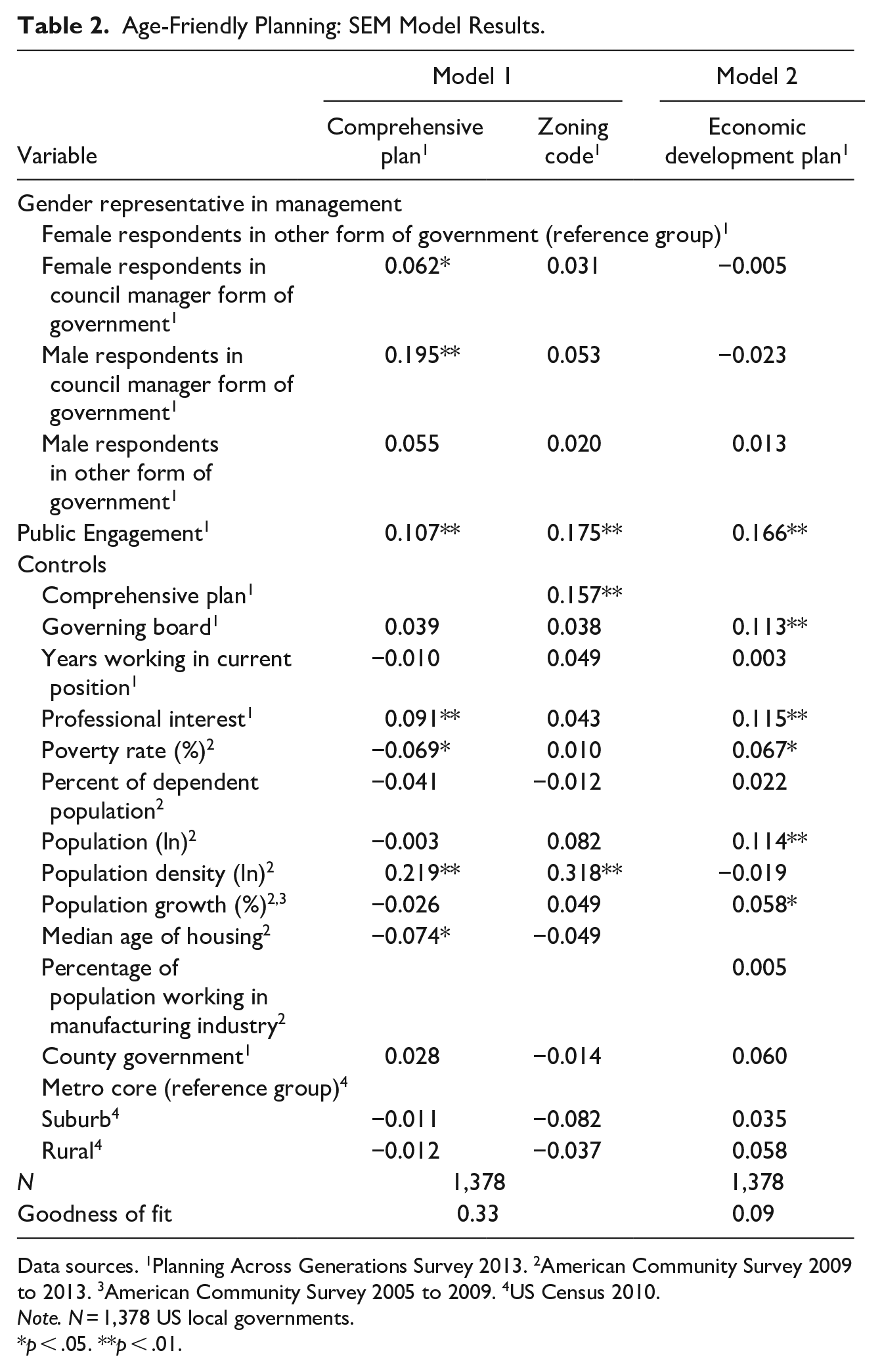
Data sources. 1Planning Across Generations Survey 2013. 2American Community Survey 2009 to 2013. 3American Community Survey 2005 to 2009. 4US Census 2010.
Note. N = 1,378 US local governments.
p < .05. **p < .01.
Female and male respondents by CM and non-CM government are measured with dummy variables. Female respondents in non-CM governments are the reference category. Model results show CM communities are more likely to have comprehensive plans that address the needs of children and older adults than non-CM communities. The coefficient for male respondents is higher than female respondents, but both female and male respondents in CM governments have higher levels of age-friendly planning. It is the professional structure of government that matters more than gender. This lends support to a professional effect over a gender effect. Public engagement has a statistically significant positive effect in both models. It is the only model variable that has a strong positive effect on all three outcomes: comprehensive plans, zoning, and economic development plans.
Communities with age-friendly comprehensive plans have more age-friendly zoning codes. This is expected, as comprehensive plans provide the vision and foundation for elaborating zoning codes. However, no difference by gender or CM government is found in zoning codes. Zoning codes are path dependent and reproduced in the built environment. Thus, institutional barriers to change are stronger in zoning than in comprehensive planning. Age-friendly zoning is higher in larger communities with greater population density. This may reflect the fact that age-friendly best practices are based on principles of walkability and mixed use, which are easier to achieve in more urban environments (Zhang & Warner, 2023).
Neither gender nor CM form of government explain differences in age-friendly economic development plans. However, communities with a more evenly balanced governing board are more likely to address the needs of children and older adults in their plans. Communities with higher poverty are also more likely to have age-friendly economic development plans, as are larger communities and those with more growth.
The professional interest variable includes attention to community need, fiscal efficiency, and literature on best practices. Professional interest has a positive effect in both the comprehensive plan and economic development plan models; this professionalism evidently enables managers to address emerging needs and embrace new paradigms for age-friendly planning.
Community characteristics also matter. Communities with more older housing and higher poverty are less likely to have age-friendly comprehensive plans, but communities with higher poverty are more likely to have economic development plans that address the needs of children and older adults. Larger communities have more age-friendly economic development plans. Denser communities have more age-friendly comprehensive plans and zoning codes. Density increases recognition of the need for age-friendly planning and zoning and makes these practices easier to achieve. County governments do not show significant differences. Differences by metro status are not significant once population size and density are controlled. Level of dependent population has no effect.
Discussion
Representative bureaucracy theory emphasizes active representation, and these models show public engagement distinguishes the level of age-friendly planning and zoning across US communities. Communities which engage families with children and older adults are more likely to reflect their needs in comprehensive plans and zoning and in economic development plans. Public engagement is the only factor which has a positive effect on all three measures of age friendly practice. This supports the theoretical frameworks offered by UNICEF (2004), WHO (2007), and AARP (n.d.) on how to promote more age-friendly communities.
Regarding gender representation and professionalism, the models show that professional management, more than gender, distinguishes communities with more age-friendly planning. Why does gender of the manager not have more of an effect? Recall that female respondents were more likely to be from smaller, rural governments that were not of the council manager form. In these governments, it is possible that organizational culture may be more traditional (Stivers, 2000), and administrative discretion may be limited. Even though female respondents in our sample on average had 2.5 more years of experience in position, they may not have enough power to change paradigms or enough external professional engagement to be aware of new age-friendly planning practices. Future research should explore these questions.
Research on planners has found that even when female planners are in place, they may not have the power to be heard or effect policy change (Turesky & Warner, 2020), especially in regulatory planning functions (Siemiatycki et al., 2020). Similar results have been found among female city managers (Bishu & Headley, 2020; Holman, 2017). Role congruence and expectations may constrain the ability of women to push paradigmatic boundaries (Bosak et al., 2012; Correll & Ridgeway, 2006).
In CM governments, both men and women have a positive effect on age friendly planning. This may be because professional managers help promote active representation, both inside and outside the organization (Bishu & Kennedy, 2020). Research on gender dynamics in planning workplaces has found more gender respect and attention to age-friendly planning issues in planning agencies with female managers (Turesky & Warner, 2020). Professional managers are more likely to be aware of emerging trends (Carr, 2015; K. L. Nelson & Svara, 2012; Warner & Zhang, 2022). The models here show where these professional interests are higher, comprehensive plans and economic development plans are more age-friendly.
While the findings include a positive effect of both CM government and female respondent in the comprehensive planning process, there was no effect on zoning or economic development. Zoning and planning boards are separate entities and have independence from local government managers. Although variances may be granted by these boards, there is strong path dependence in zoning regulations. Zoning codes are baked into the built form of the community and difficult to change in the short term. Once zoning codes are written, they may stay on the books for years. This makes paradigm change difficult. Feminist planners have criticized the gender bias in zoning that privileges single family dwellings and separation of public and private spheres (Hirt, 2013). As residents change and needs shift, zoning codes need to be updated. The comprehensive planning process is more open to public engagement and visioning, but zoning codes are harder to change. Residents can put pressure on their governments by operating in violation of zoning codes (Micklow & Warner, 2014) or seeking variances, but changing zoning requires a willingness to challenge old paradigms.
Similar challenges are faced in economic development, where powerful business interests keep economic development policy focused on tax abatements at the expense of broader community development concerns (Feiock, et al., 2003; Read & Leland, 2019). Less than a quarter of respondents to our survey reported that the needs of children or older adults were addressed in their economic development plans. Similarly, the survey found planning and economic development agencies were less likely to collaborate to address the needs of children and older adults. This is where professional city management can make a difference. The manager, as the chief administrative officer, can require planning and economic development agencies (often male-dominated) to address age-friendly concerns. AARP (n.d.) recommends building community coalitions to push for change. Collaboration across community agencies has been shown to be a critical factor in addressing age-friendly needs (Warner & Zhang, 2021; Zhang & Warner, 2023). However, such collaborations often are limited to social service agencies. To address the structural change that is needed, a broader set of community agencies must be engaged.
Age-friendly planning has the potential to make communities livable for everyone. This universalizing aspect may be one reason why it is professionalism and public engagement, more than gender representation, that distinguish communities with more age-friendly planning and zoning. AARP links its age-friendly initiative as part of its broader Livable Communities initiative to emphasize this universalizing approach (Harrell et al., 2014). The intersectionality of gender with age and the built environment creates both a challenge for equity in governance and an opportunity to bring together a broader coalition of community interests to address the need for paradigm change in planning and zoning.
Building an age-friendly community requires moving beyond traditional conceptions of land use and economic development to make changes in policy and practice. Local governments with professional managers are more able to make those shifts. Bearfield (2009) and Riccucci (2018) have called for more research to address the role of professional government in enabling active representation for policy change. This study shows how professional management facilitates broader public engagement to promote age-friendly planning.
Conclusion
This article explores the first national survey to address age-friendly planning and asks if representative bureaucracy can help explain communities with more age-friendly planning and zoning. It finds that public engagement is a major factor distinguishing age-friendly communities. Active representation, through public engagement, is key.
The models also show that professional management, more than gender representation, distinguishes age-friendly communities. Much public administration research has explored the role of professional management and found managers balance among policy interests of the governing board, residents, and best practices emerging in the field (Nalbandian et al., 2013). Shifting old paradigms to new models of action requires an active role of professional management. To become age-friendly, comprehensive planning must shift from segregated to mixed land use, from commuting to complete streets and walkability, and from single family housing to a wider mix of housing options (Warner & Zhang, 2022). Economic development policy must shift from business attraction strategies to a focus on local services and the care economy (Reese & Ye, 2015; Warner & Liu, 2006). These paradigm shifts require challenging old gendered stereotypes, a process that can be bolstered by support from professional managers. This is not just women’s work, but work for all in planning and public administration.
The promise of representative bureaucracy is that wider representation of the diversity of the community will lead to change. Active public engagement matters. Passive gender representation does not distinguish age-friendly communities, but professional leadership does. Council manager governments are more open to new ways of working, which help communities become more responsive to residents’ needs. Both male and female managers are promoting age-friendly cities.
Footnotes
Authors Note
Xue Zhang is also affiliated to Lerner Center for Public Health Promotion and Population Health, Syracuse University, NY, USA and Center for Policy Research, Syracuse University, NY, USA.
Declaration of Conflicting Interests
The author(s) declared no potential conflicts of interest with respect to the research, authorship, and/or publication of this article.
Funding
The author(s) disclosed receipt of the following financial support for the research, authorship, and/or publication of this article: This research was supported in part by US Department of Agriculture, National Institute for Food and Agriculture Grant nos. # 2019-68006-29674 and #2021-67023-34437.
