



Abstract
This study examined whether a relationship exists between acculturation and alcohol use among African American college students and if the relationship varies by religiosity and gender. Most researchers use unidimensional African American acculturation measures that cannot capture the construct’s complexity; this study is the first to use a bidimensional measure. Results revealed a relationship between acculturation and alcohol use. Less frequent drinking occurred among marginalists (those who reject both African and Eurocentric U.S. culture), while assimilationists (those who reject African culture in favor of Eurocentric U.S. culture) drank more frequently. Religiosity and gender also significantly influenced the nature of the relationship.
Research has consistently indicated that compared with European American college students, African American college students have higher abstention rates and are less likely to use alcohol or engage in binge drinking (Ford & Carr, 1990; O’Malley & Johnston, 2002; Stewart & Power, 2003; Windle, 2003). However, research has also consistently shown that despite their lower rates of alcohol use, African Americans suffer from the negative consequences of alcohol use (e.g., financial difficulties, relationship troubles, ill health) at a disproportionately greater rate than European Americans (Godette, 2009; Grant, 1997; Herd, 1994; Jones-Webb, 1998; Mulia, Ye, Greenfield, & Zemore, 2009). Unfortunately, the cross-race comparisons used in extant research obscure within-group variation, making it difficult to explain the paradoxical relationship between alcohol use and associated consequences among African Americans. Sempos, Rehm, Wu, Crespo, and Trevisan (2003) found a bimodal distribution in African American drinking with a concentration of abstainers on one end and a concentration of heavy drinkers on the other end. Other researchers, focused on demographic variables, found African Americans who abstain from alcohol use are more likely to be women and heavy drinkers are more likely to be men, older in age and lower in income (Caetano & Kaskutas, 1995; Herd, 1990; Jones-Webb, 1998).
Although these demographic variables tell us who is engaging in different drinking patterns, they do not tell us why the within-group differences exist. That is, they do not tell us what ethnocultural factors (e.g., acculturation, ethnic identity, religiosity) are associated with various drinking patterns among African Americans. Although there is limited research on the impact of ethnocultural variables on African American alcohol use, such variables have been shown to predict self-esteem (Phinney, Cantu, & Kurtz, 1997; Spencer, Noll, Stoltzfus, & Harpalani, 2001), smoking (Klonoff & Landrine, 1999b), and other outcomes. Thus, we examined the role of ethnocultural variables in predicting within-group differences in African American alcohol use. Specifically, we examined acculturation and religiosity.
Acculturation
The interactions that occur between two cultures inevitably result in varying degrees of immersion and acceptance of the cultural ideals of each of the cultures by their members. Ideally, both groups change through cultural contact, but the reality is that powerless groups do more changing and adapting than do powerful groups. Thus, in research conducted in the United States, acculturation typically refers to the degree to which an ethnic minority individual identifies with the attitudes, lifestyles, and values of the dominant, Eurocentric U.S. culture (Lee, 1997). Unidimensional conceptualizations depict acculturation as a single continuum with complete immersion in the dominant culture on one end and complete immersion in one’s culture of origin on the other. The assumption is that as people become more immersed in the dominant culture they necessarily identify less with their own culture. Some researchers (e.g., Berry, Kim, Power, Young, & Bujaki, 1989; Obasi & Leong, 2010) argue that acculturation is better conceptualized as a bidimensional construct with identification with the dominant culture as one dimension and identification with one’s culture of origin as a separate, orthogonal dimension. Thus, people are not forced into either immersion in one culture or the other; they could be immersed in both cultures or in neither culture.
Based on this bidimensional model, Berry et al. (1989) identified four acculturation strategies: assimilation, separation, integration, and marginalization (see Figure 1). Applied to African Americans, the bidimensional acculturation model argues that in reaction to contact between African and Eurocentric cultural thoughts and ideals, African Americans could either merge the two cultural ideals into one (integration, sometimes called bicultural), adopt Eurocentric cultural thoughts and ideals and reject African culture (assimilation), remain true to African thoughts and ideals and reject Eurocentric culture (separation, sometimes called traditional), or reject the thoughts and ideals of both African and Eurocentric cultures (marginal; Obasi & Leong, 2010). Using factor analyses, Obasi and Leong (2010) found that this bidimensional conceptualization is a better representation of African American acculturation than the traditionally used unidimensional conceptualizations.
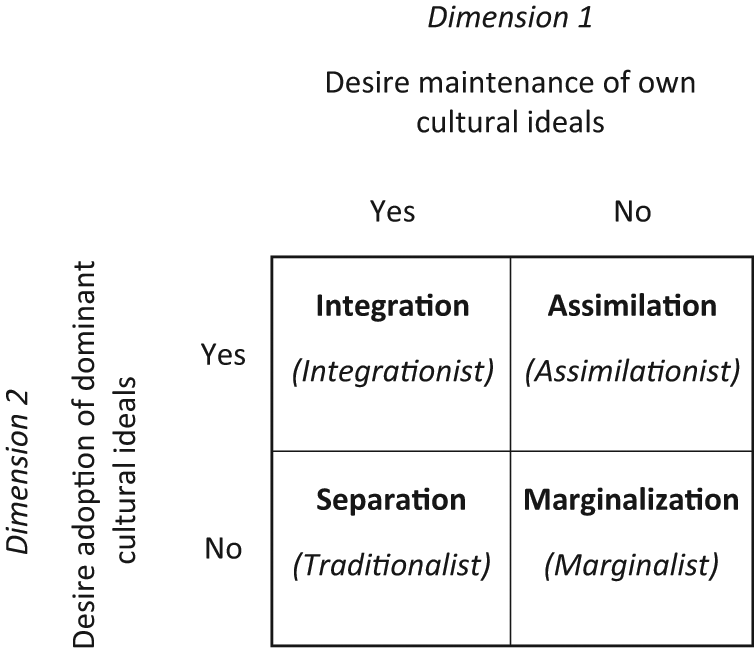
Acculturation strategies based on Berry et al.’s (1989) and Obasi and Leong’s (2010) bidimensional model
Most researchers that examine the relationship between acculturation and substance use find that those who are more assimilated into Eurocentric U.S. culture use more substances and use them more heavily than those who remain entrenched in their culture of origin (e.g., Akins, Mosher, Smith, & Gauthier, 2008; Gilbert, 1991; Herd & Grube, 1996; Johnson & Nagoshi, 1990). Much of this research has been with Latino and Asian samples, but the limited research investigating the link between acculturation and substance use among African Americans shows this same pattern. For example, Gil, Wagner, and Tubman (2004) investigated the impact of five cultural factors (perceived discrimination, acculturation, ethnic mistrust, ethnic pride, and ethnic orientation) on substance use and found that African Americans with greater ethnic pride and ethnic orientation consumed less alcohol. Similarly, Klonoff and Landrine (1999a) found that African Americans who abstained from alcohol use were less acculturated to the dominant, Eurocentric, U.S. culture. Orozco and Lukas (2000) examined gender differences in acculturation and aggression as predictors of substance use in a sample consisting of 18 African Americans and 10 Latinos and found that acculturation was the best predictor of polydrug use, followed by gender. Brook and Pahl (2005) found that familism, church attendance, and identification with African American friends were associated with lower drug use. Though the findings from these studies are encouraging, a limitation is that nearly all of the extant literature conceptualizes African American acculturation as a unidimensional as opposed to bidimensional construct. There are no known studies to date that have used a bidimensional model to evaluate the relationship between acculturation and alcohol/drug use among African Americans.
Religiosity
Substantial research examining racial differences in religiosity in adolescents and adults indicates that African Americans tend to be more religious than European Americans, and that the association between religious beliefs and health for African Americans is more salient (Bowie, Ensminger, & Robertson, 2006; Brown, Parks, Zimmerman, & Phillips, 2001; Taylor, Mattis, & Chatters, 1999). African Americans go to church more often, and are more likely to be members of a church or church-related group, pray privately, carry out religious rituals (Gallup, 1984; Jacobson, Heaton, & Dennis, 1990; Johnson, Matre, & Armbrecht, 1991; Sasaki, 1979) and view religion as important and significant (Taylor et al., 1999). Historically, religion has been a unifying force for African Americans, and religious institutions have served not only as places of worship, but also as primary locations for civil activism and social gathering, offered financial and emotional support during hardships, and served as cauldrons of intellectualism and creativeness (Taylor et al., 1999). It is not surprising, therefore, that religion often emerges as an important predictor and protective factor for many psychological outcomes among African Americans, including alcohol use.
African Americans who consider religion very important are less likely to engage in drinking than those for whom religion is not as important (Hanson & Engs, 1987) and are more likely to abstain from use all together (Krause, 1991). Although few studies have examined the relationship between religiosity and alcohol use in college students, studies using adolescent and adult samples are encouraging. For example, Park, Bauer, and Oescher (2001) found that for African American adolescents, intrinsic, subjective components of religion (e.g., the importance of religion to a person), but not extrinsic, behavioral components of religion (e.g., church attendance), significantly predicted alcohol use, even after controlling for socioeconomic status, gender, family interaction, academic achievement, time spent on extracurricular activities, self esteem, and locus of control. Bowie et al. (2006) longitudinally studied the effects of religiosity, social resources, and mental health on alcohol use problems in African American adults and found that, among those who were depressed, frequent churchgoers had significantly fewer alcohol use problems than their less frequent churchgoing counterparts. Therefore, different components of religiosity may be important in predicting alcohol use for adolescents and adults, making it important to measure religiosity among college students in a way that includes both intrinsic and extrinsic components.
Current Study
The current exploratory study, which investigated the effects of acculturation and religiosity on African American college students’ alcohol use, built on extant research in four key ways. First, it examined the relationship between religiosity and alcohol use in an African American college student sample. College is often a time of experimentation, a time when students are free from the watchful eyes of their parents and when their newfound independence affords them greater choice regarding alcohol use and the role religion plays in their daily lives. Second, we used a comprehensive, multi-item approach to assess intrinsic and extrinsic aspects of religiosity to increase the reliability of measurement. Third, although the studies reviewed point out racial differences in the relationship between religiosity and alcohol use, they do not offer an explanation for these differences. Thus, we examined the role of acculturation in explaining within-group differences. Finally, we used a bidimensional conceptualization to more accurately depict African American acculturation.
Method
Participants
Participants were 203 African American undergraduate students enrolled in Introduction to Psychology classes at the University of Kentucky (UK; n = 178)— a predominantly White institution, and the University of the District of Columbia (UDC; n = 25)— a historically Black university. For increased generalizability, we used institutions with contrasting demographic characteristics. Table 1 depicts overall demographic means and percentages as well as separate demographic means and percentages for UK and UDC. UK participants were mostly women (65.9%) and ranged in age from 17 to 25 years (M = 18.85, SD = 1.185). Their socioeconomic status (SES) was greater than the middle range (M = 47.011). The majority of UK participants (67.4%) were freshmen and enrolled fulltime. UDC participants were also mostly women (60%), but they had a much broader age range than UK participants with ages ranging from 19 to 55 years (M = 30.76, SD = 9.83). UDC students were also above the middle range in SES (M = 41.72). UDC participants were primarily juniors (36%), or freshmen (32%), and most (66.7%) were full-time students.
Sample Characteristics
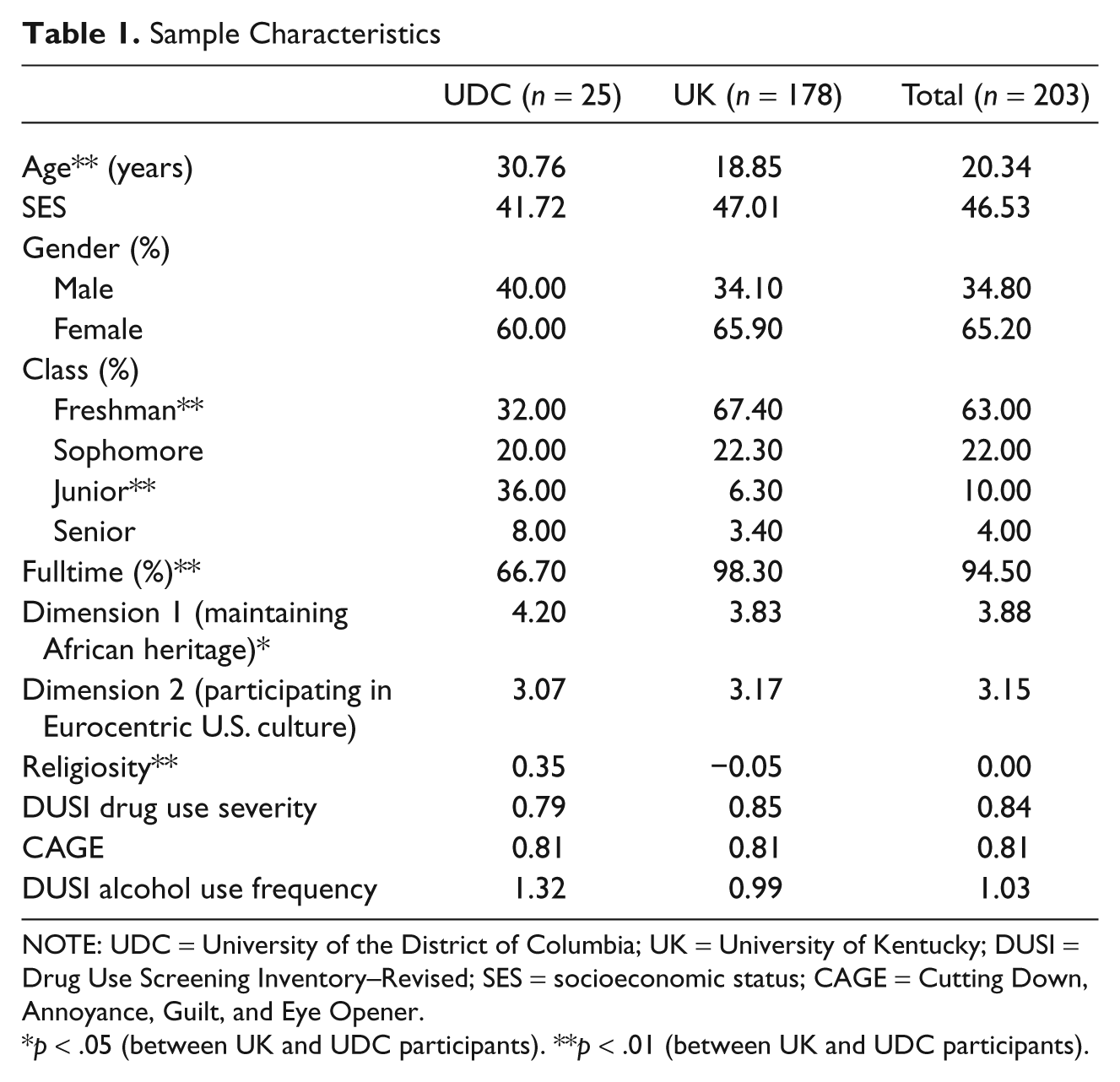
NOTE: UDC = University of the District of Columbia; UK = University of Kentucky; DUSI = Drug Use Screening Inventory–Revised; SES = socioeconomic status; CAGE = Cutting Down, Annoyance, Guilt, and Eye Opener.
p < .05 (between UK and UDC participants). **p < .01 (between UK and UDC participants).
Measures
Alcohol use
To assess frequency of alcohol use, we administered a single item from the Drug Use Screening Inventory–Revised (Tarter & Kirisci, 1997), “How many times have you used alcohol in the past month?” There are five categories to indicate frequency of use: 0 times, 1 to 2 times, 3 to 9 times, 10 to 20 times, and more than 20 times. We used this item because it is consistent with the alcohol use frequency measures used in national and regional studies involving African American and college student samples (e.g., O’Malley & Johnston, 2002; Substance Abuse and Mental Health Services Administration [SAMHSA], 2007).
Acculturation
To assess acculturation, the 45-item Measurement of Acculturation Strategies for People of African Descent (Obasi & Leong, 2010) was used. This is a bidimensional acculturation instrument designed specifically for people of African descent living in the United States. To date, it is the only instrument that measures African American acculturation bidimensionally. The measure contains two dimensions, Dimension 1 (D1; 22 items) and Dimension 2 (D2; 23 items), and crossing the two dimensions yields four quadrants, as seen in Figure 1. Thus, D1 measures the extent to which a person maintains African ethnocultural heritage, while D2 measures the extent to which a person participates in Eurocentric U.S. culture. For example, D1 contains items such as, “I was socialized to treat my elders with respect,” and “I actively support Black-owned businesses.” D2 includes items such as, “I express different cultural values in order to fit in” and “I am comfortable putting on the mask in order to fit in.” Individuals rated their endorsement of items on a six-point continuum ranging from 1 = strongly disagree to 6 = strongly agree. In the standardization sample, internal consistencies ranged from α = .80 to .87 for D1 and α = .75 to .81 for D2. In this study, the internal consistency for D1 was α = .84 and for D2 it was α = .71.
Religiosity
Religiosity was assessed using the Brief Multidimensional Measure of Religion/Spirituality (Fetzer Institute, 1999), a measure developed specifically for use in studies assessing physical or psychological health outcomes. The measure contains 12 domains that evaluate behavioral, social, philosophical, and denominational aspects of religion and spirituality. Two of the domains, private religious practices and daily spiritual experiences were used in this study. The private religious practices domain reflects an external or behavioral component of religiosity and is composed of four questions that require participants to indicate how often they pray privately outside places of worship, how often they meditate, how often they watch or listen to religious programs on TV or radio, and how often they read religious literature. The eight response choices for this scale range from 0 = never to 7 = more than once a day. Data from a national survey determined that the internal consistency for private religious practices was α = .72 (Fetzer Institute, 1999), which is comparable to the α = .75 found in this study.
The daily spiritual experiences domain reflects an internal component of religiosity and is composed of 6 items that prompt participants to indicate how often they feel God’s presence, find strength and comfort in their religion, feel deep inner peace/harmony, desire to be closer to or in union with God, feel God’s love, and are spiritually touched by the beauty of creation. The response choices are on a 6-point scale ranging from 0 = never or almost never to 5 = many times a day. A national survey determined that the internal consistency for the daily spiritual experiences domain was α = .91 (Fetzer Institute, 1999), and in this study it was α =.87. A composite religiosity score was calculated by z score transforming participants’ scores on each of the 10 items and averaging them. Low scores indicate low levels of religiosity and high scores indicate high religiosity.
Demographics
Participants were asked to state their ages, indicate whether they are male or female, write their current and permanent zip codes, and select their academic classifications (i.e., freshman, sophomore, junior, senior, or other). SES was measured using the Barratt Simplified Measure of Social Status (Barratt, 2006). This measure was chosen because it updates Hollingshead’s SES measure by including current occupational prestige ratings. Barratt’s measure combines parental education/occupation scores with the person’s own education/occupation scores, and weights the scores in such a way as to reflect any generational shifts in social status. The measure prompts respondents to select the appropriate level of school completed and occupation for themselves and their mothers, fathers, and spouses. Participants are also asked whether they are married, if they live alone, whether they are full-time students, whether they grew up with both parents, and who their primary caretakers were. Numerical values are assigned to each of the possible responses, and scores are determined based on participants’, parents’, and spouses’ levels of school completed and occupations, taking into account family structure, student status, and marital status. Total scores can range from 8 to 66, with lower numbers indicating lower SES. Internal consistency for the measure in the present sample was α = .79.
Procedures
This study was approved by the Institutional Review Boards at the University of Kentucky and the University of the District of Columbia. The procedures used at the two schools differed slightly and are outlined separately below.
University of Kentucky
Participants were recruited from the Introduction to Psychology subject pool. African American students enrolled in the course were contacted via email and phone and asked to participate in the study. At each data collection session, the study was explained and informed consent was obtained from the students. Each participant was offered a copy of the consent form to keep. Participants were instructed on how to complete the questionnaire packet and reminded to read the instructions for each of the sections. A proctor distributed the questionnaire packets and the participants completed them. After completing all the measures, the participants were given a credit slip to submit for academic credit, thanked for their participation, and dismissed.
University of the District of Columbia
Participants were recruited from the Introduction to Psychology classes. After obtaining permission from the professors, we went to several classes and explained the study. Each student was given an informed consent form, and those agreeing to participate were asked to write their email addresses on the form, sign the form, and return it. Questionnaire packets were distributed to those who agreed to participate, and they were instructed on how to complete the packets and reminded to read the instructions for each of the sections. Those who completed the questionnaires in class returned them in person. Those who were unable to complete the packets in class were given preaddressed, prestamped envelopes; and were asked to mail their packets when they completed them. An email was sent to all students who provided their email addresses on the consent form, reminding them to mail their questionnaire packets if they had not already returned them. The professors at UDC offered extra credit to those agreeing to participate.
Results
In this study’s sample, 57.5% consumed alcohol at least once in the past month. According to a nationwide study of African Americans between the age of 18 and 25 years, past month alcohol use prevalence is 46.9% (SAMHSA, 2007). Statistics from Monitoring the Future indicate that 69.6% of college students used alcohol in the past month; however, these prevalence rates were not broken down by ethnicity (O’Malley & Johnston, 2002). This sample’s prevalence rate is almost exactly between the SAMHSA’s and O’Malley and Johnston’s, which appears accurate given that noncollege young adults tend to drink less than young adults in college (Johnston et al., 2003), and African American college students drink less than the general college population (Ford & Carr, 1990).
Table 2 shows the bivariate correlations among study variables. Religiosity was positively correlated with D1, r = .469, p < .01, such that preference for maintaining African heritage was associated with greater religiosity. Gender was correlated with alcohol use frequency, r = −.200, p < .01, and D2, r = −.158, p < .05, such that being male was associated with greater alcohol use and adoption of Eurocentric U.S. culture. None of the other study variables was statistically significantly correlated.
Bivariate Correlations Between Study Variables
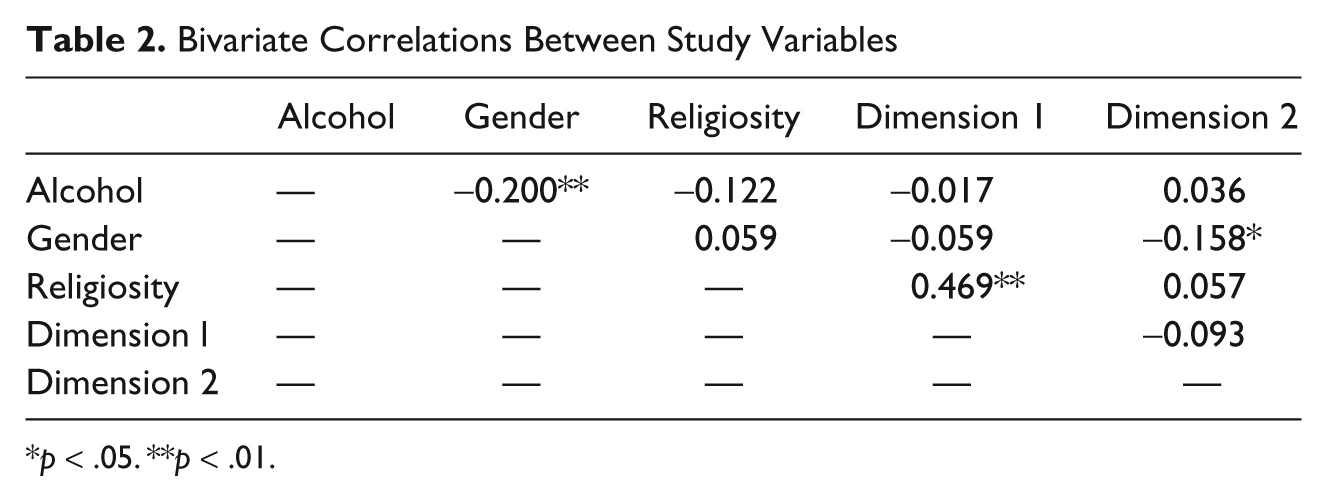
p < .05. **p < .01.
Prior to running regression analyses, we ran independent samples t tests to examine whether there were differences between UK and UDC students on the study variables and descriptive variables. Results indicated differences on D1 and religiosity with UDC students endorsing greater preference for maintaining African heritage (D1), t(202) = −2.759, p = .006, and more religiosity, t(202) = −2.881, p = .004. UDC students were also significantly older, t(198) = −15.476, p = .000, and more likely to be classified as juniors, z = 4.276, p = .000, while more UK students were enrolled in college full-time, t(198) = 7.107, p = .000, and classified as freshmen, z = 3.211, p = .001. Because of these significant differences, school was used as a covariate for all regression analyses.
Hierarchical multiple regression analysis was used to examine main effects and interactions of D1, D2, religiosity, and gender in predicting alcohol use frequency. Table 3 displays the results of the regression. School was entered in Step 1 as a covariate to account for differences between universities but was not a significant predictor of alcohol use (β = .098, p > .05).
Hierarchical Regression Analysis With Alcohol Use Frequency as the Dependent Variable
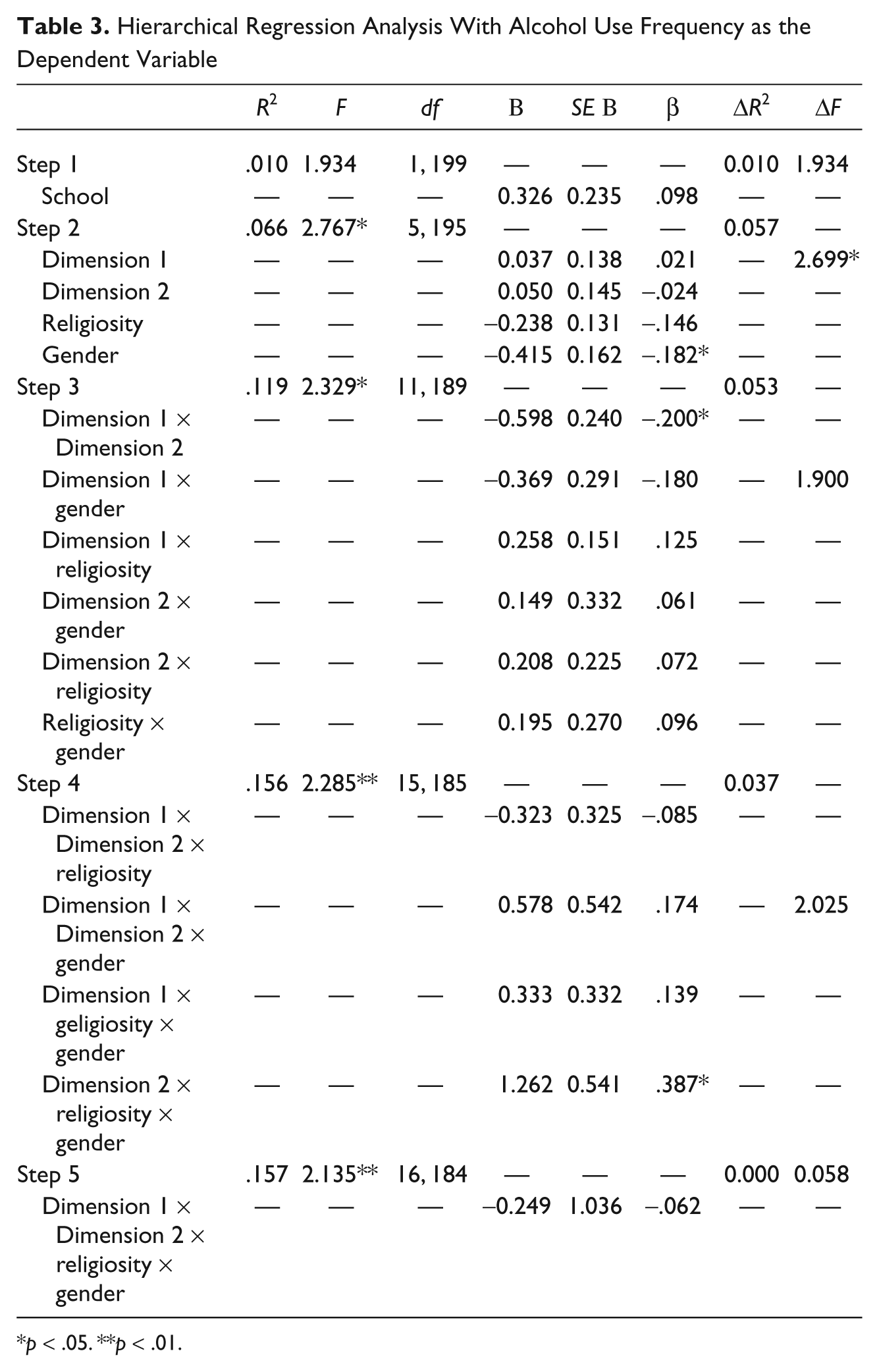
p < .05. **p < .01.
D1, D2, religiosity, and gender were entered on the second step; the two-way interaction terms were entered on the third step. There was a significant main effect in Step 2 for gender, β = −.182, p = .011, such that males consumed alcohol more frequently than females. None of the other main effects were significant.
We entered the two-way interaction terms (D1 × D2, D1 × religiosity, D1 × gender, D2 × religiosity, D2 × gender, religiosity × gender) in Step 3. The D1 × D2 interaction was significant (β = −.200, p = .014). We probed the interaction with regression, examining alcohol use frequency at ±1 SD from the mean D1 and D2 scores. Probing the interaction indicated that at lower levels of D1, higher D2 predicts significantly greater alcohol use than lower D2 (β = .218, p = .049). To use Berry et al.’s (1989) and Obasi and Leong’s (2010) nosology, these results indicate that those in the assimilation group tend to use alcohol more frequently than those in the marginalization group.
In Step 4, we entered the three-way interaction terms (D1 × D2 × religiosity, D1 × D2 × gender, D1 × religiosity × gender, D2 × religiosity × gender). Although the ΔR2 was not significant (ΔR2 = .037, p = .143), results indicated a significant D2 by religiosity by gender interaction (β = .387, p = .021). We probed the interaction using regressions in which we examined males and females separately and used ±1 SD from the mean to determine “high” and “low” D2 and religiosity scores. Results of the interaction probe should be interpreted with caution since the amount of variance Step 4 added in predicting alcohol use frequency was not statistically significant. Results showed that differences depending on religiosity closely approached significance for females who were low on D2 (β = −.177, p = .05). Females who were high in religiosity and low on D2 (the extent to which Eurocentric U.S. culture is participated in) drank significantly less frequently than females who were low in religiosity and low on D2. Figure 2 depicts the assimilation by religiosity by gender interaction. Examination of Figure 2 shows that the pattern was opposite for males and females based on D2 and religiosity levels. Females who were high in religiosity did not use alcohol frequently regardless of their D2 score. However, for females who were low in religiosity, high D2 seemed to be protective, whereas being low in religiosity and low on D2 was associated with more frequent alcohol use. A different pattern emerged for the males. For males, being high on D2 appeared to be protective for those high in religiosity and being low on D2 was protective for those low in religiosity.
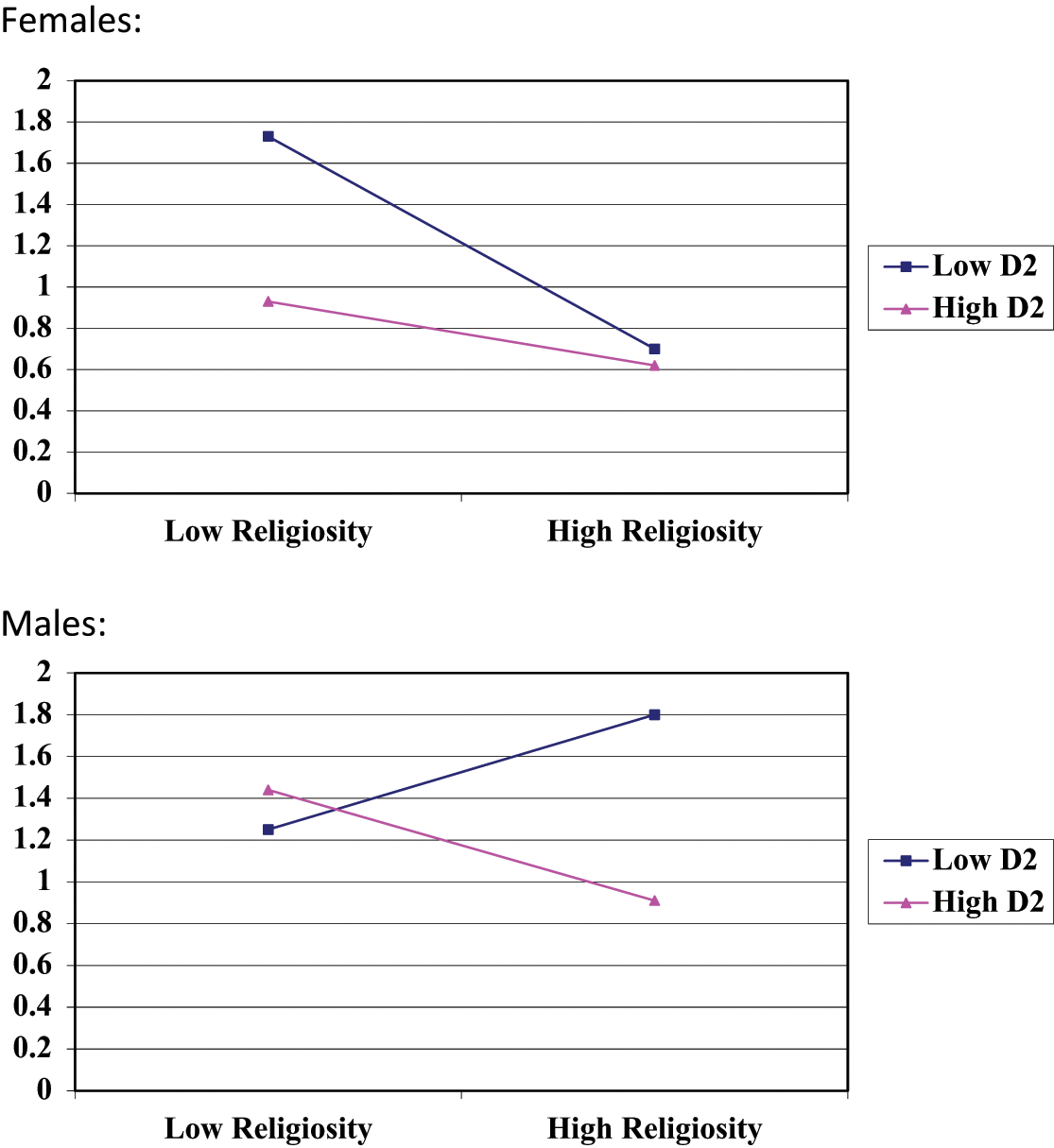
Dimension 2 by religiosity by gender interaction
Although none of the other probing regressions was significant, examination of the diagram indicates that women who were low on D2 and religiosity drank significantly more than women who were high in religiosity and low on D2. We entered the four-way interaction (D1 × D2 × religiosity × gender) in Step 5. Although the omnibus F for Step 5 was statistically significant (F = 2.421, p = .009), there was no additional variance accounted for by the four-way interaction (ΔR2 = .000, p = .810), and the interaction was not significant (β = .376, p = .810) so it was not probed. Altogether, the entire model explained 15.7% of the variance in alcohol use frequency.
Discussion
Although African Americans have been increasingly included in alcohol use research, they tend not to be examined separately from other racial and ethnic groups to determine what culturally based variables are relevant in predicting their alcohol use. To begin to address this problem, the present study focused specifically on African Americans and examined culturally based variables (acculturation and religiosity) that might differentiate among African Americans’ alcohol use. Results of this study indicate that there is a relationship between acculturation and alcohol use among African American college students, and that religiosity and gender play an important role in determining the nature of that relationship.
Results showed a two-way interaction between D1 (the extent to which African ethnocentric heritage is maintained) and D2 (the extent to which Eurocentric U.S. culture is participated in), and a three-way interaction among D2, religiosity, and gender. However, there was an insignificant increase in the amount of variance in alcohol use frequency accounted for by the three-way interaction. The two-way interaction indicated that marginalists, those who were low on both D1 (the extent to which African ethnocentric heritage is maintained) and D2 (the extent to which Eurocentric U.S. culture is participated in) used alcohol less frequently than assimilationists (those low on D1 but high on D2). In other words, for African Americans in college, drinking occurs more frequently among those who have an acculturation style in which they reject African cultural beliefs and behaviors in favor of Eurocentric U.S. cultural beliefs and behaviors. That assimilationists had the most frequent alcohol use was not surprising as adoption of Eurocentric U.S. culture has been shown to increase drinking behavior in other ethnic groups. In their study examining acculturation and substance use among Latino adults in the United States, Akins et al. (2008) found that Latinos who replaced their traditional cultural beliefs and practices with those of Eurocentric U.S. culture had higher rates of illicit drug use, hard drug use, binge drinking, and bender drinking. Research with American Indian adults has yielded similar results, indicating that after controlling for demographic variables, those who were less oriented toward American Indian culture were more than four times as likely to be heavy drinkers compared with those who were more oriented toward American Indian culture (Herman-Stahl, Spencer, & Duncan, 2003). The drinking rates of Asian Americans have also been shown to conform to those of Whites in the United States as assimilation occurs (Johnson & Nagoshi, 1990). And, Herd and Grube (1996) described how Italians and Cubans, groups that historically exhibited low rates of problem drinking because of cultural norms that proscribe heavy drinking and dictate drinking primarily in conjunction with meals and mainly with family, had significant increases in rates of heavy drinking after assimilating to Eurocentric U.S. culture that emphasizes recreational drinking with friends and drinking as the focus of activity.
The findings of our study suggest that the pattern that greater assimilation is associated with greater alcohol use holds true for African Americans. Future research should not only replicate our findings with college students to see if the pattern of results holds true for their same age, noncollege peers, and other age groups, but it should also further investigate what it is about assimilation that encourages alcohol use. Equally important is research that identifies which aspects of African American culture are most protective against frequent alcohol use for assimilationists, as this would most meaningfully inform prevention and intervention efforts.
What was surprising was that marginalists, those who were low on both D1 and D2, had low levels of alcohol use. Other researchers have found that marginalists experience the most psychological distress because they feel constant pressure to assimilate and simultaneously constant pressure to be traditional (Neff & Hoppe, 1993). The idea is that because they fit in neither with traditional African culture nor with the dominant, Eurocentric U.S. culture, they are isolated, experience considerable social pressure for not belonging, and consequently, suffer distress. Indeed, Carvajal, Hanson, Romero, and Coyle (2002) examined acculturation and mental health in Latino adolescents and found that marginalists endorsed more depressive symptoms than traditionalists, integrationists, and assimilationists. Our results are inconsistent with this extant research and may suggest that a different process is at work for African Americans.
It was also surprising that being high in D1 (the extent to which African ethnocultural heritage is maintained) was not a statistically significant predictor. Extant research has suggested that adhering to traditional African culture is protective against substance use (e.g., Gil et al., 2004). We did not find this in our study. Instead, our study found that being low in assimilation was predictive of less substance use. Thus, the results of our study suggest that it is not remaining traditional that protects, but refraining from assimilating to Eurocentric culture that is protective. A difference between our study and others is that we defined acculturation bidimensionally whereas others used unidimensional measures. In unidimensional conceptualizations, refraining from assimilating is confounded with remaining traditional in a way that does not allow these processes to be examined independently. More research is needed to better understand how being low in assimilation beliefs and behaviors (D2) is different from being high in traditional beliefs and behaviors (D1) for African Americans.
While the general pattern of findings in this study was that there is a link between acculturation and alcohol use for African Americans, the three-way interaction suggests that the link between D2 and alcohol use varies as a function of religiosity and gender. The interaction among religiosity, gender, and D2 in predicting alcohol use adds another facet to the results by elucidating potential reasons why females and males differ from each other and within their gender groups on alcohol use frequency. For females who were low in religiosity, high D2 seemed to be protective, whereas being low in religiosity and low on D2 was associated with more frequent alcohol use. Females who were high in religiosity did not use alcohol frequently regardless of their D2 score. Research generally indicates that compared with African American men, African American women tend to be more religious (Lesniak, Rudman, Rector, & Elkin, 2006) and use less alcohol (Johnson, Gruenewald, Treno, & Taff, 1998). Religiosity may serve as a protective factor against alcohol use for African American women because of religious proscription against excessive alcohol use and drunkenness, because it serves as a different coping mechanism, or because places of worship often provide alcohol-free social outlets (Bazargan, Sherkat, & Bazargan, 2004; Bowie et al., 2006).
A different pattern emerged for the males. For males, being high on D2 appeared to be protective for those who were high in religiosity, and being low on D2 was protective for those who were low in religiosity. Also, out of all the men in the sample, those who were high in religiosity used alcohol either most frequently (when low on D2) or least frequently (when high on D2). This lends support to the adoption of Eurocentric U.S. values (D2) as an instrumental factor in making a distinction among religious males. It is possible that for those men high in religiosity, there is some factor associated with adoption of Eurocentric U.S. values that leads those high on D2 to drink much less frequently than those low on D2. Similar to women, those men low on D2 could experience stress associated with living in, but not fitting in with, Eurocentric U.S. society (Neff & Hoppe, 1993). But unlike women, for men, those low on D2 and high in religiosity drink much more frequently than those low on both D2 and religiosity. Longitudinal studies examining the development of religiosity, alcohol use trajectories, and the development of acculturation are needed to help us better understand the relationship among those variables and the role they may play in causing and coping with distress. Also of note, gender was a differentiating characteristic in its interplay with D2 and religiosity, but not D1 alone or the D1 by D2 interaction, which may suggest that males and females develop the desire to adopt beliefs and behaviors consistent with Eurocentric U.S. culture (D2) differently from the way they develop the desire to maintain African ethnocultural beliefs and behaviors (D1). Longitudinal studies would help determine how early males and females differ on D2 and if D1 develops similarly for them.
Study Limitations
This study has provided a better understanding of the roles of acculturation, religiosity, and gender in predicting African American college students’ alcohol use. However, like all studies, it has limitations. One limitation is the use of a single-item measure for alcohol use. A disadvantage is that single-item measures tend not to capture construct complexity. While the measure used in this study measures frequency of use in the past month, it does not capture distinctions in drinking patterns. However, an advantage of using a single-item measure is that it allows for a direct comparison of this study’s results with extant research, as most research—especially nationally representative studies—use the same single-item we used in this study. Future research should also assess alcohol use patterns as they relate to acculturation, religiosity, and gender.
The cross-sectional design of the study is another limitation. Given that this is the first study to investigate the relationship between alcohol use and acculturation conceptualized bidimensionally among African Americans, a cross-sectional design seemed reasonable and appropriate. However, a longitudinal design would allow for a more complex examination of patterns in acculturation, religiosity and alcohol use over time, and it would likely contribute to a more complete understanding of the relationships that exist among those variables.
Our sample size of 203 was sizeable compared with other studies of African American alcohol use, and it provided sufficient power to detect large and medium effects. However, there was not enough statistical power to detect small effects. Thus, there may have been some small, but significant effects that were not detected. Our large sample size gave use sufficient power to detect a three-way interaction, a two-way interaction, and a main effect; yet, there were several trends that did not reach significance. Future research should replicate this study with an even larger sample size.
Conclusion
Despite its limitations, this study is innovative and informative in its examination of African American acculturation bidimensionally. This is one of few studies that has been able to investigate integrationist and marginalist acculturation styles among African Americans because measuring acculturation unidimensionally as opposed to bidimensionally eliminates those possibilities. Also, because few studies examine acculturation bidimensionally among African Americans, more research is needed to clarify what it means for an African American to be marginalist and integrationist. Focus groups of African Americans ascribing to each of the acculturation styles would elucidate these terms specifically as they apply to African Americans.
By focusing specifically on African Americans, this study also provides meaningful insight into within-group variation in African American students’ alcohol consumption. Although the purpose of this study was to look at the relationships among acculturation, religiosity, gender, and alcohol use frequency in African American college students, various extensions of this study, such as examining non–college-enrolled African American adults within the same age range as the present sample would be equally meaningful. As this line of research continues to be cultivated, studies should also focus on the development or augmentation of interventions to increase the effectiveness of alcohol prevention and treatment programs for African Americans.
Footnotes
Declaration of Conflicting Interests
The authors declared no potential conflicts of interest with respect to the research, authorship, and/or publication of this article.
Funding
The authors received no financial support for the research, authorship, and/or publication of this article.