




Abstract
Two experiments assess the extent that targets’ stereotypically Black physical features and individual differences in perceiver discrimination expectations influence racism-related responses. In Experiment 1, a total of 115 Black college students read about an ambiguously racist workplace situation. Participants reported their hostile emotions and racism attributions. In Experiment 2, a total of 121 Black college students read about two White police officers who physically harm a Black male. Participants reported their experience of empathy for the Black target. In both experiments, stereotypically Black physical features of the Black target were experimentally manipulated, and individual differences in discrimination expectations were assessed. More stereotypically Black physical features elicited greater racism attributions, greater hostile emotions, and more empathy for the target; and in all cases, the impact was stronger for Blacks with low discrimination expectations relative to those with high discrimination expectations. When person-related variables are especially salient, the influence of situational factors is necessarily reduced. Specifically, our findings demonstrate the insensitivity to racism-related situational cues that may be most pervasive for Blacks with high discrimination expectations.
Recently, a popular talk show featured a segment focused on racism in America. At one point, a light-skinned Black woman was discussing her feelings regarding being victimized by racism. Interestingly, several Black members of the audience questioned the veracity of the racism charges because of her skin color. One of the audience members said, “That wasn’t racism, you’re just whining while real victims of racism truly suffer.” This incident raises a number of interesting questions regarding factors that might influence Blacks’ attributions of racism in any given situation. Are racism attributions influenced by characteristics of the alleged victim? While prejudice researchers have shown great interest in assessing factors that might influence attributions to discrimination (e.g., Johnson, Simmons, Trawalter, & Ferguson, 2003; Major, Quinton, McCoy, & Schmader, 2000; Pinel, 1999), they have given minimal empirical attention to the extent that target characteristics might influence such attributions. Importantly, are there individual differences among Blacks that might determine the extent that these characteristics would have an impact on racism attributions? To address these issues, the present study assessed whether the impact of the alleged victim’s physical features (i.e., the extent to which the victim possesses stereotypically Black physical [SBP] features) on racism attributions and emotional responses will be moderated by individual differences in participant discrimination expectations.
Target Stereotypically Black Physical Features and Race-Related Responses
A focus on the impact of Black intragroup differences reflects the recent perspective of many scholars, who suggest that a broad approach to racial categorization (i.e., Whites and Blacks) tends to neglect meaningful dimensions of variability among minorities. More importantly, this variability can have implications for intergroup attitudes and responses. For example, in their prejudice distribution account of negative attribution toward minorities, Kaiser and Pratt-Hyatt (2009) demonstrated that Whites express more negative attitudes toward strongly identified minorities than weakly identified minorities. For the present investigation, we propose a perceived prejudice distribution perspective, which suggests that discrimination and prejudice attributions are not equally distributed among stigmatized group members. Specifically, we expect that racism attributions would be positively associated with the extent that Black targets possessed SBP features.
Previous research has clearly shown that SBP features (i.e., stereotypically Black skin color, hair texture, etc.) can have a significant impact on race-related responses involving Blacks (Maddox, 2004; Wilkins, Kaiser, & Rieck, 2010). For example, Blair, Judd, Sadler, and Jenkins (2002) demonstrated that Blacks with more SBP features were judged as more likely to have personality traits that are stereotypical of Black Americans (Blair et al., 2002). Additionally, Blair, Judd, and Chapleau (2004) investigated whether prison sentences of actual Black inmates could be related to these inmates’ physical features. They found that inmates with fewer SBP features received less harsh sentences than those who were higher in SBP features. Similarly, research has revealed that Blacks who are perceived to have a more stereotypically Black appearance are more likely to receive the death penalty when the victim is White (Eberhardt, Davies, Purdie-Vaughns, & Johnson, 2006). While the research demonstrating the impact of physical features on stereotypical attributions is certainly important (e.g., Blair et al., 2002), it would be interesting to explore whether such features might influence race-related responses toward Blacks that do not involve stereotypical attributions.
Given the actual statistics regarding the differential racism experiences of light- and dark-skinned Blacks in America, it would not be surprising if perceptions of discrimination varied as a function of Black victim physical features. Compared to those with darker skin, lighter skinned Blacks earn more money, live in better neighborhoods, marry higher status people, and complete more years of schooling (Arce, Murguia, & Frisbie, 1987; Espino & Franz, 2002; Hill, 2000; Hughes & Hertel, 1990; Hunter, 1998, 2005; Keith & Herring, 1991; Murguia & Telles, 1996; Rondilla & Spickard, 2007). More importantly, it has been shown that darker skinned Blacks were 11 times more likely to experience discrimination than lighter skinned Blacks (Klonoff & Landrine, 2000). Indeed, Hunter (2005) contended that a lifetime of discrimination led most of a sample of dark-skinned Black women to report desires to become lighter. On the other hand, none of the light-skinned Black women reported any wishes to become darker.
Furthermore, and more importantly, Inman and Baron (1996) demonstrated that discrimination attributions are affected primarily by our prototypic conceptions of perpetrators and victims. They found that participants tended to perceive Blacks as prototypical victims of discrimination. However, they cite theoretical perspectives in social cognition, demonstrating that prototypes are conceptualized as the most typical instance of the category or the average of the category members that are abstracted from memory (i.e., Fiske & Taylor, 1991). Although it was not directly investigated, this perspective suggests that high SBP features should elicit greater discrimination attributions than low SBP features. Similarly, Blair et al. (2002) contend that stereotypic physical features can become directly related to group-related traits (e.g., racial victimhood). They suggest that certain physical features that are frequently associated with certain group-related traits—through their association with the category—can lead those physical features and group-related traits to become directly associated with one another through associative learning (Anderson & Bower, 1972; Hayes-Roth, 1977). Thus, dark skin and coarse hair could signal a high probability of racial victimhood.
Although there is anecdotal evidence (see Hunter, 2007) and clear theoretical rationale (Blair et al., 2002; Inman & Baron, 1996) suggesting target physical features might influence racism attributions, this issue has not been directly investigated. Furthermore, while much of the literature on attributions to discrimination has focused on targets’ own experiences and attributions (see Major, Quinton, & McCoy, 2002) fewer studies have investigated targets’ attributions about incidents directed at other targets. In other words, would Blacks’ attributions about race-related incidents experienced by other Blacks depend on the victims’ racial physical prototypicality?
Although this question has not been tested directly, there is some literature on intragroup stigmatization that suggests that Blacks would make differential attributions of discrimination as a function of victims’ SBP features. For example, in their comprehensive review, Russell, Wilson, and Hall (1993) traced the roots of skin color based discrimination among Blacks to colonial America. Moreover, they noted that skin color has a host of political and social implications in the Black community, from hiring decisions to racial identity. “Colorism” is a complex issue, with some studies suggesting that lighter skinned Blacks are favored by Blacks (e.g., Bond & Cash, 1992; Robinson & Ward, 1995) and other studies suggesting that Blacks prefer darker skin color in some contexts (e.g., Okazawa-Rey, Robinson, & Ward, 1987; Wade, 1996; Wade & Bielitz, 2005).
In research most germane to the present study, Harvey, LaBeach, Pridgen, and Gocial (2005) found that Blacks at a predominantly Black university reported greater peer acceptance to the degree that they were darker skinned. Stated differently, Black peers were perceived to be less accepting of lighter skinned Blacks. Perhaps, as Inman and Baron’s (1996) work suggested, lighter skinned Blacks were seen by their peers as less prototypically Black and were consequently accepted less.
The present study addresses the conceptual gaps in the literature by assessing whether variation in target SBP features will influence racism-related responses. Experiment 1 assessed whether variation in target physical features influences racism attributions and negative emotional responses (i.e., hostile emotions after exposure to the racist event) in an ambiguous racism situation involving financial harm. A focus on hostile emotions is relevant because Swim, Hyers, Cohen, Fitzgerald, and Bylsma (2003) demonstrated that such emotions are one of the major responses from Blacks after they were exposed to racist stimuli. However, there has been minimal empirical attention given to factors that might moderate these emotions after such exposure.
Experiment 2 focused on whether variation in target features had an impact on racism attributions and positive emotional responses (i.e., empathy) in a situation involving physical harm. Furthermore, and most importantly, both experiments investigated whether the impact of target physical features on racism attributions and emotional responses would be influenced by participant individual differences in discrimination expectations.
The Role of Individual Differences in Discrimination Expectations
There are clear individual differences in the extent to which stigmatized individuals expect that others will stereotype them and/or discriminate against them on the basis of their group membership (see Major et al., 2002, for a full discussion). Measures that have been developed to assess discrimination expectations focus on race-based rejection sensitivity (Mendoza-Denton, Downey, Purdie, Davis, & Pietrzak, 2002), stigma consciousness (Pinel, 1999), sensitivity to sexism (Stangor, Sechrist, & Swim, 1999), and cultural mistrust (Terrell & Terrell, 1981). The sensitivity to discrimination measure most relevant to the present examination is a self-report measure of Black anti-White bias called the Johnson-Lecci Scale (JLS; Johnson & Lecci, 2003). The JLS captures a variety of Black anti-White attitudes, including discriminatory expectations. Although the aforementioned measures of discriminatory expectations are highly reliable and valid, they assess discrimination expectations in very specific contexts involving rejection (Mendoza-Denton et al., 2002), were not validated specifically among Blacks (Pinel, 1999; Stangor et al., 1999), or are quite lengthy (e.g., the Cultural Mistrust Inventory is 48 items). We employed the JLS discrimination expectations subscale in the present research because it is generalizable across contexts, validated in Black samples, and relatively brief—all without sacrificing good measurement properties.
Previous research has shown that variation on the JLS discrimination expectations subscale strongly predicts both race-related and racism-related responses. Relative to Blacks with low discrimination expectations, those with high discrimination expectations were more likely to perceive racism in ambiguously racist scenarios and had fewer White friends (Johnson & Lecci, 2003), were more likely to directly confront a racist and support negative treatment of Whites (Johnson, Lecci, & Swim, 2006), and were less likely to assist a White person in need (Johnson, Ashburn-Nardo, Spicer, & Dovidio, 2008). Moreover, it has been shown that these individual differences in discrimination expectations are related to personality constructs such as low agreeableness and high neuroticism (Lecci & Johnson, 2008).
Most importantly, there is evidence that race-related and racism-related responses of Blacks with high discrimination expectations are minimally influenced by external cues. Specifically, the responses of these individuals tend to reflect the belief that most Whites are racist, regardless of the nature of external cues. For example, Johnson et al. (2008) assessed whether priming nonracist cues (i.e., exposure to a nonracist essay) might influence prosocial responses toward a White target in need. They found that exposure to such cues did not influence prosocial responses toward that target for Blacks with high discrimination expectations. On the other hand, these cues led to greater target helping for Blacks with low discrimination expectations. More importantly, the interactive impact of cue exposure and discrimination expectations on prosocial responding was mediated by empathic induction. In addition, Johnson et al. (2003) demonstrated that Blacks with high discrimination expectations were more likely to make racist attributions toward a White target despite cues that the target’s actions were due to external constraints. In contrast, the racist attributions of Blacks with low discrimination attributions were reduced when such target constraint was present. Thus, in the present study, it was expected that contextual cues (i.e., target physical features) in a racism-related scenario should have less impact on high–discrimination expectation Blacks relative to low–discrimination expectation Blacks.
Experiment 1
Brief Overview and Predictions
Black participants read a passage involving a Black male who filed a racism lawsuit against his employer. They were instructed to imagine themselves as the jurors in the case. The picture of the Black male varied in terms of its SBP features. The experiment involved target SBP features and discrimination expectation assessed as continuous variables. The major dependent variables were perceptions that the employee was a victim of racism and hostile emotions. It was expected that stronger SBP features would elicit greater racism attributions and greater hostile emotions. However, the effect should be stronger for those with low discrimination expectations.
Method
Participants
A total of 115 Black participants (66% female) were recruited, with an incentive of extra credit, from upper level psychology courses (with an average enrollment of 45 students) at a historically Black university in Georgia. They were predominantly juniors and seniors with an age range of 19 to 27 years (M = 21.8 years, SD = 2.62).
Procedure
Participants were involved in two supposedly unrelated sessions. In the first session, they completed the seven-item in-group–directed stigmatization and discriminatory expectations subscale of the JLS (e.g., “I believe that most Whites would discriminate against Blacks, if they could get away with it”; Johnson & Lecci, 2003), which was embedded among other questionnaires to reduce suspicion. The complete JLS is a 20-item, face-valid, self-report inventory that assesses four factors underlying anti-White attitudes in Blacks. The four-factor JLS, which includes scales assessing out-group–directed negative beliefs, negative views toward in-group–out-group relations, and negative verbal expression toward the out-group, in addition to in-group–directed stigmatization and discriminatory expectations, was derived using an empirical approach. Based on confirmatory factor analysis, the JLS demonstrates good fit with a four-factor model, and a significantly better fit than the one-factor model (Johnson & Lecci, 2003). The JLS subscales have been shown to relate to the Big Five personality traits (Lecci & Johnson, 2008) and predict perceived racism, converge with collateral assessments of bias, and exhibit discriminant validity with regard to other out-groups (e.g., biases with regard to age, gender, physical disabilities, etc.)—thereby uniquely predicting Black-White relations (Johnson & Lecci, 2003). The 2-week retest coefficients for discrimination expectations subscale is .84 and Cronbach’s α = .89 (Johnson & Lecci, 2003).
In the present study, participants responded to the items on a 4-point Likert-type scale (1 = strongly disagree to 4 = strongly agree), and responses were scored such that higher numbers indicate greater discriminatory expectations of Whites.
Two weeks later, participants completed informed consent forms and were given an experimental booklet titled “Judgments of Social Situations.” The instructions indicated that researchers were interested in the perceptions of social situations. They were told that they would have to read and make judgments on three passages involving “actual real-life” situations. Two of the passages were unrelated to racism (i.e., a woman’s decision about leaving her unfaithful boyfriend, a young man’s choice regarding choosing a school close to home or taking a scholarship at university far from home) and were included to reduce the probability of demand bias.
The racism-related passage focused on a racial discrimination lawsuit filed by a 50-year-old Black man named John Williams who had been employed as a junior manager at Rancorp Industries for about 10 years. Participants were shown one of five color pictures of John Williams. The decision to use five pictures, rather than a simple high-low dichotomy, was to maximize the ecological validity of the images and because continuous measures have a clear statistical advantage as well (see Rossi, 1990). The pictures were all standard head shots (participants could not see the clothing) with the same blue background. Fifteen Black pretest participants made assessment of the extent that individuals in the pictures possessed SBP features (see Blair et al., 2002). These junior and senior psychology majors were instructed as follows:
All of the photographs in this set are of young Black males. However, some of the individuals have features that are more typical of Black Americans than others, in terms of skin color, hair, eyes, nose, cheeks, lips, etc. Please rate each picture on the extent that person possess typical Black American physical features.
The SBP features were measured on a Likert-type scale (l = low SBP features, 9 = high SBP features). As a manipulation check, pretest participants were also asked to identify race of the individuals in the picture.
The faces were all categorized as Black by 99% of the pretest participants, and the faces varied on SBP features (M = 5.3, SD = 2.42, on a 1-9 scale; range = 2.3-8.1). The pretest participants also gave measures of attractiveness and babyfacedness. Consistent with previous research (see Blair, 2006; Blair et al., 2002), SBP features were positively correlated with attractiveness, r(45) = .42, p < .01, and were also positively associated with babyfacedness, r(45) = .44, p < .01.
In the scenario, John Williams applied for a senior management position that would have increased his salary by at least 25%. Personnel records indicated that John consistently received excellent performance evaluations and was well liked by his coworkers. John’s lawyers discovered an internal memo written by Richard Hill, a White senior vice president who made the promotion decisions. The memo included the statement: “We don’t want John Williams or any of his kind at the next level of management.” After reading the passage, participants responded to questions assessing their racism attributions and hostile emotions.
Racism attributions
Two questions assessed the extent that participants perceived that John was a victim of racism: (a) To what extent are you certain that John was a victim of racism? (1 = small extent, 7 = great extent). (b) Could you find that the company engaged in racism if you were a juror in the case? (1 = definitely no, 7 = definitely yes). The responses were combined (r = .79) to create a perceived racism score.
Hostile emotions
To assess hostile emotions (see McCoy & Major, 2003), participants were asked the extent that they felt angry, irritated, and agitated (α = .94). The response scale was 0 (not at all) to 6 (very much). The dependent variables were counterbalanced to reduce the probability of order effects.
Results
The analyses of interest involved two continuous variables: discriminatory expectations and SBP features. Both variables were centered, and an interaction term was created by multiplying the centered variables with each other. In addition, all analyses were conducted controlling for (centered) attractiveness and babyfacedness, which were entered in Step 1. Main effects of discriminatory expectations and SBP features were entered in Step 2, and their interaction was entered in Step 3. Interactions and follow-up probes were tested in accordance with procedures outlined by Aiken and West (1991). More specifically, for any significant interaction, we regressed the relevant dependent variable on one of the predictor variables, a transformation of the other predictor variable (calculated by adding vs. subtracting 1 SD to/from the original variable), and their cross-product. In this way, we estimate the effect of the untransformed predictor on the dependent variable for individuals scoring 1 SD above versus 1 SD below the mean of the other predictor variable. Table 1 provides the descriptive statistics for and zero-order correlations among all measured variables.
Descriptive Statistics and Correlations for All Measured Variables in Experiment 1.

Note: SBP = stereotypically Black physical.
p < .05. **p < .01. ***p < .001.
Racism Attributions
The results of the hierarchical multiple regressions for racism attributions are presented in Table 2. Note that neither attractiveness nor babyfacedness correlated with participants’ racism attributions; these variables consequently will not be discussed further. More germane to the purpose of the present examination and consistent with our perceived prejudice distribution perspective, racism attributions were more likely to the extent that the target was high in SBP features. In addition, participants’ discriminatory expectations were positively associated with their racism attributions; the greater their discriminatory expectations, the more likely they were to perceive the incident as due to racism. As hypothesized, the interaction between participants’ discriminatory expectations and the target’s SBP features was also significant.
Hierarchical Regressions for Variables Predicting Racism Attributions and Hostile Emotions in Experiment 1.

Note: SBP = stereotypically Black physical. For Racism Attributions, R2 = .02, n.s., for Step 1; ΔR2 = .25*** for Step 2; and ΔR2 = .05** for Step 3. For Hostile Emotions, R2 = .06* for Step 1; ΔR2 = .16*** for Step 2; and ΔR2 = .10*** for Step 3.
p < .05. **p < .01. ***p < .001.
To probe this interaction (see Figure 1), values for participants who were low versus high in discriminatory expectations were estimated at 1 SD above and 1 SD below the mean of the subscale (Aiken & West, 1991). Simple slopes analyses revealed that for participants who had low discriminatory expectations of Whites, the target’s SBP features predicted their attributions, such that the higher in SBP features, the greater the attributions to racism, b = .63, t(111) = 5.25, p < .001. This relationship, however, was not significant for participants with high discriminatory expectations, b = .16, p = .12.
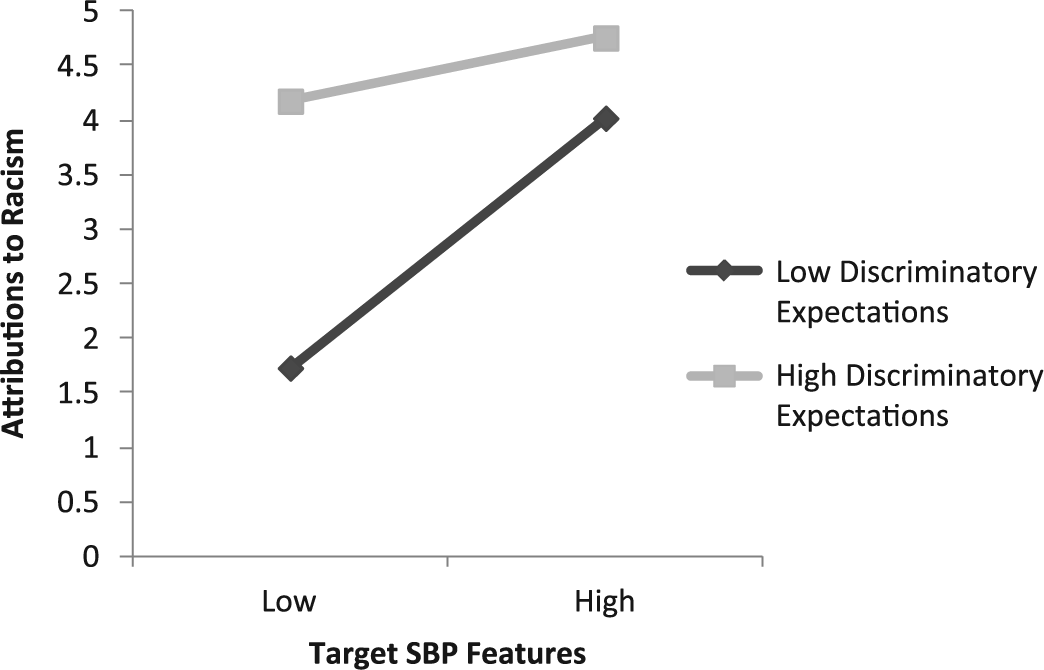
Attributions to racism as a function of target stereotypically Black physical (SBP) features and participant discriminatory expectations after controlling for target attractiveness and babyfacedness (Experiment 1).
Hostile Emotions
Identical analyses were conducted for the hostile emotions dependent variable, and they yielded similar results, with one notable exception. Specifically, as shown in Table 2, attractiveness ratings predicted hostile emotions, such that participants reported greater hostility the more they perceived the target as attractive. Again, attractiveness and babyfacedness were entered first into the regression equation as control variables. As predicted, there were significant main effects of both discriminatory expectations and target SBP features on hostile emotions, and there was a significant interaction. The interaction is depicted in Figure 2. As was the case with racism attributions, target SBP features predicted hostile emotions only for participants with low discriminatory expectations, b = .70, t(111) = 5.72, p < .001. That is, the higher in SBP features were the targets’ features, the more hostility was elicited. For participants who were high in discriminatory expectations, there was no relation between target SBP features and hostile emotions, b = .07, p = .50.
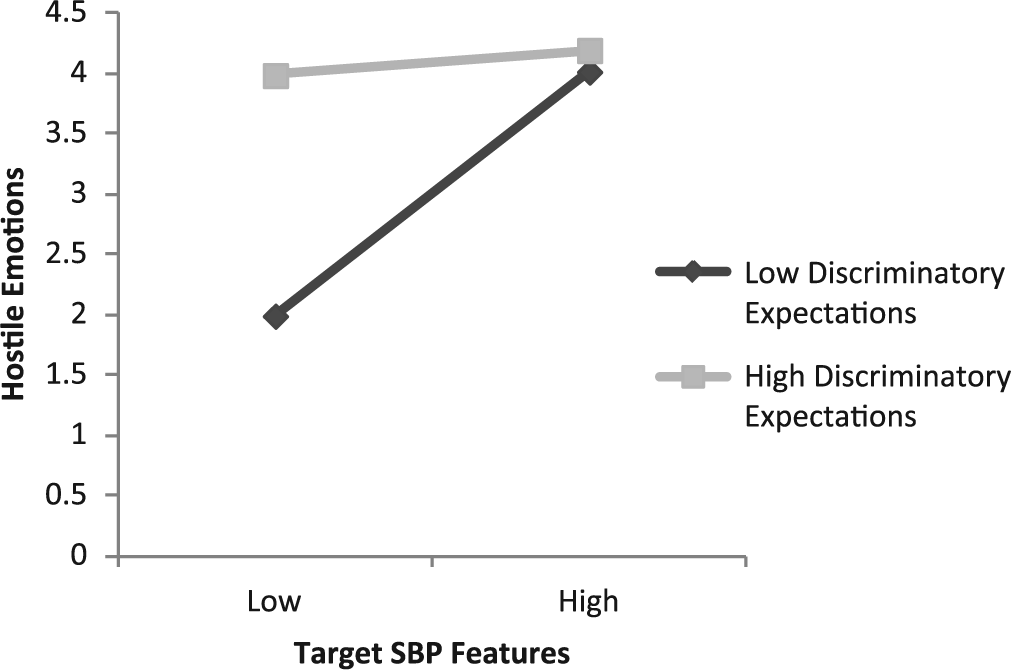
Hostile emotions reported in response to the ambiguously racist incident as a function of target stereotypically Black physical (SBP) features and participant discriminatory expectations after controlling for target attractiveness and babyfacedness (Experiment 1).
Discussion
The results of Experiment 1 extended the interpersonal processes literature by providing one of the first demonstrations that target SBP features can influence both racism attributions and hostile emotions in ambiguously racist situations. Consistent with our perceived prejudice distribution account, greater target SBP features elicited higher perceived racism and more hostile emotions than lower target SBP features. In support of previous research (Johnson et al., 2006; Johnson & Lecci, 2003), the results also demonstrated that racism-related responses varied as a function of participant discrimination expectations. Blacks with high discrimination expectations reported greater perceived racism and greater hostile emotions than those with low discrimination expectations. Most importantly, the influence of target SBP features on racism-related responses was influenced by variation in participant discrimination expectations. For high–discrimination expectation Blacks, target SBP features had a minimal impact on racism-related attributions. That is, these individuals made race-related attributions that were independent of the physical features of the target. However, for Blacks with low discrimination expectations, greater target SBP features elicited higher perceived racism and more hostile emotions than lower target SBP features. What these findings indicate is that in order to understand and anticipate the influence of target-related stereotypical physical features (e.g., skin tone, nose width, etc.), it is also important to consider individual differences in discrimination expectations. It appears that those with high discrimination expectations pay relatively little attention to the physical features of the target of racism, and instead rely on their own perceptions. In contrast, those low in discrimination expectations are attending to target cues. This indicates that factors such as the skin tone of the target matter for some, but not all, Blacks when making attributions. Given that the literature has documented the impact of the physical features of the target, it can be inferred that much of that data are derived from individuals who are not high in discrimination expectations.
While the findings of Experiment 1 demonstrated that target SBP features and participant discrimination beliefs can influence racism-related responses, they were limited to a particular form of racist situation. Specifically, the passage involved a racist situation that might lead to financial and/or emotional harm for a Black target. However, there are many ambiguously racist situations that involve other forms of harm. For example, in a case that received international attention in 2005, two White police officers in New Orleans were relieved of their duties for the criminal assault of a 64-year-old retired Black school teacher. It is not clear whether target SBP features and/or discrimination expectations would influence responses to these types of situations involving physical harm. Specifically, a White person inflicting physical harm on a Black person might elicit powerful emotional and/or cognitive responses from Blacks (i.e., anger, anxiety, thoughts of past physical abuse toward Blacks) that could attenuate or completely eliminate the influence of SBP features or discrimination expectations. Thus, a focus on physical harm would provide a much stronger test of the impact of these variables on racism-related responses.
Furthermore, Experiment 1 focused on negative emotions that Blacks might feel after exposure to a potentially racist situation. What is unclear is whether target SBP features and discrimination expectations might also influence positive emotions such as empathy. Consistent with previous research by Batson and colleagues (Batson, 1991; Batson, Klein, Highberger, & Shaw, 1995), the present study will involve empathy as an other-oriented emotional response congruent with the perceived welfare of another. A focus on empathic responding in the present study is important because such responding has been shown to be extremely relevant in situations involving persons, such as a Black man who reports being a victim of racism, in various forms of distress (see Batson, 1991; Batson et al., 1997).
In addition, there is significant evidence of a tendency to show greater empathic responding toward members of one’s own group (Batson, Duncan, Ackerman, Buckley, & Birch, 1981; Hornstein, 1978; Park & Schaller, 2005). There has been little attention given to the extent that variation within one’s own group, such as target SBP features, might influence empathic responding. Thus, the purpose of Experiment 2 was to assess whether target SBP features and/or discrimination expectations would influence perceived racism and empathic responding in an ambiguously racist situation involving physical harm.
Experiment 2
Brief Overview and Predictions
Black participants read a passage involving a Black male who suffered physical injuries after an altercation with two White police officers and filed a racism lawsuit against the city. They were instructed to imagine themselves as the jurors in the case. The picture of the Black male varied on SBP features. As in Experiment 1, target SBP features and discrimination expectation were continuous variables. The major dependent variables were perceptions that the man was a victim of racism and empathic responding. Consistent with the results of Experiment 1, it was expected that greater SBP features would elicit greater racism attributions and greater reported empathy. However, the effect should be stronger for those with low discrimination expectations.
Method
Participants
A total of 121 Black participants (62% female) were recruited, with an incentive of extra credit, from upper level psychology courses (with an average enrollment of 47 students) at a historically Black university in Georgia. They were predominantly juniors and seniors with an age range of 20 to 25 years (M = 21.3 years, SD = 2.32).
Procedure
The general procedure was identical to Experiment 1. Participants completed the seven-item in-group–directed stigmatization and discriminatory expectations subscale and were given the “Judgments of Social Situations” experimental booklets 2 weeks later. The major difference was that the racism-related passage focused on a 50-year-old Black man named John Williams who was detained by two White police officers in an affluent and predominantly White area in the city. Participants saw one of the same five pictures (i.e., that varied on SBP features) that were employed in Experiment 1.
The officers informed Williams that they had clocked him speeding at 5 miles over the speed limit. Williams protested vehemently and loudly proclaimed that the whole incident was based on racism and then told the officers that they were “jerks and lowlifes.” The officers informed John that he should calm down, get in his car, and go home. John walked “very slowly” back to his car and continued to make loud and derogatory statements about the officers. One of the officers got angry and approached Williams and said, “Johnny boy, you are going to jail for being belligerent and failing to adhere to the commands of a police officer.” While he was trying to handcuff Williams, the officer applied intense pressure to John’s arm and shoulder. Williams went to the emergency room and found out that his shoulder was severely sprained and that some tendons were torn. He was told that he would have to wear a brace for 2 months. Williams hired a lawyer and filed a racial discrimination suit against the officers and the city. After reading the passage, participants responded to questions assessing racism attributions and empathy.
Racism attributions
Two questions assessed the extent to which participants perceived that John was a victim of racism: (a) To what extent are you certain that John was a victim of racism? (1 = small extent, 7 = great extent). (b) Could you find that the city/police officers engaged in racism if you were a juror in the case? (1 = definitely no, 7 = definitely yes). The responses were combined (r = .83) to create a perceived racism score.
Empathy
Participants were told to think about John Williams and then answer five questions, on a 7-point Likert-type scale, that assessed their feelings of sympathy, compassion, warmth, soft heartedness, and being moved. The responses to these five questions (α = .87) were averaged to yield an empathy score for each participant. As in Experiment 1, the dependent variables were counterbalanced to reduce the probability of order effects.
Results
Analyses were conducted in the same manner as in Experiment 1. Descriptive statistics and correlations for all measured variables are reported in Table 3.
Descriptive Statistics and Correlations for All Measured Variables in Experiment 2.

Note: SBP = stereotypically Black physical.
p < .05. **p < .01. ***p < .001.
Racism Attributions
As shown in Table 4, neither attractiveness nor babyfacedness influenced participants’ racism attributions; these variables will not be discussed further as a result. More importantly, results revealed the hypothesized main effects of participant discriminatory expectations and target SBP features and the hypothesized interaction. As expected (see Figure 3),the relationship between target SBP features and attributions to racism was much stronger for participants with low discriminatory expectations, b = .61, t(117) = 5.32, p < .001, than for participants with high discriminatory expectations, b = .22, t(117) = 2.15, p < .04.
Hierarchical Regressions for Variables Predicting Racism Attributions and Empathy in Experiment 2.
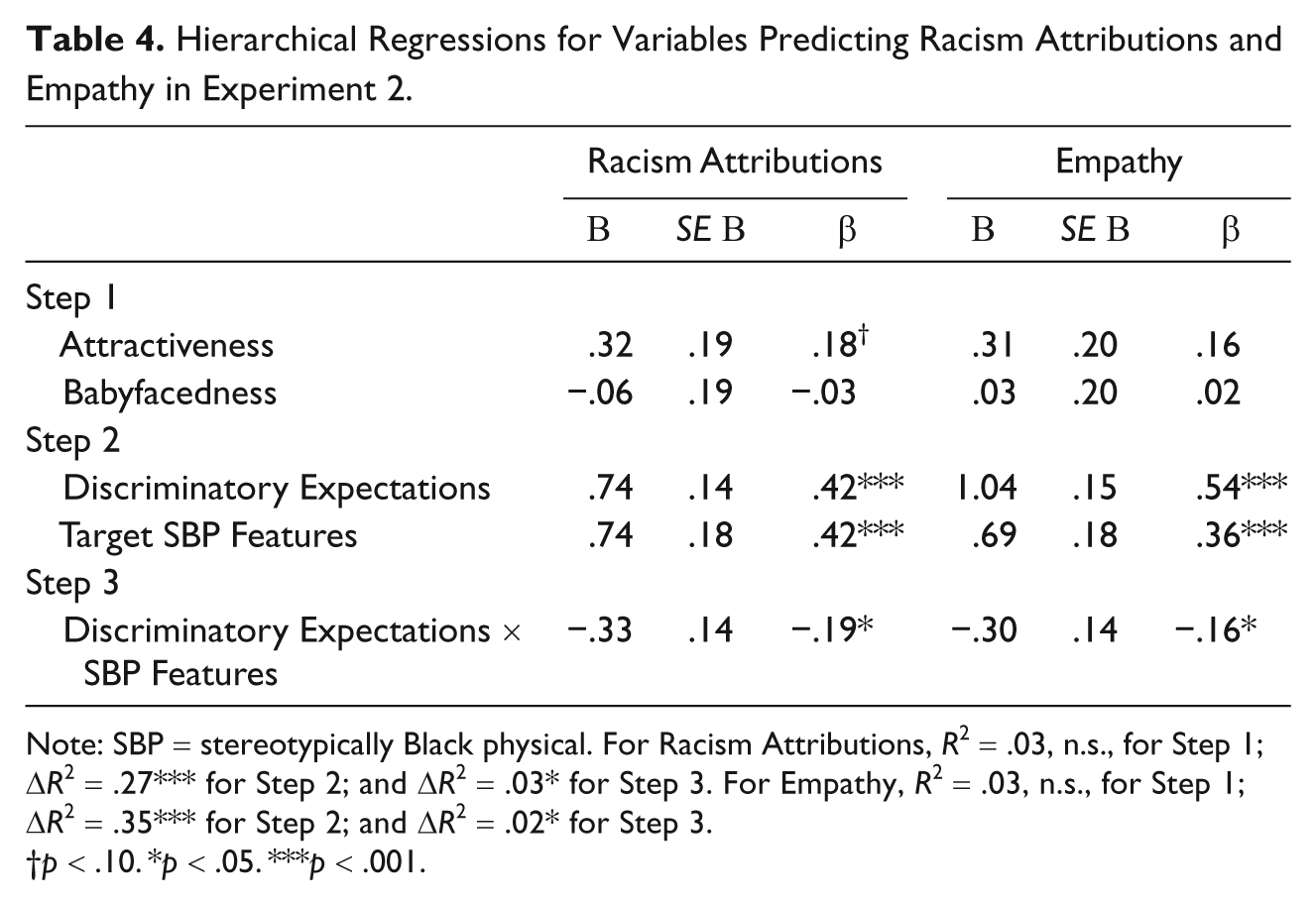
Note: SBP = stereotypically Black physical. For Racism Attributions, R2 = .03, n.s., for Step 1; ΔR2 = .27*** for Step 2; and ΔR2 = .03* for Step 3. For Empathy, R2 = .03, n.s., for Step 1; ΔR2 = .35*** for Step 2; and ΔR2 = .02* for Step 3.
p < .10. *p < .05. ***p < .001.
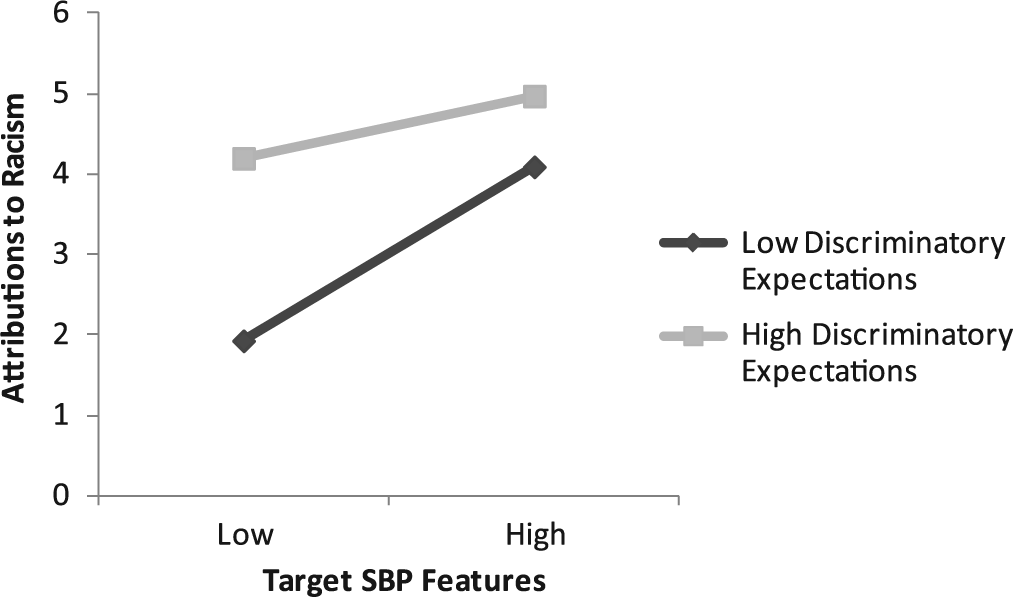
Attributions to racism as a function of target stereotypically Black physical (SBP) features and participant discriminatory expectations after controlling for target attractiveness and babyfacedness (Experiment 2).
Empathy
The same pattern was revealed for empathy. As shown in Table 4, there were, once again, significant main effects of both discriminatory expectations and target SBP features, and there was a significant interaction. As Figure 4 illustrates, target SBP features had a bigger influence on participants’ reported empathy for the target when participant discriminatory expectations were low, b = .55, t(117) = 5.07, p < .001, rather than when participant discriminatory expectations were high, b = .25, t(117) = 2.64, p = .01.
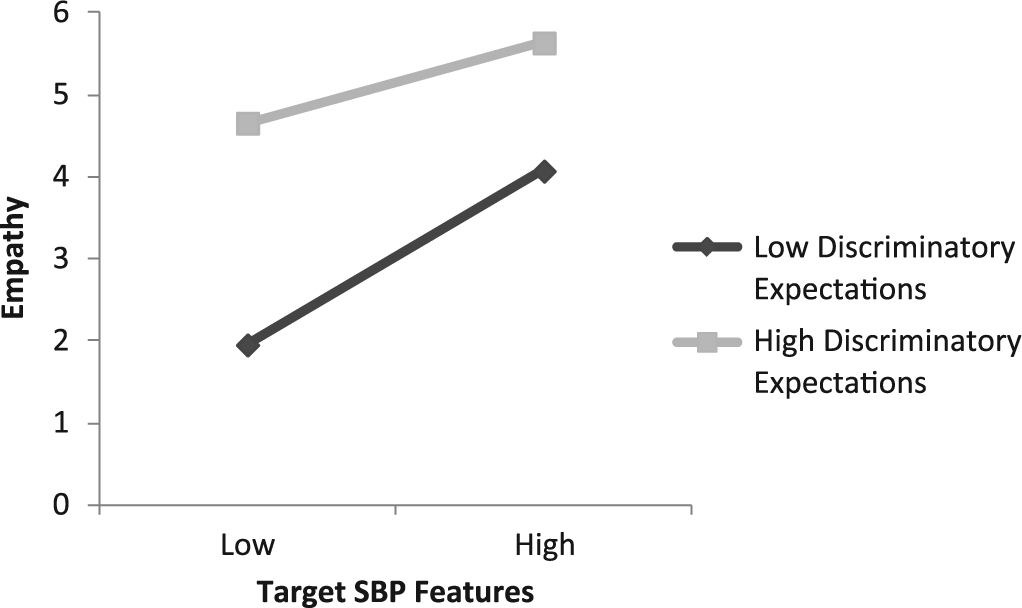
Empathy reported in response to the ambiguously racist incident as a function of target stereotypically Black physical (SBP) features and participant discriminatory expectations after controlling for target attractiveness and babyfacedness (Experiment 2).
General Discussion
Discrimination attributions among Blacks have been shown to have significant interpersonal, mental health, and physical health consequences (e.g., Johnson & Lecci, 2003; Merritt et al., 2006; Sellers & Shelton, 2003). Consequently, prejudice researchers have given an extensive amount of empirical focus to factors that might influence such attributions (Johnson et al., 2006; Major et al., 2002). The present findings demonstrate that greater attention should be given to the role of target SBP features in both racism attributions and racism-related emotional responses. Two experiments demonstrated that in situations involving both financial and physical harm, greater target SBP features elicited responses marked by higher perceived racism and greater emotional responding (i.e., hostile emotions from Experiment 1 and empathic responding from Experiment 2) than lower target SBP features. Most importantly, the present study demonstrated that the impact of SBP features on racism-related response was influenced by discrimination expectations of the participants. Relative to those with high discrimination expectations, those with low discrimination expectations were more influenced by SBP features. These findings suggest that some individuals (those high in discrimination expectations) do not require any additional information to arrive at a racial attribution, and this may be due to their past experiences in such settings. In contrast, those low in discrimination expectations still attend to other information/cues before making any race-related attributions.
Consistent with our perceived prejudice distribution perspective, the present study provides some of the first empirical evidence that target characteristics can serve as a contextual cue when making racism attributions. Given that Blacks who are low in SBP features generally do not suffer prejudice and discrimination at the same level as those who are highly racially phenotypic, it should not be surprising that low target SBP features is a cue that can reduce perceived racism and minimize racism-related emotional responding. Furthermore, these findings are consistent with cognitive perspectives (Blair, 2002; Inman & Baron, 1996) suggesting that target SBP features might influence racism-related responses. That is, the cognitive perspective suggests that individuals categorize and conceptualize Blacks differently based on how closely they match SBP features. Finally, there are a number of intragroup attributions regarding Blacks who are low in SBP features, which may have led to lower racism attributions. For example, Blacks who are low in SBP features are perceived as having low racial identity and minimal ethnic legitimacy (see Hunter, 2007, for a more complete discussion). It is possible that participants find it difficult to perceive Blacks who are low in SBP features as suffering from being Black if they are not “fully Black” or do not have a strong racial identity. Clearly, further research to assess the exact basis of the impact of racial pheonotypicality on racism attributions seems warranted.
Interestingly, there is evidence that individual differences in group identification can interact with discrimination-related cues to affect attributions to discrimination (Major, Quinton, & Schmader, 2003). However, the present findings extend the research in this area by demonstrating that contextual cues associated with the Black target and individual differences in perceiver discrimination expectations can also interact to influence racism-related responses among Blacks. More generally, the results parallel both theoretical and research-based accounts that contrast person-related variables, such as attitudes and traits (i.e., perceived discrimination expectations), to the influence of situational factors (e.g., Bem & Allen, 1974; Bowers, 1973; Epstein & O’Brien, 1985; Mischel, 1968). Specifically, when a person-related variable is especially salient (important/relevant) to that individual, then the influence of the situation is necessarily reduced (e.g., Cheek, 1982; Zuckerman, Bernieri, Koestner, & Rosenthal, 1989; Zuckerman et al., 1988). This has been referred to as cross-situational consistency, but within the context of the present research, it may be reasonable to conceptualize this effect as an insensitivity to situational cues. That is, individuals with high discrimination expectations have more extreme and personally salient views on discrimination, and such views are less malleable to variations in circumstance (i.e., the target’s SBP features). Thus, for these individuals, the best predictor of behavior is simply their attitudes/traits, whereas for those with lower discrimination expectations, the best predictors of behavior come from sources other than oneself: In this study conceptualized as SBP features. It is assumed that these findings would replicate when examining other sources of information as well, such as the circumstances of the situation, the perceived control of the target and/or the perceived control of individual perpetrating the discriminatory behavior. Future research could examine each of these circumstances to assess the generalizability of the findings.
It is also interesting to note that the present research is rather unique among studies of attributions to discrimination in that it emphasizes targets’ reactions to incidents directed at in-group members rather than at themselves (see Sechrist, Swim, & Stangor, 2004). It is important to understand reactions to discriminatory incidents directed at others because, in fact, such incidents are often more likely to be noticed and identified as discrimination (e.g., Crosby, 1984). The present results demonstrate that it is not safe to assume that targets are always highly likely to maintain in-group loyalties by attributing negative incidents to discrimination.
Previous research focused on the impact of SBP features has shown that the impact of such features on stereotypical attributions is extremely robust. For example, there is evidence that target SBP features will influence stereotypical attributions when participants are sensitized to race-based stereotyping (Blair, Judd, & Fallman, 2004), when the faces were inverted (Blair, 2006), and there is additional diagnostic information (Blair, Chapleau, & Judd, 2005). The present study showed that the impact of target SBP features was influenced by participant individual differences. Why was the impact of target SBP features less robust in the present study? There were two major differences between the present study and previous research on SBP features. First, the present study focused on racism attributions and emotions rather than simple stereotypical attributions. Second, there was an assessment of participant individual differences that could have a direct impact on such attributions and emotions (i.e., discrimination expectations). Thus, the findings demonstrated that the impact of target SBP features on more complex social judgments might be susceptible to the influence of contextual and individual difference factors.
Footnotes
Declaration of Conflicting Interests
The authors declared no potential conflicts of interest with respect to the research, authorship, and/or publication of this article.
Funding
The authors received no financial support for the research, authorship, and/or publication of this article.