




Abstract
Using a nationally representative diverse sample of 10- to 17-year-old youth, this study explores Black youths’ Internet use, communication patterns, behavior, and victimization experiences via Internet and cell phone. Findings yielded a number of differences between Black and non-Black youth, with Black youth using the Internet with more intensity and being more likely to gain access via cell phone. Notable within-group differences emerged, including the increased rates of sexual victimization and being sent sexual images via text for girls. With age, participants tend to communicate with more people they met online. In addition, the adolescent developmental task of exploring sexuality becomes more pronounced in the 13 to 15 and 16 to 17 age groups.
Since the advent of the Internet, much of the literature related to Blacks 1 has focused on a digital divide where they are less likely than Whites to have Internet access. Research has shown that 77% of Black youth had accessed the Internet compared to 87% of White and 89% of Latino youth (Lenhart, Madden, & Hitlin, 2005). By contrast, researchers now argue that youth from all socioeconomic backgrounds and racial groups find ways to use the Internet regardless of socioeconomic status (Watkins, 2010). In fact, the Generation M2 study, a nationally representative sample of 3rd through 12th graders, revealed that Blacks actually are exposed to 4.5 more hours of media per day than their White counterparts (Rideout, Lauricella, & Wartella, 2011). This includes an hour more talking and texting as well as using a cell phone for listening to music, playing video games and watching TV (Rideout, Foehr, & Roberts, 2010). Because more extensive media use can potentially expose them to a wide range of experiences, the goal of this study is to examine communication, online behaviors, and victimization experiences, particularly with regard to Internet and cell phone use.
The mental health consequences of online victimization have been well documented. First, studies have shown that online victimization, also known as cyberbullying, sexual solicitation, and harassment, is associated with depressive symptoms (Wang, Iannotti, Luk, & Nansel, 2010; Ybarra, 2004). Moreover, a recent study shows a link between cyberbullying victimization and suicidal ideation (Hinduja & Patchin, 2010). These youth were also more likely to attempt suicide. As increasing numbers of youth get access to and spend more time on the Internet, more research is needed on the experiences of Black youth and how they may differ from other groups and by sex and age.
What we do know from a study of trends in victimization by race is that for Black youth sexual solicitations (e.g., being asked to discuss sex against your will) from 2000 to 2005 increased, but declined from 2005 to 2010 (Jones, Mitchell, & Finkelhor, 2012). This study also showed an increase in online harassment (e.g., using disparaging language toward another) for Black youth from 5% to 12%. In addition, youth receive requests to send sexual pictures of themselves to people they meet online (Mitchell, Finkelhor, & Wolak, 2007a), and youth receiving such requests were more likely to be female, have an online relationship, engage in online sexual behavior, and experience offline physical or sexual abuse from an adult caregiver. Researchers have yet to examine within-group differences in victimization among Black youth.
With the prevalence of victimization 2 and potential for harm, there are national and local efforts that are underway to ensure that youth receive prevention messages. However, scholars have noted Internet safety messages have been differentially received by race. In one of the first quasi-experimental designs of the effectiveness of Internet safety programs, researchers found that the I-SAFE curriculum increased knowledge of Internet safety in the treatment group, but Black and Latino youth had lower levels of awareness of Internet safety messages than other ethnic groups (Chibnall, Wallace, Leight, & Lunghofer, 2006). With the increased rates of victimization, it is important to know whether Black youth still differentially receive prevention messages.
Given the small amount of research available about Black youth’s online experiences, we use a nationally representative sample of 1,560 relatively diverse youth and their parents to first examine communication, online behaviors, and exposure to Internet safety messages. Among Black youth specifically, we then explore age and gender differences. The primary goal of this study is to determine whether Black youth are differentially placed at risk with respect to their online communication, victimization, and prevention messages. Furthermore, we examine whether sex and age place youth at an increased risk for victimization. Last, this study will highlight Black youth’s Internet use and inform clinical and educational programs that serve this population. Research questions include the following: (1) Do rates of Internet use, online behaviors, online communication and victimization experiences differ between Black and non-Black youth? (2) Among Black youth, are there sex or age differences in these experiences? (3) Are there age or sex differences for receipt of Internet safety prevention messages between Black and non-Black youth?
Method
The Youth Internet Safety Surveys were conducted to quantify and detail youth experiences with unwanted or problematic Internet experiences including sexual solicitations, harassment, and unwanted exposure to pornography on the Internet. The 3rd Youth Internet Safety Survey (YISS-3) is the source for the current article.
Participants
Respondents in YISS-3 were a nationally representative sample of 1,560 youth, ages 10 to 17, who had used the Internet at least once a month for the past 6 months from any location, and a caregiver in each household that self-identified as the one most knowledgeable about the youth’s Internet practices. Participants were 50% male; racial/ethnic backgrounds for all participants were the following: 67% White, 13% Black, 10% Latino, 3% American Indian, 3% Asian, 2% Other (including biracial), and 2% unknown. Household income for the sample was less than $20,000 (12%); $20,000 to $50,000 (18%); $50,000 to $75,000 (16%); more than $75,000 (45%); and 9% of responses were do not know or missing. Highest education levels in the household were the following: not a high school graduate (3%), high school graduate (14%), some college (19%), college graduate (37%), postcollege degree (28%). Human subject participation in YISS-3 was reviewed and approved by the University of New Hampshire Institutional Review Board and conformed to the rules mandated for research projects funded by the U.S. Department of Justice.
Procedure
The sample for YISS-3 was drawn from households with telephones using random digit dialing. Dialing procedures included a sample of households (n = 2,908) that had been prescreened in a previous survey. Interviewers dialed a total of 214,619 numbers to identify households with children ages 10 through 17 who had used the Internet at least once a month for the past 6 months. Successful contact was made with 31% of numbers called (n = 66,948). Of the households that were contacted, 55% (n = 36,863) completed the eligibility screener, and of these, 11% (n = 4,094) were eligible for participation in YISS-3 interviews. Finally, 37% of 4,094 eligible households had completed both the adult and youth surveys when the desired sample size of 1,500 was reached. The final response rate, based on standardized formulas developed by the American Association for Public Opinion Research (2008) was 44% (more details available at http://unh.edu/ccrc/internet-crimes/papers.html). To increase the generalizability of YISS survey responses, we included a cell-phone RDD sample in addition to the landline sample (see Methodology report for more details). This sample included similar percentages of Black youth, but more with a household income of less than $20,000 (12.1% vs. 20%) and fewer with postgraduate degrees (27.9% vs. 20%).
The low response rate is reflective of a general decline in response rates for national telephone surveys (Curtin, Presser, & Singer, 2005; Keeter, Kennedy, Dimock, Best, & Craighill, 2006; Kempf & Remington, 2007), which face the challenges of caller ID, confusion with telemarketers, and survey saturation among the public. However, analyses suggest that the decline in participation has not influenced the validity of most surveys conducted by reputable surveying (Keeter et al., 2006). Keeter et al. (2006) note that compared to government benchmarks, the demographic and social composition of telephone survey samples are quite representative on most measures.
Data collection took place between August 2010 and January 2011. On reaching a household, interviewers spoke with an adult and determined whether there was an eligible child in the household. In households with eligible children, interviewers asked to speak with the adult who was most familiar with that child’s Internet use and, after receiving informed consent, asked a series of questions about Internet use. At the close of the parent survey, the interviewer asked for permission to interview the child. Parents were informed that the youth interview would be confidential, would include questions about “sexual material your child may have seen on the Internet,” and that youth would receive $10 for participating. In households with more than one eligible youth, the one who used the Internet the most often was chosen as the respondent.
After receiving parental permission, interviewers spoke with the youth and asked for permission to conduct an interview. Interviewers assured youth that their answers would be confidential; they could skip any question they did not want to answer and end the interview at any time. Youth interviews were scheduled at the convenience of youth and at times when they were able to talk freely and confidentially. Steps were taken to help ensure confidentiality and safety for youth participants including asking mostly yes/no questions, checking at regular intervals that youth were in a safe spot, and providing Internet safety resources at the end of the interview. Youth participants were mailed $10 checks after completing the survey. The average youth interview lasted 30 minutes, and the average adult interview lasted 10 minutes.
Measures
All questions refer to the past 12 months unless otherwise noted.
Demographic Characteristics
Parents provided information about youth age, sex, parental marital status, living arrangements (youth living with both biological parents or not), highest level of education in the household, and annual household income in 2009. Youth reported on their race and ethnicity.
Connection to the Internet
To examine participants’ time online and contexts of their access, youth reported on amount (frequency and intensity) and location (home, school, friend’s home, from cell phone) of Internet use (yes/no).
Cell Phone Usage
First, youth were asked whether they had a cell phone (including a Blackberry, iPhone, or other device that is also a cell phone). If yes, youth were asked whether they used the cell phone to make receive calls, send or receive email, send or receive photos, connect to the Internet, and text message. Youth who said they used their cell phones to send or receive text messages were also asked, “About how many text messages you send or receive on a typical day.” Responses options were open ended.
Use of Social Networking Sites
Youth were asked whether they used social networking sites (SNS; yes/no) and if so how many SNS profiles they had of themselves. Those who had one or more SNS profiles were asked whether they had ever pretended to be age 18 or older on this site; whether a parent knew they had an SNS (if yes, whether the parent was a friend on that site; and if yes, whether they limited the type of content the parent could see).
Online Communication
To determine the nature of online communication, participants were asked if they “talked to known people of the same age on the Internet” and whether they “talked to strangers met online” (yes/no). Youth were coded as having a close online relationship if they met someone online who “they could talk online with about things that were really important to them.” Close online relationships that resulted in an in-person meeting and those with someone age 18 or older were also queried (yes/no).
Online Behavior
Youth reported on whether or not they had engaged in sexual behavior online (i.e., talking about sex online with someone not known in person; sending or receiving text or instant messages that were sexual but did not include sexual pictures) and harassing behavior online (made rude or nasty comment to someone online; used the Internet to harass or embarrass someone you were mad at; spread rumors about someone through the Internet, whether they were true or not; share something about someone with others online that was meant to be private; post or forward a video or picture of someone online that showed them being hurt; involved in a group on a social networking site or other online site where the focus was making fun of someone else). Youth also indicated whether they had “gone to X-rated sites on the Internet on purpose.” All questions had yes/no responses with additional follow up probes assessing frequency.
Online Victimization
Sexual solicitations involved youth responding positively to at least one of the following three screener questions, pertaining to the past year: (1) “Did anyone on the Internet ever try to get you to talk online about sex when you did not want to?” (2) “Did anyone on the Internet ask you for sexual information about yourself when you did not want to answer such questions? I mean very personal questions, like what your body looks like or sexual things you have done?” (3) Did anyone on the Internet ever ask you to do something sexual that you did not want to do? In addition, youth who said they had an online sexual relationship with an adult were included to capture possible statutory sex crimes (n = 1). Online relationships were considered sexual if youth said the relationship was “sexual in any way” (this was left open to interpretation by the respondent).
Youth who responded positively to at least one of the following two questions were classified as being the target of Internet harassment: (1) In the past year did you ever feel worried or threatened because someone was bothering or harassing you online. (2) In the past year did anyone ever use the Internet to threaten or embarrass you by posting or sending messages about you for other people to see. Online harassment involved threats or other offensive behavior (not sexual solicitation), sent online to the youth or posted online about the youth for others to see.
Sexting Involvement
Sexting involvement interviewers used the following introduction: “Now I have some questions about kids taking nude or nearly nude pictures of themselves or other kids. By ‘nearly nude’ I mean pictures of kids in things like their underwear.” We used a broad question in combination with follow-up questions about specific incidents to better understand how youth interpret “nude or nearly nude”:
Has anyone ever sent you nude or nearly nude pictures or videos of kids who were under the age of 18 that someone else took?
Have you ever taken nude or nearly nude pictures or videos of yourself?
Has someone else ever taken nude or nearly nude pictures or videos of you?
Have you ever taken nude or nearly nude pictures or videos of other kids who were under the age of 18?
Any positive response was followed with questions to determine whether this occurred in the past year and the content of the nude or nearly nude pictures. Cases were classified into three groups: (1) not involved, (2) appeared in or took nude or nearly nude images, and (3) received nude or nearly nude images. Images that depicted breasts, genitals, or someone’s “bottom,” including someone completely nude, sexual intercourse, or masturbation were classified as sexually explicit.
Prevention
Youth exposure to Internet prevention messages from parents, school, police, and websites was queried. Youth were asked whether a parent had ever talked with them about: seeing X-rated pictures online; people on the Internet who want to talk to you about sex; people on the Internet who might threaten, harass, or bother you; and taking, sending, or posting sexual pictures of yourself or other kids. Youth were also asked whether they received these same four prevention messages in class, from a teacher or someone else from school. Youth were asked whether there “was any time in school that you got information on Internet safety, like from a person speaking to an assembly?” Prevention messages from police were queried by asking whether youth had “been to a presentation about staying safe on the Internet that was done by a police officer or someone in law enforcement”; and if yes, whether this presentation was given at your school. Finally, youth were asked whether “you have been to a website that teaches kids or teenagers about being safe on the Internet.”
Statistical Analysis
Using SPSS 19.0 (IBM SPSS 19.0, 2011), a series of bivariate chi-square cross-tabulations were run to examine similarities and differences in Internet use, online communication, behaviors, and experiences between Black and non-Black youth. (Non-Black youth were all youth who did not indicate they were Black or African American.) Next, among Black youth only, bivariate chi-square cross-tabulations were conducted to identify sex and age (10-12 year olds, 13-15 year olds, 16-17 year olds) differences. Logistic regression analyses, adjusting for other demographic characteristics and amount of Internet use, were conducted between Black and non-Black youth and among Black youth (for age and sex differences). Resulting odds ratios (ORs) are provided for more conservative comparative purposes.
Results
Internet Use, Communication, and Victimization Among Black and Non-Black Youth
In terms of Internet and cell phone use, Black youth were less likely than non-Black youth to use the Internet at home or at a friend’s home but more likely to use the Internet through a cell phone (see Table 1). Black youth use the Internet less frequently in terms of days per week but more intensely in terms of hours per day. All youth were equally likely to own a cell phone, as well as using their cell phone to make or receive calls or send or receive photos, though Black youth were more likely to use a cell phone to send or receive email. No differences were noted for text messaging—an overwhelming number of youth text messaged and the mean number of messages sent and received on a typical day was similar as well (129 for non-Black and 157 for Black youth). Black youth had more personal profiles on social networking sites (M = 2.0 vs. M = 1.6 for non-Black youth). Eleven percent of all youth reported ever pretending to be age 18 or older on their social networking profile. Youth reported almost all parents knew about their social networking site (98% of non-Black and 95% of Black youth, p = .05) though fewer Black youth said their parent was a friend on their social networking site.
Prevalence (%) of Internet and Cell Phone Use Characteristics Between Black and Non-Black Youth (N = 1,560).
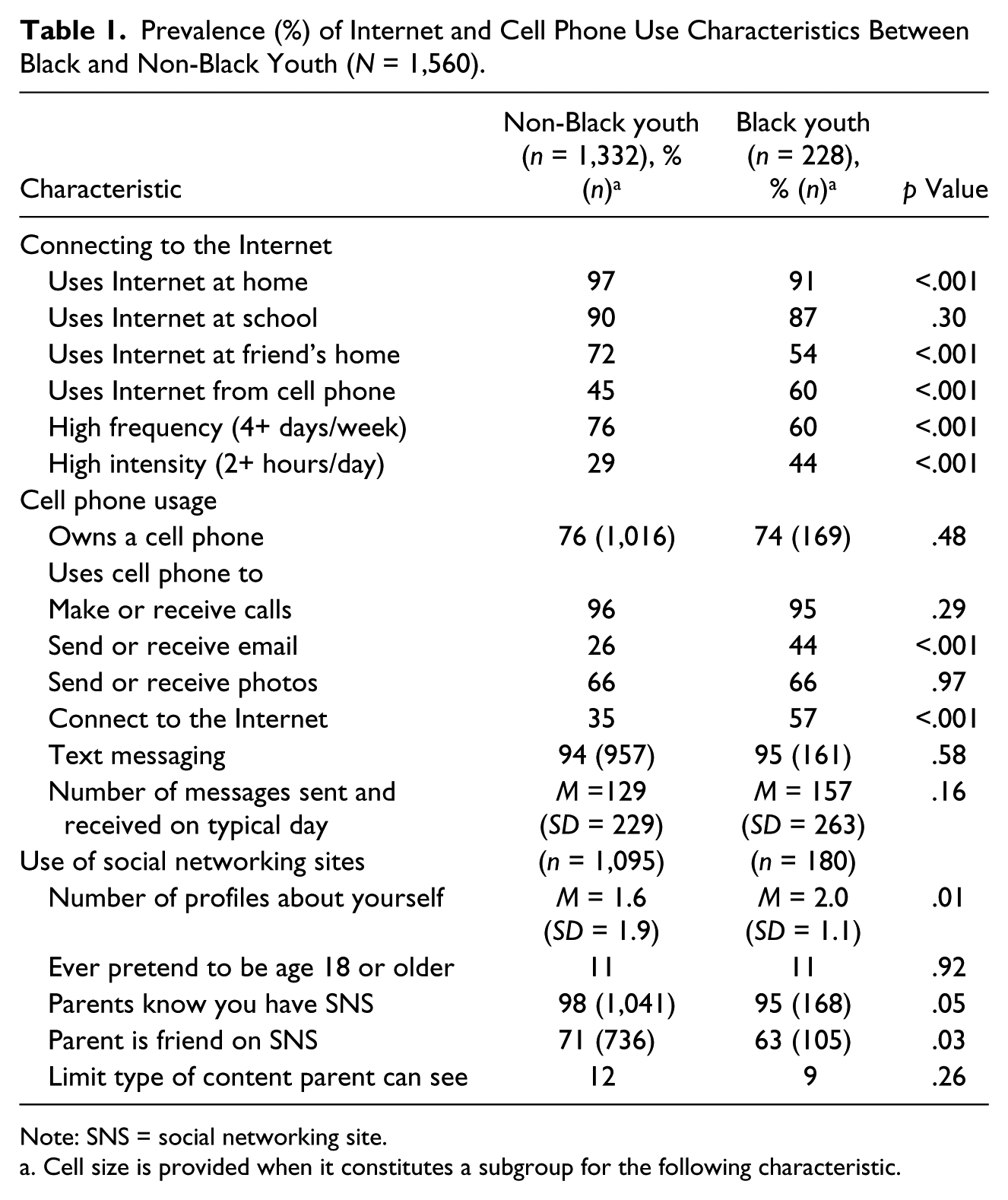
Note: SNS = social networking site.
Cell size is provided when it constitutes a subgroup for the following characteristic.
More similarities than differences were noted between Black and non-Black youth in terms of online communication, behavior, and victimization (see Table 2). Exceptions include the fact that Black youth were more likely to talk with people they met online and did not know in person (OR = 1.72, p < .01). More Black youth also reported engaging in sexual behavior online (e.g., talking about sex with someone they met online; OR = 1.60, p < .05). Similar percentages of Black and non-Black youth reported online sexual solicitation victimization, online harassment, and sexting involvement. There were also few differences in the percentages of Black and non-Black youth who have received prevention messages about Internet safety. One notable difference was that Black youth were more likely to go to a website that teaches about Internet safety (OR = 1.80, p < .001).
Prevalence (%) of Internet and Cell Phone Use Characteristics Between Black and Non-Black Youth (N = 1,560) and between Black Girls and Boys (n = 228).
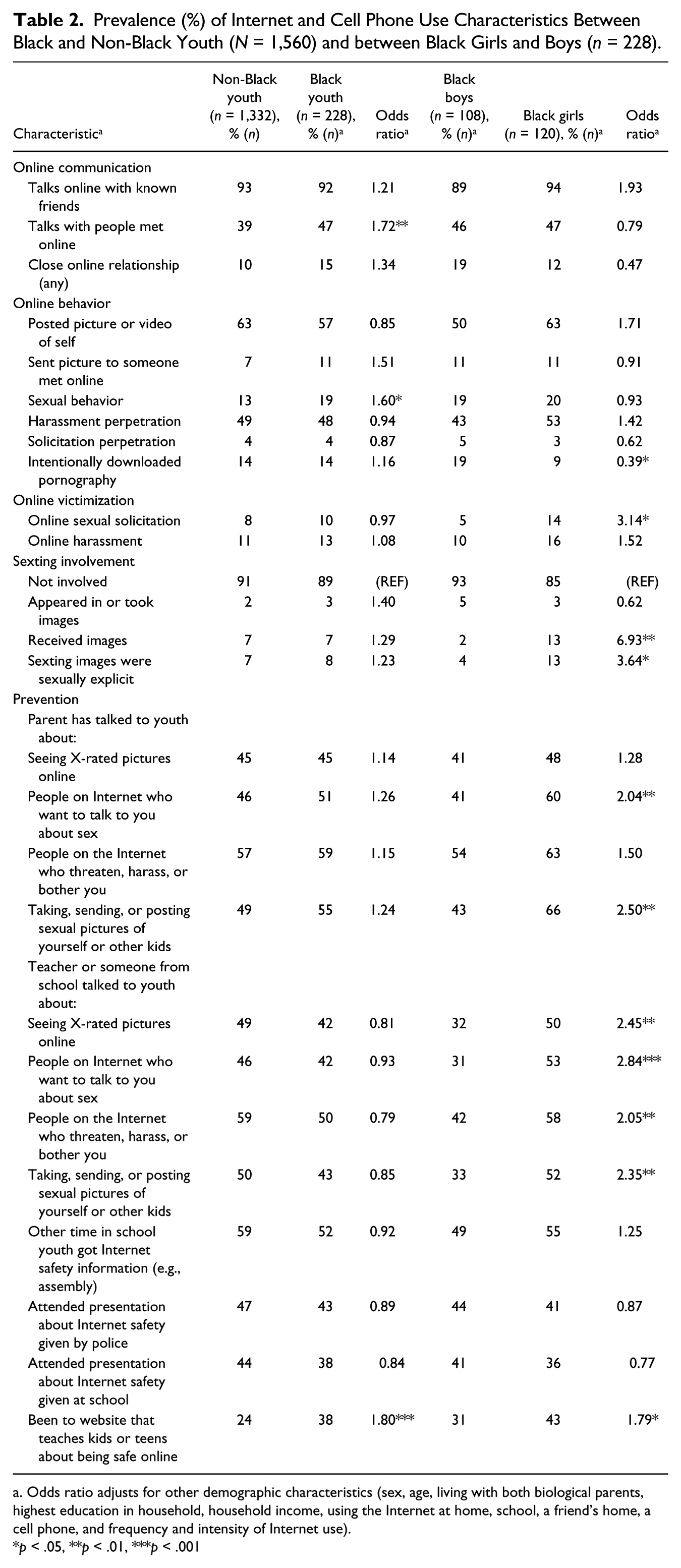
Odds ratio adjusts for other demographic characteristics (sex, age, living with both biological parents, highest education in household, household income, using the Internet at home, school, a friend’s home, a cell phone, and frequency and intensity of Internet use).
p < .05, **p < .01, ***p < .001
Sex Differences Among Black Youth
Though there were no significant sex differences in online communication, girls were more than three times more likely to report an unwanted sexual solicitation online (OR = 3.14, p < .05) and almost seven times more likely to report being involved in sexting by receiving images that someone else took (OR = 6.93, p < .01; see Table 2). They were also more likely to report that these images were sexually explicit. Conversely, more boys used the Internet to download pornography intentionally. With regard to prevention, there were several notable differences. Parents were more likely to warn their girls about people online wanting to talk to them about sex (OR = 2.04, p < .01) and taking, sending, or posting sexual images (OR = 2.50, p < .01). Girls were also twice as likely to receive messages from their teachers about seeing X-rated pictures online (OR = 2.45, p < .01), people on the Internet wanting to talk about sex (OR = 2.84, p < .001), people wanting to harass or threaten you (OR = 2.05, p < .01), and taking, sending, or posting sexual pictures (OR = 2.35, p < .01). Last, girls were more likely to go to a website that teaches youth about being safe online.
Age Differences Among Black Youth
Online communication increased with age—in terms of talking with known friends, people they met online, and having a close online relationship (see Table 3). Thirteen to 15 (OR = 8.00, p < .001) and 16 to 17 year olds (OR = 8.33, p < .001) were eight times more likely than 10 to 12 year olds to talk to people they met online. Thirteen to 15 year olds were also over 11 times more likely to have a close online relationship (OR = 11.72, p < .05). Percentages were similar for the 16 to 17 age group but the odds ratio was not significant, perhaps due to cell size. As youth get older they were also more likely to post a picture or video of themselves online, with 13 to 15 and 16 to 17 year olds being over 6 (OR = 6.66, p < .001) and almost 10 times (OR = 9.90, p < .001), respectively, more likely to engage in this practice. Likewise, 13 to 15 and 16 to 17 year olds were almost 13 (OR = 12.95, p < .05) and 15 times (OR = 15.05, p < .05) more likely to engage in sexual behavior. Sixteen to 17 year olds were also over two times more likely than 10 to 12 year olds to harass others online (OR = 2.62, p < .05). No 10 to 12 year olds were involved in sexting either creating or receiving sexual images, but by 13 to 15, 11% of youth report being a recipient. No age differences were noted for receipt of prevention messages. The only exception is the 16 to 17 years olds were least likely to have been to a website that teaches kids or teens about being safe online (OR = 0.36, p < .05).
Prevalence (%) of Internet Use Characteristics Between Black Youth by Age (n = 228).

Odds ratio adjusts for other demographic characteristics (sex, living with both biological parents, highest education in household, household income, using the Internet at home, school, a friend’s home, a cell phone, and frequency and intensity of Internet use).
p < .05, ***p < .001.
Discussion
This exploratory set of analyses sought to examine online communication, behaviors, victimization, and receipt of prevention messages among Black youth as well as between Black youth and their non-Black counterparts. Chi-square and logistic regression analyses revealed a number of similarities and differences between Black youth and non-Black youth. First, we note that Black youth are less likely to use the Internet from home computer, but more likely to access the Internet from a cell phone. We also note that Black youth are high-intensity users once they get online but they are less likely to go online four plus days in a week.
We found that more Black youth talked to people they met online. Although this may pose risk in some situations, it is also important to point out that talking to people met online is not inherently risky and could even be beneficial. Research has shown that Blacks are more likely to use the Internet to better themselves. For example, they are more likely to use the Internet to look for job and college information and to do research and training online (Boyce & Rainie, 2002; Lenhart, Madden, Macgill, & Smith, 2007) than their White counterparts. For the older youth, these practices may at times necessitate conversing with people they do not know online.
With regard to online victimization, no differences in sexual solicitation or harassment were noted between Black and non-Black youth. However, sex differences persist. What is particularly important to note is that girls experience significantly more sexual solicitation than boys, a consistent finding in the online sexual solicitation literature (Jones et al., 2012), as well as among the sexual abuse literature more generally (Finkelhor, Turner, Ormrod, & Hamby, 2005) regardless of race. Girls also receive more sexual images that someone else took. Findings from a past YISS study indicate Black girls in particular are also more likely to receive requests for sexual pictures of themselves (Mitchell et al., 2007a). It is not entirely clear why Black girls are differentially at risk. More information about the context in which such requests and exchanges occur is necessary so that effective and targeted prevention can be developed in this area. Equally important is that girls receive more prevention messages than boys. Whether girls actually receive more of these messages through groups targeted toward girls (e.g., Girl Scouts) or whether girls are more receptive and retentive to this information is an important next step for research in this area.
As youth get older, they are more likely to communicate with those they met online and to post pictures or videos of themselves. They also engage in more sexual behavior as they get older. This is to be expected as the normal adolescent developmental task of exploring sexuality moves to the online world (Subrahmanyam & Smahel, 2011). Though there were fairly large differences in percentages of victimization with age, they were not significant. This may be a result of a lack of power due to small cell sizes. The increased percentages are consistent with past research on online sexual solicitation (Mitchell, Finkelhor, & Wolak, 2001, 2007b). Interestingly, youth ages 13 to 15 were more likely to receive prevention messages, given by police or at school. Youth, ages 10 to 12 years, were more likely to visit a website that teaches about Internet safety, although whether this was due to a parents’ encouragement or their own volition is unclear.
A few study limitations need to be kept in mind when interpreting results. First, the racial differences between respondent and interviewer may have limited the amount of information respondents disclosed. However, interviewers went through extensive training on conducting telephone interviews with youth on sensitive subjects. Comparisons between Blacks and non-Blacks should be made with caution. Also, some youth declined or were barred from participating, and we do not know whether their inclusion could have changed the results. Though efforts were made to ensure that the sample was diverse with regard to socioeconomic status, the sample included an overrepresentation of people with college or postgraduate degrees. Future research should include a more socioeconomically diverse sample of youth.
This study provides a glimpse into the online social worlds of Black youth beyond a discussion of access. Girls appear to be a more vulnerable population as they experience more sexual solicitation and sexual images. It is important to note, however, that they do report receiving significantly more prevention messages than their male counterparts. It may be the case that community and school officials already recognize that girls are differentially at risk and have begun to address the problem. Nonetheless, psychologists and educators will need to remain diligent in their efforts to keep girls and boys safe online.
Footnotes
Authors’ Note
Points of view or opinions in this article are those of the authors and do not necessarily represent the official position or policies of the U.S. Department of Justice (the funding agency).
Declaration of Conflicting Interests
The authors declared no potential conflicts of interest with respect to the research, authorship, and/or publication of this article.
Funding
The authors disclosed receipt of the following financial support for the research, authorship, and/or publication of this article: For the purposes of compliance with Section 507 of PL 104-208 (the “Stevens Amendment”), readers are advised that 100% of the funds for this program are derived from federal sources. This project was supported by Grant No. 2009-SN-B9-0002 awarded by the Office of Juvenile Justice and Delinquency Prevention, Office of Justice Programs, U.S. Department of Justice. The total amount of federal funding involved is $734,900.