



Abstract
This study explored the roles of demographic variables, grade point average, centrality (an aspect of racial identity), and student-professor interactions in predicting academic self-concept. A convenience sample of 132 African American students (104 females and 28 males) ranging in age from 18 to 38 (Mage = 26), attending a historically Black university completed an online questionnaire assessing demographic information, grade point average, an aspect of racial identity from the Multidimensional Inventory of Black Identity, student-professor interactions, and academic self-concept. Results showed that grade point average and student-professor interactions characterized by faculty’s level of care were significant factors in predicting academic self-concept. These relationships may be important for understanding salient factors that influence the academic self-concept in African American college students.
Keywords
The investigation of factors related to African American’s academic achievement in higher education continues to be a focal point of some researchers (e.g., Irving & Hudley, 2008; Robinson & Biran, 2006). Statistics involving bachelor degree attainment for 2015 in the United States indicated that 34,072 (22%) of non-Hispanic White students attained a bachelor degree in comparison with 3,901 (13%) of Black students, which are inclusive of Hispanics and African Americans (U.S. Census Bureau, 2015). While the previous mentioned statistics provide relevant information about achievement gaps, there is much difficulty in understanding educational attainment data due to numerous data sources, differences in populations assessed, various methodologies for collecting the data, and the varying definitions underlying the categories reported (Baum, Cunningham, & Tanenbaum, 2015). Nevertheless, the goal for researchers is to better understand the etiology of these differences in order to close the academic achievement gap.
Research suggests that a wide range of factors impact academic achievement, among them, institutional or systemic impediments and personal factors (Jencks & Phillips, 1998). One such personal factor is academic self-concept (ASC). ASC refers to an individual’s self-efficacy beliefs regarding academic domains, which is distinct from nonacademic, general, social, emotional, and physical domains (Bong & Skaalvik, 2003). ASC has been consistently shown to be positively related to a variety of educational outcomes, including grade point average (GPA) and test performance across different countries and cultures (Awad, 2007; Choi, 2005; Marsh & Martin, 2011; Reynolds, 1988). There is a dearth of literature examining the influence of psychosocial factors on ASC, such as demographic variables, GPA, the quality of student-professor interactions and aspects of racial identification. As an example of the lack of literature on the subject matter, Cokley (2000) was unable to identify relevant literature that exclusively examined factors that influence the ASC of African American college students. Over a decade later, the paucity of research in this area continues with few studies investigating ASC and the role of student-professor interactions in samples of African American students in higher education (Cokley et al., 2004; Komarraju, Musulkin, & Bhattacharya, 2010). The present study investigated demographic variables, student-professor interactions, centrality, which is a form of racial identity, and GPA as predictors of ASC.
Factors Related to Academic Self-Concept
There are many variables associated with ASC, and their unique application to African Americans which may strongly influence observable performance and achievement. Variables such as a student’s academic classification (e.g., freshman, sophomore), parental level of education, and GPA were found to be related to ASC. Time in college has been found to have a positive impact on ASC in that academic classification based on total number of college credit hours completed has been found to be positively related to ASC (Reynolds, 1988; Williams & Chung, 2013). Specifically, researchers found that freshmen college students obtained lower ASC scores than juniors and seniors (Reynolds, 1988; Williams & Chung, 2013). Familial factors such as the presence of both parents and parental praise and engagement in family activities also appear to positively influence ASC (DeDonno & Fagan, 2013). Research has shown that parental education was positively related to students’ ASC (Baran & Maskan, 2011). The relationship between parental education and ASC was attributed to the communicative ability of the parent and his or her ability to express confidence in the child’s ASC (Baran & Maskan, 2011).
GPA was shown to be a positive predictor of ASC for African Americans attending either a predominantly White college or university (PWCU) or a historically Black college or university (HBCU; Cokley, 2000; Cokley & Moore, 2007). The previously mentioned research emphasizes ASC predicting GPA, but the inverse appears to be a possibility as well. Based on the self-enhancement model, prior academic achievement predicts subsequent ASC (Marsh & Craven, 2006). Though there are many factors related to ASC, many researchers argue that student faculty interactions are very influential for student development because if a student feels unconnected to faculty members, the students may be less motivated to learn (Chickering & Reisser, 1993; Wlodkowski & Ginsberg, 1995). Additionally, some researchers view racial identification as a protective, facilitating factor that influences the development of positive achievement beliefs and academic adjustment (O’Connor, 1999; Sanders, 1997; Ward, 1990). More research is needed to examine GPA, student faculty interactions, and racial identification as predictors of ASC.
Racial identification and ASC
According to Sellers and his colleagues’ (1998b) Multidimensional Model of Racial Identity (MMRI), racial identity is the important and qualitative meaning that individuals ascribe to their membership within the Black racial group. The MMRI is a model that does not assume race is a defining feature for all African Americans or that there is an optimal stage or level of African American identity. An example of a stage model that incorporates an optimal final stage of identity is the early nigrescence model of Black racial identity (Cross, 1971, 1991). This model assumed that the final stage of Black racial identity resulted in Black self-actualization, which inferred the acceptance of a positive Black identity and an improvement in psychological functioning. It should be noted that Cross’ nigrescence model has undergone revisions to include diverse experiences within the five stages that could be positive or negative. Parham (1989) expanded on the model by showing its applicability across the life span as well. Sellers and his colleagues (1998b) created the MMRI model to address limitations in the racial identity literature that involved a confounding of the importance and meaning of being Black as similar constructs. The MMRI is an amalgamation of preexisting models of racial identity (Sellers et al., 1998b). A benefit to using the MMRI model is that individuals are not categorized within a certain stage of identity, but are afforded the opportunity to indicate how race uniquely applies to their person.
Racial identity is embedded in one’s self-concepts, which are multiple hierarchically structured identities (Stryker & Serpe, 1994). The conceptualization of racial identity as a part of many identities within the self-concept provides the opportunity and need to investigate race within the context of ASC. Racial identity has been found to be positively associated with psychosocial constructs such as self-esteem, mental health, and academic outcomes such as cumulative GPA and ASC within the African American population (Awad, 2007; Lockett & Harrell, 2003; Smalls, White, Chavous, & Sellers, 2007).
A study of the relationship between the various dimensions that comprise racial identity and ASC has revealed gender differences (Cokley & Moore, 2007). In a study that heavily oversampled females, racial centrality, which is the degree to which one feels his or her race is important, was positively related to the ASC. Racial centrality was not related to the ASC of the male college students. Five of the six stages of racial identity, as operationally defined by Cross’ nigrescence model, were found to be negatively related to the ASC of African American college students (Awad, 2007). The internalization multiculturalist stage of racial identity, which is defined as being connected to diverse ethnic groups in addition to one’s own, was found to be positively related to ASC. In a study investigating gender differences in the influences of school racial discrimination and racial identity on academic engagement outcomes for African American adolescents, centrality did not have a significant relationship with ASC (Chavous, Rivas-Drake, Smalls, Griffin, & Cogburn, 2008). The authors were unable to identify any other literature that specifically investigates the role of centrality in predicting ASC.
Student-professor interactions and ASC
Student-professor interactions are defined as the verbal and nonverbal actions, remarks, and contexts of interactions between a professor and a student within or outside a classroom setting which may contribute to positive or negative academic outcomes (Cokley et al., 2006). Student-professor interactions are multidimensional and consist of various facets such as approachability, career guidance, respectful interactions, caring attitude of the professor, off campus interactions, connectedness, accessibility of the professor, and negative interactions.
Woodside, Wong, and Wiest (1999) were among some of the first researchers to examine the relationship between student-professor interactions and ASC. The results from their study indicated that student-professor interactions were predictive of students’ scholastic competence, which is defined as a person’s perception of school-related competence. It should be noted that the sample included a small sample of African American students and the assessment of student-professor interactions was based on observed immediate verbal and nonverbal behaviors (e.g., smiles, usage of humor, gestures; Woodside et al., 1999).
Cokley (2000) conducted a cross-sectional study examining salient factors predicting ASC of African Americans across HBCU and PWCU settings. GPA was the strongest predictor of ASC for African Americans at a PWCU and student-professor interactions were the strongest predictors of ASC for African American students at the HBCU (Cokley, 2000). In an effort to refine the previous study, Cokley (2002) found that the quality of student-professor interactions was the most powerful predictor of ASC for students at the HBCU, and GPA was the most significant predictor for students at the PWCU. The quality of the student-professor interactions was assessed by one item: “Overall, how would you rate your interactions with your professors?” using a 5-point Likert-type scale. Cokley et al. (2004) recognized this as a shortcoming and subsequently validated a new measure of student-professor interactions, called the Student-Professor Interaction Scale (SPIS) that assessed the relationship that the variables have with academic motivation, and ASC. An important finding of the study was that respectful interactions, guidance, approachability, caring attitude, and negative experiences were correlated with the ASC of African American and Hispanic students. It should be noted that there was a small sample of African Americans within the sample thereby limiting the generalizations.
Cole (2007) found that course-related faculty interaction and faculty mentorship improve college students’ intellectual concept or their perceived intellectual ability and confidence. Conversely, another finding was that receiving criticism from faculty decreased African American college students’ intellectual concept (Cole, 2007). Komarraju et al. (2010) investigated the relationship between aspects of student-professor interactions and ASC with a slightly larger sample size of African Americans (i.e., approximately 58 of the 242 participants) and results indicated that respectful interactions, approachability, and off-campus-related student-professor interactions were positive predictors of ASC. Due to the sample size and the usage of a self-reported GPA, caution was warranted regarding inferences based on the data. In a study examining a predominantly Caucasian sample, student-faculty relationships that were characterized by faculty mentorship, opportunities to work on a research project, and emotional and social support were positively associated to ASC, even after controlling for departmental and institutional level confounding effects (Kim & Sax, 2014). Furthermore, students from this study who reported more frequently visited a professor’s home as a guest, asked a faculty member for advice out of class, and challenged a professor’s ideas in class tended to report higher levels of ASC in their fourth year of their collegiate careers (Kim & Sax, 2014).
Theoretical Framework
The conceptual framework for this study includes Astin’s (1991) Input-Environment-Output (I-E-O) model and Marsh and Craven’s (2006) reciprocal effects model (REM) as it relates to ASC. Astin’s (1991) theory argues that an understanding of educational outcomes is incomplete unless it includes student inputs and the educational environment to which the student is exposed. Student inputs refer to the personal qualities that pupils bring initially into the educational program. Some examples of student inputs include cognitive functioning, aspirations, values and attitudes, and educational background characteristics. Input variables may also be conceptualized as control variables or pretests. Environmental variables can include living in a particular dormitory, being a member of a particular student organization, or participating in a remedial program. Outcome variables refer to the talents that are being developed in the context of an educational program. Student inputs can be related to both the environment and outputs, and environmental variables can be directly related to output variables. The I-E-O model was adopted to guide our analysis. Marsh and Craven’s (2006) REM asserts that a causal relation between a specific component of self-concept (e.g., ASC) and performance in a related area (e.g., academic performance) is dynamic and reciprocal. A key tenet of the REM is that people who perceive themselves to be more confident and competent tend to accomplish more than people with less positive perceptions. The I-E-O model stress the importance of modeling groups of variables in sequential order (first inputs and then environments), which allows us to assess an unbiased estimate of the effects of centrality, student-professor interactions, and GPA on a student outcomes such as ASC. GPA was a predictor in this study given the focus on ASC and the relevance of REM.
Purpose of the Study
Given the correlation between ASC and both academic and personal variables demonstrated in previous research, the purpose of this study was to explore the roles of demographic variables, GPA, centrality, and student-professor interactions in predicting ASC for African American students attending an HBCU. Given that qualitative student-professor interactions are multifaceted variables, the research question also addressed which aspects of student-professor interactions best predict ASC. The researchers expected that academic classification (e.g., freshmen, sophomore, junior, and senior), centrality, parental level of education, and student-professor interactions such as respectful interactions, guidance, caring attitude, and off-campus interactions would be strong positive predictors of ASC.
Methodology
Participants
A convenience sample of students who voluntarily consented (N = 142) from a southeastern university with an HBCU distinction were recruited for this study. Enrollment at the institution and active class registration served as the eligibility criteria to participate in the study. Demographic and descriptive characteristics of this sample can be found in Table 1. The participants were compensated with extra course credit toward an in-class assignment offered by their instructor. Participants were also given the opportunity to participate in a lottery for a gift card worth $25 for their participation. As the present study focused solely on predictors of ASC for African American college students, all non-African Americans were excluded from the analyses (n = 10).
Descriptive Characteristics of the African American Sample.

Note: GPA = grade point average.
The following academic areas were aggregated: business (accounting and business management), computer science (computer science and computer engineering), English (English and mass communications), social science (criminal justice, interdisciplinary studies, political science, psychology, and social work).
As observed in the Table 1, most participants generally exhibited a high quality of student-professor interaction and overall level of ASC. Their mean GPA was 2.70, ranging from 1.31 to 3.92. The majority of the sample was classified as freshman (38%), and seniors comprised the smallest percentage (9%). In terms of parental education, the vast majority of the sample indicated that at least one parent had at least a high school degree (95.5%).
Measures
Demographic questionnaire
Personal information was collected using a series of closed-ended questions, including gender, age, and parents’ education. Cumulative GPA was obtained from the registrar’s office at the university after obtaining permission from participants.
Racial identification
The Multidimensional Inventory of Black Identity (MIBI) assesses the importance of race as a defining element of one’s identity. The MIBI is a 56-item instrument that assesses complex formations of racial identity and the various meanings associated with them (Sellers, Rowley, Chavous, Shelton, & Smith, 1997). The MIBI assesses three dimensions of racial identity including centrality, regard, and ideology. Centrality is the only subscale from the MIBI that emphasizes the possible relevance of the phenomenon to ASC. Centrality refers to the extent to which to a person normatively defines herself or himself with regard to race; it is a measure of whether race is an important part of an individual’s self-concept (Sellers et al., 1998b). Participants were asked the extent to which they agreed or disagreed with such items as “I have a strong attachment to other Black people” and “Being Black is an important reflection of who I am.” The scale yielded an acceptable level of internal consistency (Cronbach’s α = .74) for this study, which is consistent with previous research (Sellers et al., 1998a).
Student-professor interactions
The SPIS is a 40-item scale that was used to measure qualitative aspects of interactions between students and professors (Cokley et al., 2006). The scale is composed of nine subscales (Respectful Interactions, Career Guidance, Approachability, Caring Attitude, Off-Campus Interactions, Connectedness, Accessibility, Validity, and Negative Experiences). As reported in Cokley’s initial validation study, the nine dimensions of student-professor interactions exhibited Cronbach alphas ranging from .73 to .87 for this study.
Academic self-concept
The Academic Self-Concept Scale is a 40-item scale that measures confidence in academic ability of college students (Reynolds, Ramirez, Magrina, & Allen, 1980). The Academic Self-Concept Scale has been shown to exhibit strong internal consistency based on results from an ethnically diverse sample (r = .92, as reported in Reynolds, 1988) and with an African American sample (r = .91, as reported in Cokley, 2000).
Procedures
Students completed instruments entirely online through a secure web database as part of a university institution review board-approved study. The study was advertised as an investigation of personal beliefs and academic experiences, and students in the Department of Psychology’s introductory courses were offered the opportunity to participate. The students who chose to participate in the study received and then read a brief introduction about the project including the nature of the study, topics of some questions to be answered, and a statement informing the reader that all participation was voluntary with an option of withdrawing at any time. Participants received course credit for participation in the study as well as an opportunity to enter a lottery drawing for a gift card.
Results
A four-stage hierarchical multiple regression was conducted to predict ASC based on available demographic variables, academic indicators, and student-professor interactions. The predictors in the sequential multiple regression were entered in an order determined by the I-E-O model as follows: Step 1, classification and parental education; Step 2, centrality; Step 3, GPA; and Step 4, student-professor interactions. The rationale for this order of entry was that input variables, such as demographics, background, values and attitudes occur first, and environmental variables follow when assessing educational outcomes in an academic setting. According to Tabachnick and Fidell (2007), the minimum desirable N for testing the significance of individual predictors is calculated using the following equation: N >104 + k. Given the 12 variables to be analyzed, the minimum sample size needed to detect the significance of individual predictors is N = 116 and thus was met in this study.
Descriptive statistics for the student-professor interaction subscales are provided in Table 2. Mean scores for most subscales were indicative of relatively greater positive amounts of student-professor interactions. The most prevalent Likert response for all subscales except off-campus interactions was at the higher end of the scale, further suggesting that this particular sample of students experienced generally more positive interactions.
Descriptive Statistics for Student-Professor Interaction Subscales.
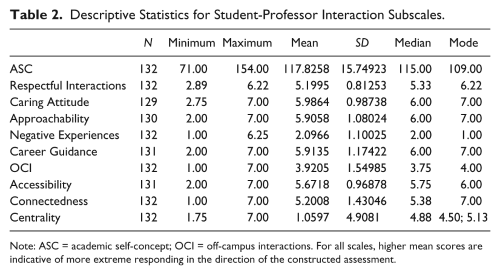
Note: ASC = academic self-concept; OCI = off-campus interactions. For all scales, higher mean scores are indicative of more extreme responding in the direction of the constructed assessment.
After examining the descriptive characteristics of the sample, several assumptions regarding regression analyses were examined. Multicollinearity was observed to be above .30 for most independent variables and ASC with the exceptions of off-campus interaction (.272), academic classification (.255), highest level of parent education (.061), and centrality (.149). Furthermore, there were minimal intercorrelations above .70 between independent variables (r = .771, between accessibility and respectful interactions; r = .717, between connectedness and caring; r = .757, between connectedness and career guidance), and these were not viewed as being sufficient evidence to discontinue the analyses. Furthermore, it was viewed unnecessary to aggregate the variables since they are conceptually distinct. All tolerance values were <1.0 and all variance inflation factor values were >1.0.
The analysis revealed that academic classification contributed significantly to the regression model in the first block, F(2, 114) = 4.266, p < .016. R2 was .070, indicating that approximately 7% of the variance in ASC scores were accounted for. Introducing centrality in the second block added a negligible contribution to the regression model, although adding GPA in the third block added an additional 29.5% of the variation in ASC as presented in Table 3. This change in R2 was significant, F(4, 112) = 16.64, p < .000. Finally, the addition of qualitative student-professor interactions in the model explained an additional 21.1% of the variation in ASC, which was also a significant change in R2, F(12, 104) = 12.14, p < .00. Only student-professor interactions characterized by a caring attitude was observed to be significant from the eight included in this final block (p < .000). Overall, ASC scores were moderately predictable from this set of demographic and environmental variables; the strongest unique predictive contribution was from GPA (ra(b. c) = .463) followed by student-professor interactions characterized by care (ra(b. c) = .167) in the final step entered. The unstandardized coefficients that comprise the full regression equation, including beta weights, significance values, and semipartial correlations can be found in Table 4.
Summary of R2 Values and R2 Changes at Each Step in the Hierarchical Regression.
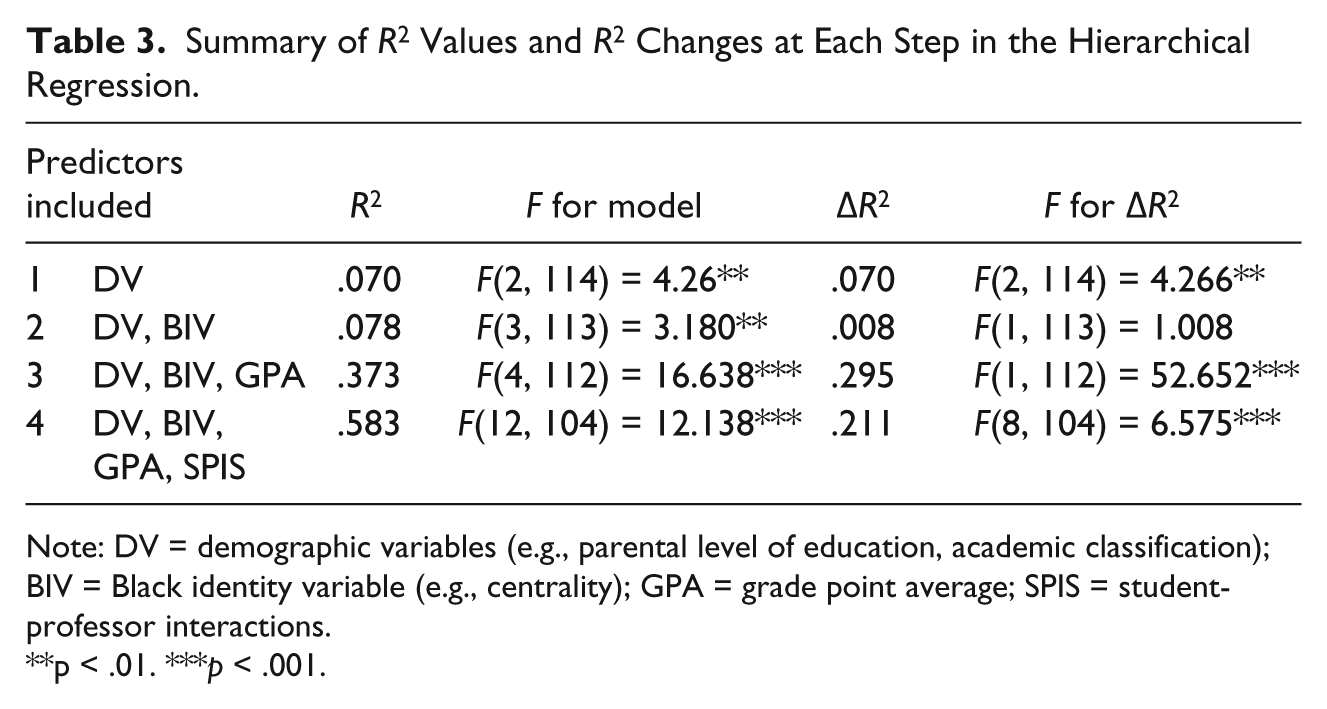
Note: DV = demographic variables (e.g., parental level of education, academic classification); BIV = Black identity variable (e.g., centrality); GPA = grade point average; SPIS = student-professor interactions.
p < .01. ***p < .001.
Hierarchical Regression Analysis for Variables Predicting ASC.
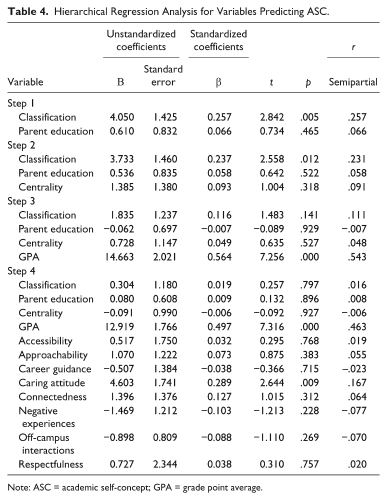
Note: ASC = academic self-concept; GPA = grade point average.
Discussion
ASC is an important factor in academic achievement. As such, it is important to understand what factors may be predictive of ASC. The current study investigated the predictive role of 12 variables. Analyses from the present study revealed that undergraduate GPA accounted for the greatest percentage of variance in ASC. Student-professor interactions characterized by care accounted for a small percentage of variance. Academic classification was found to be a significant predictor of ASC as well. Because it is modifiable, student-professor interactions characterized by care should be investigated further in an experimental design to determine if it can be manipulated to result in enhanced ASC.
The positive association of ASC and GPA is consistent with a number of studies that suggest that as students’ confidence in their academic abilities increases their overall academic achievement increases as well (Cokley, 2000; House, 1993, 1996; Robbins et al., 2004). The results of this study further highlight the positive relationship between GPA and ASC. In our study, the positive relationship between student-professor interactions characterized by care and ASC was consistent with results from other studies investigating this relationship (Cokley et al., 2004; Komarraju et al., 2010). This suggests the possibility that ASC is related to how students perceive their interactions with their professors. If they perceive their professors as having a caring attitude, then the conditions are favorable for positively influencing their ASC.
Given that students with higher GPAs also tend to have higher ASC, an alternative explanation is that students who are performing well academically have more caring relationships with their professors. Faculty may take a greater interest in students whom they perceive as having greater potential for success, as indicated by GPA or students may make more attempts to connect with these faculty in a more caring way. These notions are speculative in nature and cannot be definitively stated, as the underlying cause of the relationship between caring interactions with professors and ASC could not be determined given the parameters of this study.
Contrary to the previous findings of Cokley (2000, 2002), student-professor interactions were not the strongest predictor of ASC of African American students attending a HBCU when college GPA was included in the analyses. These discrepant findings may be best explained by differences in the operationalization of student-professor interactions. Student-professor interactions in this study were assessed by a variety of subscales with viable psychometric properties and a strong theoretical basis. Student-professor interactions assessed in the aforementioned studies were assessed by the National Study of Black College Students’ Questionnaire, which is based on a single question to assess the quality of student-professor interactions. This one question addressed the frequency of interactions, whereas the SPIS used in the current study assesses nine different components of student-professor interaction.
Centrality was not a significant predictor of ASC for the student sample in this study. The finding seems to be consistent with research examining the relationship between centrality and ASC with African American students in high school (Cokley, McClain, Jones, & Johnson, 2011). This finding may be related to the different meanings that racial identity has for African American students when assessed for its relationship with academic outcomes as well. Furthermore, the results may be inconclusive due to an exigency to address the role of gender in a substantive way (Cokley & Moore, 2007). This study did not afford an opportunity to explore within group gender differences due to the oversampling of female African American students.
One example of a gender difference in how racial identity is expressed in the context of its relationship with academic outcomes may include how being a part of one’s “ethnic-in” group is more related to improved academic outcomes for males, but not females (Oyserman, Bybee, & Terry, 2003). Achievement as an in group identifier has been shown to be more closely related to academic outcomes for females (Oyserman et al., 2003). Additionally, gender differences in racial identity that may be related to a lack of a relationship between centrality and ASC could be related to a phenomenon known as cool-pose culture (Majors & Billson, 1992). Researchers have speculated that many African American male youth in particular derive self-esteem, respect, and a sense of identity from nonacademically oriented activities related to popular culture in a way that African American female students do not experience (Majors & Billson, 1992).
More research is needed to support these notions and further understand the relationship between racial identity and ASC for African American students. The results of the present study are both consistent with previous research and inconsistent in some ways that yield promise into developing further insight into the factors that are related to the ASC of African Americans. It is the hope of the researchers that these results will inform approaches of higher education personnel and faculty in an effort to promote favorable conditions for student confidence and success.
Limitations and Future Research
One of the major limitations of this study was its relatively small sample size and sampling from a single institution. Furthermore, there was an oversampling of females who were generally younger, evidenced by the most common age of participant in this study being 18 years. More specifically, generalizability cannot be assumed to transfer to other HBCUs, with even greater difficulty applying these results to non HBCUs.
Additional descriptive variables were not available for analyses, and other factors could have been used to derive a more generalizable model of ASC for African Americans across a wider range of sociodemographic categories. Future studies should try to incorporate larger samples with equal proportions of male and female students to provide a stronger basis for predictive models. If possible, future studies should also include a non-HBCU control group, along with collecting more background information pertaining to the student’s academic history, culture of origin, and family status.
Footnotes
Declaration of Conflicting Interests
The authors declared no potential conflicts of interest with respect to the research, authorship, and/or publication of this article.
Funding
The authors received no financial support for the research, authorship, and/or publication of this article.