




Abstract
A sex-positive lens is needed to investigate Black sexuality, which is often depicted through deficit and risk models. Extant sex research leaves an opportunity to understand Black experiences of sexual pleasure untapped. Using narrative inquiry coupled with constructivist grounded theory methods, we examined 18 Black university students’ last sexual encounter narratives. An explication of their disclosure about and meaning making around pleasure is presented. Themes included the following: monitoring mutual pleasure, relegating pleasure to men’s performance, and positioning pleasured possibilities as hope or expectation. Research implications for Black psychology are addressed.
Sex positivity is an important framework for both research and psychological practice (Mosher, 2017). A sex-positive framework forces researchers to move beyond evaluating sexuality and sexual behaviors through a deficit, risk-focused lens established by an exclusive set of U.S. cultural standards, to acknowledge the “numerous socio-political and value-based factors that influence normative sexual practice and beliefs” (Burnes, Singh, & Witherspoon, 2017, p. 514). Williams, Prior, and Wegner (2013) noted “too often cultural forces are given ‘lip service’ but not serious attention in understanding sexual practices,” which “contributes to marginalization and othering” (p. 273) in sex research. Specifically, the shift toward a sex-positive paradigm in Black sexology can open new avenues of research such as the exploration of universal components of optimal sexuality across all groups, namely, pleasure (Burnes et al., 2017; Morgan, 2015).
Although an exploration of pleasure is necessary for scientific advancement in Black sexology, discourse on Black sexuality continues to be reduced to stereotypes such as hypersexuality (e.g., bad girl tropes, the player image) and sociopolitical distancing attempts such as the performance of respectability (e.g., good girl tropes, the Black buddy image), with little attention to pleasure at either end of the continuum (Collins, 2005; Nash, 2012). For reference, in mass media Black masculine sexuality is frequently portrayed as the harmless, middle-class Black buddy to a White protagonist, an image void of an independent Black male identity. He is often depicted as asexual and “stripped of the seemingly dangerous parts of Blackness” (Collins, 2005, p. 168). Black men are also represented as the player or hustler image, “who use their sexual prowess to exploit women” (Collins, 2005, p. 162; see also Babbitt, 2013; Calabrese et al., 2017). Black feminine sexuality tends to embody either good girl sexual scripts, the modest, virtuous, and respectable Black woman; or bad girl tropes, the hypersexualized, lascivious Black woman (i.e., the Jezebel image; Babbitt, 2013). These stereotypes represent Black sexuality as either absent or impulsive. Since the significance of sexual pleasure is absent in the current literature of stereotyped depictions of Black sexuality, a more in-depth understanding of how Black people make meaning of their sexual encounters is warranted. Exploring meaning can help explicate how pleasure informs the experience and retelling of the story of one’s last sexual encounter.
Sex positivity recenters sex research as multicultural and intersectional (Williams, Thomas, Prior, & Walters, 2015), emphasizing the experiences and strengths of traditionally marginalized communities and identities. Morgan (2015) approaches sex positivity through an intersectional lens and situates pleasure politics in a liberatory Black Feminist framework. This redirection in the canon of Black sexuality research is necessary, as it can help combat stereotypes and it can expand the narrow scope of current literature. Stereotypes can have a profound impact on interpersonal treatment, sexual partnering, expectations, and safety practices (Calabrese et al., 2017). However, the nearly exclusive focus on sexual stereotypes and Black reactions and responses to racial-sexual stereotypes forgoes a holistic representation of sexual health (Morgan, 2015).
The current study explores the last sexual encounter narratives of 18 Black university students, from a sex-positive, hedonic, and eudemonic pleasure politics theoretical framework (Arakawa, Flanders, Hatfield, & Heck, 2013; Boul, Hallam-Jones, & Wylie, 2009; Morgan, 2015). First, we detail the limited depictions of Black sexuality in research and review relevant literature on last sexual encounter and sexual pleasure research, framing the study within hedonic and eudemonic pleasure politics. Then, we present the results from the current study and discuss them in the context of the Black sexology canon. Finally, we offer limitations and future directions for research, concluding with implications for Black psychology.
Depictions of Black Sexuality in Research
Lewis and Kertzner (2003) suggest that Black sexuality is often represented in two categories: sexual deficits/risks and sexual stereotypes. Bowleg et al. (2017) confirm this representation, specific to Black male sexuality, in what they call epistemologies of ignorance. Morgan (2015) makes a similar assertion about Black female sexuality. Most published Black sexology frames research through a deficit or medical model, frequently omitting pleasure altogether and highlighting the relationship between Black racial identity and sexual health risks (e.g., inconsistent or incorrect use of condoms as contraception and/or protection against sexually transmitted infections [STIs]; Hallum-Montes et al., 2012; Higgins et al., 2014), risky sexual behaviors and links to or protective factors against STIs (Oparanozie, Sales, DiClemente, & Braxton, 2011), and predictors of adolescent sexual activity and associations with other health risks among Black populations (Kogan et al., 2008; Mandara, Murray, & Bangi, 2016). These representations tend to dominate literature on Black sexuality, although the World Health Organization (2006) indicates that sexual health includes pleasure. This commitment to the deficit perspective of Black sexuality has its foundation in racial-sexual stereotypes.
Racial-sexual stereotypes conflate racist beliefs with the bodies and sexual behaviors of Black people (Babbitt, 2013; Calabrese et al., 2017). The current stereotypical representations of Black sexuality originate from 19th- and 20th-century White “scientists” who postulated that Africans were evolutionarily closer to nonhuman species than to White humans, fueling long-standing bias and portrayal of Black sexuality as “primitive” and “promiscuous” (Calabrese et al., 2017). These stereotypes continue to saturate the dominant culture and sexual messaging, influencing not only sexual partners’ views and expectations of Black sexuality but also Black individuals’ construction of their own sexuality (Babbitt, 2013; Calabrese et al., 2017). Such stereotypes also pervade sex research in psychology. Hargons, Mosley, and Stevens-Watkins (2017) found that in counseling psychology, research about racially/ethnically marginalized people was exclusively framed as sex negative—focused on risk. Calabrese, Rosenberger, Schick, and Novack’s (2015) study on Black gay men’s love, pleasure, and affection is one of the few studies that explicitly counters Black gay male stereotypes. Crowell, Delgado-Romero, Mosley, and Huynh (2016) present one of the few empirical studies about heterosexual Black male sexual health that includes an explicit articulation of pleasure and how heterosexual Black men of Caribbean descent define it. Black feminist theorists in the social sciences have long called for new, intersectional, and nuanced articulations of Black sexual politics (Collins, 2005; Thomas, 2004), and other researchers have also begun to articulate the need for Black women’s sexual pleasure research (Bowleg et al., 2017; Morgan, 2015). Their calls have largely gone unheeded, especially in the last sexual encounter research.
Last Sexual Encounter Research
Most research exploring last sexual encounters focuses on behaviors, predominantly on what types of sex occurred, from a quantitative methodological paradigm (Berg, Tikkanen, & Ross, 2013; Hagger-Johnson, Bewick, Conner, O’Conner, & Shickle, 2011; Herbenick et al., 2010). Herbenick et al. (2010) used a national probability sample to investigate the most recent sexual encounters of people aged 18 to 59 years. Of this sample, 11.1% were Black; however, data were not presented based on ethnic differences. Herbenick et al. (2010) reported statistics about sexual acts, location, partner type, substance use, and sexual experience, but there were no descriptions about what these behaviors meant in the context of the sexual experience. For example, approximately 83% of men and 66.4% of women reported experiencing pleasure at last encounter, yet an understanding about what pleasure means to the participants is excluded. Without the participants’ reported meaning of these behavioral indices, readers and researchers are left to hypothesize any potential meaning-making behind individuals’ sexual experiences of pleasure. Due to the minimal body of research exploring sexual pleasure at last encounter among Black populations, and the tendency for Black sexuality to be negatively depicted, these reader and researcher hypotheses may be problematic for Black people (Richters, de Visser, Rissel, & Smith, 2006).
Furthermore, Black populations subject to questions about last sexual encounters are often gay men or men who have sex with men, using a medical model to determine their level of risk for STIs (Dodge et al., 2015; Halkitis et al., 2011). Although this research has value in understanding the epidemiology of STIs among a highly affected group, Black men who have sex with men, the continued use of this limited sample and approach to research leads to a constricted understanding of Black sexuality. Few studies have qualitatively explored sexual encounters with a sex-positive approach to Black sexuality (Williams et al., 2015).
Moreover, last sexual encounter research represents an opportunity to understand a person’s current state of sexuality. Explored qualitatively, the narrative of the last encounter extends beyond behavioral incidents. Qualitative data on the last sexual encounter, particularly in narrative form, can explicate the meaning of partner and personal pleasure, including what participants hope for and what they actually get and give, as well as the way they define sexual pleasure for themselves and for their partners. For Black university students, extant research minimally attends to their lived experiences of sexuality and pleasure (Simmons, 2012), presenting an opportunity to fill this gap in the literature.
Sexual Pleasure
Rye and Meaney (2007) define sexual pleasure as “the positive feelings that arise from sexual stimuli” (p. 30). Despite such a simple, yet broad, definition, exploring sexual pleasure has often been reduced to orgasm and healthy sexual functioning (Blair & Pukall, 2014; Salisbury & Fisher, 2014). Extant research often fails to explicate the meaning of sexual pleasure, although pleasure is a primary motivation for sex (Boul et al., 2009). Beasley (2008) suggested that few studies explore straight men’s sexual pleasure from a sex-positive perspective, often depicting it as dangerous. He highlights that preventative health and gender studies literature provides space for pleasure among gay men and positions straight men as “predatory penises” (p. 156). For straight Black men, who have an additional layer of danger attached to their stereotyped sexual scripts (Lewis, 2004), research highlighting their pleasure is scarce (Crowell et al., 2016). Thus, readers are more likely to find narratives of gay Black men and their pleasure (Calabrese et al., 2015 ), which provides a necessary perspective. However, sexual pleasure narratives of straight Black men and women, and lesbian, bisexual, transgender, and queer Black people offer an important empirical complement that is currently lacking (Morgan, 2015).
Whereas research on Black men’s pleasure is rare, Black women’s sexual pleasure research is even scarcer. Despite a relatively large body of sexual pleasure literature for White women (Mah & Binik, 2002; Stulhofer & Ajdukovic, 2013), sex for Black women is almost exclusively depicted as risky (Lewis, 2004; Timm, Reed, Miller, & Valenti, 2013). Rose (2004) presents narratives of Black women’s sexuality broadly, focusing on three major themes: survival “through the fire,” guardedness “guarded heart,” and possibility “always something left to love.” Even in these extensive narratives, pleasure is an afterthought or an aspiration, rather than an expectation or a mainstay. The women see sex as a means to an end, such as building emotional intimacy with a partner, performing relationship maintenance, or manipulating relationship power dynamics (Rose, 2004). When pleasure is discussed, the eudemonic, goal-oriented pleasure, is often more central than the hedonic (Boul et al., 2009). The women describe their pleasure not in terms of their own climax or physiological sensation, but in receiving satisfaction from bringing their partner to climax or in strengthening their relationship through the intimacy of sex (Rose, 2004). Black women’s enjoyment of sex is a gap for sexology because, despite real risks, pleasure is often one of the main reasons people engage in sex (Rye & Meaney, 2007). We sought to expand the discourse on Black women’s and men’s pleasure.
Theoretical Framework: Sex Positive Hedonic and Eudemonic Sexual Pleasure Politics
A sex-positive hedonic and eudemonic sexual pleasure politic integrates Arakawa et al.’s (2013) sex-positive framework with the foci of hedonic and eudemonic pleasure (Boul et al., 2009) in a Black cultural context (Morgan, 2015). Arakawa et al. (2013) describe sex-positive research as “positive attitudes toward sex, sexual desire, sexual fantasy, sexual excitement, sexual pleasure, sex and happiness, orgasm, sex and intimacy, sexual satisfaction, positive and/or healthy relationships” (p. 311). As this study addresses sexual pleasure, it is inherently sex positive. However, an expanded definition of sexual pleasure was needed as a point of departure from which the various themes in this study could be understood. Boul et al. (2009) detail the differences between hedonic and eudemonic pleasure; they describe the former as pleasure based on feeling and sensations and the latter as pleasure through goal attainment, such as receiving pleasure from eliciting an orgasm from one’s partner. Their discussion of sexual pleasure acknowledges that the combination of hedonic and eudemonic pleasure often motivates sexual activity. People find aspects of sex pleasurable for a variety of reasons, from achieving intimacy and physiological responses to the manipulation of interpersonal power dynamics, with socialization often determining what one experiences as pleasure (Boul et al., 2009). Last, as we conceptualized this study among ethnically and sexually diverse Black university students, Morgan’s (2015) specific call for a pleasure politic in Black female sexuality was heeded and undergirded our intention for the study and our interpretation of the results.
Exploring the role of pleasure for Black university students is where this study begins to fill an important gap in sexology. In subject matter, paradigm, and methodology, this article’s focus on sexual pleasure among Black university students disrupts typical deficit models and stereotype research, offering qualitative data on the meaning of sexual pleasure. This study employed narrative inquiry (Esin, Fathi, & Squire, 2013) with constructivist grounded theory methods (Charmaz, 2014) to examine the last encounter stories among 18 Black university students in a midsized Southern city. As part of a larger study on Black university student sexual experiences, the last encounter narratives provide the greatest opportunity to introduce readers to how these 18 Black university students currently, rather than historically or retrospectively, engage in and make meaning of their sex lives. To the authors’ knowledge, this is the first study to explicitly elicit the last sexual encounter narrative in a qualitative format.
Method
Recruitment and Participants
Recruitment flyers were distributed in person by research team members on the campus of a large public university located in the South Eastern region of the United States. The research team handed flyers to students walking around campus and leaving academic buildings. The principal investigator accompanied the research team while they handed out flyers in person to answer any potential questions of interested participants. Students who took a flyer were directed to call or e-mail the principal investigator if they were interested in participating. Recruitment flyers were also posted online via message boards and listserves. The study and recruitment flyer were both approved by the University of Kentucky Institutional Review Board.
After participants contacted the principal investigator, she screened them to ensure eligibility. Eligible participants needed to identify as Black, 18 years of age or older, and willing to discuss their first and last sexual encounters. It did not matter when their most recent sexual encounter occurred. No exclusion criteria existed, other than to be able to speak English. As part of the data collection process, the research team employed purposeful sampling to ensure richness of data (Charmaz, 2014). By continuously analyzing the data as they were collected, codes and categories emerged. As pleasure became an important category, participant recruitment continued until the team received no new information pertaining to pleasure. The team also focused purposeful sampling on gender and sexual identity diversity, to offer a heterogeneous presentation of Black sexuality.
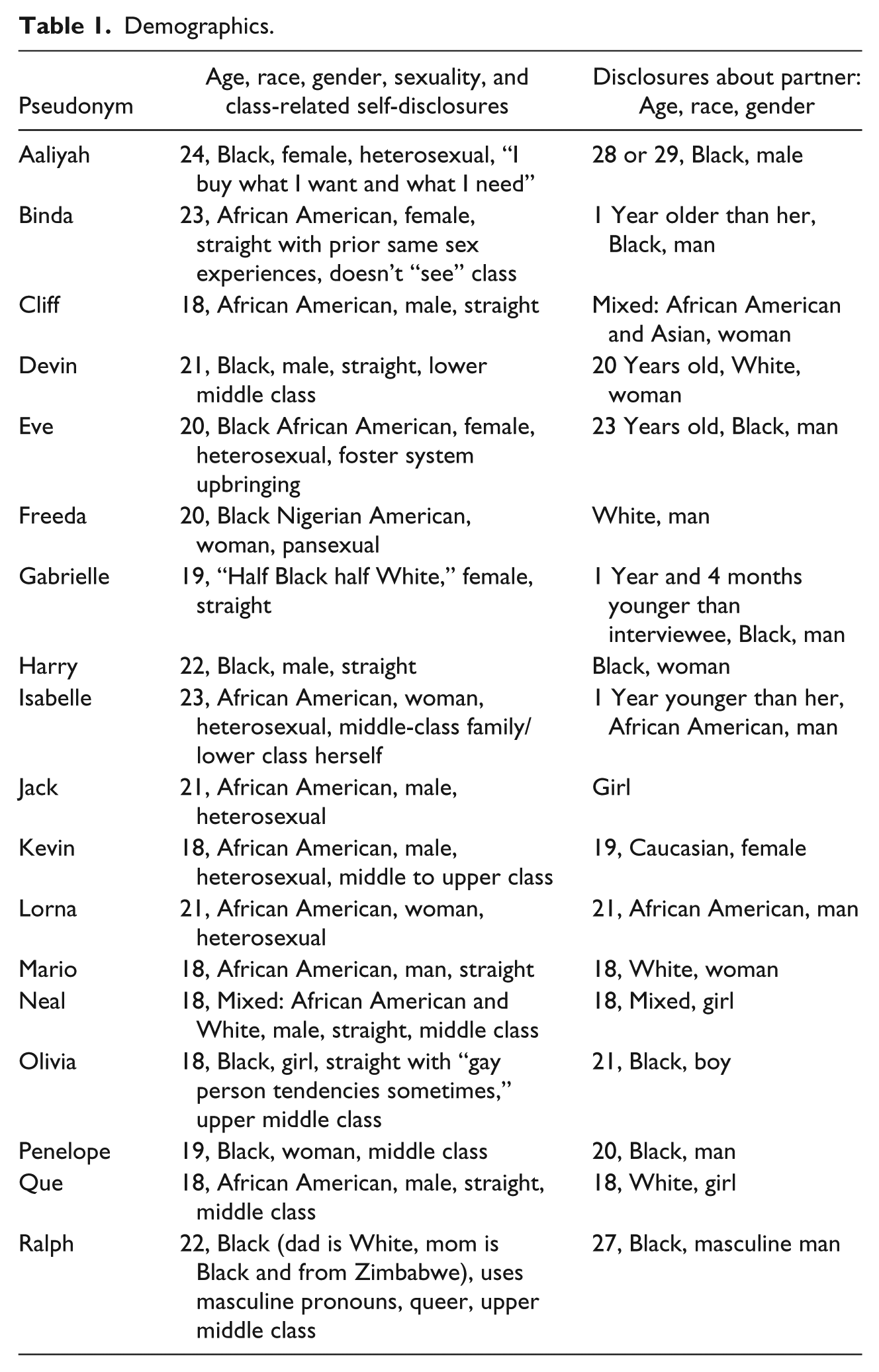
In total, 18 students agreed to participate. All participants identified as Black; however, three also identified as biracial and two identified as being of immediate African descent (Nigerian and Zimbabwean). One participant identified as pansexual and another identified as gay. The remaining participants identified as straight or heterosexual, with two straight-identified participants disclosing same-sex attraction and/or past experience. Only the gay-identified participant reported a same-sex partner at last sexual encounter. Participants received $20 for their participation. Pseudonyms were created throughout data collection and analysis to protect participant confidentiality (see Table 1).
Demographics.
Procedures
Participants were scheduled for a day/time to complete the interview in a secure, private office space at the university. Prior to the interview, each participant was invited to review the informed consent document as it was read aloud. Once participants consented, the interview began. Using a semistructured interview protocol, interviews were conducted by the seven members of the research team. Interviews ranged in time from 40 minutes to 75 minutes. Sample items from the interview protocol relevant to this study included the following: “Tell me about your last time. If it helps, tell it like a story.” “How was it? What sensations do you remember? Was it good to you?” “Did you and your partner achieve orgasm? Did you expect to?” Participants were informed during the consent process that they could choose to skip any question they did not want to answer. All participants answered all questions.
Subjectivities Statement
Research team members included six graduate students and the first author, an assistant professor. The first author and one research team member, the graduate research assistant coleading this project (second author), identified as Black. Six team members identified as female; one member identified as male. One team member identified as polyamorous, and two identified as queer. The remaining team members identified as heterosexual. Given the varied social locations of the research team, the first author trained all team members on Black sexuality, researcher reflexivity, and narrative and constructivist grounded theory research methods during a yearlong, weekly research team meeting and two 6-hour qualitative research training workshops. Part of the training including having all research team members act as both interviewer and interviewee using the interview protocol that was developed for this study. Each interview dyad had an opportunity to process their own thoughts and feelings about having discussed their most recent sexual encounter with the rest of the research team. The first author led discussions designed to help the research team process their own thoughts and feelings that emerged during the mock interviews, especially regarding how their cultural identities may have influenced their experience and how their identities might influence the co-construction of the research narratives during data collection. Research team members who observed the mock interviews provided constructive feedback that helped team members understand their interview styles in a cultural context. Conversations related to intersectionality and reflexivity were ongoing during data collection and analysis. Specifically, as a Black heterosexual woman training a predominantly White research team to study Black sexuality, the first author dedicated dozens of hours to explicating how sex positivity and intersectionality need to be at the forefront of our recruiting, interviewing, analyzing, and interpreting in this study.
Data Analysis
The current study uses integrated constructionist narrative inquiry with constructivist grounded theory methods (Charmaz, 2014; Esin et al., 2013). The purpose of the analysis was to explicate the meaning of sexual pleasure in Black university students’ last encounter narratives (Esin et al., 2013) with the structured methodological process of constructivist grounded theory as an analytic guide (Charmaz, 2014). Each interview was transcribed verbatim by the interviewer, with the exception of the first author’s interviews, which were transcribed by members of the research team. Transcripts underwent initial coding line-by-line, per Charmaz’s (2014) recommendation. The research team initially coded the first transcript together during research team meetings. Subsequent transcripts were coded by individual research team members and then shared with the larger team for discussion and the addition of other initial codes. The initial coding step included the action in each narrative’s content (Charmaz, 2014), as well as the narrative strategies or positioning, participants used to convey their stories (Esin et al., 2013).
Upon completion of initial coding, research team members reviewed initial codes to extract themes, or focused codes (Charmaz, 2014), and narrative patterns within the data (Creswell, 2007; Esin et al., 2013). As more interviews were transcribed and initially coded, they were reviewed independently for focused codes. The research team spent copious time reviewing focused codes to determine if any overlapped. Overlapping codes were condensed into one category. The research team discussed these categories and determined which codes were grouped under which categories. Categories were coded in an iterative process, during the data collection, to remain close to the data. New codes and categories that emerged during later interviews were applied to previously collected data as needed. All team members reviewed and discussed the codes and categories throughout to determine which emerged across a majority of cases or to a degree of salience that it stood out among others. Salience was determined by the frequency of codes that were found across participants, as well as the richness of data found in each code, as research team members went back to examine data after determining categories (Charmaz, 2014; Creswell, 2007; Merriam, 2009). Richness of data entailed the length of conversation that participants gave to these categories as well as the perceived importance that research team members were able to deduce from the participant based on their emotion and nonverbal communication as well (Merriam, 2009). Theoretical saturation was not achieved, as the goal of this study was not to create a theory but to present the narrative categories in the sexual experiences of these 18 Black students. Categorical saturation of the pleasure category and narrative positioning of pleasure resulted in this article.
Results
Pleasure emerged as a key category within the last encounter narratives of Black university students. The experience, as well as the absence, of pleasure was coded in order to explicate how participants described and made meaning of their last sexual encounter. Three subcategories explained the ways these students made meaning of and narrated their understanding of sexual pleasure during their last time: (a) monitoring mutual pleasure, (b) relegating pleasure to men’s performance, and (c) positioning pleasured possibilities as hope or expectation. These narrations of pleasure were gendered, with meanings and experiences often reinforcing traditional gender roles, regardless of the participants’ sexual identities. Mutual pleasure was the aspiration for participants irrespective of their gender, but men and women in our sample typically reported that pleasure came as a result of what a man did and how he did it. This attribution resulted in a gendered positioning of pleasure as a hope for most women and an expectation for most men, although participants in committed relationships were less likely to report this attribution.
Monitoring Mutual Pleasure
Most participants monitored whether both partners mutually experienced sexual pleasure and presented mutual pleasure as the aspiration for the sexual encounters. Olivia reported that she and her partner necessitate mutual pleasure. “So, every time I feel like I get my needs required, and I try to make sure I make his needs required.” She noted that because she and her partner committed to pleasuring each other, they are willing to do what they have learned to do to help each other achieve pleasure. For her, pleasure meant that both people enjoyed the experience and had orgasms. Aaliyah also attributed pleasure to orgasm, although she did not experience pleasure during her last encounter. Monitoring her partner’s pleasure resulted in her performing oral sex once she no longer wanted to have vaginal sex. She said, “Yeah, can’t leave you [last partner] hanging.” Specifically, she discontinued vaginal intercourse because she experienced an allergic reaction from the condom. Interestingly, she reported that she did not like her partner at that point, but she still wanted to ensure that he had an orgasm during the sexual encounter, even though she did not.
Some of the men in our sample discussed their desire to ensure their partner’s pleasure, so as not to be selfish.
I guess my goal was to give her an orgasm, so she wouldn’t feel like it was just being a waste of time. I feel like . . . if we was gonna please each other, please each other the right way. (Kevin)
Jack noted, “It’s pleasurable to know someone else is getting pleasure out of it. Maybe you don’t exactly know why.” Que shared a similar sentiment, “It’s way better when y’all are both, like she’s trying to please you and you’re trying to like please her. Y’all both trying to make each other feel orgasm or something. It’s just way better like that.” Kevin and Que defined pleasure as orgasm, whereas Jack indicated that observing his partner’s pleasure was his pleasure. These men reported that they preferred and enjoyed a mutually beneficial experience at their last encounters, but that was not the case for all men.
Harry stated that his last sexual encounter was “pretty good,” but not as pleasurable because he was uncertain that his partner enjoyed it too: I get satisfaction if she . . . like when I know she’s done then I can pull it back out . . . she always tells me that she’s satisfied but um, it’s just a part of me that doesn’t really believe that. . . . She tells me like she rarely comes anyway like because—in my opinion, I don’t feel like she knows her body all that well. Like she doesn’t masturbate or anything like that, and uh . . . I feel like if I could keep going then I could, like, do things to her that she’s not expecting. (Harry)
The desire for a mutually pleasurable experience at last encounter and its absence hampered his ability to fully enjoy the sex, because he did not believe that his partner really enjoyed sex if she did not have an orgasm. However, Harry’s perception that he could improve his partner’s sexual experience by helping her achieve orgasm if she allowed him to try something unexpected connects to the next theme.
Relegating Pleasure to Men’s Performance
For several men, the pleasure was both in the sensations as well as their pride in performance. Pride in performance included feeling like a “pro” (Mario) and lasting a long time. Neal stated, Yeah, it was good. It was actually like a long time. I didn’t even . . . you know . . . orgasm at all. . . . It makes you feel . . . I guess like good because you can last a long time.
Thus, for Neal, having a pleasurable sexual experience was actually the lack of orgasm and ejaculation, which allowed him to extend the time of the encounter. When asked what was good about his last time, Que said, “I actually knew what I was doing compared to the first time I did it. Yeah, it lasted longer and we did way more positions.” The pleasure of meeting personal and perhaps societal standards of masculine sexual performance enhanced the sexual experience reported by these Black men. Ralph, who identified as gay, described his last time as the “best sex he has ever had.” He noted, So then, what did I do? Like I was the fucking magician, pulling out all my bag of tricks . . . I knew what I was doing at that point, from the first time. . . . And . . . I was comfortable with him.
In Ralph’s experience, pleasure was both tied to his performance and comfort with his partner, without an explicit articulation of his own sensations.
This attribution of pleasure to the performance and level of comfort with the man in the sexual relationship applied to women participants as well. For many of the women participants, their pleasure was also attributed to the man in the partnership’s knowledge and skill, rather than their own. Olivia shared, “But, I feel like that’s what makes it better, because he’s more experienced than I am. And that’s why I feel like when I do orgasm it’s better, because he knows what he’s doing.” Olivia did not report that her ability to orgasm related at least in part to her own knowledge or experience.
Lorna described her last time enthusiastically, first indicating that her partner’s performance made her pleasure possible, rather than acknowledging something about her ability to create her own pleasure within the sexual experience. She said, I love having sex with him. And, I like it because he takes his time and he wants me to have pleasure which is what I love. . . . Usually when he eats me out it feels so good, and um I feel like it’s not like an orgasm—I mean I had an orgasm, but um, like something between like “oh my gosh, that feels so good” but it’s not orgasm, but it’s just like (sings) you know what I’m saying? . . . Goodness gracious, it was so good. (Lorna)
Her narrative shifts later in the dialogue, as she identifies that she asks for what she wants due to her level of comfort, body satisfaction, willingness to explore, and the love she feels in their relationship. “I feel so comfortable with my body and just doing anything, and so I go ‘you know, let’s try this’ and that sort of thing” (Lorna).
Both Freeda and Isabelle also add how their men’s sexual performance enhanced their pleasure. Freeda shared, “Yea it was good. [last partner name] knows what he’s doing,” Isabelle described the way her partner engaged her with passion. “Well it was pleasurable from the beginning, cause he just like came into my house and like literally pushed me up against my wall, and then like yeah, went from like my kitchen to my bedroom” (Isabelle). These women’s pleasurable sexual experiences were reported as a result of something their partners did, although Lorna also identified her comfort with her body and willingness to try new things as partially related.
Kevin’s narrative summed up the general perspective of study participants as it relates to who is responsible for the pleasure in a sexual encounter.
I feel like the guy is supposed to take more charge, because, like during sex, you both wanna be pleasured but then like I feel like the guy is making . . . not the guy is making like all the pleasure, but . . . I feel like it’s mutual, because without the guy, the girl wouldn’t have any pleasure, but without the girl, the guy wouldn’t have any pleasure. But I feel like guys are supposed to take more charge in giving pleasure to the female, I guess. (Kevin)
Because the participants largely agreed that men determined the pleasure for both parties, it informed the next theme about the possibilities for pleasure.
Positioning Pleasured Possibilities as Hope or Expectation
Inquiring about the last encounter revealed the ways participants position the possibility of pleasure with their partners. All men in the sample expected to experience pleasure, whereas most women hoped for it. As an exception, women who were with long-term partners were able to articulate the expectation of pleasure in ways similar to the men in our sample. Isabelle stated, “Yeah, it was very pleasurable. I always have orgasms when we have sex. So, it’s always like very pleasurable and all that stuff. I guess you would say the sensations that I felt were amazing. It was great sex.” Isabelle’s use of “I always have orgasms . . .” indicated that she had come to expect them in their relationship. Penelope, on the other hand, hoped for good sex with a new partner, only to be disappointed.
Then when he got down to crackin’, I was like this is it? I thought I need to get drunk again, ’cause this? I’m disappointed. I was really disappointed. It hurt my feelings for real. . . . It was just so bad, bad all over!
Penelope recalled that her partner had talked about some of the ways he intended to please her leading up to the encounter, and although she was suspicious of his ability to follow through, she hoped he would. She found herself disappointed when her hopes were not realized. Hoping for pleasurable sex appeared to be a phenomenon exclusive to women. When asked about pleasure and orgasm, Kevin noted, “I was expecting to [orgasm] ‘cause like I knew like if I didn’t, then I was gonna have like blue balls, I guess is how you would say it. And no one likes that ‘cause it hurts.” Kevin also shared that he expected to be able to provide his partner’s pleasure too.
The expectation of pleasure among men did not ensure it was the most pleasurable sex one had.
It was good, but I didn’t feel anything because I wasn’t dating her versus my first girlfriend. So, it was, I mean it felt great, you know, but at the same time I did not really want her or . . . I did not really enjoy it as much as I did my first time. (Cliff)
The lack of intimacy in Cliff’s last encounter provided a point of comparison to his previous partner, an ex-girlfriend with whom he had more intimacy. The “feel anything” to which he was referring was emotional intimacy. He expected pleasure, and he experienced great pleasurable sensations, but his definition of pleasure included intimacy too. Because intimacy was absent from his last experience, it was less pleasurable despite his expectations. Intimacy, or at a minimum familiarity, provided the platform for greater pleasure in the last sexual encounter among these participants, in that pleasure could become an expectation rather than a hope. Although men in our sample expected to experience pleasure and most women hoped to experience it, the extent to which participants of either gender actually experienced pleasure was typically often contingent upon their degree of familiarity with their partners.
Discussion
This study centered pleasure in last encounter narratives of Black university students to contribute a sex-positive approach to Black sexology (Lewis, 2004; Morgan, 2015). The narrative inquiry of this study sought to examine the small story of last sexual encounters as the analytical unit (Esin et al., 2013), rather than taking on the big story social narratives about Black sexuality, because these small stories of everyday Black people’s sex lives have been underrepresented in sex science (Morgan, 2015). These 18 small stories enter the discourse with the big stories of sexual stereotypes and sexual risk, providing evidence for the need to broaden Black sexuality research to include pleasure. Through this study, we offer an initial definition of what these students mean when they say sexual pleasure. Additionally, three subcategories emerged from this study of Black sexual pleasure: (a) monitoring mutual pleasure, (b) relegating pleasure to men’s performance, and (c) positioning pleasured possibilities as hope or expectation.
Meaning Making and Pleasure
For many participants, pleasure meant having an orgasm within the sexual encounter, mapping onto the hedonic definition of sexual pleasure (Boul et al., 2009). However, eudemonic pleasure was also represented among this sample by demonstrating one’s sexual competence by pleasing a partner and seeking power and respect through sex. These findings partially align with research that explores orgasm and narratives around what students expect and enjoy (Bridges, Lease, & Ellison, 2004; Salisbury & Fisher, 2014). For example, Salisbury and Fisher (2014) interviewed focus groups of young adult men and women, and they found both men and women placed the responsibility on men for providing the physical stimulation needed for orgasm. However, they noted that participants emphasized women’s responsibility in being psychologically ready to receive orgasm. Their study limited the exploration of pleasure to the experience of an orgasm, whereas this study described pleasure as both eudaemonic and hedonic (Boul et al., 2009).
Monitoring Mutual Pleasure
Overall, what participants found most pleasurable was a mutually satisfying sexual experience. This finding echoes the reciprocity of pleasure themes, which feature prominently in Morrison et al.’s (2015) article on young men. The authors sought to measure the men’s adherence to sexual scripts about traditional masculinity and femininity, relational and emotional contexts of sex, and the dating process. Their mixed-methods study found that men were interested in some aspects of traditional masculinity, but also drawn to sex positive women, or women who openly endorse enjoying sex. Experiencing joint sexual pleasure seemed to be the highest aspiration of the sexual experience the young men sought. Participants in the current study reported a similar aspiration. The narratives of the Black men in this study that emphasized mutually pleasurable sexual experiences and a desire to please their women partners actively refute the stereotypes that are typically associated with Black men’s sexuality. Straight men’s sexuality has often been depicted as predatory (Beasley, 2008), with an additional layer of danger added for Black men’s sexuality (Lewis, 2004). The narratives present in this study offer an important look into how pleasure is experienced for Black men attending universities. Crowell et al. (2016) also found that heterosexual Black male participants, aged 30 to 50 years, wanted to offer a mutually pleasurable experience to their partners.
Despite the desire for men to provide the sexual pleasure, some women shared that they also wanted to actively please their partners. To ensure a mutually pleasurable sexual experience, women in committed partnerships actively emphasized their partner’s pleasure, as seen by engaging or continuing with sexual behaviors to increase their partner’s pleasure. Even Aaliyah, who was not in a committed partnership, asserted that despite her physical discomfort after an allergic reaction she chose to perform oral sex so that her partner could have an orgasm. In considering the connection between the themes of monitoring mutual satisfaction and positioning pleasured possibilities as hope or expectation, the women described actions they took to ensure that the expectation of their male partner experiencing pleasure was met. Thus, although women did not frame pleasure as their responsibility in the same way men assumed responsibility for pleasure, some women did articulate a desire to provide pleasure.
Relegating Pleasure to Men’s Performance
Men in our study tended to emphasize the length of the sexual experience, and they reported indicators of their performance as a way to narrate the pleasure they offered and received—a eudemonic representation. Overwhelmingly, they narrated pleasure as their responsibility, despite a desire for their women partners to be more aware of what was pleasurable for them (Chadwick & van Anders, 2017). These findings align with studies that describe Black sexual scripts for men as necessitating high levels of prowess and peak performance (Poulson-Bryant, 2005). Importantly, stereotypes about Black women’s hypersexuality did not emerge. The women in this study did not articulate that they had to be sexually astute; rather, they could choose it or not. In Simmons’ (2012) historical perspective of Black university student sexuality in the 1930s, the Black women at Howard University—her study’s research site—described pleasure as an affront to respectability that was both anxiety provoking and exciting. Those participants did not feel they were supposed to receive or give pleasure, although they enjoyed both. The current study’s results indicate Black university students desire and pursue sexual pleasure, even within the context of predominantly White university settings, where they may be more susceptible to stereotypes about their perceived sexual prowess and predilections. Perhaps the Black university students in this current study endorsed the vast array of Black sexuality options available to women, rather than the stereotypical limits imposed upon them.
Contrarily, although stereotypes of Black women’s sexuality as hypersexual or asexual did not emerge, politics around respectability for Black women may have been present for women in the way they explained their narratives. Black university students may feel pressured to conform to politics of respectability in describing their sexual experiences and pleasure (Simmons, 2012). We did not see this represented in the men’s narratives, but for Black women, this may mean minimizing the agency they have over their own pleasure. Many of the women experienced pleasurable last encounters, attributing the pleasure to the prowess of the men they were engaging in sex with more often than not. Few noted that their ability to successfully communicate their sexual needs improved the encounter. Therefore, women in the current study may have emphasized the role their partners play in their pleasure to conform to the politics of respectability (Collins, 2005; Nash, 2012). Future studies should focus on Black women’s sexual pleasure to further examine the way they narrate and understand what facilitates their pleasure and what they find pleasurable.
For the one participant who identified as a femme presenting queer man, his performance was also tied to the delivery of pleasure to the man who was his last sexual partner. This suggests performance expectations for men may hold true across sexual identities and gender presentations. This finding aligns with Verduzco’s (2016) report that younger Mexican gay men find themselves positioned to provide pleasure, whereas older men, or those further in their sexual identity development, maintained more power to receive pleasure. As such, our findings warrant further investigation about performance and pleasure expectations among Black queer men who have sex with men.
Positioning Pleasured Possibilities as Hope or Expectation
The narratives of Black women in this study contributed to the emphasis on pleasure in ways not previously explored in the literature, moving the discussion beyond portraying Black women’s sexuality as risky (Lewis, 2004; Timm et al., 2013). However, this study found that hedonic pleasure was not an expected outcome of all of their last encounters, as it was for the men. The eudemonic framework was particularly useful in understanding what these Black women hoped to experience and actually did experience, as it relates to pleasure. For Aaliyah, she sought respect and power, forgoing the hedonic pleasure. The women who experienced both hedonic and eudemonic pleasure had their hopes for pleasure realized, emphatically expressing that “it was so good” (Lorna). Very little research presents positive narratives such as these for Black women. By highlighting pleasure within their last encounter narratives, the Black women in this study offered a perspective on Black sexuality that is not highlighted in current literature, although research on pleasure does exist with regard to White women (Mah & Binik, 2002; Stulhofer & Ajdukovic, 2013).
The Black men in this study expected that sex would be good, and all of them narrated the experience of hedonic pleasure. Eudemonic pleasure, however, was not a universal experience. Not only did a committed relationship typically relate to women wanting to actively engage in pleasing their partners, but intimacy within the relationship additionally seemed to be connected to sexual pleasure for women and men. For women in committed relationships with greater amounts of intimacy, their pleasure shifted from that of hope to expectation. Men in our study also shared experiences of eudemonic sexual pleasure related to being comfortable with their partner and described sexual experiences with intimacy as more pleasurable than those without. This aligns with a quantitative study of 2,968 straight men and 285 gay men from Portugal and Croatia that found that relationship factors, especially couple intimacy, most strongly predicted sexual satisfaction (Carvalheira & Costa, 2015). Additionally, Birnie-Porter and Hunt (2015) examined sexual satisfaction across different types of sexual relationships. The results showed a positive correlation between intimacy and sexual satisfaction for all relationship types (i.e., friends with benefits, casual dating, exclusive dating, engaged, and married). However, the correlation was stronger for individuals in exclusive dating, engaged, or married relationships than those in friends with benefits or casual dating relationships. Similar patterns of intimacy enhancing sexual pleasure are present in the narratives of Black university students in the current study.
By highlighting the risky, dangerous, and hypersexualized aspects of Black sexuality among men and women, current literature and depictions of Black sexuality are incomplete and provide an often stereotyped, problematic view on Black sexuality (Lewis & Kertzner, 2003). Given the importance of pleasure in the promotion and experience of sexual health (World Health Organization, 2006), it is equally as important for the experience of pleasure to be understood and explored as it is to understand aspects of safer sex and risk. The narratives presented in this study highlight that for these 18 Black university students pleasure is an important component of their last sexual encounters. Future research should further emphasize Black sexual pleasure to disrupt discourse that too often focuses on risk and deficits in Black sexuality (Hallum-Montes et al., 2012; Higgins et al., 2014; Kogan et al., 2008; Mandara et al., 2016; Oparanozie et al., 2011).
Limitations
Meaning making is the product of experience and identity (Esin et al., 2013). The participants’ construction of pleasure is a product of their identities and interpretation of past experiences. The identities of the research group also color the consumption of the narratives as well as the meaning construed from them. The research team is composed of two individuals who identify as Black women, four who identify as White women, and one White man. From a constructionist narrative perspective, the research team’s racial and gender composition and positionality affect the narration (Esin et al., 2013). Participants may have felt more vulnerable confiding in a researcher of a different racial, gender, and/or sexual identity because of previous experiences of discrimination or racism (Bowleg, 2012). They may have altered their narratives, consciously or unconsciously, to protect themselves from such vulnerability (Simmons, 2012), to protect their social respectability, to mirror dominant discourses, or to avoid conforming to negative stereotypes of Black sexuality. It is impossible to know how the narratives may have been told if the researcher across the room had a different identity, although White research team members were trained to elicit feedback and introduce racial differences as a part of the research protocol.
Thus, the limited racial and gender diversity of the research group is a limitation of this study. It potentially affects not only the understanding and interpretation of the narratives presented in this study, but may have also affected the narratives themselves. The research team took steps to minimize this risk by engaging in autoethnographic exploration, reflexivity, and discussion at every step in the research process, guided by the team leaders, the first author and lead research assistant, who identify as Black. However, the influence of the White cultural socialization cannot be completely eliminated or controlled.
Additionally, the public university where students were recruited was a historically White institution. Five participants reported interracial last sexual encounters, but this study did not seek to explore interracial sexual dynamics. None of the participants identified negative interracial dynamics in their last encounter, although one participant, Devin, described a racist incident in another sexual experience. Devin shared that he ended the sexual relationship with this partner due to her comments about his inability to be a committed partner and father, even though he was still physically attracted to her and had enjoyed the sex. This research specifically focused on pleasure as a disruption to the overarching narratives on Black sexual risk—including racism and fetishism, but future research may want to explicitly explore Black sexual pleasure in the context of interracial relationships to further explicate racial dynamics.
Conclusion
This article provides a unique contribution to the existing literature on Black sexuality by exploring meaning making around pleasure in last sexual encounters from a sex-positive, intersectional, and qualitative perspective. It does so by describing narratives of 18 Black university students, including narratives from a pansexual woman, a gay man, and women and men who identify as straight. Investigating the last sexual encounter is important because it provides a picture of participants’ current state of sexuality, and it fills a gap in the extant literature since most of the last encounter research focuses primarily on behaviors. Focusing on pleasure also allows for a positive aspect of the last encounter to be shared (Arakawa et al., 2013). Since all participants in this study were Black, providing a platform for sharing positive aspects of the last sexual encounter is crucial considering most of the extant literature examining Black sexuality is deficit based.
The field of Black psychology has great potential to contribute more comprehensively to the discourse on Black sexuality from a sex-positive pleasure politic perspective. In fact, as members of the Black community, it is our imperative to move beyond risks and stereotypes that have been imposed upon us (Morgan, 2015). Future research should examine how other factors such as intimacy, familiarity, racism, and love affect the experience of pleasure among Black people. In general, more qualitative research examining meaning making within Black sexuality is needed to allow participants to share their own sexual narratives with their words and in their voices. When we canonize Black people’s perspectives of pleasure and sexuality, we are able to draw upon our community’s varied strengths and wisdom to inform politics, policy, and practice.
Footnotes
Declaration of Conflicting Interests
The authors declared no potential conflicts of interest with respect to the research, authorship, and/or publication of this article.
Funding
The authors received no financial support for the research, authorship, and/or publication of this article.