



Abstract
Based on historical literature, Black Americans have persisted through centuries of oppression in North America. To survive, they retained Africultural values and adopted group-specific practices. Black cultural values and practices can potentially, if bolstered, increase psychosocial health in this population. In the current study, we examined specific Black values and practices and their collective ability to predict psychosocial health. In a sample 486 Black, middle-class, American adults with a mean age of 31 years, we used structural equation modeling to test a first- and a second-order measurement model, as well as a structural model. We hypothesized that health-promoting aspects of Black racial identity (e.g., racial centrality), racial socialization (e.g., cultural socialization), and racism-related coping (e.g., confrontation), as well as higher levels of communalism and spirituality would indicate one latent factor, Black Cultural Strength. Furthermore, we hypothesized that Black Cultural Strength would be predictive of psychosocial health. After slight model modifications, we found an acceptable fit for the data. Clinical implications and future research directions are discussed.
The enslavement of Blacks in the North American colonies has left a lasting system of racial oppression in the United States (Feagin, 2006). People of African descent (i.e., Black Americans) are subjugated to unfair treatment and social and economic oppression (Feagin, 2006). In the United States, Blacks were originally thought to be culturally deficient, and therefore any common practices among them were considered by-products of treatment and interactions with Whites (Gutman, 1976). However, social scientists and historians have identified cultural values that originated in African tribal communities and remain present in Black America. The work of some scholars has shifted perspectives on Black culture from deficient to culturally different (Marshall et al., 2017). Even further, contemporary work has uncovered aspects of Black culture that both enabled Blacks to survive ongoing racial oppression in the United States and maintain psychological health. The current study builds on this work to propose a strengths-based model of Black culture, Black Cultural Strengths.
Cultural Values and Collective Identity: A Theoretical Framework
To begin a discussion of cultural values, a framework for understanding culture is needed. Culture is defined as a system of meaning with values, norms, behaviors, language, and history that is passed on from one generation to the next through socialization and participation in the group’s organizations and institutions (Stewart & Bennett, 2011). Culture includes norms surrounding familial roles, communication patterns, affective styles, and values regarding collectivism and spirituality (Betancourt & Lopez, 1993). Scholars have asserted that it is important to examine Black culture from an Afrographic approach, which means to examine Black culture as not solely based on Blacks’ varying levels of closeness with White values (Boykin & Ellison, 1995; Jagers & Mock, 1993). The most well-known paradigm of Black culture that exists is “the Triple Quandary” (Boykin, 1986). The Triple Quandary was created to allow for a complex examination of African American psychology. It consists of three distinct cultural realms: Anglo-cultural, one’s cultural values being congruent with that of White Americans; Minority, the varying cultural expressions that can manifest as a result of being a member of an oppressed racial group; and Africultural, the traditionally African values of African Americans which encompass the concepts of affect, communalism, and spirituality. Boykin’s (1986) approach shed light on the complex existence that young Black people had to navigate, needing to be a part of mainstream society, coping with racial oppression in the United States and maintaining their Black cultural traditions. While acknowledging that the existence of each of the cultural realms could manifest in each individual, Jagers and Mock (1993) found that a higher endorsement of Africultural values (relative to endorsement of Minority and Anglo-cultural values) was associated with more prosocial values and less problematic behaviors and values (e.g., delinquency and Machiavellianism). These findings support two important notions in the exploration of Black cultural expression: (a) traditional African values appear to be related to positive behaviors and values in Black Americans and (b) Black cultural expression can vary in part due to the influence of the sociopolitical history of the United States (i.e., Minority and Anglo-cultural realms). Therefore, it remains important to work from an Afrographic approach, while also understanding that some within-group variation is to be expected.
Collective identity describes people’s sense of personal identity and their connection to a group. This collective identity is manifested in cultural symbols and practices, as well as attitudes, beliefs, and feelings (Ogbu, 2004). Unlike contemporary definitions of culture, collective identity emerges out of a shared collective experience (e.g., colonization, forced labor, North American slavery). Furthermore, Ogbu (1981) argued that aspects of collective identity (e.g., racial socialization) are rooted in culture, in that parents are helping children develop skills necessary to be competent adults within the cultural group. Scholars have also found that racial identity and coping with racism are associated with cultural values. For instance, Gaines et al. (1997) found that racial identity was positively associated with the cultural value orientations of familism and collectivism. Additionally, Cokley (2005) found that belief in Afrocentricity (e.g., unity, cooperative economics) was positively related to Blacks’ use of Afrocentricity to guide their thoughts and behaviors. These findings demonstrate how Black collective values can be considered interdependent with Africultural values and thus important to examine as cultural strengths. In an attempt to capture the most comprehensive understanding of Black cultural values, practices, and beliefs that are associated with strength (i.e., positive social and psychological functioning), we argue that it is important to examine both traditional Africultural values and aspects of collective identity in Black Americans.
Black Cultural Strengths: Africultural Values and Collective Beliefs
Some cultural practices and beliefs of their African ancestors have become customs and traditions of Blacks in America (Nobles, 2013). A belief that the survival of the individual is dependent on the survival of the group (i.e., communalism) and an interconnectedness between a person, nature, and others (i.e., spirituality) are among these cultural practices. Furthermore, additional practices and beliefs have emerged within the Black American collective identity. First, racial identity broadly refers to the process of developing an understanding of oneself as a member of the Black racial group. This process can encompass varying levels of engagement with other Blacks, endorsement of Africultural values, and beliefs about the importance of race (Helms, 1990; Sellers et al., 1998). Additionally, part of the Black collective experience is the need to orient younger generations regarding the role of race and racism in the lives of Black Americans, as well as how to cope with racism (i.e., racial socialization and racism-related coping).
While scholars have worked to identify Africultural values and manifestations of Blacks’ collective experiences, we assert that it is important to identify which of these cultural values promote social and psychological health, as well as understanding how they may work interdependently. We focus on strength as an important aspect of exploring Black cultural and collective values, acknowledging that scholars have found aspects of these factors to be associated with positive social and psychological functioning for Black Americans (D. Hughes & Chen, 1997; Jagers & Mock, 1993). Together, elements of Black culture and collective identity may be sources of Black Cultural Strengths, which promote psychosocial health for many Black Americans.
Black Cultural Strengths
Black Racial Identity
Several theories of racial identity have been posited: Cross’s (1971) Model of Nigrescence; Sellers et al. (1998) multidimensional model of Black identity, and Helms’s (1990) theory of Black racial identity statuses. Cross (1971) proposed the model of Nigrescence, a stage theory of Black conscious development. An expanded model of Nigrescence (Cross & Vandiver, 2001) and a corresponding measure, the Cross Racial Identity Scale (CRIS; Vandiver et al., 2000) were later developed. The CRIS outlines three Pre-Encounter subscales, Assimilation, Miseducation, and Self-Hatred; as well as one Immersion-Emersion Anti-White subscale and two Internalization subscales, Afrocentric and Multiculturalist Inclusive.
Helms (1990) proposed a stage, then later status model of Black racial identity in which she amended Cross’s (1971) original model. In the model, the author proposed that each racial identity status contained an understanding of one’s race which changed from an external, other-derived perspective to an internal or personally derived grasp of one’s and others’ race. Thus, with changes in racial identity status, a new cognitive template is used to organize racial information about oneself and others. Furthermore, Helms (1990) posited that maturation accompanied the shift from externally to internally derived racial identity and characterized one’s ability to hold various aspects of racial identity attitudes while one particular status dominates (e.g., internalization; Helms, 1990). The dominant statuses can range from Pre-Encounter, rejections of one’s own racial group, to Internalization, acceptance and investment in one’s race and culture. It has been posited and empirically shown that individuals can exhibit attitudes and behaviors in one dominant status or many statuses at the same time (Banks & Kohn-Wood, 2007; Neville & Lily, 2000; Pieterse & Carter, 2010).
Sellers et al.’s (1998) multidimensional model of racial identity includes the qualitative aspects of being African American and universal properties of racial and ethnic identity to develop four dimensions that represent manifestations of racial identity: salience, is person and situation specific and refers to how relevant an individual’s race is to their self-concept; centrality is a person’s perception of self by race, which remains relatively constant, regard is the feeling of negativity or positivity associated with being Black and operates in both public (i.e., how others view Blacks) and private (i.e., how one feels about Blacks) domains; and ideology is one’s beliefs and opinions about how Blacks should exist within and interact with others in society.
From theory, existing measures have been developed to assess Black racial identity (Parham & Helms, 1981; Sellers, 2013; Vandiver et al., 2002). Despite theoretical differences in Black racial identity theories, racial identity research shows that Black people can vary in their thinking, affectivity, and behavior as a result of their membership in the racial group. Most studies have examined one racial identity model and its correlates (e.g., M. Hughes et al., 2015). At least one study has combined aspects of different racial identity scales (Lee & Ahn, 2013). These authors found that Internalization–Afrocentricity (CRIS), combined with private regard and centrality from the Multidimensional Inventory of Black Identity (MIBI) were inversely related to psychological distress. Furthermore, they found that Black Racial Identity Attitudes Scale (BRIAS) Internalization, Internalization–Multiculturalist (CRIS), and Minority subscale of the MIBI were not related to psychological distress. These findings show that many domains exist to understand Black racial identity but only some of them have been positively associated with psychological health. It appears that racial identity scales reflecting (a) positive thoughts about being Black and other Black people, (b) finding race as an important aspect of identity, and (c) being able to appreciate and tolerate others’ cultures are associated with the least psychological distress. These aspects of racial identity studied in isolation show similar findings.
Using the MIBI, Sellers et al. (2006) found that psychosocial well-being was associated with racial identity that reflected Black pride and investment in Black culture, as well as tolerance for other racial groups. Other scholars have reported that feelings of closeness with other Blacks (M. Hughes et al., 2015) was inversely related to depressive symptoms. Furthermore, Sellers et al. (MIBI; 2006) found that higher racial centrality and private regard were associated with more psychological well-being. Internalization racial identity attitudes have been associated with increased self-esteem, psychological health, and inversely related to psychological distress (Franklin-Jackson & Carter, 2007; Mahalik et al., 2006). Psychological health reflects a general sense of wellness rather than specific psychological symptoms (e.g., positive affect, self-esteem). Measures used to assess psychological health (e.g., psychological well-being, life satisfaction) have been negatively associated with the presence of affective disorders and psychological distress (Ryff & Keyes, 1995). We refer to aspects of Black racial identity that have been found to be associated with psychosocial health as central-internalized racial identity. In order to fully understand how one develops a health-promoting, central-internalized racial identity, we must understand how it is transferred from person to person and from generation to generation. This process is best described as racial socialization.
Black Racial Socialization
Racial socialization involves the transmission of direct and indirect messages about race, being aware of oppression, and having racial-cultural pride typically transmitted by parents, family, and community members (Barr & Neville, 2014). Researchers have found that racial socialization messages are intertwined with racial identity status attitudes, presenting a cyclical pattern between the two. Studies show that parental racial identity influences the degree to which parents’ talk or care about race, what types of racial messages they transmit, and the resulting racial identities of recipients (Cooper et al., 2015; Tang et al., 2016).
Studies show that racial socialization occurs more frequently when the receiver has high Internalization status attitudes and racial pride (Thomas & Speight, 1999; Thomas et al., 2010). Furthermore, higher salience, centrality, private regard, and Internalization attitudes are positively related to transmitting messages of racial pride, cultural socialization, and preparation for bias (Demo & Hughes, 1990). These messages are then positively related to better psychological and social functioning including better college adjustment, increased family and peer self-esteem, academic achievement, anger management, and decreased behavioral problems (Anglin & Wade, 2007; Constantine & Blackmon, 2002; Scott, 2003). Therefore, a central-internalized Black racial identity is associated with racial socialization messages that prepare the person for racial bias and that promote racial pride (Thomas et al., 2010).
Despite multiple investigations into the linkages between racial identity and racial socialization, few researchers have added other constructs into these queries. In broadening the breadth of cultural and collective values in our investigation, we examined constructs that were usually studied in isolation, not as interdependent aspects of Black culture (i.e., cultural spirituality, communalism). We contend these are related to socialization and racial identity, and are aspects of Black culture and collective values which promote psychosocial well-being.
Communalism and Cultural Spirituality
Black cultural values have been maintained potentially by a group effort on the part of Black Americans, including a value of the group for Blacks. This sentiment, communalism, is the belief that the success of the individual and the group are inseparable (Boykin et al., 1997). Communalism is expressed through preserving and valuing extended family systems (i.e., beyond blood ties), as shown in the practice of shared child rearing beyond family members. Researchers have found communalism to be positively related to positive emotions and a sense of purpose (Abdou et al., 2010; Gooden, 2013). It is also manifested in cooperative achievements Blacks have made and sustained, such as the Black church, a source of social and economic survival for Black people (Blank et al., 2002). Beyond communalism, there are other customs that bind Black Americans together (Mattis & Jagers, 2001).
Often conflated with religiosity, Jagers and Smith (1996) contend that African American spirituality is a cultural value, which encompasses a sense of connection with one’s ancestors and contains the idea that things in nature have a force that directs life events. This value exists in tandem or separate from one’s religious practices. Spirituality, as a cultural belief, has been found to be positively associated with quality of life and optimism (Underwood & Teresi, 2002) and negatively associated with depression and posttraumatic stress disorder (Watlington & Murphy, 2006). Africultural spirituality has been found to be positively associated with both psychological well-being and life satisfaction (Reed & Neville, 2014). Some scholars have recognized spirituality as an important aspect of racial socialization (Anglin & Wade, 2007; Stevenson, 1998). Others believe spirituality is an important part of coping with racism (Forsyth & Carter, 2012). Therefore, spirituality appears to be an important cultural factor that may converge with other values such as racial identity and communalism.
Along with evidence of their positive impact on psychosocial functioning, both communalism and cultural spirituality have been positively associated with central-internalized Black racial identity and other Africultural values. Specifically, Brown et al. (2013) found positive correlations between communalism and Internalization racial identity status attitudes. These authors also found communalism to be predictive of empathy, when combined with spirituality and affect. Cultural spirituality has been explored less often in regard to other Black cultural values but has been associated with a communalistic orientation (Jagers et al., 1997), along with Internalization racial identity attitudes (Watt, 1997).
Racism-Related Coping
As posited, Black cultural values emerged and were maintained not because of Black Americans contact with Whites, but rather in spite of it. Black people had to develop ways to cope with the oppression they faced. Scholars have found that seeking social support and engaging in confrontation and/or anger expression mitigated the negative impact of racism (Hyers, 2007; Noh & Kaspar, 2003). Collective (i.e., group-centered activities) and spiritual Africultural coping styles were also positively associated with private regard (Constantine et al., 2002). Forsyth and Carter (2012, 2014) found four distinct cluster groups for racial identity status attitudes, as measured by the BRIAS, and racism-related coping strategies demonstrating the interrelatedness of these two constructs. These authors found that confrontation, followed by empowered action, spiritual coping, and constrained resistance tactics were associated with Internalization status attitudes. Furthermore, these strategies were associated with decreased depression, anxiety, hostility, somatization, and interpersonal sensitivity. Their findings demonstrate the interrelatedness of racism-related coping within the larger constellation of Black cultural values, particularly those that promote psychological health.
Current Study
Blacks have not only survived but also thrived through centuries of social and economic oppression in the United States. Scholars and researchers in the social sciences have sought to understand the strengths of Black Americans in lieu of these harsh realities (Boykin et al., 1997; Gutman, 1976; Helms, 1990; Jagers & Smith, 1996; Mattis & Jagers, 2001). There is evidence that aspects of racial identity, racial socialization, communalism, cultural spirituality, and racism-related coping have health-promoting properties that have contributed to Black survival. Most of this evidence has resulted from analysis of these cultural values in isolation with only a few instances of researchers attempting to understand how they intersect.
The central aim of the current study was to understand the relationships between these aspects of Black culture and collective identity, with the goal of further understanding the factors that have enabled survival and progress for Blacks in the United States. The positive and affirming components of Black racial identity, racial socialization, and racism-related coping, along with communalism and cultural spirituality have been associated with positive social and psychological outcomes in Black Americans. The current model builds on past theoretical and empirical work with cultural and collective values of Black Americans. According to this model, the determinants of Black Cultural Strength, a latent variable, are central-internalized racial identity, positive racial socialization, communalism, effective racism-related coping, and cultural spirituality. Additionally, life satisfaction and general mental health well-being are the determinants of Psychosocial Health. On the basis of this model, Black Cultural Strength will positively predict Psychosocial Health. We used structural equation modeling (SEM) analysis to test the aforementioned hypotheses.
Method
Participants
Participants were 486 self-identified Black American adults. The majority of the sample was female (76.3%, n = 371) with 23.7% identifying as male (n = 115). Participant ages ranged from 18 to 80 years with a mean age of 31.62 years (SD = 12.12). Participants’ social classes were as follows: Lower Class (n = 35, 7.2%), Working Class (n = 191, 39.3%), Middle Class (n = 218, 44.9%), Upper Middle Class (n = 40, 8.2%), and Upper Class (n = 2, 0.4%). Most identified as heterosexual (77%, n = 374), with 6.4% (n = 31) Gay or Lesbian, 16.3% (n = 79) Bisexual, and no designation (0.3%, n = 2). The majority were born in the United States (93.3%, n = 463). Participant highest education levels were as follows: less than a high school diploma (2.4%, n = 12), high school diploma/General Education Development (6.0%, n = 31), some college (24.3%, n = 124), trade/vocational training (2.9%, n = 14), associate’s degree (6.8%, n = 33), bachelor’s degree (30%, n = 147), master’s degree (20.2%, n = 98), professional degree (2.9%, n = 14), and doctoral degree (4.5%, n = 22). Last, the majority of the sample was single, never married (67.5%), with some married (22.6%), and the remainder were widowed, divorced, or separated (9.8%).
Measures
Demographic Questionnaire
Participants completed a self-report demographic questionnaire that solicited their personal and educational background including age in years, race, gender, country of origin, sexual orientation, highest level of education, social class (e.g., working class, upper middle class), and marital status (e.g., single, widowed).
Central-Internalized Black Racial Identity
Black Racial Identity was measured using scales from the MIBI (Sellers, 2013) and the BRIAS (Helms, 1990; Parham & Helms, 1981). The BRIAS is a 50-item scale with four scales: Pre-Encounter, negative attitudes about Blackness; Encounter, ambivalence about one’s race; Immersion/Emersion, idealization of own racial group and denigration of other racial groups; and Internalization, a positive commitment to one’s own racial group that uses a 5-point Likert-type scale (1 = strongly disagree; 5 = strongly agree) and summed responses. Only the Internalization scale was used in the current study, wherein higher scores indicate greater presence of the status attitudes. A sample item is, “I feel good about being Black, but do not limit myself to Black activities.” Prior studies have found alphas ranging from .66 to .73 (Forsyth & Carter, 2014). The Internalization scale has been found to be positively correlated with ethnic identity, and negatively correlated with adverse psychological outcomes (e.g., depression, anxiety; Forsyth & Carter, 2014; Hall & Carter, 2006).
The MIBI is a 51-item measure of four identity dimensions: salience, centrality, ideology, and regard for African Americans. All items are measured on a 7-point Likert-type scale, from 1 = strongly disagree to 7 = strongly agree. In the current study, only the private regard and centrality scales were used. Racial centrality refers to the importance of being Black to oneself. Private regard refers to one’s positive or negative feelings toward Blacks and being Black. Higher scores indicate more presence of that dimension. Sample items include “I feel that Blacks have made major accomplishments and advancements (private regard)” and “My destiny is tied to the destiny of other Black people (centrality).” Hope et al. (2013) found Cronbach’s alpha for centrality was (.76) and private regard scores (.73). Sellers et al. (1997) reported convergent and concurrent validity evidence with the centrality scale negatively associated with the contact with Whites scales and positively associated with the contact with Blacks scales (Wegner & Shelton, 1995). Further private regard and centrality have been found to be positively correlated with well-being and negatively correlated with depression (Sellers et al., 2006).
Effective Coping with Racism
An individual’s use of racism-related coping skills was assessed using the Racism-Related Coping Scale (Forsyth & Carter, 2014). The RRCS is a 59-item and eight scale measure, which uses a 4-point Likert-type scale (0 = did not use, 3 = used a great deal). Scores are summed wherein high scores indicate more reliance on the particular coping style. The scales are Bargaining (6 items that consists of strategies used to make sense of racism experiences by examining one’s own responsibility in the incident and how to change behavior to avoid similar incidents in the future.), Hypervigilance (11 items—involves using greater caution and sensitivity in interactions with non-Blacks, as well as avoidance of racially charged interactions and cognitive preoccupation with potential racial incidents), Social Support (3 items—involves providing and receiving assistance to and from others), Confrontation (8 items—refers to direct interaction with the perpetrator of the racial incident), Empowered Action (9 items—are activities such as use of community and/or legal resources to hold people accountable for their role in racial incidents), Spiritual (7 items—coping strategies include seeking religious counsel, readings, and relying on prayer and meditation), Racial Consciousness (9 items—involves taking action against racism), and Constrained Resistance (6 items—includes both passive [e.g., work-slowing strategies] and active [e.g., use of intimidation or nonviolent protests] efforts to combat racism). Sample items include, “I sought legal advice” (empowered action); “I only did the bare minimum to get by in my job as a form of resistance” (constrained resistance); “I prayed about it” (spiritual); and “I talked about it with the person(s) involved in order to educate them” (confrontation).
In the current study, only Confrontation, Empowered Action, Spiritual, and Constrained Resistance were used. Forsyth and Carter (2014) reported evidence of construct validity, showing that these coping skills were positively associated with one another (r = .29 - .58), and with scales of the Africultural Coping Systems Inventory, a measure of culture-specific coping strategies for African Americans. In addition, theses scales were inversely correlated with depression, hostility, and somatization (Forsyth & Carter, 2014). Spiritual coping was positively related to psychological well-being.
Communalism
The construct of communalism was indicated by two different scales.
The Communalism Scale (Boykin et al., 1997) is a 40-item, 6-point Likert-type scale (1 = completely false to 6 = completely true) that assesses the degree to which respondents are socially interdependent and adhere to a group orientation. Higher scores indicate stronger communalism. A sample item is, “I make sacrifices for my family and they do the same for me.” Reliability estimates have ranged from .84 to .87, with a 3-week test–retest reliability of .81 (Boykin et al., 1997). Construct validity was found by the relationships with Social Interdependence (Johnson & Norem-Hebeisen, 1979) showing that cooperative attitudes were positively correlated with Communalism scores (e.g., r > .35) and were inversely related to competitive attitudes (e.g., r < −.05; Boykin et al., 1997) providing evidence of discriminant validity.
The African American Collectivism Scale (Lukwago et al., 2001) is a 6-item measure, which uses a 4-point Likert-type scale (1 = strongly disagree to 4 = strongly agree). A sample item is, “In your opinion, how important is it that you and your family call, write, or see each other often?” Past tests of internal consistency found good reliability (r = .93, Lukwago et al., 2001). Sheppard et al. (2014) reported convergent validity, by showing inverse relationships between the African American Collectivism Scale and measures of anxiety (r = −.15) and depression (r = −.25) in Black breast cancer patients. Discriminant validity has not been established for this scale.
Cultural Spirituality
Two scales were used to assess cultural spirituality.
The Spirituality Scale (Jagers & Smith, 1996) is a 20-item measure that assesses Africultural spirituality on a 6-point Likert-type scale (1 = false to 6 = true). A sample item is, “I feel that life is made up of spiritual forces.” Cronbach’s alphas were from .84 to .87 and 3-week test–retest reliability was .88 (Jagers et al., 1994). Higher scale scores indicate more spirituality. Evidence of convergent and discriminant validity was shown through positive associations with scales measuring religious well-being (r = .47), God agency (r = .44), and disparate associations between Blacks (r = .24) and Whites (r = .17) with the Spirituality Scale and existential well-being (Jagers & Smith, 1996).
The Daily Spiritual Experiences Scale (DSES; Underwood & Teresi, 2002) is a 16-item measure that assesses one’s spiritual experiences in daily life. It has a 6-point Likert-type scale (1 = many times to 6 = never) and is reverse scored with higher scores indicating less spirituality. A sample item is, “I feel God’s presence.” Underwood (2011) reported a Cronbach’s alpha of .89. Underwood and Teresi (2002) reported convergent validity, with participants who were not religious having a low level of daily spiritual experiences and those who did engage in religious activities having frequent spiritual experiences. In addition, Cole et al. (2008) found a positive correlation between the DSES and another measure of spirituality (r = .57). Evidence of the discriminant validity of the DSES was shown through inverse relationships found between the DSES and anxiety (r = −.39), alcohol consumption (− .20), and depression (r = −.22). Traditionally, the DSES is reverse scored and higher scores indicate less spirituality. In the current study, we transformed DSES scores so that higher scores indicated more spirituality.
Positive Racial Socialization
Subscales of the Racial Socialization Scale (D. Hughes & Chen, 1997) were used to indicate positive racial socialization. The Racial Socialization Scale consists of three subscales: preparation for racial bias, cultural socialization, and racial mistrust. Scored on a 5-point Likert-type scale (1 = never to 5 = always), the measure assesses the types of racial socialization messages an individual has received. Only the preparation for bias (i.e., discussions of group differences and explanations of racial bias) and cultural socialization (i.e., cultural heritage, teaching, and awareness) scales were used in the current study. Sample items include, “Did your parents take you to other groups’ cultural events?” (cultural socialization) and “Did your parents ever tell you that you have to work harder because of who you are?” (preparation for bias).
D. Hughes (2003) reported reliability coefficients for the preparation for bias and cultural socialization subscales of .74 and. 87, respectively. Concurrent validity was shown with cultural socialization and preparation for bias messages positively associated with enculturation and parents’ racial and ethnic identity (D. Hughes et al., 2006). Preparation for bias (r = −.27) and cultural socialization (r = −.36) have been inversely associated with parents’ White ethnicity. Higher scores indicate more racial socialization experiences in each domain.
Psychosocial Health
Two scales indicated psychosocial health. The Satisfaction with Life Scale (Diener et al., 1985) uses a 7-point Likert-type scale (1 = strongly disagree; 7 = strongly agree) and assesses one’s self-reported life satisfaction. Higher scores indicate greater life satisfaction. A sample item includes, “In most ways, my life is close to my ideal.” Reliability coefficients ranged from .72 to .82 (Utsey et al., 2002). Evidence for convergent and discriminant validity was shown by positive correlations with other measures of well-being (r = .44) and negative correlations with measures of distress (r = −.48; Pavot & Diener, 2009).
The Mental Health Inventory (MHI; Veit & Ware, 1983) assesses mental health emotions and symptoms it has two global scales, psychological distress and well-being, and six subscales. Scores ranged from 1 (all of the time) to 6 (none of the time). Only the global psychological well-being scale was used in the current study. A sample item is, “During the past month, how much of the time have you been a happy person?” The psychological well-being scale reliability coefficients were .84 to .92 (Veit & Ware, 1983; Ware & Gandek, 1994). Positively worded items were reverse scored so that higher total MHI scores indicate better mental health. The MHI-psychological well-being scale has been associated with optimism (r = .61) and health values (r = .25; Burris et al., 2009) and inversely related to anxiety (r = −.87) and depression (r = −.82; Ware et al., 1979).
Procedure
Once institutional review board approval was obtained by the first author’s institution, participants were recruited for the online data collection through e-mail, listservs, and social media posts from organizations and societies with a large Black membership and/or readership (e.g., Black Lives Matter and Black Republicans Facebook groups). Possible respondents included those who identified as African American or Black American, were 18 years or older, and had interest in participating in a study of Black cultural values. A link to the survey was available so that when participants clicked the link they were directed to complete informed consent. If they consented, they were then directed to the self-report survey. Participants took about 45 minutes to finish the survey in which each measure was in the following set order: informed consent form, demographic questions, Communalism Scale, MIBI–Private Regard and Centrality scales, The Spirituality Scale, BRIAS–Internalization, African American Collectivism Scale, RRCS–Spiritual, Empowered Action, Constrained Resistance, and Confrontation scales, RS–Bias and Cultural Socialization, DSES, Satisfaction with Life Scale, and the MHI–Well Being Scale. After the survey, participants were directed to an external website where they could provide their e-mail address in order to be entered into a raffle for a $200 gift card. No identifying information (e.g., date of birth, IP address) was collected at this site to ensure participant confidentiality.
Data Analysis Plan
SEM techniques were used with the robust maximum likelihood estimation procedure and based on covariance matrices in Mplus (Version 7.4). Path coefficients were examined to test the hypothesized relationships between latent constructs in the structural model. SEM was the best data analytic approach because through this strategy measurement error is partialed from the obtained coefficients rather than included in scores like in multivariate analyses (Kenny, 1979). Then, SEM path coefficients and model fit data were examined.
Power Analysis
Given the desired power of .80, 15 observed variables and 7 latent variables (see Figure 1), and anticipated medium effect size (.30), a minimum sample size of 170 was recommended to detect a medium effect and 366 was recommended given the complexity of the model using Soper’s (2019) Cohen’s d online power calculator. In addition, Weston and Gore (2006) recommend 10 to 20 participants for each parameter being estimated in the model. For the proposed model (Figure 1), 29 parameters were being estimated; therefore according to Weston and Gore (2006), a sample size of 290 to 580.

Standardized coefficients—Black cultural strength original measurement model (n = 486).
Results
Preliminary Analyses
Preliminary analyses involved checking for missing data, reliability estimates, outliers, and assumptions of causal models. Missing data included 428 participants who did not fill out the survey in its entirety and those who took the survey but did not meet study criteria (non-American, non-Black, younger than 18 years). A total of 486 individuals completed the study in its entirety and met full study criteria. Of participants who did not take the full survey, we found no noticeable demographic differences between them and those who completed the survey. Study fatigue appeared to be the reason for study noncompletion. No univariate outliers were found and nine multivariate outliers were found on demographic variables. Outliers were not removed given that they were on demographic variables. Multivariate normality is a common assumption in the data of SEM. The means, standard deviations, skewness, kurtosis, and correlations between all study variables are presented in Table 1. Inspection of Table 1 showed no evidence of multicollinearity using an r > .85 as a guide as recommended by Bohrnstedt and Carter (1971). Due to some borderline skewness and kurtosis values, steps were taken in order to conduct primary analyses that accounted for nonnormality in the study variables (i.e., using the robust maximum likelihood method for SEM; Bentler & Yuan, 1999).
Scale Skewness, Kurtosis, Cronbach’s Alphas, and Bivariate Correlations (n = 486).
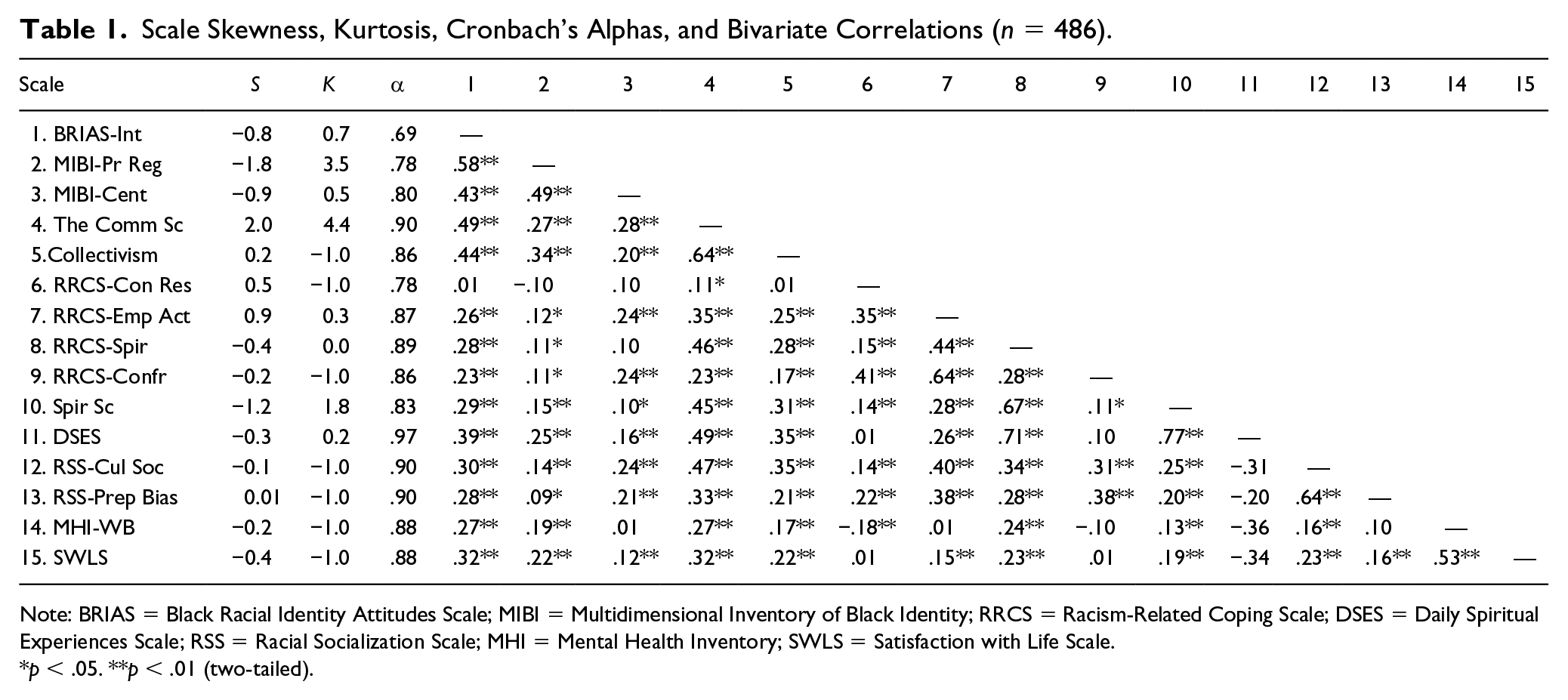
Note: BRIAS = Black Racial Identity Attitudes Scale; MIBI = Multidimensional Inventory of Black Identity; RRCS = Racism-Related Coping Scale; DSES = Daily Spiritual Experiences Scale; RSS = Racial Socialization Scale; MHI = Mental Health Inventory; SWLS = Satisfaction with Life Scale.
p < .05. **p < .01 (two-tailed).
In order to examine the generalizability of any study findings, a series of analyses of variance were conducted to determine whether statistically significant differences in primary study variables (e.g., MIBI—centrality, cultural socialization, communalism) were present among demographic groups (gender, educational level, social class, sexual orientation, age, and marital status) within the sample. Using Bonferroni corrections to protect against a Type I error, the significance level was set at .002. Some of the demographic variables were significant on primary study variables. There were statistically significant differences for Gender on RRCS–Constrained Resistance, F(2, 494) = 14.31, p < .001, η2 = .04, and RRCS–Empowered Action, F(2, 494) = 5.29, p = .005, η2 = .03. There were also statistically significant differences for SES on RRCS–Constrained Resistance, F(4, 494) = 4.29, p = .002, η2 = .03, and BRIAS–Internalization, F(4, 494) = 3.89, p = .004, η2 = .03. Last, there were statistically significant differences for Education on Daily Spiritual Experiences, F(8, 494) = 6.30, p = .000, η2 = .02, and RRCS–Spiritual, F(8, 494) = 3.81, p < .001, η2 = .01. Despite statistically significant differences on some demographic variables, effect sizes were small; therefore, we conducted primary analyses without the inclusion of demographic variables.
Primary Analyses
First-Order Measurement Model Indicators
Following recommendations set forth by Russell et al. (1998), we used two to three indicators for each first-order latent variable (i.e., central-internalized racial identity, positive racial socialization, effective racism-related coping, communalism, and cultural spirituality; see Table 2 for indicator correlations). Using multiple indicators for each latent variable is consistent with recommendations by Russell et al. (1998) for improving multivariate normality and overall model fit. All of the indicator variables significantly loaded on the latent variables (all ps < .001).
Factor Loadings for the Original Measurement Model (n = 486).
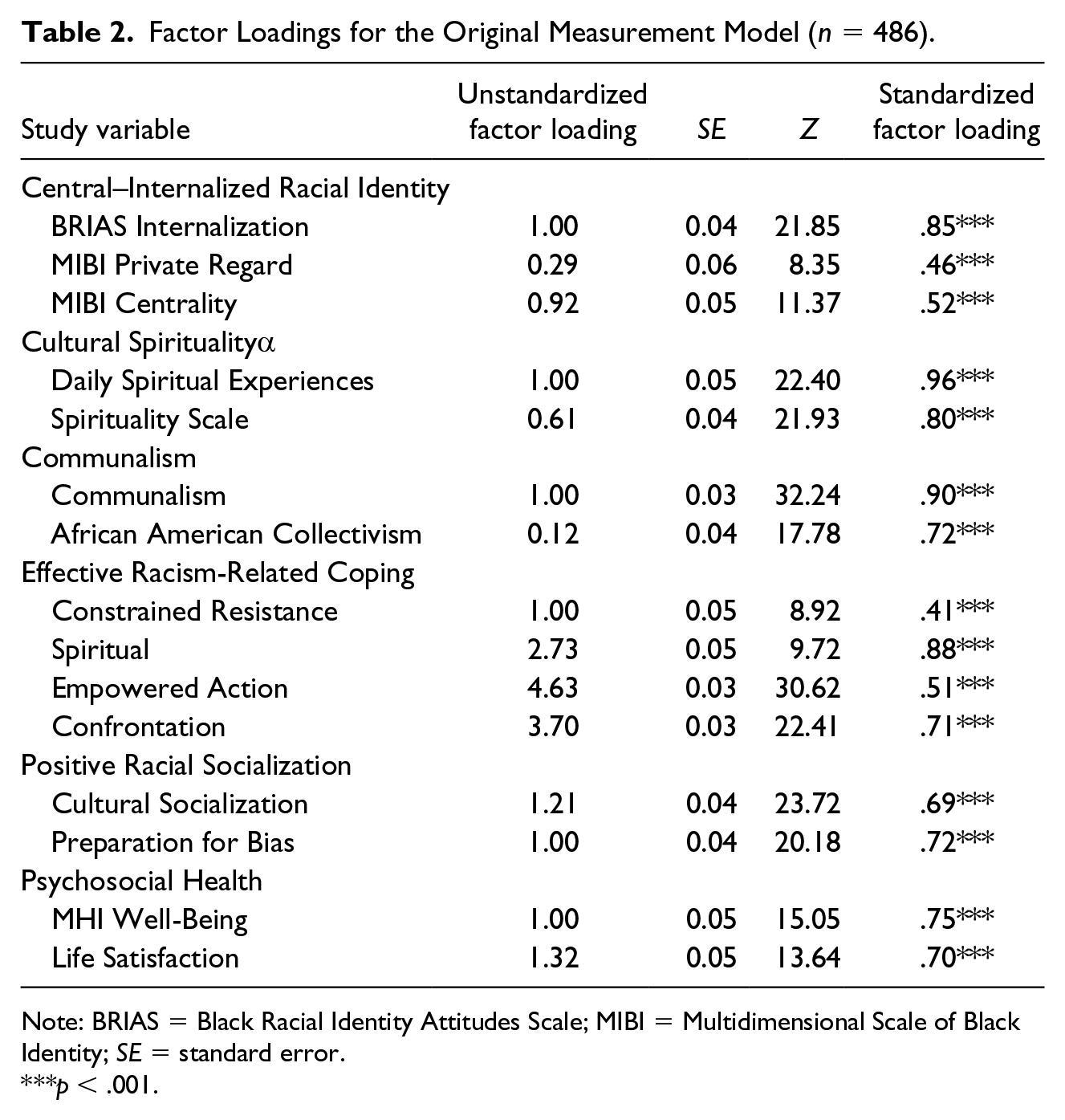
Note: BRIAS = Black Racial Identity Attitudes Scale; MIBI = Multidimensional Scale of Black Identity; SE = standard error.
**p < .001.
Measurement Model
We first tested the original measurement model in which the six latent variables (central-internalized racial identity, positive racial socialization, effective racism-related coping, cultural spirituality, communalism, and psychosocial health) were allowed to covary (see Figure 1). When testing complex models in SEM, as noted by Kline (2011), reporting multiple fit estimates is necessary given that different statistics reflect different dimensions of model fit. It is suggested that at least three indices meet criteria for the model to demonstrate a good fit (Hu & Bentler, 1999). For a model fit, the chi-square should be nonsignificant. However, it is often significant when large sample sizes are used and thus has limitations as an index of absolute model fit (Barrett, 2007). Additionally, the root mean square error of approximation (RMSEA) should be .06 or lower, the comparative fit index (CFI), and Tucker–Lewis Index (TLI) should be .90 or higher, and the standardized root mean square residual (SRMR) should be .08 or lower (Hooper et al., 2008; Steiger, 2007). Using confirmatory factor analysis, it was found that the original measurement model did not fit the data well: χ2(degrees of freedom [df]= 84, n = 486) = 628.695, p < .001; CFI = .78; TLI = .73; RMSEA = .11; and SRMR = .10 (see Table 3).
Fit Indices for Measurement and Structural Models (n = 486).
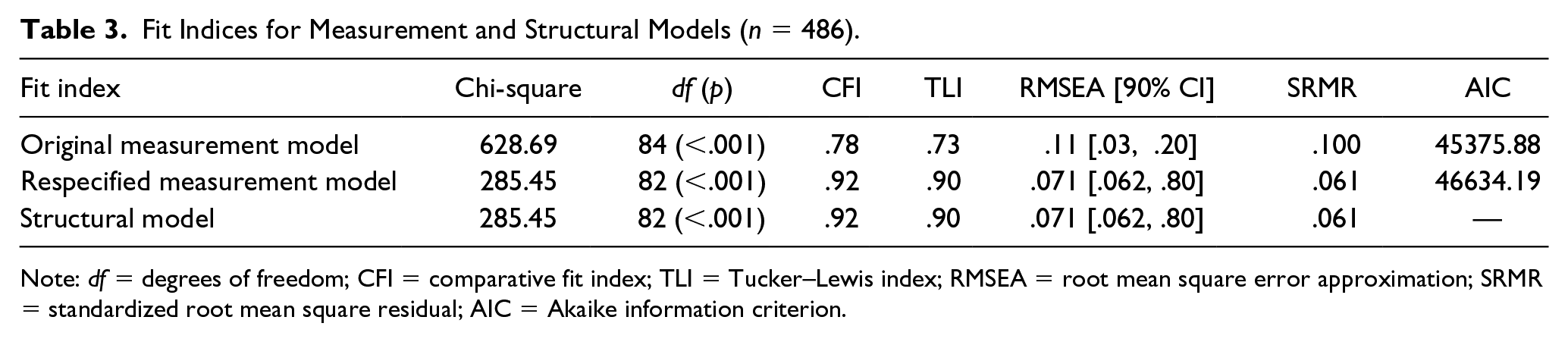
Note: df = degrees of freedom; CFI = comparative fit index; TLI = Tucker–Lewis index; RMSEA = root mean square error approximation; SRMR = standardized root mean square residual; AIC = Akaike information criterion.
Respecification of Measurement Model
Weston and Gore (2006) note that the proposed model rarely results in the best fitting model. In addition, they assert that modifications to a poor fitting model should be done judiciously and with regard to theory. Examination of modification indices showed that the RRC–Spiritual (an indicator of the latent variable, effective racism-related coping) could also be an indicator for another latent variable, cultural spirituality. In addition, modification indices showed that positive racial socialization and effective racism-related coping were correlated.
Empirical and Theoretical Considerations
In respecifying a model, it is important to do so if the modification is empirically and theoretically sound (Weston & Gore, 2006). Two changes were considered. First, modification indices suggested that racism-related spiritual coping was related to two latent factors: effective racism-related coping (already specified in the model) and cultural spirituality (not specified in model). Allowing cultural spirituality to be freely estimated, and thus correlate with the latent variable, spiritual coping, would produce a standardized loading of .74 as well as a statistically significant decrease in the χ2. In addition to its advantages toward improving model fit, the modification also had theoretical support. It is reasonable to accept that one’s level of cultural spirituality, or oneness with nonmaterial life forces, could be associated with one’s reliance on this aspect of their life as a means of managing difficult situations including instances of racism. Lewis-Coles and Constantine (2006) provided empirical support for this notion, finding an association between general use of spiritual-centered coping and levels of institutional racism-related stress.
Modification indices also suggested that positive racial socialization and effective coping were correlated and that this modification would result is a statistically significant reduction in the χ2. Modification indices showed that there was a correlation of .38 between these two variables in the model. We believe that the correlation revealed an unexamined and unobserved variable namely “promotion and use of approach coping strategies” that was not previously considered. Racial socialization could contain messages about how to prepare for racial bias and how to manage such bias when it arises. Scott (2003) provided empirical support for the modification, finding that adolescents’ use of approach coping strategies (e.g., making a plan of action) was positively correlated with racial socialization messages about racism. Conversely, avoidant coping strategies (e.g., distancing, internalizing) were not related to racism-related racial socialization messages. Given the theoretical and empirical evidence in support of the modification, positive socialization and effective coping were correlated in the respecified model.
Comparing the Original and Respecified First-Order Measurement Models
The respecified first-order model results were as follows: χ2(N = 496; df = 82) = 285.453, p < .001; CFI = .92, TLI = .90; RMSEA = .07, and SRMR = .06 (see Table 3; Bentler & Bonnet, 1980; Steiger, 2007). As seen in Figure 2, all of the standardized factor loadings were well above the commonly used standards .30 or .40 (Kline, 2011). Based on these results, the revised model was deemed to accurately reflect the variables.

Standardized coefficients—Black cultural strength respecified measurement and structural models (n = 486).
To ensure that the respecified model was a better fitting model than the original first-order model, it is recommended to compare the Akaike information criterion (AIC) predictive fit index, with lower scores indicating better fit (Vrieze, 2012). The AIC for the respecified first-order model (46634.19) was an improvement over that of the original model (47001.41). Therefore, given the improvement of the CFI, TLI, RMSEA, SRMR, and decrease in the AIC, it was concluded that the respecified model fit the data better than the original model.
Test of the Second-Order Measurement Model and Structural Model
The second-order measurement model was used to examine the relationship of the latent variables: central-internalized racial identity, effective racism-related coping, positive racial socialization, cultural spirituality, and communalism to the latent variable, Black Cultural Strength. The structural model was used to examine the relationship between the latent variables, Black Cultural Strength and Psychosocial Health. In comparing the AIC of the respecified measurement model (46634.19) with that of the second-order measurement model (45375.883), the second-order measurement model appeared to be a better fitting model. For the structural model, a significant chi-square was found: χ2(df = 82, N = 496) = 285.453, p < .001. A significant chi-square finding is common in sample sizes over 200 (Barrett, 2007; Schermelleh-Engel, Moosbrugger, & Muller et al., 2003). Nevertheless, other fit indices indicated a good fitting modelincluding the CFI = .92, TLI = .90, SRMR = .06, and the RMSEA = .07, CI [.062, .080]. Given that five of the six fit indices met the criteria, the model was deemed a good fit to the data (see Table 3). The direct effects (i.e., path coefficients) are presented in Figure 2.
Discussion
The purpose of the current study was to understand the relationships between aspects of Black culture and collective identity that have been found to have positive impact on psychosocial functioning in Black Americans. Empirical evidence provides support for a set of Black cultural values that are interrelated (Bediako & Harris, 2017; Forsyth & Carter, 2012; Jagers et al., 1997) and positively associated with psychological well-being, life satisfaction, quality of life, and other prosocial variables such as self-esteem and optimism, and negatively related to depression and posttraumatic stress disorder (Forsyth & Carter, 2014; M. Hughes et al., 2015). Historically scholars tend to study the relationships between these cultural values and practices in isolation. We hypothesized that central-internalized racial identity, positive racial socialization, effective racism-related coping, cultural spirituality, and communalism would adequately measure Black Cultural Strength. Additionally, we hypothesized that mental health well-being and life satisfaction would be adequate indicators for the latent variable, Psychosocial Health. We found sufficient evidence to support both hypotheses.
Black Cultural Strength and Psychosocial Health
This study’s findings provide support for the existence of an interdependent model of strengths-based Black cultural values. The model shows that each Black cultural variable was significantly and positively related to Black cultural strength and that this construct was positively related to psychosocial health. Communalism was most strongly predicted by Black cultural strength, followed by central-internalized racial identity, cultural spirituality, positive racial socialization, and last, effective racism-related coping.
This pattern of least to most strong indicators speaks to how these values might interact with one another. First, one’s level of connectedness with other Blacks may be an essential part of Black cultural strength. Without a communalistic orientation, one’s ability to develop a central-internalized racial identity, recognize and then learn to effectively cope with racism, and absorb racial socialization messages can be compromised. Alternatively, communalism may be a by-product of other Black cultural values or practices. As one is socialized as a Black person, part of that process may involve teachings about how one can and should rely on other Blacks, even those outside of their immediate family or social network.
It is not surprising that central-internalized racial identity was also strongly predicted by Black cultural strength. It has been associated with most of the other Black cultural practices including racism-related coping and racial socialization. One’s understanding of race in their lives and their regard toward the Black racial group is an essential component of Black cultural strength, and certainly affects the way that parents socialize their children, and thus how Black cultural values are passed intergenerationally (Thomas & Speight, 1999).
Positive racial socialization and effective racism-related coping were additional correlates in the model speaking to the possibility that some racial socialization messages, particularly those geared toward preparation for bias, may also include recommendations about how to effectively cope with racism. If this is true, perhaps racial socialization messages are focused on effective strategies and other coping tools (i.e., bargaining, hypervigilance) that are not necessarily learned strategies, but results of emotional distress related to the racial incidents. Without the communalistic nature of Black culture, individuals may face distressing race-based incidents without knowing how to deal with such incidents, pursue coping methods, and be faced without sufficient social support in the aftermath.
The Black cultural strength model fits into the larger context of findings about the state of psychological health within the Black community. Scholars have found that when compared with other people of Color, Blacks did better in terms of psychological and physical health correlates of racism (Carter et al., 2017). This is not to say that Blacks do not suffer from racial oppression. Rather, Black cultural strength may mitigate these effects to a degree.
Theoretical Findings
The study findings also reveal disparate strength of associations from each construct to their respective latent variables. As compared with private regard and centrality, internalization had the highest coefficient associated with central-internalized racial identity. This is not surprising given that this aspect of racial identity encompasses one’s view of self and other. That is, internalization assesses one’s view of themselves as a Black person and members of the dominant racial group. Those who possess internalization dominant racial identity statuses may be less distressed by interactions with Whites. Private regard and centrality are also important aspects of a positive racial identity but they did not load as strongly as internalization. One explanation for this finding is that perhaps because centrality and private regard only capture one’s feelings about other Blacks, it misses an important part of the central-internalized racial identity picture which is one’s feelings about and ability to tolerate interactions with others outside of the racial group.
Possessing a high level of Black centrality and private regard at face value is positive, yet if one has not developed an ability to work in concordance with Whites they can face distress in a number of settings (e.g., school, work, health care). Furthermore, Blacks with high private regard may also find it particularly troubling that while they hold positive views of other Blacks, this does not reflect the views of the majority of Americans. Therefore, instances of racial discrimination may result in a higher level of difficulty for these individuals. Learning how to cope with this dissonance through the process of racial socialization can ameliorate distress.
Empowered action was the indicator with the highest coefficient related to effective racism-related coping, followed by confrontation, constrained resistance, and finally spiritual coping. Ultimately, these findings support earlier work with the RRCS (Forsyth & Carter, 2012, 2014) in which empowered action, confrontation, and constrained resistance were all associated with internalization status attitudes and lower-than-average psychological distress. Furthermore, using empowered action can help a person increase their feelings of self-worth. Importantly, the use of this method is unlikely to promote psychosocial health without the presence of other cultural values such as other effective racism-related coping strategies (e.g., spiritual) and high private regard.
The finding that effective racism–related coping and positive racial socialization were correlated in the model supports the explanation that perhaps a unique aspect of Black cultural strength is a reliance on beliefs in a higher power as well as a simultaneous understanding that one must be active in coping with racism. Knowledge of how to effectively cope with racism and one’s need to be proactive in this process may rise from positive racial socialization.
Cultural socialization was only slightly stronger than preparation for bias in the model. This finding provides evidence that warnings about inevitable racial bias are important, but teaching about one’s culture is equally, if not more vital. Furthermore, it may be harmful to only provide preparation for bias messages. For example, a young Black girl may grow up being warned that she will be discriminated against for her looks and hairstyles, but lack the knowledge that many popular styles and trends are inspired by African culture.
Conceptual Findings
We found that general spirituality was more strongly related to effective racism-related coping, than cultural spirituality, perhaps indicating that spirituality may not be a cultural value and may not differ across racial groups. Nevertheless, it may function differently for Black Americans. Racism-related spiritual coping was the least predictive of effective racism-related coping, as compared with constrained resistance, empowered action, and confrontation. It is possible that the level of spirituality is mostly responsible in enriching the lives of Black Americans, even when unrelated to experiences of racism.
Implications for Research and Practice With Black Americans
The current study made contributions to the literature on racial identity and racism-related coping by confirming past findings that centrality, private regard, and internalization status attitudes are positive correlates of psychological health (Sellers et al., 2006). Cokley (2007) suggests, given the complexity and differences in what is measured by various racial identity measures that researchers should use multiple indicators of racial identity in their work. This study employed such a method, and supports the notion that using multiple measures of racial identity may be advantageous over singular measures. Future investigations may benefit from using other measures of racial identity, including the CRIS, which assess varying aspects of racial identity, as well one’s feelings about other cultural groups (e.g., LGBT community; Vandiver et al., 2002).
In addition, the findings point to cultural values that should be promoted and reinforced for Black American clients in therapy. Clients may be facing pressures to conform to White cultural values in a variety of settings (e.g., academic). Clinicians should consider ways in which the student may regain their sense of communalism, even within an institution, which does not reflect their own cultural values (e.g., joining the Black student union).
Clinicians may serve the role of additional racial socializers, and suggest racism-related coping strategies that have been empirically proven to be effective. For instance, a clinician may find that a client relies heavily on cognitive racism-related coping. The clinician may suggest that the client “get out of their head” and confront the parties involved. Furthermore, a clinician can rely on their knowledge of the client’s spirituality to suggest they also utilize spiritual coping strategies as well (e.g., praying). Even if the individual does not regularly engage in formalized religious practices, clinicians should be aware that they may endorse high levels of spiritual coping.
Future research would be enhanced by examining the role of additional Black cultural factors in relation to the psychosocial health of Black Americans. For example, Grills and Longshore (1996) posited other Africultural values (e.g., cooperative economics, self-determination) that may be important to consider the examination of Black Cultural Strength and psychosocial health. Additionally, it will be important to determine if there is a benefit of Black Cultural Strength constructs over and above culturally nonspecific factors such as degree of social support, cognitive ability, and family system functioning as others have done (Utsey et al., 2007) and to examine if indirect effects (i.e., mediators) are present that can account either fully or partially for the relationship between Black Cultural Strength and psychosocial health.
Limitations of the Study
Despite novel findings, this investigation has a number of limitations that should be considered. First, despite finding no differences on demographic variables in the current sample, differences may be found with a sample more representative of the larger population or in a study that examined ethnic group differences as well (e.g., differences in Caribbean and African American values). Tests of measurement invariance may offer an opportunity to distinguish how well the model fits for various within-group demographic differences in the future. Another possible limitation is that the model was proposed prior to analyses and modified slightly. Kenny (2011) recommends that a replication of the test of the model be undertaken to ensure findings were not a result of chance. Furthermore, an alternative model was not examined, as is suggested (Weston & Gore, 2006). While many social scientists fail to test alternative models (Steiger, 2007), the model presented in the current study can only be considered exploratory in nature. Finally, measures within the study were not counterbalanced, limiting our ability to test for order effects and posing a potential threat to internal validity.
Conclusions
We believe this study’s results provide important findings in the areas of cultural values for Black Americans. Black cultural values are interdependent and should be examined as a complex set of factors, rather than in isolation. Clinicians should be aware of the ways in which cultural values interplay to affect the psychological functioning and overall life satisfaction of Black American clients and people in general. Specifically, this study provides valuable evidence to support working from a strengths-based approach to counseling with Black American clients.
Footnotes
Declaration of Conflicting Interests
The author(s) declared no potential conflicts of interest with respect to the research, authorship, and/or publication of this article.
Funding
The author(s) received no financial support for the research, authorship, and/or publication of this article.
