



Abstract
Scholars have long asserted the importance of studying cultural socialization processes predicting prosocial behaviors, but studies on this topic among Black young adults are rare. The current study examined the mediating roles of ethnic-racial identity and religious identity in associations between ethnic-racial socialization and prosocial behaviors among Black young adults. Participants consisted of 208 Black young adults (Mage = 19.90 years, SDage = 1.62, 73.6% women) from universities across the United States, who reported on their ethnic-racial socialization, ethnic-racial identity, religious identity, and prosocial behaviors. Mediation analyses showed that ethnic-racial identity and religious identity mediated the relation between ethnic-racial socialization and prosocial behavior. Our findings highlight the ways in which cultural socialization and identity processes may foster prosocial behaviors among Black young adults. Discussion focuses on a culturally grounded and strengths-based understanding of prosocial development among Black young adults.
In recent years, there has been growing interest in the cultural processes that promote positive developmental trajectories of Black young adults. 1 Cultural experiences of ethnic-racial socialization and identity formation have been found to exert significant influence on positive adjustment outcomes (see D. Hughes et al., 2006, for a review). For example, Black families might socialize their young adults about race and ethnicity, which might further encourage exploration of social identities such as ethnic-racial identity and religious identity (D. Hughes et al., 2009; Sanchez & Carter, 2005). Ethnic-racial identity, or a sense of attachment to one’s ethnic-racial group, is viewed as a cultural asset that facilitates positive well-being (Umaña-Taylor et al., 2017). Similarly, religious identity, or the importance of religiosity in self-conceptions, is considered an important resource implicated in positive developmental outcomes among Black young adults (Ysseldyk et al., 2010). Furthermore, many young adults tend to be immersed in a consciousness-raising environment during college that encourages them to reflect upon their cultural socialization and identity processes (Umaña-Taylor et al., 2014). Thus, cultural scholars (D. Hughes et al., 2009; Sanchez & Carter, 2005) have underscored the roles of ethnic-racial socialization and identity in promoting the psychological and behavioral well-being of Black young adults.
One sociobehavioral marker of positive well-being is prosocial behavior (i.e., voluntary actions intended to benefit others; Eisenberg et al., 2006). Prosocial behaviors include comforting a loved one, helping fulfil requests, and assisting during crises. Prosocial behaviors are considered to be valuable social behaviors due to their positive ties with self-regulation (Padilla-Walker & Christensen, 2011), academic achievement (Carlo et al., 2018), and social adjustment (Sallquist et al., 2009). Several scholars have noted the preponderance of pathology and deficit-based work on Black young adults (see Cole & Stewart, 2001; see also Moynihan, 1965), whereas studies (e.g., White-Johnson, 2015) that explore the cultural correlates of prosocial behaviors among Black young adults are sparse. While there is some research that suggests greater ethnic-racial socialization is related to higher prosocial behaviors among Black young adults (White-Johnson, 2015), the cultural mechanisms through which ethnic-racial socialization may influence prosocial development are largely unknown. For instance, ethnic-racial and religious identity processes are considered to be of special cultural significance in Black culture (M. Hughes et al., 2015; Taylor & Chatters, 2010). Therefore, the primary goal of this study is to examine the mediating roles of ethnic-racial identity and religious identity in associations between ethnic-racial socialization and prosocial behaviors among Black young adults.
Ethnic-Racial Socialization and Prosocial Behavior
Cultural developmental scholars (Super & Harkness, 1986; Whiting & Edwards, 1988) assert that culture-specific socialization experiences of distinct cultural groups impact values, identity, and social behavioral outcomes. Ethnic-racial socialization refers to explicit or implicit family practices teaching children about their unique racial/ethnic heritage and history (D. Hughes et al., 2006). D. Hughes et al. (2006) presented four common types of ethnic-racial socialization processes: (a) cultural socialization, (b) preparation for bias, (c) promotion of mistrust, and (d) egalitarianism. Cultural socialization refers to practices that teach children about the values, customs, and behaviors normative to their ethnic-racial group. Preparation for bias entails parents’ efforts to promote their children’s awareness and coping with discrimination. Practices that express wariness in interracial relationships reflect promotion of mistrust. Egalitarianism entails efforts to foster individual skills and competencies deemed important for adaptation to majority culture.
Among most Black families, parents and caregivers might teach their children cultural values and customs consistent with helping needy others and respect and consideration of others (Evans et al., 2012; D. Hughes et al., 2006). Furthermore, scholars have found that Black parents transmitted messages about positive adjustment outcomes within ethnic-racial socialization messages (Evans et al., 2012; D. Hughes et al., 2006). For instance, Suizzo et al. (2008) found that many Black parents taught their children about being a good person as a part of race-related socialization about the meaning of being Black. Such ethnic-racial socialization typically consists of messages with positive role models, who have displayed leadership, civic engagement, and community participation skills (e.g., Black political figures; D. Hughes et al., 2006). Furthermore, ethnic-racial socialization may include highlighting racial awareness and racial injustice that might spark social justice and prosocial attitudes among Black college students (Evans et al., 2012; Flanagan & Levine, 2010).
However, empirical research on the effects of cultural socialization on prosocial behaviors is limited. In one study, White-Johnson (2015) found that Black college students, who received greater cultural socialization and other ethnic-racial socialization messages from parents alerting them about racism, were more involved in prosocial activities. Similarly, Zaff et al. (2008) showed that parental involvement in the Million Man March as well as ethnic-racial socialization predicted later civic engagement in Black adults. These studies suggest that parenting and familial messages of ethnic-racial socialization continue to promote Black prosocial development, despite the recent gains in autonomy during college.
Mediating Roles of Ethnic-Racial Identity and Religious Identity
Ethnic-racial socialization, ethnic-racial identity, and religious identity
Individuals who identify as Black share a sociohistorical context that leads to shared cultural experiences in the United States (Reynolds et al., 2017). Blacks have experienced a long history of systemic discrimination in the United States that prevails in present times (Feagin & Ducey, 2019; McAdoo, 2007; McNeil Smith & Landor, 2018). In response, Black young adults and their families have demonstrated a range of culturally adaptive socialization and identity processes (Jones & Neblett, 2017). Blacks might, therefore, stand at a unique intersection of racial and ethnic socialization and associated identity processes (Reynolds et al., 2017; Umaña-Taylor et al., 2014). Indeed, many ethnic-racial socialization practices have been found to cultivate ethnic-racial identity among young adults by exposing them to positive aspects of their cultural history and heritage (D. Hughes et al., 2009; Seaton et al., 2012). As a result, young adults are considered to subsequently internalize this sense of belongingness toward their ethnic-racial background and develop a secure sense of ethnic-racial identity (D. Hughes et al., 2009; Seaton et al., 2012). Thus, ethnic-racial socialization practices seem to promote the development of ethnic-racial identity among Black young adults (Reynolds et al., 2017).
Similarly, ethnic-racial socialization in Black families may also include messages of religion and spirituality (Stevenson & Arrington, 2009; Wielhouwer, 2004). Black families typically attend religious institutions, where Black young adults are not only socialized about religion but also their unique ethnoracial background. Black churches, for example, have historically served as sites of ethnic-racial socialization (Bagley & Carroll, 1998; McAdoo, 2007). Owing to the unique cultural significance of religion in the Black community (Taylor & Chatters, 2010), Black college students also tend to inculcate a salient religious identity. Past research has shown that ethnic-racial socialization has been also closely associated with a religious orientation among Black college students (Stevenson & Arrington, 2009).
Taken together, there is substantive evidence that ethnic-racial socialization has been consistently linked to both ethnic-racial and religious identities among ethnic minority young adults (Berkel et al., 2010; Knight et al., 2011). Furthermore, ethnic-racial identity and religious identity appear to be correlated (Sanchez & Carter, 2005). It is likely that some Black individuals develop a strong ethnic-racial identity, whereas some others develop a strong religious identity as a result of cultural socialization. Thus, both ethnic-racial identity and religious identity are viewed as covarying explanatory mechanisms in the context of ethnic-racial socialization.
Ethnic-racial identity, religious identity, and prosocial behavior
Social identity theory focuses on the impact of individual’s self-conceptions of social group membership (e.g., race, religion) on intergroup behaviors (Ellemers & Haslam 2012; Tajfel, 1981). Social identity is defined as the level of importance attached to the social group and affective evaluation of one’s group membership (Tajfel, 1981). The significance attached to group membership may have consequences for the individual adjustment of group members (M. Hughes et al., 2015). Two important aspects of social identity are ethnic-racial and religious identity. Social identity processes of race and religion have been linked to socialization (Chatters et al., 2008; Stevenson & Arrington, 2009). Because identity processes can vary across Black young adults, social behavioral outcomes, including prosocial behavior, may also vary as a function of ethnic-racial and religious identity.
Ethnic-racial identity is a multifaceted construct (e.g., exploration and affirmation) that is closely tied to positive adjustment among ethnic minority young adults (Neblett et al., 2012; Syed, 2010; Umaña-Taylor et al., 2017). Both exploring one’s identity in relation to one’s ethnic-racial group and experiencing a sense of pride and belongingness toward one’s ethnic-racial group have been found to become salient during young adulthood (D. Hughes et al., 2006; Umaña-Taylor et al., 2014). Because ethnic-racial identity entails a positive regard for one’s ethnic-racial group and its associated values, customs, and practices, Black young adults who strongly endorse their ethnic-racial identity might exhibit relatively high levels of social behaviors consistent with those values.
A strong ethnic-racial identity has been linked with positive adjustment outcomes (e.g., psychological well-being) among ethnic-racial minority young adults (M. Hughes et al., 2015). For instance, ethnic-racial identity has been linked to higher self-esteem and lower depressive symptoms in Black youth (Mandara et al., 2009; Street et al., 2009). More specifically, researchers have suggested that higher levels of ethnic-racial identity are positively associated with prosocial behaviors among ethnic-racial minority adolescents and young adults (Armenta et al., 2011; Knight et al., 1993; Schwartz et al., 2007). In one study, a positive ethnic-racial identity was found to foster greater prosocial behaviors in U.S. Mexican young adults (Armenta et al., 2011). Thus, empirical evidence has supported this positive association between ethnic-racial identity and prosocial behaviors among Black young adults.
Another aspect of social identity, religious identity, has also been linked to both ethnic-racial socialization and prosocial behaviors. Religious identity is theoretically associated with helping others and concern for the welfare of others (Donahue & Benson, 1995; Musick & Wilson, 2008). Because most religions advocate principles of benevolence and generosity toward others (Einolf, 2011), religious identity might foster prosocial behaviors. Furthermore, young adults who have been active in religious practices tended to engage in charitable activities, which provided hands-on experience with prosocial behaviors (Einolf, 2011; Musick & Wilson, 2008). Black religious institutions (e.g., churches) are expected to foster prosocial behaviors by creating a positive community with prosocial role models and community helping opportunities (Grayman-Simpson & Mattis, 2013).
Despite the cultural importance of religious identity among African American and Caribbean Black young adults (Chatters et al., 2008; Sanchez & Carter, 2005), empirical evidence between religious identity and prosocial behaviors in this population is scant. Some research indicated that religiosity was positively related to moral outcomes, volunteering, and community involvement among Black adolescents (King & Furrow, 2004; Mattis & Jagers, 2001; Zaff et al., 2008). Furthermore, an endorsement of such cultural socialization in the form of religious identity has been found to reduce involvement in risky behaviors, such as risky sex (Landor et al., 2011), while also enhancing prosocial behaviors in Black youth (Grayman-Simpson & Mattis, 2013). Ethnic-racial minority (e.g., U.S. Latino/a) adolescents’ religious identity was also found to predict multiple types of prosocial behaviors (Carlo et al., 2010). Thus, religious identity might act as another salient aspect of Black identity that affects positive social adjustment.
The Present Study
Based on conceptual and empirical evidence, though limited, there are expected associations among ethnic-racial socialization, ethnic-racial identity, religious identity, and prosocial behaviors. Scholars have hypothesized that ethnic-racial socialization, ethnic-racial identity, and religious identity are predictors of positive developmental outcomes in Black young adults (M. Hughes et al., 2015; White-Johnson, 2015; Ysseldyk et al., 2010). However, research that specifically examines the possible intervening roles of ethnic-racial and religious identity on the relations between ethnic-racial socialization and prosocial behaviors among Black young adults is limited. Therefore, we hypothesize that ethnic-racial socialization will be positively associated with both ethnic-racial identity and religious identity development which, in turn, will be positively associated with prosocial behaviors in Black young adults. Moreover, ethnic racial socialization was expected to be directly and positively associated with prosocial behavior.
Method
Participants
The participants of this study were 208 Black young adults (Mage = 19.90 years, SDage = 1.62, range = 18-25; 73.6% women), who identified as “Black, African American, Afro-Caribbean, Black African, or an other (e.g., nonethnic-racial label) category.” Participants described their race/ethnicity in their own words as Black (35.6%), followed by African American (26.4%), Afro-Caribbean (8.7%), Black African (6.2%) and other nonethnic-racial labels (e.g., Black beautiful; 23.1%). A majority of participants were born in the United States (83.2%) and represented a wide range of family incomes (34.1% <$30,000, 25.5% $30,000-$50,000, 25.5% $50,000-$100,000, and 14.9% >$100,000). Last, participants were mainly in their first year of college education (42.3%); followed by second year (15.9%), third year (18.8%), fourth year (12.5%), greater than 4 years of college education (6.2%), and unreported years of college education (4.3%).
Procedure
The present study relied on a subset of the data from the Multi-Site University Study of Identity and Culture (MUSIC) project. This subset of the data included Black college students, who had completed data on prosocial behaviors. The MUSIC project primarily aimed to collect data on identity and cultural processes that occur during young adulthood (Weisskirch et al., 2013). The MUSIC project included college students attending 30 colleges and universities within the United States between 2008 and 2009. The data collection sites included different types of institutions (land grant and private), settings (urban and rural), geographical locations (Northeast, Midwest, and Southeast United States), and ethnic compositions (range: 8% to 83% ethnic-racial minority students). The institutional review boards at the participating data collection sites approved the study. Participants were recruited into the study using fliers and in-class announcements. Participants completed digital surveys at each data collection site. A waiver of signed consent was procured at each data collection site, which allowed participants to provide consent online. Participants generally took approximately 45 to 90 minutes to complete the survey. All measures were administered in the same order. Participants received course credit for their participation.
Measures
Demographic sheet
Participants reported on demographic characteristics such as age, gender, race/ethnicity, nativity, family income, and years of college education.
Ethnic-racial socialization
The Familial Ethnic Socialization Measure (Umaña-Taylor, 2001; Umaña-Taylor et al., 2004) is a 12-item scale that was used to assess the extent to which participants believed their families taught them about their ethnic and/or racial background. Participants responded to items such as “My family teaches me about my ethnic/cultural background” on a 5-point Likert-type scale ranging from 1 (strongly disagree) to 5 (strongly agree). The scores have shown acceptable reliability estimates (e.g., in previous research with Black samples (α = .93; Reynolds et al., 2017) and in the current sample, the reliability estimate of the scores was high (α = .93). This measure has demonstrated concurrent validity through positive correlations with ethnic-racial identity in Black young adults (Reynolds et al., 2017). Furthermore, this measure has shown discriminant validity through low, negative correlations with language-related stressors in immigrant young adults (Weisskirch et al., 2011). Past research has also established a unidimensional factor structure of this measure using factor analysis in ethnic-racial minority samples (i.e., Latino/a; Supple et al., 2006). Thus, mean scores were calculated with high scores suggesting greater ethnic-racial socialization.
Ethnic-racial identity
The Multigroup Ethnic Identity Measure-Revised (Phinney & Ong, 2007; Roberts et al., 1999) is a 12-item scale that measures specific processes of ethnic identity search, affirmation/belonging, and lends a global ethnic-racial identity score. Items like “I have spent time trying to find out more about my ethnic group, such as its history, traditions, and customs” (exploration) and “I have a strong sense of belonging to my own ethnic group” (affirmation) are rated on a 5-point Likert-type Scale ranging from 1 (strongly disagree) to 5 (strongly agree). In line with reliabilities demonstrated in prior research with Black college students (e.g., α = .92; Reynolds et al., 2017), the scale displayed acceptable reliability in the current sample (α = .92). The measure has shown convergent validity via positive correlations with ethnic-racial identity scales like importance to identity and centrality in ethnoracially diverse (i.e., African American and Latino/a) youth (Casey-Cannon et al., 2011). Additionally, the measure has demonstrated discriminant validity via a lack of correlation with public identity (Casey-Cannon et al., 2011). Previous research has also supported the validity of a composite ethnic-racial identity score among Black young adults (Reynolds et al., 2017). As a result, global ethnic-racial identity mean scores were computed; high scores suggested greater ethnic-racial identity.
Religious identity
The 10-item short form of the Religious Commitment Inventory (Worthington et al., 2003, 2012) was used to measure participants’ religious identity. The two subscales, intrapersonal and interpersonal, were combined into one global religious identity score due to psychometric support for the composite score (Worthington et al., 2003, 2012). Items like “I enjoy working in the activities of my religious affiliation” (interpersonal) and “My religious beliefs lie behind my whole approach to life” (intrapersonal) were reported on a 5-point Likert-type scale ranging from 1(not at all true of me) to 5 (totally true of me). Consistent with previously demonstrated high reliabilities (e.g., α = .93; Worthington et al., 2003), the scores were considered reliable based on the current sample (α = .90). This measure has shown evidence of convergent validity through a positive correlation with frequency of attendance of religious activities in diverse, religious samples (e.g., African American, Christian; Worthington et al., 2003). This measure has also shown evidence of discriminant validity through a lack of correlation with spirituality (Worthington et al., 2003). Prior research has supported a unidimensional structure for this measure based on confirmatory factor analysis in ethnoracially diverse adults, including African Americans (Worthington et al., 2003). Therefore, mean scores were calculated such that high scores indicated relatively high religious identity.
Prosocial behavior
The Prosocial Tendencies Measure (PTM) was used to assess participants’ prosocial behavioral tendencies (Carlo & Randall, 2002). Three subscales of the PTM, dire (three items), compliant (two items), and emotional (five items), of the PTM were combined into one prosocial behavior score that reflects commonly exhibited forms of helping (Carlo et al., 2018). Participants indicate how well a series of statements describe themselves using a 5-point Likert-type scale that ranged from 1 (does not describe me at all) to 5 (describes me greatly). Example items of prosocial behavioral tendencies include “I tend to help people who are in a real crises or need” (dire); “I never wait to help others when they ask for it” (compliant); and “Emotional situations make me want to help others in need” (emotional). Adequate reliability of the scores in prior research with ethnic-racial minority youth has been reported (e.g., α = .84; Calderón-Tena et al., 2011). The reliability estimate of the scores was found to be .86 in the current sample. This measure has demonstrated concurrent validity via positive correlations with prosocial parenting practices in Latino/a youth (Calderón-Tena et al., 2011). Furthermore, this measure has demonstrated discriminant validity via a lack of correlation with no-nonsense parenting in Latino/a youth (Carlo et al., 2018). Moreover, previous work has supported a unidimensional structure of the composite prosocial behavior measure using confirmatory factor analysis in ethnoracially diverse samples (e.g., Latino/a; Calderón-Tena et al., 2011; Carlo et al., 2018). Thus, a mean score of the three scales was computed and greater scores suggested higher prosocial behaviors.
Results
Preliminary Analysis
There was between 0.4% and 15.4% of missing data on the variables. The missing data percent per variable was as follows: 1.5% for ethnic-racial socialization, 0.4% for ethnic-racial identity, 15.4% for religious identity, and 4.1% for prosocial behavior. The data were missing at random based on Little’s MCAR (missing completely at random) test: χ2(14) = 7.40, p = .92. Thus, listwise deletion was used to deal with missing data, resulting in the study sample of 208.
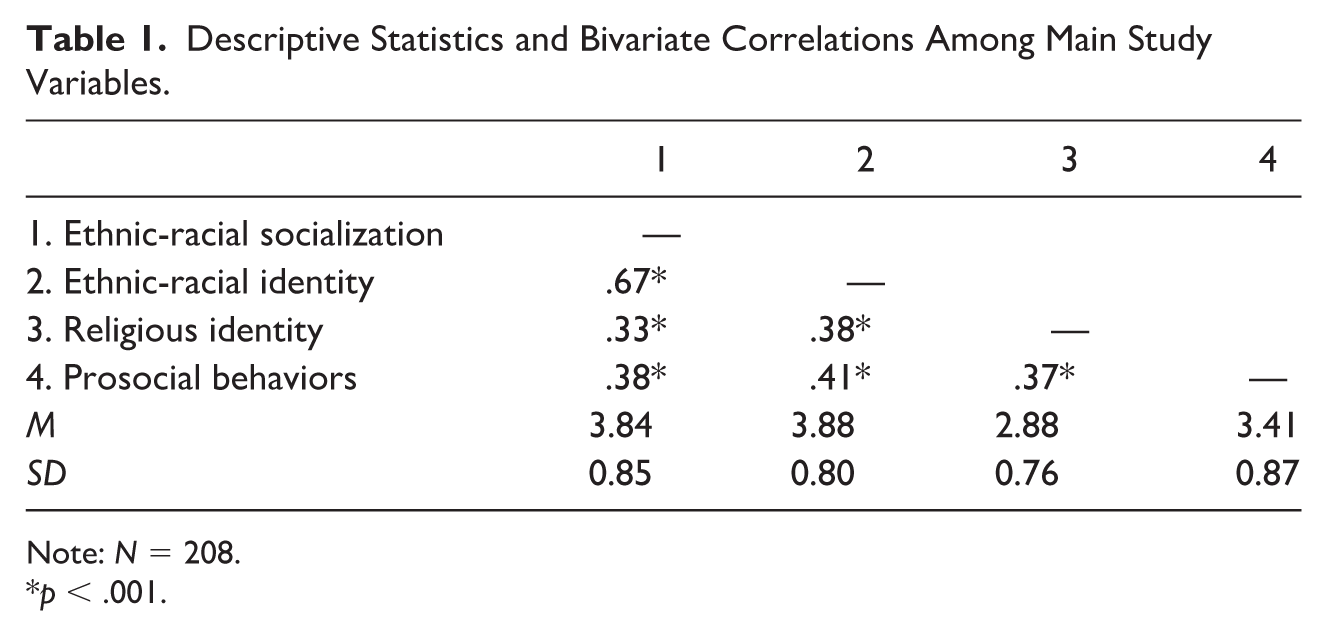
The data met the regression assumptions of linearity, homoscedasticity, independence, and normality. Regression diagnostics revealed no outliers. Descriptive statistics and bivariate correlations between the main study variables are shown in Table 1. Ethnic-racial socialization was significantly positively associated with ethnic-racial identity, religious identity, and prosocial behavior. Ethnic-racial identity and religious identity were positively interlinked. In addition, both ethnic-racial identity and religious identity were significantly positively related with prosocial behavior.
Descriptive Statistics and Bivariate Correlations Among Main Study Variables.
Note: N = 208.
p < .001.
Main Analysis
Mediation analysis was conducted using the PROCESS function in SPSS (Hayes, 2017). A mediation model was specified with ethnic-racial socialization as the exogenous variable, ethnic-racial identity and religious identity as parallel mediators, and prosocial behavior as the endogenous variable (see Model 4; Hayes, 2017). Based on previous work on demographic covariates of prosocial development in ethnic-racial minority youth (Brittian et al., 2013; Carlo et al., 2018), gender (1 = male, 2 = female) and income (1 = below $30,000, 2 = $30,000-$50,000, 3= $50,000-$100,000, 4 = Above $100,000) were entered as statistical controls in the model.
The mediation model results are shown in Figure 1. Results showed that ethnic-racial socialization was directly and positively associated with ethnic-racial identity (b = .63, p < .001) and religious identity (b = .30, p < .001). In addition, ethnic-racial identity (b = .23, p < .05) and religious identity (b = .27, p < .001) were positively associated with prosocial behavior. There was no significant association between ethnic-racial socialization and prosocial behavior.
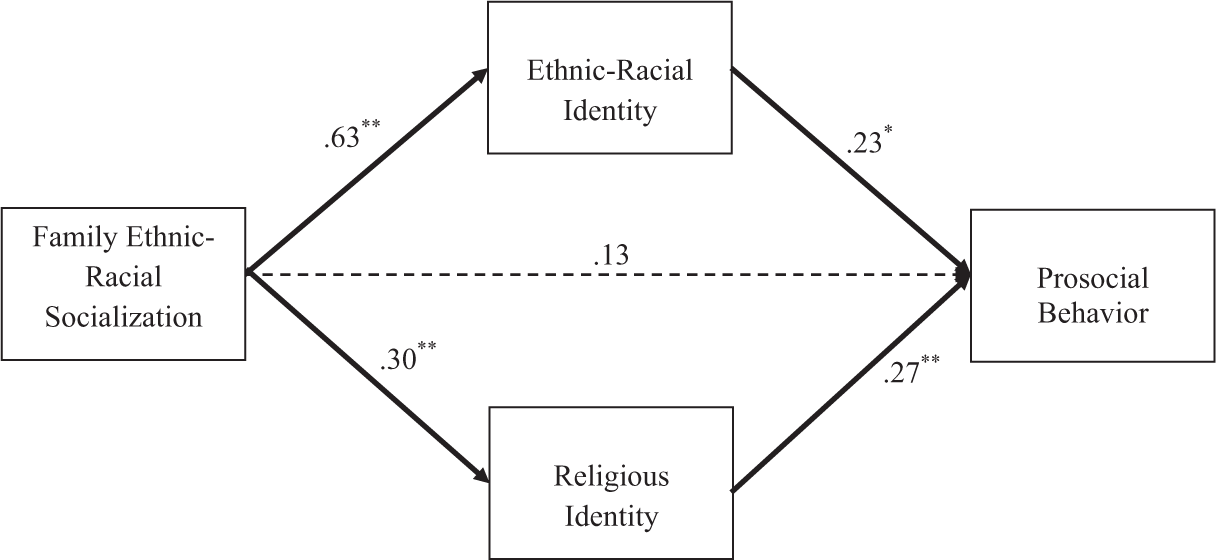
Cultural processes and prosocial behavior.
Mediation tests using bootstrapped confidence intervals (bootstrap samples = 5,000) were conducted to assess the mediating roles of ethnic-racial and religious identities. Two significant indirect relations were found: ethnic-racial socialization to prosocial behavior via ethnic-racial identity (indirect effect = .15, standard error = .06, 95% confidence interval [.03, .26]) and family ethnic-racial socialization to prosocial behavior via religious identity (indirect effect = .08; standard error = .04; 95% confidence interval [.02, .16]). Both indirect effects were small in magnitude. Overall, the predictors accounted for moderate variance in prosocial behavior (R2 = 29.01%).
Discussion
The primary aim of the present study was to investigate the intervening roles of ethnic-racial identity and religious identity in associations between ethnic-racial socialization and prosocial behaviors in Black young adults. We hypothesized that ethnic-racial socialization would be positively related to ethnic-racial and religious identities, both of which would be positive related to prosocial behaviors. Furthermore, we expected that ethnic-racial socialization might be directly related to greater prosocial behaviors. There was overall supportive evidence that both ethnic-racial identity and religious identity mediated the associations between ethnic-racial socialization and prosocial behaviors in Black young adults. However, there were no direct relations between ethnic-racial socialization and prosocial behaviors in Black young adults. The findings are consistent with cultural socialization and social identity theories that highlight the importance of studying cultural processes (i.e., ethnic-racial socialization, ethnic-racial identity, and religious identity) in relation to prosocial behaviors in order to gain a better understanding of prosocial behavioral outcomes in Black young adults (Tajfel, 1981; Whiting & Edwards, 1988). Importantly, this evidence contributes to the development of strength- and asset-based models of Black young adults.
Findings also extend social identity theory (Tajfel, 1981) by demonstrating the mediating roles of ethnic-racial and religious identities in understanding prosocial development in Black young adults. More specifically, the present finding highlights the role of ethnic-racial identity in cultivating prosocial behavior of ethnic minority young adults (Armenta et al., 2011; Knight et al., 1993). This indirect relation is also in line with prior research, suggesting that the benefits of ethnic-racial socialization for psychological well-being are largely accrued through ethnic-racial identity (D. Hughes et al., 2009; Seaton et al., 2012). Moreover, religious identity might be a simultaneous cultural mediating process through which ethnic-racial socialization is related to prosocial behavior (Berkel et al., 2010; Knight et al., 2011). This latter finding provides much needed empirical support for the theoretical predictions regarding religious identity and prosocial behavior in Black young adults. Furthermore, this finding can be interpreted in light of the special cultural significance of religiosity for Blacks (Taylor & Chatters, 2010; Mattis & Jagers, 2001).
The support for the intervening roles of ethnic-racial and religious identity processes in the association between ethnic-racial socialization and prosocial behavior have several key implications. Black families appear to socialize their young adults regarding their race and ethnicity, which seems to encourage the formation of positive ethnic-racial and religious identities (D. Hughes et al., 2009; Sanchez & Carter, 2005). Moreover, young adults who develop strong ethnic-racial and religious identities have been found more likely to engage in prosocial behaviors (Armenta et al., 2011; Carlo et al., 2010).
It is noteworthy that the positive benefits of ethnic-racial socialization for prosocial behavior have been found to accumulate through a unique intersectionality of ethnic-racial and religious identities in Blacks (McNeil Smith & Landor, 2018). This intersectionality of a low status ethnic and racial group membership (McNeil Smith & Landor, 2018) could prompt Black young adults to engage in prosocial behaviors as a means to respectable citizenship. This view of prosocial behaviors as respectable is considered to be further reinforced by religious messages prevalent in Black culture (Sanchez & Carter, 2005). Due to the symbolic violence rooted in prevalent racism in American society, Blacks are continuously exposed to negative cultural images as perpetrators of antisocial behaviors (Bourdieu, 1989; Landor & Barr, 2018). Given the racialized and classed politics of respectability (Higginbotham, 1993; Landor & Barr, 2018), we propose that Black young adults may equate prosocial behavior with respectable citizenship in order to combat these negative cultural images. Prosocial behaviors may act as both a resource and index of power for social adjustment of Black young adults in an otherwise unequal society. Viewing prosocial behaviors from a politics of respectability lens, therefore, enables understanding the distinctive significance of prosocial behaviors for Black young adults.
Although the findings were generally supportive of the hypothesized relations among ethnic-racial socialization, ethnic-identity, religious identity, and prosocial behavior, there are important study limitations. The study design is not longitudinal, which limits strong inferences of causality or directionality of effects. Furthermore, the study measures were presented in a fixed order, which may add respondent bias to the findings. Moreover, the data were collected between 2008 and 2009, which could introduce cohort differences between college students then and now. Additionally, Black college students represent only a subset of Black young adults with multiple prosocial opportunities (Zaff et al., 2008). Given this selection bias, the findings in the current study may not be generalizable to other populations of Black young adults.
Future researchers should study larger community samples of Black young adults and explore within-group differences by ethnic origin (African American vs. Afro-Caribbean), nativity (U.S. born vs. foreign-born Blacks), or skin tone (light vs. dark skin tone; Landor & McNeil Smith, 2019). Furthermore, the current study does not account for the role played by discrimination in conjunction with culturally relevant predictors for prosocial behavior in Black young adults. Given that discrimination experiences are known to undermine prosocial behaviors in ethnic minority young adults (Davis et al., 2016), future researchers should explore whether cultural socialization and identity processes continue to foster prosocial behaviors in Black young adults experiencing discrimination.
Despite study limitations, the present study meaningfully adds to the understanding of the associations among ethnic-racial socialization, ethnic-racial identity, religious identity, and prosocial behavior in Black young adults. The results of this study provide support for both direct and indirect relations (via ethnic-racial identity and religious identity) from ethnic-racial socialization to prosocial outcomes among Black young adults. Given the relative sparse existing research on prosocial behaviors among Black young adults, the findings contribute to an area of study that addresses the current overemphasis on deficits and pathology in this population. Specifically, we adopted a culturally grounded and strengths-based approach to better understand the interplay of culture and identity in predicting prosocial behaviors among Black young adults. Even though more research is needed in socioeconomically and racially diverse samples, the present findings can be useful for policy makers and program developers to create culturally relevant support for ethnic-racial socialization and identity formation to foster prosociality in Black young adults.
Footnotes
Declaration of Conflicting Interests
The author(s) declared no potential conflicts of interest with respect to the research, authorship, and/or publication of this article.
Funding
The author(s) received no financial support for the research, authorship, and/or publication of this article.
