



Abstract
Black adults in the United States seek mental healthcare at a lesser rate than White adults, attributed in part to the stigma of seeking psychological help. Black men in need of mental health care face a double barrier associated with the intersection of their race and gender, as men report more negative attitudes toward help-seeking than do women. To understand help-seeking attitudes among Black men, this study examined the direct effects of traditional masculinity, traditional/Black masculinity, and Black masculinity on public stigma of help-seeking as well as the indirect effects on self-stigma of help-seeking and psychological help-seeking attitudes among a sample of Black men in the United States (N = 160). Results demonstrated that Black masculinity and traditional/Black masculinity predicted greater public stigma, which predicted greater self-stigma and in turn less positive psychological help-seeking attitudes. This study also found an unexpected negative relationship between traditional masculinity and public stigma and an indirect positive effect on psychological help-seeking attitudes. Results support tailored stigma-reduction interventions for the Black community.
Caring for one’s mental health is necessary for overall functioning, but multiple barriers can make it difficult to seek mental health care. Although many individuals experience barriers to help-seeking, some populations have been found to experience greater barriers to care. This difference is reflected in the finding that Black or African American adults in the United States (U.S.) with a mental illness received mental health services at a lower rate than their White counterparts (30.6% vs. 49.1%, respectively; Substance Abuse and Mental Health Services Administration, 2019). Within the Black community, research shows that barriers to mental health care can include religious beliefs that view help-seeking as a lack of faith in God, cultural mistrust of a predominately White healthcare system bound in discriminatory systems, and past negative psychological help-seeking experiences (see Burkett, 2017; Taylor & Kuo, 2019 for a review).
In addition, stigma of seeking psychological help is a significant barrier for the Black community (Burkett, 2017; Campbell & Mowbray, 2016; Taylor & Kuo, 2019). Americans with minority identities who have mental health concerns undergo a “double stigma,” in which they face the prejudice and discrimination associated with both having an actual or potential mental illness and being a member of a racial minority group, which can serve as an increased barrier for seeking mental health services (Gary, 2005). In addition to the double stigma of race and mental health concerns, Black men face the intersectionality of race and gender, being both Black and a man, and the societal and cultural norms that accompany both (Bowleg et al., 2016). Much research has found that adherence to masculine norms relates to help-seeking stigma and attitudes toward help-seeking. However, little research has been conducted with Black men specifically, and that research has relied on traditional conceptualizations of masculinity that do not fully encompass what it means to be a Black man. Understanding the role of both Black masculinity and traditional masculinity—as well as the overlap between traditional and Black masculinity (traditional/Black masculinity)—in stigma of psychological help-seeking and attitudes toward seeking psychological help in Black men will allow for more culturally responsive approaches to reducing barriers to mental health care.
Stigma of Psychological Help-Seeking
There are two main forms of stigma associated with psychological help-seeking: (a) public (social) stigma, which is the negative attitudes toward seeking psychological help that are held by people with whom a help-seeker may interact and (b) self-stigma, in which the individual internalizes negative attitudes toward seeking psychological help (Vogel et al., 2006, 2009). Public stigma has been found to predict self-stigma of help-seeking in African American men (Cadaret & Speight, 2018). In addition, self-stigma of help-seeking has been found to relate to more negative attitudes toward seeking psychological help in African Americans (Saykeo & Lawrence, 2018; Vogel et al., 2006). Furthermore, mediation research with broader populations has shown that public stigma of help-seeking leads to self-stigma (Cheng et al., 2013; Vogel et al., 2013), such that self-stigma is the more proximal predictor of help-seeking attitudes (Ludwikowski et al., 2009; Vogel et al., 2013). Although there are multiple studies exploring various forms of stigma and its effects on help-seeking attitudes, there is less research on how masculinity impacts help-seeking attitudes. Understanding the role of masculinity on help-seeking attitudes may help to explain the more negative attitudes about help-seeking held by men compared to women (Wendt & Shafer, 2016).
Forms of Masculinity and Psychological Help-Seeking
Traditional Masculinity and Psychological Help-Seeking
Levant et al. (2013) define traditional masculinity ideology as “beliefs about the importance of men adhering to traditional norms for male behavior,” including “avoidance of femininity, restrictive emotionality, self-reliance, dominance, toughness, nonrelational sexuality, and negativity toward gay men” (p. 393). Meta-analytic research has shown that conformity to masculine norms is negatively associated with psychological help-seeking attitudes (r = −.31; Wong et al., 2017). In addition, research has demonstrated that adhering to masculine norms has predicted higher self-stigma, which in turn predicted lower help-seeking attitudes (Hammer et al., 2013; Ramaeker & Petrie, 2019).
Vogel et al. (2011) similarly found that self-stigma was a partial mediator between masculinity and attitudes toward seeking psychological help, but that the strength of the relationship was different among racial/ethnic groups (European American, Asian American, African American, and Latino American men). Specifically, the relationship between conforming to masculine norms and self-stigma, and the relationship between self-stigma and attitudes toward seeking psychological help were weakest for African American men, while the direct relationship between masculine norms and attitudes toward seeking psychological help was the strongest for African American men. The authors state that these results showed that factors in addition to self-stigma may impact attitudes toward psychological help in African American men. We propose that, for Black men, public stigma may serve as an important mediational pathway in understanding the connection between conformity to masculine norms and attitudes toward help-seeking. We explore that potential mediation path after first addressing our supposition that Black men also incorporate aspects of masculinity into their identities that differ from traditional conceptions of masculinity.
Black Masculinity and Psychological Help-Seeking
Masculinity and racial identity are multidimensional, and both influence Black men’s mental health and well-being. Literature has theorized how African American men negotiate their masculine identity within the context of sociopolitical environments that invalidate one’s manhood (Wade & Rochlen, 2013). Franklin (1987) states that African American men are often subject to a different set of socializing influences than their White counterparts, which creates a different social reality and, ultimately, a different masculinity to adhere to.
While African American men do define manhood in terms of traditional aspects of masculinity (e.g., being a provider, aggressive, competitive, and ambitious), nontraditional aspects are also included (Hunter & Davis, 1992; Pierre et al., 2001). In a focus group examining both traditional masculinity and Black masculinity in a group of Black men (Mincey et al., 2014a), Black men described traditional masculinity in terms of what it means to be a man (e.g., handling responsibilities) and Black masculinity in terms of what it means to be a Black man (e.g., experiencing negative stereotypes). Some themes also emerged both when considering what it means to be a man and what it means to be a Black man, demonstrating overlap between traditional masculinity and Black masculinity (e.g., having to prove oneself in academic settings). In addition, Hammond and Mattis (2005) identified four themes with which African American men defined manhood: (1) an interconnected state of being (connection between self, family, and others), (2) a redemptive process (rectifying past behavior through active family and civic participation), (3) a fluid developmental process (manhood as being and becoming), and (4) a proactive course (anticipating potential barriers or threats to one’s identity as well as ensuring its maintenance by initiating a set of positive life actions). These more nontraditional aspects of masculinity may reflect some of the core cultural constructs of manhood for Black men, which may also impact stigma and attitudes toward help-seeking. For example, qualitative research found the conditioned belief to “take care of it oneself” and lack of trust for mental health professionals to be barriers to mental health help-seeking (Lindsey & Marcell, 2012). Lindsey and Marcell also found that perceptions of negative community beliefs about mental healthcare was a barrier. These findings demonstrate how multiple levels—such as individual, sociocultural, community, and health care system levels—impact help-seeking attitudes for Black men. We, thus, return to the notion that public stigma of help-seeking may be an influential factor in understanding how masculinity influences help-seeking attitudes for Black men.
Black Masculinity and Perceptions of Public Stigma
Culture is defined as a set of norms, beliefs, and values within a group that are passed down through generations (American Psychological Association, n.d.). The Black community has a variety of cultural components centered on community, such as interdependence, collectivism, harmony, and collective responsibility (Nobles, 1981, as cited in Goddard et al., 2014), which may increase the importance of others’ perspectives in shaping personal attitudes and decisions. Another norm in Black culture is family, which has been considered influential in shaping Black men’s identity of masculinity (Mincey et al., 2014a). The obligations to family have the potential to conflict with the personal independence of Black men (Franklin et al., 2015), which may influence their help-seeking when they perceive others to stigmatize such behaviors. The Black community as a whole is also known to value spirituality (Nobles, 1981, as cited in Goddard et al., 2014). Among Nigerian Americans, higher Afrocentric spirituality was associated with more social (public) stigma of psychological help-seeking, further demonstrating the connection between Black cultural norms and perceptions of how others stigmatize help-seeking (Meniru & Schwartz, 2018). This combined literature led us to consider that Black men who adhere more to Black-centered notions of masculinity may also be in contexts in which stigmatization of mental health and treatment-seeking are more common, thus influencing perceptions of public stigma and personal attitudes toward help-seeking.
The Current Study
Although previous literature on masculinity and help-seeking has linked masculinity directly to self-stigma of help-seeking, much of that research was conducted on largely White samples for which the individualistic focus may be more appropriate (Hammer et al., 2013; Levant et al., 2013; Vogel et al., 2011). However, given that Black men as a whole do ascribe to more collectivist orientation (Nobles, 1981, as cited in Goddard et al., 2014), we took a novel approach to understanding psychological help-seeking attitudes by examining public stigma as a potentially important mediating variable between masculinity and self-stigma among Black men. In addition, we examined the influence of several forms of masculinity, given that traditional conceptions of masculinity do not fully capture the experience of Black men (Mincey et al., 2014a). Specifically, we tested a path analysis model (see Figure 1) in which traditional masculinity, Black masculinity, and traditional/Black masculinity would each positively predict public stigma of help-seeking, which in turn would positively predict self-stigma of help-seeking. Finally, we expected self-stigma of help-seeking to negatively predict attitudes toward psychological help-seeking. We also included two control variables in the path analysis. Age was included as a control variable because previous research on Black men found that age was positively correlated with help-seeking attitudes and served as a moderator between self-stigma and attitudes (Cadaret & Speight, 2018). In addition, we included prior psychological help-seeking experience, consistent with previous literature on stigma or help-seeking that suggests controlling for prior help-seeking experiences in internalized stigma models (Brenner et al., 2020; Lannin et al., 2015). We utilized path analysis to test our hypothesized model, given the multiple direct and indirect effect predictions, all utilizing observed variables rather than latent constructs. Hypothesized path analysis model to predict attitudes toward psychological help-seeking.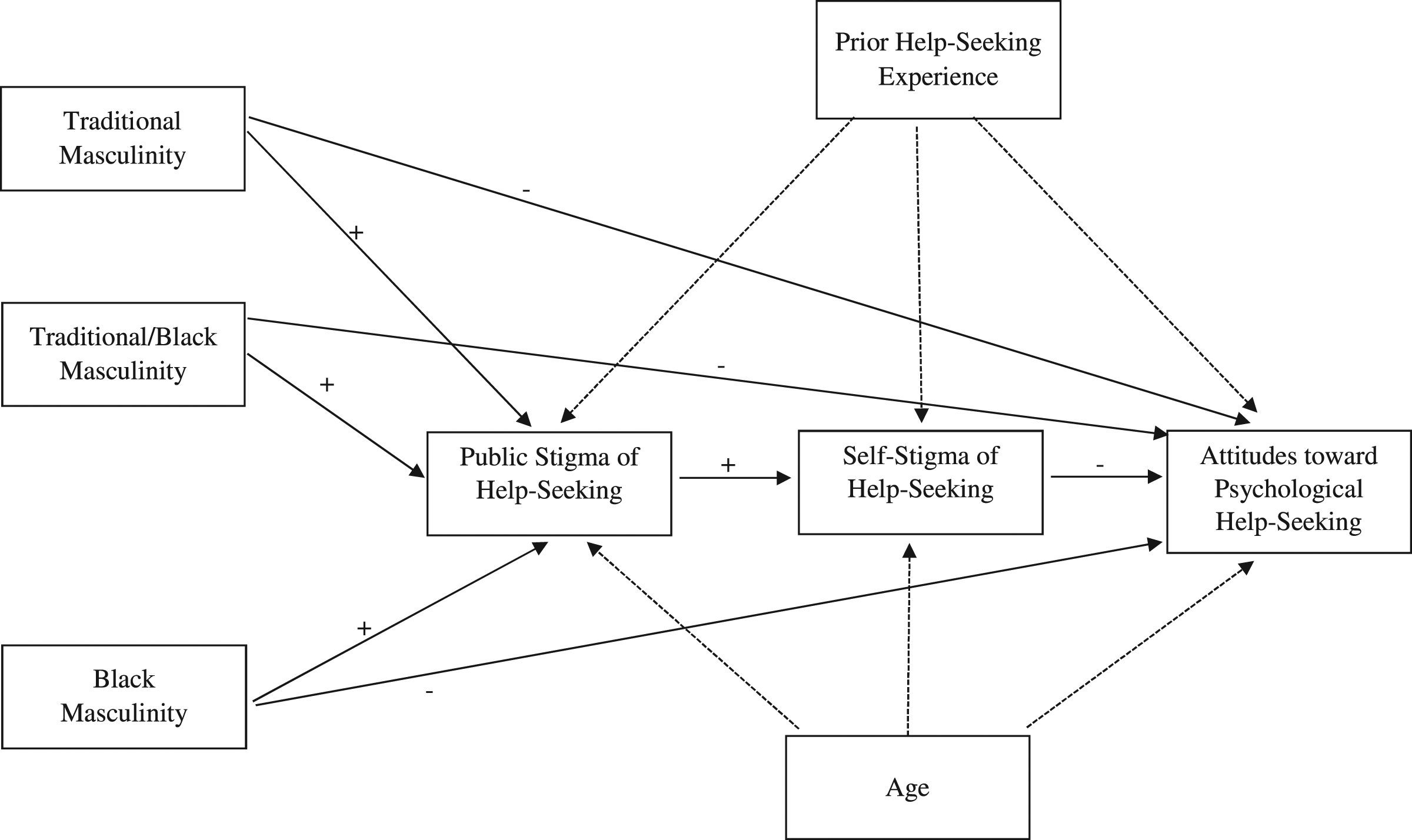
Method
Participants
Demographic Information of Sample.

Note: N = 160.
Measures
Demographics
Participants were asked basic demographic questions regarding age, race, gender, religious affiliation, sexual orientation, romantic relationship/marital status, highest education level completed, employment status, household type growing up, perceived socioeconomic status (SES), and residing region of the U.S. to observe the representativeness of the sample. To measure prior help-seeking, participants were also asked if they have ever sought psychological help (0 = no, 1 = yes).
Masculinity
Three subscales of the Masculinity Inventory Scale (MIS; Mincey et al., 2014b) were used to assess masculinity in the current study. This measure was constructed following focus groups with Black men about what it means to be a man and what it means to be a Black man. The scale developers used focus group responses to identify points of overlap and points of distinction between being a man and being a Black man, as well as influences on becoming a man. Items associated with these factors were generated and measured on a 5-point scale from 1 (strongly disagree) to 5 (strongly agree).
Exploratory factor analysis in the original development study suggested five subscales, three of which measured masculinity experiences and norms (used in the current study) and two of which measured influences on becoming a man (Mincey et al., 2014b). In the current study, mean scores were generated for each subscale, with higher scores indicating greater adherence to the specific form of masculinity.
Traditional Masculinity
We used the Mainstream Society subscale of the MIS (Mincey et al., 2014b) to assess adherence to traditional masculinity. This subscale contains 12 items that represent experiences and norms associated with being a man (e.g., “A man is able to control his emotions”). Cronbach’s alpha was .94 during scale development (Mincey et al., 2014b) and was .92 in the current study. Prior validity evidence for this subscale is limited to content validity from the scale development focus groups and factor analysis that identified this as a unique component of masculinity for Black men (Mincey et al., 2014b).
Black Masculinity
We used the Black Masculinity subscale of the MIS (Mincey et al., 2014b) to assess adherence to Black masculinity. The subscale contains 10 items that measure experiences and norms unique to being a Black man (e.g., “As a Black man, you’re up against a lot from birth”). Cronbach’s alpha was .87 during scale development (Mincey et al., 2014a) and was .81 in the current study. Prior validity evidence for this subscale is limited to content validity from the scale development focus groups and factor analysis that identified this as a unique component of masculinity for Black men (Mincey et al., 2014b).
Traditional/Black Masculinity
We used the Mainstream Society/Black Masculinity subscale of the MIS (Mincey et al., 2014b) to assess adherence to traditional/Black masculinity. This subscale contains 13 items that capture experiences and norms associated with both being a man and being a Black man (e.g., “I have to prove myself in academic situations”). Cronbach’s alpha was .79 during scale development (Mincey et al., 2014b) and was .75 in the current study. Prior validity evidence for this subscale includes content validity from the scale development focus groups and factor analysis that identified this as a unique component of masculinity for Black men (Mincey et al., 2014b). In addition, Black men who attended a Historically Black College or University (HBCU) scored significantly higher on this subscale than did Black men who attended a Predominately White Institution (PWI).
Public Stigma of Help-Seeking
We used the 5-item Perceptions of Stigmatization by Others for Seeking Psychological Help scale (PSOSH; Vogel et al., 2009) to measure public stigma of help-seeking. Participants indicated on a 5-point scale from 1 (not at all) to 5 (a great deal) the anticipated responses (e.g., “react negatively to you”) from others with whom they interact if they were to seek psychological help. The total score was used in the current study, with higher scores indicating higher perceived public stigma.
This measure demonstrated adequate to good internal reliability in the original study (α = .78–.89) across five samples as well as good test-retest reliability, 3 weeks apart, in a sample used in the original study (r = .77, p < .001; Vogel et al., 2009). Cronbach’s alpha was .94 in the current study. The PSOSH displayed concurrent validity with a measure of social stigma of help-seeking and a measure of public mental health stigma, and incrementally predicted self-stigma of help-seeking beyond the effects of social stigma and public mental health stigma. (Vogel et al., 2009).
Self-Stigma of Help-Seeking
We used the Self-Stigma of Seeking Help scale (SSOSH; Vogel et al., 2006) to measure self-stigma of help-seeking. The SSOSH is a 10-item, unidimensional scale that assesses how seeking professional psychological help would threaten one’s sense of self. Each item (e.g., “I would feel inadequate if I went to a therapist for psychological help”) is rated on a 5-point scale from 1 (strongly disagree) to 5 (strongly agree). The total score was used in the current study, with higher scores indicating higher self-stigma.
In the original development of the SSOSH, five studies were conducted to test the measure’s reliability and validity (Vogel et al., 2006). The SSOSH previously displayed good to excellent internal consistency (α = .86–.91) and good test-retest reliability after 2 months (r = .72). Cronbach’s alpha was .90 in the current study. Scale development research demonstrated construct validity through moderate correlations with anticipated risks of disclosing to a therapist and with social stigma, along with a negative correlation with intentions to disclose distressing information and intentions to seek counseling. The SSOSH also incrementally predicted intentions to seek counseling above the effects of expectations of disclosure and social stigma. In addition, the SSOSH displayed the expected discriminant validity, showing no association between scores on the SSOSH and measures of social desirability, self-esteem, and overall psychological distress (Vogel et al., 2006).
Psychological Help-Seeking Attitudes
We used the Attitudes Toward Seeking Professional Psychological Help – Short Form (ATSPPH-SF; Fischer & Farina, 1995) to measure psychological help-seeking attitudes. The ATSPPH-SF is a 10-item, widely used, unidimensional measure of an individual’s willingness to seek psychological help (e.g., “If I believed I was having a mental breakdown, my first inclination would be to get professional attention”). Each item is rated on a 4-point scale from 0 (disagree) to 3 (agree). After reverse scoring five items (items 2, 4, 8, 9, and 10), we used the total score, with higher scores indicating more positive attitudes toward help-seeking.
The original development study of the ATSPPH-SF scores yielded both good internal reliability (α = .84) and test-retest reliability after 1 month (r = .87). Cronbach’s alpha was .86 in the current study. This scale displayed construct validity through a negative correlation with social stigma of help-seeking and divergent validity through non-significant correlations with measures of current mental health (Elhai et al., 2008). Increased scores on the ATSPPH-SF were also associated with increased intentions to seek mental health care in the next month (r = .24, p = .001) and at 6 months (r = .26, p < .001).
Procedures
An exempt study protocol was approved by the researchers’ Institutional Review Board (IRB) to conduct this study. We first utilized email and social media recruitment ads, targeting Historically Black Colleges and Universities (HBCUs), organizations servicing either the Black community or Black men, and individuals who identify as Black men in the United States. The ads included a link to an information letter about the study and the Qualtrics survey. One hundred forty-seven people clicked the survey link. Of those individuals, 16 people did not provide any data, 6 did not meet eligibility criteria, 11 did not correctly answer the attention check questions, and 49 did not complete the survey, leaving a sample of 65 participants. To increase the sample size, we then utilized Prolific Academic (https://www.prolific.co/) to recruit additional participants. We used pre-screeners available in this online research pool to advertise only to individuals who were residing in the United States, who identified as Black or African American, and who identified as a man. Participants who completed the survey through Prolific were compensated US$2.17 at a rate of US$6.51/hour for completion of a 20-minute survey. (Prolific requires researchers to provide a minimum wage of US$6.50/hour to participants for survey completion.) Of 100 participants who completed the study on Prolific, 5 were eliminated for failure to pass attention checks, leaving a Prolific sample of 95 participants and a combined sample of 160 participants. The participants recruited through email and social media were not compensated for survey completion. The Prolific survey participants received compensation because participant compensation is a requirement of the platform. All participants completed demographic questions first then completed the remaining measures in a randomized order.
Results
Missing Data
For the 160 participants with valid completion of the study, we first examined the degree of missing data for study variables. Most scale items had no missing data, and no item had more than 1.8% missing responses. We also conducted Little’s Missing Completely at Random (MCAR) test. The non-significant result (p = .68) allowed us to proceed with the assumption that missing responses were missing completely at random (Tabachnick & Fidell, 2013). To allow us to utilize data from participants who omitted a small number of items, we substituted their omitted item(s) with participants’ mean score from their completed scale/subscale items prior to calculating their variable score, provided they completed at least 80% of items for that scale/subscale. No participants were lost through this procedure, thus retaining the sample size of 160 participants.
Descriptive Analyses
Descriptive Statistics of Study Variables.

Note: N = 160. Prior help-seeking: 0 = have never sought psychological help, 1 = have sought psychological help.
Correlations **p < .01. *p < .05.
Skewness and Kurtosis critical value **p < .01.
Examining normality of individual variables using a critical z-value of 2.58 (p = .01) recommended for moderate sample sizes (Tabachnick & Fidell, 2013), some variables did have significant skewness and/or kurtosis, as can be seen in Table 2. There were also univariate outliers on some variables (3 high outliers on self-stigma, 5 high outliers on public stigma, 4 low outliers on Black Masculinity, 2 high and 2 low outliers on Traditional/Black Masculinity, and 5 high outliers on age). However, for path analysis, covariance residuals, rather than normality of individual variables within the model, help to determine if statistical assumptions have been met for the model. Thus, we examined the standardized root mean square residual (SRMR) for the hypothesized model to screen for possible concerns with the covariance residuals (see Path Analysis section; SRMR >.10 may indicate poor fit; Kline, 2016).
Because we had two recruitment methods, we conducted independent samples t-tests to determine if there were any differences in our study variables based on whether participants were recruited through email/social media or via Prolific. For these t-tests, a priori effect size descriptors of small (d = 0.20), medium (d = 0.50), and large (d = 0.80) were set using Cohen’s (1988) guidance. There were no significant differences on the outcome variable of attitudes toward professional help-seeking (t [158] = 0.062, p = .951, d = 0.09) nor on the mediator variables of public stigma of help-seeking (t [158] = 0.099, p = .922, d = 0.02) or self-stigma of help-seeking (t [158] = −0.234, p = .816, d = −0.04). Regarding predictor and control variables, there were no significant differences between recruitment methods for traditional masculinity (t [158] = 1.839, p = .068, d = 0.31), traditional/Black masculinity (t [158] = −1.221, p = .224, d = −0.19), or age (t [158] = 0.599, p = .550). However, there was a significant difference between the two recruitment methods for Black masculinity, t (158) = 3.114, p = .002 d = 0.51, medium effect size. Participants recruited via email/social media had significantly higher Black masculinity (M = 4.11, SD = 0.52) than did participants recruited via Prolific (M = 3.80, SD = 0.67), with a medium effect size for this difference (Cohen, 1988). This difference may have been due to email/social media recruitment primarily targeting individuals who have self-selected into Black contexts (e.g., HBCUs, Black community groups). A chi-square analysis revealed no significant difference in prior help-seeking experience based on recruitment method, χ2 = 0.232, p = .630. Because participants did not differ on the mediator, control, or outcome variables based on recruitment method, we proceeded with a single sample for path analysis.
Path Analysis
We utilized AMOS to conduct a path analysis to test the hypothesized model from Figure 1, designed to predict attitudes toward psychological help-seeking through three forms of masculinity, public stigma, and self-stigma. We used maximum likelihood for this analysis, with raw data converted into a covariance matrix. Because path analysis allows for simultaneous testing of an entire model, rather than of individual components, we set a significance value of p < .05 to determine statistical significance (see Kline, 2016, for more information on path analysis). As noted above, we first screened for SRMR. In our hypothesized model, SRMR was .05, less than the value (>.10) that would suggest concerns about the covariance residuals. In addition, using guidance from Kline (2016), the path analysis had acceptable fit overall for the hypothesized model, including χ2 (df = 4) = 14.9, p = .005; Comparative Fit Index (CFI) = .94; Normed Fit Index (NFI) = .93; and Root Mean Square Error of Approximation (RMSEA) = .13, (90% CI = .06, .21). Therefore, statistical assumptions for this path analysis were sufficiently met despite the presence of some outliers.
Results of the model are presented in Figure 2 and Table 3. Path coefficients are standardized for easier interpretation across variables in this model. In addition, we used R2 effect size descriptors of small (.02), medium (.13), and large (.26) to indicate the amount of variance explained for each of our endogenous variables. As can be seen, both control variables were significant predictors of attitudes toward help-seeking. Those who had previously sought professional help had significantly more positive attitudes (β = .19), and higher age was associated with more positive attitudes (β = .19). In addition, higher age predicted less public stigma of help-seeking (β = −.22) and previous help-seeking experience predicted less self-stigma of help-seeking (β = −.17). Standardized path analysis results to predict attitudes toward psychological help-seeking. Correlations and Covariances for Exogenous Variables in Path Analysis. Note: N = 160. ** p < .01. * p < .05.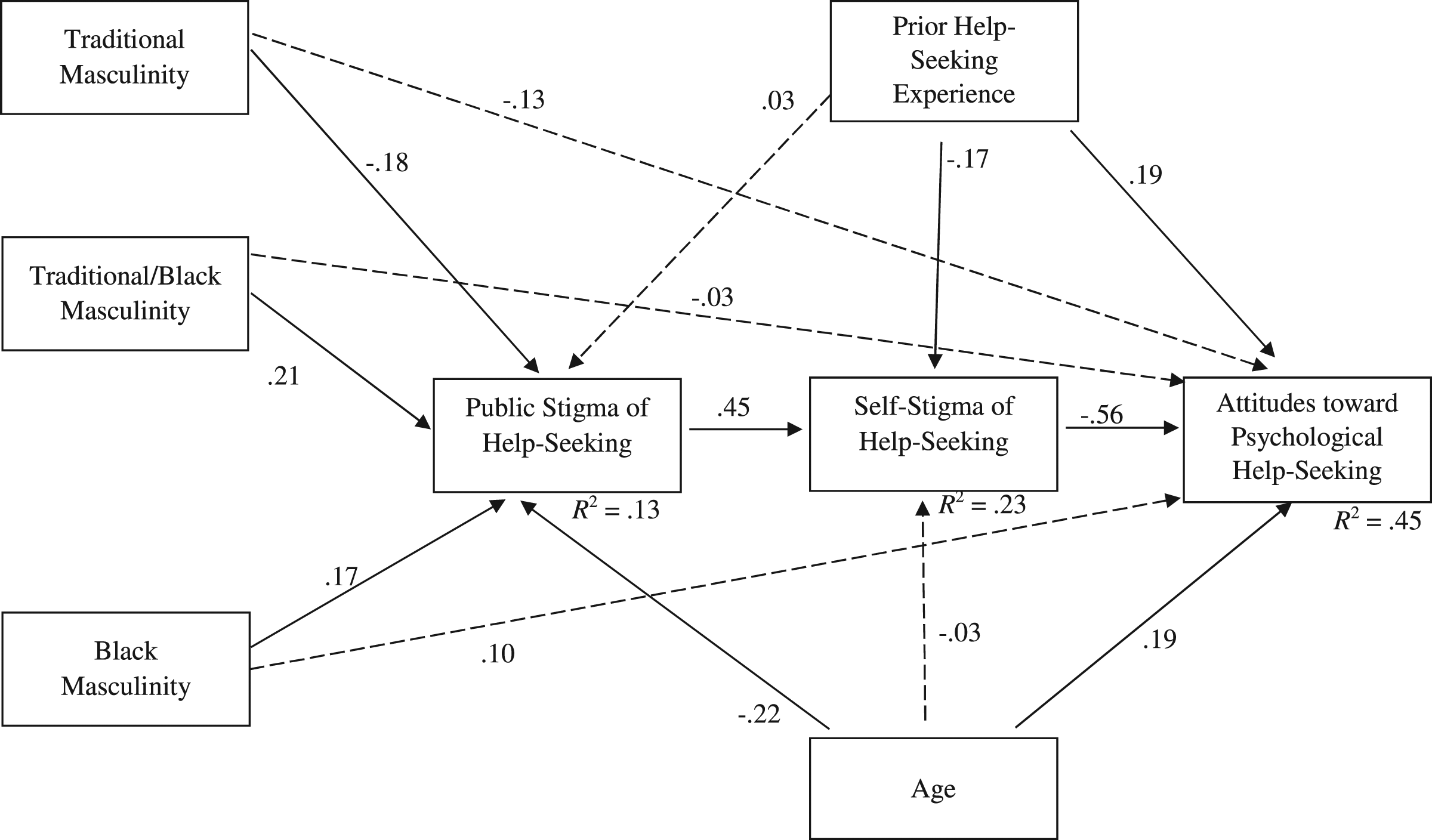

Consistent with hypotheses, higher traditional/Black masculinity and Black masculinity both significantly predicted higher public stigma of help-seeking (β = .21 and β = .17, respectively), with similar strength in their effects. Traditional masculinity was also a significant predictor of similar magnitude, but in the opposite direction than hypothesized; higher traditional masculinity predicted lower public stigma of help-seeking (β = −.18). The included variables explained 13% of the variance in public stigma (R2 = .13), a medium effect. As expected, higher public stigma predicted significantly higher self-stigma of help-seeking (β = .45), with the path model explaining 23% of the variance in public stigma (R2 = .23, medium effect). Public stigma, in turn, predicted less positive attitudes toward help-seeking (β = −.56). These paths were stronger than the paths from the masculinity variables to public stigma. There were no significant direct paths from masculinity to attitudes. The path model explained 45% of the variance in attitudes toward help-seeking (R2 = .45), a large effect.
Bootstrap Estimates of Standardized Indirect and Total Effects in Path Analysis.

Note: N = 160.
* = significant 95% confidence interval.
Discussion
This study sought to understand the roles of Black masculinity and traditional masculinity in stigma (public and self) and attitudes toward psychological help-seeking in Black men in order to inform stigma-reducing interventions. As predicted, we found that greater public stigma was associated with greater self-stigma of help-seeking, which was then associated with less positive attitudes toward help-seeking. Our overall model effect size was large in its prediction of attitudes. This pathway has been well established in other populations (e.g., Vally et al., 2018; Vogel et al., 2007), but we were unable to find previous research testing this full pathway for Black men specifically. Our findings extended to Black men, which are consistent with the literature highlighting the consequences of help-seeking stigmatization (Hammer et al., 2013; Vogel et al., 2006).
Our results also extend prior literature by specifically testing a model in which Black men’s adherence to different types of masculinity predict their perceptions of public stigma of help-seeking, with a medium effect size result. Specifically, adherence to both traditional/Black masculinity and Black masculinity were associated with greater public stigma of help-seeking, which was consistent with hypotheses. This may be due to cultural aspects, including the large emphasis on family in the Black community (Hammond & Mattis, 2005), the psychological resilience of African American men in the methods of coping with structural challenges (Bowleg et al., 2013), perceptions of negative community belief about mental health care, and lack of trust for healthcare professionals (Lindsey & Marcell, 2012).
Prior research has found traditional masculinity to be associated with negative attitudes toward help-seeking as well as negative mental health outcomes such as depression, anxiety, substance abuse, and low self-esteem (Gerdes et al., 2017; Wong et al., 2017). We thus expected traditional masculinity to predict greater public stigma of help-seeking for our sample of Black men. However, contrary to expectations, adherence to traditional masculinity was negatively associated with public stigma and indirectly predicted less self-stigma and more positive attitudes toward help-seeking within our sample of Black men. Although this finding contradicts literature highlighting that conformity to masculinity is associated with more barriers to seeking help (Wong et al., 2017), the results suggest there may be a unique experience of masculinity for Black men that is culturally contingent and may not be accounted for under traditional masculine contexts. Although Black men conform to traditional masculine norms—such as emotional control, self-reliance, being encouraged by challenges, and providing for family—this adherence may serve as a protective factor when controlling for Black masculine norms such as experiencing obstacles based on racial status (e.g., lack of opportunity, experiencing and avoiding negative stereotypes, and lack of support). This could speak to the intersectionality and multidimensional aspect of masculinity and racial identity that both influence Black men’s mental health and well-being (Bowleg et al., 2016). This is supported by Hammond (2012)’s finding that the masculine norm of self-reliance was associated with less depressive symptoms when African American men between the ages of 18–29 years old and 40 years old and older were met with experiences of perceived everyday racial discrimination. Future research should explore additional factors that may also impact help-seeking stigma and help-seeking attitudes for Black men, including how traditional masculine norms may counterbalance the negative experience that stems from racial identity. Previous literature has suggested a moderation effect of age and self-stigma, such that under conditions of low stigma, older Black men are more likely to seek psychological help than younger Black men (Cadaret & Speight, 2018). Consistent with the literature, the current study found a negative relationship between age and public stigma and a positive relationship between age and help-seeking attitudes. This suggests that, as age increases, public stigma decreases, which likely also decreases self-stigma, and, in turn, predicts more positive help-seeking attitudes among Black men. This supports the necessity of interventions specifically targeted toward younger Black men. Future directions could include qualitatively examining explanations for why age or generational status is negatively associated with public stigma and positively associated with positive help-seeking attitudes.
Implications
The results of this study have clinical implications for mental health professionals providing services to Black men. Understanding the barriers to help-seeking and the unique experience that conforming to Black masculinity has on help-seeking attitudes may allow clinicians and helping professionals to diversify their methods and approach to treating Black male clients, as well as creating effective interventions for this population. One way to reduce public stigma is to provide psychoeducation in the Black community on mental health and the idea that even physically healthy people get sick (Taylor & Kuo, 2019). From a clinical perspective, it is suggested that strengths-based approaches could be helpful and effective when working with Black men to assist in reframing their meaning of manhood (Gerdes & Levant, 2018; Wong, 2006). Future research should explore effective methods and interventions aimed at reducing the public and self-stigma toward psychological help-seeking for Black men as a unique population. Given our findings that older age was associated with less self-stigma, interventions that incorporate older men sharing about their perspectives and experiences with psychological help-seeking may be particularly powerful in disrupting self-stigma for younger men. We also found that previous psychological help-seeking among Black men predicted more positive attitudes toward help-seeking as well as less self-stigma of help-seeking. This may suggest that attending therapy may not be as negative of an experience as expected. That being said, Black masculinity was an indirect predictor of more self-stigma and more negative attitudes toward psychological help-seeking. Given that the Black masculinity measure used in our study (Mincey et al., 2014b) is primarily composed of difficult experiences such as racial stressors and discrimination, the role of these factors on attitudes toward help-seeking cannot be ignored. The mental health system in the United States is still a primarily White system, and, as such, Black men—particularly those high in Black masculinity—may associate the mental health system with likely discrimination (Data USA, n.d; Holden & Xanthos, 2009; Taylor & Kuo, 2019). Continued work toward increasing racial diversity in mental health systems will help to address this. In addition, clinicians and agencies can make sure their webpages are culturally inclusive, with invitations for clients to discuss topics such as race, gender, and discrimination in counseling. Including this type of public information may increase the likelihood that Black men would be willing to seek services. Once clients have sought services, it is imperative that the services are offered in a culturally responsive manner (Holden & Xanthos, 2009; Taylor & Kuo, 2019). Some clinicians may need to engage in continuing education in order to effectively address concerns such as race, gender, and racial stressors with Black men.
Limitations
We note some limitations of this research. First, the scale used to measure Black masculinity (MIS; Mincey et al., 2014b) primarily focused on negative aspects of Black men’s experiences (e.g., discrimination). We utilized this measure because it was the only available measure of Black masculinity found in the literature. However, the emphasis on negative experiences leaves out the ways in which more adaptive aspects of Black masculinity may influence stigma and help-seeking. In addition, little research has utilized the MIS to date, including a lack of work to establish concurrent validity with other measures of masculinity, lack of discriminant validity evidence, and no previous reports of intercorrelations among the MIS subscales. It is therefore difficult to determine if results from this study are consistent with what would be expected if more established measures of traditional masculinity were utilized. Without sufficient prior validity evidence for the MIS, these results should be interpreted with caution until further research can confirm these patterns. Another limitation is the survey’s cross-sectional nature; causality cannot be determined. Our sample was also on the lower size for path analysis. We utilized path analysis rather than structural equation modeling due to our sample size, but we may have been limited in detecting some smaller effects at our selected alpha level of p < .05. In addition, given our emphasis on cultural norms in this study, generalizability of this sample of Black men needs to be considered. Participants were asked where they currently reside in the U.S. but were not asked questions about if they were born in the U.S., how long they lived here, and if the region where they reside is where they grew up. These limitations leave implications for future research.
Future Research
Since the MIS, which is the only available measure of Black masculinity found in the literature, primarily focuses on the negative aspects of Black masculinity, such as discrimination, future research—including future scale development research—should explore more positive aspects of Black masculinity (e.g., family and community support) to understand the experience more holistically. Future research should also address factors that may help to disrupt the connection between Black masculinity and public stigma. Protective factors to examine include the support of family and community, self-esteem, income, and education levels (Gayman et al., 2018; Teti et al., 2012). Since limited work has been conducted to establish concurrent validity between the MIS and established masculinity scales, future research with the MIS may work to establish concurrent validity and compare results across measures of masculinity. Related, our correlation analyses revealed that the three masculinity variables on the MIS are distinct, with Black masculinity not significantly correlated with the two subscales that include traditional aspects of masculinity. Future research may examine variables that influence the form(s) of masculinity that Black men most adhere to.
Future research should also conduct longitudinal studies to examine the relationships found in this study. Given the emphasis of cultural norms in our study, future research should assess the depth of cultural demographics of U.S. Black men, such as the length of residence in the U.S. and country of origin, the length of residence in their current region in the U.S., and past residency in other regions of the U.S. along with the length of time in each region, to determine if the results of this study or similar studies are regional, can be generalized to the entire U.S., or are universal. We included detailed demographic data so that future researchers can compare their sample with ours on numerous variables.
Conclusion
Black men may adhere to a different cumulative set of masculine norms than White men due to the intersectionality of their race and gender and the accompanying social norms, such as experiencing racism. Black men’s adherence to Black masculine norms and the intersection of traditional/Black masculinity norms was associated with greater public stigma, whereas adherence to traditional masculine norms was associated with less public stigma when controlling for the other masculinity variables. This may be due to the Black man’s masculine norm of family and community influencing their notion of masculinity. This study is also the first study to examine a pathway between masculinity, public stigma, self-stigma, and help-seeking attitudes using a scale that examines both traditional masculinity and Black masculinity in Black men. As addressed above, this has important implications for understanding a Black man’s notion of masculinity and therapeutic practices that may ensue.
Footnotes
Declaration of Conflicting Interests
The author(s) declared no potential conflicts of interest with respect to the research, authorship, and/or publication of this article.
Funding
The author(s) received no financial support for the research, authorship, and/or publication of this article.
