




Abstract
Although extant research highlights the detrimental effects of the Superwoman Schema (SWS) on Black women’s physical and psychological well-being, researchers have yet to examine the implications of SWS endorsement on Black women’s sexual attitudes and behaviors. As a culturally salient racialized gender schema that reifies Black women’s supposed superhuman emotional and physical strength, to what extent does endorsement of the SWS contribute to Black women’s reported sexual assertiveness and satisfaction? In the present work, 406 Black women completed an online survey measuring their endorsement of the SWS, as well as their sexual assertiveness and sexual satisfaction. SWS dimensions moderated the association between sexual assertiveness and sexual satisfaction. Findings from the present study highlight the importance of considering culturally salient racialized gender schemas when examining Black women’s sexual attitudes and behaviors.
In 2018, the United States (U.S.) Centers for Disease Control and Prevention (CDC, 2019) reported that Black Americans had the highest sexually transmitted disease (STD) rates in the U.S. One predictor of STD transmission risk is assertiveness in sexual relationships (e.g., assertiveness in initiating condom use and/or refusing sexual activity without condom use; Morokoff et al., 2009; Zerubavel & Messman-Moore, 2013). When women are less sexually assertive, they may be less likely to discuss safe sexual behaviors with their partners and less likely to refuse unwanted sexual encounters (Kennedy & Jenkins, 2011; Livingston et al., 2007). Conversely, women who reported higher sexual assertiveness felt more entitled to sexual pleasure and were more likely to communicate their sexual needs and desires during partnered encounters (Chmielewski et al., 2020; Santos-Iglesias et al., 2013; Tolman, 2005). Effective sexual communication and the belief that their sexual desires matter may reduce sexual risk factors, such as unwanted pregnancies and STD transmission (e.g., Mastro & Zimmer-Gembeck, 2015).
Yet, scholars suggest that contextual factors, including the societal sexual objectification of women’s bodies and the propagation of traditional racialized gender roles (e.g., Ward et al., 2020), contribute to lower sexual assertiveness among many women. Specifically, mainstream U.S. culture proliferates the sexual objectification of women’s bodies through messages that their worth is defined by their ability to please others sexually (Fredrickson & Roberts, 1997). Concurrently, traditional gender scripts and ideologies reinforce that women should monitor and/or silence their own sexual desires, which perpetuates the sexual double standard that women should be sexually available but not appear too sexually assertive (Manago et al., 2015). For example, many young girls receive heteronormative messages that women should maintain a sexually attractive figure but not feel sexual desire and that their sexual desires are less important than males’ sexual desires. These messages may be received in school and family contexts (L’Engle & Jackson, 2008; Leath, Jones, Jerald et al., 2021); advertisements (Stankiewicz & Rosselli, 2008); and through online media entertainment (Manago et al., 2015; Subrahmanyam & Šmahel, 2011).
Findings suggest that the endorsement of traditional gender roles is associated with lower sexual assertiveness and sexual satisfaction, and more sexual deference in intimate relationships (Katz & Tirone, 2009; Kennett et al., 2013). However, much of this earlier work has primarily examined the experiences of White women (e.g., Karsay et al., 2018; Sánchez-Fuentes et al., 2013), thus contributing to a limited rendering on positive sexual health processes and outcomes among Black women (Ward et al., 2020). To expand the sexual health literature, it is important to examine the unique gendered and racialized cultural norms that may influence Black women and girls’ navigation of their sexual experiences (Auslander et al., 2012; Jenkins & Kennedy, 2013; Kennedy & Jenkins, 2011). The present study begins to address this gap by examining how the internalization of the Superwoman Schema (Woods-Giscombé, 2010), a culturally relevant gender schema that promotes self-sacrifice and resilience, may influence Black women’s sexual assertiveness and sexual satisfaction.
Black Women and the Superwoman Schema
The Superwoman Schema (SWS) is a racialized gender schema that highlights Black women’s perceived role as invulnerable superwomen who have responsibilities within their community and the broader U.S. society to provide for others, suppress her own emotional needs, and succeed despite inadequate resources (Beauboeuf-Lafontant, 2009; Harris, 2018; Walker-Barnes, 2014; Woods-Giscombé, 2010). Specifically, Woods-Giscombé (2010) enumerated five dimensions of the SWS: (a) obligation to present an image of strength, (b) obligation to suppress emotional responses to stressors, (c) resistance to vulnerability with others in fear of being hurt, (d) determination to succeed despite limited resources, and (e) obligation to help others and focus more on taking care of others rather than prioritizing their own health. Some Black women may internalize this cultural prescription of strength to mitigate the adversity of living in a racist and sexist society that devalues Black women’s subjective and objective health and well-being (Beauboeuf-Lafontant, 2009; Donovan & West, 2015; Thomas & King, 2007).
Several scholars have examined the psychosocial implications of Black women’s endorsement of the Superwoman Schema (e.g., Abrams et al., 2019; Black & Woods-Giscombé, 2012; Leath, Jones, & Butler-Barnes, 2021; Woods-Giscombé, 2010). In general, many of these studies found that Black women may endorse the SWS in adolescence (Anyiwo et al., 2021) through older adulthood (Hudson, 2019; Woods-Giscombe et al., 2016), though younger Black women may report greater SWS endorsement than older Black women (Watkins, 2020). SWS endorsement has also been found to contribute to negative health outcomes depending on how Black women integrate the racialized gender schema within their lives. For example, Abrams et al. (2019) found that Black women with greater endorsement of the SWS were more likely to engage in self-silencing behaviors in their everyday lives; for instance, “biting their tongues” to avoid expressing negative emotions such as discomfort, pain, or a need for help, out of fears that they may be perceived as being vulnerable. Additional evidence suggests that Black women’s internalization of the SWS is associated with stress-related behaviors such as emotional eating, dysfunctional sleep patterns, postponement of self-care, migraines, hair loss, panic attacks, disordered eating, and weight gain (Abrams et al., 2019; Black & Woods-Giscombé, 2012; Harrington et al., 2010). Thus, while endorsement of the SWS contributes to negative mental, physical, and emotional health outcomes among emerging adult Black women, researchers have yet to fully examine how SWS endorsement may play a role in Black women’s self-objectification and sexual health.
The Superwoman Schema and Self-Objectification
Theories of sexual self-objectification detail the process by which individuals adopt an observer’s perspective of their body and bodily functions and abilities; in particular, sexual self-objectification highlights how individuals may construe their sexual identities and experiences, primarily as tools for the sexual pleasure of others (McKinley & Hyde, 1996). Women who engage in self-objectification may base their self-worth on their ability to please others sexually and pay less attention to their own sexual satisfaction and needs (Breines et al., 2008; Fredrickson & Roberts, 1997). In regard to Black women’s sexuality, a higher internalization of the SWS, particularly the obligation to help others and to present an image of strength, may facilitate the development of an objectified body consciousness and sexual self-objectification. As such, it is important to consider how SWS endorsement influences Black women’s sexual beliefs and experiences.
Like theories of self-objectification and objectified body consciousness (Breines et al., 2008; Fredrickson & Roberts, 1997), Black women who more strongly endorsed tenets of the SWS may believe that they must subvert their personal sexual needs and desires to fulfill their default roles as helpers and caregivers (Parks, 2010). In addition, sexual self-objectification includes self-silencing (i.e., viewing oneself as a tool for the sexual pleasure of others) and denying the importance of one’s subjective experiences and feelings within sexual encounters (Papadaki, 2010; Watson et al., 2012). Emerging evidence indicated that Black women who internalized the SWS may prioritize the superwoman identity and ignore their own emotional and physical needs. For example, Abrams and colleagues (2019) explored linkages between Black women’s self-silencing behaviors, perceived obligations to exude strength, and depressive symptoms; Black women who experienced an obligation to present an image of strength also reported greater self-silencing behaviors and depressive symptoms. Understanding the role of Black women’s internalization of SWS dimensions as a unique manifestation of an objectified body consciousness is critical to developing comprehensive empirical understandings of the internal, interpersonal, and sociohistorical factors that influence Black women’s sexual health behaviors (Lewis et al., 2013).
Sexual Assertiveness and Sexual Satisfaction Among Black Women
Understanding Black women’s experiences with unique racialized gender schemas is crucial for identifying sexual attitudes that may increase their sexual risk and hinder their sexual assertiveness and satisfaction. While constructions of White women’s sexuality have historically been based on notions of purity and chastity (Perkins, 1983; Welter, 1992), Black women have been subject to discourses of hypersexuality and promiscuity to justify their systemic sexual objectification and exploitation (Harris-Perry, 2011; Hooks, 1992; Lamb et al., 2016; Willingham, 2017). For example, the racialized and gendered Jezebel representation is a stereotypical narrative that depicts Black women as having an insatiable appetite for sex (Collins, 2002). Historically, White men relied on this stereotype to justify the sexual abuse and exploitation of enslaved Black women (Willingham, 2017). Today, scholars suggest that Black women’s awareness of historic negative sexual stereotypes, like the Jezebel, may influence how they enact their sexual desires (Donovan & Williams, 2002; Jerald, 2018; Ward et al., 2020). For instance, Black women may engage in sexually modest or inhibitive behaviors (e.g., sexual conservatism and shame, and lower sexual assertiveness) to counter stereotypes of hypersexuality and sexual deviancy (Leath, Jones, Jerald et al., 2021; Jerald, 2018). Thus, SWS endorsement, particularly self-silencing behaviors, and the expectation to display strength and emotional invulnerability, may be an additional contributing factor to some Black women’s engagement in sexually inhibitive behaviors.
A lack of sexual assertiveness is one such sexually inhibitive behavior that reflects individuals’ ability to communicate their sexual needs and has been a strong positive predictor of sexual satisfaction (Adebayo & Olonisakin, 2014; Azmoude et al., 2016; Ménard & Offman, 2009). Sexual satisfaction refers to the degree of satisfaction derived from sexual encounters and is associated with overall well-being, physical health, and relationship satisfaction (Byers, 2005; Gianotten et al., 2021; Taleporos & McCabe, 2002). While some studies have shown that approximately two thirds of Black women reported being at least somewhat sexually satisfied (Addis et al., 2006; Townes et al., 2020), additional research indicated that, compared to other racial groups, Black women reported less sexually assertive behaviors that contribute to sexual satisfaction (e.g., Ferguson et al., 2006). Specifically, compared to White and Hispanic women, Black women in heterosexual relationships expressed significantly lower sexually assertive attitudes and beliefs and were less likely to enforce contraceptive use with sexual partners (Jenkins & Kennedy, 2013; Kennedy & Jenkins, 2011; Sales et al., 2012).
As a culturally grounded gender script that is often perceived as a defining characteristic of Black womanhood (Beauboeuf-Lafontant, 2009), endorsement of the SWS may have detrimental implications on Black women’s sexual assertiveness and satisfaction. This association between prevalent cultural ideologies and sexual outcomes is not novel, and findings have suggested that Black heterosexual women’s internalization of traditional gender roles is associated with lower sexually assertive behaviors (Brown et al., 2018; Ward et al., 2020). However, it remains unclear how culturally salient racialized gender schemas such as the SWS may affect Black women’s sexual beliefs. In one of the few examinations of the sexual implications of cultural prescriptions of strength, Harris (2018) examined the relations between heterosexual Black women’s endorsement of the Strong Black Woman schema (i.e., perceived obligation to be emotionally invulnerable and self-sacrificial) and their sexual assertiveness. Findings indicated that Black women who reported higher endorsement of Strong Black Woman schema beliefs reported lower sexual refusal skills (e.g., refusal of sex after partner initiation) than Black women who indicated lower Strong Black Woman endorsement. This initial study suggests that Black women’s internalization of the SWS may hinder the expression of their sexual needs and desires in favor of catering to those of their sexual partners. To our knowledge, no additional studies have examined the SWS in relation to Black women’s sexual behaviors.
The Current Study
Sexual assertiveness is an important predictor of sexual risk behavior that has received little empirical attention among Black women (e.g., Kennedy & Jenkins, 2011). This situation exists despite evidence suggesting that Black women may report lower sexual assertiveness due to societal pressures around sexual submissiveness (Fasula et al., 2014; Ward et al., 2020). Additionally, it remains less clear how culturally salient racialized gender schemas may influence how Black women navigate and perceive their sexual experiences. Therefore, the present study examined whether the relationship between sexual assertiveness and sexual satisfaction differed based on Black women’s endorsement of the SWS. Based on prior evidence (e.g., Harris, 2018), we hypothesized that SWS endorsement would weaken the positive association between sexual assertiveness and satisfaction. By investigating the sexual implications of SWS endorsement among Black women, we hoped to offer culturally relevant insight that can inform and improve sexual health intervention efforts for this population.
Method
Participants
A total of 527 Black women were participants in the Black Women’s Mental Health and Identity Survey. Only participants who completed all measures and who reported at least one sexual encounter were included in the analysis for the present study. Fifty-one participants were removed because they never had a sexual encounter, and 70 were removed because they had missing information. Analysis of variance tests indicated that excluded participants were younger and reported lower SWS dimensions than included participants. The final sample was 406 Black women. Participants self-reported their age (M = 27 years, SD = 4.57 years) and were from across the U.S. (21% indicated they were from the Northeast, 44% from the South, 16% from the West, and 20% from the Midwest). Most of the sample (88%) self-identified as African American and/or Black, with 4% identified as African, 3% identified as biracial, 2% identified as Afro Caribbean, and 2% identified as Afro Latina. Regarding gender identity, most of the sample (87%) identified as cisgender women, 7% as femme, and 3.4% as Black women of trans experience. The women reported diverse sexual orientations; 70% identifying as heterosexual, 12% as bisexual, 6% as asexual, 5% as gay/lesbian, and 2% as pansexual. Finally, participants reported their highest level of educational attainment on an ordinal scale; four percent of women reported that they held less than a high school diploma, 31% reported holding a high school diploma, 28% reported some college or trade school, 13% held an associate’s degree, 17% of women held a bachelor’s degree, and 6% of women indicated they had a graduate degree.
Procedures
After obtaining IRB approval, the PI used Qualtrics survey panel service to recruit participants, with survey parameters mandating that the sample be nationally representative in terms of geographical location and be evenly distributed across age groups (i.e., 20–25, 25–30, and 31–35). To qualify for the survey, participants had to identify as a Black woman between the ages of 18 and 35. Eligible participants provided informed consent and were redirected to complete a 20–30-minute online survey (M = 25 minutes). Measures were administered in the same sequence for each participant. Participants received monetary compensation through Qualtrics for survey completion.
Measures
Demographic Items
Participants self-reported their demographic information including ethnicity, sexual orientation, and education level. Sexual orientation was dichotomized for analyses (0 = non-heterosexual, 1 = heterosexual). Participants’ partner and sexual activity status was measured via self-report items where participants indicated the nature of their dating and/or sexual relationships, with 5% declined to answer, 28% indicating neither partnered nor in a sexual relationship, 11% indicating non-sexual partnerships, and 56% indicating sexual partnerships. Responses were then dichotomized to 0 = non-sexually active (43.9%) and 1 = sexually active (56.1%).
Black Women’s Identity Beliefs
The Woods-Giscombé Superwoman Schema Questionnaire (Woods-Giscombé et al., 2019) was used to assess Black women’s endorsement of cultural prescriptions of strength. This 33-item measure has five subscales representing a different dimension of the SWS; responses for each subscale were coded on a 4-point Likert scale ranging from 1 (not true for me) to 4 (true for me most of the time). We focused on four of the five dimensions based on their hypothesized relevance to Black women’s sexual behaviors: (a) obligation to present an image of strength (4 items, e.g., “I have to be strong because I am a Black woman,” α = .75); (b) obligation to suppress emotions (7 items, e.g., “I keep my feelings to myself,” α = .84); (c) resistance to being vulnerable (7 items, e.g., “I have a hard time trusting others,” α = .85); and (d) obligation to help others (9 items, e.g., “I put everyone else’s needs before mine,” α = .86). Mean scores were computed for each dimension. For each dimension, scores were summed with higher scores indicating a stronger endorsement of that SWS dimension.
Reliability estimates of scores for each dimension were consistent with those found in Woods-Giscombé and colleagues’ (2019) initial assessment of internal consistency: obligation to present an image of strength (α = .70), obligation to suppress emotions (α = .85), resistance to being vulnerable (α = .86), and obligation to help others (α = .87). Each subscale has previously demonstrated (Woods-Giscombé et al., 2019) significant convergent validity with the Center for Epidemiological Studies – Depression Scale (r = .09–.49; Miller et al., 2008; Radloff, 1977) and the Perceived Stress Scale 4 (r = .28–.52; Cohen et al., 1983) and a significant negative association with sleep quality using the Pittsburgh Sleep Quality Index (r = .26–.47; Buysse et al., 1989).
Sexual Beliefs and Behaviors
Sexual Assertiveness
Sexual assertiveness was measured using a modified, 10-item version of Hurlbert’s Index of Sexual Assertiveness (Hurlbert, 1991). Using a scale ranging from 1 (never) to 4 (always), participants identified the frequency in which they engage in two categories of sexually assertive behaviors: sexual initiation (e.g., “It is hard for me to say no when I do not want to have sex”) and comfort with their partner (e.g., “I feel uncomfortable telling my partner what feels good”). Scores were then reverse coded so that higher scores indicated greater sexual assertiveness. Scale reliability of scores was good at α = .82 and consistent with previous estimates of internal consistency (i.e., .85; Pierce & Hurlbert, 1999). The HISA has previously demonstrated significant convergent validity with the Gambrill–Richey Assertion Inventory (r = .83; Gambrill & Richey, 1975; Hurlbert, 1991) and subscales of the Revised Sexual Consent Scale (r’s < .23; Humphreys & Brousseau, 2010).
Sexual Satisfaction
Sexual satisfaction was measured using Stulhofer et al.’s (2010) Sexual Satisfaction Scale. Participants were asked, “Think about your sex life for the past year, please rate your satisfaction with the following…” The 12 items were measured on a Likert-type scale ranging from 1 (extremely dissatisfied) to 5 (extremely satisfied), with higher scores indicating greater sexual satisfaction. Items included “quality of your orgasms” and “the balance between what you give and receive in sex.” Scale reliability of the scores was good at α = .94 and consistent with previous measures of internal consistency (i.e., all α < .90; Stulhofer et al., 2010). Additionally, the scale has demonstrated significant convergent validity with a global measure of sexual satisfaction (Stulhofer et al., 2010) and the New Sexual Satisfaction Scale (Brouillard et al., 2019).
Data Analysis
First, we conducted descriptive analyses (i.e., means, standard deviations, and bivariate correlations) to examine associations among Black women’s age, education, sexual partner status, sexual orientation, and the primary study variables. We then conducted simple moderation analyses using Hayes’ PROCESS Macro (Hayes, 2022) to determine whether endorsement of each distinct dimension of the SWS moderated the relations between sexual assertiveness and satisfaction. Hayes’ PROCESS Macro centered predictor variables prior to conducting moderation analyses (Hayes, 2022). This setup allowed us to identify the statistical interactions between the predictor variable (i.e., sexual assertiveness) and moderators (i.e., SWS dimensions) as well as to identify the strength and direction of the interaction’s effect on the outcome variable (i.e., sexual satisfaction). Simple slopes analyses were conducted for significant interactions.
Results
Preliminary Descriptive Analyses
Descriptive Statistics for Main Study Variables (N = 406).

Note. Strength = SWS obligation to present an image of strength; Emotion = SWS obligation to suppress emotions; Vulnerable = SWS resistance to vulnerability; Help = SWS obligation to help others; Sex Assert = Sexual assertiveness; Sex Sat = Sexual satisfaction.
*p < .05. **p < .01. ***p < .001.
Bivariate correlations were conducted using key study variables. Alpha was set at .05. Effect sizes were interpreted using the following parameters: small, r = |.1|, medium, r = |.3|, and large, r = |.5| (Cohen, 1992). Bivariate correlations indicated that participants’ age, education, and sexual orientation were unrelated to the primary study variables so were removed from subsequent analyses. Participants’ sexual partner relationship status was significantly positively associated with sexual assertiveness, obligations to promote an image of strength, and sexual satisfaction. Sexual assertiveness was positively associated with sexual satisfaction (r = .52, p < .001) and negatively associated with obligation to suppress emotions (r = −.17, p < .001), resistance to vulnerability (r = −.11, p = .03), and obligation to help others (r = −.18, p < .001). Sexual satisfaction was positively associated with Black women’s obligation to present an image of strength (r = .14, p = .006).
SWS as a Moderator for Sexual Assertiveness Predicting Sexual Satisfaction
To test the main hypothesis about whether dimensions of SWS endorsement moderated the relations between sexual assertiveness and sexual satisfaction, we utilized Model 1 of Hayes’ PROCESS Macro to conduct simple moderation analyses with each SWS dimension entered into its own model. The overall model for obligation to present an image of strength was significant, F (4, 401) = 42.43, p < .001, and R2 = .30, with a significant interaction between sexual assertiveness and obligation to present an image of strength, b = −0.21, t (401) = −2.17, p = .03, and ΔR2 = .01 predicting sexual satisfaction. Simple slope analysis revealed that the association between sexual assertiveness and sexual satisfaction was stronger among those reporting lower (−1 SD; b = 0.91, t (401) = 9.16, p < .001, CI [0.72, 1.11]) versus higher (+1 SD; b = 0.63, t (401) = 7.60, p < .001, CI [0.47, 0.80]) levels of an obligation to present an image of strength. Additionally, the overall model for obligation to suppress emotions was significant, F (4, 401) = 44.26, p < .001, and R2 = .31, with a significant interaction between sexual assertiveness and obligation to suppress emotions, b = −0.31, t (401) = −3.44, p < .001, and ΔR2 = .02, predicting sexual satisfaction. The association between sexual assertiveness and sexual satisfaction was stronger among those reporting lower (−1 SD; b = 1.03, t (401) = 10.43, p < .001, CI [0.83, 1.22]) versus higher (+1 SD; b = 0.58, t (401) = 6.64, p < .001, CI [0.41, 0.75]) perceived obligation to suppress emotions.
Main and Interaction Effects Between Sexual Assertiveness, SWS Dimensions, and Sexual Satisfaction (N = 406).
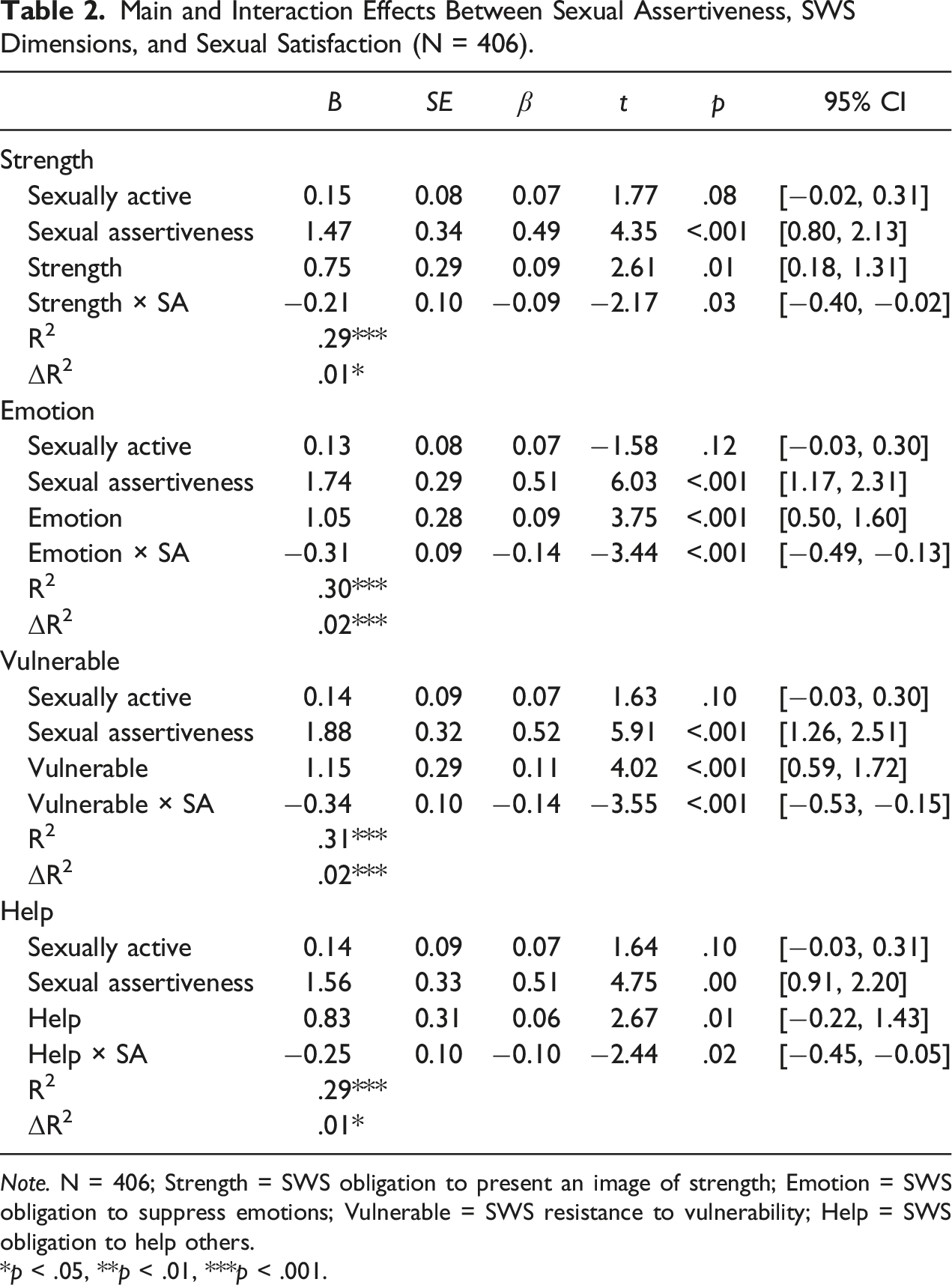
Note. N = 406; Strength = SWS obligation to present an image of strength; Emotion = SWS obligation to suppress emotions; Vulnerable = SWS resistance to vulnerability; Help = SWS obligation to help others.
*p < .05, **p < .01, ***p < .001.

Sexual assertiveness by SWS obligation to present an image of strength on sexual satisfaction (N = 406). Note: Sexual assertiveness is presented at −1, 0, and +1 standard deviations from the mean. SWS strength is presented at −1 and 1 standard deviations from the mean. All slopes were significant at p < .05.

Sexual assertiveness by SWS obligation to help others on sexual satisfaction (N = 406). Note: Sexual assertiveness is presented at −1, 0, and +1 standard deviations from the mean. SWS help is presented at −1 and 1 standard deviations from the mean. All slopes were significant at p < .05.

Sexual assertiveness by SWS resistance to vulnerability on sexual satisfaction (N = 406). Note: Sexual assertiveness is presented at −1, 0, and +1 standard deviations from the mean. SWS vulnerable is presented at −1 and 1 standard deviations from the mean. All slopes were significant at p < .05.

Sexual assertiveness by SWS obligation to suppress emotions on sexual satisfaction (N = 406). Note: Sexual assertiveness is presented at −1, 0, and +1 standard deviations from the mean. SWS suppress is presented at −1 and 1 standard deviations from the mean. All slopes were significant at p < .05.
Discussion
The present study examined the ways in which Black women’s endorsement of the Superwoman Schema (SWS) influenced the association between sexual assertiveness and sexual satisfaction. Our investigation builds on prior literature (e.g., Brown et al., 2018; Harris, 2018) by highlighting how endorsement of the SWS may influence Black women’s sexual attitudes in ways that may make them more vulnerable to sexual risk. In general, we found that greater endorsement of SWS tenets (e.g., perceived obligation to promote an image of strength, suppress emotions, help others, and hide expressions of vulnerability) weakened the positive association between sexual assertiveness and sexual satisfaction. While some previous sexual health research suggests that identification with racialized gender scripts is associated with Black women’s sexual agency and functioning (e.g., Brown et al., 2018; Ward et al., 2020), the current study provides evidence that the SWS may undermine Black women’s sexually assertive behaviors and satisfaction.
Our findings mirrored previous quantitative evidence that Black women who endorsed the SWS engaged in greater self-silencing by inhibiting their expressions of negative thoughts and behaviors (Abrams et al., 2019), as well as qualitative evidence suggesting that SWS endorsement may have a role in emotional strain within intimate romantic relationships (e.g., Woods-Giscombé, 2010). It is possible that sexually assertive behaviors may conflict with Black women’s perceived obligations to defer to a partner’s needs, and Black women with high SWS endorsement and sexual assertiveness may feel dissatisfied with their sexual experiences as they grapple with prioritizing both their own and others’ sexual needs. This pattern aligns with existing research findings that Black women who endorsed the SWS and similar cultural gender norms (i.e., the Strong Black Woman) tended to engage in self-silencing and refrain from self-care behaviors in efforts to maintain the image of a Black Superwoman (Abrams et al., 2019; Black & Woods-Giscombé, 2012). As previous research highlighted the detrimental psychological, physiological, and interpersonal consequences of SWS endorsement (Leath, Jones, & Butler-Barnes, 2021; Harrington et al., 2010), the present findings extend this research and indicate that pressures for Black women to appear superhuman by ignoring their physical and emotional needs may also be detrimental for sexual attitudes and behaviors.
Consistent with the literature on objectified body consciousness (Breines et al., 2008; Fredrickson & Roberts, 1997), our findings also suggested that Black women who more strongly endorsed the SWS may perceive their bodies as tools to satisfy others’ sexual needs and desires. Indeed, results aligned with theories of self-objectification in that SWS endorsement may pressure Black women to ignore their psychological, sexual, and bodily needs in favor of meeting the needs and expectations of romantic others (Fredrickson & Roberts, 1997; Papadaki, 2010). As Black women may draw strength from their identity as a Black Superwoman in times of distress (i.e., Woods-Giscomé, 2010), it is crucial to further explore the linkages between SWS endorsement and experiences of objectification. Our study highlights that, in efforts to cultivate Black women’s sexual autonomy, future research must challenge racialized societal norms that may contribute to experiences of sexual and self-objectification.
Surprisingly, our results also indicated that among participants with low sexual assertiveness, high endorsement of the SWS was associated with more sexual satisfaction than those with low SWS endorsement. As previous research suggests that sexual assertiveness is a key predictor of satisfaction (Adebayo & Olonisakin, 2014; Azmoude et al., 2016), our findings demonstrated that Black women’s sexual satisfaction may also be uniquely informed by their endorsement of the SWS. As Black women have been found to engage in sexually modest behaviors to counter existing hypersexualizing stereotypes (e.g., the Jezebel; Jerald, 2018), those with higher SWS endorsement and lower sexual assertiveness may draw from their perceived “superhuman” physical and emotional strength, and achieve sexual satisfaction through engaging in sexually assertive behaviors that are not captured in the present study measures. Our findings add to the existing sexuality literature (e.g., Chmielewski et al., 2020) by suggesting that sociocultural scripts of emotional resilience and superhuman strength may have unique implications for Black women’s sexual attitudes and behaviors.
Limitations
Our examination of sexual satisfaction addresses Hargons and colleagues’ (2020) call for sex-positive approaches to the study of sex research with Black women samples. Specifically, the present work centered on the importance of considering culturally salient racialized gender schemas in relation to Black women’s sexual pleasure and satisfaction. Despite these merits, there are several limitations in the current study. First, the current sample consists of predominantly heterosexual, Black women. Given our focus on heteronormative sexual scripts (i.e., women’s sexual desire comes secondary to men’s sexual desire in heterosexual relationships; Fasula et al., 2014; Kiefer & Sanchez, 2007), we were only able to capture heterosexual women's sexual beliefs and experiences in relation to the SWS. Additionally, the sample consisted of emerging adult women between the ages of 18 and 35, limiting the generalizability of the study to older and younger populations. Our unequal sample size limited our ability to examine fully the role of sexual orientation on study variables, and this study does little to account for the sexual needs and beliefs among sexually diverse Black women. Another limitation is the self-report nature of the study and reliance on scales created using predominantly White samples (e.g., Hurlbert, 1991; Stulhofer et al., 2010), which may have also impacted our findings as these scales may not fully capture the unique sexual experiences of Black women. The cross-sectional nature of the survey study also prevents us from making causal inferences about the predictive role of the SWS on sexual assertiveness or satisfaction. Lastly, while sexual satisfaction and sexual assertiveness are predictors of sexual risk behaviors (e.g., Chmielewski et al., 2020), we did not measure traditional experiences of risky sexual behavior, such as frequency of past condom use and birth control. Therefore, we cannot conclude that endorsement of the SWS predicts risky sexual behavior.
Future Directions
There are many possible directions for future research. Though our sample did not allow for a meaningful analysis of the implications of Black women’s sexuality, our findings highlight the critical need for more scholars to explore romantic and sexual expectations and norms among Black women in non-heterosexual relationships (Chmielewski, 2017). Future research should build on work by Chmielewski (2017) and Logie et al. (2015) by examining how Black women in the LGBTQ + community, as well as other sexual communities (e.g., polyamorous relationships, the BDSM community), navigate sexual assertiveness and the SWS outside of traditional heteronormative scripts for sexual behaviors. Because our work was cross-sectional, future studies should examine behavioral markers of risky sexual behaviors and use experimental or longitudinal methods to probe the causal mechanisms of these relationships. For instance, recent research has indicated that Black girls were aware of the SWS and similar racialized stereotypes as early as adolescence (Anyiwo et al., 2021), and future studies should longitudinally explore these developmental implications in shifting Black women’s sexual beliefs and behaviors over time. To address potential problems with scales normed among predominantly White samples, scholars should continue to develop and integrate culturally emic measures unique to Black women’s lived realities to holistically understand their experiences of sexuality and sexual behavior.
Implications
Our central aim was to understand the Superwoman Schema as it relates to Black women’s sexual attitudes and behaviors. Our findings have practical implications for therapists and counselors discussing sexual health with their Black female patients. Participants in the present study were early and emerging adults, a critical time in identity development where youth behavior is defined by ever-shifting role status, new experiences, and identity values (Arnett, 2000; Kogan et al., 2008). Racialized-gendered expectations and cultural stereotypes shape how emerging adult Black women understand their role in society with critical implications for their sexual attitudes and behaviors (Phills et al., 2018). As some research indicated that positive sexual communication, such as sexual refusal skills, protected against negative sexual consequences (e.g., unwanted pregnancy and STDs; Kennedy & Jenkins, 2011), therapists and counselors should also discuss how endorsement of the Superwoman Schema may hinder sexual communication and attentiveness to Black women’s own sexual needs (Beauboeuf-Lafontant, 2009; Watson-Singleton, 2017). Additionally, intervention efforts should target Black women and girls’ early internalization of racialized stereotypes when navigating sexual exploration, with emphasis on how these stereotypes may pose as significant barriers to setting healthy sexual boundaries (Anyiwo et al., 2021; Winslett & Gross, 2008). It is important that Black women have the resources and support necessary to communicate their deservingness of sexually satisfying experiences to their sexual partners, and researchers and counselors should explore targets of intervention to normalize Black women’s expressions of vulnerability in the pursuit of their own sexual needs.
As the Superwoman Schema “keeps [the Black woman] from identifying what she needs and reaching out for help” (Romero, 2000, p. 225), it is crucial to address how pressures to bear hardships without complaint may contribute to Black women’s hesitations to seek professional intervention in the case of sexual violence and abuse. Indeed, research has found that Black women were at increased risk for sexual violence (Hodges & Cabanilla, 2011), may ignore their sexual pain (Malone et al., 2021), and were less likely to seek social support from others compared to women from other racial groups, partially due to sociocultural pressure to present an image of strength (Catabay et al., 2019; Watson-Singleton, 2017). Black women may persevere through domestic hardship for the greater good of the Black community (i.e., avoid proliferating negative stereotypes about Black male sexual aggression, pressures to protect Black men from a racist legal system; Donovan & Williams, 2002). Thus, counselors and community organizers should offer culturally competent mental health care services that recognize and counteract the harm of these societal pressures.
Our findings also have significant implications for how SWS endorsement affects Black women’s interpersonal interactions. Watson and Hunter (2015) found that Strong Black Woman schema endorsement was negatively associated with perceived emotional support, a potential reflection of Black women’s designated roles as caregivers as opposed to care-receivers (Watson-Singleton, 2017). Individuals, and specifically romantic partners, may be less likely to recognize and offer help to Black women enduring physical, emotional, or sexual distress due to assumptions of their Superhuman abilities. This pattern, combined with the lasting effects of the historic sexual exploitation of Black women’s bodies, may lead to unsatisfying sexual experiences if Black women’s sexual partners are less likely to recognize their sexual distress. Because the SWS is internalized highly among some Black women and those who interact with Black women, it is important to identify and continue challenging the dominant racialized gender schemas that may encourage self-objectifying behaviors, as such endorsement may reinforce the broader objectification of Black women in U.S. society.
Conclusion
Our findings suggest that the Superwoman Schema, while originally intended to emphasize Black women’s strength and resilience as they navigate intersecting systems of oppression, may shape sexual beliefs and attitudes in ways that are detrimental to sexual health. While most of the literature examining the SWS has focused on the psychological toll of its endorsement, we add to the existing literature by addressing sexual health implications as another important area of study. It is of critical importance for researchers to consider how Black women’s socialization experiences around notions of strength influence a variety of their lived experiences and belief systems, including their sexual autonomy and sexual pleasure.
Footnotes
Declaration of Conflicting Interests
The author(s) declared no potential conflicts of interest with respect to the research, authorship, and/or publication of this article.
Funding
The author(s) received no financial support for the research, authorship, and/or publication of this article.
