



Abstract
In 1957, local newspaper the Princeton Packet announced plans to develop integrated housing in Princeton and West Windsor Townships, New Jersey. These developments and the events surrounding them illustrate the racial and class implications of integration in the 1950s. Decisions made about the occupancy of these developments highlight decisions that would lead to an affluent suburb by 1970 that was decreasingly affordable and accessible to middle- and low-income African Americans and whites.
On September 26, 2008, past and present residents of the Glen Acres and Maplecrest housing developments joined together for a reunion to celebrate their community’s fiftieth anniversary. Traveling across the country, and some traveling around the world, families braved a tropical storm to return to Glenview Drive in Princeton, New Jersey, and commemorate the friendships they forged over potluck dinners and backyard baseball games. Glen Acres residents reflected on personal memories of their community, its impact on their lives, and Glen Acres’ and Maplecrest’s status as Princeton’s racially integrated “checkerboard neighborhood.”
Beginning in 1957 when the first houses were sold on Glenview Drive and Mount Lukas Road, the Glen Acres and Maplecrest housing developments were racially integrated (See Figure 1). Racial, ethnic, and cultural diversity have become an integral part of how these residents understand themselves, their neighbors, and their community. “Over the years,” noted white homeowner Bob Duncan, who purchased his home on Glenview Drive in 1957, “Glen Acres has evolved from inter-racial to international and multi-cultural. … That diversity has greatly enriched community life, not least in the wide variety of ethnic cuisines available at annual (or more frequent) neighborhood potluck picnics.” 1 Unlike other attempts at integration, Glen Acres and Maplecrest are unique because they have experienced a continued racial and ethnic diversity that reflects local population changes such as the influx of immigrants from east and southeast Asia.

Note: Map of Glen Acres and Maplecrest developments

Note: Median housing values in New Jersey places between 10,000 and 25,000 inhabitants, 1960, from the 1960 U.S. census
The history of these two housing developments presents a striking anomaly in the history of post–World War II housing. These two small developments totaling forty-five houses were peacefully integrated without violence or widespread white resistance, and these were not the only new housing developments to achieve such a feat. Housing developer Morris Milgram built his housing career on creating such developments and had experienced success in constructing similar developments in Philadelphia and its Trevose suburb. Glen Acres and Maplecrest were part of Milgram’s experiments in integrated living that demonstrated the social desirability and financial viability of racially integrated housing. Alongside his business partner George Otto and his head of sales Stuart Wallace, Milgram built a series of businesses that emphasized privately developed, racially integrated housing between 1952 and 1964. Princeton served as one of Milgram’s prized examples of how his method worked.
Princeton demonstrates not only how Milgram’s method of integration worked and appealed to housing activists but also how important locational context is for understanding the acceptance or rejection of integrated housing. Of all the places Milgram and Otto could have developed, Princeton was an unusual choice. Schools in Princeton had been officially segregated until 1948, and African Americans in the community continued to experience segregation and discrimination in public accommodations and education after desegregation. A series of postwar changes, particularly rapid population growth, created a Princeton that was conducive to these experiments in integrated living. Rapid population growth, Princeton’s residential exclusivity regardless of race, and an easing of racial tensions and de jure segregation were the conditions that made these developments a possibility and a continued example of racially integrated housing.
In many respects, Princeton presents a counternarrative to how historians have come to understand race relations in the post–World War II United States. Princeton complied with the spirit of school desegregation in 1948, gaining notoriety for its progressive, tolerant Princeton Plan to create a unified school district. Yet a closer examination finds the competing forces that were making Princeton racially neutral were also making the town more exclusive along the lines of class. Integration in this community raises questions about how to define and assess the success of integration as a method for achieving racial equality, particularly integration through housing, when socioeconomic discrimination appears to replace racial discrimination.
Scholars have already substantively dealt with issues surrounding housing and race in the postwar period and the question of the pragmatic civil rights movement. While scholars have understood housing and homeownership as an aspect of twentieth-century American citizenship, residency as opposed to citizenship is in an integral way of understanding postwar Princeton’s changing economic and racial landscape. 2 Unlike citizenship, residency carries a sense of belonging that ties individuals to their neighbors, local institutions, and organizations. 3 Connections between individuals and organizations on a local level were of the utmost importance to housing activists, who relied on their social capital to ensure that these developments were peacefully purchased on an integrated basis. In Princeton, informal local connections took the place of federal and state laws regarding nondiscrimination in housing to ensure the construction and occupancy of these two integrated developments.
Milgram’s work in Princeton alongside local housing activists offers an alternative way of approaching housing activism in the years following World War II. Although some scholars have noted that the efforts of housing activists at best had no effect and at worst were insincere, Milgram’s experiences were noticeably different. 4 In the tradition of organizing through religious institutions and around deeply held principles of faith, housing activists such as those in Princeton, both white and black, were actively searching for opportunities to change their local housing market and open it to African American buyers. 5 Indeed, Milgram’s model and method of integration appealed immensely to housing activists who wanted the possibilities he offered and sought out his assistance as a consultant and developer. These efforts at integration, however, do not clearly demonstrate success or failure. Rather, Glen Acres and Maplecrest demonstrate that the success and failure binary obscures residential integration’s complexity and the differing goals of the developers, activists, communities, and residents themselves.
White fears about residential integration indelibly shaped activists’ efforts to secure both racially segregated housing for African Americans and integrated housing. 6 These deep-seated views forced activists such as Milgram to approach housing integration in a way that was both radical and conservative. In many respects, Milgram’s sympathies lay with the liberal wing of the civil rights movement. Friends and neighbors of Milgram in Philadelphia were African American activists associated with liberal interracial coalitions and organizations. 7 Milgram’s unyielding emphasis on integration in every aspect of the project, his use of interracial coalitions and reform groups, and his emphasis on democratic action in housing through the private market mark him as a postwar liberal. Yet liberalism is somewhat limiting, in part because his practices were often unsettling to liberals in large part because these practices were as much pragmatic as they were ideological. Legal historian Tomiko Brown-Nagin associates pragmatism in the civil rights movement with African American activists’ efforts to obtain adequate housing for their race regardless of whether it was integrated; however, Milgram’s efforts at integration can also be understood as a pragmatic approach to the problem of residential segregation. 8 Milgram’s use of “benign” quotas, much to the concern of his business partner, investors, activists, and potential homebuyers, was an attempt to pragmatically counteract a market that was skewed against him thanks to the federal government, private business, and the general views of white Americans. 9
Glen Acres and Maplecrest illustrate the complex postwar landscape of housing and race, raising questions about the real possibilities that existed for residential integration and also about the limitations of residential integration as a means of achieving racial equality. Rather than clearly illustrating one distinct political or social approach to ameliorating race relations, these developments and Milgram’s early work generally obscure many of the binaries historians have discussed when talking about housing and race, particularly the nagging question of success versus failure in integration efforts. There is no doubt, though, that these postwar anomalies of racial integration exemplify that with the right conditions, integration was indeed possible and financially profitable.
Know Your Town
Princeton was an unlikely site for experiments in residential integration in the mid-twentieth century. Public schools were officially segregated until 1948, and local businesses practiced their own informal segregation in restaurants, hair salons, and other public accommodations. For Princeton’s native son Paul Robeson, Princeton was not a place of racial progressivism or tolerance. In his 1958 autobiography, Robeson wrote, “The Princeton of my boyhood (and I don’t think it has changed much since then) was spiritually located in Dixie. Traditionally, the great university—which is practically all there is in the town—has drawn a large part of its student body from below the Mason-Dixon Line, and along with these sons of the Bourbons came the most rigid social and economic patterns of white supremacy.” 10
Despite Robeson’s views, Princeton was far more flexible on race issues relative to other towns throughout the United States, and no issue more clearly demonstrated this than school desegregation. When the New Jersey legislature amended the state constitution to prohibit discrimination in schools, Princeton complied with the spirit of desegregation to create a unified school district with a plan that became known nationally as the Princeton Plan. Princeton’s Board of Education, although it agreed to desegregate swiftly, made sure to refute any notion that separate schools had not been equal schools, telling the community that “the Board is unanimous in its feeling that the organization which prevailed up to this time has been of the greatest possible service to all residents of the community.” 11 Princeton’s plan for desegregation garnered the town a reputation as a progressive place. New Jersey commissioner of education John H. Bosshard wrote, “The State Board of Education is pleased to note … that your Board of Education has taken definite steps or is making plans to eliminate segregation before September 1, 1948.” 12 Further demonstrating Princeton’s rapid progress in race relations, shortly after school desegregation, the first African Americans were elected to the Board of Education.
Even the ghetto in Princeton was, relatively speaking, nice. Future Glen Acres resident Donald Moore noted that “they called it years ago, the Golden Ghetto, because it was always clean, it was never dirty and when you drove through there you wouldn’t possibly recognize the fact that only blacks lived there.” 13 Although whites still understood the area as blighted, African Americans reflected a sense of pride in their ghetto, which was not exclusively black. Italian immigrants and Italian Americans lived alongside black neighbors in the area, although they experienced more mobility and housing options by the mid 1950s that would increasingly take them out of the John Witherspoon area.
On a limited basis, Princeton’s Presbyterian Churches even held integrated services. Beginning in 1952, the predominantly white First and Second Presbyterian churches met with the predominantly black Witherspoon Street Presbyterian church during the summer months. Joint services offered the clergy more vacation time and meant that an African American might preside over a white wedding or funeral or vice versa. This temporary integration astounded Milgram, who twenty years later still marveled at Princeton’s progressive race relations. “Nobody left the church. … On the contrary, the white Presbyterians got started making friends with black fellow-churchpeople and discovered there was a certain right that they, as whites, enjoyed in Princeton—namely, the right to buy or rent housing where pleased—which black Princetonians did not enjoy.” 14 During the men’s group meetings, white participant Leonard Newton recalled how African Americans voiced their complaints about race relations in Princeton and the continued discrimination they faced in the town, even in the area of education.
The grievances aired at these meetings included African Americans’ dissatisfaction with school desegregation. In the mid 1990s, Estelle Johnson, a black former student in the newly integrated Princeton schools, coyly responded that the schools were integrated “after a fashion.” Informal segregation continued to trouble black students who did not feel welcome in the integrated schools and had limited expectations for their professional careers. In 1964, sixteen years after desegregation, a black student told a New York Times reporter, “I’ve heard it said that equal academic opportunities were open to all Negroes and that it was up to us to take advantage of them. But you don’t go where you’re not wanted unless you’re trying to win a battle or prove a point. No one told us we couldn’t mix, of course. We just knew we weren’t welcome.” 15 The distinction between vocational and college-preparatory tracks further emphasized black students’ problems. Lack of financial resources assured Johnson and others that they were not meant for the college-preparatory program regardless of their ability, and the dearth of jobs available to black students after graduation further lessened their incentive to excel in school, prompting one student to ask, “Why should I have broken my back to do well in high school if the only job I could find afterwards was as a janitor?” 16
Urban renewal programs within Princeton were also forcing African Americans to engage politically with the municipal government in defense of their homes and specifically over the issue of housing. Princeton Borough set its sights on obtaining an urban renewal grant from the federal government to create a road that would run parallel to Nassau Street and alleviate traffic on the congested roadway. 17 The plan also meant leveling twenty-five homes in the only part of Princeton open to black families, a number of which were occupied by the homeowners. Jim Floyd, who subsequently became Princeton’s first black mayor in 1968, recalled the fight against urban renewal as a time of great unity and political power among black Princetonians and white allies. “We did organize, we got our congressman to come in. We even enlisted the aid of some folks from the western side of town, for whom some of our members worked [for a] private family. We thwarted the effort. And the chap who was mayor at the time and was endorsing it, we threw him out.” 18
Housing and school desegregation became the basis for discussion at the Presbyterian group meetings and the initial impetus for integrated housing developments. At one of the first interracial meetings of the Presbyterian men’s groups, former principal of the segregated Witherspoon School and now school superintendent Howard Waxwood voiced his opinion that school desegregation was only one part of the problem. Newton remembers Waxwood telling the group, “We need to focus our attention on the most important [issue]. … He says, ‘we can’t educate children who don’t have a place to live.’” 19 Reflecting back on the origins of the integrated developments, Newton emphasized how Waxwood’s speech moved him and the other members of the group to think about how they could rectify the housing problem and thus give black children a better chance of succeeding in school and in life.
A group of men and women met in Newton’s apartment to form the Princeton Housing Group, which would act concretely to bring about integration in Princeton and open housing to African Americans. Like other groups with a similar purpose, the Princeton Housing Group individually arranged sales between white owners and black buyers. Locating sympathetic buyers through personal connections, by finding interested black buyers, and by assuaging the fears of white neighbors, the small group of activists slowly worked on the problem. By 1954, however, the activists were looking to have a greater impact on the community, and at a lunch meeting Presbyterian minister Dr. John Bodo offered another suggestion. Bodo had “heard about the projects of Milgram and Otto in Philadelphia. … Well, the answer is let’s bring them up here, see what they’ve done down there. Go down and see what these places are like. Those that took the trip liked what they saw came back and said let’s start, let’s form a corporation.” 20
Postwar Princeton experienced what was at least a superficial easing of racial tensions and discrimination, and this change was a significant condition that allowed for the integrated developments of Glen Acres and Maplecrest. Simply the presence of African Americans in the community and their growing involvement in municipal governance and public education prompted whites to consider the housing problem. As groups held interracial meetings, it became increasingly clear that school desegregation had been only one part of Princeton’s race problem. The sense that there was a pressing need prompted the Princeton Housing Group to decide it wanted more change than the house-by-house model could offer, a model that was popular among postwar housing activists, and by 1954, Morris Milgram and George Otto were prepared to offer them a viable alternative.
The Milgram Method
Fifty miles from Princeton, housing developers Morris Milgram and George Otto had proven that privately developed, racially integrated housing was possible and potentially profitable. With the help of Otto, the help of their head of sales Stuart Wallace, and the invaluable help of the American Friends Service Committee (AFSC), Morris Milgram had realized his vision of racially integrated housing with not one but two developments totaling more than one hundred homes. Privately funded, built, and sold, Concord Park in Philadelphia’s Trevose suburb and Greenbelt Knoll in northern Philadelphia were Milgram’s model communities that served as concrete examples of what housing activists and the socially conscious developer could achieve. These developments helped sell the Princeton Housing Group and others on Milgram’s model of integration and his business that specialized in racially integrated housing developments.
Morris Milgram was himself an unconventional housing developer whose commitment to racial equality and integration in housing outweighed all other concerns. Before becoming a housing developer, Milgram worked as a secretary in the Workers’ Defense League and was an outspoken political activist during the 1930s and 1940s. 21 A friend of Norman Thomas’s and Pauli Murray’s, Milgram was a leftist whose sympathies fell with the cause of racial equality. Milgram always cited Pauli Murray’s poetry and influence as his inspiration for dedicating his life to racial equality through housing, writing in 1979 that he “realized that the following lines about the son of slave traders told us that the ghetto’s purpose is to preserve the unfreedom blacks suffered under slavery: ‘Traders still trade in double-talk / Though they’ve swapped the selling-block / For ghetto and gun!’” 22
Practically, however, Milgram’s professional connections made his vision of integrated housing possible. Grace Smelo, Milgram’s first wife, was an urban planner, and her father owned and operated his own development company based in Philadelphia. William Smelo was also willing to teach his son-in-law the business of housing and commercial development. 23 These two individuals offered Milgram the opportunity to learn and work in a field in which he had virtually no practical experience. Quaker developer and business partner George Otto similarly became the driving force of practicality and business sense behind Milgram’s social vision.
Milgram’s early career demonstrates how deeply housing efforts were embedded in local organizations and individuals. The AFSC, based in Philadelphia, was integral to the development and sale of Concord Park and Greenbelt Knoll. The AFSC offered Milgram not only his business partner, who was a well-respected, well-connected, and professionally successful housing developer, but also their connections to local Federal Housing Authority (FHA) officials such as Frank Horne and their help in securing financing for the projects, with more than half coming from Philadelphia-area Quakers. George Otto was the perfect balance to Milgram, and together they managed not only to achieve Milgram’s vision for integration but also to generate profits for their investors.
The Princeton Housing Group looked for alternatives to their house-by-house method at the same time that Concord Park was completed and covered in national and local newspapers. On November 21, 1954, the New York Times ran an article about Concord Park titled “Bucks County Gets Interracial Housing.” “Planned by a group of Quakers, the fifty-acre development of 140 ranch homes is described as the first interracial post-war housing project in Bucks County.” 24 Under Quaker leadership, the development is judged a success, with half the residents being from “majority groups” and the other half from “minority groups.” Unlike in other cases of housing integration, Milgram, alongside the AFSC, made concerted efforts to document and publicize the existence of Concord Park’s 140 integrated homes and drew the attention of activists across the country, and in Princeton, as a result of his efforts.
Milgram’s method of integration was an excellent match for the Princeton Housing Group and other postwar housing groups. A significant aspect of Milgram’s appeal was that he offered people a potentially viable option to residential segregation or neighborhood transition. In 1958, Mrs. Edward Schik of Teaneck, New Jersey, wrote to Milgram out of desperation because no one could provide her housing group with an alternative to the racial transition her neighborhood was experiencing. “Our organization has tried every approach to people in our community—ministers, priests, rabbis, social workers’, real estate boards, state representatives of all types are interested—but no one has offered even a suggestion as to how we can help an older neighborhood from turning all negro—especially when the homes are good buys, schools are excellent, shopping near by, and we are 10 minutes from the George Washington Bridge.” 25 For housing activists and homeowners like Schik and the Princeton Housing Group, Milgram offered the suggestions and plans that meant change in their community.
The method Milgram employed offered other benefits for the Princeton Housing Group. First, by working with the Quaker community, Milgram valued and utilized religious institutions and faith-based organizations in raising funding and support for integration projects. For the activists in Princeton, Presbyterians took the place of Quakers in providing support, both financial and social, for the developments. Presbyterian ministers such John R. Bodo played a crucial role in securing both land and financing for the development through his personal and religious influence within the Princeton community. Newton recalled that when the landowner, Walter Foster, refused to sell to the developers, Bodo enlisted U.S. diplomat and Princeton resident George Kennan to visit Foster. They “said to Walter Foster Sr., ‘if you don’t do this you’ll probably go to hell. You won’t make it to heaven.’” 26 If nothing else, religious clergy could threaten the opposition with eternal damnation. The relationship between activism and religion in both Princeton and Philadelphia illustrates not only the church’s importance as an important local institution and connection between residents but also the fundamental importance of faith-based activism. For individuals like Newton, working toward integration in housing was an integral part of practicing their Christian faith in the brotherhood of man. The more agnostic among those who participated, such as George and Eunice Grier, were similarly acting at least in part on their belief in the moral soundness of their actions.
Second, Milgram gave activists local control over their integration projects. Indeed, Milgram stressed the importance of local control and involvement in developments and relied on the residents to bring financing and influence to the project. Writing in 1959 to Mrs. Theodore W. Robinson of Atlantic City after beginning his national corporation, Modern Community Developers, Inc. (MCD), Milgram demurred on building a development there, writing, “Development of new integrated communities as far as MCD is concerned involves having a vigorous local group anxious to put energy and funds into the effort. To be effective such a group should include members of the local power structure and people of substantial means. Perhaps as you get acquainted with people in the area you can better decide whether you want to tackle this effort.” 27
A third benefit Milgram offered activists was a controlled method of integration. Writing to developer Corneff W. Taylor in Milwaukee, Wisconsin, Milgram advised that the “occupancy policy must be firm—management must quietly decide on a policy of no less than 55% white, and preferably 67% white, and stick to it. … Purchasers must be informed that sales are 2/3 white, 1/3 negro, and that’s how we are going to keep it.” 28 Milgram’s ratios combined statistical analysis of the surrounding area, an understanding of whites’ fears about residential integration, and real market pressures to decide on his white-to-black ratio, which he rarely called a quota.
In many respects, this practice was a quota and a practical response to the realities of the postwar housing market. In the Philadelphia area alone, 550,000 African Americans were excluded from the sprawling Levittown development and others like it while whites had a number of new housing developments from which they could choose. 29 A small development of only 140 houses, Concord Park was ill suited to meeting the pressing needs of African American house hunters, and Milgram’s own sales staff exacerbated the problem when they sold 50 houses to black buyers and only 10 to whites. 30 Milgram found that whites wanted the reassurance quotas offered and “found it easier to attract whites sales. People accepted our oral assurances that we were determined to achieve a white majority.” 31
Quotas were reassuring, but they were also exceptionally controversial and caused tension between Milgram and Otto, with civil rights and race relations groups, with activists, and with investors. In 1954, an African American leader in Philadelphia noted, “It’s very important that it [Concord Park] be interracial. Otherwise, it wouldn’t prove anything, it would just be another ghetto.” The same individual, however, noted that quotas were simply an unacceptable method of achieving this, saying, “I don’t believe in quotas. They’re undemocratic.” 32 When Milgram proposed quotas, organizations such as the AFSC balked at the idea and threatened to deny him access to their mailing lists, which he used to find white buyers and investors.
No one was comfortable with using quotas, and in many respects they were a last resort after other efforts had failed to slow black demand for the houses. Controlling occupancy was not limited to refusing to sell houses to buyers, and Milgram experimented with a variety of alternatives to see if he could achieve his ideal racial balance without actually engaging in the overt discrimination of refusing to sell. Pouring $4,000 into advertising in daily newspapers, Concord Park was advertised to whites as a typical suburban development with no mention of its racial composition or open occupancy status, a practice that also was followed in Princeton (See figures 3 and 4). 33 Direct mailings were sent to white members of liberal organizations, with these advertisements including information about the developer’s desire to have racially integrated homeownership in an effort to get white liberals to practice their principles. 34 In contrast, advertisements were not run in black papers so as not to generate an avalanche of black visitors to the models, and instead publicity aimed at African Americans relied on word of mouth, which generated the three thousand to four thousand visits in the first months. 35
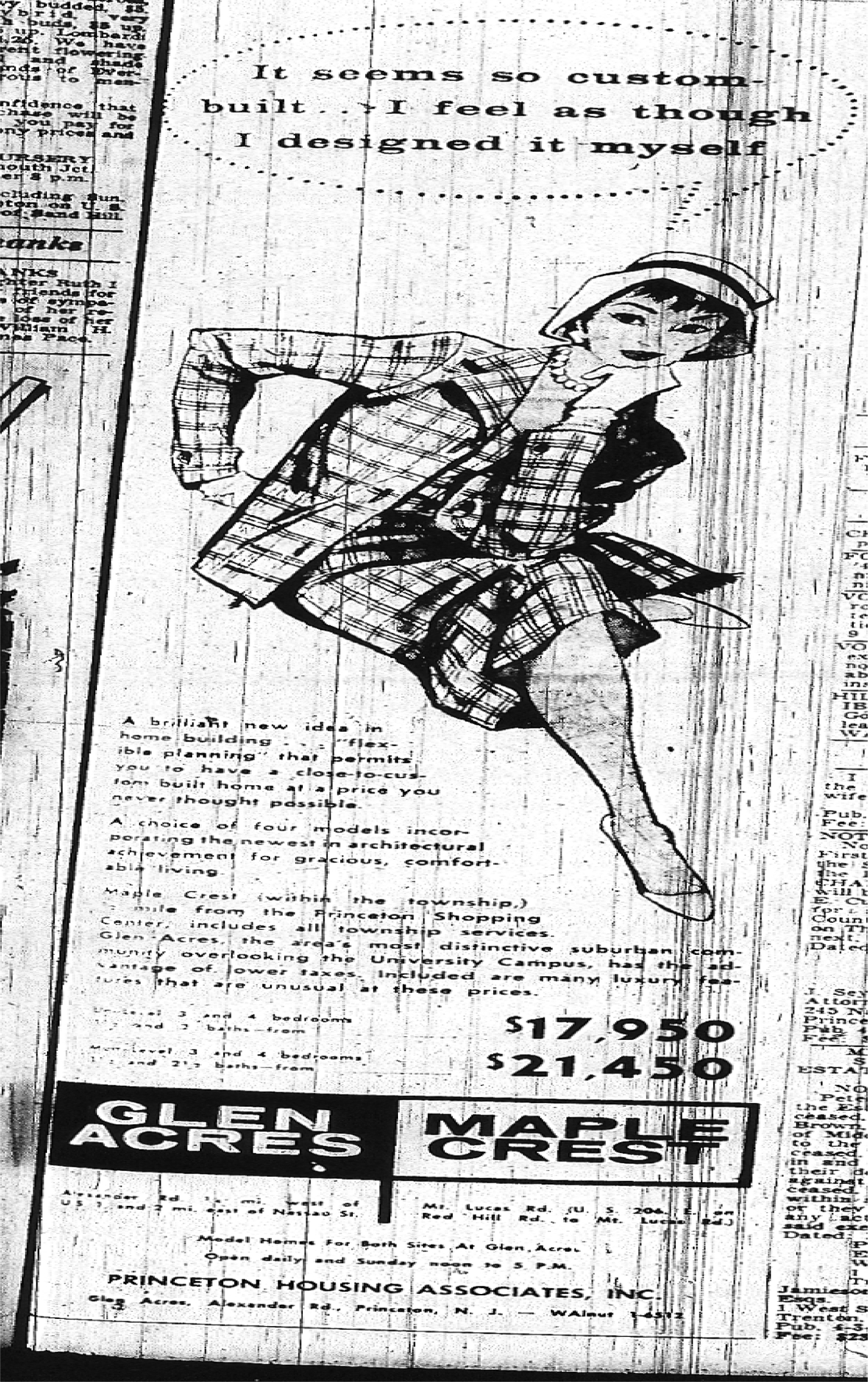
Note: So custom built, I feel like I designed it myself! An ad that appeared in the Princeton Packet in June 1957. An elegantly dressed white woman is chosen as the personification of Glen Acres and Maplecrest style.

Note: Advertisement for Glen Acres and Maplecrest, Princeton Packet, 1958
These efforts were unsuccessful, however. Between Otto and Milgram, the quota question required a frank discussion about what Concord Park was supposed to achieve. “The venture,” argued Otto in one meeting, “social cause or not, must be firmly based in sound business practices and must not lose money.” 36 If this meant that the houses all would be sold to black buyers, Otto accepted this outcome. In contrast, Milgram’s unyielding commitment to integration mediated the quota question. In a 1957 interview, Milgram told the New York Times that he “does not like the occupancy quota—which is a form of discrimination—but he says that the alternative would have been a nearly all Negro community.” 37 Milgram had his own crisis of conscience as he recalled waking up at nights thinking, “Milgram, you S.O.B., you’re building a ghetto.” 38
The FHA was the deciding factor in favor of adopting quotas. Frank Horne, the African American FHA representative to region 2 in eastern Pennsylvania agreed with Milgram’s insistence that the developments be integrated and that a quota be imposed to attain this goal. At a meeting with Otto, Milgram, and the board, Horne stated unequivocally that through him, the FHA and Veterans’ Administration would “throw its resources behind truly open projects to as great an extent as they do for segregated projects.” 39 The FHA’s approval, and its coming from an African American, swayed the board to adopt a quota system. 40
Morris Milgram and George Otto demonstrated that they could build and sell an integrated housing development of 140 houses, a number that far surpassed what could be done through the house-by-house method many activists used. When the Princeton Housing Group and other activists visited Concord Park, which was something Milgram always encouraged and suggested even to people who opposed residential integration, they found a development that they would want to replicate in their own communities. Concord Park was a community of middle-class, well-educated professionals in neat, single-family homes. Local control assured activists that they, too, would end up with homeowners who fit their notion of good neighbors. At the same time that Milgram and Otto offered this solution, postwar Princeton’s changing landscape and population worked in favor of the developer and his associates. The easing of racial tensions coincided with a tremendous growth in white demand for housing in the Princeton area, and by 1955, the Princeton of Paul Robeson’s childhood was rapidly changing if not disappearing.
The Milgram Model in Princeton
Three years after forming the Princeton Housing Group, activists regrouped as a private corporation that they named Princeton Housing Associates, Inc., to begin their new housing developments and partnership with Otto and Milgram. Glen Acres and Maplecrest are the ultimate marriage of social goal and private business; although the goal was to meet a pressing social need, activists understood themselves as a business, not a charity. Newton recalled that “it wasn’t a 501C3 or a government funded or anything like that. … We said we don’t want to go that way; it’s gonna take too long and have all kinds of roadblocks thrown in our way.” 41 Shares in the company could not be advertised and the number of individuals involved similarly had to be restricted to prevent involvement by the Securities and Exchange Commission. Thus, running a for-profit corporation as opposed to a charity gave Princetonians a heightened sense of control over the project, ensuring that there would be no government interference and at the same time providing investors with a financial reward for their socially conscious behavior.
Princetonians were also exceptionally proud of their involvement in bringing about housing integration through these small communities. Half the funding came from Princeton residents, with the other half coming from individuals who had invested in Concord Park, thus drawing on a growing network of potential investors for integrated endeavors, which were perceived to be exceptionally risky. At Milgram’s behest, Princetonians wrote about and publicized their involvement and pride in the new communities. A group of Princeton pastors from seven faiths wrote that their involvement in these integrated housing efforts was part of a larger desire for “practical action within the community, rather than point the finger at evils afar.” 42
Public support of and discussion about integrated developments were uncommon. While sociologists and Concord Park residents George and Eunice Grier noted that publicity highlighting integrated developments was detrimental to integration efforts, arousing the ire of opponents who might otherwise be unaware of its presence, Princetonians openly and publicly discussed, oftentimes praised, their new developments. The Daily Princetonian, Princeton University’s student paper, covered the development and to a great extent stripped it of any radical connotations. Stuart Wallace, Milgram’s head of sales, “explained that he and his group were businessmen, not integrationists, but that they were unique among developers in not adhering to community trends on Negro housing.” 43 If any Princetonians harbored fears about the consequences of housing integration, or the presence of potential agitators, Wallace assured them that he and his associates were simply good American businessmen who happened to be willing to sell to blacks.
The Mayor’s Committee on Housing, which also was dealing with the issues surrounding urban renewal, similarly released a statement that reassured Princetonians that they were doing the right thing. In December 1957, local paper the Princeton Packet ran a front-page article titled “Promote New Home Venture: Firm to Finance Two Projects with Open Occupancy.” A member of the Mayor’s Committee on Housing was quoted as saying that “Princeton will grow as a civilized community only as all sections of it are open without distinction to all citizens who have the financial resources to secure property.” 44
Princeton required substantial financial resources to secure property, and this requirement was the most effective barrier to homeownership not only among African Americans but also for many whites. The high cost of housing in Princeton, New Jersey, and the well-priced Maplecrest and Glen Acres developments made integration in the developments possible because the relatively low housing prices fueled white demand. Leonard Newton became involved in the project as much for himself as for black Princetonians when he was unable to find affordable housing for his young, growing family. Newton recalled, “I came to Princeton with a degree from MIT. I got paid $300 a month; how much housing could I afford? I paid $94 a month, and I had a fireplace, and one bedroom and a bath, and a little seated area in the kitchen and that was it.” 45
Relatively speaking, Princeton’s housing prices were among the highest in the state. In 1960, the U.S. census reported that median housing prices in Princeton were $26,600, and 53 percent of the owner-occupied housing in Princeton was valued at $25,000 or more (See Figure 2). Housing ads running in the Princeton Packet in 1957–1958 indicate that housing prices in Princeton were not on a decline. Developments located in Princeton and advertised in the Packet ranged from $24,000 to $50,000. In nearby Princeton Junction, the Princeton Colonial Park development offered “the best value in New Jersey,” with houses starting at $17,690. In contrast, the Princeton Housing Associates advertised a minimum price of $17,450 for a house located within Princeton’s municipal boundaries or right across the municipal border in West Windsor and thus offered homebuyers what was a relatively good deal. 46
A local population boom alongside the lower prices helped the Princeton Housing Associates sell houses to whites. Princeton’s population doubled between 1930 and 1960, with the bulk of the growth occurring between 1950 and 1960. The new arrivals were typically well-educated individuals who were not directly affiliated with Princeton University but instead worked at one of the many research facilities that were being built in the postwar years. In many respects, Princeton became what historian Margaret Pugh O’Mara termed a “city of knowledge,” a “magnate for highly skilled workers and highly productive industries.” Postwar Princeton created a “space where university, industry, and scientists could create new networks of innovation and production.” 47
Princeton prided itself on its educational institutions as far back as the nineteenth century if not earlier. The local chamber of commerce advertised that Princeton’s business was education, but by the mid-twentieth century, the university ceased to be the only employer in the area. Boosters helped attract educational businesses such as the headquarters of the Educational Testing Service. The 1950s brought continued growth to the area as research businesses, ranging from laboratories to publishers, built facilities in and around Princeton. By 1964, Princeton had companies such as Princeton Research Lands, Inc., that dealt strictly with land and buildings for “research engineering, industrial, office buildings, and residential” purposes. Scientific research organizations made Princeton and its surrounding municipalities home: the RCA David Sarnoff Research Laboratory and Space Center, Electronic Associates Research and Computation Division, Food Machinery and Chemical Corporation Research Center, Western Electric Laboratories, and the Stony Brook Research Laboratory of Socony Mobil Oil Company, to name a few. 48 In addition to hosting local employment, Princeton was ideally located for commuters to two major cities. “One of Princeton’s major assets is its location on the main line of the Pennsylvania Railroad and near such major highways as U.S. 1 and the New Jersey Turnpike. Its ready accessibility to New York and Philadelphia make it a particularly attractive community for commuters,” noted the Princeton Chamber of Commerce. 49
Local employment was what drew Robert and Helen Duncan to Princeton in the early 1950s. The Duncans are a well-educated couple; when they moved to New Jersey, Robert had just finished his doctorate in physics at Cornell, and Helen worked as a teacher. Robert began working at the RCA David Sarnoff laboratory, a few minutes away from the Glen Acres development. While they first lived in Plainsboro, the Duncans were looking for something a little closer to Princeton to reduce Robert’s commuting time, to be closer to their Presbyterian church, and so they could have a house in which to raise their growing family. 50 The Duncans were exactly the type of family Milgram wanted for his exhibition developments.
African Americans in Princeton experienced a slightly different economy, one that drew on education and on service. Princeton was what historian Andrew Wiese termed a “service suburb,” a place where affluent whites lived near African Americans who worked most commonly in domestic capacities. “Affluent whites’ desire for a leisurely lifestyle,” noted Wiese, “led to the employment of thousands of paid domestic workers, most of whom lived very nearby in households of their own.” 51 Part of the reason Princeton had one of the highest percentages of African Americans in New Jersey was due to the desire for domestic workers. In 1930, YMCA surveyors noted that as the number of commuters and campus eating clubs rose, so too did the number of African Americans calling Princeton home. “This fact is supplemented,” they argued, “by the immigration restrictions which make it increasingly difficult to get white servants. The result has been to tempt the negroes from the South in ever increasing numbers to avail themselves of greater opportunities, both in northern homes and factories.” 52 In 1950, the League of Women Voters’ Guide to Princeton noted that while 22 percent of Princeton’s residents were “professionals,” a significant 17 percent were service workers; in total these positions accounted for a plurality of Princeton’s jobs. As a result of this employment, African Americans experienced an economic disadvantage in addition to racial discrimination. The Daily Princetonian, Princeton University’s student newspaper, covered the opening of Maplecrest and Glen Acres, noting that “at present Princeton’s Negroes who are mostly domestics, all live in one area of town mostly in the so-called Clay-Street Projects.” 53
Milgram and his associates had to compete with deeply held beliefs about the negative consequences of residential integration, and thus the selection of homeowners who would live in these exhibition communities was of the utmost importance. At Concord Park, the first family to move in was a white couple who purchased the house right next door to the model. The Griers, a college-educated, professional couple, had difficulty securing the down payment though. To secure them as residents, the AFSC agreed to pay the Griers slightly more than the down payment for a sociological study of Concord Park and its residents and publish their findings for the AFSC to use. 54 The Duncans were, in many respects, Milgram’s ideal residents. A young, growing family, well educated and racially tolerant relative to others, the Duncans could easily be publicized as the kind of great residents Milgram relied on to sell his developments, literally and ideologically, to other whites.
Preferential financing for whites and price controls in lieu of formal quotas were some things Milgram advised using to achieve integration. In a letter to a fellow builder, Milgram advised, “The house should not be too cheap. There is twice as much support for open occupancy among professionals and white-collar workers as among blue collar, our questionnaire shows. By keeping houses in the price bracket $11,000 and up, the stereotype Negro, who might seriously hurt sales, is avoided.” 55 The class question was raised at meetings for the board of the Princeton Housing Associates, as well, when Leonard Newton raised concerns about the “class” of the individuals living in the new developments.
Residency in Princeton and in the two integrated developments was tied closely to class in much the same way civil rights activism of the period centered on the middle class. Residents’ class played a pivotal role in selling and publicizing not only the Princeton developments but also Milgram’s overarching vision by refuting whites’ fears about African Americans. In a 1960 promotional brochure, the homebuyers were listed as “professional—engineers, ministers, physicists, an architect, several teachers, psychologists; business-men—merchants, salesmen; civil service personnel; a Boy Scout executive, a social worker, and so on.” 56 Sociological studies of integrated housing also tended to emphasize the professional status of residents and that African Americans had equal if not greater household incomes compared to their neighbors. 57
All of Princeton was undergoing changes, however, that would make the community more economically exclusive, regardless of race. By the early 1970s, a group of urban planners at Rutgers University called Princeton the “affluent suburb.” 58 Princeton’s population consisted of individuals who were “substantially in the upper quartile of American income levels, educational achievements, and styles of life.” 59 The desire to restrict residency in Glen Acres and Maplecrest along the lines of class was a part of a larger transformation that Princeton and other suburban communities across the United States underwent in the postwar period, and the lower cost of housing in Glen Acres and Maplecrest continued to draw white buyers. Stuart Wallace, who not only was in charge of the initial sales but also oversaw subsequent sales for the next four years, noted that selling to whites in Princeton was not a problem; faculty from the university and relocated workers wanted to live in the new housing because of its value and to a lesser extent because of its ideals and social goals. 60
Princeton’s exclusivity and desirability were two of the main selling points for whites. Newton recalled clearly how people were willing to pay more for less housing simply to live in Princeton. “People … they just did what they had to do. … They didn’t want to go to Trenton; they didn’t want to go to Hamilton, to Ewing, to Pennington, all these satellite communities that have grown a lot over the years. They were just little villages and they weren’t Princeton. That wasn’t where they worked. They wanted to be here. So that was the type we were working with usually.” 61 Prior to moving into Glen Acres, the Duncans had established roots in Princeton through the Second Presbyterian Church and Robert’s employment and had a desire to be a part of the larger intellectual community. As Wallace noted, Princeton itself did much of the work in selling whites.
Glen Acres’ and Maplecrest’s draw for African Americans was much simpler though: these developments offered them housing. The appeal for black homeowner Donald Moore was simple: “they didn’t run out the back door when I showed up.” 62 “This was sort of saying hey, yes, you can buy this and we nearly fell off our chair,” he remembers. “You mean we can really buy a house in a nice area, well, it was just fields, it was empty but it was [nice], you could build a house and that is clean and neat and like any other person and it was sort of a revelation.” 63
The financial cost was a burden for black buyers, however. The Moores repeatedly asked that the house be repainted in an attempt to stall paying the closing costs and down payment until they could secure it. Before development began, a survey of black Princetonians found that many lacked the financial resources to buy homes unless the price was lowered. 64 Reflecting back, Robert Duncan noted that although some residents argue their only difference was race, he was aware of the fact that black buyers had struggled more to come up with the down payments for their homes. 65 Responding to this need, Princeton Housing Associates offered a pool of money to help buyers with down payments in addition to their mortgage loans.
Black Princetonians understood the socioeconomic restrictions that surrounded Glen Acres and Maplecrest. Estelle Johnson found herself in need of a home during the 1950s as a result of Princeton’s urban renewal program. Working as a chambermaid at the Nassau Inn before she returned to high school and became a teacher’s aid, Johnson knew that what she called the “professional developments” were not housing options that would be open to her. Milgram and his associates were also aware of the economic restrictions around the Glen Acres and Maplecrest communities, realized the pressing need for more affordable housing, but were unable to meet it.
Unlike other American towns, Princeton accepted and to a certain extent welcomed these integrated developments because of its affluence, its economic exclusivity, its growing population of racially moderate whites, a growing political activism on the part of African Americans, and a growing group of residents who firmly believed in their duty to act on their religious beliefs. The quotas and restrictions Milgram used to ensure integration provided a viable alternative to segregation. Otto and Milgram’s previous experience in Concord Park and the continued support of their Pennsylvania investors gave Princeton Housing Associates not only a method for integration but also financial backing and resources, which these well-connected, determined activists used to accomplish their goal.
The Meaning of Success
Gauging the success of Glen Acres and Maplecrest requires considering the goals the activists, developers, and residents had for the community, and they are justifiably proud of their accomplishments. In a market that inhospitable to their desire for residential integration, the activists not only built and sold their developments on a racially integrated basis but even secured an exceptional return for their investors. “In 18 months,” recalls the company treasurer Leonard Newton, “basically we were able to create a project, fund it, build it, sell it, and pay the investors back approximately 18% return on their investments. Not bad.” 66
Princeton became the base for Milgram and Otto’s efforts to expand their business nationally and form MCD, which advised, developed, and managed integrated housing. Many of the individuals involved in MCD were people Milgram met in Princeton, such as the Reverend Benjamin J. Anderson and the affluent Scheide family, lifelong investors in Milgram’s corporations. The headquarters for MCD were at 84 Nassau Street, across the street from Princeton University’s campus.
The residents themselves are a testament to Milgram’s vision and the continued work that went into maintaining integration long after the initial sales. Residents in Glen Acres came together in the early 1960s to discuss maintaining the quotas when a black buyer wanted to buy one of the white-owned homes. At the insistence of black homeowners, residents agreed to retain the original quota although ultimately a white family offered more money for the house and have remained Glen Acres residents ever since. 67 Residents’ commitment to their community extended beyond the borders of their developments, though, and show a continued engagement with social and political activism. “I was never a joiner until I moved here,” reflected Robert Duncan. Residents ran for local political office and organized to thwart road construction that would tear down houses on Glen Acres Drive or turn one home site into a bank. Joyce Wallace enlisted the help of the League of Women Voters to protest the racial segregation of Princeton’s swimming pools.
When Milgram attempted to bring the same kind of developments to the all-white Chicago suburb of Deerfield, Glen Acres and Maplecrest rallied around and defended their communities as wonderful places to live. Newton recalls the November visit of a reporter from the Chicago Sun-Times who was trying to understand the developments. “He was convinced there was something wrong here—I don’t understand are you nuts or are you a social worker or where did you come from blah blah blah. I said no, this is just the way we do things here. We’re going to break down this barrier to affordable houses. Some of us have come into this community and had a tough time ourselves getting established here. We work here. We want to live here. The same is true, color doesn’t have anything to do with that.” 68 The sense of community that residents feel in Princeton—the reason half the homeowners today are the original owners—is a hallmark of Milgram’s early developments including Concord Park. Perhaps the fact that so many families stayed on Glenview Drive and continued to call it home or attend the reunions held every ten years is a testament to the success of Milgram’s experiment.
The success of these developments historically, though, is somewhat more subjective, particularly when we lose sight of the goals the developers and activists set for the community. The economic exclusivity and class consciousness are perhaps the most glaring aspects that prompt discomfort with the project, as well as its relatively small size of only forty-five houses. With no more than fifteen houses sold to African American buyers, Glen Acres and Maplecrest did not substantially quell black demand for adequate housing, much less affordable housing, and there was little doubt that this was a white project. Jim Floyd, Princeton’s first black mayor, elected in 1968, noted that “I must admit that group was predominantly non African American. … As is the case, you just have to have that kind of support and understanding and the ability to in quotes ‘take on’ the people who deny you. So that a lot of that evolved out of a relationship between the men’s group at Witherspoon Street Presbyterian Church and the men’s group at … First Presbyterian church.” 69
Floyd’s comments demonstrate that Milgram’s approach and the developments themselves were pragmatic approaches to easing racial tension and fostering residential integration. Limiting residence along the lines of class and using quotas eased white fears by assuring them that the developments would not be a completely radical change. As Wallace told the Daily Princetonian, they were businessmen, not agitators, and so not a threat to the community. The shortcomings, then, can be viewed as pragmatism on the part of not only whites but also African Americans. The developments, although they did not necessarily radically alter race relations in Princeton, were a part of larger changes within the community and provided other towns with viable, private alternatives to residential segregation. Glen Acres and Maplecrest are thus a complicated reflection of a complex situation.
There was nothing absolute or inevitable about residential segregation in the postwar period. Residence in Princeton, and across the United States, was contingent on local race relations, politics, and to a lesser extent federal policies. Particularly in Princeton, activists drew on their financial and social capital to realize their vision of integrated housing in their community, a vision that stemmed from their deeply felt religious faith and beliefs. Princeton and Morris Milgram present historians with an anomaly in postwar housing that calls into question how we define and conceptualize segregation and integration not only as a particular racial composition but also as a means of fostering better race relations and racial equality by demonstrating the possibilities and limitations both offered. For all its ambiguities, for one resident of Glen Acres, the community’s meaning was clear: “As I grew older and experienced racism, it became clear that this was a place of unconditional acceptance and love.”
Footnotes
Acknowledgements
Thank you to the parents of Gail F. Stern, Eileen Morales at the Princeton Historical Society, the residents who allowed me to speak with them about their community, and all the people who read drafts of this project during the past four years.
Declaration of Conflicting Interests
The author declared no potential conflicts of interest with respect to the research, authorship, and/or publication of this article.
Funding
The author received financial support for the research from the Princeton Historical Society Gail F. Stern Fellowship.