



Abstract
Emergent public choice theory and innovations in suburban local government worked together to create and justify greater inequality among metropolitan places in postwar Los Angeles County. This article examines public choice theory and suburban home rule as mutually dependent components of suburbanization. Theorists praised postwar metropolitan fragmentation, challenging a prior consensus for metropolitan political and economic integration. Local governments under the “Lakewood Plan” obtained public services by contract from Los Angeles County at covertly subsidized prices, making government in new suburbs cost effective at the expense of older municipalities. The governments deployed symbols of suburban “home rule” and public choice principles of efficiency to defend their privileges. Movements to incorporate minority-dominated cities in Watts and East Los Angeles and for the secession of the San Fernando Valley from Los Angeles reflected the dominance of the practice and ideology of localism in California metropolitics.
Keywords
On March 9, 1954, residents of Lakewood, California, a group of housing subdivisions near the city of Long Beach in southeastern Los Angeles County, voted to incorporate a city of more than 71,000 residents. Lakewood exemplified most of the main currents of the history of postwar American suburbanization: it was mass-produced, financed by federal construction and mortgage programs, sustained by employment in nearby defense industries, connected to the metropolis by networks of highways, and built around a large shopping mall. To the extent that suburbs are local manifestations of federal policy and macroeconomy, Lakewood was like its contemporaries—Levittown or subdivisions of the San Fernando Valley of Los Angeles—exemplars of the mode of development Dolores Hayden terms “sitcom suburbs.” 1 But more local actions and political movements also shaped the particular form the United States took in becoming a suburban society. Lakewood’s residents and elected officials led a transformation of local government and metropolitan political economy that made Los Angeles County a decentralized, politically fragmented, and fiscally unequal metropolitan area and crafted political and ideological frameworks that encouraged similar fragmentation nationwide.
Lakewood’s incorporation positioned the new city at the intersection of two transformative metropolitan processes. The first process produced a radical shift in the political and social geography of Los Angeles County. The advocates of Lakewood’s incorporation, who became the new city’s political leadership, pioneered a system of contracting with the county government for nearly all public services. This arrangement, which became known as the Lakewood Plan, inspired a rapid wave of new municipal incorporations in Los Angeles County—four new cities in 1956, five in 1957, twenty-six by 1960, and thirty-two new cities with nearly 700,000 residents by 1970 (Figure 1). 2 The contract services plan allowed these cities to obtain services far more cheaply, and with much lower municipal property taxes, than older cities that maintained their own fire, police, and sanitation departments. By 1970, the city of Long Beach levied a local property tax of $1.52 per $100 of assessed value, while the adjacent city of Lakewood charged 8 cents, a discrepancy that was quite typical of the system as a whole. California’s Proposition 13, passed in 1978, capped local property taxes at 1 percent of assessed value. But even before the tax revolt, nearly all of the contract cities charged less than half that amount. 3

Incorporated cities in Los Angeles County, before and after Lakewood’s incorporation in 1954. This map reveals the broad range of suburban municipalities in metropolitan Los Angeles, including the older port city of Long Beach (incorporated in 1897), residential communities such as Lakewood, and the commercial entity of Industry (incorporated in 1957).
Though the politics of low taxes, particularly in California, have been typically associated with affluent white residential suburbs, the Lakewood Plan offered significant economies to many kinds of suburban cities, including blue-collar suburbs, wealthy residential enclaves, and single-purpose cities incorporated to shelter valuable industrial property from taxation. The economic diversity of these new contract cities reinforces the collective insight of “new suburban historians” that there is no single universal form or process of suburbanization. Despite their social, economic, or environmental differences, though, political interests seeking incorporation in all of these suburbs used the Lakewood Plan to resolve what Robert Self has described as the central political-economic problem of postwar growth: reconciling demand for public services with the distribution of tax burdens. 4 The reorganization of metropolitan political and fiscal geography, however, also supported racial segregation at the municipal scale. Within an increasingly diverse metropolitan area, new municipal boundaries enclosed communities from which African Americans and working-class Latinos were nearly entirely excluded. Twenty-eight of the thirty-two Lakewood Plan cities had black populations of 1 percent or less in 1970. The strong correlation of racial homogeneity and political fragmentation provoked contemporary public administration scholars to advocate more consolidated metropolitan government, “which would serve the entire area and unite its common advantages for the good of the whole.” 5 The Lakewood Plan endured, however, as a model of government that empowered residents of growing suburban areas to reject metropolitan integration in multiple senses of the term.
The reorganization of local government under the Lakewood Plan was also connected to a second transformation, that of ideas about metropolitan governance. During the 1950s, even as public administration experts recommended governmental consolidation, a new school of “public choice” theorists advocated thorough decentralization of political, economic, and fiscal control. They disparaged efforts to create integrated metropolitan governments and argued that material inequalities among municipalities in metropolitan areas might be ethically benign and socially useful. 6 Public choice ideas, which ultimately became very influential in urban economics, public administration, and political science, had some of their first empirical tests and institutional applications in southern California. There Lakewood’s overlapping roles as a municipality, a residential community, and a symbol of a new suburban way of life provided a platform for local, county, and state officials who benefitted from decentralization to push for more of it, while deflecting serious questions about equitable access to housing and local political representation with rhetoric about freedom of choice and the efficiency of markets as distributional mechanisms.
Public choice theory produces economistic abstractions of social behavior that are flawed as historical explanations for suburbanization. However, these ideas still demand attention as historical phenomena. Public choice ideas, combined with social and institutional changes, constituted a governing technology that remade Los Angeles County and other metropolitan regions. Local government officials built and implemented this technology through pragmatic compromises between theory and practice, creating an “actually existing public choice” in three phases between 1950 and the mid-1970s. 7 These phases are defined by parallel and interconnected developments in local government and in the realm of ideas and ideology. In the first, spanning roughly the 1950s, developers and homeowners built and settled fast-growing subdivisions at the eastern edges of Los Angeles County. Municipal and county officials and good government advocates considered a range of solutions to the political problem posed by growth: how to fund services in areas that were substantively urbanized but remained unincorporated. The Lakewood Plan made incorporation a politically viable, though not necessarily equitable, resolution. Public choice theorists simultaneously began to describe the incorporation of many jurisdictions as a preferable alternative to consolidated metropolitan government. The political imperatives that animated incorporationists and the intellectual ones that inspired academics became intertwined in the second phase, as local and county government officials in the 1960s successfully appropriated the rhetoric of public choice in political struggles to make decentralization, not consolidation, the dominant model for metropolitan organization. Despite material and social differences among Los Angeles County’s postwar suburbs, both advantaged and disadvantaged areas became more committed to the common ideological and institutional frameworks of public choice, local control, and the Lakewood Plan. In the last phase, covering the late 1960s and early 1970s, academic theorists and state, county, and local officials consolidated the intellectual and cultural politics of the public choice metropolis as state policy.
New Cities, New Theories, and Old Conflicts
Postwar suburbanization thoroughly reorganized Los Angeles County as a social and economic space. Lakewood exemplified the intertwining of public policy and private interests in that transformation. The Los Angeles Chamber of Commerce touted Lakewood as an example of “what private enterprise is doing” to solve the region’s dire housing shortages, but like other contemporary developments, it was inherently shaped by federal government programs. 8 Developers built houses to specifications set by the Federal Housing Administration, priced them according to FHA and Veterans Administration (VA) guidelines, and marketed them to buyers—semiskilled or skilled workers and veterans—who qualified for VA or other federal mortgage programs. 9 Workers and their families were also drawn to Lakewood tract homes by jobs in the aircraft and petroleum plants of nearby Long Beach and Signal Hill. Lakewood and other areas of the San Gabriel Valley in eastern Los Angeles County thus attracted the majority of single-family house construction in the county during the 1950s (Figure 2). 10 Home equity in Lakewood and nearby tracts fueled the rise of a distinct social type that one local reporter termed “Mr. Lakewood”: a skilled worker or lower manager, a veteran, a homeowner and family man who was learning to spend his wages, which were above the regional average, on consumer goods. 11 Tens of thousands of Mr. Lakewood’s contemporaries in the early 1950s were starting to recognize that their suburban homes supported an affluent and desirable, if far from opulent, lifestyle.
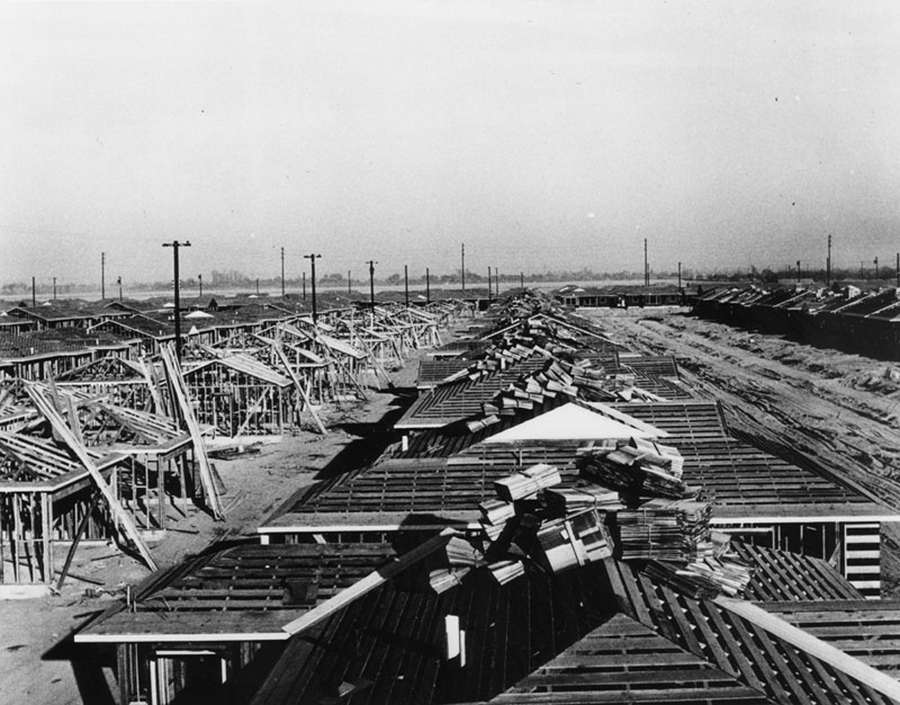
Constructing community in Lakewood, 1950.
Lakewood’s character as a community of homes constituted a real asset for this emergent middle class. During the brief period when Lakewood had been settled but remained unincorporated, residents feared that more intensive land use would threaten their clean and relatively peaceful neighborhoods. These fears surfaced most dramatically in 1953, when the city of Long Beach planned an “honor farm” for the rehabilitation of alcoholics on land near the Lakewood tracts. Lakewood’s developers obviously feared the rehab center might threaten home sales, and they found Lakewood’s many young parents willing allies. The company organized squads of Lakewood mothers to disrupt Long Beach City Council meetings with chants and signs protesting what they dubbed “Hangover Palace.” One Lakewood woman argued in a letter to the editor of a Long Beach newspaper: “I desire to raise my family in the best atmosphere possible. My idea of good surroundings does not include an honor farm.” 12 Land use became a central issue in local politics even before Lakewood had a municipal government, and the prospect of exercising controls at the local level would become part of the mix of agendas and interests leading to incorporation (Figure 3).

Lakewood mothers protest the installation of telephone polls on their street in 1952, an example of small-scale domestic activism.
Community values in the region’s residential suburbs also absorbed institutionalized racial and class exclusions and privileges. Exclusivity began with national mortgage programs that almost exclusively benefitted whites. 13 At the local level, though, large-scale builders like the Lakewood Park Corporation (LPC) also acted as gatekeepers to homeownership. When the LPC began its home sales in 1950, one central sales office processed title for 17,000 lots and houses. Company sales officers could thus systematically and effectively steer nonwhite buyers away from their developments. One salesman—who later became a Lakewood city councilman—explained, “I had the responsibility of making certain that the applicants were not going to be people who would be objected to by their neighbors.” 14 Such practices effectively excluded racial minorities from nearly 98 percent of new housing built in Los Angeles County in the 1950s. 15 Racial exclusion was a malignant, but undeniable, facet of the region’s increasing suburbanization.
Postwar growth also exacerbated longstanding conflicts in the region’s political economy because so much of it happened outside of existing cities. During earlier boom periods, residents and property owners in unincorporated growth areas generally chose to annex to Los Angeles; the need for water from the Los Angeles aqueduct overwhelmed antipathy toward the big city. After the 1920s, though, outlying areas grew more resistant to annexation. In part, the change was technological. The Metropolitan Water District completed its ten-year Colorado River Aqueduct project in 1941, creating an alternative to Los Angeles city water, and the cadre of civil engineers that designed and built Los Angeles’s municipal infrastructure could complete similar projects in smaller cities at progressively lower costs. 16 But the state of California’s decision in 1912 to grant Los Angeles County a home rule charter was arguably more significant. 17 Developers were drawn to county territory by cheaper land and because Los Angeles County Supervisors like Herbert Legg, whose district included Lakewood and nearly all of the Lakewood Plan cities, “tende[d] to equate developer interests with the public interest.” 18 Consequently, the population of the county’s unincorporated territories grew from 445,000 in 1939 to more than 1,150,000 in 1954. 19 Los Angeles County essentially became an urban government, unlike most other California counties, and its charter empowered it to provide more extensive (and expensive) services to the territory under its control.
The costs of these services were an enduring source of controversy. As early as 1935 the City of Los Angeles demanded an audit of the county’s budget, claiming that city residents’ taxes were redirected to serve the unincorporated areas. 20 According to one 1950 estimate, taxpayers in incorporated cities provided 83 percent of police costs for unincorporated parts of the county, equivalent to giving each property owner in unincorporated territory a tax break of one dollar per hundred of assessed valuation. Leaders of the established cities, speaking through the League of California Cities, demanded that “so gross an inequity as the misuse of the funds raised from general county taxpayers” be remedied by legislation that would either force unincorporated areas to join existing cities or establish service districts for the unincorporated areas. 21 Many existing cities were eager to annex newly developed territory, both to stop service subsidies and expand their own tax bases. The city of Long Beach devised a particularly aggressive tract-by-tract strategy for annexing the Lakewood development in 1951, presenting annexation as a boon to both areas. 22 But two constituencies in Lakewood opposed any action, whether incorporation or annexation, to place their territory within a city. Homeowners desired local land use control, but they were even more fearful that local government power would come at the price of higher property taxes or industrial development. The LPC also initially opposed incorporation because it controlled the shopping mall, the most valuable taxable property in the area. As Long Beach pushed to annex parts of Lakewood, the LPC pivoted sharply and began to consider incorporation under the theory that the development corporation could better influence the government in a smaller city. The idea of contracting for services, a compromise brokered by LPC officials and local attorney John Todd, made incorporation, previously considered “worse than slurring motherhood” by local businessmen, a viable solution. 23 The lower cost achieved by using the county’s service departments allowed the new city to control land use tightly while avoiding high taxes on homes and existing businesses. 24
In Cities by Contract, Gary Miller argued that most incorporations were driven by the property interests of incorporation advocates. However, city managers in municipalities that formed after Lakewood found that ideas, however abstract, of community identity and civic pride were as influential as fiscal issues in generating support for incorporation and allegiance to local government, if not more so. 25 Lakewood’s first public relations officer looked back on the recent incorporation and concluded that “youngsters won this campaign. . . . They organized a vast campaign of kaffeklatsches, night meetings, debates, bull sessions.” 26 This description was not so much inaccurate as selective; it obscured the role the LPC played in conjuring community identity, beginning with the production and financing of a 1953 pro-incorporation film called “The Lakewood Story.” Though the LPC paid $3,000 to produce the film and was estimated to have spent about $70,000 to oppose annexation to Long Beach and promote incorporation, the film’s genius lay in concealing the developers’ interest in Lakewood’s political status with images of grassroots domestic activism and family life. 27 Children at play appeared throughout the film, paired with the declaration that “through a local city government, Lakewood can begin at once . . . to keep the ever-energetic minds and hands of our children occupied with useful and constructive pastimes.” 28 Though the film was a product of corporate public relations, its representations were not entirely inauthentic. In the aftermath of the “Hangover Palace” controversy, Lakewood residents were primed to see incorporation as a means of protecting family and neighborhood security. The Lakewood plan built a coalition of voters and financial interests behind incorporation because it forestalled local conflicts over funding the operation of local government.
Although incorporation under the Lakewood Plan resolved local political conflicts, it was out of step with prevailing liberal thought about metropolitan government, which recommended consolidated local governments and broad regional authorities that would take important decisions out of the hands of local politicians. Robert Wood’s 1,400 Governments, a 1959 treatise on metropolitan New York, defined this perspective, criticizing the proliferation of municipalities and other administrative agencies as impediments to efficient government, equity, and democracy. 29 Los Angeles also had a regionalist brain trust; the foundation established by Progressive-era reformer John Randolph Haynes sponsored a slew of postwar surveys of social conditions and government in the region, culminating in a sixteen-volume series published between 1952 and 1955. While most of the volumes presented detailed descriptions of trends in population, governmental organization, infrastructure, and economic activity in the region, a concluding volume closed the project with a clear call for Angelenos to “adjust our frame of reference to the thought that this IS a united community and that through the process of governmental integration each and every one of us can receive benefits over and above those offered under the present governmental arrangement.” 30
Unfortunately for the advocates of metropolitan integration, new suburban cities provided political means for suburbanites to reject the idea of a unified metropolitan community. Race was an undeniable undercurrent of this rejection. A strong majority of the respondents to a 1961 Lakewood Junior Chamber of Commerce survey affirmed that “a mild influx of a minority group” would impact their willingness to reside in the community. 31 Professional realtors committed themselves to preserving this understanding of neighborhood character through racial steering and support for Proposition 14, a 1964 ballot initiative to repeal California’s fair housing law. Massive support in Lakewood and other suburban areas contributed to a thirty-five-point margin of victory in Los Angeles County for the effective property right to discriminate. 32 While Proposition 14 was a state initiative, it reflected the enthusiasm that residents and property owners in new suburban cities had for using government to exclude potential threats to their social and material stake in property and community. One Lakewood resident’s response to a 1969 community planning survey crystallized the expectation that municipal officials would “hold the line—prevent further intrusions of commercial and multiple-family into single-family neighborhoods.” 33 Lakewood’s zoning and land use policies, and those of other residential suburbs, exemplified the usefulness of the new governmental technology of the Lakewood Plan to preserve an unfree housing market.
In 1959, Democratic governor Edmund “Pat” Brown convened a Commission on Metropolitan Area Problems, staffed it with policy scholars and municipal officials, and charged them with recommending reforms of government in greater Los Angeles that would address the social, political, and administrative dysfunctions of suburban growth and political fragmentation. The commission’s 1961 report expressed a majority view that political fragmentation was unfair; incongruent with regional labor, transportation, and social networks; and rooted in fervor for “home rule” that interfered with good government. One commissioner even suggested that the wave of incorporations threatened “apartheid” as “through local government and other devices the whites have erected a virtual ring around the minorities, most particularly the Negroes.” The commissioners largely saw the Lakewood Plan as enabling free choice by the privileged while imposing burdens on others. 34
But not all academic analysts of the region’s government were uneasy about the unfolding changes. In 1956, economist Charles Tiebout published “A Pure Theory of Local Expenditures,” an influential article proposing that public goods such as schools, parks, and policing might be efficiently delivered in a process approximating a consumer market if regions became more politically fragmented, offering residents more choice and imposing greater competitive pressure on local governments to provide attractive mixes of taxes and services. 35 Tiebout joined the economics faculty at the University of California at Los Angeles in 1958, continuing his contribution to an emergent body of academic theory that became known as “public choice.” Public choice adherents in economics, political science, and administration sought to apply the economic assumptions of rationality and methodological individualism—that social phenomena result from the independent choices of self-interested individuals—to explain problems of government and politics. 36 1950s Los Angeles County, with its explosion of municipal incorporations, allowed Tiebout and his colleagues and students—among whom Vincent and Elinor Ostrom became particularly influential—to develop this “pure theory” into a body of empirical and normative work on decentralized government.
Observing the Lakewood Plan in action, public choice advocates became more confident in challenging the wisdom of metropolitan consolidation. They described regional governments as “Gargantua,” entities too large, distant, and unresponsive to serve local needs, and pointedly substituted “polycentric” for “fragmented” to reject the a priori assumption that decentralized government was dysfunctional. In contrast, the “quasi-market conditions” created by the Lakewood Plan made the local administrative officer “a bargainer for local consumer interests.” 37 In this regard, public choice advocates supplemented their predictions of more efficient service allocation with a somewhat fuzzier evocation of local democratic expression (albeit with citizenship defined as choice in the consumption of public services). This combination, which tied theory more closely to the experiences and worldview of suburban residents, would prove to be especially potent in the implementation of public choice in Los Angeles County.
Though Tiebout’s theory quickly attained prominence, its implementation attracted criticism from contemporary politicians and later scholars. Los Angeles County Supervisor John Anson Ford, whose district included the territory of older cities, was a strong critic of increased incorporations, describing some new cities as “atrocious” devices to shield industrial or commercial property from taxation. 38 Political scientists and other scholars in the “metropolitics” or “collective goods” schools of thought have carried on the consolidationist tradition, arguing that politically fragmented metropolitan areas have worked as “great sorting machines for separating Americans along the lines of class, race, ethnicity, religion, and lifestyle” rather than systems of free choice. 39 Historical analysis has also undercut key assumptions of Tiebout’s hypothesis, which included open housing, knowledge by citizens of local “packages” of services and taxes, the independence of residence from employment, and the absence of cost externalities between communities. 40 The federal government, of course, created substantial diseconomies by subsidizing the homes, highways, and mortgages that built suburbia, and only whites exercised true choice in the marketplace. And, in defiance of the economic rationality presumed by public choice, residents of many diverse suburbs formed social bonds with their neighbors and mobilized politically to defend affective as well as material community values. Public choice theory, then, is rooted in assumptions that are poorly supported by the historical record of suburbanization. 41
Public choice’s continued influence despite its nonconformity to social reality can be explained by another aspect of the practice of decentralization: it was implemented politically, and at the county and state levels. Rather than true independence among small jurisdictions, the Lakewood Plan established a metropolitan confederation of contract cities that relied on Los Angeles County’s vast resources and administrative expertise while satisfying the need of the county to maintain a clientele for its services. The county’s chief administrator established an office of the county-city coordinator soon after Lakewood’s incorporation, hiring Robert Andersen, Lakewood’s city administrator, as its first head. His office provided information about county services, implicitly promoted incorporation, and strengthened professional ties between local city managers in the contract cities and the county’s major service divisions, which dedicated a department-level coordinator to oversee contract city services. This extensive political infrastructure did not necessarily encourage diversity among cities in terms of services; fifteen of the first sixteen contract cities opted to buy the same low-cost service plan, and critics of contracting charged that this system substituted a dependent relationship to the county for true local control. Nevertheless, the Lakewood Plan provided more home rule than unincorporated areas enjoyed, and imposed fewer costs than traditional cities bore. Thus, the confederation of contract cities became an increasingly important feature of the region’s political economy. 42
The viability of the Lakewood Plan also depended on decisions made in the state capital of Sacramento. The 1956 Bradley-Burns Uniform Local Tax Law empowered all local jurisdictions—whether cities or counties—to collect a 1 percent tax on retail sales within their boundaries. The law’s uniformity eliminated a problem inherent in purely local sales taxes: that consumers would shop across city lines to avoid taxation. It also provided a positive incentive to incorporate so that sales taxes collected in an area would not revert to the county, and reduced a disincentive to incorporation by making governments less reliant on property taxes. Before the Lakewood Plan, a typical city in Los Angeles County took in 40 percent of its revenue from property taxes; under Bradley-Burns, twenty-two contract cities eliminated their local property tax entirely by 1970. Homeowners in contract cities were still responsible for paying property taxes to the county and to their school districts, levies that greatly exceeded local property taxes. 43 Regardless, the ability of local governments to reduce the taxes under their control made government and social services administered and delivered at higher levels appear an unwelcome burden on suburban taxpayers. In 1958, John Todd decried “double taxation” of his community, as “older communities with charity and hospital problems are receiving a free ride from the city of Lakewood,” a claim that reflected a framing of civic obligation that was shrinking from the metropolitan scale to the local. 44
The academic credibility of public choice theorists also proved a compelling source of rhetoric. Lakewood officials seized a leading role in this campaign, and the city-county coordinator’s office also defended the contract system it had worked to establish. Their public arguments held, consistent with the administrative rationale of public choice and its vision of citizens as rational consumers of services, that the Lakewood Plan matched services efficiently to local need, allowing local residents to “obtain . . . more control over the level and type of service conducted locally.” 45 However, advocates also relied on more value-laden rhetoric stressing “local identity and the ability to control local government policy,” particularly through land use controls. 46 Such remarks underscored the point made by the city-county coordinator in 1968 that the contract system and fragmentation were essential to allowing area residents the “free choice” that democracy required. 47 Public choice provided the intellectual basis for portraying a metropolitan political order dominated by the large county government and its five powerful supervisors as a guarantor of democracy.
The civic myths that exerted such force in Lakewood’s internal politics also enabled and supported a metropolitan transformation by supporting the credibility of public choice claims. Other cities benefitted from the way that Lakewood’s public image humanized the governmental technology of the Lakewood Plan. For example, an influential 1955 feature in American City described Lakewood as a local government “free to devote its time and energies to actually representing the taxpayers in getting things done” and represented the interests of taxpayers through an attractive image of families empowered to protect themselves through local government (Figure 4). 48 Few contract cities matched Lakewood’s enthusiastic promotion of its own municipal image, but its carefully crafted origins myth helped draw other cities into the contract system, and provided an interpretive frame for understanding the system’s benefits that proved compelling as debates across the county and the state about resources and power in the metropolitan area became more contentious.
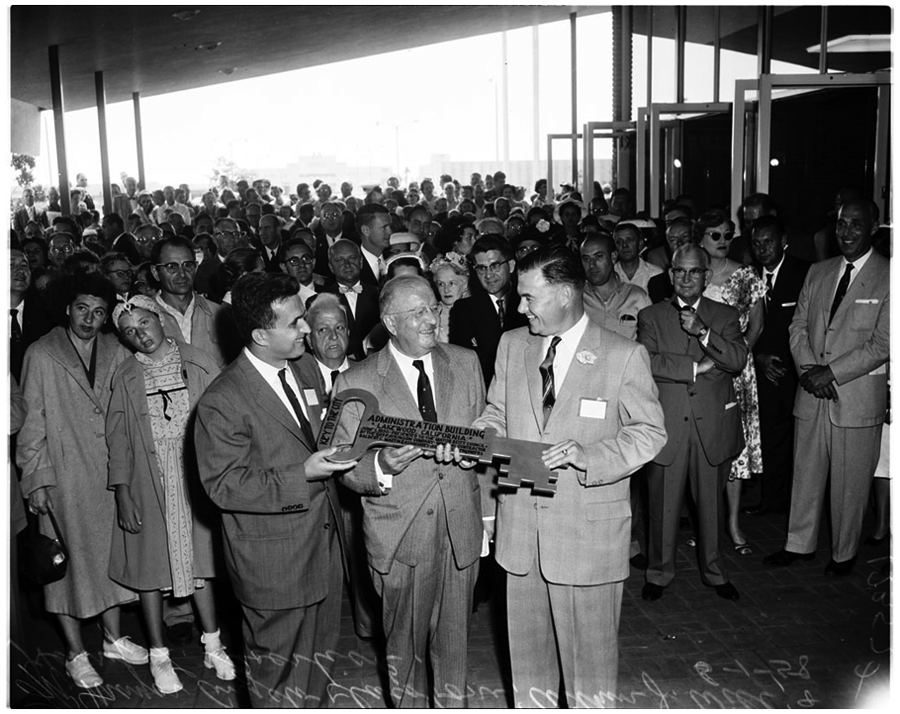
Residents assemble to dedicate the Lakewood City Hall, 1958.
Institutionalizing Public Choice
By the early 1960s, the traditionally organized cities in the region came to see the Lakewood Plan as a new institutional form of an old political problem: the county subsidizing public services in new suburbs with general revenues, more than half of which came from taxpayers in the cities of Los Angeles, Long Beach, and Pasadena. 49 The growth of the contract system supported and underwrote expansion of the county’s infrastructure and bureaucracy, ensuring that established workforces, equipment, and facilities could continue to operate at full capacity. The county ensured that new contract cities would remain county clients by offering low prices for services and a solicitous administrative relationship with local governments. 50 State law prohibited any direct subsidy as an illegal gift of funds between local governments, but left considerable leeway for the county to distinguish between the direct costs of contract services (e.g., the wage, equipment, and fuel costs of a patrol car shift), which everyone agreed the contract cities should pay, and “overhead” costs of central administration. Since intergovernmental contracting at the scale practiced in Los Angeles County was unprecedented, setting accounting standards for cost allocation was an ongoing political improvisation. Both the county and the contract cities preferred to exclude the overhead from contract prices, arguing that these were costs that county government would have incurred with or without contracting. The county could effectively subsidize the contract cities while claiming to have “little flexibility in this segment of the program.” 51 The politics of accounting spurred Los Angeles County cities to organize new lobbying organizations. The contract cities formed the California Contract Cities Association (CCCA) as a lobbying group in 1958; Los Angeles, Long Beach, Pasadena and other older and traditionally organized cities responded by forming the Independent Cities Association (ICA) in 1961. 52 The split between traditional and contract cities became the most significant axis of conflict between local governments in the county, and made actually existing public choice in southern California more a product of politics than of the market.
Between 1969 and 1971, Los Angeles County, confronted with surveys confirming the ICA’s claims of covert subsidies to the contract cities, reversed its prior pattern of favoritism toward the contract cities. It adopted more inclusive accounting formulas that resulted in increased prices for policing, the most expensive contract service. The new accounting eliminated externalities between jurisdictions, but resulting rate hikes clashed with contract cities’ expectation that the county supervisors would guarantee inexpensive services. 53 The CCCA responded in 1972 by supporting a bill, named for Assemblyman Joseph Gonsalves from the contract city of Norwalk, that required Los Angeles County to exclude nearly all overhead from its contract service rates. Lobbying, the shrewd drafting of the bill with population restrictions that made it apply only to Los Angeles County, and the growing strength of suburban areas in state politics all helped to surmount opposition by the Los Angeles County Supervisors and the ICA. Governor Ronald Reagan vetoed the Gonsalves bill, claiming a principled objection to “legislative intrusion by the state” into a dispute among local governments. However, Reagan was not neutral on the substance of the bill; he described the county’s higher overhead charges as “inequitable” and told Gonsalves’s office that if the county and contract cities did not negotiate a settlement he would sign an identical bill the next year. With this assurance, the contract cities had no reason to compromise. Los Angeles County agreed to lower overhead charges in its next budget, but Gonsalves still reintroduced his bill in 1973, and Reagan signed it into law. 54
Reagan’s intervention reflected the fact that metropolitan decentralization dominated his approach to local government as governor and later as President. He regarded issues of local control sufficiently important to convene a Local Government Reform Task Force, advised by public choice theorists including Vincent and Elinor Ostrom of Indiana University and Robert Warren and Robert Bish of the University of Southern California. The task force’s 1973 report rejected the Brown commission’s calls for regional government, deferring to the wisdom of voters who “have chosen, through elections, a local government structure of many units.” 55 It would be unfair to describe the task force’s academic advisors as ideologues, but their report did merge normative ideas about local government with advocacy for new administrative practices, including an end to mandates attached to state aid to local governments and a local income tax, fully deductible from state income taxes, that supported further decentralization. Public choice theory also meshed with a strong non-academic disdain within the administration for regionalism, which one of the governor’s advisors described as a scheme by planners “to make us live as they think we should, whether we like it or not.” 56
The most important evidence the Reagan task force marshaled in support of its prescriptions came not from quantitative studies of local budgeting or service costs but from public opinion surveys that gauged citizen attitudes about different levels of government. The results showed much higher “citizen satisfaction with government” at smaller scales, and suggested that dissatisfaction with higher levels of government was driven by citizens’ perception that these levels were responsible for land use, social welfare, and educational policies that intruded on suburban prerogatives. 57 This enthusiastic gloss on public choice and political fragmentation as “the best hope for ‘a government that is visible, responsive, and efficient in meeting the needs of our people’” normalized the distribution of the benefits of actually existing public choice to favored social groups and political constituencies: large property owners and white middle-class residents of new, growing suburbs. 58 The Gonsalves bill and the Task Force collectively signaled the arrival of public choice as a ruling idea in state policy.
The traditionally organized cities predictably dissented from this new consensus, and initiated a lawsuit in 1975 to overturn the law. Their challenge on equal protection grounds threatened the legal viability of the contract system, until Superior Court Judge Harry Hupp delivered summary judgment for the contract cities a year later. 59 Hupp’s ruling, with approving references to “efficiencies” created by “the latest chapter in the continuing saga of that remarkable government development universally known as the ‘Lakewood Plan,’” reflected the synthesis of suburban political power, the civic mythology crafted in Lakewood, and public choice theory. Hupp’s acceptance of the cultural ideals of localism appeared to blind him to the substantial evidence of subsidies from county taxpayers. The judge also punted responsibility for resolving the conflict to the legislature. Even if state law created a two-tiered system of cities in which one tier enjoyed fiscal advantages at the expense of the other, he decided, it was not cause for judicial intervention. 60 The ruling doomed the independent cities’ hopes for reform because suburban politicians, particularly from the southern part of the state, had become the largest bloc in both houses of the legislature by the end of the 1960s. 61 Suburban political power was sufficient to defend the Lakewood Plan and the actually existing public choice it created, despite its shortcomings in terms of equity and transparency.
The collective efforts of policy academics, suburban citizens, developers, and municipal and county governments had effectively overturned an earlier intellectual consensus about the best way to govern metropolitan areas. As it evolved, this emergent common sense blunted efforts to remedy the racial and economic inequalities organized by place in the county. The attractive image of Lakewood’s homes, families, and children were crucial symbolic supports for the new governing consensus. Judicial and legislative support for the Lakewood Plan and for public choice would likely have been weaker had they been represented in public discourse by the City of Industry or by Commerce (Figure 5), two other contract cities that incorporated in 1957 and 1960, respectively, to protect industrial property from taxation. The City of Industry might be considered a social and symbolic antithesis of Lakewood (Figure 1). Its irregular boundaries held about 10 percent of industrial property in the county, and about 5 percent of all assessed value, despite the fact that it satisfied the requirement that a city seeking incorporation have a population of 500 people only by counting the inmates of a local mental hospital. The Brown Commission had singled out Industry as a “special interest city,” but advocates for consolidation were unsuccessful in making such cities the public face of the contract system. 62 Robert Self’s phrase “the rule of the home” expresses how the cultural value placed on home ownership generally steers suburban municipal politics toward the political agenda of homeowners. 63 The political technology of the Lakewood Plan worked differently, however. It harnessed the locally specific image of Lakewood to a metropolitan discourse of home rule and choice that mediated the less appealing aspects of the metropolitan system, including industrial zones, insular elite communities, covert transfers of resources, and racial and class homogeneity.
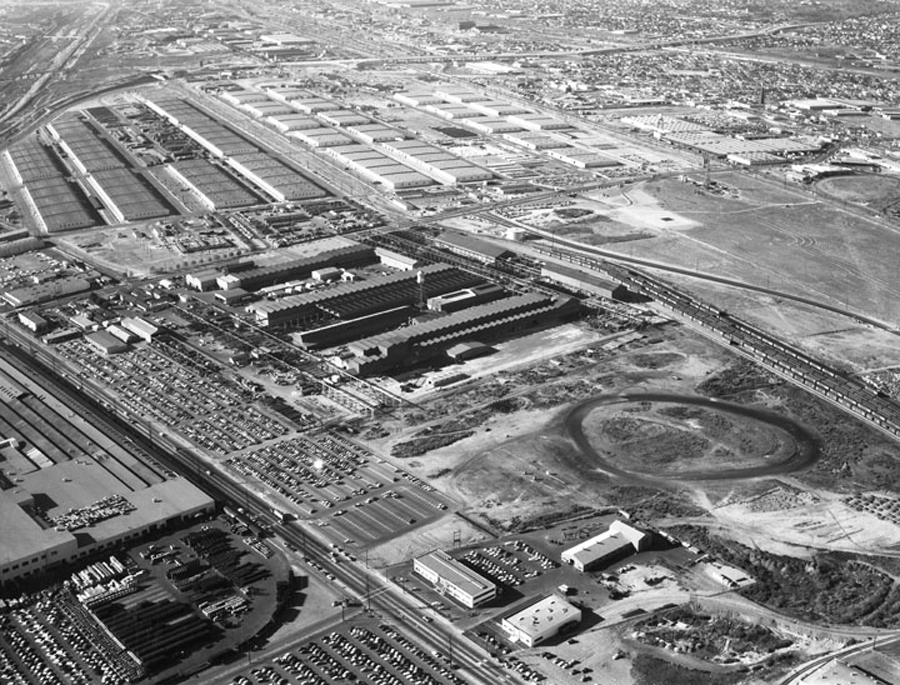
The other face of the contract system: these industrial properties, shown in 1957, would gain protection from taxation when the city of Commerce incorporated three years later.
Although actually existing public choice in Los Angeles County departed significantly from theory, the institutionalization of public choice through political discourse and institutions helped to create the social reality that theory assumed. Rules and policies based on the assumption of competitive relations among localities (even if that competition was subsidized by the county in practice) made competitive relations among localities appear rational and inevitable. Such rules also discouraged alternative rhetorical frames to describe or challenge even the most severe forms of metropolitan inequality. Public choice so effectively displaced consolidation as a model of metropolitan organization that even economically distressed local areas were hard pressed to demand anything but increased local power as a remedy.
Indeed, activists in two of Los Angeles County’s poorest communities demanded local municipal incorporation as a solution to economic underdevelopment and racial oppression. In 1966, African American activists in Watts proposed to separate the district from the city of Los Angeles as a black-ruled “Freedom City.” Mexican American leaders in unincorporated East Los Angeles also brought municipal incorporation to the ballot in 1961 and 1974. Although contemporary and historical analysts associated Freedom City with the Black Power movement and the much more widely studied campaigns for East Los Angeles cityhood with the Chicano movement, they drew a significant measure of their rhetoric from the very different movement for suburban home rule in Los Angeles County, arguing that local self-government was essential to the achievement of economic empowerment and the overthrow of racial oppression. 64
Freedom City originated with Student Nonviolent Coordinating Committee (SNCC) activists in Watts, in the aftermath of the August 1965 rebellion, who adopted “the home rule theory ‘that people can take care of their community better than a few Congressmen in Washington, Assemblymen in Sacramento, and City Councilmen downtown.’” 65 Though the plan reflected SNCC’s embrace of Black Power, even moderates such as Norman Houston of the local NAACP initially appeared willing to consider how municipal self-government might “increase the status and dignity of citizens.” 66 Watts had, in fact, been an independent suburban municipality before consolidating with Los Angeles in 1926. While African American property owners were major supporters of consolidation, Watts residents had since found ample reason to complain that Los Angeles municipal authorities undermined their status and dignity, including the deliberate and disproportionate placement of public housing in the area, abusive treatment by the police, and Mayor Sam Yorty’s recalcitrance in implementing federal antipoverty programs. UCLA sociologist Paul Bullock’s interviews with Watts youth in 1966 showed that many viewed incorporation as a means of controlling institutions that affected community life. 67 The appropriation by black militants of the rhetoric of suburban incorporation advocates suggested a perspectival shift; equity in terms of the right to govern had replaced distribution as the primary goal of politics in the suburban-dominated metropolis.
Advocates of incorporating East Los Angeles likewise explained the impoverishment and racial oppression of the area’s ethnic Mexican residents in terms of a lack of local government authority. County and state planners made East Los Angeles the region’s freeway hub, with elevated highways and massive interchanges destroying some communities and blighting others that survived. In 1962, the county planning department issued a master plan that established the area as a dumping ground for high-density housing that incorporated cities with control over local land use were likely to reject, and adjacent incorporated cities like Commerce annexed valuable industrial property with the support of the county supervisors. 68 East Los Angeles thus experienced the burdens of supporting a poor and working-class population with progressively fewer resources at its disposal. Chicano movement intellectuals would later famously call this “lack of control over . . . the barrio as a municipal entity” by the name of “internal colonialism,” but similar assessments of the area’s problems predated the movement. 69 Attorney Joseph Galea, a leader of the Committee to Incorporate East Los Angeles, advocated incorporation in 1961 as a way to “assure local control of tax revenues,” while an East L.A. resident told the Los Angeles Times “if we make it into a city we Mexican Americans will at last have a voice in our civic affairs.” 70 Concerns about the fiscal viability of the city, however, were the dominant factor in cityhood’s narrow defeat at the polls in 1961. 71
By the end of the 1960s, incorporation advocates and the emerging Chicano movement harnessed more explicitly ethnic rhetoric to demands for local political control in East Los Angeles, leading to a renewed campaign for incorporation in 1974. The East Los Angeles Community Union (TELACU), a community development corporation, was the principal institutional mover, advocating incorporation through a spinoff, the Ad Hoc Committee to Incorporate East Los Angeles (ACIELA). 72 In the months leading to the 1974 vote, incorporation proponents like California State University–Los Angeles Chicano Studies Professor Richard Santillan argued that incorporation was an effort to secure “the basic right guaranteed a free people under a democracy: the right to control their own lives,” a privilege enjoyed without controversy by suburban whites in the region. He also explained that “incorporation would assure change, for local leaders would be able to pay close attention to local needs in housing, employment, and health.” 73 Black Power and Chicano movement partisans thus had an ironic commonality with the suburban adherents of public choice theory; movement strategy proposed to bring local government to the ghetto and the barrio, spaces produced not by choice but by constraint.
Neither Freedom City nor East Los Angeles Cityhood activists secured public support to accomplish their goals. Freedom City foundered in part because it clashed with the ideals of integration that many Watts residents still held. But even residents who were less than optimistic about the progress of integration were still more pessimistic about the prospects of Freedom City to sustain itself on chronically underdeveloped local economic assets. The Los Angeles Sentinel undermined Freedom City by printing the views of residents who distrusted the militants and suggested Watts “hasn’t got the industry and businesses to support itself.” 74 Even Freedom City advocate Clayborne Carson conceded that the urgent need for economic development meant that incorporation “would almost certainly have to be under the control of people with conservative—or at least not anti-business—views,” a municipal regime unlikely to countenance economic redistribution sufficient to meet local needs. 75 TELACU and ACIELA also had difficulty squaring community demands for economic development, police reforms, and increased services with the need to control costs, and incorporation opponents exploited the fear of high taxes to convince voters to once again reject cityhood in 1974. 76
The failures of the Freedom City and East Los Angeles cityhood campaigns exposed the inherent contradictions of public choice; it was widely attractive as a rhetoric of local autonomy and democratic self-government, but in practice it was viable only for areas with valuable property, affluent populations, and the solicitousness of higher levels of government, and it catered to the preferences of the privileged while leaving the poor with limited and less desirable options. 77 Advocates for incorporation were justified to claim in the abstract that racial and ethnic minorities should enjoy the same privilege of self-government as white suburbanites. However, Watts residents and voters in East Los Angeles were ultimately unconvinced that more localized government was a panacea for historically accumulated disadvantage in their communities. Despite the failure of these specific proposals, however, local control had become and would remain the dominant framework for discussing community grievances in these communities and nationwide. 78 The ideology of localism offered activists in poor areas a critical frame that resonated with national ideals of democracy but obscured the ways in which political fragmentation organized and preserved metropolitan patterns of inequality.
Conclusions: Localism and the Past and Future of Metropolitan Equity
The governmental technology of the Lakewood Plan reshaped Los Angeles County and the nation. Over the latter half of the twentieth century, as legal scholar Richard Briffault argues, “local autonomy has been transformed from a principle of administration to a faith in the decentralization of responsibility for the provision of public services and the exercise of public power.” 79 As more than 80 percent of Americans now live in metropolitan areas, the consequences of this shift are serious. Social scientists under the banners of “metropolitics” and “new regionalism” have pointedly described public choice governance’s contributions to metropolitan inequity. 80 These critiques evaluate the effects of public choice as an administrative principle and deconstruct it as an ideology, but they have neglected to analyze it as a historical phenomenon that took shape as ideas became embedded in institutions and discourse about government in particular metropolitan political contexts. Challenging this system requires not simply demonstrating its dysfunctions but understanding the processes through which those dysfunctions have been institutionalized.
Making historical sense of public choice requires historians to adopt the spatial framing of new regionalists and recognize that metropolitan areas are significant sites of social, political, and ideological conflict. Policy historians and many of the “new suburban” historians have been methodologically bound to national or intensely local spatial frames respectively. Wendell Pritchett, for example, has described 1960s urban policy as a vertical negotiation between Washington and large city governments. 81 In this view, the retreat from metropolitan consolidation was directed from Washington, first as the Johnson administration urged policies targeted toward the “inner city” and then with the Nixon administration’s New Federalism. But the shift of population from central cities to suburbs in the postwar period made the horizontal political and ideological conflicts among local places increasingly important.
New suburban historians, for their part, have documented the growth and development of many different kinds of American suburbs. But community study methodologies have sustained an intensely local focus in much of their work that precludes exploring connections and disconnections between and among localities in metropolitan processes. 82 Robert Self and Colin Gordon have demonstrated one productive approach to a metropolitan history based on process by evaluating investment in commercial, industrial, and residential real estate and public infrastructure, a zero-sum political economy where one locality’s growth was funded by another’s decline. 83 Matthew Lassiter and Brett Gadsden have argued that metropolitan school districts linked urban and suburban neighborhoods in contentious desegregation debates, often creating complex realignments of race, class, and community as political identities. 84 Here, I have followed the approach of legal scholar Gerald Frug and examined local governments, relationships among local governments in a metropolitan area, and ideas about those relationships, as parts of an evolving governing technology in postwar metropolitan America. 85 As local and county officials institutionalized public choice in Los Angeles County as a response to historically specific metropolitan political problems, they also built the ideological and intellectual framework and political constituency of New Federalist policy and contemporary metropolitan inequality.
Partisans in new metropolitan conflicts continue to repurpose the intellectual frames that decentralization advocates in Los Angeles County developed. The movement to separate the San Fernando Valley from the city of Los Angeles, which gained national attention before its ultimate electoral defeat in 2002, supplemented the activism of Valley business and homeowner groups with intellectual and ideological support from analysts at libertarian, free market, and antigovernment policy institutes, including the Reason Public Policy Foundation, the Competitive Enterprise Institute, and the Milken Institute. 86 This intellectual work was necessary to departicularize the politics of secession and cast a campaign organized by businesses and residents of some of the whitest and most affluent parts of Los Angeles as a referendum on good government. It should be noted, however, that secession advocates made significant inroads in recruiting Latino residents of the northeast Valley, and less successful outreach to African Americans in South Los Angeles, to rally around the banner of increased localism. 87 A 2001 symposium sponsored by pro-secession activists and the Reason Foundation coined “rightsizing,” a label that Robert Scott, a Valley business leader, explained in terms of a constitutional principle “that the most representative government is that closest to the people.” Ignoring the U.S. Constitution’s inconvenient silence on the organization of local government, Scott and his allies assimilated urban secession into the established framework of public choice as good government. Scott also described the mission of the San Fernando Valley secession movement in terms of creating governance that “fuses public government with local private sector leadership,” a form that Reason’s Robert Poole called “a dramatically different and better form of government.” 88 Both privatization and secession were logical extensions of the impulses to decentralize and organize governments to serve private interests. The ideological and institutional triumph of localism in metropolitan America has made limiting local control to promote metropolitan equity next to impossible.
Footnotes
Declaration of Conflicting Interests
The author declared no potential conflicts of interest with respect to the research, authorship, and/or publication of this article.
Funding
The author received no financial support for the research, authorship, and/or publication of this article.