




Abstract
This article argues that parents of the post–World War II baby boom chose where to live based primarily on the characteristics of individual neighborhoods, rather than by making sharp distinctions between urban and suburban space. The scholarship on post–World War II domesticity and mass suburbanization usually presumes that these two phenomena went hand in hand as baby-boom parents sought the suburbs’ supposedly unique amenities for nuclear family togetherness. This case study of black and white families in Chicago reveals instead that diverse postwar parents described suburban and urban neighborhoods in remarkably similar terms. These families sought out friendly and supportive communities for themselves and their children, opportunities for homeownership, and space for recreation, which they found in a variety of metropolitan Chicago neighborhoods, urban and suburban alike.
The Carters, a young white couple in Chicago, adopted two children during the 1950s. Aside from their infertility, they were very much like other couples who wed during the baby boom: they had married young, just after Mr. Carter returned from his World War II military service, and they believed parenthood would truly make their lives complete. As their adoption application reveals, they sought to impress the adoption social worker by explaining to her all of the reasons they would be excellent parents. They particularly boasted about the fine qualities of their home and neighborhood. Mrs. Carter thought the area had an exceptionally rich community life, explaining that “there are over 100 children in the square block where they live.” It was “a very tight neighborhood with much visiting, block parties, etc.” She even played the lead in several plays in the nearby park’s drama club, and Mr. Carter led a local Boy Scout troop. 1
One might expect that the Carters lived in one of the many newly developing mass suburbs at the time that catered to growing baby boom families. But instead they lived in the neighborhood of Englewood on Chicago’s South Side. When the Carters purchased their home in 1949, they decided against a suburban location and instead bought an older urban home that was big enough to have three separate apartments—the first floor, where they lived, and two more upstairs for rental income. Jokingly naming the house “Tottering Towers” because it was so old, the couple spent their early years there fixing it up just the way they wanted it. Alongside the drama club and the Boy Scouts, home improvement kept them busy and active, and tied them to their home and their future there together. By 1955 the Carters had paid off the house and were clearing a healthy profit from the rentals, which helped with the expenses of childrearing.
While the Carters were adjusting to parenthood and raising their adopted children within the vibrant community life of the neighborhood, Englewood was undergoing significant changes of its own. The area was annexed by Chicago in 1889 and was a mature residential neighborhood by the early twentieth century. It had some large, stately homes from its early years as an outlying settlement, but by the turn of the century it also had many multifamily dwellings and small homes belonging to immigrants, working-class families, and stockyard workers. A small population of African Americans had lived in Englewood since the late nineteenth century, but the racial makeup of the neighborhood began to change dramatically after 1940 because of the large in-migration of black southerners to Chicago’s South and West Sides. The neighborhood of Englewood, which bordered the city’s South Side Black Belt, went from 97.8 percent white and 2.2 percent black in 1940 to 89.4 percent white and 10.5 percent black in 1950. The trend accelerated in the following decade, and by 1960 the area was 30.8 percent white and 68.9 percent black (Figures 1–3). 2
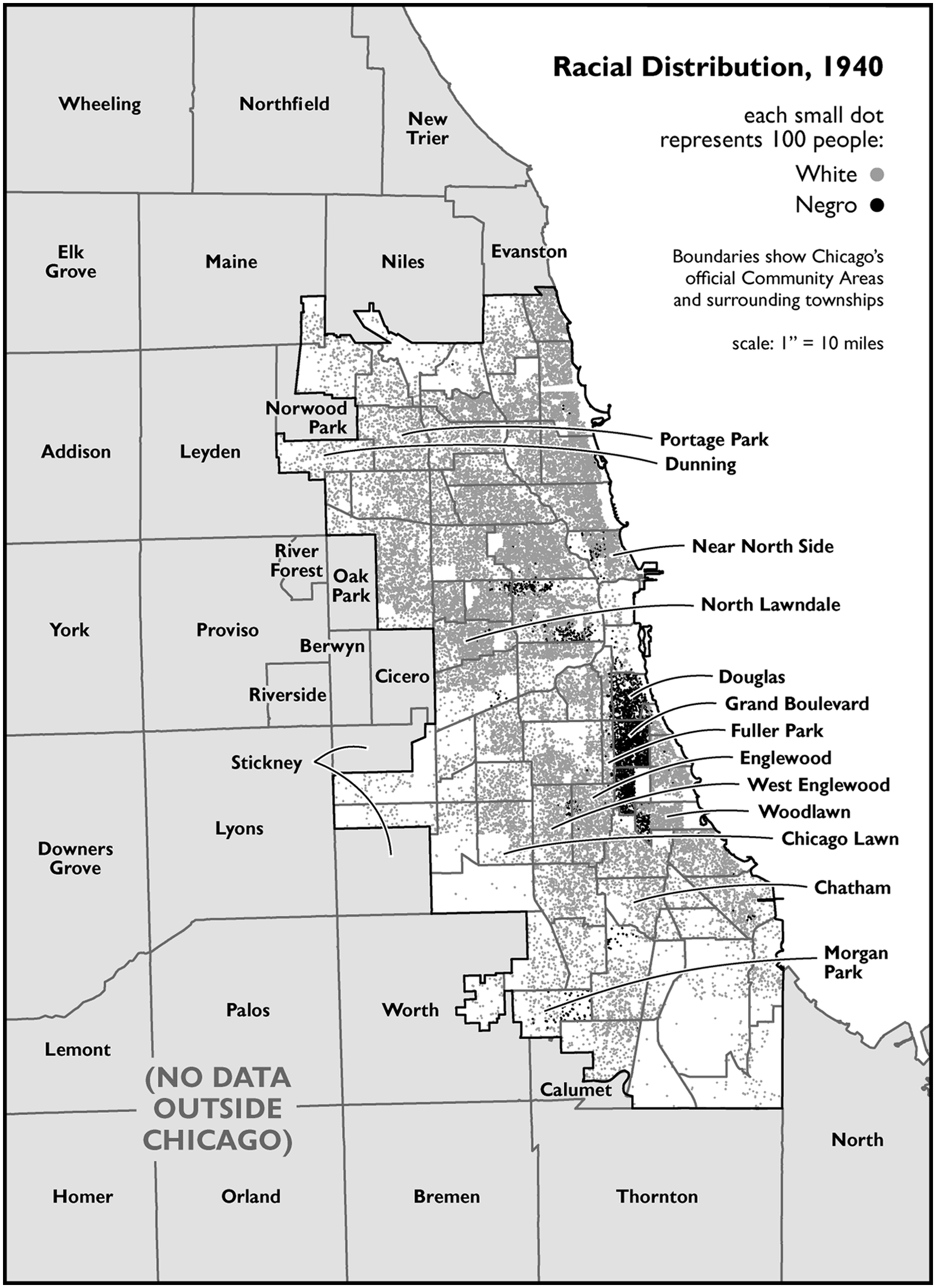
Racial distribution of black and white population of the city of Chicago, 1940
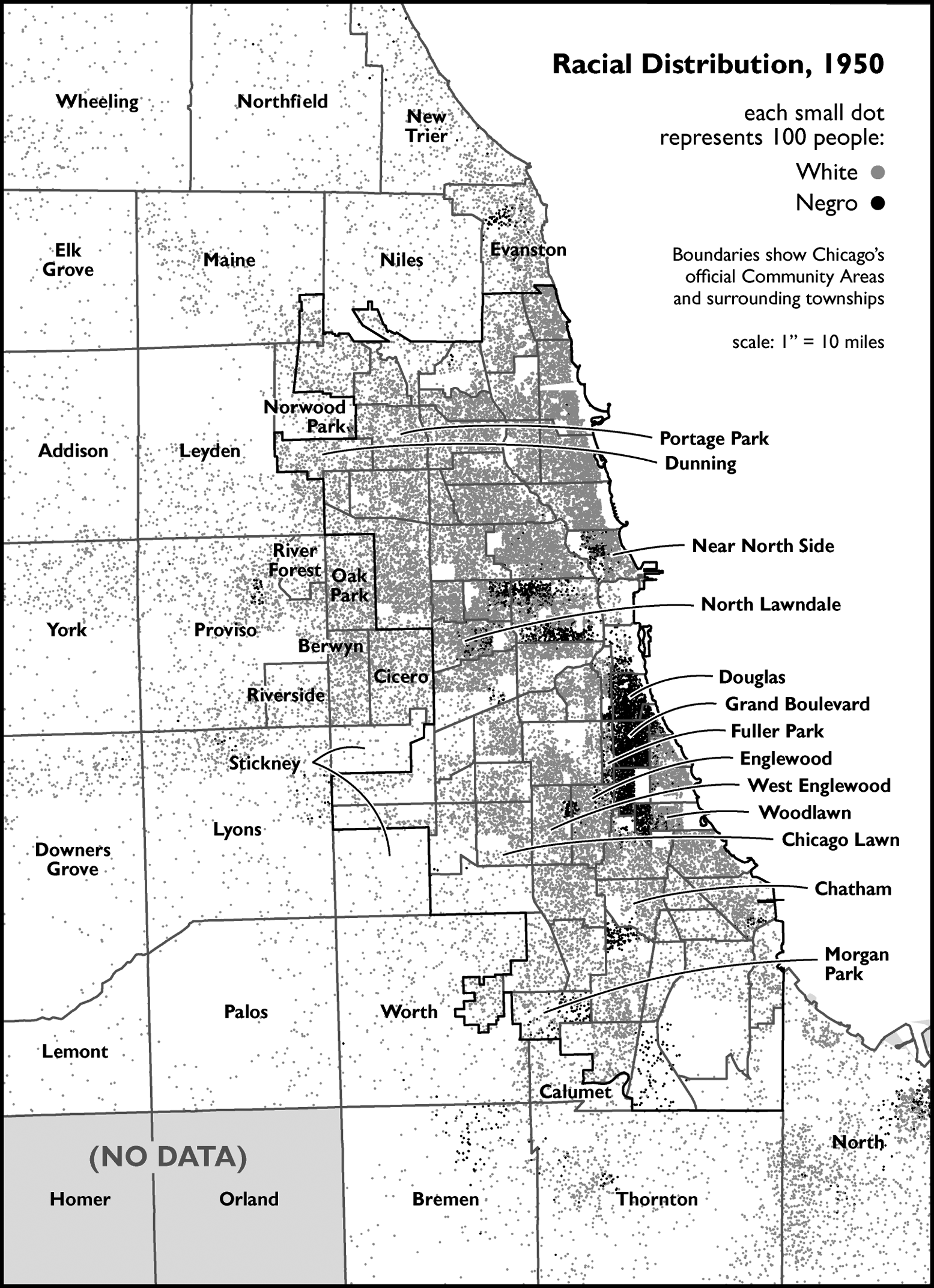
Racial distribution of black and white population in Chicago and its surrounding townships, 1950
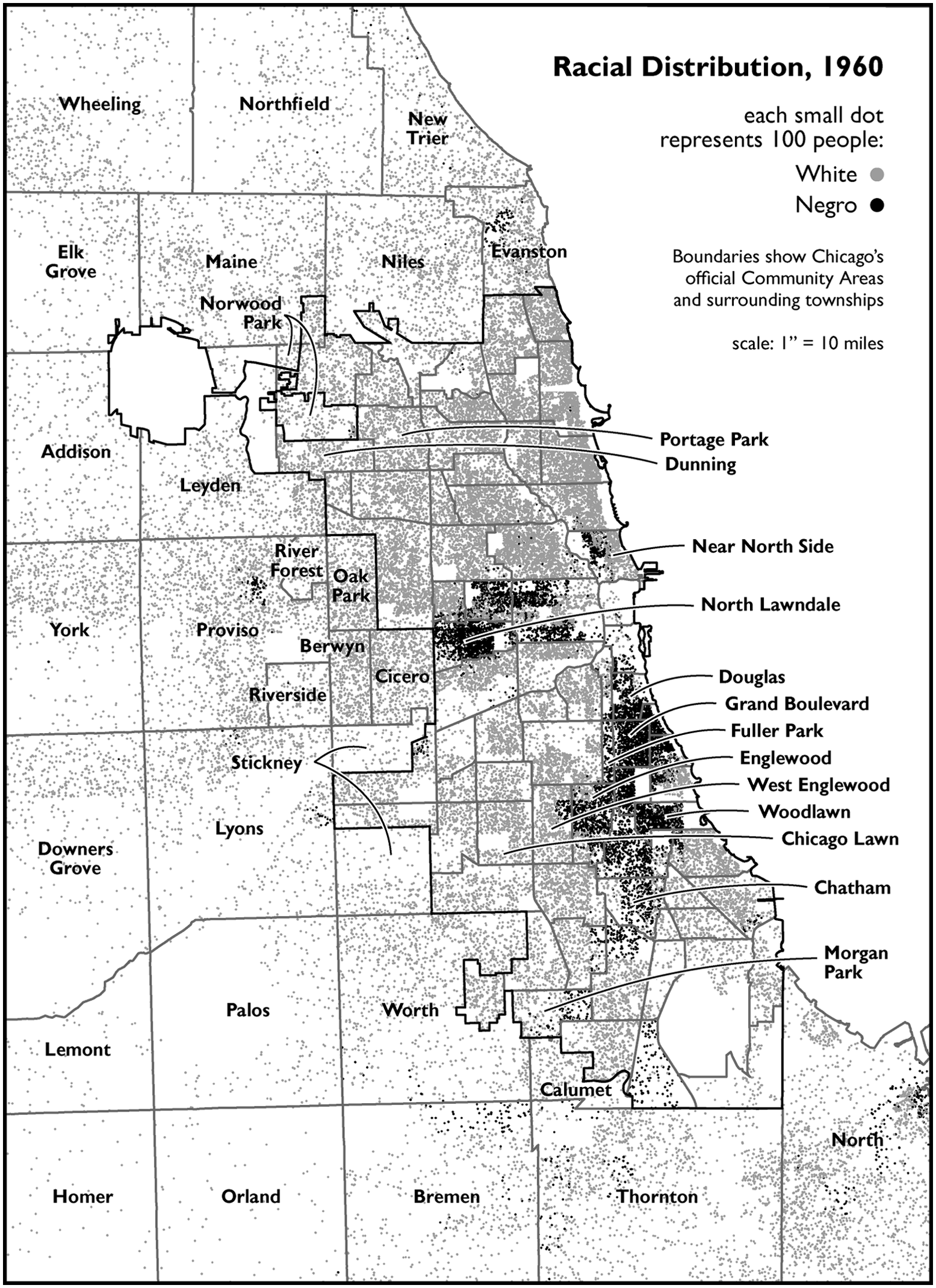
Racial distribution of black and white population in Chicago and its surrounding townships, 1960
Racial change in Englewood, as in many places across the city and the nation at the time, created anxiety and even violence. Despite their fondness for the area’s social life and the close friends they had made, the Carters were not oblivious to the transformations happening around them. In the summer of 1958, Mr. Carter mentioned to his adoption social worker that he was worried about his property value because more African Americans were moving in nearby, and the family had been thinking about leaving the area. But he was reluctant to go, saying that “his family had always lived around this part of Chicago and that he would be hesitant about moving to the suburbs but that they had been looking at some houses.” 3 A combination of racism, fear, and a concern for the financial future of his family prompted him to consider leaving the area, but he was not eager for a suburban home and hated to give up the social life and lucrative rental property his family had built in Englewood. The Carters’ adoption record closed in late 1960 with the family still living in “Tottering Towers,” and there is no way to know how much longer they stayed. Chances are they took off sometime in the following decade, for Englewood was only 4 percent white in 1970. 4
Even without the end of their story, this family challenges assumptions about postwar mass suburbanization and white flight: it was not always an obvious choice for white families with children and ample financial resources to leave changing urban neighborhoods to pursue the “American Dream” of a single-family home in a low-density, all-white suburban community. While Mr. Carter sought to persuade his social worker that the family provided a wholesome, caring environment for the children she had placed in their care, he did not pretend to strongly aspire to suburban homeownership. Instead, he emphasized the benefits of their current location. The Carters’ very presence in Englewood in 1960—and their ambivalence about leaving their multifamily home and extended family for the suburbs—demonstrates the variety of concerns families brought to their decisions about where and how to live in order to maximize their well-being during the baby boom. Alongside welcoming neighbors and many playmates, the availability of multiunit buildings, the proximity of family and friends, and a sense of connection to a community were also important factors.
Race, likewise, played a critical role in how people related to different urban and suburban spaces. While for the Carters the growing number of black families in Englewood signaled neighborhood decline, making the neighborhood seem more “urban” and less desirable, for African American families a home in Englewood marked a significant step up to a neighborhood that was much more suburban in feel than the often crumbling, crowded conditions of the South Side Black Belt. Barred from many newly developing suburbs and most of Chicago’s traditionally white neighborhoods, African Americans pursued higher-quality housing, homeownership, and safe places for their children to play as best they could within their limited options. For many, the availability of affordable housing for purchase, as well as a stable, child-friendly community with ample space like Englewood, were crucial factors when selecting a neighborhood in which to live. 5
This article considers the range of ways diverse Chicagoans related to domestic and residential space during the immediate postwar period, particularly in relation to their family lives. It uses as its primary archive the confidential case records of more than 250 working-class and middle-class black and white couples who applied to adopt or provide foster care to infants awaiting adoption in Chicago during the 1940s and 1950s through the Illinois Children’s Home and Aid Society (ICH&A). 6 These families sought out particular amenities, including friendly and supportive communities for themselves and their children, opportunities for homeownership, and space for recreation that could be found in a range of neighborhoods, both within Chicago’s city limits and in its rapidly expanding suburban communities. White applicants who chose to live in the suburbs or to stay in the city often described their preferred communities as like a “small town,” suggesting these qualities could be found in a range of neighborhoods. Black applicants, meanwhile, pursued similar goals in neighborhoods both inside and outside the Black Belt, but within the context of significant racial and economic discrimination. Across racial lines, these men and women described urban and suburban space in the 1940s and 1950s in ways that trouble the assumption that suburbs were universally understood as the most desirable, family-friendly places to live. The experiences of both white and black families suggest that the urban–suburban binary favored by scholars does not capture the ideological attachments to place as closely as does a neighborhood-level analysis.
Most histories of the postwar family posit a strong linkage between a commitment to family togetherness and the suburbs, and a sharp demarcation between city and suburb. In the conventional narrative, the single-family suburban home was an essential part of the family-focused consumer package that was so prized by the white middle class. As GI Bill mortgage benefits, highway construction programs, and metropolitan development strategies encouraged suburban growth, the millions of Americans who had married younger and had more children flocked to newly developed communities erected outside of city centers that promised more space, greater family privacy, and racial homogeneity. At the same time, the single-family suburban home further reinforced the primacy of the postwar nuclear family by encouraging couples to concentrate their attentions on their marriages and children, and by isolating them from neighbors, friends, and relatives. This narrative overlooks the real diversity of postwar families’ residential and domestic choices, and assumes too strong a drive for suburban conformity. It also largely overlooks race and class differences by presuming that—even though the baby boom occurred across all racial, ethnic, and economic groups—it was white, upwardly mobile suburban families who were the standard bearers for postwar domestic ideals. Interrogating the relationship between family ideals and domestic and residential space reveals that when it came time to make the decision regarding where to raise a baby boom family, people made fewer distinctions between city and suburb than the literature usually suggests. 7
Analysis of the diverse meanings that adoptive families attached to residential space adds to recent reconsiderations of urban and suburban history. Historians such as Andrew Weise and Becky Nicolaides have argued for greater attention to the diversity of suburbia, both in the past and today. 8 Likewise, Richard Harris and others have argued that scholars have overemphasized divisions between urban and suburban space, and have underanalyzed the many distinctions among suburbs and among a variety of urban neighborhoods. This line of argument is particularly relevant for Chicago, which has long been described as a “City of Neighborhoods,” each with its own character. Its suburbs were similarly varied, offering different kinds of communities to residents. As historian Ann Durkin Keating suggests, “Looking at the [Chicago] region as a collection of neighborhoods calls into question the too-simple opposition between suburb and city.” 9
Adoption and foster care records offer a unique lens into the interplay between family ideals and people’s conceptions of urban and suburban living during the early years of mass suburbanization and neighborhood change in Chicago. These records certainly do not represent the full range of experience or opinion at the time, and applicants did not always tell the truth about their lives when trying to convince their social workers to place a child in their home. But the case records of adoptive and foster care applicants provide a telling lens into how a range of individuals described an “ideal” family—and an ideal family neighborhood—during the baby boom.
In the records, social workers and applicants imbued domestic and residential space with profound family significance. Discussions of housing were moments when applicants and workers alike expounded on the meaning their families had for them. People’s ideas about homes and neighborhoods proved inextricable from the feelings of pleasure, inclusion, and purpose promised by family living during this period. But despite their commitment to family-friendly homes and neighborhoods, applicants’ and social workers’ definitions of the best places in which to raise a family did not fall into clear-cut hierarchies between urban and suburban space. Instead, they drew on a range of beliefs about the family implications of different kinds of neighborhoods and communities. They particularly took into account practical considerations, such as social networks and available housing stock, which would affect their family’s financial and personal stability. Rather than a stark contrast between city and suburb, individuals across race and class lines instead described a sense of continuum between these two spaces, with each offering a unique mix of emotional, social, and material benefits for family living.
*****
The location most associated with the postwar family is, of course, the residential suburb. The happy-go-lucky world of Leave It to Beaver and photo spreads of suburban family togetherness in magazines such as Life and McCall’s have made the cookie-cutter suburban home the iconic image for “1950s family life.” Histories of postwar domesticity have also emphasized that suburbia was the principal location for—and indeed the most important symbol of—a postwar ideology that glorified traditional gender roles and family-focused consumption. In her important work on family ideology after World War II, Elaine Tyler May presupposes life in a single-family suburban home as the underpinning of widespread “domestic containment.” She argues that “the sexually charged, child-centered family took its place at the center of the postwar American dream,” and “the most tangible symbol of that dream was the suburban home—the locale of the good life, the evidence of democratic abundance.” 10 A suburban home became an essential aspect of the ideal postwar family.
Yet adoption and foster care records from Chicago during these years reveal that even social workers, whom one might expect to hew most closely to a suburban family ideal, did not outwardly embrace it. Social workers were charged with evaluating adoptive and foster care applicants in order to decide if a child should be placed in the home, a months-long process they called the “home study.” As part of the home study, workers literally scrutinized applicants’ homes and neighborhoods for clues as to whether they would be suitable parents. Their concerns were, in part, practical. They sought to ensure that the children in their care would be placed in homes that had adequate indoor and outdoor space for a child to be comfortable, and that homes, apartment buildings, and neighborhoods were generally safe. 11
But social workers also read into domestic and residential space much deeper meanings about applicants’ potential attitudes toward the children in their care. Workers commented on the relative upkeep of the homes, buildings, and streets in the area, and they evaluated applicants’ homes in relation to their surroundings. One might assume workers’ primary interest was in assessing a family’s relative affluence, but in fact they already had extensive financial information on applicants. Instead, their interest was in the couple’s character. A well-maintained, friendly house suggested to workers that the family took pride in making their home a comfortable and happy place to live; presumably, they would convey similar warmth and care to the children placed in their charge. For instance, one worker remarked that the “simple but excellent taste” of the home of a white middle-class couple suggested it was “obviously the home of two people who enjoy each other and it very much.” 12 Another worker reported that the home of an older white working-class couple appeared “to be very much lived in and it is apparent that there is no over emphasis on the home but more on the activities within the home.” 13 Likewise, an African American social worker found a black couple’s home to be rather “cluttered and gaudy,” but concluded that “the atmosphere of the home is so cheerful and warm, that one overlooks the fact that it is somewhat overdone, and notes the fact that this is a very comfortable home where people seem to be happy.” 14 These were the kinds of homes—and parents—that would provide young children the security, attention, and loving care they required.
Despite social workers’ interest in domestic and residential space, they did not necessarily prefer one type of housing or location over others. On the one hand, social workers were well aware of the real financial and racial restrictions on applicants’ choice of neighborhood. Most social workers who worked with African American applicants were also African American themselves, making housing discrimination no secret to them. Similarly, because ICH&A often relied on low-income families to provide pre-adoptive foster care in return for a modest boarding payment, workers recognized that some applicants simply could not afford better housing.
On the other hand, workers also saw a variety of costs and benefits to different living situations. They made distinctions among not only urban and suburban neighborhoods but also different kinds of housing and spaces within those neighborhoods. Though workers certainly considered quiet residential neighborhoods good places for childrearing, they also recognized that some applicants found these areas lonely and isolating while bustling city streets felt warm and welcoming. For instance, in the mid-1940s one white couple sold their home in suburban Oak Lawn, in Worth Township, to move to an apartment in the all-white Chicago Lawn neighborhood on the city’s southwest side (Figures 1–3 provide the racial makeup and population density of all locations mentioned in the text). The couple felt their suburban home was time consuming and expensive to maintain, and they “had difficulty getting into the city to enjoy their social contacts.” The couple was “very pleased with their apartment,” and for her part the social worker also thought the home would be a good place for children, noting with particular approval that there was a large lot next door where children played and dug fox holes. 15 Workers’ priority was to provide the children in their care the best homes possible. To do so, they worked to identify supportive, loving families who would offer adequate nurture and care for a child, and they found those families in suburbs and city neighborhoods, in apartment buildings and single-family homes. Instead of drawing a simple distinction between the family-friendliness of urban and suburban space, workers instead carefully considered a range of qualities of applicant’s communities and houses. 16
Many white applicants, meanwhile, idealized certain aspects of suburbia, imagining communities on the city’s fringes to offer better housing, friendlier neighbors, and more space for children to play. For these men and women, a home in the suburbs represented a supposedly friendlier, more child-centric living experience than the city could offer. White couples’ strong belief in the potential for close, stable relationships in the suburbs likely rested on the assumed racial and class homogeneity of many suburban areas, but none explicitly mentioned race or class when recounting their desire to raise their children in a suburban community. Instead, applicants repeatedly described the suburbs as like a “small town,” associating suburban living with friendly, closely knit neighborhoods. One couple described their home in Palatine, in the far northwest suburbs, as particularly pleasant because it had “a small hometown atmosphere.” 17 Similarly, an urban dweller explained that he “would really prefer living in a suburban area, partly because he misses the friendship he used to have as a child, living in a small town. He said as a child, he knew everybody within a mile radius, but now he knows only the people who live on either side of him.” Hoping to re-create this pastoral experience, this man and his wife eventually purchased a home on the outskirts of the city in which to raise their adopted children. 18
Other white couples described suburbs as desirable because they offered a quiet escape from the bustle of the city, while still allowing easy access to urban amenities. A woman whose husband grew up in a farming community commented in 1948 that their home in Melrose Park, a generally white working-class suburb in Proviso Township, gave him “a feeling of being away from a busy city, which he likes.” She, meanwhile, was not as enamored of rural life as her husband, and saw the suburbs as a good compromise. She added that the location was “especially good for a growing youngster which is chiefly the reason they made the decision to buy their present home.” 19 Likewise, a couple who lived in Hillside, another community in Proviso Township, noted that they “enjoy this community very much, are particularly pleased with its growth, its new shopping center and feel that they have an ideal location because it is easy to commute from there to the city and yet they have suburban living with friendly neighbors.” 20 Suburbs also offered more space for growing children to play safely. One couple that had moved from a city apartment to a single-family home in the sparsely populated Township of Downers Grove in the late 1950s credited their child’s first “summer in the suburbs” for his increased coordination in terms of roller skating and bike riding. 21
But even as applicants expressed a belief in the desirability of the suburbs, they were actually in search of specific qualities that they deemed attractive: many children, space to play, and friendly neighbors. These amenities were not automatically available in a community simply because it was outside the city limits, and many applicants—like their social workers—made distinctions among different suburbs as they sought out the best neighborhoods for their families. For example, one couple was delighted with the change in their daughter’s behavior on moving from a community with many older people in suburban River Forest to a community with many young families in Lyons Township. They explained, “it was as though she had almost discovered a new world,” which made them “see how wrong they had been in living in a community where there were no children.” 22
Children were not the only ones who lacked friends in some suburban communities. Adults were also disappointed when they failed to make the easy friendships they had anticipated when they moved to a suburban neighborhood. One couple reported feeling extremely lonely in the growing community of Markham, in Thornton Township. There was not much visiting among neighbors because the men worked late and were too tired to go out. Further, they did not feel they had much in common with the one couple that wanted to be their friends and did their best to avoid them, but the situation was awkward because this couple lived so nearby. They coped by making a point of enjoying their time together outdoors at nearby forest preserves, but they were unhappy with the area and the wife was especially lonesome when her husband was at work. 23
Some white families also found that their suburban locale was not as beneficial for their children as they had imagined. For instance, in 1959, one woman initially bubbled over with praise of her new home in Schaumberg Township, an area almost thirty miles northwest of the downtown Loop. The family had always lived in cramped apartments with little or no yard, so this woman loved that her daughter could now play informally with other children and have space to run around. The couple enjoyed getting to know their neighbors, working on their new home, and becoming involved in their church. After a few months, though, the charms of the area had faded: her social worker reported that, when asked about her home, she said that “they are living in the ‘sticks’ and that their current house is a ‘down payment’ on their dream house.” 24 She also believed their current location was hurting her children’s eventual ability to compete educationally and professionally with others. By 1963, she mentioned that they were looking for a new home in an area with better schools and more space. As she explained, they were “wanting to give the children a few more cultural things. . . . [She] mentioned getting into town about twice a year and the children are becoming very countrified where they are and Mrs. thinks of the future when they will be in competition with other children.” 25 Even those applicants who embraced the promises of suburbia most enthusiastically did not always find in their particular suburbs the amenities they desired.
Likewise, some white applicants did not pursue suburban homeownership and instead chose to live in neighborhoods within the city limits. Chicago’s suburbs expanded rapidly during the postwar years, with more than three-quarters of new homes built in the area between 1945 and 1959 constructed outside of the city limits. 26 But in contrast to the overall number of white families moving to communities outside the city limits, many families in the records—like the Carters—chose to stay in the city. Unlike those most studied in the historical literature, these families were not Catholic or part of a tight-knit ethnic immigrant community. 27 Instead, they described important family benefits to living in a city neighborhood. Though their choices were not the norm, their reasons for staying in the city add nuance to scholars’ understanding of how people thought about housing and neighborhoods, for they suggest that suburbs did not hold the monopoly on perceived family friendliness. Rather than simply aspiring to live in the suburbs, many were instead seeking out particular amenities that could be found in a variety of neighborhoods both within and outside the city limits.
Many white applicants chose to stay in city neighborhoods because, like suburbanites, they wanted to live in a close, family-centered community and found that kind of life possible in racially homogenous Chicago neighborhoods. For instance, one woman described her fondness for the Portage Park neighborhood in 1951. This area was almost entirely white, offering a mix of rental apartments and single-family homes along with a popular park that attracted neighborhood residents. Portage Park was more densely populated than most of the city’s suburbs, but it was less crowded than areas closer to the lakefront and downtown Loop (Figure 2). This family had rented a small one-bedroom apartment and then bought a single-family home in the neighborhood, explaining that “on Sundays it was just like a small town, and the men get out and wash and polish their cars, and there is a great deal of chatting back and forth.” 28 Suburbs were not the only location where “small town” sociability could be found.
This Portage Park couple also cited practical benefits to their neighborhood, invoking the same conveniences that suburbanites attached to their communities. The family told their social worker before purchasing their home that their small apartment was very cramped, and their “eventual plan is to have a suburban home.” They desired “a yard in a suburban area as the children grow older” and wanted more playmates nearby. But they also noted that they “feel comfortable in their present location.” 29 When they finally decided to buy a single-family home, they bought in the same neighborhood rather than leaving for the suburbs, citing Portage Park’s convenient location. They “described their home as being a somewhat older one which has both advantages and disadvantages but the main thing is the fact that the neighborhood is so convenient.” Their church and the children’s school were both a few blocks away, and a major shopping center was nearby. 30 Portage Park offered the same sense of community and convenience as did many suburbs, as well as the privacy and space of a single-family home with its own yard. These material and social considerations shaped this family’s decision about where to live, not an ideological commitment to the family-friendliness of the suburbs.
Some white applicants also saw benefits to city neighborhoods that suburbs did not offer. A number of couples chose to stay in the city to be nearer to parents and siblings. Extended family remained important to them, and for many, the sense of attachment to a particular urban area emerged from having grown up there and/or having friends and family nearby. Relatives tended to congregate together in urban neighborhoods when possible, which encouraged families to stay in the city rather than move to a suburb to raise their children. On the one hand, this pattern allowed couples to rely on extended family networks for emotional and social stability. On the other hand, it was also a strategy to secure the family’s class status, since they could rely on relatives and close friends for unpaid help with child care or home improvement projects. 31
Blue-collar families in particular had remarkably strong ties to extended family, and for many applicants the decision to live within the city limits came down to the availability of multifamily dwellings to purchase with relatives. Buying a two- or three-flat with parents, siblings, or other relatives provided not only supportive neighbors, but also a way to offset the expenses of homeownership. For example, the Daniels bought their three-flat in the Dunning neighborhood on the far Northwest side with the understanding that Mrs. Daniels’ two sisters would be their initial tenants. Like Portage Park, the area was all white and not terribly crowded (Figure 2), but it did offer a mix of single- and multi-family homes that was not available in many newly developing white suburbs. The older sister in this family, whose children were grown, lived with her husband upstairs, and the younger unmarried sister lived in a small basement unit, while the Daniels lived with their two daughters on the first floor. Mrs. Daniels explained that the three sisters had always tried to live near each other and were very happy to share a home. As their social worker put it in 1952, “When the Daniels decided to buy their present home, it was a family affair.” 32 Although some men and women complained of a lack of privacy from their in-laws and tenants, most of these families were willing to live with the intrusions, at least for the foreseeable future. Their choices suggest that, for some families, the autonomy of financial stability mattered more than the private, physical isolation of a single-family household. 33
In short, city neighborhoods could offer white families many of the same amenities as the suburbs, with some other benefits as well. Particularly in neighborhoods where racial integration did not yet seem a pressing issue, the city’s older, more varied, and often less expensive housing stock offered opportunities for homeownership to families of limited means. These neighborhoods were more densely populated than most of Chicago’s suburbs, but couples suggested they still offered “small town” amenities like friendly neighbors, convenient shopping, and space for children to play. They also allowed people to stay close to relatives and friends, and to take advantage of the emotional, personal, and financial support those social networks provided. In contrast to the claims of much of the literature on postwar domesticity, these couples often downplayed the distinctions between urban and suburban space and the desirability of a single-family home. They instead focused on the perceived benefits of their particular neighborhood, community, and housing type for their families. Their experiences suggest that scholars need to consider more carefully the particular qualities of various neighborhoods and various families, rather than making broad characterizations based on a community’s location within or outside of the city limits, or presuming a commitment to domesticity also included a commitment to suburbia.
*****
Black applicants, on the other hand, had considerably less latitude than whites when making decisions about their housing. Chicago’s housing markets were rife with discriminatory practices. Restrictive covenants, blockbusting real estate agents, and mob violence dictated the terms under which blacks could purchase property, leaving many to pay exorbitant rents for decaying kitchenette apartments. 34 A close look at how black men and women described their housing in the adoption and foster care records shows that poverty and discrimination shaped many of their decisions about domestic and residential space in ways that made many families prioritize homeownership. At the same time, however, their experiences further demonstrate the importance of a neighborhood-level analysis of families’ housing decisions during the postwar period. Many black applicants expressed similar desires as their white counterparts, searching out friendly communities that offered space and a supportive social network for their children. Although their options were much more limited than those of white applicants, they looked both within and beyond the Black Belt—and within and beyond the city limits—in order to find communities that best served their families’ material and social needs.
The significant racial tensions over housing in Chicago meant African Americans had a very different relationship with neighborhood space than did their white counterparts. For instance, the Nelsons, a black couple, moved into Englewood in late 1958. They lived just a few blocks from the Carters and their “Tottering Towers,” which opened this article. The Nelsons had met and married in rural Louisiana in 1949, when both were in their late 20s. They moved to New Orleans and built a small home for themselves there in the early 1950s. But after watching relatives earn more money in Chicago, they soon decided to move north. Once in Chicago, the Nelsons organized their lives around purchasing a home. Mr. Nelson was a skilled construction worker who eventually became a foreman. He worked long hours and took a job that was physically dangerous because it paid more. Mrs. Nelson also worked regularly as a nurse’s aide to help save up for a house. To economize, the couple lived very cheaply in a one-room kitchenette in Douglas, at the northern end of the Black Belt. The area had been the cultural and commercial heart of Bronzeville, but it was increasingly dominated by public housing projects during the 1940s and 1950s. 35
By 1958, the Nelsons had saved enough money to purchase a home, but they were slow and careful in their home search. Mrs. Nelson’s sister, who also lived in Chicago, had recently bought a three-flat and, based on her experience, Mrs. Nelson thought this was a wise investment because the building basically paid for itself and covered the housing costs. Mr. Nelson, however, “commented that buildings entailed a ‘headache’; he felt that he would be better satisfied with a cottage and Mrs. Nelson said that if that’s what he wanted that’s what he would get.” 36 Despite her assurances to her husband, Mrs. Nelson prevailed and the family purchased a two-flat in Englewood. The couple decided that a multifamily home had “more advantages in terms of their future security. They have both learned that from her sister’s experience what to look for in a building in terms of predicted future income.” 37
Homeownership, however, did not immediately translate into greater security for the Nelson family. Although they lived in an area that was generally quite well maintained, their house was old and required more work than they had anticipated, including expensive plumbing and electrical repairs. Further, their upstairs tenant quickly became behind in rent, and both Mr. and Mrs. Nelson had to scramble for extra work to cover their mortgage payments. There had also been a racially motivated bombing nearby a few months before, and the area had twenty-four-hour police protection. The Nelsons brushed this off, probably hoping not to alarm the social workers and jeopardize the placement of an adoptive child with them, and said they felt safe in Englewood and that more black families were moving in all the time.
The Nelsons’ story reveals the vastly different circumstances of black and white Chicagoans at the time. While the Carters had emphasized the neighborhood’s friendliness, with its block parties and wide array of community activities, the Nelsons instead faced potential violence. While they appreciated Englewood’s good housing and were determined to stay in their home, they did not express in the record any indication that they felt particularly welcome there. In fact, it was just as the Nelsons were moving into the neighborhood that Mr. Carter began to discuss with his social worker the prospect of leaving the area. Englewood had much to offer a white middle-class family, but it was living near families like the Nelsons that began to tip the scale in favor of the suburbs.
The Nelsons’ story also typifies many African American applicants’ attitudes toward housing at the time. Many black families in the records prioritized homeownership, making significant sacrifices to purchase a house. For these men and women, most of whom had come from the South at some point in their lives, homeownership served as a symbol of the family’s accomplishment in the urban North. Owning a home in Chicago represented their commitment to their new lives in the North and made the city feel more like home. Several black men explicitly likened purchasing their homes in Chicago to putting down “roots.” One man, who lived in Woodlawn with his wife, “summed up his feeling about his home when he said that when he found a home, he wanted to stay in it; he wanted roots; he now feels he has them.” 38
Homeownership was so important because it had practical as well as ideological benefits. Many black families, like the Nelsons, were strategic in their purchases. African American families who could afford homeownership frequently invested in multifamily dwellings and did so even more often than working-class whites in the Chicago adoption records. Multifamily dwellings made particular economic sense in the black community. The racism of Chicago’s dual housing market kept blacks mostly confined to the limited housing of the Black Belt. African American homeowners and renters paid inflated prices for housing that was often substandard. For homeowners, becoming a landlord to tenants paying premium rents helped offset the cost of overpriced housing. In addition, even fairly well-off families always faced insecurity in their incomes because of employment and wage discrimination, so black families were far more careful to ensure multiple sources of income for the family. Owning rental units could provide significant financial and emotional security, for they were a source of income that was under the family’s control and could therefore act as a safety net in hard times.
African American applicants also described a number of strategies for using their property productively to help their families get by in hard times: they engaged in extensive gardening and canning, took in mending work, and a few even opened small beauty parlors on their back porches. Others took in strangers to board. Although some white families did this, too, it was a far more common practice in the black community and was generally much more important to a family’s financial survival. 39 For instance, in the late 1940s and early 1950s, the family of a man who had lost his hand in an accident at work relied on taking roomers into their home on Grand Boulevard as a way to support themselves. Although he had been promised a lifetime job at the company as compensation for his accident, the company soon reneged and fired him, leaving him with few choices. This family first converted the top floor of their two-story home into a separate rental unit as a way to make income, but they could not earn enough to survive with just the one unit. Instead, they came to rely on taking roomers into their half of the home as well. 40 While social workers sometimes worried about the impact of roomers on children in the home, it was such a common practice that they often had to overlook their concerns.
Black families also frequently took relatives and friends into their homes. In a community where many were forced into precarious financial circumstances despite their best efforts to get ahead, providing shelter to those who needed it was a given for many families. The records were filled with stories of taking in those who had no place else to go. There were a variety of arrangements—from temporarily housing a niece or nephew who was new to the city for a month, to long-term arrangements where friends or relatives paid board and expected to live there until their circumstances changed. One West Englewood family first volunteered to take in the husband’s parents because their home was in an area that was being demolished as part of a slum clearance project. Before his parents were able to move out, the family also took in close friends who were expecting a baby and could not find housing that allowed children. The wife was gracious about the arrangement and had “assured the couple that they need have no anxiety over having to move until they find an acceptable place even if it takes as long as a year.” 41 Black men and women, by necessity, envisioned their households within the context of their community, and they found themselves constantly juggling the needs of their immediate families alongside the needs of relatives and friends. African Americans’ homes were rich with intimate familial meaning, but they were also sites where people coped with the very public problem of racial inequality. 42
Because of both limited finances and racial discrimination, many black families also found they had few options when choosing a neighborhood, but they pursued homeownership anyway. One couple, after riding out the Depression as renters, sought to buy a home so they would have greater financial security in case of future economic instability. They purchased a two-flat in the South Side neighborhood of Fuller Park during World War II, where there were a number of crumbling buildings that homeowners were slowly improving. They told their social worker “that this was the last neighborhood which they considered when they were contemplating the purchase of a home. However, their financial circumstances were such that they were unable to buy in what they then considered, a more desirable neighborhood.” 43
Like many white applicants, this couple sought a friendly, supportive community in which to raise children in spite of the many inequalities they faced. Though they might have simply been trying to impress their social worker, they emphasized that, despite the neighborhood’s poor physical condition, it was actually quite family friendly. Their social worker noted that “they have never enjoyed living in a community in Chicago as much as they have enjoyed this one. The people are neighborly and yet not meddlesome, quiet and orderly. With the exception of the voices of the children playing in the afternoon they are surrounded by quiet. Parents are interested in their children, seeing that they go to bed at a reasonable hour afterwards quiet descends such as they had never expected to find in the city.” 44 This pair also eventually formed a club with neighbors devoted to “the building up and maintenance of their neighborhood.” The wife explained that she was “working closely with the precinct captain to get action on the part of the city department of streets and sewers, to clean the streets and remove the garbage regularly.” 45 Although they continued to struggle financially and eventually came into conflict with the adoption agency when the wife started running a numbers game from their home to make extra money, they put a significant amount of time and energy into improving their home and community to make it a more comfortable place to live.
Other black couples were also involved in neighborhood improvement associations to create a more desirable community in areas facing poverty and deteriorating buildings. Just as whites often feared that racial integration signaled neighborhood decline, black homeowners also worried that an influx of lower-class migrants would erode community standards. For instance, a janitor and his wife were very involved in their local community center and helped to found a neighborhood improvement council to address the problems of their Near North Side neighborhood. They hoped to convince the homeowners around them to plant gardens, clean up the streets, and generally make the area more attractive. During the home study, the wife “was quite frank in stating that the new arrivals in the community represented a very different class, usually recent arrivals from rural sections of the South, who had quite different educational and cultural standards. Without creating antagonism they hoped to assimilate these new arrivals into their community and create a pride in it.” 46 Although many black applicants desired better housing and wealthier neighborhoods than they could afford, they went ahead and purchased homes wherever they could—and then sought to improve the area.
Families with greater financial resources were more successful in their pursuit of better-maintained housing and less crowded neighborhoods on the borders of Chicago’s Black Belt. Like white applicants, black applicants with stable employment and adequate savings sought homes away from urban blight in areas with friendly neighbors and more space for their children to play. In addition, like their white counterparts, they found these qualities in both urban and suburban neighborhoods, usually in integrated areas. One middle-class family began to contemplate leaving their home in the Grand Boulevard area in the early 1950s because the area was becoming more crowded. The area had been central to the community life of Bronzeville, but in 1956 the couple believed the neighborhood was “changing in terms of fewer stable home owning people.” The wife’s mother, who lived with the family, contemplated a move “with reluctance” but appreciated “the advantages to her grandchildren in being in a community where there is more freedom, playmates of comparable standards.” 47 In 1958, the family relocated to, as the social worker described it, “a quiet, newly integrated substantial neighborhood” in the Chatham area. Chatham went from overwhelmingly white in 1950 to more than 63 percent black in 1960 (Figures 2 and 3), becoming home to a large number of black middle-class families. It offered high-quality housing, space for recreation, and like-minded neighbors. The community also organized to avoid racial violence as it integrated and, unlike the threatened violence the Nelsons faced in Englewood, this family claimed that they were “well received in the neighborhood.” 48 For this family, Chatham represented an escape from the more “urban” neighborhoods at the core of the Black Belt to a community that was more suburban in feel.
Although it was rare, some black families also managed to move into integrating suburban communities to find these amenities. A family that had lived in both the small West Side Black Belt and on the South Side during the 1950s eventually bought a home in suburban Broadview, in Proviso Township, in 1960. The family had moved to North Lawndale in the mid-1950s, when the neighborhood “was just beginning to change and property was well maintained. Their particular building had been quite impressive—however, when they left, the entrance and stair hall were very deteriorated.” The wife had been urging her husband to move the family for some time, and when they purchased a suburban home she called her social worker to say it was “the kind [of home] that she had dreamed of but never actually felt she would be able to afford.” They had saved carefully for years, and the house was modern, with wall-to-wall carpeting, in a mostly white community. This woman was “very well pleased with the fact that [her son] can get outdoors daily and that there are a number of small children with whom [he] can play. Since the community is small, [he] can go outdoors by himself with their keeping an eye on him and the usual traffic hazards are not as great as they would be in a more urban community.” 49 Black families—just like many white families—looked for neighborhoods with more space, more playmates, and higher-quality housing.
Most black applicants who lived outside of Chicago’s Black Belt, however, were unable to afford a home in an integrating neighborhood. Many of these families were older couples who lived in either black pockets in suburbs such as Maywood (in Proviso Township), Phoenix (in Thornton Township), or Evanston, or they lived in the black section of Morgan Park, a city neighborhood on the far Southwest side with a long history of African American residence. These areas tended to be less densely populated than the Black Belt at the time, but they were more working-class in character than many white suburbs or integrating middle-class communities like Chatham. These families used their property productively in many of the same ways as their counterparts in the Black Belt. Many had extensive gardens, and some had fruit trees and chickens. They also took in roomers or created separate upstairs or basement units for tenants and relatives. Their experiences support Andrew Wiese’s suggestion that African American suburbs in the first half of the twentieth century were “often poor, but they were fully part of the national trend toward urban decentralization known as suburbanization. At the same time, they reflected a vision of residential, family, and community life that was at once suburban, working class, and African American.” Although in the 1950s, middle-class African Americans began to search out suburban housing that was more in line with that of the white middle class, working-class housing patterns of self-building and the productive use of property persisted in many black suburbs. 50
These families described these communities as superior to the urban Black Belt, even as they also emphasized their working-class character. They boasted in particular of the space and self-sufficiency their neighborhoods provided. For example, one older couple that took in foster children had a home with three separate apartments in Morgan Park. Their grown daughter and her family lived in one apartment, a tenant lived in another, and the foster family lived on the main floor. The home had fruit trees and an extensive garden that also provided some of their food. Although the foster mother worried about the influence some of the rowdier children in the neighborhood might have on her foster children and grandchildren, she also bragged about the many benefits of the home for the children. When the social worker noticed the lack of grass in the front and back yards, this woman “explained that she did not prohibit the children from playing there as she thought children were more important than grass.” She also showed the social worker a barbecue pit and picnic table in the backyard that they used for family recreation. 51 Several applicants took this commitment to space and self-sufficiency even further and purchased property in rural areas well outside the city limits, hoping to eventually build homes there and to support their families through farming. These families kept their homes in the city while doing their best to improve their rural property so they could enjoy it during weekends and vacations. As one couple put it, they “visualize a farm as an ideal place to rear a child.” 52 Although these families’ suburban and rural communities were quite different in terms of their housing stock, amenities, and general feel than the middle-class suburbs to which many white applicants aspired, the African American applicants who lived there still prioritized space for children to play and the overall family-friendliness of the area.
*****
As these white and black families in metropolitan Chicago pursued their interests, they followed a variety of paths, ranging from a home in a quiet suburb to a three-flat shared with relatives in a bustling urban neighborhood, or from to a decrepit row house in the Black Belt to a home in a black working-class suburb. While many whites aspired to suburban homeownership, in their day-to-day lives they often made decisions about where to live based on practical and social concerns about the kinds of homes available, the proximity of family and friends, and the convenience of services such as shopping and schools. Blacks, meanwhile, generally faced more constraints when choosing a home and neighborhood. Many black applicants used housing as a way to cope with racial and economic inequality, which made homeownership especially important. But black families also often aspired to similar kinds of communities as did their white counterparts. They sought friendly playmates, well-maintained housing, space to play, and a stable community, and they did the best they could to achieve these goals despite the many obstacles they faced.
These families’ choices suggest that there was a complex interplay between postwar domesticity and the era’s dramatic changes in Chicago’s racial and spatial geography. Family ideals were deeply embedded in diverse couples’ decisions about their housing and neighborhoods, but not in ways that led automatically to an isolated nuclear family in a single-family suburban home. Instead, all of those “other” baby boom families—those who were working-class, African American, and/or living within the city limits—demonstrate that people drew diverse connections between family well-being and domestic and residential space.
These families’ stories also suggest that, instead of reifying a hard and fast line between city and suburb, historians need to look more closely at the distinct qualities of various neighborhoods and communities. When considering where to live, both white and black applicants prioritized a variety of local neighborhood amenities that they believed supported family living: space to play, a lot of children, friendly neighbors, and housing that met the family’s particular financial and personal needs. Individual neighborhoods both inside and outside the city limits offered distinct ideological, material, and social advantages, and applicants suggested the differences among urban neighborhoods and among suburbs were as salient—if not more so—than those between the broad categories of urban and suburban space.
Footnotes
Acknowledgements
The author wishes to thank Matthew Lassiter, fellow panelists, and audience members at The Diverse Suburb conference at Hofstra University for their insights into this material. Thanks also to colleagues at the University of Memphis for their careful feedback on earlier drafts of this essay, and thanks to William Rankin for making the maps to go with it.
Declaration of Conflicting Interests
The author declared no potential conflicts of interest with respect to the research, authorship, and/or publication of this article.
Funding
The author disclosed receipt of the following financial support for the research and/or authorship of this article: This research was completed with generous support from the University of Memphis, the University of Chicago’s Center for Gender Studies and History Department, and the Woodrow Wilson National Fellowship Foundation.