




Abstract
This essay explores princely violence against cities and the transformation of the late medieval commune into the early modern city. Its consideration is European wide, with nascent Mexico City also studied, but its frame is the Burgundian-Habsburg urban world. Urban historians have long insisted that the transformation of the medieval commune into the Baroque city was a pivotal event in the history of modernity, the city a privileged site of and midwife to modernity. But the momentous change in civic life came not only because of the city’s commercial wealth, dense populations, and roaring economic might. Claims to political power, whether civic or princely, were enacted in the early modern city’s public places, with assertions of rulership performed at city gates, upon market spaces and other public squares, and through corporative and sacred symbols. In the early modern period, these civic spaces became marked as contested grounds, especially for those cities whose political boundaries were under the strain of dynastic rulers intent on better managing their subjects. My essay argues that princely violence against cities in the critical centuries from the late medieval to the early modern period sought to transform urban public space to better manage control over it.
Keywords
Sometime shortly after 1572, Frans Hogenberg, a leading practitioner of the Geschichtsblätter, the news sheet, issued a single sheet illustration of the sack of his native city of Mechelen. 1 His copper-engraved print (Figure 1) records the spectacular plunder of Mechelen on October 2, 1572, by the forces of the duke of Alba, a punishment delivered after the city had sided with William of Orange in the incipient stages of what would become the Dutch Revolt. The German text recounts how “old and young” fell victim to Spanish depredations. The illustration offers a visual freeze frame of the chaos: soldiers swarm the city, houses are looted, a fleeing citizen is grabbed by his coattails, and two naked women and their terrified children are hectored by a soldier while another male citizen scrambles to gather up his belongings. At the mercy of its enemies, the city is the realm of disorder and violence.
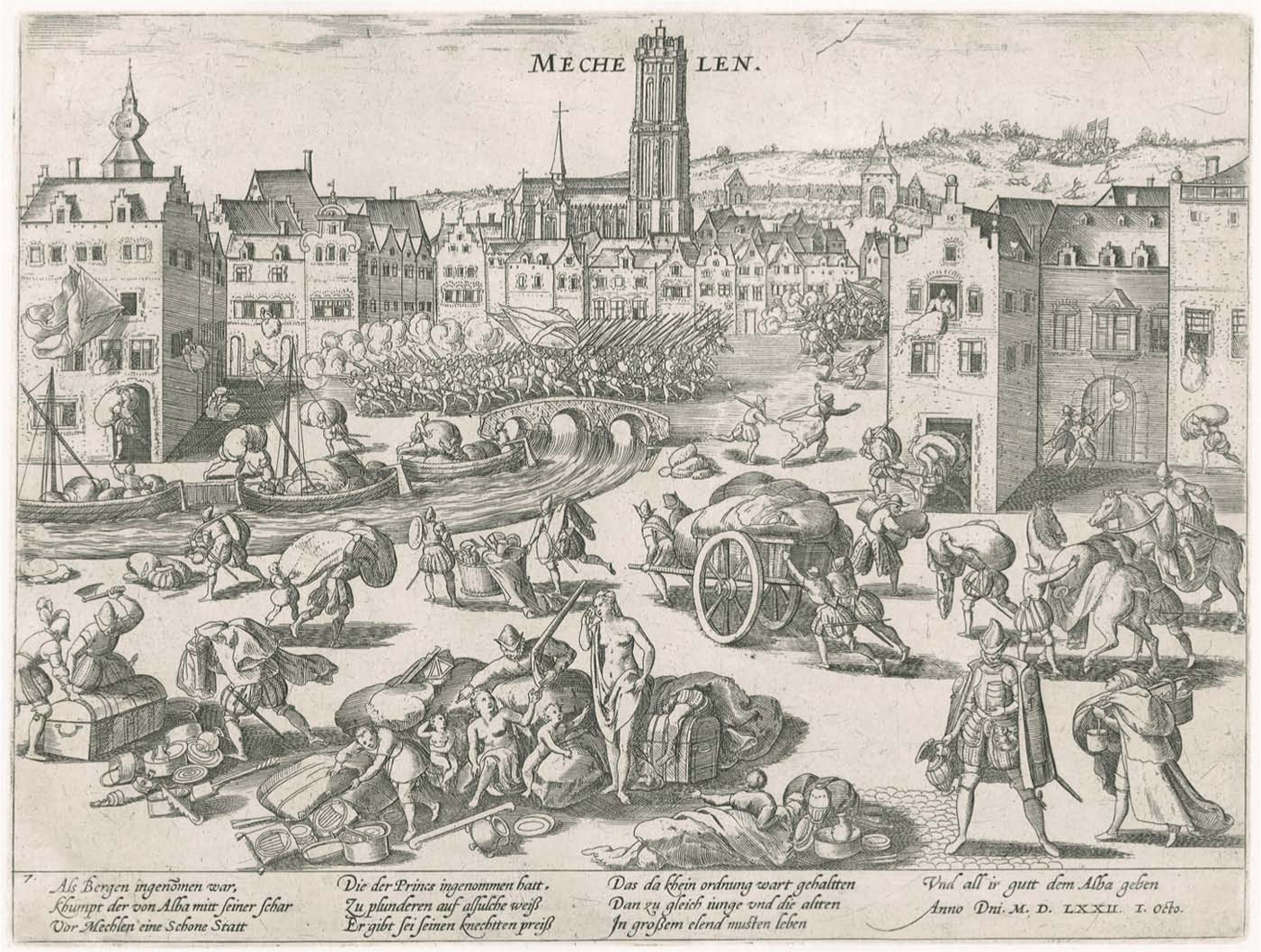
Mechelen sacked by Army of Flanders, 1572. Frans Hogenberg.
In the very same year of 1572, however, Hogenberg engraved an entirely different illustration of Mechelen (Figure 2). It appeared in the first volume of the Civitates Orbis Terrarum, an atlas of world cities that he and the Cologne-based Georg Braun produced. 2 So successful was the atlas with its elegant cityscapes, Latin texts, and cartouches that it prompted French and German translations, and the publication of five subsequent volumes. Like many of the atlas’s cityscapes, Mechelen is rendered in profile view. Parish churches and city gates shape the urban landscape, small groups of townspeople and laborers cluster in the foreground on the greenery surrounding the city, and boats ply the river’s waters. The city is expertly demarcated and spatially balanced according to the latest techniques of cartography and chorography, with Mechelen presented as a self-contained, well-ordered civic realm.
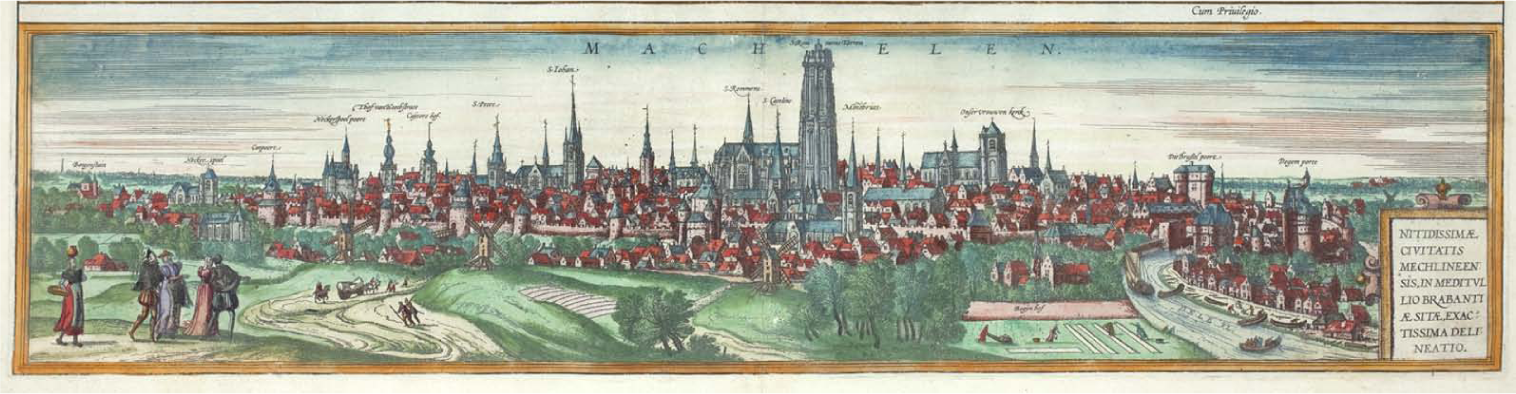
Mechelen, 1572. Braun and Hogenberg.
Hogenberg’s two cityscapes of Mechelen in 1572 were thus opposites: the first a depiction of its sack, a farrago of motion and fury; the second, a tribute to its urban form, harmonious and elegant. For the artisans, merchants, noblemen, and royalty who were their intended audience, early modern prints served as barometers of cultural tastes and political interests. For a ruler like Philip II of Spain, simultaneous illustrations of cities under their lordship like Mechelen destroyed and exalted were not the contradiction its binary might seem. If Hogenberg’s print of Alba’s sack bespoke the power of the prince to punish errant cities, his profile view of Mechelen in his atlas confirmed that such troublesome cities nevertheless mattered, as important to a sovereign as any other cherished asset. Little wonder then that monarchs like Philip eagerly embraced the new cartography, commissioning its most talented practitioners to catalogue their prized urban possessions in topographically exact representations. 3
Royal patronage of works like the Civitates Orbis Terrarum speaks to the political desire of princes to know, grasp, and master their urban terrain and display this hegemony as much in representation as in political policy. Such interest in the management and presentation of urban space made ample political sense in the early modern world of territorial rulers and their urban subjects. Historians have long recognized the cornerstone role of cities in the premodern state. Indeed, they have hailed cities with almost Whiggish enthusiasm as springboards of modernization—a scholarly inclination social theorists of cities, from Georg Simmel to the Chicago school, likewise embraced. 4 To the early twentieth-century practitioners of urban theory and history like Max Weber and Henri Pirenne, medieval cities were incubators of commerce, political liberties, and associational life. Communal self-governance was a political accomplishment Weber touted as unique to the West, one remarkably distinct from middle and near eastern urban traditions, where municipal power was subordinate to state power and cities subject to top–down administration. 5 If these early twentieth-century scholars interpreted cities in a heroic vein with an occidental conceit, their arguments still have weight in scholarship on premodern urban life, despite the overturning of much of what they proposed. We still too often consider cities in the teleological key, and still imperfectly understand their enmeshment within larger interests, particularly those of lords and sovereign. 6 We are far better at acknowledging the political football cities became to early modern dynastic states, whether as sites for conquest in the Habsburg-Valois turf battles in Italy, or as targets of the centralizing interests of the French or English crown, or as resources to be integrated more firmly within the sprawling Habsburg composite state, from Castilian urban centers to the developing civic grid in the viceroyalties of New Spain and Peru. 7 Historians further recognize that cities lost many of their hard won privileges to the interests of the state between the late middle ages and the seventeenth century, or at least had them fiercely contested, though exceptions like Geneva, Emden, or the Swiss League make blanket generalization unwise. 8 Much of the taming of urban independence happened piecemeal or at key moments—after a decisive military victory or political battle—when an overlord could weaken urban constitutional rights or impose new military fortifications to change the face of urban design. 9 Charters might be revoked, guilds combined or abolished, financial obligations stiffened, and legal privileges contested. The city’s built environment too might be affected, whether by negotiation with urban magistrates or by top–down mandates: new walls erected, citadels constructed, and princely or viceregal residences established, altered, or expanded. In some instances, these two processes were interlaced—dramatically so when individual cities were singled out for punishment at the hands of sovereigns and their military deputies. In such cases, cities were forcibly remade through a repertoire of punishment: theatrical enactments of defeat, spatial alterations of defining features like walls and gates, and political and financial indemnities. Cities might also fall victim to a military sack, swift, violent, and all too common in the late medieval and early modern period. 10 In rarer instances, princes and their militaries might destroy core sections or even the whole city. Whatever the terms of the penalty, princely retributions could dramatically transform cities.
In what follows, I consider these punitive measures in the early modern Burgundian and Habsburg world, tracing their application in the urban-laced territories of the fifteenth-century Low Countries and tracking their political currency in sixteenth-century Habsburg territories, including New Spain. Urban historians have long insisted that the transformation of the medieval commune into the Baroque city was a pivotal event in the history of modernity, the city a privileged site of and midwife to modernity. 11 But the momentous change in civic life came not only because of the city’s commercial wealth, dense populations, and roaring economic might. 12 Claims to political power, whether civic or princely, were enacted in the early modern city’s public places, with assertions of rulership performed at city gates, upon market spaces and other public squares, and through corporative and sacred symbols. These spaces were densely layered with political resonances, none more important than as venues for communal values that were both essential to urban identity and to the interests of the state. In the early modern period, these civic spaces became marked as contested grounds, especially for those cities whose political boundaries were under the strain of dynastic rulers intent on better managing their subjects. 13 Nowhere was this more true than the Burgundian Low Countries, with northern Europe’s greatest concentration of cities and with a dynastic state within which the balance of power between civic regimes and princely administrators was neither stable nor fixed. The spatial dimension of civic and princely conflicts offers new ways to understand what was at stake in the fierce competition between Burgundian dukes and their cities. For in Low Countries cities, as elsewhere, space was more than just an inert container; rather, it was an accumulation of concrete places that both signified and enacted communal authority—walls, public squares, town halls, guild houses, city gates, churches and chapels, and processional routes. To disrupt, reset, and master these spatial zones was to destabilize, even delegitimize, how such places worked in tandem with one another as expressions of the civic sphere.
The burden the early modern city bore as a platform for securing political legitimacy was consequential. The city was the progenitor, as Henri Lefebvre ambitiously proposed, of modern spatial practice, a sphere whose very concrete places and their discursive representations braided the social relations of self, society, and production. Lefebvre’s The Production of Space is a prolix, sprawling meditation on spatiality, not urban history as such, much less a chronology of the empirical repercussions of the politics and practices of place. 14 Yet it has much to say to urban historians not only by endowing space with causative power but also by acknowledging its historicity. In a concrete way, the consideration of the alteration, remaking, and wholesale destruction of a city as political and military punishment underscores the power of space to tether the communal values that were the source of so much conflict between territorial lords and cities. To destroy and remake urban space and key urban signifiers like walls and gates was to construct and reconstitute political authority in the public domain, encompassing the precise boundaries of citizenship, the legal long arm of sovereign authority, and the public realms where they could be legitimately enacted.
Antagonisms between cities and rulers are as old as urban life itself. In the near eastern or classical world, political triumphs often came at the painful expense of subjects and their cities’ spatial foundations, with claims to royal authority staked on mastery over urban terrain.
15
When the Assyrian King Sennacherib sacked Babylon in 589
I destroyed the city and its houses, from foundation to parapet, I devastated and burned them. I tore out the bricks and earth of the inner and outer walls (of the the Arahtu canal). I dug canals through the midst of that city, I flooded it with water. I made its very foundations disappear, and I destroyed it more completely than a devastating flood. So that in future days the site of that city and (its) temples would not be recognized, I totally dissolved it with water and made it like inundated land.
16
To Sennacherib, victory over Babylon, the slaughter of its inhabitants—about which he also boasts—and the seizure of its precious assets was not enough. The city had literally to be unmade, dismantled, and erased so that the rival Nineveh assumed its luster and replaced its historical significance. Such victories over cities, predicated on the memorialization of triumph and blood-soaked destruction, proliferated in the ancient Near East and classical Mediterranean, the stories of the destruction amplified by centralized states and their monarchical or imperial idioms of rule.
Although most of these ancient reprisals against cities had been forgotten by the late middle ages, three were firmly lodged in the cultural memory and became reference points for early modern rulers: the campaigns that resulted in the destruction of Troy, Jerusalem, and Carthage. Of this trio of cities, Troy had the most elastic resonances, in part because its Homeric literary glow was just as rich as its political metaphors.
17
For sovereigns, Troy became a handy reference in the political task of inventing heroic lineage. Less explicitly, it served the cause of political triumphalism. The cases of Carthage and Jerusalem were different to the Romans and their heirs, for their destruction carried rich political associations. Scipio Aemilianus’s sack of Carthage in 146
Like their near eastern and classical predecessors, medieval cities fell prey to the violence of lords and princely enemies. Italy’s remarkable communal movement in the late eleventh century had its roots in the pushing back of episcopal and princely authority to secure political, property, and trade privileges. 20 There, in Lombardy and elsewhere, cities gained charters of rights by delimiting external authorities or vacating them of real power. The communal movements’ victories were astonishing, but never complete. The political tremors they unleashed provoked the best known medieval prototype of punishment against an urban adversary: the German Hohenstaufen emperor Frederick Barbarossa’s triumph over Milan and its Lombard allies in 1162. 21 Determined to assert imperial claims over his northern Italian territories, Barbarossa went to war against rebellious Milan and its allies. The humiliation of Milan represented the pinnacle of his campaigns in northern Italy. On March 1, 1162, Barbarossa forced the city’s defiant magistrates, ringleaders of a coalition of allied cities, to submit before him in penitential garb and with swords hung around their necks. Five days later, the Milanese surrendered their war wagon, the carroccio, unfurling the banner of their patron Saint Ambrose, a divestment of their proud symbol of civic might. The city was given over to Barbarossa’s men and Milan’s enemies who had sided with them. They proceeded to thoroughly sack and destroy the city: walls were torn down, moats filled in, and churches plundered. Having earlier vowed not to wear the imperial crown until Milan’s defeat, Barbarossa celebrated its demise at Easter mass in Pavia—a religious and political rebirth predicated on the commune’s eradication. 22 Barbarossa’s punishment of Milan was a benchmark in the imperial response to communal independence, and an indication that a medieval lord was willing to destroy a city that had dared to resist him.
Cities waged battles for hegemony among themselves, and they did so on the same terms, and with similar resources, as did their princes. The new world of cities dotting the European landscape triggered fierce competition and warfare during which retaliatory gestures focused on key urban symbols marking communal authority. Here again, the Italian cities have provided some of the best examples. Humiliation after sieges included robbing a city of its civic banners or statues of its cherished saints and carting them into the victor’s city in a minor version of a Roman triumph. It spawned rituals like the felling of trees and the minting of new coins bearing the attacking city’s insignia upon their stubs, which on occasion were then pressed into the enemy city’s walls. 23 In November 1335, after Perugia defeated Arezzo, the victors had their communal flag hung from Arezzo’s cathedral, forced its bishop to celebrate a victory mass, and minted medals celebrating the triumph in the piazza, They even forced a race of prostitutes in front of Arezzo’s main gate—a shaming ritual other communes also practiced in warfare. 24 Such victory rituals made up the woof and warp of retaliation among warring cities, intended to mock a defeated city by deflating its civic pride. But these military actions rarely scaled up to the kind of draconian punishment a great prince like Barbarossa inflicted upon a defeated city.
Barbarossa’s destruction of Milan was memorable not merely for the thoroughness of its violence and the sacred and imperial imagery it knitted together, but also for its utter failure to secure his political influence in northern Italy. The German emperor’s Lombard enemies banded together in a League, a battered Milan joining them, and eventually won back their independence in 1183, effectively rebuffing Barbarossa’s northern Italian strategy to subdue the cities. 25 The success of the Lombard League carried a political message to future lords: cities, no matter how truculent, were better dealt with through negotiation and strategic alliances. Barbarossa’s political failure suggests why, despite the classical heritage of sieges and sacks, high-profile retaliations against cities that involved their partial or whole dismantlement were not common in the medieval world. More typically, a king or lord reigned in a city’s republican inclination while nurturing the development of civic space, civic institutions, and civic prosperity. The rulers offered charters of liberties in political, economic, and legal matters in exchange for a dependable source of revenue, and supported urban fortification projects to secure commercial and population centers from enemies. It was a civic policy that, for example, the French monarchs successfully pursued with their bonnes villes throughout the medieval period. 26 Dramatic and exemplary destruction of cities, by contrast, typically occurred outside one’s own territories, the farther away the more violent. Such was the infamous sack of Constantinople during the Fourth Crusade in 1204, the great Byzantine city plundered and its religious treasures looted. 27 Even the much anticipated denouement of the Spanish reconquista, the fall of Granada in 1492, occasioned no vengeful looting or destruction of the city. Instead, the Spanish monarchs carefully negotiated a surrender through a series of stipulations that guaranteed the urban public sphere remained intact even as the emirate of Cordoba was dismantled. 28
But if rare, princely retaliation against a city’s built environment or civic symbols nonetheless did occur, especially in the late medieval and early modern period when cities became victims of new and more aggressive artillery warfare and the ambitions of Renaissance princes. In the Burgundian Low Countries during the fifteenth century, conflict between princes and cities spawned a repertoire of punishment and retaliation more pronounced than almost anywhere else in Europe. The sharpness of conflict between prince and cities in the Burgundian north had everything to do with the particular configuration of power in the territories the dukes of Burgundy ruled as well as the formation of their composite state. 29 A cadet branch of the French monarchy, the dukes of Burgundy—through the accidents of dynastic succession and a shrewd plan for military expansion—acquired a set of territories that eventually stretched from ducal Burgundy in northern France to Holland and Zeeland, lands laced with mid- to large-sized urban centers of great commercial importance. Theirs was not a unified state but a series of accumulated territories over which they exercised sovereignty in local titles of rule. Apart from the senior and mid-level nobility—the grands seigneurs and gentilhommes—the dukes’ greatest political interlocutors were the urban patricians, merchants, and guild masters whose coalition governments ran the textile-manufacturing and trade cities that populated the landscape. While sometimes their political and economic interests might overlap—the distinction between state and city should not be exaggerated since the court was often very present in the urban landscape as was the city at court—the ducal administration and the cities of the Burgundian Netherlands were often at loggerheads. As fledgling rulers of the Low Countries, the dukes of Burgundy desired the acquisition of new territory and the efficient consolidation of their rule. The cities, economic centers like Valenciennes, Douai, Lille, Bruges, Antwerp, Ghent, Middelburg, Leiden, and Amsterdam, among them, had opposite ambitions. Some big cities like Ghent sought city-state independence, and other urban regimes, no matter what size or rank, hoped to reduce external political control while expanding their dominion over civic political life and rural hinterlands. In the main, these ducal-civic tensions were debated in the parliamentary-like regional estates, where towns bulked large as a political block, and in political negotiations between town aldermen and representatives of Burgundian leadership. 30 And yet tensions were constant, sparking upheavals against Burgundian policy and even warfare. A common feature of the Low Countries since the twelfth century, urban revolts occurred with increasing regularity during the Burgundian period. In the leading Flemish city of Ghent alone, there were rebellions in 1401, 1404, 1406, 1411, 1414, 1423, 1437, 1440, and 1449–1453, the last expanding to a full-scale war with duke Philip the Good. Bruges, a court city and a commercial center, was engulfed in rebellion in 1411 and 1436–1438. 31 Such turmoil reflected diverse antagonisms: internal strife pitting guildsmen against merchant and patrician elites as well as more vertical tussles between city regimes and Burgundian officials who were squeezing them for revenues and resources. 32
In a political terrain rocked by civic instability and aggression, the Burgundian dukes resorted to a policy of exemplary punishment of difficult urban adversaries, often targeted at urban space. Depending on the relative value of a city and its place within the Burgundian patrimony, rituals of punishment assumed two different modes: elaborate forms of humiliation or the partial or whole destruction of the city itself. Philip the Good’s punishment against Bruges in 1438–1440 and his war against Ghent in 1452–1453 set the model for the Burgundian use of penitential rites and spatial alteration against rebellious cities. Both cities were key to the Burgundian patrimony: rich, big, and located in the all-important county of Flanders, the heartland of the Burgundian state. Both civic rebellions were fueled by opposition to increased fiscal burdens put on them and by divisions among the urban political class—patricians, master guildsmen, and merchants. 33 To both cities, Philip the Good meted out punishment that included the execution of each revolt’s ringleaders and an onerous financial penalty: 200,000 golden ridders, an amount in excess of the usual annual tax burden of each. At the same time, Philip the Good’s actions against Bruges and Ghent involved laser-sharp alterations to urban design, most notably the tearing down or sealing off of key gates that had been staging grounds for the rebellions, and the ordering of commemorative masses to give liturgical permanence to the memory of princely victory.
The centerpiece of Bruges’ and Ghent’s symbolic punishment was a ritual of collective abasement, the so-called amende honorable (honorable amend), staged as a preface to the duke of Burgundy’s ceremonial entry into the defeated cities. This penitential ritual was not new; it was drawn from the church’s sacrament of penance and melded to its role in customary law in kingdoms like France as a means of the public confession of one’s guilt for a misdeed. 34 But the amende honorable’s political application was still fairly novel, and its penitential quality—confession, penance, and forgiveness—paramount. 35
Both in Bruges in 1438 and Ghent in 1452, the duke’s officers had threatened to raze the rebellious cities to the ground as punishment. 36 Such political swagger is hardly surprising for a late medieval prince, especially given the seriousness of each city’s upheaval. Bruges had rebelled for a number of economic and political reasons. Foremost was Philip the Good’s new alliance with the king of France that had cut the city off from its important textile relations with England, supplier of its wool. When Philip attempted to visit Bruges on May 22, 1437, to deal with the boiling tensions, his ducal train of Walloon soldiers was ambushed; a high-ranking advisor, Jean de Villiers, was murdered in the streets; and the duke himself barely escaped with his life. So dramatic was this attack that it spawned numerous written accounts and even a ballad about Villiers’s fate that was still sung in the sixteenth century. 37 Ghent likewise had economic and political grievances: bitter resentment of a new salt tax in 1451 served as a surrogate for larger conflicts over the prince’s economic control of the hinterland and his incursions upon civic autonomy. As in Bruges, so in Ghent: the old city regime fell to rebels, who were convinced that its town fathers were secretly complicit with ducal policy. Full-blown war ensued. A special regime of three captains led the Ghent campaign, rallying guildsmen to their side with the promise of a fuller advocacy of their rights and prompting constant public demonstrations on the central marketplace where guildsmen defiantly lofted their banners. Ambassadors for the French king intervened in 1452, and in the course of threats and negotiations, Philip menaced Ghent with demolition in retaliation for their war against him. 38
Neither city, however, was demolished. They were not because they suffered a greater disgrace, that of subjecting their persons and their city to a public ritual of submission that granted the defeated no honor, only shame. Undressed, unarmed, and on their knees in penance before a triumphant duke on the cusp of entering and taking possession of the city, Bruges’s and Ghent’s magistrates suffered loss of control over their respective city’s communal spaces—precisely why the ritual of the amende honorable was the acme of both cities’ punishment. The prince offered reconciliation but at the price of a collective penance, with the accompanying alteration of gates and walls intended less to disrupt civic life than to insert the memory of punishment within it. The humiliation ritual of Bruges and Ghent had two leitmotifs for the Burgundian duke: the penance ritual that endowed the ruler with a sacerdotal authority and a political one that presented him as a triumphant, but forgiving, ruler. Enacted by guild deans and other political leaders, the amend was a public performance, one that enriched the already keen interest of the Burgundian state in the visual, textual, and ceremonial recording of their political might. Didactic about the subordinate place of the urban sphere, performances and commemorations of civic submission became as important as the physical and financial punishment of urban enemies because of the way they reordered public space and recorded these political shifts in public. Such punishments also resonated in the civic realm, their memory invoked to justify later protests and rebellions.
These rituals were part of a larger effort to create a master narrative of civic subordination in prose, verse, and visual texts that the Burgundian prince, like rulers of other territories, encouraged. Urban punishment as a subject in artwork, for example, is taken up in two tapestry sets, no longer extant, commissioned by Philip the Bold and John the Fearless that illustrated the victories of Roosebeke and Liège over urban rebels in 1382 and 1408. Tapestry sets were staging props, all the more effective because they were theatrical in grandeur and easily portable and put on display at ceremonial events and in diplomatic venues. Memorialized in tapestry, the triumphs of Roosebeke and Liège could be restaged upon demand, at court events and diplomatic meetings. 39
Just as ducal tapestries were serviceable political vehicles, so too, in a less obvious way, were Burgundian literature and theater. Titus’s destruction of Jerusalem was among the histories, Biblical stories, saints’ lives, and romances crowding the ducal library. The narrative of Jerusalem’s siege and sack chronicled by the Jewish Roman Flavius Josephus, however, was much changed in the late-medieval retelling, especially in Eustache Marcadé’s play, La vengeance de nostre seigneur, performed regularly in northern France and the southern Low Countries in the fifteenth century. Marcadé’s text was a late medieval son et lumière extravaganza, a play so ambitious, densely layered, and violently themed that it had a shock and awe quality to it. The Arras manuscript—one of two that survive—runs 14,554 lines and required three days to perform. It required a cast of more than one hundred actors, and perhaps twice as many extras. Marcadé’s theme is the triumph of Rome over Jerusalem in They are exactly like the Jews. They band together against God, and men come and seize the property of others, like the thieves, pillagers and brigands . . . and the girls are raped. They are not at all afraid of married men either.
40
As political dramaturgists who staged urban defeat through rites like the amende honorable, the Burgundian dukes’ interest in Marcardé’s text is understandable. Its recounting of Jerusalem’s violent end as rightful punishment against the Jews inspired two fragments of a tapestry set about the destruction of Jerusalem now in Tournai and in the Metropolitan Museum in New York, which scholars think Philip the Good owned. 41 Given the popularity of the drama in urban theater in northern France and the southern Low Countries, it should not surprise us that Philip likewise commissioned an illuminated manuscript of Eustache Marcadé’s Vengeance, now housed in Devonshire. The manuscript is described in a 1467 inventory of the duke’s library, and there is payment to the copyist and illuminator recorded in 1468 after Charles the Bold came to rule. 42
The year 1467 is a particularly apt date for the Burgundian acquisition of the manuscript of Marcadé’s Vengeance, with its harrowing storyline of urban defeat, starvation, cannibalism, and other forms of human misery inflicted upon Jerusalem’s citizens. That same year, Duke Charles the Bold was engaged in warfare with the independent principality and bishopric of Liège. A year earlier, he had defeated and violently sacked its ally Dinant, continuing campaigns begun by his father Philip. 43 The punishment rendered again Dinant in 1466 and against Liège, first in 1467, and more spectacularly in 1468 after yet another rebellion, took Burgundian reprisal against troublesome cities to a new level. The violent ransacking of each city echoed the fate of Jerusalem. Certainly, the chronicler Jacques du Clercq thought so; following four days of systematic destruction of the walls and properties of Dinant after it yielded to the forces of Charles, he compared the violence specifically to what befell Jerusalem, while also mentioning the two classical analogies of Troy and Carthage. 44
The near total destruction of Dinant and Liège stunned contemporaries. Ballads decrying the fate of the cities were written, chroniclers dutifully recorded the pillage as a fitting punishment for the sins of these rebellious citizens; townspeople themselves—ruling magistrates above all—recoiled in awe and fear, exchanging hasty messages describing the violence, some from regions beyond Burgundian territory, like German magistrates from Cologne to Nuremburg. 45 Even stubborn Ghent sent a letter of congratulation to Charles the Bold on his victory over Liège. 46 Significantly in 1469, just a year later, the city of Bethune paid for the public performance of a play concerning Liège’s destruction, both a jab at an urban adversary and a cautionary tale to local inhabitants that the price of rebellion was exceedingly high. 47 In considering why first Philip the Good and then Charles the Bold punished these cities so dramatically, the political valence of these actions as a form of exemplary violence stands out. It worked—so much so that neighboring cities memorialized the victory in civic drama, just as the Burgundian dukes themselves commissioned the illuminated manuscript of Marcadé’s play about Jerusalem’s fate. The parallel between real-life sieges and their fictional and historical enactments surely is instructive. Sieges were large-scale, staged events whose visual representation in prints and whose theatrical staging—with audiences invited to visit and watch—would become commonplace in the sixteenth and seventeenth centuries. 48
That Dinant and Liège were singled out for an exemplary destruction had everything to do with their political jurisdiction. While both cities were part of the Burgundian sphere of influence, and Liège a bishopric, neither was under the direct political authority of the duke. As such, the public relations issue that confronted Philip the Good when considering how to punish Ghent and Bruges—the implications of the choice to destroy one’s own patrimony and thereby violate the ideal of the prince as protector of the bien public—was less pressing. 49 What is more, neither city had earlier surrendered, so war had been ongoing and their punishment was not part of a carefully negotiated peace treaty but a sack following a siege. Standard fare in the premodern world, sieges and sacks were often conjoined as military operations. They were not only widely practiced, but the stuff of princely vanity, with the siege even a motif in court ritual and pageantry, including as a popular metaphor deployed in tournament and carnival. 50 Further, there were the so-called rules of wars that defined the permissible boundaries of a sack, though these were less a set of codified legal points than a loose amalgamation of treatises and legal opinions. While we should exercise a healthy skepticism about whether “laws” governing late medieval warfare were as fixed as the term implies, there was still a working consensus among political rulers and their court chroniclers in northern Europe that sacking was fitting punishment for a defeated city whose defiance had gone unabated. 51 The “customs of war” might be loosely defined, but destruction, looting, murder, and rape were standard practice, with classical models, most prominently derived from Roman history, shaping the tradition. The very Latin term that came to describe a city plundered, the verbal noun direptio employed by authors like Livy and Tacitus, had rape as its semantic essence. In Roman warfare, direptio came to signify two simultaneous activities: plundering a city and raping its citizenry, women above all, but male youth too. 52 Possessing the city, therefore, permitted the seizure and violent destruction of the built environment and the sexual violation of the citizenry, its dependents—youth and women—most notably.
Of the two sacks by Charles the Bold, Liège’s was more consequential because it had long been a hotbed of anti-Burgundian radicalism to the point that an exasperated Philip the Good had compared its citizens to Turks in 1466. As previously noted, Liège was also a bishopric, which raises a paradox: why would an ambitious prince like Charles the Bold so violently punish a bishop’s seat, especially when he cultivated sacred and priestly metaphors of authority in his statecraft? 53 Two-thirds of Liège was razed in 1468, its churches and chapels looted; its civic column, the Perron, confiscated; its religious objects and relics stolen. This kind of damage had been a concern of the church throughout 1467, when the papal legate Onofrio de Santa Croce, dispatched to Liège, had worked hurriedly to mediate a peace, impose an interdict, and protect the legal interests of the clergy and bishop. 54 True enough, the fifteenth century was the era of the Renaissance prince, and one needs only to look to Italy to see that prelates, bishops, or even higher church officials were by no means immune to the incessant violence. Nevertheless, a strategic destruction of a bishop’s urban seat was risky as a form of exemplary violence. Charles the Bold knew that. While churches and chapels were looted, they were also left standing; while soldiers pilfered ecclesiastical objects, the duke intervened to seize and protect the relics of Saint Lambert in the bishop’s cathedral, which he later returned. What is more, in 1471 Charles donated to the cathedral a beautifully wrought gold votive statue executed by the Lille goldsmith Gérard Loyet that consisted of two statuettes, one of himself, another of Saint George, resting upon a gold pedestal. 55 In a city only then rebuilding, Charles consecrated himself as a hero-savior, proving that a bishopric is fair target only if its sacral legitimacy is secured, and the prince’s enhanced in the process.
The destruction of Liège and Dinant stand as high water marks in the Burgundian campaign against cities. The cycle of urban rebellions that flared between 1477 and 1492 in southern Low Country cities against Maximilian of Austria triggered renewed princely antagonism against cities, but not with the ferociousness Charles the Bold had unleashed against Liège and Dinant. 56 Yet the sixteenth century and the Habsburg era saw not only the continuation but the intensification of Burgundian spatial penalties against cities. Now, however, they were cast more broadly and joined to the ambitious, pan-European campaign to gird cities with citadels and bastion-styled fortifications, a development the architectural historian Martha Pollak has dubbed “military urbanism.” 57 One reason for bigger and more violent interventions against cities is that princes were more aggressive in efforts to scale back urban autonomy. The Habsburg world also had larger stakes, greater terrain, and imperial conceits of universal monarchy. 58 Like his predecessor the Burgundian duke Charles the Bold, Charles V came to power facing urban truculence, as early at 1515 in Flanders when he attained the countship of Flanders, but tellingly in the 1520s in Castile, when he confronted the revolt of the comuneros. This sustained, complex string of urban protests by Castilian cities whose rallying cry was on behalf of “communidad” he punished lightly. Despite the widespread rebellion and armed conflict, none of the rebellious cities was altered spatially. 59 Once more fully established, however, Charles V treated urban adversaries harshly, the lessons of the troubles in Flanders and Castile not forgotten. 60 The exemplary punishment of cities had considerable traction in his larger imperial project. But results were mixed, particularly in its most famous instance, the sack of Rome in 1527. On a cold and foggy May 6 of that year, Charles’s mercenary forces, exhausted and poorly paid, decided to plunder the riches of the city they had just taken. German lansquenets and Spanish and Italian infantry poured into the city while a startled Clement VII, his curia personnel and his cardinals fled into the safety of the Castel Sant’Angelo to be joined eventually by some three thousand citizens. What transpired sent shock waves throughout Europe, and became the subject of bitter polemics and sharp-tongued pasquinades that drew on the talents of some of Renaissance Europe’s greatest literati. 61 The forced imprisonment of Clement VII and the reduction of Rome to a smoldering slaughterhouse hardly befitted an Emperor who was a sworn enemy of the Lutheran heresy and the newer menace of iconoclasm. 62 Indeed, Rome’s sacking was a public relations fiasco for the emperor, interpreted as both overreaching and sacrilegious, a point Baldassare Castiglione, in his capacity as papal nuncio, riposted in a letter to Charles’s secretary Alfonso de Valdés, author of a defense of Rome’s fate. 63 Charles the Bold, after his forces had destroyed the bishopric of Liège and robbed its ecclesiastical gems and relics, had justified this violence as protection of the city’s sacrality, sealed both by his personal vow taken in the cathedral before the fighting had started and his preservation of the relics of Saint Lambert. Rome was an infinitely more important and audacious prize, but Charles V had not directed, much less authorized, the full scale of violence that had erupted against it. As a result, he could neither claim nor recuperate any sacrality, his authority blemished by the violence carried out by his very forces. The sworn enemy of iconoclasm, it seemed, had become the greatest iconoclast of them all.
The attention given to the famous campaign against Clement VII that culminated in Rome’s pillage has overshadowed three other important triumphs against cities. Before Rome’s sack, the taking of Prato by Charles’s imperial forces in 1512 had spawned outcries about civilian casualties and rape of women, girls, and young boys, though it did not unleash political furor. 64 In 1553, Charles V ordered the French royal enclave and bishopric of Thérouanne in Artois razed down to its foundations, a fate that befell also the small, nearby town of Hesdin. 65 While the stakes were not particularly high, both were well-known buffers in the Valois–Habsburg borderlands. Thérouanne, like Liège, was a bishopric, one whose cathedral was destroyed, whose chapter was distributed between Saint Omer and Boulogne, and whose seat was transferred among those two cities and Ypres as part of the reorganization of bishoprics in the Low Countries in 1559. 66 Thérouanne and Hesdin were consequential less for their political reverberations—they were too small to provoke serious rumblings—than for the fact that they represented a new pinnacle in princely violence: the entire destruction of a city down to its foundations.
Charles’ greatest urban prize after Rome, however, was the capture of Tunis in 1536 as part of the skirmishes between the Spanish, the Portuguese, and the Barbary kingdoms, a news event that inspired analogies to Scipio Aemilianus’s sack of Carthage in 146
The political usefulness of Tunis’s sack was obvious. Tunis’s classical foundations as Carthage allowed Charles to present his campaign as a Roman triumph; its Moslem status and the release of its Christian prisoners burnished the victory as a crusader’s success. Tunis played the role of the good victory, the rightful sack to expunge the urban violence gone awry when Rome had been taken in the emperor’s name. No wonder the Tunis victory was invoked regularly, most ardently in a string of Italian entry ceremonies that Charles made in 1536 on his return to the Italian peninsula, the most famous of the many processional entries of his reign. This was the case in Palermo, Messina, Naples, Genoa, Rome, Siena, Florence, and Lucca, where classical apparati and pompous analogies to Scipio Africanus and Carthage were favored. In Messina, captured Moslems even participated in the triumph, seated in a small chariot, and paraded before the emperor as he approached the city walls in a belabored effort to revive the Roman triumph. In Rome itself, the city displayed refurbished pride, the parade route laid out to revive the ancient via triumphalis. Charles’ entry into Rome came, however, at the expense of urban properties, including an astonishing two hundred houses and four churches torn down in preparation. 68 Charles was hailed as a classical imperator to a city his forces had only recently devastated. It was a stunning renewal after the hatred incurred from the desolation inflicted in 1527. 69 It was not, however, without hard feelings, captured best in a work of anonymous graffiti that mocked Charles’s entry by portraying him riding into Rome seated on a shrimp, his famous device plus ultra reversed as plus retro. 70 That said, Charles’s Italian entries asserted his mastery over civic space while proclaiming his grand victory over the infidel city of Tunis.
As Tunis fed the imperial pretence of Charles, so did a triumph where he was repeatedly evoked but nowhere present: Hernan Cortés’s siege and destruction of Tenochtitlan in 1521. It was the sixteenth century’s most stunning example of a destruction of a metropolis. It was in the heartland of the Aztec tributary state that the Spanish set about to construct new municipalities in a landscape strongly marked by centuries of preconquest urbanism. Founding cities was key to Cortés’s own military and political strategy, starting with Villa Rica de la Vera Cruz in the Yucatan, whose formation of a cabildo, or municipal council, with Cortés as its head endowed his enterprise with legal independence from Diego de Velázquez, the military governor of Cuba. But he and his men also remade established urban centers, none more consequential than Tenochtitlan, the conqueror’s greatest prize. So much attention has been given to the compressed, stunning set of events that led to the city’s fall on August 13, 1521, that it is easy to overlook just how rapidly the Spanish utterly remade it into Mexico City with political and sacred spaces conducive to Habsburg concerns. Already by 1559, Charles V’s death could be memorialized in a funerary ritual that, while it could not rival the one mounted in Brussels in size or scope, nevertheless was remarkable for its ambitious staging. Its centerpiece was an imperial catafalque in the chapel of San José de los Naturales inside the convent of San Francisco festooned with paintings, one of which concerned the fall of Tenochtitlan. 71
The story of how a city whose spaces were both dangerous and utterly alien to the Spanish became a new civic platform of Habsburg authority is a narrative of violent reckonings. To say that Tenochtitlan, the shimmering island city of some 150,000 citizens, astonished Cortés and foot soldiers like Bernal Diaz is an understatement. 72 They compared it to a chivalric dream, and once reality better set in, a metropolis on the scale of Constantinople, Venice, and Naples. Cortés and Diaz marveled over the sprawling city’s urban squares, temples, marketplaces, and commerce, trying to square the Mexica they denounced as idolaters, sodomites, and foul practitioners of human sacrifice with the abilities of superior urbanites. But awe soon enough morphed into total destruction, done in the name of conquest and lord sovereign Charles V.
Two points are worth making about the stunning transformation of Tenochtitlan. First, Cortés’s decision to rebuild Mexico City upon the ruins of Tenochtitlan—and with its detritus as building blocks—was not necessarily a popular one, though it followed the Roman practice of building new cities upon the site of vanquished ones. Years later in 1553, the city’s viceroy could still decry the location of nascent Mexico City as the “worst that could have been selected.” 73 Such was not the case in Peru, where the Spanish founded the new coastal city of Lima as the administrative seat instead of the conquered Inca capital of Cuzco. 74 Cortés’s decision bespeaks the power of urban space—even when shattered by the most intense warfare, blood, and destruction—to retain and remake political and cultural boundaries. For that reason, Cortés’s imperial visions of a new capital could be spatially grafted upon indigenous Mexican ones. The city’s total destruction offered the possibility of renewal and transformation because its spaces still carried their special valences, even absent physical infrastructure. Second, while the new city quickly rebuilt with a Spanish traza at the center, the memory of Tenochtitlan’s destruction persisted. As Charles V’s funeral points out, both conquered and conqueror referenced Tenochtitlan’s fall for decades to follow, perhaps necessarily so, since the new city’s raison d’etre depended on remembrances of the old city’s destruction. The year 1539 is a case in point. In young Mexico City, Charles V’s peace of Aigues-Mortes with Francis I was feted with carnival celebrations—it was February and the Lenten season was at its close—and a mock Siege of Rhodes. Not to be outdone, nearby Tlaxcala, whose inhabitants had famously allied themselves with Cortés, months later staged the Destruction of Jerusalem, part crusader allegory and thinly veiled reference to Tenochtitlan’s fate only eighteen years earlier. 75 It is telling that there is an eighteenth-century Nahautl text of the Destruction of Jerusalem play that is directly linked to a fifteenth-century Catalan text, Destruccio de Hierusalem, itself a cognate of Marcadé’s late-medieval French original that Philip the Good had commissioned as an illuminated manuscript. On both technical and contextual grounds, Louise Burkhart argues that the Nahuatl text evolved from a lost sixteenth-century original, perhaps one tied to the 1540 Tlaxcalan staging that the Franciscans had organized and which Torbio de Benavente Motoliná recounted in his chronicle. 76 Whatever its prototype, the Nahuatl drama centers on the destruction of Jerusalem. Take, for example, the starkness of its injunction: “Let us level it. Let us destroy it. Let no stone remain in it.” Jerusalem is the city in question, but Tenochtitlan’s fate is implicitly evoked, just as the Tlacaltecas had struck the analogy between the refusal of the Jews to submit to Roman authority and the refusal of Tenochtitlan to submit to Charles V. Tlaxcala had been wiser than its urban rivals; its city and people had flourished as a result.
In both the Mexico City and Tlaxcala productions, Charles V is entirely absent but absolutely present, if only in name and as a stage character. The real emperor was instead, as Bernal Diaz noted, in Flanders. What Diaz did not say was that Charles was replaying an old political script there in his role as a Burgundian heir facing the city of Ghent’s defiance, this time over a tax request to defray military expenses in the Habsburg–Valois wars. 77 An anonymous imperial sympathizer of the 1539 upheaval in Ghent excoriated Ghentenars for their provincial sense—even if factually true—that Charles was to them merely count of Flanders. 78 Ghent’s rebellion was radical and quixotic. It ended with Ghent’s aldermen and guildsmen performing a spectacular amende honorable before Charles, determined to showcase that his authority had broader reach than his political title to rule in the city as its count. The ceremony was heavy on explicit symbols reminding participants and spectators that Charles was an emperor of universal sovereignty, and the city not a zone independent of his reach. As punishment, the city lost it political and guild privileges, was spatially altered with a citadel built, reprimanded for treason, and compared to Carthage. 79 Ghent is as eye opening as Tenochtitlan, but for entirely different reasons. It was Charles V’s birthplace and a city of troublesome inclination. But its rebellion in 1539 drew a reaction from Charles disproportionate to its significance, especially when compared to the light punishment the emperor handed out to the more sustained revolt of the comuneros in 1521. Ghent’s rebellion prompted Charles to come from Castile to settle it personally, though there were other, graver issues he confronted. In two vastly different corners of the world, two entirely different sets of subjects gave tribute to Charles V by staging ceremonies of urban defeat and destruction, with Jerusalem and Carthage metaphors of urban chastisement. One need look no further than Maarten van Heemskerck’s prints of Charles V’s victories that Hieronymus Cock published in 1556 to grasp the point that subjected cities and citizens nurtured his imperial conceits. 80 The power of the sovereign was the power to control cities and amend civic space summarily.
In book five of The Prince, Machiavelli had stern counsel for rulers in possession of newly acquired cities that had lost their independence. He advised a sovereign to destroy conquered cities rather than rule a disgruntled, restless population who would forever chafe at the curtailment of civic rights. Yet few early modern princes opted for such drastic action. 81 The destruction of a city was rare, threatened against one’s own subjects, and inflicted selectively on outsiders, whether it be urban rebels in Liège, Dinant, or Tenochtitlan. But it did happen, and those cities singled out were touted as models of exemplary punishment, proof that a prince could remake a city by extreme violence, be it a familiar place, like Hesdin or Thérouanne, or entirely new and unsettling, as was Tenochtitlan. A prince’s more common remedy for urban rebellion, as we have seen, was to impose political restrictions. These actions typically focused less on blunting the city’s economic potential than scaling back its political rights, usually by revoking charters that granted guilds and other corporate groups a role in the election of town magistrates. But they just as insistently involved spatial punishments—the closing of city gates and walls, the removal of symbols of communal and corporate authority, and the enactment of ceremonies of defeat like the amende honorable. Such penalties were dictated in treaties and recounted in prose, verse, and artwork commissioned by princely victors. They demonstrate early modern sovereigns’ remarkable attentiveness to urban space as a cartography of civic symbols that enabled political expression and materialized it in concrete form.
In the seventeenth century, the power of the prince or king expanded with the growth of the territorial state. In lockstep, the rituals, political penalties, and iconographical and literary commemorations deployed against major urban rebellions intensified. Their content remained much the same, a telling indication that the axis of conflict between city and state—the wrestle between urban privileges and state authority—would not fundamentally change until the revolutions of the eighteenth century. In the seventeenth century, memorable reprisals against European cities occurred, especially the horrific sack of Magdeburg in 1631 during the Thirty Years War and the reconquest of Messina in southern Italy in 1678. 82 But for sheer triumphalism, Louis XIII’s defeat of the Huguenot stronghold of La Rochelle in 1628 stands out. For Europe at least, it represents the pinnacle of royal rituals of victory over civic liberties and public space, not the least because it was a culmination of the confessional divisions that had torn France asunder for much of the previous century. Not only were La Rochelle’s walls destroyed and its civic liberties confiscated, the city was politically refeudalized, forfeiting its independence and suffering the sting of becoming another’s possession. 83 Louis XIII’s victory also triggered one of the largest cycles of pamphlets, broadsheets, medals, and paintings in absolutist Europe, all outsized tributes to monarchical authority over the urban landscape. However grand its pretension, the iconographical palette of these commemorations of La Rochelle’s defeat owed much to the past, especially to Charles V and his penchant for memorializing his important sieges and sacks. Not surprisingly, old metaphors about the destruction of Jerusalem even crop up. Consider Poussin’s painting of the destruction of Jerusalem’s temple (Figure 3, 1625), with its neo-classical coolness and geometrical perfection, at first glance an artistic work entirely detached from the campaign against La Rochelle. Cardinal Francesco Barberini commissioned it at the height of the Thirty Years War, but he then offered it as a gift to Cardinal Richelieu, the architect of La Rochelle’s submission, a few years after the city’s defeat.
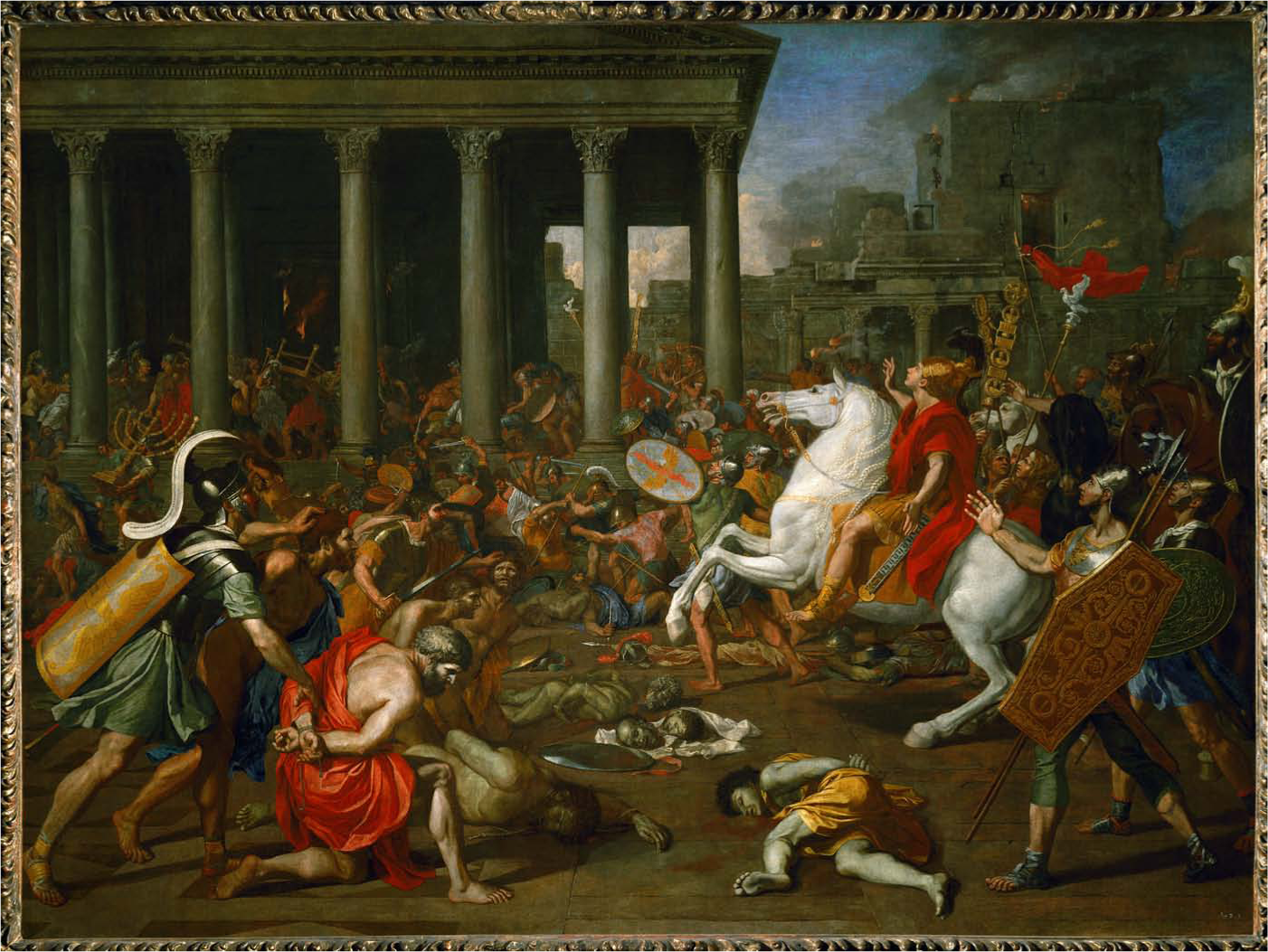
Nicolas Poussin: Emperor Titus destroys the temple in Jerusalem (1625–1626, oil on canvas).
In the Baroque era, monarchs and princes perfected their grip over urban space—citadels, royal fortifications, and military parade grounds established the field for the state’s militarization of civic space. 84 New court capitals like Madrid were transformed, with great squares like the Plaza Mayor remade as geometrically improved spaces better suited for monarchical ritual, the urban redesign inspired in part by the principles laid out for the development of Spanish cities in new world. 85 Great boulevards were built, linking bastioned fortifications to civic squares, and were then deployed as grander, more accessible zones for monarchical spectacle. Cities in the seventeenth century, metropoles like Brussels, Rome, London, Paris, as well as growing capitals like Lima and Mexico City, soared in population. But the politically troublesome spaces where late medieval civic protests occurred and where princely authority was negotiated—public squares, guild houses, town halls, city gates—were spatially better supervised, and in many cases recast, by sovereign power. These changes constitute not just an architectural narrative of new design—the more geometrically perfect streets, bigger squares, and more fortified walls featured in some urban histories. As we have seen, they were products of the centuries-long process of conflict, a messy, bloody, and entangled story of negotiation, coercion, and extreme violence, with cities attacked, besieged, and forcefully remade. The spaces of the medieval city that promoted communal identity and the prerogatives of citizenship were those recast to stage better the political obligations of subjecthood to the early modern state.
Footnotes
Declaration of Conflicting Interests
The author(s) declared no potential conflicts of interest with respect to the research, authorship, and/or publication of this article.
Funding
The author(s) received no financial support for the research, authorship, and/or publication of this article.