




Abstract
The economic vitality of all town centers is highly dependent upon an ability to attract customers. With the popularization of the car in Australia, the travel decisions of shoppers impacted local centers in two significant ways—more demand for car parking space and reduced dependence on local shopping destinations. A review of historical newspaper coverage about three local centers in an inner city area of Sydney provides insight into how a neighborhood adapts to such change. Marrickville, Dulwich Hill, and Newtown all wanted to change the town center urban form to remain attractive and competitive to customers but they each faced different barriers and pressures. Change was slow. Trade-offs were required. Mistakes were made, expectations changed, and new problems emerged. The neighborhood, in short, adapted.
These three ladies had a special interest in the official opening of the car parks on Saturday morning. Each has lived in the Marrickville area for more than 40 years and to them the parking areas were yet another step forward in Marrickville’s progress. (Figure 1)
1

Mrs. Whitney, Mrs. Parsons, and Miss Walker, the women referenced in the above quote, photographed at the official opening of the three car parks in Marrickville town center in July 1968. The presence of these long-term residents of Marrickville at the grand opening and enthusiastic coverage of the event in the local papers demonstrates how the car park infrastructure was welcomed as a means of adapting the town center to participate in the realities of modern life.
What part has car parking played in the social history of urban neighborhoods? On Saturday July 27, 1968, when Marrickville Municipal Council opened its first three off-street car parks it was undoubtedly an event deemed worthy of a community celebration. The opening ceremony was held on the top deck of the Victoria Road car park where guests were able to enjoy the district views accompanied by music played by a local school brass band. The opening involved a series of speeches from local dignitaries, including a short speech by the wife of the Mayor. Before unveiling a plaque that had been concealed behind the Australian flag, the Mayoress is reported to have called on the Marrickville people to “make good use of their off-street car parking areas.” 2 Newspaper reports in the following weeks suggest shoppers heeded her advice, as the multistorey Victoria Road car park and the two single-level car parks were “a busy place,” particularly on Saturday mornings. 3 The shopkeepers of Marrickville appeared to have what every shopping district needed to attract customers and remain competitive—plenty of free car parking in off-street locations. Notwithstanding the value of parking spaces to Marrickville’s businesses, more parking was soon needed as the multideck car park was soon shown to be unpopular with shoppers, and would be demolished in 2002.
While many have discussed how cities and urban life were changed by the car there has been less attention on how neighborhoods adapted to create more car parking space to “capture” or “consume” this new mobility resource. 4 The popularization of new suburbs designed for cars and the subsequent decline of inner cities was a phenomena observed in many metropolitan cities. This spatial redistribution of the population from the city core to the periphery had economic consequences. Many inner city and downtown areas of Europe, Britain, North America, and Australia previously home to a vibrant local economy became urban ghettos. The exodus, however large, was not universal. The new immigrants and urban poor who moved to, or stayed in, these neighborhoods may have been constrained by their lower economic resources but they were not necessarily immune to the appeal of the car and the associated changes in travel behaviour expectations. This paper focuses on the less familiar narrative of inner city neighborhood town centers seeking to remain relevant, viable, and modern by creating more space for cars.
The story of car parking in the Marrickville Council area, as chronicled by local newspaper clippings kept by Council in their historical collection, illustrates how important changes in transport are linked to changing social expectations about the use of space for mobility needs. The mass transit systems of railways, trams and buses, which themselves had expanded the distances and speed that people could travel, became secondary when the personal freedom offered by car travel became more financially accessible to more people. However as more households had access to this new privatized mobility people they developed new expectations about travel which placed pressure on the urban form. Some car-enabled people moved out of the area to satisfy their desire to support their new mobility choices with more space. Those that remained also wanted new mobility choices accommodated which lead to efforts to reform use of space in inner city neighborhoods.
The practice of considering the neighborhood as the unit of analysis for urban histories, is one that has already gained attention within the Journal of Urban History. 5 Neighborhood studies can be rich in material that provides alternative viewpoints not aired in the macro-level accounts of urban change. The smaller spatial scale of the neighborhood allows recognition of different experiences within a city. A city’s topography, transport infrastructure, and economic conditions are not constant. The variation shapes the mobility choices of people living within the neighborhood as well as the flow of movement across neighborhoods. The population densities can vary among neighborhoods of a city, as can the class and political affiliations. These different conditions and profiles of these smaller-scale clusters of people and space in turn develop shared experiences and commonality within a neighborhood.
However, the conceptualization of a neighborhood is not only complex but also mutable. The concept draws on communality created through spatial proximity, social connectivity, and socioeconomic classes. This paper focuses on two levels of neighborhood—the administrative jurisdiction of local government and the local town center. Local Councils are the third tier of representative government in Australia. The experiences within a Council area are subject to a common vision of the Mayor and the elected Councillors, previously known as Alderman. 6 The commonality shared by residents and businesses within a local Council include urban planning decisions and community amenities such as parks, streetscapes, community services, and infrastructure which are funded through Council rates, or levies, collected from local landowners and businesses. The second level of neighborhood of interest to this paper is the spatial proximity of businesses in local town centers. Local centers are neighborhood places that have been formed from complex interrelationships derived through spatial proximity. Shopkeepers and retailers are known to purposefully cluster together as they can gain access to customers attracted to their neighboring competitors. 7 This “co-opetition” 8 relationship among businesses where they compete for customers and cooperate at the same time extends also to the infrastructure that they share, such as car parking facilities.
While the likelihood of commonality among neighborhood actors increases, various perspectives on a single event may still coexist. The different and sometimes contrasting perspectives can divide neighborhoods by even smaller scales of commonality—such as a community of local shopkeepers, a cluster of residential streets, or a group of people with a shared concern. As time passes, these links may strengthen, weaken, or reorganize as new entrants and new conditions present themselves. The variety of perspectives are particularly evident in local newspaper coverage where local controversies are central to keeping the newspaper relevant and interesting to readers, and in turn attractive to advertisers.
This case study gives insight into the contemporary debate about adapting neighborhood town centers to accommodate changes in mobility by drawing on local newspaper articles and associated archived Council records. 9 The use of such unobtrusive source material offers researchers interesting and complex challenges for understanding events of the past. 10 The extraction of meaning from the accounts needs to be done cognizant of the power of the original documenter, such as the journalist or council officer, in judging what will be included or excluded and the portrayal of the facts through language and sequence. The narrative and analysis in this paper is another stage of the “poetic elaboration” as the perceptions and reactions to the original news articles is renegotiated into a new narrative contract with a new audience. 11 In this paper, the accounts of the planning and opening of the off-street car parking and subsequent controversies are used as an indicator of themes, and meaningfulness of renegotiating neighborhood space for car parking. It begins with an overview of the pressures on neighborhoods in inner city areas of Sydney when increased car ownership changed urban travel. Attention is then focused on the three local town centers as neighborhood places. A discussion then follows about how the transformation process of the neighborhood landscape was coupled with a transformation on how to manage the use of the car parks, and changing expectations about entitlement. Finally, the article considers how the process of adapting to changes in mobility continues, as local centers contend with a new trend of car parking policy measures.
Adapting Neighborhoods to Changes in Urban Travel: The Marrickville Experience
Australians, in common with others around the world, have changed their travel behavior in response to the popularization of new transport modes. The new patterns of travel have in turn had a transforming effect on the urbanizing of society and the landscape. Mass transit had an important role in phases of urban development in the inner city areas of Sydney. It has been a topic of extensive scholarly research—which has included study of the urban form, political legacy, and sociocultural experience. 12 This paper focuses on three town centers within the local government area of Marrickville Council—Marrickville, Dulwich Hill, and Newtown (see Figure 2).
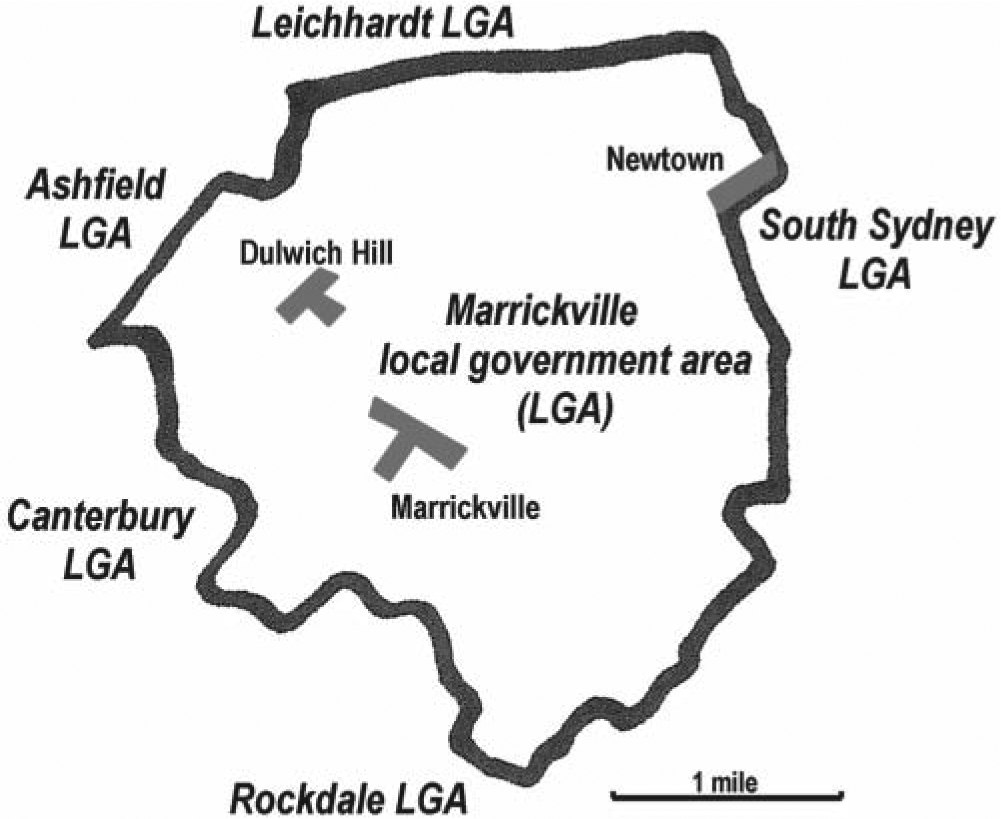
Map of Marrickville Municipal Council and the three centers.
Marrickville Council is one of the local government areas located in the inner west of Sydney. Marrickville Council as a local government entity was first proclaimed in 1861 and covered a small geographical area. Successive amalgamations of the adjacent municipalities of Camperdown, St. Peters, Petersham, and Newtown have expanded the geographical size of the Marrickville Council. By 1968, the Marrickville Council area consisted of a number of local centers of varying sizes and economic importance that have since become strongly associated with Sydney’s successive waves of migration. 13
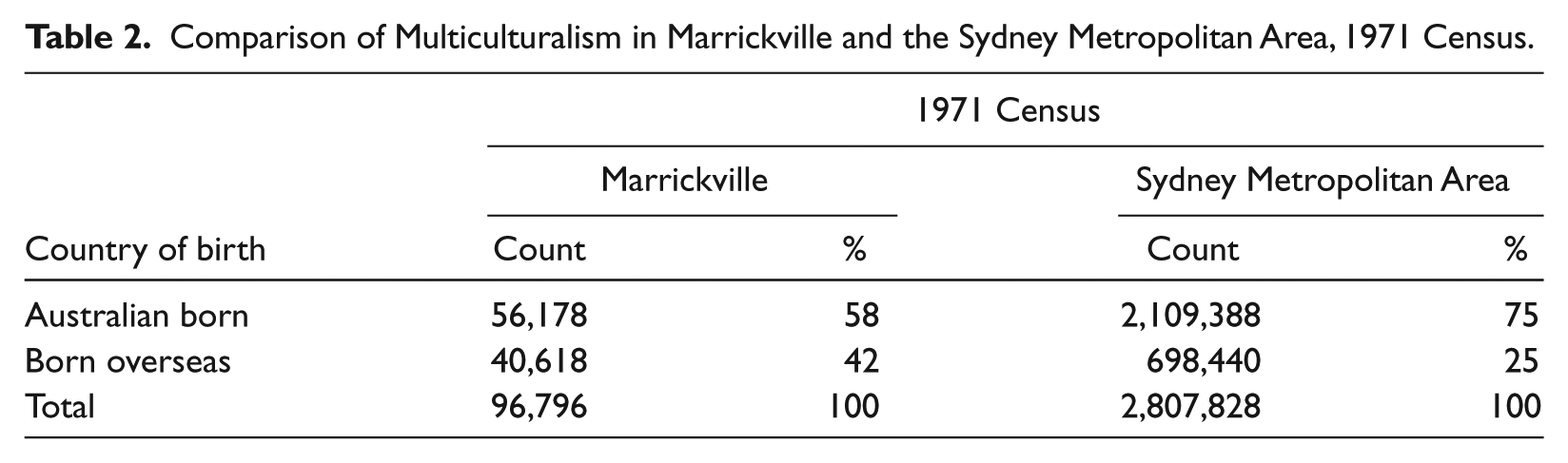
The businesses in Marrickville’s town centers came to reflect the residential multicultural population which changed in a different way to the trend seen in the Sydney metropolitan area during the same period (see Table 1). While the population was growing across the metropolitan city, the inner city areas such as Marrickville were losing residents and large employers attracted to the more spacious and cheaper land releases in the outer suburbs. The population decline might have been more significant had the Marrickville area not been an attractive destination for Sydney’s growing migrant population. 14 By 1971, Sydney was already a multicultural city, with 25 percent of the population born overseas, but Marrickville even more so with 42 percent born overseas (see Table 2). While the largest portion of migrants in Sydney came from the United Kingdom and the Republic of Ireland (9.1 percent), they made up only 5.5 percent in Marrickville. In 1971, the residents were from Greece (13.6 percent), Yugoslavia (4.9 percent), Italy and Asia (both 4.4 percent), though by 1981 it became more diverse with larger numbers of Lebanese and Vietnamese residents. 15 Although there was a period where the multiethnicity of the area was associated with drug trades, fire bombing of shops, and targeting of elected officials, this has since given over to pride in the culinary benefits of multiculturalism. Marrickville town center is now associated with Greek- and Vietnamese-run businesses, Dulwich Hill an Arabic-speaking community, and Newtown as the restaurant strip for all ethnic cuisines. 16
Population Changes in Marrickville and the Sydney Metropolitan Area, over 6 Census Periods.

Comparison of Multiculturalism in Marrickville and the Sydney Metropolitan Area, 1971 Census.
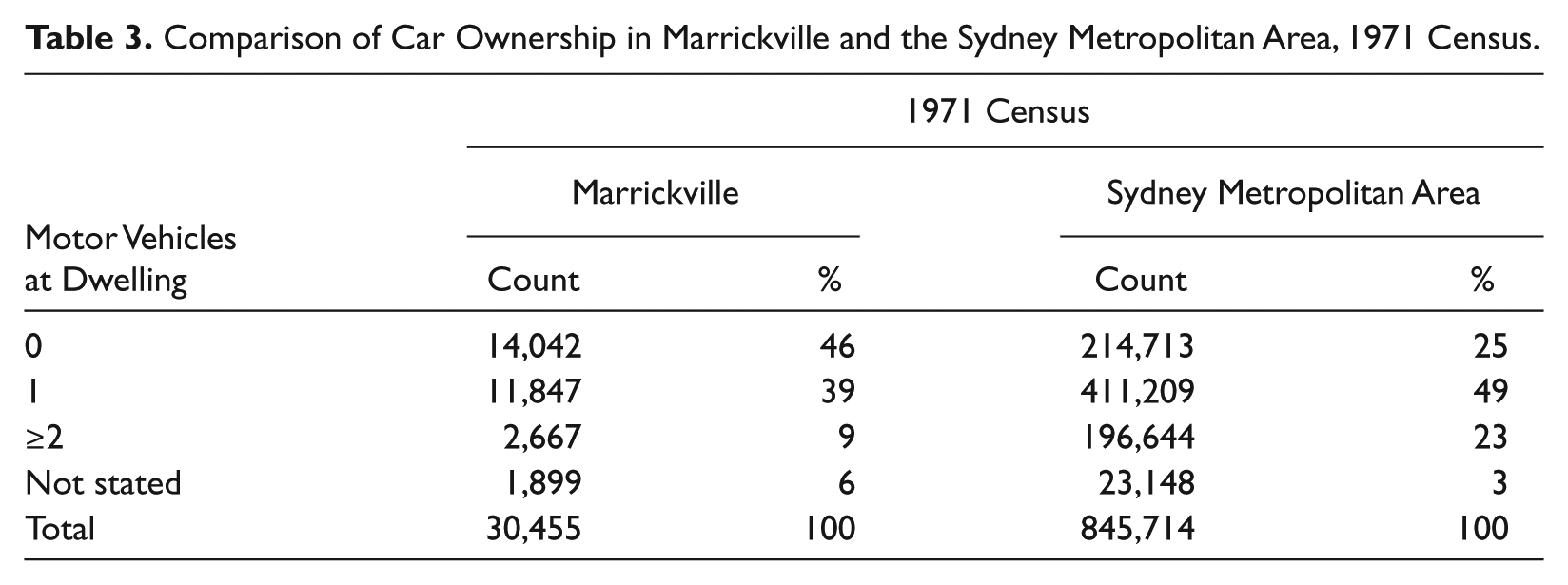
From a transport and land-use perspective, the physical character of the local centers in Marrickville developed during the early period of Sydney’s urbanization facilitated by the metropolitan railway network in 1855 and the tramway network in 1880. The town centers developed around railway stations and expanded along the tram routes to create the characteristic long “ribbon” shopping streets. Competition for road space and the appeal of motorized vehicles (private and public) that were not constrained by rails goes someway to explain the gradual policy shift away from trams and to road transport though urban historians point to politics and political ideology also having a strong influence. 17 Privately owned buses established in the 1920s became public bus services by the 1930s. Buses became favored over trams and the tram routes were taken over by bus services by 1957. 18 By the 1950s, levels of car ownership had increased in Sydney to the point that the car became a favored mode for traveling. This increased mobility did not only mark a shift in how people traveled to shop but also in their choice of shopping destinations. Shoppers who owned cars were no longer limited to public transport, walking, or cycling and therefore were less constrained by distance, predetermined routes, or carrying ability. While levels of car ownership were much lower in Marrickville than the rest of the Sydney metropolitan area, there was pressure on local centers to cater for the approximate 14,500 Marrickville households who had car mobility (see Table 3).
Comparison of Car Ownership in Marrickville and the Sydney Metropolitan Area, 1971 Census.
Growth in private car ownership places pressure on the road network as more vehicles compete for access to a constrained amount of space. Likewise, the demand for car parking can exceed the supply of car parking spaces. If motorists choose to cruise the streets looking for a car parking space, this can impede the flow of traffic causing congestion. As early as the 1930s, traffic and parking controls had been introduced in Sydney’s central business district to deal with the competing demands for road space for parking. 19 Urban centers took longer to reach the limits to competition, though by the 1950s and early 1960s Councils were advocating off-street car parking as a policy for relieving congestion in town centers. 20
Adding parking supply in areas off the main street was a way to alleviate the traffic congestion and make parking easier to find. This worked well in newer urban areas of Sydney, where space was more abundant and land cheaper. For older areas, like Marrickville, adapting the landform in town centers to accommodate the car was a more complex task as the centers were structurally and spatially ill equipped for car traffic. The narrow and busy streets provided insufficient space for curb-side parking, and the tightly packed existing development meant there was less open space that could be easily and inexpensively converted into off-street parking lots. Motorists could choose not to cruise for parking and instead shop at one of the competing town centers, but intraregional competition was similarly constrained. This changed in 1965 with the opening of a new shopping destination six miles southwest of the Marrickville area called Roselands.
Roselands was the first regional shopping center to open in Sydney. It was marketed as a “superior shopping convenience” as customers had access to a compact and large cluster of retailers under one roof and a large amount of car parking. 21 Roselands included multideck car parks, which optimized space and reduced walking distance to the shops, thereby reducing effort costs and consumer fatigue. 22 In 1966, the town centers of Marrickville faced competition from other three new regional shopping centers: East Lakes four miles east, Burwood Westfield five miles northwest, and Bankstown Square nine miles west of the Marrickville area. A feature of all four shopping centers was the large number of big retailers, which effectively brought city shopping choices to the suburbs.
Car ownership gave new mobility choices to customers frustrated with difficulties in getting parking in their local town centers. Marrickville Council perceived this change in mobility and destination choice as a threat to the viability of their existing town centers, which at the time served a wide range of local needs in terms of food, clothing, hardware, and furniture. The mismatch of car parking demand with car parking supply was seen as a barrier to capturing or consuming customers traveling by car. In partnership with the business community, the Council began constructing off-street car parking as a strategy to help the centers compete and survive. 23
Mayor of Marrickville, Ald. J. Carr, said yesterday that the council was probably unique in Australia so far as its parking problems were concerned. SEVEN CENTRES “Unlike many other Local Government bodies in New South Wales, Marrickville Council is faced with the problem of providing adequate parking in at least seven shopping centres within its municipality,” he said. “Realising this, council since 1960, when it held its first meeting with Mr. Stan Reynolds, the then chairman of the Marrickville Chamber of Commerce, has been endeavouring to acquire properties where parking areas could be established throughout the municipality. “Much time, thought and planning has gone into this. Most of Sydney’s larger developers have been invited to consider re-development schemes for Marrickville, with the idea that if re-development was carried out parking would be provided. “However, because of the closely populated areas of Marrickville this was most difficult and hard to negotiate because of properties being owned by so many individuals.
24
Mobility can be conceptualized as a resource that enables an individual to access a range of opportunities in both the social and physical sense. 25 This paper broadens the discussion about mobility to include the way businesses and destinations adapt to “capture” or “consume” the resource of customer mobility. This case study focuses on a period where the increased use of car mobility lead to businesses focusing on car parking provision as the means of being able to competitively consume customer mobility. This focus on car parking persists today, despite the renewed interest in more sustainable modes of travel.
Local Centers as Neighborhoods of Businesses
Changes in how people traveled and where they shopped can be described as a process of social change at the neighborhood level. The change was affecting both the traveler, the people in the neighborhood space they traveled through, and the people who had a stake in the neighborhood destinations that were or were not being visited. While there is a tendency to adopt the dominant historical narrative of a change event differentiating the before-neighborhood and after-neighborhood, as Garrioch and Peel argue, this rarely reflects the reality. 26 Neighboring is instead, they argue, a dynamic process of a network of urban social relationships being constantly renegotiated, reinforced, and re-created to adapt to changing circumstances. This paper interprets the changes in urban travel in Marrickville as a dynamic and constant process of neighborhood transformation.
By focusing on the local centers as a neighborhood of businesses, there is recognition that businesses have individual and collective expectations about the desired features of the town center in which they operate. These expectations would be expected to be shaped by new experiences, the persuasive argument of their peers, and their different assessments of what worked well for their business. Not all businesses have equal ability to attract customers. Within a town center there is usually a mix of larger shops and businesses that are trip generators such as supermarkets, department stores, and banks, and then a periphery of smaller businesses that can generate trips but mostly capture passing trade. The makeup of these business neighborhoods are also subject to change as businesses turn over. One business departure is a potential opportunity for another, thereby making a demarcation of a center’s decline highly subjective.
The language used to refer to different businesses in the source material of newspaper articles suggests that a class structure existed within the town centers. Most of the language in the news articles and the advertisements refer to “shopkeepers.” The news coverage does however make reference to a group separate and distinct to the shopkeepers. This other group included specific big-name stores, hotels, “leading business houses, banks, and chain stores.” The distinction alludes to differences in power, in terms of customer-pulling power and financial power, as well as loyalty or commitment to the community. 27 As will be seen, financial resources seemed to be a less useful predictor for being an advocate for car parking. Financial and emotional investment in the survival of the local center does however seem to be more important. The power differential being overcome by the smaller business interests through a combination of collective effort, tenacity, and political representation.
Celebrations and Tribulations of Getting Car Parking
Car parks do not get built overnight. The collection of newspaper reports began in 1967 when the first three car parks were at the final stages of construction. It was the Mayoress of Marrickville Council, Mrs. J. Carr, who was given the honor of opening the first three newly built car parks on Saturday July 27, 1968. The car parks, in total, comprised 222 off-street car parking spaces and were strategically located around the T-shaped town center of Marrickville (Figure 3). At the Illawarra Road car park 43 spaces were available, with 58 spaces at the Shrublands parking area. The Victoria Road parking station was the largest and reportedly the most expensive. Its multi-deck structure cost $128,000 to build and provided 120 spaces, or $1,067 per parking space. The expense aside it, it was described as heralding Marrickville’s modernization. 28

Marrickville town center and the first three car parks.
To commemorate the event and promote the new community assets, The Free Weekly and Marrickville Council published a special eight-page tabloid newspaper. The commemorative edition included illustrations, photos, articles, and instructions for using the car parks. Local businesses and their suppliers were supportive of the development with the five pages worth of adverts including various congratulatory messages. The twenty adverts were an opportunity for businesses to promote their new level of convenience to their customers, with many referring to the location of the business relative to the free parking. 29
Dulwich Hill shopkeepers naturally wanted a car park too. In May 1969, the proposal for an off-street parking site in Dulwich Hill began taking form when Council approved the purchase of three residential properties on Seaview St. The newspaper reports that Council instructed the Town Clerk to write to shopkeepers in New Canterbury Road informing them that Council wanted to acquire the rear of their properties. 30 To the frustration of the independent Alderman Jack Shanahan who owned the local newsagency in Dulwich Hill, the process took more than a year before the first stage of the desired car parking development was complete. At the official opening of the single-level Seaview St. car park in July 1970, Alderman Shanahan delivered a controversial speech about the favoritism and expense the Labor-dominated Council showered onto Marrickville town center, and the neglect experienced by Dulwich Hill (Figure 4). 31 The full speech was published in the Marrickville Free Press alongside adverts of five Dulwich Hill businesses. The placement of adverts could be interpreted as shared sentiment, but could also be considered good business sense as the adverts would have greater chance of being seen by readers curious to read about local controversy. 32
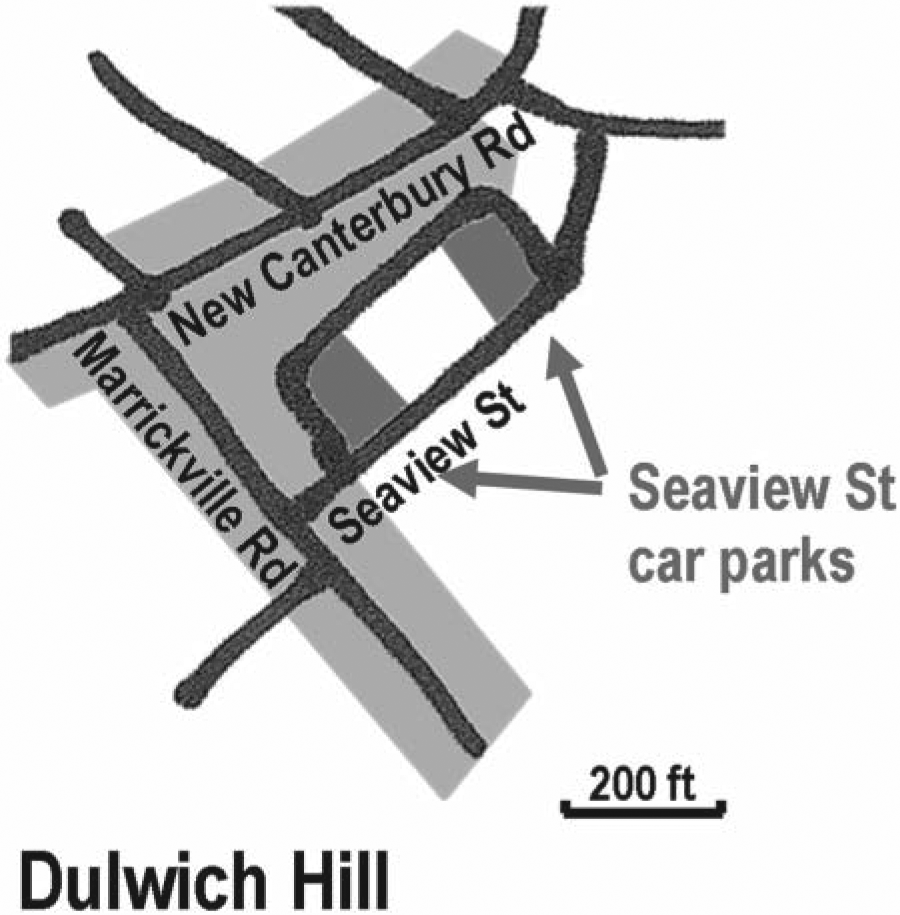
Dulwich Hill town center and Seaview St. car parks.
Efforts to get stages two and three of the Seaview St. car park were more difficult. The businesses of Dulwich Hill town center had been paying a special car park levy for a number of years but additional finance was needed. The Council met with a number of bank managers to discuss the option of getting a loan, and approached larger businesses in the area, proposing a cooperative purchase of property. A variety of proposals to purchase land were put forward, but fell through. In 1975, five years after the first car park was completed, Dulwich Hill got a step closer to having a second car park when Council agreed to purchase additional property in Seaview St. from Woolworths. The houses were demolished and Dulwich Hill had its second single-level car park opened in April 1977. 33
Newtown, at the time, was a town center managed by three different councils: South Sydney, City of Sydney, and Marrickville Councils. In 1974, the Newtown Business Chamber of Commerce in Newtown approached Marrickville Council with a proposal for a three-level car park on Lennox St. at the corner of Church St. The proposal required the purchase and demolition of properties including a Baby Health Care Centre, a factory, an office, and seven residential properties. Other car parks existed in Newtown, courtesy of South Sydney Council. 34
Like the experience of Dulwich Hill, the time taken to get the car parking was a protracted one. Owners of all the properties were reluctant to sell, but did so eventually. Archived Council records indicate that the threat of council action for assets constructed without development consent may have been somewhat persuasive in the decision to sell. 35 Community dissent towards the project was high among local residents who were concerned about more traffic being enticed onto the narrow streets. Newtown Reverend Don Meadows summed up concerns by suggesting Council had its priorities wrong as “providing spaces for cars before people is putting things back to front.” Eventually, residential property owners were left with little choice but to haggle for a good price. 36
The Lennox St. car park was opened in 1979 as a single-level facility giving Newtown an additional 48 parking spaces, for the sum of $350,000 (Figure 5). At a cost of $7,292 per parking space it was $6,225 more expensive per space than the Victoria Road multideck parking built eleven years earlier. It was perceived as excessive by other Aldermen with claims that the money would have had more value in the other town centers where property was cheaper. The purchase of the factory alone cost $205,000 which might have been considered good value if the original plan to construct a three-level car park accommodating 139 vehicles had overcome engineers’ concerns about the maneuvering ability of cars as dictated by contemporary car parking specifications. 37
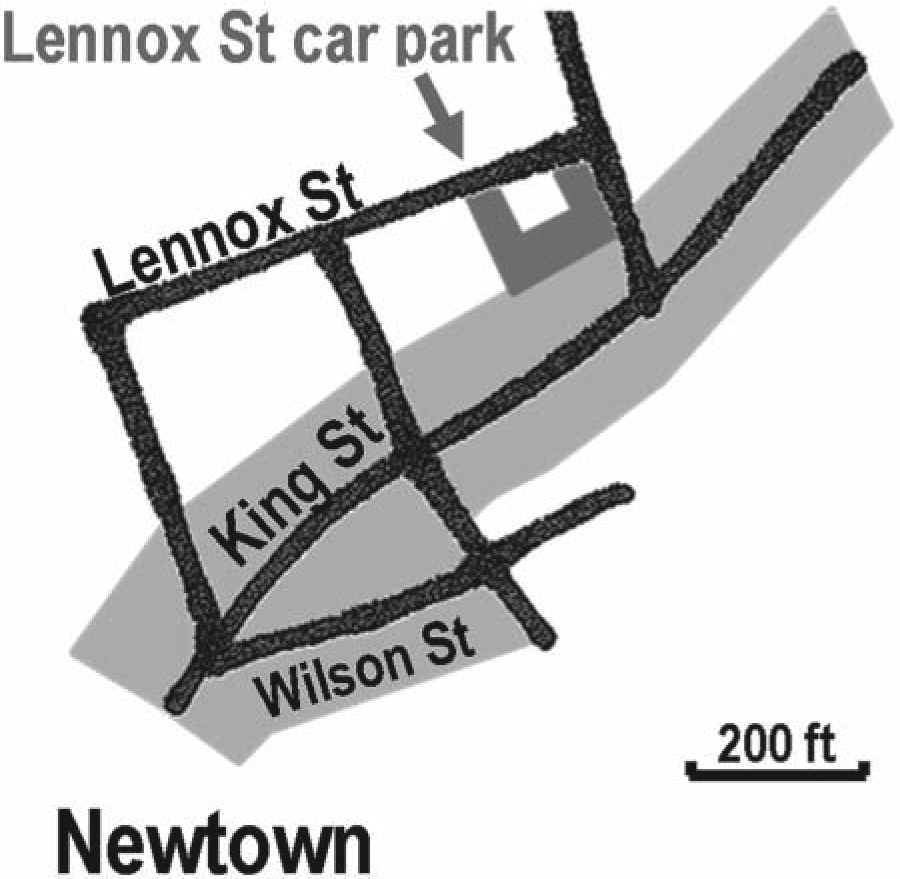
Section of Newtown town center and Lennox St. car park.
Off-Street Car Parking: The Costs and Trade-offs
Modernizing local centers through the construction of car parks required a reorganization of land use that incurred trade-offs both within and between different elements of the community. Building each of the car parks (and others that were subsequently built) involved a surrendering of existing land use, and in many cases the acquisition of land parcels. 38 Losing the existing or potential functionality of the land was a major point of controversy for most of the car parking proposals considered by the Council. The trade-off was significant for the Marrickville Presbyterian community. The special edition newspaper published to celebrate the opening included pictures of St. Andrew’s church intact and then as rubble to make way for the Illawarra St. car park. It reported that the Council leased the land occupied by the church for ten years at $4,000 per year, and within a few days of the lease had sent in the workmen. The paper optimistically explains, “While the issue was controversial at the time, people will now agree that the parking area, with provision for 43 cars, will be of considerable benefit to the shopping centre.” 39
Businesses may be intended to be the major beneficiaries of the car parks; however, they too were subject to trade-offs. The acquisition of land was an expensive task for Marrickville Council as the land parcels were small and owned by different entities, with residential, commercial, and industrial properties in proximity with each other. Operational businesses in Newtown, including a factory, were bought out so that the remaining businesses could benefit. Seven years after the initial proposal, Alderman Shanahan eventually persuaded his fellow Dulwich Hill businessmen to give up a part of their rear property so that a rear access lane could be widened to improve access to the car park. 40 The cost to shopkeepers, it was rationalized, would be recouped with expected increases in customers. The people who lost a place of worship, a health service, homes, and workplaces were not so easily compensated and appear to have had little opportunity to negotiate. The neighborhood connections therefore would have changed, as would the patterns of urban travel as people attended relocated services and found new homes and new places of employment.
Provision of car parking has been considered a necessary investment to maintain the economic vitality of the area. Clusters of shops that had plenty of car parking were perceived then, as now, more convenient and attractive destinations for customers due to the “reduced effort costs of patronage.” 41 Shopkeepers therefore were inclined to view off-street car parking as a strategy to attract shoppers and keep businesses viable. The threat was not just the regional shopping centers but also the effects of heavy traffic making the local center a place to pass through rather than shop at. In Newtown, the main street called King St. is also a small section of the national route one, the Princes Highway. According to Mr. Joe Meissner, president of the Newtown Business Chamber of Commerce, the Lennox St. car park was considered a necessary addition to the local center to avoid King St. “becoming a freeway.” He goes on to explain, as “one of the most important ribbon shopping centers in Sydney,” Newtown had a distinctive character as it comprised mainly small private businesses. However, the loss of the few major retailers that the smaller businesses needed was “blamed directly on the absolutely inadequate parking facilities.” 42
The financial responsibility for funding the establishment of off-street car parking in local centers was a point of contention. Local municipalities are funded through the rates paid by landowners and businesses. Funds for car parking were an additional capital expense and therefore required raising of additional revenue. Businesses in each town center lobbied the Council to direct the municipal’s limited budget to their town center’s car parking needs. Some of the elected representatives were themselves local business owners, including the car park advocate Alderman Jack Shanahan. It was the view of shopkeepers, and Alderman Shanahan, that Council should protect and upgrade existing local centers. It was argued that the town center did not just provide a “convenience to the people,” but the businesses within them also contributed to Council revenue. “The goose that lays the golden egg must be protected,” remarked the car park advocate Alderman Shanahan. 43 The Council was regularly criticized by business chambers for showing favoritism toward Marrickville town center. In April 1975, the President of the Dulwich Hill Chamber of Commerce, Mr. Joe Garcia expressed shock at the news that the Council was considering building and funding a sixth car park in Marrickville. The Council’s favored treatment of Marrickville was “at the expense of its sister suburb, Dulwich Hill,” he is reported to have said on hearing the news. 44
Some businesses were prepared to pay a car park levy. The funds raised by Dulwich Hill business owners, for example, went directly towards the car parking fund for their local center. Waiting for enough funds to accrue before adding car parking was said to be putting the viability of existing businesses at risk, so additional finance was sought from banks, the Council, and the larger businesses. Larger businesses were perceived as having greater capacity and obligation to pay, as they had greater number of patrons. 45 These larger businesses were understood to be important customer attractors within the business cluster, and therefore likely to also want car parking. The larger businesses appear not to be convinced. Some moved to alternative, more spacious locations, possibly as their greater scale of car parking needs meant that contributing to off-street town center parking was evaluated as possibly less value for money. Finance was eventually acquired with Council assistance.
The decision of Council to focus car parking investment first in Marrickville town center was strategic. Marrickville town center was viewed, at the time, as a competitor to other towns in neighboring council areas as well as the regional shopping centers. In 1987, it was clear that Mr. Sam Carter, President of the Marrickville Chamber of Commerce still positioned Marrickville as a center of significance as he described it as a good place for shopkeepers and shoppers, attracting people from as far away as Blacktown, Wollongong, and Newcastle, which is approximately a driving distance of 19, 47, and 105 miles, respectively. 46 However, while the shopkeepers in Dulwich Hill and Newtown may be able to see the benefits of cooperative relationships with other businesses in their cluster, they would have less or no motivation in helping Marrickville become the premier shopping location.
Use and Abuse of Car Parks: Equity and Accessibility
The previous sections have discussed the conflict about the allocation of car parks to centers. This section is concerned with conflicts about the use of car parks. These conflicts arise from each motorist having a self-interest to maximize their use of the common car parking asset, a classic “tragedy of the commons.”
47
The tragedy was anticipated, as Mr. A. Backhouse the President of Marrickville Chamber of Commerce warned in 1968 in the special issue Free Weekly:
People should use them only for the two-hour limit, thereby making them available for other people, just the same as they would return a book to the library to make it available for re-issue. Shopkeepers or their employees who used the car parks would be depriving a shopper of a parking space and possibly themselves of a customer.
48
While the three Marrickville car parks and the Silver St. car park in Dulwich Hill had a two-hour time limit from the outset, the Lennox St. car park in Newtown did not. Newtown Business Chamber of Commerce had put a condition in the agreement with Marrickville Council that the parking would have no time limit. Once the Lennox St. car park was opened, shopkeepers, shoppers, and Council alike complained that there were never any spaces as they were occupied by the same vehicles all day long. Shopkeepers were accused of abusing the car park for their own needs, and denying the use to the more deserving shoppers. The Council urgently called a meeting with the Chamber, as the expensive project that had not been without controversy was also now threatening the reputation of Newtown as a good and friendly place to shop. 49
Although there was broad agreement that the car parking was a public asset that needed to be shared, there was not a consensus on how a “fair” share was to be enforced. Fining motorists who overstay the time limit requires Council resources for enforcement and a commitment of councillors to ride the political storm. Council parking fines were then, as today, viewed with suspicion as revenue-raising policies rather than protecting the equitable use of the car parking. This was illustrated in the dispute in 1978 between the local Alderman Shanahan and staff from Dulwich Hill High School discussed next.
To the frustration of Alderman Shanahan and local shopkeepers, teachers at Dulwich Hill High were using the car park as staff parking. As the car park had an existing two-hour limit, the Alderman encouraged Council staff to enforce the rule, and ninety-four people, including forty-six teachers and some shopkeepers, found that their cars had been fined. There was documented outrage about the six-dollar fine, even though it was cheaper than the hundred-dollar fines that were threatened for “car park hogs.” The community outrage appears to have been severe as Alderman Shanahan later asked the Council to pardon the fines. 50 “Morally they are not right to park in the car park, all the time, but it has made me unpopular with my constituents,” he reportedly explained. 51 In response to claims he was a “dobber,” 52 the Alderman tried to regain popularity by noting he had the highest regard for teachers and suggesting the motorists should have first received a warning before being fined. In 1981 the Council obliged, declaring they would fine teachers using the car park. The Council’s suggestion that the hundred school staff use the nearby seven blocks of Department of Education–owned land for car parking was rejected by the principal, who noted it would be an inconvenient distance for staff to walk, and only a short-term solution as the plots were earmarked for playing fields. 53
Lessons were learnt about the planning, funding, constructing, and operation of the car parks, with every car park and its associated controversies and successes. Disappointingly for the businesses and the Council, the Victoria St. multideck car park did not live up to expectations. Within eight years of its opening, concern was raised about the safety and convenience of pedestrians and motorists. The newspaper accounts include concerns that shoppers were at risk of being run over as they tried to return to the car park, particularly those pushing “grocery laden trolleys.” The car park locations were described as not convenient enough as they required shoppers to walk long distances. The deck parking design that had previously been celebrated was found to require drivers to make awkward maneuvers to park there. People were also unwilling to walk up and down two flights of stairs to the top level, leaving it poorly patronized. By 1997, the Victoria St. car park was a liability for the Council. It did not comply with modern engineering requirements and it was considered by many as an unsafe place to park because of its reputation as a place for antisocial behavior. The cost of making the required alterations was too expensive for the Council, so the car park was demolished in 2002 and sold as rezoned land for mixed commercial and residential development. 54
The early evaluation of Victoria St. car park as a costly failure impacted the intentions of building additional decks to the Seaview and Lennox St. car parks. It did not, however, dissuade the Council or the business community that car parking was a valuable investment for the area. Instead, the pressure to convert other properties to car parking continued. One car park was never enough. 55 There appeared “no turning back” as the growing number of people with a driving licence and a car would only increase demand for car parking. Car park signage, line markings, and familiarity with car parks as features of town center locations helped to grow motorist competence in using car parks. 56 It is likely to have concurrently contributed to a loss of other mobility competencies still seen today. Knowing how to use alternative methods of travel to reach desired destinations becomes largely irrelevant to customers who have a car. Likewise, it has become customary for shopkeepers to assume customers travel by car. This is demonstrated by the common practice to refer to the availability of parking, but not the convenience to public transport in marketing materials for business.
Businesses Adapting to Changes in Mobility
Urban neighborhoods are constantly changing with turnover of people and fluctuating patterns of movement and consumption. The attractiveness of town center neighborhoods is also subject to constant change. It changes with changes in consumer preference and trends, as well as attributes of the location that are subject to broader changes in economic trends, and cultural and technological changes related to mobility. In a constantly changing and growing urban environment, the transport system will always struggle to accurately match the travel demand needs of passengers. 57 The privatization of personal mobility has compensated for this deficit; however, with more people using their own car it becomes difficult to predict the demand for car parking at different destinations. Providing car parking to satisfy peak demand is not always possible or simple when spatial constraints exist, as the stories of Marrickville, Dulwich Hill, and Newtown demonstrate.
The off-street car parks were promoted by Marrickville Council as a strategy to alleviate traffic congestion, and generate prosperity for the town centers. The shopkeepers and retailers framed car parking a necessary neighborhood asset for attracting customers and fought ardently to secure and protect their car parking entitlement. Not having sufficient car parking, conversely, was viewed as endangering the economic vitality of the town centers, particularly with the emergence of regional shopping malls with ample parking. The extent that the off-street car parking was able to help Marrickville, Dulwich Hill, and Newtown remain economically viable is difficult to assess without longitudinal data. Unlike corporate-owned regional shopping centers, which predominate in Australia, local centers do not have a management authority tasked with regularly monitoring traffic and economic turnover of the cluster of businesses. As Councils have become more focused on the social and environment costs of increased car use, focus has turned to managing demand rather than increasing supply of car parking.
Sustainability is a policy objective that has gained traction among local Councils across Australia. In present day Sydney, new sustainable transport policies such as charging for car parking and promoting more public transport use are being implemented by Councils. On-street car parking is temporarily, and sometimes permanently, removed to improving traffic flow for buses, cars, but also bikes and pedestrians. Such changes to car parking however remain contentious, particularly among business owners. 58 Off-street car parking investments are still desired by business owners. They are still viewed as expensive but sometimes necessary public expenditure. Disputes about fair use, fair price, and fair enforcement still exist.
Changes to the spatial organization of neighborhoods and changes in policy thinking about transport accessibility can be easy to track. The Marrickville Council officer who chose to keep and store the car parking newspaper clippings over five decades identified the planning and construction of car parking as an issue of local relevance not just because of the controversy but because it was changing the urban environment. 59 The attitude changes among shop owners about the necessity of being accessible by different transport modes (such as car, public transport, etc.) are less obvious.
This paper used the newspaper accounts to identify some of the changes that took place within three neighborhood centers of inner Sydney. It began with discussing the reorganization of local space to accommodate parking as a way for inner city town centers to remain relevant to customers whose mobility expanded with the car and the establishment of regional parking-enabled shopping centers.
In presenting the efforts of those involved in establishing off-street car parking in Marrickville, Dulwich Hill, and Newtown, some differences were observed. It was found that the local smaller business owners consistently placed a high value on the importance of car parking to the survival of the local center, but the enthusiasm of the Council and the community shifted over time. The willingness of businesses to accept trade-offs such as car parking levies and time restrictions indicates the business community adapted, though albeit not always with the desired outcome—more off-street parking. Lobbying for car parking took various forms including the use of newspaper exposure to pressure Council, larger businesses, and placate upset motorists. As current-day sustainability concerns about car dependence grow, business owners may need to adapt again and develop new competencies to ensure that they can attract customers even with less car parking. This process of urban social change will undoubtedly generate a new flurry of news stories.
Footnotes
Acknowledgements
I am grateful to Prof. Corinne Mulley and the anonymous referees for their comments on earlier versions of this article. I thank the staff at Marrickville Council’s Archival Heritage Centre who provided access to such interesting material. Portions of this paper were presented at the Academic Association of Historians in Australian and New Zealand Business Schools (AAHANZBS) conference, held at the University of Sydney, December 14–15, 2009.
Declaration of Conflicting Interests
The author(s) declared no potential conflicts of interest with respect to the research, authorship, and/or publication of this article.
Funding
The author(s) received no financial support for the research, authorship, and/or publication of this article.