




Abstract
The Irish Americans of Philadelphia, prompted by an awakening of cultural nationalism across the Atlantic in native Ireland, constructed their own community of Irish culture, nationalism and ethnic pride in the waning years of the nineteenth century and early decades of the twentieth. The expressions of this Gaelic public awakening were seen in literature, language, theatre, and in sport; the adoption of Gaelic games became a particular poignant emblem of late-century Irish resurgence, the gallant Irish hurler a symbol of Irish masculinity. The return to Gaelic culture in a hard, industrial city coincided with the public posturing of a Celtic paramilitarism in the form of Hibernian rifle regiments, overnight encampments, and other displays of the revived and armed Celt of Irish Philadelphia.
Introduction
The 1890s and early 1900s in Ireland and Philadelphia were the years of the Irish cultural revival, a movement that asserted itself in these trans-Atlantic locations, part of a rising constellation of Irish national forces casting their gaze backward to ancient and traditional symbols of Irish autonomy and pride. At the same time, the Irish in Philadelphia followed a modernist impulse to settle, achieve, and construct an ethnic community out of the dislocation of emigration and adjustment to labor in a vibrant, vast, industrial city. The revival embraced many forms of culture and expression and was seen in many shapes, in the Irish agricultural cooperative movement and prominently in language and the rise of the Gaelic League in Ireland and in the United States, in theatre, literature, and in sport.
The sports club was an emerging type of voluntary association in the late 1890s, and this new institution was changing the nature of leisure. E. J. Hobsbawm observed that sport had become “a mass spectacle . . . transformed into the unending succession of gladiatorial contests between persons and teams symbolizing nation-states . . . the imagined community of millions seems more real as a team of eleven named people.” 1
Philadelphia’s Irish Americans in the 1890s were busy constructing their own “imagined community” in the Diaspora born of an ethnic confidence based on long-term settlement in Philadelphia, a sense of arrival that allowed for cultural excursions outside of the world of labor and work, experimentation in rediscovering and reinventing Gaelic pastimes. 2
This essay focuses on the short-lived rise of Gaelic sport in the 1890s, early 1900s in the Irish Diaspora community of Philadelphia, a broad ethnic network dispersed throughout this sprawling industrial metropolis, integrated by Irish efforts to forge bonds and bind the vast ethnic population, evidenced by the extraordinary number of Irish voluntary associations that circulated throughout the city. The Gaelic sport revival also seemed to meld easily with an Irish Catholic masculinity that took pride in the public posturing of a Celtic paramilitarism in the form of Hibernian rifle regiments, encampments, and other displays of the revived and armed Celt of the late nineteenth century.
The Mobile, Multiple Visions of Irish Nationalism
Michael Cronin suggests that nationalism can be “formalized, imagined or challenged by forces, groups and individuals both within, and outside of the projected vision or reality of the nation.” 3 This pliant typology, in concert with Benedict Anderson’s concept of “an imagined political community,” is a compelling heuristic for probing the inventions and practices of the national fervor of Philadelphia’s late nineteenth-century Irish.
Language played a vital role in the Diaspora Irish acceptance of the many shapes and forms of nationalism, producing a narrative in which cultural and political borders had been violated by outsiders—colonial invaders—a vernacular purveyed less by an intelligentsia, an Irish Catholic refined elite, but by a coterie of popular journalists, amateur historians, traveling priests, and commentators that filled the halls of the ethnic society meeting rooms and the pages of the ethnic press in Irish Philadelphia.
The ethnic press in Philadelphia bound the community, offering details on local Irish events, reprinting national and international stories, all supporting the ideology of the violated Gael, suggesting that the Philadelphia Irish needed to defend its national icons and reconstructed images. Both Gellner and Anderson extol the influence of literacy and a common language on the rise of nationalism. 4 This ideal-based community had its symbolic defenders, and they became the sporting warriors of hurling and mock soldiers of the Irish paramilitary brigades.
The cultivation of purely Irish sporting forms and paramilitaristic Gaelic imagery in the 1890s seemed, as John Hutchinson states, directed toward “the moral regeneration of the national community rather than the achievement of an autonomous state.” 5 The statements and public postures on the shape of Irish identity being debated and hammered out by Philadelphia’s Irish in these years seemed more cultural than strictly political, a nationalism that operates within an exclusive idealistic framework intent on resetting a public image rather than creating a new national state in Ireland. McDevitt’s reading of Gaelic nationalism is also pitched toward cultural rebirth, a constellation of “symbolic constructs created via cultural imaginings.” 6
Still, with all of the cues bombarding the Diaspora Irish at century’s end, stirring them to action, the result was the construction of an image and a style, a more masculine, assertive, militant Celt. This was a Diaspora Irish identity with strict boundaries, identified by those in favor of a separate Catholic nation and all those opposed, a united front of nationalism as stern opposition, as Cronin states, “the Irish often seek to define themselves in a manner that is oppositional to Britain . . . [reveling in] the rejection of anything British.” 7 Sport simply became part of the oppositional identity equipment the Irish adopted in the late 1800s, a cultural appendage of this defiant stance.
The Gaelic Athletic Association (GAA) ban on British games, in essence a boycott of Anglo influence in sport and a historical brake on the easy diffusion of British cultural influence, represents opposition in sport to British influence drifting across the Irish Sea in the late 1800s, early 1900s. 8 Writing on the expanding imagery of Gaelic sport, Eoin Kinsella stated, “it was in the nineteenth century that hurling, and specifically the hurley, became loosely associated with Catholic political agitation and support for Irish nationalism, both cultural and political.” 9
For an Irish American working class intent on educating itself on ethnic meaning in the wake of forced exile 10 from Ireland, endowed with the material resources derived from employment in the industrial colossus of late nineteenth-century Philadelphia, organized in an interlocking maze of Irish American voluntary associations, they registered an ethnic pride in the past while embracing the modernism of the new world wherever it appeared. Their reconstructed Gaelic games eventually assumed the shape of popular sport in their deep structure, but the meaning was attached to an emotional core of remembrance and revolt.
Philadelphia: A Nineteenth-Century Irish City
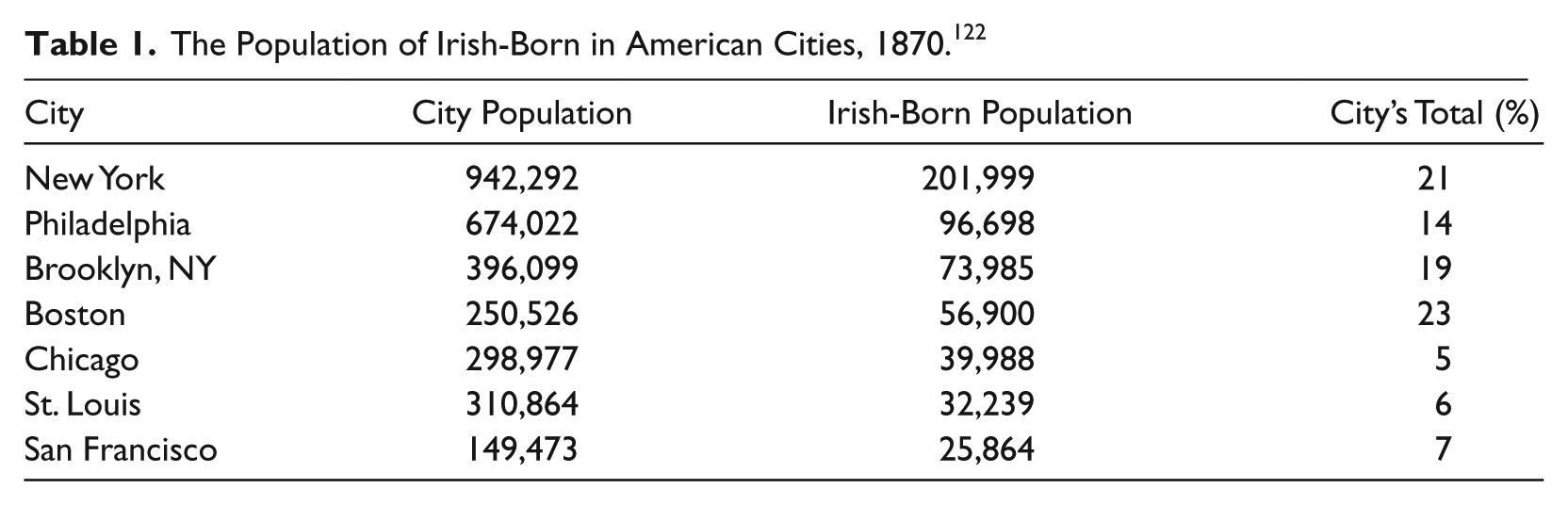
Philadelphia may not enjoy the reputation of other urban centers as a location of Irish awareness in America, but as Table 1 suggests, it was a city of high Irish population in which the Irish-born came to exert a sizeable presence in the city in the later half of the nineteenth century. Philadelphia, however, was the exception in its construction of its Irish identity because its urban ecology, working-class mobility, and diverse industrial structure spatially diffused the Irish so that no single location turned into an exclusive zone of Irish influence, an Irish urban ghetto. 11 Instead, as the working classes sought housing close to labor opportunities, the Irish would share urban blocks with German Americans, native white Americans in heterogeneous urban settlements as all groups positioned themselves to find work in a walking city.
The Population of Irish-Born in American Cities, 1870. 122
Philadelphia had its major enterprises, the Baldwin Locomotive Works, shipping its locomotives all over the world, and the Cramp Shipyards along fifty acres of the Kensington shoreline of the Delaware River constructing merchant and war ships in the late nineteenth, early twentieth centuries. 12 Kensington and Manyunk were the locations for textile mills of various sizes, milltowns within the city that employed English and Scottish weavers specializing in wool and Irish workers. 13 Other smaller craft operations and diversified manufacturers dotted the city’s landscape, shipping finished products of all kinds along the east coast, to the Midwest interior and all over the world. 14
The Structure of Philadelphia’s Irish American Neighborhood
The Irish confronted this industrial colossus in the later half of the nineteenth century, entering the workforce as laborers and settling in already established urban neighborhoods where they could find housing. By 1860, from the Census by wards, the distribution of the emigrating Irish had begun to show and the dock areas just south of the central city on the Delaware River exhibited high concentrations of Irish settlement, but never more than 26 percent, in the neighborhoods of Southwark and Moyamensing. On the other side of Penn’s city, its second river, the Schuylkill with its own set of docks that accepted river traffic from upstate Pennsylvania unloading the coal, lumber, stone and materials for the construction and contracting industries of Philadelphia as well as agricultural goods, we find an Irish concentration in neighborhoods contiguous to the commerce of the river. 15
Philadelphia’s Irish neighborhoods in the late nineteenth century acted less like urban villages than assembly points around Philadelphia industries. Port Richmond employed the Irish in unskilled labor on the Reading Railroad wharves, unloading the coal barges and relocating the material to the railroad terminal in Port Richmond. 16 Kensington was marked by stark segregation in the northern wards, the result of German and native white retrenchment and the many English immigrants who monopolized the textile weaving trades, feeling the threat of cheap Catholic labor. 17
A Mobile Irish American Working Class
The Irish American population in late nineteenth-century Philadelphia was mobile and the neighborhood an urban unit given to rapid turnover and change. Stuart Blumin states on Philadelphia, “only one out of every four or five adult male inhabitants (and probably their families) remained in a given neighborhood as long as ten years.” 18 He concluded that late nineteenth-century Philadelphia “men follow jobs,” which provided the dynamism and mobility of the years of industrial expansion which militated against the concentration of the Irish in ethnic enclaves.
The expanding division of labor demanded by an advanced industrial economy as well as the spatial diffusion of Philadelphia’s industry, spread out in smaller factories all over the city, were factors that undermined the facile continuation of ethnic tradition and ethnic identity. 19 As industry dispersed so did labor and its immigrant newcomers, and the result was an initial fragmentation of Irish tradition, resulting in competing worldviews amid the pressures of practical choices demanded every day by an immigrant ethnic group.
By the 1890s, the second generation, the American-born of Irish immigrants, had established their imprint on the city. Table 2 demonstrates a continuation of the geographic dispersion of ethnicity as well as the persistence of early patterns of urban settlement and reflects the new mobility of the higher-status Irish away from the previous areas of residential settlement close to work. While the Irish did not dominate any neighborhood—never more than 40 percent of a ward—they had a presence in every neighborhood in Philadelphia in the early 1900s. 20
Irish Residential Pattern in Philadelphia, 1900–1910.
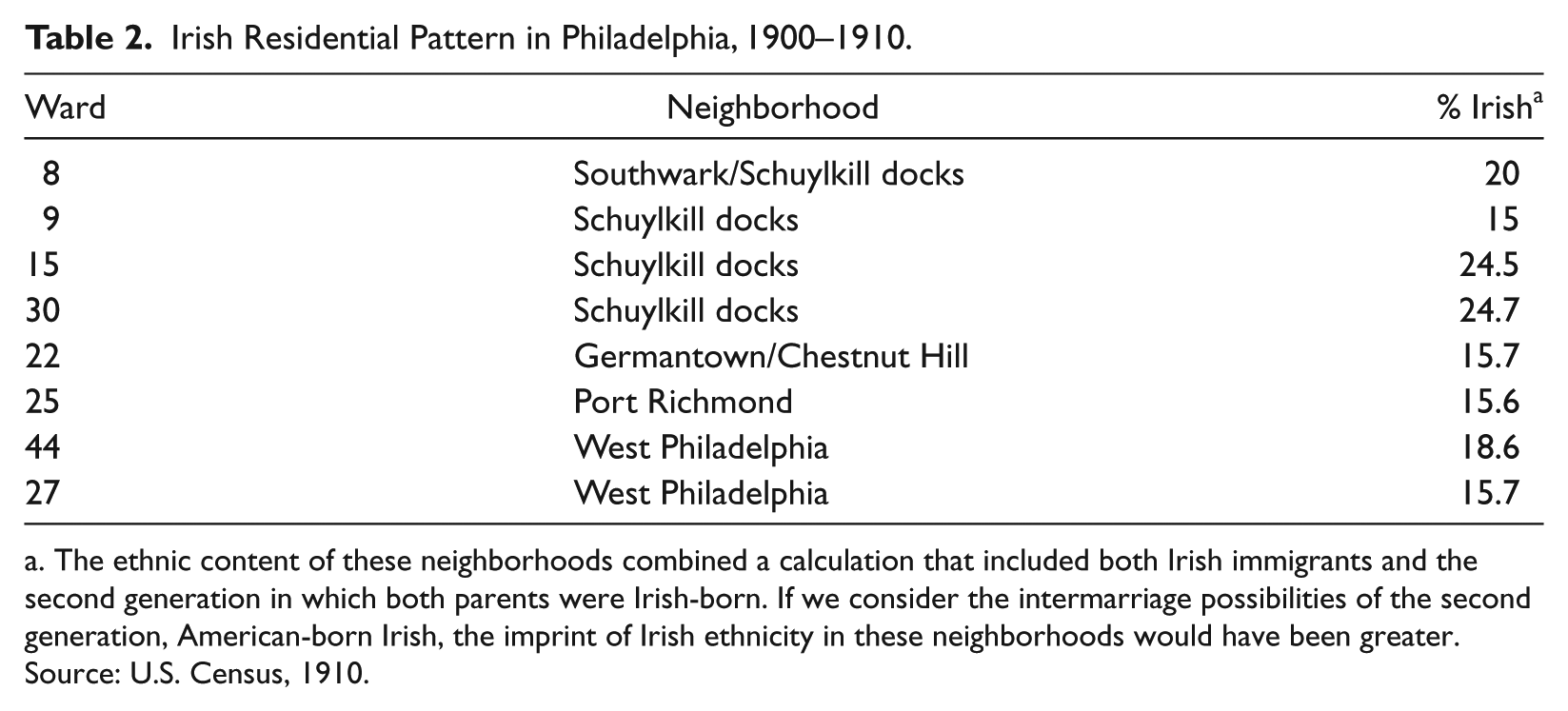
The ethnic content of these neighborhoods combined a calculation that included both Irish immigrants and the second generation in which both parents were Irish-born. If we consider the intermarriage possibilities of the second generation, American-born Irish, the imprint of Irish ethnicity in these neighborhoods would have been greater.
Source: U.S. Census, 1910.
Dennis Clark’s Irish Philadelphia
The writings of Dennis Clark have left us with a portrait of the Irish neighborhood in Philadelphia. 21 He has described the neighborhood as a self-contained ethnic enclave with a distinct “social heritage . . . [an] array of symbols, usages, and attachments” bound by memories and conceptions of “a place, a people, and a legacy of recollections.”
The memory trace of Ireland was a bond that gave “the personality a fund of models, aspirations, moods, motives, and constraints.” 22 This depiction of the stable Irish neighborhood in Philadelphia invokes a nostalgic remembrance when the social reality for the Irish was mobility and relocation within the city in the search for work in neighborhoods that were ethnically heterogeneous.
Sam Warner suggests that Philadelphia’s industrialism constructed new kinds of social bonds for an urban community that could result in ethnic urban villages. In neighborhoods, “numerous small-scale loyalties and linkages” were formed in which nineteenth-century Philadelphia became, for the ethnic Irish, less a place of “mass anomie” than a “manageable small community setting.” 23 The corner taproom and grocer’s shop was within an easy walk in the late nineteenth century, but the more serious meeting halls of the associations and the many balls and sport picnics required an extra effort for the Irish to access this Diaspora zone of cultural heritage.
However spatially dispersed, the Irish were held together by other means, by the proliferation of the Irish ethnic press in Philadelphia. Ford’s Irish World was available in Philadelphia, and there were local weeklies as well, the Philadelphia Hibernian which printed local, national, and international news of Irish interest as well as providing detailed reports on the many meetings and events of the numerous branches of the Hibernia societies in Philadelphia. The Freeman & Irish American Review was a Philadelphia journal, and the Irish American Review & Celtic Literary Advocate was a Philadelphia weekly that featured stories and news on the language movement, the Gaelic League in Ireland, and other sites, and the Philo Institute of Philadelphia.
Confronting Ethnic Isolation
Dale Light’s depiction of Irish Philadelphia also employed the model of geographic dispersion, and he takes this fundamental fact of Irish settlement in Philadelphia to paint a portrait of the Irish community as fragmented into many small settings, combining industrial work, the neighborhood grocery shop, church, or corner tavern into isolated urban units. Light came to believe that during the nineteenth century “most Irish immigrants organized their lives within the context of the neighborhood communities.” 24
We now understand from studies of residential mobility and the relationship of work to home that Irish workers in Philadelphia, from the 1880s into the early 1900s, were compelled to live close to their place of work, that they could not afford to join friends and family and Irish colleagues in neighborhoods of their choice because of the prohibitively high cost and inefficiency of routes of public transport across the city. 25 These structural constraints upon travel, communication, and interaction led Light to believe that during the nineteenth century “most Irish immigrants organized their lives within the context of the neighborhood communities.” 26
Philadelphia’s industrial expanse and its vast distances, Light concluded, fragmented the Irish in self-sufficient urban zones and “this parochialism posed a barrier to attempts to organize Philadelphia’s Irish into a coherent political or ideological community.” 27 This tension between the local and the global in Irish perspective, according to Light, surfaced in Irish organizations that “had to couch their appeals in terms that bore relevance to the immigrants’ immediate experience.” 28
Yet, by the 1880s through the early decades of the twentieth century, Irish American associations flourished, and Irish awareness actually increased in spite of the spatial scattering; Irishness was not the result of a comfortable association derived from existence in isolated, all-Irish neighborhoods but a deliberate and determined movement within the city of ethnic construction supported by the energy supplied by the extraordinarily high number of Irish societies in Philadelphia. 29 Association members of limited means found ways to band together in their associations, to sacrifice time for the meetings and precious personal funds for the trolley fares. 30
The Limits of Urban Transport in Philadelphia
The extent and limits of transportation in industrial Philadelphia was part of the late nineteenth-century urban ecology that determined a range of social options for working people, from decisions about home residence, opportunities for leisure, as well as membership and participation in the ethnic community. The revolution in urban transport in Philadelphia in the 1890s was a sporadic, class-based development:
For working-class Philadelphians, home, work, and shopping, indeed much of everyday life, often was bounded by a few blocks. Through out the 19th century, high transport fares made the streetcars and trains luxuries for most workers and their families and the traditions of the walking city remained strong well into the 20th century in largely working-class sections like Kensington and Manyunk.
31
The walking commute had its limits, and Greenburg calculates that “the distance of one mile . . . is a good approximation of the likeliest maximum distance for a one-way daily trip on foot . . . at the end of the 19th century,” 32 Hepp imagined a shorter walking commute for the working man of 6/10 of a mile from home to one’s place of labor. 33
Walter Licht noted that “distance traveled to work increased by the early decades of the twentieth century, but most industrial workers still lived near sites of employment.” 34 Even in the 1930s in Philadelphia, it was “estimated that the average worker lived within 2.8 miles of his or her work, or within a forty minute walk.” Prospects of job security, problematic in prospects for many Philadelphia workers in the industrial era, also increased the nexus of home and labor as workers would locate near to a job that held prospects of longevity. 35
Yet, when it came to the work and commitment of establishing Irish identity, the Diaspora Irish of Philadelphia established their own guides for action; the commute to the ethnic association, its monthly meetings and weekly committee meetings as well as its numerous outings and public events was often beyond the limits of the one-mile norm, which required the Irish to take the electric street car and pay the fare.
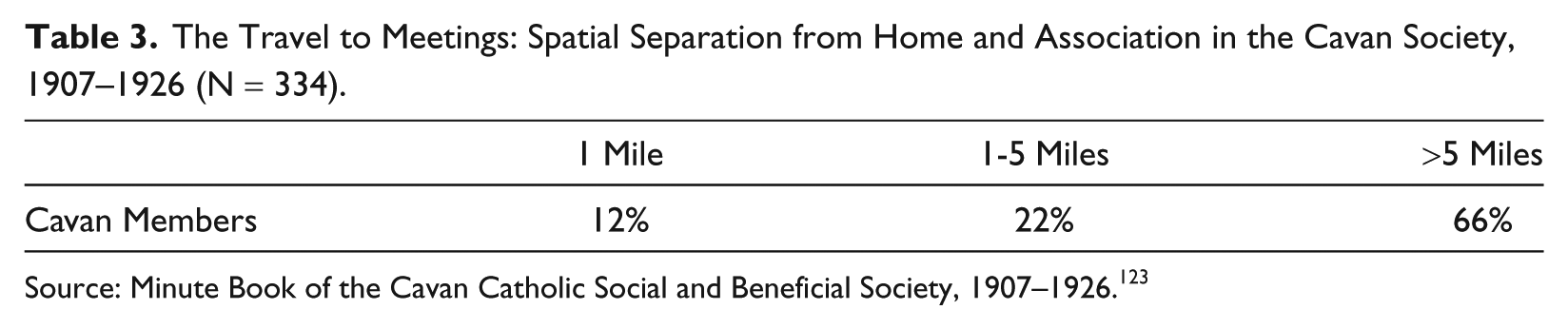
Looking at the Cavan Catholic Social and Beneficial Society in the early 1900s, we find its members spatially distributed around the city but willing to make the journey to attend the society’s many meetings at 1534 Ridge Ave., just north of the central city (see Table 3).
The Travel to Meetings: Spatial Separation from Home and Association in the Cavan Society, 1907–1926 (N = 334).
Source: Minute Book of the Cavan Catholic Social and Beneficial Society, 1907–1926. 123
On any given weekday evening or Sunday afternoon in Philadelphia during the late nineteenth, early twentieth centuries the Irish American community was on the move, extending themselves to attend a meeting of their ethnic association that required urban transport. The Donegal Association met in the center of Philadelphia, at Industrial Hall, 314 North Broad Street, and its monthly meetings and twice-monthly committee meetings at that location meant that its members had to travel in from all over the city. 36 Regular meetings of the branch associations of the AOH and the divisional “camps” of the Clan Na Gael naturally attracted men from the immediate neighborhood but were also populated by members well outside of the normal walking distance in the tradition of establishing contact and solidarity beyond neighborhood by attending a gathering outside of one’s local association. 37
It has been suggested that the stifling localized life of the Irish isolated in neighborhood settings prevented the forging of a collective consciousness of Irish identity—Dale Light wrote, “In America, as in Ireland, the Irishman was an intensely parochial person.” 38 If the Irish Americans were merely satisfied with a cultural consciousness within walking distance, the dynamic cultural life and ideology of ethnic difference they constructed would not have been possible in the Philadelphia of the 1890s and early 1900s. Instead, this ethnic group reached beyond the confines of immediate residence to take the electric trolleys that brought them together to meetings outside of their neighborhood and to the mass gatherings for the Irish picnic and nationalist games at Pastime Park.
Sport, Manliness, and the Proto-Irish Nation in Philadelphia
Philadelphia, an Irish city in the late nineteenth century, the location of a burgeoning spirit of Irish awareness, home of ethnic voluntary associations and its own lively ethnic press, was an ideal location for the transatlantic planting of hurling and Gaelic football. Philadelphia’s Irish community adopted the athletic, nationalist creed which they then applied to their concept of the athletic Celt, a heroic masculinity based on “honor, pluck and ability,” an Hibernian Social Darwinism. 39
In the capillary branches of Philadelphia’s AOH and the multitude of the city’s Irish American societies in the 1890s, there was a warm sympathy for the language revival movement and encouragement to attend the evening classes in Gaelic offered at various locations in the city and even a gentle suggestion for members to purchase Gaelic grammar texts.
Judging from the turnout at the sport picnics and the proliferation of these sport events, a mix of Gaelic and American games, on the social calendar of Irish American voluntary associations, many more Philadelphia Hibernians turned their attention to sport as leisure and an expression of nationalist sentiment.
The Gaelic Sport Revival in Ireland
There were multiple reasons for the rise of the GAA and its successful seizure of the Catholic sporting turf in Ireland in the late 1800s. Modernism itself allowed for the appeal of the new games in Ireland and, as Cronin and Mandle both argue, the reconstruction of Irish sport was enervated by images of ancient Ireland but constructed on the model of existing British sport structures. 40 However, dependent as they were on existing sport forms and practices, opposition to British sporting tradition was an unquestioned mantle of Irish identity in Ireland and in the far-off Diaspora lands.
Michael Cusack and the Original Gaelic Sport Movement
Michael Cusack, athlete, sport organizer, headmaster, journalist, and literary man about Dublin is credited with the inspirational vision and organizational energy behind the founding in 1884 of the GAA in Thurles, Ireland. 41 Renown as the character of the citizen in Joyce’s Ulysses, Cusack was an eccentric figure in Dublin’s Gaelic revivalist drawing rooms embracing the language movement as well as sport. 42
Cusack, experienced as a rural secondary teacher, arrived in Dublin in the early 1880s and assumed a teaching position at Blackrock, a Catholic college. 43 Three years later, he established his own Civil Service Academy in Dublin and, for ten years, achieved an enviable record of success in preparing students for civil service examinations. Cusack was also a versatile athlete, who was at one time or another a footballer, hurler, cricketer, track athlete, and rower.
He enthusiastically endorsed a Catholic “muscular Christianity” among his students at Cusack’s Academy, sponsoring a football team of high standing. In the football championships of 1880, Cusack’s Academy won twelve matches against teams like Catholic University, Kingstown School, Santry School, and the Hibernian Club. 44
An exceptional athlete, first a cricketer, a rugby player, and eventually a hurler, Cusack joined the Irish Champion Club in 1878, but he had become disillusioned with Victorian sport in Ireland, tired of British influence, disenchanted with the class exclusion that forbade working men access to Dublin Victorian sport, club clauses that reserved sport for “amateur gentlemen,” banning the laboring classes, the “tradesmen, laborers, [and] artisan.” 45 Cusack also criticized the Anglo-Irish preference for foot races over the weight events at track meets, stating that the slightly framed, urban Englishman had an advantage over the native Irish competitor who was conditioned by the hard labor of rural farm work, heavily muscled.
While Cusack and his GAA were carving out an Irish sporting nationalism for their reinvented games in the 1880s, W. F. Mandle suggests that they were only following a British precedent. Mandle writes of the new Gaelic sportsmen and their appetite for a sporting press as “unconscious imitators of the English writers who were doing the same thing in an English context for a Saxon tradition, for a Protestant faith.” 46 Rouse also acknowledged the hidden influence of the modernist urge upon the nascent Gaelic sport revival, “the proximity to Britain, the ties of kinship and commerce,” which was not easily admitted nor erased even by determined sport separatists eager to separate their games from existing models. 47
Early Gaelic Sport in Philadelphia
“The Irish and Irish Americans are the greatest athletes in the world,” wrote Malachy Hogan in the Philadelphia Ledger in 1908. He went on to say that they have a “phenomenal reserve of energy, such as quickness of thought and action and concentration of alertness, grit, nerve, and lightning speed.” In all, Malachy states, the “Irish Celts . . . stand pre-eminently alone,” their success in sport a testament to their racial separatism. 48 This statement of sporting Darwinism could just have easily been made at any meeting in any camp of the more militant Clan Na Gael in Philadelphia, or a division of the AOH, and it would have been accepted and applauded by the Irish Americans as public knowledge in the early 1900s, ideological support for an American GAA.
Ireland’s GAA envisioned an American support system similar to the Land League branches that spontaneously surfaced in the 1880s and 1890s in American cities and, in fact, GAA sport sprouted in Boston, New York, San Francisco, Chicago, and Philadelphia.
49
The GAA in Ireland was struggling with its own nascent association in the 1890s, yet it endeavored to encourage the Gaelic sport revival in the United States, as we can see from this open letter in 1890 to Philadelphia’s Freeman & Irish American Review
50
from Limerick, Ireland:
The Gaelic Association in America can be worked only by the American Gaels themselves in the same way that Irish counties manage their Gaelic affairs, under the guidance and subject to the approval of the Central Council. . . . but what about the Irish abroad? Are not the exiled sons of our race, who are breathing the free air of the great Western Republic, as Irish as we are? Are they not in position to raise the standard of the Gael in the land of their adoption with as much ease and with much lighter hearts than we at home, galling under the iron heel of alien oppression? Irishmen show yourselves equal to the occasion, show yourselves true to your national honor, and success will be sure to crown your efforts.
The Philadelphia Irish were well informed on GAA events in Ireland through the association’s extensive coverage in the city’s ethnic press and may well have been inspired by the contemporary tales of Gaelic sport clashes. One could have read in the Philadelphia Hibernian or the Freeman & Irish American Review about the 1895 All-Ireland football championships between the Young Ireland Club of Dublin and the Desperandums of Cork in which ten thousand fans testified that there was “still an enormous amount of vitality in the Gaelic Athletic Association.” 51 In addition, Philadelphia’s Irish Americans would have learned about the modernization of this ancient Irish sport, the limit of seventeen players to a side and new safety rules, such as no “nails or iron tips . . . on the boots of the players,” rules against “collaring and holding and running with the ball,” 52 and “pushing or shouldering from behind, tripping or kicking, catching, holding or jumping at a player.” 53
But most of all Philadelphia’s Irish Diaspora would have learned about Gaelic sport by watching the games themselves among the burgeoning Gaelic sport clubs in Philadelphia. The GAA in Philadelphia received a boost through the GAA’s “invasion of America” tour in 1885; the tour was centered in New York, but the Irish hurlers and Gaelic footballers came to Philadelphia for an exhibition in the fall of 1885. This exhibition was promoted through the Irish American associations in Philadelphia, especially the Clan Na Gael and the AOH, and the Irish GAA played a team of Irish Philadelphians recruited from the various city hurling clubs at Philadelphia’s Pastime Park.
The Philadelphia Hurling Clubs
The Limerick Guards Hurling Club of Philadelphia was established by 1889, five years after the beginning of the GAA in Ireland, and the Guards eventually affiliated with the GAA in Dublin. The hurling club was formed from members of the Limerick Guards Patriotic, Social and Benevolent Association, a mutual aid society located at 9th and Spring Garden Streets in Philadelphia. 54
The Limerick Guards played exhibition matches—there were not enough teams to organize a league—the typical style of arrangement being a public challenge to a club for a match on an agreed upon date. On Thanksgiving Day, 1889, the Limerick Guards hosted New York’s Gaelic Athletic Club and its captain, Dr. M. D. Griggin, in a hurling match at Philadelphia’s Pastime Park. 55 Hurling was indeed a new sport for many in the Irish American community of Philadelphia—it was noted that “a large number of those present saw for the first time a genuine hurling match.” 56 The game’s speed and potential for collisions was also evident as one of the New York hurlers had to leave the field after he slipped and hit his head “against the drawn hurley of a member of his own club.” 57
After the sporting event, Philadelphia’s Limerick Guards hosted the Gaelic Club of New York to a reception and the ritualistic round of speeches at their association hall. Edward O’Meagher Condon, editor of a Philadelphia Irish American newspaper, spoke on the martial imperative of Irish hurling. Recalling the Irish American commitment to the American Civil War and the need for readiness in the coming Irish war for liberation, Condon
referred to hurling clubs that were in existence in this country thirty years ago, and of which he was a member, having in those days played games at Niagara Falls witnessed at times by 20,000 people. He said that the war coming on soon after that broke up the clubs, the hurlers being the first from their localities to fall in line and fight for the preservation of the Union. He hoped the hurlers of today would have an opportunity to use the supple limbs and strong muscles . . . for the attainment of Irish independence.
58
Every occasion when the Irish gathered in late-century Philadelphia seemed to be a moment for building Irish culture and nationalist feeling, and the presentation in Philadelphia of hurling with its violent clash of athletes affirmed growing popular martial symbols. The Limerick Guards, led by Captain Hogan, returned the favor when they traveled to Brooklyn a few weeks later to play the New York Gaelic Athletic Club on their own hurling turf. 59
By 1893, the Thomas Francis Meaghers and the Charles Stewart Parnells joined the Limerick Guards in Philadelphia as established hurling clubs. 60 Philadelphia GAA clubs took their names from fallen Irish Republican heroes or molded their public image on republican themes—The Celtic Son’s, Thomas Davis, Charles J. Kickham, the Thomas Francis Meagher (Civil War general of the Irish Brigade), John C. Cosgrove (convicted of treason and hanged by the British for gun running), William Smith O’Brien (elected Irish representative of Parliament), and the James Stevens Club (founder of the Irish Revolutionary Brotherhood, the precursor to the Irish Republican Army) all merged sport and militant nationalism in the iconic imagery of their clubs.
At the 1890 Clan Na Gael Games in Philadelphia, a game of Irish football was organized between the William Smith O’Brien and Terrence Bellow McManus Clubs, with the winner taking a three-hundred-dollar prize and a banner. 61 The Ancient Order of Hibernians Irish National Games were held in the summer of 1895 and it featured a “Grand Hurling Tournament for the American Championship” that brought in GAA teams from Chicago, New York, and Boston to Philadelphia. 62 The Philadelphia hurling clubs, like their Irish brethren across the Atlantic who, in their prematch ritual, seized the public space of a quiet Sunday afternoon to march military style through the town square with their hurling sticks sloped on their shoulders like weapons, carried the style and imagery of a resurgent Celtic masculinity as they gathered for a Sunday afternoon of Irish sport in the 1890s. 63
The Nineteenth-Century Irish American Sport and Cultural Festival in Philadelphia
The Irish communal associations in Philadelphia used sport as a mechanism of appeal for their ethnic cause and a way to bring large crowds together in one location for fund-raising events. These summer spectacles were massive urban picnics, part nationalist rally, part cultural lesson, and most of all a moment away from work in the industrial city for leisure and entertainment. The following 1895 announcement of the AOH summer sports in the ethnic press
64
was typical of the appeal presented by this style of games:
___________________________________________
Under the auspices of the combined Divisions of the
Washington Park, July 4th, 1895
________________________
Grand Hurling Tournament for the American Championship ___________________________________________
Cultural events accompanied the sporting attraction and were presented according to the American competitive ethos, with competitions in the Irish jig, Irish reel, and the popular, “mirth provoking” tug-of-war matches among the numerous branches of the AOH. 65 The “ring” at Rising Sun Park in North Philadelphia became well known in Irish American associational circles, identified with Irish American track races in the 1890s. 66 Winning the AOH tug-of-war match among the competing divisions insured bragging rights in the victorious association for the entire year, club teams with colorful titles such as the “Richard Barry, Daniel O’Connell, Free Soil, Larkin & O’Brien, Emmett and Speranza,” all battling for the coveted trophy and money prize. 67 The games also attracted massive crowds, and the financial rewards for the association could be substantial. For the AOH Memorial Day picnic in 1894, twenty thousand tickets were printed and distributed among the divisions to sell; a “special paper” was printed and distributed to promote the games, and posters hung around the city two weeks in advance. 68
The 1895 Gaelic Games sponsored by Philadelphia’s Irish American associations attracted top athletes from across North America: the 1895 “Irish Nationalists” Games in Rising Sun Park were attended by runners from Canada, Pittsburgh, the Manhattan Athletic Club, and featured Peter Cummings, “the champion 56-pound thrower of the United States.” 69 Entrance fee was a manageable 25¢, and the site was chosen for its proximity to the trolley lines that ran north and south. 70
Urban transport was crucial to the success of the Irish summer sport picnics, the park sites just north of the central city the most accessible by trolley from all parts of the city with direct routes north requiring a simple transfer from the western sections of the city. 71 The 1894 “Games of the Emerald Isle” sponsored by the “Irish Nationalists” were held at Washington Park in North Philadelphia while the AOH held its mass games in the same summer, Memorial Day, 1894, at Forepaugh Park, a baseball park in North Philadelphia at Broad and Dauphin Streets, home of the Philadelphia Quakers baseball team.
The 1889 Nationalist Games sponsored by the Clan Na Gael were held in Rising Sun Park where “the immense crowd [was] estimated at from 45,000 to 50,000”—the city’s Irish “came on the railroads, in the street-cars, in wagons and carriages and on foot.” 72 Eager to avoid the stigma of rowdiness at any Irish gathering in Philadelphia, public order was a priority and on-duty police Lieutenant Brode was quoted as observing, “I never saw so much enjoyment, so great a crowd, and so little disorder.” 73
The Games themselves, the many sporting events, the tug-of-war, the reel and jig contests, the cultural events, the music and dancing were also a way of promoting the Clan Na Gael as less secretive and conspiratorial, a more respectable Irish American association unlikely to do public harm—it was reported that “the whole body of the citizens of Philadelphia approve of the Clan Na Gael . . . it represents the Irish-American People.” 74
In 1890, the Clan Na Gael’s Nationalist Games were again held at Rising Sun Park, and the attendance was estimated to be forty-five thousand. The athletic events, the jig and reel competitions, were the main attraction, but this was just as much a total Irish cultural festival:
The dancing pavilions were crowded all day. A large brass band and several orchestras discoursed sweet music and scattered throughout the grounds were a number of fiddlers and piccolo players, to whose inspiring music even the old people were tempted to dance the reels, jigs and horn pipes of the old land.
75
Philadelphia’s Clan Na Gael followed the summer extravaganzas with a massive Labor Day event in 1890 that was a combination of picnic, track event, and nationalist political rally in which forty thousand people attended:
Men and boys, young women and old women, grandsires and babies. It was a family gathering. The people scattered through the park and enjoyed themselves in various ways. Of course the games attracted the greater number.
76
For those with stamina, at the close of the athletic games there was a reception at the Clan Na Gael’s Irish American Club on Race Street, more speeches and the singing of “several patriotic songs” well into the evening hours. 77
Irish American ethnic associations copied the grand model of the Clan Na Gael and the AOH Nationalist Games and picnics and smaller versions of this style of leisure appeared all over the city. Even the Catholic Total Abstinence Union held its games in the fall of 1889, at Pastime Park in North Philadelphia. 78 Baseball was played at the Company H Hibernian Rifles picnic in the Falls of Schuylkill, between the many neighborhood teams of this working-class district; this time, the Actives of Manyunk defeated the Bellevues of East Falls 16-11. 79 Such was the eclectic nature of Irish American sport and leisure in the 1890s as it spread itself across the Irish American associations of Philadelphia. 80
The Darwinistic Leanings of Nineteenth-Century Sport
Donna Gabaccia writes, “in the United States, Social Darwinism rooted consensual citizenship not just in whiteness . . . but in the Anglo-Saxon race,” 81 a social fact the Irish Americans reacted to and confronted to invent their own racial type. Thus, the ancient Celtic warrior wed to the soil, embattled and often defeated but never vanquished appeared in the 1890s to be set aside a morally inferior British type, an urban dweller with materialistic goals and values. Gaelic sport was often portrayed as race combat, and the Irish took pride in their manly events involving the rural strength of the Celt working the land and the militaristic show on a Sunday afternoon that became modern hurling, all in contrast to Anglo sport derided by Irish observers as more suited for a restrained, urban civility.
All of these racialized slogans and images of Irish manly vigor in hurling and Irish football resonated in Diaspora Philadelphia, creating an ideal type, an image of the Irish sportsman as a militant warrior for a nation in waiting, willing and able to drop the hurling stick and pick up the rifle when called upon. Sport embodied much more of a martial spirit than the other attendant expressions of the Gaelic revival, the language movement for example, and inspired a connection to an emerging pride in Gaelic masculine achievement; as McDevitt states, the GAA in these years combined “manhood, patriotism and resistance.” 82 In an era of Social Darwinism when nation, sport, and war all blended together to produce a national heroic type, these phrases of Celtic ideology rolled easily off the tongues of the Irish in Philadelphia.
The GAA offered the Irish their own national games, restored to resemble the shape and form of established British games like soccer and rugby, but rougher and more traditional, with the skilled use of the Irish caman or hurling stick invoking ancient Gaelic martialism. As Richard Holt states, GAA sport was a “unique blend of the traditional and the modern,” eventually adapting to a public demand for speed, skill, and open play visible to a mass audience in an enclosed space. 83
The GAA made political and social statements with its public style, its popularity among rural and town workers, and its active opposition to British Victorian sport and came to eventually place its own GAA ban 84 on British games all together. GAA ideology was total in its opposition to British modernism, as McDevitt writes that hurling “associated the games with violence and violence with manhood. Any fear of bodily harm was deemed a sign either of encroaching British influence or effeminacy.” 85
Manly Sport and Irish Militarism
AOH president of Division 34 in Philadelphia’s Old Southwark just south of the central city, Jeremiah Sheehan, stated in 1895, “there should be 35,000 armed and disciplined Irishmen in this country . . . no organization is more worthy to foster the military spirit than the A.O.H.” 86 The attraction of sport and its Irish revival, in hurling and Irish football, resonated in the association meeting halls and ethnic press combining a resurgent Irish masculinity with Celtic racial nationalism, made more vital by displays of military bearing.
The martial presentation of Philadelphia’s Irish athletes tapped into a popular version of Irish Social Darwinism that reinvented the Celtic race as the true bearer of Irish masculinity and the martial expression of the coming Irish nation—John O’Dea, an officer in AOH 49 and the chief organizer of Irish sport in the city and a fixture at every Irish sports picnic, revered the Irish athlete in Philadelphia as “an excellent type of the Irish race.” 87
Philadelphia’s Hibernian Rifles: Paramilitary Show
The Hibernian Rifles of Philadelphia’s AOH were organized in the 1880s “to encourage the formation and maintenance among citizens of Irish birth or descent of an independent body of citizen soldiers.” 88 The Rifles were an auxiliary organization attached to the AOH, and its warriors assembled in uniform, drilled, marched and even went out on maneuvers, holding an occasional encampment in the Pennsylvania woods, readying themselves for the ultimate test to defend their nation of descent.
Irish paramilitarism had an early history in Philadelphia where there were few restrictions on the display of arms in public. On St. Patrick’s Day, 1859, Philadelphia’s Public Ledger reported on the parade’s march of Irish units: “the following companies participated: Montgomery Guards, Irish Volunteers, Hibernia Greens, Emmett Guards, Meagher Guards, Shields Guards . . . after marching through the principle streets the Regiments proceeded in a body to hear a lecture.” 89
The Irish-American Military Union was established in 1884; the real associational energy of this martial society was confined to the branch societies in various cities of high Irish concentration, such as Philadelphia. The Irish-American Military Union vowed to bring together “the best and ablest men of our race . . . men of Irish descent, in whose hearts burn that love for the military art.” 90 The Union advanced an ideology of Irish racial supremacy to contrast with the “Anglo-Saxon pirates” and organized encampments and instruction on how to use arms. 91 As with most of the Irish-American paramilitary associations, there seems to have been much play acting at war in mock battles with imagined historical enemies.
In 1890 the Hibernian Rifle Clubs of Philadelphia mustered out for their nationalist sports and picnic on Easter Monday. The Frankford and Manyunk Hibernians squared off in a rough game of football in which one of the Manyunk “boys . . . was carried from the field.” 92 Across the Delaware River, in Camden’s Stockton Park, the New Jersey Hibernian Rifles Company C sponsored its field day of sports and cultural events in May 1890; Philadelphia Hibernians crossed the Delaware taking the ferry from Market Street in Philadelphia. 93
At the 1889 Irish Nationalist Games sponsored by the Clan Na Gael, the featured event was a tournament in “hurling by the leading Irish-American clubs” as well as the military drill exhibition by the Hibernian Rifles. 94 Public order during the nationalist games and gatherings of the Hibernian Rifles was also an opportunity for martial display, and during the 1899 games “a detachment of the Irish Volunteers were on duty, under the command of Captain McGuiness . . . but the Irish Volunteers whose duty it was to maintain order had scarcely anything to do.” 95
The Irish American societies and clubs of Philadelphia were well schooled by the turn of the century in the detailed organization, advanced planning by an assortment of the committees and presentation of large cultural events in Philadelphia, public galas that were opportunities for the display of an Irish martial bearing within the context of a communal pride in Celtic racial pride. The Hibernian Rifles, First Regiment under Colonel James H. Murphy, followed the tradition of Irish militarism on St. Patrick’s Day, 1890, marching through the streets of Philadelphia, displaying “soldierly bearing and excellent discipline.” 96 These maneuvers by the Philadelphia Hibernian Rifles were apparently not all that threatening a military presence in Philadelphia: U.S. Army Colonel Wendell P. Bowman observed the Rifles on this occasion and reported: “when I saw this gang of buccaneers, who call themselves the First Infantry, Hibernian Rifles, or something of the sort, parading down the street, I thought they were as harmless, as well as badly disciplined, a set of young fellows one could meet with.” 97
Such public disrespect of Irish military valor naturally motivated a public defense in the Irish American press:
At Gettysburg, Fredericksburg, Malvern Hill and Antietam, when the rebels saw the Irish Brigade advancing with the green flag of their motherland and the Stars and Stripes, they did not regard them as “harmless boys.” Neither Sheridan, Meagher, Corcoran, Shields, McClellan, nor Grant spoke of them as “buccaneers.”
98
The Hibernian Rifles missed few opportunities to appear at Irish American public gatherings in the 1890s, promoted as “exhibition drill by Irish-American Military Companies.” At the Clan Na Gael Games in 1890, Company F of the Rifles entered the drill contest, and they “gave an exhibition drill” for the large crowd gathered for the day’s athletics. 99 The combined camps of the Hibernian Rifles, at the St. Patrick’s Day celebrations in 1894, “paraded in the afternoon” and held a reception in the evening at Horticultural Hall.” 100 At the 1895 “Irish Nationalist Gaelic Games” at Rising Sun Park, there was “an exhibition drill by the Emmet Guards . . . each company went through a series of military evolutions in a way that drew cheers from the spectators.” 101
The Hibernian Rifles of Philadelphia saw themselves as ideal public defenders of the Celtic race as well as American freedoms:
The Hibernian Rifles are no tax upon the state. They clothe themselves, pay for the rent of their drill rooms and buy their own guns . . . [if] a call came tomorrow for troops to defend the State of Nation, no body of men in Pennsylvania would more quickly respond than the Hibernian Rifles. The race of which they form a part has proven beyond all question its devotion to this Republic.
102
At the Clan Na Gael sports in the summer of 1899, on July 4th, “a detachment of the Irish Volunteers
103
were on duty . . . to maintain order.”
104
The Irish nationalist Luke Dillon was the celebrity referee for the games. After the athletic contests were completed,
the Irish Volunteers gave an exhibition drill under the command of Captain McGuiness. The efficiency and general conduct of this military body of Clan-na-gael men merits the highest encomiums. For such meritorious duty . . . the “Irish Volunteers” ought to be supported in every possible way and encouraged, and every true Irishman . . . should enlist in this regiment and learn how to use the rifle and the day will come when they will have to use it “In freedom’s righteous cause.”
105
The Hibernian Rifles of the AOH established a central board to monitor the branch associations, the various military “camps.” The board met at the Sheares’ Club on Sunday afternoons, and the organization kept up a military bearing in all things. In 1890, Lieutenant Colonel O’Brien called “the quartermaster to the chair” for Sunday meetings and the board decided to take part in a flag raising ceremony in Bryn Mawr for Decoration Day. “Colonel O’Brien issued orders from headquarters to the captains of the various companies to assemble . . . for the train ride to Bryn Mawr.” 106 Such was the exalted vernacular of Irish American militarism in late nineteenth-century Philadelphia.
Colonel O’Brien of the Philadelphia Hibernian Rifles was also the treasurer of the Irish-American Military Union of Philadelphia. The Irish-American Military Union held its monthly meetings at 8th & Walnut and in 1890 had an “encampment” for three straight nights at Rising Sun Park for the July 4th, a massive, open display of Irish American militarism that coincided with the Irish nationalist picnic and athletic sport scheduled for that site at that time. 107 Six hundred tents were ordered for the many Irish associations expected to join the open-air encampment, and Irish American paramilitary units from as far away as Brooklyn, Boston, Hartford, and Scranton had signed on, a total of two thousand Irish American “soldiers” expected for the four-day event, a show complete with prizes for the contests in military march, formations, and weapons drill. 108
The Knights of the Red Branch, reviving the martial legends of the Ulster Red Branch Knights, was another Philadelphia Irish American paramilitary association with at least 14 divisions spread across Philadelphia in the late nineteenth century. 109 It called its divisions “commands,” and its leader was known as a “grand chief.”
The penetration of the Irish American associations by militaristic images and mock preparation for war was all part of the renewal of a defiant Irish masculinity, attaching itself to cultural forms and gathering momentum in the late nineteenth century. The distinctive uniforms, the marching and military order drill, the overnight encampments, the public marshalling of weapons, the rhetoric of warfare and even the choice of Irish hurling over American baseball were propaganda set pieces in open display in the streets and gathering places of Philadelphia’s Irish, part of a forming identity that eschewed integrative complacency for images of militant opposition.
The Ideology of Militant Opposition
The Rifles, Guards, and Red Knights were an extension of the construction of historical memory parlayed in the ethnic press and gatherings of the ethnic associations, a vital link that served to bolster a battered image of past military defeats in Ireland and failed military excursions in Canada. Irish association meetings tapped into the reservoir of martial discourse generated by Irish service in the American Civil War, a record that generated more battlefield success—at an AOH meeting of Kensington’s Branch 21, guest speaker Col. O’Reilly rose and “spoke of the gallant deeds of the 69th Pennsylvania during the Civil War.” 110
The following few lines on the exploits of the Irish Brigade during the Civil War were read at a Clan Na Gael dinner in 1891, to celebrate Robert Emmett’s birth:
At Gettysburg
Hancock is sullen and Meade is in anger; Chivalrous Lee cometh on with the South; Thunder on thunder the maddening clangor Bellows from cannon and battery’s mouth, Fierce is the shock—in the red gap of danger, Dire is the need of a stubborn blade; Golden and green comes the flag of the stranger— Forward to glory, the Irish Brigade! Vainly the volleying hurricane greets them, Forward the flag of Old Ireland is seen; Fiercely tho’ southern chivalry meets them, Forward in victory flashes the Green. Anderson reels from the shock of their onset; Bravo! The boys of the Irish Brigade! Over their banners the angels of sunset Laurels of victory blazon and braid.
111
Men of the various camps of the Hibernian Rifles of Philadelphia were appreciated for their martial militancy, their status among their peers elevated during these years of martial posturing. John Flanagan, an officer in Command 13, was described as being from the “Irish liberating army that went to Canada years ago,” a reference to the Fenian “invasion” of Canada in the late 1860s. 112 “Captain” Thomas O’Neill was president of the AOH Division 35, of South Philadelphia, a title he earned as the leader of a Hibernian rifle company in Philadelphia—“while never seeking a fight in civil life, O’Neill is full of it as a soldier, and his sword is ready to leap from its scabbard at the first call for Irish volunteers or defenders of the American flag.” 113
England’s loss was always seen as Ireland’s gain in the public vernacular of the Irish community, and Britain’s struggles in the late-century Boer War were not lost on the Irish American associations in Philadelphia. Philadelphia’s AOH Division 64 produced this resolution during one of their monthly meetings in 1899, “this Division of the Ancient Order of Hibernians does express its entire sympathy with the brave Boers in their just and righteous war against their invader, and hopes that the God of Justice and Right will continue to aid them until final victory shall crown their gallant fight.” 114
Close to thousand Irish Americans gathered at Philadelphia’s Industrial Hall in 1900, representatives of the more than ninety branches of the city’s AOH, forty camps of the Clan Na Gael, the Abstinence associations and other Irish societies to register support for the Boers in their “struggle against British aggression.” 115 The associations made it clear that Philadelphia would not be sending an Irish American brigade to fight in the Transvaal but did admonish the mainstream press to stop printing sensationalist stories of Irish American adventures that suggested “proposed invasions of Canada, equipment of alleged volunteers” and Irish American weapon ships headed to South Africa. 116
Across town, the Anglo Saxon Brotherhood held its own meeting in a hall on Poplar Street to express support for the British cause in the Transvaal, boasting to place “200,000 men at the disposal of the British Empire” to be transported by the British Navy. 117 The outpouring of symbolic support for the Boers and military posturing among Philadelphia’s Irish Americans thus became part of a dueling war of hyperbolic words with native Protestant support for Britain in Philadelphia.
The discourse of opposition and discontent punctuated the public space of the Irish American association at the monthly meetings in the late nineteenth century, and a cultural consensus among Philadelphia’s Irish Americans arrived to confirm that they were a Diaspora nation, victims of British tyranny, exiled by the forces of Famine and landlordism, with a special mission to help set Ireland free. Even the loss of the Irish language was presented as a British ploy—“the English government relied to crush the Irish nation by breaking the symbol of their civilization, the embodiment of their glorious and fond traditions, so elegantly set in the chaste and beautiful form of the Irish language.” 118
The Irish community also enjoyed a degree of cross-fertilization among the various nationalist movements and associations, and so if you were a member of the Gaelic League you might be attracted to other traditional Gaelic arts, dance, music and, naturally, Irish sport. At the postmatch banquet, when the Gaelic Club of New York visited Philadelphia to play a hurling match with the Limerick Guards of Philadelphia, the president of the New York team rose and addressed the group:
Hurling was only one feature of the work their association had commenced, and that literary excellence was by no means lost sight of in the desire for greater physical prowess. A study of the Gaelic language is . . . the principle matter of a literary nature that engages the attention of the members of the club.
119
At the “Irish Nationalist Games” in 1895, sponsored by the Clan Na Gael, it was observed that “there were several interesting contests between tug-of-war teams from the different Irish American literary clubs, for a handsome banner.” 120 Various currents of ethnic identity and Irish nationalist fervor were constantly colliding and overlapping in the complex and broad cultural life that the ethnic voluntary associations of the era supported, embraced, and extended.
Irish American Sport as Cultural Revival
The men and women of the Irish community, inspired and influenced by an ethnic press and a vibrant communal interaction that included monthly society meetings, annual balls, summer Gaelic games, and the will and initiative to create a distinct Diaspora Irish community, did not seem to distinguish between political and cultural nationalism—instead, they more often embraced a united front of oppositional images and slogans, a rhetoric of defiance and masculine resolve in the form of the Irish hurler.
The choice of Irish sport as it emerged in the Gaelic cultural revival in the 1880s and 1890s was part of this stance, a cultural revival that instilled pride and purpose among the Irish searching for meaning and connections in late-century Philadelphia. As David Fitzpatrick writes, “The Gaelic revival served a further purpose for immigrants by encouraging a belief in the community of Celtic peoples . . . feelings of abstract solidarity flourished in the absence of chilling first-hand acquaintance. The mystique of race helped ameliorate the immigrants’ sense of alienation.” 121
Philadelphia was a good test of the ability and drive of the late nineteenth-century Irish to reach beyond the fragmenting obstacles the industrial city presented to construct an ethnic consciousness. The city was a vast workshop in the late nineteenth century that required labor, and, as the Irish followed the prospect of employment, it was dispersed to all corners of the urban landscape—no neighborhood or urban area emerged as a special zone of Irish influence.
The Irish found homes in multiple, ethnically heterogeneous neighborhoods and naturally established local ties to home blocks and responded to neighborhood cues. Yet, Philadelphia’s late-century Irish, constricted geographically, did not let the cost and inefficiency of the urban transport system interfere with building an Irish American community and instead used the trolley lines to establish unity, reaching beyond a neighborhood parochialism to construct an impressive, vibrant cultural community. In their late nineteenth-century ethnic associations, their hurling clubs, Gaelic language societies, their ethnic press, and loyalty to Anglo opposition, the late-century Irish in Philadelphia overcame the fragmentation and potential isolation of urban life to create a vibrant, rich ethnic community.
Footnotes
Declaration of Conflicting Interests
The author(s) declared no potential conflicts of interest with respect to the research, authorship, and/or publication of this article.
Funding
The author(s) received no financial support for the research, authorship, and/or publication of this article.