



Abstract
In 1916, a national planning expert strongly advised Milwaukee city and county planners to integrate electric railway transit into any comprehensive metropolitan plan. In that same year, a great proponent of publicly owned transit, socialist Daniel W. Hoan, became mayor of Milwaukee. Twelve years later—while Hoan was still mayor—a national engineering firm made the same recommendation. During the interim, however, it became apparent to city leaders, including Hoan, that they did not have either the legal or financial tools necessary to effectively implement any plan that involved altering and improving transit routes and service. Although Wisconsin adopted municipal “home rule” in 1924, the provision was in reality “too little too late” in that it did not grant cities authority to take over the privately owned for-profit transit companies holding monopolies over their streets. Nor was an option to establish a regional transit authority available until after World War II. This article explores the intersecting roles of state laws, the Wisconsin Railroad Commission, local elected leaders, and appointed planners in the ultimate—automobile-dependent—result.
Keywords
The growth of large cities has taxed the inventiveness of man to the utmost to solve the question of passenger transportation therein, and especially in their congested business centers. . . . It is to the interest of a city to make its streets convenient for the easy travel thereon of all who live within or visit it.
1
Introduction
That statement, made in 1920 by Wisconsin Supreme Court Justice Aad J. Vinje, suggested that cities indeed had the necessary powers to make their streets “convenient for easy travel” following World War I. However, that was not the case. This article considers the sizeable but often underestimated legal and political limits blocking necessary city development—not only in the 1920s but even today. It also explores how those limits restricted options for intra- and inter-city transportation at a time when urban populations still significantly depended upon electric rail and other forms of mass transit—before cities like Milwaukee committed themselves almost exclusively to automotive transport.
Milwaukee provides one important case study of a city vainly attempting to institute a comprehensive transportation plan, constrained by numerous political and legal impediments. This city is a useful subject in that it was once a vibrant agricultural shipping nexus and large industrial equipment manufacturer. 2 Founded in part by railroad investor Byron Kilbourn, it held great promise as a passenger and freight transportation hub: electric streetcars dominated its streets; electric “interurban” railway cars brought regional commuters and consumers into its commercial district; heavy rail tied it to far-flung cities and regions north, west, and south, and its deep Lake Michigan harbor fostered strong shipping connections with Eastern ports.
In the early twentieth century, Milwaukee possessed the vision and many of the tools necessary to maintain and expand its status as a major Midwest interchange, despite and in some ways because of its proximity to Chicago. One important step toward this goal was to integrate its multiple modes of passenger and freight transportation into a comprehensive development model. However, this never materialized; instead, the trajectory of urban development in the region eventually became as motor vehicle driven as that of any other U.S. metropolis.
This paper examines merely one aspect of Milwaukee’s transportation system—passenger transit. The historical record indicates that, at the time of its greatest expansion, the city contemplated expanding and integrating its transit system into city planning in several important ways. Yet it failed to do so, not solely due to matters of choice but because of state constitutional and statutory limits on local decision making and fiscal matters, as well as state-controlled regulation of the privately owned city transit system.
As in most cities, by 1920, mass transportation in Milwaukee was dominated by a single privately owned electric street car (trolley) system. In 1896, the city’s several uncoordinated trolley companies had been consolidated under one corporation, The Milwaukee Electric Railway & Light Co. (hereafter “TMER&L Co.”). Between 1880 and 1920, TMER&L Co.’s streetcar system grew from less than 12 miles to more than 180 miles in length, and its subsidiary company, the Milwaukee Light, Heat and Traction Co. provided interurban service throughout the Southeast Wisconsin region. 3 Yet by 1960, the entire rail system had been torn up and a complex freeway infrastructure was being built in its place; today U.S. Interstate 94 runs from Chicago through Milwaukee to Madison along portions of the old interurban rapid transit route. So what happened?
Transit-Rejection Explanations
It goes without saying that adoption of the motor vehicle–dependent development model characterized virtually all cities nationwide by the mid-twentieth century. Scholars representing various professions have developed theories explaining this almost universal substitution of private automobiles for rail and other mass transit forms of urban commutation in all but the largest cities. Briefly, these explanations include (1) consumer preference, fed by the increasing availability and affordability of automobiles due to Henry Ford’s assembly line production beginning in 1913, increasing consumer credit post–World War I, and marketing appeals to American individualism; (2) the capitalistic ambitions of pro-roads industrialists; (3) federal economic incentives, that is, highway funding, prompted by the rural “Good Roads” Movement and defense transportation needs beginning with World War I; and (4) simple (myopic) planning preference. All four explanations fall on a continuum between actor “choice” and structural “constraint.” 4 Another type of “choice” theory would be the disputed conspiracy explanation involving General Motors, Standard Oil, Firestone Tires, and the National City Lines Bus Company. 5
According to transit historian Mark Foster, whose theories fall on the choice end of the spectrum, planners decided to replace transit with highway development for benign if not altruistic motives; these included improving living standards while supplanting self-interested transit moguls. 6 Regardless of planners’ motives—as historian Clay McShane explained when writing about Milwaukee’s early (pre-1900) streetcars—politicians, planners, and the general public shared with automobile enthusiasts a common hatred for private corporate transit bosses. 7 This disdain might in fact be characterized as a “constraint,” but not so much of the political and legal variety as the social and economic.
Paul Barrett was one of only a few scholars explicitly examining state legal constraints to local transit development. In The Automobile and Urban Transit: The Formation of Public Policy in Chicago, 1900-1930, he carefully delineated both local and state political mechanisms operating in early twentieth-century Chicago. Yet, while noting the influence of state law, he saw it as a mere backdrop for local agency. Perhaps this emphasis on volition is proper in the case of behemoth Chicago; however, for many cities, state institutional realities had such important consequences that these structures, in effect, became actors as powerful, or more so, than the policy makers themselves. 8
Transit historian Glenn Yago also acknowledges structural, meaning political and legal, constraints on the choices of both public and private transportation policy makers. He recommends the exploration of local histories to unearth the ways in which transportation is affected by structural variables that promote “the bureaucratization of transportation planning” and “the insulation of local corporate interests from public opposition.” 9 This is similar to the argument of policy historian Jon Teaford, who criticized the inordinate state administrative control that Progressive-era legislatures imposed on city development. 10
The mixed success of Milwaukee’s transportation planning between the two world wars supports these constraint theories. The Wisconsin Railroad Commission Act, signed into law by Progressive Governor Robert La Follette in 1905 and extended to local transit in 1907, took the power of transit regulation out of the hands of local governments and established an ineffectual, hyper-bureaucratic entity that insulated policy makers from scrutiny. 11 The Railroad Commission stifled the voices of local citizens; despite holding massive hearings on transit service complaints, it rarely took substantive action based on hearing testimony. The very existence of the Commission, as well as its failure to act, also operated to derail the city’s efforts to incorporate transit into planning efforts at a particularly critical juncture—the inter-war period—when transit still might have been “saved.” Indeed the timing of state intervention could not have been worse, since, after World War I, transit companies contemplated selling their assets (albeit at outrageous prices) to the cities in which they operated because of war-time inflation and other factors. The Commission’s intervention merely complicated the valuation process (to establish a price for city transit purchase), and state constitutional limits on city financing also made it impossible for the city to obtain sufficient funding.
According to political theorist Paul Pierson, the structure of political relationships and the timing of various events in relation to one another often constrain choices. The “path dependent” nature or “temporal dimensions” of all policy decisions limit decision makers’ choices despite their best intentions. 12 Not only may the timing of events in relation to structural realities “constrain and enable political actors,” timing may also “shape those actors’ very understandings of who they are and what they want to do.” 13 Pierson’s path dependency methodology looks at how the context of an event—bounded in both space and time—can determine its outcome because of two things: (1) “political space” and (2) “social capacity.” “Political space” relates to whether or not there is a power vacuum, allowing the entry of new players who are vying over political outcomes. “Social capacity” represents the sociological and political reality that sets the stage for how different actors attempt to control political space. 14 Political scientist Joel Rast recommends the application of both the historical institutionalist and path-dependent theories espoused by Pierson to city policy making, as he has done in two studies on Milwaukee. 15
Milwaukee’s planning history suggests that a local government may only implement any profound infrastructural change if it simultaneously has three things in sufficient measure: (1) public support, (2) political and technical expertise, and (3) institutional space—room to maneuver despite social and political constraints. The term institutional space attempts to capture elements of Pierson’s political space and social capacity—but the primary focus instead is the law as a delimiting force. 16 This essay illustrates the particular importance of institutional space to implementing any policy—however popular or well conceived. Although often taken for granted, institutional space is very real. Legal scholar John Brigham has argued that law indeed should not be ignored, since it colors every other choice. In Brigham’s metaphor, law is like the Eiffel Tower, which one might attempt to escape by dining in the Eiffel Tower’s restaurant; we often fail to see the extent to which law surrounds us, and attempting to escape it we find ourselves that much closer. 17
Milwaukee’s Transit-Centric Planning Priorities
In 1910, Milwaukee began exploring how to address growing urban congestion and gridlock under the Socialist administration of Mayor Emil Seidel (1910–1912). 18 The Milwaukee Socialists, later dubbed “sewer Socialists” for their water and waste-processing projects, also engineered a Bureau of Efficiency to streamline and depoliticize local administrative functions. Additionally, they obtained state enabling legislation to create a local planning board. The Socialists also called for ownership of public services like transit and electric utilities. On December 18, 1911, Milwaukee established a Board of Public Land Commissioners (BPLC). 19 One of the Commission’s first acts was to contract a set of preliminary reports, including recommendations by nationally recognized planners, F.L. Olmsted and John Nolen. 20
Five years later, when the next Socialist mayor, Daniel W. Hoan was elected, the BPLC committed itself to adopting a comprehensive zoning plan; by 1920 it was spending more than $30,000 annually for the administration of planning projects. 21 Also in 1916, the city hired an urban planning consultant, Werner Hegemann to further the goals established during Seidel’s brief administration. Hegemann urged Milwaukee to prioritize transit, observing that cities run into problems when they allow the development of parks, streets, and residences “to collide with those areas and rights of way that ought to be rightly reserved for the needs of transportation in accordance with a well studied and farsighted plan.” 22 Hegemann lamented Milwaukee’s adherence to this country’s beloved grid pattern, the city’s narrow streets, its absence of building set-back requirements to preserve opportunities for later widening, and its reduction in diagonal streets over time. 23 According to Hegemann, this repetitive geometric platting worked “against the natural flow of traffic,” impeding land values and contributing to congestion. In contrast, he viewed the city’s earlier “radial highways” as being vital to proper traffic flow, since they were broad and accessible as compared to the new county highways being built at the time. Hegemann noted that “none of the county roads [extending from downtown into the surrounding suburbs], with the exception of one, carries street car lines.” Nor, he observed, were they equipped to carry such lines. 24
To Hegemann, Milwaukee’s “blind acceptance” of old street patterns “irrespective of various new uses” was especially troubling in outlying areas that had only recently begun to develop, since widening, or preserving space to widen, streets was relatively cheap when buildings had not yet been built. Hegemann pointed out: Everything that can be done to develop the radius of rapid transit of a large city like Milwaukee is essential. . . . [T]he plan of the City and County of Milwaukee neither contains nor contemplates at present any street really suitable to carry highly developed modern street car traffic, and . . . since the end of 1911 no extensions of the street car system of Milwaukee have been built.
25
Hegemann attributed this to “a lack of co-operation between public and private enterprises,” which he said “surely must prove detrimental to the progress of this city.” 26 As a solution to Milwaukee’s narrow street problem, Hegemann said that Milwaukee, with a population approaching half a million, “ought to develop higher types of rapid transit than ordinary street car traffic on street levels”; this would include “high speed suburban lines running on an elevated level inside the congested part of the city and making about 18 miles an hour instead of 9 miles as the Milwaukee street cars do.” 27 Hegemann’s report foreshadowed a subsequent report promoting both rapid and semi-rapid transit lines, as well as street widening and the improvement of cross-town streets.
Crusade for Local Control of Transit Decisions
TMER&L Co., Milwaukee’s privately owned transit company, was a publicly traded corporation, formed under the laws of the state of New York. It was in turn owned by a national holding company, the North American Company of New Jersey, which owned major electric power/electric transit facilities in several other states, as well as the District of Columbia. 28 In 1907, as noted, the state of Wisconsin assigned the responsibility for regulating city transit companies like TMER&L Co. to an appointed three-man board, the Railroad Commission, located in the state capital of Madison. 29
Milwaukee Socialist Mayor Daniel W. Hoan (1916–1940) devoted his entire public career—1910–1940—to taming TMER&L Co. While people might believe this was because he was a doctrinaire socialist espousing public ownership simply on principle, Hoan was actually considered fairly centrist in his day; he was perhaps the most outstanding example of “pragmatic socialism” in a capitalist society. 30 In 1918, Hoan withstood a virtual inquisition by a citizen’s advisory group regarding his national loyalty, because of his support of the Socialist Party’s official “St. Louis Platform” against World War I. 31 Twelve years later, a Chicago journalist attempting to explain Mayor Hoan’s sustained popularity, noted that his socialism was not “of the lunatic kind” but one “founded more on university acquired sociology,” absent the “rancor” and doctrinaire “oratory” of other socialists. 32 As a pragmatist, Hoan understood the importance of transit to local development and worked closely with community leaders of all stripes to develop metropolitan planning priorities beneficial to the entire region.
During his initial mayoral campaign, Daniel Hoan reiterated the Socialists’ promise of “a better, bigger, and brighter Milwaukee,” including numerous “municipal ownership projects,” which required “someone to direct those things along a sane channel.”
33
As part of this program, he vowed to continue his fight to make TMER&L Co. pay its share of road upkeep and improvements.
34
In this position, Hoan shared the views of his non-Socialist friend, Detroit Mayor James Couzens, who called a meeting of the mayors from Milwaukee, Cleveland, Toledo, Chicago, Buffalo, St. Louis, Minneapolis, Kansas City, and Pittsburgh to explore “concerted action or consensus of opinion” regarding street railway management. Couzens wrote: My experience has led me to believe that this problem of street railway regulation will always be with us until the matter is taken out of the hands of private ownership. No matter . . . the plan of operation . . . under private management, the issues which arise always come back to city hall for settlement.
35
Mayor Hoan’s distrust of TMER&L Co. was supported by substantial evidence that the company consistently placed the interests of out-of-state investors over those of local citizens. In 1918, TMER&L Co. claimed a $7 million deficit and sought new local investment money to close the gap, while paying common stock dividends of “from 7¾ to 12 percent” to its East Coast investors. City Attorney Clifton Williams wrote to Hoan at the time that: “practically every share of this common stock is held by the Wisconsin Edison Company of New York, which in turn is owned by the North American crowd.” He complained that, if the Company had not paid such enormous and largely worthless dividends, it “would be in an excellent financial condition today, would be able to buy more cars, build extensions and give the service contemplated by the Railroad Commission law, to say nothing of financing wage increases.” 36 Hoan replied: “Borrowing money of Milwaukee citizens for the indirect and left-handed purpose of paying large dividends on common stock to this New York crowd must be stopped.” 37
Legal Constraints Make Strange Bed-Fellows
Despite these very real concerns, Mayor Hoan gradually realized that he would have to consider working with his nemesis, TMER&L Co. To understand his reason for this change of heart, one must comprehend how the state Railroad Commission mediated the relationship between these two avowed enemies. As Hoan expressed it, he wanted more than anything to remove Milwaukee’s transit decisions from the “clutches” of the Commission, which not only controlled transit but also had power over every public utility in the state. 38 According to University of Wisconsin Economics Professor John R. Commons, who helped to design the Commission, the first of its kind in the nation: “Its authority is great and far reaching. . . . It enters into the daily life of the people more than all other agencies of government combined.” 39 Prior to 1907, Wisconsin cities, like others throughout the country, had granted contracts called franchises to private transit companies. In that year, the state legislature converted all outstanding municipally granted franchises to “indeterminate permits” (contracts with no expiration dates) and cancelled the rights of cities to grant future licenses without Commission certification. It also reassigned all regulatory functions from the city to the Commission. 40 By June of 1913, the Commission had handled 2,511 formal and 5,237 informal service complaints and, as of 1915, was responsible to regulate approximately a half billion dollars in assets. 41
In 1914, while city attorney, Daniel Hoan authored a book called The Failure of Regulation, an outright attack on the Railroad Commission.
42
As city attorney, he pursued legislation that would have empowered the city to purchase the transit company or barring that, authorizing local rather than state regulation. He also appealed many Railroad Commission decisions to the Wisconsin Supreme Court, and even one to the U.S. Supreme Court, which he won several years into his mayoral tenure.
43
An untiring advocate for the rights of the average citizen, Hoan wrote to the Commission in early 1918 to remind it that: Hundreds of our citizens stand from thirty to forty minutes regularly, particularly during the rush hours, waiting for a car to board. . . . As Mayor of Milwaukee, I will state that I would not be surprised, if on any night in the near future our enraged citizenship expressed itself in some manner which I would deeply regret.
44
In the years immediately following the end of the war, Hoan expressed his growing exasperation with the Commission’s ineptitude. Appearing as “a citizen” at a January 15, 1920, Railroad Commission hearing, Hoan asserted that the entire proceeding was a sham that wasted taxpayer money, that the Commission’s own engineers acknowledged people were “packed into our street cars like human cattle,” and that the Company’s representative had openly referred to the Milwaukee public “as human hogs because they desired to get on cars that were already packed.” Hoan lamented that, despite innumerable Commission orders, the Company has paid “about as much attention to your orders as it would to an order issued by a tribunal from Mars. . . . Why waste any more of the people’s money in investigating, if you are perfectly impotent to give us better service?” 45
Hoan also accused the Commission of what today is commonly called “regulatory capture,” whereby an administrative agency comes to identify with and endorse the actions of the very industry it is charged with regulating. He pointed out that the Company’s revenues were greater than ever, and that the Commission was more concerned with “enhancing the value of [the Company’s] stocks and bonds” than with providing a public service. “If you do not know this,” he said, “I would recall your attention to the statement of [TMER&L Co. Manager] John I. Beggs on the Thanksgiving Day following the enactment of this infamous law, when he said in effect, that he was thankful on that day for the wonderful law that was passed for the benefit of his company.” 46 In the end, Hoan was more exasperated with the inept/captured state agency—celebrated creation of well-intentioned Wisconsin Progressives like Robert La Follette—than he was with arrogant corporate bad actors like Beggs. Perhaps he saw the danger in creating superficial government mechanisms, which lulled the public into unguarded acceptance of what he perceived to be an anti-public corporate agenda.
Toward the end of World War I in 1918, street railway expert Frank B. Putnam, a former TMER&L Co. executive in Milwaukee, wrote to Hoan that there was a growing need for city and company cooperation to eventually bring about city ownership of the system, in the face of diminished funds for capital improvements because of war-time austerity measures.
47
Indeed American Electric Railway Association President Richard McCulloch expressed the shared belief of many railway company executives that it might be time to sell out to local governments, given these austerity measures and the high rate of post–World War I inflation gripping the country; despite inflation, state railroad commissions were slow to consider requests to increase fares above the standard five-cent fare prevalent in most cities at the time, placing companies in precarious positions vis-à-vis their investors. McCullough said: Under public ownership the character of equipment and the kind of service may be determined by the people themselves. They may have exactly the service they wish to pay for . . . [and] no longer complain about “the absentee landlord.”
48
Attaching a copy of McCullough’s speech, Putnam sent Hoan a letter requesting a private meeting to discuss the possibility of city–company cooperation toward this end, stating: “You probably see this as clearly as I do—more clearly, perhaps, than some of the men who, although they are expert utility operators, have not had our experience in American municipal politics.” 49
While there is no evidence of Hoan’s subsequent meeting with Putnam, this inquiry must have instigated the Common Council’s appointment in 1919 of a “Committee on Advisability of Purchasing Street Railways,” later called the Acquisition Committee. 50 The events that followed were complex and are deserving of significant scrutiny. However, only the following facts about the Acquisition study are relevant to our current analysis. The study began in 1920 with the Committee’s enthusiastic endorsement of the municipal purchase idea. Four years later, when the Committee submitted its final report to the Common Council, it recommended a completely different course of action—something called a “Service-at-Cost” contract. This would allow the company to continue to own and operate the metropolitan transit system, while the city would have more direct control over day to day service issues. The contract would guarantee the company a limited return on its investment via fares (7.5 percent), while the company would have to open its books to the city—specifically to a city-administered Metropolitan Transit Authority. The company would submit to service upgrade recommendations, and any disputes would be arbitrated by the state Railroad Commission. The parties would work to establish a valuation of the company and its assets based on the system’s present cost (“replacement value”), at which price the city could eventually purchase the company.
The reasons for the Acquisition Committee’s about-face were likely rooted in state constitutional and statutory limits on cities. Although the state legislature had passed a law allowing cities to purchase their utilities, the Committee considered this an “empty right,” because the city was not allowed to issue sufficient bonds to fund the purchase. The Wisconsin constitution held the city’s debt to a 5 percent limit of the value of taxed properties, yet the cost to purchase TMER&L Co. “would far exceed the legal limit.” 51 Mayor Hoan was initially extremely suspicious of the Service-at-Cost recommendation, for obvious reasons, but eventually came to accept it after a thorough investigation by his city attorney’s staff. 52 The nonpartisan City Club also performed an independent review and issued a report that basically endorsed the proposal. 53
The question of whether to adopt the Service-at-Cost contract was submitted to the voters as a nonbinding referendum in April of 1925. To further complicate matters, it was combined with another referendum related to a different transportation development issue—street widening to create a boulevard leading from City Hall to a new Civic Center for city, county, state, and federal offices (today’s Milwaukee County Courthouse complex). The wording of both referenda was extremely convoluted to say the least, with the civic center question asking whether citizens wished to renege on an earlier referendum that had authorized the Civic Center project. City planners sought a “yes” answer on the Service-at-Cost provision and a “no” vote on the Civic Center project, which city and county were embroiled in planning; in contrast, a growing “anti-tax” movement pursued the “no” vote on the transit contract and a “yes” vote to cancel the Civic Center work. Despite the Service-at-Cost’s incredible complexity, the plan’s full text was published in the Milwaukee Journal, which enthusiastically endorsed it. 54 On the other hand, for several months leading to the election, the more conservative, Hearst-owned, Milwaukee Sentinel ran numerous vitriolic opinion pieces and even paid full-page ads—mostly against the planners’ program. These ads were financed by both anti-tax interests and a group led by a county supervisor opposing the civic center, as well as anti-Socialist elements. The latter group also opposed election of several Socialists to the school board—the only other election combined with the referenda. 55
The vote came out two to one against (“no” on) the Service-at-Cost measure and about the same favoring abandonment of the Civic Center project. These numbers were similar even in Socialist-friendly wards within the city with respect to the Service-at-Cost plan only; postmortem analysis of this vote was that Socialist voters felt the mayor and Common Council had sold out by abandoning their long-held municipal ownership goal, that is, this plan had not gone far enough. 56 Other voters were no doubt also concerned that they were being hoodwinked by the company, after reading the New York Times article in February 1925 revealing that TMER&L Co.’s parent, the holding company, North American Company, had made a 31 percent profit in 1924, with a net income of over $31 million. 57
A few weeks after the election, Fred S. Hunt, a citizen member of the Acquisition Committee, which had drafted the defeated Service-at-Cost agreement, explained the legal realities of Milwaukee’s transit dilemma to the Chicago City Club. Presumably his advice was sought because Chicago was lobbying to pass a “terminable permit” law in the Illinois legislature, also known as the Barr bill (and similar to Wisconsin’s indeterminate permit), which would allow the city to eventually purchase its transit system. While praising the Wisconsin Railroad Commission for improving a very bad situation, Hunt complained: “We are compelled to go to the commission for everything. If we want a six minute headway instead of eight, a one man car instead of a two man or the cars to stop at a certain street, we must go to the commission. Many people in Milwaukee do not like that.” He noted citizen perceptions that the commission appeared more responsive to transit company concerns than those of the public, but observed: “The trouble lies in the fact the commission is fast with the company and slow with the people, because the company has the information [that the Commission needs for decision making] and the people do not have it.” Regarding the Service-at-Cost agreement, he said, “If you are going to terminate [a company’s] permit by municipalization, settle now the value of the plant to be obtained or the method of appraising it.” Otherwise, he warned, a “terminable permit” like Chicago contemplated might be difficult to end. 58
Cooperative Transportation Study
The botched Service-at-Cost compromise was the backdrop for subsequent cooperative efforts between the city and transit company the following year. In the spring of 1926, TMER&L Co. President S.B. Way wrote to the mayor on May 14, 1926, offering $50,000 to pay for a study of Milwaukee transportation problems and suggesting the value of “highly trained traffic engineers and a committee of representative citizens.” 59 He also noted: “Until comparatively recently, there has been no systematic method of controlling the platting of property adjacent to the city with a view of requiring [it] to conform to some suitable and comprehensive general city plan.” 60
Mr. Way stated that “extremely wide distribution” of automobiles (which he albeit characterized as a “wonderful development”) “has perceptibly arrested the annual increase and demand for street railway transportation,” increasing the cost of providing service to outlying areas. He pointed out that the company continued to serve “at least 75 percent” of working citizens, under conditions where rush hours required six times more service than non-rush hour periods. Way emphasized the need to improve “economies” with regard to the shortest routes and highest safe speeds to serve passengers in their home to work commute.
The transit company president also noted that a resulting report was likely to receive greater public confidence if members of the public were involved in the process, under the direction of the city, civic associations, the Railroad Commission, and the company. Recommending retention of a New York engineering firm, McClellan and Junkersfeld, which had recently completed a similar study on Washington, D.C., Way assured Hoan: “The engineers will be instructed to report exclusively to the committee and their operation will not be subject to the control of the Company.” Finally, he noted that the Common Council might want to expand the scope of the study to include transportation issues relevant to the Harbor Commission, something that was agreeable to the company. 61
Mayor Hoan shared the letter with the Common Council’s Committee on Transportation Problems, which then recommended the proposal to the Common Council, resulting in a contract with McClellan & Junkersfeld (M&J) and the creation of a “Committee on Transportation Survey.” This committee was composed of three city representatives, three citizens, three transit company representatives, and three representatives of the Wisconsin Railroad Commission, and led by M&J “Resident Engineer in Charge” Thomas R. Tate. 62 The resulting report, ultimately published in its final form in 1928, offered significant practical recommendations to improve streets and transit routing and service. 63 The study process was innovative, in that the engineering firm regularly submitted chapter drafts to the Transportation Survey Committee for input, so that the Committee could recommend additional information to gather and then include in the final report. 64
Stakeholders
In addition to including transit, business, and citizen leaders in the process, McClellan & Junkersfeld also sought to understand public preferences, stating in the report’s foreword: Too frequently . . . decisions are made to meet insistent demands of business and industrial groups without full consideration of the comfort and convenience of the citizens as a whole including those who are clamoring for certain decisions unselfishly or otherwise.
65
It continued: “a great city is not a static thing but alive and growing. . . . [Thus,] [l]ooking forward is absolutely necessary because the bane of all planning in the past . . . has been the filling of needs of the moment or dealing with parts without adequate consideration of the whole.” 66
The study plotted the location of the city’s major businesses, representing them on a city map (Image 1) in small or large squares corresponding with the number of workers they employed (detailed in Image 2). It also included a comprehensive questionnaire about citizen riding habits, which garnered widespread support. The number of valid surveys returned equaled over 95 percent of the total number of employees in the city. 67 It also engaged with the metropolitan real estate community, recounting the long-held conviction among real estate “operators” that transportation routes were “of sufficient importance to justify their financing and constructing them.” 68

Location of Industries Showing Number of Employees. See Image 2 for names of corresponding businesses by number with statistics for each. McClellan & Junkersfeld, Inc. Engineers, Transportation Survey Metropolitan Milwaukee (1928). Used with permission of the City of Milwaukee Legislative Reference Bureau.

The numbered businesses on the chart in Table 9, left, correspond with squares on the map in Image 1. Transportation Survey. Used with permission of the City of Milwaukee Legislative Reference Bureau.
Despite the study’s stated goal to obtain public input, its investigators failed to enlist the help of the city’s many civic groups already independently studying city transportation issues, such as the Milwaukee City Club, which had dominated the Mayor’s Committee on Civic Planning, already had its own Committee on Public Utilities (including electric rail transit), and was part of the Milwaukee Civic Alliance and several other collaborative planning efforts. 69 However, several members of the original 1920 Acquisition Committee were in fact appointed the city’s M&J Transportation Survey Committee.
Transportation Problems Identified
McClellan & Junkersfeld identified several major barriers to effective transportation throughout the metropolis: (a) congestion of established traffic-ways due to both population density and multiple, incongruous uses; (b) inadequate connections of residents to their places of employment and schools; (c) natural geographic boundaries (i.e., the Menomonee, Milwaukee, and Kinnickinnic Rivers and Menomonee River Valley), and (d) shared rights-of-way/grade crossings. It concluded that Milwaukee’s central business district was “less extensive and less developed” than similarly populated cities, that the secondary business districts required careful consideration regarding transportation design, i.e., access through cross-town routes, and that “more persons are employed in outlying districts than in the central district,” necessitating transportation service patterns that were not solely tied to downtown. 70
Regarding transit use, the study ascertained that fully 115,000 or 90 percent of the employed population lived within four miles of their work. Yet this group continued to utilize public transit to the same degree as others residing farther from their places of work; 60 percent of all workers and students from all areas of the city utilized public transit. 71 From this traffic flow information, M&J determined the most heavily used routes and thus the areas of greatest congestion. Other factors considered with regard to traffic flow and congestion included shared incompatible uses of city streets, including parking. 72
Perhaps the Report’s most important contributions, however, were its suggestions about reducing downtown business district congestion, improving efficient transit between the downtown and outlying residential areas (including suburbs), and introducing new cross-town transit options. These involved street-widening, introducing separate “highways” for passenger, trucking, and other purposes, establishing new rapid and semi-rapid transit routes with dedicated rights-of-way to transport commuters from the suburban fringe (see Image 3), and increasing the number of local streetcar and bus routes (see Image 4). 73 The report also discussed the problem of financing rapid transit. It applauded New York City’s solution of “regarding the subway as an underground street which it had to provide at its own expense just as it provides surface streets.” 74
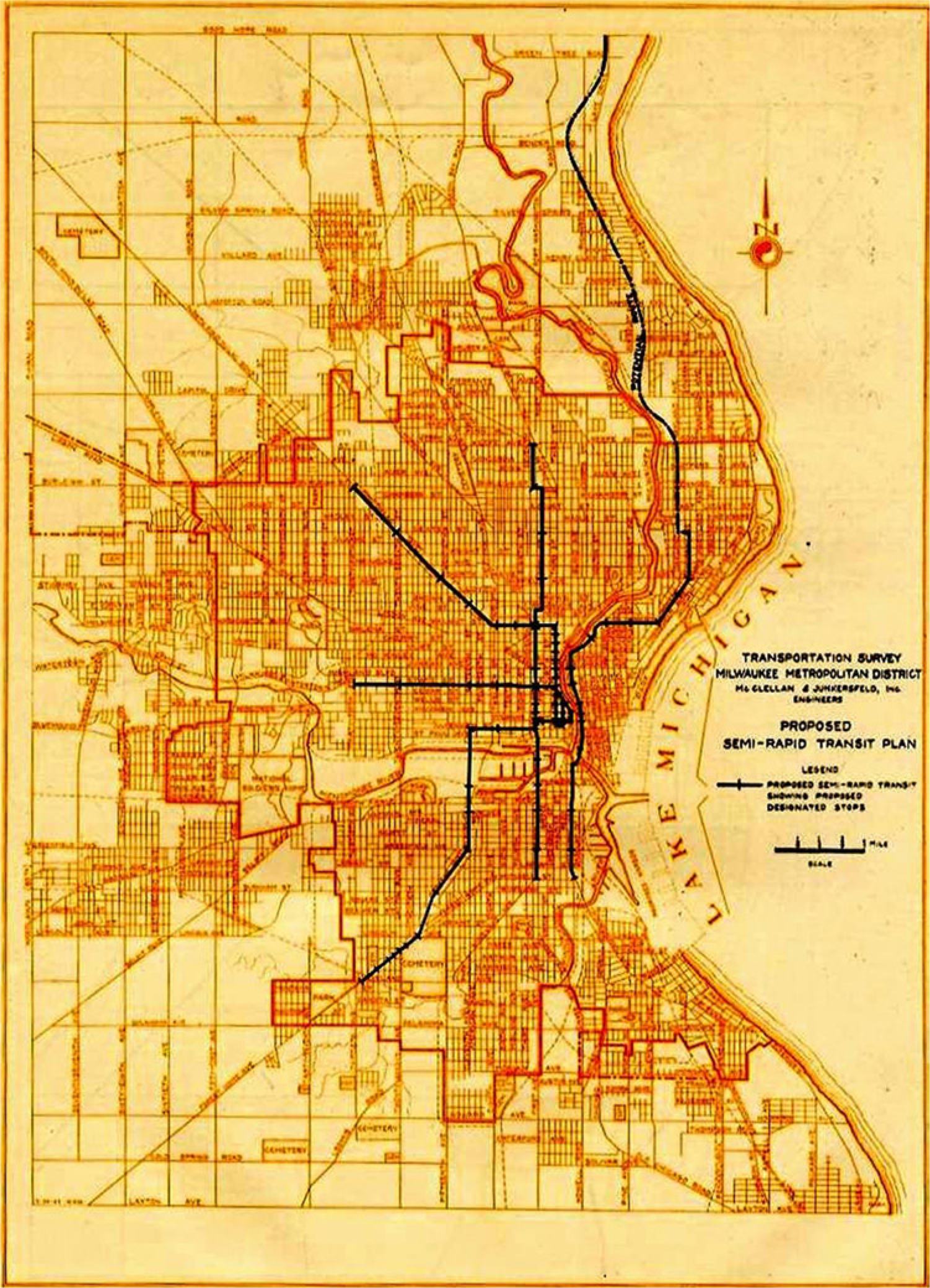
Proposed Semi-Rapid Transit Plan, Transportation Survey. Used with permission of the City of Milwaukee Legislative Reference Bureau.

Proposed New Lines, Reroutings and Extensions Rail and Bus, Transportation Survey. Used with permission of the City of Milwaukee Legislative Reference Bureau.
To explain and, perhaps justify, its argument favoring public transit, the report noted that street cars and buses comprised less than 5% of the vehicles entering and leaving the city each day; yet they carried 47% of the passengers. In contrast, automobiles represented 77% of all vehicles and carried only 45% of the passengers. Thus street cars carried more than 15 times as many people, justifying ordinances that would grant streetcars the right-of-way over other vehicles to increase both speed and safety. 75
Fate of the Transportation Survey
Although presented to the city’s Board of Realtors in February of 1928, the M&J Report was not officially released to the Common Council for several months because its authors and the Committee could not agree on the transit issue. When finally published, the Transportation Committee’s recommendations notably failed to include a final concluding paragraph, an omission that is particularly striking at the end of such a detailed report of several hundred pages. While there is no explanation for this, the reasons may be deduced from other records. 76
Of the many recommendations, only two proposed road projects were eventually completed: the 35th Street viaduct crossing the Menomonee Valley and—much later—the Hoan Bridge over the harbor mouth, connecting North Shore and South Shore Drives at the shore of Lake Michigan, opened in 1977. 77 Over time, the city also widened many downtown streets and adopted zoning ordinances to preserve street set-backs and control the locations of businesses and housing. No concerted effort was ever made to implement the transit extension portions of the McClellan & Junkersfeld plan. 78
The report itself cryptically foreshadowed its own unfavorable end when it cautioned: Differences of opinion on these vital subjects, which could block all improvements because of disagreements on individual projects, must be eliminated by compromise if Milwaukee is to keep pace with her growing needs and with other cities. Details of the city plan are not as important as is immediate action on the plan as a whole.
79
Indeed, the study acknowledged the enormous problem of political coordination, noting that “execution of the plan . . . would be easier if the whole Metropolitan District of Milwaukee were one municipality.” Further, it suggested the need to overcome public resistance to proposed changes through “organized, intelligent and sympathetic education” of the community. 80 Frustration with the failure to make any real progress, whether for these or other reasons, was shared by others involved in Milwaukee metropolitan planning, including Arthur J. (“Jerry”) Sweet, an engineer who had been very active in earlier planning efforts. In a letter to the City Club, he expressed disgust that the setbacks were the only changes adopted, yet they were praised as being innovative. 81
Legal Impediments to City-Driven Transit Planning
The failure to implement any of the major transit recommendations can be traced to preexisting state legal structures constraining city choices. In their 2010 book, City Bound: How States Stifle Urban Innovation, municipal law scholars Gerald E. Frug and David J. Barron explain how cities have always been creatures of the states in which they reside. States incorporate cities in ways that are very similar to business incorporation. 82 While today most cities have home rule authority (the right to design their own governments and to make purely local decisions), the outlines of this authority remain blurry, and states and cities still end up in court over jurisdictional issues. Milwaukee’s failure to manifest its pro-transit development plans in the 1920s illustrates some of the problems stemming from the legal stature of cities as relatively weak entities.
Milwaukee’s political capacity expanded too late to allow it to effectuate the very promising proposals the M&J report had put forward. As soon as Daniel Hoan became city attorney in 1910, he had drafted a home rule bill and lobbied hard for its passage in the state legislature. Although passed in 1911, it was soon declared unconstitutional. The Wisconsin Supreme Court explained that the only legal home rule measure would be a state constitutional amendment. Wisconsin’s Home Rule Amendment was finally passed and signed into law in 1924, and it took several years beyond that for the city to rewrite its charter in order to exercise its new powers. A few more years of judicial challenges further delayed its use, and the court’s circumscribed extension of municipal home rule through these cases rendered home rule ineffective as a useful device for city planning.
Wisconsin Supreme Court Justice William Timlin had predicted this outcome in his concurring opinion for the 1912 Mueller case, where the home rule statute had been struck down. He explained that, even with home rule, states would always interject their sovereignty over cities. He described how Detroit had attempted to amend its charter under Michigan’s Home Rule Constitutional Amendment, so it could buy its street railway, but failed to garner the necessary additional borrowing power from the state legislature to finance the endeavor; despite Home Rule, the state still determined the limits of the city’s indebtedness. 83
A principle called “Dillon’s Rule” severely impeded these ends. “Dillon’s Rule,” named for municipal law scholar John Dillon, was widely adopted nationally by the end of the 19th century. It required strict construction of any state-conferred powers to municipalities. U.S. cities had at various times sought to interpret state-granted “police powers” to mean not only public safety but also regulation of commerce, including transportation of goods and services along city streets and eminent domain (taking of private property for “public use” or the “public good”—terms with significantly different meanings). Yet courts routinely struck down this “overreaching.” Because of the unfortunate grip of Dillon’s Rule and the inopportune timing of home rule adoption, Milwaukee and other cities did not possess the powers necessary to direct or coordinate metropolitan transit plans such as McClellan & Junkersfeld had recommended.
Similar to Detroit, most cities throughout the country, including Milwaukee, also labored under constitutionally imposed debt limits of 5 percent of the value of taxable property within their jurisdiction. These debt limits also applied to long-term infrastructural investments like purchasing a street railway system. Even after legislation was specifically passed enabling cities to buy their transit systems, this debt limit factor severely hobbled city development. Such financial limits even dogged larger cities like Chicago. Although the Illinois state legislature had granted Chicago the right to purchase its transit system without being encumbered by its debt limits via the controversial Mueller Law, the Illinois Supreme Court held this portion of the law unconstitutional in 1907. This placed significant limits on Chicago’s spending power, influencing voters’ decision to reject a referendum regarding purchase of the city’s transit system later that year. 84 Debt limits also forced city planners to ingratiate themselves to wealthy city boosters, who were potential benefactors and sponsors of large city cultural projects. 85
Legally, Milwaukee also lacked the power to monitor and penalize its transit system for inferior service conditions. By creating the Railroad Commission, the state placed the city in the role of supplicant on behalf of angry citizens. Thousands of pages of testimony suggest that Milwaukee’s riding public, distraught about service infractions, demanded city assistance. The city attorney’s office spent considerable time (and hence money) advocating on their behalf at Commission hearings, which ultimately resulted in slaps on the wrist to the transit company. It should be noted, though, that continuing citizen appearances at seemingly fruitless Commission hearings suggested sustained public interest in retaining public transit for commuting purposes, well into the 1940s. 86
In his 1914 book, The Failure of Regulation, Daniel Hoan declared state Railroad Commission regulation to be “a farce and a fizzle,” explaining: Regulation in Wisconsin, as elsewhere, is one continual fight by the corporations on the one hand, and the municipality, or other complainants, on the other, before the Railroad Commission and the courts. The delays incident to such fighting, which is a necessary element of regulation, are beginning to make the citizens of Wisconsin disgusted with the entire mess of regulation, and developing them into advocates of common ownership of public utilities.
87
To emphasize his point, Hoan detailed the very first Commission investigation of Milwaukee citizen complaints against the street railway company in 1907 (before he entered public office): Nearly one hundred witnesses were heard, particularly on the question of over-crowding of street cars during rush hours, lack of cleanliness of cars and poor ventilation. The case was argued by both sides at Madison, Wisconsin, on April 23, 1907, and the decision was rendered July 11th of that year. . . . The order which was rendered in the case was a joke from the view-point of the street railway company, but lacked all elements of humor to those who, night after night, were packed like sardines into the street cars of the City of Milwaukee.
88
Hoan was particularly upset that, despite the magnitude of the complaints, the difficulty of getting witnesses to the hearings, and the time expended, the Commission’s vague order merely admonished: “That The Milwaukee Electric Railway and Light Company [should] maintain in the future at least as good or better service than it maintained during the months of February and March, 1907.” 89 At Hoan’s insistence, the Commission finally issued a fine of $10,000 against TMER&L Co. since the company was still not in compliance when he became city attorney several years later. As Hoan explained, however, the money the company saved by challenging many other decisions against it made up for this tenfold in a matter of years. 90
Zoning and Eminent Domain Powers
Another limitation on the city’s powers that reduced its ability to go forward with city plans was its inability to reconfigure downtown commercial and residential spaces through zoning and eminent domain without constant challenge. Even after the 1924 Home Rule Amendment and adoption of a city charter based on that amendment in 1926, property owners sought city zoning variances when, for instance, areas were rezoned commercial rather than multi-family residential districts. Denied variances often ended up in court, with individuals claiming a loss of use or loss of value amounting to an impermissible “taking” of property by the city without due process. Property owners along streets that the city attempted to widen, particularly the boulevard now known as Kilbourn Avenue, connecting City Hall with the controversial Civic Center to the west, challenged the city’s eminent domain powers or sought greater compensation than the city assessor recommended. No doubt the city anticipated similar conflicts regarding land for any new or extended rapid transit lines. This was evident when large numbers of people testified against placement of the Rapid Transit line to the western suburbs in their backyards (classic “NIMBY” arguments). 91
Property versus Use Tax
With increasing automobile traffic in the city, policymakers sought to determine the most equitable way for obtaining maximum revenues for road repairs. As Paul Barrett pointed out, transit companies continued to be charged for their use of the streets, while automotive and truck drivers paid gasoline taxes and licensing fees to the state. While these were divided among various levels of government, they were not tied to street usage in any way.
92
This created a shortfall of funds for street maintenance in cities with the most heavily traveled, hence frequently repaired, roads. These shortfalls had to be made up by city property taxes. The city’s undue reliance on property taxes encouraged city property owners to move just outside the city limits, while remaining near enough to access the city commercial district and cultural amenities. Indeed, Mayor Hoan lamented the unfair burden automobiles placed on both city streets and municipal finances: The automobile has increased Milwaukee’s budget expenditures more than any other one thing. The city has been forced to lay more substantial pavements. Regardless of the durability of these floorings their propensity to wear out is stupendous. . . . Street widening has become an absolute necessity. The cost of everything associated with traffic has been doubled when one compares present conditions with those prevailing 15 years ago. Consider merely one item—that of providing traffic officers. One hundred of them cost $200,000 a year. . . . Then there is the additional cost of providing sufficient traffic signals. . . . And another thing, playgrounds are a greater necessity today than ever before in the history of Milwaukee or any other American city. Boys and girls can’t play in the streets any more as we did. . . . And the automobile has added the burden of many millions of dollars upon the city taxpayers. And the great bulk of this tax—90 per cent of it goes to the state.
93
Annexation and the Irony of the Home Rule Amendment
Urban historian John McCarthy’s book, Making Milwaukee Mightier takes a detailed look at the city’s failed attempts to expand its borders through annexation or, barring that, to unify the entire metropolitan area under one jurisdiction by way of city–county consolidation. 94 For a time, Milwaukee used the transit company’s single-fare zone within city limits to entice surrounding communities to agree to annexation, but the state Railroad Commission and courts removed that carrot by allowing single fares for distances far beyond the city’s boundaries. 95 Indeed, the city would have to have annexed a great deal of property in order to incorporate all areas served by the transit system into the city. The consolidation issue, which had been bandied about since the late 1800s, would have involved dissolution of all municipal governments and creation of a new amalgamated government. Most unfortunately, a referendum on the measure was defeated in the 1930s, even though the majority of county voters favored the measure, because the votes were not tallied on a county-wide basis. 96
Without consolidation of jurisdictions, even road-building projects were jeopardized because city roads stopped abruptly, to be taken up by other jurisdictions or the county. In this regard, the county had the upper hand, since it was legally viewed as an arm of the state and as such had more direct access to both state and federal road construction money. 97
Filling the Power Vacuum—Expanding County Powers
Even as the city continually faced roadblocks to its planning initiatives, Milwaukee County was expanding its political power. In 1927, the state passed a law vesting any county with a population of 250,000 or more (i.e., only Milwaukee County) with additional and substantial legislative and administrative powers regarding public works and safety-related services. These powers included the ability to establish special purpose districts and incur indebtedness through bond initiatives for area improvement projects. 98 The upshot of this law was that towns, villages, and cities outside the city of Milwaukee could turn to Milwaukee County for needed infrastructural improvements and services that had formally been available to them only if they submitted to being annexed into the city of Milwaukee.
Prior to this enactment even, the County had been competing with the City on park development and road improvements. And planner Charles Whitnall worked for both. He had been the City Treasurer since 1910 and had been on the City Board of Plan Commissioners since 1907. He was also the long-time secretary of the County Park Commission, which overlapped in many ways with the County Highway Committee and was responsible for designing the county’s extensive parkway system. Whitnall’s dual role was unusual in a locality where the city and county were often at odds. Because of his longevity as well as his forceful character, Whitnall’s views on transportation greatly influenced the entire region’s development trajectory, including the diminished place of transit in transportation planning. 99
At the March 22, 1928, meeting of the Milwaukee Transportation Survey Committee, Whitnall announced he would not approve of the final M&J Survey conclusions as written because of M&J Engineer Tate’s “framing of the recommendations” to include transit improvements. He instead preferred planning efforts that would generate development outside the city limits and accommodate “the automobile shopper” by diverting truck traffic from commercial districts. He stated emphatically that the M&J-espoused goals would “be defeated by expending an enormous amount of money and energy in the construction of rapid transit from all sides into the center of the downtown area.” Whitnall instead sought to establish competing “centers of convenience and function . . . far beyond the downtown center,” in fact, as far away as possible from downtown Milwaukee, within the bounds of economy and the practical need for proximity. Whitnall continued that, since the M&J report had admitted rapid transit improvements could not be financed through private capital, they would be “an inefficient waste of time, money and energy.” 100 Implementation of Whitnall’s favorite parkway project—albeit resulting in some of the area’s most scenic drives—progressed into the 1930s even as rail transit plans, such as those set forth in the M&J report, fell by the wayside. 101
The city and county boards also had significantly different goals, in part because the county agency sought to acquire inexpensive rural land for parks and parkways before it was developed, while city spaces were necessarily constrained by current functions and had to be rezoned and redeveloped by displacing current users. Charles Whitnall’s preference for automobiles over public transit, like his decentralization vision, “embedded itself in the metropolitan fabric” with the development of the parkway system. Whitnall’s views also manifested in the career choice of his son, city planner Gordon Whitnall, who became one of the chief architects for a major Los Angeles freeway. Charles Whitnall often visited his son on the West Coast, returning to Milwaukee with fresh ideas about replicating the development patterns of L.A. 102 However, by 1938, Whitnall himself characterized Milwaukee’s ever increasing gridlock as “Automobile Problems.” His solution was a plan by which businesses within each four block downtown area would “contribute to a central parking area;” these areas he called “auto parks.” 103
Conclusion
Following completion of the McClellan & Junkersfeld study, no infrastructural projects in Milwaukee involved improvements to electric rail transit. Instead, development ventures from the late 1920s through the Depression era took the form of big downtown civic improvements like the Civic Center (after considerable delays) and the widening of major streets that tied into the county’s highway-widening efforts with the Railroad Commission’s blessings. In 1938, TMER&L Co. began replacing its street railway cars with “trackless trolleys”—rubber-tired vehicles that also ran in the streets, using the same overhead electric wires, but without connection to the road surface. 104 In March of 1958 the last Milwaukee streetcar was sent to the scrap yard. Local governments were unable to acquire or even oversee the transit system. This was despite Mayor Frank Zeidler’s success in obtaining passage of enabling legislation to establish a “Metropolitan [regional] Transit Authority.” The failure of regional municipalities to establish such an authority can be immediately traced to infighting between the municipalities over how many representatives each jurisdiction should have the right to appoint to the new Authority. The remaining transit system, consisting solely of diesel-powered buses, was finally purchased by Milwaukee County in 1975. 105
There is no question that both macro-economic realities of the Depression era and the increased availability of personal automobiles contributed to these outcomes. However, preceding and setting the stage for these decisions was the advantage that county-oriented pro-automobile advocates had in state politics and under state laws compared with their pro-transit city counterparts. 106 Also, as Paul Barrett explained: “regulated private ownership . . . limited the role of transit in future city planning.” 107 The tabling of the M&J plan spelled the beginning of the end for light rail transit in Milwaukee—until the twenty-first century. The city plans to build and operate a two-mile “starter” streetcar system in the near future—that is if efforts by opponents to obtain intervention by the Wisconsin Public Service Commission (the current name of the old Railroad Commission) succeeds. 108
Footnotes
Declaration of Conflicting Interests
The author declared no potential conflicts of interest with respect to the research, authorship, and/or publication of this article.
Funding
The author received no financial support for the research, authorship, and/or publication of this article.