




Abstract
Italy’s urban camps for segregating the Roma minority have received much critical attention recently, yet few attempts have been made to explore how they have evolved historically and function as systems of social control from a theoretical point of view. This article seeks to fill that gap, drawing on Wacquant’s framework for identifying constituent elements of ghettos past and present. It explores whether a genealogy can be traced between the early modern Jewish ghetto and today’s camps, focusing on the Italian capital, Rome. It suggests that many of the original ghetto’s functions operate in contemporary camps; however, it also argues that a crucial feature of the ghetto—its ability to strengthen solidarity within the segregated community—is being strategically undermined. The camps can thus be defined as neo-ghettos, rooted in the past but refined in the present and functional to their specific contemporary social and political context.
Keywords
Introduction
Over the last three decades, different levels of government in Italy—municipal, regional, and national—have collaborated to generate a unique and continuously evolving system for warehousing the Roma minority in special, ethnically-segregated urban camps. 1 The legal status of those camps and the concrete conditions experienced by those who live in them have been widely discussed. 2 What is often lacking in this literature, though, is an attempt to develop a theoretical framework for understanding how the camps originate and function as systems of social control profoundly tied to their local political and economic contexts. The camps are mainly seen as a manifestation of a general escalation in anti-Gypsyism in Italy, manipulated by a discredited political class that has increasingly resorted to fear-mongering in order to acquire legitimacy and support at election time. While these points are certainly important, they do not go far enough in explaining the complex relationships that exist between the camps and the urban environments that spawn and transform them. The prevailing view that they are spaces of exclusion that serve to push out and hide society’s unwanted and “excess” population does not conceive of them as “pieces of the city”; functional, integral, and dynamic components of urban social relations that serve concrete political and economic purposes.
In order to explore the functions of Roma camps in Italy, I draw on Loïc Wacquant’s theoretical framework for understanding the constituent elements of ghettos past and present. 3 Both in the media and academia, 4 some links have already been made between the original Italian enclosures for Jews and today’s camps. Indeed, Wacquant himself 5 has viewed the increasing relegation of Roma in isolated ethnically concentrated neighborhoods in much of Europe, and particularly Italy’s corralling of these groups in state-run structures, as a move towards renewed ghettoization. However, these discussions have not systematically dissected the connections—and the distinctions—between the ghettos of the early modern period and today’s camps. This article debates whether a genealogy can indeed be identified between these two structures for containment that is both historical and functional, focusing on how they operate as devices: complex mechanisms capable of modulating closure and porosity, oppression and self-determination. While it is widely recognized that Jewish ghettos were not simply manifestations of anti-Jewish feeling, but were reactions to local social, political, and economic pressures, 6 there is a need for a similar analysis of how state-engineered Roma camps have evolved over time as technologies for managing a minority perceived as problematic in the urban environment. The study concentrates on the city of Rome, which had the longest-lived Jewish ghetto in the Italian peninsula (1555–1870) and is now home to the country’s largest Roma population, contained in more than three hundred camps of different types. The choice to restrict the analysis to a single city is rooted in the view that any urban institution is the product of the specific spatial conditions and power relations of its time. While an overarching “ghetto system” 7 emerged in the Italian early modern states, each ghetto was inseparable from its immediate political and commercial context; it would be reductive to disentangle Rome’s ghetto from the papal power that created and exploited it. Equally, while Roma camps exist throughout Italy, those of Rome have a special symbolic and political status tightly linked to the city’s recent drive to assert itself as a modern, global capital.
Italy’s camps policy has been condemned for infringing human and civil rights 8 and for being economically unjustifiable and unsustainable. 9 Yet, successive municipal governments in Rome both of the left and right have, for three decades, persevered in developing and refining this system of containment, and there is no indication that a radical change in approach will soon emerge. Paradoxically, Italy has recently drawn up a National Strategy for Inclusion of Roma, 10 which calls for an end to their segregation in camps, responding to the European Union’s call to Member States to actively tackle anti-Gypsyism in all its forms. This contradiction between the national agenda and a local practice that appears economically and politically self-defeating can, I argue, be best understood by de-ethnicizing the issue, identifying what interests lie behind the perpetuation of this system in Rome. In order to fulfill the twin aims of analyzing how Roma camps function as devices of control and how the fine-tuning of these devices is interlinked with social and economic change in the city, the article is structured as follows: It first explains why Roma camps can more usefully be compared to ghettos than to other camp forms, and then highlights the most relevant features in the functioning of Rome’s Jewish ghetto. These elements are subsequently applied to the contemporary panorama of Roma camps in the capital, stressing where there is continuity and break with the past. I suggest that today’s camps can be defined as neo-ghettos, which are both rooted in and move beyond their historical prototype. The final section contextualizes these developments within recent neoliberal approaches to governing the city.
The discussion presented here is based on fieldwork that began in one Roma encampment in Rome in 1997 and has since extended to eight other camps, covering the main typologies that currently exist in the city (illegal micro-shanties, historic encampments slated for demolition, and four state-run mega-camps). This has allowed me to observe firsthand the impacts of public policy on camp residents during a large part of the time period discussed in this article. The fieldwork has involved participation in everyday life activities and important family events within the communities in which I have built close relationships; I have also been present during two forced evictions. Inevitably, our conversations have concerned a wide range of issues in the Roma’s private and public lives; however, the importance of living in adequate and stable environments has meant that municipal policies regarding camps have been a frequent focus of discussion. In the state-built camps in which visitors must receive permission from the authorities to enter and where there is intensive surveillance, I have held semistructured interviews with residents, official community representatives, and members of the NGOs who manage the camps. I have also been a participant observer in various public meetings and demonstrations. My analysis of the evolution of social policy instead compares the official documents and statements issued by the municipal authorities with my observations of their application in practice, complemented by reports by activists and NGOs working in this field.
Lessons from the Ghetto
Scholars have tended to discuss Italy’s Roma camps in terms of their relationship with other, similar modern structures for containing unwanted groups of people; primarily the concentration camps of the late nineteenth and first half of the twentieth century and camps for refugees and other “superfluous populations” 11 of the contemporary world. 12 Although a number of connections do exist, there are also notable gaps that justify moving beyond the camps paradigm. It is difficult to generalize about the multitude of different forms of concentration camps that emerged in different periods around the globe to separate and isolate people somehow considered a threat to the dominant political order. 13 The herding of Roma into ethnic prison camps in the last years of Italy’s Fascist regime as well as their mass murder in Nazi concentration camps makes it tempting for some observers and some Roma themselves to view today’s camps and related policies as a first step toward history repeating itself. 14 The spatial and social isolation, high fences, constant policing, and grid-like layout of many Roma camps (formally known as “villages”) appear to visually reinforce the similarities. Yet, two obvious differences make the other resemblances reductive: while today’s “villages” do indeed concentrate and isolate an ethnic minority, their inhabitants have some—although not complete—freedom of movement into and out of the structures and they are coerced to live there not through violence but through a lack of alternative, economically accessible, housing. Despite the discomfort, many Roma actively seek to live in them. 15 Moreover, while the camps have operated a gradual erosion of Roma’s rights, they do not set out to strip people of their identities in order to transform them into “bare life” as the Nazi camps did. 16 On the contrary, as I will argue later, today’s Roma “villages” selectively provide some rights in ways that are strategic to their functioning.
The proliferation of humanitarian camps for refugees, stateless persons, and other vulnerable populations since World War II and particularly in the last two decades presents some rather more convincing overlaps with Italy’s Roma camps. The ambiguity in many refugee camps between the declared goals of sheltering politically and economically weak groups, while often restricting their freedoms in order to protect those on the outside, 17 reappears in the Italian situation. The management of Roma “villages” is increasingly articulated through the terminology of humanitarianism despite the fact that Roma in Italy arguably do not need humanitarian protection: 18 they are predominantly citizens of Italy or other EU member states, except for those who migrated from former Yugoslavia between the 1970s and 1990s but who have been unable to naturalize or successfully apply for asylum because of Italy’s restrictive and shifting legislation. The economic and social problems faced by the Roma are to a large extent caused, not solved, by living in camps. The strongest link that ties these structures to real humanitarian camps is the fact that like many protracted refugee situations, Roma “villages” exist in a state of permanent temporaneity; they are clearly unsustainable in the long term, but no effective solutions are proposed to move beyond them. Meanwhile, entire generations are born and grow up within their spatial, legal, and social limbo. There is, nevertheless, a fundamental distinction between the two camp forms. Humanitarian camps are usually the outcome of a crisis that has occurred elsewhere; they involve an escape from an external situation and they are thus rarely the product of the urban context in which they are located. In contrast, as will be demonstrated in the second part of this essay, today’s Roma camps are among the mechanisms that have been devised by local and national authorities to manage power relations within the city.
It is worth turning to the Jewish ghetto, therefore, to explore whether it offers more useful elements for dissecting the origins and functions of Roma “villages.” The Jewish ghettos that were created in many towns and cities in Northern and Central Italy from the early 1500s onwards shared a number of obvious features; they all made strategic use of, and often incited, fears that this religious minority morally, physically, and economically endangered the rest of the population. The threat had to be reduced through physical separation while simultaneously keeping this commercially and politically essential group geographically close. Despite their similarities, though, the very diverse sociopolitical contexts within the different Renaissance towns in which ghettos were created suggests that they were not all of the same mold. In the specific case of Papal Rome, the creation of the ghetto in 1555 must be understood in light of the social and political upheavals generated by the Protestant Reformation and the consequent drive to revive and reform the Catholic Church from within. As Stow underlines, the primary goal was to accelerate conversions to Catholicism thereby “validat[ing] not only Christianity, but the claims of the Catholic Church to exclusive religious truth.” 19 The need to enact a renewed sense of Christian piety and purity intensified the stigmatization of the Jewish population, which for centuries had been viewed as polluting and which now had to be physically isolated to avoid spiritually contaminating the Catholic majority. The grave conditions of overcrowding, lack of hygienic facilities, imprisonment within the ghetto walls from sunset to sunrise, and a range of other restrictions on their freedom of movement and activity served a dual goal: asserting Catholic power and authority at a time of political weakness and holding up the Jews as a close and constant reminder of the consequences of failing to join the Catholic flock. In the Papal State, spiritual, political, and economic matters were closely interlinked and the targeting of the Jews for symbolic purposes was accompanied by various forms of financial exploitation. High taxes, fines, restrictions on a wide range of professional activities, and the ban on Jews owning property all served to fill the church’s coffers at a time of considerable financial strain, while also protecting Catholic businesses from competition and guaranteeing a continuous source of rent to Catholic institutions and families. Meanwhile, though, the Jews could continue to serve their crucial role in the heart of Rome, both as producers and suppliers of important goods and as money lenders to Christians, without which urban commercial activity could not have functioned effectively. 20
As a contraption, 21 therefore, Rome’s ghetto was highly sophisticated, for it simultaneously isolated Jews from Christians while also ensuring the maintenance of social and business relations. It served to conserve the Jews’ status as “intimate outsiders,” 22 and the continuity of daily interactions with other Romans resulted in their lifestyles and customs remaining closely tied throughout the three centuries of segregation. This ambiguity was also evident in the Church’s justification for the ghetto’s creation, which coupled its punitive function with one of paternal protection from anti-Jewish mob violence; 23 it “constituted an intermediary space between exile and citizenship,” 24 providing Jews with a refuge from persecutions occurring elsewhere in Europe. Jews were also allowed to preserve their rites and internal organization, with a large degree of autonomy to run themselves. Although no pope ever entirely freed the Jews from the ghetto, the latter’s repressive functions were intensified or relaxed depending on the political moment and the relative tolerance of each individual pontiff. Its importance to papal power was such that it was twice reinstated after its abolition during the Roman Republics of the eighteenth and nineteenth centuries.
A number of conclusions can be drawn from this brief discussion, which will later help to establish comparisons with Roma camps as similarly multifunctional devices. Rome’s ghetto was a very elastic device for constraint and ethnic enclosure, able to accommodate various only apparently incompatible polarities. It enforced Jews’ stigma but gave them special privileges; it isolated them and yet maintained symbiotic and porous relations with other Romans; it constructed Jews as a single mysterious and defiling entity, and enabled a highly heterogeneous population to survive and resist; 25 it contributed to the city’s wealth while reducing the majority of the ghetto population to dire poverty. Its mutations over time demonstrate that it was malleable enough to adapt to the political pressures and ethical norms of different historical periods. Rather than a system aimed exclusively at domination, we can consider it a technology of government that, in structuring the Jews’ “possible field of action,” 26 at least in part recognized their subjectivity. It was also the materialization of a paradox in the Church’s exertion of pastoral power that was extended to Jews by affording them particular protection while simultaneously constructing them and punishing them as a defiling enemy from which the Christian body had to be shielded.
In his discussions of ghettos past and present, Loïc Wacquant 27 has strongly argued that the term “ghetto” continues to be widely and inaccurately applied to a broad variety of contemporary situations of urban segregation and poverty, thereby analytically obscuring the profound distinctions that exist between different forms of social and spatial exclusion. Drawing on the original Jewish ghettos, he provides a framework for identifying which elements are essential to and constitutive of a ghetto and which are instead potential derivative features, arguing that very few of today’s spaces of relegation function as the historical ghettos did. Of the various aspects of the Roman ghetto discussed above, the components that correspond to Wacquant’s list of structural features of any ghetto are as follows: the containment of a highly stigmatized group; enforced residence in a space that is exclusive and segregated; and the development of community organizations, solidarity networks, and activism. This last point is particularly important because it moves away from the commonsense view of ghettos as exclusively negative spaces, underlining the active forms of identification and mobilization that often occur within them. In his analysis, poverty, unemployment and geographic isolation are not constitutive elements of the ghetto although they do often accompany it. Most usefully, Wacquant recognizes that ghettoization is a multi-dimensional process, allowing us to analyze configurations that do not perfectly fit the archetype and to identify the mutations underway. This enables us to de-ethnicize the issue of Roma’s spatial segregation and poverty, moving away from the traditional view of Roma camps as somehow detached from other urban processes, instead providing a lens through which to read the different phases in the evolution of the camps as a device for governing a section of the population within the context of broader political, economic, and spatial dynamics in the city.
Evolution of Roma Camps in Rome
Whereas Rome only ever had one, geographically very specific, Jewish ghetto, there are currently more than three hundred very diverse Roma settlements in the city. Their number and locations are in a state of constant flux, making it impossible to generate exact data. The most recent official figures provided by municipal government put the Roma population at around seven thousand, living in one hundred camps of different types. 28 The municipality has acknowledged that there are also numerous illegal settlements, but it has not mapped them and has no clear idea how many people they are home to. NGOs estimate that they bring the real Roma population to between twelve and fifteen thousand. 29 The main reason for this lack of clarity is that during the last decade, the authorities have pursued a policy of repeatedly evicting and bulldozing illegal encampments, forcing their residents to scatter and re-create their makeshift homes in ever more hidden and precarious places. Thus, Roma camps form a broad spectrum ranging from shacks hidden among bushes and housing a few families, to shantytowns of more than a hundred people, to state-run “villages” that often hold close to a thousand.
Within this apparently muddled scenario, we can discern discrete phases that constitute a linear progression in the exertion of state power to manage the Roma population over the last forty years. Three main typologies of camps—generically labeled campi nomadi (“nomad camps”)—exist in Rome. As a result of Italy’s economic boom and massive urbanization of the 1950s and 1960s, slums developed on the outskirts of the city, home to Italian migrants including Roma. While some of the Roma families benefited from the expansion of public housing in subsequent decades—or were able to consolidate their shacks into permanent homes—many others remained on scrubland, to be joined by growing numbers of Roma from Yugoslavia from the 1970s onwards. Initially, these settlements were mostly ignored and tacitly accepted by the authorities; however, in 1985 a Regional Law to protect “nomad culture” was introduced to formalize them and provide some basic services. Piasere argues that these agglomerations were conceived by the authorities as part of the semantic notion of camps as spaces of freedom, close to nature, appropriate for people deemed less modern and urbanized than the rest of the population. 30 Intrinsic to this concept of freedom was the assumption that Roma—considered to be inherently nomadic—would move on. This culturalist labeling underpins the discriminatory way in which public policies and practices concerning them have since developed; 31 indeed, the authorities use the myth that they are nomadic to justify failing to facilitate their access to standard housing. Most of the Roma, both Italian and foreign, living in those camps had little reason to leave and thus remained, often joined by other friends and relatives. A number of such self-created and self-managed encampments continue to exist in Rome although the trend in recent years has been toward their elimination, especially since 2009 when these once-authorized or “tolerated” settlements were declared illegal.
Piasere views the mid-1980s as the turning point in how Roma camps were conceived in Italy; at the same time that the regions were incentivizing the creation of formal camps, rising numbers of foreign Roma were arriving, especially during the Balkan conflicts of the 1990s. Homes were no longer mainly caravans and shacks but often self-built wooden chalet-style houses, soon to be joined by “containers”—prefabricated plastic and metal huts provided by the authorities—establishing the permanent temporaneity of the sites. For Piasere, this move from the caravan to the container marks the moment in which Roma camps transitioned from the semantic area of camping and nature to that of camps for concentration and containment; the moment when “the ‘nomad’ was definitively included among the ‘superfluous populations’ of late modernity.” 32 In Rome, a new generation of specially built legal camps (now defined as “villages” by the municipality) equipped with containers, washing facilities, public lighting, and fences was spawned. The infrastructural investment involved, and the much clearer legal status of the sites, meant that the authorities were no longer willing to allow Roma to manage their living environment themselves; municipally designated NGOs were instead paid to do so. The last decade has seen the fine-tuning of these externally designed and managed camps. Regulations dictating who may reside within them and under what conditions, and the rules for communal living to which Roma must adhere, have been intensified and refined by city government, culminating in 2009 in the introduction of twenty-four-hour armed guards, video-surveillance, special ID badges, and a ban on visitors not expressly authorized by municipal officials. 33 The physical structures have also been perfected: located in ever-more isolated spaces, containers positioned in easily monitored rows, guards’ booths, and electric entrance gates installed. 34 In Piasere’s terminology, these camps are “reservations that have the whiff today of concentration camps.” 35 I argue below that they reveal more solid parallels with the ghetto.
The building of these formal “villages” for Roma was accompanied by a radical intensification of forced evictions from other settlements, carried out first by a center-left administration that just in the years between 2006 and 2008 expelled more than fifteen thousand people from their homes. The right-wing municipal government that came to power in 2008 further intensified and formalized this in 2009 with its “Nomad Plan”: the city’s new housing policy for Roma. 36 The Plan declared that all Roma encampments would be progressively shut down and six thousand people housed in thirteen authorized “villages.” Where the approximately six thousand remaining Roma would live was not addressed. In practice, though, the Plan was not completed because the authorities did not identify adequately isolated and low-cost sites on which to build three projected new “villages.” Moreover, in May 2013 the entire national-level policy on which Rome’s local strategy was based was declared illegitimate by the Italian Supreme Court of Cassation and the Plan thus ground to a halt. 37 Consequently, only eight “villages” now exist and the authorities have continued to cram Roma into already overcrowded ones while nevertheless persevering with forced evictions. For example, in the Via di Salone camp, homes have been pushed dangerously close together to create additional space for families who were originally supposed to be moved to new camps; similarly, overcrowding was long evident in the Cesarina “village.” 38 Posters for the Mayor’s reelection campaign in 2013 boasted that the city had carried out 1,075 camp clearances since 2008. 39
As a result of continuing evictions, a third category of settlements is made up of very small, hidden, and fleeting shanties in Rome’s interstitial spaces, which are mostly created by new arrivals from Eastern Europe who have not found room in the city’s “villages.” 40 It is these small, illegal encampments under bridges, hidden in wasteland and along riverbanks, that are the most intensively targeted by municipal clearance campaigns and that are often rebuilt immediately afterwards by the Roma who have few alternative sites in which to create their homes. As Cervelli argues, 41 this marks a strategy of control that instead of confining and isolating marginal groups, imposes state power by continuously “chasing” them around the city. A final, related, category of recent development in Rome is what we might call “legal overflow spaces”; disused buildings, such as a former paper factory on the via Salaria, 42 where the authorities house some of the “excess” Roma for whom they cannot find space in “villages.” Conditions in these structures are so inadequate (leaking roofs, overflowing toilets, blankets hung to create privacy) that they closely resemble the illegal encampments that they are supposed to replace, but with none of the autonomy of those self-built settlements. They represent the closure of a circle: the formal production of shantytowns by Rome’s city government.
The drive in municipal policy to replace self-managed encampments with state-engineered and externally run “villages” and the systematic reduction in the number of areas accessible to Roma in the last two decades is evidenced in maps based on the municipality’s own data (Figures 1–3). The balance has clearly shifted from the majority of Roma living within the symbolic boundary represented by the ring-road, to their concentration outside the main residential and business areas. While the number of camps acknowledged by the authorities more than halved from the original 50 in 1995, the number of people they accommodated in 2008 had remained static, leading to serious overcrowding. These maps represent the situation as it was formally recorded until 2008. While not all the self-managed camps were subsequently demolished, 43 their numbers shrank dramatically in the following years as the city government attempted to move towards its ultimate goal of 13 “villages” (Figure 4). In contrast, Figure 5 depicts the reality that the policy spawned: the proliferation of hundreds of precarious illegal encampments.
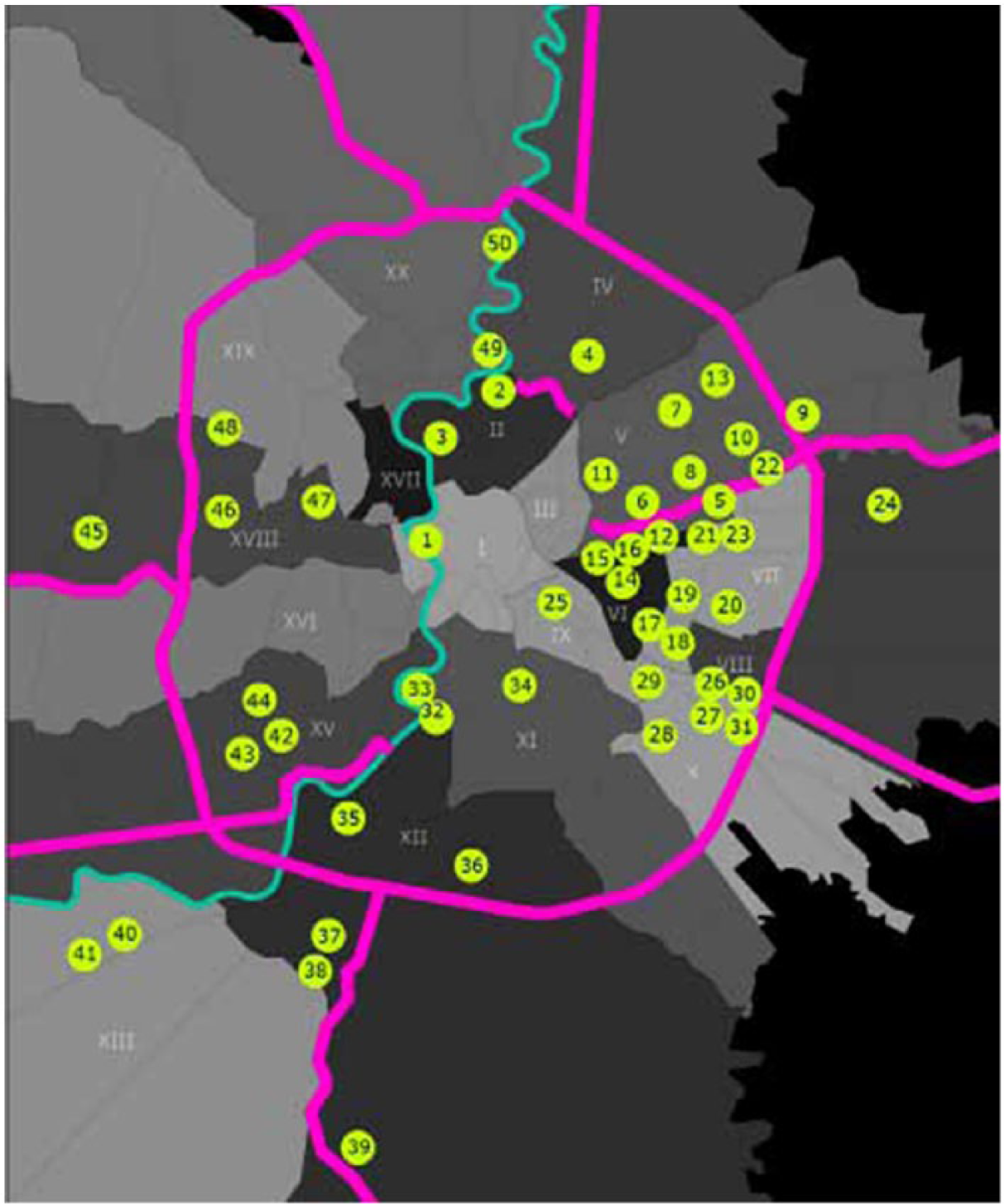
1995: 50 camps: 5,467 people.
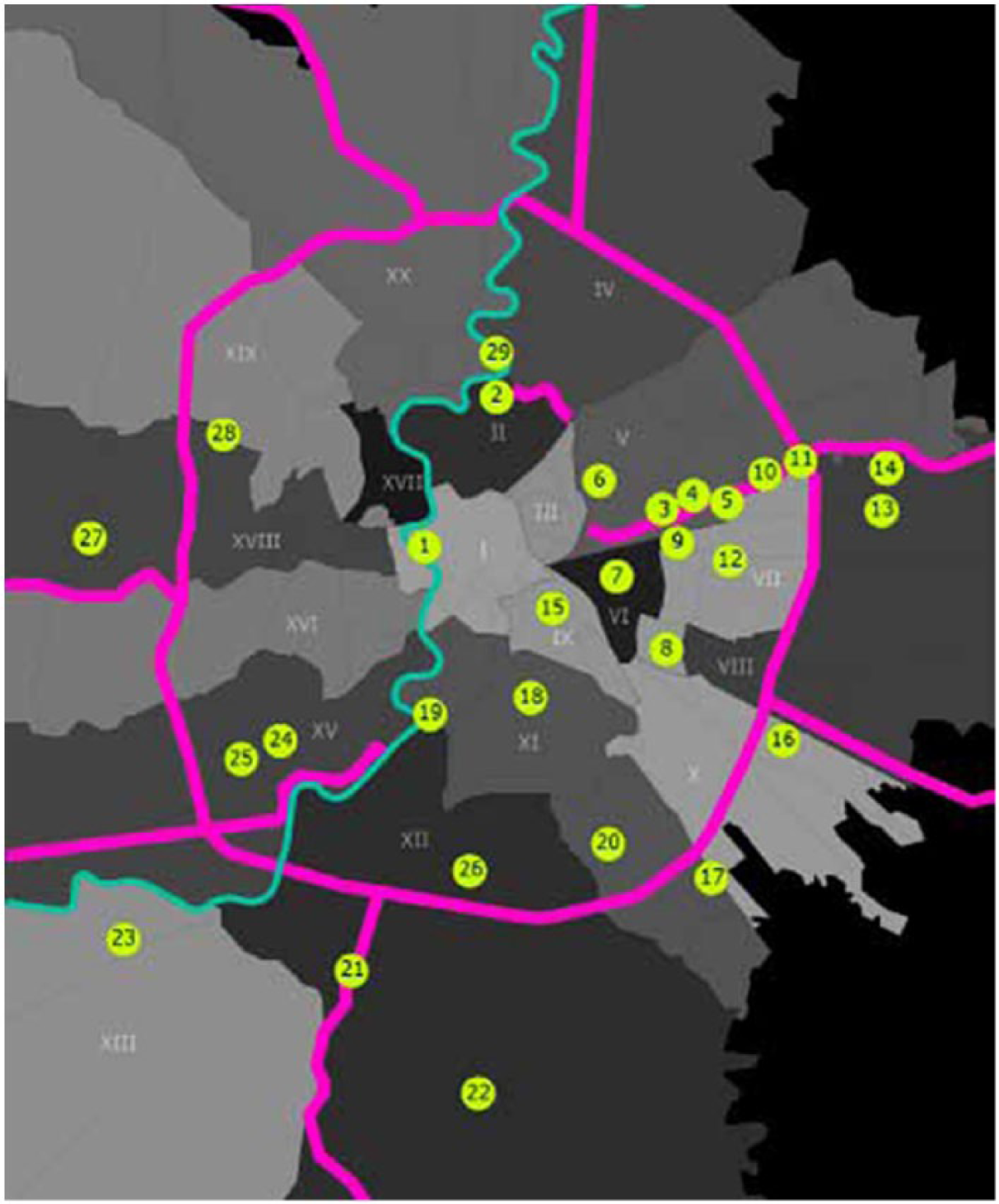
2001: 29 camps: 6,523 people.
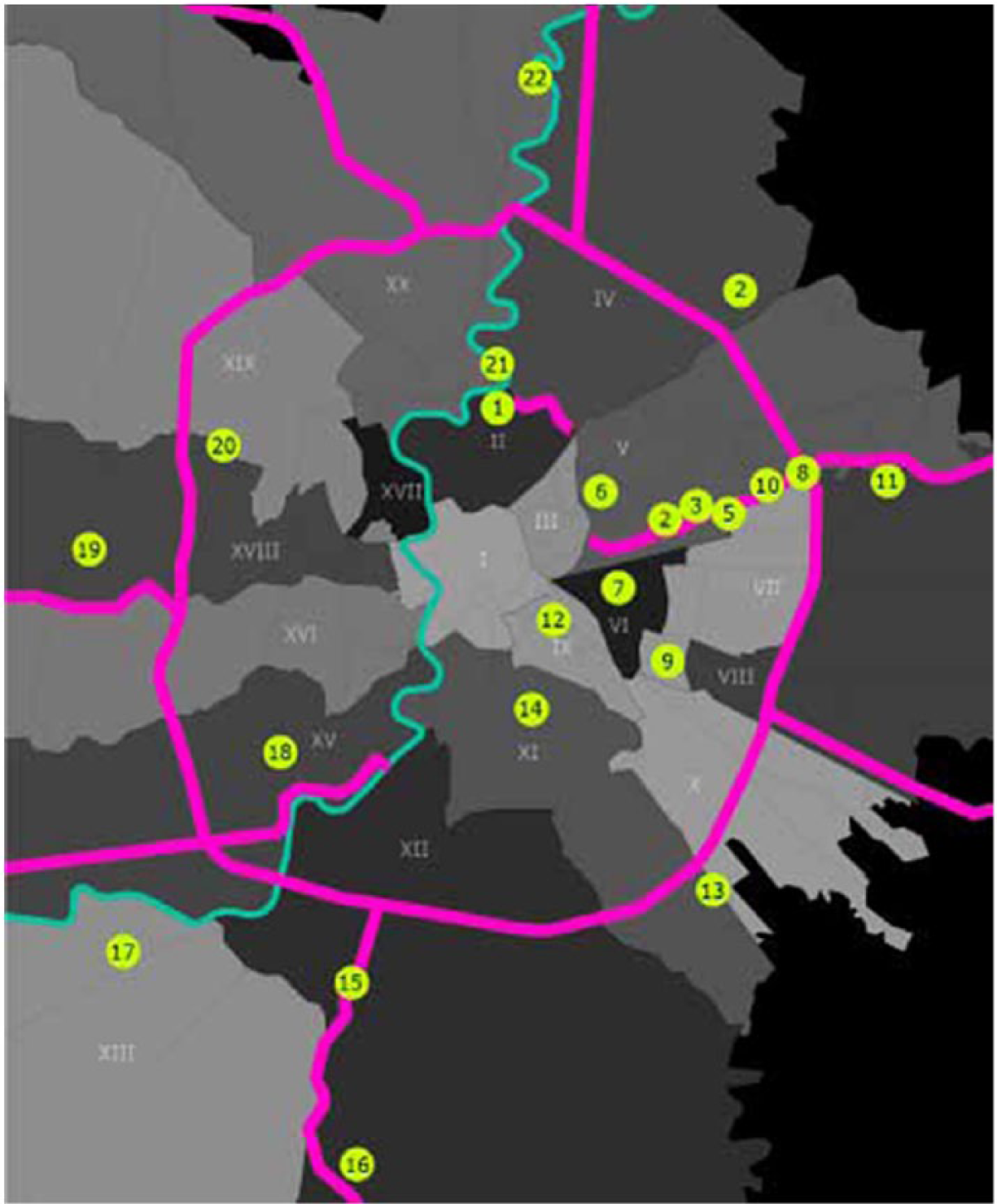
2008: 22 camps, 5,700 people.

The “Nomad Plan”: eight “villages” completed out of thirteen originally planned (six thousand people).
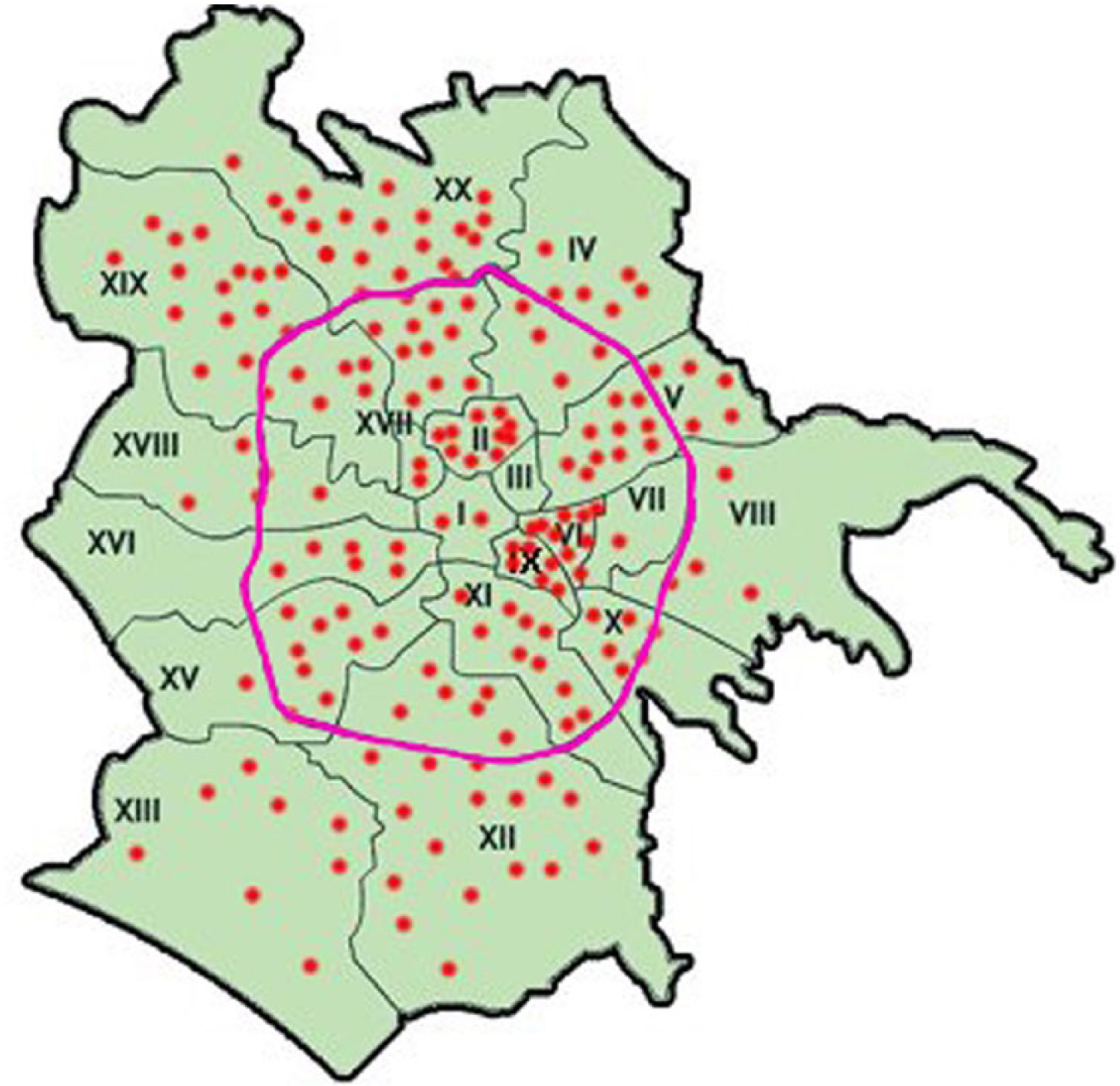
Unauthorized settlements inhabited by Roma in Rome in August 2008.
Despite the great variety of living conditions in these different camp forms, they are all exclusionary and substandard, and they all violate Italian and European housing rights standards and legislation. 44 This is irrespective of the fact that many of them have been created by successive municipal governments with the declared goal of fostering integration. On the surface, they would all seem to conform to commonsense definitions of ghettos: they are all located in distinct and stigmatized spaces where other city dwellers fear to venture and where living conditions are significantly inferior to those of the rest of the urban context; the vast majority of their inhabitants are poor and unemployed. However, this does not help us to conceptualize the differences between them and, especially, it does not account for the role of the state in their creation and management.
Roma Camps as Neo-Ghettos
Having outlined the main phases in the state-orchestrated evolution of Roma camps from spaces of self-management to specially constructed “villages”, we can now apply Wacquant’s ghetto framework to analyze whether this evolution can be read as a process of increasing ghettoization. Wacquant’s first constitutive feature of the ghetto is the spatial relegation of a stigmatized group. Roma’s age-old stigma as dirty, parasitic, and criminal outsiders has played a central role in their residence in marginal urban camps throughout the postwar period. However, the creation of specially designated “villages” in the last two decades has been accompanied by public discourses by Rome’s leading politicians that have justified the expense of building official camps as a means to better monitor groups essentialized as both criminal and polluting, in order to protect the rest of society. 45 The Roma’s traditional stigma has thus been strategically amplified and channeled as part of a political drive to visibly isolate them through means that are strongly reminiscent of the stigma attached to Jews in Renaissance Rome as morally and physically tainted. The consequence has been a significant intensification of constraint experienced by Roma in camps. While they were financially constrained to build their own encampments in Rome because of excessive housing costs and discrimination from landlords in mainstream accommodation, the city government’s ruling in 2009 that Roma may only live in state-built “villages” introduced a dramatic curtailing of their freedom of movement and choice. In the self-managed camps, Roma are able to move in and out according to their economic interests and for family reasons, in a complex intertwining of mobility and rootedness, 46 whereas, as we have seen, such flexibility is impossible in the “villages.” 47 The intensification of Wacquant’s third component of the ghetto—segregation—is evident in the maps shown above. The new “villages” have been built to eliminate the porosity that characterized the location of Roma’s self-built camps and that enabled the communities to maintain social and business relations with non-Roma in their neighborhoods. Roma who have been relocated to the “villages” now find themselves often unable to reach basic services such as public transport, schools, and hospitals in a system that activists have defined as “apartheid.” 48 This is particularly the case for elderly people, children, and women who do not have access to a car, many of whom have told me of their increased isolation and reduced independence since they were moved into their “village.”
It is on the issue of ethnic homogeneity that developments in the spatial control of the Roma start to deviate from Wacquant’s framework. Whereas he argues that homogeneity is often present in a ghetto situation, the herding of Roma into “villages” has in fact resulted in culturally and socially diverse groups and families living together in ways that tend to be avoided in self-built camps. These camps are generally made up of extended kinship groups, and the very nature of their self-management ensures that there is a certain level of harmonious cohabitation and solidarity among residents. If conflicts arise, these are usually resolved through one of the parties moving away. While this does not mean that the encampments are necessarily homogenous (some are also home to non-Roma immigrants and Italians as well as friends or partners from outside the kinship group) or that tensions do not exist, the spatial and social flexibility of the camps ensure that they can be managed through internal diplomacy and geographic and symbolic reorganization. The “villages,” with their prearranged and immovable rows of huts, allocated by the authorities according to their own criteria and for nonnegotiable periods of time (two years, with the possibility of extension for a maximum of six years) force together Roma with very different histories, religions, legal statuses, and social and cultural practices. Tensions and sometimes overt conflicts exist in many of the “villages”; in one, Castel Romano, a fence and a “no-man’s land” geographically and symbolically separate two sides; in another, La Barbuta, a group of Sinti live outside the camp’s fence, having refused to move into the camp which is, in turn, divided into distinct zones for families of different origins. With far less leeway for diffusion of tension, a sense of mistrust and hostility between different groups characterizes many of these “villages.” This is crucial because it connects to the next component in Wacquant’s framework: the community solidarity that often emerges in ghetto situations.
Wacquant sees the ghetto as a Janus-faced contraption: while for the outside it is a tool of domination and control, for those who inhabit it, it functions as a protective shield, fostering active forms of identification, resistance, and mobilization from within. The ghetto thus theoretically contains the seed of its own destruction, 49 allowing for the emergence of outright rebellion or less overt tactics for circumventing the oppressive effects of its punitive power. It is this feature of the ghetto that allows us to best identify the innovative forms of control that are being introduced and refined by replacing Roma’s self-built camps with “villages.” It would be wrong to romanticize the self-managed camps as inherently egalitarian and harmonious; indeed, internal power and decision-making dynamics often marginalize weak groups and produce forms of governance that reflect the interests of certain families over others. While the possibilities for self-determination and collective identity-building within them are contingent both on internal relations in each individual camp and on the broader political and social context (when an encampment is threatened with demolition, the sense of protection it offered evaporates), at the very least the camps provide “a protective buffer that creates a distinctive Lebenswelt within which the subordinate can breathe, away from direct contact with the dominant.” 50 I argue that the state-created “villages” are instead strategically designed to undermine the development of such forms of potential resistance and escape by fomenting tensions and creating obstacles to weaken internally recognized power structures and solidarity networks. While ghettos are generally marked by a low presence of state institutions in daily life, the state’s penetration in these “villages” is extensive. This serves both disciplinary purposes—through wide-ranging regulations, surveillance, armed guards, and the constant threat of expulsion for bad behavior—and a form of governmentality that manages their daily lives with the purpose of molding them into “good citizens.” Residence in the “villages” is conditional on sending children to school, accepting participation in employment projects, keeping the “village” clean and tidy, and eschewing all forms of crime. Often, a few inhabitants are selected for paid employment in the “villages,” fostering further resentments and competition over resources. The provision of services within the “villages” discourages Roma from interacting with the world outside (e.g., by taking their children to school, going to a family doctor, making potential business contacts), pushing them toward a condition of passivity and dependence.
Although the regulations also call for elections of Roma representatives to participate in managing the “villages,” in practice elections have only taken place in two structures and significant doubts have been raised about the legitimacy of electoral procedures, the true representativeness of the candidates, and their effectiveness in advancing the Roma’s concerns with the authorities. 51 In various “villages,” instead, forms of patronage have emerged in which certain individuals have developed personal relationships with institutional representatives charged with managing Roma affairs; the former obtain favors such as preferential treatment in the allocation of huts and guards turning a blind eye to the violation of “village” rules, as long as they exert pressure on their own and other families to acquiesce. Indeed, a very interesting feature of these structures is that their regulations are applied selectively and ambiguously: rules are more rigid in some “villages” than others, and they are applied to some inhabitants while others are able to carry out unauthorized activities undisturbed. 52
What has been outlined, therefore, is a gradual, multidimensional move closer to the ghetto system, with the new “villages” producing intensified forms of stigma, constraint, and segregation compared to earlier generations of camps. We are not dealing here with absolute constraint (indeed, some Roma actively seek to live in the “villages” since these provide more stability and better hygienic conditions than the self-built camps 53 ) or with absolute segregation: Roma are free to continue interacting with the city of Rome if they are willing and able to overcome the spatial and infrastructural obstacles to doing so. It is this element of ambiguity, the functioning of the “village” as a contraption that modulates freedom and constraint, protection and control, subjectivity and state imposition, that suggests a close relationship with the ghetto. Yet these new forms of ghetto are a refinement of the original; they work to eliminate the main weakness of the ghetto system: its capacity to strengthen a sense of community and solidarity among the people it aimed to humiliate and disempower. These “villages” are thus better defined as neo-ghettos: 54 they learn from and build on past experiences but are very much functional to the present and projected towards the future. Similarly to the Jewish ghetto, they are complex devices that are instrumental to governing the city. It is worth therefore briefly exploring what their specific political and economic functions in Rome may be.
The “Village” and the City
The development from self-built encampments to today’s “villages” is closely interlinked with broader social and economic changes in the city. Roma settlements were largely ignored by Rome’s authorities until the mid-1990s when a center-left administration came to power under the first directly elected mayor, Rutelli. His main political goal, subsequently taken up by his successor Veltroni, was to project Rome as a multicultural modern city, breaking with the capital’s image as an economic and cultural backwater marginalized by processes of globalization. The left pursued a rhetoric of protecting and empowering weak social groups and stimulating intercultural initiatives, while simultaneously liberalizing the housing market. This resulted in massive price rises and gentrification in much of the center of town as well as in many previously peripheral areas, profoundly affecting parts of the middle class and radically altering the social composition and cultural life of various neighborhoods, as was documented in detail by Herzfeld. 55 This generated widespread resentment toward immigrants, who were often believed to be moving into the housing from which Romans were evicted. 56 While the political rhetoric also claimed that urban renewal was occurring in the most disadvantaged peripheries, in practice the outward movement of low-income residents, among them growing numbers of migrants often living in highly precarious conditions, was perceived by many Romans to be producing rising crime rates, an erosion of their sense of community and social protection, and a reduction in access to public spaces. 57 As more recent scholarship underlines, these perceptions continue to be widespread and are connected to larger-scale neoliberal and globalizing processes that have been transforming the city in complex and often worrying ways: evictions and homelessness are still rising while large parts of the city’s housing stock remains empty and the city fails to provide adequate low-income housing; private real-estate speculation and local government promotion of massive shopping centers are forcing many to relocate into Rome’s sprawling hinterland and are weakening independent family businesses; many “self-built” neighborhoods are still neglected and deprived of services; green and pedestrianized areas, as well as public spaces for noncommercial and communal leisure activities, continue to be gravely lacking. 58
To address the complex reasons why a growing proportion of Rome’s residents have felt abandoned by the political elites (problems resulting from unplanned urban growth; dwindling educational, health, and other services; and accusations that local politicians have been more interested in courting big business and media attention for their own national ambitions), would require substantial reform of municipal management systems, priorities, institutional cultures, and use of funds. From the late 1990s onwards, within a national and local political context in which the right wing increasingly resorted to securitizing discourses, Rome’s left-wing leaders instead chose to compete on the same issues, seeking to prove their own success in making the city safer for its citizens. The creation of Roma “villages” that increasingly concentrated and segregated a group traditionally stigmatized as criminal served to demonstrate—through highly mediatized demolitions of illegal camps and equally publicized inaugurations of the new structures—that a social problem in the city was being managed, thereby distracting attention from the fact that the more profound reasons for tensions and inequalities in the city remained. It can be argued that this dual approach of playing on local security fears, while simultaneously cultivating insecurity and fixedness for camp-dwelling Roma, reflects part of a broader “dialectic between safeguards and uncertainty, security and insecurity, keeping safe and being subject to risk” that Molé identifies in the Italian workplace but that appears equally pertinent to the management of urban fears and frustrations. 59
The securitizing strategy of the left was not ultimately successful and it lost the 2008 municipal elections. Nevertheless, the post-Fascist mayor who came to power, Alemanno, persevered with it, formalizing the policy through his “Nomad Plan” discussed above and intensifying both the disciplinary aspects of the “villages” as well as their protective, “humanitarian” dimension. Despite having won largely as a result of the frustrations of voters in the peripheries, his administration failed to address the housing shortages (there were approximately eight thousand homeless in the city 60 ), urban blight and lack of services experienced there, 61 resulting in widespread dissatisfaction and his consequent defeat in the 2013 elections.
While the ghettoization of the Roma has not succeeded in creating a long-term sense of improved living conditions and social harmony in the city, it has allowed administrations of both the left and right to generate political capital by claiming to “solve the nomad problem” while simultaneously keeping that “problem” alive through the continued existence of illegal encampments. The various stigmas attached to Roma thereby remain available for politicians to activate in future should they need to galvanize in-group solidarity by constructing a threatening “other”. The functions that Roma serve as the city’s perennial “outsiders within” are thus very similar to those of the Jews in the ghetto era; in both cases their punishment for being “outsiders” is accompanied by claims to protect their culture by providing them with privileged spaces, ensuring that their outsider status is constantly dramatized and reinforced.
A further link to the Jewish ghetto are the economic motivations that can be glimpsed behind the more evident political utility of claiming to “solve the Roma problem.” On the surface, the “villages” policy in Rome makes little economic sense: one NGO estimates that the city government spent over one hundred million euro (around US$132 million) to implement the “Nomad Plan” between 2009 and 2012. 62 One of the most dilapidated “villages,” where heating and electricity are provided intermittently, walls and windows leak, and toilets and showers are barely functional, costs the city 1,360 euro (approximately US$1,800) per family per month. 63 In a city with a massive shortage of public housing, the expenditure of such vast sums of money to accommodate a few thousand individuals in structures that are temporary, inadequate, and require continuous maintenance would suggest that there are hidden economic factors motivating the authorities to persevere with such misspending. The liberalization of the real-estate market since the 1990s has resulted in intense commercial competition over spaces that until recently were considered low-value or wasteland. One striking example is the ongoing regeneration of the former slaughterhouse complex in the newly gentrified central neighborhood of Testaccio. A group of Italian Roma inhabited the space for over twenty years but were evicted in 2008 to a parking lot near an out-of-town mall once business interests identified Testaccio’s economic potential. A similar process occurred with real estate developments connected to the expansion of the Roma Tre University, which resulted in the removal of more than eight hundred Roma from a nearby camp in 2005 to the distant “village” of Castel Romano. The rising value of land throughout the city has meant that the most economically viable spaces to warehouse the Roma today are in locations that remain unappealing to commercial speculators because they are unsanitary or distant from urban infrastructures. 64 At the same time, the “villages” have the potential to generate economic advantages for various interest groups. There has, for example, been speculation that the positioning of the Castel Romano “village” in an isolated nature reserve is a step in a long-term strategy to re-zone the area for residential or commercial use. 65 Moreover, since the management of Roma “villages” continues to be outsourced to NGOs who thereby provide jobs to their members (in a city where unemployment among middle classes is rampant), the system creates potential for funds to be allocated to organizations close to the ruling political grouping of the day. 66 Given Italy’s long-standing political culture of public works contracts being assigned to companies with strong political connections, the “villages” have for a long time raised concerns about a lack of transparency regarding which organizations may be commissioned to build, furnish and manage the new structures. In late 2014, shortly before this article went to press, a large-scale judicial investigation revealed strong links between various Roman politicians, especially ones close to former Mayor Alemanno, corrupt businessmen, and criminals. The collusive allocation of substantial funds to an NGO close to high-ranking politicians to manage various “nomad camps” featured among the alleged business deals. 67
Conclusion
What emerges from this discussion is that despite evident historical factors that distinguish Rome’s Jewish ghetto from today’s Roma camps (different notions of the role of the state, different rights and norms and a different arsenal of tools for exerting power over citizens), the concept of a ghetto as a multidimensional device for managing social relations in the city is useful for understanding the apparent chaos and contradictions in Rome’s contemporary camps. Wacquant’s view of ghettoization as a multilevel process allows us to go beyond a one-dimensional view of Rome’s new “villages” as spaces for simply isolating and confining an unwanted ethnic group and to focus instead on the ways in which they function to serve diverse political and economic interests. The ambiguous nature of the ghetto—its ability to both exclude and include, to provide rights and privileges while removing autonomy and freedom, to recognize subjectivity while objectifying, and its ability to intensify and relax these features according to the political moment—is reflected in the evolution of Roma camps. Ghettos and neo-ghettos are not total institutions but rather malleable devices that selectively make use of a stigmatized group for purposes that are largely external to the group itself.
Footnotes
Declaration of Conflicting Interests
The author declared no potential conflicts of interest with respect to the research, authorship, and/or publication of this article.
Funding
The author received no financial support for the research, authorship, and/or publication of this article.