



Abstract
Civic boosters advocate physical arts development as a path for urban revitalization. Current research examines these specialized bricks and mortar efforts through snapshot outcome evaluations, broad policy analyses, and critiques of predatory activity. Project development is overlooked as is whether such efforts mirror general urban development patterns and behavior. This case study explores a successful dual-nonprofit partnership between the Seattle Art Museum and the Trust for Public Land to build the Olympic Sculpture Park. This recent history explains institutional motivations and political strategies and identifies organizational assets employed to overcome intense market pressures and past failures. It adds richness to conventional development wisdom and its intense focus on public–private partnerships as the prevalent model for urban development. This alignment between a local arts institution and a national conservation organization may unveil an alternative model or shed light on a less visible structure for developing urban civic amenities. This study further reinforces the connection between contemporary urban improvement and early beautification agendas via municipal art, open space, and civic leadership.
Introduction
In 2004, the Seattle Art Museum (SAM), one of the oldest cultural organizations in the Pacific Northwest, stood in the middle of an ambitious two-part redevelopment plan to increase its visibility and support an ongoing urban renaissance in downtown where “the arts [were as important as] retail and office.” 1 Feasibility for both projects depended upon two separate joint partnership structures: a downtown expansion effort with the now defunct financial giant WaMu and a waterfront sculpture park with the conservationist group The Trust for Public Land (TPL). These high-profile alliances coincided with several other public–private partnerships (PPPs) that transcended pure arts infrastructure to include commercial, residential, and civic projects. Some of the more prominent illustrations centered on creating new flashy public amenities (the Koolhaus-designed Seattle Public Library), rehabbing historic structures (Nordstrom’s headquarters in the Frederick Nelson building) and building tourism facilities (Washington State Convention Center). Heavy development pressures coincided with the city’s new comprehensive plan that favored increased livability factors and greater housing choice in the core.
Accompanying this building boom and new planning era was a pervasive and convincing conversation between mayors, corporate elites, and scholars across the United States who argue that public–private partnerships, a formal agreement between for-profit and government entities to share the risks and rewards of a targeted program or project delivery, was the preferred answer for implementing and financing downtown and waterfront urban redevelopment in the face of dwindling federal dollars, shrinking municipal budgets, and growing anti-tax sentiments. 2 PPP narratives in scholarly journals, professional magazines, and popular media outlets cover numerous illustrations of how these informal and formalized relationships shape investments in transportation, workforce training, utility services, mega real estate projects, and anchor institutions. 3 As PPP strategies grow and diversify, different sectors embody a unique set of attributes with catchy acronyms and planning jargon to describe these relationships, such as DBO (design, build, operate), FDBO (finance, design, built, operate), BOT (build, operate, transfer), BO (bid, operate), and more. While responsibilities vary depending upon individual contracts, negotiating expertise, and local planning cultures, the traditional model typically matches a public government entity with a private commercial or for-profit business in a formalized and legally binding agreement that sets the terms of investment and risk. The codified relationship reinforces a steady push to make the public sector more entrepreneurial and collaborative in comparison to the “command and control” era of Urban Renewal and large-scale redevelopment endeavors.
Yet, while PPPs are increasingly common and continue to dominate recent histories of urban redevelopment from New York’s Battery Park to LA Live!, does this planning subfield overlook or mask other joint player models, or does it too easily group all partnerships under the commonly used and politically palpable term of PPPs? Thus, this study asks the following questions: What other partnership structures exist for urban development beyond the dominant narrative of PPPs in conventional wisdom? To what extent do these alternative partnerships mirror traditional public–private behavior? How does partnership structure influence redevelopment outcomes? How do these partnerships reflect attributes from the nineteenth-century era of urban improvement from the early days of the planning profession?
This study explores these questions by providing a recent history of the SAM-owned Olympic Sculpture Park (OSP) along Elliott Bay in downtown Seattle that is the result of a unique dual-nonprofit partnership (DNP) between the museum and the TPL. This case study of an art/conversation alliance merges two themes prominent throughout planning and urban history namely the use of open space and municipal art as urban improvement in disinvested areas. The strategic partnership takes on greater meaning when juxtaposed against earlier successes and failures from both the public and public–private side to finance urban infrastructure in a state that has a skeptical if not somewhat hostile attitude toward seemingly cozy relations between government and private actors. The rumbling over how to finance civic amenities or how to identify the “public” in public good is especially stark when looking at OSP in relation to the Seattle Commons, an unrealized large park connecting the commercial business district to the industrial South Lake Union neighborhood via a traditional public–private deal between the city and Microsoft co-founder, Mariners owner, and Vulcan Development entrepreneur Paul Allen who would later turn this John C. Olmsted–inspired open space into a renowned technology hub and urban campus for e-retailer Amazon.
This research uncovers a DNP model that counters conventional wisdom where PPPs dominate urban redevelopment literature specifically within an implementation framework. This less visible or alternative nonprofit model is a hybrid between a public–private partnership and a single nonprofit-driven endeavor. The case provides evidence that there is a more diverse set of partnership models for achieving urban change although the capacity of such structures depends on a number of factors and may not be generalizable across all cities and regions. The DNP model between a highly renowned local arts organization without a development-driven mission and a national environmental advocacy group with brownfield and land development expertise transformed a part of Seattle’s contested and privatized waterfront into public open space. While perhaps less remarkable as a sculpture park or a pure civic space, its primary achievement has been to become Seattle’s first downtown waterfront park. The DNP did so through leveraging its unique sets of expertise in fundraising, programming, land negotiation, and environmental remediation. The project succeeded largely because the partners strategically structured a private planning process of controlled land acquisition and project financing through harnessing civic investment and wealth. Their approach responded to Seattle’s planning culture, which is characterized as overtly process-driven with dominant single-interest voices where “process is the product.” 4 In some ways, this dual mission-driven model addresses critics of PPPs who point toward limited transparency and elite-oriented outcomes that greatly favor private rather than public interests. However, this case also raises bigger questions about the implications of a nonprofit alliance between two private organizations that manages and controls public space. Further, it brings into question whether this DNP is truly an alternative model, a model that is common but less talked about, or one that is an exception rather than the rule, especially in the case of Seattle with its economic wealth and civic culture. Finally, the analysis shows similarities between open space and municipal art initiatives when comparing late nineteenth-century and twenty-first-century projects, raising the need to frame urban redevelopment not only in the mechanics and literature of PPPs but also in the context of civic leadership.
Conventional Wisdom
This study draws on a confluence of literature to create a theoretical and conceptual framework. It lays out the conventional wisdom for urban development drawing on knowledge from physical arts development and urban politics. Current research is useful and valuable for exploring the complexity of urban transformation. However, these conventions largely centered on public–private partnerships or the labeling of all partnerships as public–private whether the organization structure fits this type or not. As such, it overlooks other avenues for implementation. This is especially true in situations where the public refuses to keep an open tab for urban infrastructure or where private or for-profit actors cannot be enticed to build civic amenities as part of their larger market-driven agenda. This is not to suggest that PPPs should be tossed out, but that if others models exist then they should be explored by urban development scholars particularly in the area of specialized arts development.
Scholars study the politics of urban development through testing long-standing political economy models and/or providing greater insight on the processes and deals that remake the city. One scholarly line of inquiry questions the social, economic, and environmental costs by highlighting the obliteration of neighborhoods for commercial anchors, the transformation of productive industrial districts into residential playgrounds, and the privatization of the city to create safer places for tourists, suburban visitors, and wealthy residents. 5 Often, these critical discourses draw on urban regime and growth machine theories to make sense about who, collectively, has the power to change the urban landscape under a given set of constraints and motivations. 6 They further explore how these coalitions evolve over time in response to governance changes, powerful structural forces, and federal devolution. Here the conventional wisdom argues that the alliances for urban development prioritize economic growth over economic development.
A different line of scholarship centers on partnership structure where the urban political theories described above overlook the “idiosyncratic combinations of opportunity and risk” in the negotiation and implementation of urban development. 7 Several robust case illustrations on public–private partnerships—the leading coalition in development endeavors—show the nuance and complexity inherent in project implementation. Frieden and Sagalyn highlight the different partnership structures for retail development in San Diego, Saint Paul, Minneapolis, and Boston, as cities sought to bring this lost industry back to downtowns using a number of different experimental models. 8 Brown explores how transformed public authorities aligned or shied away from development partnerships in remaking urban industrial waterfronts in Philadelphia-Delaware, San Diego, and Miami. 9 Fainstein explains how neoliberal agendas aligned in property development with less than equitable outcomes and processes in New York and London. 10 Altschuler and Luberoff outline the evolution of federal priorities and explain the emergence of public–private partnerships in a federal era of “Do No Harm” and devolution. 11 Some of these longitudinal analyses frame the development decision-making processes within the planning culture and experience of each place, leading to a different set of problems and opportunities. 12 Here, these historical analyses study public–private partnerships and their dominance in remaking the urban landscape in response to anti-tax sentiment, federal devolution, and shrinking municipal budgets. Fewer opportunities for project financing exist, pressuring cities to become more entrepreneurial and to become more reliant on for-profit resources and expertise.
Arts researchers largely overlook the intricacies of physical arts development and bypass opportunities to apply urban political research and public–private partnership approaches in exploring bricks and mortar investments in arts infrastructure. Scholars focus more on economic models, 13 policy rationales, 14 and signs of cultural and creative competiveness. 15 The work that does exist tends to focus broadly on arts development and its relationship to economic objectives and organizational health. Birch argues that major arts institutions like hospitals and universities are valued anchors because their “rootedness” contributes to job stability, identity enhancement, and property investment. 16 Worokowicz et al. takes a more critical turn and contends that the twenty-first-century building boom of museums, performing art centers, and theatres is detrimental to organizational stability. 17 Gadwa, Markusen, and Johnson come from a different angle by providing a softer set of positive assessments to evaluate how small-scale art developments contribute to neighborhood revitalization, artist occupational opportunities, and civic engagement. 18
Only a few scholars directly address the politics of arts and urban development in the United States where the arts—because of its good standing in city life—are increasingly a “material shaper” of cities and a “favored route” for development. 19 Their spatial focus traditionally centers on flagship projects in downtowns and waterfronts 20 or offers more fine-grained “creative class” approaches that catalyze neighborhood change, for better and worse. 21 Whitt, in particular, critiques the arts for becoming part of the growth machine, while Strom considers how different planning culture influence partnership choices. 22 However, these studies do not show how physical arts development reflects the public sector’s move from “passive regulation to active development” where the city becomes a full-fledged partner rather than purely a facilitator or technical supporter. 23 The illustrations rarely detail project implementation or partnership formation.
While arts research should take a closer look at PPP structures and how they reflect current knowledge in urban politics, the sole focus on conventional wisdom in PPPs can be limiting and can overlook other collaborative structures that shape arts and urban redevelopment. 24 Is there perhaps something unique about how arts organizations approach urban development and whom they select as partners? In the past, scholars focused primarily on the arts integration into growth machine models, but does this particular bent tell the only story?
In addition, scholars should consider returning to the early history of planning in the late nineteenth and early twentieth century during the momentum for City Beautiful interventions. The urban improvement era prioritized arts and open space to reshape and reimagine the ills of urban life. Civic and business sectors took the lead in organizing and designing urban space while lobbying for municipal resources and citizen support. These histories provide insight into whether these two early pillars—arts and open space—are still relevant for contemporary urban revitalization. The case below provides an avenue for dispelling conventional wisdom about PPP domination, and it presents an opportunity to consider how arts organizations participate in urban development through entrepreneurial partnerships. Finally, this contemporary history offers a chance to reflect on how urban improvement themes from the early days of planning re-emerge in communities today.
Setting and Approach
This case study of Seattle’s Olympic Sculpture Park illustrates a different and understudied approach to urban development. It is placed against the backdrop of other public–private efforts in Seattle to build civic assets—some that failed and others that succeeded. The case study methodology is well suited for exploring rather than purely describing partnerships and implementation processes. Greater inferences can be drawn as a single city acts as a controlling force for political, economic and social factors.
The case study draws on historical research from primary and secondary data sources. The author made three site visits between 2008 and 2011 to survey the study area. Twenty in-depth and focused interviews were completed and represented a range of project interests, including project stakeholders, public planning officials, downtown developers, economic development specialists, downtown business leaders, urban waterfront activists, local foundation directors, and community arts leaders. The author selected the respondents through identifying central stakeholders and then supplementing the list through snowballing techniques. 25 While the focus is primarily on the OSP, the interviews were also used to gain feedback about the similarities and differences of other redevelopment projects. Specifically, the subjects were asked a set of targeted questions over a ninety-minute in-person interview: What was the history of the Olympic Sculpture Park? How did the partnership structure evolve between SAM and TPL? How did different interest groups support/inhibit project implementation? What are the outcomes of the Olympic Sculpture Park? Why did the OSP project succeed and other efforts fail? What do these cases highlight about Seattle’s planning culture and urban development? The author also posed follow-up questions through a combination of email and telephone correspondence. Interviews as the central data source made it possible to understand the politics of development, the intricacies of project implementation, and the motivations behind the partnering between different institutional and organizational players. The study employs and integrates the interviews in the case narrative and in the analysis section employing certain methods to mask respondent identity. Interviews were supplemented with local and national media coverage; public and nonprofit photographic images; federal, state, and local government documents; and design drawings and concepts.
As with many case studies, the weakness of this approach is that it cannot produce definitive generalizable behavior or convey how often the DNP is used in other cities. However, it does create the groundwork for future research to explore these areas. More city comparisons would be useful for determining whether the Seattle case is an outlier, an example of a hidden but entrenched structure, or is emblematic of a larger movement. This study acts as a starting point for a conversation about how to create urban assets beyond those strategies and mechanisms outlined and promoted by conventional wisdom.
Historical Trajectory of Open Space and Municipal Art Agendas
Parks and open space initiatives and municipal art and design have a long tradition in planning and city development harkening back to mid-nineteenth-century European grand modernization plans in the oft- profiled transformations of Hausmann’s Paris, Sitte’s Paris, and Cerda’s Barcelona. Inspired by their European counterparts and trips abroad, U.S. architects, landscape architects, and civic boosters initiated City Beautiful movements marked by such seminal illustrations as Chicago’s 1893 World’s Fair, Washington, D.C.’s 1901 McMillian Plan, and Chicago’s 1909 Plan. Their influence—tied to greater expertise in engineering and formal spatial organization—shaped systems planning for parks and open space in many other cities, including Philadelphia, Cleveland, Minneapolis, Denver, and Seattle. 26 Many civic leaders and groups, like the business-minded Chicago’s Commercial Club and the civic-focused New York’s Municipal Art Society, championed these physical efforts as an avenue for supporting public health, social uplift, and economic development. Coinciding with the maturation of the City Beautiful movement, these groups financed plans, created image-heavy marketing materials, integrated material into school curriculum, and lobbied government support until municipalities took on greater responsibilities. The beautification era folded as criticisms grew about aesthetically driven design solutions, and as the developing planning profession focused its technical efforts and professional legitimacy on data collection and interpretation, which was used to guide land use choices via the advent of zoning and master planning.
In recent years, many cities have experienced a renaissance of parks and open space initiatives, including Seattle. These “Back to City” narratives witnessed communities turning outdated infrastructure, undesirable Urban Renewal activity, and underused transportation investments into urban assets and key ingredients for sustainability and livability agendas. These beautification projects dominated American Planning Association and Urban Land Institute publications, where glossy magazine covers and prominent feature stories profiled the transformation of neglected railroad tracks into bicycle and pedestrian paths or charted the rebirth of industrial waterfronts through new civic green spaces and enhanced public access. Sculpture parks and temporary public art took center stage as a way to support agro and urban tourism respectively while toting live/work/play mantras. Greenbelts, greenways, green corridors, and green roofs became part of the urban lexicon and part of marketing public health. With support from federal agencies and private foundations, national civic organizations devised strategies and best practices for new urban utopians targeted at planners, elected officials, and grassroots players with such marketing labels as the creative city, the green city, and the livable city. More often than not, the quest for civic amenities involved public–private partnerships in formal and informal ways.
Community envy and national spotlights focused primarily on success stories. Chicago created Millennium Park over railroad tracks through tax increment financing and corporate support. Renowned designer Alex Garvin created Atlanta’s Emerald Necklace to overcome its reputation as a car-polluting region. Minneapolis and its suburban partners expanded the Greenway to enhance its reputation as a bike friendly city. New York City and the Friends of the High Line championed the aboveground corridor on old tracks through the historic Garment District. However, the focus on these urban assets tends to overlook several unfulfilled and unrealized projects or glosses over the battles over financing and tensions over who benefits from such endeavors. This raises questions about why some cities succeed or fail in their quest for open space and parks, and whether partnership structures contribute to this dynamic or how they change their strategies in reaction to one-time failures. Further, these attempts to design open space and parks projects offer a chance to critique the dominance of PPP models with regard to open space and park renewal. The experience of Seattle’s OSP provides an opportunity to compare how it fits within a larger citywide push for PPPs to fund and fuel urban development and civic open space amenities.
Context: Financing Urban Infrastructure and Civic Amenities
Seattle and King County have a deep history of investing public dollars in engineering feats and in urban infrastructure, including building four of the world’s largest floating bridges (two of which sank) in 1940, 1963, 1989, and 1993, constructing the Howard Hansen damn in the Green River Valley in 1961, developing campuses for the 1909 Alaskan-Yukon-Pacific Exposition and the 1963 World’s Fair, creating the Tolt Reservoir and Pipeline in 1963, and configuring the Seattle Convention Center over a freeway in 1988. One interview respondent commented, Seattle used to believe that there was an engineering solution to every problem. They did enormous, mega-expensive public projects. They believed that they didn’t need private helpers. Expense was no issue. Their approach to the world was to build, build, build. The jeep fell off the track in the 1980s when they realized the well wasn’t bottomless. Voters were the option of choice for over a century, but voters started saying baloney and that they were tired of it.
27
Seeds of discontent over public financing for mega initiatives grew in the 1960s during the Forward Thrust Campaign, a comprehensive plan to finance large capital projects. In 1968 and 1970, twelve ballot initiatives were packaged together: eight of the initiatives passed but the last four, geared toward federal-funded transportation projects, failed. In part, the public’s reaction had to do with Boeing leaving town and an impending national economic crisis. And, in part, it marked public exhaustion over such requests. 28
As a result, Seattle turned toward PPPs, an experimental mechanism incentivized by the short-lived but powerful federal Urban Development Action Grants, that were being leveraged by many U.S. cities. However, Seattle did not fully embrace this structure from the start, as one interview respondent articulated, “Despite the public’s tax fatigue at paying the full bill, the populace, being populist, were wary of public/private partnerships.” The concern over such a cozy relationship reflects the state’s history where the state constitution makes it difficult to encourage such alliances at the city and county level. The restrictions for eminent domain declare: “Whenever an attempt is made to take private property for a use alleged to be public, the question whether the contemplated use be really public shall be a judicial question.” 29 The political and ideological clash came to a head in 1981 when the State Supreme Court, in a 4-1 ruling, deemed it unconstitutional for the City of Seattle to use eminent domain to acquire land for a new downtown retail center and turn it over to a private developer. 30 The City argued that the project was not just for private gain but had many public benefits, including an urban park, more open space, and facilities for the Seattle Art Museum. However, the Court argued that because the success of the Westlake Project centered on private sector outcomes, then it was not truly for the public good even if some public benefits were provided. 31
Despite concern over public assistance in private activity, there have been several successfully completed PPP deals although not without their controversies. For example, the City of Seattle built two stadiums to replace the Kingdome, one for the Mariners in the late 1990s, and one for the Seahawks in the early 2000s. In the case of SafeCo Field, King County voters turned down public bonding of the project three times—even or perhaps in spite of—the threat by the Mariners to leave. In reaction, the state legislature intervened and held a special session where they granted King County the right to tax its residents through restaurant and car rental sales. Difficulty in passing such bonding measures is exacerbated by state law that requires not only a super-majority of 60 percent to pass, but requires an additional validation where voter turnout has to equal 40 percent of the general election. 32 The State of Washington also does not have a statute authorizing urban renewal, one of only a handful of states with that claim. One interview respondent commented “a bastardized version exists” but it still makes such partnerships difficult although some public development authorities have been able to fill that need in a limited manner. This is not to say that Seattle or King County is anti–private sector as it has done a great deal of private sector investment whether for the tech industry or for downtown and suburban development, but that there are some structural, institutional, and historical issues at play that make partnerships like this challenging. One of the more successful endeavors was the $430-million financing of the now-named CenturyLink Field for the Seahawks professional football team, which was largely funded and politically maneuvered by Paul Allen who had expertise in extracting public funds for private interests. By a wide margin, residents approved bonding for the facility, and the state legislature created the Washington State Public Stadium Authority to negotiate on behalf of the public sector, although with mixed results. 33
In this conflicting climate toward public–private relations, city, county, and state policy makers look for ways to fund both urban development projects and civic amenities. The ongoing tension over who benefits from public dollars manifested in the unrealized Seattle Commons, which later influenced how OSP stakeholders structured their own project process. The 1990s Commons concept, Seattle’s version of New York’s Central Park and the Boston Commons, evolved from a single-interest civic-led initiative into a PPP between Allen and the City of Seattle. The development partners sought to connect a revitalizing downtown with the South Lake Union industrial neighborhood through a 470-acre urban village centered on an 80-acre park (Figure 1). The project ultimately failed, creating a pathway for Allen to assemble public and private land for a bio-tech neighborhood situated within an entrenched manufacturing, working-class area—reflecting Seattle’s dual economic identity.

Olympic Sculpture Park and Seattle Commons.
The Commons idea emerged in 1989 when Seattle Times journalist John Hinterberger put forth the idea to build a large park and boulevard from Westlake Center to Lake Union in reaction to his frustration that the controversial Westlake Project, a joint residential/commercial/retail project in the downtown core, did not incorporate open space or parks. Hinterberger reflected on his initial vision in a 1991 Seattle Times column: “I would do to Seattle what Baron Haussman had done to Paris in the 19th century. Bulldoze marginal areas, create boulevards, open up streets to the sky. And build a major park.” The reporter’s idea was not new; rather, parks and open space had been an enduring sentiment in the public ethos since the Board of Park Commissioners hired John C. Olmsted and the Olmsted Brothers firm in 1903 to create a park system in preparation for the 1909 Alaska-Yukon-Pacific Exposition. City records state, Although J. C. Olmsted’s primary goal was to locate a park or a playground within one half mile of every home in Seattle, the dominant feature of the plan was a 20-mile landscaped boulevard linking most of the existing and planned parks and greenbelts within the city limits. Furthermore, it emphasized the speed with which the plan should be realized; desirable sites would soon be developed privately, or priced beyond the means of the City.
34
Hinterberg’s idea caught the attention of architect Fred Bassetti and Holly Miller, Seattle’s Superintendent of Parks, who “expressed a fond wish” for a park near the Regrade before “major commercial development w[ould] move in and there w[ould] be no chance for the city.”
35
In a follow-up column, Hinterberger sought to generate more community support: That’s the funny thing about a dream. It has no limits, although it may have direction and a semblance of structure. Imagine a salmon run in the middle of Seattle. Imagine new groves of evergreens where once upon a time there was nothing but old groves of evergreens. In short, imagine the essences of the Northwest—right here in the major urban defoliation of the Northwest. How absurd. How delicious. Could it be done? Yes. Emphatically, yes. Will it be done? If enough people in Seattle still care enough about the natural spirit of the Northwest and what it once was, yes. If they want to see and smell the grass and the trees downtown again, instead of another reckless, hopeless, earth-killing series of skyscrapers, yes. It would be expensive. But not prohibitively so. It would take time; the kind of urban planning that looks forward a half century instead of half a fiscal year. It would take vision and leadership. We would need seed money for preliminary designs; perhaps some foundation money to fund a year of research. But it could be done. Whispering firs, running waters, running paths, multifamily housing along the fringes. A brand-new salmon run, maybe all the way to a fake pond in back of City Hall. How absurd. How delightful. How about it?
36
That same year, the Committee for the Seattle Commons formed to advocate on behalf of Hinterberger’s idea; however, the group transformed the vision from purely an open space and parks project to a $370-million, 470-acre urban village consisting of residential and commercial development surrounding an 80-acre park (later reduced to 85, 74, and 60 acres) (Figure 2). 37 In an excellent detailed policy and process analysis of the initiative’s early stages, Iglitzen notes, The Committee, a “single issue group” of an “open space constituency,” designed a sophisticated planning strategy that relied on a Board of Directors, nicknamed the “influentials,” who had access to civic resources. 38 Iglitzen further suggests that the Committee worked “outside of the government” because [the project] was “too large, too overwhelming, and too political for the city to undertake.” 39 However, she argues that this “dual private and public tracks” system changed over time. 40 Early on, the city planning office provided behind-the-scenes technical support. Later on, former Mayor Norm Rice and the City Council became its champions by embedding it within the city’s comprehensive plan and entering into a formalized agreement with the Committee whereby the city would own the land and provide public financing. 41
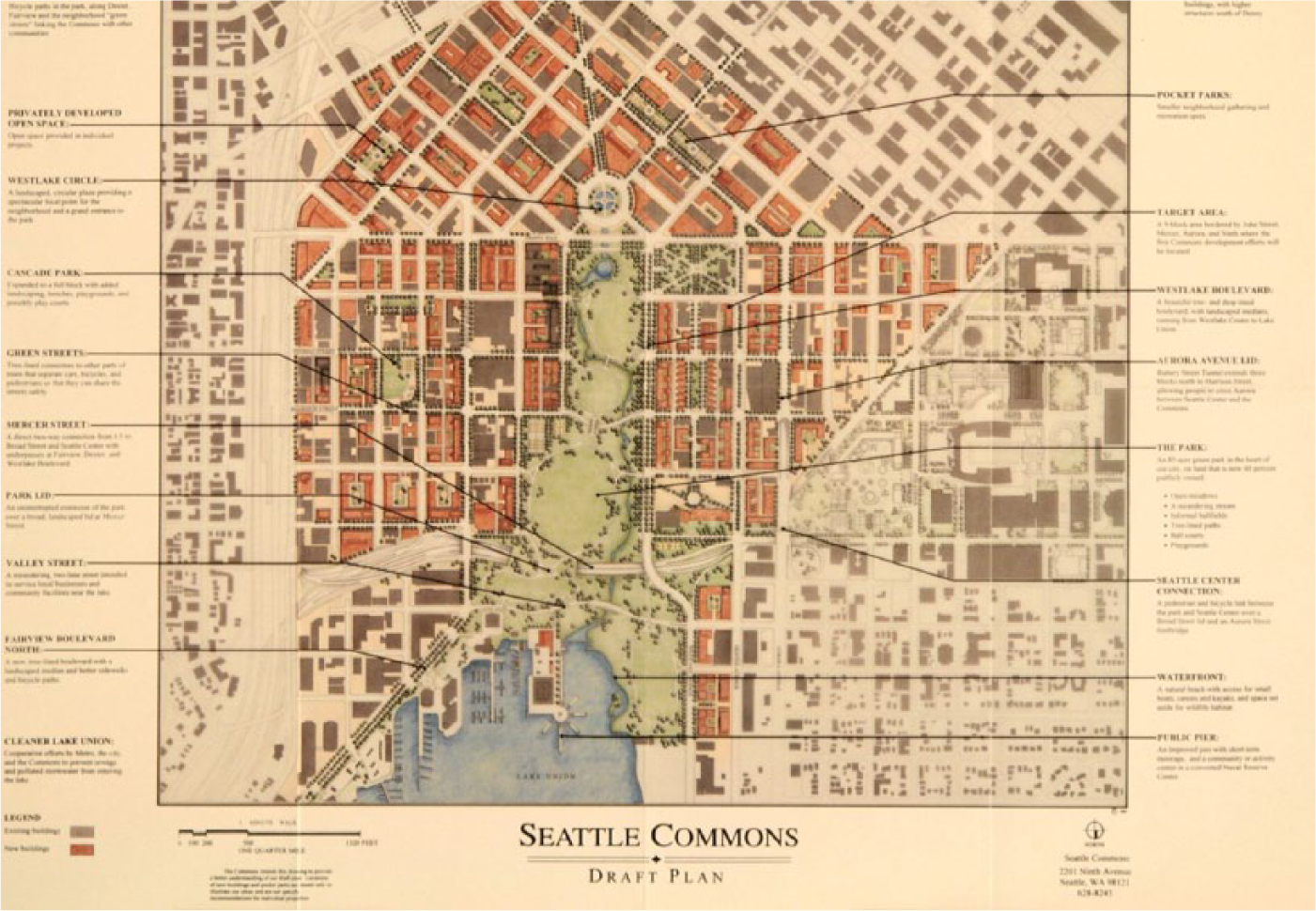
Seattle Commons Master Plan, 1993.
While the planning process was underway, the Committee quietly began to acquire property in the targeted area to proactively counter criticisms of being neighborhood “outsiders” while simultaneously negotiating with several key corporate players who were wary of the urban village idea. 42 The Committee initiated a capital campaign to raise $20 million to ensure they could secure the funds to assemble 50 percent of the land within the proposed park boundaries. An anonymous donor, revealed as Allen, posted a $20-million challenge grant for the acquisition while simultaneously buying up nearby parcels for his own development company, Vulcan Northwest. In a proposed PPP, he made the city a tantalizing offer: he would forgive his $20-million loan, the largest private gift ever given to the municipality, if Seattle voters approved the $111 property tax levy to offset ten years of development costs. 43
Despite project momentum and policy maker support, many critics decried the project and mobilized to protest against the Commons master plan. Concerns about gentrifying a working-class neighborhood and purposefully pushing out light industrial activity were paramount. 44 Others were against a civic elite–led project that favored high-end development over more equitable alternatives. The large-scale vision also reminded citizens of the slash-and-burn tactics of urban renewal in other places, which created fury over such grand plans. On September 20, 1993, Seattle residents narrowly defeated the levy to build and publicly finance the Commons by a 53/47 margin. Project proponents moved forward despite the setback: Allen renewed his challenge grant. Mayor Rice and the City Council scaled down the project, which cut the levy by more than half to $48.5 million. On May 22, 1996, voters again rejected the levy amid increasing anti-tax sentiment and ongoing reservations about the equitable allocation of project benefits. At that time, citizens were also voting on several other large tax levies for sports stadia raising concerns about the overextension of public financing for urban development. Admitting defeat, the City decided to forgo a third run. 45
Without a deal in site, Allen demanded that the City transfer 11.5 acres back to his possession to cover his $20-million loan to the City. He quickly acquired more than 60 acres in the industrial South Lake Union to build a science and tech neighborhood.
46
As a top priority of the city and county, policy makers and planners allocated significant planning and infrastructure resources to the redevelopment plan. The centerpiece has been Amazon’s 1.6-million-square-foot corporate headquarters in an eleven-building corporate campus in the area previously designated as the Seattle Commons.
47
While South Lake Union is an economic development success story for the tech community; it also marks a failed story for public open space. While the citizens rejected the levy on the grounds that it was not equitable enough, they ended up with perhaps something even more inequitable and less public—a relatively privatized economic hub with limited public benefits. One interview respondent commented, The neighborhood didn’t want it. [They said:] we are a great neighborhood, we have jobs, and yes, we may be a bit gritty. [To them,] it seemed like a grand, elitist planner vision. Now, [Paul Allen] owns 60 acres there and is trying to implement his vision of bio-tech hub in a cool hip neighborhood. Some argue that what happened was that you got the Commons without the great park.
48
The Commons illustration does not suggest that PPPs are an exhausted model for civic amenities or that it is a failed paradigm. Its failure can be attributed to many reasons: bad timing, populist dissent over private subsidy, distrust in development motivations, concern of public budgeting, and wariness over project scale. What it does provide is a historical lesson about a failed project that motivated Seattle actors to find other ways to build public goods. This helped lead to a different implementation and financing structure that culminated in creating more open space in downtown Seattle. The OSP varied in both partnership model and in process: a different set of nonprofit partners led the process; the public sector took on a more traditional role; the financial structure relied less on public support; and the timing worked in its favor. In a strategic move, the DNP, with tailored sets of expertise, aligned to capitalize on the message of merging art and green as a way to turn a private waterfront into civic urban space. This arts/conservation entrepreneurialism suggests that there may be other ways to provide civic assets given certain conditions, resources, and motivations.
An Alternative Model: The Seattle Olympic Sculpture Park
From 1910 to 1975, Union Oil Company of California (Unocal) owned and operated a fuel storage facility in downtown Seattle across from Elliott Bay on the Central Waterfront bordered by Western Avenue, Bay Street, Broad Street, and Elliott Bay Trail with parts of the park sitting over Elliot Avenue and railroad tracks. Historically, this area was tagged the “Regrade,” a major capital works project in the early twentieth century designed to level the slope for economic development purposes. In the mid-1980s, Unocal, in agreement with the Washington State Department of Ecology, invested $6.5 million to begin cleaning up the brownfield with its soil and groundwater contamination from petroleum hydrocarbon products (Figure 3). 49

Unocal site, pre OSP.
The OSP did not occur in isolation but was part of downtown Seattle’s thirty-year quest to “breathe new life into downtown” and bring greater private investment to the core. 50 Civic boosters and political leaders unleashed a building boom financed through public–private dollars to catalyze an urban renaissance. Seattle’s arts sector was an integral part of this push, as downtown boosters believed the arts could increase downtown visibility and vitality in a way that a nine-to-five-business core could not. In an arts shuffle, city leaders persuaded several cultural and arts institutions to leave the center city edge for the struggling downtown core by promising greater visibility, bigger audiences, corporate support, and facility investment, giving organizations coveted control over their organizational and programming destinies. These arguments enticed the Seattle Art Museum to be one of the first groups to move to a transitioning part of downtown in the late 1980s despite other competitive offers from the Seattle Center, a former World’s Fair site that housed a cluster of cultural organizations near South Lake Union. The city’s oldest cultural organization with its cache and heavy hitter board maintained its original 1933 location at Victory Park, but constructed a Venturi-designed expansion on 1st Avenue and University Street in a “seedy part of downtown” 51 made possible through municipal bonding capacity. In 1998, the Seattle Symphony Orchestra also left the Seattle Center to move to Benaroya Hall, a publicly financed and publicly owned facility on 2nd Avenue and University Street. A hotly contested campaign to save historical theatres also made way for many smaller theatrical companies to travel closer to the core, convincing the renowned regional theatre group ACT to relocate to the Old Eagles Auditorium Theatre underneath affordable housing units (the former Washington State Convention and Trade Center). 52 More fine-grained activity accompanied this arts and cultural migration. The visual arts community occupied many abandoned or vacant buildings in the historic Pioneer District. Planning and municipal incentives sweetened the deals as the city offered an array of tools from advocating density bonuses to issuing public bonds and creating public authorities.
SAM opened in 1991 marked by Jonathan Borofky’s distinct Hammer Man sculpture at its front door. Despite development problems and architectural critiques, the museum’s board of directors began planning for the next expansion by preparing a new master plan and assembling targeted parcels in anticipation of facility growth. 53 However, a booming real estate market and the resulting high land values made it financially difficult to maintain momentum. Internal financial instability, a recurring issue for the organization, further delayed their grand plans. The museum struggled to pay off its public debt due to the loss of Nordstrom Inc.’s rental income from its adjacent commercial building.
Museum fortunes for expansion plans began to change in 1996 when SAM’s then executive director Mimi Gates met Washington TPL Board Member Martha Wycoff on a fly-fishing trip in Mongolia. In a conversation over the failed Commons vote and the inability to develop urban park space in Seattle, they discussed a mutual interest in creating a place for open space and outdoor sculpture. One interview respondent reflected, We both had a hope and a dream for something unique in Seattle. [Mimi] wanted to see monumental public sculpture in the Commons. I was coming from the necessity of using public parks to stop sprawl. We needed an alternative to the Seattle Commons. The conservation community is always looking for philanthropic civic support and the arts organizations are always looking for ways to [access new audiences].
54
The nonprofit match appeared surprising at first due to drastically different missions: TPL “conserve[s] land for people to enjoy as parks, gardens, and other natural spaces—ensuring livable communities for generations to come,” and the Seattle Art Museum “provide[s] a welcoming place for people to connect to art and consider its place in their lives.” Other institutional differences emerged that later became complementary. SAM had limited experience in urban redevelopment outside of building a traditional art facility downtown, but it did have an influential board of directors and regional cultural stature. The TPL chapter was part of a national advocacy organization with extensive background in land acquisition and brownfield remediation. Both shared expertise in political negotiation and bargaining due to the museum’s previous capital campaigns and bonding capacity, and the conversation group’s local, state, and federal interaction in not only financing projects through cleanup programs but also working through environmental policy processes.
The nonprofit partners spent two years “join[ing] forces to map the city” looking for an appropriate site to install a large park and an outdoor museum. 55 They considered alternative locations such as rooftops and old gas stations but kept returning to Unocal’s waterfront property, which was situated in the Belltown neighborhood and had been targeted for urban redevelopment. Once part of the previously noted Denny Regrade, the changing neighborhood was transitioning from a light industrial and arts community to a dense residential center in compliance with the city’s downtown plan. The site contamination did not alarm or “frighten” TPL, 56 as the local group had access to national resources and expertise. They knew how “to buy it, clean it, get it into public ownership, and turn it into great public parks.” 57 TPL was able to remove barriers to development, making it more attractive to SAM, who “trusted” their partner’s abilities to make the deal work. To create further institutional synergies, SAM hired TPL’s development specialist to act as the project manager, who was charged with promoting TPL’s motivation to keep “the sensibility of environmental commitment and the necessity of public access” while maintaining SAM’s interests. 58 The partners agreed to the following terms: TPL would negotiate the land deal and cleanup process, and SAM would operate, administer, and program the park on behalf of the Museum Development Authority, a quasi-public agency created in 1984 to finance SAM’s downtown development through its bonding capacity powers. SAM also agreed to keep the space open and free to the public rather than creating a privatized outdoor exhibition space.
The DNP strategized to secure the targeted property in reaction to a highly competitive real estate market and resulting development pressures. The City’s comprehensive plan tagged the area near Unocal’s site for residential and commercial development, and the Port Authority had already approved a Request for Proposal to turn the site into 850,000 square feet of mixed-use development. Plans changed after former Mayor Paul Schell introduced Gates, Wycoff, and Rodgers to the Port Commission, who eventually agreed to the TPL/SAM land transaction. In 1999, they acquired the rights to buy the 7.4-acre site consisting of two upland parcels and one tideland parcel, and they quickly announced a capital campaign to raise $11.5 million to supplement the $4.5 million down payment and secure the purchase. 59 The deal was further sweetened through a tax break as the property was assessed at $24 million, but Unocal agreed to sell it for $16 million with an $8 million tax deduction, making it financially feasible for both the park developers and the seller. 60 TPL/SAM pulled in a little more than half of needed financing through a $3 million donation from the William H. Gates Foundation and $3.6 million from other private sources, but the group was still $4.9 million shy of the purchase price, forcing Unocal to extend its deadline. Not only was the group unable to acquire the property, but they had little set aside for actual development of the land. SAM decided to bundle it within a single campaign that included not only the park but also a new downtown expansion and original site renovations. A key gift came from Microsoft billionaire Jon (who was also SAM’s Board Chair) and Mary Shirley, who stepped in and pledged $20 million for the park’s endowment in exchange for naming rights and an explicit agreement that the park remained open and free rather than gated and privatized. 61
In an international search leveraging funding from the National Endowment for the Arts and SAM’s donor base, the partners initiated the planning and design process by hiring New York–based Weiss/Manfredi Architects, one of 150 groups competing for the project bid. In its chosen capacity, the public sector took on a traditional project oversight role: the City Council “authorized and directed city agencies to develop policies, programs and funding strategies necessary to develop the Sculpture Park.” 62 In 2001, SAM and the city agreed to design criteria, a physical program and an artistic program. 63 The negotiated scope of work embodied three primary elements: connecting the park to other urban assets; incorporating city priorities for non-auto uses; and ensuring “free public access” as a “public sculpture park.” 64 SAM controlled the design process although the city created an advisory group with representatives from the Department of Parks and Recreation, the Seattle Transportation Department, the Strategic Planning Office, and the Department of Design, Construction and Land Use. In exchange for mutually agreed upon design criteria, the city contributed staff resources and $150,000 in funding from Executive Services Department’s Emerging Capital Projects Fund and from the Department of Park and Recreation’s Shoreline Parks Improvement Fund. In 2005, the City Council approved the OSP’s design with the following park components: a small beach within Myrtle Edwards Park, a stabilization of the seawall between Bay and Broad Streets, a ten-thousand-square-foot indoor facility, a pedestrian crossing system over Elliott Avenue and the railroad tracks, and several acres of green open space that reworked the waterfront. SAM and TPL continued to raise additional capital funds for park construction and development with a price tag nearing $60 million. Later that year, the City transferred the former surface parking lot within the Alaskan Way right-of-way to the Department of Parks and Recreation to act as a park boulevard. The two and a half acre site was leased to SAM for two consecutive twenty-five-year terms to create a continuous connection between city assets and infrastructure.
SAM/TPL confronted several challenges despite the project’s momentum. 65 The first was solving the environmental issues and addressing contamination. 66 The second was restoring and stabilizing the sea wall following an earthquake. The third was securing public rights of way and discussing whether a private institution should manage public space. The fourth was an unrealized plan to run the Alaskan Way viaduct under the park, creating construction delays. The fifth was working to make the waterfront a site for salmon restoration. All of these significant challenges led to a later opening date and increased construction costs.
SAM was also stretched thin in its capacity as a nonprofit arts organization. The museum was building a downtown expansion in partnership with the now-defunct WaMu for a $350-million joint tower that required an additional extensive capital campaign. Board members were nervous about overextending their risk and responsibilities. 67 To counteract these organizational stresses, they leveraged their joint projects in unique ways. For example, in 2004, they transferred 92,986 cubic yards of dirt from the expansion site to the park as recycled landfill. They also combined both projects in a successful effort to have the City Council extend the city’s credit backing to $65 million in bonds to help pay for both projects. 68 Through a transfer of development rights agreement targeting increased open space, WaMu paid SAM $1.3 million to send development rights from the OSP to the downtown expansion site as the receiving site. Several respondents, who were part of the deal, commented, “The WaMu tower made this possible. It is how the city helped make the Sculpture Park happen.” 69
SAM began installing public art in July 2006 with Richard Serra’s 5-part sculpture, “Wake,” in anticipation of a July grand opening. However, the arts organization pushed the park’s unveiling back seven months in response to a concrete workers strike and a host of other construction problems. The nonprofit park officially opened in January 2007 (Figure 4). As discussed above, SAM, TPL, and the city worked together to integrate the green/art project into other investments in the area, including a bicycle and pedestrian path along the waterfront. The park was part of a larger conversation about how transformations in the urban core reflected the tensions between the city and region’s dual economic identity as a historic maritime and manufacturing powerhouse and contemporary science and tech regional hub. This shift also provides context for how urban development partnerships change and develop. The success of the DNP project was far less about creating a public art sculpture park and far more about creating a civic waterfront space after centuries of a privatized waterfront in a city with a history that demonstrated that “land was a marketable commodity and civic rights had no place or presence.” 70
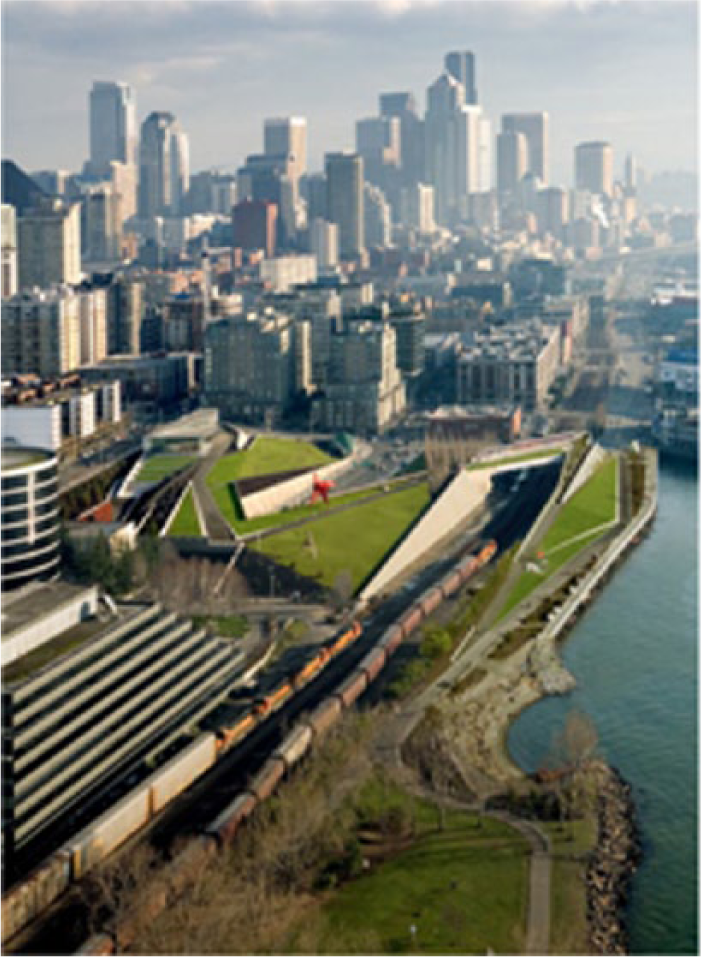
Aerial view of Seattle’s Olympic Sculpture Park.
Analysis and Findings
The purpose of this research was to reflect not only the stories of open space and arts, but to more importantly, explore what OSP, can tell us about urban development partnership structures, how single interest nonprofit organizations collaborate in urban redevelopment, and how they reflect or react to other public–private efforts at that time. This analysis focuses on arts nonprofit institutions that typically do not have a real estate or development component in their mission or charter. This differentiates them from the community development corporations (CDCs) and community-based organizations (CBOs) that often prioritize projects leading toward urban stabilization or redevelopment. SAM, in particular, relied on outside expertise for both the downtown expansion project and the OSP on the waterfront.
What Alternative Partnership Structures Exist for Urban Redevelopment?
This study provides an avenue for bringing greater nuance to how scholars and policy makers think about partnership models in urban redevelopment. Typically, there are three configurations that come to mind: public–private partnerships, anchor institutions, and community development corporations (CDCs). Each group with varying purposes/missions tends to have expertise in urban redevelopment, whether it is in disinvested neighborhoods, downtown redevelopment, or waterfront revitalization. Significant literature exists that documents their endeavors; however, these dominant models tend to overshadow other illustrations of joint partner configurations. This is not to say that PPPs should be cast aside but that other structures may be considered. The Seattle Art Museum and The Trust for Public Land are a collaborative hybrid of PPPs and CDCs in that the dual nonprofit structure risked private dollars for a public good. While they do share some similar traits with these two types, they are inherently different. This civic partnership took on a single project in the realm of urban development that was outside of the regular purview. Once the OSP process was completed, they disbanded to return to focusing on their organizational missions and regular programming.
To What Extent Do DNPs Mirror Traditional Public–Private Partnerships?
These DNPs share some similar features as traditional or conventional PPPs in urban development; however, five attributes set them apart. First, this narrative involves two nonprofits leading the development charge where they share risks and responsibilities. This partnership differs from the typical model of a private commercial group joining forces with a governmental entity. Further, one nonprofit did not have extensive knowledge about urban development, which sets it apart from other CDCs that have real estate as their mission-driven focus or have greater experience in development. Second, the public sector played more of a traditional role for the OSP project in creating a regulatory environment that allowed for urban development incentives available to all, rather than tailoring a specific set of financial and planning incentives toward this targeted intervention. This differs from the traditional PPPs where the public sector plays a more proactive role of equally sharing risks and payoffs rather than playing a supportive role. In this case study, the nonprofit partnership mobilizes the public sector; the public sector did not lead the charge partly due to its controversial experience with the Commons. It took on what Sagalyn calls its traditional role as a “passive regulator.” 71
Third, these nonprofits counter the common assumption that corporate or commercial enterprises are the sole organizational structures with business and negotiating expertise to run projects that are complex in nature. Despite research to the contrary, a prevalent view is that nonprofits and community organizations are less proficient in downtown project development. The success of TPL and SAM in redeveloping a controversial site contradicts current thinking and supports research that studies the success of CDCs and community-based organizations as urban development leaders in low resourced areas.
72
Here, nonprofits had the in-house development, technical, and financial tools available. TPL possessed brownfield redevelopment expertise and land transaction abilities. SAM brought a strong donor base and supportive downtown community that ranked the arts as an important economic sector and driver for urban vitality. SAM also had the financial backing and civic board leadership to fundraise for a project of this scale, which underscored the civic and private wealth it could tap into for this project. One respondent involved in the partnership structure commented, TPL knows how to work with different constituencies to get the deal put together. Our job is to get the deal done. SAM’s role is to bring the art to it. What has been wonderful is that SAM has allowed TPL to stay connected.
73
The nonprofit focus of both organizations—one that focused on open space and one that focused on the arts—created a mutually beneficial climate, with TPL’s goal of providing citizen access to the waterfront matched by SAM’s desire to extend its museum and reputation outward. Neither group had placed profit motives in front of the public good even though such projects do require significant investment.
In a sense, one double bottom line organization (SAM) and one triple bottom line organization (TPL) were uniquely positioned to produce public benefits and equitable development. The public sector is not always able to do this in a traditional PPP because of the reliance on private dollars to make deals happen and their limited ability to negotiate and evaluate deals on the front or back end. As one interview respondent commented, “The challenge of a PPP is that neither side speaks the same currency.” 74 This is not to say these nonprofits in this DNP are altruistic—far from it—but their nonprofit and mission-driven motivations matched or matched enough in currency.
The OSP project does have some features similar to PPPs that blur private–nonprofit designations in some ways. While SAM and TPL are nonprofit organizations, they received significant private sector support through wealthy individuals and corporate foundations. It so happens that these civic elites support the mission and project goals of a citizen waterfront, but at the end of the day, the nonprofits act as a funnel or distribution channel for largely private sources of financial support and investment. It raises the question of how private sector donor money is perceived and marketed through the DNP structure. Such an approach raises important social issues about philanthropic investments in urban development and the tradeoffs for the public or publics. In addition, one of the chief criticisms about PPPs is their lack of accountability. While limited transparency is inherent in deal-making and negotiation, it also runs contrary to an open and democratic process. This raises a larger question of how public and civic engagement occurs within DNP projects where it is not an entirely open or closed process.
How Do Partnership Structure Influence Redevelopment Outcomes?
Many factors contribute to effective outcomes and partnership structure is an important one that is often overlooked, which is demonstrated when looking at OSP in the context of the Commons failure. In talking with participants about why the Commons project failed and the OSP succeeded, a number of common sentiments emerged. First, unlike the Commons, TPL and SAM controlled the site early on, making the project more feasible. Second, like the Commons, OSP had a small group of people who led the initiative, spanning several key interest groups with different resources and skills. One interview respondent commented, They were brilliant and there was nothing they couldn’t do. They were smart about their vision. They checked in with everyone. They built tremendous good will. So, when dealing with fights about integrating parkland with private land, they had all of the good guys on their side. The fights were hard and they were well poised to fight them. The Sculpture Park could have just been a park but by having waterfront, park, and art—the three were merged together brilliantly because we could have just had a park.
75
Third, compared to the OSP, the Commons was ill-timed. There was a sense that the large-scale project felt too much like urban renewal. Critics chastized policy makers, corporate leaders, and civic boosters for wanting to bulldoze a working-class industrial neighborhood. SAM and TPL’s approach was more surgical than full-scale demolition and clearance, which created less political and neighborhood tension. The Commons master plan started at 87 acres, which dwarfed the OSP’s 7.8 acres. The OSP also transformed a brownfield site into a coveted urban amenity in a prime real estate area. Furthermore, Seattle residents saw the OSP as a connector for a growing greenway transportation network along the waterfront.
Fourth, one of the more significant differences is that the OSP project never faced a public vote or referendum, creating a mostly private process for project financing and land acquisition. One interview respondent commented, “The big distinction between the success and failure of each was that the Commons was a public process, OSP was a private activity.” 77 The city was also a strong partner in offering different avenues for off-budget financial support and general regulatory incentives, but it did not directly invest significant public money in the project.
Finally, both projects had significant support from civic leadership and civic elites in Seattle, where three of the wealthiest hundred people in the United States live. 78 A significant portion of the OSP’s financing came from Microsoft executives, which shows how newer technology and science wealth is partly driving urban development in Seattle. As The New York Times pointed out in article detailing OSP’s opening, “where money’s no object, space is no problem.” 79
What these explanations fail to point out is that other factors contributed to a successful outcome beyond the private nature of the planning process and the strategic alignment of nonprofit institutional missions. Unlike the Commons initiative, OSP’s site was largely vacant creating less tension over concerns about industrial and residential gentrification. No residential demolition or relocation was required, and the project was of a much smaller scale. However, OSP’s development obstacles were not minor as it dealt with site contamination, public right-of-way disputes, earthquake protections, proposed highway routes, and an existing plan to develop a 850,000-square-foot residential and commercial structure that was more aligned with the city’s comprehensive plan. While project size and location were important, they were not the primary explanatory factors for explaining why OSP succeeded and the Commons failed; rather, it was a complex set of dynamics that created the suitable and politically favorable conditions for development.
What a broader look at Seattle’s recent history to build civic amenities and open space shows is that it is too simple of a question to ask what role partnership structure plays in the success or failure of each project. Instead, it is useful to consider how the different conditions and implementation cultures relate to one another. The important historical lesson from the earlier Commons narrative is how it motivated other actors, and subsequently, their institutions, namely TPM and SAM, to test a different partnership model for urban redevelopment.
How Do These Partnerships Reflect Attributes from Earlier Eras of Urban Improvement?
This case brings together many of the key elements associated with planning’s early linage in urban improvement, including municipal art, open space and parks, and civic leadership. Past histories of this piecemeal era, along with studies of the later City Beautiful movement, examine how such late nineteenth- and early twentieth-century interventions changed the urban landscape. Critics question whether these aesthetic solutions ameliorated the problems of urban areas. Proponents point towards early systems planning and community appreciation for open space and parks. Both dialogues continue to resonate today. This case adds to this conversation by illuminating some of these older debates and by introducing new tensions in the quest for urban improvement.
The impact of the OSP has been substantial going beyond acting as a traditional site for art exhibitions or an isolated park site. A local planning consultant and local activist reflected, The Sculpture Park is a fantastic example of [how view about the waterfront have changed.] Seattle had turned its back on the waterfront. People think about their cabin or San Juan Island and never thought about water right next to everyone as nature. The Sculpture Park shed this image. Until it opened, people did not know how significant it would be in terms of the fact that it is our prime civic real estate. It was a courageous planning effort to think a new way about urbanism, civic life, and the arts. It was a tremendous turning point for Seattle.
80
Many of the other interviewed subjects concurred. The “very innovative use of a horrible brownfield” changed the argument about reusing the waterfront. An interview respondent advocating on behalf of downtown economic development observed, Seattle had a significant deficit of parkland in the city. People think because we have water so we don’t need green space. So, the Sculpture Park is now a big space of green in downtown. It showed people what an open waterfront could do.
81
The urban improvement project also influenced conversations about what to do with other investments in the core, including the Alaskan Way viaduct and the state-led proposal for a cut and cover strategy along the waterfront. One interview respondent reflected, In relation to the viaduct, the Governor was about to support a rebuild because it was the most cost effective. The park was nearing completion. The project developers organized a grand opening and invited the Governor. It happened to be a gorgeous day with a panoramic view of gorgeous open space. The Governor later announced plans to redevelop central waterfront. The Olympic Sculpture Park made that tangible.
82
The project also demonstrated a link between planning and art that defied concerns about the elite nature of art museums. One respondent remarked about the integration of a landscape through art and design, The OSP is a living art place. It is a living public forum. It is a living green space. SAM positioned itself as a front door to the city through OSP through aligning art and design.
83
A bigger issue framing the OSP, that many cities face, is how to approach waterfront transformation in terms of prioritizing land use, considering public access, and balancing competing visions for creating sustainable residential neighborhoods for different levels of affordability. Many of the interview respondents continued to reinforce how the OSP contributes to this region-wide dialogue symbolically and practically. One interview subject commented, “The citizen has a right to the waterfront. OSP enlightens that topic.” 84
That said, it is important to not cast SAM as a purely selfless civic player in this project. SAM, understandably, had its own mission interests at play, which suggest that trade-offs have to be made with DNPs as well as with PPPs in the quest to create civic assets. The OSP is an extension of SAM and of typical museum faclities with its art sculptures, amphitheater, parking garage, and education enter. Beyond these traditional elements, the park offers little else in the way of park amenities. In part, this is because of its small size, and in part, it is because of SAM’s desire to create an art park that figuratively and literally connects with its downtown location.
One of the more pronounced critiques of the OSP has been how art is treated or not treated as part of civic space. The quote below highlights the debate over a “Don’t Touch” policy that is enforced by the museum and its security staff. Richard Serra, an artist who designed “The Wave” below responded to this tension in a Seattle Times article: Look, I’m not precious about my work. I think when you put it in the public; it has to survive on its own. [This is a feature of public art,] it’s “off the pedestal” where people “can do what they want with it.” 85 This reaction is part of an ongoing debate about whether a nonprofit museum can treat public space as “public” due to their conflicting organizational responsibilities and institutional culture. Further, it is part of a larger conversation about how communities “police” and “control” the public and private realm in an era where urban improvements are increasingly funded outside of public budgetary lines.
Conclusion
This case study demonstrates an overlooked DNP partnership model that runs contrary to conventional wisdom about how to implement and finance urban redevelopment. This DNP structure between the Seattle Art Museum and the Washington State Chapter of the Trust for Public Land provides an alternative strategy for thinking about how urban redevelopment occurs, especially in attempts to save downtowns and waterfronts. This is not to say that DNPs should replace PPPs, but that they provide a different option in communities where PPPs are politically tenuous, where private actors are not interested in the complexities of PPPs, or where the public is not willing to continue to pay out-of-pocket for urban improvements. Some institutions, like these nonprofits, can be important players in fulfilling public needs or civic goods. As one interview respondent reflected, Most PPPs are not about trust. This was different. For the OSP, the collaboration required a huge amount of trust. It is messy. We didn’t hold our donor base close to the vest. We knew we would do it together. It is a model that can happen over and over again.
86
The study also suggests the need for future research to determine whether DNPs are common in other communities or if Seattle represents an exception due to its corporate wealth and civic leadership. Beyond the mechanics and logistics of partnership structure, this case also illuminates the evolving history of urban improvement with its enduring connections to open space, parks, municipal art, and civic leadership.
Footnotes
Declaration of Conflicting Interests
The author declared no potential conflicts of interest with respect to the research, authorship, and/or publication of this article.
Funding
The author received no financial support for the research, authorship, and/or publication of this article.