



Abstract
Poised on the cusp of the twentieth century, many urban citizens believed their societies to be sickened by suicide epidemics. It was assumed that rapid modernization and technological advance caused some individuals to develop nervous conditions that negated their impulses for self-preservation. Although statistical evidence pointed to higher rates of suicide among adult men, society believed that youth and women were most vulnerable to the epidemic. This article examines cases of young women carefully planning their suicides in symbolic spaces of Mexico City. It argues that public suicides made self-conscious decisions on how they would die, in particular choosing the sites of their deaths for their cultural meanings. How society viewed their deaths depended upon their virtue in life; nevertheless, Mexicans perpetuated their culture of commemorating the dead by erecting ephemeral memorials at the sites of death.
As the twentieth century loomed, many urban citizens worldwide believed their societies to be sickened by suicide epidemics. Economic and technological changes occurred at a rapid pace, and some members of society could not endure the increased pressures of modern life. Scholars have viewed suicide as a largely male activity in Victorian and Edwardian London, imperial Russia, and the post–Civil War U.S. South. Many Mexicans, on the other hand, believed suicide in the late nineteenth and early twentieth centuries to be a peculiar affliction of youth and women. 1 Official statistics, in part, belie this perception, yet in a society preoccupied with the vicissitudes wrought by modernization, the spectacle of female and youth suicide magnified fears about the future. Indeed, gender disorder or the idea that women were increasingly transgressing social mores by stepping out alone or challenging male authority worried many capital residents. Mexico City was becoming an enclave of rural migrants, and an increasing number of households lacked a male head. Likewise, modern leisure activities like the cinema and opportunities for female employment in the numerous offices and workshops threatened the existing gender ideology that found honorable women in the home. Newspapers featured daily reports of suicides: some short factual paragraphs, others serial essays peppered with conjecture and opinion. Journalists and editors used the specter of the unnatural deaths to lament disturbing aspects of the changing world. Moreover, they endeavored to shape rational discourses on morality and honor in an attempt to represent public opinion. In fact, they assigned honor or dishonor to suicide victims but also used their sensational deaths to criticize their peers and rival newspapers. Instead of pistols, words acted as weapons in this papered field of honor, though a particularly virulent printed conflict could still result in a duel, especially in the late 1800s. 2
This essay examines the public narratives of young women who carefully planned and committed suicide in symbolic public spaces of Mexico City at the turn of the twentieth century. This analysis does not read public narratives to discover what really happened, but how they served to construct cultural communities. 3 Shared public narratives, like gossip, forged communities across social groups. 4 Committing suicide was infamous enough, but forgoing a private death for a public one provoked scandal and complex commentary in society. These scenarios provided newspapers with an outlet to shape and represent public opinion and assert claims to cultural authority. For their part, the young female suicides attempted to influence the public narrative of their deaths by the choices they made in dying and the effects they left behind. Elisabeth Bronfen argues, “suicide implies an authorship with one’s own life, a form of writing the self and writing death that is ambivalently poised between self-construction and self-destruction.” Bronfen theorizes that women, objectified in life, take the subject position by denying the body in the staging of an aesthetical suicide. 5 In other words, as Margaret Higonnet has argued, “to take one’s life is to force others to read one’s death.” 6 Indeed, reporters read female suicide and used the victims to discuss a number of troubling themes of the modern era, including honor, morality, gender roles, and mental health. Journalists viewed themselves as arbiters of reputation and attempted to craft a dominant public narrative. The reality was that in discussing suicide, competing narratives existed in Mexican society as each entity—newspapers, popular publications, the suicides, and mourners—competed for social authority. How reporters analyzed suicides depended on perceptions of the departed’s virtue in life. 7 Even when journalists ridiculed the neurotic or dishonorable women who committed suicide, ephemeral memorials sometimes appeared at the sites of death, suggesting a collective mourning that contrasted with the spiteful and judgmental treatment by the press. I argue that young women opting for a public suicide made self-conscious decisions on how they would die, in particular choosing the sites of their deaths for their cultural meanings. Attempting to construct their selves in their suicides, young women employed tropes of honorable death and conformed to a cultural logic of female suicide. 8 In particular, they took great pains to choose the site and method of their sacrifice in order to communicate significant meanings to their deaths. The essay begins by setting the urban context of the public suicides. Mexico City underwent rapid modernization and secularization at the cusp of the twentieth century, and public spaces took on new meaning at the same time that intellectuals grappled with the perceived rise in suicide. Next, the essay focuses on two prominent suicide spaces—Chapultepec Park and the Cathedral—and the women who authored their deaths there. An analysis of the public narratives asserted by various newspapers and actors underlies the analysis. While suicides were quick and fleeting acts, they served as touchstones for various actors to debate and discuss the trajectory of Mexican society, a nation on the cusp of a new century and a social revolution (1910–1917).
Tragic deaths in public urban spaces were commonplace in early-twentieth-century Mexico City, as crime rates mounted, corpses piled up in the morgue, and the media reported on sensational cases of murder and suicide. 9 Broadsides and newspapers alike depicted violent deaths in city streets. Presses employed artists to sketch crime scenarios, such as the latest throat-slashed victim of Mexico’s Jack the Ripper or bodies falling head first from the Cathedral 10 (see Figures 1 and 2). Reminders of death surfaced in other ways as well. Mexico had developed a keen culture of memorializing statesmen and heroic martyrs, evidenced in particular in the multiple state funerals during the rule of President Porfirio Díaz (r. 1876–1911). 11 Parallel to official acts of commemoration and statecraft, temporary memorials occurred at literal “stains of blood.” Indeed when someone committed suicide in a public space, such as a church or popular park, once officials removed the corpse to the morgue and collected evidence, at times onlookers and grievers gathered to leave flowers, notes, and other mementos at the scene. Planning their deaths with exquisite precision, the women who chose public places for their suicides strived to shape how they would be immortalized in popular discourse. Likewise, mourners who contemplated the “stains of blood” shared in performative rituals of memorializing death on the streets of Mexico City. 12 Even though the flowers wilted and mementos eventually made their way into trash bins, ephemeral memorials were “highly orchestrated and self-conscious acts of mourning aimed at expressing, codifying, and ultimately managing grief.” 13 This outpouring of sorrow could be personal to the victim or more abstractly nostalgic for lost youth or a bygone era.
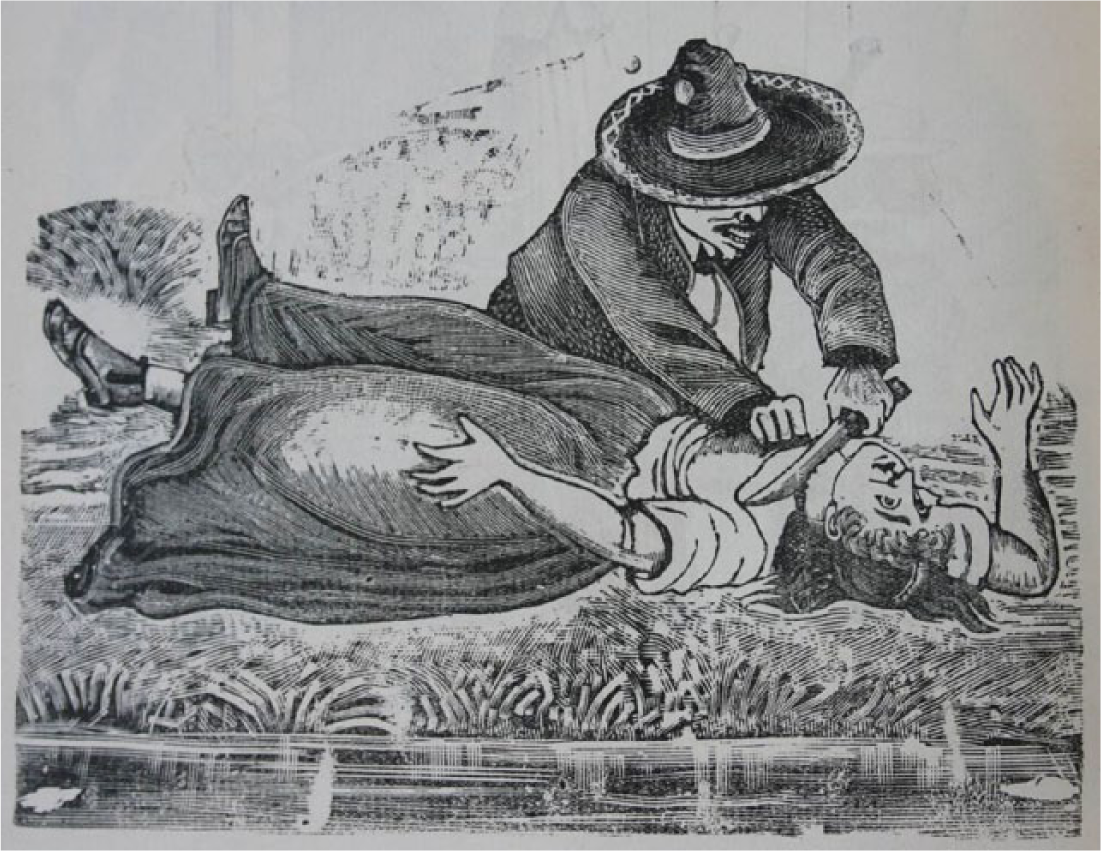
Note: Francisco Guerrero, aka “The Mexican Ripper” committed a series of violent crimes in 1880s Mexico City, including the murder of women working in the northern suburbs of Mexico City. By José Guadalupe Posada (1852–1913). Corrido: el Chalequero. Colección Andrés Blaisten, Fondo Francisco Díaz de León.
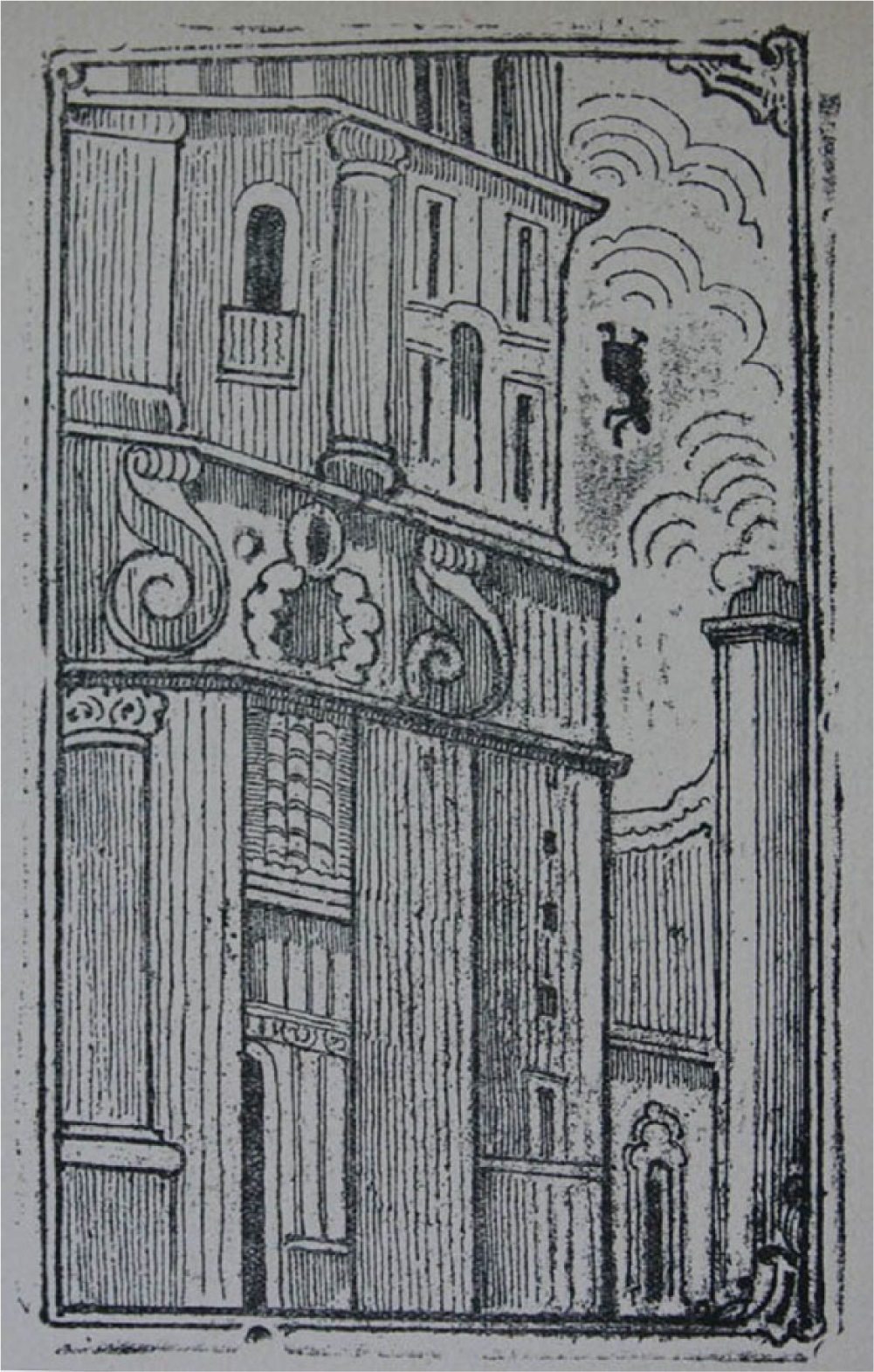
Note: The body of a woman falls from the Cathedral after jumping from one of the Towers of the Suicides. By José Guadalupe Posada (1852–1913). Corrido: La suicida María Luisa. Colección Andrés Blaisten, Fondo Francisco de Díaz de León.
The media and public interest in suicide coincided with the rapid urbanization of Mexico City. A secularization impulse that began in the mid-nineteenth century under liberal reformer President Benito Juárez resulted in fundamental changes. Compulsory public education replaced religious schooling; secular replaced religious holidays; and a body of civil legislation (culminating in the 1870 Civil Code) governed marriages, burials, and family relations. Likewise the Penal Code of 1871 gave rise to the transformation of the judicial system and the building of a prison scheme based on the idea that criminals could be studied and sometimes, rehabilitated. A new breed of politicians who applied science to social problems emerged and a cadre of professionals interested in sociology populated the halls of government, medical schools, and newspapers. 14 In fact the Revista Positiva published a thirty-one-page article by positivist historian and writer, Carlos Pereyra, “Abstract Sociology and Its Application to Some Fundamental Problems of Mexico” in 1903, an essay that refers to major foreign sociologists such as Franklin H. Giddings and Emile Durkheim. 15 Other articles on suicide and mental illness appeared in the journal of the national medical school, La Escuela de Medicina, from 1879 to 1914. Simply put, Mexico endeavored to situate itself as a modern nation interested in employing science to find solutions to the problems that might impede its economic and social progress.
The Mexican state did not classify suicide as a crime, owing to a long trend of decriminalization of the act worldwide. When a death occurred that appeared to be unnatural, authorities transported the corpse to a local hospital for an autopsy, and experts investigated to determine the cause of death. 16 Law recommended punishment only for accomplices or instigators of self-destruction. Jurists agreed that a suicide was not fully to blame for self-murder; thus no penalty existed for the suicide, the attempted suicide, or the heirs left behind. 17 Simply put, suicide was an individual choice, one to be saddened by, but not prosecuted. Mexican doctors followed the lead of French specialists, like Jean-Étienne Esquirol, who posited that brain abnormalities combined with or caused by environmental factors like poverty and lack of education could inflame passions and lead to mental illness. 18 A belief in contagion informed attempts to blame certain social groups for having the potential to infect the entire body politic. Social contagion gained most currency in thinking about suicide rates; and like their counterparts in Argentina, Mexican intellectuals posited that the poor, living in crowded tenements and exhibiting higher rates of alcoholism and crime in their neighborhoods, were more vulnerable to physical and social diseases, and the resulting brain lesions could be passed to subsequent generations. 19 El Imparcial reported on a speech that Dr. José Olvera presented at the Academy of Medicine in 1899, where he confirmed his argument that religious disbelief was a significant cause of suicide, a theory that conflicted with the hypotheses of his liberal peers. His colleague, Dr. L.E. Ruiz disputed the relevance of religious belief in mental illness, and at the end of the article, the anonymous El Imparcial reporter brushed off Olvera’s supposition as well, noting, “More important, in our view, is the collection of causes that increase the number of suicides. It is a disease, as Dr. Olvera states, but its etiology has deeper roots than the superficial ones proposed by the distinguished academic. And therefore, the measures [moral treatment] he proposes to remedy the evil, provide poor results.” 20 Certainly by 1910 the “medicalization of madness” had fully taken over and doctors largely focused on the physical causes of insanity, although they agreed that environmental factors could lead to these physical anomalies. Asylum intake interviews included questions about family patterns of alcohol and tobacco abuse, history of sexually transmitted disease, childhood illnesses, and menstrual status. 21 Experts viewed the insane as criminal or potentially criminal, an individual who lacked moral capacity and therefore could not benefit from the moral treatment that Olvera advised. 22
However, explaining mental disorders based on inheritance and family history did not satisfactorily explain the existence of suicide among the middle and upper sectors. These individuals presumably lived comfortable lives, sheltered in clean and orderly neighborhoods, and enjoyed proper parenting. Neurasthenia, first chronicled by George Beard in 1880, and further studied by students at the national medical school, became the catchall diagnosis for middle-class suicides, especially for male university students and professionals. 23 Physician José Salas y Vaca argued in 1903 that neurasthenia was an illness of the professional classes and suggested exercise and fresh air as treatments. 24 Neurasthenia could be brought on by mental exhaustion, idleness, and the inability to adapt to the fast pace of modern technology. 25 Salas y Vacas and other Porfirian scientists agreed with Emile Durkheim, who placed the causes of suicide firmly in society rather than in inherited maladies or deformities of the body. 26 Durkheim linked the increasing isolation of modern urban life as an alienating factor that propelled some to self-destruction. 27 Porfirian officials agreed that modern life fostered mental illness in the prosperous classes but also thought that an underlying weakness or defect sometimes existed in the individual to drive him or her toward self-murder. The defect could simply be weak morals or “selfish instincts” (instintos egoístas). 28 Dr. Antonio Gota de Zaragoza shared this sentiment, writing in the medical school journal in 1909, “life in populous cities has become more refined, causing restlessness. The excited nerves respond in the mire, in poisoned and perverted media, until they finally exhaust themselves.” 29 Newspapermen followed the latest trends in science and psychology. For example, an editorial in El Diario stated, “The cause of this illness [suicide] is located in the environment. You can’t find it in the individual. Our era is nervous par excellence. It is the era of degenerates and neuropaths.” 30
The Urban Environs and the Meanings of Space
Mexico City was indeed a populous city that had undergone many modernization efforts. A public building spree transformed the built environment during the Porfiriato. Architects designed new green spaces, widening streets to form tree-lined boulevards, and erected monuments and statues to visually narrate Mexico’s history. 31 Some citizens benefitted from the rapid development; others suffered greatly and left their ancestral villages to seek menial work in the capital. Mexico City teemed with rural migrants, who plied goods, offered their services, and to the visitor seemed to be the undulating underbelly of modernization. Porfirian Mexico City certainly projected a facade of modernity. However, the city evolved not simply as a linear progression forward from the past, but a suturing of past and present in constant tension. This suturing could literally be seen or read as the center of the modern city shifted away from the historic pre-Columbian and colonial center to the new city to the south and west. 32 The Zócalo or central plaza of Mexico City had been the heart and soul of Mexican civilization since the Mexica (Aztecs) ruled the Valley of Mexico from 1428 to 1521. The Spanish literally built their city atop the ruins of the Mexica capital Tenochtitlán after the conquest of the Aztec Empire in 1521. For the next three hundred years the Zócalo confirmed the twin pillars of power in society—church and state. The government palace occupied the full east side of the plaza and the Cathedral rose up to cast shadows from the north side of the square. Its towers, completed in 1791, provided the best panoramic view of the city and the twin volcanoes, Popocatépetl and Iztaccíhuatl. By the late nineteenth century the west side of the central plaza housed a long commercial arcade, containing offices, merchant houses, and retail shops. 33 In the first years of the reign of Porfirio Díaz, the Zócalo embodied a tense intermingling of the traditional and the modern, the old and the new, the poor and the rich. Mexicans of all classes and ethnicities packed the central square on national holidays or knelt for mass in the imposing Cathedral. Businessmen traversed the plaza to make deals in government offices to later return to their places of commerce on the western side. Rich and poor citizens stood side by side watching performances of puppeteers and street musicians. 34 Over time the elite abandoned the palatial homes of the northern and eastern barrios to take up residence in the attractive and modern western side. They could leave their homes in their finest Parisian fashions and ride in carriages or hired private cars down the fashionable shopping street of Plateros (now Madero), past the Alameda Park, and along the Paseo de la Reforma, a modern avenue modeled on Paris’s Champ-Álysées, to socialize and be seen amongst the smart set. New middle-class neighborhoods lined the Paseo, further shifting cultural, economic, and political attention away from the historic center. The modern city rose up along the Paseo de la Reforma, “and this area served the purpose of giving the upper middle classes a place in which to assert their cultural and economic identity apart from the people at large.” 35 The fashionable streets of Plateros and Corpus Christi sported electric streetlamps by 1880, while other streets in the center relied on gas and hydrogen carbonate for illumination. 36 Likewise, electric trains took those who could afford the fares to outlying villages for shopping or work. Simply put, these sites west of the historical central plaza “represented urbane, civilized, and modern Mexico: in a word, Europe.” 37
The refashioned western side of the Zócalo contrasted sharply with the east, which had housed many elite families since early Spanish colonization. Grand homes had been subdivided and transformed into tenements for poor workers and, later, a throng of rural migrants displaced from their lands in neighboring states. Social scientists viewed the tenements as their laboratories. Criminologist Julio Guerrero in the 1890s classified residents of Mexico City according to how close they lived to the street. Tenements housed five occupants on average in one-room apartments, and the former expansive courtyards now served as communal patios where laundry, cooking, and bodily elimination occurred. The lack of privacy in the homes led to sexual promiscuity and criminal impulses according to Guerrero. 38 The only connection between the western and eastern halves of the capital was that poor residents living in the working-class barrios of Tepito or La Bolsa provided most of the menial services in elite residences and businesses. They cleaned homes, swept shop floors, shined shoes, nursed babies, and hawked newspapers. In the end, a visitor to Mexico City who only toured the colonial buildings of the plaza, but stayed and dined in the neighborhoods to the west along the Paseo de la Reforma, had a distorted view of the capital as eminently modern. Not many blocks away, dirt roadways, euphemistically called Rat’s Alley, Dog’s Lane, and Pulque Place, crisscrossed the eastern barrios. In the reaches north of the Zócalo small factories operated, adding to the malodorous and unhygienic environment of the working poor barrios. Mexico City suffered epidemics of typhus in 1884 and cholera a year later. 39 The Health Department routinely sent physicians to these enclaves to forcibly vaccinate tenement dwellers, noting that more than half of all homes had cases of typhus in the 1890s and 1900s. 40 Stray dogs were yet another nefarious feature of urban life. Vectors of rabies, murderous when traveling in packs, and spoilers of city sidewalks, “dogs ruled the streets.” 41
Death was an inescapable quality of modern, urban life in Mexico City. No matter how municipal planners attempted to separate the dying from the healthy living, capital residents confronted the impermanence of life on a daily basis. Traversing the city by carriage, trolley, car, or on foot took spectators past rotting carcasses of stray dogs; diseased and infirm beggars; shops that hawked caskets; funeral processions to cemeteries; and public memorials to heroes long since deceased, but commemorated, in uniquely Mexican fashion, on the anniversary of their deaths. 42 City residents likely paused in their daily movements around the city to observe a state funeral or ride a streetcar with mourners destined for one of the public cemeteries that flanked the city center.
When families could, they spent lavishly on cemetery processions and gravesites. Like other lifecycle milestones, funerals were an opportunity for the wealthy to exhibit their piety and fortune. The state also sponsored funeral processions for illustrious statesmen, including the 1876 cavalcade from the Zócalo, west down Plateros, around the statue of King Carlos V on the Paseo to the modern and hygienic Dolores cemetery. 43 The poor also took great pains to bury their departed in the best style by renting finer caskets than they could afford to purchase or covering crude coffins with colorful flowers. 44 Modern, urban life brought with it “mechanized killings” in the form of railroad accidents, 45 trolleys derailing and careening into bystanders, and construction mishaps. Death was on its way to becoming Mexico’s national totem, and the spectacle of the suicide committed in public space hardened residents’ intimacy with their own transience. 46 Reporters fueled the capital’s acquaintance with mortality by showcasing sensational occurrences of suicide and murder on the front pages of newspapers. Social commentator and engraver José Guadalupe Posada brilliantly depicted the pitfalls of modernization in his satiric broadsides (see Figure 3), and this ephemeral material found its way onto city walls and into residents’ hands. Public suicides in particular caused alarm and comment in the capital. Capitalinos consumed these dramatic stories, and reporters were eager to chronicle and analyze the rising tide of suicide, especially among the city’s lovelorn youth. In fact, papers reported the same facts a reader could find in a police report, but also embellished the story with imagined musings and motivations of the victim as well as the emotions experienced by loved ones that mourned them.
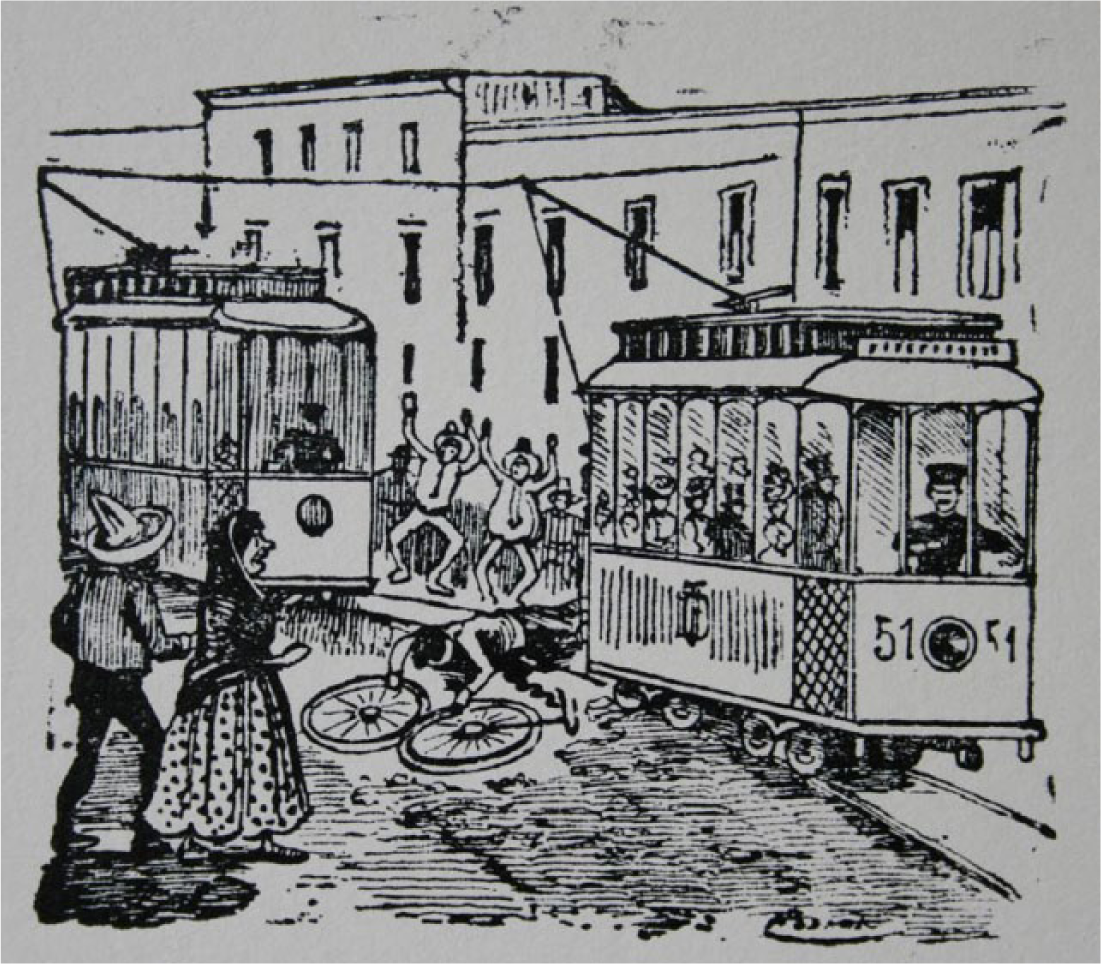
Note: A cyclist is cut in two by a trolley. Bicycle riding in early twentieth century Mexico were a favorite theme of Posada. A North American import, Posada critiqued the bicycling craze among the elite and usually noted cyclists either causing or being victims of accidents. By José Guadalupe Posada (1852–1913). Hombre ciclista partido en dos por un eléctrico. Colección Andrés Blaisten, Fondo Francisco Díaz de León.
When a desperate individual took the dramatic step of consuming poison in one of the popular parks, raising a gun to the head in a cantina, jumping in front of a trolley, or leaping off a building, the story could play out in the headlines and, presumably, in public conversations for days. Drawings of death scenes accompanied reports of suicides in newspapers like El Imparcial, El Democrata, and El Diario. In the early twentieth century, illustrated weeklies such as La Semana Ilustrada included photographs of the victims and the sites of their tragic deaths. In many ways, reporters unwittingly provided primers on how to successfully end a life, by detailing the amount and type of poison consumed, the caliber of gun employed, the height of buildings jumped off, and a blueprint for writing a goodbye note. Likewise, by publishing the photos of the victim’s home or describing the site of the demise, reporters sacralized the spaces of death for subsequent pilgrimages and memorials. Reporters, in particular, had unbelievable access to crime scenes, evidence, and forensic investigators. In fact, reporters for El Democrata chauffeured detectives to a suicide scene in Chapultepec Park and read the letters left behind over the shoulders of the investigators. 47 Journalists entered morgues and described broken and wounded bodies on cold slabs. It is not surprising that commentators, especially from the Catholic press, lamented the contagious nature of suicide at the turn of the twentieth century and faulted the sensational dailies for reporting the chilling details. 48 The government-subsidized El Imparcial received the most censure from rival dailies. An editorial in El Universal claimed that El Imparcial strived to interest the “sick curiosity” of its readers by reporting conjecture rather than facts. 49 Yet readers could not get enough.
Suicides committed in dramatic, public fashion especially grabbed attention. Most suicides were carefully premeditated, especially when individuals chose a meaningful site for death and made meticulous preparations to carry out their plans. City spaces in which they lived, worked, and loved held special significance for them. They courted in certain places, experienced camaraderie and a few drinks with friends in others, and worshipped and celebrated spiritual milestones in the various churches that anchored the landscape. In other words, specific places and objects held special meaning, and the arrangements for self-murder took these connotations into account when they chose the place to commit suicide.
Suicide Park
Social meaning imbued Chapultepec Park, like the Zócalo, the Alameda, and other prominent public places. People of all social classes traversed some of the same spaces, yet it was clear that some sites remained the realm of the privileged classes. In fact, urbanization and public works initiatives acted to reproduce social relations and divide cities between zones of inclusion and exclusion. The poor were not barred from Mexico City’s green spaces, but it was clear that their chief function was to provide services to the rich who could afford leisure activities there. In other words, workers should be invisible. Likewise, the desperate chose Chapultepec to carry out their plans for self-annihilation. Chapultepec Park certainly held symbolic and political importance to Porfirian urban planners who carried out an impressive renovation of its historic castle and gardens. The Park was the site of the most famous, heroic suicide in Mexican history: Los Niños Héroes. Every September residents gathered to pay tribute to the martyrs, who, rather than surrender to the Yankee invaders in 1847, jumped to their deaths from the ramparts of the Castle. One cadet allegedly wrapped himself in the Mexican flag before he leapt to his death. City residents sought leisure time in Chapultepec Park, and the Castle was the president’s summer home. In fact, honorable society promenaded or rode in their fine carriages and cars from the Alameda near El Centro down the Paseo de la Reforma to Chapultepec to picnic and socialize under the grand cypress trees. 50 Young sweethearts kissed on park benches and in the privacy of its gardens. 51
The double suicide of two adolescent girls stood as the most sensational public suicide to occur in Chapultepec Park during the Porfiriato. On November 5, 1909, two best friends crossed the Zócalo, boarded a trolley, and headed for Chapultepec Park. Attired in their best dresses, cloaks, and hats, María Fuentes and Guadalupe Ortiz appeared destined for a party or an afternoon spent with suitors. Three young men, who would later provide testimonies to police, spotted the eighteen- and sixteen-year-old girls on the trolley and flirted with them on the passage to their destination. Disembarking at Chapultepec, the three would-be paramours followed the girls at a safe distance until María and Guadalupe shooed them away and turned down a wooded path. The boys took an alternate route but circled back to continue their flirtations with the pretty girls. Upon their return they discovered a truly horrific sight. Tucked into the verdant greenery just off a footpath of Chapultepec’s famous forest, María and Guadalupe tightly clutched each other in death’s embrace. A small glass bottle and a bundle of letters and photographs rested several feet from their bodies. The alarmed boys contacted authorities who removed the corpses to Hospital Juárez for autopsies. Reporters flocked to the scene in the aftermath to search for clues and craft a bird’s-eye reimagination of the double suicide for readers in the next day’s papers. 52 The tragic event also drew curious voyeurs to the scene, likely to visualize deaths or mourn the tragedy of youth that seemed all too common those days in the capital. 53 The subsequent investigation concluded that Fuentes and Ortiz died almost instantly after ingesting potassium cyanide, a poison that causes death within fifteen minutes. Physicians found suicide notes tucked neatly under their dresses. One note addressed to the Prefect of Police read, “The motive for taking our own lives is very simple: we do not wish to live this sad life, with its bitterness and torment, even though we are very young. And to not take a wrong turn and live a life to which we cannot aspire, it’s death.” 54 Only one reporter pondered, “Where did these young girls, who were not of the best education, learn that cyanide of potassium is the most deadly and the quickest acting poison known?” 55
As individuals moved through private and public spaces their bodily comportment communicated multiple messages. At the core of this communication was the fact that “the body served as a metaphor for social order and honor.” 56 The preparation of the body before carrying out self-murder and its condition after death mattered to many suicides. According to family members, María and Guadalupe had gotten up like any other day. The girls went to the public baths, groomed and styled their hair, and dressed in their finest togs. They tucked their suicide notes in their bodices, carried a bundle of letters and photos neatly wrapped with ribbon, and boarded the trolley on Friday morning for their chosen destination: Chapultepec Park. Two points are important here. The young women hoped to guide the interpretation of their suicide and control the destiny of their cadavers. Committing suicide in the middle of the day guaranteed that their stroll through the Park would not be out of the ordinary for two young women, and their remains would not begin decomposing overnight or become forage for passing scavengers. Taking care to go through the rituals of civilized, honorable citizens—bathing, grooming, and dressing in their best clothes—also constructed the girls as honorable young women. Wrapping their letters and photographs with ribbon and depositing them at the scene also linked them to a long pattern of romantic suicides. Women, in particular, killed themselves for love, and at times society accepted this motive as an unfortunate, but honorable one. Death scenes often were littered with romantic mementos or prendas such as love notes and portraits. The two best friends followed this script to a tee.
The media developed the storyline. The reporter at El Imparcial emphasized the honorable status of the girls, noting their arrogant presence, elegant dress, and white skin. He theorized that they must have been from the best social class as they donned sophisticated hairstyles and wore tailored clothes of the best brands and silk undergarments. The reporter surmised that María and Guadalupe must have been accustomed to the good life. In fact it was thought that prosperous young women in particular subscribed to a “chic” script of suicide. A reporter for El Imparcial noted in 1898 “a person who boasts of being elegant, loses his or her reputation if dressed in improper attire for the kind of death they have chosen.” A woman who kills herself and hopes to die elegantly and with honor must not leave behind a disfigured cadaver. Therefore the chic suicide eschews firearms or virulent poisons that might result in gaping wounds, protruding tongues, or contorted faces—in other words, an ugly corpse. The girls’ choice of potassium cyanide ensured a rapid death, a poison that was thought would not horribly disfigure them. 57 Moreover, how the elegant suicide dressed was equally important. The chic female suicide donned dresses of luxurious, light fabric, richly embroidered with cascades of lace. Since incidences of suicide required autopsies, the suicide should take care to wear their finest and most attractive undergarments, preferably finely embroidered silk, dark stockings, and exquisite slippers. 58 Reporting on the double suicide at Chapultepec Park, the writer emphasized the romantic aspect of their deaths. The sub-headline pointed out that the “The suicides hid to kill themselves on one of the most poetic paths.” 59 The reporter also speculated that the girls loved the same man, Elias Rojas, who came to the hospital and identified their bodies just after midnight. 60 A rival paper, El Diario, reported on the “two romantics (María and Guadalupe) who sought the solitude of nature, the poetic of the forest and drank a cup of poison. Tomorrow their white bodies will be in horrible contrast to the black coldness of the Hospital of Blood.” 61 The English-language newspaper, The Mexican Herald, continued the theme, noting the careful premeditation of the double suicide and a new twist—that the girls wore lockets around their necks with photos of two soldiers. The assumption was that love and deception drove them to suicide. 62 Indeed, articles noted that women more than men killed themselves for love. 63 The tone of the reporting suggested that it was honorable and even saintly to die for passionate love in particular. In other words, María and Guadalupe were no different than the romantic heroes of literature (e.g., young Werther) who died for the noblest of passions—sublime love. The girls’ mental state was never questioned in the early reporting. There was absolutely no speculation of brain lesions or dubious social environments. On the surface the double suicide at Chapultepec Park conformed to societal values and expectations—two beautiful, prosperous girls, consumed by love and disappointment, sought an exalted and romantic end. Even the girls’ morning grooming ritual and the letters penned to authorities followed the expected scheme. They endeavored to leave behind an exquisite corpse.
Constructing their selves as honorable and virtuous in death, however, failed within days. María and Guadalupe, a day before—two young women in the flower of life, honorable and elegant—fell squarely off their pedestal once reporters decided to be nosy. What had been judged as a tragic but honorable suicide by the press devolved into a dishonorable pact committed by two girls who could not fulfill their lust for the good life. As more details came to light, El Diario reversed its course of extolling the girls’ virtues and strove to correct the details perpetuated by rival dailies. The reporter interviewed family and neighbors and detailed the girl’s personal histories of single mothers, stepfathers, multiple moves between Puebla and the capital, and increasing deprivation. He noted that the tenement they lived in only had two patios, one surrounded by ten apartments, the other by thirty-one. The implication alluded to Guerrero’s conjecture that the girls lived in crowded and very public conditions and were, therefore, susceptible to immoral or criminal actions. He stated that María had several boyfriends and that the girls did not die for love but for the realization that they could not achieve their desires for wealth and luxury. 64 The underlying tone was that because María worked in the ticket booth of a movie theater, her salary could not fund the lifestyle she wanted. Moreover, her presence in public selling film tickets diminished her potential for honor. Perhaps modern films playing at her cinema fueled her impossible fantasies. Afflicted with unfulfilled and unreasonable desires for wealth, the best friends chose death. Reporters took their crusade a step further, attending the funeral procession and making special note that the girls had to be buried in the same clothes they died in, the family departed for the cemetery in second-class transportation, and grave diggers interred their bodies in the fifth-class—the cheapest-paid—section of the cemetery. 65 Even El Imparcial’s reporter, who gained access to their corpses in the morgue, described them no longer as “white” but as “naked” and of “carnes morenas” (dark flesh). 66 How quickly the narrative changed when reporters learned that the girls may have looked privileged by their clothing and modern hairstyles; in reality, they were two working-class girls who lacked honor for their unreasonable desires.
The turning tide of opinion and the incessant reporting of intimate details provoked the Catholic press. The church viewed suicide as an individual act and mortal sin. Proponents of this view disagreed with scientists like Emile Durkheim and Carlos Roumagnac and their belief that external factors or insanity pushed people to self-murder. For them, lack of faith in an increasingly secular Mexican society caused suicides to become commonplace, especially among the youth who received a nonreligious education. The writer for the Catholic daily El País came to the girls’ rescue and chastised the sensationalist press for destroying the girls’ honor by their incessant speculation and reporting of the grisly details. Moreover, the reporter lambasted the press for invading the sanctity of the grieving home and having the gall to interview the crying nine-year-old brother of María, who they described as “poorly dressed.” The reporter insisted that the girls possessed honor and that harmful writings such as those found in the city’s newspapers compromised their religious faith. 67 He declared, “Who is responsible for this crime, though it is not considered such by the newspapers? Who if not the same who daily and with tenacious effort continue to kill faith in lost souls with attacks on religion and its ministers, withering the flower of purity in them (Ortiz and Fuentes) with the obscene stories, snatching all hope and with a determination to destroy, in short, the germs of virtues to the scorching breath of the passions.” 68 The article proceeded to lay equal blame on parents who allowed immoral newspapers into their homes.
If the mainstream press switched from extolling the elegant romantics to putting them in their place as poor girls who could never achieve luxury, the Boletín de Policía impugned the girl’s honor further. María and Guadalupe transformed from victims of envy to vengeful older friend and weak, younger acolyte. The writer referenced Italian intellectual, Scipio Sighele, who argued that double suicides usually had an architect and a disciple. 69 The writer theorized that María, because her boyfriend allegedly spurned her for her younger friend, sought revenge by convincing Guadalupe to agree to a suicide pact. Guadalupe succumbed because of her young age, weak character, and lack of a father. The reporter argued, “This suicide, like many, is nothing more than revenge, for María deprived her unfaithful lover of Guadalupe, and racked him with misery.” 70 The victim was no longer the suicide but the man robbed of his beloved.
For practical reasons, the Park may have provided the girls the privacy they needed to complete the deed, but it is fruitful to suggest that the girls made a calculated decision to choose a public and honorable space for their suicide pact. 71 The tree-lined lanes of the Park were spaces that the youth claimed for courting, socializing, and in this case, dying. In the case of María Fuentes and Guadalupe Ortiz, they opted to pay the fare and board the archetypal representation of modern urban life and progress—the electric trolley. 72 Trolleys moved residents from place to place in the city but also caused death and gender disorder. Famously engraver and artist José Guadalupe Posada rendered an image of a trolley careening into a funeral procession, resulting in caskets and corpses cascading onto the street (see Figure 4). The interior space of the trolley also represented gender disorder as women traveling alone could attract untoward male attention or exploit its confines to flirt with strange men. Fuentes and Ortiz boarded the trolley, eschewed the advances of flirtatious men, and traveled from the historic center to the modern city in the west to author their deaths. Although María worked in the ticket booth of a movie theater in the fashionable Juárez neighborhood, she lived with her cousin in Tepito, a working-class neighborhood north of the Zócalo and east of the Paseo. Instead of fulfilling their suicide pact at home, in the public baths, or at some site in the historical city center, the girls took that trolley excursion to the park and sought a quiet spot off a footpath in the forest. Trolley fares were not cheap. It cost 5 centavos in 1910 for travel around the city and an unskilled laborer earned just 50 centavos per day. 73 The girls left notes and personal effects behind to define their motives and selves and the conclusions they hoped the public would draw from their suicides. They also asked that their bodies be buried without autopsy in hopes of controlling the destiny of their cadavers. It was known that autopsies were part and parcel of suicide investigations and, likely, the girls hoped to prevent their bodies from being violated by scientific instruments. The location of their suicide on the “poetic path” of the park also drew individuals brought together in an abstract collective mourning of lost youth or simply out of curiosity. Even their wake a couple days later drew strangers to the family home to visit the “deceived young women,” which the reporter described as a true pilgrimage (verdadera romería). 74
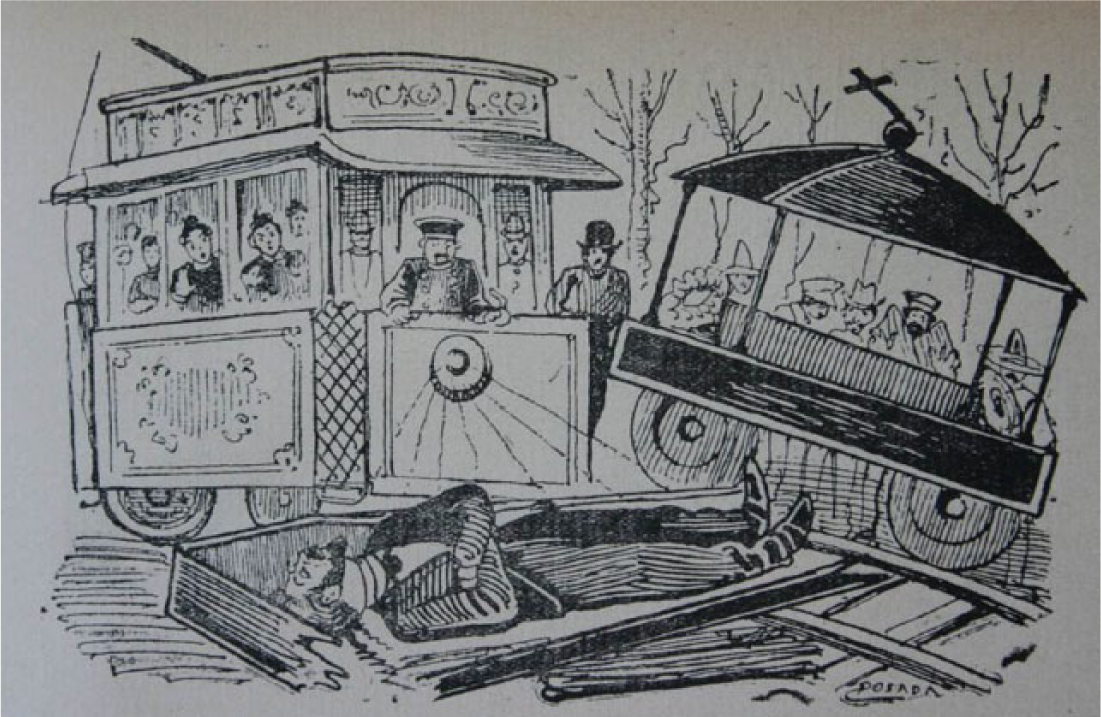
Note: A trolley car runs into a funeral wagon, propelling the casket and its well-dressed occupant onto the tracks. By José Guadalupe Posada (1852–1913). Choque de un eléctrico con un carro fúnebre. Colección Andrés Blaisten, Fondo Francisco Díaz de León.
The Tower of Suicides
A journalist for the largest circulating newspaper in 1899 Mexico City, El Imparcial, recounted the suicide of Sofía Ahumada, a young woman who jumped to her death from the tower of the metropolitan cathedral. He mocked the twenty to thirty “unemployed” people who loitered around the “stain of blood” left at the site of her tragic leap. 75 He referred to the irony of her suicide to the spot where she landed—the location of the Aztec sacrificial stone that was excavated in 1790 during repairs on the church. Whether he equated suicide to sacrifice or her impulse to self-destruction to barbarity, the reporter’s narrative lamented the rise of suicide in the city and its potential powers for imitation.
The Catholic Church judged suicide a sin, and in previous eras, a suicide could be barred a religious burial. Nonetheless in fin-de-siècle Mexico, the towers of the metropolitan Cathedral became known as “The Towers of the Suicides.” One of the most talked about suicides at the towers occurred on the cusp of the new century when capital residents felt trepidation for the coming century. When Sofía Ahumada decided to jump off the Cathedral in 1899, she joined an assembly of victims before her who had succumbed to the infectious mania of self-murder. The writer prefaced his report of her death with the warning: “Suicide spreads and the number of victims of this imitative mania is already alarming. They employ all forms of destruction known, the knife, the pistol, the rope, the poison; she chose the wrong way to throw herself off when a full trolley passed. This last suicide has produced a terror in society. The method employed is certainly not new.” 76
The article continued with a familiar narrative. Sofía, of middle-class background, had moved to the city with her sisters when their parents died. The reporter noted “she was at the height of her youth, brimming with life; she was, if not beautiful, graceful.” The four sisters supported themselves with respectable work. One by one, Sofía’s sisters moved out of their shared home for employment outside of the city. Only one sister remained in the capital but lived separately with her husband. Sofía eventually moved in with her married sister in a home on Concepción Street. She met a young man who soon passed by her balcony to initiate a courtship. Bonifacio Martínez learned the watchmaking and clock trade from his father. He loved Sofía until she unleashed her hysteria and exhibited violent fits of neurotic behavior, according to the reporter for El Imparcial. The older sister, Tomasa, recounted that Sofía had always been lively, possessed of easy conversational skills but also excessively nervous, known to clench her fists tightly when upset. Two months before she leaped to her death, Tomasa noticed a drastic change in her younger sister. She slept fitfully, rose earlier than usual, begrudgingly ate her meals, and spent long hours lost in her thoughts. Apparently Bonifacio had broken off their relationship. Sofia went to him and told him “I cannot live without seeing you” and he agreed to meet. They went to the Cathedral where he worked and he attended to the clock. They bickered, and as he tinkered with the clock mechanism, Sofía jumped over the balustrade and fell to her death on the pavement below. The reporter noted that the “neurotic” landed with her head to the south and in the direction of the plaque that marks the site of where the Aztec Calendar was found. 77 Bonifacio peered down in horror, then ran down the steps to the street below, only to run back up the tower, fearing that people would think he had pushed her. Authorities found a letter in her skirt that read, “I was born to suffer! For some time I have thought of suicide as the only remedy for my pain. . . I do not want the man I have loved to be thought the cause. No. I killed myself because I felt like it. No one is responsible for my death.” Her letter went on to inform authorities that no one would claim her body and she would be buried in a pauper’s grave.
Police detained potential perpetrators or accomplices in most investigations, and cadavers awaited autopsies in the Hospital Juárez. Since Bonifacio had been atop the tower with her, it was possible he had pushed her or egged her into killing herself. The fact that her shawl was found in the tower and not on her body raised suspicions. Generally a shawl signified modesty and women did not go into the street without it. 78 The fact that Sofía would discard her shawl and then jump seemed unthinkable. Authorities also found an inscribed portrait of Sofía in their search of Bonifacio’s home and confiscated it in order to see if the handwriting matched the letter found in her skirt, as they presumed it to be written in masculine hand. 79 The next day the young victim’s body continued to rest on the slab at the morgue as she predicted; family did not claim the body nor arrange the burial. Three girlfriends identified her body and told a reporter that they knew she would choose the most extravagant way to kill herself. Coworkers stated that she had procured dynamite in weeks past but they managed to get it away from her and discard it in the toilet where they worked. 80
A common theme of editorializing youth and suicide was to look to the influence of novels. An unsigned editorial agreed with the Italian doctor Luigi Midena that novels were the cause of many moral calamities. In fact, it was thought that reading such novels caused liver congestion, which, in turn, led to moral dissipation. The editorial took the Ahumada case and spun a familiar narrative from Victor Hugo, stating, He was a watchmaker. He knew her from the street. He followed her. Came to love her. There was jealousy. . . They arranged to meet at the Cathedral . . . this boy was not Quasimodo but his girlfriend had one of those bizarre temperaments, decadent, novelistic; she took bromide and jumped to her death. While he managed the clock weights, she fixed her eyes on the horizon. While he fine-tuned the needles, she pondered sad things. While he worked his tool, she felt a pessimism that seemed so foreign and deep as to be rare in our country, this bitterness of character . . . she decided to kill herself . . . made preparations . . . new clothes, colorful stockings, letter in her showy interior clothing, she jumped from the tower to eternity.
81
The reporter prolonged his tone of mockery noting the ten, twenty, or thirty unemployed who contemplated the “tombstone commemorating the calendar of idolatry . . . and the stain of blood” of Ahumada’s broken body. 82 Certainly the analogy of unemployed mourners contemplating idolatry and the suicide was not lost on readers. This reporter had less sympathy for Ahumada than the reporter writing of the double suicide in Chapultepec Park ten years later. What Sofía Ahumada lacked that the other girls appeared to have, at least initially, was honor. That she would torture her stolid artisan beau with her hysterics and trifles placed her in the category of young girl corrupted by decadent literature, a victim of suicide that lacked virtue. Religious newspapers, in particular, highlighted the negative influence of popular novels and dramatic plays on a person’s will to live. An 1895 editorial signed “The Messenger of the Priesthood” warned readers of the ill effects of novels that only served to “delight the flesh.” She continued, “Think about what impact this reading will have on a maiden, a half-open bud, who inhales the poisoned perfume of the passions that drags us back to the corrupt nature of original sin.” 83 The message was not yet that madness caused suicide but that popular culture debased young impressionable minds that might be “bored with life” or who might be slaves to the latest fashions. A reporter expressed shock that she would jump off the tower in full view of passengers enjoying a trolley ride and related that she wore stockings to the knees so that when her skirts flew up during the fall, onlookers would not see her nudity. 84
Just over a decade after Sofía Ahumada hurdled to her death, a drawing of three figures falling off the Tower of Suicides—two large and one small—graced the front page of El Imparcial. The victims were two young women and a toddler of almost two years old. The reporter discovered that one of the victims was Juana López, “of fine presence and a manner of dress that denotes her as a woman of middle class circumstance from the interior.” He was equally impressed with her clothes and, as in most reports of female suicide, noted her silk blouse and undergarments. Yet while the reporter above ridiculed the new but plain, silk clothes of the neurotic Sofía, this one stressed them as evidence of López’s prosperity and good education. Her compatriot in death, the younger Margarita Pereda, dressed equally respectably in clothing of silk. The trio had arrived at the Cathedral for noon mass and witnesses saw them kneeling in prayer at the altar. Witnesses recounted that they asked the doorman for access to the towers to take in the view. According to the reporter they removed letters from their pockets, and the older woman threw the young child off the tower and jumped immediately afterwards. The youngest woman soon followed. One letter obeyed the formula, stating that no one was responsible for her death. Juana López simply asked to be buried with her son. Margarita’s letter diverged from the pattern by blaming her father for her suffering and her death. In a display of literary license, the reporter speculated erroneously that a man, Juan López, who had jumped off the tower six months earlier, was Juana’s son and Margarita’s beloved. The rift between Margarita and her father, the reporter surmised, was that he prohibited her marriage to López. 85 The hint of star-crossed lovers urged the reporter to paint the suicide in romantic terms, scarcely mentioning the murder of the toddler. It was if a cultural logic existed that made female suicide understandable and perhaps even, condonable, if committed for love. The condition was that a lovelorn woman had to be honorable.
The case of the double suicide-murder took on new twists with further investigations. Margarita did not love a Juan López who was erroneously thought to be Juana’s son. Instead an evil suicide pact grew between the more domineering Juana and the impressionable Margarita according to reporters on the story. A lover had abandoned Juana and a father had abandoned Margarita. A shared sense of desertion fueled their mutual desire to end their suffering once and for all, and the older friend convinced the younger to succumb to her evil scheme. The sordid story began with Margarita’s parents, Joaquina and the unnamed father. A love grew between them, a child was born, but when the father rose in social status and met a young lady with means, he forsook Joaquina. Nonetheless he registered as the infant’s father in the civil registry and committed 20 pesos monthly to her education. Joaquina befriended a married Frenchman and his wife, who offered to adopt Margarita and raise her as their own. The benefactor enrolled Margarita in the prestigious high school El Buen Tono, and she excelled academically, learning French in three months. However, her French adoptive father became seriously ill, and he and his wife moved back to France, leaving Margarita in the care of a good friend. At the same time, her biological father stopped paying for her schooling. Margarita encountered him in the street one day, and he ran from her, telling her that she was not his daughter and he did not know her. Since that day, according to her temporary guardian, Mrs. Prince, Margarita had been despondent and inconsolable. Mrs. Prince recounted that her restaurateur husband had brought home Juana López when he found out she had been abandoned by the father of her child. The problem for Margarita was that her new housemate talked incessantly of suicide and had failed a couple of times to kill herself. Once she jumped in the path of a trolley, another time she drank alcohol with matches dissolved in it, but friends intervened and saved her. The Princes alleged that the abandoned, single mother had a strong influence on Margarita. Much to the young girl’s glee, her adoptive father, Señor Bulmé, returned from France and took her shopping for a new dress in an attempt to cheer her up. They shopped happily, but in retrospect he pondered the fateful meaning of her odd question as she glanced up at the Cathedral towers: “If you jumped from the first floor, would it kill you?”
The unfortunate day came to pass when Mrs. Prince left Margarita and Juana in charge of her young children while she ran errands. She returned hours later to find her children at the neighbors’ and Margarita, Juana, and Juana’s toddler son gone. A note addressed to Señor Bulmé read, “Cher papa Bulmé, I kill myself because I suffer so much. I don’t want to suffer anymore. Your daughter, who loves you very much. Margarita Bulmé. All my portraits are for you. Goodbye.” The older child of Mrs. Prince told reporters that the young women drank some cups of absinthe before they departed. Reporters concluded that the thirty-two-year-old Juana convinced Margarita to join her in a suicide pact. 86 The same analysis held true for the double suicide at Chapultepec Park. It seemed unfathomable that a young woman would kill herself if she had not been brainwashed by an older accomplice. In this case, the young adopted girl of a French businessman maintained her virtue in death. However, the older architect of the suicide, the working-class single mother, held no esteem for her actions.
Angelina Ruiz would make sensational news for leaping from the same tower to her death less than a decade later, though her suffering was not for loss of love of a father, but for the shame caused by an unknown lover. El Democrata reported on July 23, 1920, that the young woman of refined education who worked as a ticket seller at the Salón Rojo jumped from the tower to her death the day before. The subtitle asked whether it was love, desperation, or insanity that drove her to do it. The article recounted her biography, noting that she lived with her widowed mother and younger siblings. 87 She worked at the cinema to help the family make ends meet. Her workday began at three o’clock in the afternoon. She sold tickets and “gave away smiles” and her mother would meet her at ten o’clock each night to escort her home. The reporter wrote that they would walk home and peer in the windows of the cafés and gaze at the elite customers in their fine clothes. He implied that her mother accompanied her in the street and saved her from dishonor, though they both gazed enviably on the rich patrons. He wrote that she lived the life of most modern youth, one of relative monotony, noting that she had been affected by a “morbid misanthropy” from her experiences working in the ticket booth. One day she visited the Cathedral and asked to take the stairs to the tower. The guard forbade her from ascending because rules dictated a male escort for women to enjoy the city views from the turret. Undeterred for long, Angelina boarded a trolley the following day and ran into an acquaintance from work and asked him to escort her up the towers. He accepted and they both debarked the trolley at the majestic church. They paid the guard 50 centavos and ascended the stairs. Angelina asked her friend to inscribe their names and dates on the wall: “Angelina Ruiz and Onésimo García . . . 7-22-920.” He complied, took out a pencil, and began writing. Moments later he realized that the young woman he knew just slightly from work had jumped off the tower. The newspaper described her injuries in detail, noting her torn clothes, broken leg, and face crushed by falling so heavily on the stone pavement below. 88
The next day the focus on her young, broken body continued but this time with a warning to other girls who might follow her path. Clearly the empathy for young suicides who killed themselves for love had begun to wane by the 1920s. Mexico had just emerged out of almost two decades of revolution. With more than 2 million dead, condoning a lovelorn suicide was no doubt frivolous. A reporter for El Democrata wrote, “Read corny señorita, you think to kill yourself because your boyfriend, insubstantial youngster, has quarreled with you, read . . . on the cold marble slab, completely naked, read, completely naked was Angelina’s body already in a state of decomposition.” 89 He went on to detail how surgeons approached her body with the detachment of science, tearing open her flesh and examining her entrails not to look for something spiritual but to seek evidence of lesions that might explain her actions. Another report on a female suicide in 1920 also took a cold view, ridiculing young women who forget that their naked corpses will rest on the cold slabs of the morgue and serve as “fodder for science and men, who justly laugh at them, those who commit that sad madness.” 90
Like most suicide inquests, the judge determined that no crime existed and released Onésimo García from custody. However, four months later, Angelina’s mother appealed the conclusion of no-fault suicide after finding various forms of evidence in her daughter’s personal effects, in particular, a letter that blamed a said “Jacobo” for her disgrace. Coincidently or not, the owner of the theater and her boss was named Jacobo Granat. The mother wanted the case reopened because someone stole the watch, rings, and money that Angelina had on her person the day of her suicide. 91 Likewise she alleged that Angelina might have been deflowered by said Jacobo and chose death to end her shameful suffering. Clearly the mother wanted to understand the motives for her daughter’s suicide, and covering up shame was an accepted excuse for suicide. Mr. Granat’s lawyer responded to the appeal and noted that his client had no more relationship than employer to employee and that there were many men named Jacobo. As for the charge of deflowering (estupro), the lawyer contended that the medical experts did not document a recent loss of virginity and reminded the judge that estupro applied to girls fourteen years of age and younger. The mother insisted that a letter she found under a hatbox from Angelina said she had had sex with Jacobo and he abandoned her. She also revealed to the judge what she considered to be damning evidence of Granat’s guilt. According to Angelina’s mother, Granat come to her house after the suicide and offered to pay the funeral and burial expenses. In her mind, these seemingly charitable actions originated in his guilty conscience. The grieving mother failed to have Granat prosecuted, and did she not recover her daughter’s personal effects. However she succeeded in having the sordid story play out in the newspaper, which certainly tarnished Mr. Granat’s honor and reputation. It is impossible to assess but the mother’s appeal may have restored some of her daughter’s honor in certain readers’ minds, at least those who believe that death was preferable to public shame.
Honor was indeed a slippery slope that journalists and the suicide victims attempted to navigate. What was most important was honor’s public component or how others viewed one. Newspapers strived to offer the most accurate versions, even while they fictionalized crime stories to make them more interesting to readers. The large dailies had investigative reporters who interviewed family, friends, witnesses, and coworkers. The victims hoped that their deaths by suicide would be remembered as rational and honorable. Of course, reporters had the upper hand. As the case of María Fuentes and Guadalupe Ortiz shows, no matter how the young girls attempted to portray themselves as honorable, the newspapers ended up dragging them through the mud, and some went as far as to suggest a diabolical suicide pact. Victimhood transferred to the young soldier deprived of his beloved. Although reporters by and large no longer signed their names to stories at the turn of the century, the history of rivalries and duels between newspapermen were legendary. 92 Reporters routinely called out rival papers for the errors they printed when covering the same stories. The independent press criticized El Imparcial for the subsidy it received from the government, and understandably, it was seen as the mouthpiece of the Díaz regime. In its report on the Ahumada suicide, the reporter for El Chisme told its readers only it could correct the erroneous information disseminated by the rest of the dailies in the capital, noting its investigative reporters who hunted down the facts. 93 The reporter for the Catholic newspaper El País ignored Sofía’s relationship with Bonifacio. Instead, he used the spectacle of her suicide to blame the government-sponsored Positivist-liberal newspapers like El Imparcial for the increased immorality in society. Such newspapers did not teach the public to read or cultivate itself but induced residents to kill themselves by its lewd and salacious coverage of crime and immoral acts. 94
Journalists penned the details of the suicides, but enlaced in the litany of biographical details were lessons on honor, proper education, the roots of insanity, and gender ideology. Journalists placed María and Guadalupe on pedestals; extolled their comely and arrogant visages; encouraged readers to sympathize with their suicides; and then, once they discovered that they lived in a tenement in the working-class barrio Tepito, they knocked them down to condemn their acts. The press disparaged Sofía from the outset, although they also employed romantic language to describe the tragedy. An orphaned factory worker at crosshairs with her respectable artisan beau, her neurosis stood front and center in the reporting of her death. What seemed most troubling to her chroniclers was the fact that her suicide was too public in its full pornographic spectacle in the Zócalo. Unlike the best friends who drank poison down a private path, Sofía jumped off the tower as a trolley arrived, and her fall disheveled her clothes and exposed her body to onlookers. As her friends opined, she desired an extravagant exit, but one that could not be romanticized by the press.
The ephemeral memorials at the “stains of blood” presented an alternate narrative. Although it is impossible to know concretely what motivated these forms of vernacular commemoration, their existence provides us a glimpse of popular attitudes towards the suicides. Certainly some visitors to sites of suicide satisfied a morbid voyeurism, while others who left behind flowers memorialized the lost souls. Journalists fancied themselves rational arbiters of public opinion, engaging in an exchange of ideas in a Habermasian vision of a public sphere. 95 Could the temporary memorials at the “stains of blood” be an affective exchange amplified by emotion, mourning, and nostalgia? There is no doubt that the memorials were “populist phenomena, ways for people to mark their own history” regardless of the media narrative. 96 Indeed, temporary memorials are performative in character as they “mark instances of untimely and especially traumatic deaths, become places of communion between the living and the dead, and invite broad public participation.” 97 The affective arena of the memorials and the arrival of onlookers to contemplate the “stains of blood” contrasted with the calculated reporting of journalists for the major dailies. Sofía may have lacked honor in the eyes of the judgmental newspapers, but mourners felt differently, leaving behind flowers as they contemplated the “stain of blood” and perhaps the fate of youth in modern times.
Conclusion
María Fuentes and Angelina Ruiz, two movie theater ticket sellers, killed themselves about a decade apart. Some could have questioned whether films had sickened their minds. Guadalupe Ortiz and Sofía Ahumada joined them in their death wish. Two chose the cypress forest of Chapultepec Park and four chose the metropolitan cathedral on the historic plaza. Their lives and suicides drew ample coverage by reporters and interest from capital residents. Ephemeral memorials appeared at their “stains of blood,” and perhaps society questioned the cost of modernity and its impact on its youth. Ultimately these young women made self-conscious decisions to realize their suicides in public spaces that were imbued with historical and cultural meaning. In the case of the double suicide at Chapultepec Park, María Fuentes and Guadalupe Ortiz departed their working-class tenement, groomed and dressed at the public baths, and proceeded to the historic center where they caught a trolley on the central plaza. The girls literally traveled from the historic center down the Paseo and into the modern city to author their deaths. They left notes and personal effects behind to define their motives and selves in hopes of shaping the ensuing discourse that would surround their suicides. They drank poison under the cover of the forest, and died in a final embrace. A cultural logic pardoned suicide for love and deception when committed by honorable women. The authorship of their deaths linked them to a long line of romantic deaths. They also asked that their bodies be buried without autopsy in hopes of controlling the destiny of their cadavers. To undergo the dissection scalpel might have seemed inevitable, but suicides attempted whenever possible to resist this medical penetration of their bodies. Sofía Ahumada, Juana López, Margarita Bulmé, and Angelina Ruiz chose the “Tower of Suicides” on the central plaza to end their lives. When the young women jumped from the tower, their bodies broke on historic ground. Indeed the Cathedral sat atop the ruins of an Aztec temple in which sacrifices had been symbolic and commonplace. The female victims of the Tower of Suicides opted for very public and sensational suicides. They must have known that their deaths would be observed, that the curious would gather around their “stains of blood,” and that reporters and city residents would discuss their lives and demise for days afterward. Reporters maligned the working-class Ahumada and López, saving their more romantic intonations and empathy for middle-class Ruiz and Bulmé. All of the young women chronicled herein carefully planned their suicides to construct their selves in their deaths in the meaningful public spaces of the city. They also endeavored to project their honor. Even a reporter noticed that Sofía wore socks to just below the knees to cover as much flesh as possible. Ortiz and Fuentes followed the most romantic script by carefully wrapping letters and portraits in fine ribbon to leave at the scene. Though they must have known that their bodies would suffer the forensic probing of male eyes and surgical instruments, the women dressed in their finest clothes, coifed their hair, and penned their notes. The public narratives that ensued competed for authority, yet in many ways the stains of blood left behind had the most permanence as certain spaces of death, the Tower of Suicides and Chapultepec Park, became linked to modern suicide for years to come.
Footnotes
Acknowledgements
I would like to thank Nancy Egan, who commented on a version of this essay at the 2013 CLAH meeting in New Orleans, and my fellow panelists, Kristin Ruggiero and Anton Rosenthal.
Declaration of Conflicting Interests
The author declared no potential conflicts of interest with respect to the research, authorship, and/or publication of this article.
Funding
The author received no financial support for the research, authorship, and/or publication of this article.