




Abstract
This case study of Los Angeles County portrays the war on drugs during the 1950s as a racial and spatial project that combined tough mandatory-minimum sentences for urban “pushers” and Mexican American “gangsters” with discretionary loopholes for white suburban “victims” of the heroin and marijuana markets. State institutions, media scripts, and white middle-class organizations constructed illegal drug use as a suburban crisis through a racialized pusher–victim discourse that collectively criminalized minority youth while decriminalizing white teenage lawbreakers. The escalation of California’s antinarcotics crusade during the postwar decades illuminates the deep historical roots, thoroughly bipartisan policies, and grassroots suburban politics that shaped the rise of mass incarceration and the continuing racial and spatial inequalities of drug war enforcement in modern America.
During the 1950s, neighborhood groups and civic organizations representing more than one million residents of California petitioned the state government for lengthy mandatory-minimum sentences for dope “pushers” who supplied marijuana and heroin to teenagers, with considerable public sentiment for life imprisonment or the death penalty. California’s war on narcotics enlisted a broad and ideologically diverse spectrum, led by nonpartisan alliances such as the California Federation of Women’s Clubs and the statewide Parent-Teacher Association (PTA) network and advanced by Republican and Democratic policymakers alike. White parents from the racially segregated suburbs of Los Angeles County constituted the most vocal advocates of the grassroots tough-on-drugs movement, especially the residents of middle-class communities located in close proximity to the Mexican American barrios in East Los Angeles and the San Gabriel Valley. 1 These suburban groups mobilized in response to recurring local media hype about Mexican American “wolf packs” and “rat packs” invading white communities to peddle drugs and commit violence, a series of thoroughly racialized “epidemics” both falsely constructed and politically consequential. California’s war on narcotics during the 1950s, like its federal counterpart, also revolved around a greatly exaggerated “epidemic” of marijuana and heroin addiction among white middle-class adolescents, a suburban crisis narrative promoted by political and cultural institutions from the metropolitan to the national levels. 2 The ubiquitous discourse of “dope peddlers” and “narcotics pushers” animated the moral crusade for a supply-side war on drugs and transformed white teenage lawbreakers into the helpless victims of external villains who lured their prey into an urban dystopia of addiction, crime, and prostitution. The bipartisan consensus that emerged for tough state and federal mandatory-minimum laws during the postwar era likewise sought to protect innocent suburban youth and white middle-class communities by incarcerating dangerous pushers and predatory addicts from the barrios and ghettos. 3
As a cultural and political script of white innocence lost, the pusher–victim binary played a crucial role in cementing the racial and spatial inequalities of the war on drugs and the broader metropolitan landscape in postwar California and in modern America. The pusher/peddler framework resonated because it fused the categories of race, gender, class, age, and space in potent ways—constructing both the physical landscapes of the single-family suburbs and the symbolic terrain of white middle-class society as utopian ideals threatened by dystopian nightmares. In its most scandalous formulation, conveyed in forums ranging from Hollywood films to congressional hearings, sinister villains turned pretty white females into heroin addict-victims who invariably descended into the living death of prostitution across the urban color line. 4 But across the board, the pusher–victim narrative fundamentally misrepresented the social practices of illegal drug users and the consumer–supplier dynamics of the underground marketplace. Political and cultural discourse collectively dehumanized and criminalized minority youth “hoodlums” and “gangsters” (who rarely sold drugs to suburban customers) while removing criminal responsibility as well as moral agency from white middle-class youth who did choose to violate the law. During the 1950s, as pervasive fears of middle-class juvenile delinquency accompanied mass suburbanization, the pusher/peddler trope helped to justify racial segregation as essential for the moral and physical safety of vulnerable white youth. 5 In 1956, at the height of the narcotics crisis, the state of California officially promoted residential segregation as a core antidelinquency strategy, assuring its citizens that the best antidote for teenage drug use and other vices was a single-family neighborhood with “a homogeneous population welded together by similar racial, cultural and economic backgrounds.” 6 Moral panics, however, proved to be a recurring and indeed inevitable feature of white middle-class political culture, because the utopian suburban solution fixates on external scapegoats and evades the internal dynamics of youth crime, delinquency, and illegal drug use.
The racial and spatial logics of California’s war on narcotics during the 1950s provide a longer chronological view and a broader ideological dimension for scholars seeking to excavate the origins of mass incarceration and the development of the carceral state in modern America. The standard historical narrative highlights turning points such as the conservative “frontlash” against the civil rights movement during the 1960s, Richard Nixon’s declaration of unconditional war on drugs in 1971, the Rockefeller mandatory-minimum laws of 1973, and Ronald Reagan’s repressive assault on crack cocaine in the mid-1980s. 7 Scholars have situated these now canonical mileposts too smoothly within the “rise of the right” and “racial backlash” narratives, misconstruing the origins and escalation of the war on drugs as primarily a partisan Republican and ideologically conservative project. In reality, each of these landmark developments in America’s long war on drugs reflected bipartisan support and received near unanimous legislative majorities, accompanied by pusher–victim discourses in political culture that emphasized the dual imperatives of protecting white middle-class youth from the drug market alongside the criminal control of their urban minority counterparts. 8 These same dynamics shaped the establishment of harsh and racially targeted mandatory-minimum penalties during the 1950s, at the federal level as well as in states such as California. Recent scholarship has produced superb analyses of the ways in which state institutions, discretionary policing practices, and discourses of social pathology criminalized minority youth collectively, but it is just as important to recognize the ways in which these same processes racialized and decriminalized white middle-class youth. 9 The postwar California story reveals how the war on drugs escalated through the dynamic interaction of grassroots and top-down forces and has consistently flourished as a bipartisan crusade whenever politics and culture combine to reproduce the intertwined categories of the racialized urban pusher and the equally racialized suburban victim.
Producing the Narcotics Crisis in Postwar Los Angeles
In April 1950, the Los Angeles media began hyping a sudden epidemic of senseless crime and random violence by Mexican American youth, labeled “wolf packs” and “rat packs” in the sensational headlines of the daily newspapers. The Los Angeles Daily News attributed the reign of terror to “youthful malcontents” who trafficked in marijuana and turned into “roving gangs of hoodlums,” “marauding ‘wolf pack’ youth,” and an “infestation of juvenile rat packs” driving their cars across the metropolitan region in search of innocent victims. 10 The Herald Express warned of “wolf gangs of youthful hoodlums on a rampage,” from downtown to the suburbs, with “a gang of eight swarthy” teenagers assaulting and robbing pedestrians and another group of Mexican Americans pulling a young white man from his car and terrorizing his wife and baby. 11 The Los Angeles Times vividly portrayed the white suburban victims of the month-long outbreak of “youthful ‘wolf packs’” that “cruise the county in hot-rod cars spreading terror,” attacking a twenty-two-year-old housewife from Lakewood, a real estate agent in Westwood, and teenagers at the beaches of Santa Monica and Malibu. 12 Politicians and law enforcement officials in the city and county of Los Angeles immediately declared an “all-out war against ‘wolf packs’” and rounded up dozens of Mexican American youth from the East Los Angeles barrio, some for specific acts of violence but many others on allegations of gang affiliation. 13 This racialized criminalization of Mexican American teenagers by legal and political authorities and the mass media reprised the infamous state crackdown on “hoodlums” and “gangsters” during the Sleepy Lagoon trial and Zoot Suit Riots of 1942-1943. 14 The mobilization against the “wolf pack” menace of 1950 demonstrated that Mexican American youth continued to loom largest in the racial imaginary of crime and delinquency in Los Angeles County, where the total population of 4.32 million included 5.8 percent Hispanics, 5 percent African Americans, and 88 percent Anglo residents. 15
Based on little if any evidence, the chief of the Los Angeles Police Department proposed that marijuana addiction had caused the wave of indiscriminate violence, the “reefer madness” myth nationally popularized by Commissioner Harry J. Anslinger of the Federal Bureau of Narcotics. 16 The Republican candidate for state attorney general asserted that organized syndicates supplied the marijuana that fueled such juvenile sprees, unchecked by the soft-on-crime policies of incumbent Edmund G. (Pat) Brown, his Democratic opponent. 17 In letters to the newspapers, frightened and angry residents from white areas of the city and suburbs alike demanded a “get tough” approach to juvenile crime and condemned the liberal “bleeding hearts” and “sob sisters” for “coddling” the hoodlums and preventing the police from protecting the “decent, law-abiding citizens.” 18 Civil rights groups countered that the media had fanned public hysteria with the “wolf pack” designation, and they promoted the traditional antidelinquency remedies of more parks, recreation centers, and vocational training for low-income youth in East Los Angeles and other minority areas. 19 The progressive juvenile delinquency coalition of civic and municipal agencies that had formed after the Zoot Suit Riots denounced all of the major metropolitan newspapers for “increasing racial tensions” by once again sensationalizing a false epidemic of “gang lawlessness of youth in minority groups.” 20 After a month of inflammatory headlines, the Los Angeles Times implicitly acknowledged this critique by reporting the consensus of the juvenile justice authorities that there was no epidemic of delinquency and that rates of youth crime in the metropolitan region had actually declined during the previous year. 21
In cultural and political discourse, the “wolf pack” panic helped to cement the connection between racial gangs, juvenile delinquency, predatory crime, and narcotics “pushers” and “peddlers” who targeted innocent white middle-class teenagers, especially for a suburban audience that primarily encountered these images through the mass media. During the early 1950s, the Los Angeles newspapers chronicled Mexican American “peddlers” who smuggled narcotics (heroin and marijuana) across the border, “preyed” on high school students in Long Beach (by selling them pot), and operated a wholesaling ring that allegedly distributed marijuana to white teenagers from the upscale beachfront enclaves of the Westside to the outlying suburbs of the San Fernando Valley. 22 Patricia Williams, a white suburban teenager “from a good family in Pasadena,” provided the most shocking account of all with her nationally serialized confession of how she ended up as a heroin addict consorting with “Mexican pushers” in East Los Angeles (see Figure 1). As a sixteen-year-old, Patricia began smoking pot for kicks with her older suburban boyfriend but quickly “graduated” to heroin under the spell of “Chelo, the little Mexican who kept me in supplies.” Once arrested, she went undercover to send the East Los Angeles pushers to jail before entering a rehabilitation facility in Pasadena, a therapeutic outcome that reinforced her innocence and decriminalization. 23 Hollywood soon fictionalized this deeply gendered framework of suburban victim/urban villain in Teenage Devil Dolls (1955), featuring a pretty teenager named Cassandra who begins smoking marijuana with a motorcycle gang of white middle-class delinquents and then crosses the racial and spatial boundary into intimate heroin addiction with Mexican pushers in East Los Angeles. In the western frontier-style finale, they make a run for the border with the law in hot pursuit, with Cassandra ultimately rescued and sent to the narcotics hospital and the Mexicans headed for prison. 24
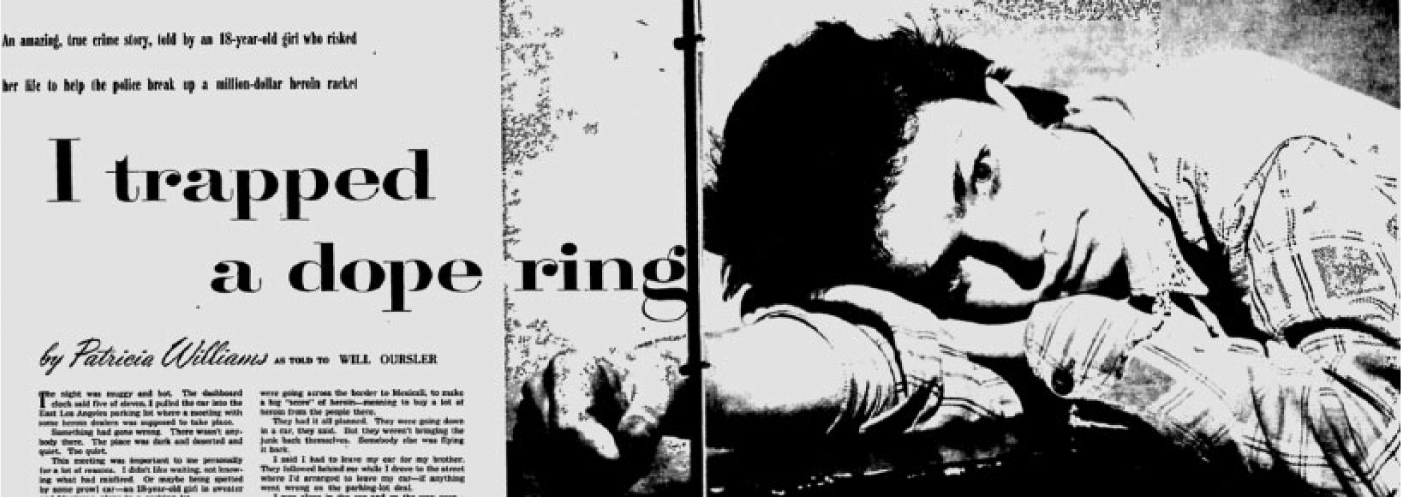
The Suburban Poster Child for the War on Narcotics.
In national politics, the 1951 hearings of the Senate Crime Investigating Committee played a pivotal role in popularizing the marijuana-to-heroin gateway thesis, the menace of the urban minority addict-criminal, and the fate of the white middle-class addict-victim at the mercy of the Mafia underworld and the “despicable drug peddler.” 25 Commissioner Anslinger of the Federal Bureau of Narcotics lambasted the lenient judges who let pushers off the hook and emphasized the racialized threat of “young hoodlum addicts . . . [who] begin to smoke marijuana and then graduate to heroin.” 26 The Los Angeles media highlighted the testimony of delinquent African American and Puerto Rican males from New York City and Chicago driven to crime for their heroin fix and “pretty blonde” girls as young as fifteen who started with marijuana, turned to heroin, and ended up prostituting themselves across the color line to pay for the habit. 27 In its final report, the Crime Committee urged ordinary citizens to mobilize against the “insidious evil” of teenage narcotics addiction and concluded that “no penalty is too severe for . . . the peddler who is willing to wreck young lives to satisfy his greed.” 28 Antidelinquency organizations reiterated this message in films such as Drug Addiction (1951), a sordid tale of malevolent pushers leading white middle-class teenagers down the path from marijuana experimentation to the “living nightmare” of heroin addiction, a reminder that dope threatened youth from “all walks of life” not just the “teeming slum areas.” 29 The Bureau of Narcotics welcomed the “get tough” public mood, although Anslinger warned the middle-class audience of Reader’s Digest not to become overly hysterical because the epidemic of teenage addiction was mainly a big-city problem involving juvenile gang members from broken families and slum neighborhoods. 30 In the Boggs Act of 1951, the U.S. Congress first classified marijuana as a narcotic and established mandatory-minimum penalties—for distribution and possession alike—of two to five years for the first offense, five to ten for the second, and ten to fifteen for the third, with no probation for repeat violators. 31
The state of California increased its mandatory-minimum sentences for distributing narcotics to a minor (including marijuana and heroin) in the summer of 1951, four months before the U.S. Congress passed the Boggs Act. After Governor Earl Warren called for a war on dope peddlers who victimized teenagers, the legislature passed the Republican-sponsored measure with no evident dissent, raising the minimum penalty to five years for the first offense and ten for the second, with parole officials empowered to keep dangerous pushers incarcerated for life. The law also removed the possibility of probation for first offenders convicted of simple possession of marijuana or heroin, which now brought a minimum of ninety days and a maximum of six years. 32 The records from Los Angeles County, which processed a large majority of narcotics cases statewide, reveal that government officials were mobilizing against a relatively insignificant criminal justice issue at the time. In 1950, the juvenile courts dealt with sixty-two minors arrested for narcotics violations, and the district attorney prosecuted 1,029 adults, 60 percent for marijuana. Contrary to the crisis rhetoric of invading pushers and helpless middle-class victims, almost all narcotics charges in Los Angeles County involved working-class or poor defendants, which likely reflected a combination of actual social practices and discretionary policing based on race and geography. And despite the overwhelming focus on Mexican peddlers and delinquent addict-hoodlums in popular narcotics discourse, Caucasians, Mexican Americans, and African Americans each represented about one-third of the total prosecutions in 1950 (along with a negligible number in the “Oriental” category). 33 The available evidence suggests that in the “ethnically stratified marketplace” of Los Angeles County, heroin remained a working-class drug used almost exclusively by adults and generally acquired from dealers of the same race, while only a small number of teenagers smoked marijuana whether in the suburbs or the barrio. 34
In this early stage of the war on drugs, the political system in California produced a narcotics crisis that at times acknowledged the racial elasticity of the “dope pusher” but relentlessly reserved the sympathetic status of addict-victim for white middle-class youth and suburban teenagers, the demographic and spatial categories fused together on the symbolic landscape of utopia besieged. In 1951, the Juvenile Court for Los Angeles County collaborated in the production of The Terrible Truth, an educational film designed to alert parents about the epidemic of “hundreds and hundreds of teenage boys and girls becoming hopeless dope addicts,” an expensive and incurable habit that inevitably turned males into thieves and females into prostitutes. The “true story” chronicled the tragic fate of Phyllis, a once pretty high school senior from an outlying Los Angeles suburb, who started smoking pot with her nice-looking but delinquent male classmates before a shady older white peddler hooked her on heroin. 35 The Los Angeles County sheriff’s department circulated the same message in Subject: Narcotics (1951), a police training video distributed nationwide, which featured a motley assortment of Anglo and white ethnic pushers pressuring delinquent white teenagers in both urban and suburban spaces to graduate from marijuana to heroin. In the climactic scenes, a pretty white girl wearing pearls succumbs to a pusher’s needle while sitting on a shooting gallery bed beside an African American addict and then turns into a haggard prostitute at a sleazy motel (see Figure 2). 36 In 1952, in a special narcotics report distributed to public schools statewide, a teacher from the Westside region of Los Angeles portrayed a thriving network of marijuana distribution outside high school buildings and “nearby malt shops and hamburger stands” in upscale white neighborhoods. While many Californians believed that the narcotics scourge “is confined to the Mexican American group and to slum areas,” this account emphasized that not only marijuana customers but also the “young peddlers” on the Westside were all “Anglo-Americans from middle-class backgrounds.” 37
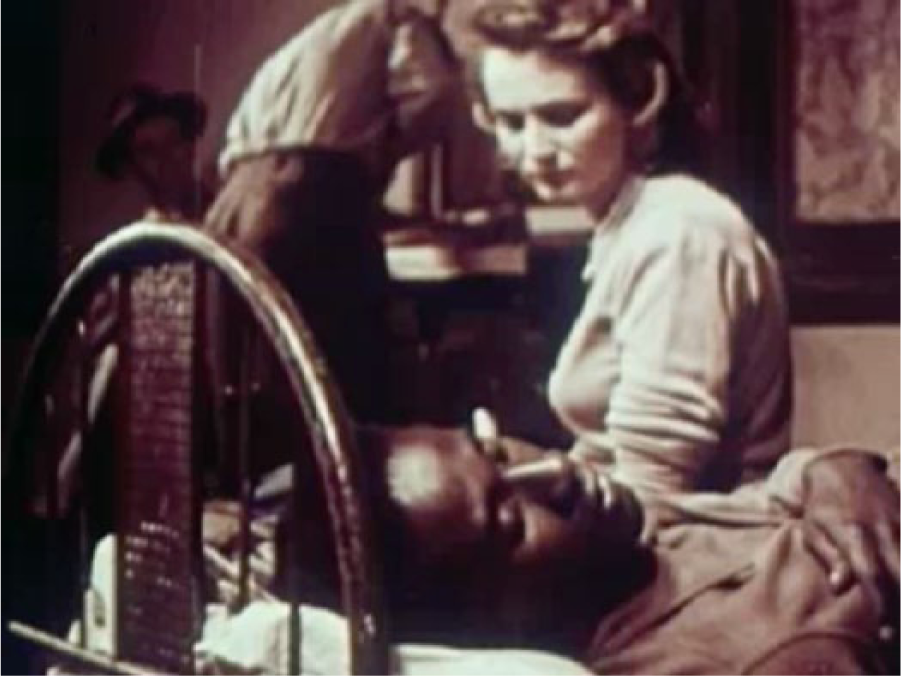
Heroin Addict-Victims across the Urban Color Line.
The Suburban Crusade against Dope “Peddlers”
During the early 1950s, the juvenile narcotics debate in California fluctuated between alarmist portrayals of a rising epidemic in white middle-class areas and official reassurances that dope trafficking and addiction primarily ravaged the urban slums, with competing consequences for public policy and policing practices. In 1951, immediately after the state legislature enacted the mandatory-minimum sentences for providing marijuana or heroin to minors, the California Federation of Women’s Clubs demanded even tougher punishment for narcotics traffickers and the mandatory civil commitment of addicts, part of a national mobilization of women’s groups coordinated by its parent organization. To generate public alarm, the nonpartisan federation warned mothers and other concerned citizens who lived in suburbs and small towns that any sense of safety and isolation from the big-city narcotics plague was an illusion, because peddlers sought “new converts” among helpless teenagers everywhere and had recently corrupted an entire suburban high school in an unsuspecting (and apocryphal) California community. 38 Two years later, the Governor’s Advisory Committee on Children and Youth praised the PTAs and civic groups that had fought to keep the “narcotics evil” out of wholesome neighborhoods and reassured these grassroots activists that almost all drug use among delinquents took place in urban minority slums, a trend overshadowed by false, media-inspired rumors of rampant marijuana consumption among white middle-class teens. The committee conceded that reports of a national epidemic of teenage drug addiction had been “greatly exaggerated” but endorsed the zero tolerance position that state and local authorities must do whatever it took to prevent any more children from “being drawn into the narcotics evil.” 39 The California Board of Corrections also advocated more vigorous action against the border traffickers and street peddlers responsible for the “narcotics menace,” reasoning that the small number of marijuana and heroin convictions statewide—393 adults and seventy-three juveniles incarcerated in 1951—belied the full scope of the crisis. 40
Inflexible mandatory-minimum penalties created unexpected pressure for more discretion in the war on narcotics because the affluent white youth who peddled and smoked marijuana in the instructional films turned out to have real-life counterparts who occasionally encountered the criminal justice system of Los Angeles County. In the summer of 1953, the California legislature unanimously increased the upper range of penalties for narcotics distribution while making parole more flexible for (less dangerous) drug dealers and restoring the probation option for first-time possession violations. 41 A Republican assemblyman from the Los Angeles suburb of Glendale sponsored the legislation, which reflected the efforts of a coalition of state and local law enforcement officials, including Democratic attorney general Pat Brown. 42 The probation reform followed complaints by judges in Los Angeles County that the mandatory incarceration of first offenders on possession charges resulted in a “great injustice” for misguided delinquents who did not belong in jail, a category that included teenagers of all races but especially applied to white youth. One juvenile judge criticized mandatory minimums when applied to adolescents “from a good environment” who experimented with marijuana “out of a spirit of bravado,” and law enforcement officials warned that juries would refuse to impose harsh punishment on such defendants. 43 A network of conservative women’s groups in the Los Angeles suburbs believed that the bipartisan 1953 reforms did not go far enough and organized an unsuccessful campaign behind a much harsher alternative, introduced by a Republican from Inglewood, mandating life imprisonment without parole for providing narcotics to a minor. Governor Goodwin J. Knight, the newly elected Republican from Los Angeles, received an outpouring of letters from frightened parents and petitions from civic groups, PTA chapters, and women’s clubs based in white suburbs such as Redondo Beach, Gardena, Manhattan Beach, and Inglewood—most located near the African American or Mexican American districts to the south and east of downtown (see Figure 3). Many correspondents adopted identical language advocating life sentences without parole for “those who sell narcotics to children,” while a significant number argued that “dope peddlers deserve the death sentence.” 44
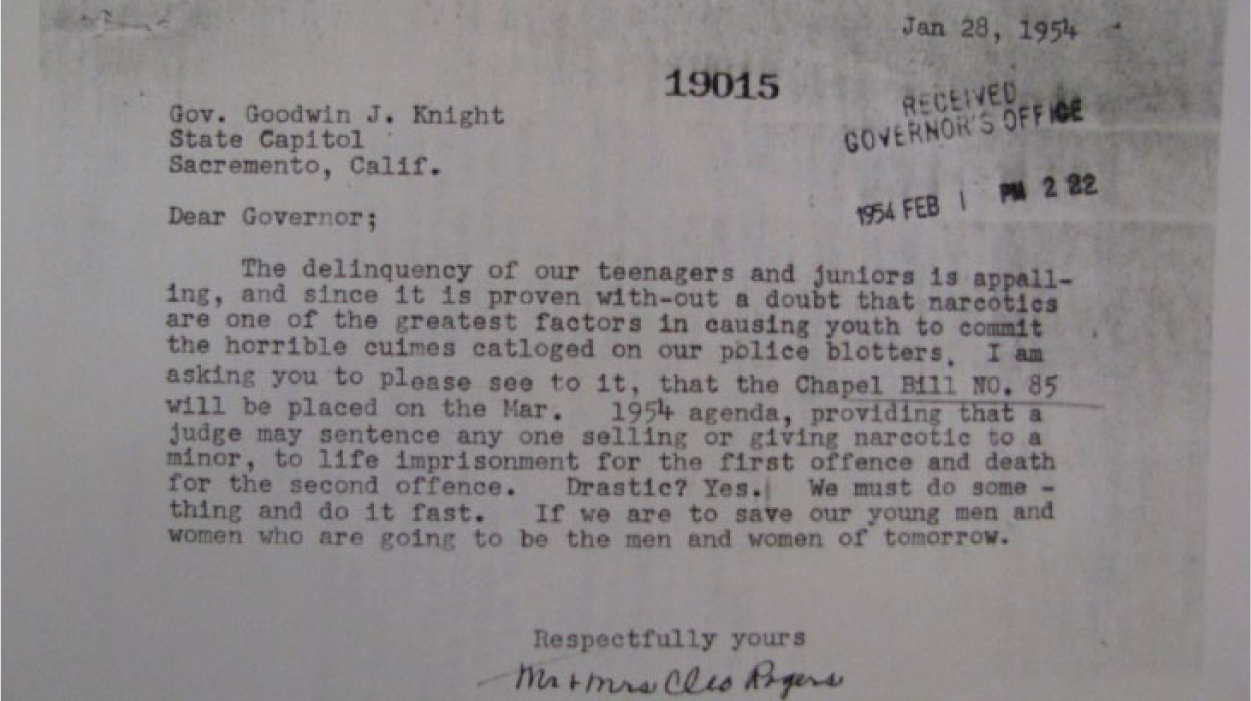
Grassroots Suburban Pressure for Tougher Narcotics Laws in California.
In December 1953, only a few weeks after the start of this grassroots get-tough campaign, another media-hyped panic about Mexican American “rat pack” gangs further fused the political imperative of urban crime control with the white racial imaginary of evil pushers and deranged addicts invading middle-class communities throughout the city and county. The drama began with the arrest of four Mexican American teenagers for the murder of William Cluff, a white businessman who lived in a Los Angeles suburb and was on the way to meet his wife at a downtown restaurant. Cluff died while attempting to break up a confrontation—the details remain unclear—between the Mexican American youth and a group of off-duty Marines from nearby Camp Pendleton, with each faction apparently inebriated. 45 For the rest of the month, the Los Angeles newspapers headlined the rampages of a “‘mad dog’ mob” of “street-roaming hoodlums” and portrayed every arrest of a Mexican American youth as part of the “new outbreak of rat pack outrages,” including sensational stories of home invasions and street assaults in the suburbs. 46 Under intense pressure from fearful and outraged constituents, elected officials warned that Los Angeles was on the verge of becoming a “gang controlled city,” and police chief William Parker stated that his department was “losing the war against crime.” 47 The Los Angeles Times demanded forceful police action and long prison sentences for the “youthful gangs” responsible for the “senseless ‘rat pack’ beatings” that made decent citizens afraid to walk the streets, a sentiment shared by a deluge of correspondents who blamed lenient judges and soft-hearted juvenile authorities. 48 “It is time we stop regarding these vicious criminals as juveniles,” a Los Angeles woman told the governor. “I’m afraid to be on the streets after sundown knowing these Rat Packs are allowed to do as they please to decent citizens.” 49
In an incendiary six-part expose published in mid-December, the Los Angeles Times warned readers that waves of juvenile gangsters and youthful hoodlums were “roaming after dark” throughout the city and its suburbs, peddling narcotics and assaulting women, mugging and murdering without conscience. The Times claimed that at least five thousand boys and young men, mostly of Mexican descent, belonged to organized gangs in Los Angeles County, and that almost all of them took dope and/or sold narcotics for profit. One particularly notorious unit, the Rose Hill Gang, allegedly distributed marijuana and heroin to white teenagers at dances and parties in Pasadena and other upscale suburbs nearby. Drug-addicted juvenile gangsters often committed terrifying acts of violence, “just for kicks,” while their mobility in the car-centered metropolis allowed hoodlums to target suburban “housewives, walking home from movies or stores, [who] are dragged into automobiles and whisked to isolated areas where they are beaten or criminally attacked.” 50 Civil rights groups and social welfare agencies accused the Times and other local newspapers of “inflammatory, prejudicial, and unfounded generalizations” about Mexican Americans and warned that the media construction of a false juvenile crime wave would undermine public support for programs that attacked the root causes of delinquency in high-poverty areas. The head judge of the juvenile court system emphasized that only one-fourth of the county’s delinquents were Mexican American youth, while 97 percent of that community were “law abiding, self respecting, and God fearing” citizens. 51 Six weeks into the panic, the Los Angeles County Youth Committee summoned local media and elected officials to a behind-the-scenes briefing where the city police chief and county sheriff acknowledged the “unnecessary hysteria,” admitted that juvenile crime had not spiked, and categorized most of the “so-called gangs” as “street corner societies” rather than narcotics traffickers or violent addicts (see Figure 4). 52
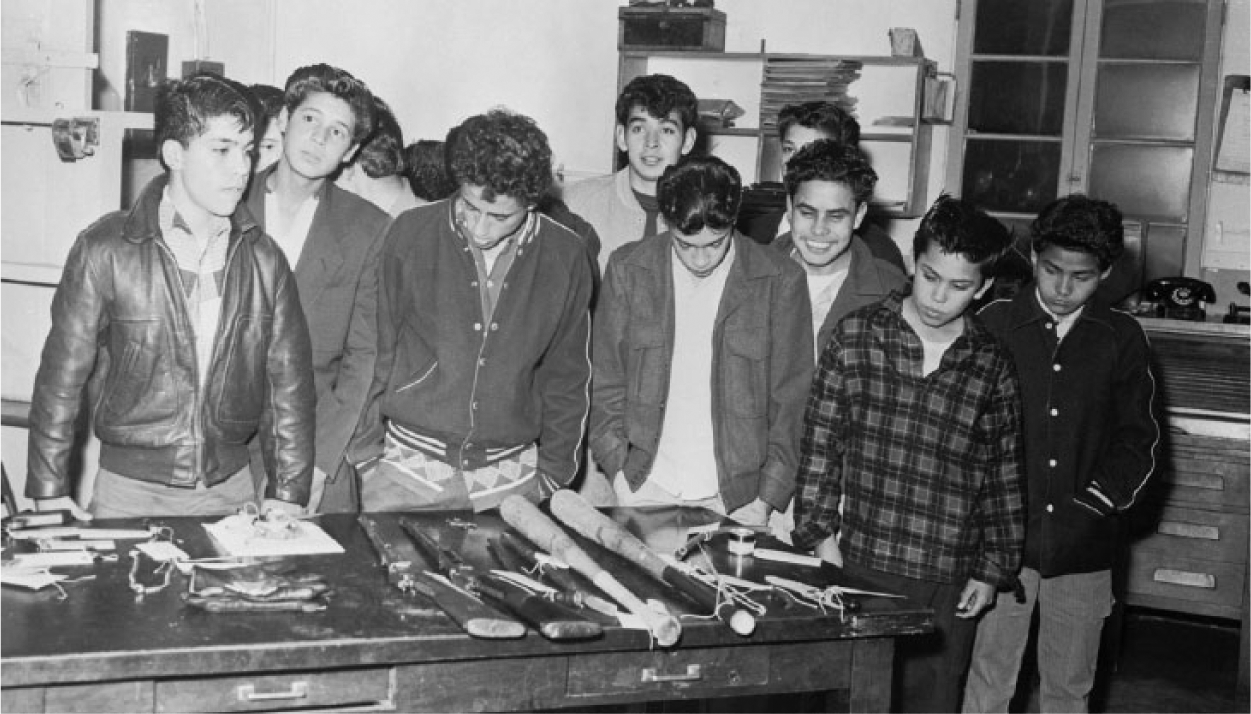
The Criminalization of Mexican American Youth
In the white middle-class imagination, the latest “rat pack” epidemic provided a vivid illustration of the frightening consequences of dope trafficking and a racialized explanation for how innocent teenagers from wholesome communities could be lured into a life of delinquency, addiction, and crime. While some interpretations also portrayed Mexican American addict-gangsters as the victims of dope pushers, the overriding view demanded the protection of suburban boundaries and white spaces through a tougher crackdown on invading peddlers and predatory addicts alike. “I am greatly concerned about the way our teenagers are being enticed” into trying marijuana and heroin, a woman from Redondo Beach wrote Governor Knight; only the deterrent of life without parole for peddlers might stop the “drug addicts, resulting in rat packs and gangs, committing crimes, even murder! We must do something!” 53 “The peddlers of dope should receive the death penalty,” a man from Los Angeles informed the governor bluntly. “I don’t think that there is a more horrible type of murder,” agreed another capital punishment supporter from Santa Cruz, “than to induce our young people to acquire the dope habit.” 54 “Nothing but strong harsh measures will be effective,” a business executive from General Electric insisted, for “rat pack gangs and certainly those who encourage our youth in the use of narcotics.” 55 “Some of these peddlers do not hesitate to prowl around high school campuses [and] snare a few victims,” a teacher explained, and it was past time for “heavy penalties for such corrupters of our youth.” 56 Parents of addicted children in suburban towns such as Pasadena, Inglewood, and Anaheim demanded harsh punishment for the pushers, part of the ubiquitous characterization of drug suppliers as sinister intruders and the corresponding removal of any responsibility from white teenage consumers for their criminal participation in the underground market. 57 “To just think of these sweet young girls and boys,” lamented a woman from North Hollywood, with “their whole future blotted out” by dope pushers who deserved to be locked away for life. 58
Moral panics involving mobilized white parents from the middle-class suburbs generally elicit prompt, bipartisan responses from elected officials and often directly reshape law and public policy. In the avalanche of letters sent to the governor and the newspapers between December 1953 and March 1954, the most vocal residents of metropolitan Los Angeles called for all narcotics peddlers to be tried as adults and receive a mandatory-minimum sentence of life in prison for the first offense, although a substantial faction preferred the death penalty (with very little awareness of the difference between heroin addiction and recreational marijuana smoking). 59 In response, Democratic attorney general Pat Brown promised a statewide crackdown on narcotics traffickers and championed a prevention crusade to curtail teenage marijuana use. Republican governor Goodwin Knight pledged a full-scale war on narcotics pushers, criticized the abuse of probation by lenient judges, and explained that marijuana users who started for kicks often graduated to the incurable scourge of heroin addiction. 60 In a televised address in March, the governor labeled teenage narcotics addiction “one of the most terrifying social problems of our day” and thanked the women’s clubs and other concerned citizens who had alerted the public to the crisis. 61 With one dissenting vote, the California legislature again toughened the mandatory-minimum sentencing range by making all penalties for distribution equal to the current punishment for providing narcotics to minors: five to life for the first offense and ten to life for the second. 62 “Dope peddlers are rats,” Governor Knight told a series of emergency conferences on youth and narcotics. “Every day and every hour the peddlers and pushers” stalked the high school campuses to lure thrill-seeking youngsters into their deadly trap. They “‘hook’ a young boy, or a young girl, and they will have slaves for the rest of their days. . . . They deserve no mercy whatsoever.” 63
The grassroots suburban crusade against dope pushers continued to escalate during the mid- to late 1950s, with groups representing more than one million residents of California ultimately petitioning for even tougher laws to protect the youthful victims of narcotics trafficking (see Figure 5). 64 From the Long Beach area, around one thousand people collectively requested a special law enforcement campaign against pushers and demanded the deterrent of capital punishment or life without parole for providing marijuana or heroin to youth. 65 “The dope pusher is no better than a murderer,” a woman from the upper-middle-class community of Altadena explained, destroying innocent lives by “enticing our teenagers into the dope habit.” 66 The California Federation of Women’s Clubs called on the legislature to double the current penalties for narcotics peddlers, while a group from the middle-income suburb of Norwalk proposed thirty years to life for the pushers who menaced the children of their community. 67 Racial tensions accelerated in 1956 following the rape and murder of Doris Moulton, a housewife and twenty-nine-year-old mother of four who lived in the suburb of Whittier (not far from East Los Angeles), by two Mexican American teenagers who were out on bail. Before she died, Moulton allegedly told the police that “they beat me apparently for the sheer joy of it,” pausing (according to the implausible official report) only “to give themselves hypodermic injections” of narcotics. 68 “Something must be done” about lax laws and lenient judges, a desperate woman from Long Beach demanded of the governor, or “can a dope addict go around raping as often as he wants until he kills someone?” 69 William Parker, chief of the Los Angeles Police Department, reinforced these fears by claiming that narcotics addicts committed half of all crime in Los Angeles and reiterating the “reefer madness” fiction that marijuana in particular caused “unpredictable” violence and “very serious sex crimes.” 70 Although contemporaneous academic research had discredited the pusher–victim mystique, the charges that juvenile street corner gangs of minority youth peddled dope, and the equation between heroin addiction and violent (rather than property) crime, all of these myths continued to resonate powerfully in the political and cultural arenas. 71

Map of Los Angeles County, 1960 Census.
Punitive Policies and Discretionary Loopholes in the War on Narcotics
The U.S. Congress unanimously doubled the federal penalties for distribution of marijuana and heroin in the Narcotics Control Act of 1956, in the context of widespread media coverage of an alleged epidemic of white adolescent drug use as well as pressure from states such as California and New York to crack down on the pushers and violent urban addicts. During the juvenile delinquency “crisis” of the mid-1950s, middle-class magazines and metropolitan tabloids vividly portrayed the innocent white youth targeted by the “peddler of living death” and warned that “narcotics pushers . . . are turning their attention to the children of well-to-do families, particularly in the Long Island and Westchester suburbs” of New York City. 72 A special U.S. Senate investigating committee, chaired by Price Daniel of Texas, traveled to the primary narcotics distribution centers (including New York City, Chicago, Detroit, Dallas, and Los Angeles) and deliberately orchestrated the racial and gender categories of the sinister urban pusher and the innocent female addict-prostitute. In consultation with the Bureau of Narcotics, the hearings juxtaposed Mexican, African American, and Italian American traffickers with the white twenty-nine-year-old junkie “married to Negro pimp and prostitutes with Negroes” in Detroit, the “attractive” white twenty-five-year-old prostitute in Philadelphia, and the white “addict from a well-to-do family” in Los Angeles. 73 Only a few academics and medical experts criticized the Daniel committee for hyping a white teenage epidemic, criminalizing addiction, distorting the dealer/customer dynamic, falsifying a link between violent addicts and juvenile gangs, and exploiting racial animosities. 74 In July 1956, Congress overwhelmingly increased the mandatory-minimum sentencing range for selling narcotics to five to ten years for the first offense and ten to forty for the second, with no possibility of parole, and up to a life term or the death penalty for providing heroin to a minor. The federal legislation also facilitated racially biased discretion in prosecution and sentencing by raising the upper range for marijuana and heroin possession (up to ten, twenty, and forty years for the first, second, and third offenses); most states soon established comparable structures. 75
In California, where similar mandatory minimums already existed, Governor Knight and the state legislature resisted pressure for extreme and inflexible measures in the war on narcotics out of recognition that the criminal justice system needed discretionary authority to rehabilitate illegal drug users, especially first offenders, who did not fit the categories of the “professional, non-addict peddler and international wholesaler.” 76 The cultural and political stigmatization of “rat packs” and Mexican pushers obscured the actual social practices by the “victims” in the white middle-class suburbs, where the typical “narcotics peddler” was an older white teenage dealer or recreational marijuana user providing small quantities to friends and classmates. 77 According to an official with the California Youth Authority, the “scores of fine appearing boys and girls, many from good homes,” arrested during the mid-1950s generally traveled to Tijuana on their own initiative to acquire marijuana or heroin. 78 “Even the bobby soxers cross the border,” a housewife from the upscale Orange County community of Corona Del Mar reported to the governor, in a rare acknowledgment of an entrepreneurial network of white middle-class dealers and consumers on the suburban end of the distribution system. 79 Absent the incendiary headlines, law enforcement reports and local news coverage periodically identified busts of Anglo teenagers involved in small-scale marijuana rings, or white heroin users who appeared responsible for acquiring the narcotic on their own. 80 This racial and spatial context helps to explain why state legislative committees bottled up legislation to impose capital punishment or life imprisonment for “peddling narcotics to a minor” during the mid- to late 1950s, instead maintaining the current mandatory-minimum system with its significant discretionary loopholes that allowed prosecutors and judges to choose penalties ranging from conditional probation to life without parole depending on the status of the offender more than the nature of the offense. 81
During California’s early war on narcotics, the discretionary features of state policy and metropolitan policing practices institutionalized new double standards that had disproportionate consequences for minority youth and low-income neighborhoods. The political culture in Los Angeles had long displayed a divided attitude toward juvenile delinquents from Mexican American areas, with the crime containment approach to predatory gangs of “wolf packs” competing with the rehabilitative philosophy that youth who joined “street corner societies” were victims of poverty, racial discrimination, family breakdown, and the psychopathology of addiction. 82 In 1955, Democratic attorney general Pat Brown proposed a combination of tougher laws for traffickers and the coercive, indeterminate hospitalization of addicts, but law enforcement officials from Southern California (along with the Federal Bureau of Narcotics) defeated the latter initiative for its “coddling of dangerous criminals.” 83 The liberal and conservative stances increasingly overlapped by 1957, when delinquency officials in Los Angeles County advocated the transfer of teenage narcotics addicts and “sophisticated young criminals” to the adult court system to salvage rehabilitative programs for the majority of juvenile delinquents given the “get tough” political mood. 84 Law enforcement data revealed that drug violations had doubled during 1956-1957 but still represented only 4 percent of all juvenile arrests countywide, a total that resulted from more aggressive policing rather than a sudden narcotics wave. Although delinquency remained a problem in fast-growing suburbs that lacked adequate youth services, the rate was three times higher in the Mexican American and African American areas of East and South Central Los Angeles, although nearly half of these caseloads involved status offenses (for instance, “lack of parental supervision,” “illegitimate sexual relations,” “loitering”) that tended to be selectively policed based on race, socioeconomics, and neighborhood. 85
During the late 1950s and early 1960s, the political culture in metropolitan Los Angeles and in California continued to fluctuate between restoring the lost innocence of the white suburbs and redeclarations of war on the pushers and peddlers who suddenly violated their children’s innocence once again. In 1956, at a major statewide gathering, the Governor’s Council on Children and Youth categorized delinquent teenagers as the products of “delinquent neighborhoods” that shared the characteristics of minority populations, urban-industrial locations, and dense, multifamily housing. The state of California’s recommended solutions to the delinquency crisis—solid family values and racially segregated neighborhoods—signified the increasing criminalization of Mexican American and African American spaces and the official embrace of the utopian ideal of suburban whiteness. 86 In 1959, the California Board of Corrections released a narcotics report that portrayed marijuana use and heroin addiction as “urban phenomena [that] occurs in ethnically mixed depressed neighborhoods,” especially among Mexican American delinquents with “neighborhood gang associations.” 87 By 1960, 70 percent of all drug cases in California originated in Los Angeles County, half involved heroin, and the typical defendant was Mexican American, older than twenty-five, a user rather than a trafficker, and a repeat offender. For juvenile arrests, which usually involved marijuana or the illegal use of amphetamines and barbiturates, the racial breakdown included 39 percent Hispanic, 37 percent white Anglo, and 22 percent African American (in 1960, non-Hispanic whites made up four-fifths of the county population of six million). 88 While most medical experts now believed that marijuana was a nonnarcotic that created psychological dependence rather than physical addiction and violent tendencies, the (spurious) gateway theory promoted by the Bureau of Narcotics remained at the epicenter of the war on drugs. 89 Kenneth Hahn, a liberal law-and-order advocate and the most powerful Democratic politician in Los Angeles County, justified the crime control approach because “marijuana is usually the first step toward becoming addicted to heroin” and “most addicts eventually turn to pushing narcotics.” 90
In mid-1959, new governor and liberal Democrat Pat Brown pledged a comprehensive war to shut down the “vicious” and “inhuman” narcotics traffickers, in direct response to another media-triggered firestorm about the white middle-class victims of Mexican pushers. 91 In a weeklong series that helped secure a Pulitzer Prize for public service journalism, the Los Angeles Times highlighted the tragic casualties of the narcotics peddlers and pushers responsible for the deluge of marijuana and heroin coming across the Mexican border. Almost every sympathetic victim in this expose turned out to be a white teenager from a good background who graduated from marijuana to heroin: the lost boy from an “excellent family,” the “strikingly beautiful” girl first corrupted by older men at a house party, the avid male pot smoker on probation who boasted an “exceptionally high IQ,” and the “sweet, innocent-appearing” sixteen-year-old addict-prostitute. 92 To dramatize the crisis, a state legislative committee presented the shocking testimony of the anonymous “Miss Jones,” a twenty-three-year-old addict who started smoking marijuana at age sixteen with a crowd of white suburban teenagers before seeking out a heroin connection through a Mexican-born smuggler. She warned the politicians that all of the “big dope peddlers are moving out” into the Los Angeles suburbs and “you used to find it in Mexican and the colored, but now you can find it with everybody.” 93 At a special hearing conducted by the U.S. Senate Subcommittee on Juvenile Delinquency, Sheriff Peter Pitchess of Los Angeles County argued that “to eliminate the narcotics peddler, . . . drastic mandatory penalties must be provided for these loathsome creatures.” 94 The district attorneys from Los Angeles County and other metropolitan centers, however, deflated the momentum for tougher mandatory-minimum penalties by highlighting the continued reluctance of juries to impose harsh punishment on youthful first offenders and insisting on the necessity of prosecutorial discretion and indeterminate sentences. 95
In the early 1960s, the bipartisan crusade against narcotics in metropolitan Los Angeles again mobilized against the Mexican menace after two white heroin addicts shot and killed seventeen-year-old Leonard Moore, a white high school senior from Lakewood, during a botched robbery at a suburban drive-in. 96 The Los Angeles County Board of Supervisors, joined by their counterparts in four nearby suburban counties, demanded “an all-out, State-wide war on narcotics” through a crackdown at the Mexican border and even stricter mandatory penalties for the “peddlers.” 97 Kenneth Hahn, the liberal Democratic ringleader of this effort, labeled the criminal justice system a “revolving door,” demanded the indeterminate quarantine of dope addicts, and charged that innocent Californians were “paying for a whole era of softness toward criminals and crime.” 98 Governor Brown endorsed tougher penalties for pushers but initially insisted on maintaining the probation option for first offenders and warned against disproportionate consequences for racial minorities in the slum areas with the highest rates of addiction, a stance that drew fierce condemnation from the Republican Party and Democratic politicians in Los Angeles. 99 In 1961, Brown relented and signed a compromise package supported by more than 95 percent of the legislature. For first offenders, the new law established a mandatory sentencing range of two to ten years for narcotics possession and five years to life in prison for distribution. The legislation included a ten-year mandatory-minimum enhancement for second offenses and for provision of narcotics to a minor, with no probation alternative and more restrictive limits on parole. Selling marijuana carried the same felony penalties, while possession brought terms of one to ten years for a first offense, two to twenty for a second, and up to life for a third. 100 While hardline drug warriors preferred even longer mandatory sentences, liberals celebrated a coercive rehabilitation provision that authorized civil commitment of addicts to treatment facilities for six months to ten years. 101 “In this war,” Governor Brown declared, “we can never declare a truce.” 102
Conclusion: The Decriminalization of White Youth
What would it mean to grant white middle-class youth the agency of full political subjects and to consider the internal causes of their stigmatized social practices, including responsibility for delinquent and criminal activities? In 1954, at the height of the political crusade to save the adolescents of Los Angeles County from the narcotics scourge, the state of California took the unusual step of asking teenagers themselves what had gone so wrong and what should be done. At the Youth Conference on Narcotics, Governor Goodwin Knight warned that the pushers “represent a greater and more deadlier evil than a man with a loaded gun pointed right at your heart. No punishment is too great for a dope peddler who deliberately creates a craving for narcotics among our young people.” Invited to respond, the teenage delegates agreed that narcotics peddlers should face lengthy prison terms but also emphasized that for many juvenile delinquents and drug addicts, “the tendency starts in an unhappy situation in the home and a craving for excitement.” 103 The State Bureau of Narcotics Enforcement, while boasting of its success in containing the heroin plague within low-income urban areas, attributed flare-ups in affluent white neighborhoods to the permissive suburban society soon to be indicted in the film Rebel without a Cause: “Too much ready money, too many late-model cars provided by over-indulgent parents.” 104 When given a chance to speak, however, illegal drug users from white middle-class families rarely blamed their parents, never fingered the pushers, and generally took responsibility for their own recreational choices. While the resilient pusher–victim binary infused the Los Angeles Times expose that inspired Governor Pat Brown’s declaration of war on narcotics in 1959, the white middle-class “addicts” profiled at length each appeared to have purposefully pursued illegal drugs. “I dig pot. It’s cool,” explained a teenage boy with sophisticated knowledge of where to track down dealers in Los Angeles County. “We usually toke up every weekend,” another unapologetic marijuana smoker and occasional heroin user acknowledged, with multiple arrests for possession not seeming to have inhibited his lifestyle. 105
As a political category and a cultural symbol, the young white middle-class victim has been as central to the ebb and flow of America’s long war on drugs as the urban dope pusher and the violent narcotics addict. In postwar California, support for increasingly stringent mandatory-minimum sentences reflected a basic political consensus around the pusher–victim interpretation of the illegal drug marketplace, as did the belief that the criminal justice system required discretionary loopholes to handle vulnerable youth from good families and middle-class neighborhoods when they violated the laws designed to safeguard their innocence. The enhancement of the carceral state constituted a racial and spatial project rather than a partisan enterprise, mobilizing liberals and conservatives, mass media and law enforcement agencies, women’s clubs and juvenile authorities, political institutions and ordinary parents. In 1962, Governor Pat Brown of California appeared before the U.S. Senate Subcommittee on Juvenile Delinquency to boast of the success of his administration’s all-out war on the “murderous enterprise” of marijuana and heroin trafficking, which had “removed hundreds of peddlers and thousands of addicts from the streets.” 106 Senator Thomas Dodd of Connecticut, the subcommittee’s Democratic leader, blamed Mexican traffickers for supplying marijuana and heroin to “previously law-abiding and even-tempered” American youth and warned that “goons and hoodlums” were luring “victims from the well to do ‘white collar’ areas” into the dystopia of drug addiction. 107 A decade after the California legislature and the U.S. Congress first declared war on narcotics pushers, the racialization, decriminalization, and depoliticization of their middle-class victims remained intact. From the local to the federal levels, state institutions have long constructed America’s war on drugs as a suburban crisis and proved extremely responsive to the political and cultural imperatives of policing white middle-class innocence.
Footnotes
Declaration of Conflicting Interests
The author(s) declared no potential conflicts of interest with respect to the research, authorship, and/or publication of this article.
Funding
The author held the Security Pacific Fellowship at the The Huntington Library while conducting research for this article.