




Abstract
This article describes a squatter settlement that arose in Belgrade between the two world wars and the communities that lived in it and fought for their right to housing. At the end of the war in 1918, a completely new phenomenon appeared in Belgrade—the squatter settlement. Jatagan-mala was the largest and best known among them. It is used as a case in point to analyze the municipal authorities’ attitude toward squatter settlements and their residents. It is shown how Belgrade Municipality threatened to demolish Jatagan-mala and then partially tore it down, and how it dealt with those who, as a result, were left without a roof over their head. The article also describes the residents’ battle not to lose their homes. Organized and strong in the beginning, over time, their efforts flagged, and in the end, they haggled over monetary compensation for their demolished homes.
Introduction
In 1919, the squatter settlement called Jatagan-mala 1 arose in Belgrade, a small city in the European context, in which the process of modernization had started in the mid-nineteenth century with gradual liberation from Ottoman rule. 2 Belgrade was an administrative, commercial, financial, university, and cultural center. The production was based on crafts and manufacturing, with few industrial enterprises. During the First World War, Belgrade was seriously destroyed by Austro-Hungarian attacks, and only forty-eight thousand of the prewar population of ninety thousand remained. As early as 1921, the city’s population had grown to more than 110,000 inhabitants. At that time, the city center was unformed with a mixture of new, modern buildings and single-story old-town houses. 3 The city’s building area, within which construction was allowed, covering 1,100 hectares was cramped, which led to land speculation and the uncontrolled expansion of the city beyond official boundaries. A municipal infrastructure (water supply system, sewer system, and street lighting) existed in some parts of Belgrade. Public transport included three trolley car lines. The street grid was partially regulated: of the total 304 streets, only eight had a modern cobblestone pavement, 167 had a Turkish cobblestone pavement, and 129 were made of dirt.
At the end of WWI, Belgrade became the capital of the newly formed Kingdom of the Serbs, Croats, and Slovenes, called the Kingdom of Yugoslavia in 1929, a country with a population of around twelve million in 1921. Peace brought new development prospects to Belgrade. As the capital city and seat of the king and government, it strove to improve the urban system, functions, structure, and form. Following the example of other European cities, an international competition was opened to regulate and expand the city, and later, in 1924, a General Regulation Plan was adopted. 4 Interwar Belgrade will be described as “one of Central-East Europe’s most vibrant urban centers.” 5
However, the newly formed Kingdom had to confront numerous challenges, ranging from the different economic and urban development of various parts of the country, to the assortment of cultural and religious environments, and to political, interethnic, and social tensions and antagonisms. 6 All of this hindered the Europeanization process of both the country and its capital city. Interwar Belgrade was managed by as many as thirteen mayors who were representatives of different political parties that often supported opposing values and interests. 7 This led to personal and organizational changes in the municipal administration and technical services, which was one of the obstructions to progress. Nevertheless, certain common characteristics can be noted among the urban policies of various Belgrade administrations. The economy was based on trade and finance, without any encouragement to develop industry; the spatial and environmental orientation was toward beautifying the center while neglecting the outskirts; in the social sphere, support was given to the upper stratum of society, without resolving the vital problems of other social classes. Such policies arose from early and fledgling capitalism in a country that was primarily agrarian.
The Kingdom also faced substantial migrations from rural areas to urban centers. 8 Much of the migration was toward Belgrade, where masses of people arrived, primarily poor people from undeveloped parts of the country. Research at the time 9 and more recently indicates that between 70 and 80 percent of the capital’s total population consisted of the heterogeneous poor. 10 Slobodan Ž. Vidaković, publicist, sociologist, and long-standing editor of Belgrade’s municipal journal Beogradske opštinske novine (BON), noted that “Belgrade was a city of office workers before the war and a city of poor people after the war.” 11 In 1931, Belgrade had a population of around 260,000, which means that between 180,000 and 210,000 people were poor. Dr. Miloš Đ. Popović, a physician involved in poverty issues, spoke about different ranks within Belgrade’s overall poor population. 12 Among them, Popović saw the deprived who had a realistic possibility of social and economic elevation by their own forces, then there were the impoverished who had great difficulties satisfying their basic needs, after them were the indigent who were constantly hungry, and finally, at the bottom of society were the miserable who, in Popović’s opinion, could not get out of their terrible situation without society’s help. 13
Belgrade was shaken by a serious housing crisis. Just before the outbreak of WWI, there were around eighteen thousand apartments in the city, 60 percent of them overcrowded and 75 percent inadequate. 14 Wartime destruction demolished 25 percentage of the residential buildings, 15 resulting in serious social and family problems. To house the homeless, in 1919, the government resorted to measures used by other European countries such as Germany, France, Great Britain, and Austria. 16 Rent controls were introduced, apartments and empty property were requisitioned, and temporary housing was built. Nevertheless, in Belgrade’s conditions, these actions were insufficient for the growing housing needs, so the poor population had to find their own solutions.
Three main housing models were used by the poor who gravitated to Belgrade and the poor who lived there. One was to buy a modest plot of land on the distant outskirts and peripheral zones of Belgrade, and build a small house there. The second was to rent an apartment in rundown parts of the city where there was an assortment of “local people along with country folk or recent peasants, Russian refugees, Hungarians, Germans, people from Lika and Old Serbs as migrant workers.” 17 They were all living in “scrappy shacks,” apartments in narrow and damp courtyards, located in all parts of the city or in devastated areas of the city core held over from the Ottoman era. 18 Since this housing was inside the city, the rent was high compared with its bad quality. 19 The third housing model was used by the poorest newcomers and Belgraders who became squatters by occupying unused municipal and private land within or on the administrative border of the city where they illegally built poor-quality houses. Intermittently employed workers, servants, impoverished craftsmen, landless people from rural areas, failed tradesmen, or low-paid employees were among those who could resolve their housing problem solely through the model of illegal construction.
Informal settlements, squatter settlements, and shantytowns, or bidonvilles, existed in other European cities as well. 20 For example, until the mid-1920s, around forty-two thousand impoverished inhabitants in Paris lived in squatter settlements built where fortifications used to stand, 21 and several tens of thousands of people “simply occupied land on the outskirts, putting up huts in fields of mud, with no proper water supply.” 22 In the early 1930s, around 120,000 people, or 2.8 percentage of the population, of Berlin lived in informal housing in allotment colonies. 23 And in Vienna, after WWI, allotment colonies grew into squatter settlement, also known as “wild settlements.” 24 Illegal construction was also widespread in other large centers of the Kingdom of Yugoslavia, in Zagreb, Sušak, Split, Ljubljana, Sarajevo, and Skopje, 25 but this phenomenon was rarely the topic of research into the history of their urban development. 26 In this article, using the example of Belgrade’s Jatagan-mala, which is presumably relative to other parts of Europe or parts of the developing world, we argue that informal housing and squatter settlements played an important role in urban history. We also consider that the organized approach of Belgrade’s squatters and the voice of the poor were an anticipation of community-based organizations and the fight for the right to housing, at a time when this right was not recognized as a human right.
During the two interwar decades, a large part of Belgrade was covered by a fabric of impoverished housing, some of which was illegal (Figure 1). Publicist Svetolik Stefanović mentioned some of them. He wrote that from 1920 to 1927, “the lack of housing led to an unusual initiative by the homeless. Using their own means, the poor created special settlements in Hadžipopovac, Bulbulder, Pašino Brdo, Novi Smederevski Đeram, Pištolj-mala and Jatagan-mala.” 27 These were only part of around forty such settlements in Belgrade. 28 The last settlement mentioned, Jatagan-mala, grew into a real inner-city shantytown with 5,600 inhabitants (Figure 2).
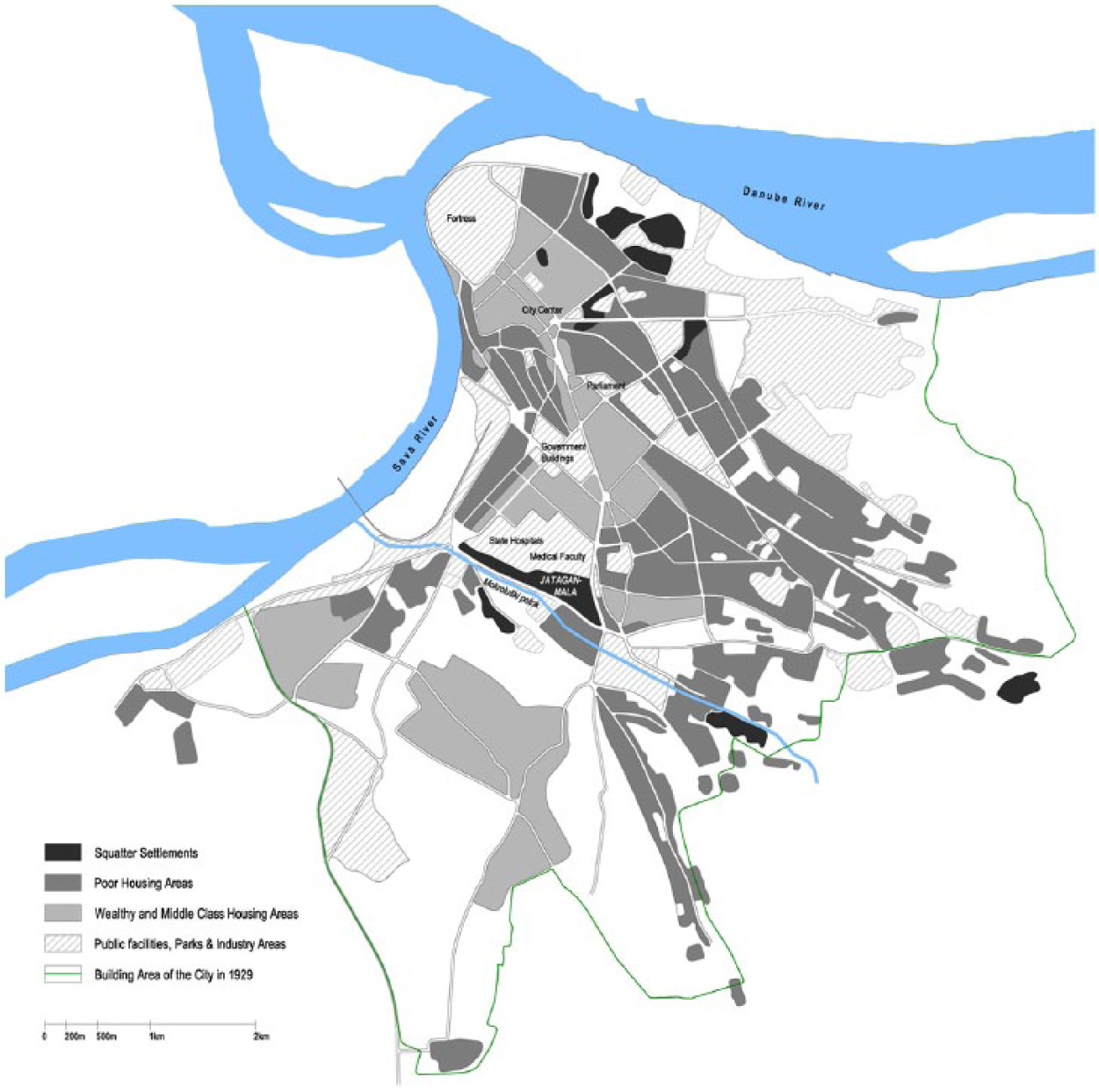
Map showing Belgrade’s poor areas and Jatagan-mala in 1929.
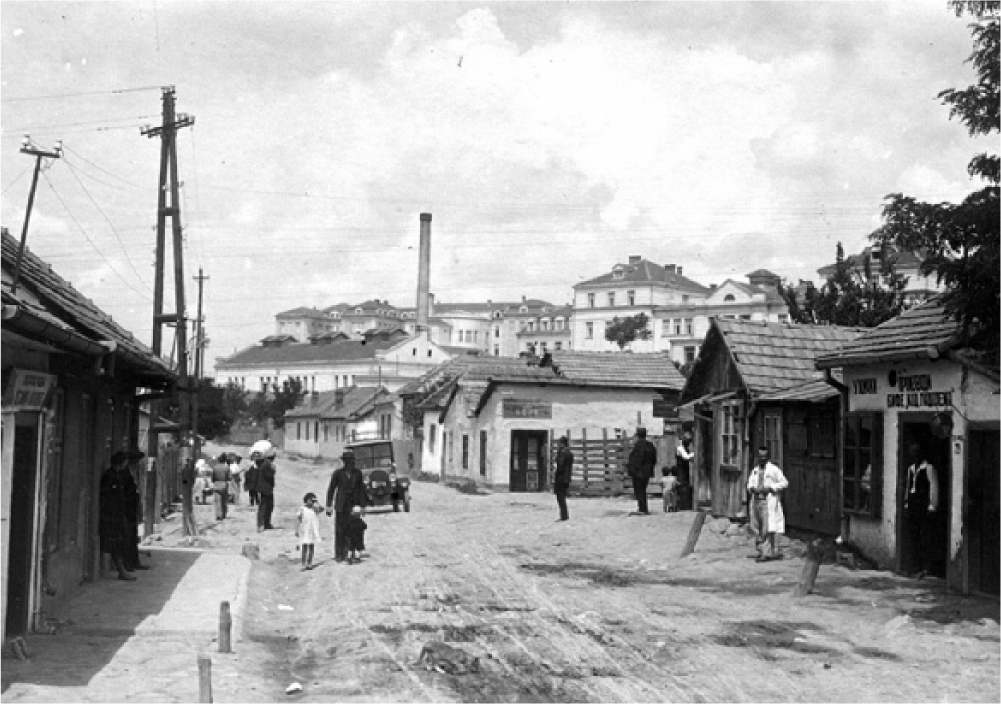
Central Street in Jatagan-mala squatter settlement in the early 1930s lined with numerous stores. In the background is part of the state hospital complex.
Emerging Squatter Settlements and Municipal Authority Reactions
As a rule, squatter settlements arose on locations that were unhealthy or not easily accessible. Abandoned open pit mines, quarries, land near malarial swamps, inundated stream mouths, land exposed to floods on banks of the Sava and Danube rivers, Belgrade’s garbage dump, and so on were places where the poor were able to settle, hoping that the authorities would leave them alone at least for a while. Thus, after World War I, Belgrade was introduced to a completely new urban form—illegally constructed “unhygienic settlements” that can be described with today’s term of slum. 29 Mrs. Danica Tomić-Milosavljević, one of the leading municipal architects in the interwar period, wrote that the hygienic conditions in Belgrade squatter settlements were far below the minimum and were “a great evil that appeared after the world war when village and small town inhabitants rushed to the big city to earn their livelihood” 30 (Figure 3). To get a better idea of the housing conditions in which the poor lived, let us cite expressions used by researchers, journalists, and public workers to describe them at the time. Instead of “house” and “apartment,” they used the expressions “stinking dive,” “tuberculosis hotbed,” “wretched hovel,” “small room with the dank smell of the grave,” “disgusting shack,” “hygienic horror,” “hotbed of contagion,” “lethal pit,” and so on.

Jatagan-mala in 1924. Above: The first inhabitants of Jatagan-mala were poor Belgraders and people who moved there from rural areas. Below: “The most beautiful house in Jatagan-mala” was journalist’s comment.
Throughout the interwar period, an annual average of ten thousand people moved to Belgrade, seven thousand to eight thousand of them poor. 31 Neither Belgrade’s economy with regard to employment nor municipal administrations with regard to housing were able to respond to the needs of the capital’s new inhabitants. In terms of housing, the problem was not the newcomers who had “rushed to the big city to earn their livelihood,” as the municipal architect Tomić-Milosavljević wrote, 32 rather the inadequate creative capacities and material resources of Belgrade’s administration, and its lack of motivation to resolve the issue of housing for the poor and their settlements in a humanely acceptable way. Slobodan Vidaković wrote in 1935 that support from the state to develop and implement an adequate housing policy did not exist. “Our country has remained among a small number of European states that have not done anything in this most important field of social policy.” 33 The weak capacity of Belgrade Municipality to resolve the problem of slum housing is best seen from the fact that the Municipality throughout the interwar period built only around five hundred flats for workers and the poor. 34
In addition to squatter settlements, interwar Belgrade was familiar with another kind of illegal construction where poor people built houses without building permits but on their own land on the outskirts that they bought from land speculators. According to Vidaković, around 1930, there were some 150,000 people on the outskirts of Belgrade.
35
The Municipality undertook measures to regulate this development and, from time to time, as the city’s building area expanded, joined the illegal settlements to the city borders, thereby assuring that one day, they too would have paved streets, a water supply system, and street lighting. This process, however, was very slow since the Municipality’s priority was to regulate the central zone of the city. The Municipality therefore sought partnerships with citizens’ associations on the outskirts to assure municipal services in these areas. This is shown by a conference in 1930 during which the vice president of the Municipality and architect, Dr. Miloslav Stojadinović, stated Belgrade Municipality’s clearly defined views on how to regulate the outskirts of town. Stojadinović said,
A man of little economic means is directed to live on the outskirts where it is less expensive to build apartments and it is realistically possible to afford a home of his own. . . . In addition, it is a natural tendency for our towns to expand just as Vienna, Berlin and all larger towns in the world have expanded. . . . We have undertaken the obligation to build up Belgrade and it is increasingly difficult to find large sums of money so that Belgrade can be built as befits a capital city. This gave rise to the idea of the direct participation of the owners [of property on the outskirts] in carrying out construction works that are otherwise unavoidable and in the interest of both one and all. . . . The suggestion to work together to pave Belgrade with cobblestones came primarily from delegations sent by the citizens to the Municipality.
36
Through such cooperation between the Municipality and the inhabitants, which was some sort of program to regulate the outskirts, over time, many of its parts became completely or partially equipped with municipal services. The view toward squatter settlements was completely different, since they were illegally constructed on municipal land.
The municipal authorities’ attitude and actions toward the development of squatter settlements included contradictory procedures that blocked the resolution of the problem during the two interwar decades. Pressured by reality, the Municipality installed public fountains and street lighting in these settlements but did not accept the proposal to legalize them. Since some of these settlements had relatively large populations, the Municipality rented land to storekeepers so that they could build general stores, bakeries, butcher shops, and so on but refused to cobble the streets as a basic sanitary measure. The Municipality levied a property tax but treated these houses as illegal. So squatter settlements remained “neither in heaven nor on earth, neither with God nor with the people.” 37
Unlike the demolition of individual poor houses and small enclaves in the city center, 38 the problem with large squatter settlements was far more complicated. Belgrade Municipality was well acquainted with the experience of other European countries and their housing programs of building small, hygienic, and financially affordable apartments. 39 In some years, there were even discussions about foreign loan arrangements to build such apartments for workers and the poor, 40 but none of these projects was ever carried out. 41 Despite the fact that numerous regulations had been passed prohibiting illegal construction and despite the fact that a municipal service existed to control construction and had the legal possibility of involving the police, firefighters, and workers to tear down illegal houses, these mechanisms were not appropriate to resolve the problem of larger squatter settlements. This was because the Municipality was “faced with the difficult issue of housing [and] partially tolerated these settlements, always with the assumption that houses would be constructed there or in another place for economically fragile residents, thereby removing the illegal settlements.” 42
The conservative part of the Belgrade and state elite felt that unhygienic settlements should be torn down, their inhabitants should take care of own housing in accordance with their means, and the Municipality should not offer them any kind of assistance in this regard. Part of the elite, including left-wing intellectuals, advocated resolving the problem of squatter settlements by first building new housing and only then moving people and demolishing the settlements. With regard to this perception of the solution, Velibor Gligorić, literary critic and subsequent president of the Serbian Academy of Science and Art, wrote in 1934,
The Municipality’s communal policy must have a social task above all. . . . Demolishing slums, moving the wretched by force into the streets and roads, creating beggars out of beings who have grasped hold of a small piece of land is not the solution for a municipality that has not only a Funeral Services Department, but also a Department to Assist the Poor and social institutions. The issue of Jatagan-mala, Pištolj-mala and similar settlements must be constantly on the agenda at municipal sessions. . . . The Municipality must not use rash measures against these impoverished settlements. It must ensure the more durable provision of housing before undertaking any demolition or relocation.
43
This and similar appeals had no practical outcome. Prokop, Jatagan-mala, Marinkova Bara, Šajkaška, Pašina Česma, and the neighborhoods of Pančićeva, Dobračina, and Smetlište in Pištolj-mala, were well-known squatter settlements in interwar Belgrade. They went through a similar development and shared the same fate of being demolished and resettled just before or after WWII. With the adoption of the Construction Law in 1931 that reiterated the old prohibition on illegal construction, the Municipality’s tolerant attitude from the 1920s began to change, and it resorted increasingly to the demolition of illegally constructed houses. The Municipality, however, did not work systematically to resolve the overall problem, rather tore down those parts of squatter settlements that hindered the realization of city or state projects, finding a palliative solution to satisfy the inhabitants’ minimal requirements. Thanks to such demolitions, above-mentioned squatter settlements gradually decreased and completely disappeared from the city in the period 1950-1980.
Jatagan-mala: Demolishing the Settlement and Resident Resistance
Jatagan-mala arose at the end of the First World War on municipal land in the valley of the stream called Mokroluški potok. 44 The stream poured out and created ponds with standing water. It was a place filled with dirt and garbage where mosquitoes were a source of malaria. Above the valley rose the steep slopes on which Jatagan-mala was gradually built. 45 On a spacious plateau above the slope stretched the State Hospital and Faculty of Medicine grounds. There are several myths as to why the settlement was named after the Turkish sword, the yataghan. One interpretation is that the inhabitants used a yataghan to wrest the land from the Municipality, another is that workers used a yataghan as a tool when building houses, and it is highly likely that during the construction of a house, an old yataghan was found in the ground. 46 The word mala comes from the Turkish word mahhale. In nineteenth-century Serbian towns, mala denoted a neighborhood based on ethnic or religious affiliation, and in the interwar period, it was a settlement where people of a similar social status lived. The name of Jatagan-mala was quickly adopted and became the synonym of an illegal unhygienic settlement in interwar Belgrade and Yugoslavia.
Enterprising police recording clerk and Belgrader Milorad Marković was the first to build an illegal house there. Two months later, the settlement already had seventy houses.
47
In 1924, a journalist from Vreme daily newspaper gave a picturesque description of the settlement’s rapid growth:
These little houses made of timber and boards or adobe, and even ordinary dugout sod house, were not comfortable indeed, but they meant a lot to these homeless . . . In just one year Jatagan-mala grew to 150 houses . . . Without a regulation plan, without any supervision and help, even in defiance of the authorities, the inhabitants of Jatagan-mala divided the land into plots and regulated streets.
48
As soon as the first houses were built on land that would be the future Jatagan-mala, the municipal Construction Control Service and the Administration of Municipal Assets reacted by asking the municipal and police authorities to stop this process immediately, “but the municipal Administration did not get sufficiently involved to put an end to it.” 49 In 1924, Dr. Bogoljub Konstantinović, physician and specialist in social medicine, conducted a thorough investigation of the housing situation in Jatagan-mala with a team from the Institute for Social Medicine of Ministry of Public Health to pinpoint why it was built, identify its problems, and find a way to solve them. Jatagan-mala already had 1,900 inhabitants living in 490 self-built houses. 50 The inhabitants were primarily Serbs with a small amount of Roma (Gypsies), and there is sporadic mention of Albanians, Volksdeutschers, Muslims, Russians, and others. 51 The inhabitants of Jatagan-mala were Yugoslav citizens (along with a few foreigners) who had the same obligations as those living in legal settlements. 52 Among other things, they paid property taxes, regardless of the fact that their houses were illegally constructed. The heads of household had a variety of professions, ranging from servants and musicians to railroad workers, coachmen, workers, day laborers, and the widest variety of craftsmen and people of other profession, and there was also a court recorder. 53 The twenty to forty dinars of daily wages earned by half the residents clearly indicated that they were the urban poor. 54 Konstantinović saw the extremely low income of the settlement’s residents, which was “below subsistence level” and insufficient to pay rent for an apartment in the city, as the reason behind materialization of Jatagan-mala. 55
Konstantinović’s recommendation was unambiguous: the settlement should be torn down in its entirety, but first, the families needed to be provided new apartments on a new and healthy location. This recommendation, along with findings on the dire housing situation in the settlement, was published in Politika daily newspaper in September 1925.
56
The inhabitants of Jatagan-mala rose up against this proposal and sent the following message to the authorities:
We think the state should consider itself lucky when poor people sell their beds and the shirts off their back and enterprisingly build a roof over their head, asking for no help from either the state or the Municipality . . . We went to war for the venerable cross and gilded freedom, and now we are doing this for our daily bread and our families.
57
The residents felt that even though they were poor, they had the potential to resolve their housing problem—even without outside help—and could take care of the housing, sanitary, security, and other conditions in the settlement. The inhabitants of Jatagan-mala seemed to be strongly convinced that their housing situation would worsen if the settlement were torn down, since they did not believe that the Municipality would follow the investigation’s proposal and work to resolve their housing problems at the same time. A comparison of data (Table 1) and photographs of Jatagan-mala from 1924 and 1930 (Figure 3 and Figure 4) shows serious progress in the settlement’s buildings and hygiene, supporting the inhabitants’ claim that they could take care of their settlement.
Basic Data about the Development of Jatagan-mala, from 1920 to 1941.
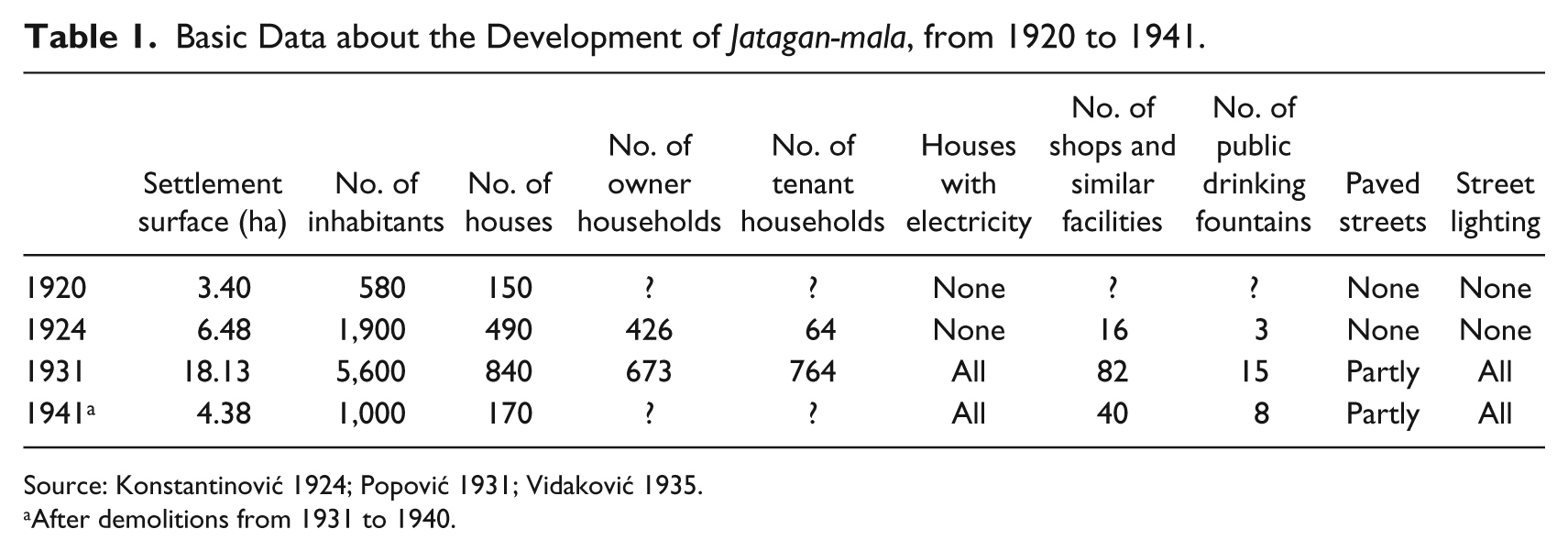
Source: Konstantinović 1924; Popović 1931; Vidaković 1935.
After demolitions from 1931 to 1940.

Jatagan-mala in 1930. Above: One of the residential streets with solid houses, public lighting, and partially constructed sidewalks. Below: The greatest progress in Jatagan-mala was made in terms of quality of houses.
The inhabitants of Jatagan-mala regularly cleaned the gutters, maintained the settlement’s hygiene, repaired the dirt streets, and so on. The settlement’s vigor is also shown by several specific resident activities such as publishing Jataganmalac, a local newspaper in which they defended their interests, 58 or forming the Association for the Beautification of Jatagan-mala, 59 which conducted negotiations with the Municipality to install drinking water fountains, street lighting, and to provide houses with electricity. They hired an architect who elaborated a regulation plan of the settlement, 60 and they even advocated the construction of a Cultural Center and settlement square. 61 Vreme daily newspaper wrote that this Association “fought (almost with rifle in hand) to maintain the prosperity of this settlement and defy attacks by those with power and money who would love to see even a brickworks on this location—anything but Jatagan-mala.” 62 At the end of the 1920s, the inhabitants of Jatagan-mala were called “citizens of steel,” and “militant and resilient” advocates and defenders of their rights (Figure 5).
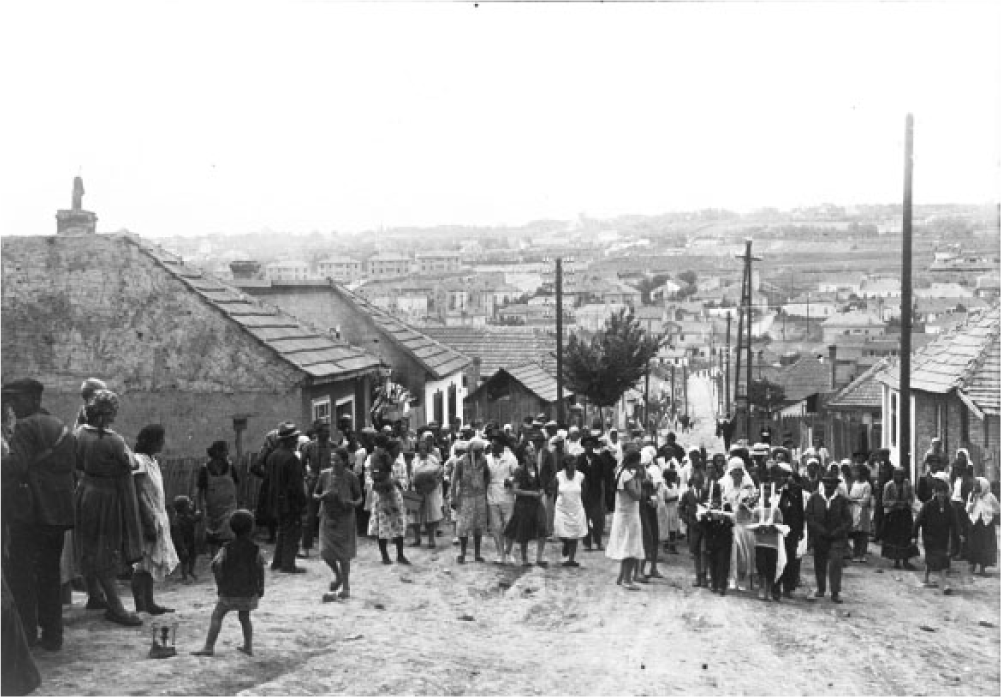
In its first decade, the Jatagan-mala community was socially homogeneous. A Roma wedding around 1930 was attended by Roma and non-Roma alike.
The residents’ fears in 1925 that the Municipality would not build new apartments or provide the conditions for them to build housing themselves in tandem with tearing down the settlement proved justified. Their distress was additionally heightened by the fact that the new General Regulation Plan of Belgrade of 1924 envisaged on their land the expansion of the existing State Hospital complex and the Faculty of Medicine, and the construction of a Faculty of Veterinary Sciences and a green strip along Mokroluški potok stream. 63
In 1931, the first noteworthy demolition of houses in Jatagan-mala took place to build a boulevard on the edge of the settlement and build a large sewage collector (Figure 6). Around sixty houses were removed of the total 840 recorded at the time by the municipal Committee to Relocate Jatagan-mala. The settlement had 5,600 inhabitants and 1,440 apartments.
64
The Committee’s initial idea was to build new houses for the owners of those demolished in new municipal settlement,
65
but this did not happen. When the demolition was announced to construct the boulevard and the collector, 102 of the settlement residents wrote and signed a petition in which they stated:
We do not want to stand in the way of the capital’s development, but according to all the principles of social justice, we must be provided the rightful and moral protection that municipalities all over the world provide to their inhabitants. . . . Hoping for a just resolution, we take the liberty to propose the following to the Municipality to resolve this difficult matter:
“Let the Municipality buy a large plot of land where all the residents could easily fit and help each other during the move and building houses; Let the Municipality build houses or provide loans for our inhabitants to build their own houses. Such loans should be no shorter than 15 to 20 years. Let the Municipality take our current houses and land into account. Compensation can be calculated for the houses and land to pay for new land and newly constructed houses.”
66

Space where houses were demolished to build a boulevard and sewage collector along Jatagan-mala. In the background are houses that did not hinder this project.
Let us summarize: the petition signers’ position was that the problem could be resolved by moving the settlement to another location, with a partnership between the Municipality and the inhabitants regarding matters of land and financing, within the scope of the existing legislative apparatus. It was an impressive proposal of activities to be undertaken to adequately ensure the settlement inhabitants’ housing needs, elaborated by the 102 signatories. The coherence of the proposals set out in the petition was probably due to the fact that one-third of the homeowners living in Jatagan-mala, or 214 people, were educated civil servants and self-management and private clerks, some of them active in the settlement’s Association. 67 Instead of adopting these proposals, the Municipality paid a few thousand dinars to the owners of the demolished houses. According to the calculations of the Chamber of Labor, the modest life of a family of four required an income of 1,800 dinars per month in 1932. 68 The compensation given by the Municipality was enough to live on for several months but not build a new house. However, the money paid to the families of the demolished houses initiated internal accusations and quarrels, since some families, primarily those close to the Association management, received more money than others, regardless of the quality of the demolished houses. 69 Such situations undoubtedly undermined the social cohesion of Jatagan-mala’s residents.
Supported by the central authorities, Belgrade Municipality, over time, became very interested in removing squatter settlements from the city’s image, large Jatagan-mala above all. At a Belgrade City Council session held at the end of 1934, the “proposal to dislocate the illegally constructed settlement of Jatagan-mala” was debated. 70 The mayor at the time, Milutin Petrović, said, “not only municipal authorities but also state authorities are interested in dislocating the settlement and developing the land occupied by Jatagan-mala, and they have approved the dislocation.” 71 The whole City Council was “thoroughly in a mood to do away with Jatagan-mala, since it was high time to remove all those who had occupied municipal land illegally.” 72 One of the aldermen felt that this should not be carried out “now on the threshold of winter,” rather in spring of the following year “when the inhabitants of Jatagan-mala will have an easier time finding new accommodation.” 73 Not a word was said about whether the Municipality should and could help them.
In 1938, another 165 houses were demolished to make way for the construction of two schools (Figure 7). The Municipality paid the owners of the demolished homes a total of 350,000 dinars or two thousand dinars each, “by way of assistance.” 74 For the sake of comparison, at that time, it cost about twenty-six thousand dinars for the Municipality to build a 34 m2 apartment on another Belgrade outlying district. 75 This means the compensation for a demolished house in Jatagan-mala was thirteen times less than the money needed to build a new apartment, not including the cost of the land.
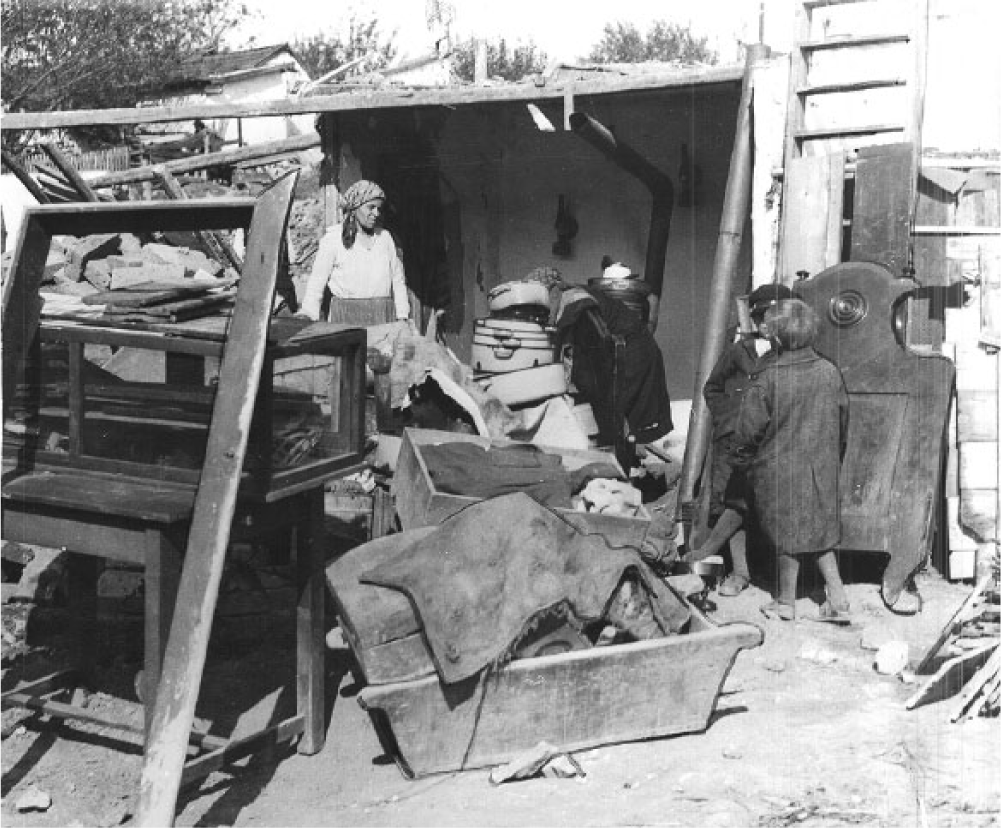
Woman with children and household effects after their house was demolished in Jatagan-mala. When the inhabitants demolished their houses by themselves, the Municipality let them take the building material.
During these years, the state was negotiating with the Municipality about ceding land that was scheduled in the General Regulation Plan to be used to expand the Faculty of Medicine and build the Faculty of Veterinary Sciences. 76 Negotiations ended with the agreement that the Municipality would tear down part of Jatagan-mala, hand over the cleared land to the state, and in return would receive land held by the state in another part of Belgrade. 77
According to this agreement, around 450 houses were demolished in late 1939 and early 1940 (Figure 8). The Municipality earmarked 1,353,500 dinars to dislocate Jatagan-mala. Depending on the size and quality of the houses, families were paid from 1,500 to five thousand dinars. 78 After the demolition, residents moved to other locations, the best known being Marinkova bara where many Roma families lived. 79 This was the largest demolition, reducing Jatagan-mala to around 170 houses. The settlement inhabitants threatened civil servants who came to enumerate and evaluate the property, and sent letters to the authorities, but their content was unconvincing and indecisive. The inhabitants no longer protested self-confidently as in the years right after the First World War, referring to their wartime services and their rights. Instead, they asked the Municipality for monetary compensation, which they later received. However, the Municipality feared possible unrest, considering the dissatisfaction of 450 families a potential threat, and so compensation money was provided that was somewhat greater on average by household than for the previous demolition in 1938. 80

On-site sketch of part of Jatagan-mala with 450 houses that were demolished in 1939-1940 to expand the Faculty of Medicine and build the Faculty of Veterinary Sciences.
Over time, Jatagan-mala had to deal with two developments. The first was its growing size in population and space, and the second was the flagging vigor of its inhabitants to defend their right to housing. At the very beginning, Jatagan-mala consisted exclusively of homeless and urban poor families who built their own illegal houses. These two characteristics—housing and monetary penury—were the cohesive force of the early Jatagan-mala. Over time, the economic structure of the population shifted to wealthier categories. It never left the sphere of poverty, but in the early 1930s, the inhabitants had better-paid professions. This change was accompanied by another one. As time passed, it transpired that people did not have to live in their homes in Jatagan-mala, they could rent them out. A new category of small-time and big-time landlords appeared, many no longer living in the settlement. 81 The ratio changed between the number of owners living in their own apartments and tenants. In 1924, only sixty-four families were tenants, while owners were living in 426 houses. 82 In 1931, 764 families were tenants, and 673 families were living in their own homes. Documents indicate that parts of houses, rooms in apartments, or sheds in yards were also rented out, primarily to supplement a family’s income; these tenants were even poorer than those renting out part of their apartment. It might even be said that in the early 1930s, Jatagan-mala was a “tenant colony” and source of income for a considerable number of landlords (Figure 9). This is also supported by the fact that the total annual rent paid by all the tenants in Jatagan-mala equaled almost two-thirds of the total sale value of all the houses in the settlement. 83 Landlords at the time were from the ranks of civil servants and independent and private clerks, and some were workers with good-paid job and stable situation, while the tenants were primarily unskilled laborers. These three groups—homeowners, tenants, and landlords—had different interests, and in such conditions, those among them who were at risk could not speak out more energetically and fight for their housing rights. Regardless of the fact that in 1939, 450 families faced the real threat of losing their homes, they were no longer a force or a community, and the only strength they had left was to appeal for “assistance and receive the money before their homes were demolished.” 84

Drawing of an existing house with two apartments for rent in Jatagan-mala owned by a small-time landlord who worked as a railroad warehouseman and lived in the Ministry of Traffic and Transport Colony.
The initial phase of the settlement’s development during the 1920s can be called its rise. This was a time when Jatagan-mala flourished, the number of residents grew, and the housing and municipal service situation improved. The phase that we can denote as its fall started in the 1930s when the settlement lost both houses and residents. We see two basic forces that governed Jatagan-mala’s development: one was the residents’ social cohesion as an internal development factor, and the other was the authorities’ attitude toward the settlement as an external factor. In the first phase, social cohesion was strong, and the authorities’ attitude varied from benevolent to tolerant. In the second phase, social cohesion decreased, and the authorities’ attitude varied from bureaucratic to intolerant. 85 Jatagan-mala was fully relocated in the late 1960s and early 1970s when the highway was built through Belgrade. Most of the residents moved to Ledine, one of the new settlements on the outskirts of the city. Included in the written trace of Jatagan-mala are the attributes “running sore on the face of the capital,” “Belgrade’s shame,” and “shantytown thrown by the devil from the sky,” ascribed to it in various texts written during its half-century of existence.
Conclusion
The housing situation in Belgrade after WWI was very difficult. This was owing to inadequate housing facilities from before the war, destruction of the city during the war, and rapid urbanization. These problems also existed in other cities in Europe, and many of them, along with their governments, worked on easing the housing crisis. But Belgrade was not among them; instead, it left it to the inhabitants to resolve their housing issues. A very high percentage, 70 to 80 percentage were poor.
In the period between the two world wars, Belgrade’s poor were scattered all over the city: they rented devastated housing facilities in the city center, or built on their land on the outskirts without a permit, or built illegally in squatter settlements. The municipal authorities reacted to these solutions in different ways. They let private investors push the poor out of central zones by tearing down dilapidated houses and building new multistory business-residential buildings. The Municipality’s most important involvement was in settlements on the outskirts where it undertook programs to regulate and improve the sanitary conditions of informal construction.
Among these squatter settlements, Jatagan-mala was the largest and best known and as such was a “thorn in the side” of Belgrade’s authorities. Its inhabitants felt they had the moral right to settle land that was unused and abandoned, regardless of the fact that it belonged to the Municipality. Municipal authorities were unhappy with this phenomenon in 1920s but did not undertake measures to prevent or channel these developments. On the contrary, the measures they undertook were to levy a tax on the land and houses, build public fountains, issue permits to open stores, pay compensation for demolished houses, and so on, kindling hope among the poor that the settlement would be legalized at some point. But this did not happen. As needed, the Municipality carried out partial demolitions in 1930s for the sake of some city or state project, or simply to remove residents from its property.
The residents wrote petitions and appeals, and sent them to municipal and state authorities, but the answer was always negative. The residents proposed alternative solutions in their letters that were very innovative both then and now. In essence, new apartments should be provided before houses were demolished, or instead of tearing houses down, apply an improvement model so that the combined forces of all stakeholders, including the poor, worked to improve the settlement’s conditions. Municipal authorities turned a blind eye to all of this, since resolving the housing problems of the poor was not a priority on its agenda. With the exception of writing petitions and appeals, inhabitants did not use any other means to fight for their rights, particularly not force. This can be interpreted by the fact that they were not strong enough or homogeneous. Their perception of a person’s right to housing—something that was not codified or publicly recognized at the time, although it was a topic of discussion and the poor were extremely aware of it—gave rise to illegal construction as a pragmatic act in conditions when no one who should have offered any other option. In 1924, Dr. Bogoljub Konstantinović wrote in his study about Jatagan-mala that the facts and findings of this settlement provide “a good image of the housing problem of Belgrade as a whole.” 86 The situation remained almost the same during the entire interwar period.
Although in the 1920s the residents of Jatagan-mala had the impression that the authorities understood their message, their voice nevertheless went unheard beyond the settlement’s borders. They succeeded in persuading the Municipality to install municipal services. They were innovative in how they organized life within their community, but the Belgrade and state administrative elite did not consider this to be a model that could be used to resolve the problem of squatter settlements. The elite were busy with shaping Belgrade’s center; they were preoccupied with palaces and public buildings, and monuments and parks but not with the efforts of settlements such as Jatagan-mala to live a better life. From our observations, Jatagan-mala, illegal and feisty, did not fit into the fashionable desires of the political elite to have a pretty and regulated capital city.
Even though Jatagan-mala was demolished, illegal construction and squatter settlements exist in Belgrade to this day. During the entire twentieth century, regardless of the social changes—from democracy toward dictatorship or from capitalism toward socialism—the government knew only one approach to resolving substandard settlements: demolishing them without a package of measures to resolve their problems.
The positive self-management experience of Jatagan-mala’s residents remained captive in the two interwar decades, known only to Belgrade’s poor. Much later, this practice in the form of different community-based organizations would become well established in many slums throughout the world, in Latin America, Africa, and Asia. The example of Belgrade’s Jatagan-mala shows us that when studying the history of cities’ urban development, it is important to bear in mind illegal construction and informal settlements, in Europe itself, particularly Southeastern Europe, since many of these countries still face such phenomena today.
Footnotes
Acknowledgements
The authors would like to express their deepest gratitude to anonymous reviewers for their insightful comments.
Declaration of Conflicting Interests
The authors declared no potential conflicts of interest with respect to the research, authorship, and/or publication of this article.
Funding
The authors received no financial support for the research, authorship, and/or publication of this article.