




Abstract
The practice of city planning in New York City was transformed in the decades after World War II. At the start of this period, the system was characterized by little citizen involvement and no transparency. By the mid-1970s, citizens had become accepted participants in land-use decision-making, and formal procedures for involving citizens in planning had been written into local law. This article explores how this turning point in citizen participation came about by focusing on the Cooper Square Committee—an ambitious practitioner of neighborhood activism on the Lower East Side of Manhattan. Setting the Committee’s quest in the participatory context of the times uncovers a groundswell of voluntary groups who used the city’s neighborhoods as forums for democratic action. Along with government actors, planning professionals, and civic and social agencies, such groups contributed to the transformation in planning, which developed not by premeditated campaign but by a cumulative process of public problem-solving and social innovation.
Keywords
Today, in the midst of pricey Manhattan, walk down East Fourth Street in the gentrified East Village and you’ll encounter an island of affordability and equality. Three-bedroom apartments that cost $750 a month. Small businesses that can afford their storefronts. Nonprofit theaters that own their buildings. Racial diversity. Economic diversity. Housing and land trusts to sustain this good fortune into the future. All the result of decades of effort by the Cooper Square Committee (CSC), a voluntary group based in the neighborhood that continues its activism in the present day.
In 1959, the CSC’s founders organized to stop an urban redevelopment plan proposed by New York’s powerful czar of planning, Robert Moses. How this tiny group defeated the Moses plan and then survived to implement one of its own is the topic of this article. Their story reveals a quest for social justice that animated New Yorkers who believed that urban renewal was inflicting grievous harm on the city’s most vulnerable residents. It also reveals an enthusiasm for direct involvement in planning for a better city. These activists were not alone. Setting their quest in the participatory context of the times uncovers a groundswell of ordinary people in ordinary neighborhoods taking part in planning for New York in the tumultuous decades after World War II. As New Yorkers increasingly recognized the import of land-use decision-making on the creation of wealth and poverty, social equality and inequality, and urban vitality and failure, it no longer seemed wise to leave planning to the “experts” (Figure 1).
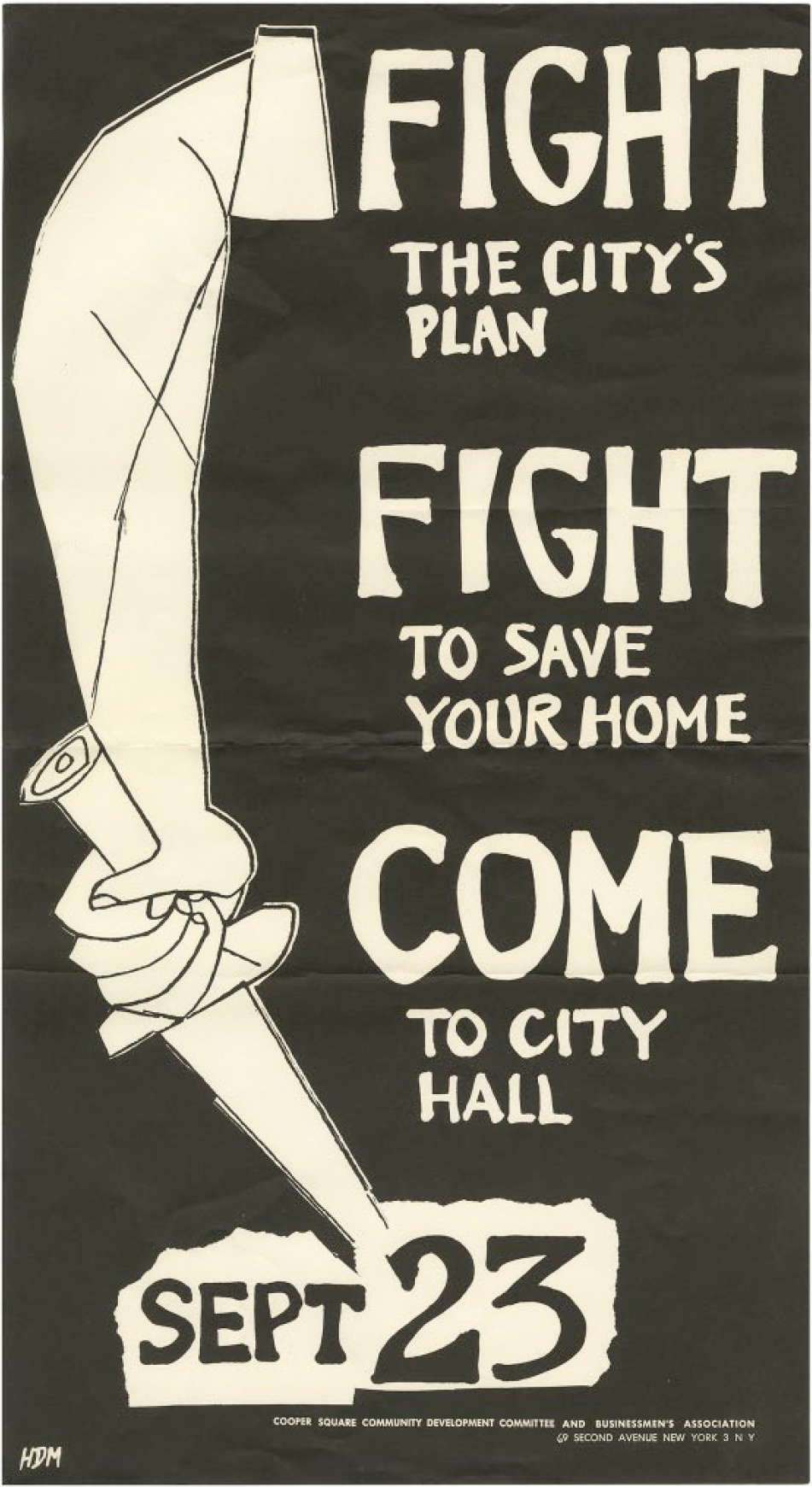
Cooper Square Community Development Committee and Businessmen’s Association, n.d.
One insight that emerges from examining intersecting strands of neighborhood-centered activism is that the CSC and many other New York activist groups viewed neighborhoods as critical, constituent parts of the larger city, not as exclusive redoubts. In their thinking, the (generally permeable) boundaries that defined neighborhoods did not necessarily impede participation in municipal affairs, or produce only defensive, protective action. Instead, they saw neighborhoods as important sources of well-being and as forums for democratic action. Thus, neighborhood identification could galvanize acts of citizenship. When contemporaries used the phrase “citizen participation,” as they frequently did, they were talking about their privileges and responsibilities in a representative democracy. So despite their apparent focus on the local, neighborhood activists had larger objectives in mind.
The CSC is worth exploring in depth because it was an early and particularly ambitious practitioner of this type of neighborhood activism in U.S. city planning. After the Committee’s remarkable success in stopping the urban renewal project that would have bulldozed and rebuilt a 12-block-long stretch of Manhattan’s Lower East Side, 1 participants chose not to retire from the field after victory. Instead, they put themselves forward as alternate planners and developers, intent on seeing improvement that would benefit, not displace, the racially diverse, low-income population living in their area. They also wanted to show that in cooperation with professionals willing to work with them, ordinary citizens who lived in ordinary neighborhoods could contribute positively to the practice of city planning. The committee’s innovative intellectual and political work has remained largely unexamined, lumped, as grassroots activity often is, under the broad categories of “political protest” or “community organizing.” It was both of these things, but it was also a novel combination of neighborhood activism and professional expertise. The results brought material improvements to the low-income population and the development of new modes of political practice. 2
Urban Renewal in Cooper Square
“Everywhere is the sound and the fury of demolition, the large white X’s on windows of buildings marked for extinction,” reported one settlement house worker of the urban renewal bulldozers ripping through the Lower East Side—Manhattan’s historic immigrant district—in the 1950s. 3 New Yorkers had experienced slum clearance under Mayor La Guardia in the 1930s, but the 1949 Housing Act gave this strategy even greater scope. By providing federal dollars to cities around the nation to improve housing and revive commercial districts, the Housing Act’s Title I provision heavily subsidized clearance and redevelopment. In New York, an aggressive and bureaucratically independent Slum Clearance Committee with Robert Moses at the helm operated with little transparency, needing the approval of only two city government entities to apply for federal funds from the Housing and Home Finance Administration, predecessor to the U.S. Department of Housing and Urban Development. One of those was the relatively new City Planning Commission (1938) that Moses had a seat on. By 1958, New York had received more Title I funding than any other municipality. 4
In 1959, Moses announced yet another intervention. This plan targeted a long, narrow, rectangle on the Lower East Side, stretching from East Ninth Street on the north to Delancey Street on the south, and Third Avenue/Bowery on the west to Second Avenue on the east. Altogether, 22 acres of low-rise tenements (most of them no taller than six stories), small businesses, and Bowery lodging houses would be cleared to erect towers of moderate-income, cooperative apartments. Having singled out these blocks, Moses also named them. He dubbed the new area “Cooper Square,” after Cooper Union, the art and engineering college located within its boundaries that had welcomed without charge the city’s working classes for a century, and now stood, he thought, as a beacon in blighted territory.
Moses invited the United Housing Foundation (UHF)—a union-sponsored, limited profit cooperative housing developer—to come in as the city’s required private partner. In New York, this involved not only developing the housing but also clearing the land and relocating site residents. A frequent partner with Moses, the UHF was already working on three other co-op projects in Manhattan when Cooper Square was announced. 5 For this newest development—the “Robert Owen Homes”—the UHF expected to build twelve, twenty-six-story towers containing about 2,900 co-op apartments, along with parking and shopping. According to the Slum Clearance Committee, this plan represented living space for a couple of hundred more households than existing tenements accommodated, but none at all for the several thousand or more homeless men who slept in Bowery lodging houses and hotels. 6 The new units would be of higher quality than almost anything else then standing, but they would also be significantly more expensive, meant for moderate-income homeowners, not low-income renters.
News of the Cooper Square plan sent settlement house tenant organizers Staughton Lynd and Frances Goldin into action. Both already opposed slum clearance and urban renewal, angered by the destruction of racially mixed, low-income neighborhoods like the one that had surrounded the site for Lincoln Center on the Upper West Side. And just one block east of Cooper Square, 1,750 families were about to be uprooted to make way for new middle-income apartments that the majority of existing site tenants could not afford. 7 Believing their neighbors did not need to sacrifice their homes and businesses to save New York, Lynd and Goldin quickly assembled a citizens committee to oppose the bulldozers. But by the time the CSC formed, the renewal plan was almost a fait accompli. Although there had been occasional press reports of the Cooper Square plan, no official mechanism then existed to inform or involve citizens in land-use decision-making. Planning for Cooper Square had not been done in public, so residents, business owners, and civic leaders were just becoming aware that renewal was underway.
The CSC founders included an artist, an urban planner, a settlement house director, several housing organizers, and a few other residents and business owners from the proposed urban renewal area. Of various European ethnicities, and low-to-middling socioeconomic origins, these early leaders were reasonably representative of longstanding residents in this working-people’s district. Even their status as professionals distinguished them less and less as individuals in the arts, and the upwardly mobile young sought out the district’s low rents. The racial makeup of the larger neighborhood was changing, too. Newer Eastsiders were increasingly Puerto Rican and African American, and before long, the CSC would reflect that growing diversity. Politically, the committee’s original members were to the left, on a spectrum ranging from communist to New Deal democrat. They uniformly believed that the right to decent, affordable housing for everybody was an important element of a socially just city.
What worried the Cooper Square activists was that the UHF’s proposed co-ops would displace the area’s many small businesses as well as most of the local residents. Even though New Yorkers who bought into UHF cooperatives earned modest incomes for the era, becoming a “cooperator” still required a $500 deposit upon application, a down payment of about $600 per room, and monthly carrying charges of about $22 per room. 8 The city-sponsored relocation survey purported to show that local residents could afford these prices. To test this claim, the CSC conducted its own survey, and came up with dramatically different results. Ninety-three percent of site families had incomes so low that they qualified for public housing, the CSC said, adding that public housing did not provide the answer to their relocation. Even if space could be found in New York City Housing Authority projects, stringent eligibility criteria would disqualify an estimated third or more of the site residents. 9 The activists feared that once displaced, Cooper Square’s population would join the tens of thousands of New Yorkers trapped in the city’s widely acknowledged housing crisis, forced to double up in substandard lodgings or shuttle from one deteriorating neighborhood to another. 10
The young urban planner Walter Thabit had joined the committee during its first weeks. He quickly invited his mentor, the distinguished lawyer, planner, and fair housing advocate Charles Abrams, to walk the blocks of the renewal area and consider how to respond to the city’s plan. Abrams had helped draft the 1949 Housing Act, but had become disenchanted with Title I urban renewal programs for “displacing the poor from their footholds to make way for higher rental dwellings.” 11 Both men recognized the area’s deficits in housing stock, commercial health, and household income. But they also felt that this northern stretch of the Lower East Side had assets to offer. Attractive private townhouses, churches, and institutional buildings dating back to the 1830s still existed, as did important cultural hotspots, social service institutions, and community gathering places.
Thabit and Abrams also placed a high value on protecting the invisible but vital social relationships and networks that threaded throughout the neighborhood. Neither man romanticized tenement life, but having grown up in low-rent districts themselves, they could see beyond the label of slum. It was this recognition, that “communities could take many forms—even flourish in the midst of profound poverty,” that shaped the values, program, and activism of Abrams, Thabit, and members of the CSC. 12 The group may have concurred with the Slum Clearance Committee’s label of commercial blight in Cooper Square, but not with the notion of a slum so irredeemable that nothing remained but to tear it down.
Now convinced that a more fine-grained plan could renew the area and protect the low-income residents, the CSC proposed its own renewal vision to city leaders. The group suggested that low-income rental housing be added to the middle-income co-ops in the UHF plan. It proposed that low-interest loans be offered to site tenants to help them buy into the co-ops. And it offered to not only support the co-ops but also aid the relocation effort if the Slum Clearance Committee and UHF would certify that suitable replacement housing existed. 13 The answer to the CSC was no. Neither Robert Moses nor UHF leader Abraham Kazan were inclined to alter their renewal model, and both held views of urban reform that identified tenements as morally, spiritually, and intellectually degrading. Since the 1930s in New York, the bulldozer had been seen as the best solution for tenement districts. For Kazan, moreover, a fervent cooperativist, the social good to be achieved from creating cooperative housing far outweighed, he believed, any negative impact that would result from the displacement, especially since the displaced would be removed from what he viewed as terrible living conditions. 14
Their proposal rejected; the CSC went on to wage an aggressive, sophisticated campaign to stop the project. They put forward a compelling alternative vision of renewal, brought technical expertise to their work, and promoted it with savvy organizing. They also reached out to neighbors, progressive professionals, the press, and city and state elected officials. Their work attracted attention, but they also had lucky timing.
For one, displacement was getting a bad name. The City Planning Commission estimated that between January 1946 and March 1953, approximately 170,000 people had been displaced in clearance operations. Twenty-nine percent of the displacees were relocated to public housing, but no information existed about the fate of the remaining 71 percent. 15 Critics charged that moving displaced site residents to substandard lodgings around the city only created new slums. In 1955, the New York State Committee on Discrimination in Housing reported that 40 percent of the families displaced by Title I operations in New York City were members of minority groups. 16 And in 1959, the same year that New York’s Department of City Planning estimated a citywide shortage of 430,000 housing units, the New York Times reported that at least 15,000 families throughout the city would have to be relocated because of renewal or other type of municipal project. 17
Another factor working in the CSC’s favor was growing opposition to Robert Moses, based partly on the relocation catastrophe, but also on financial scandals within the Slum Clearance Committee. Moses also refused to heed new federal requirements in the 1954 Housing Act that introduced rehabilitation as a renewal strategy and mandated the inclusion of citizen participation. A 1960 investigation commissioned by Mayor Robert Wagner brought an end to the Slum Clearance Committee and forced Moses from the helm of urban renewal (although not from other key posts). Signaling a fresh approach, and bowing to opposition to the Cooper Square plan, Wagner’s new Housing and Renewal Board put Cooper Square on hold. To the understandable and vocal dismay of prospective residents in the Robert Owen Homes, the UHF withdrew and the project was cancelled. 18
At that moment, the CSC could have declared victory and disbanded. Instead, the committee told its supporters, “Our plan is very much alive!” 19 It was this decision to continue with its own vision of renewal that distinguished the CSC from a purely oppositional group. The CSC did not object to the notion of urban renewal. Quite the opposite, it wanted to be the city’s renewal partner in the same manner as the UHF. Encouraged by some members of Mayor Wagner’s administration, and empowered by the knowledge that, since 1954, federal guidelines for urban renewal mandated the input of citizens, the CSC set about creating an alternate plan for the Cooper Square area. The Robert Moses–defined boundaries of the area held no special meaning for them; it was a small part of the Lower East Side. But its modest size offered the advantage of being able to plan specifically and creatively for existing residents and newcomers. Moreover, city officials had proposed to improve this swath of turf, so the CSC challenged them to create something that would be “mature, humane and sensible.” 20 The activists recommended compassion for the poorer citizens already in residence as well as the slightly better-off New Yorkers who would have been served by the UHF cooperatives. Both suffered from the crisis in housing.
Advent of Citizen Participation in Planning
Although brazen for its time, the CSC’s claim to be taken seriously as a planning partner was not without precedent. In fact, activists in New York City had been pushing to democratize planning since the 1940s. These initiatives did not always share the same motivations or goals, but they did all aim to engage greater numbers of citizens in issues of consequence to their daily lives. And they demonstrated that action taken at the neighborhood level was not solely parochial or exclusive. It, too, could have citywide objectives and the common good in mind.
In one quest, civic leaders as well as design and planning professionals sought to strengthen democracy by promoting greater citizen participation in local government. Inspired by promising experiments in Detroit, civic activists in New York began in the 1940s to propose that New York divide itself into community planning districts for planning, administrative, social welfare, and cultural purposes. 21 Proponents for community districts saw a direct relationship between government centralization and citizen apathy and alienation. They believed that greater democracy and efficiency could be achieved by decentralizing government into smaller units at the neighborhood level. Two influential groups, the Citizens Union and the Citizens Housing and Planning Council, assumed leadership of this initiative, but it also developed within a flurry of related local efforts. 22 At its core were broader concerns about the perils of mass society, and a drive by thinkers and policy makers in mid-twentieth-century America to reestablish small-group linkages through community development to reverse the increasing scale and centralization of social life. 23
Such arguments would bear fruit in New York in 1951 with the help of Robert Wagner, former city planning commissioner, who instituted community districts throughout Manhattan after becoming the borough president. Wagner’s subsequent election to mayor led in 1961 to a mandate for community districts in the City Charter. By 1968, community boards run by local citizens had been established throughout the city. Supporters of the boards acknowledged that the democratic process did not automatically produce the best decisions, but neither did it produce the worst ones. As one proponent said, mistakes could come from any quarter, even from those whose “Olympian views (and authority) remain serenely unblurred by local considerations.” While “without democracy and without the responsibility of the public in decisions affecting their future, all that urban life has always meant in diversity and vigor and independence will eventually be lost.” 24
On other fronts, concerns about community tensions arising from school desegregation and urban renewal motivated civic leaders and social workers to agitate for greater citizen input in planning. In one mid-fifties scheme to cultivate local leaders, the Community Council of Greater New York formed a five-borough network of neighborhood-based groups called the Neighborhood and Regional Planning Board, to bring activist citizens into direct contact with planning officials and politicians. 25
An even more ambitious project to involve local citizens in social and physical planning emerged in 1954 from venerable Henry Street Settlement House. The Lower East Side Neighborhoods Association (LENA) brought together settlement houses and other reform- or community-minded groups to address local problems. Five affiliated neighborhood councils gave LENA a grassroots network and a forum for cultivating community leaders. In April 1959, the LENA coalition released its own urban renewal plan for an area located between the Manhattan and Brooklyn bridges. The “Two Bridges Self-Renewal Plan” was an impressive, neighborhood-based effort to stimulate physical improvements with minimal displacement, and to retain economic and racial balance. “Experts for years have bemoaned the fact that communities do not plan for their own needs,” the plan’s authors noted, but “this is one community which has accepted the charge.” 26 The group next challenged itself with making a master plan for the entire Lower East Side, which it published in 1961. Both times it obtained help from professional planners who belonged to the Metropolitan Committee on Planning (METCOP). An education and advocacy organization created by planners in the late 1940s to promote better community and regional planning, METCOP supported the notion of making citizen participation a regular part of the planning process. 27 No actual renewal projects emerged from this LENA–METCOP partnership. But contemporaries took note of the unusual collaboration between social workers and urban planners, and out of this experimentation, the outlines of a new kind of cooperation became visible. A community coalition, not a city agency, had proposed to planners that together they present the city with a comprehensive vision of what local people wanted.
All of this activity was made easier by the terms of the 1954 Housing Act. After the act’s passage, the Housing and Home Finance Agency required all recipients of Title I renewal funds to adopt a “Workable Program for Community Improvement.” One Workable Program requirement obliged participants to show that “the community as a whole is fully informed and has the fullest opportunity to take part in developing and executing an urban renewal program.” 28 Part of the rationale was to encourage local citizens to do their bit and support the aims of renewal programs. But this federal “deference to localism” also aimed to avoid alienating those metropolitan officials determined to employ urban renewal to sustain or initiate racially segregated housing. 29
Much of the citizen participation activated by this new federal proviso remained rather anemic. Still, the act’s requirement legitimized public involvement, setting neither a minimum standard nor an upper limit. Citizen activists could define it as they wished. The CSC defined citizen participation as an equal partnership and put their version to the test. As the newness of urban renewal wore off, increasing numbers of citizens directly threatened by the plans similarly insisted on becoming involved. In response, government officials and the planners who worked for them tried to head off trouble by including ever widening circles of people in their planning process. As one planner said when contemplating who to invite to a meeting, “Do we want them on the inside working with us, or on the outside making trouble?” 30
In most of these early experiments with citizen planning, as protagonists innovated with new ideas and strategies, and neighborhoods emerged as sites for citizen action at the local and citywide levels, activity took shape concurrently rather than in association. Yet even when their doings evolved separately, or apparently in conflict, they could be mutually enhancing. After civic organizations introduced a formal apparatus for citizen participation in city government by establishing community boards, neighborhood-based citizen groups had a place to take their issues. And once government officials sanctioned some form of participation, groups like the CSC pushed against attempts at top-down controls and cooptation, advocating for more meaningful involvement. In this accumulation, something more than the sum of their parts was fashioned, and an attentive public for citizen participation in planning grew and matured.
The CSC’s Alternate Plan for Renewal
In 1961, the CSC published its “Alternate Plan for Cooper Square” and went public with its vision of renewal for this subsection of the Lower East Side.
31
Charles Abrams gave the keynote speech at the group’s press conference (Figure 2). Despite the modesty of its title, the press recognized the plan’s radical departure from business as usual. A prominent New York Times headline emphasized the plan’s intention to rehouse rather than remove local residents.
32
Village Voice reporter Mary Nichols summed up the plan’s excitement and promise: In this melting pot of nationalities where Greenwich Village runs into the Lower East Side, a unique departure in the planning history of New York City is in form . . . The people of Cooper Square have become, with professional assistance, the planners themselves.
33
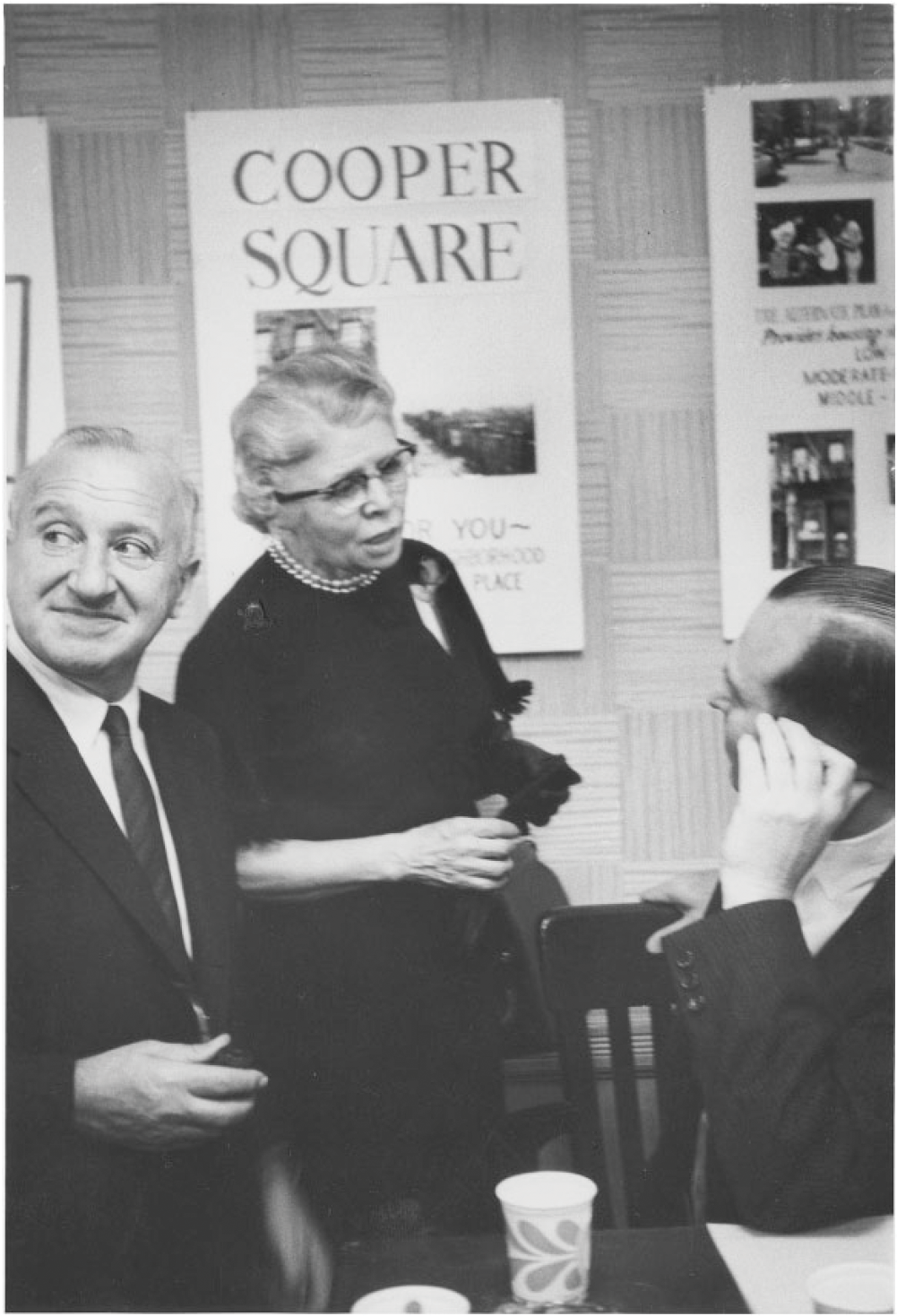
Charles Abrams (left), Thelma Burdick, and Harris Present, at the press conference for the Alternate Plan, 1961.
The Alternate Plan reduced the target area to ten of the twelve blocks originally designated for renewal, positing that the challenge of humanely relocating all of the estimated 4,000 men from the Bowery’s skid row demanded more intensive study. (An appendix to the plan began that process.) Surveys, data collection, and more than 100 open meetings had gone into the plan’s creation. 34 Again and again, participants discussed needs and possible solutions, trying to synthesize their findings into a plan that would gain official acceptance as well as meet with community approval. Walter Thabit, the plan’s principal author, attended nearly every one of these meetings. Thabit knew he was giving up the privileged position that planners generally adopted. The same people that Thabit encountered as flesh and blood clients and colleagues appeared only in statistical form to many of his fellow planners. But he put up with the discomfort of cooperatively planning with nonprofessionals because he believed that citizens should have professional representation during this era of massive physical change to cities.
The Alternate Plan clearly articulated the group’s first nonnegotiable principle: “Physical improvements which will attract a higher-income group must—first of all—benefit those affected by the program, not cause them to suffer from it.”
35
It was highly unusual for renewal leaders to care for the needs of low-income site residents, intentionally, and to acknowledge that, otherwise, they would suffer. Far more typical was the assumption that such aims were incompatible with achieving citywide objectives and the common good. Generally, the authorities justified such projects by saying that the majority of site residents wanted to move. Not so, the CSC contended, after putting that very question to area residents. The tenants want better housing, but they are opposed to a project that would displace them from the site. Local residents, the CSC stated, resent the inference that they are not fit to live with because they are poor, that they must get out of their community because middle-income housing is so important to the future of the City of New York, that they are expendable pawns in the housing experiments of the intelligentsia.
36
The plan’s authors established still other core principles, one of which was the belief that social networks and other forms of community relations that contribute to the well-being of residents exist even in very poor districts (Figures 3 and 4). In old-growth neighborhoods like the Lower East Side, such “ethnic, social, cultural, and economic associations and dependencies” could be highly developed and valued by participants, they wrote. 37 Other thinkers, too, were expressing similar ideas and criticizing urban renewal practice for not acknowledging the importance of such connections. Herbert Gans’s influential 1959 study of renewal and relocation in Boston’s West End asserted that top-down projects that ignored such concerns wreaked havoc in the lives of the poor and elderly. Moreover, by discounting the sacrifice of site residents, officials also discounted their involuntary subsidies to redevelopment through the payment of hidden economic, social, and psychological costs as well as their share of the tax monies used for the projects. Jane Jacobs—listed among the Alternate Plan’s sponsors—added to this discussion in 1961 with The Death and Life of Great American Cities, where she argued against urban renewal and relocation policies that treated site residents—citizens—as simple statistics, as “no longer components of any unit except the family, [who] could be dealt with intellectually like grains of sand, or electrons or billiard balls.” 38

A model of the Alternate Plan in the Cooper Square Committee office window, circa 1963.

Local residents examine a model of the Alternate Plan in the Cooper Square Committee office window, circa 1963.
Having set out the ways in which the Alternate Plan challenged the premises of urban renewal as it was then practiced, the document described what it would do to protect site residents and sustain the area’s best features while improving its worst ones—primarily the blocks of particularly dilapidated row houses and tenements, many of the latter built before the “New Law” improvements of 1901. 39 The city considered almost all of the residential buildings to be substandard, with many lacking heat, hot water, and bathrooms in the apartments. So the community planners set out to calibrate their remedies to the specific physical conditions and human populations in the district. 40
Despite the advanced age of the area’s housing stock, Walter Thabit and Charles Abrams had observed in 1959 that the three, northernmost blocks retained buildings in decent condition. These were the same blocks that hosted the most stable businesses and important community facilities. In line with this original vision, and stating their unwillingness to clear land without compelling reason, the authors left these blocks intact. Instead, the CSC proposed to mobilize government legal and financial resources—some existing, others quite new—to require and assist private owners in repairing and reconditioning their buildings. The plan also called for the city to supplement private efforts by improving the surrounding streetscape.
To the south of these blocks, where the structures were in worse shape, the CSC specified clearance and new construction for almost the entire area, skirting only key community facilities. Having gathered and evaluated the data on the needs and economic status of the area’s residents and business owners, the Alternate Plan proposed 1,440 new units for the clearance area. Of these, 620 would be low-income public units, 300 would be moderate rentals, and 520 would be middle-income co-ops (Figure 5). By specifying many more middle-income co-ops than site residents could fill, the CSC tried to reinforce its claim that it welcomed better-off newcomers, even if it did not want them to dominate. Rather, the report explained, new residents would “join this community of divergent interests and strengthen it.” 41
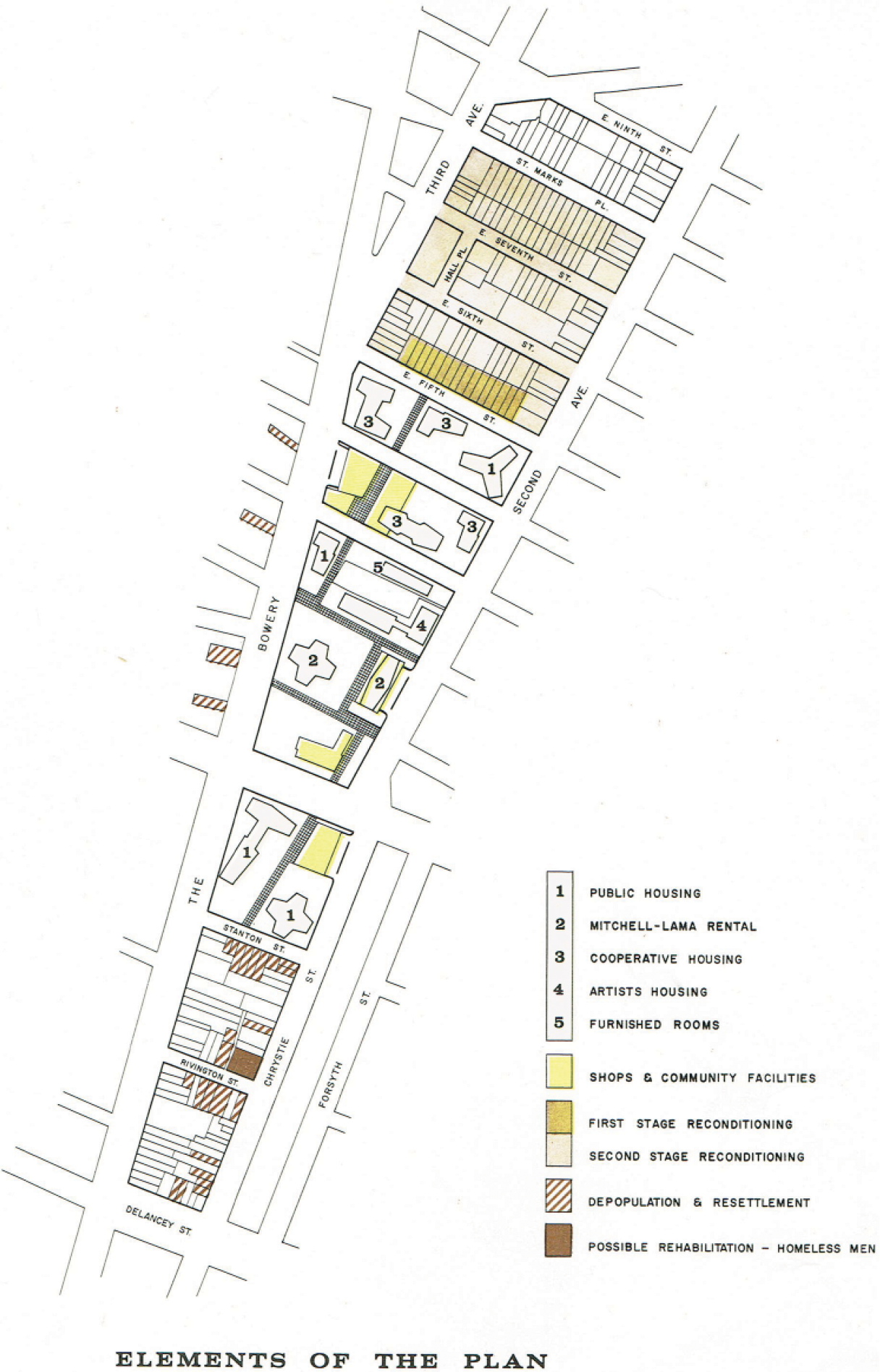
Cooper Square Committee, An Alternate Plan for Cooper Square, 1961.
One vulnerable group that concerned these community planners was the elderly, who made up an estimated 15 percent of Cooper Square households. Rather than segregate this population to senior-only buildings, the report proposed that up to 20 percent of units in each type of housing be fitted out for older occupants, removing saddles from doorways and steps from entrances, and installing grab bars near bathtubs. 42
Many of the elderly residents lived in the area’s 450 furnished rooms—a type of low-rent dwelling that was disappearing throughout the city. Over the years, housing advocates had criticized such lodgings, and in the mid-1950s, New York City declared a moratorium on furnished rooms to prevent unscrupulous landlords from moving in whole families desperate for shelter. Walter Thabit, however, believed in the utility of rooming houses, having helped his mother operate several in Brooklyn. Contending that new, properly designed and maintained rooming houses in redevelopment areas could fill an important function, the authors proposed to create a 160-unit furnished room pilot project to “prove the soundness of constructing such facilities.” 43
Artists came in for special consideration as well. “Artists both on and off the site displayed great interest in the Committee’s plan,” the report stated, “and little by little disclosed the nature of their own problems.” 44 The plan included a 48-unit building for artists that featured live/work space. One of the first of its kind, the experiment attracted the support of the architecture curator of the Museum of Modern Art. 45
The plan also called for the construction of three groups of stores in the clearance area that would house community groups, galleries and theaters, and professional uses on their upper floors. 46 The authors proposed specific strategies to improve the relocation ordeal for commercial entities, for example, speeding the pace and raising the rates of relocation reimbursements for small businessmen who, the report said, were badly disadvantaged by the renewal process. “Businessmen want to be compensated not confiscated,” wrote the authors, taking a swipe at renewal authorities. 47
To create all these new structures and recondition hundreds more, the plan anticipated eventually displacing and rehousing “1,205 families, 206 furnished room occupants, possibly 2,707 beds for homeless men, and 193 non-residential units.” 48 The CSC proposed to ease the pain for site residents by staging clearance, new construction, and repairs so that residents could be moved within the renewal area itself while work was in progress. By carefully managing the process, the authors believed they could minimize even temporary off-site displacement and rehouse most of those who wanted to stay. The men in Bowery lodging houses posed the biggest challenge, but the plan anticipated that many could remain on site in improved versions of the same housing type.
While the CSC hoped to demolish the worst of the tenement housing and provide more open space, it also had to maintain density to rehouse existing residents. To achieve this same end, most architects and planners at the time turned to Le Corbusier’s “towers in the park” design, with its tall, efficient buildings surrounded by landscaped open space. The CSC expected to do so as well, but with a twist. Thabit and his colleagues shared the concerns of a growing body of critics who attacked the approach for being aesthetically sterile and hampering healthy social interaction. So the Alternate Plan pointedly specified that it would vary the height, size, shape, and arrangement of the new buildings to maintain visual interest and prevent the new development from becoming a forbidding cluster of towers and canyons.
The Alternate Plan interrupted the existing street grid less than the original Moses-UHF plan, but still, its anticipated new buildings were oriented away from the street and toward an internal pedestrian circulation system. The CSC well knew that such an orientation was one of the problems associated with the massive superblock projects then going up around the city that were effectively segregating New Yorkers by income and race. “Such projects create their own neighborhood feeling among their residents,” the authors wrote, and “a feeling that they are different from the people who live there.” 49 According to the Alternate Plan, the Cooper Square development would break this pattern by constructing housing types for people of diverse income levels and placing them side-by-side. The authors expected that the income mix and longstanding local residency of many of the inhabitants would counter the tendency toward separation that grid-breaking site planning fostered.
Altogether, what jumps out from the pages of the Alternate Plan is the creative thinking of committee members. What kinds of changes to existing housing would improve their collective lives? How could they stay alert to the diversity of human capacities and needs, and plan for rather than in spite of such considerations? The CSC envisioned a neighborhood crisscrossed with social networks and supportive institutions, stocked with housing types that supported diverse incomes and life situations, and welcoming to people of color—in the language of the day, an open or integrated neighborhood.
The subject of racial integration appeared frequently in CSC leaflets and public letters. Committee members hated what they saw happening all around them as urban renewal projects uprooted the city’s mixed neighborhoods. Especially for those members who were longtime tenant activists, or affiliated with communist and left-wing political parties, such neighborhoods represented the possibility that racism and other social prejudices might one day diminish. They detested the city’s typical renewal process because in destroying mixed neighborhoods it also destroyed a precious social vision. 50
It was ironically on the issue of race that the Alternate Plan attracted significant criticism—some of it from erstwhile supporters. Critics charged that promising to return site tenants to renewal areas would prevent the city from changing “segregated, congested, or other undesirable residential patterns.” 51 The CSC countered that its plan provided for a substantial number of new middle-income cooperatives that would bring in higher income residents. But the Alternate Plan also kept a place in Cooper Square for ethnically and racially diverse site residents who wanted to stay and enjoy improved conditions. One important supporter, the Citizen’s Housing and Planning Council, weighed this issue carefully before deciding whether to support the plan. After struggling to formulate a position, the group decided to support the Alternate Plan because it would produce low- and moderate-cost housing for a diverse set of residents. 52 What the Council said in effect was, let’s look at the facts in this one case, and not get lost in the theories: in this neighborhood, the Alternate Plan promotes integration and sound housing.
The endorsement of a group like Citizen’s Housing and Planning Council helped the CSC in its campaign to assemble a distinguished roster of honorary sponsors and funders, most of them from outside the neighborhood. These supporters noted that, for the first time, a local community, operating outside the expert world of government housing and planning officials, had “advanced a counter proposal rather than simply opposing the original sponsor’s proposal.” 53 It seemed to promise an era of constructive relations as opposed to blind opposition. Walter Thabit’s planning expertise, the creativity and organizing savvy of CSC members, and the Alternate Plan’s vision of a humane city all contributed to the group’s increasingly positive reception. But it was also aided by the participatory landscape that was developing in many arenas of public life during the 1960s (Figure 6). Struggles against urban renewal, for civil rights, and against the war in Vietnam fostered an increasingly receptive climate and constituency for the concepts, technologies, and politics of democratic planning.
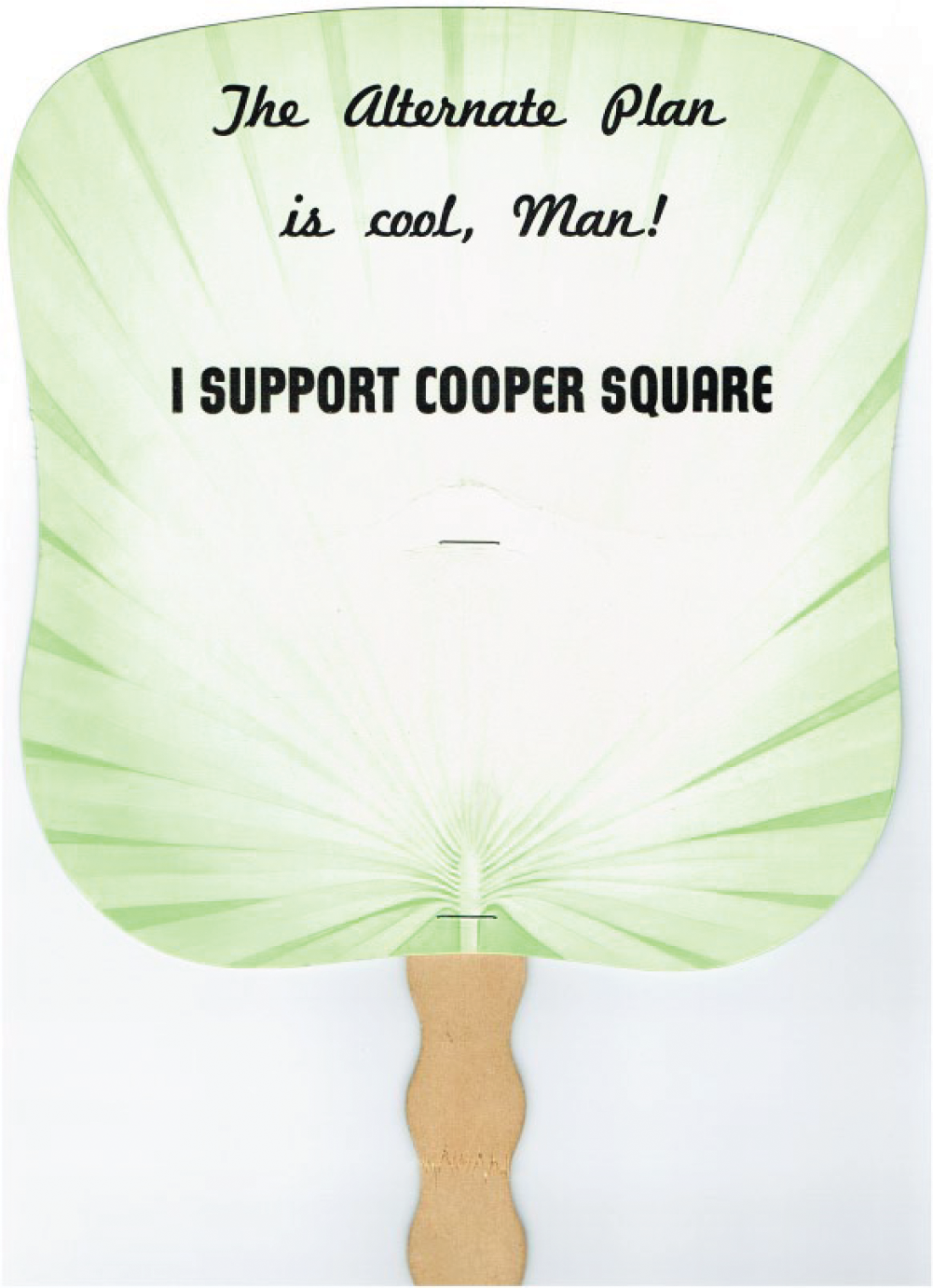
Cooper Square Committee, 1960s.
Advocacy Planning and “Maximum Feasible Participation”
As we have seen, as early as the 1950s, planners organized into groups like METCOP searched for ways to collaborate with ordinary citizens to produce better and fairer plans. Cooper Square’s Walter Thabit was one of the leaders in this new direction for planners. In the early 1960s, increasingly alert to the ways that planning could reinforce inequality, a growing number of planners raised questions about whom planning really served. 54 In 1963, one of METCOP’s founders, George Raymond, chair of Pratt Institute’s Department of City and Regional Planning, started a program to “bring about a certain degree of equality of knowledge between city and community representatives.” 55 Raymond and his colleagues wanted to improve the likelihood that well-conceived urban renewal programs would gain citizen support, and that badly conceived ones would be stopped or improved through citizen action. Partnering with a grassroots coalition in a largely African American area of Central Brooklyn, the Pratt Center for Community Improvement and its field director, Ronald Shiffman, began to rack up impressive accomplishments. 56 Among them was the Bedford Stuyvesant Restoration Corporation—one of the nation’s earliest community development corporations—created with the support of Senators Robert Kennedy and Jacob Javits. From 1964 on, planners and architects founded similar projects in New York and in cities around the country. Some, like The Architects’ Renewal Committee in Harlem, focused on local communities. 57 Others, like Planners for Equal Opportunity, cofounded by Walter Thabit, cultivated national influence.
Paul Davidoff, a New York–based planner, lawyer, and educator, gave all this activity a theory and a name. His 1965 article, “Advocacy and Pluralism in Planning,” argued that planners should practice pluralism in planning by working with more diverse sectors of the population on a greater variety of plans, and that they should advocate, as lawyers do, for their clients. “Advocacy planning” became the term by which the movement was known. Even if not all like-minded planners or architects used it to describe their work, it gave identity and intellectual cohesion to the movement. 58
Davidoff and the planners he spoke for recognized the profound social and political choices embedded in planning. They argued that just because a plan claimed to be rational or comprehensible did not mean that it distributed burdens and benefits fairly. Advocacy planners also maintained that decision-making should be subjected to a public, political process that included rather than excluded citizens. “Inclusion” means not only permitting the citizen to be heard. It also means that he be able to become well informed about the underlying reasons for planning proposals, and be able to respond to them in the technical language of professional planners.
59
This argument for meaningful citizen engagement made its way into President Johnson’s War on Poverty. The 1964 Economic Opportunity Act established Community Action Agencies around the country to provide for the “maximum feasible participation” of local residents and community-based organizations as they attacked local problems. And it sought to bring federal dollars as close as possible to the source of the action. Of the many influences on the program’s creation, one was Mobilization for Youth (MFY)—an organization founded in 1957 by the ever-creative LENA, the J. M. Kaplan Fund, and sociologists Lloyd Ohlin and Richard Cloward. MFY and other domestic and international experiments in community development offered precedent and prototype for Johnson’s new federal program that would presumably skirt unhelpful state and local officials, and, like MFY, coordinate multifront campaigns. 60
Although federal tolerance for maximum feasible participation quickly evaporated, its impact was dramatic. The War on Poverty programs provided institutional support for citizen activism by expanding participation and providing new opportunities and funding for a kind of social learning and innovation that had begun some time earlier. And they opened these modalities explicitly to the poor and people of color. In the end, the federal initiatives attracted considerable opposition and proved more vulnerable to shifting political winds than citizen-initiated projects like the CSC. But even so, their temporary existence helped to spread the concepts and practice of advocacy planning, and supported the efforts of citizen-planners like those in Cooper Square.
The CSC and Citizen-Led Renewal
Once the CSC created and published its Alternate Plan for urban renewal in 1961, its members embarked on a campaign to actually build the housing they imagined. Successfully moving from plan to reality would mean securing allies, defeating or neutralizing opponents, sustaining their own activity, and confronting the thorny trade-offs involved in building in an environment as complicated as New York. Most of all it would mean convincing the city to accept them as a partner in these endeavors. The CSC embarked on its wooing of the city with optimism.
But what the new situation gained in possibilities, it lost in clarity. Once CSC members reimagined their collective identity as community planners rather than opponents, they complicated their status as “outsiders” vis-à-vis city authorities. Where before they could confront the opposition as a solid block, they now had to do intricate business with “insiders” of a complex bureaucratic and political arena.
For Thabit, one of the key tensions was the dismissive attitude that officials routinely took toward the concerns and ideas of nonexperts, characterizing them as local and parochial, rooted in neighborhood only, irrelevant to the concerns of a larger city and, likely, antithetical to any common interest. Thabit defended neighborhood participation because he thought that “blind and shortsighted programs and policies” could come just as easily from private entrepreneurs and politicians as from the community groups he worked with. Moreover, he and his Cooper Square colleagues believed that the socially just principles and fine-grained planning modeled in their scheme were in the common interest and would produce a better functioning city. 61
As the Cooper Square Alternate Plan moved ahead in fits and starts, conflicts over “local” versus “citywide” objectives emerged in numerous contests between the CSC and city agencies and, on occasion, with opposing local groups (Figures 7 and 8). In each case, development priorities in other parts of the city or new fads in planning theory threatened to upset the CSC’s carefully worked out approach, calculated to stagger new construction, minimize displacement, and orchestrate rehabilitation in existing tenements without spurring rent spikes. Committee members worried that rehabilitation without tenant protections would displace people as surely as the bulldozers. Indeed, improvements by private landlords presented particular concern since they need show no semblance of public purpose nor contend with safeguards built into the urban renewal program.
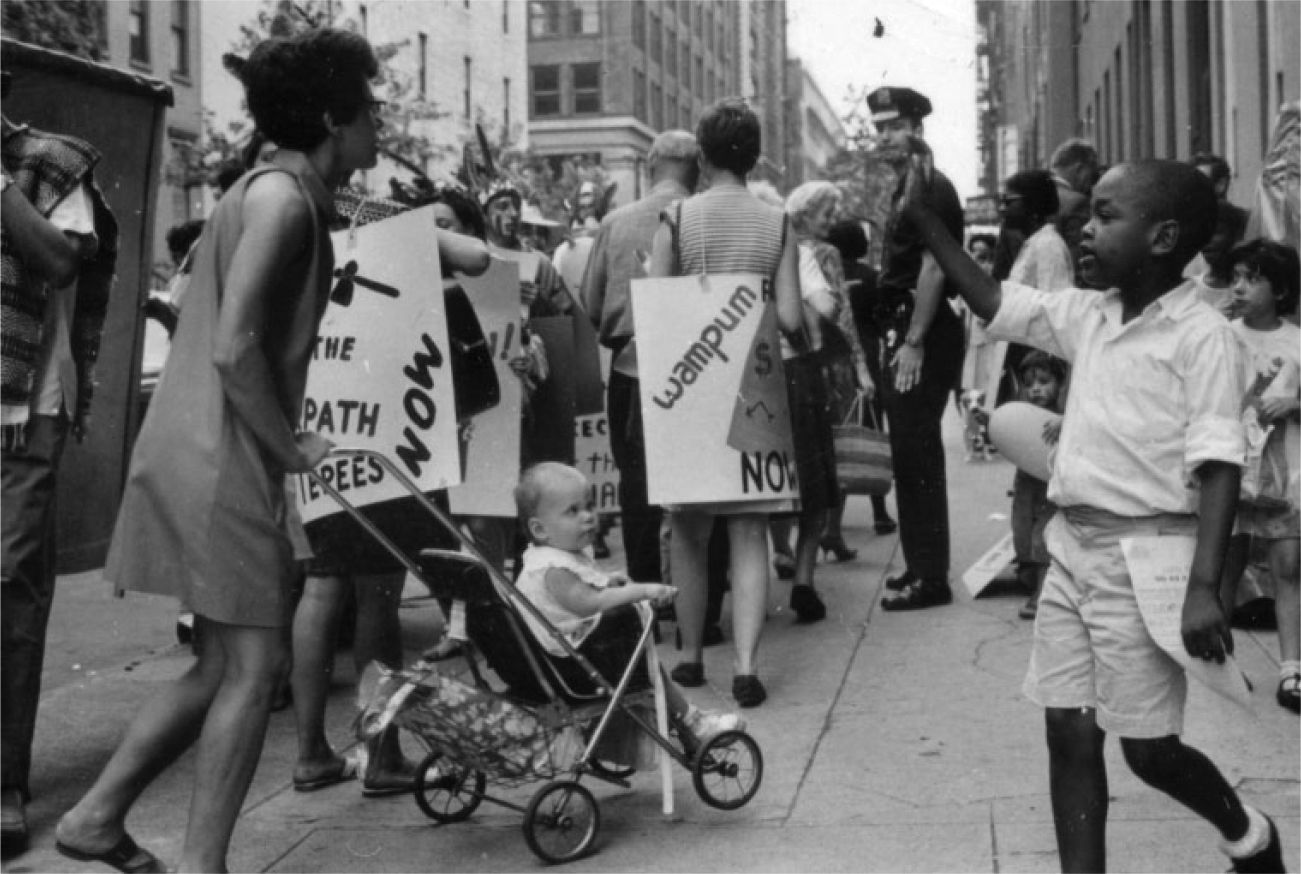
To convince city government to move ahead with renewal in Cooper Square based on the Alternate Plan, the Cooper Square Committee mounted its “warpath” campaign in 1965-1966. Picket lines, “teepee” camps, and a postcard campaign that swamped City Hall with green feathers attracted the press, mobilized constituents, and pressured city officials.
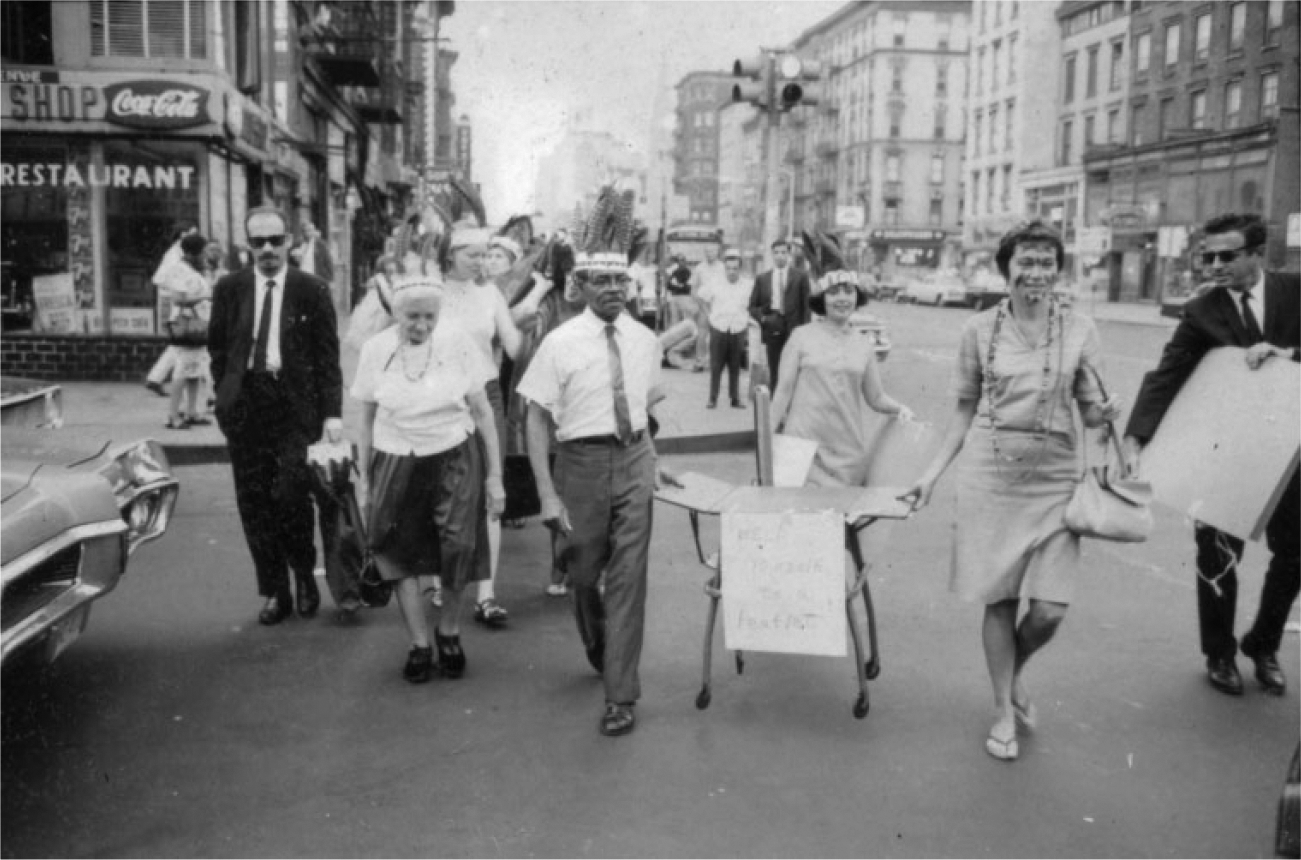
Cooper Square Committee members head down Second Avenue as part of the group’s warpath campaign, 1965-1966. Frances Goldin is in the lead, with Walter Thabit, wearing sunglasses, at the other side of the pack.
Throughout these disputes, the activists managed to stop or slow threats to their plan, and build enough political support to force continued attention from the city. Eventually, the city gave the CSC its wish—a chance to cooperate with city officials to implement the Alternate Plan.
In early 1968, officials from Mayor Lindsay’s Housing and Development Administration—the new superagency for most of the city’s housing and renewal programs—told the CSC that in recognition of the desperate housing needs on the Lower East Side, the agency would implement the Alternate Plan in Cooper Square. 62 Thabit would be subcontracted to the firm of Abeles, Schwartz & Associates to begin work in Cooper Square.
Peter Abeles and Harry Schwartz were advocacy planners who had been involved with MFY. For this new project, Thabit was to concentrate on Cooper Square while Abeles and Schwartz planned for improvements to a larger swath of the Lower East Side. This represented a significant departure for urban renewal in the city. It elevated the stature of advocacy planning and authorized the CSC to implement its plan to improve its neighborhood for the benefit of the people living there. The contract specified that Thabit’s work be “carried out in close cooperation with the CSC and the community.” It continued, “Working through the Committee, the community is to be consulted and its guidance is to be sought during each step of the process.” 63
So despite all the setbacks, the CSC had survived long enough to reap the benefits of two decades of advocacy for citizen participation in urban planning. In its new position as renewal leader, the CSC finally secured responsibility for seeing its plan through to completion. Thabit hired seven planners and trained assistants to help, and from fifty to one hundred CSC members actively assisted. Several hundred more could be called upon to attend hearings and protests, for the need to apply political pressure never abated. 64 The pace was relentless and probably excruciating.
Not only were the intellectual and logistical demands of the work prodigious, but also few models existed for nonprofessionals to enact citizenship within the arena of urban planning and in their own neighborhoods. Exciting as it must have been to see themselves as pioneer citizen-planners, it was strenuous duty on uncharted terrain. Certain traits that helped them are worth noting. The ability to organize was one.
Many CSC members were exceptional organizers, having brought with them prior experience as professionals and volunteers in tenant, consumer, social welfare, and left-wing political organizations. Others developed organizing skills through their participation with the CSC. Many of these leaders were women (Figures 9 and 10). With their passion for the issues, detailed mastery of the content, organizational capabilities, and ability to build consensus and community, they engaged the residents and businessmen of their community as well as a much broader constellation of supporters. Court translator Genoveva Clemente found her way to the CSC via Metropolitan Council for Housing, but she had previously participated in other local affairs, such as the LENA’s Housing Committee. Recreational therapist Mike Ladin learned of the renewal effort via the East Side Tenants Council. Ladin had been orchestrating gatherings and campaigns of one sort or another since his Boy Scout days, so the good cause and leadership opportunities provided by the CSC attracted him right away. Lois Dodd painted, and in the early fifties had cofounded the cooperative, artist-run Tanager gallery in the neighborhood. She learned of the CSC through fellow artist Helen Demott and was intrigued by the radical notion of creating live/work space for artists.

Frances Goldin hands out leaflets in front of the Department of City Planning on Lafayette St., 1965.
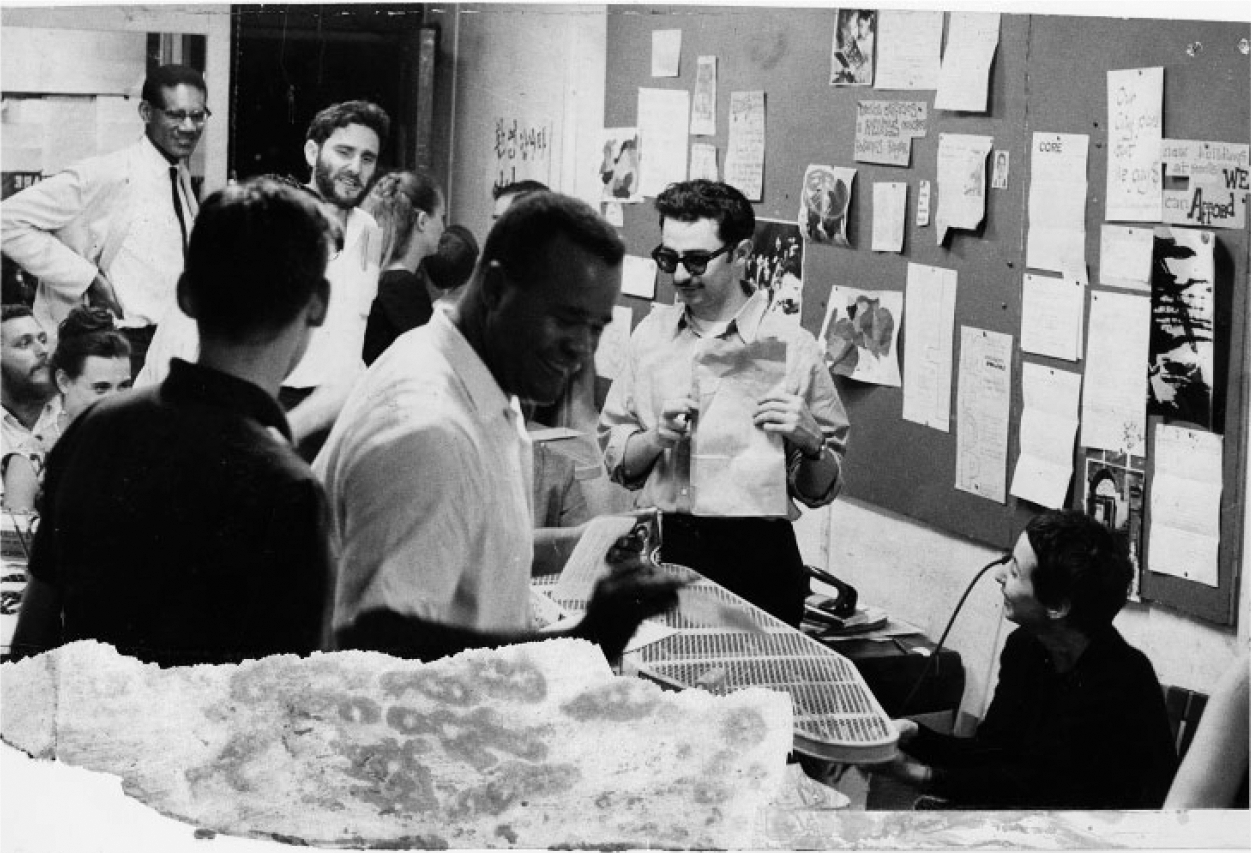
Cooper Square Committee office, circa 1963-1966.
Ladin, Clemente, and Dodd were three members outside the founding group who attained leadership roles. 65 Two others were mailman Pedro Ortega and church caretaker Carlos Perez. As a neighborhood-based collectivity, the CSC drew from local residents, and in the main, residents and leaders were of European descent. But from early on, Puerto Rican New Yorkers like Ortega and Perez, and African Americans like Wilbert “Bill” Tatum—who later worked for Mayor Lindsay and then published the African American–focused New York Amsterdam News—played key roles.
Opening an office in 1963, and turning the CSC into a membership organization, greatly expanded the roster of individuals available to work on committees, attend public hearings, and take part in picket lines, marches, and other street actions. During 1964, for example, committees met to design housing for artists and for single persons, resolve a dispute over a parcel of land, conduct house-to-house surveys, and put out a newsletter that kept members and friends informed and involved. After 1968, one committee or another met several times a week, often more. In addition to the Steering Committee, other committees addressed membership, architect selection, Bowery residents, housing, commercial vacancy, tenant selection, site action, and tenant problems. With its meetings and rallies, holiday parties, and special events like the chartered bus to the Poor People’s Campaign in Washington, D.C. in 1968, the CSC also gave members a community—something to attach themselves to. 66
CSC leaders and members were also remarkably tenacious. They soldiered on despite considerable difficulties. Whenever possible, they used the divisions within the housing bureaucracy, and the good will of individual officials, to try to make positive things happen. If they had not persevered, they would not have survived “two Mayors, four City Planning Commission chairmen and as many heads of the HDA.” 67 Nor would they have been there when opportunity knocked in 1968. And without such persistence, they never would have acquired the expertise that earned them a reputation for know-how.
Much of the CSC’s technical expertise owed to Walter Thabit’s participation (Figure 11). Thabit did not carry the full burden, however. Since there was rarely enough money to pay him before 1968, committee members provided much of the labor, developing expertise in government housing and land-use regulations, and in the jargon and methods of planners. One of Lindsay’s top housing aides said of the committee, “They knew they had to do a professional job. In those days, that was unique. They didn’t just scream ‘What we want is . . .!’ They went out and experimented.” 68
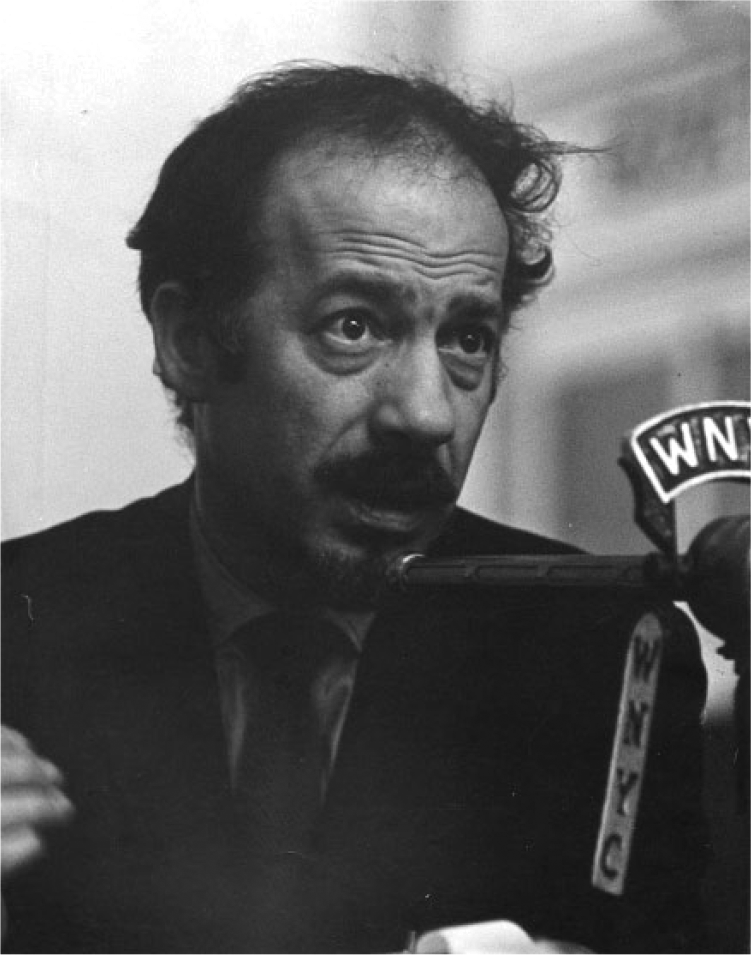
Walter Thabit testifies on behalf of the Cooper Square Committee at a city hearing in 1969.
Another key aspect of the CSC strategy was its maintenance of the historical record. Accounts of the Committee’s dogged persistence tended to win it supporters, so with few other tools at their disposal, members did what they could to shape the narrative of their struggle. Committee members wrote up chronologies of their efforts and letter after letter to public officials detailing what had been promised when and by whom. Marshaling this evidence kept the campaign’s history and first principles in plain view for its members and the larger public.
All of this effort was the behind-the-scenes side of citizen participation—the nurturing and mobilization of human resources. For participants, it meant not only endless meetings, complicated trainings, wrenching decisions, and distressing arguments but also feelings of power and accomplishment when the effort paid off.
This is not to suggest that the CSC’s effort proceeded smoothly. The new responsibilities that accompanied the CSC’s contract with the city in 1968 also brought formidable challenges—some of their own making, such as planning humanely for the diverse needs of the population, and some over which they had no control, such as negotiating in a political and bureaucratic thicket that daunted even the most skilled insiders. Making matters more difficult, CSC members felt that, despite their contract, city officials still treated them as outsiders.
Indeed, across the country, even as citizen participation in planning forged ahead in some arenas, it fell behind in others, as when Congress shed the maximum feasible participation requirement from its Model Cities Program in 1966. Even so, the federal program subsequently published new guidelines that sought to bring neighborhood residents into the plan-making process. The same Model Cities official and longtime activist who authored these guidelines, Sherry Arnstein, subsequently published an outgrowth of her work that she called a “Ladder of Citizen Participation.” Her eight-rung ladder, which became a widely influential analytic tool, showed a hierarchy of relationships and participatory possibilities between government and citizens. The rungs ranged from manipulation by authorities at the bottom to citizen control at the top. The CSC wanted something in the top tier, perhaps aiming for the sixth rung that Arnstein called “partnership.” New York City officials seemed to prefer something toward the bottom, where there was “no follow-through, no ‘muscle,’ hence no assurance of changing the status quo.” 69
Yet, in spite of their differences, the parties needed each other and continued to interact. The CSC had committed itself to improving living conditions in its area. It could not accomplish its goals without the city. The city had committed itself to something called citizen participation as a necessary component of activating renewal plans. Without the CSC—the most visible and viable candidate for this role in the Cooper Square area—the city could neither claim it was adhering to its pledge nor move vigorously to foster renewal. Unable to rid themselves of the other, they had to practice some form of diplomacy that constrained opposition and kept them coming back to the negotiating table despite their mutual defensiveness, distrust, and conflicting objectives.
By 1970, the CSC had formulated a plan that received city and federal approval. It also received support from the local population, prompting the group to claim that this was the first time that residents and businessmen in a renewal area had ever rallied to endorse a plan “responsible for their uprooting.” 70 The new plan specified 1,050 units of new and rehabilitated low- and middle-income housing, a school for kindergarten to second grade, a daycare center, and other community facilities. As before, clearance and new construction would be staggered so that residents and businesses would be only temporarily and locally displaced while structures were built or rehabilitated, and whenever possible, sound housing would be preserved. Of the new or improved units, about 60 percent would be reserved for low-income occupants, with nearly fifty of these units designed specifically for artists. The Museum of Modern Art was still collaborating with the CSC, and intended to help the artist’s committee find an architect to design the live/work units. A rooming house for single persons and amenities for the elderly stayed in the plan, as did improved lodging houses for some of the Bowery’s homeless men. (The CSC committee formed to consider the needs of the homeless later evolved into the Bowery Residents’ Committee, an important provider of services to the homeless today.) In terms of design, to attain the needed density, the CSC anticipated that new six-story buildings—the same height as the tenements—would be placed on the street edge, with towers set back in the interior of the developments. 71
The group’s pace slowed, as members coped with the complications of actually executing the plan, and then bitter internal disputes lamentably interrupted their progress even further. Then, in 1973, events decisively turned against them when President Richard Nixon’s administration declared a moratorium on new housing starts financed by federal subsidies. No federal funds would be forthcoming for its project, the CSC learned to its profound dismay. 72 Now reliant on New York State funds, the CSC wrangled for several years with the Urban Development Corporation and city housing agencies to get them to begin work in Cooper Square. Plans lurched back and forth as the finances of the city and state became ever more precarious. When in 1975 New York City came close to defaulting on its debt, the Urban Development Corporation did default and shut down. With the withdrawal or crash of all of the CSC’s funding mechanisms, its own plan crashed as well.
Faced with the collapse of years of work, the activists confronted a painful decision. Could they move ahead? How? The odds of recovering their momentum and standing did not look good. Despite this, the committee chose to stay intact even though members knew that their plans would have to change yet again. Of the many problems they faced, one demanded immediate attention: the threat to existing housing. After approving the CSC’s urban renewal plan in 1970, the city had assumed many of the buildings through eminent domain. A nearly bankrupt municipality now owned much of the property in Cooper Square. In 1975, the public and private disinvestment associated with the fiscal crisis in New York City had yet to reach its height, but residents were palpably aware that buildings were going untended and worse. With the city feeling like it was in free fall, the Cooper Square activists turned their attention to saving their buildings, not only from vandals and arsonists but also from a financially strapped municipal landlord that cut back on maintenance and tried to tear down aging units rather than repair them. 73
That the CSC managed to save its housing stock during those grim years says a good deal about the members’ willpower, and also their skills at organizing. Consummate organizers like Frances Goldin had helped propel the activists from the beginning, and many others in the committee developed similar abilities. Indeed, in the years that followed, the CSC expanded its community organizing and community planning. Members joined with other activists around the Lower East Side to halt and then recover from the devastation of the fiscal crisis years. Then, when distressed properties were being snapped up by investors and turned into luxury housing, they struggled to prevent gentrification from displacing the Lower East Side’s low-income residents. The community-wide initiatives that emerged used legal and political tools to secure racial integration in new and existing housing developments, subsidize the construction of new low-income units in the part of the Lower East Side hit hardest by the fires of the 1970s, and create a nonprofit credit union at a time when private banks had fled the area.
The CSC also worked to revive its Cooper Square plans (Figure 12). Having been forced to abandon the idea of comprehensive renewal, the committee pursued a piecemeal approach and looked for sources of funding. Its first successful venture opened in 1985 at the southern edge of the old renewal area. It was a large, newly constructed building for low-income renters, financed by a private investor, and named for Thelma Burdick, the settlement house director who cofounded the group in 1959 and helped lead it for 13 years. 74 Unable to afford much architectural decoration but eager to beautify the structure for its residents, the CSC won a grant from the National Endowment for the Arts to install art in the building’s interior. A second project opened on Christmas Eve, 1988. That night, twenty-two formerly homeless families moved into The Cube Building. 75 The CSC had purchased the structure from the city five years earlier and rehabilitated it with state monies as one of the first cooperatives for the homeless.
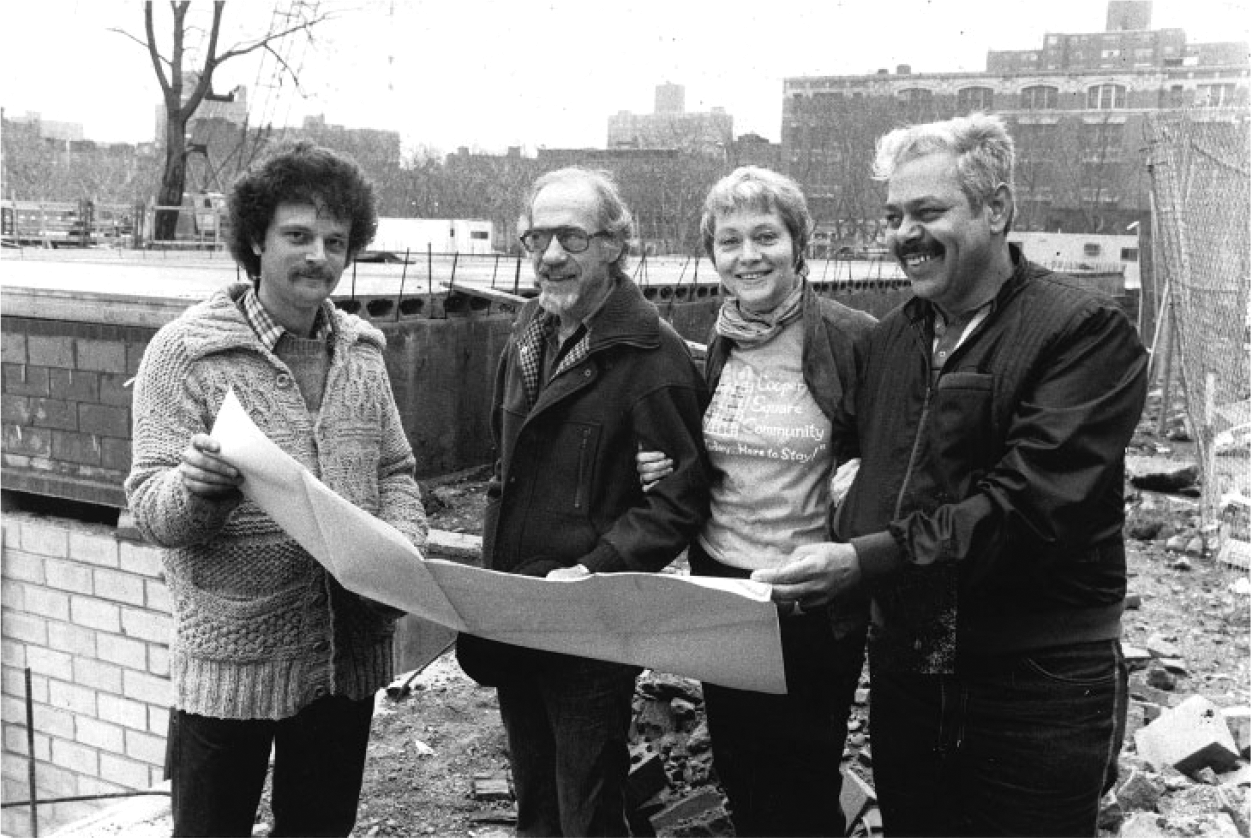
Cooper Square Committee leaders at the site of their forthcoming development, the Thelma Burdick Houses, circa 1983. Left-Right: Valerio Orselli, Walter Thabit, Frances Goldin, and Carlos Perez.
Then, sympathetic housing officials in the administration of the new mayor, David Dinkins (1990-1993), helped the CSC reinvigorate parts of its larger urban renewal scheme. In exchange for the CSC’s willingness to relinquish its “claim” to one large lot in the renewal area, thus opening up the space to luxury housing, the city agreed that 25 percent of the new rental units would be developed for low-income tenants. The city also promised to spend tens of millions of dollars to rehabilitate twenty-one tenement buildings located along East Third and Fourth Streets, to be managed by the CSC.
Under the CSC’s watch, renovation of the tenements was staggered to minimize disruption and displacement. The activists also borrowed a strategy used in European social housing and created a mutual housing association. Today, the association functions as an overarching co-op for the CSC’s renovated buildings, thus creating a cooperative governance structure as well as operational efficiencies that have kept costs surprisingly low. A community land trust separates ownership of the land from ownership of the buildings. Since the cooperative’s shareholders do not own the land, they must sell their apartments back to the association, thereby preserving the buildings as low-income housing. Frances Goldin serves on the land trust’s board of directors.
Spinning off part of itself to run the mutual housing association, the CSC continues in the present day to develop housing and defend the interests of area tenants. In 2008, it opened a new building of supportive housing units and, in 2015, cosponsored transitional housing for LGBT (lesbian, gay, bisexual, and transgender) youth. The group also brokered a plan whereby the city sold six of its buildings along East Fourth Street for the symbolic figure of $1 each to resident theater and dance troupes. The effort helped sustain the arts groups and provided a vibrant anchor for the surrounding affordable apartments and commercial storefronts. It also led to the block’s designation as a New York City cultural district in 2006.
Conclusion
More than five decades have passed since activists in the Cooper Square neighborhood organized to stop displacement by urban renewal, and then proposed that they themselves help to foster a more equitable type of renewal planning. Neither the group’s founders nor those who joined later could have imagined the convoluted path that lay ahead, or the interminable amount of time it would take to implement the Alternate Plan. Certainly, the CSC did not achieve all of its goals. But almost implausibly, despite innumerable setbacks, the group succeeded in many respects. Its campaigns did protect the interests of site residents, preserve access to the area for low-income New Yorkers, and improve local housing stock through new construction and rehabilitation of sound structures.
The CSC also managed to sustain the humanistic vision of urban life it originally envisioned. Its stretch of East Fourth Street is lively and welcoming, full of commercial and cultural attractions, and interesting to the eye architecturally. The presence of the past is palpable in the landscape. The full range of the city’s population is visible on the street. Behind the building facades, economically and racially diverse people live and work in decent conditions. This is not the kind of renewal that generally comes with gentrification. The important difference is that, here, renewal has opted for social inclusion, not exclusion. The combined protections that make residential, commercial, and cultural space affordable on East Fourth Street have created a place that shows us what the city could look like with a greater commitment to social imperatives.
Moreover, the CSC’s innovative work in Cooper Square and in the larger neighborhood demonstrated the capacity of nonprofessionals to contribute positively to the practice of city planning. In this regard, the committee was an important player in a larger constellation of groups and initiatives that pioneered and sustained the postwar drive for citizen participation in planning.
Next door to CSC headquarters on East Fourth is the office of Community Board #3, representing the Lower East Side—a product of the campaign for greater democracy in city government that began, as we have seen, in the late 1940s (Figure 13). Walter Thabit, who passed away in 2005, likely appreciated the juxtaposition. Thabit was one of the few advocacy planners who worked to implement and empower community boards. He saw them as vehicles for the kind of leadership being exercised by citizens in Cooper Square. In fact, the frustrations of trying to work with planning officials on the Cooper Square project may have persuaded him that ad hoc relationships with the city were not sufficient: citizens needed a guarantee of participation. He believed that there were salient and complementary roles for different kinds of citizen bodies. He valued groups whose actions were unimpeded by formal ties with government, such as the CSC. He also identified a need for official mechanisms like community boards that provided a vehicle for collaboration, or at least guaranteed on-the-record, two-way communication between citizens and government.
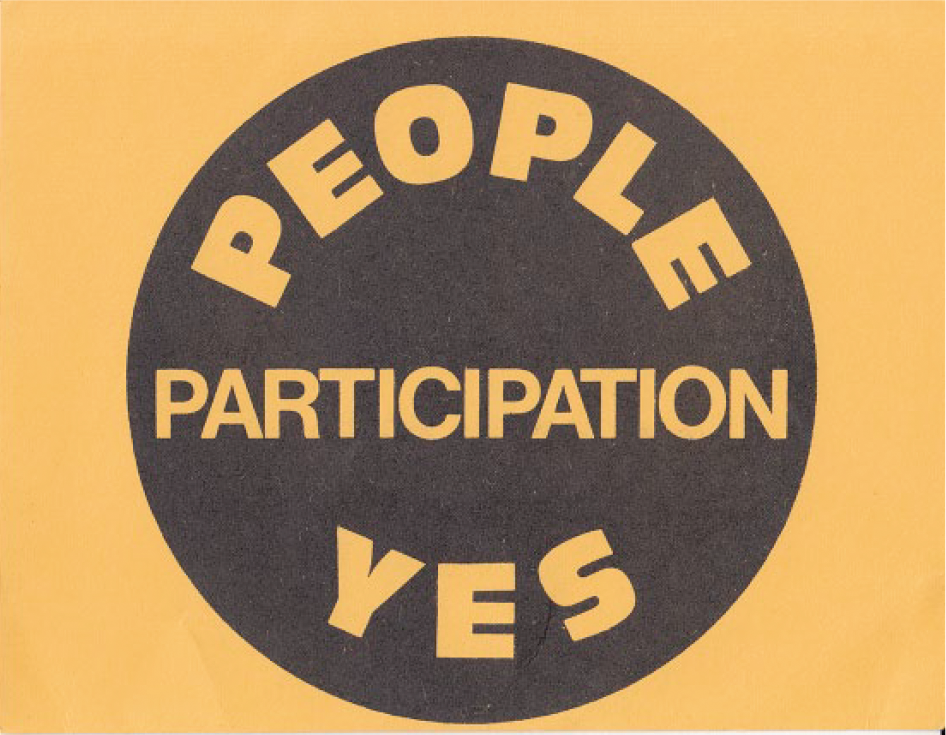
Cooper Square Committee propaganda material, n.d.
The campaign for community boards received a shot in the arm when, in 1969, the City Council passed Local Law 39, which for the first time placed community boards within the city’s decision-making structure. Then, in 1975, prompted by a renewed bout of advocacy for decentralization, the City Charter lodged community boards within a formal structure for land-use decision-making. The Uniform Land Use Review Procedure institutionalized a procedure and timetable for a host of land-use applications, and inserted community boards into the first stage of the process. To the distress of advocates like Thabit, the powers of the boards remained purely advisory, but at least citizens concerned with land-use policy and actions now had an official forum to address.
So, by 1975, public problem-solving, and social experimentation and innovation by voluntary groups like the CSC and other citizen-planning advocates had helped alter the way planning happened in New York. When the CSC first organized, planning in New York was characterized by a lack of transparency, little citizen involvement, and centralized authority. Three decades later, transparency had been mandated, citizen participation formalized, and authority to some extent decentralized. The attitudes of planning professionals, political leaders, and ordinary citizens had also changed. By the end of this period, all parties expected that citizens would enact their citizenship by participating in planning.
Perhaps several hundred activists—many of them working in neighborhood settings—led these efforts, but the campaigns gained the support of thousands of New Yorkers over thirty years. Their actions challenged and changed the political landscape of planning in New York and secured greater political leverage for a broader range of stakeholders. Although the initiatives I discuss did not create equality or equality of opportunity in planning, the very opportunity to use leverage meant that citizens now had a “seat at the table.” City planning in New York had been brought inside a democratic political framework, and the burdens and benefits imposed by planning decisions became public issues.
The CSC members and many other activists discussed here viewed themselves as neighborhood actors and citizens of the broader polity and city. They urged their fellow New Yorkers to claim the right to benefit from public improvements and to shoulder the obligation to contribute to them. The largely neighborhood-based protagonists who contributed to this turning point in planning thus secured for all New Yorkers new avenues for influencing public decisions of weighty consequence.
Footnotes
Declaration of Conflicting Interests
The author declared no potential conflicts of interest with respect to the research, authorship, and/or publication of this article.
Funding
The author received no financial support for the research, authorship, and/or publication of this article.